
Pre-Workout Blends: The Complete Supplement Guide
On this page
Quick Reference Card
Attribute
Common Name
- Detail
- Pre-workout blends
Attribute
Other Names / Aliases
- Detail
- Multi-ingredient pre-workout supplements, MIPS, pre-training blends, stimulant pre-workouts, stim-free pre-workouts
Attribute
Category
- Detail
- Multi-ingredient sports-performance supplement category
Attribute
Primary Forms & Variants
- Detail
- Caffeinated formulas, stimulant-free formulas, pump-focused blends, high-stimulant blends, capsule formats, ready-to-drink products. Ingredient transparency varies widely, and many formulas hide key amounts inside proprietary blends [1][2].
Attribute
Typical Dose Range
- Detail
- Serving sizes are product-specific. In disclosed formulas, caffeine commonly lands in the low-to-mid hundreds of milligrams per serving, while other common ingredients such as citrulline, beta-alanine, and creatine are often included below stand-alone ergogenic targets [2][3].
Attribute
RDA / AI / UL
- Detail
- No category-wide RDA, AI, or UL exists for pre-workout blends as a class. Individual ingredients may have their own intake limits or safety concerns [7].
Attribute
Common Delivery Forms
- Detail
- Powder, ready-to-drink beverage, shot, capsule, stick pack
Attribute
Best Taken With / Without Food
- Detail
- Product-dependent. Faster stimulant perception is often reported when taken away from meals, while taking with food may reduce harshness for some users. Evidence is stronger for total ingredient exposure than for any universal timing rule [3][4].
Attribute
Key Cofactors
- Detail
- Hydration status, total daily caffeine accounting, electrolyte intake, sleep, and overall training plan matter more than any single cofactor [1][3].
Attribute
Storage Notes
- Detail
- Keep sealed, dry, and away from heat and humidity. Powders are especially vulnerable to clumping and scoop inconsistency when exposed to moisture.
Overview
The Basics
Pre-workout blends are not one ingredient. They are a category of formulas built to make a training session feel stronger, sharper, or more intense. Most combine some mix of caffeine, amino acids, nitric-oxide-support ingredients, buffering agents, creatine, tyrosine, taurine, niacin, and flavoring systems into one product [1][2].
That sounds convenient, and sometimes it is. The problem is that convenience hides a lot of variation. One product may mostly be a moderate caffeine drink with a few supporting ingredients. Another may be a high-stimulant formula with aggressive marketing and very little dose transparency. A third may be mostly a "pump" formula that leans on citrulline and flavor rather than stimulant intensity [1][2].
This is why people often talk past each other when they talk about pre-workout. Some are describing a helpful session boost. Others are describing jitters, tingles, poor sleep, or a label full of ingredients that sound impressive but are too underdosed to matter much. The category can be useful, but it is one of the worst categories for assuming that every tub behaves the same way [1][3].
The Science
Category-level reviews describe multi-ingredient pre-workout supplements as formulations that usually combine caffeine with creatine, beta-alanine, amino acids, and nitric-oxide-oriented ingredients in an attempt to improve acute exercise performance, perceived energy, and training volume [1]. Label-analysis work shows just how heterogeneous this category is. In one analysis of 100 top-selling formulas, products contained an average of 18.4 ingredients, with 44.3% of listed ingredients hidden inside proprietary blends [2].
The same label analysis found that several common ergogenic ingredients were frequently disclosed below the amounts most often cited in stand-alone sports-nutrition literature, including beta-alanine, citrulline, and creatine [2]. This matters because a pre-workout blend may generate strong subjective effects through caffeine while still failing to deliver full evidence-based exposure for ingredients that usually depend on consistent daily intake or higher disclosed doses.
The broadest evidence summary is therefore mixed but coherent. Acute benefits are most credible for subjective energy, training readiness, and some endurance or repetition-related outcomes. Effects on pure strength and power are less consistent across products and study designs, and long-term safety remains much less characterized than category marketing often implies [1].
Chemical & Nutritional Identity
Property
Identity
- Value
- Product category rather than a single nutrient, molecule, or botanical [1][2]
Property
Core Ingredient Classes
- Value
- Stimulants, amino acids, buffering agents, creatine compounds, nitric-oxide-support ingredients, vitamins, electrolytes, flavoring systems [1][2]
Property
Commonly Reported Ingredients
- Value
- Beta-alanine, caffeine, citrulline, tyrosine, taurine, creatine, niacin [2]
Property
Molecular Formula
- Value
- No single formula applies to the category
Property
Molecular Weight
- Value
- No single molecular weight applies to the category
Property
CAS Number
- Value
- Not applicable for the category as a whole
Property
PubChem CID
- Value
- Not applicable for the category as a whole
Property
Nutritional Classification
- Value
- Mixed ergogenic supplement category, not an essential nutrient class
Property
Daily Values
- Value
- No category-wide dietary requirement or official daily value exists
Property
Primary Identity Problem
- Value
- Label transparency matters more than category name alone because proprietary blends often conceal the amounts of the ingredients most likely to drive both benefit and risk [2]
Pre-workout blends should be thought of as delivery systems for multiple ingredient classes rather than as a standardized compound. From a practical standpoint, the category identity lives in the label, not in the brand slogan. Two products can both be called "pre-workout" while sharing only a few overlapping actives and very different stimulant loads.
Mechanism of Action
The Basics
The easiest way to understand pre-workout blends is to separate what they are trying to do into three buckets. First, they try to make the session feel more energized or focused. Second, they try to support more work in the gym through better endurance, repetition tolerance, or willingness to push. Third, they try to make the workout feel more rewarding, usually through stronger pumps, tingles, or a more intense overall sensation [1][3][4].
Not every ingredient works on the same schedule. Caffeine can change how a workout feels fairly quickly. Beta-alanine tingles can show up quickly, but its performance relevance depends more on repeated use over time. Creatine is famous in sports nutrition, but a single scoop inside a blend does not automatically mean that one serving will change anything noticeable that day. This is one reason pre-workout marketing can sound more unified than the biology really is.
The Science
Mechanistically, the category is additive rather than singular. Caffeine is the clearest acute driver because adenosine-receptor antagonism can raise alertness, reduce perceived effort, and increase willingness to sustain output [1][4]. Nitric-oxide-support ingredients such as citrulline are included to support blood-flow-related effects, while beta-alanine is used for intramuscular buffering logic and creatine is often included for phosphocreatine-related energy support, even though its best-supported effects depend on cumulative exposure rather than a single acute serving [1][2].
Tyrosine, taurine, niacin, and other adjuncts are frequently added for focus, osmoregulation, or sensory effect, but the degree to which they materially change outcomes inside finished commercial formulas remains harder to isolate [2]. This is a central mechanistic limitation of the category. The blend can look mechanistically comprehensive on paper while still being too underdosed or too opaque to reproduce the benefits seen in ingredient-specific research.
Pathway
- Ingestion and dissolution: Powder or liquid enters the GI tract, and the formula begins separating into rapidly absorbed stimulants, amino acids, and slower relevance ingredients such as creatine-related compounds.
- Early neural phase: Caffeine and other centrally acting ingredients are most likely to shape early alertness, perceived energy, and motivation to train [1][4].
- Circulatory and sensory phase: Ingredients marketed for pump or blood-flow support may contribute to fullness or vascularity, while niacin flush and beta-alanine paresthesia can create strong sensory feedback even when performance change is modest [1][2].
- Work-capacity phase: If the formula is well designed, the user may tolerate more repetitions, sustain effort more comfortably, or report lower perceived exertion during the session [1][5].
- Carryover and downside phase: The same stimulant load that sharpens the session can also increase jitteriness, GI distress, elevated heart-rate perception, and later sleep disruption, especially when servings are repeated or stacked with other caffeine sources [3][7].
Absorption & Bioavailability
The Basics
Absorption is one of the least appreciated parts of the pre-workout story. People often judge a formula by how fast they feel it, but feeling it is not the same thing as meaningfully absorbing every ingredient that matters. A strong caffeine hit can make a product seem effective even when other headline ingredients are present below the levels most often used in research [2][4].
This category also hides a timing problem. Some ingredients are built for a same-day effect, while others are better thought of as background sports-nutrition ingredients that only make sense when daily intake is consistent. A single proprietary blend can therefore combine fast-acting compounds with ingredients that are biologically plausible yet poorly matched to the way buyers expect a pre-workout to work.
The Science
The bioavailability question in pre-workout blends is driven less by one transport mechanism and more by formulation design, ingredient chemistry, and disclosed dose. Label-analysis data suggest that common actives such as beta-alanine, citrulline, and creatine are often present below the amounts most frequently cited as useful in stand-alone ergogenic literature [2]. In practical terms, this means the ingredient may be absorbed, yet still be underdelivered relative to what the evidence base usually studies.
The controlled-trial literature also points to this split between acute stimulant effects and broader formulation claims. In a crossover trial comparing caffeinated and non-caffeinated versions of the same multi-ingredient formula, both products improved some force metrics relative to placebo, but the caffeinated version produced the clearer subjective energy effect [4]. That pattern suggests the category cannot be reduced to caffeine alone, but it also shows that central stimulant exposure remains one of the fastest and most noticeable absorption-linked drivers of user experience.
Because finished products vary so widely, there is no defensible single bioavailability figure for "pre-workout blends." The more useful framework is to ask whether the formula discloses ingredient amounts, whether the stimulants are proportionate to the rest of the label, and whether the serving is likely to deliver enough of the key non-stimulant ingredients to matter [2].
Research & Clinical Evidence
Acute Energy and Session Readiness
The Basics
This is the most believable promise the category makes. People take pre-workout blends because they want a session to feel easier to start and easier to push through. The evidence mostly supports that idea, especially when caffeine is part of the formula [1][4].
The limit is that energy is not the same thing as better performance in every metric. A product can make someone feel much more ready to train without producing a dramatic change in every lift or every lab test.
The Science
The broader review literature identifies subjective energy, mood, and muscular endurance as the most repeatable acute benefits of multi-ingredient pre-workout use, with less consistent findings for force and power [1]. In the caffeinated versus non-caffeinated crossover trial, the caffeinated formula improved subjective energy relative to placebo, while the non-caffeinated version did not show the same subjective lift [4]. That is a useful reminder that perceived readiness is often one of the most immediate and stimulant-sensitive outcomes in this category.
Strength, Power, and Repetition Performance
The Basics
This is where the marketing usually gets ahead of the evidence. Some studies show better reps, better peak power, or lower perceived effort. Others do not show clear improvements in the classic headline lifts people care about most. The honest summary is that some formulas can help some session-level outputs, but the benefit is not universal [1][4][5].
The Science
The acute evidence is selective rather than sweeping. One placebo-controlled crossover study in trained men and women found improved bench-press peak power, more total repetitions, and lower perceived exertion after a commercial pre-workout blend [5]. Another study found both caffeinated and non-caffeinated formulas improved isometric squat peak force versus placebo, but traditional bench press, leg press, and isokinetic squat outcomes did not improve consistently across all tested measures [4].
The practical research conclusion is that pre-workout blends may improve certain acute resistance-exercise outcomes, especially repetition tolerance and perceived effort, but category-level certainty for broad strength or power enhancement remains limited [1][4][5].
Real-World Use Patterns and Adverse Events
The Basics
Controlled trials only tell part of the story. Real-world users do not always stop at one serving, and many stack pre-workout with coffee, energy drinks, or other caffeine-containing products. That is where risk climbs quickly.
The Science
Survey data from 872 regular users show why real-world interpretation matters. Energy and focus were the dominant reasons for use, but more than half of respondents also reported side effects, including skin reactions, heart abnormalities, and nausea [3]. Fourteen percent reported taking two or more servings at a time, and 18% reported using pre-workout more than once per day [3]. Those behavior patterns are especially important because category safety data are mostly short-term and usually studied under more controlled conditions than real consumer use [1][3].
Quality and Contamination Risk
The Basics
Some of the biggest risks in this category have nothing to do with normal caffeine effects. They come from poor labeling, undeclared stimulants, and athlete contamination risk.
The Science
Regulatory and anti-doping sources repeatedly flag pre-workout and energy-style supplements as a high-risk category for adulteration, hidden stimulants, or inaccurate labels. FDA enforcement letters have targeted products containing DMHA and phenibut in sports-performance contexts [6]. USADA and UKAD both warn that performance-focused supplements can contain prohibited substances not listed on the label and that no supplement can be treated as risk-free [8][12]. This means the quality question is part of the evidence question, not a separate consumer preference issue.
Evidence & Effectiveness Matrix
Category
Energy Levels
- Evidence Strength
- 7/10
- Reported Effectiveness
- 6/10
- Summary
- This is the strongest combined signal. Trials and user reports both support a real acute energy effect, especially in caffeinated formulas, but the score is capped by crash and overstimulation complaints [1][3][4].
Category
Focus & Mental Clarity
- Evidence Strength
- 6/10
- Reported Effectiveness
- 6/10
- Summary
- Focus is plausible and commonly reported, but it appears strongly formula-dependent and may feel productive in some users while feeling harsh or imbalanced in others [3][4].
Category
Physical Performance
- Evidence Strength
- 6/10
- Reported Effectiveness
- 6/10
- Summary
- Acute workout performance can improve in selective outcomes such as repetitions, peak power, or perceived effort, but broad strength effects are inconsistent across studies [1][4][5].
Category
Sleep Quality
- Evidence Strength
- 3/10
- Reported Effectiveness
- 2/10
- Summary
- The evidence base supports stimulant-related sleep disruption as a plausible downside, and community reporting is directionally negative even when users like the category overall [3][7].
Category
Nausea & GI Tolerance
- Evidence Strength
- 4/10
- Reported Effectiveness
- 3/10
- Summary
- GI complaints are common enough in survey and community data to matter, particularly when formulas are harsh, servings are large, or products are stacked [3].
Category
Heart Rate & Palpitations
- Evidence Strength
- 4/10
- Reported Effectiveness
- 3/10
- Summary
- Survey findings and stimulant-heavy use patterns support caution for users prone to racing-heart or palpitation-type experiences, even if not every formula produces that response [3][7].
Category
Side Effect Burden
- Evidence Strength
- 5/10
- Reported Effectiveness
- 4/10
- Summary
- Side effects are not fringe events in this category. More than half of surveyed users reported some adverse effect, and anecdotal reports commonly mention crashes, tingles, GI distress, or poor sleep [3].
Category
Treatment Adherence
- Evidence Strength
- 4/10
- Reported Effectiveness
- 4/10
- Summary
- Adherence is limited by taste fatigue, stimulant tolerance, proprietary blend distrust, and side-effect burden. The category is easy to start and easy to abandon when the fit is poor [2][3].
Categories not scored: The remaining biomarker categories did not have enough direct category-level evidence or community data for a defensible score in the current dossier.
Benefits & Potential Effects
The Basics
When pre-workout blends work well, the benefits are usually straightforward. The workout feels easier to start, effort feels more tolerable, focus feels sharper, and the session may feel more productive. Some users also care about pumps, mood lift, or simply feeling more switched on before training [1][3].
The important correction is that not every positive effect means the formula is well built. A product can feel powerful because it is very stimulant-heavy, not because it meaningfully covers the ingredients most often linked to better long-term training support. That is why the best benefit framing is narrow and practical: better session readiness, better training feel, and sometimes better acute performance markers, not a guaranteed leap in every adaptation that follows [1][2].
The Science
The category-level review literature supports the most confidence for acute energy, mood, and muscular-endurance-related outcomes, with more mixed findings for force and power [1]. Controlled trials deepen that nuance. Some commercially available formulations improve peak power, repetition volume, or isometric force measures [4][5], but the benefit pattern is selective rather than uniform across all resistance-exercise outcomes.
The most defensible evidence-based benefit list therefore includes subjective energy, perceived readiness to train, selective improvements in work capacity, and possible session-level gains in repetitions or peak power depending on the formula tested [1][4][5]. Claims that a generic pre-workout blend will automatically drive muscle growth, transform body composition, or replicate stand-alone creatine or beta-alanine protocols are less secure because many formulas underdeliver those ingredients relative to their best-studied use cases [2].
Side Effects & Safety
The Basics
The downside of pre-workout blends is usually not subtle. When a formula is a bad fit, users tend to notice quickly. Common complaints include jitters, stomach upset, nausea, tingling, feeling overheated, a racing heartbeat, a rough post-workout crash, or poor sleep later that night [3][7].
The category is also risky because the label does not always tell the full story. A dramatic feeling in the gym can come from high stimulant exposure, not from a balanced formula. In more serious cases, it can come from ingredients that were never supposed to be in the product at all.
The Science
Real-world survey data show that side effects are common rather than exceptional in regular users. Fifty-four percent of respondents in one large survey reported side effects, including skin reactions, heart abnormalities, and nausea [3]. The same study also showed behavior patterns that plausibly amplify harm, including multiple servings per use and more-than-once-daily intake [3].
Official safety sources widen the concern beyond ordinary stimulant discomfort. FDA has warned that highly concentrated caffeine products can create dangerous overdoses when consumers measure powder or liquid inaccurately [7]. FDA has also taken enforcement action against sports-performance supplements containing DMHA and phenibut, underscoring that some formulas cross from "harsh" into "adulterated or misbranded" territory [6].
Managing side effect risks across a multi-supplement stack can feel overwhelming, especially when interactions between supplements, medications, and foods add layers of complexity. Doserly brings all of that into a single safety view so nothing falls through the cracks.
Rather than researching every possible interaction yourself, the app checks your full stack automatically and flags supplement-drug and supplement-supplement interactions that warrant attention. If you do experience something unexpected, logging it takes seconds, and over time the app helps you spot patterns: whether symptoms correlate with specific doses, timing, or combinations. One place for the safety picture that matters most when your stack grows beyond a few bottles.
Capture changes while they are still fresh.
Log symptoms, energy, sleep, mood, and other observations alongside protocol events so patterns do not live only in memory.
Trend view
Symptom timeline
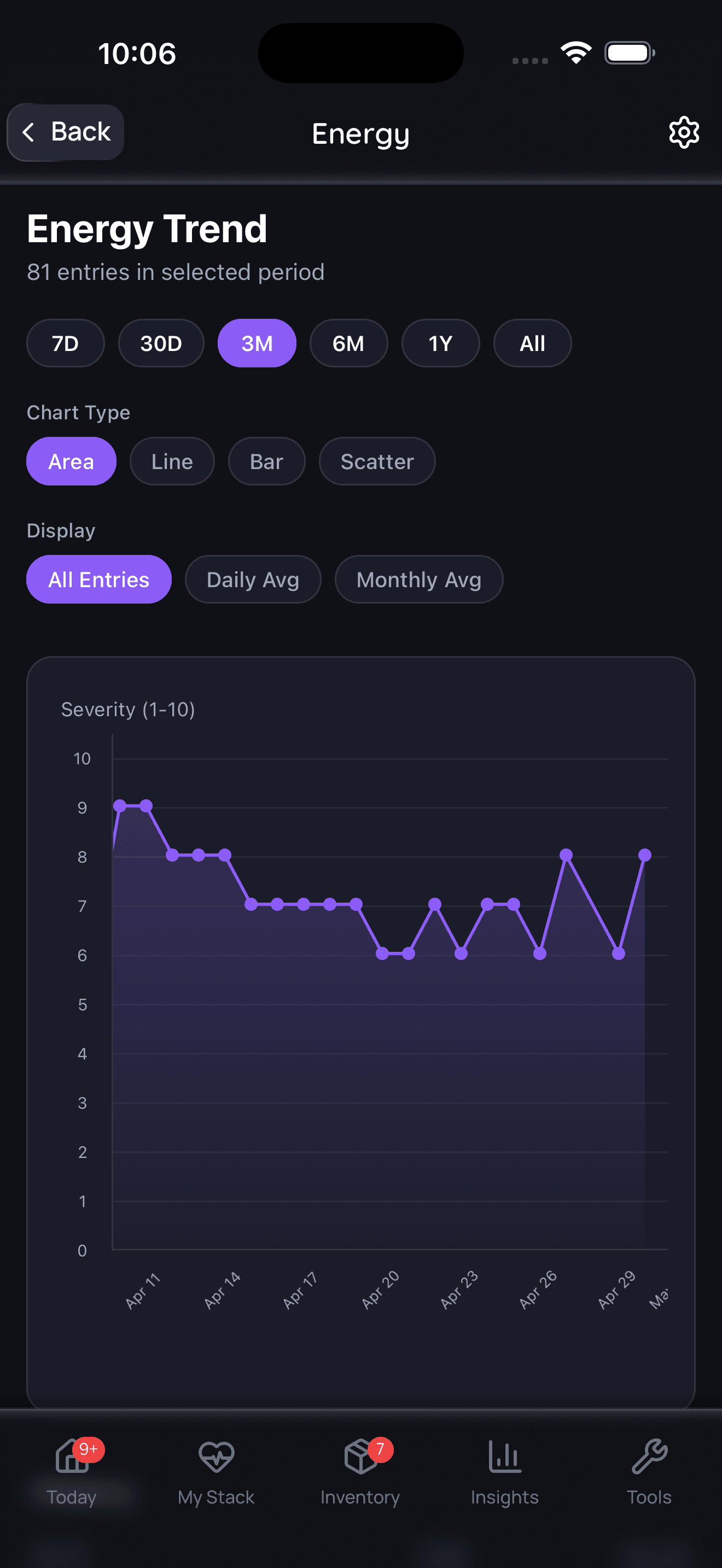
Symptom tracking is informational and should be interpreted with a qualified clinician.
Dosing & Usage Protocols
The Basics
There is no single meaningful "pre-workout dose." The useful question is not how much pre-workout, but how much caffeine, how much citrulline, how much beta-alanine, how much creatine, and how much undisclosed material is actually inside one serving. The serving on the front label can hide a very different reality on the ingredient panel [2].
This is why pre-workout dosing is a high-conflict category. Some formulas are built around a clearly disclosed, moderate stimulant serving. Others rely on proprietary blends that make it impossible to judge whether the ingredient profile matches the performance claims. The safest summary is that product-specific labels matter more than category averages, and total daily stimulant exposure matters more than loyalty to a single brand [2][3][7].
The Science
Label-analysis data provide the clearest category-wide dosing reality check. Across 100 top-selling formulas, average disclosed amounts were about 2.0 g for beta-alanine, 4.0 g for citrulline, 2.1 g for creatine, and 254 mg for caffeine, with only a minority of products reaching the commonly cited ergogenic targets for several non-stimulant ingredients [2]. Survey data show why this matters in practice: some users respond to perceived underdosing or tolerance by taking multiple servings or using the product more than once per day [3].
From a liability-conscious standpoint, the most defensible dosing discussion is ingredient-first. Readers should evaluate disclosed caffeine per serving, whether the label hides key amounts inside proprietary blends, whether the formula invites stacking with other caffeine sources, and whether the ingredient profile looks designed for daily saturation or same-day sensation [2][3][7]. For any user with cardiovascular, anxiety, sleep, or medication concerns, healthcare review matters more than broad category averages.
When your stack includes several supplements, each with its own dose, form, and timing requirements, the logistics alone can derail consistency. Doserly consolidates all of it into one protocol view, so every dose across your entire routine is accounted for without spreadsheets or guesswork.
The app also tracks cumulative intake for nutrients that appear in multiple products. If your multivitamin, standalone supplement, and fortified protein shake all contain the same nutrient, Doserly adds them up and shows you the total alongside recommended and upper limits. Managing a thoughtful supplement protocol shouldn't require a degree in nutrition science. The app handles the complexity so you can focus on staying consistent.
Track injection timing, draw notes, and site rotation.
Doserly helps keep syringe-related notes, injection site history, reminders, and reconstitution context together for easier review.
Injection log
Site rotation
Injection logs support record-keeping; follow clinician instructions for administration.
What to Expect (Timeline)
First 30 to 90 minutes: If the formula is stimulant-forward, the earliest change is usually subjective. Users may feel more alert, warmer, more focused, or more ready to train. If the product is a poor fit, the same window is also where jitters, nausea, tingles, or a sense of being overstimulated can show up [3][4].
First few workouts: The clearest early positives are usually training feel, not body composition. Some users report better session energy, more willingness to push hard, stronger pumps, or slightly better rep output. Others notice very little beyond sensory effects [1][4][5].
After repeated use over days to weeks: This is where the category splits. If the formula is moderate and the user tolerates it well, it may settle into a routine support role. If the formula is too harsh, tolerance can rise while sleep quality, appetite rhythm, or stimulant sensitivity gets worse. Ingredients that usually matter through cumulative intake, such as creatine or beta-alanine, still depend on how much of them the formula actually provides and whether use is consistent [2][3].
Longer term: Long-term category safety remains less characterized than many buyers assume. Most published safety data are short-term, and the survey literature suggests real users often consume these products in more aggressive patterns than trials study [1][3]. Long-term value depends less on the initial "kick" and more on whether the formula remains tolerable, transparent, and compatible with the rest of the user's training and sleep routine.
One of the hardest parts of any supplement routine is knowing whether it's working when results unfold gradually over weeks or months. Without a record, it's easy to abandon something too early or keep taking something that isn't delivering. Doserly solves that by giving you a visual timeline of your entire supplementation history mapped against the outcomes you care about.
When everything is in one view, you can compare how different supplements in your stack are performing over the same period. You can see whether adding this supplement coincided with the improvement you've noticed, or whether the timing points to something else entirely. That kind of clarity turns patience into a strategy rather than a gamble.
Connect protocol changes to labs and health markers.
Doserly can keep lab results, biomarkers, symptoms, and dose history close together so follow-up conversations have better context.
Insights
Labs and trends
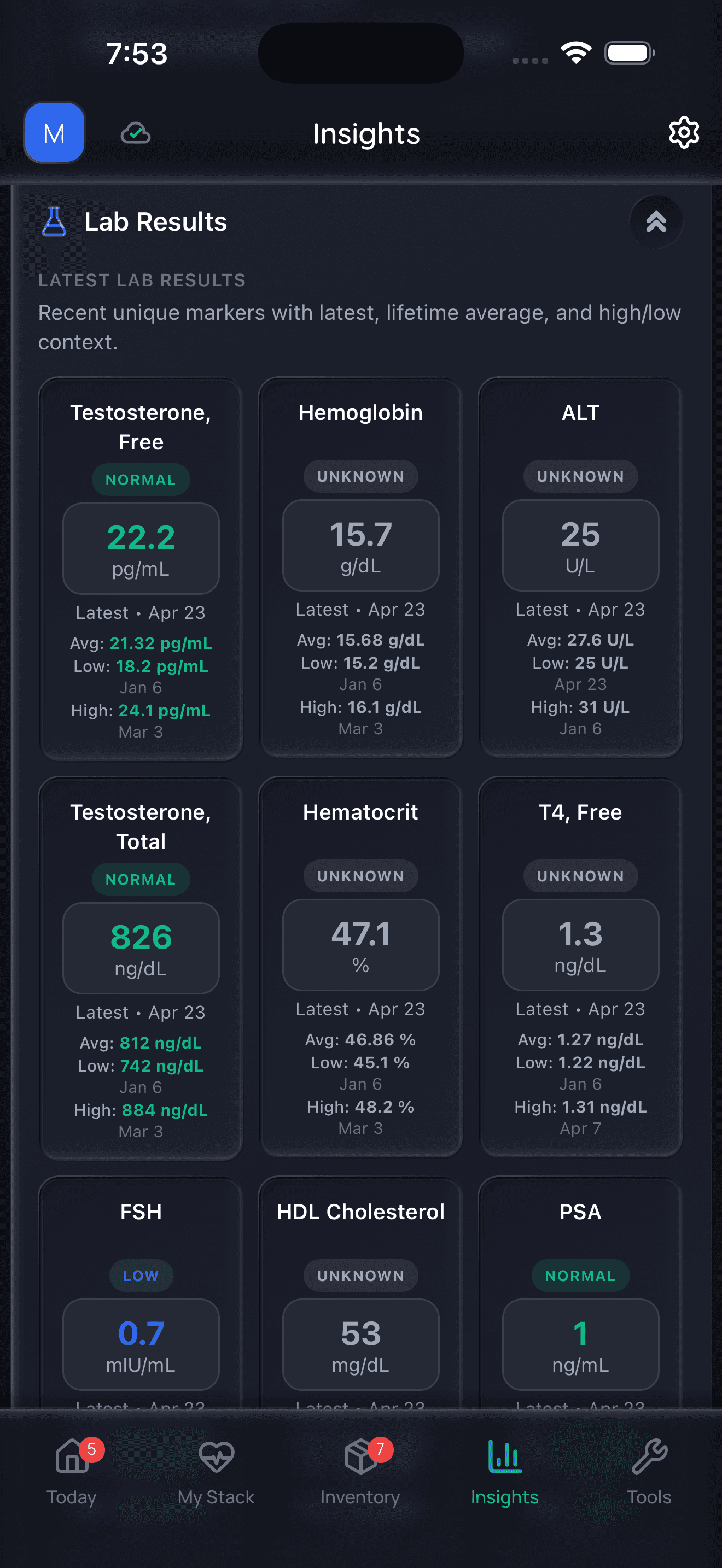
Doserly organizes data; it does not diagnose or interpret labs for you.
Interactions & Compatibility
SYNERGISTIC
- Caffeine: Many pre-workout blends already contain caffeine, so synergy is real but dose accounting is critical. The useful interaction is often not "more caffeine" but understanding whether the formula already covers the stimulant role.
- L-Citrulline: Pump-focused formulas often rely on citrulline. A disclosed formula may overlap meaningfully with stand-alone citrulline products, which can change how readers interpret the label [2].
- Beta-Alanine: Commonly paired for buffering logic and training-volume support, though category labels often provide less than stand-alone protocols typically use [2].
- Creatine: Frequently included in pre-workouts for convenience, but users still need to distinguish between true daily creatine coverage and marketing-level inclusion [2].
- Taurine: Often paired in formulas oriented toward hydration feel, endurance, or smoother stimulant character [2].
- Electrolyte Powders/Tablets: Can be compatible with pre-workout use in hot environments or longer sessions where fluid balance matters more than extra stimulation.
- HMB: Goal overlap can occur in users trying to support training output and recovery at the same time, though the evidence questions are different.
CAUTION / AVOID
- Stacking with extra caffeine or energy drinks: Survey data and FDA safety warnings both support caution here. Multiple stimulant sources can raise risk far faster than users expect [3][7].
- Late-day use in users sensitive to sleep disruption: The category commonly collides with sleep, especially when stimulant content is high or undisclosed [3].
- Medication overlap checked only through ingredient lists: Global athletic status tools can help for medications, but finished supplements remain a different risk class because anti-doping and safety problems can come from undeclared ingredients [8][11][15].
- Athlete use without third-party testing: NCAA, USADA, UKAD, and WADA-linked guidance all support extra caution for tested athletes because the product, not just the label, is the risk [8][9][11][12].
- Products using proprietary blends plus aggressive stimulant marketing: This combination makes it harder to estimate exposure and harder to judge whether the label is proportionate to the intended use [2][6].
How to Take / Administration Guide
The most useful administration principle for pre-workout blends is to treat them like full formulas, not like harmless flavor powders. Readers should evaluate the delivery form, disclosed caffeine amount, the presence or absence of proprietary blends, and how the serving fits with the rest of the day's stimulant intake [2][3][7].
For powders, consistency of scooping and adequate mixing matter because clumping, moisture exposure, and casual "heaping scoop" habits can change real intake. Ready-to-drink products remove scoop variability but do not remove the need to check the label. Capsule products can reduce taste burden, but they still carry the same ingredient-transparency questions.
Timing relative to meals is product-dependent. Some users report a harsher but faster effect away from food, while others tolerate the formula better when not taking it on a very empty stomach. For formulas that contain a heavy stimulant load, late-day use can be difficult to reconcile with good sleep. For formulas that rely on ingredients better known for repeated exposure, the more important question is not acute timing but whether the user is relying on a flashy serving size instead of a coherent overall sports-nutrition plan.
Cycling is not a category-wide rule, but stimulant tolerance and sleep disruption are practical reasons many users revisit frequency, product choice, or total exposure over time. Readers with cardiovascular, psychiatric, GI, or medication-related concerns should treat product-specific review with a healthcare professional as part of administration planning, not as an afterthought.
Choosing a Quality Product
Quality matters more in pre-workout than in many lower-risk supplement categories because both benefit and risk depend heavily on what is actually in the tub. The first screen is label transparency. A formula that discloses actual ingredient amounts is easier to evaluate than one that hides a long list inside a proprietary blend [2].
Third-party certification is especially valuable for athletes and anyone worried about contamination. NSF explains that general supplement certification focuses on contaminants, toxicology review, and label claims, while NSF Certified for Sport adds banned-substance screening relevant to competition settings [10]. USADA and UKAD similarly point athletes toward certified or batch-tested products as a risk-reduction step, not as a guarantee [8][12].
Red flags include:
- oversized proprietary blends
- dramatic stimulant marketing with vague ingredient disclosure
- formulas built around novelty stimulants or "hardcore" positioning
- missing lot information or weak manufacturer transparency
- claims that the product is "approved" by anti-doping organizations
For international buyers, regulatory markers can also help. In Canada, licensed natural health products can be checked through product and site licensing systems [13]. In Australia, listed medicines carry an AUST L identifier, but that still does not mean the full finished product was individually pre-assessed for efficacy before sale [14].
Storage & Handling
Pre-workout blends are usually shelf-stable, but powders can degrade in usefulness long before they technically expire if they are stored poorly. Moisture exposure can cause clumping, make scoop sizes less consistent, and change the feel of flavoring systems. Heat can also worsen product stability over time.
Keep containers sealed, dry, and away from direct sunlight. If the powder begins to cake heavily, develops off odors, or no longer mixes in a way that matches its normal texture, that is a practical quality signal even when the printed date has not yet passed. Ready-to-drink or shot products should also be checked for storage instructions because sweetened liquid systems are less forgiving than dry powder tubs.
Lifestyle & Supporting Factors
Pre-workout blends work best as accessories to training, sleep, nutrition, and hydration, not as substitutes for them. A formula can make a tired session feel more alive, but it cannot reliably compensate for chronic sleep loss, poor hydration, or a training plan that is too aggressive for recovery capacity [1][3].
Hydration deserves more attention than it gets. Many users treat pre-workout as an energy ritual and ignore the fact that hard training performance is also shaped by fluids, heat, and electrolyte balance. Sleep is equally important. A product that improves one workout but regularly erodes sleep may create a net-negative training pattern over time.
Lifestyle context also helps explain why some people love this category and others do not. A user training early in the day, eating predictably, and accounting for total caffeine may tolerate a moderate formula well. A user already under-recovered, anxious, or layering several stimulant sources is more likely to feel the downside first.
Regulatory Status & Standards
United States
In the United States, pre-workout blends sold as dietary supplements fall under the DSHEA framework rather than drug pre-approval. FDA safety actions show why that matters. The agency has warned against highly concentrated caffeine products because small measuring errors can become dangerous overdoses, and it has issued enforcement action against sports-performance supplements containing DMHA and phenibut [6][7]. Retail availability should therefore be read as market access, not as proof of formula quality.
Canada
Health Canada regulates natural health products under a distinct framework from prescription drugs. Companies involved in manufacturing, packaging, labeling, or importing these products must hold valid product and site licenses and follow GMP requirements [13]. Canada also maintains product-lookup systems that can help readers confirm whether a natural health product is licensed [13].
European Union
Australia
Australia's TGA states that listed medicines can only contain low-risk ingredients and low-level indications, but it also makes clear that listed medicines are not individually evaluated for quality, safety, and efficacy before supply. Sponsors certify compliance, and the TGA can later target products for compliance review [14]. That distinction matters for imported or online pre-workout products that may sound more regulator-vetted than they really are.
Athlete & Sports Regulatory Status
- WADA: Current prohibited-list materials make clear that many stimulants and related compounds that can appear in aggressive sports-performance products are prohibited, while caffeine and synephrine are in the monitoring program rather than treated as prohibited substances [11]. That is not a free pass for finished products because contamination and analogue use remain real problems.
- USADA: USADA warns that pre-workout and energy products may contain illegal stimulants and that no supplement can be guaranteed risk-free. It recommends third-party certification, especially NSF Certified for Sport, as the best currently recognized risk-reduction strategy [8].
- UKAD: UKAD emphasizes strict liability, inaccurate labeling risk, and batch-tested products. It explicitly states that WADA and anti-doping organizations do not approve supplement products [12].
- NCAA: NCAA states there are no NCAA-approved dietary supplements and warns that supplements can contain banned drugs not listed on the label. Its stimulant examples are highly relevant to the pre-workout category, including DMHA, DMAA, hordenine, octopamine, and synephrine [9].
- Global DRO: Global DRO is useful for checking medication status across multiple countries, but it explicitly says it does not apply to dietary supplements. A label that looks acceptable in a medication database does not make a pre-workout product safe for sport [15].
- Certification programs: NSF Certified for Sport, Informed Sport, and similar batch-testing programs can reduce contamination risk, but they do not transform a harsh formula into a low-risk one. Formula design, disclosed stimulant content, and athlete rule sets still matter [10][12].
Regulatory status and prohibited-substance classifications change frequently. Athletes should verify the current status of any supplement with their sport's governing body, their national anti-doping agency, and a qualified sports medicine professional before use. Third-party certification reduces but does not eliminate contamination risk.
FAQ / Frequently Asked Questions
What is a pre-workout blend actually supposed to do?
Based on available research, the category is mainly built to improve acute training readiness, perceived energy, and selected session-level performance markers. The evidence is strongest for how the workout feels and for some work-capacity outcomes, not for universal gains in every lift or adaptation [1][4][5].
Are stimulant-free pre-workouts pointless?
Not necessarily. Controlled data suggest some non-caffeinated multi-ingredient formulas can still affect selected force outcomes, but the subjective energy effect is usually more obvious with caffeine-containing products [4]. Formula design still matters.
Do pre-workout blends build muscle on their own?
Available data do not support treating the category as a direct muscle-building shortcut. Some blends may support better training sessions, which can matter indirectly, but many formulas underdeliver ingredients that are often marketed for adaptation support [1][2].
Why do some products feel much stronger than others?
The biggest reasons are stimulant content, proprietary blend design, and total formula transparency. Two products can both be labeled "pre-workout" while delivering very different caffeine loads and very different doses of the supporting ingredients [2].
Can pre-workout blends affect sleep even if the workout felt great?
Yes. Poor sleep is one of the most common practical downsides discussed in both survey and community data, especially when stimulant content is high or use is later in the day [3][7].
Why do some pre-workouts cause tingles?
The sensation is often associated with beta-alanine-related paresthesia, though other ingredients can contribute to unusual body sensations or flush-like effects. The feeling itself does not prove the formula is well designed or performance-optimal [1][2].
Are proprietary blends automatically bad?
Not automatically, but they are a major transparency problem. If key ingredients are hidden inside a blend, it becomes much harder to judge whether the formula matches the evidence base or simply relies on stimulant feel and marketing language [2].
Is it safe to stack pre-workout with coffee or energy drinks?
The current evidence base supports caution rather than a blanket answer. Survey data show that some users already take multiple servings or use products more than once per day, and FDA has warned about concentrated caffeine risk more broadly [3][7]. Readers with cardiovascular, anxiety, sleep, or medication concerns should review total stimulant exposure with a healthcare professional.
Can tested athletes use pre-workout blends safely?
This category deserves more caution than most athlete-friendly marketing suggests. USADA, UKAD, NCAA, WADA guidance, and Global DRO limitations all point in the same direction: contamination and hidden ingredients remain real risks, even when the label looks acceptable [8][9][11][12][15].
How should someone compare one pre-workout with another?
Based on available sources, the most useful comparisons are disclosed caffeine per serving, whether the label uses proprietary blends, whether the non-stimulant ingredients are disclosed at meaningful levels, whether third-party testing exists, and whether the formula creates side effects that outweigh session benefits [2][10].
Myth vs. Fact
Myth
All pre-workout blends are basically the same.
- Fact
- The category is extremely heterogeneous. Label-analysis data show wide ingredient variation and frequent reliance on proprietary blends, which makes formula-to-formula comparisons difficult [2].
Myth
If a pre-workout feels strong, the whole formula must be evidence-based.
- Fact
- A strong feel may mainly reflect stimulant exposure. Many formulas appear to underdeliver key non-stimulant ingredients relative to commonly cited ergogenic targets [2].
Myth
More scoops automatically means better results.
- Fact
- Real-world survey data show multiple-serving use is common, but side effects are also common. More exposure can increase harm without guaranteeing better performance [3].
Myth
Stimulant-free formulas cannot do anything useful.
- Fact
- Controlled data suggest some non-caffeinated formulas may still improve selected force outcomes, even though they usually produce less subjective energy than caffeinated versions [4].
Myth
If caffeine is not prohibited by WADA, any pre-workout is probably sport-safe.
- Fact
- WADA, USADA, UKAD, NCAA, and Global DRO guidance all point to contamination and hidden-ingredient risk. Product safety for sport is not the same thing as caffeine's legal status [8][9][11][12][15].
Myth
A product sold legally online has already been proven safe and effective.
- Fact
- U.S., Canadian, and Australian regulatory sources all make clear that supplement oversight does not equal drug-style pre-approval of every finished formula [6][7][13][14].
Sources & References
Clinical Trials, Reviews, and Observational Research
- Jagim AR, Harty PS, Camic CL. Multi-ingredient pre-workout supplements, safety implications, and performance outcomes: a brief review. PubMed. https://pubmed.ncbi.nlm.nih.gov/30089501/ . Category-level review of pre-workout composition, efficacy patterns, and safety limits.
- Jagim AR, Harty PS, Camic CL, et al. Common Ingredient Profiles of Multi-Ingredient Pre-Workout Supplements. PubMed Central. https://www.ncbi.nlm.nih.gov/pmc/articles/PMC6413194/ . Label-analysis study of 100 top-selling commercial formulas.
- Jagim AR, Harty PS, Wright GA, et al. Common Habits, Adverse Events, and Opinions Regarding Pre-Workout Supplement Use Among Regular Consumers. PubMed. https://pubmed.ncbi.nlm.nih.gov/31014016/ . Survey of 872 regular pre-workout users.
- Souza D, Simões HG, de Salles Painelli V, et al. The influence of caffeinated and non-caffeinated multi-ingredient pre-workout supplements on resistance exercise performance and subjective outcomes. PubMed. https://pubmed.ncbi.nlm.nih.gov/35599920/ . Controlled crossover trial in resistance-trained adults.
- Trexler ET, Smith-Ryan AE, Stout JR, et al. A single dose multi-ingredient pre-workout supplement enhances upper body resistance exercise performance. PubMed. https://pubmed.ncbi.nlm.nih.gov/38321990/ . Acute placebo-controlled crossover study in trained men and women.
Government and Institutional Sources
- U.S. Food and Drug Administration. FDA Acts on Dietary Supplements Containing DMHA and Phenibut. https://www.fda.gov/food/cfsan-constituent-updates/fda-acts-dietary-supplements-containing-dmha-and-phenibut . Enforcement action relevant to sports-performance supplements.
- U.S. Food and Drug Administration. FDA Takes Step to Protect Consumers Against Dietary Supplements Containing Dangerously High Levels of Highly Concentrated or Pure Caffeine. https://www.fda.gov/news-events/press-announcements/fda-takes-step-protect-consumers-against-dietary-supplements-containing-dangerously-high-levels . Safety warning on concentrated caffeine exposure.
- U.S. Anti-Doping Agency. Supplement Connect. https://www.usada.org/athletes/substances/supplement-connect/ . Athlete guidance on supplement contamination and certification.
- National Collegiate Athletic Association. NCAA Banned Substances. https://www.ncaa.org/ncaa-banned-substances . NCAA warning language on contamination and stimulant categories.
- NSF. Supplement and Vitamin Certification. https://www.nsf.org/consumer-resources/articles/supplement-vitamin-certification . Overview of general certification and NSF Certified for Sport screening.
- World Anti-Doping Agency. The Prohibited List. https://www.wada-ama.org/en/prohibited-list . Current anti-doping classification framework and supplement-related FAQ layer.
- UK Anti-Doping. Managing Supplement Risks. https://www.ukad.org.uk/athletes/managing-supplement-risks . Strict-liability and batch-testing guidance for athletes.
- Health Canada. Natural health product regulation in Canada: Overview. https://www.canada.ca/en/health-canada/services/drugs-health-products/natural-non-prescription/regulation.html . Canadian licensing and GMP framework for natural health products.
- Therapeutic Goods Administration. Listed medicines. https://www.tga.gov.au/products/medicines/listed-medicines/overview/listed-medicines . Australian framework for listed complementary medicines.
- Global DRO. Global Drug Reference Online. https://www.globaldro.com/Home?changelang=en-us . Multi-country medication status tool that explicitly does not apply to dietary supplements.