
SAMe (S-Adenosyl Methionine): The Complete Supplement Guide
On this page
Quick Reference Card
Attribute
Common Name
- Detail
- SAMe
Attribute
Other Names / Aliases
- Detail
- S-adenosyl-L-methionine, ademetionine, AdoMet, S-adenosylmethionine
Attribute
Category
- Detail
- Methyl donor / mood, joint, and liver support supplement
Attribute
Primary Forms & Variants
- Detail
- Oral SAMe tablets or capsules, often enteric-coated; formulation quality matters because exposure differs across products [6][7]
Attribute
Typical Dose Range
- Detail
- Commonly studied oral ranges vary by goal, from 200 to 400 mg at the low end up to 800 to 1,600 mg/day in mood-focused and PK studies, with liver-focused reviews commonly clustering around 1,000 to 1,200 mg/day [5][6][7][9]
Attribute
RDA / AI / UL
- Detail
- No established RDA, AI, or UL. SAMe is not an essential nutrient with a standard intake target [1][2]
Attribute
Common Delivery Forms
- Detail
- Enteric-coated tablet, capsule, combination mood-support products
Attribute
Best Taken With / Without Food
- Detail
- Common product instructions and PK discussion often favor taking oral SAMe away from meals, but formulation-specific directions vary and food may alter exposure [7]
Attribute
Key Cofactors
- Detail
- Methionine is the biochemical precursor. Folate and vitamin B12 are pathway-relevant nutrients, though direct SAMe stack outcome data are limited [2][10]
Attribute
Storage Notes
- Detail
- Commercial products are typically kept cool, dry, and sealed. Current sources do not provide a detailed SAMe-specific stability protocol.
Overview
The Basics
SAMe is a compound your body already makes. It helps run methylation, which is one of those quiet background systems that touches mood chemistry, liver function, cell repair, and many other processes. If you think of methylation as a mailroom that moves tiny biological signals around the body, SAMe is one of the main couriers carrying those packages [1][2].
People usually become interested in SAMe for three reasons. The first is mood support, especially when they want something that feels more "natural" than a prescription antidepressant. The second is joint pain, because SAMe has been studied in osteoarthritis. The third is liver support, where it has a long research history but less certainty than marketing often suggests [1][3][8][9].
The important nuance is that SAMe is neither a miracle supplement nor an empty fad. The evidence is real, but it is mixed. Some studies and many users report meaningful benefit, especially for mood. Other studies show smaller effects, non-significant findings, or tolerability problems that limit long-term use [3][4][5].
The Science
S-adenosyl-L-methionine is the sulfonium derivative of L-methionine and an endogenous methyl donor central to one-carbon metabolism [2]. It participates in transmethylation reactions relevant to neurotransmitter synthesis, phospholipid metabolism, gene regulation, and hepatic biochemical pathways [2][10].
Clinical interest centers on three main domains. In neuropsychiatry, SAMe has been studied as monotherapy and augmentation for depressive disorders, with promising but not definitive evidence [3][5]. In osteoarthritis, randomized trials and meta-analyses suggest low side-effect burden but only modest average efficacy [1][8]. In liver disease, systematic review data support improvements in some liver-related parameters, but the evidence is stronger for biomarker support than for broad disease-treatment claims [9].
Chemical & Nutritional Identity
Property
Chemical name
- Value
- S-adenosyl-L-methionine
Property
Molecular formula
- Value
- C15H23N6O5S+
Property
Molecular weight
- Value
- 399.4
Property
PubChem CID
- Value
- 34756
Property
Classification
- Value
- Sulfonium compound; endogenous methyl donor; methionine-cycle intermediate
Property
Nutritional status
- Value
- Endogenous metabolite rather than a required dietary nutrient
Property
Common supplement identity
- Value
- Oral SAMe products usually use stabilized salt formulations to make commercial tablets and capsules feasible
Property
Isomer / stereochemistry note
- Value
- The biologically relevant compound is the L-methionine derived form rather than the D-enantiomer [2]
SAMe sits in an unusual category. It is sold as a supplement, but it is also a normal human metabolite with broad biochemical roles. That is one reason the discussion around it often feels more drug-like than the discussion around a basic vitamin or mineral [1][2].
Mechanism of Action
The Basics
At the simplest level, SAMe helps your body transfer methyl groups. That sounds abstract, but the practical meaning is easier to understand: it helps many other important molecules get built, modified, or switched on. Mood chemistry, liver chemistry, and cell membrane function all intersect with that job [2][3].
This is why SAMe attracts such a wide range of claims. A supplement that touches methylation can influence several systems at once. The problem is that broad biological importance does not guarantee broad clinical benefit. A pathway can matter a lot without a supplement reliably transforming every symptom linked to that pathway [3][10].
The Science
SAMe is generated from methionine and ATP, then participates in methyl transfer reactions affecting phosphatidylcholine synthesis, catecholamine and serotonin-related pathways, polyamine metabolism, and hepatic detoxification-related biochemistry [2][10]. Clinical and mechanistic reviews also point to roles in neurotransmitter metabolism and membrane fluidity relevant to mood disorders [3].
Human metabolic data show that oral SAMe changes methylation-related biomarkers, including S-adenosylhomocysteine and total homocysteine, confirming real biologic activity rather than inert supplement passage [10]. In liver-focused literature, SAMe is discussed as part of hepatocellular methylation and antioxidant defense systems, which helps explain interest in chronic liver disease contexts [9].
Pathway
Dietary methionine or endogenous methionine pools -> ATP-dependent SAMe synthesis -> methyl transfer reactions -> S-adenosylhomocysteine -> homocysteine recycling or transsulfuration [2][10]
In practical terms, SAMe is upstream of several downstream effects people care about. Mood, liver markers, and some joint-related outcomes are all indirect consequences of this broader methylation role rather than direct single-receptor stimulation [2][3][9].
Absorption & Bioavailability
The Basics
SAMe is not a supplement where the label dose tells the whole story. Product design matters. Enteric coating, meal timing, and overall formulation quality can materially change how much SAMe actually reaches circulation. That helps explain why some users swear by one product and say another does nothing or causes stomach problems [6][7].
The practical lesson is straightforward. SAMe appears to be orally bioavailable, but it is also somewhat finicky. If the form is poor, the real-world experience can drift a long way from the headline milligram number [6][7].
The Science
A human pharmacokinetic study found that oral SAMe at 1,600 mg/day meaningfully increased serum SAMe concentrations, supporting true oral bioavailability [6]. A later Phase 1 study comparing formulations found that an enteric-coated high-bioavailability product produced approximately 2.8-fold greater exposure than a commercial comparator and that food delayed peak absorption while reducing exposure [7].
These findings support two key guide points. First, formulation matters enough to influence effectiveness and tolerability. Second, food timing can alter exposure, so source-specific instructions are not interchangeable across products [6][7].
Understanding how your body absorbs a supplement is only useful if you can act on it. Doserly lets you log exactly when you take each form, whether it's a capsule with a meal, a sublingual tablet on an empty stomach, or a liquid taken with a cofactor, so you can see how timing and form choices affect your results over time.
The app also tracks cofactor pairings that influence absorption. If a supplement works better alongside vitamin C, fat, or black pepper extract, Doserly reminds you to take them together and logs both. Over weeks, your personal data reveals whether those pairing strategies are translating into measurable differences in the biomarkers you're tracking.
Build reminders around the routine, not just the compound.
Doserly can keep timing, skipped doses, and schedule changes organized so the plan you read about becomes easier to follow and review.
Today view
Upcoming reminders

Reminder tracking supports consistency; it does not select a protocol for you.
Research & Clinical Evidence
Mood and Depression
The Basics
This is the most important reason most people take SAMe. The evidence suggests it may help some people with depression, but the effect is not as clean or as universally reliable as supplement marketing implies. Some studies are encouraging, some are less convincing, and user experience varies a lot [1][3][4][5].
The fairest way to read the mood literature is that SAMe has a plausible antidepressant signal, especially for selected users, but it is not a guaranteed replacement for standard psychiatric care. That is particularly important because the people most interested in SAMe are often also the people most vulnerable to disappointment, destabilization, or self-treatment without support [1][3][5].
The Science
Older meta-analytic work reported antidepressant effects superior to placebo and broadly comparable to tricyclic agents in the included trials [4]. A later clinician-oriented review described the overall neuropsychiatric evidence as promising but limited, both for monotherapy and augmentation [3]. A modern 8-week randomized controlled trial in unmedicated adults found a numerical benefit on MADRS but not a statistically significant adjusted primary outcome, though exploratory subgroup findings suggested benefit in milder baseline depression [5].
Osteoarthritis and Joint Pain
The Basics
SAMe has also been studied for osteoarthritis, especially knee and hip pain. The upside is that it usually looks easier to tolerate than many pain medicines. The downside is that the average benefit appears modest [1][8].
That makes SAMe a compound with a recognizable joint-health story, but not one that justifies bold cartilage-repair promises. It may matter to some people, especially if tolerability is their main concern. It is not a clearly powerful joint supplement on average [1][8].
The Science
The Cochrane review of knee and hip osteoarthritis trials found very small reductions in pain and function differences versus placebo, with adverse events similar to placebo [8]. Official U.S. evidence summaries similarly describe the osteoarthritis evidence as mixed, even though some head-to-head studies against NSAIDs favored SAMe on tolerability [1][8].
Liver Health
The Basics
Liver support is the quiet third branch of the SAMe story. This is the area where people often hear that SAMe helps bile flow, liver enzymes, or fatigue in chronic liver problems. The literature is more encouraging than many people realize, but it still does not justify sweeping disease-treatment claims [1][9].
The Science
The 2024 systematic review of liver-health studies found that SAMe improved liver-related parameters across the included studies, with mostly mild and transient gastrointestinal adverse events. The most common doses in that literature were 1,000 mg/day and 1,200 mg/day, sometimes used with another therapy or natural supplement [9].
Evidence & Effectiveness Matrix
Category
Mood & Wellbeing
- Evidence Strength
- 6/10
- Reported Effectiveness
- 7/10
- Summary
- Mood evidence is promising but mixed. Community feedback is generally favorable, though not uniform.
Category
Anxiety
- Evidence Strength
- 4/10
- Reported Effectiveness
- 5/10
- Summary
- The research does not clearly establish anxiolytic effects, and community reports are polarized between calmness and overstimulation.
Category
Motivation & Drive
- Evidence Strength
- 3/10
- Reported Effectiveness
- 6/10
- Summary
- This is more of a user-reported functioning signal than a well-studied clinical endpoint.
Category
Emotional Regulation
- Evidence Strength
- 3/10
- Reported Effectiveness
- 4/10
- Summary
- Anger, irritability, or agitation show up often enough to keep this below neutral.
Category
Focus & Mental Clarity
- Evidence Strength
- 3/10
- Reported Effectiveness
- 5/10
- Summary
- Some users report cleaner thinking, but the signal is thin and confounded by mood changes.
Category
Side Effect Burden
- Evidence Strength
- 5/10
- Reported Effectiveness
- 4/10
- Summary
- Clinical studies often describe SAMe as fairly well tolerated, but community feedback shows a more uneven tolerability picture.
Category
Nausea & GI Tolerance
- Evidence Strength
- 5/10
- Reported Effectiveness
- 3/10
- Summary
- GI complaints are common enough in both studies and community reports to deserve prominent caution.
Category
Joint Health
- Evidence Strength
- 4/10
- Reported Effectiveness
- Community data not yet collected
- Summary
- Osteoarthritis evidence suggests modest average benefit with low adverse event burden, but community signal was too thin to score honestly.
Benefits & Potential Effects
The Basics
The clearest possible benefit is improved mood and a better ability to function day to day. Some users describe that as feeling less buried, more capable, or more emotionally mobile. Others describe better initiative and less mental drag [3][5].
There is also a smaller but real case for joint comfort and liver-related support. Those are not equally strong use cases, and they should not be marketed as if they are. The best way to think about SAMe is as a broad biochemical support compound with a mixed but interesting evidence base, not as a one-condition cure [1][8][9].
The Science
Depression-related benefit remains the main clinical signal, though the magnitude and reliability vary across study designs [3][4][5]. Osteoarthritis data point to modest symptomatic effects at best [8]. Liver data are more favorable for biomarker and parameter improvement than for hard clinical outcomes [9].
The most defensible benefit framing is therefore selective and cautious. Mood support is plausible. Joint support is modest. Liver support is promising in specific contexts. None of those statements justify overconfident disease-treatment language [1][3][8][9].
Side Effects & Safety
The Basics
SAMe is often marketed as gentle because it is naturally made in the body. That is not the same thing as harmless. The most common practical problems are digestive upset, headaches, sweating, overstimulation, and feeling emotionally "too activated" rather than more balanced [1][6][7][9].
The most important caution is mood destabilization. People with bipolar vulnerability, mixed features, or a history of activation need to take that risk seriously. The second major caution is interaction risk with serotonergic medications or supplements [1][6].
The Science
Clinical studies commonly describe SAMe as generally well tolerated, with mild gastrointestinal adverse events predominating [5][7][9]. However, human PK and safety research documented a transient mixed manic state with suicidal ideation in one participant, which is why bipolar-spectrum caution should remain prominent rather than buried [6].
Another subtle safety issue is metabolic signaling. One human study found no homocysteine increase during 1,600 mg/day exposure [6], while another found rises in methylation-related metabolites including total homocysteine during 800 mg/day use [10].
Knowing the possible side effects is the first step. Catching them early in your own experience is what keeps a supplement routine safe. Doserly lets you log any symptoms as they arise, tagging them with severity, timing relative to your dose, and whether they resolve on their own or persist.
The app's interaction checker cross-references everything in your stack, supplements and medications alike, flagging known interactions before they become a problem. It also monitors your total intake against established upper limits, alerting you if your combined sources of a nutrient are approaching thresholds where risk increases. Think of it as a safety net that works quietly in the background while you focus on the benefits.
Connect protocol changes to labs and health markers.
Doserly can keep lab results, biomarkers, symptoms, and dose history close together so follow-up conversations have better context.
Insights
Labs and trends
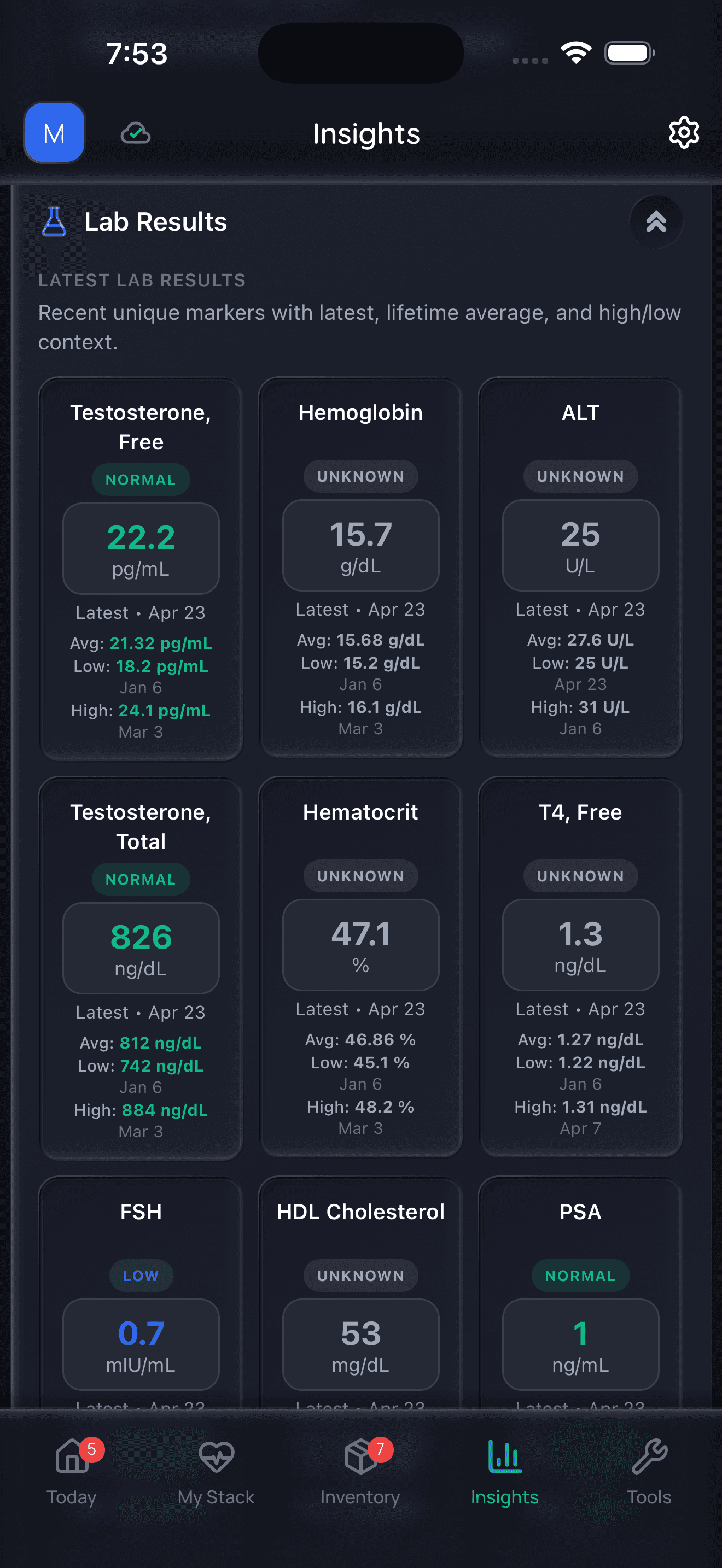
Doserly organizes data; it does not diagnose or interpret labs for you.
Dosing & Usage Protocols
The Basics
There is no single SAMe dose that fits every goal. Studies for mood, PK, and liver support use overlapping but different ranges. Community reports also show that some users feel better at low doses while others feel overstimulated when they push higher too quickly [5][6][7][9].
The safest way to talk about SAMe dosing is in ranges rather than rules. Mood-focused studies often live in the 800 to 1,600 mg/day zone, while liver-focused work often clusters around 1,000 to 1,200 mg/day. Real-world users also talk a lot about 200 to 400 mg starting ranges, especially when tolerability is a concern [5][6][7][9].
The Science
The 2020 depression RCT used 800 mg/day for 8 weeks [5]. The 2004 PK study escalated to 1,600 mg/day [6]. The 2024 liver systematic review reported that 1,000 mg/day and 1,200 mg/day were the most common study doses in liver contexts [9]. Community review sites frequently describe 200 mg, 400 mg, or 400 mg twice-daily use patterns, though those reports are more vulnerable to bias than the clinical literature.
Getting the dose right matters more than most people realize. Too little may be ineffective, too much wastes money or introduces risk, and inconsistency undermines both. Doserly tracks every dose you take, across every form, giving you a clear record of what you're actually consuming versus what you planned.
The app helps you compare RDA recommendations against therapeutic ranges discussed in the research, so you can see exactly where your intake falls. If you switch forms, say from a standard capsule to a liposomal liquid, Doserly adjusts your tracking to account for different bioavailabilities. Pair that with smart reminders that keep your timing consistent, and the precision that makes a real difference in outcomes becomes effortless.
Turn symptom and safety notes into a clearer timeline.
Doserly helps you log doses, symptoms, and safety observations side by side so patterns are easier to discuss with a qualified clinician.
Pattern view
Logs and observations
Pattern visibility is informational and should be reviewed with a clinician.
What to Expect (Timeline)
In the first few days, people who react strongly to SAMe often notice that quickly. That can mean early mood lift, better initiative, or, on the negative side, nausea, jitteriness, sweating, or a sense of being overstimulated [5][6][7].
Over the first two to four weeks, mood-related users are more likely to judge whether the supplement feels directionally helpful. The structured mood trial literature uses windows closer to eight weeks, which is a reminder that early impressions are not the whole story [5].
For joint pain, the expected effect is slower and less dramatic. For liver-related outcomes, the discussion is often about lab trends or disease-context parameters rather than sensations a user can obviously feel day to day [8][9].
Interactions & Compatibility
Synergistic / Compatible Context
- L-Methionine: methionine is the biochemical precursor to endogenous SAMe, so the relationship is pathway-linked even though direct stack outcome data are limited [2].
- Vitamin B9 and Vitamin B12: these nutrients participate in methylation and homocysteine handling, which makes them pathway-relevant context rather than proven SAMe boosters [2][10].
Caution / Avoid
- L-Tryptophan: official safety summaries caution against combining SAMe with serotonergic agents or supplements because of overstimulation risk [1].
- St. John's Wort: similar serotonergic overlap means caution is warranted [1].
- Levodopa: official safety summaries warn that SAMe may reduce levodopa effectiveness [1].
How to Take / Administration Guide
Most of the modern oral SAMe discussion revolves around enteric-coated tablets or capsules, because formulation quality matters to both absorption and GI tolerance [6][7]. Sources and community reports commonly frame SAMe as a supplement where product instructions deserve close attention rather than casual substitution across brands.
Meal timing appears relevant. Food reduced exposure in one pharmacokinetic comparison, which helps explain why many commercial products favor away-from-meal use, though users still need to balance that against stomach tolerance and the specific product label [7].
If a person is evaluating SAMe within a larger stack, the most important practical issue is not novelty. It is isolation. Because mood and GI responses can both move quickly, adding it during a period of multiple simultaneous changes makes the outcome harder to interpret [1][6][7].
Choosing a Quality Product
Quality matters more for SAMe than for many simple nutrients. The most useful markers are enteric coating, clear dose disclosure, brand transparency, and reputable third-party testing where available [7][11].
Red flags include:
- vague proprietary blend language
- poor dissolution or coating complaints in user reviews
- promises of drug-like antidepressant effects without risk discussion
- products marketed as risk-free for athletes or as "approved" by sports bodies, which they are not [11]
For athletes, third-party certification matters. Official anti-doping guidance emphasizes that a supplement product can still pose contamination risk even when the headline ingredient is not typically prohibited [11].
Storage & Handling
Lifestyle & Supporting Factors
SAMe works inside broader systems rather than in isolation. Sleep, alcohol use, diet quality, concurrent medication use, and baseline mood stability all shape how a person interprets the supplement's effect [1][3][9].
The most useful supporting factor is usually not an extra supplement. It is observation. Because SAMe can produce both benefit and activation, symptom tracking, medication review, and clear monitoring of mood stability matter more than stacking creativity [1][6].
Regulatory Status & Standards
In the United States, SAMe is sold as a dietary supplement under DSHEA rather than as an FDA-approved disease treatment [1]. Current athlete-focused guidance does not identify SAMe itself as a standard prohibited ingredient, but it strongly warns that supplement products can be mislabeled or contaminated and that label accuracy is not guaranteed before sale [11].
For sport, the practical message is clearer than the ingredient-level message. Even if SAMe itself is not a typical red-flag banned substance, the product category still carries contamination risk. Third-party certification, especially NSF Certified for Sport, may reduce but does not eliminate that risk [11].
FAQ / Frequently Asked Questions
What is SAMe actually supposed to do?
Based on available data, SAMe is mainly discussed as a methyl donor involved in mood-related pathways, liver biochemistry, and some joint-health applications. The evidence is mixed rather than universally positive [1][3][8][9].
Is SAMe basically a natural antidepressant?
That is too strong. Older studies are more favorable than newer controlled oral data. A more accurate summary is that mood benefits are plausible for some people, but the evidence is not conclusive and safety cautions still matter [3][4][5].
How long does it usually take to notice something?
Based on available studies and community reports, some people notice effects or side effects within days, while mood-focused trials usually assess outcomes over several weeks, often around eight weeks [5][6][7].
Why do people care so much about enteric coating?
Because SAMe exposure differs by formulation. The current PK literature supports real formulation-dependent differences in absorption and tolerability [6][7].
Can SAMe make anxiety or irritability worse?
Yes, it can. That risk shows up in official safety summaries, human adverse-event data, and community reports, especially when users feel overstimulated or emotionally activated [1][6].
Is SAMe useful for joint pain?
Possibly, but the average effect appears modest. The osteoarthritis literature does not support a strong, broad joint-pain claim [1][8].
Is SAMe mainly for liver support instead?
Liver-related evidence exists and is more favorable than many people assume, but it still supports cautious language about liver parameters rather than disease treatment [9].
Can athletes assume SAMe products are safe because the ingredient is not usually prohibited?
No. Official anti-doping guidance emphasizes product contamination and labeling risk. Athletes should verify product quality and check current sport-specific guidance before use [11].
Myth vs. Fact
Myth 1: Because SAMe is natural, it cannot destabilize mood.
Fact: SAMe is endogenous, but that does not make it risk-free. Mood activation, irritability, anxiety, and even manic-type reactions have been reported [1][6].
Myth 2: All SAMe products are interchangeable.
Fact: Formulation matters. PK data support real differences in exposure, and community reports frequently mention brand or coating-related tolerability differences [6][7].
Myth 3: If SAMe helps mood, it is basically the same as replacing clinical depression treatment.
Fact: The evidence is promising but mixed. Even the more favorable reviews do not justify treating it as a universally reliable substitute for formal care [3][4][5].
Myth 4: Higher doses are always better.
Fact: The literature uses different ranges for different goals, and higher doses may also increase activation or GI burden [5][6][9].
Myth 5: SAMe is a strong joint supplement.
Fact: The osteoarthritis evidence suggests only modest average symptom benefit, even though tolerability may compare favorably with some alternatives [1][8].
Myth 6: If a product label looks clean, athletes can treat it as safe.
Fact: Athlete guidance explicitly warns that supplements can be mislabeled or contaminated regardless of the label [11].
Sources & References
- National Center for Complementary and Integrative Health. S-Adenosyl-L-Methionine (SAMe): In Depth. https://www.nccih.nih.gov/health/sadenosyllmethionine-same-in-depth
- PubChem. S-adenosyl-L-methionine. https://pubchem.ncbi.nlm.nih.gov/compound/34756
- Sharma A, Gerbarg P, Bottiglieri T, et al. S-Adenosylmethionine (SAMe) for Neuropsychiatric Disorders: A Clinician-Oriented Review of Research. J Clin Psychiatry. 2017. https://pubmed.ncbi.nlm.nih.gov/28682528/
- Bressa GM. S-adenosyl-l-methionine (SAMe) as antidepressant: meta-analysis of clinical studies. Acta Neurol Scand Suppl. 1994. https://pubmed.ncbi.nlm.nih.gov/7941964/
- Sarris J, Byrne GJ, Bousman CA, et al. S-Adenosylmethionine (SAMe) monotherapy for depression: an 8-week double-blind, randomised, controlled trial. Psychopharmacology (Berl). 2020. https://pubmed.ncbi.nlm.nih.gov/31712971/
- Gören JL, Stoll AL, Damico KE, et al. Bioavailability and lack of toxicity of S-adenosyl-L-methionine (SAMe) in humans. Pharmacotherapy. 2004. https://pubmed.ncbi.nlm.nih.gov/15537554/
- Cameron BR, Ferreira L, MacDonald ID. Pharmacokinetic study of a novel oral formulation of S-adenosylmethionine (MSI-195) in healthy subjects: dose escalation, food effect and comparison to a commercial nutritional supplement product. BMC Pharmacol Toxicol. 2020. https://pubmed.ncbi.nlm.nih.gov/33317621/
- Rutjes AWS, Nüesch E, Reichenbach S, Jüni P. S-Adenosylmethionine for osteoarthritis of the knee or hip. Cochrane Database Syst Rev. 2009. https://pubmed.ncbi.nlm.nih.gov/19821403/
- Baden KER, McClain H, Craig E, et al. S-Adenosylmethionine (SAMe) for Liver Health: A Systematic Review. Nutrients. 2024. https://pubmed.ncbi.nlm.nih.gov/39519500/
- Loehrer FMT, Angst CP, Brunner FP, et al. S-adenosylmethionine but not methionine increases methylation products, acute phase proteins, and serum asymmetrical dimethylarginine in humans. J Nutr. 2009. https://pubmed.ncbi.nlm.nih.gov/19422296/
- U.S. Anti-Doping Agency. Supplement Connect. https://www.usada.org/substances/supplement-connect/