
In this guide
What is a bone-health supplement stack?
A bone-health stack is an informal grouping of products such as calcium, vitamin D3, vitamin K2, magnesium and boron. There is no standard formula, no requirement to take every member, and no single trial in the sources below establishing the complete five-ingredient regimen. Each product needs its own reason for inclusion. [1], [2], [3], [4], [5]
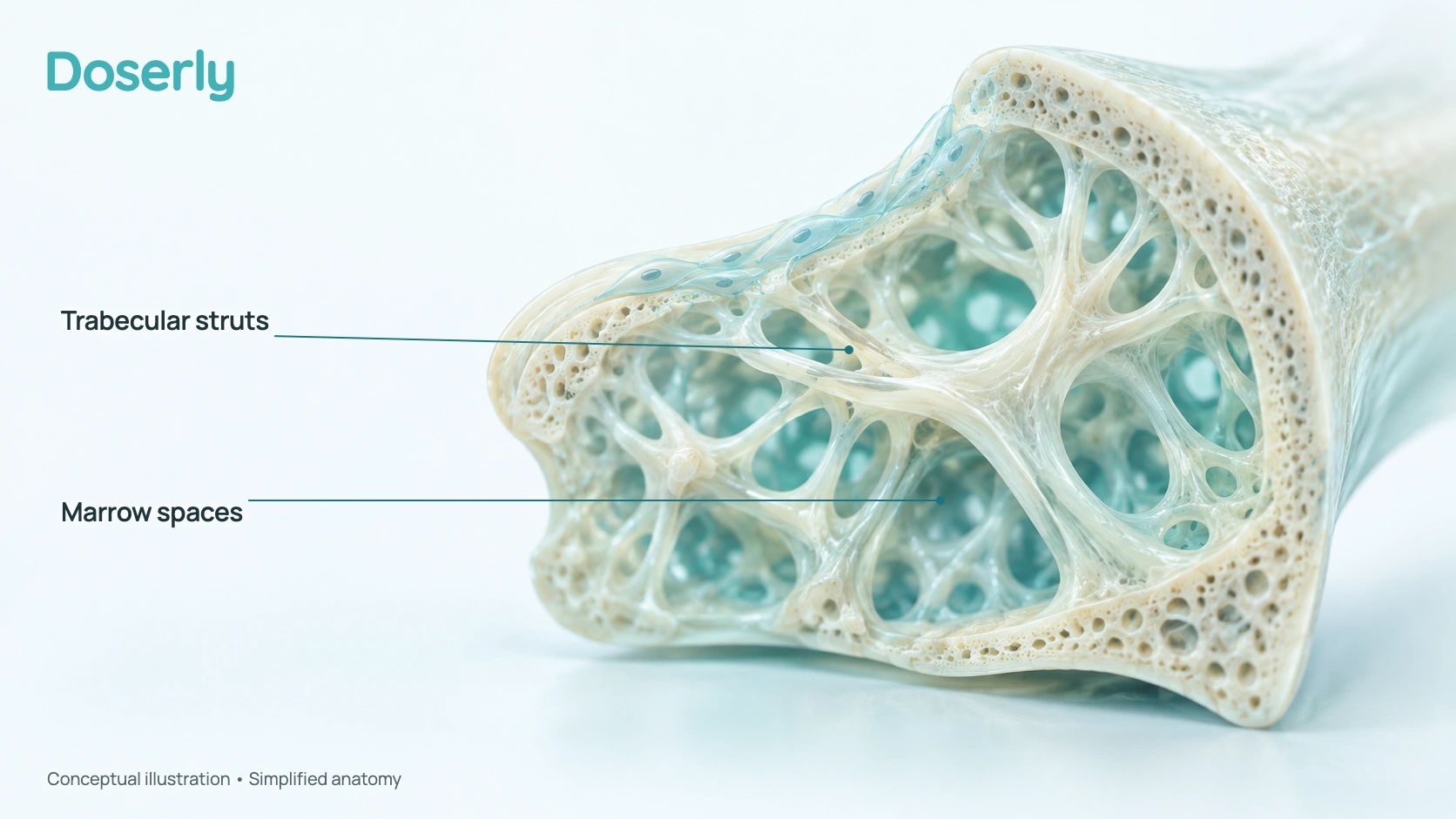
Bone is living tissue. Its mineral content matters, but fracture risk also depends on structure, falls, age, health conditions and treatment. A supplement cannot be judged only by whether its ingredient participates in bone metabolism. Evidence that a nutrient is necessary is different from evidence that extra intake improves an outcome.
Osteoporosis and fragility fractures need clinical assessment. A supplement combination is not a substitute for prescribed osteoporosis treatment. A normal blood calcium result also does not establish that the diet supplies enough calcium or that bone density is normal. [1]
How do the five ingredients compare?
| Ingredient | Established context | Main limitation for this stack |
|---|---|---|
| Calcium | A structural mineral; inadequate intake can compromise bone health | More is not always better, and a supplement dose must account for food intake. [1] |
| Vitamin D3 | Supports calcium absorption and mineralization; deficiency can cause bone disease | Supplementing generally healthy, largely vitamin-D-replete adults is a different question from treating deficiency. [2], [6] |
| Vitamin K2 (MK-4, MK-7) | A family of vitamin K forms involved in activating certain proteins | A biochemical role does not establish fracture prevention, and K2 is not an antidote to excessive calcium. [3] |
| Magnesium | Contributes to normal bone structure and many enzyme reactions | No universal bone-health supplementation protocol follows from that role. [4] |
| Boron | Investigated for effects on mineral and hormone metabolism | No RDA or Adequate Intake is established; routine bone-health benefit remains unproven. [5] |
The members are not interchangeable. A combined tablet also fixes their ratios: increasing it to obtain more of one ingredient increases the others too.
Which amounts are nutritional references rather than protocols?
A Recommended Dietary Allowance, or RDA, describes total usual intake for a defined population. It does not mean that the entire amount should come from a supplement. The upper limit is a safety reference, not a target. These U.S. adult figures illustrate the distinctions; pregnancy, childhood, illness and other jurisdictions need their own context. [1], [2], [3], [4], [5]
| Nutrient | Adult reference | Upper-limit scope |
|---|---|---|
| Calcium | 1,000 mg/day for adults 19–50; 1,200 mg/day for women 51–70 and everyone over 70; men 51–70 remain at 1,000 mg/day | 2,500 mg/day at 19–50; 2,000 mg/day at 51+, from all sources. [1] |
| Vitamin D | 600 IU (15 mcg)/day at 19–70; 800 IU (20 mcg)/day over 70 | 4,000 IU (100 mcg)/day for adults, from all sources. This is not a routine starting dose. [2] |
| Vitamin K | Adequate Intake: 120 mcg/day for adult men and 90 mcg/day for adult women | No UL established; the reference is for vitamin K, not a proven K2 bone-treatment dose. [3] |
| Magnesium | 400–420 mg/day for adult men and 310–320 mg/day for nonpregnant adult women, depending on age | 350 mg/day from supplements and medications only; food magnesium is excluded. [4] |
| Boron | No RDA or Adequate Intake established | 20 mg/day adult UL is not an efficacy target or a reason to supplement. [5] |
Mineral labels report the elemental amount. The weight of calcium carbonate or magnesium citrate is not the same as the weight of calcium or magnesium itself. Adding label amounts across a multivitamin, a bone formula and separate products can expose duplication. [1], [4]
What do human studies show about fractures?
The VITAL fracture trial tested vitamin D3 at 2,000 IU once daily against placebo in 25,871 U.S. adults, men aged at least 50 and women aged at least 55. Median follow-up was 5.3 years. Participants were not selected for vitamin D deficiency, low bone mass or osteoporosis. Total fractures occurred in 769 of 12,927 vitamin D participants and 782 of 12,944 placebo participants. The hazard ratio was 0.98, with a 95% confidence interval of 0.89–1.08: no statistically significant reduction. [6]
This is evidence against promising fracture prevention from that regimen in that study population. It does not show that treating established vitamin D deficiency is useless. Nor does it test the complete calcium/D3/K2/magnesium/boron stack. A null single-ingredient trial and an untested combination are different findings. [2], [6]
Calcium and vitamin D findings depend on baseline intake, setting and co-interventions. Vitamin K research includes biochemical markers and bone-density outcomes; those should not be silently upgraded to fewer fractures. Magnesium and boron physiology also do not supply a validated five-product regimen. [1], [3], [4], [5]
Vitamin D3 did not reduce fractures in VITAL
25,871 adults not selected for vitamin D deficiency or osteoporosis; median follow-up 5.3 years.
Vitamin D3
2,000 IU daily. Total fractures: 769 of 12,927 participants.
Placebo
Total fractures: 782 of 12,944 participants.
Comparison
Hazard ratio 0.98; 95% confidence interval 0.89–1.08. No statistically significant reduction.
LeBoff et al., NEJM 2022. This trial does not establish the effect of treating diagnosed deficiency or of a five-ingredient stack.
Do the form and product label matter?
Calcium carbonate depends more on stomach acid and is generally taken with food. Calcium citrate depends less on acid and can be taken without food. The label, tolerability and medicines still matter. Calcium absorption is highest when individual supplemental amounts are 500 mg or less, which is an absorption observation rather than a universal daily prescription. [1]
“Vitamin K2” covers forms including MK-4 and MK-7. Their studies, amounts and exposure profiles cannot be combined into one interchangeable dose. Magnesium salt comparisons likewise do not prove that the best-absorbed form delivers the best bone outcome. [3], [4]
How should the products be stored?
Follow each finished product’s storage and expiry instructions. A powder, softgel and multi-ingredient tablet need not have the same stability. This collection does not establish a universal temperature or usable period after opening.
What happens when the routine stops?
Stopping a supplement changes intake; it does not reveal a universal withdrawal or “bone-loss clock.” The underlying reason for use matters. A prescribed deficiency regimen or osteoporosis plan should be reviewed with the treating professional rather than replaced by an unsourced cycling rule. [1], [2]
What are the main risks and interactions?
More ingredients can mean more overlap. Excess vitamin D can cause high blood calcium. High calcium intake is not automatically safer because K2 is included. Kidney-stone findings for supplemental calcium are mixed: some research raised concern while later reviews found no association. Existing kidney disease changes how calcium, vitamin D and magnesium are handled. Magnesium from supplements commonly causes diarrhea; significant toxicity is more likely when renal clearance is impaired. [1], [2], [4]
Vitamin K and warfarin require special attention. Sudden changes in vitamin K intake can alter anticoagulation. K2 is not exempt. Consistency and the prescriber’s monitoring plan matter more than a generic claim that the vitamin is “natural.” [3]
Calcium and magnesium can interfere with absorption of some medicines. Examples include certain antibiotics and osteoporosis medicines; calcium can also interfere with levothyroxine. The appropriate separation depends on the exact medicine and label. A universal two-hour rule is not reliable for the whole collection. [1], [4]
The U.S. reference amounts in this guide describe nutrition, not drug approval. Product regulation and permitted claims differ between the United States and Canada; a supplement sold in either country should not be assumed to be an approved osteoporosis treatment. Pregnancy, kidney disease, existing high calcium, stone history and anticoagulant treatment require individual assessment.
In the United States, FDA does not approve supplements for safety or effectiveness before sale. In Canada, natural health products require product licences; a Natural Product Number (NPN) identifies an authorized product. A product’s status should not be extended to every combination or fracture-prevention claim. [7], [8]
What is useful to track?
The useful record starts with what is actually taken: ingredient, elemental amount where relevant, formulation, date, food context and other products containing the same nutrient. A dietary estimate helps separate a food-intake gap from a decision to add a full label serving. [1], [4]
A clinician may assess vitamin D status, blood calcium, kidney function or bone density when the clinical situation warrants it. Those are different measurements. Serum calcium does not measure bone stores, and a day-to-day symptom improvement does not demonstrate that fracture risk fell. Routine testing is not automatically justified for every healthy supplement user. [1], [2]
There is no validated symptom timeline for the complete five-ingredient stack. A log can support a discussion about adherence and unwanted effects; it cannot establish that the stack caused a change or replace an osteoporosis assessment.
What can personal experiences establish?
A person’s report can describe their own tolerability, product burden or difficulty keeping a routine. It cannot separate the effects of five ingredients taken together, measure silent changes in bone strength, or establish fracture prevention. This guide does not assign a success rate to community anecdotes.
A new fracture or persistent pain needs clinical assessment even when a supplement routine seems consistent. Absence of an obvious side effect is not proof that the doses or combination are appropriate.
Common questions about bone-health supplements
Does everyone need calcium and vitamin D pills?
No. Nutrient requirements can be met partly or fully from food, and supplement decisions depend on intake and clinical circumstances. Deficiency and osteoporosis treatment are separate from routine supplementation in already nourished adults. [1], [2]
Does K2 direct all calcium safely into bones?
No. That phrase turns a biological mechanism into a safety guarantee. K2 does not neutralize excessive calcium or vitamin D, and it can interfere with vitamin K antagonist treatment. [2], [3]
Does a normal calcium blood test prove the routine works?
No. Blood calcium is regulated closely and is not a direct measure of dietary adequacy, bone density or fracture protection. [1]
Can a combined pill replace osteoporosis treatment?
No. A supplement formula and a treatment shown to reduce fracture risk are different interventions. Replacing prescribed treatment with the five-ingredient combination is not supported by the evidence in this guide. [1], [6]
Why does magnesium’s upper limit look lower than its requirement?
The requirement includes food and other sources. The 350 mg adult upper limit concerns magnesium from supplements and medications, primarily because of gastrointestinal adverse effects; it excludes magnesium naturally present in food. [4]
Is boron essential for this stack?
No established nutritional requirement or proven routine bone-health dose makes boron a necessary member. Its inclusion in a product is not proof that it improves fracture outcomes. [5]
Glossary
Terms that distinguish a nutritional role from a clinical result.
- Recommended Dietary Allowance
- An intake estimated to meet the requirement of nearly all healthy people in a defined age and sex group. It is not an amount to add on top of food.
- Tolerable Upper Intake Level
- A population reference for the highest usual daily intake unlikely to cause harm. Its source and age scope matter; it is not a target or a guarantee for an individual.
- Elemental amount
- The amount of the mineral itself, separate from the total weight of a salt such as calcium carbonate.
- Bone mineral density
- A measure of mineral content in bone, usually assessed by DXA. It contributes to fracture-risk assessment but is not the same as a fracture outcome.
- Surrogate outcome
- A marker used in research instead of the outcome that matters directly to health. Improving a marker does not always improve that clinical outcome.
How was this guide researched?
Sources and limits
This AI-assisted educational guide compares public nutrient references with a primary randomized fracture trial. It distinguishes nutrient requirements, deficiency treatment, trial regimens and uncertain combination claims. It is not a systematic review or independent medical peer review. Doserly develops a commercial tracking app. Illustrations explain concepts; app screens contain example data. New official guidance or material safety evidence warrants review. Corrections can be sent to Doserly support with the relevant source.
Explore the sources
Official nutrient references provide intake and interaction context. The primary VITAL report provides the fracture results; its population limits remain part of the interpretation.
Showing 8 sources
- 01
Calcium - Health Professional Fact Sheet ↗
Official nutrient reference
Calcium intake, forms, interactions and safety.
- 02
Vitamin D - Health Professional Fact Sheet ↗
Official nutrient reference
Nutrient reference values, deficiency and limits of prevention trials.
- 03
Vitamin K - Health Professional Fact Sheet ↗
Official nutrient reference
Vitamin K forms, adequate intakes, bone research and anticoagulant interaction.
- 04
Magnesium - Health Professional Fact Sheet ↗
Official nutrient reference
Total dietary requirements versus the supplemental-only upper limit.
- 05
Boron - Health Professional Fact Sheet ↗
Official nutrient reference
No established nutritional requirement or proven routine bone-health regimen.
- 06
Supplemental Vitamin D and Incident Fractures in Midlife and Older Adults ↗
Randomized trial
LeBoff et al. · NEJM 2022 · VITAL fracture ancillary trial; results in generally healthy adults, not treatment of deficiency.
- 07
Questions and Answers on Dietary Supplements ↗
Official regulatory source
U.S. regulation; not approval of every product or its efficacy.
- 08
Natural health product licensing ↗
Official regulatory source
Canadian natural health product licensing; check the product and its authorized use.
No matching sources
Try a different term or show the full list.