
In this guide
What does this guide compare?
Nutritional adequacy, targeted replacement and research-context derivatives.
This collection compares products discussed around one topic. It is not a protocol to take in full. Links to individual profiles appear after the article.
| Reference point | Context |
|---|---|
| Products compared | 27 |
| Evidence scope | Ingredient, formulation, population and measured outcome |
| Complete combination | The cited studies do not automatically validate all members together |
Which products are compared?
Vitamin A, Vitamin D2 (Ergocalciferol), Vitamin D3 (Cholecalciferol), Vitamin E, Vitamin K1 (Phylloquinone), Vitamin K2 (MK-4, MK-7), Vitamin C, Vitamin B1 (Thiamine, Benfotiamine), Vitamin B2 (Riboflavin), Vitamin B3 (Niacin, Niacinamide), NMN (Nicotinamide Mononucleotide), NR (Nicotinamide Riboside), Vitamin B5 (Pantothenic Acid), Vitamin B6, Vitamin B7 (Biotin), Vitamin B9 (Folic Acid, Methylfolate), Vitamin B12, Choline, Alpha-GPC, Inositol (Myo-Inositol, D-Chiro-Inositol), B-Complex, Prenatal Vitamins, Men's Multivitamins, Women's Multivitamins, Children's Multivitamins, Seniors' Multivitamins, Sport/Performance Multivitamins.
Individual profiles describe formulation, source-reported amounts, tolerability and interactions. Those details remain ingredient-specific. An amount studied alone is not automatically appropriate in a combination.
How do their roles differ?
Vitamins support specific biochemical functions; they do not supply calories. Vitamin D regulates calcium handling, whereas B vitamins participate in metabolism and blood-cell or nervous-system functions. NMN, NR and alpha-GPC share this browse category for navigation but are not interchangeable with essential vitamin requirements. [1][2][3][4][5]

What does the research show?
Correction of a nutritional shortfall is a different question from supplementation in a well-nourished person. COSMOS cognitive substudies found modest benefits from a particular multivitamin in older adults; the parent trial did not show lower overall cardiovascular events or all-cause mortality. A 2025 VITAL substudy found less leukocyte telomere shortening with vitamin D over four years. Telomere length is a surrogate, not evidence of longer life. A prespecified 2026 COSMOS ancillary study in 958 older adults found small differences in two of five tested methylation clocks after two years of a specific daily multivitamin; cocoa extract did not change the clocks. Clinical relevance remains uncertain, and these measurements do not represent extra years of healthy life. [1][2][3][4][5]
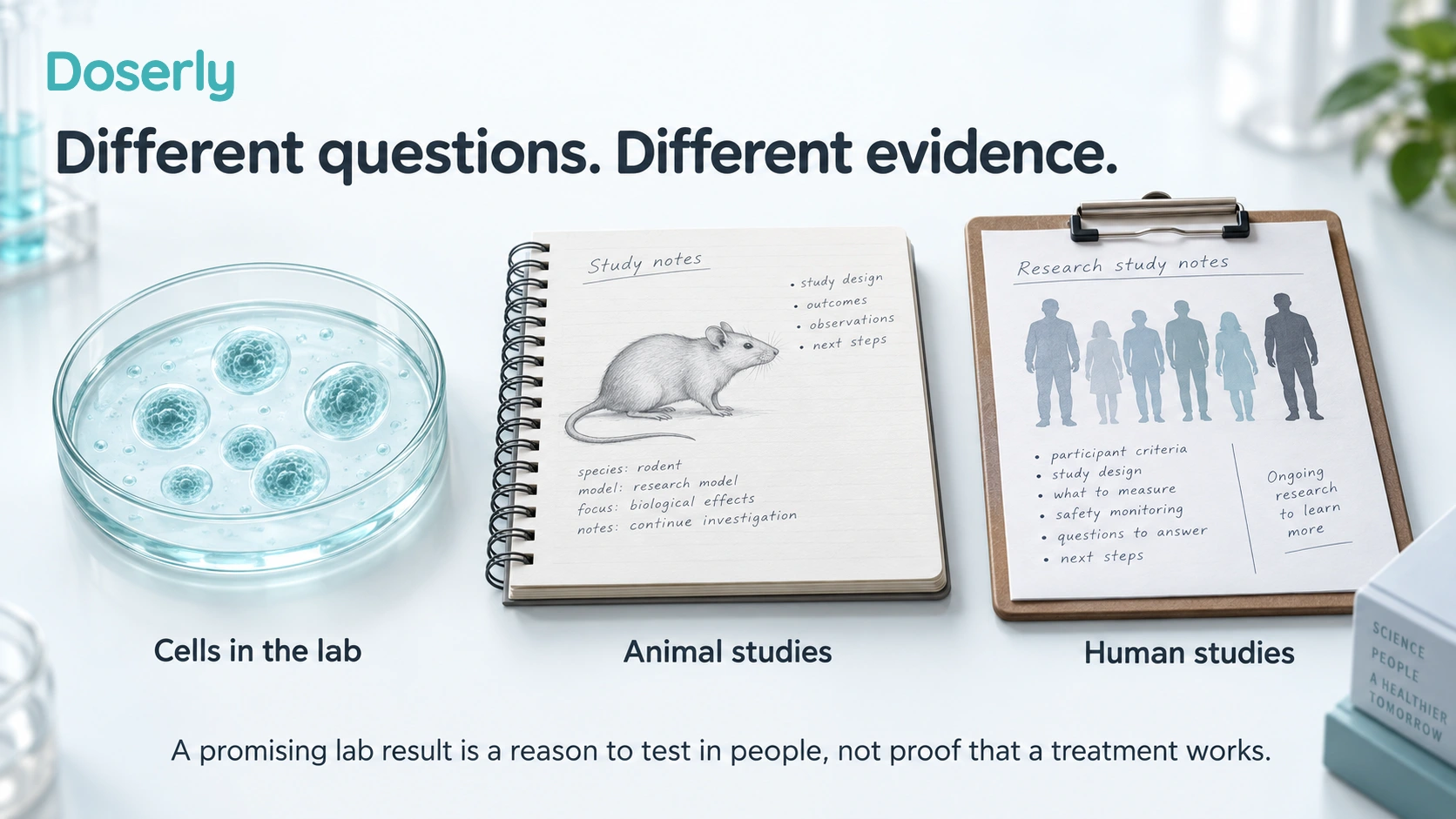
An observational association, a laboratory finding and a perceived benefit answer different questions. Randomized trials need their comparator, duration and population kept in view. An inconclusive result does not establish that an effect is impossible; it limits the claim that can be made.
Which overlaps and risks matter?
Cautions and interactions
Duplicate ingredients across multivitamins, fortified products and single-nutrient bottles can raise total exposure. Fat-soluble vitamins can accumulate; water solubility does not make large B-vitamin doses harmless. Clinical context, life stage and product amounts matter more than the number of vitamins included. [1], [2], [9], [10], [11]
A complete product list includes prescription medicines, nonprescription products and supplements. Combination formulas can conceal duplicate ingredients. Timing and spacing from a medicine should follow its labeling and pharmacist guidance; this collection does not supply a universal timetable.
Regulatory status
In the United States, FDA does not approve dietary supplements for safety and effectiveness before marketing. In Canada, a natural health product requires a product licence before sale; its NPN or DIN-HM must match the finished product. An ingredient name or inclusion in this collection does not establish that every product or claim is authorized. Authorization also does not validate the complete combination. [6], [7]
U.S. NMN status changed in 2025
On September 29, 2025, FDA revised its earlier position and concluded that NMN is not excluded from the dietary-supplement definition under the drug-exclusion provision. It describes NMN as a dietary ingredient and a new dietary ingredient. This is neither approval of anti-aging benefits nor blanket clearance of every product: the other legal criteria, applicable notification requirements and safety basis still matter. Categorical statements based only on FDA’s 2022 position are therefore outdated. This U.S. decision does not determine a product’s Canadian status. [8]
What should be recorded and how should changes be interpreted?
Doserly brings dose logs, symptoms and routine changes together. For this collection, useful observations include product formulation, duplicate nutrients, adherence, fatigue and clinician-requested laboratory results.
- Doses and adherence: record the formulation, amount actually taken, timing and missed doses so observations have context.
- Potential benefits and tolerability: compare consistent symptoms or measurements over time alongside sleep, food and activity changes. Personal trends help evaluate the experience without proving causal efficacy.
- Product list: maintain the full product list for review with a pharmacist or clinician.
- AI monthly reports: summarize recorded doses, symptoms and trends to prepare for a discussion. Reports depend on the data entered and are not a diagnosis or an instruction to change treatment.
Explore the topic further
Common questions
Are water-soluble vitamins harmless at high doses?
No. Excess vitamin B6 can cause neuropathy. Intake across several products matters; water solubility does not make a large amount harmless. [10]
Are vitamin A and beta-carotene interchangeable?
No. Preformed vitamin A and provitamin A carotenoids differ in conversion and risk. Excess preformed vitamin A is particularly concerning in pregnancy. Read the form and unit, not just the displayed percentage. [9]
Should vitamin K be eliminated when taking warfarin?
The guidance emphasizes consistent intake coordinated with anticoagulant monitoring. Abrupt dietary or supplement changes can alter the medicine’s effect; this page does not propose eliminating vitamin K. [11]
Does COSMOS prove every multivitamin slows aging?
No. Findings concern a specific formulation and populations. An epigenetic-clock change does not establish longer healthy life. Derivatives such as NMN or NR do not become essential vitamins merely because they appear in this browse category. [1], [5], [8]
Glossary
Terms for interpreting the comparisons.
- Formulation
- The exact preparation, including its ingredients, their forms and labeled amounts.
- Study population
- The people included in a study; their characteristics limit where its result applies.
- Comparator
- The placebo, treatment or condition used as the comparison.
- Measured outcome
- What the study evaluates, such as a symptom, laboratory result or clinical event.
- Overlap
- The same ingredient appearing in more than one product used together.
How was this guide researched?
Sources and limits
This AI-assisted educational guide compares the cited public references. Findings remain tied to the ingredients, preparations and populations studied. It is not a systematic review or independent medical peer review. Doserly develops a commercial tracking app. Illustrations explain concepts; app screens show example data. Report a correction with its source to Doserly support.
Explore the sources
The references below provide context for the claims and their limits.
Showing 11 sources
- 01
NIH ODS — Multivitamin/mineral supplements ↗
Public reference
Check the reported population, preparation and limitations.
- 02
- 03
Vitamin D3 and marine ω-3 fatty acids supplementation and leukocyte telomere length: 4-year findings from the VITamin D and OmegA-3 TriaL (VITAL) randomized controlled trial. ↗
Public reference
Check the reported population, preparation and limitations.
- 04
Effect of multivitamin-mineral supplementation versus placebo on cognitive function: results from the clinic subcohort of the COcoa Supplement and Multivitamin Outcomes Study (COSMOS) randomized clinical trial and meta-analysis of 3 cognitive studies within COSMOS. ↗
Public reference
Check the reported population, preparation and limitations.
- 05
Li et al., 2026 — COSMOS epigenetic-clock ancillary trial ↗
Public reference
Check the reported population, preparation and limitations.
- 06
FDA — Questions and Answers on Dietary Supplements ↗
Regulatory reference
United States dietary supplement regulation.
- 07
- 08
FDA — Response to NMN citizen petition FDA-2023-P-0872 ↗
Regulatory decision
Revises the drug-exclusion determination; other dietary-supplement marketing requirements still apply.
- 09
Vitamin A — Health Professional Fact Sheet ↗
Official guidance
Forms, requirements, excess intake and interactions.
- 10
Vitamin B6 — Health Professional Fact Sheet ↗
Official guidance
Forms, requirements, excess intake and interactions.
- 11
Vitamin K — Health Professional Fact Sheet ↗
Official guidance
Forms, requirements, excess intake and interactions.
No matching sources
Try a different term or show the full list.