
In this guide
What is hCG?
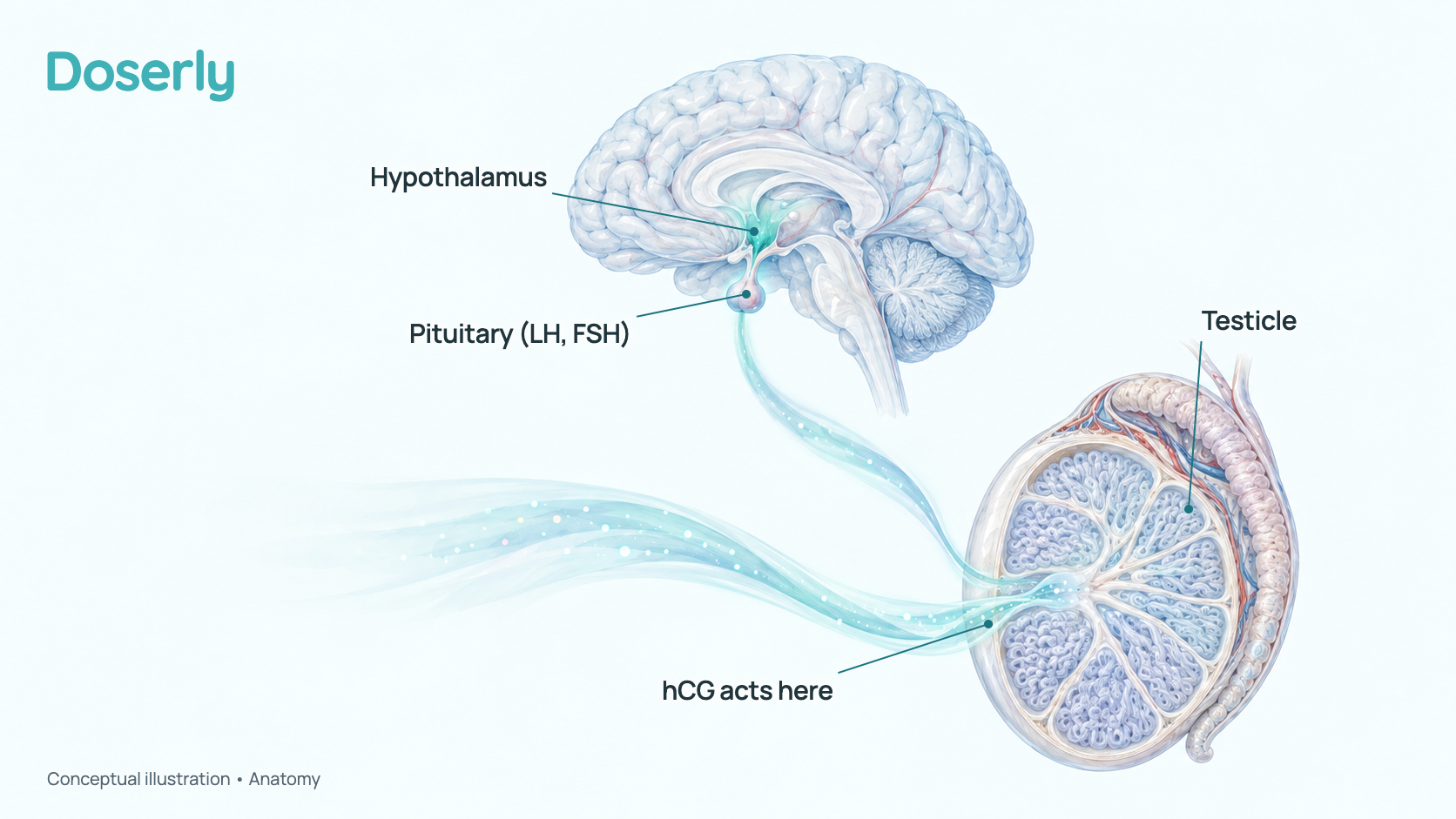
hCG (human chorionic gonadotropin) is the hormone the placenta makes in early pregnancy, and it is also a prescription medicine. As a medicine it copies LH (luteinizing hormone), the signal from the pituitary gland that tells the testicles to make testosterone and the ovaries to release an egg. It is used for men whose pituitary does not send enough of that signal, as a "trigger" shot in fertility treatment and, in some countries, for boys with an undescended testicle. [1], [2]
The name explains the job: "chorionic" refers to the chorion, part of the developing placenta, and a "gonadotropin" is a hormone that acts on the gonads (the testicles or ovaries). It is the hormone pregnancy tests detect. [3], [4]
hCG is a protein, not a steroid. It has two chains: an alpha chain of 92 amino acids, shared with LH, FSH and thyroid-stimulating hormone, and a beta chain of 145 that gives hCG its own identity. Sugar chains attached to both make it a glycoprotein, so its exact weight varies, and urinary hCG doses are measured by biological activity in units rather than by weight. [5], [6], [1], [7]
| Product | Where it comes from | Form and route | Main labeled uses |
|---|---|---|---|
| Pregnyl | Purified from pregnancy urine | 10,000-unit powder vial; intramuscular in the US | Men with low LH and FSH, ovulation trigger, undescended testicle |
| Novarel | Purified from pregnancy urine | 5,000-unit powder vial (the 10,000-unit vial was discontinued); intramuscular | Same as Pregnyl |
| Generic chorionic gonadotropin | Purified from pregnancy urine | 10,000-unit powder vial; intramuscular in the US, subcutaneous or intramuscular in Canada | Same as Pregnyl |
| Ovidrel (Ovitrelle in Europe) | Made by genetically engineered cells (recombinant) | 250 mcg ready-to-use syringe or pen; subcutaneous | Ovulation trigger in fertility treatment |
[1], [8], [9], [10], [11], [2], [12], [13]
People also come across hCG sold online as "research" vials, as compounded vials and as "hCG diet" drops. None of these is an approved product, and drops sold as homeopathic hCG are illegal in the US. [14], [15]
Typical hCG Protocols
| Product and use | Amount each time | Frequency | Weekly total | Duration |
|---|---|---|---|---|
| Urinary hCG (Pregnyl, Novarel, generic) · men with low LH and FSH from a pituitary problem, option 1 | 500–1,000 units | 3 times a week, then twice a week | 1,500–3,000 units, then 1,000–2,000 units | 3 weeks, then 3 weeks |
| Urinary hCG · same use, option 2 | 4,000 units, then 2,000 units | 3 times a week | 12,000 units, then 6,000 units | 6–9 months, then 3 months |
| Pregnyl (Canada) · same use | 4,000–5,000 units | 3 times a week | 12,000–15,000 units | 6–8 weeks per course Canada's monograph describes 2–3 weeks off between courses |
| Urinary hCG · women, trigger for ovulation after fertility drugs | 5,000–10,000 units | Once | Not applicable | One injection, one day after the last gonadotropin dose Only with ultrasound and blood-test monitoring in a fertility clinic |
| Ovidrel · women, trigger for ovulation after fertility drugs | 250 mcg by subcutaneous injection | Once | Not applicable | One injection, one day after the last follicle-stimulating drug dose Only with ultrasound and blood-test monitoring in a fertility clinic |
| Boys · undescended testicle (one of four label options) | 4,000 units | 3 times a week | 12,000 units | 3 weeks US and European guidelines now advise against hormone treatment to move a testicle down |
For men, the labels' lower schedule starts at 500–1,000 units three times a week. For men already on testosterone therapy, which no label covers, the US testosterone guideline says doctors may offer 250 or 500 IU every other day, and the most common clinic schedule is 250–500 IU two or three times a week (500–1,500 IU a week) by subcutaneous injection. No standard length of use has been set. [1], [17], [18], [19], [20], [21], [22], [23]
- Titration Adjusting the dose in steps
- The US labels list several schedules for specific conditions and say the regimen depends on the patient; they do not give a step-up plan based on blood tests. In practice, guidelines start men with low LH and FSH on a modest dose and adjust it by blood testosterone and semen results. The US male infertility guideline describes hCG at 500–2,500 IU two or three times a week, adding FSH once testosterone is normal if sperm are still needed. European urology guidance starts at 250 IU twice a week and allows up to 2,000 IU twice a week, adding FSH (75 IU three times a week, later 150 IU) if sperm do not appear. A 2026 trial in men with a lifelong deficiency started at 2,000 IU twice a week and adjusted the dose to hormone targets, up to a research ceiling of 5,000 IU three times a week (above the US label options). Alongside TRT, dosing sources start at 250–500 IU and adjust by testosterone, estradiol and symptoms, while a 2025 international consensus adjusts the dosing, keeping testosterone low, so that FSH stays measurable, and checks semen often. No trial has tested a step-up schedule for hCG added to TRT. [24], [25], [26], [22], [20], [27]
- Breaks and cycles
- The US labels give courses of fixed length. Canada's Pregnyl monograph describes 6–8-week courses with 2–3 weeks off between them. Alongside TRT, some sources run hCG continuously; one mentions optional 2-week breaks every 6–12 months. [16], [22] No study has compared continuous with on-and-off use.
Read the units: US labels write doses in USP units, which an FDA-approved label defines as international units (IU); Canadian labels, guidelines and websites mostly write IU. Ovidrel is measured by weight instead: 250 micrograms (mcg), which the EU label says is about 6,500 IU for that product only, not a general conversion. The amount each time and the weekly total are separate columns: 500 IU three times a week is a 1,500 IU weekly total. For vials, see how IU convert to syringe units. [28], [29], [13]
These are the labeled schedules for specific conditions; prescribers adjust them using testosterone levels, semen tests and symptoms. The TRT rows below come from two guideline documents and three clinic or protocol sources. None of them was tested in a fertility trial.
What doses are used alongside testosterone therapy?
| Source | Amount each time | Frequency | Weekly total | Duration |
|---|---|---|---|---|
| US testosterone guideline · usual testosterone dose | 250 or 500 IU | Every other day | About 875 or 1,750 IU | Alongside TRT; length not stated [17] The guideline says doctors "may offer" this, based on one 3-week hormone study |
| International consensus · testosterone lowered to 50–100 mg a week | 750–2,000 IU | 3 times a week | 2,250–6,000 IU | Length not stated; adjusted by FSH levels and frequent semen tests [27] For men who want to keep fertility but cannot stop testosterone; it calls this off-label and says to pause before prescribing it |
| Clinic cohort · UK men's-health provider | 500 IU | Once a week | 500 IU | Length not stated; hormones followed for up to 6 months [30] The provider's standard schedule, reported in a cohort of 6,999 men |
| Dosing website · telehealth platform's article | 500 IU | Twice a week | 1,000 IU | Length not stated; optional breaks mentioned [22] The same page mentions optional 2-week breaks every 6–12 months |
| Dosing website · peptide protocol site | 500 IU | 3 times a week | 1,500 IU | 8–12 weeks typical, up to 16 or more [18] A website schedule, not an outcome study. The UK provider in the clinic cohort row used the same amount for men who wanted to keep some fertility |
The rows are alternatives, not steps to move through. The two guideline rows describe different situations. The US guideline adds hCG to a usual testosterone dose. The international consensus also lowers the testosterone dose, because the 150–200 mg a week often used on TRT is likely to suppress FSH and sperm production. The US guideline row rests on one 3-week hormone trial. [17], [27], [31]
Cautions for every schedule above. hCG alongside TRT is not proven to protect fertility, and the US male infertility guideline says testosterone should not be prescribed to men who want children now or in the future. [24] hCG needs working testicles, so it is not expected to help primary testicular failure. The labels list breast enlargement and fluid retention, advise caution with heart, kidney or blood-pressure problems, list prostate cancer as a reason not to use it, and say hCG is not for use in pregnancy. [1] The US testosterone guideline sets the first follow-up blood tests no sooner than 4 weeks after starting (what to monitor). [17] Women receive the trigger injection only with ultrasound and blood-test monitoring, because of ovarian hyperstimulation and multiple pregnancy. [2], [13] Before drawing a dose, check whether it is written in IU or mcg and how IU convert to syringe units. In one lab test of illegal products labeled as hCG, 6 of 16 contained none. [32] hCG is banned in sport for males at all times. [33]
Where these numbers come from
The label rows come from the current US Pregnyl (revised March 2025), Novarel (revised May 2023) and Fresenius Kabi generic (revised February 2025) labels, which share the same schedules; the Ovidrel label (dated June 2018); and Canada's 2021 Pregnyl insert. The four cryptorchidism options in the US labels are 4,000 units three times a week for 3 weeks; 5,000 units every second day for four injections; 15 injections of 500–1,000 units over 6 weeks; and 500 units three times a week for 4–6 weeks, with a second series at 1,000 units a month later if needed. [1], [8], [10], [2], [16]
The TRT rows each come from one source. The first comes from the discussion of the American Urological Association (AUA) testosterone deficiency guideline (published 2018, validity reconfirmed 2024), which bases it on the 3-week Coviello trial; the same guideline's drug table lists hCG at 500–4,000 IU two or three times a week, by subcutaneous or intramuscular injection, with a half-life of 2 days, as a general range rather than a TRT schedule. The second comes from the 2024 International Consultation on Sexual Medicine (published 2025), which calls hCG with a lowered testosterone dose a well-established off-label practice supported by scant literature. The clinic cohort row is the standard schedule reported in a 2026 cohort from a UK provider (500 IU weekly, or 500 IU three times a week for men seeking fertility). The two dosing-website rows come from FormBlends and Dosage Peptide. [17], [27]
All 13 reviewed TRT pages start their range at 250 or 500 IU per injection, given two or three times a week or every other day; across the six single amounts they state, the median is 500 IU. Clinic pages from Hone Health and Vitalis Luxe go up to 500–1,500 IU, and one protocol site up to 1,000 IU. [30], [22], [18], [19], [34], [20], [21], [35], [36], [37], [38], [39], [40], [23]
Not used for any row: a 60-day limit after mixing taken from one product's label and applied to every vial, a claimed "desensitization threshold" above 1,500 IU per injection (no human study sets one), and monotherapy ranges of 1,500–3,000 IU given without a duration. Those are discussed in the next section. [41], [20]
What is hCG commonly used for?
Most people who look up hCG want one of four things: to keep their testicles working while on testosterone therapy, to get their fertility back, to raise their own testosterone without taking testosterone, or to trigger ovulation during fertility treatment. A smaller group is asking about the "hCG diet." [18], [22], [24], [14]
These uses rest on very different evidence. Treating men whose pituitary does not make enough LH and FSH, and triggering ovulation, are approved uses backed by decades of research. Use alongside TRT and for recovery after anabolic steroids are off-label practices supported by short studies and case series. Weight loss has been tested and failed.
Keeping the testicles working on TRT
Testosterone therapy switches off the brain's LH and FSH signals, so the testicles make much less testosterone of their own, often shrink and make fewer sperm. [42], [30], [27] In a 3-week trial, men on testosterone alone lost 94% of the testosterone inside their testicles; adding 250 IU of hCG every other day kept it near normal, and 500 IU raised it above the starting level. [31]
That trial measured a hormone inside the testicle, not sperm or pregnancies. A 26-man series on hCG 500 IU every other day kept semen results stable for about 6 months, and no man lost all sperm. But a published case describes a man who had almost no sperm left despite hCG 500 IU twice a week with his testosterone. He then stopped testosterone, started clomiphene and raised hCG to 3,000 IU every other day, and his sperm count improved within 3 months; the case cannot show which change helped. [43], [44]
Guidelines split on this. The US testosterone guideline says doctors may offer hCG alongside testosterone, and a 2025 international consensus calls it well-established off-label practice. The 2024 US male infertility guideline says testosterone should not be prescribed to men who want children now or in the future; its discussion adds that men whose plans are more distant may be offered testosterone after counseling about its effect on sperm. It does not recommend adding hCG to TRT because the evidence is too limited. [17], [27], [24] See what the studies found.
Fertility in men with low LH and FSH
This is hCG's main approved use in men. When the pituitary does not make enough LH and FSH (hypogonadotropic hypogonadism), hCG replaces the LH signal and usually brings testosterone into the normal range. Sperm often also need FSH, so doctors add FSH or hMG when hCG alone is not enough; the US male infertility guideline describes starting with hCG 500–2,500 IU two or three times a week and adding FSH, when needed, once testosterone is normal. In a 2026 series of 99 men treated at one specialist clinic, sperm appeared in 78% of treatment courses after a median of 5 months, and pregnancies followed in 57% of the courses in men trying to conceive. [1], [24], [25], [45]
The labels cover only men whose low testosterone comes from a pituitary problem. hCG works by stimulating the testicles, so it is not expected to help when the testicles themselves have failed (primary hypogonadism). [1]
Recovery after TRT or anabolic steroids
Men who stop testosterone or steroids to have children often use hCG with other drugs to speed the return of sperm. In one series from two clinics, 47 of 49 men recovered or improved on hCG 3,000 IU every other day plus other medicines, after an average of 4.6 months. In another, 46 of 66 men reached a total motile sperm count above 5 million within a year on hCG plus a tablet that raises LH and FSH (a SERM), and recovery was slower in older men and after longer testosterone use. Neither study had an untreated comparison group. A 2025 international consensus suggests allowing at least 3 months of hCG for sperm to return after testosterone or steroid use, and adding FSH for men who do not improve on hCG alone. [46], [47], [27]
Raising testosterone without TRT
Some men use hCG alone instead of testosterone. In a randomized trial of 282 men with low testosterone, hCG (5,000 IU twice a week), clomiphene tablets and the two together raised testosterone by similar amounts. Smaller clinic series of hCG alone report mixed symptom results. This is not a labeled use unless low testosterone comes from a pituitary problem. [48], [49], [50]
Fertility treatment in women
In fertility treatment, one injection of urinary hCG (5,000–10,000 units) or Ovidrel (250 mcg) makes the eggs complete their final maturation and triggers ovulation, timed by ultrasound. For women at high risk of ovarian hyperstimulation syndrome, US fertility guidance recommends a different trigger as the first choice (a drug that copies gonadotropin-releasing hormone, GnRH). [1], [2], [51]
Undescended testicles in boys
hCG is still on the labels for boys with an undescended testicle that is not blocked by anatomy, but US and European urology guidelines now advise against hormone treatment to bring a testicle down. Surgery is the standard treatment. [1], [52], [53]
Weight loss (the "hCG diet")
The hCG diet pairs small daily hCG injections or drops with a very-low-calorie diet. Controlled trials found that people lost the same weight on placebo injections, and the US labels state that hCG has not been shown to help treat obesity. [54], [55], [1] See the trial results.
Where do hCG protocols differ?
The labels are precise. The disagreements come from off-label use: how often to inject, how much protects fertility, whether to take breaks, how to use hCG after a steroid cycle and how to stop.
Is the schedule from a label or from a TRT clinic?
A label schedule and a TRT schedule answer different questions. The label doses (thousands of units a week) are meant to replace a missing LH signal completely in men with a pituitary problem. TRT sources use smaller amounts (hundreds of IU at a time) to try to keep the testicles active while testosterone therapy supplies most of the body's testosterone; no amount has been shown to preserve fertility on TRT. Copying a label dose onto TRT, or a TRT dose onto a fertility problem, mixes two different jobs. [1], [31]
Every other day, or two or three times a week?
The trial behind most TRT schedules gave hCG every other day. Websites and clinics mostly convert that into two or three fixed days a week, which is easier to remember but was not what the trial tested. [31], [18], [22]
Timing may matter for estradiol. In a small 1984 study of 7 healthy men, a single 1,500 IU dose made estradiol peak at 4.4 times its starting level after 24 hours, and testosterone fell below its starting level a week later. The same 1,500 IU split into five daily 300 IU doses raised testosterone about twice as much overall, without the early estradiol spike. [56], [57] In community education groups, educators give the same advice: smaller, more frequent doses rather than one large one.
How much hCG protects fertility on TRT?
Nobody knows, because no trial has tested it. The 250–500 IU range comes from a hormone measurement over 3 weeks, and the 500 IU every-other-day schedule from 26 men without a comparison group. The UK clinic cohort gave men seeking fertility 500 IU three times a week but did not measure sperm. [31], [43], [30]
The guidelines disagree. The US testosterone guideline (reconfirmed in 2024) says doctors may offer 250 or 500 IU every other day, based on that one 3-week trial. A 2025 international consensus calls hCG with a lowered testosterone dose a well-established off-label practice, usually 750–2,000 IU three times a week with 50–100 mg of testosterone a week, but says to pause before prescribing it because no trials have proven it safe or effective. The 2024 US male infertility guideline says the evidence is too limited to recommend adding hCG to TRT, and a 2022 UK endocrinology guideline says its authors do not endorse the combination. [17], [27], [24], [58]
In community education groups, educators describe a higher "fertility" tier of 500–1,000 IU three times a week, which overlaps the low end of the consensus range. No member documented a semen result on that schedule while staying on TRT, and none described lowering their testosterone dose the way the consensus does.
Do hCG and hMG "fertility stacks" follow the guidelines?
Only for men with low LH and FSH. The US male infertility guideline describes hCG first and FSH added later for that group. For infertility without a known hormone cause, it mentions FSH treatment, not hCG, and cautions that FSH is not FDA approved for that use in men. [24] In community education groups, some members without a diagnosed pituitary problem copy an hCG 500–1,000 IU three-times-a-week plus hMG schedule from a shared cheat sheet; none documented a pregnancy from it.
Continuous, or on and off?
No study has compared the two. One man described taking hCG for more than 10 years without a break [59], and one TRT dosing page says men have stayed on it for a decade but mentions an optional 2-week break every 6–12 months [22]. A common teaching in community education groups is a month of hCG every 3–4 months, on the idea that continuous use drives estradiol up. The one thing the studies show is that the effect on the testicles does not outlast the hCG (see stopping). [60]
Does a high dose "burn out" the testicles?
In rats, large hCG doses temporarily reduce the number of LH receptors on Leydig cells and blunt their response, an effect called desensitization. In the human study above, one large dose was followed by a temporary dip in testosterone. That does not establish a human danger threshold: the claim on some websites that more than 1,500 IU per injection crosses a "desensitization threshold" is not based on any human study. [61], [62], [56], [41]
What about hCG after a steroid cycle?
Bodybuilding sources use hCG at the end of an anabolic-steroid cycle, then switch to SERM tablets such as clomiphene or tamoxifen (post-cycle therapy). Schedules range from 250–500 IU twice a week during a cycle to 500–1,500 IU every other day for 1–2 weeks, and an older text gives 2,000 IU every other day for 20 days. None of these schedules has been tested in a trial. [63], [64], [65]
In community education groups, educators disagree about the order. Some teach hCG first and a SERM afterward; others warn that hCG keeps the testicles going but gives the brain no reason to restart its own LH, so long courses can delay recovery. A 2021 study of 100 men who used anabolic steroids found no measurable recovery benefit in those who chose hCG or post-cycle therapy, though the men chose their own treatments. [66]
How do IU convert to syringe units?
Most hCG comes as a freeze-dried powder that is mixed with liquid before use (reconstitution). Syringe units on an insulin syringe measure volume, not hCG: on a U-100 syringe, 100 units equal 1 mL. The IU in each unit depends on how much liquid went into the vial. [1], [18]
For example, a 5,000 IU vial mixed with 2 mL holds 2,500 IU per mL, so 500 IU is 0.2 mL, or 20 units on the syringe. Mixed with 5 mL instead, the same 500 IU is 50 units. Copying "20 units" from someone with a differently mixed vial can give a very different dose. [18], [67] In community education groups, people regularly write "mcg" or "mg" when they mean IU, or call syringe units "IU". Doserly's reconstitution calculator works out the arithmetic for any vial and shows each step.
What happens when you stop hCG?
The effects of hCG fade within days to months, depending on what you measure. Studies of hCG with TRT followed men during treatment; none shows what happens after hCG stops while TRT continues, so that answer comes from the physiology and related studies. [30], [31], [43]
- The drug itself. Blood levels halve about every 32–33 hours for urinary hCG and every 29 hours for Ovidrel after a single dose. After repeated doses in men, the effective half-life was longer, about 5.8 days. In an anti-doping study, hCG could be detected for 7 days in blood and 10 days in urine, and labels warn that pregnancy tests can read falsely positive for up to 10 days. [68], [2], [69], [70], [16]
- On TRT. Once hCG stops, the testicles are left with testosterone therapy alone. In the 3-week trial, testosterone therapy alone cut the testosterone inside the testicles by 94%. [31]
- Sperm in men with low LH and FSH. In a 1984 series, two men who produced sperm on hCG alone had no sperm at all (azoospermia) again 4 months after stopping. In 13 men who continued on hCG alone after sperm production had been started with hCG plus hMG (or, in one man, a GnRH pump), sperm counts fell gradually over 12 months but stayed present in all except one man, who lost all sperm. For boys with low LH and FSH who finish puberty induction with FSH and hCG, a European guideline advises a semen test before switching to testosterone, and considering sperm banking if enough sperm are present. [60], [71], [72]
- Rebound. No study has tracked withdrawal or rebound effects after a course of hCG ends. After a single 1,500 IU dose in 7 healthy men, testosterone fell below its starting level a week later, so a temporary dip after stopping is possible but has not been studied. [56]
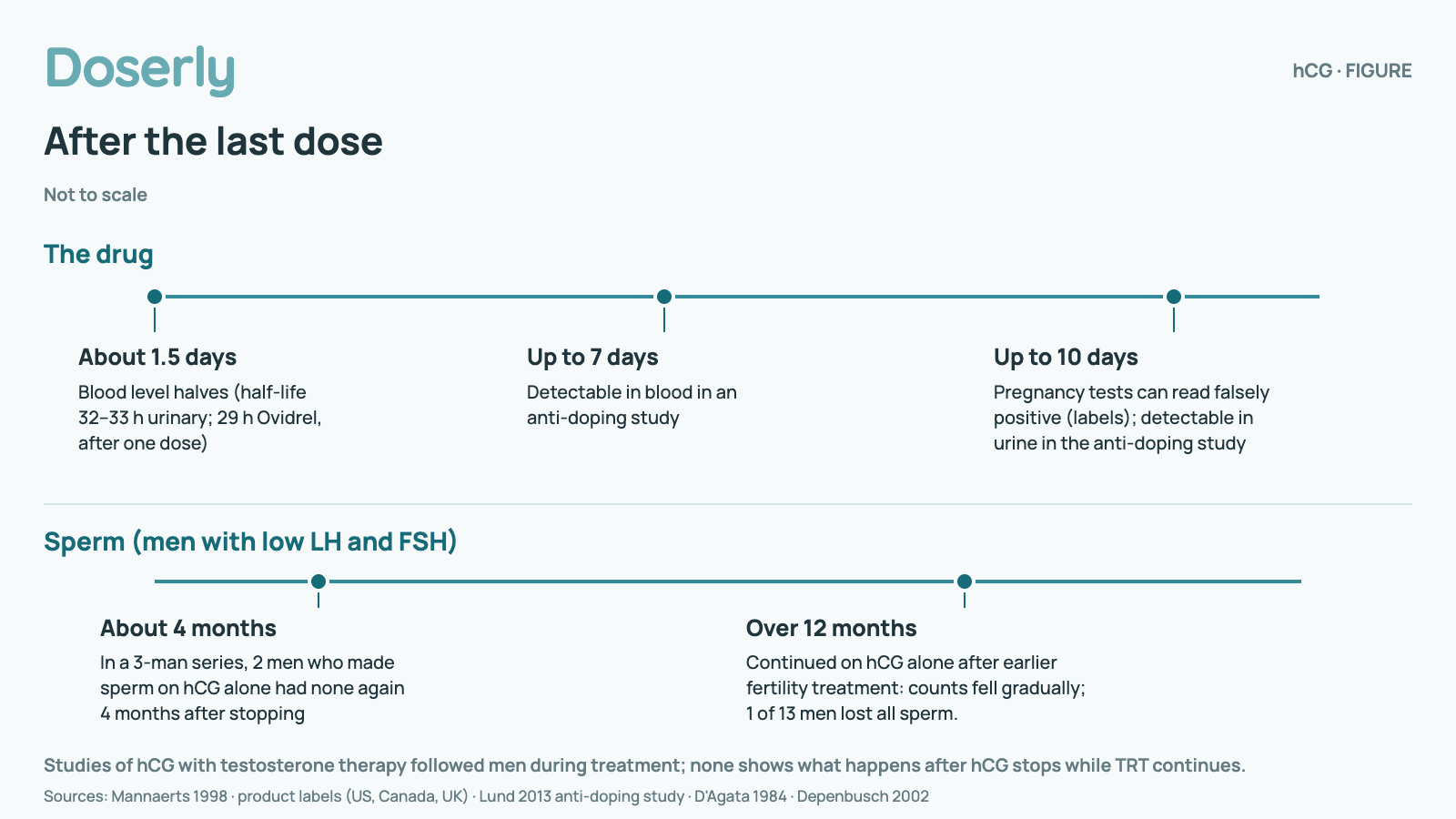
After the last dose
Not to scale
The drug
- About 1.5 days
Blood level halves (half-life 32–33 h urinary; 29 h Ovidrel, after one dose)
- Up to 7 days
Detectable in blood in an anti-doping study
- Up to 10 days
Pregnancy tests can read falsely positive (labels); detectable in urine in the anti-doping study
Sperm (men with low LH and FSH)
- About 4 months
In a 3-man series, 2 men who made sperm on hCG alone had none again 4 months after stopping
- Over 12 months
Continued on hCG alone after earlier fertility treatment: counts fell gradually; 1 of 13 men lost all sperm.
Studies of hCG with testosterone therapy followed men during treatment; none shows what happens after hCG stops while TRT continues.
After anabolic steroids, recovery varies a lot. In a 2026 study of recreational bodybuilders who had used steroids briefly, 87.5% of those who took clomiphene plus hCG (1,500 IU three times a week) had normal semen after 12 months, compared with 69.2% on clomiphene alone and 58.6% with no treatment. Treatment was not randomized, five men also received FSH, and there was no hCG-only group, so the percentages cannot isolate hCG's effect. [73]
Do the different hCG products and injection routes work the same way?
They contain the same hormone, but they are not interchangeable by label. Urinary hCG (Pregnyl, Novarel, generic) is a powder measured in units; recombinant hCG (Ovidrel, Ovitrelle) is a ready-made solution measured in micrograms. The US urinary labels say intramuscular only, Canada's generic allows subcutaneous or intramuscular, and Ovidrel is subcutaneous. [1], [8], [10], [11], [2]
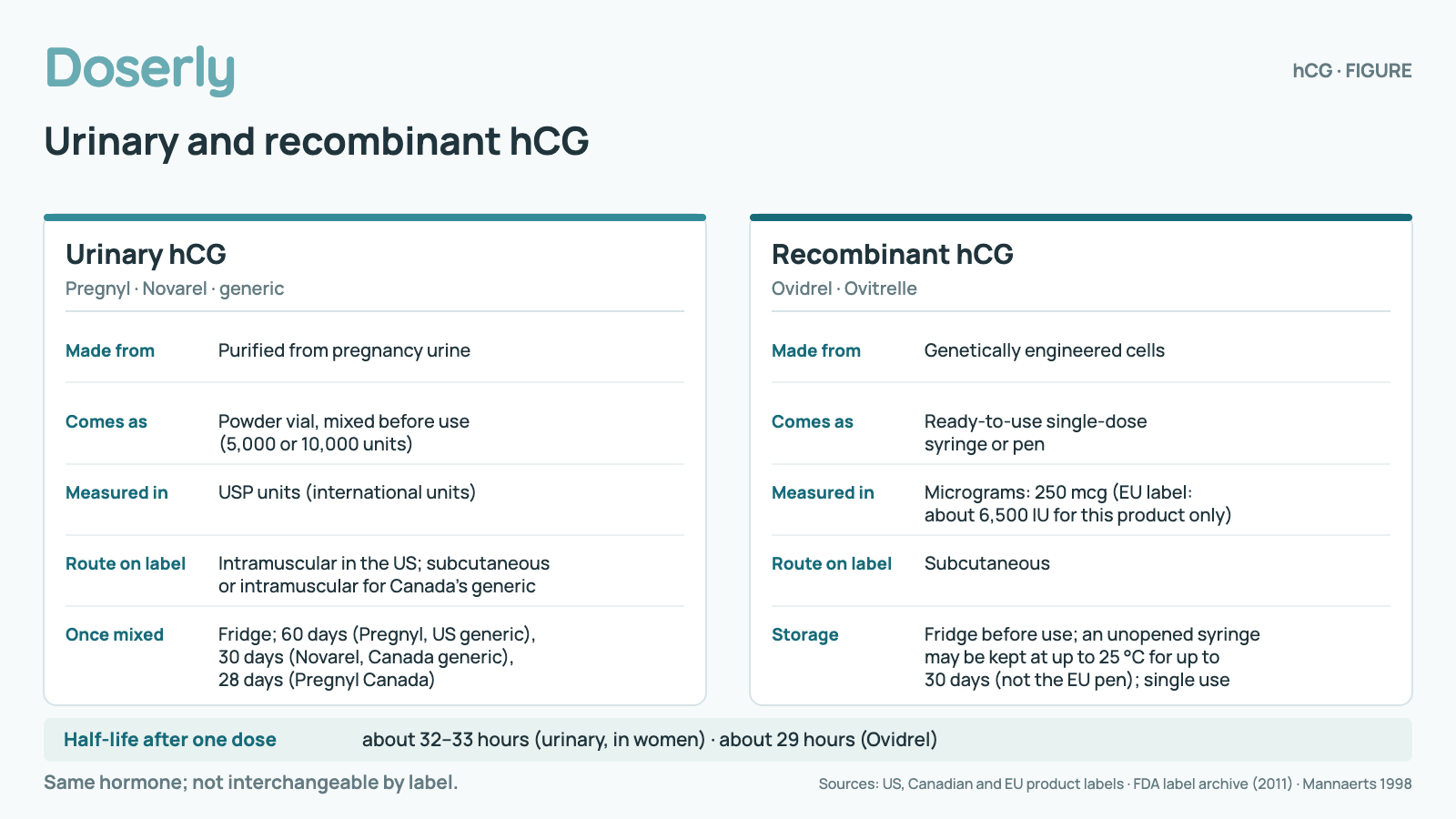
Urinary and recombinant hCG
Urinary hCG Pregnyl · Novarel · generic
- Made from
- Purified from pregnancy urine
- Comes as
- Powder vial, mixed before use (5,000 or 10,000 units)
- Measured in
- USP units (international units)
- Route on label
- Intramuscular in the US; subcutaneous or intramuscular for Canada's generic
- Once mixed
- Fridge; 60 days (Pregnyl, US generic), 30 days (Novarel, Canada generic), 28 days (Pregnyl Canada)
Recombinant hCG Ovidrel · Ovitrelle
- Made from
- Genetically engineered cells
- Comes as
- Ready-to-use single-dose syringe or pen
- Measured in
- Micrograms: 250 mcg (EU label: about 6,500 IU for this product only)
- Route on label
- Subcutaneous
- Storage
- Fridge before use; an unopened syringe may be kept at up to 25 °C for up to 30 days (not the EU pen); single use
- Half-life after one dose
- about 32–33 hours (urinary, in women) · about 29 hours (Ovidrel)
Same hormone; not interchangeable by label.
Subcutaneous or intramuscular? Most TRT clinic sources describe subcutaneous injection, and the key hormone trial used that route, while US urinary labels specify intramuscular injection. The route mainly changes the blood-level curve, not the total amount absorbed: in 18 healthy women, 10,000 units of Pregnyl gave the same total exposure by either route, and in an in vitro fertilization (IVF) study of 40 women, subcutaneous injection gave higher blood hCG 36 hours later than intramuscular injection (349 versus 259 IU/L). No trial has compared the two routes for testicular or fertility outcomes in men. [31], [68], [74] About 40% of an Ovidrel dose reaches the blood (bioavailability), peaking about 12–24 hours after injection. [2]
Urinary or recombinant? In a 2024 study in men, tested doses of Pregnyl and Ovidrel produced similar testosterone responses, although their blood levels were not formally equivalent. In healthy women given both by subcutaneous injection, urinary hCG peaked sooner (16 versus 24 hours), and half-lives were similar (about 37–39 hours in that study). [69], [75]
How long does hCG last compared with LH? Much longer. In healthy young men, the body's own LH was cleared from the blood with a half-time of about 90 minutes, while a single hCG injection has a half-life of about 29–33 hours. That is why injections every few days are enough, while the body's own LH comes in short pulses. [76], [2], [68]
Are drops, sprays and pills the same? No. There is no approved oral or under-the-tongue hCG. FDA says products sold as homeopathic hCG drops, pellets and sprays are illegally marketed, and none is approved for weight loss. [14], [77]
How should hCG be stored, and how long does it last?
Each product's label sets its own rules, and they differ by product and country, so the leaflet in your own box is the final word. In short, powder vials are kept at room temperature (or as labeled) and go in the fridge once mixed; Ovidrel goes in the fridge. [1], [2]
| Product | Before mixing or first use | After mixing (reconstitution) or opening |
|---|---|---|
| Pregnyl (US) | 15–25 °C | Fridge, 2–8 °C; discard after 60 days; do not freeze or shake |
| Generic chorionic gonadotropin (US) | 20–25 °C | Fridge, 2–8 °C; discard after 60 days; do not freeze or shake |
| Novarel (US) | 20–25 °C; brief excursions to 15–30 °C allowed | Fridge, 2–8 °C; use within 30 days |
| Pregnyl (Canada) | 15–30 °C | Fridge; stable for 28 days |
| Generic chorionic gonadotropin (Canada) | Below 25 °C | Fridge, 2–8 °C; use within 30 days |
| Ovidrel (US) or Ovitrelle (EU) prefilled syringe (no mixing) | Fridge, 2–8 °C, in the original package; before use it may be kept at up to 25 °C for up to 30 days, then discarded | Single use; use once opened and discard any remainder |
| Ovitrelle pen (EU) | Fridge, 2–8 °C; do not freeze | Use immediately after opening |
[1], [10], [8], [29], [11], [2], [13], [78]
Research and compounded vials. No label covers them, so no storage period has been established for them. One product's label limits do not transfer to another product, or to hCG kept in plastic syringes, frozen after mixing or mixed with a different liquid. One compounding laboratory's handout says hCG sticks to plastic more than to glass, without published data. A home pregnancy test only shows that some hCG is present; it cannot show the dose, strength or sterility of a vial. [79], [3] In community education groups, people disagree about how long a mixed vial stays useful; a sense that it feels weaker cannot show its strength or sterility.
This guide does not cover mixing or injection technique; the Academy note below covers practical handling.
What do we actually know about hCG in people?
A lot about its approved uses, much less about the off-label ones. hCG has been used as a medicine for decades, and randomized trials support its role in fertility treatment. For use alongside TRT, the evidence is one short hormone trial in healthy men given testosterone, a few small series and a large cohort without sperm results. [2], [80], [31], [30]
Does hCG protect fertility on TRT?
It protects a hormone signal; whether it protects fertility is not proven.
| Study | Who and what | What it found | What it cannot show |
|---|---|---|---|
| Coviello 2005 (controlled trial) | 29 healthy men on testosterone 200 mg a week, randomized to placebo or hCG 125, 250 or 500 IU every other day, 3 weeks | Testosterone inside the testicle changed by −94% (placebo), −25%, −7% and +26% | Sperm, pregnancy or long-term effects [31] |
| Roth 2010 (controlled trial) | 37 healthy men whose LH was switched off with a drug (acyline), randomized to 0, 15, 60 or 125 IU of subcutaneous hCG every other day, or daily testosterone gel, for 10 days | Even very small doses raised testicular testosterone, in proportion to the dose | Fertility; used a drug, not TRT, to switch off LH [81] |
| Hsieh 2013 (human report) | 26 men on TRT plus hCG 500 IU intramuscular every other day, average 6.2 months | Semen results stayed stable; no man lost all sperm; partners of 9 men became pregnant | No comparison group [43] |
| Case report 2018 (human report) | 1 man on testosterone 100 mg a week plus hCG 500 IU and an aromatase inhibitor, both twice a week | Almost no sperm; the count improved within 3 months after testosterone was stopped, clomiphene started and hCG raised to 3,000 IU every other day | How often this happens, or which change helped [44] |
| Clift 2026 (human report) | 6,999 UK men; 6,364 on hCG plus TRT, usually 500 IU a week | Testosterone rose into range; LH and FSH stayed suppressed | Sperm, estradiol or pregnancy were not measured [30] |
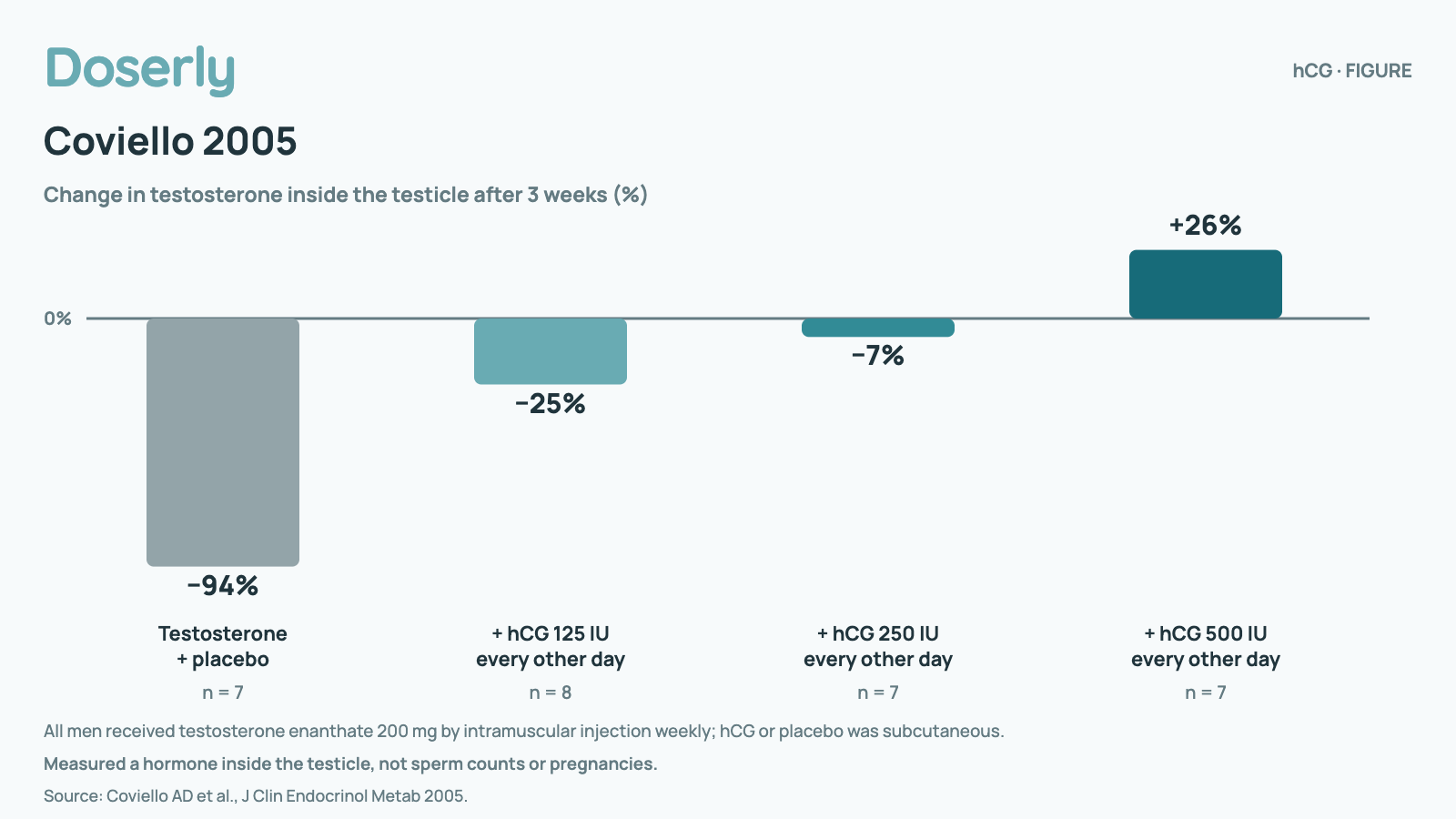
Coviello 2005
Change in testosterone inside the testicle after 3 weeks (%)
Vertical line = 0%; left is decrease, right is increase.
- Testosterone + placebo
- n = 7 · −94%
- + hCG 125 IU every other day
- n = 8 · −25%
- + hCG 250 IU every other day
- n = 7 · −7%
- + hCG 500 IU every other day
- n = 7 · +26%
All men received testosterone enanthate 200 mg by intramuscular injection weekly; hCG or placebo was subcutaneous.
Measured a hormone inside the testicle, not sperm counts or pregnancies.
Men who continue testosterone while trying for a baby are a separate question. In a 2025 series of 19 men who kept using non-prescribed androgens, sperm counts were higher after recombinant hCG three times a week was added, and the number with a normal motile count rose from 1 to 11. The clinic also advised the men to move from high-dose cycles to a lower maintenance dose, so the study cannot isolate hCG's effect. In another 2025 series, sperm improved in about three-quarters of men on hCG plus FSH whether or not they stayed on testosterone. Neither study had an untreated comparison group. [82], [83]
Does hCG work without testosterone therapy?
It raises testosterone when the testicles can respond. In the randomized trial of 282 men, hCG 5,000 IU twice a week, clomiphene 50 mg and the combination all raised testosterone, with no difference between groups. In a series of 20 men with symptoms but normal testosterone, hCG (about 2,000 IU a week) raised average testosterone from 362 to 520 ng/dL, and half reported feeling better; there was no placebo group. [48], [49]
In 40 older men with low-normal testosterone, a 3-month placebo-controlled trial of Ovidrel 250 mcg twice a week increased lean mass by about 2 kg and reduced fat by about 1 kg, without changing insulin sensitivity. [84]
How well does it start sperm production in men with low LH and FSH?
Well, but slowly, and usually with FSH. In the 2026 specialist-clinic series, sperm appeared in 78% of treatment courses after a median of 5 months, and a sperm concentration above 2 million per mL was reached in 56% after a median of 12 months. In a 2026 randomized trial in 45 men with lifelong (congenital) deficiency, sperm appeared in most men in all three treatment strategies, after a median of 12–15 months. [45], [26]
How the deficiency started matters. Men whose deficiency began before puberty are more likely to need FSH as well as hCG, while those whose deficiency began after puberty more often respond to hCG alone. In a 1988 study, 14 of 22 men had sperm appear on hCG alone, more often when their testicles were larger to begin with. A 2014 pooled analysis of published studies found that sperm appeared in about three-quarters of men treated with gonadotropins. In a 2025 study of 50 men with deficiency from before puberty, sperm production was started in 82%, with hCG first and FSH added. [85], [86], [87], [88]
Does it help recovery after steroids or TRT?
Probably, when combined with other drugs, but the studies cannot separate hCG's share. The recovery series used hCG with SERMs, aromatase inhibitors or FSH, and none had a randomized untreated group; the 2021 HAARLEM study found no measurable benefit in men who chose hCG or post-cycle therapy themselves. [46], [47], [66]
What did weight-loss trials find?
No benefit. In a double-blind trial of 51 people, weight loss was the same on hCG and placebo injections with the same diet; a crossover trial of 202 people, a 1977 trial and a 1990 trial of 40 women agreed. A 1995 review of 24 studies found that only 1 of 12 better-quality studies reported any benefit. The weight loss people see on the hCG diet comes from the very-low-calorie diet itself. [54], [89], [90], [55], [91], [14]
What about fertility treatment in women?
Urinary and recombinant hCG both work as ovulation triggers. In a 2000 trial, the two gave similar numbers of eggs and similar pregnancy rates, and the recombinant version caused fewer injection-site and other side effects. European fertility guidance (2025) accepts either. [80], [92]
How does hCG work?
hCG switches on the same receptor as LH, called the LH/choriogonadotropin receptor (LHCGR). The labels describe its action as "virtually identical" to pituitary LH, with a small degree of FSH activity. Its effects in people are well measured. [1], [93]
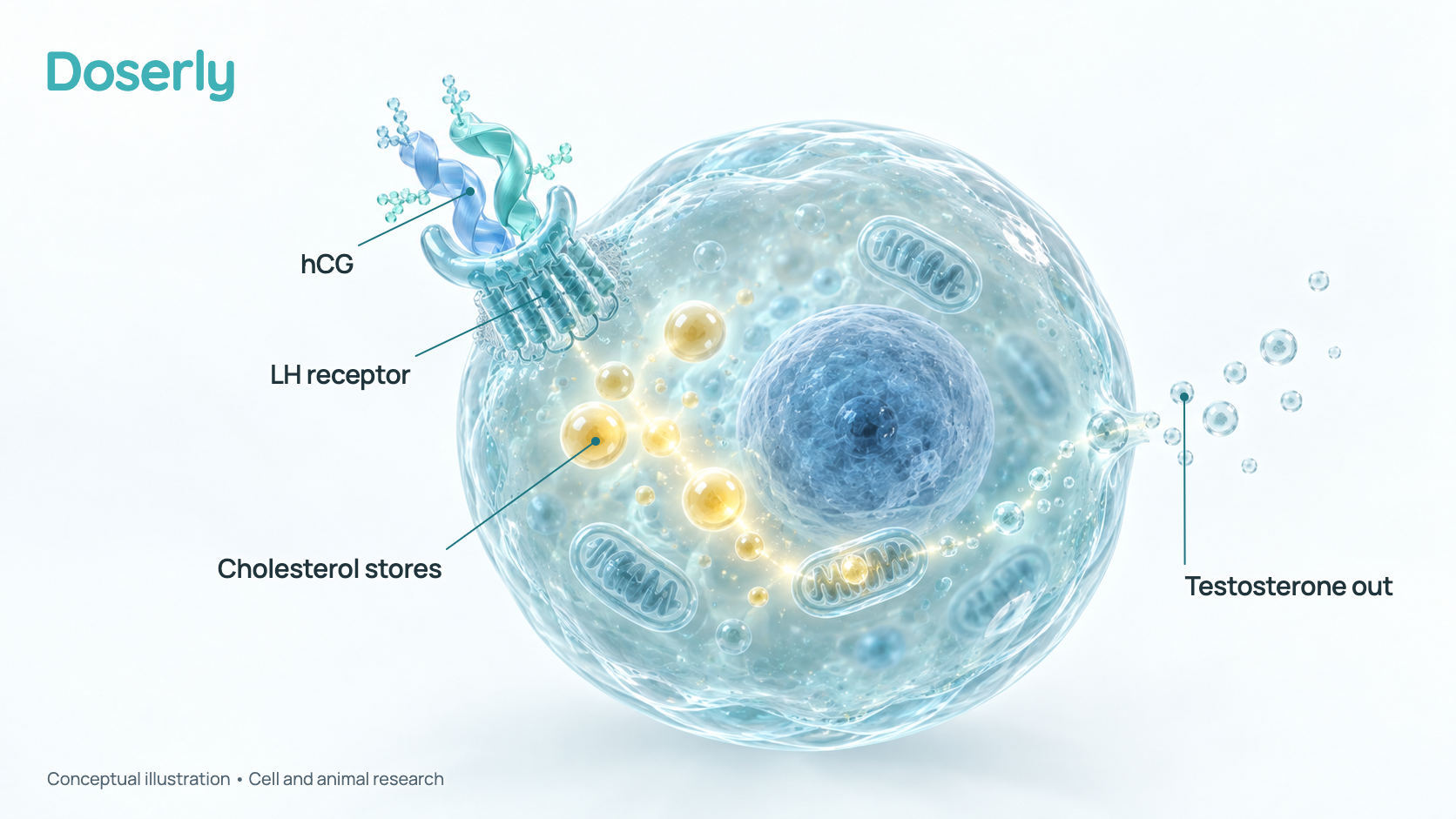
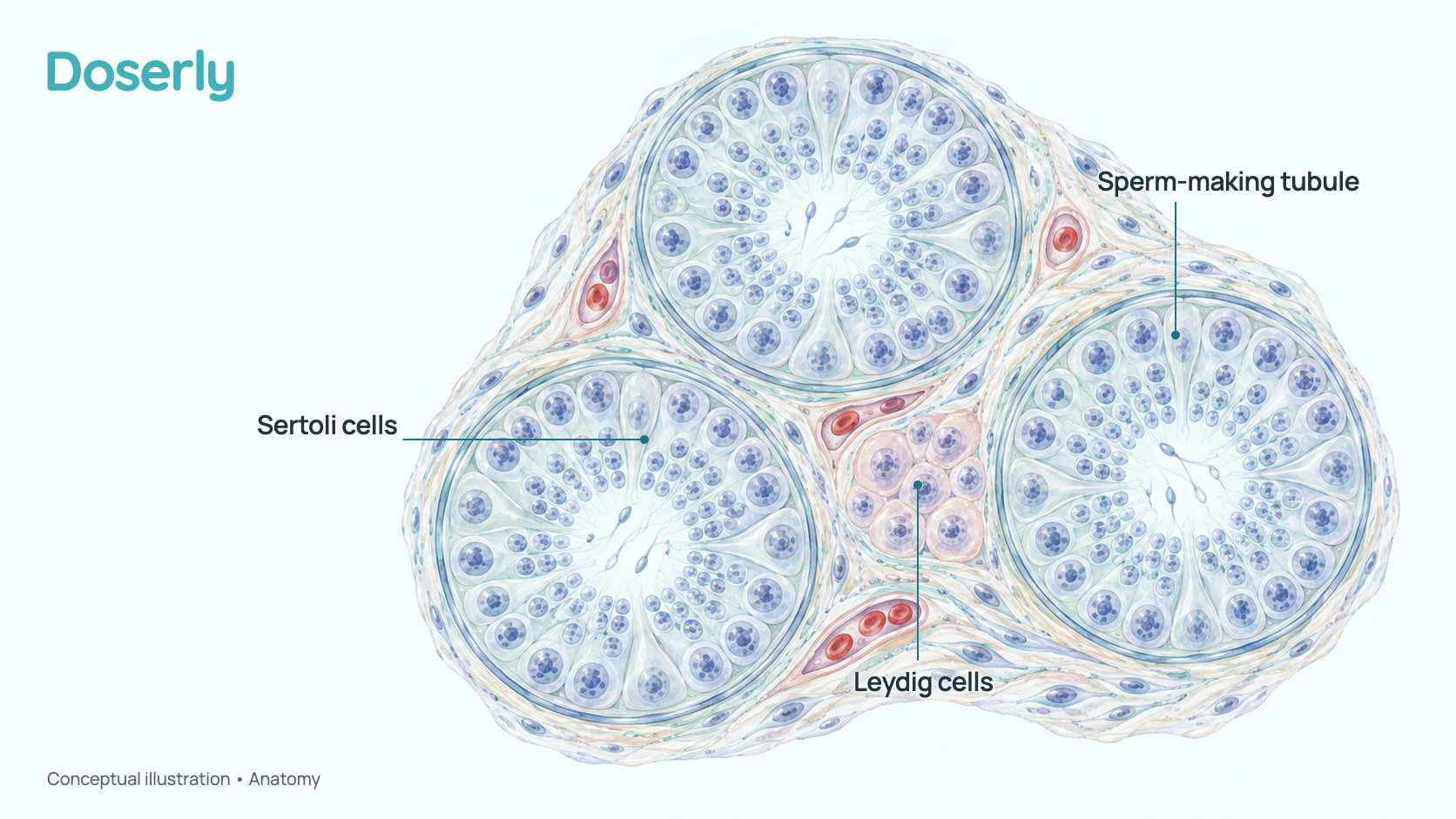
In men, hCG reaches the Leydig cells in the testicles and makes them produce testosterone. Testosterone inside the testicle is normally far higher than in the blood (a median of about 2,500 nmol/L in one study, against blood levels in the tens), and sperm production depends on it. That is why hCG can keep the testicles active when testosterone therapy has switched off the brain's own LH. [1], [81], [30]
In women, the same receptor on the ovary's follicle cells triggers the final ripening of the egg and its release (ovulation). [2], [94]
Why doesn't hCG alone always restore sperm?
Sperm production needs two signals: high testosterone inside the testicle (which hCG provides) and FSH acting on the Sertoli cells that nurse developing sperm. hCG has only slight FSH-like activity and does not raise the body's own FSH; in men taking hCG with TRT, LH and FSH stayed suppressed. [1], [30], [25]
Why does hCG raise estradiol?
The testicles turn some of the extra testosterone into estradiol, a form of estrogen. Estradiol peaks about 24 hours after a dose, earlier than testosterone, which peaks at about 72 hours. In a 1988 study of men with low LH and FSH treated with hCG alone, 7 of 22 reached estradiol levels above the normal range. In the 26-man TRT series, estradiol did not change significantly. [57], [86], [43]
Does hCG "desensitize" the testicles?
Large doses can temporarily reduce the testicle's response, clearly in rats and briefly in people, but a lasting human effect or a safe maximum dose has not been established. In adult rats, one injection cut the testicles' LH receptors to 5–10% of normal after 3 days, with a gradual return toward normal afterward. Laboratory work on human fetal testicle tissue did not show the same desensitization. [61], [95], [96], [56]
What are the risks and unanswered questions?
Is hCG safe?
Prescription hCG has a long safety record in its approved uses, and its main risks are well described: fluid retention, breast enlargement and mood changes in men, ovarian hyperstimulation in women and early puberty in boys. Years of use alongside TRT have not been studied. [1], [2], [30]
What are the most common side effects?
The US urinary labels list headache, mood changes such as irritability and depression, tiredness, fluid retention (edema), breast enlargement, early puberty in boys, injection-site reactions and allergic reactions, including rare severe ones. Because hCG raises androgens, which can make the body hold on to fluid, the Pregnyl label advises caution in people with heart or kidney disease, high blood pressure, epilepsy, migraine or asthma. [1], [8], [10]
With Ovidrel, injection-site reactions occurred in 14.6% of women, compared with 28% on urinary hCG. [2]
How common is breast enlargement?
It depends on the dose and the person. In the 2026 randomized trial in men with lifelong LH and FSH deficiency, where hCG started at 2,000 IU twice a week and could rise to 5,000 IU three times a week alongside FSH, 20% developed breast enlargement. In a 1993 study, 5 men in the hCG-plus-hMG group did. In a clinic series of 31 men on hCG alone, none did. Rising estradiol is the usual explanation. [26], [97], [50], [86] In community education groups, members with more body fat describe the biggest estradiol rises.
What about women and children?
- Ovarian hyperstimulation syndrome (OHSS). The ovaries swell and fluid shifts into the belly, sometimes severely. In Ovidrel's trials it occurred in 1.7% of IVF patients and 3.0% of ovulation-induction patients at 250 mcg; the EU label puts it at about 4%, severe in under 0.5%. Multiple pregnancy, blood clots and twisting of an enlarged ovary are also label warnings. [2], [13]
- Boys. hCG can bring on early puberty. About 20% of testicles moved down by hormones rise back up, and in one study, men who had unsuccessful childhood hCG treatment had more signs of damaged sperm-forming cells in their testicle biopsies. [8], [53], [98]
Could hCG affect cancer tests?
Yes. hCG is also a tumor marker for some testicular cancers, and injected hCG raises it. One man under cancer surveillance underwent a full search for relapse before he disclosed hCG injections; his level normalized after he stopped. The labels also say not to use hCG with prostate cancer or other androgen-dependent tumors. [99], [1]
Could research-market or compounded hCG change the risk?
Yes. When researchers tested 16 illegal post-cycle products labeled as hCG, 6 contained no hCG at all, only a filler sugar. FDA has posted recalls and inspection findings involving compounded hCG vials over sterility concerns, and Health Canada warns against injecting unauthorized peptides bought online. A "research use only" label does not make a product legal or tested. [32], [100], [101], [102], [103]
Is hCG legal? Is it FDA approved?
Checked September 24, 2026. Rules differ by country and change often.
United States. hCG is an FDA-approved prescription medicine for specific uses. The key steps:
- Approved products. Pregnyl, Novarel and a Fresenius Kabi generic are licensed urinary products; Ovidrel was approved on September 20, 2000, and its prefilled syringe is still marketed. [9], [12]
- Diet products. FDA and the Federal Trade Commission have sent joint warning letters to sellers of over-the-counter "homeopathic" hCG diet products, which FDA calls illegally marketed. [14]
- March 23, 2020. hCG moved to the legal category of a biologic, which ended pharmacies' routine exemptions for making compounded copies. [15]
- May 16, 2023. The Novarel 10,000-unit vial was added to FDA's discontinued list; the 5,000-unit vial remains. [9]
- States. Some states add their own controls; New York, for example, lists chorionic gonadotropin as a Schedule III controlled substance. [104]
Canada. Prescription-only. Health Canada's drug database lists Pregnyl (intramuscular), a Fresenius Kabi generic (subcutaneous or intramuscular) and two Ovidrel products (subcutaneous) as marketed prescription drugs. [105], [29], [11], [106]
European Union. Ovitrelle is centrally authorized as a prescription medicine, valid across the EU. [107], [13]
United Kingdom. Chorionic gonadotrophin is a Class C controlled drug in Schedule 4 Part II, the same group as growth hormone and clenbuterol. Ovitrelle is licensed. [108], [78]
Australia. hCG is a Schedule 4 (prescription-only) medicine, except in pregnancy test kits. Pregnyl's registration was cancelled in 2023; Choriomon is supplied under a special approval until August 2027, and Ovidrel has had limited availability. [109], [110], [111], [112]
A "research use only" label does not make any product legal or approved.
Is hCG banned in sport? Does it show up on a drug test?
Yes, for males. The World Anti-Doping Agency (WADA) 2026 Prohibited List bans chorionic gonadotrophin in males at all times, in and out of competition. Anti-doping labs flag urine hCG above set limits in male athletes, and in one study injected hCG was detectable for up to 10 days in urine. It also turns a pregnancy test positive for up to 10 days. WADA's 2027 list, published on September 21, 2026, keeps the same ban from January 1, 2027. [33], [113], [70], [16], [114]
Who should be especially cautious?
- Pregnancy, breastfeeding and fertility treatment. The labels say hCG is not for use in pregnancy, and Ovitrelle is not for use while breastfeeding; for Pregnyl, passage into breast milk is unknown. In fertility care it is used only with ultrasound and blood-test monitoring, because of OHSS and multiple pregnancy. [1], [2], [78]
- Men who may want children. Testosterone therapy can stop sperm production, and hCG alongside it is not proven to prevent that. The US male infertility guideline says testosterone should not be prescribed to men who want children now or in the future, and its discussion adds counseling for men whose plans are more distant. [24], [44]
- Children and teenagers. Only with specialist care; hCG can trigger early puberty. [1]
- Heart, kidney or blood-pressure problems, epilepsy, migraine or asthma. Fluid retention can worsen these. [1]
- Prostate cancer or other androgen-dependent tumors. Listed as reasons not to use it. [1]
- Primary testicular failure. hCG needs working testicles, so it is not expected to help; the labels cover pituitary causes only. [1]
- Drug-tested male athletes. Banned at all times. [33]
- People taking other medicines, including testosterone, SERMs, aromatase inhibitors or FSH; see the next question.
Can hCG be taken with other medicines?
It is usually taken with other hormones, but formal interaction studies are lacking: the UK Ovitrelle information says none have been done. [78]
- Testosterone. hCG adds the testicles' own testosterone on top of therapy, so total testosterone and estradiol can climb; in the 26-man series, average testosterone was 1,055 ng/dL on the combination. [43]
- SERMs, aromatase inhibitors and FSH. Common partners in fertility and recovery care; the studies above cannot separate each drug's share. [46], [47]
- Lab tests. hCG can interfere with LH blood tests and pregnancy tests. [8], [10]
- Mixing in one syringe with other peptides. Not studied.
Bring a full list of everything you take, including supplements, to a pharmacist or doctor.
What should be monitored while using hCG?
The labels set monitoring rules for women and boys. For men, the checks come from guidelines, and none gives a trial-tested schedule for hCG alongside TRT. Use this summary to prepare questions for your prescriber; it is not a personal testing plan. [1], [17], [25]
| Why it matters | What labels and guidelines say | Tracking category |
|---|---|---|
| Testosterone response (men) | US testosterone guideline: for men starting hCG, clomiphene or anastrozole, it recommends follow-up blood tests "no sooner than four weeks after commencement". UK guidance checks testosterone and estradiol at 4 weeks when hCG is used for men with low LH and FSH | Blood work; Libido; Energy Levels |
| Sperm production (men with low LH and FSH seeking fertility) | Semen analysis every 3 months during treatment, unless conception occurs (European urology guidance); for boys finishing puberty induction with FSH and hCG, a semen test before switching to testosterone | Other (semen result) |
| Estradiol and breasts | Estradiol at 4 weeks in UK guidance; labels list breast enlargement | Blood work; Hormonal Symptoms |
| Red blood cells | Full blood count at 4 weeks in the same UK guidance (hCG for low LH and FSH, not combined with TRT) | Blood work |
| Fluid and blood pressure | Labels warn that hCG can cause fluid retention | Fluid Retention; Blood Pressure |
| Mood | Labels list irritability, restlessness and depression | Mood & Wellbeing; Emotional Regulation |
| Women in fertility treatment | Estradiol blood tests and ultrasound during stimulation; hCG is withheld if the ovaries over-respond. Canada's Pregnyl monograph asks for watching for OHSS for at least 2 weeks after the trigger | Hormonal Symptoms |
| Boys | Watch bone maturation and stop treatment at signs of early puberty | Other |
[17], [58], [25], [72], [1], [8], [10], [2], [29]
A 2025 international consensus suggests checking testosterone, estradiol, LH and FSH at least every 4–6 months on sperm-preserving treatments, while noting that the research has never set that interval. For hCG with a lowered testosterone dose, it adds frequent semen tests and keeping FSH measurable. [27]
Lab surprises. hCG can read as LH on some blood tests, turns pregnancy tests positive for up to 10 days, and raises the hCG tumor marker used in testicular cancer follow-up. Tell the lab and your doctor you take it. [8], [16], [99]
What did the studies measure?
Different things, which is why their answers differ. The TRT trials measured testosterone inside the testicle over days to weeks. The 26-man series tracked testosterone, estradiol and semen. The large UK cohort tracked LH, FSH, testosterone, red blood cells and symptom scores but not semen or estradiol. The 2026 randomized trial checked hormones every 6 weeks and semen and testicular size every 3 months. [31], [81], [43], [30], [26]
In a series of 28 men who switched from testosterone to hCG alone, 15 had hematocrit (the share of blood made up of red cells) measured before and after; their average fell slightly, from 45.3% to 44.2%. No blood clots or heart attacks were recorded, but the series was too small to judge those risks. [115]
Symptoms matter too: libido, energy, mood, breast tenderness and testicular size are what most people notice. Tracking them alongside dose changes and lab results makes a conversation with your prescriber more useful.
What do people in public communities report?
Public forums contain men pleased with hCG on TRT, men who felt worse and stopped, fertility successes and long waits, and women describing trigger shots. The most useful posts give the product, the dose in IU, what else was taken and what happened later. Discussions in community education groups are summarized here without identifying anyone.
What do the positive reports look like?
On TRT, the common report is fuller testicles, more semen volume and sometimes a change in libido. One man on 250 IU every other day described larger testicles, more ejaculate and what he called a "different" kind of libido after a month, with no change in mood; another reported recovering about 80% of his earlier testicular size on 400 IU twice a week. [116], [117] In community education groups, members describe the same benefits, including libido that seems to fall when hCG stops, though such reports cannot show that hCG caused the change.
Fertility reports include pregnancies. One man who stopped TRT reported a sperm count above 80 million on 750 IU three times a week and later a pregnancy; another on 1,500 IU every other day plus clomiphene reported a pregnancy after about three months. [118], [119]
How long do changes take, and do they last?
Testicular fullness is usually described within weeks. Sperm take months: public reports of sperm returning after TRT run from about 3 months to a year or more, and several are still waiting. One man had no sperm 3 months after starting hCG and, after FSH was added, reported rare sperm 4 months later; another got sperm back only after 12 months off TRT on hCG and clomiphene. [118], [120], [121] One man with secondary hypogonadism described more than 10 years on hCG alone, with more fat, less muscle and worse mood during a 9-month break. [59]
Does everyone respond?
No. Some men on hCG alone saw testosterone rise but libido stay low, and one young man with a lifelong deficiency still had low testosterone after 2 months and switched to testosterone. [122], [123], [124] In community education groups, nonresponse stories include poor recovery after long, high-dose steroid use or many years of TRT.
What about unwanted effects?
Estradiol-type complaints dominate: nipple sensitivity or burning, breast lumps, bloating and water weight, and mood swings or anxiety. One man stopped because of nipple burning and slight breast enlargement; another felt better off hCG, had side effects when he restarted it and stopped again. [125], [126], [127], [128] One man on hCG alone for 13 months reported insomnia and a hematocrit that rose above 50% until he lowered his dose. [129] In community education groups, members describe estradiol rising sharply, especially with more body fat, and breast tenderness or enlargement at higher doses. Some take an aromatase inhibitor from the first day, which educators in the same groups call over-management.
Women describe trigger side effects such as breast pain, bloating and headaches, and one described severe OHSS with more than a month in hospital. [130], [131], [132]
What do people report about the hCG diet?
Big early losses, then regain. One person described losing 40 lb in 40 days and keeping it off for years; the researchers behind a 1977 trial turned away several people who had finished an hCG course within the past year but were back at their starting weight. [133], [134] In community education groups, people describe repeated diet rounds with weight lost each time and difficulty keeping it off; educators attribute the loss to the diet itself.
Are unit mix-ups common?
Yes. Public posts include a dose written as "500 mcg" and another as "2,500 mg", neither of which fits an IU-labeled product. [135], [136] In community education groups, people regularly wrote "mcg" or "mg" for IU, called syringe units "IU", and one group's reconstitution rule was written for peptides measured by weight and does not work for hCG.
How can you judge an hCG story?
Ask: Was it prescription or research-market hCG? What was the dose in IU, not syringe units? What else changed, such as testosterone dose, SERMs, aromatase inhibitors, weight-loss medicines or weight loss? Was there a semen test or a lab result, and when was it taken? What happened a year later?
These selected discussions show what people experience and the questions research should answer. They are not a survey of all users, a success rate or a substitute for the studies.
How does hCG compare with gonadorelin, kisspeptin, enclomiphene and clomiphene?
These are the options most often weighed against hCG for keeping or restarting a man's own hormone production. They act at different points: hCG on the testicles, gonadorelin and SERMs on the pituitary, and kisspeptin above that. Status was checked on September 24, 2026.
| Option | What it is | Route and schedule in studies or labels | Human evidence in men | Status |
|---|---|---|---|---|
| hCG (this guide) | LH copy that acts directly on the testicles | Injection 2–3 times a week (intramuscular on US labels, often subcutaneous) [1] | Decades of use for low LH and FSH; short hormone studies on TRT [45], [31] | Approved prescription medicine for specific uses [1] |
| Gonadorelin | Copy of gonadotropin-releasing hormone (GnRH), the brain signal that tells the pituitary to release LH and FSH | Subcutaneous pump every 2 hours in studies, because it works only in pulses [97] | Small comparisons in men with low LH and FSH [97] | US human products (Factrel, Lutrepulse) are on FDA's discontinued list [137] |
| Kisspeptin | Signal above GnRH in the chain | Infusions in short physiology studies [138] | Raised LH and FSH for 12 days in healthy men; no fertility trials [138] | Investigational; FDA lists kisspeptin-10 among compounding substances with significant safety risks (2026) [139] |
| Enclomiphene | SERM tablet that raises the pituitary's LH and FSH | Daily tablet in trials [140] | Phase 3 trials: raised testosterone and kept sperm counts normal, unlike testosterone gel [140] | Not FDA approved; under FDA review for compounding (2026) [139] |
| Clomiphene | Older SERM tablet (mixed isomers) | 50 mg in the trial against hCG [48] | Raised testosterone as much as hCG in a short randomized trial [48] | Approved only for ovulation problems in women; used off-label in men [141] |
Only a few studies compare these directly: the 282-man trial of clomiphene against hCG, and a 1993 comparison in which the gonadorelin pump grew the testicles more and raised estradiol less than hCG plus hMG, with sperm appearing in 10 of 14 and 8 of 17 men. The table cannot rank them. The practical difference is where each acts: SERMs, gonadorelin and kisspeptin all work through the pituitary, while hCG acts on the testicles directly, so it can work even while TRT switches the pituitary off. The large UK cohort followed both hCG and clomiphene alongside TRT but did not measure semen or pregnancies. [48], [97], [31], [30]
Common questions about hCG
Does hCG stop testicles shrinking on TRT?
It may help, but how often is unknown. The 3-week trial measured testosterone inside the testicles, not their size, and some TRT users report fuller testicles. It does not guarantee fertility: one man had almost no sperm on a standard schedule. [31], [44], [116] See what the studies found.
Is hCG a steroid? Is it the same as HGH?
Neither. hCG is a protein hormone that makes your own testicles produce testosterone; it is not testosterone or an anabolic steroid. HGH (human growth hormone) is a different hormone with different effects, though the names are often confused online. It is still regulated closely: the UK lists it as a Class C controlled drug, and WADA bans it in male athletes. [4], [108], [33] See how hCG works.
Can hCG raise testosterone without TRT?
Yes, if the testicles can respond. In a randomized trial of 282 men, hCG raised testosterone as much as clomiphene. It is approved for men whose low testosterone comes from a pituitary problem, and it will not help if the testicles themselves have failed. [48], [1] See raising testosterone without TRT.
How long does hCG take to work?
Testosterone rises within days: after one dose, it peaks at about 72 hours. Guidelines check testosterone no earlier than 4 weeks after starting. Sperm take much longer: in men with low LH and FSH, a median of about 5 months for the first sperm. [57], [17], [45] See monitoring.
Will hCG make a pregnancy test positive?
Yes. Pregnancy tests detect hCG, so an injection can turn them positive for up to 10 days, which matters after a fertility trigger. For the same reason, a home pregnancy test cannot check a vial's strength. [16], [142], [3] See storage.
Does the hCG diet work?
No. Controlled trials found the same weight loss with placebo injections, and the labels say hCG has not been shown to treat obesity. The loss comes from the diet, traditionally about 500 calories a day. FDA says no hCG product is approved for weight loss. [54], [91], [1], [143], [14] See the trials.
Is Ovidrel 250 mcg the same as 10,000 IU of Pregnyl?
No. Ovidrel is recombinant hCG in a single-use syringe or pen given subcutaneously; Pregnyl is urinary hCG in a vial, given intramuscularly in the US. The EU label says 250 mcg of Ovitrelle is about 6,500 IU, a product-specific figure, and both are used as single ovulation triggers. [2], [1], [13] See products and routes.
Do I need an aromatase inhibitor with hCG?
Not routinely. hCG raises estradiol, but in the 26-man TRT series it did not change significantly, and guidelines check estradiol rather than treating it by default. US urology guidelines list aromatase inhibitors, like hCG and SERMs, as an option for men trying to keep or restore fertility, and the US testosterone guideline says they should generally not be used for long periods because of concerns about bone density. [43], [58], [17], [24] Educators in community education groups call automatic use the most common way people over-manage estradiol. See why hCG raises estradiol.
Glossary
Plain explanations of the medical, dosing and research terms used in this guide. Underlined terms in the text link here.
- Adverse event
- A harmful or unwanted medical event reported after someone used a treatment. A report alone does not prove the treatment caused it.
- Amino acid
- A small chemical building block. Chains of amino acids make up peptides and proteins. hCG has two chains totaling 237.
- Animal study
- Research in animals such as rats or mice. It shows what a substance does in a living body, but results in people can differ.
- Aromatase inhibitor
- A medicine, such as anastrozole, that blocks the enzyme that turns testosterone into estradiol.
- Azoospermia
- No sperm at all in a semen sample.
- Bioavailability
- How much of a dose reaches the bloodstream in a usable form. For subcutaneous Ovidrel it is about 40%.
- Cell study (in vitro)
- Research on cells or tissue grown in a dish. It gives early clues about biology, but it is far from proof of benefit in people.
- Compounding
- When a pharmacy prepares a customized medicine from individual ingredients. Since 2020, hCG has been regulated as a biologic in the US, and pharmacies can no longer make routine compounded copies.
- Controlled trial
- A study that compares people who receive a treatment with a similar group who do not, often receiving a placebo instead. Randomly assigning people to each group makes the comparison fairer.
- Course and cycle
- A course is the period of repeated use, such as six weeks. A cycle is a course plus a planned break before any further use.
- Desensitization
- A temporary drop in a tissue's response after strong stimulation. For hCG it is clear in rats and brief in people; no lasting human effect or safe maximum dose has been established.
- Dose (amount each time)
- The amount given on one occasion. A protocol lists both the dose and how often it is given.
- Edema
- Swelling from fluid held in the body's tissues, often in the ankles, hands or face.
- Estradiol
- The main form of estrogen. In men it is made mostly from testosterone, and it rises when hCG raises testosterone.
- FSH (follicle-stimulating hormone)
- A pituitary hormone that acts on the Sertoli cells in the testicles and the follicles in the ovaries. It is needed for sperm production, and hCG does not replace it.
- Glycoprotein
- A protein with sugar chains attached. hCG is one, so its weight varies; urinary hCG is labeled in units of biological activity, while recombinant Ovidrel is labeled in micrograms.
- GnRH (gonadotropin-releasing hormone)
- The brain signal that tells the pituitary to release LH and FSH. Gonadorelin is a medicine that copies it.
- Gynecomastia
- Growth of breast tissue in men, often tender at first. It is linked to a higher estrogen-to-testosterone balance.
- Half-life
- The time it takes for the level of a substance in the blood to fall by half. For a single hCG injection it is about 29–33 hours. It is not the same as how long an effect lasts.
- Hematocrit
- The share of the blood made up of red blood cells. Testosterone therapy can raise it, which is why it is checked.
- hMG (human menopausal gonadotropin)
- A medicine containing FSH and LH activity, purified from urine. It is added to hCG when sperm production needs FSH.
- Hypogonadotropic hypogonadism
- Low testosterone (or low ovarian hormones) because the brain and pituitary send too little LH and FSH. It can be present from birth or start later. This is the condition hCG is approved to treat in men.
- Intramuscular (IM)
- Injected into a muscle. The US labels for urinary hCG use this route.
- Investigational
- Still being studied and not approved by a regulator, such as the FDA, to treat any condition.
- IU and USP units
- Units that measure a hormone's biological activity rather than its weight. US labels write hCG doses in USP units; most other sources use international units (IU). This guide keeps each source's own unit.
- Leydig cells
- Cells in the spaces between the testicle's tubules that make testosterone when LH or hCG reaches them.
- LH (luteinizing hormone)
- A pituitary hormone that tells the testicles to make testosterone and triggers ovulation in women. hCG copies it and lasts much longer.
- LHCGR
- The LH/choriogonadotropin receptor, the switch on testicle and ovary cells that both LH and hCG turn on.
- mcg and mg
- Micrograms and milligrams. 1 mg equals 1,000 mcg. Only recombinant hCG (Ovidrel) is dosed by weight, as 250 mcg; urinary hCG is dosed in units.
- Ovarian hyperstimulation syndrome (OHSS)
- An over-response of the ovaries to fertility drugs, in which they swell and fluid shifts into the belly. Severe cases need hospital care. The hCG trigger can set it off.
- Pharmacokinetics
- How the body absorbs, moves, breaks down and removes a substance.
- Placebo
- A dummy treatment with no active ingredient, used as a comparison in studies.
- Post-cycle therapy (PCT)
- Drugs taken after an anabolic-steroid cycle to try to speed the return of the body's own testosterone, usually SERM tablets and sometimes hCG. The schedules used online have not been tested in trials.
- Primary hypogonadism
- Low testosterone because the testicles themselves do not work well, even though the pituitary sends plenty of LH and FSH. hCG is unlikely to help.
- Reconstitution
- Mixing a freeze-dried powder with a liquid so it can be measured and injected. The amount of liquid sets how much hCG each syringe unit holds.
- Recombinant
- Made by cells that have been given the human gene for a protein, rather than purified from human urine. Ovidrel and Ovitrelle are recombinant hCG.
- Research use only
- A label on products sold for laboratory research. It does not mean a product is approved, tested for human use or legal to sell as a medicine.
- Schedule 4 (Australia)
- Australia's prescription-only medicine category. hCG is listed there, except in pregnancy test kits.
- SERM (selective estrogen receptor modulator)
- A tablet, such as clomiphene, enclomiphene or tamoxifen, that blocks estrogen's feedback in the brain so the pituitary releases more LH and FSH.
- Sertoli cells
- Cells lining the testicle's tubules that support developing sperm. They respond to FSH and to the high testosterone level inside the testicle.
- Subcutaneous (SC)
- Injected into the fatty layer just under the skin. Ovidrel uses this route, and most TRT clinic sources describe it for hCG.
- Syringe units
- Markings on an insulin syringe that measure volume. On a U-100 syringe, 100 units equal 1 mL. The IU of hCG per unit depends on how much liquid was added to the vial.
- Titration
- Adjusting a dose in steps, usually starting lower and increasing if needed.
- TRT (testosterone replacement therapy)
- Prescribed testosterone, by injection, gel or other forms, for men with low testosterone. It switches off the brain's LH and FSH signals.
- WADA
- The World Anti-Doping Agency, which publishes the list of substances banned in sport. hCG is banned in males at all times.
- Withdrawal and rebound
- Withdrawal effects are symptoms caused by stopping a substance. A rebound is a problem returning worse than before after stopping. No study has tracked rebound after a course of hCG ends.
How this guide was researched
This guide is built from a thorough review of the sources cited throughout it: product labels from several countries, clinical guidelines, published clinical trials and studies, regulatory documents and published dosing descriptions. We also reviewed public online forums and community education groups where people describe their own experiences with hCG.
The guide cites 143 sources, including 41 original studies in people and 5 cell and animal studies. Each type of source answers a different question. Labels, guidelines and trials show what was approved and measured. Dosing descriptions show how hCG is typically discussed and used. Personal accounts show what individual people experienced. Every numbered citation links to its entry below, labeled by source type.
How this guide was made
Research and drafting were AI-assisted. Every cited source was checked against the original, and the guide was reviewed and edited by Doserly before publication. It has not had an independent clinical review, and Doserly does not currently have medical reviewers. Doserly makes a medication and health-tracking app and runs Doserly Academy, both of which are promoted in this guide. Read our editorial policy for how guides are researched, updated and corrected.
This guide is for educational purposes. It summarizes what the reviewed sources report so the research is easier to understand; it is not medical advice. For a deeper dive, or to check any point for yourself, go straight to the cited sources.
Explore the sources
These are the documents cited in this guide. Labels, guidelines, studies, website advice and personal accounts answer different questions. A source being listed does not mean every statement on its page is endorsed.
Showing 143 sources
- 01
PREGNYL (chorionic gonadotropin for injection, USP) ↗
Product label (US)
Full label reviewed.
Detail: Labeled for men with hypogonadism from a pituitary deficiency, ovulation induction and prepubertal cryptorchidism; 10,000-unit intramuscular vial; mixed solution discarded after 60 days.
- 02
OVIDREL (choriogonadotropin alfa injection) ↗
Product label (US)
Full label reviewed.
Detail: Single 250 mcg subcutaneous dose for ovulation trigger; median time to peak 24 hours and terminal half-life 29 ± 6 hours.
- 03
Guidance for Over-the-Counter (OTC) Human Chorionic Gonadotropin (hCG) 510(k)s ↗
Regulator guidance (US)
Original page reviewed.
Detail: The guidance defines qualitative home urine tests that measure the presence of hCG.
- 04
New discoveries on the biology and detection of human chorionic gonadotropin ↗
Review
Original full text reviewed.
Detail: Describes regular, hyperglycosylated and free-beta hCG forms and their different biological and marker contexts.
- 05
CGA - Glycoprotein hormones alpha chain - Homo sapiens ↗
Protein database record
Original page reviewed.
Detail: The alpha-subunit precursor has 116 amino acids; the mature chain has 92.
- 06
CGB3 - Choriogonadotropin subunit beta 3 - Homo sapiens ↗
Protein database record
Original page reviewed.
Detail: The beta-3 precursor has 165 amino acids; the mature chain has 145.
- 07
6th International Standard for Chorionic Gonadotrophin, human ↗
Reference standard
Original full text reviewed.
Detail: The standard assigns 159 IU per ampoule by bioassay and 186 IU per ampoule by immunoassay.
- 08
NOVAREL (chorionic gonadotropin for injection, USP) ↗
Product label (US)
Full label reviewed.
Detail: Intramuscular 5,000- and 10,000-USP-unit vials; refrigerate reconstituted product and use within 30 days.
- 09
CDER Billable and Discontinued Biological Products, June 2026 ↗
FDA product listing
Original page reviewed.
Detail: FDA lists active application numbers for four hCG products and the discontinued 10,000-unit Novarel presentation.
- 10
Chorionic Gonadotropin for Injection, USP ↗
Product label (US)
Full label reviewed.
Detail: 10,000-USP-unit intramuscular vial; reconstituted solution is labeled for 60 days under refrigeration.
- 11
Chorionic Gonadotropin for Injection, USP: Product Monograph (Canada) ↗
Product monograph (Canada)
Full label reviewed.
Detail: Canadian monograph permits intramuscular or subcutaneous use and lists male regimens of 4,000–5,000 USP units three times weekly.
- 12
Product Details for: Ovidrel ↗
FDA product listing
Original page reviewed.
Detail: FDA lists Ovidrel 250 mcg subcutaneous syringe as prescription marketed; its earlier single-dose vial is discontinued.
- 13
Ovitrelle: EPAR product information ↗
Product information (EU)
Full label reviewed.
Detail: Each 250 mcg Ovitrelle dose is described as approximately 6,500 IU for this product.
- 14
Questions and Answers on HCG Products for Weight Loss ↗
Regulator guidance (US)
Original page reviewed.
Detail: FDA states that no hCG product is approved for weight loss.
- 15
Notice to Compounders: Changes that Affect Compounding as of March 23, 2020 ↗
Regulator notice (US)
Selected full-text passages reviewed by a verification reviewer.
Detail: FDA identifies hCG among biological products affected by the March 2020 compounding transition.
- 16
PREGNYL package insert (Canada) ↗
Product monograph (Canada)
Full label reviewed.
Detail: Canadian Pregnyl label permits intramuscular use; reconstituted solution is stable for 28 days refrigerated.
- 17
Evaluation and Management of Testosterone Deficiency ↗
Clinical practice guideline
Original full text reviewed.
Detail: Says clinicians may offer hCG 250 or 500 IU every other day alongside testosterone, based on one small study; Statement 27 allows hCG, aromatase inhibitors or SERMs for men who want to keep fertility; recommends follow-up blood tests no sooner than four weeks after starting hCG; its drug table lists hCG 500–4,000 IU two or three times a week, subcutaneous or intramuscular, half-life 2 days.
- 18
HCG (5000IU Vial) Dosage Protocol ↗
Dosing website
Original page reviewed.
Detail: 500 IU subcutaneously 3 times a week (1,500 IU a week) alongside TRT; 5,000 IU plus 2 mL gives 2,500 IU/mL, so 500 IU is 20 units.
- 19
HCG (5000 IU Vial) Dosage Protocol ↗
Dosing website
Original page reviewed.
Detail: The page describes 250–500 IU per administration 2–3 times weekly.
- 20
HCG Peptide: TRT, Fertility & Testosterone Guide (2026) ↗
Dosing website
Original page reviewed.
Detail: The page describes 250–500 IU per administration 2–3 times weekly.
- 21
HCG Dosage Chart: 250-500 IU Protocol Guide ↗
Dosing website
Original page reviewed.
Detail: The page describes 250–500 IU per administration 2–3 times weekly.
- 22
HCG dosing protocols for men on TRT: 250 IU, 500 IU, and beyond ↗
Dosing website
Original page reviewed.
Detail: Describes 250 IU three times a week (750 IU a week) and 500 IU twice a week (1,000 IU a week) alongside TRT, with optional breaks.
- 23
How to Reverse the Main Side Effect of Testosterone Therapy ↗
Clinic page
Original page reviewed.
Detail: The page describes 250–500 IU per administration twice weekly.
- 24
Diagnosis and Treatment of Infertility in Men: AUA/ASRM Guideline, 2024 amendment ↗
Clinical practice guideline
Original full text reviewed.
Detail: Statement 42 says clinicians should not prescribe testosterone to men interested in current or future fertility; the discussion adds counseling for men whose plans are more distant, finds the evidence too limited to recommend adding hCG to testosterone, allows hCG among options for infertile men with low testosterone, and describes hCG 500–2,500 IU two or three times a week, then FSH, for men with low LH and FSH.
- 25
EAU Guidelines on Sexual and Reproductive Health: Male Infertility ↗
Clinical practice guideline
Original full text reviewed.
Detail: For hypogonadotropic hypogonadism, hCG starting at 250 IU twice weekly (up to 2,000 IU twice weekly), with FSH added if needed; semen analysis every three months during treatment unless conception has occurred.
- 26
Comparing the response of triple therapy and conventional treatment in male congenital hypogonadotropic hypogonadism: a randomized controlled trial ↗
Human trial (randomized)
Original full text reviewed.
Result detail: Of 45 randomized men, sperm appeared in 11 of 13, 9 of 13, and 9 of 12 followed participants across three treatment arms.
- 27
Male hypogonadism: recommendations from the Fifth International Consultation on Sexual Medicine (ICSM 2024) ↗
Clinical practice guideline
Original full text reviewed.
Detail: Calls hCG with a lowered testosterone dose a well-established off-label practice (usually hCG 750–2,000 IU three times a week with testosterone 50–100 mg a week) but advises pausing before prescribing it; allows at least 3 months of hCG for sperm to return, adding FSH if needed; suggests checking testosterone, estradiol, LH and FSH at least every 4–6 months, an interval the literature has not set.
- 28
Chorionic Gonadotropin for Injection, USP ↗
Product label (US)
Full label reviewed.
Detail: States that potencies refer to USP Units (International Units) defined by the USP Chorionic Gonadotropin Reference Standard.
- 29
PREGNYL Product Monograph (Canada) ↗
Product monograph (Canada)
Full label reviewed.
Detail: Canadian Pregnyl monograph gives 4,000–5,000 USP units intramuscularly three times weekly for selected male hypogonadotropic hypogonadism.
- 30
Pituitary Axis Impacts and Effectiveness of Clomiphene and Human Chorionic Gonadotropin in Treating Hypogonadism: Cohort Study ↗
Human report (cohort)
Original full text reviewed.
Result detail: 6,999 men; standard hCG 500 IU a week with TRT (500 IU three times a week if seeking fertility); LH and FSH stayed suppressed; semen and estradiol not measured.
- 31
Low-dose human chorionic gonadotropin maintains intratesticular testosterone in normal men with testosterone-induced gonadotropin suppression ↗
Human trial (randomized)
Original full text reviewed.
Result detail: In 29 men on testosterone, intratesticular testosterone changed −94% with placebo and −25%, −7%, +26% across ascending hCG doses.
- 32
Illegal and falsified medicines self-administrated in not approved post-cycle therapy after the cessation of anabolic-androgenic steroids - qualitative analysis ↗
Product analysis
Original full text reviewed.
Detail: Of 16 illegal post-cycle products labeled as hCG, 10 contained hCG and 6 had none detected, only mannitol.
- 33
The 2026 Prohibited List ↗
Anti-doping document
Original full text reviewed.
Detail: The 2026 list prohibits chorionic gonadotrophin under peptide hormones for male athletes at all times.
- 34
HCG Dosing Calculator ↗
Dosing website
Original page reviewed.
Detail: The page describes 250 IU per administration every other day.
- 35
HCG (5,000 IU Vial) ↗
Dosing website
Original page reviewed.
Detail: The page describes 250–1,000 IU per administration 2–3 times weekly.
- 36
TRT with HCG ↗
Clinic page
Selected full-text passages reviewed by a verification reviewer; the page had been retired by 24 Sep 2026.
Detail: The page describes 250–500 IU per administration 2–3 times weekly.
- 37
HCG ↗
Clinic page
Original page reviewed.
Detail: The page describes 500 IU per administration 3 times weekly.
- 38
HCG With TRT: Fertility & Testicular Function ↗
Dosing website
Original page reviewed.
Detail: The page describes 500 IU per administration every other day.
- 39
Pairing hCG With TRT to Preserve Fertility ↗
Dosing website
Original page reviewed.
Detail: The page describes 500–1,500 IU per administration 2–3 times weekly.
- 40
TRT and hCG Protocol to Maintain Fertility and Testis Health ↗
Clinic page
Original page reviewed.
Detail: The page describes 500–1,500 IU per administration 2–3 times weekly.
- 41
HCG Dosage Guide and Calculator ↗
Dosing website
Original page reviewed.
Detail: The page gives dosing or reconstitution advice without reporting original clinical outcomes.
- 42
Recovery of spermatogenesis following testosterone replacement therapy or anabolic-androgenic steroid use ↗
Review
Original full text reviewed.
Detail: Reviews how testosterone therapy and anabolic steroids suppress sperm production, and the evidence on recovery treatments including hCG.
- 43
Concomitant intramuscular human chorionic gonadotropin preserves spermatogenesis in men undergoing testosterone replacement therapy ↗
Human report (case series)
Original abstract reviewed.
Result detail: In 26 men receiving testosterone plus hCG, no azoospermia was reported; nine partners became pregnant.
- 44
Azoospermia With Testosterone Therapy Despite Concomitant Intramuscular Human Chorionic Gonadotropin: NYU Case of the Month, July 2018 ↗
Case report
Full-text passages reviewed through an indexed copy by a verification reviewer.
Result detail: On testosterone 100 mg weekly with hCG 500 IU and anastrozole twice weekly, almost no sperm; after testosterone was stopped, clomiphene started and hCG raised to 3,000 IU every other day, 15 million/mL at 3 months.
- 45
Efficacy of Gonadotropin Therapy to Induce Spermatogenesis and Fertility in Men with Pathologic Gonadotropin Deficiency ↗
Human report (cohort)
Original full text reviewed.
Result detail: 99 men, 160 treatment courses: sperm appeared in 78% (median 5 months); pregnancies in 57% of courses in men trying to conceive.
- 46
The Use of HCG-Based Combination Therapy for Recovery of Spermatogenesis after Testosterone Use ↗
Human report (case series)
Original abstract reviewed.
Result detail: In a 49-man retrospective combination-treatment series, 47 improved or recovered spermatogenesis, on average after 4.6 months.
- 47
Age and duration of testosterone therapy predict time to return of sperm count after human chorionic gonadotropin therapy ↗
Human report (cohort)
Original abstract reviewed.
Result detail: After testosterone use, 46 of 66 men reached total motile sperm count above five million within 12 months on recovery treatment.
- 48
Clomiphene citrate and human chorionic gonadotropin are both effective in restoring testosterone in hypogonadism: a short-course randomized study ↗
Human trial (randomized)
Original abstract reviewed.
Result detail: Three randomized treatment groups had a pooled testosterone rise from 2.31 to 5.17 nmol/L, with no reported between-group difference.
- 49
Human Chorionic Gonadotropin monotherapy for the treatment of hypogonadal symptoms in men with total testosterone > 300 ng/dL ↗
Human report (case series)
Original full text reviewed.
Result detail: Mean testosterone rose from 361.8 to 519.8 ng/dL during hCG monotherapy.
- 50
Efficacy and Safety of Human Chorionic Gonadotropin Monotherapy for Men With Hypogonadal Symptoms and Normal Testosterone ↗
Human report (case series)
Original full text reviewed.
Result detail: 31 men with symptoms and normal testosterone on hCG alone: estradiol did not change significantly and no breast enlargement was recorded; no control group.
- 51
Prevention of moderate and severe ovarian hyperstimulation syndrome: a guideline ↗
Clinical practice guideline
Selected full-text passages reviewed by a verification reviewer.
Detail: For OHSS risk reduction, ASRM favors a GnRH-agonist trigger where suitable and advises against relying on lower-dose hCG alone.
- 52
Evaluation and Treatment of Cryptorchidism: AUA Guideline ↗
Clinical practice guideline
Original full text reviewed.
Detail: Statement 10: providers should not use hormonal therapy to induce testicular descent, because of low response rates and no evidence of long-term benefit.
- 53
EAU Guidelines on Paediatric Urology: Management of Undescended Testes ↗
Clinical practice guideline
Selected full-text passages reviewed by a verification reviewer.
Detail: The guideline advises against hormones for unilateral testicular descent and discusses endocrine treatment separately for bilateral cases.
- 54
Ineffectiveness of human chorionic gonadotropin in weight reduction: a double-blind study ↗
Human trial (randomized)
Original abstract reviewed.
Result detail: The double-blind weight-loss study found no significant hCG advantage for weight, circumference or hunger.
- 55
Human chorionic gonadotrophin and weight loss. A double-blind, placebo-controlled trial ↗
Human trial (randomized)
Original abstract reviewed.
Result detail: Forty women on the same diet showed no advantage from hCG over saline after six weeks.
- 56
Differential effect of single high dose and divided small dose administration of human chorionic gonadotropin on Leydig cell steroidogenic desensitization ↗
Human study
Original abstract reviewed.
Result detail: In seven men, a single 1,500-IU dose produced a 4.4-fold estradiol peak at 24 hours; divided dosing lacked that early peak.
- 57
Evaluation of endocrine testing of Leydig cell function using extractive and recombinant human chorionic gonadotropin and different doses of recombinant human LH in normal men ↗
Human study
Indexed abstract reviewed.
Result detail: Testosterone and estradiol responses were similar between the two hCG formulations; estradiol peaked at 24 hours and testosterone at 72 hours.
- 58
Society for Endocrinology guidelines for testosterone replacement therapy in male hypogonadism ↗
Clinical practice guideline
Selected full-text passages reviewed by a verification reviewer.
Detail: For fertility in central hypogonadism: 1,000–1,500 IU subcutaneously twice weekly, blood tests at 4 weeks, semen at 3 months; does not endorse hCG plus testosterone.
- 59
hCG monotherapy for 10 years ↗
Community account
Public thread reviewed: opening post and 3 comments.
Detail: The poster described mid-range testosterone on long-term hCG alone, and more fat, less muscle and worse mood during a nine-month break.
- 60
hCG-induced maturation of the seminiferous epithelium in hypogonadotropic men ↗
Human study
Original abstract reviewed.
Result detail: Two of three men developed sperm after 12 and 24 months of hCG; effects reversed after four months without hCG.
- 61
hCG suppression of LH receptors and responsiveness of testicular tissue to hCG ↗
Animal study (rats)
Original abstract reviewed.
Result detail: In rats, testicular LH receptors fell to 5–10% of controls three days after a 75-IU hCG dose.
- 62
[Desensitization by human chorionic gonadotropin (hCG): demonstration of a negative control of gonadotropin receptors by hCG at the level of testicular Leydig cells] ↗
Animal study (rats)
Original abstract reviewed.
Result detail: In prepubertal rats given 500 IU, receptors were nearly undetectable from 10 to 96 hours.
- 63
Post-Cycle Therapy: What It Is, Why Men Need It, and What the Evidence Says ↗
Dosing website
Original page reviewed.
Detail: The page describes 250–500 IU per administration twice weekly.
- 64
HCG for Post-Cycle Therapy (PCT): Protocol & Bloodwork ↗
Dosing website
Original page reviewed.
Detail: The page describes 500–1,500 IU per administration every other day.
- 65
Anabolics E-Book Edition ↗
Dosing website
Original page reviewed.
Detail: Describes a post-cycle program starting with 2,000 IU every other day for 20 days.
- 66
Disruption and recovery of testicular function during and after androgen abuse: the HAARLEM study ↗
Human report (cohort)
Selected original full-text passages reviewed.
Result detail: In this androgen-use cohort, self-selected hCG or post-cycle therapy was not linked to detectable testicular recovery benefit.
- 67
Peptide Reconstitution Calculator ↗
Dosing website
Original page reviewed.
Detail: Worked example: 5,000 IU in 5 mL gives 1,000 IU per mL, so 500 IU is 50 units on a U-100 syringe.
- 68
A randomized three-way cross-over study in healthy pituitary-suppressed women to compare the bioavailability of human chorionic gonadotrophin (Pregnyl) after intramuscular and subcutaneous administration ↗
Pharmacokinetic study
Original abstract reviewed.
Result detail: 18 women: 10,000 IU gave the same total exposure intramuscularly or subcutaneously; elimination half-life 32–33 hours; under 10% of peak activity left after 8 days.
- 69
Single and multi-dose pharmacology of recombinant and urinary human chorionic gonadotrophin in men ↗
Pharmacokinetic study
Original abstract reviewed.
Result detail: In a multi-dose context involving 52 men, the pooled apparent hCG half-life was 5.8 days.
- 70
Sports drug testing using immuno-MS: clinical study comprising administration of human chorionic gonadotropin to males ↗
Human trial (anti-doping)
Indexed abstract reviewed.
Result detail: The anti-doping study detected administered hCG through day 7 in serum and day 10 in urine.
- 71
Maintenance of spermatogenesis in hypogonadotropic hypogonadal men with human chorionic gonadotropin alone ↗
Human report (cohort)
Original abstract reviewed.
Result detail: Among 13 men maintained on hCG alone after induction, sperm counts decreased and one became azoospermic.
- 72
Pubertal induction and transition to adult sex hormone replacement in patients with congenital pituitary or gonadal reproductive hormone deficiency: an Endo-ERN clinical practice guideline ↗
Clinical practice guideline
Original full text reviewed.
Detail: The guideline recommends semen analysis before switching from fertility treatment to testosterone and considering sperm banking when enough sperm are present.
- 73
Post-cycle therapy after short-term anabolic-androgenic steroid use: comparative outcomes in recreational bodybuilders ↗
Human report (cohort)
Original abstract reviewed.
Result detail: At month 12, normozoospermia was reported in 87.5% with clomiphene plus hCG, versus 69.2% with clomiphene and 58.6% untreated.
- 74
Subcutaneous versus intramuscular administration of human chorionic gonadotropin during an in vitro fertilization cycle ↗
Pharmacokinetic study
Original abstract reviewed.
Result detail: At 36 hours, mean serum hCG was 348.6 IU/L after subcutaneous versus 259.0 IU/L after intramuscular administration.
- 75
Randomized Pharmacokinetic Study of a Highly Purified Human Chorionic Gonadotropin and of a Recombinant Human Chorionic Gonadotropin Following Single Subcutaneous Administration in Healthy Women ↗
Pharmacokinetic study
Original full text reviewed.
Result detail: Median time to peak was 16 hours with urinary hCG and 24 hours with recombinant hCG.
- 76
In vivo dynamics of luteinizing hormone secretion and clearance in man: assessment by deconvolution mechanics ↗
Human study
Original abstract reviewed.
Result detail: The estimated disappearance half-time of endogenous LH was 87 ± 8 minutes.
- 77
HCG Plus ↗
Product label (homeopathic drops)
Original page reviewed.
Detail: Directs 10 drops under the tongue three times a day; FDA says homeopathic hCG products are illegally marketed.
- 78
Ovitrelle 250 micrograms solution for injection in pre-filled pen: Summary of Product Characteristics ↗
Product information (UK)
Full label reviewed.
Detail: Single 250 mcg subcutaneous trigger; the product information warns pregnancy tests may be falsely positive for up to ten days.
- 79
HCG Formulations Facts ↗
Compounding handout
Original page reviewed.
Detail: The handout states that hCG tends to adhere to plastic more than glass; it is not an independent stability experiment.
- 80
Induction of final follicular maturation and early luteinization in women undergoing ovulation induction for assisted reproduction treatment--recombinant HCG versus urinary HCG. The European Recombinant Human Chorionic Gonadotrophin Study Group ↗
Human trial (randomized)
Original abstract reviewed.
Result detail: 190 women: recombinant 250 mcg vs urinary 5,000 IU gave 11.6 vs 10.6 eggs; pregnancy 33% vs 25% (not significant); fewer side effects with recombinant.
- 81
Dose-dependent increase in intratesticular testosterone by very low-dose human chorionic gonadotropin in normal men with experimental gonadotropin deficiency ↗
Human trial (randomized)
Original full text reviewed.
Result detail: 37 men with LH switched off by acyline: testicular testosterone rose with the hCG dose; median 77 nmol/L without hCG versus about 2,500 nmol/L at baseline.
- 82
Efficacy of human chorionic gonadotropin hormone in restoring spermatogenesis in men using non-prescribed androgens: a retrospective analysis of real-world data ↗
Human report (cohort)
Original full text reviewed.
Result detail: Mean total sperm count increased from 18.0 to 146.9 million in the hCG group continuing non-prescribed androgen use.
- 83
Optimal restoration of spermatogenesis after testosterone therapy using human chorionic gonadotropin and follicle-stimulating hormone ↗
Human report (cohort)
Original abstract reviewed.
Result detail: 77 men after testosterone: on hCG 3,000 IU plus FSH 75 IU three times a week, 74% improved, whether or not they stayed on testosterone.
- 84
Do reproductive hormones modify insulin sensitivity and metabolism in older men? A randomized, placebo-controlled clinical trial of recombinant human chorionic gonadotropin ↗
Human trial (randomized)
Original abstract reviewed.
Result detail: In 40 older men randomized to hCG or placebo, lean mass rose about 2 kg and fat fell about 1 kg; insulin sensitivity did not change.
- 85
Testosterone Therapy in Men With Hypogonadism: An Endocrine Society Clinical Practice Guideline ↗
Clinical practice guideline
Original full text reviewed.
Detail: For fertility, men whose deficiency began before puberty may need FSH plus LH-like treatment; after puberty, LH-like treatment alone may be enough.
- 86
Gonadotropin therapy in men with isolated hypogonadotropic hypogonadism: the response to human chorionic gonadotropin is predicted by initial testicular size ↗
Human report (case series)
Original abstract reviewed.
Result detail: Among 22 men on hCG alone, testicular volume rose from 5.5 to 10.8 mL and 14 developed sperm.
- 87
Factors affecting spermatogenesis upon gonadotropin-replacement therapy: a meta-analytic study ↗
Meta-analysis
Original abstract reviewed.
Result detail: Pooled across uncontrolled studies, sperm appeared in about 75% of men treated with gonadotropins; hCG's share cannot be separated from FSH.
- 88
Induction of Spermatogenesis and Its Predictors in Men with Prepubertal-Onset Hypogonadotropic Hypogonadism Undergoing Gonadotropin Therapy ↗
Human report (cohort)
Original full text reviewed.
Result detail: Spermatogenesis was induced in 41 of 50 men, or 82%.
- 89
Chorionic gonadotropin in weight control. A double-blind crossover study ↗
Human trial (randomized)
Original abstract reviewed.
Result detail: The double-blind crossover study found no significant benefit during any measured phase.
- 90
Human chorionic gonadotropin (HCG) in the treatment of obesity: a critical assessment of the Simeons method ↗
Human trial (randomized)
Original abstract reviewed.
Result detail: Weight loss was identical with hCG and comparison treatment; hunger, mood and localized measurements did not differ.
- 91
The effect of human chorionic gonadotropin (HCG) in the treatment of obesity by means of the Simeons therapy: a criteria-based meta-analysis ↗
Meta-analysis
Original abstract reviewed.
Detail: Across the meta-analysis, no convincing evidence supported hCG for weight, fat distribution, hunger or wellbeing.
- 92
Guideline on ovarian stimulation for IVF/ICSI: update ↗
Clinical practice guideline
Original full text reviewed.
Detail: Both recombinant and urinary hCG are accepted triggers; routine 1,500-IU hCG luteal support after hCG trigger is discouraged for OHSS risk.
- 93
LH and hCG action on the same receptor results in quantitatively and qualitatively different intracellular signalling ↗
Cell study
Original abstract reviewed.
Result detail: In cells, hCG and LH act on the same receptor but trigger signals of different strength and type.
- 94
Use of exogenous gonadotropins for ovulation induction in anovulatory women: a committee opinion ↗
Clinical practice guideline
Original full text reviewed.
Detail: Describes urinary and recombinant hCG as alternative triggers after follicular development, with monitoring for multiple pregnancy and OHSS.
- 95
Temporal relationship between hCG induced desensitization of LH/hCG responsive adenylyl cyclase and downregulation of LH/hCG receptors in the rat testis ↗
Animal study (rats)
Original abstract reviewed.
Result detail: In rats, LH/hCG-responsive adenylyl cyclase fell 40% at two hours, before receptor binding declined.
- 96
Leydig cell desensitization by human chorionic gonadotropin does not occur in the human fetal testis ↗
Cell study
Original abstract reviewed.
Result detail: Human fetal testis cells in culture retained responsiveness after a second hCG stimulus.
- 97
Pulsatile gonadotrophin releasing hormone versus gonadotrophin treatment of hypothalamic hypogonadism in males ↗
Human trial (comparative)
Original abstract reviewed.
Result detail: In 36 men, sperm developed in 10 of 14 on pulsatile GnRH and 8 of 17 on gonadotropins.
- 98
Germ cell apoptosis after treatment of cryptorchidism with human chorionic gonadotropin is associated with impaired reproductive function in the adult ↗
Human report (cohort)
Original full text reviewed.
Result detail: Prior hCG exposure in cryptorchidism was associated with 4.3-fold higher germ-cell DNA fragmentation marker.
- 99
Abnormal hCG levels in a patient with treated stage I seminoma: a diagnostic dilemma ↗
Case report
Original full text reviewed.
Result detail: A man after seminoma had beta-hCG 28.5 mIU/mL while using hCG injections; the level normalized after stopping.
- 100
Synergy Rx Pharmacy Issues Voluntary Nationwide Recall of All Lots of HCG Freeze Dried Vials Due to a Lack of Sterility Assurance ↗
Regulator notice
Original page reviewed.
Detail: All lots of freeze-dried hCG vials were recalled because sterility could not be assured.
- 101
KRS Global Biotechnology, Inc. Issues Voluntary Nationwide Recall of All Human and Animal Sterile Drug Products Due to Lack of Assurance of Sterility ↗
Regulator notice
Original page reviewed.
Detail: The recall included 20,000-IU lyophilized hCG among sterile products recalled for lack of sterility assurance.
- 102
Revive Rx LLC dba Revive Rx Pharmacy, Houston, TX, FDA Form 483 issued 03/27/2026 ↗
Regulator notice
Original page reviewed.
Detail: An FDA inspection observation identified an hCG 12,000-IU vial lot; it did not measure active hCG or establish contamination.
- 103
Think twice before injecting peptides bought online: unauthorized products can seriously harm you ↗
Regulator notice
Original page reviewed.
Detail: Warns that unauthorized injectable peptides sold online can seriously harm people and lists examples Health Canada has seized.
- 104
New York Public Health Law §3306 ↗
Controlled-drug law
Selected full-text passages reviewed by a verification reviewer.
Detail: New York's Schedule III includes preparations containing chorionic gonadotropin.
- 105
Drug Product Database search results for chorionic gonadotropin and Ovidrel ↗
Drug database listing
Official database records reviewed.
Detail: Pregnyl (intramuscular), Fresenius Kabi chorionic gonadotropin (subcutaneous or intramuscular) and two Ovidrel products (subcutaneous) are listed as marketed prescription drugs.
- 106
OVIDREL Product Monograph (Canada) ↗
Product monograph (Canada)
Full label reviewed.
Detail: Single 250 mcg subcutaneous dose after suitable follicular stimulation for ovulation induction or final maturation.
- 107
Ovitrelle ↗
Regulator notice
Original page reviewed.
Detail: EMA page for Ovitrelle, a centrally authorized recombinant hCG medicine.
- 108
List of most commonly encountered drugs currently controlled under the misuse of drugs legislation ↗
Controlled-drug list
Original page reviewed.
Detail: The UK list places chorionic gonadotrophin in Class C and Schedule 4 Part II.
- 109
Therapeutic Goods (Poisons Standard–June 2026) Instrument 2026 ↗
Controlled-drug list
Original page reviewed.
Detail: Australian poisons standard lists hCG in Schedule 4, except pregnancy test kits.
- 110
PREGNYL gonadotrophin - chorionic human 5000IU powder for injection vial with diluent vial Cancelled under Section 30(1)(c) of the Act ↗
Regulator notice (Australia)
Selected full-text passages reviewed by a verification reviewer.
Detail: The Australian Pregnyl registration was cancelled effective 31 August 2023.
- 111
CHORIOMON 5000 I.E gonadotropinum chorionicum (hCG, human chorionic gonadotropin) freeze-dried powder and solvent for the preparation of the solution for injection (Switzerland) ↗
Section 19A approval (Australia)
Original page reviewed.
Detail: Australian Section 19A approval for Choriomon runs through 31 August 2027.
- 112
Ovidrel shortage: limited availability ↗
Drug shortage notice
Original page reviewed.
Detail: The TGA shortage listing reports limited Ovidrel availability.
- 113
TD2021CG/LH: Analysis, Reporting and Management of Urinary hCG and LH Findings in Male Athletes ↗
Anti-doping document
Original full text reviewed.
Detail: The technical document sets analysis, reporting and management procedures for urinary hCG and LH findings in male athletes.
- 114
WADA publishes 2027 Prohibited List ↗
Anti-doping document
Original page and 2027 List reviewed.
Detail: The 2027 List, published on 21 September 2026, enters into force on 1 January 2027; its entry prohibiting chorionic gonadotrophin in males at all times (S2.2.1) is unchanged.
- 115
The Safety of Human Chorionic Gonadotropin Monotherapy Among Men With Previous Exogenous Testosterone Use ↗
Human report (case series)
Original full text reviewed.
Result detail: In 28 men previously using testosterone, paired hematocrit fell from 45.27% to 44.16% among 15 with measurements; semen was not measured.
- 116
How has hCG affected your mental state? ↗
Community account
Public thread reviewed: opening post and 5 comments.
Detail: A commenter reported no mood change and described larger testes, more ejaculate and a "different" kind of libido after a month, while unsure whether it was placebo.
- 117
Discussion thread in r/trt ↗
Community account
Public thread reviewed: opening post and 1 comment.
Detail: A commenter described getting back about 80% of earlier testicular size on 400 IU twice weekly with testosterone.
- 118
hCG got my sperm count back to normal ↗
Community account
Public thread reviewed: opening post and 4 comments.
Detail: The poster reported a sperm count above 80 million after hCG treatment and later reported conception.
- 119
Post TRT fertility challenges ↗
Community account
Public thread reviewed: opening post and 3 comments.
Detail: A commenter reported a partner pregnancy about three months after stopping testosterone while using hCG and clomiphene.
- 120
No sperm after 8 months on hCG FSH need advice ↗
Community account
Public thread reviewed: opening post, update and comments.
Detail: The poster reported no sperm on an April test after starting hCG in January (FSH added in April), then rare sperm, below 1 million/mL, in an August update.
- 121
Becoming fertile while staying on TRT possible ↗
Community account
Public thread reviewed: opening post and 2 comments.
Detail: A commenter reported no sperm recovery while staying on testosterone; sperm appeared after 12 months off it.
- 122
Libido ↗
Community account
Public thread reviewed: opening post and 1 comment.
Detail: The poster reported a testosterone rise but persistently low libido after one month of hCG.
- 123
On hCG mono therapy help with blood and symptoms ↗
Community account
Public thread reviewed: opening post and 2 comments.
Detail: The poster reported a testosterone rise but continuing fatigue and low libido.
- 124
New diagnosis ↗
Community account
Public thread reviewed: opening post and 5 comments.
Detail: The poster reported a testosterone value of 79 after two months, without a stated unit.
- 125
Started hCG once a week 2wks agosoooo tired ↗
Community account
Public thread reviewed: opening post and 5 comments.
Detail: Posters described tiredness after starting hCG; one commenter dropped it because of nipple burning and slight breast enlargement.
- 126
Anybody else quit hCG ↗
Community account
Public thread reviewed: opening post and 2 comments.
Detail: A commenter felt better after stopping hCG with testosterone, had side effects when he restarted it, and stopped again.
- 127
Issues after adding hCG ↗
Community account
Public thread reviewed: opening post and 4 comments.
Detail: The poster reported bloating, acne, mood swings and poor erections after adding hCG to testosterone.
- 128
My hCG monotherapy experience ↗
Community account
Public thread reviewed: opening post and 3 comments.
Detail: The poster reported better strength and erections but no libido increase; several other drugs and lifestyle changes were involved.
- 129
13 months on hCG monotherapy for secondary ↗
Community account
Public thread reviewed: opening post and 2 comments.
Detail: Over 13 months of hCG alone, the poster reported more energy and muscle, little libido change, insomnia and a hematocrit that rose above 50% until he lowered his dose.
- 130
Discussion thread in r/IVF ↗
Community account
Public thread reviewed: opening post and 2 comments.
Detail: The poster described intense breast and nipple pain after a fertility trigger shot.
- 131
Discussion thread in r/IVF ↗
Community account
Public thread reviewed: opening post and 1 comment.
Detail: Posters described headache, nausea and bloating after trigger shots.
- 132
High AMH IVF, what trigger did you have? ↗
Community account
Public thread reviewed: opening post and 3 comments.
Detail: A commenter described severe OHSS after a 5,000-unit trigger, with more than a month in hospital, followed by a pregnancy.
- 133
Discussion thread in r/HCG ↗
Community account
Public thread reviewed: opening post.
Detail: The poster attributed 40 lb of weight loss to an hCG diet, which also included severe calorie restriction.
- 134
A Clinical Study of the Use of Human Chorionic Gonadotrophin in Weight Reduction ↗
Human trial
Original full text reviewed.
Result detail: Double-blind crossover of daily 125 IU hCG or saline with a 500-calorie diet (19 enrolled, 8 completed) found no hCG advantage; the authors turned away people who were back at their original weight after an earlier course.
- 135
hCG does the trick, man ↗
Community account
Public thread reviewed: opening post and 5 comments.
Detail: The poster wrote the dose as "500 mcg", a unit that does not fit an IU-labeled hCG product.
- 136
Fertility help on hCG for 6 months ↗
Community account
Public thread reviewed: opening post and 10 comments.
Detail: The poster wrote the dose as "2500 mg"; semen concentration rose from 2.0 to 5.0 million/mL on hCG, clomiphene and later FSH.
- 137
Approved Drug Products with Therapeutic Equivalence Evaluations, March 2020 Edition ↗
Regulator notice
Original page reviewed.
Detail: FDA's March 2020 list of approved drug products, including its discontinued-product list.
- 138
Chronic subcutaneous kisspeptin-10 stimulates gonadotropin secretion for 12 days in healthy men ↗
Human trial
Original full text reviewed.
Result detail: Daily eight-hour kisspeptin-10 infusions sustained gonadotropin increases over 12 days; hCG was not a comparator.
- 139
Bulk Drug Substances Nominated for Use in Compounding Under Section 503A of the Federal Food, Drug, and Cosmetic Act ↗
Regulator notice
Original full text reviewed.
Detail: The FDA compounding list places enclomiphene among Category 1 substances under evaluation.
- 140
Oral enclomiphene citrate raises testosterone and preserves sperm counts in obese hypogonadal men, unlike topical testosterone: restoration instead of replacement ↗
Human trial (randomized)
Original abstract reviewed.
Result detail: In two randomized trials, enclomiphene raised testosterone while maintaining sperm concentration; testosterone gel reduced spermatogenesis.
- 141
CLOMID - clomiphene citrate tablet ↗
Product label (US)
Full label reviewed.
Detail: Clomid is labeled for ovulatory dysfunction in women seeking pregnancy.
- 142
Ovitrelle 250 micrograms solution for injection in pre-filled syringe: Summary of Product Characteristics ↗
Product information (UK)
Full label reviewed.
Detail: The syringe product information warns that serum or urine pregnancy tests may be falsely positive for up to ten days.
- 143
Dr. Simeons' HCG Diet Protocol ↗
Dosing website
Original page reviewed.
Detail: Describes the original Simeons protocol: 125 IU injected daily with a 500-calorie diet, for no longer than 40 days.
No matching sources
Try a different term or show the full list.
Updates and corrections
Updated September 23, 2026. This version replaces the earlier hCG guide with a full rewrite based on the current US, Canadian, EU, UK and Australian labels. It adds the 2024 US male infertility guideline (replacing the 2021 version), a table of doses used alongside TRT with their sources (including the schedules the US testosterone guideline and a 2025 international consensus describe), the 2026 clinic cohort and randomized trial, storage rules by product and country, what labels and guidelines ask prescribers to monitor, what happens when hCG stops, a comparison with gonadorelin, kisspeptin, enclomiphene and clomiphene, and a dated legal-status summary. It corrects the earlier guide's citation of the 2021 guideline and frames testosterone support and fertility by the specific evidence for each. The date describes this revision, not a fresh check of every source.
Corrected September 24, 2026. An independent source check corrected how the guide summarizes the US male infertility guideline on testosterone and future fertility and what the international consensus adjusts on TRT, added the WADA 2027 list, revised the note on rebound after stopping, removed an unsupported EU statement, and fixed several website, forum and source-directory details.
Found an error or a relevant study we missed? Report a correction with the guide title, the specific passage and a supporting source if available. Please leave out personal health records. See our editorial policy for how we handle attribution, evidence limits and corrections.