
In this guide
What is clomiphene?
Clomiphene (clomiphene citrate, best known as Clomid) is a prescription tablet that makes the brain ask the testicles for more testosterone. It does this by blocking estrogen's feedback signal in the brain. It is approved only to help women ovulate, but doctors prescribe it off-label to men with low testosterone, especially men who want to keep their fertility. [1], [2]
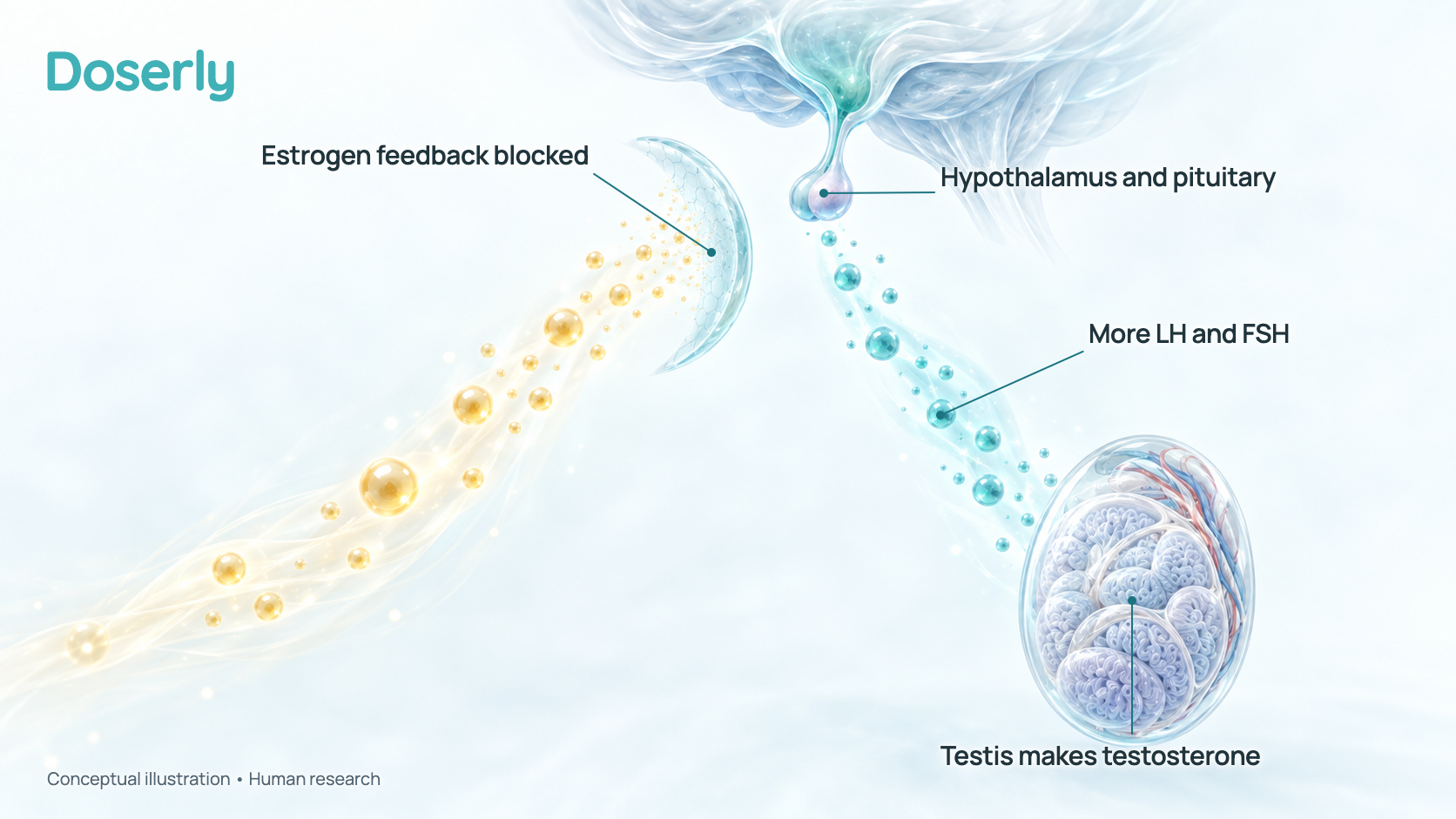
It belongs to a group of medicines called SERMs (selective estrogen receptor modulators). The body uses estradiol, the main estrogen, as a gauge: when the brain senses enough of it, the pituitary gland at the base of the brain turns down its two signals to the testicles, LH (luteinizing hormone) and FSH (follicle-stimulating hormone). Clomiphene sits in the estrogen receptors of the brain and blocks that gauge, so the pituitary releases more LH and FSH. LH tells the testicles to make testosterone, and FSH supports sperm production. [2], [3], [4]
That is the key difference from testosterone replacement therapy (TRT), which supplies testosterone from outside and switches the LH and FSH signals off. Clomiphene turns them up, so it only works when the testicles can still respond. The European urology guideline says SERMs "cannot work" when the testicles themselves fail (primary hypogonadism) or the brain-to-testes chain is damaged, and the British Society for Sexual Medicine (BSSM) says not to use them when pituitary function is compromised. [5], [6]
Two drugs in one tablet. Clomiphene is a mix of two mirror-image forms (isomers): enclomiphene, which blocks estrogen, and zuclomiphene, which acts partly like estrogen and lingers in the body for weeks. The US label says 30–50% of the mix is zuclomiphene. Enclomiphene alone is sold as a separate, unapproved product; see the enclomiphene guide. [1], [7]
Its status for men. The US Food and Drug Administration (FDA) approved clomiphene for ovulation problems in women in 1967. Its label says there are "no adequate or well-controlled studies" showing that it works for male infertility, and the US Department of Veterans Affairs (VA) notes that no long-term, adequately powered randomized trial in men exists. [7], [1], [3]
| Product | Where | Form and strength | Status (checked September 2026) |
|---|---|---|---|
| Clomid and generic clomiphene citrate | United States | 50 mg tablets, scored so they can be halved | Prescription; 16 current labels, including Milophene |
| Serophene | United States | 50 mg tablets | Discontinued |
| Clomifene 50mg Tablets | United Kingdom | 50 mg tablets | Prescription-only medicine |
| Clomid | Australia | 50 mg tablets, scored | Prescription (Schedule 4) |
| Clomid, Serophene | Canada | 50 mg tablets | All cancelled; the last in July 2020 |
[8], [9], [10], [11], [12], [13], [14]
Clomiphene is not a steroid and not a controlled substance in the United States. It is, however, banned in sport, and it is widely used outside medical care as "post-cycle therapy" after anabolic steroids, which this guide describes but does not treat as a protocol. [15], [16], [17]
Typical Clomiphene Protocols
| Source | Amount each time | How often | Weekly total | Adjusted by | Source type |
|---|---|---|---|---|---|
| US label · Clomid and generics, ovulation in women (the only labeled use) | 50 mg, then 100 mg in a later course | Once daily for 5 days per course | Not applicable (5-day courses) | Ovulation response; no dose for men on any label | Label Shown as the anchor only: the label says no adequate or well-controlled studies show it works for male infertility |
| UK label · Clomifene 50mg Tablets, ovulation in women | 50 mg (first course) | Once daily for 5 days | Not applicable | Ovulation response | Label |
| Australian label · Clomid, ovulation in women | 50 mg (first course) | Once daily for 5 days | Not applicable | Ovulation response | Label |
| American Urological Association (AUA) 2018 · alternative to testosterone for low T | 25–50 mg | Every 1–2 days | 87.5–350 mg | Testosterone and LH, first checked no sooner than 4 weeks; a higher dose only if both stay low or normal | Guideline Marked not FDA-approved in men; the only major guideline that prints a male dose |
| US academic care pathway (2023) · low T with low or low-normal LH | 25 mg, raised to 50 mg if testosterone stays below goal | Every other day (daily dosing avoided) | 87.5–175 mg | Labs every 4 weeks until at goal, then every 6 months; dose lowered if estradiol reaches 60 pg/mL | Clinic protocol source Not offered when LH is above 6 IU/mL |
| Dutch hospital cohort (2023) · treated up to 8 years | 25 mg; 50 mg if there is little response | Every other day (daily above 100 kg body weight); daily at 50 mg | 87.5 mg (175 mg above 100 kg); 350 mg at 50 mg daily | Testosterone response; dose lowered for side effects | Clinic protocol source |
The two clinic protocols start at 25 mg every other day and step up to 50 mg every other day (US pathway) or 50 mg daily (Dutch cohort); the AUA lists 25–50 mg every 1–2 days. Trials mostly used 25 mg or 50 mg once a day for 3 to 6 months. [18], [7], [19], [20], [21]
- Titration Adjusting the dose
- The AUA checks testosterone no sooner than 4 weeks after starting and measures LH too. If testosterone is still low and LH is low or normal, the dose goes up. If testosterone is low but LH is high, the testicles are not responding, and a higher dose is unlikely to help. The US academic pathway repeats labs every 4 weeks after each change until testosterone reaches goal, then every 6 months, and lowers the dose when estradiol reaches 60 pg/mL (about 220 pmol/L). [18], [7] See where protocols differ.
- Breaks and cycles
- Not established for men. Studies used continuous treatment for up to 8 years, and no source describes planned cycles. The label's limit of about six courses applies to women's 5-day ovulation courses, not to men. When clomiphene stops, testosterone usually falls back (what happens when you stop). [19], [22], [1]
Read the units. Clomiphene comes only as a 50 mg tablet, so a 25 mg dose means half a tablet (the US and Australian tablets are scored for splitting). "Every other day" works out to about 3.5 doses a week: 25 mg every other day is about 87.5 mg a week, and 50 mg a day is 350 mg a week. There are no millilitres or syringe units to convert, so an injection calculator does not apply. [1], [13]
These are guideline, clinic and trial doses for an off-label use; prescribers adjust them using blood tests (testosterone, LH and estradiol) and symptoms. These guides are for men. Clomiphene's labeled use in women is fertility care outside this guide, and testosterone for women is covered in testosterone therapy for women.
Cautions for every schedule above. Any vision change (blurring, spots or flashes) means stopping and getting a full eye exam, because the labels say such changes can occasionally be permanent. The US label rules clomiphene out with liver disease or a pituitary tumor, the European urology guideline warns of a possible blood-clot risk, and estradiol rises along with testosterone (monitoring). [1], [11], [5]
Where these numbers come from
The label rows come from the US Clomid label (DailyMed version effective January 31, 2025; printed revision August 2023), which the newest US generic label (effective July 16, 2026) matches, the UK Clomifene 50mg Tablets product information (revised June 24, 2024) and the Australian Clomid product information (revised February 26, 2026). All three cover women only; none gives a dose for men. [1], [23], [11], [13]
The guideline row comes from Table 6 of the AUA testosterone deficiency guideline (2018), which lists clomiphene 25–50 mg by mouth every 1–2 days and marks it not FDA-approved in men. The Endocrine Society, European urology, BSSM, Canadian urology and VA guidelines mention clomiphene without a dose. [18], [24], [5], [6], [25], [3]
The clinic rows each come from one published source: a care pathway from a US academic cancer center's men's health program (Flores 2023, full text) and a Dutch university hospital cohort (Huijben 2023, full text). The study rows in the next table each come from one trial or clinic study. Weekly totals are simple multiplications; the sources do not state them. [7], [19]
Not used for any row: the 50 mg for 12 weeks in one placebo trial (the abstract gives no frequency), a 1980s fertility schedule of 3 weeks on and 1 week off, a 40-day "test course" used to study stopping, and every post-cycle or steroid-recovery schedule, including the ones people describe online. The European Academy of Andrology says clomiphene should not be used to hasten recovery after anabolic steroids. [26], [27], [28], [29]
What doses did studies in men use?
| Study | Amount each time | How often | Weekly total | Course | Source type |
|---|---|---|---|---|---|
| Helo 2015 · 26 infertile men with low T and normal LH, randomized against anastrozole | 25 mg | Once daily | 175 mg | 12 weeks | Human trial |
| Pelusi 2017 · 24 men with obesity and prediabetes or diabetes, placebo crossover | 25 mg | Once daily | 175 mg | 3 months | Human trial |
| World Health Organization 1992 · 190 couples with unexplained male infertility, placebo-controlled | 25 mg | Once daily | 175 mg | 6 months | Human trial No pregnancy benefit ([fertility](#fertility)) |
| Shukla 2025 · 50 men with low sperm counts and normal testosterone, placebo-controlled | 50 mg | Once daily | 350 mg | 3 months | Human trial |
| Taylor 2010 · 65 men compared with men on testosterone gel | 50 mg | Every other day | 175 mg | Average follow-up 23 months | Human report |
| Da Ros 2012 · 125 older men with low libido | 25 mg | Once daily | 175 mg | At least 3 months | Human report |
| Anno 2026 · 54 men with symptoms of low T (Japan) | 50 mg | Every other day | 175 mg | Up to 1 year | Human report |
| Pozzi 2026 · 166 men with low T and low sperm counts (Italy) | 50 mg | Once daily | 350 mg | At least 3 months | Human report |
The rows are alternatives, not steps to move through. Most used daily dosing, which the US academic pathway avoids. [7]
What is clomiphene commonly used for in men?
Every use in men is off-label. Guidelines allow clomiphene as an option in a few situations, and none recommends it over testosterone for men who do not care about fertility. The AUA adds a warning that matters for every use below: the benefits proven for testosterone therapy "cannot be extrapolated" to alternatives such as clomiphene. [18], [2]
- Low testosterone with low or normal LH, when fertility matters. This is its main role in guidelines. The US infertility guideline says clinicians may use SERMs, hCG, aromatase inhibitors or a combination in infertile men with low testosterone, and should not prescribe testosterone to men who want children now or later. [2]
- Low testosterone linked to obesity. Several trials in men with obesity, often alongside advice to lose weight first. [26], [21]
- Male infertility with normal testosterone. Common in fertility clinics, but the evidence for pregnancies is weak. [36], [30]
- Restarting your own production after TRT or anabolic steroids. Widely discussed; the evidence mostly comes from combinations with hCG. [37], [29]
Can clomiphene raise testosterone instead of TRT?
Yes, in men whose testicles and pituitary work, but the evidence is mostly about blood levels, not how men feel. A 2025 meta-analysis of randomized trials found that clomiphene or enclomiphene raised total testosterone by about 274 ng/dL (about 9.5 nmol/L) more than placebo, similar to testosterone gel, while also raising LH and FSH. A 2026 meta-analysis of 11 studies and 1,512 men found testosterone levels on clomiphene similar to gel, but libido scores improved less than on testosterone therapy. [4], [38]
In clinic studies, levels often roughly double: in a Dutch hospital cohort of 153 men, average testosterone rose from 9 to 16 nmol/L (about 260 to 460 ng/dL), and the rise lasted up to 8 years in men who stayed on it. [19]
Guidelines are cautious. The Endocrine Society says neither its efficacy nor its safety has been shown in randomized trials, the VA considers it only case by case for men with low LH who want fertility, and the European urology guideline calls the evidence poor. For the symptom evidence, see can testosterone rise without feeling better? [24], [3], [5]
Does clomiphene help fertility?
It helps sperm counts in some men, but no trial has shown that it leads to more pregnancies. It raises FSH, which drives sperm production, instead of switching it off the way testosterone does. The results in men with fertility problems are mixed:
- The largest placebo-controlled trial found no benefit. In a World Health Organization trial of 190 couples, men took 25 mg a day or a placebo for 6 months; pregnancies by 8 months were 8.1% on clomiphene and 11.7% on placebo, and semen quality did not change. [30]
- Reviews disagree. A 2013 meta-analysis of 11 randomized trials that pooled clomiphene and tamoxifen found more pregnancies (odds ratio 2.42; its abstract gives no absolute pregnancy rates), an older Cochrane review found no clear difference and was later withdrawn, and a 2025 review concluded the effect on pregnancy "remains uncertain". [39], [40], [41]
- Sperm counts rise on average. A 2023 meta-analysis found sperm concentration about 8.4 million per mL higher during treatment, mostly in uncontrolled before-and-after studies, and a 2025 network analysis found 25 mg every other day gave the biggest rise in concentration, though nothing improved sperm movement. In a small placebo-controlled trial of 50 men, 50 mg a day raised sperm counts. [42], [43], [31]
- Counts can also fall. In 166 Italian men with low testosterone and low sperm counts, clomiphene normalized testosterone in 91%, but sperm concentration fell in 29%. A normal testosterone result does not tell you what is happening to sperm. [35]
Guidelines reflect this. For infertile men with low testosterone, the US infertility guideline allows SERMs among other options (Conditional recommendation; Grade C evidence). For unexplained infertility with normal hormones, the European urology guideline says not to use SERMs routinely. [2], [36]
A small trial of clomiphene plus vitamin E reported 11 pregnancies among 30 couples against 4 of 30 on placebo, but the combination hides clomiphene's own effect. [44] In 496 men with no sperm who were heading for surgical sperm retrieval and were given clomiphene (with hCG or hMG added when hormones did not rise enough), 54 (about 11%) had sperm appear in the ejaculate, in a study without random assignment. [45]
See TRT and fertility for the full picture, including sperm banking and recovery after TRT.
Does clomiphene help low testosterone linked to weight?
It raises testosterone in men with obesity, but weight loss comes first in guidelines, and the symptom gains are small. In a placebo-controlled trial of 78 men with obesity, 12 weeks of 50 mg raised testosterone, estradiol, LH and FSH, increased lean mass, and improved one sexual complaint (weaker erections), but it lowered HDL ("good") cholesterol. In a crossover trial of men with obesity and prediabetes or diabetes on metformin, 25 mg a day raised testosterone from 3.03 to 5.99 ng/mL (about 300 to 600 ng/dL) over 3 months, while placebo changed little; a follow-up analysis found no clear benefit for sexual function. [26], [21], [46]
A 2023 meta-analysis of men with obesity found clomiphene raised testosterone by about 11.6 nmol/L in short courses, and a 2026 network analysis of 23 trials found no single treatment clearly best for obesity-related low testosterone. See obesity-related hypogonadism. [47], [48]
Is clomiphene used after stopping TRT or steroids?
Often, but there is no controlled trial of clomiphene alone for this, and the recovery evidence comes mostly from hCG-based combinations. In 66 men treated with hCG plus a SERM after testosterone use, 70% reached a total motile sperm count above 5 million within 12 months; older men and men who had used testosterone longer recovered more slowly. In one reported case, clomiphene alone did not restore sperm counts after long-term injections of testosterone undecanoate. [37], [49]
After anabolic steroids, the advice is firmer. The European Academy of Andrology says clomiphene or hCG "should not be used" to hasten recovery, because there is not enough evidence that they work, and the European urology guideline puts stopping the steroid first, with sperm usually improving over 6 to 12 months. In men with steroid-related azoospermia (no sperm) treated with clomiphene plus hCG, 27.8% of those followed still had no sperm after 6 months. A pilot study of clomiphene after steroid use has published its plan but no results. [29], [36], [50], [51]
Post-cycle schedules are not protocols, and this guide does not give any. See stopping TRT and TRT vs steroids.
Where do clomiphene protocols differ?
Clomiphene dosing in men is, in the words of the US academic pathway, "empiric": it grew out of clinic experience, not dose-finding trials, which leaves real disagreements. [7]
Every other day or daily?
The US academic pathway prefers every other day; the AUA allows every 1–2 days, and most trials used daily dosing. The pathway starts at 25 mg every other day, goes up to 50 mg every other day, and "typically" avoids daily dosing because of a worry that the drug stops working over time (tachyphylaxis, below). The Dutch cohort also started every other day, but raised the dose to 50 mg daily when the response was small. No trial has compared schedules directly. [7], [18], [19]
Zuclomiphene, the lingering half of the tablet, is one reason people argue for less frequent dosing: in 15 men on 25 mg a day for about 2 years, blood levels of zuclomiphene were 20 times those of enclomiphene. Whether that build-up causes side effects has not been shown (two drugs in one). [52]
Start at 25 mg or 50 mg?
Both are used. The US academic pathway and the Dutch cohort start at 25 mg every other day. In the records of 332 men treated at two US fertility centers, 50% started on 50 mg every other day, 27% on 25 mg every other day, 18% on 50 mg daily and 5% on 25 mg daily. [7], [19], [53]
Who is likely to respond? The LH question
Men with low or normal LH respond more often in some studies, but not in all. The US academic pathway does not offer clomiphene when LH is above 6 IU/mL, because a high LH suggests the testicles are the problem. Its earlier study of 76 men found that an LH of 6 or lower (hazard ratio 3.5) and larger testicles predicted a response, and its 2026 study of 292 men found each 1-unit rise in baseline LH lowered the odds of responding (odds ratio 0.82). [7], [54], [55]
In 332 younger men at fertility centers, however, baseline LH and FSH did not predict the rise in testosterone. [53] In 69 young men with obesity on 25 mg every other day, median testosterone rose from 226 to 389 ng/dL; lower LH and FSH and a younger age went with a bigger rise, while the starting estradiol level made no difference. [56]
The AUA uses LH differently: it looks at LH after starting, and a high LH with a still-low testosterone means the testicles are not responding. [18]
What counts as success?
Response rates depend on how a study defines success, how old the men were and how long they were followed, which is why published figures range from under half to nearly 9 in 10.
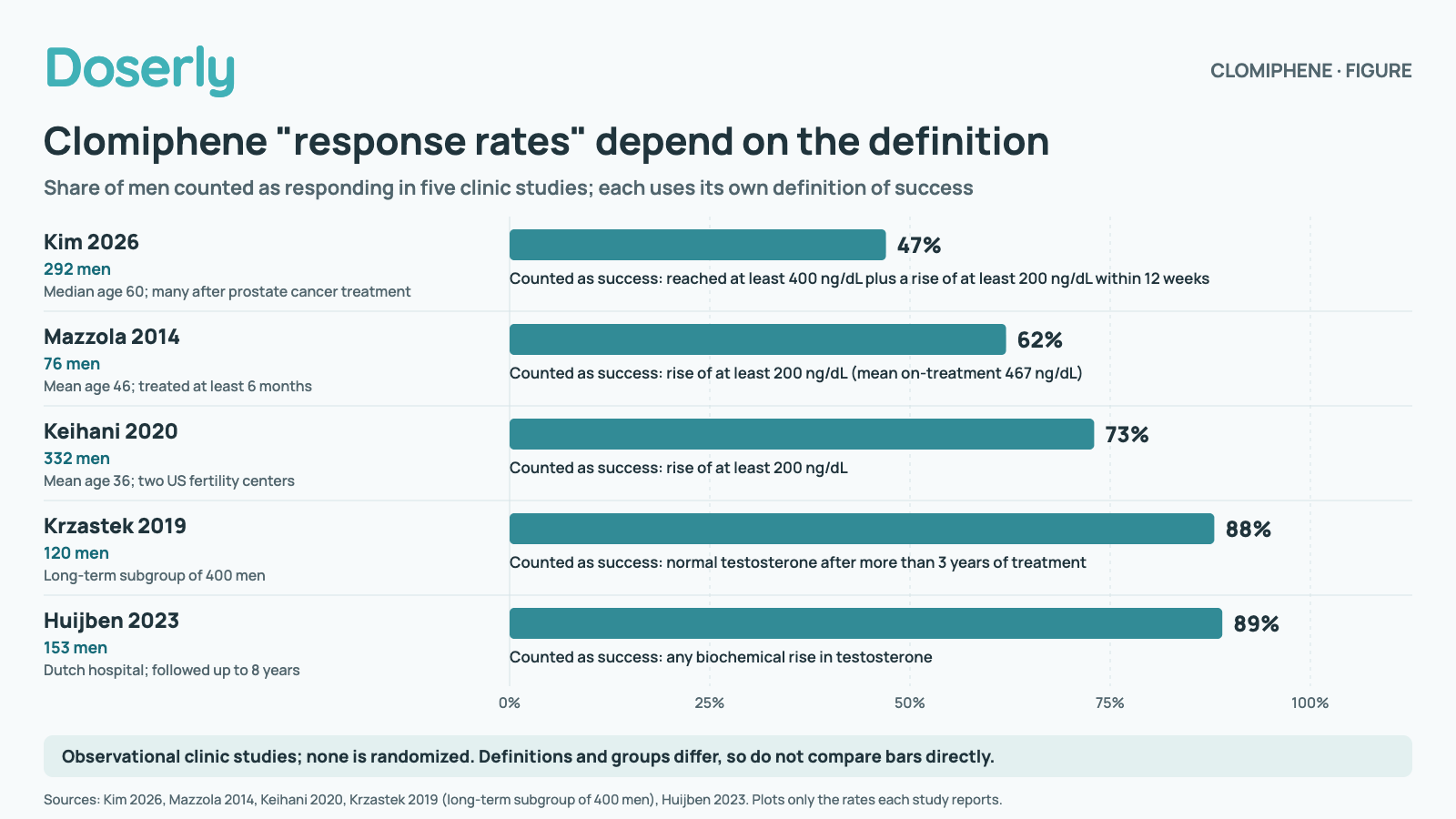
Clomiphene "response rates" depend on the definition
Share of men counted as responding in five clinic studies. Bars run from 0 to 100% of men.
- Kim 2026 (292 men): 47%
- Counted as success: reached at least 400 ng/dL plus a rise of at least 200 ng/dL within 12 weeks. Median age 60; many after prostate cancer treatment.
- Mazzola 2014 (76 men): 62%
- Counted as success: rise of at least 200 ng/dL (mean on-treatment 467 ng/dL). Mean age 46; treated at least 6 months.
- Keihani 2020 (332 men): 73%
- Counted as success: rise of at least 200 ng/dL. Mean age 36; two US fertility centers.
- Krzastek 2019 (120 men): 88%
- Counted as success: normal testosterone after more than 3 years of treatment. Long-term subgroup of 400 men.
- Huijben 2023 (153 men): 89%
- Counted as success: any biochemical rise in testosterone. Dutch hospital; followed up to 8 years.
Observational clinic studies; none is randomized. Definitions and groups differ, so do not compare bars directly.
- 47% of 292 mostly older men (median age 60, many after prostate cancer treatment) reached at least 400 ng/dL plus a 200 ng/dL rise within 12 weeks. [55]
- 62% of 76 men rose by at least 200 ng/dL, to an average of 467 ng/dL. [54]
- 73% of 332 younger men rose by at least 200 ng/dL. [53]
- 88% of 120 men treated for more than 3 years had normal testosterone. [22]
- 89% of 153 men had some rise in testosterone. [19]
High estradiol: lower the dose or add an aromatase inhibitor?
Estradiol rises on clomiphene, and sources handle it differently. The US academic pathway aims for estradiol of 20–40 pg/mL (about 73–147 pmol/L) and first lowers the clomiphene dose when it reaches 60 pg/mL or more, which it says usually normalizes the level; some men also get an aromatase inhibitor. In one US fertility practice, 97 of 318 men on clomiphene (30.5%) later had anastrozole added, more often when they had obesity or a higher starting estradiol. [7], [57]
The VA does not generally recommend aromatase inhibitors for men, citing heart events, belly fat and bone loss. In the only randomized comparison, clomiphene raised testosterone more than anastrozole did, while estradiol rose on clomiphene and fell on anastrozole; semen and symptom scores did not differ. See anastrozole and estrogen on TRT. [3], [20]
Does clomiphene stop working over time?
Nobody has measured how often. The US academic pathway says "about 1 in 10" of its patients meet its definition of tachyphylaxis (a fading response), but that is a clinical impression without a count, and the same paper notes there is no standard definition and that most data are case reports. The AUA calls the concern "anecdotal" and advises checking testosterone regularly. The long-term cohorts point the other way on average: 88% of men treated for more than 3 years had normal testosterone, and in the Dutch cohort the rise lasted up to 8 years in men who stayed on it. [7], [18], [22], [19]
Can clomiphene be taken with TRT?
It is sometimes prescribed alongside testosterone, but there is no controlled evidence that it protects fertility during TRT. Outside testosterone switches off LH and FSH at the pituitary, which is the very signal clomiphene is meant to raise. The US infertility guideline calls the evidence for adding hCG, SERMs or FSH to testosterone too limited to recommend. In one large UK clinic cohort, 8% of men were prescribed clomiphene with testosterone, while clomiphene alone raised LH and FSH over 6 months. [2], [58] See TRT and fertility.
What happens when you stop clomiphene?
For most men, testosterone falls back toward where it started, because clomiphene boosts the body's own signal rather than fixing its cause. [19], [28]
- During a planned break. In the Dutch cohort, 52 men stopped for a trial period, and testosterone fell in 48 of them (94%), from an average of 19.1 to 10.8 nmol/L (about 550 to 310 ng/dL). [19]
- After a short course. In 75 men given 50 mg a day for 40 days, 18 (24%) still had testosterone above 300 ng/dL and no symptoms 6 months after stopping; the authors concluded that most men need ongoing treatment. [28]
- Many stop anyway. A third of the Dutch cohort stopped in the first year, most often because they felt too little effect. In US insurance claims for 12,318 men, the median time on clomiphene was 3.6 months, and 63% stopped within 6 months. [19], [59]
- The drug lingers. Zuclomiphene stays in the blood for more than a month after a single dose, and after 30 days of 50 mg a day it was detectable in urine for 121 to more than 261 days. No study has timed how quickly side effects fade after stopping. [1], [60], [61]
- No taper. No source describes tapering clomiphene off.
See stopping TRT for the wider picture, including restarting your own production.
How does clomiphene behave in the body?
It is a tablet swallowed with water, so there is no injection, no skin gel that can transfer to a partner, and no peak-and-trough cycle like injected testosterone. What sets clomiphene apart is how slowly it leaves the body and the fact that it contains two different drugs. [1]
How long does clomiphene last in the body?
A long time. The AUA's table gives a peak about 5 hours after a dose and a half-life of 5–7 days. In the label's study with a radioactive tracer, about half of an oral dose left the body within 5 days, mostly in the feces, and traces were still found 6 weeks later. Zuclomiphene has a longer half-life than enclomiphene and stayed detectable for more than a month after a single dose. [18], [1], [60]
No study has tested whether food changes absorption, and no pharmacokinetic study has been done in men with low testosterone.
Why does it matter that clomiphene is two drugs in one?
Enclomiphene blocks estrogen receptors; zuclomiphene acts partly like estrogen and builds up. In men on long-term 25 mg daily, median blood levels were 44.0 ng/mL of zuclomiphene against 2.2 ng/mL of enclomiphene, a 20-to-1 ratio (several authors of that study worked for a company developing enclomiphene). [52], [7]
Whether zuclomiphene causes clomiphene's mood or estrogen-like side effects is a hypothesis, not a finding. In one observational study of 66 men who switched from clomiphene to enclomiphene, estradiol rose less and side effects were less common on enclomiphene. See enclomiphene. [62]
Does your genetic makeup change how clomiphene works?
Possibly. The liver enzyme CYP2D6 turns clomiphene into its most active forms, and in healthy volunteers, gene variants of that enzyme changed levels of the active forms several-fold. No study has linked this to how men respond, and no guideline tests for it. [63], [64]
What testosterone levels does clomiphene reach compared with gel and injections?
About the same as gel and well below injections. In an age-matched comparison of 31 men per group, median testosterone rose from 247 to 504 ng/dL on clomiphene, from 230 to 412 on gel, and from 224 to over 1,000 on injections (the abstract prints the final injection value as both 1,104 and 1,014). In another clinic comparison, average testosterone was 573 ng/dL on clomiphene 50 mg every other day and 553 on gel. The 2026 meta-analysis found no overall difference from gel, with injections higher. [65], [32], [38]
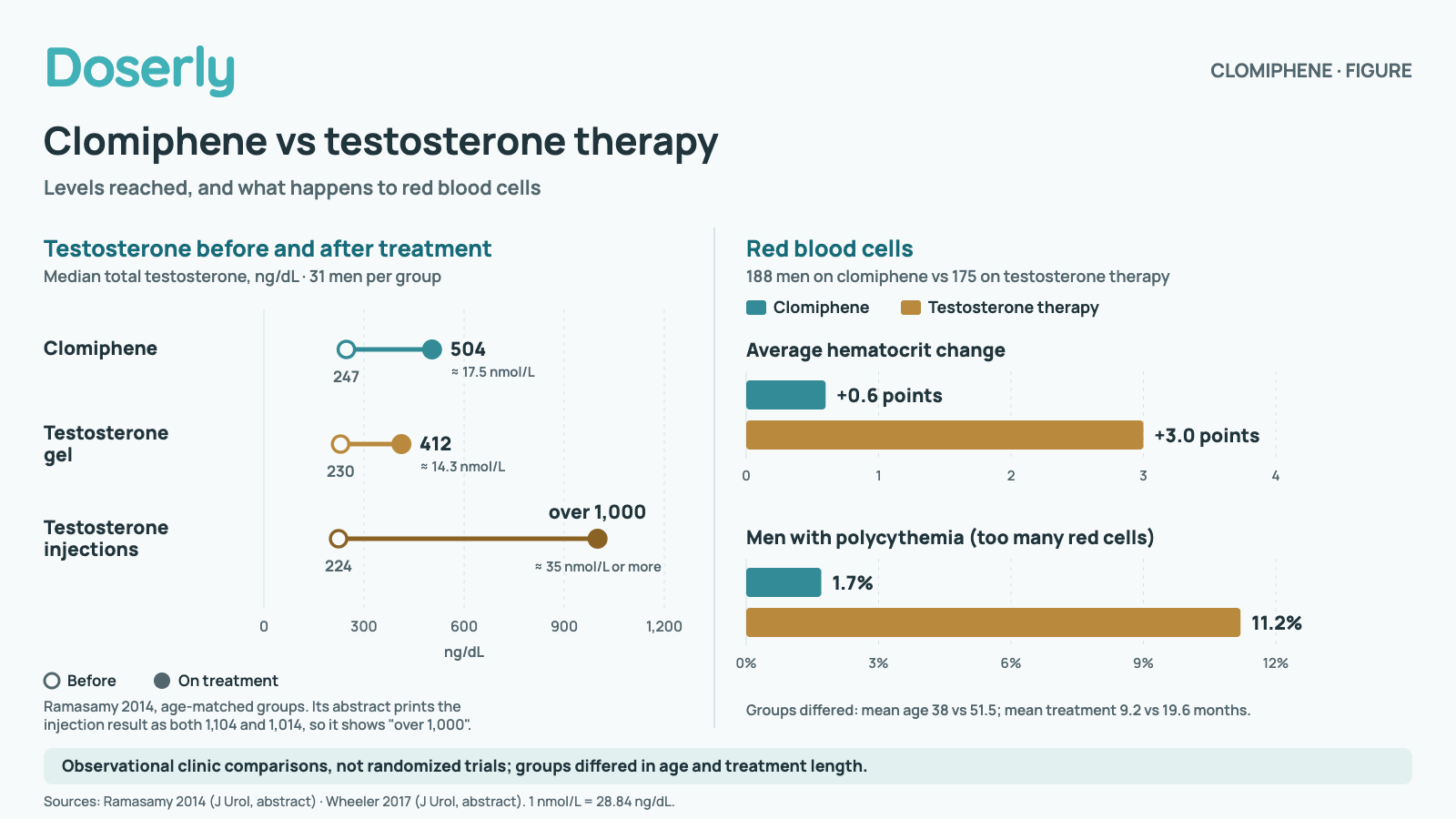
Clomiphene vs testosterone therapy
Testosterone before and after treatment
Median total testosterone, 31 men per group (Ramasamy 2014). Bars run from 0 to 1,200 ng/dL; the paler part is the starting level. The injection bar stops at 1,000 because the study abstract prints both 1,104 and 1,014.
- Clomiphene
- 247 → 504 ng/dL (about 17.5 nmol/L)
- Testosterone gel
- 230 → 412 ng/dL (about 14.3 nmol/L)
- Testosterone injections
- 224 → over 1,000 ng/dL (about 35 nmol/L or more)
Red blood cells
188 men on clomiphene vs 175 on testosterone therapy (Wheeler 2017).
ClomipheneTestosterone therapy
- Average hematocrit change
- +0.6 vs +3.0 percentage points
- Men with polycythemia (too many red cells)
- 1.7% vs 11.2%
Groups differed: mean age 38 vs 51.5; mean treatment 9.2 vs 19.6 months.
Observational clinic comparisons, not randomized trials; groups differed in age and treatment length.
How should clomiphene be stored?
Store tablets at room temperature in a closed container, away from heat, light and moisture. Each product sets its own range, so the label on your pack is the final word. The labels give no separate in-use period for opened packs, so use the tablets by the expiry date on the pack. [1], [16]
| Product | Storage |
|---|---|
| Clomid (US) and the Camber generic | 15–30 °C; protect from heat, light and excessive humidity; closed container |
| ANI generic (US) | 20–25 °C, with short excursions to 15–30 °C allowed |
| Clomifene 50mg Tablets (UK) | Do not store above 25 °C; keep in the original packaging |
| Clomid (Australia) | Below 30 °C |
The UK tablets contain lactose, and the US Clomid tablets contain lactose and sucrose, which matters for people who must avoid them. For carrying tablets on a trip, see traveling with testosterone. [11], [1]
What does clomiphene do to fertility, estrogen and red blood cells?
These three effects are where clomiphene differs most from testosterone therapy. Each has its own hub guide; here is what is specific to clomiphene.
Fertility. Clomiphene raises FSH instead of switching it off, so it does not shut down sperm production the way testosterone does; in a large UK clinic cohort, men on clomiphene alone had higher LH and FSH at 6 months. It is not a guarantee, though (fertility evidence). See TRT and fertility. [58]
Estrogen. Estradiol rises along with testosterone, because some testosterone is converted into estradiol. In men on long-term 25 mg a day, median estradiol rose from 17 to 34 pg/mL (about 62 to 125 pmol/L), and in a Canadian fertility cohort it rose by 53.9 pmol/L (about 15 pg/mL). No guideline sets an estradiol target for men on clomiphene (how sources handle it). See estrogen on TRT. [52], [66]
Red blood cells. Hematocrit, the share of blood made of red cells, barely moves. In a multi-clinic comparison, hematocrit rose by an average of 0.6 percentage points on clomiphene against 3.0 on testosterone therapy, and polycythemia (too many red cells) affected 1.7% of 188 men on clomiphene against 11.2% of 175 on testosterone; the clomiphene group was younger and treated for a shorter time. In a VA records study of 2,518 matched pairs, coded polycythemia was 1.07% on clomiphene and 2.22% on testosterone. Low is not zero. One case report describes a man switched from testosterone injections to clomiphene after his red cell count rose too high, with normal free testosterone restored. See hematocrit on TRT. [67], [68], [69]
What do we actually know about clomiphene in people?
That clomiphene raises testosterone, LH and FSH in men with working testicles is settled; randomized trials show it consistently. Whether that makes men feel better is far less certain, and there is no long-term randomized trial in men at all. [4], [3]
Which placebo-controlled trials have tested clomiphene in men?
| Study | Who and what | What it found | What it cannot show |
|---|---|---|---|
| Guay 1995 (crossover trial) | 17 men with erectile dysfunction and secondary hypogonadism (low testosterone from too little LH); clomiphene and placebo for 2 months each | LH, FSH and testosterone rose; erections did not improve, except some measures in younger, healthier men | Longer use; very small [70] |
| Soares 2018 (controlled trial) | 78 men with obesity; 50 mg or placebo for 12 weeks | Hormones and lean mass rose; one sexual complaint (weaker erections) improved; HDL cholesterol fell | Long-term effects [26] |
| Pelusi 2017 and 2022 (crossover) | 24 men with obesity and prediabetes or diabetes on metformin; 25 mg a day or placebo for 3 months each | Testosterone roughly doubled; no clear sexual-function benefit | Men without diabetes; very small [21], [46] |
| WHO 1992 (controlled trial) | 190 couples with unexplained male infertility; 25 mg a day or placebo for 6 months | No more pregnancies (8.1% vs 11.7%); semen unchanged | Men with low testosterone [30] |
| Shukla 2025 (controlled trial) | 50 men with low sperm counts and normal testosterone; 50 mg a day or placebo for 3 months | Sperm count 9.2 to 13.9 million/mL; testosterone 372 to 806 ng/dL | Pregnancies [31] |
Two active-comparison trials add to this: clomiphene raised testosterone more than anastrozole in 26 infertile men over 12 weeks, and in 282 men who wanted to keep fertility, clomiphene, hCG and both together raised testosterone similarly over 3 months, with symptom scores improving most on the combination. [20], [71]
Can testosterone rise without feeling better?
Yes, and this is the most important thing to know about clomiphene. The placebo-controlled trials above mostly found no clear gain in sexual function, and a 2020 review concluded that clomiphene and tamoxifen "should not be used in routine clinical practice" to treat sexual symptoms in men whose low testosterone comes from the brain or pituitary. [70], [46], [72]
Uncontrolled clinic studies are more positive, which is what you would expect without a placebo group: 75% of 178 men said sexual function improved, 67% of 18 men in an endocrinology series felt better, and 74% of the Dutch cohort reported fewer symptoms. But measured scores tell a mixed story even there. In a Japanese cohort, an overall symptom score improved while the sexual-function score did not, and in a US cohort of 77 men, a general symptom questionnaire improved while an erection score did not. [73], [74], [19], [34], [75]
Compared with testosterone therapy, libido does worse:
- The 2026 meta-analysis found lower libido scores on clomiphene than on TRT (3 studies, 199 men). [38]
- In an age-matched comparison, overall satisfaction was similar, but men on injections reported more libido. [65]
- In a small prospective study, the libido score fell on clomiphene (from 3.75 to 3.2) while symptoms improved overall. [76]
- Of 41 men who switched from clomiphene to nasal testosterone because of low libido, 38 reported better libido at similar testosterone levels, with lower estradiol. That group was selected for being unhappy on clomiphene. [77]
Why this happens is not known. Proposed explanations include the rise in estradiol, zuclomiphene's estrogen-like effects and clomiphene's blocking of estrogen receptors in the brain; none has been tested directly. The practical point: a good testosterone number on clomiphene is not proof of benefit, so symptoms deserve their own record.
What do the long-term studies show?
- Krzastek 2019: 400 men, 120 of them treated for more than 3 years (up to 7). Of the long-term group, 88% had normal testosterone, 77% reported better symptoms and 8% reported side effects; no serious adverse events. [22]
- Huijben 2023: 153 men in a Dutch hospital, followed up to 8 years. Testosterone rose from 9 to 16 nmol/L; 10% reported side effects; 33% stopped in the first year. [19]
- Moskovic 2012: 46 men with testosterone of 612, 562 and 582 ng/dL at 1, 2 and 3 years, and improved bone density scores. [78]
- Katz 2012: 86 young men (average age 29); testosterone and gonadotropins rose, and 70% were on 25 mg every other day at their last visit. [79]
All four are clinic records without a comparison group, so they show what happened to men who stayed on clomiphene, not what it would do for everyone.
What do the big records studies show?
In US insurance claims for 12,318 men prescribed clomiphene, 52% had a male-infertility diagnosis and no clear rise in reported side effects appeared. A 2026 VA study of 2,518 matched pairs of veterans found lower coded rates on clomiphene than on testosterone for polycythemia (1.07% vs 2.22%), new high blood pressure (6.04% vs 10.48%) and stroke (0.52% vs 1.43%), but also far fewer deaths (1.83% vs 10.13%), a gap too large to be a drug effect, which shows how differently the groups were chosen. Records studies like this cannot show which treatment is safer for the heart; for testosterone's randomized heart data (the TRAVERSE trial), see blood clots and heart events. [59], [68]
How does clomiphene work?
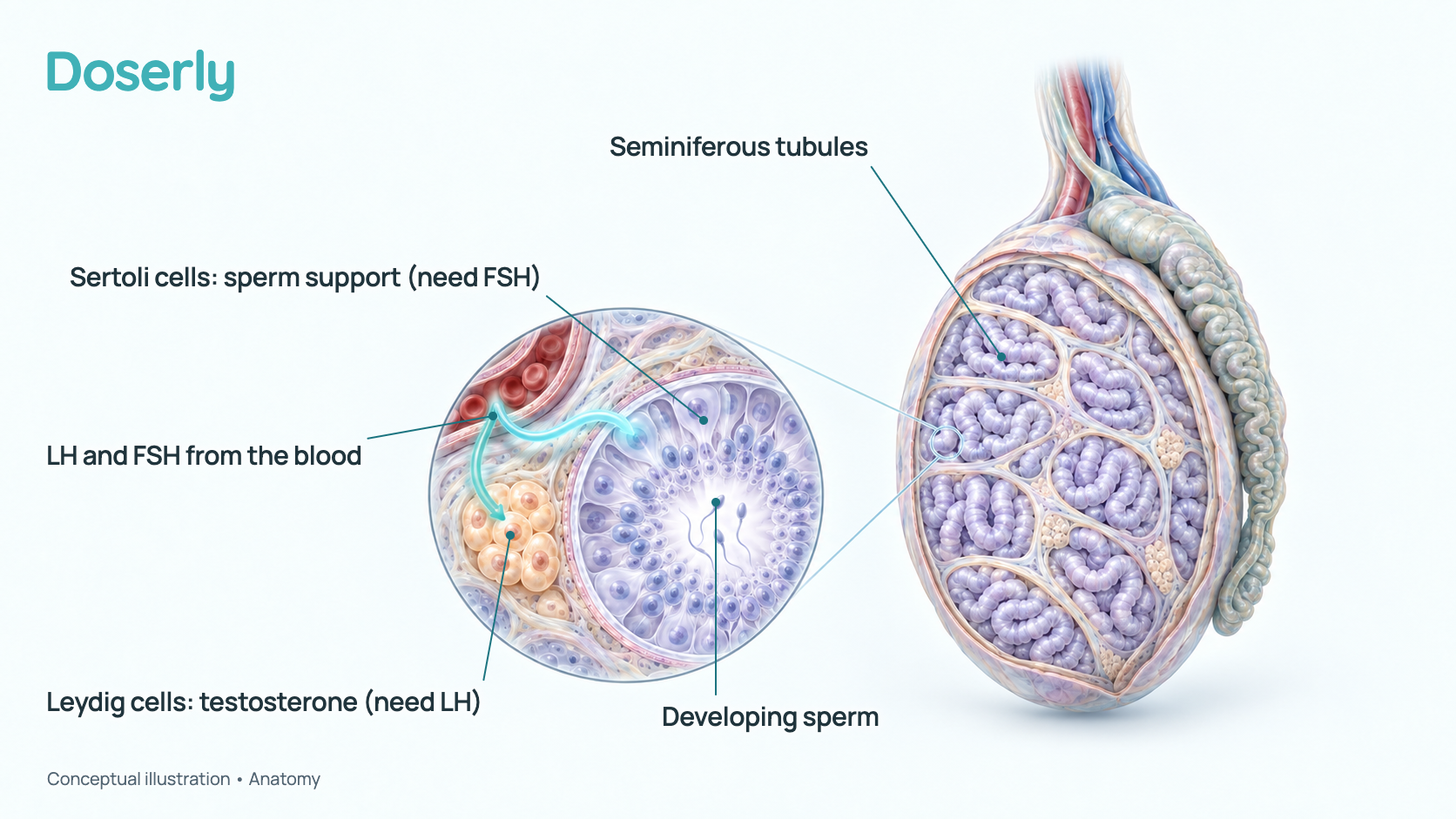
In men, clomiphene works through the brain rather than the testicles. It competes with estrogen for the estrogen receptors in the hypothalamus and pituitary. With the estrogen signal blocked, the hypothalamus releases more GnRH, the pituitary releases more LH and FSH, the Leydig cells in the testicles make more testosterone, and FSH acts on the Sertoli cells that support sperm. In a 2025 review of randomized trials of clomiphene and enclomiphene, LH was about 4.7 IU/L higher and FSH about 4.6 IU/L higher than on placebo. [2], [3], [4]
Why it needs a working system. Every step depends on the one before it. If the testicles cannot respond (usually with a high LH already) or the pituitary is damaged, raising the signal does nothing useful. [5], [6]
Why estradiol rises. Clomiphene blocks estrogen's action in the brain, not its production. More testosterone means more conversion to estradiol by the enzyme aromatase, so blood estradiol goes up. [52], [20]
A new signal. In a small 2025 study, IGF-1, a marker of growth hormone activity, fell in 15 of 20 men on clomiphene, and in 2 it fell well below the normal range for their age. What that means for health is not known. [80]
What are the risks and unanswered questions?
Is clomiphene safe?
In the published studies, side effects were uncommon and mild, but the evidence has real gaps. Pooled studies report side effects in fewer than 10% of men and no serious adverse events. Missing are a long-term randomized trial in men, rates for rare harms such as clots, and a clear picture of the mood and sexual effects men describe online. [81], [22], [19], [3]
What side effects are reported in men?
The US label's side-effect table comes from 8,029 women taking short ovulation courses, so it says little about men. [1] In men, the counts come from clinic cohorts:
- Dutch cohort (153 men): side effects in 16 (10%): hot flushes 5, agitation 4, visual changes 2, nipple tenderness 2 and mood change 1. [19]
- Long-term US cohort (120 men on it for more than 3 years): mood changes 5, blurred vision 3 and breast tenderness 2. [22]
- Reviews also list headache, dizziness, breast growth (gynecomastia) and worsening of existing psychiatric illness. [82]
The UK product information adds anxiety, depression, mood swings, irritability, nervousness and insomnia, all with frequency not known, and very rare hair thinning. [11]
Can clomiphene cause vision problems?
Yes. Vision changes are uncommon but are the labels' main warning, and they can occasionally be permanent. The US label describes blurring, spots or flashes that become more common with a higher total dose or longer use, and says they are usually reversible, but prolonged cases have been reported, some starting after clomiphene was stopped, and some may be irreversible. The UK label adds that symptoms often appear in bright light, can make driving riskier, and rule out further use in anyone who has had a clomiphene-related vision disorder. Both labels say to stop at once and have a full eye exam. [1], [11]
Male studies record visual changes in 2 of 153 and blurred vision in 3 of 120 men. Case reports in men include sudden vision loss from optic nerve damage after 2 weeks of 100 mg a day, and a blocked retinal vein in a man carrying the clotting gene variant factor V Leiden. [19], [22], [83], [84]
Can clomiphene affect mood and sleep?
Yes, in some men, though no trial in men gives a rate. Mood change was the most common side effect in the long-term US cohort and agitation the second most common in the Dutch cohort, the UK label lists anxiety, depression, mood swings and insomnia, and one case report describes mania in a man with a psychiatric history after 6 months of 25 mg a day. Mood and sleep complaints are also the most common theme in public forums (community reports). People with a history of depression, anxiety or bipolar disorder have a reason to discuss this before starting. Both the US and UK labels also list rare psychotic reactions from reports after approval, without a rate. [22], [19], [11], [85], [1]
Does clomiphene cause blood clots?
Rarely, as far as anyone knows, but no rate exists for men. The European urology guideline says SERMs "could predispose" men to clots in the veins (venous thromboembolism) and that patients should be warned, although data are lacking. Case reports in men describe a lung clot after 2 years of treatment for low testosterone, a clot in the veins of the brain after 3 weeks, and the retinal vein blockage above; in the Dutch cohort, one man with a past leg clot developed a lung clot in his fourth year. A "less than 1%" figure sometimes quoted rests on a single case report. [5], [86], [87], [84], [19], [7]
The labels themselves list clot-related events from reports after approval, with no rate and no split by sex. The US label lists pulmonary embolism (a clot in the lungs), thrombophlebitis (vein inflammation with a clot), stroke and retinal thrombosis (a clot in the eye), and the UK label lists stroke and cerebral thrombosis (a clot in the brain). [1], [11]
For comparison, the European regulator counted 4 clot-related events among 1,403 men who took enclomiphene in its trials (one leg vein clot with a lung clot, two leg vein clots and one fatal stroke, all in men with other risk factors), against 1 heart attack on placebo and none on testosterone. The report text does not give the size of the placebo and testosterone groups. The events were one of the reasons it refused approval. [88]
Testosterone has its own randomized heart evidence. TRAVERSE compared daily testosterone gel with placebo gel in about 5,200 men aged 45 to 80 with low testosterone and existing heart disease or high heart risk (2,596 men on testosterone, 2,602 on placebo). Heart attack, stroke or heart death occurred in 7.0% on testosterone and 7.3% on placebo (hazard ratio 0.96, a measure of relative risk), meeting its safety margin, while atrial fibrillation (3.5% vs 2.4%), acute kidney injury (2.3% vs 1.5%) and lung clots (0.9% vs 0.5%) were more common on testosterone. It tested only a gel, men used it for 21.7 months on average and about 61% stopped early. Clomiphene has no comparable trial, so these results do not transfer to it. See TRT and heart health. [89], [90]
What about bone, cholesterol and the testicles?
- Bone. Results conflict. Bone density scores improved over 3 years in one cohort, the US academic pathway saw no change at 3 years with scans every 2 years, but spine density fell in 21 younger men on clomiphene or anastrozole (the study pooled the two). The European urology guideline says long-term SERM use can reduce bone density. [78], [7], [91], [5]
- Cholesterol. HDL cholesterol fell against placebo in the 12-week trial in men with obesity. [26]
- Testicular tumors. The US label notes testicular tumors reported in men and says the cause is not known. One 1985 report found 2 tumors among 650 men treated for low sperm counts; cause and effect were never established. [1], [27]
Is clomiphene legal? Is it FDA approved?
Checked September 2026. Rules differ by country and change often.
United States. Clomiphene is FDA-approved for ovulation problems in women (since 1967) and prescription-only. It is not on the Drug Enforcement Administration's controlled-substance list, and DailyMed lists it with no DEA schedule. Current products are generics and Clomid, now sold under a generic application; Serophene is discontinued. Prescribing it to men is legal off-label use. FDA's shortage data list no clomiphene shortage. [7], [15], [16], [9], [10], [92]
Canada. No clomiphene product is marketed. All four products ever listed, including Clomid and Serophene, are cancelled; the last, Clomid, on July 15, 2020. [14]
United Kingdom. Clomifene is a prescription-only medicine licensed for ovulation problems in women; the only current product information on the UK medicines compendium is for a generic 50 mg tablet. [11], [12]
Australia. Clomid is a Schedule 4 (prescription-only) medicine. The national subsidy scheme (PBS) covers it only for women's infertility and IVF, at a full price of A$35.38 for 10 tablets and a general patient charge of A$25.00. [13], [93]
European Union. Rules are national, and member states were not checked for this guide. The European Medicines Agency refused approval for enclomiphene in 2018. [94] See TRT in Europe.
A "research use only" label on clomiphene sold online does not make it legal, tested or the same as a licensed product.
Is clomiphene banned in sport? Does it show up on a drug test?
Yes. Clomifene is named in class S4.2 (anti-estrogenic substances) of the World Anti-Doping Agency (WADA) Prohibited List, banned in and out of competition, and the 2027 list keeps it banned from January 1, 2027. It is detectable for a long time: after 30 days of 50 mg a day, zuclomiphene stayed in the urine for 121 to more than 261 days. [17], [95], [61]
Who should be especially cautious?
- Men with vision problems, or a past vision disorder on clomiphene. A past clomiphene-related vision disorder rules out further use on the UK label. [11]
- Men with liver disease or a pituitary tumor. Both are contraindications on the US label, which also rules it out with uncontrolled thyroid or adrenal problems. [1]
- Men with a history of blood clots or a clotting disorder. The European urology guideline warns of a possible clot risk. [5]
- Men with depression, anxiety or other psychiatric illness. Mood effects are listed on labels and in reviews. [11], [82]
- Men whose testicles do not work (high LH with low testosterone). Clomiphene is unlikely to help. [18]
- Pregnancy. Clomiphene is contraindicated in pregnancy; these guides are for men. [1]
- Teenagers. No study supports use under 18; treatment of delayed puberty is specialist care.
- Drug-tested athletes. Banned at all times. [17]
- People taking other medicines; see the next question.
Can clomiphene be taken with other medicines?
No drug interactions are documented on the US label, and the UK label says "none known", but that mainly reflects how little has been studied. Clomiphene is activated by the liver enzyme CYP2D6, so medicines that strongly block that enzyme (some antidepressants, for example) could in theory change its effect; no study in men has tested this. [1], [11], [63], [64]
In practice, clomiphene is often combined with hCG or anastrozole in fertility care, and the combinations are covered above (estradiol, after TRT). Bring a full list of everything you take, including supplements, to a pharmacist or prescriber.
Is clomiphene available, and what does it cost?
Checked September 2026.
In the United States, 50 mg generic tablets are widely available from many makers. As a reference point, the average price US pharmacies paid for generic clomiphene 50 mg in September 2026 was about $4.21 per tablet; at 25 mg every other day, a month uses about 7 to 8 tablets. What you pay depends on the pharmacy and any insurance. In Australia the PBS subsidy applies only to women. In Canada it is not marketed. [8], [96], [93], [14]
What should be monitored while using clomiphene?
No label gives monitoring rules for men, so the numbers come from the AUA and the US academic pathway. Use this summary to prepare questions for your prescriber; it is not a personal testing plan. [18], [7]
| Why it matters | What guidelines and protocols say | Tracking category |
|---|---|---|
| Testosterone and LH | AUA: first check no sooner than 4 weeks, with LH; then regularly because of the tachyphylaxis concern. US pathway: every 4 weeks until at goal, then every 6 months | Blood work (testosterone, LH, FSH); Libido; Energy Levels |
| Estradiol | US pathway: aim for 20–40 pg/mL; lower the dose at 60 pg/mL or more | Blood work (estradiol); Hormonal Symptoms |
| Vision | Labels: stop and get a full eye exam for any visual symptom | Other (vision symptoms) |
| Mood and sleep | The UK label lists anxiety, depression, mood swings and insomnia; both labels list rare psychosis | Mood & Wellbeing; Sleep Quality |
| Sperm | Semen analysis when fertility is the goal; a normal testosterone result does not show sperm production | Other (semen result) |
| Bone | US pathway: bone density scan at the start and every 2 years | Other (bone density) |
| PSA and blood count | US pathway checks both at the start; one cohort found no change in either and suggested routine checks may not be needed | Blood work; Urinary Symptoms |
[18], [7], [1], [11], [35], [75]
Write down the timing. Note the date you started, your dose and schedule, and any change before each blood test. Because testosterone rises over weeks, a result means little without that context. See TRT blood work.
What do people in public communities report?
Public forums hold every kind of clomiphene story: men whose testosterone doubled and who felt like themselves again, men whose numbers rose while nothing else changed, and men who stopped because of mood, sleep, vision or sexual side effects. The accounts below come from public Reddit threads posted between September 2025 and September 2026 and are described without identifying anyone.
What do the positive reports look like?
The most convincing good reports include lab results and a follow-up.
- Hormones and fertility together. A man in his 30s with low LH who wanted children took 25 mg a day. After a month his total testosterone had gone from 360 to 860, with LH and FSH roughly doubling; he later described feeling more social and having more night-time erections, and said a repeat semen test had improved. [97]
- A pregnancy after years of trying. One man took clomiphene for a year and a half to improve his semen: his testosterone went from 230 to 710, he felt well, and his partner conceived. His thread gives no semen numbers. [98]
- Long-term, with mixed goals met. After two and a half years on 25 mg a day, one man reported testosterone of 839 ng/dL, hematocrit of 45.9% and better sexual function, but little of the muscle progress he had hoped for. [99]
- Credit shared with lifestyle. A man in his 30s on 50 mg a day went from 203 to 640 in three months and felt more energetic and motivated, and he said himself that regular exercise, better food and sleep deserved much of the credit. [100]
Why do so many say the numbers went up but they feel the same?
This is the most common story, and it matches the trials (numbers vs symptoms).
- A man in his 30s saw testosterone rise from 275 to about 700 ng/dL over two and a half months, but an early lift faded after a couple of weeks. [101]
- A man in his 20s reached 1,368 ng/dL, with estradiol of 110.3 pg/mL, after three months and felt no meaningful improvement. [102]
- On 25 mg every other day, another man went from 222 to 686 at six weeks; several symptoms improved strongly for two to three weeks and then partly faded, though he still felt better than before. [103]
- Two men, one in his 20s and one in his 60s, reached 830 and 616 ng/dL but barely felt different, and both were switching to testosterone therapy. [104], [105]
Replies often point to other causes worth checking first, such as sleep apnea, weight, stress and antidepressants.
What sexual side effects do men describe?
Loss of libido and weaker erections are the most alarming reports, sometimes despite high testosterone.
- After switching from testosterone gel to 25 mg a day, one man described a profound loss of sex drive, erection problems and low mood at a testosterone level of 1,002 ng/dL; his libido came back about a week after he stopped. [106]
- Another, on 25 mg a day for fertility after testosterone cream, had a strong rise in libido around month 4, then a fall, and by month 6 no sex drive and new erection problems; three weeks after stopping, function had only partly returned, and a short course of anastrozole in the middle makes the timeline hard to read. [107]
- Two men describe severe effects that lasted months: one, after three months of 25 mg, reported loss of libido, erection problems, emotional numbness and suicidal thoughts, still with erection problems 8 months after stopping; the other said his symptoms began about three months after stopping 25 mg every other day and eased from about 8 months. Neither thread includes lab results. [108], [109]
- On 50 mg every other day, one man felt less anxious and stronger, with testosterone in the 800s, but noticed much less semen and occasionally could not ejaculate. [110]
These accounts cannot prove cause, but they line up with the trial finding that libido does worse on clomiphene than on testosterone. Suicidal thoughts on any medicine need urgent medical help.
What about mood, anxiety and sleep?
Forum users call the mood effects the "Clomid crazies".
- A man in his 30s whose testosterone rose from 9.6 to 28 nmol/L described low mood, emotional blunting and brain fog, and his doctor switched him to hCG. Another, taking it alongside testosterone injections, described swings between crying, anger and elation that a lower dose did not fix. [111], [112]
- Early waking is a recurring complaint: one man woke at 2 to 3 a.m. and could not get back to sleep after his testosterone rose from 275 to 700, another woke at 4 a.m. on each of his first five days at 12.5 mg (he had had insomnia before), and a third reported broken sleep and night sweats as early benefits faded at two months. [113], [114], [115]
- One man stopped 50 mg every other day after three months of anxiety, insomnia and fatigue, despite initially better sexual function, and still felt unwell two weeks later. [116]
What do people report about vision?
Reports are fewer but the most consistent in what happens next: people stop.
- After stopping TRT, one man took 25 mg for fertility and noticed trails behind moving objects by the third dose and blurry vision by the fourth; both were unchanged a week after stopping. He had a pre-existing visual condition, which makes the cause uncertain. [117]
- A man in his 20s stopped after ten weeks of 50 mg every other day because of possible vision changes, even though his testosterone had risen. [118]
- A man on 50 mg a day stopped after nine days of intense anxiety, chest pain and visual disturbance. [119]
Replies in these threads urge stopping and seeing an eye doctor, which is what the labels say.
What about estradiol, breasts and water retention?
In two months on 25 mg a day, one man's testosterone went from 224 to 963 ng/dL and his estradiol from 18 to 94.8 pg/mL; energy and erections improved, libido did not, and breast sensitivity appeared, then went away when he moved to 25 mg every two days. Others describe nipple tenderness and water weight that a lower dose did not fix, or joint discomfort after adding anastrozole while estradiol stayed high. [120], [121], [122]
What happens when men combine it with TRT, or use it after TRT?
- A man on testosterone 100 mg a week added low-dose clomiphene to protect fertility: his total testosterone rose from about 580 to 830, but LH and FSH stayed undetectable, so the pituitary signal clomiphene is meant to raise did not return. [123]
- After stopping TRT because of a low sperm count, a man in his 40s took 25 mg every other day for three to four years: his sperm count recovered and testosterone sat near 1,000, but his libido and erections stayed poor. [124]
- Another man who stopped 18 months of injections to plan a child felt wiped out three weeks into 25 mg a day, shortly after a bout of COVID. [125]
How can you judge a clomiphene story?
Ask: What dose, how often and for how long? Were testosterone, LH and estradiol measured before and after, and sperm if fertility was the goal? What else changed at the same time, such as stopping TRT, adding anastrozole or hCG, weight loss or new training? What happened months later?
These selected discussions show what people experience and the questions research should answer. They are not a survey of all users, a success rate or a substitute for the studies.
How does clomiphene compare with other options?
These are the options most often weighed against clomiphene. Status was checked in September 2026.
| Option | What it is | How it is taken | What stands out | US status |
|---|---|---|---|---|
| Clomiphene (this guide) | SERM tablet; a mix of two isomers | By mouth, 25 mg every other day to 50 mg a day | Raises LH, FSH and testosterone; estradiol rises; hematocrit barely moves | Approved for women only; off-label in men [1], [18] |
| Enclomiphene | The anti-estrogen half of clomiphene on its own | By mouth daily; a 2026 UK position statement suggests starting at 6.25 mg daily and rising to 25 mg (up to 50 mg if the response is inadequate) | Kept sperm counts normal in trials where gel reduced them; smaller estradiol rise than clomiphene in one observational study | Not approved anywhere; refused in the EU in 2018 [126], [127], [62], [94] |
| hCG | Injected hormone that copies LH | Subcutaneous (into the fatty layer under the skin) or intramuscular injections | Acts on the testicles directly, so it can work when the pituitary cannot; raised testosterone as much as clomiphene in a trial | US labels list selected cases of male hypogonadism from a pituitary deficiency (low LH); besides testosterone, the only option here with a labeled use for that in men [128], [71] |
| Anastrozole | Aromatase inhibitor tablet | By mouth | Lowers estradiol; raised testosterone less than clomiphene in a randomized trial; the VA does not generally recommend it for men | Off-label in men (see its guide) [20], [3] |
| Tamoxifen | Another SERM | By mouth | Labeled for breast cancer in women and men; like clomiphene, a 2020 review advises against routine use for sexual symptoms in central hypogonadism | Approved for breast cancer; off-label for low T (see its guide) [129], [72] |
| Testosterone therapy (gel, injections and other forms) | Testosterone from outside the body | Gel, injections and other forms | Better libido gains than clomiphene; switches off LH, FSH and sperm production | Approved; Schedule III [38], [15] |
No trial ranks these on long-term outcomes. The choice usually turns on fertility plans, whether the pituitary and testicles still work, and how much a rise in estradiol or red blood cells matters. See the hCG, gonadorelin and enclomiphene comparison for the fertility medicines side by side.
Common questions about clomiphene
Is clomiphene the same as TRT?
No. TRT gives you testosterone from outside and switches off your own production, including the signal for sperm. Clomiphene is a tablet that makes your own body produce more testosterone by blocking estrogen's feedback in the brain, so LH and FSH go up instead of down. It raises testosterone to levels similar to gel, but only when the testicles and pituitary still work, and libido improves less on average than with TRT. [4], [38], [5] See what clomiphene is.
What is the usual clomiphene dose for men?
There is no labeled dose for men. The AUA guideline lists 25–50 mg by mouth every 1–2 days, and the two published clinic protocols start at 25 mg (half a 50 mg tablet) every other day and go up to 50 mg every other day, or daily, if testosterone stays low; 50 mg every other day was the most common start in a larger clinic record. The first blood test comes no sooner than 4 weeks after starting. Trials mostly used 25 or 50 mg a day. [18], [7], [19], [53] See typical protocols.
Why is my testosterone higher on clomiphene but I don't feel better?
This is common. Placebo-controlled trials mostly found no clear improvement in sexual function even though testosterone rose, and libido improves less on clomiphene than on testosterone therapy. Possible reasons include the rise in estradiol and clomiphene's effects on estrogen receptors in the brain, but none is proven. Other causes of the symptoms, such as sleep apnea, stress or medicines, are worth ruling out too. [70], [38], [77] See numbers vs symptoms.
Will clomiphene keep or improve my fertility?
It usually keeps sperm production running, because it raises FSH instead of switching it off, and average sperm counts rise in studies. But counts fell in 29% of men in one cohort, and the largest placebo-controlled trial found no increase in pregnancies. A semen analysis, not a testosterone result, shows what is happening. [42], [35], [30] See fertility.
Can clomiphene cause permanent vision problems?
Rarely, yes. The labels say vision changes such as blurring, spots or flashes are usually reversible but can occasionally last or be permanent, especially at higher doses or with longer use. Any visual symptom means stopping and getting a full eye exam, and a past clomiphene-related vision disorder rules out using it again on the UK label. [1], [11] See vision problems.
How soon will I notice a difference on clomiphene?
Testosterone usually rises within weeks, and the AUA checks it no sooner than 4 weeks after starting. In an endocrinology clinic series, average testosterone rose from 7.6 to 19.3 nmol/L (about 220 to 560 ng/dL) by the first check at 6 to 8 weeks, and in a 40-day study 92% of 75 men were above 300 ng/dL (about 10.4 nmol/L). No study has timed when symptoms change, and in placebo-controlled trials they often changed little. [18], [74], [28] See numbers vs symptoms.
Can I take clomiphene while on TRT?
It is sometimes prescribed that way, but testosterone switches off the pituitary signal that clomiphene is meant to raise, and the US infertility guideline calls the evidence for adding medicines to testosterone to protect fertility too limited to recommend. [2], [58] See clomiphene with TRT and TRT and fertility.
What is the difference between Clomid and enclomiphene?
Clomid (clomiphene) contains two forms: enclomiphene, which blocks estrogen, and zuclomiphene, which acts partly like estrogen and lingers for weeks. Enclomiphene is the first form on its own. In one observational study, estradiol rose less and side effects were less common on enclomiphene. Clomiphene is an approved medicine used off-label; enclomiphene is not approved anywhere. [1], [52], [62], [94] See enclomiphene.
Glossary
Plain explanations of the medical, dosing and research terms used in this guide. Underlined terms in the text link here.
- Adverse event
- A harmful or unwanted medical event reported after someone used a treatment. A report alone does not prove the treatment caused it.
- Aromatase inhibitor
- A medicine, such as anastrozole, that blocks the enzyme that turns testosterone into estradiol.
- Azoospermia
- No sperm at all in a semen sample.
- Controlled substance
- A medicine whose prescribing and possession are restricted by law because it can be misused. Testosterone is one in the US; clomiphene is not.
- Controlled trial
- A study that compares people who receive a treatment with a similar group who do not, often receiving a placebo instead. Randomly assigning people to each group makes the comparison fairer.
- Crossover trial
- A trial in which each person takes the treatment and the placebo in turn, so everyone is compared with themselves.
- Dose (amount each time)
- The amount given on one occasion. A protocol lists both the dose and how often it is given.
- Estradiol
- The main form of estrogen. In men it is made mostly from testosterone, so it rises when clomiphene raises testosterone.
- Estrogen receptor
- The docking site estrogen uses to switch on a cell. Clomiphene occupies these receptors in the brain so estrogen cannot use them.
- FSH (follicle-stimulating hormone)
- A pituitary hormone that acts on the Sertoli cells in the testicles and is needed for sperm production. Clomiphene raises it; testosterone therapy lowers it.
- GnRH (gonadotropin-releasing hormone)
- The brain signal that tells the pituitary to release LH and FSH. Gonadorelin is a medicine that copies it.
- Gynecomastia
- Growth of breast tissue in men, often tender at first. It is linked to a higher estrogen-to-testosterone balance.
- Half-life
- The time it takes for the level of a substance in the blood to fall by half. The AUA gives clomiphene 5–7 days; its zuclomiphene part lingers longer. It is not the same as how long an effect lasts.
- Hematocrit
- The share of the blood made up of red blood cells. Testosterone therapy can raise it; clomiphene barely changes it.
- Hypogonadotropic hypogonadism
- Low testosterone because the brain and pituitary send too little LH and FSH to the testicles. It can be present from birth or start later. Also called secondary hypogonadism.
- Isomer
- One of two or more forms of a molecule with the same atoms arranged differently. Clomiphene is a mix of two isomers, enclomiphene and zuclomiphene, which act differently.
- Leydig cells
- Cells in the spaces between the testicle's tubules that make testosterone when LH reaches them.
- LH (luteinizing hormone)
- A pituitary hormone that tells the testicles to make testosterone. Clomiphene raises it; testosterone therapy switches it off.
- Meta-analysis
- A study that pools the results of several earlier studies to get a larger, more precise answer. Its quality depends on the studies it pools.
- Off-label
- Use of an approved medicine for a condition, group or dose its label does not cover, such as clomiphene in men.
- Post-cycle therapy (PCT)
- Drugs taken after an anabolic-steroid cycle to try to speed the return of the body's own testosterone, usually SERM tablets and sometimes hCG. The schedules used online have not been tested in trials.
- Pharmacokinetics
- How the body absorbs, moves, breaks down and removes a substance.
- Placebo
- A dummy treatment with no active ingredient, used as a comparison in studies.
- Polycythemia (erythrocytosis)
- Too many red blood cells, shown by a high hematocrit. It is much less common on clomiphene than on testosterone therapy.
- Primary hypogonadism
- Low testosterone because the testicles themselves do not work well, even though the pituitary sends plenty of LH and FSH. Clomiphene is unlikely to help.
- Schedule 4 (Australia)
- Australia's prescription-only medicine category. Clomiphene is listed there.
- Sertoli cells
- Cells lining the testicle's tubules that support developing sperm. They respond to FSH and to the high testosterone level inside the testicle.
- SERM (selective estrogen receptor modulator)
- A tablet, such as clomiphene, enclomiphene or tamoxifen, that blocks estrogen's feedback in the brain so the pituitary releases more LH and FSH.
- Subcutaneous (SC)
- Injected into the fatty layer just under the skin. hCG is often given this way.
- Tachyphylaxis
- A response that fades while a medicine is still being taken. For clomiphene in men there is no standard definition and no measured rate.
- Titration
- Adjusting a dose in steps, usually based on blood tests and symptoms.
- TRT (testosterone replacement therapy)
- Prescribed testosterone, by injection, gel or other forms, for men with low testosterone. It switches off the brain's LH and FSH signals.
- Venous thromboembolism (VTE)
- A blood clot in a vein, such as in the leg (deep vein thrombosis), that can travel to the lungs (pulmonary embolism).
- WADA
- The World Anti-Doping Agency, which publishes the list of substances banned in sport. Clomiphene is banned at all times.
- Weekly total
- All the amounts taken in one week, added together. For example, 25 mg every other day is about 3.5 doses, or 87.5 mg, a week.
How this guide was researched
This guide is built from a thorough review of the sources cited throughout it: product labels and regulator records from the United States, the United Kingdom, Australia and Canada, clinical guidelines from the United States, Canada, the United Kingdom and Europe, published clinical trials and studies, and government price and product data. We also reviewed public online forums where men describe their own experiences with clomiphene.
The guide cites 129 sources, including 9 product labels and leaflets, 10 clinical guidelines and position statements, and 55 original studies and case reports in people, plus 29 public community threads. Each type of source answers a different question. Labels and guidelines show what is approved and what clinicians are told to do. Trials and studies show what was measured, and in whom. Personal accounts show what individual people experienced. Every numbered citation links to its entry below, labeled by source type.
How this guide was made
Research and drafting were AI-assisted. Every cited source was checked against the original, and the guide was reviewed and edited by Doserly before publication. It has not had an independent clinical review, and Doserly does not currently have medical reviewers. Doserly makes a medication and health-tracking app and runs Doserly Academy, both of which are promoted in this guide. Read our editorial policy for how guides are researched, updated and corrected.
This guide is for educational purposes. It summarizes what the reviewed sources report so the research is easier to understand; it is not medical advice. For a deeper dive, or to check any point for yourself, go straight to the cited sources.
Explore the sources
These are the documents cited in this guide. Labels, guidelines, studies and personal accounts answer different questions. A source being listed does not mean every statement on its page is endorsed.
Showing 129 sources
- 01
Clomid (clomiphene citrate) tablets USP, 50 mg: prescribing information ↗
Product label (US)
Full label reviewed.
Detail: Ovulation problems in women only; no adequate or well-controlled studies in male infertility; testicular tumors and breast growth reported in men, cause not known; 30–50% zuclomiphene; visual symptoms rise with dose and duration and may be irreversible; no documented drug interactions; store at 15–30 °C.
- 02
Diagnosis and Treatment of Infertility in Men: AUA/ASRM Guideline ↗
Clinical practice guideline
Original full text reviewed.
Detail: Statement 41: SERMs, hCG, aromatase inhibitors or a combination may be used in infertile men with low testosterone (Conditional; Grade C); Statement 42: no testosterone for men wanting current or future fertility; adding medicines to testosterone to protect sperm too limited to recommend.
- 03
Evaluation for and Management of Males with Low Testosterone: Recommendations for Use (January 2026) ↗
Health-system clinical recommendations
Original full text reviewed.
Detail: Clomiphene not FDA-approved for men because no long-term adequately powered trials exist; not generally recommended, but may be considered case by case for fertility before hCG; aromatase inhibitors not generally recommended.
- 04
Clomiphene or enclomiphene citrate for the treatment of male hypogonadism: a systematic review and meta-analysis of randomized controlled trials ↗
Meta-analysis
Original abstract reviewed.
Detail: Randomized trials: clomiphene or enclomiphene raised total testosterone about 274 ng/dL vs placebo, similar to gel; LH +4.66 and FSH +4.59 IU/L.
- 05
EAU Guidelines on Sexual and Reproductive Health: Male Hypogonadism ↗
Clinical practice guideline
Original full text reviewed.
Detail: SERMs need an intact brain-to-testes axis and cannot work in primary hypogonadism; evidence poor; may predispose to venous clots (warn patients; data lacking); long-term use can reduce bone density.
- 06
The British Society for Sexual Medicine Guidelines on Male Adult Testosterone Deficiency, with Statements for Practice ↗
Clinical practice guideline
Original full text reviewed.
Detail: Off-label SERMs are an alternative in secondary testosterone deficiency; not for use when pituitary function is compromised; long-term safety data lacking.
- 07
Clomiphene citrate therapy for testosterone deficiency: a proposed clinical care pathway ↗
Clinic protocol (practice paper)
Original full text reviewed.
Detail: US academic program's pathway: start 25 mg every other day, up to 50 mg every other day, daily dosing avoided; not offered if LH above 6 IU/mL; labs every 4 weeks until at goal; estradiol kept at 20–40 pg/mL; tachyphylaxis about 1 in 10 by impression only.
- 08
DailyMed labels for clomiphene ↗
Label listing (US)
Structured data reviewed.
Detail: 16 current clomiphene labels, including Clomid, Milophene and generic 50 mg tablets from several makers; no other strength.
- 09
Drugs@FDA records for clomiphene citrate ↗
FDA approval records (US)
Structured data reviewed.
Detail: Current US clomiphene products are generic applications; Clomid itself is marketed under ANDA 075528.
- 10
Drugs@FDA record NDA 018361 (Serophene) ↗
FDA approval record (US)
Structured data reviewed.
Detail: Serophene (NDA 018361): marketing status discontinued.
- 11
Clomifene 50mg Tablets: Summary of Product Characteristics ↗
Product information (UK)
Full product information reviewed.
Detail: Ovulatory failure in women only; past clomifene-related vision disorder is a contraindication; visual disturbances may be irreversible; anxiety, depression, mood swings, nervousness and insomnia (frequency not known); interactions: none known; do not store above 25 °C.
- 12
Clomifene Tablets: patient information leaflet ↗
Patient leaflet (UK)
Full leaflet reviewed.
Detail: Prescription-only medicine; dose for adult women only.
- 13
Clomid (clomifene citrate): Australian product information ↗
Product information (Australia)
Full product information reviewed.
Detail: Ovulatory failure in women; Schedule 4 (prescription medicine); 50 mg scored tablet; store below 30 °C.
- 14
Drug Product Database: clomiphene citrate products ↗
Drug product database (Canada)
Structured data reviewed.
Detail: All four clomiphene products ever listed are cancelled post-market; the last, Clomid, on July 15, 2020.
- 15
Controlled Substances: Alphabetical Order ↗
Controlled-substance list (US)
Full list reviewed.
Detail: Clomiphene does not appear; testosterone is Schedule III.
- 16
Clomiphene citrate tablets (ANI): DailyMed product record ↗
Product label (US)
Full label reviewed.
Detail: DEA schedule: none; store at 20–25 °C with excursions to 15–30 °C.
- 17
World Anti-Doping Code: Prohibited List 2026 ↗
Anti-doping list
Full document reviewed.
Detail: Clomifene named in class S4.2 (anti-estrogenic substances), prohibited at all times.
- 18
Evaluation and Management of Testosterone Deficiency: AUA Guideline ↗
Clinical practice guideline
Original full text reviewed.
Detail: Table 6: clomiphene 25–50 mg by mouth every 1–2 days, not FDA-approved in men; check testosterone and LH no sooner than 4 weeks; raise the dose if both stay low or normal; high LH with low testosterone means testicular failure; tachyphylaxis concern anecdotal.
- 19
Clomiphene citrate: A potential alternative for testosterone therapy in hypogonadal males ↗
Human study (cohort or case series)
Original full text reviewed.
Detail: 153 men followed up to 8 years: testosterone 9 to 16 nmol/L; side effects in 10%; testosterone fell in 48 of 52 during a planned break.
- 20
A Randomized Prospective Double-Blind Comparison Trial of Clomiphene Citrate and Anastrozole in Raising Testosterone in Hypogonadal Infertile Men ↗
Randomized trial
Original abstract reviewed.
Detail: 26 infertile men, 12 weeks: testosterone rose more on clomiphene 25 mg daily than anastrozole 1 mg daily; estradiol rose on clomiphene, fell on anastrozole.
- 21
Clomiphene citrate effect in obese men with low serum testosterone treated with metformin due to dysmetabolic disorders: A randomized, double-blind, placebo-controlled study ↗
Randomized crossover trial
Original abstract reviewed.
Detail: 24 men with obesity on metformin, 25 mg daily or placebo for 3 months: testosterone 3.03 to 5.99 ng/mL.
- 22
Long-Term Safety and Efficacy of Clomiphene Citrate for the Treatment of Hypogonadism ↗
Human study (cohort or case series)
Original abstract reviewed.
Detail: 400 men, 120 treated more than 3 years: 88% normal testosterone, 77% better symptoms, 8% side effects.
- 23
Clomiphene citrate tablets USP, 50 mg (Camber): prescribing information ↗
Product label (US)
Full label reviewed.
Detail: Newest US generic label; same indication, male statement and storage wording as Clomid.
- 24
Testosterone Therapy in Men With Hypogonadism: An Endocrine Society Clinical Practice Guideline ↗
Clinical practice guideline
Original full text reviewed.
Detail: Clomiphene used empirically in hypogonadotropic hypogonadism; neither efficacy nor safety shown in randomized trials.
- 25
Canadian Urological Association guideline on testosterone deficiency in men: Evidence-based Q&A ↗
Clinical practice guideline
Original full text reviewed.
Detail: hCG, SERMs (clomiphene, tamoxifen) and aromatase inhibitors are off-label alternatives for men wanting fertility.
- 26
Effects of clomiphene citrate on male obesity-associated hypogonadism: a randomized, double-blind, placebo-controlled study ↗
Randomized controlled trial
Original abstract reviewed.
Detail: 78 men with obesity, 50 mg or placebo for 12 weeks: hormones and lean mass up; one sexual complaint improved; HDL cholesterol down.
- 27
Testicular germ cell tumors after clomiphene therapy for subfertility ↗
Human study (cohort or case series)
Original abstract reviewed.
Detail: 650 men treated for low sperm counts: 2 developed a testicular tumor; cause and effect not established.
- 28
Testosterone kinetics on hypogonadal men under clomiphene ↗
Human study (cohort or case series)
Original abstract reviewed.
Detail: 75 men, 50 mg daily for 40 days: 92% above 300 ng/dL; 24% still normal 6 months after stopping.
- 29
European Academy of Andrology guidelines on investigation, treatment and monitoring of functional hypogonadism in males ↗
Clinical practice guideline
Original full text reviewed.
Detail: Clomiphene or hCG should not be used to hasten recovery after anabolic steroid misuse (insufficient evidence); evidence for anti-estrogens in functional hypogonadism is poor.
- 30
A double-blind trial of clomiphene citrate for the treatment of idiopathic male infertility. World Health Organization ↗
Randomized controlled trial
Original abstract reviewed.
Detail: 190 couples, 25 mg daily or placebo for 6 months: pregnancies 8.1% vs 11.7%; semen unchanged.
- 31
Clomiphene citrate improves sperm parameters in infertile men with idiopathic oligoasthenozoospermia ↗
Randomized controlled trial
Original abstract reviewed.
Detail: 50 men with low counts, 50 mg daily or placebo for 3 months: sperm count 9.17 to 13.88 million/mL; testosterone 372 to 806 ng/dL.
- 32
Clomiphene citrate and testosterone gel replacement therapy for male hypogonadism: efficacy and treatment cost ↗
Human study (cohort or case series)
Original abstract reviewed.
Detail: 65 men on 50 mg every other day vs 39 on gel: average testosterone 573 vs 553 ng/dL.
- 33
Twenty-five milligrams of clomiphene citrate presents positive effect on treatment of male testosterone deficiency - a prospective study ↗
Human study (cohort or case series)
Original abstract reviewed.
Detail: 125 older men on 25 mg daily: testosterone 309 to 642 ng/dL at 3 months; no comparison group.
- 34
Efficacy and Safety of Clomiphene Citrate for Late-Onset Hypogonadism as Evaluated by Aging Male Symptom Rating Scale Over One Year ↗
Human study (cohort or case series)
Original abstract reviewed.
Detail: 54 men on 50 mg every other day for up to 1 year: overall symptom score improved; sexual-function score did not.
- 35
Outcomes and Predictors in Hypogonadal Oligospermic Men Treated with Clomiphene Citrate ↗
Human study (cohort or case series)
Original abstract reviewed.
Detail: 166 men with low testosterone and low sperm counts on 50 mg daily: testosterone normal in 91%; sperm concentration fell in 29%.
- 36
EAU Guidelines on Sexual and Reproductive Health: Male Infertility ↗
Clinical practice guideline
Original full text reviewed.
Detail: Do not routinely treat unexplained infertility with SERMs (weak); after anabolic steroids, stop first, with sperm usually improving over 6–12 months.
- 37
Age and duration of testosterone therapy predict time to return of sperm count after human chorionic gonadotropin therapy ↗
Human study (cohort or case series)
Original abstract reviewed.
Detail: 66 men after testosterone use, hCG plus a SERM: 70% reached a total motile count above 5 million within 12 months.
- 38
Clomiphene citrate versus testosterone replacement therapy in male hypogonadism: a systematic review of literature and meta-analysis ↗
Meta-analysis
Original abstract reviewed.
Detail: 11 studies, 1,512 men: testosterone similar to gel, lower than injections; libido scores lower on clomiphene than TRT.
- 39
Revisiting oestrogen antagonists (clomiphene or tamoxifen) as medical empiric therapy for idiopathic male infertility: a meta-analysis ↗
Meta-analysis
Original abstract reviewed.
Detail: 11 trials of clomiphene or tamoxifen: higher pregnancy rates (odds ratio 2.42); trial quality mixed.
- 40
Clomiphene or tamoxifen for idiopathic oligo/asthenospermia (Cochrane review) ↗
Systematic review (withdrawn)
Original abstract reviewed.
Detail: No pregnancy difference in securely randomized trials (odds ratio 1.26); the review was withdrawn in 2007.
- 41
Efficacy of clomiphene citrate and tamoxifen on pregnancy rates in idiopathic male subfertility: A systematic review and meta-analysis ↗
Meta-analysis
Original abstract reviewed.
Detail: Effect of clomiphene or tamoxifen on pregnancy rates remains uncertain.
- 42
Clomiphene citrate for male infertility: A systematic review and meta-analysis ↗
Meta-analysis
Original abstract reviewed.
Detail: Sperm concentration about 8.4 million/mL higher during treatment, mostly uncontrolled data; pregnancy rate 0–40% across 10 studies.
- 43
Empirical hormonal treatments for idiopathic male infertility: a network meta-analysis comparing antiestrogens and FSH ↗
Network meta-analysis
Original abstract reviewed.
Detail: Clomiphene 25 mg every other day gave the largest rise in sperm concentration; nothing improved progressive motility.
- 44
Combination clomiphene citrate and antioxidant therapy for idiopathic male infertility: a randomized controlled trial ↗
Randomized controlled trial
Original abstract reviewed.
Detail: 60 men, clomiphene 25 mg plus vitamin E vs placebo for 6 months: pregnancies 11 of 30 vs 4 of 30.
- 45
Optimization of spermatogenesis-regulating hormones in patients with non-obstructive azoospermia and its impact on sperm retrieval: a multicentre study ↗
Human study (cohort or case series)
Original abstract reviewed.
Detail: 496 men with no sperm given clomiphene (hCG or hMG added when hormones did not rise enough): sperm appeared in the ejaculate in 54 (10.9%) across all groups; not randomized.
- 46
Overall Sexual Function in Dysmetabolic Obese Men with Low Testosterone Levels Treated with Clomiphene Citrate ↗
Randomized trial sub-study
Original abstract reviewed.
Detail: Placebo crossover in 24 men with obesity and diabetes or prediabetes: no clinically meaningful sexual-function benefit.
- 47
Selective modulation of estrogen receptor in obese men with androgen deficiency: A systematic review and meta-analysis ↗
Meta-analysis
Original abstract reviewed.
Detail: Men with obesity: clomiphene raised testosterone by about 11.6 nmol/L over short courses.
- 48
Treatment strategies for functional hypogonadism in obese men: a systematic review and network meta-analysis ↗
Network meta-analysis
Original abstract reviewed.
Detail: 23 trials in men with obesity-related low testosterone: no single treatment clearly best; confidence often low.
- 49
Cryptozoospermia after treatment with clomiphene citrate following long-term use of intramuscular testosterone undecanoate depot injection (Nebido) ↗
Case report
Original abstract reviewed.
Detail: Case: sperm counts did not recover on clomiphene after long-acting testosterone undecanoate.
- 50
Fertility outcomes in men with prior history of anabolic steroid use ↗
Human study (cohort or case series)
Original abstract reviewed.
Detail: Men with steroid-related azoospermia on clomiphene plus hCG: 27.8% of those followed still azoospermic at 6 months.
- 51
Off-label use of clomiphene citrate to treat anabolic androgenic steroid induced hypogonadism upon cessation among men (CloTASH) - A pilot study protocol ↗
Published study protocol
Original abstract reviewed.
Detail: Published plan for a 16-week study of clomiphene after anabolic steroid use; no results yet.
- 52
Serum levels of enclomiphene and zuclomiphene in men with hypogonadism on long-term clomiphene citrate treatment ↗
Human study (cohort or case series)
Original abstract reviewed.
Detail: 15 men on long-term 25 mg daily: zuclomiphene 44.0 vs enclomiphene 2.2 ng/mL; estradiol 17 to 34 pg/mL.
- 53
Baseline Gonadotropin Levels and Testosterone Response in Hypogonadal Men Treated With Clomiphene Citrate ↗
Human study (cohort or case series)
Original full text reviewed.
Detail: 332 younger men: testosterone up 329 ng/dL on average; 73% rose 200 ng/dL or more; baseline LH and FSH did not predict response.
- 54
Predicting biochemical response to clomiphene citrate in men with hypogonadism ↗
Human study (cohort or case series)
Original abstract reviewed.
Detail: 76 men: 62% rose by 200 ng/dL or more; LH of 6 or lower (hazard ratio 3.5) and larger testicles predicted response.
- 55
Predictors of clomiphene citrate response in the treatment of men with testosterone deficiency ↗
Human study (cohort or case series)
Original abstract reviewed.
Detail: 292 mostly older men: 47% responded within 12 weeks; higher baseline LH lowered the odds (odds ratio 0.82 per unit).
- 56
Pre-treatment estradiol does not predict testosterone response to clomiphene citrate ↗
Human study (cohort or case series)
Original abstract reviewed.
Detail: 69 young men with obesity on 25 mg every other day: median testosterone 226 to 389 ng/dL; starting estradiol did not predict response.
- 57
Obesity and Baseline Estradiol Levels Are Independent Predictors for Initiation of Anastrozole in Hypogonadal Men on Clomiphene Citrate ↗
Human study (cohort or case series)
Original abstract reviewed.
Detail: 318 men on clomiphene: anastrozole added in 30.5%, more often with obesity or higher estradiol.
- 58
Pituitary Axis Impacts and Effectiveness of Clomiphene and Human Chorionic Gonadotropin in Treating Hypogonadism: Cohort Study ↗
Human study (cohort or case series)
Original abstract reviewed.
Detail: UK clinic cohort of 6,999 men: 83 on clomiphene alone had higher LH and FSH at 6 months; 8% took clomiphene with TRT. Three of four authors work for a testosterone clinic.
- 59
Demographics, Usage Patterns, and Safety of Male Users of Clomiphene in the United States ↗
Insurance claims study
Original abstract reviewed.
Detail: 12,318 US men: median use 3.6 months; 63% stopped within 6 months; no clear rise in reported side effects.
- 60
Single-dose pharmacokinetics of clomiphene citrate in normal volunteers ↗
Pharmacokinetic study
Original abstract reviewed.
Detail: 24 healthy women, single dose: zuclomiphene eliminated much more slowly, detectable up to 1 month.
- 61
Hypothalamic-Pituitary-Testicular Axis Effects and Urinary Detection Following Clomiphene Administration in Males ↗
Open-label study
Original abstract reviewed.
Detail: 12 healthy men, 50 mg daily for 30 days: testosterone up 146%; zuclomiphene in urine for 121 to more than 261 days.
- 62
Safety and efficacy of enclomiphene and clomiphene for hypogonadal men ↗
Human study (cohort or case series)
Original abstract reviewed.
Detail: 66 men switched from clomiphene to enclomiphene: smaller estradiol change and fewer side effects on enclomiphene.
- 63
Genetic polymorphism of cytochrome P450 2D6 determines oestrogen receptor activity of the major infertility drug clomiphene via its active metabolites ↗
Laboratory and volunteer study
Original abstract reviewed.
Detail: Liver cells and healthy women: CYP2D6 forms clomiphene's most active metabolites.
- 64
Effect of the CYP2D6*10 allele on the pharmacokinetics of clomiphene and its active metabolites ↗
Pharmacokinetic study
Original abstract reviewed.
Detail: 22 healthy volunteers: the CYP2D6*10/*10 genotype raised active exposure 2.95-fold.
- 65
Testosterone supplementation versus clomiphene citrate for hypogonadism: an age matched comparison of satisfaction and efficacy ↗
Human study (cohort or case series)
Original abstract reviewed.
Detail: 31 men per group: median testosterone 504 ng/dL on clomiphene, 412 on gel, over 1,000 on injections (the abstract prints both 1,104 and 1,014); libido higher on injections.
- 66
Effectiveness of clomiphene citrate on total motile sperm count and hormonal profile in men with clinical infertility ↗
Human study (cohort or case series)
Original abstract reviewed.
Detail: 60 men with infertility for about a year: total motile count up 13.1 million; estradiol up 53.9 pmol/L.
- 67
A Comparison of Secondary Polycythemia in Hypogonadal Men Treated with Clomiphene Citrate versus Testosterone Replacement: A Multi-Institutional Study ↗
Human study (cohort or case series)
Original abstract reviewed.
Detail: 188 men on clomiphene vs 175 on testosterone: polycythemia 1.7% vs 11.2%; hematocrit change 0.6 vs 3.0 points.
- 68
Testosterone Versus Clomiphene Treatment of Hypogonadism: A Retrospective Analysis in US Veterans ↗
Records study
Original abstract reviewed.
Detail: 2,518 matched pairs of veterans, clomiphene vs testosterone: coded polycythemia 1.07% vs 2.22%, new hypertension 6.04% vs 10.48%, stroke 0.52% vs 1.43%; groups differed greatly (deaths 1.83% vs 10.13%).
- 69
Clomiphene for hypogonadism complicated by polycythemia ↗
Case report
Original abstract reviewed.
Detail: Case: a man switched from testosterone injections to clomiphene after polycythemia.
- 70
Effect of raising endogenous testosterone levels in impotent men with secondary hypogonadism: double blind placebo-controlled trial with clomiphene citrate ↗
Randomized crossover trial
Original abstract reviewed.
Detail: 17 men, placebo crossover, 2 months each: hormones rose; erections did not improve except in younger, healthier men.
- 71
Clomiphene citrate and human chorionic gonadotropin are both effective in restoring testosterone in hypogonadism: a short-course randomized study ↗
Randomized trial
Original abstract reviewed.
Detail: 282 men randomized to clomiphene, hCG or both for 3 months: testosterone rose similarly in all three.
- 72
Treatment of Men with Central Hypogonadism: Alternatives for Testosterone Replacement Therapy ↗
Review
Original abstract reviewed.
Detail: Clomiphene and tamoxifen should not be used routinely for sexual symptoms in men with central hypogonadism.
- 73
Clomiphene increases free testosterone levels in men with both secondary hypogonadism and erectile dysfunction: who does and does not benefit? ↗
Human study (cohort or case series)
Original abstract reviewed.
Detail: 178 men with erectile dysfunction, 4 months: 75% reported better sexual function; no comparison group.
- 74
Clomiphene citrate in the treatment of idiopathic or functional hypogonadotropic hypogonadism in men: a case series and review of the literature ↗
Human study (cohort or case series)
Original abstract reviewed.
Detail: 18 men with low LH-driven testosterone: 7.6 to 19.3 nmol/L at 6–8 weeks; 67% felt better.
- 75
Characterising the safety of clomiphene citrate in male patients through prostate-specific antigen, haematocrit, and testosterone levels ↗
Human study (cohort or case series)
Original abstract reviewed.
Detail: 77 men for about a year: testosterone up; PSA and hematocrit unchanged; dose changed or stopped in 31% each.
- 76
Testosterone versus clomiphene citrate in managing symptoms of hypogonadism in men ↗
Human study (cohort or case series)
Original abstract reviewed.
Detail: 23 men on clomiphene vs 52 on testosterone: libido subscore fell on clomiphene.
- 77
Converting Men From Clomiphene Citrate to Natesto for Hypogonadism Improves Libido, Maintains Semen Parameters, and Reduces Estradiol ↗
Human study (cohort or case series)
Original abstract reviewed.
Detail: 41 men switched to nasal testosterone for low libido: 38 reported better libido; estradiol had nearly doubled on clomiphene.
- 78
Clomiphene citrate is safe and effective for long-term management of hypogonadism ↗
Human study (cohort or case series)
Original abstract reviewed.
Detail: 46 men: testosterone 612, 562 and 582 ng/dL at 1, 2 and 3 years; bone density scores improved.
- 79
Outcomes of clomiphene citrate treatment in young hypogonadal men ↗
Human study (cohort or case series)
Original abstract reviewed.
Detail: 86 young men: testosterone and gonadotropins rose; 70% on 25 mg every other day at last visit.
- 80
Reduced IGF-1 Levels Following Clomiphene Treatment for Male Hypogonadism ↗
Human study (cohort or case series)
Original abstract reviewed.
Detail: 20 men: IGF-1 fell in 15; 2 fell well below the age-matched range.
- 81
Clomiphene citrate for men with hypogonadism: a systematic review and meta-analysis ↗
Meta-analysis
Original abstract reviewed.
Detail: 19 studies (4 randomized), 1,642 men: testosterone rose; side effects under 10%; no serious adverse events.
- 82
Clomiphene Citrate for the Treatment of Hypogonadism ↗
Review
Original abstract reviewed.
Detail: Reported side effects include headache, dizziness, breast growth and worsening of psychiatric illness.
- 83
Presumed clomiphene-induced optic neuropathy: A case report ↗
Case report
Original abstract reviewed.
Detail: Case: sudden vision loss after 2 weeks of 100 mg daily.
- 84
Central retinal vein occlusion secondary to clomiphene treatment in a male carrier of factor V Leiden ↗
Case report
Original abstract reviewed.
Detail: Case: retinal vein blockage in a man carrying factor V Leiden.
- 85
Mania Precipitated by Oral Clomiphene in an Adult Male: A Case Report ↗
Case report
Original full text reviewed.
Detail: Case: mania after 6 months of 25 mg daily in a man with a psychiatric history.
- 86
Pulmonary Embolism as a Rare Complication of Clomiphene Therapy: A Case Report and Literature Review ↗
Case report
Original abstract reviewed.
Detail: Case: pulmonary embolism after 2 years of clomiphene for low testosterone.
- 87
Intracranial venous thrombosis in a man taking clomiphene citrate ↗
Case report
Original abstract reviewed.
Detail: Case: clot in the brain's veins after 3 weeks of clomiphene.
- 88
EnCyzix (enclomifene): assessment report ↗
Regulator assessment (EU)
Full report reviewed.
Detail: 4 clot-related events among 1,403 men who took enclomiphene in trials (one fatal stroke), 1 heart attack on placebo.
- 89
Cardiovascular Safety of Testosterone-Replacement Therapy ↗
Randomized controlled trial
Original abstract reviewed.
Detail: TRAVERSE: heart attack, stroke or heart death 7.0% vs 7.3% (hazard ratio 0.96); testosterone gel, not clomiphene.
- 90
KYZATREX (testosterone undecanoate) capsules: prescribing information (TRAVERSE results) ↗
Product label (US)
Full label reviewed.
Detail: Class labeling with TRAVERSE results: atrial fibrillation 3.5% vs 2.4%, acute kidney injury 2.3% vs 1.5%, pulmonary embolism 0.9% vs 0.5%.
- 91
Bone mineral density and response to treatment in men younger than 50 years with testosterone deficiency and sexual dysfunction or infertility ↗
Human study (cohort or case series)
Original abstract reviewed.
Detail: Men under 50: spine bone density fell in 21 men on clomiphene or anastrozole (pooled).
- 92
FDA Drug Shortages dataset ↗
FDA shortage data (US)
Structured data reviewed.
Detail: No shortage record for clomiphene.
- 93
PBS item 1211R: clomifene citrate 50 mg tablet ↗
Subsidy listing (Australia)
Original page reviewed.
Detail: Restricted to anovulatory infertility and IVF; full price A$35.38 for 10 tablets; general patient charge A$25.00.
- 94
EnCyzix (enclomifene): refusal of marketing authorisation ↗
Regulator decision (EU)
Original page reviewed.
Detail: Enclomiphene (EnCyzix) refused: symptom benefit not shown and a blood-clot risk.
- 95
World Anti-Doping Code: Prohibited List 2027 ↗
Anti-doping list
Full document reviewed.
Detail: In force January 1, 2027; SERMs including clomifene remain prohibited.
- 96
NADAC (National Average Drug Acquisition Cost) 2026: clomiphene citrate 50 mg tablets ↗
Government price data (US)
Structured data reviewed.
Detail: What pharmacies pay, not what patients pay: $4.21 per 50 mg generic tablet.
- 97
Clomid Clomiphene testosterone boost ↗
Community account
Public thread reviewed: opening post and 20 comments.
Detail: 25 mg daily for low LH and fertility: total testosterone 360 to 860 in a month; more sociable; better semen result reported.
- 98
Why do so many people go straight to TRT instead of Clomid/Enclo? ↗
Community account
Public thread reviewed: opening post and 36 comments.
Detail: A year and a half on clomiphene: testosterone 230 to 710; semen improved and the couple conceived.
- 99
Clomid update 2.5 years in ↗
Community account
Public thread reviewed: opening post and 10 comments.
Detail: Two and a half years on 25 mg daily: testosterone 839 ng/dL, hematocrit 45.9%, better sexual function, little strength change.
- 100
Total T Went From 203 → 640 in a Few Months On Clomid Only ↗
Community account
Public thread reviewed: opening post and 3 comments.
Detail: 50 mg daily for 3 months: 203 to 640; credited exercise, diet and sleep as well.
- 101
Confused after 3 endocrinologists, all saying different things (pre & post Clomid labs inside) ↗
Community account
Public thread reviewed: opening post and 8 comments.
Detail: 275 to about 700 ng/dL after 2.5 months; early improvement faded.
- 102
Total Testosterone Spiked on Clomid, But I Still Feel the Same. Need Advice. ↗
Community account
Public thread reviewed: opening post and 20 comments.
Detail: Total testosterone 1,368 ng/dL and estradiol 110.3 pg/mL at 3 months with no meaningful improvement.
- 103
6 Weeks on Clomid — Great Numbers, Mixed Symptom Improvement ↗
Community account
Public thread reviewed: opening post and 8 comments.
Detail: 25 mg every other day: 222 to 686 at six weeks; strong early improvement partly faded.
- 104
Anyone go from Clomid to TRT? ↗
Community account
Public thread reviewed: opening post and 27 comments.
Detail: Testosterone 830 on clomiphene with symptoms barely improved; started testosterone therapy.
- 105
Clomid to Xyosted for TRT ↗
Community account
Public thread reviewed: opening post and 4 comments.
Detail: Man in his 60s: 216.5 to 616 ng/dL with no energy or mood change; asked to switch to testosterone.
- 106
clomid side effects and how long it ends after i stop taking it? ↗
Community account
Public thread reviewed: opening post and 15 comments.
Detail: 25 mg daily after gel: loss of libido, erection problems and low mood at 1,002 ng/dL; libido back about a week after stopping.
- 107
Clomid and Sex Drive ↗
Community account
Public thread reviewed: opening post and 74 comments.
Detail: 25 mg daily after testosterone cream: libido rose then fell by month 6; partial return 3 weeks after stopping.
- 108
Stay Away From Clomid ↗
Community account
Public thread reviewed: opening post and 71 comments.
Detail: 25 mg for 3 months: loss of libido, erection problems, numbness and suicidal thoughts; erection problems 8 months after stopping.
- 109
Leaving this behind for all who will suffer clomid ED and libido loss ↗
Community account
Public thread reviewed: opening post and 11 comments.
Detail: 25 mg every other day for 3 months: symptoms began after stopping and eased from about 8 months.
- 110
My experience with Clomid for low T ↗
Community account
Public thread reviewed: opening post and 36 comments.
Detail: 50 mg every other day for 3 months: testosterone in the 800s, less anxiety, much less semen.
- 111
Anyone else switch from Clomid to hCG monotherapy to maintain fertility? ↗
Community account
Public thread reviewed: opening post and 3 comments.
Detail: Testosterone 9.6 to 28 nmol/L with low mood, emotional blunting and brain fog; switched to hCG.
- 112
Fighting the Clomid Crazies ↗
Community account
Public thread reviewed: opening post and 10 comments.
Detail: Clomiphene with testosterone injections: severe mood swings; clomiphene stopped.
- 113
Clomid impact on Sleep ↗
Community account
Public thread reviewed: opening post and 9 comments.
Detail: 275 to 700 with early-morning waking; libido benefit lasted a week.
- 114
clomid and insomnia - i wake up at 4 am and i cannot fall asleep, 12.5 mg each day dose 5th day - quit or continue? ↗
Community account
Public thread reviewed: opening post and 5 comments.
Detail: 12.5 mg daily: woke at 4 a.m. for five days; prior insomnia.
- 115
Question regarding Clomid ↗
Community account
Public thread reviewed: opening post and 1 comments.
Detail: 25 mg daily: early benefits faded by 2 months with broken sleep and night sweats.
- 116
when side effects from clomid go away? ↗
Community account
Public thread reviewed: opening post and 16 comments.
Detail: 50 mg every other day for 3 months: 350 to 1,079; stopped for anxiety, insomnia and fatigue.
- 117
Visual issues from 4 doses of 25 mg clomid ↗
Community account
Public thread reviewed: opening post and 3 comments.
Detail: 25 mg after stopping TRT: visual trails and blurry vision within four doses; pre-existing visual condition.
- 118
Super Responder to Clomiphene ↗
Community account
Public thread reviewed: opening post and 4 comments.
Detail: 50 mg every other day for 10 weeks: stopped because of possible vision changes.
- 119
Clomid andweight loss ↗
Community account
Public thread reviewed: opening post and 7 comments.
Detail: 50 mg daily for nine days: anxiety, chest pain and visual disturbance; stopped.
- 120
My experience with clomiphene. Side effects? ↗
Community account
Public thread reviewed: opening post and 3 comments.
Detail: 25 mg daily: testosterone 224 to 963 ng/dL, estradiol 18 to 94.8 pg/mL; breast sensitivity eased on every two days.
- 121
Clomid working great but estrogen side effects, dosing question ↗
Community account
Public thread reviewed: opening post and 1 comments.
Detail: 25 mg daily: nipple tenderness and water weight; weekdays-only dosing did not resolve them.
- 122
Lab Results for Clomid and Anastrozole. ↗
Community account
Public thread reviewed: opening post and 8 comments.
Detail: High estradiol on clomiphene; joint discomfort after adding weekly anastrozole.
- 123
Thoughts on this? Just added clomid per docs suggestion. ↗
Community account
Public thread reviewed: opening post and 4 comments.
Detail: Clomiphene added to testosterone 100 mg weekly: testosterone rose, LH and FSH stayed undetectable.
- 124
43m - Being treated for male infertility. Doc said ok to switch from Clomid to HCG, but the dose and cost is prohibitive. ↗
Community account
Public thread reviewed: opening post and 38 comments.
Detail: 25 mg every other day for 3–4 years after TRT: sperm count recovered; libido and erections stayed poor.
- 125
Got on clomid after trt and feel wiped. ↗
Community account
Public thread reviewed: opening post and 21 comments.
Detail: 25 mg daily after stopping 18 months of injections: fatigue and low motivation at 3 weeks, after COVID.
- 126
British Society of Sexual Medicine: Position Statement for the Potential Use of Enclomiphene in the Treatment of Male Hypogonadism ↗
Position statement
Original full text reviewed.
Detail: Enclomiphene unlicensed; not recommended for routine use outside specialist settings; suggested start 6.25 mg daily, rising to 25 mg.
- 127
Oral enclomiphene citrate raises testosterone and preserves sperm counts in obese hypogonadal men, unlike topical testosterone: restoration instead of replacement ↗
Randomized controlled trials
Original abstract reviewed.
Detail: Two phase 3 trials: enclomiphene kept sperm counts normal while testosterone gel markedly reduced them.
- 128
Novarel (chorionic gonadotropin) for injection: prescribing information ↗
Product label (US)
Full label reviewed.
Detail: Novarel (hCG): selected cases of hypogonadotropic hypogonadism (hypogonadism from a pituitary deficiency) in males; dosing regimens listed.
- 129
Tamoxifen citrate tablets (Mylan) prescribing information ↗
Product label (US)
Full label reviewed.
Detail: Tamoxifen is effective in metastatic breast cancer in women and men.
No matching sources
Try a different term or show the full list.
Updates and corrections
Updated September 29, 2026. This version replaces the earlier clomiphene guide with a rewrite based on the current US, UK and Australian labels, current clinical guidelines and the published studies in men. It adds a protocol table with each schedule's source, the disagreements over frequency, starting dose, LH and estradiol, what happens when clomiphene stops, storage rules, the evidence on symptoms versus blood levels, dated legal status and what men report. It corrects the earlier page on several points: the 1.5% rate of vision symptoms came from trials in women, not men; the clot rate of "under 1%" rests on a single case report; the "about 10%" tachyphylaxis figure is one program's impression, not a measured rate; clomiphene does not avoid sperm effects entirely (counts fell in 29% of men in one cohort) and has not been shown to increase pregnancies; response rates range from 47% to 89% depending on the study; and clomiphene is not marketed in Canada. It also corrects two citations: the 400-man long-term study is by Krzastek and colleagues (2019), and the one-year Japanese study is by Anno and colleagues (2026). The date describes this revision, not a fresh check of every source.
Found an error or a relevant study we missed? Report a correction with the guide title, the specific passage and a supporting source if available. Please leave out personal health records. See our editorial policy for how we handle attribution, evidence limits and corrections.