
In this guide
What is gonadorelin?
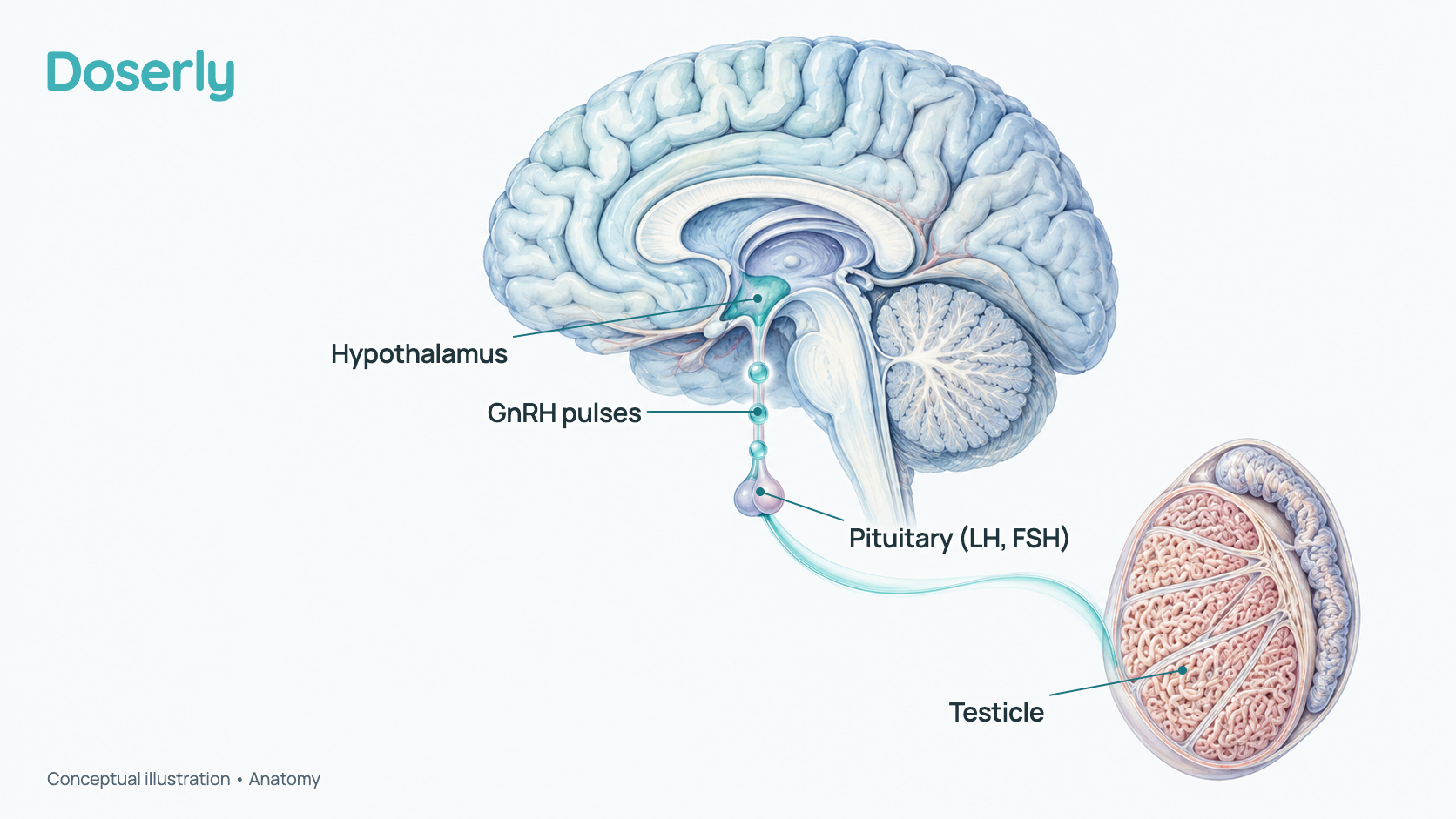
Gonadorelin is a manufactured copy of gonadotropin-releasing hormone (GnRH), the signal a small area at the base of the brain (the hypothalamus) sends to the pituitary gland. GnRH tells the pituitary to release two hormones, LH and FSH, which in turn tell the testicles to make testosterone and sperm, and the ovaries to mature and release an egg. [1], [2]
It is a peptide of 10 amino acids with exactly the same sequence as the body's own GnRH. That makes it different from drugs such as leuprolide and triptorelin, which are altered, longer-lasting versions of GnRH designed to switch the system off. It is also different from hCG, which skips the brain and pituitary and acts on the testicles directly. Other names you may see include LHRH, LH-RH and luliberin, and the brands Factrel, Lutrepulse, Lutrelef, Relefact, Kryptocur and Cystorelin. [2], [3], [4], [5]
It is an approved prescription medicine in some countries for three jobs: a one-time test of whether the pituitary can release LH, pump treatment that delivers small pulses every 90 minutes to restore ovulation or fertility when the brain does not make enough GnRH, and a nasal spray for boys with an undescended testicle. In the clinic pages and public forums reviewed for this guide, most discussion is about a use that no label covers: keeping the testicles working during testosterone therapy (TRT), a use that grew after US pharmacies lost the ability to compound hCG in 2020. [1], [6], [7], [8]
| Product | Country | Form and route | Labeled use |
|---|---|---|---|
| Gonadorelin 100 micrograms (HRF) | United Kingdom | Powder vial; subcutaneous or intravenous | One-time pituitary test |
| LHRH Ferring 100 mcg | France | Solution; injection | One-time pituitary test |
| LH-RH 0.1 mg Nipro | Japan | Injection; intravenous, subcutaneous or intramuscular (into a muscle) | One-time pituitary test |
| Lutrelef 3.2 mg | France | Powder for a small wearable pump; subcutaneous pulses | Ovulation in women whose brain signal is missing |
| Kryptocur 200 mcg per spray | Germany, Austria | Intranasal spray (into the nose) | Undescended testicle in boys |
| Factrel, Lutrepulse (human) | United States, Canada | Injection and pump products | Discontinued; current US Factrel is a cattle product |
[1], [9], [10], [6], [11], [12], [13], [14], [2]
Typical Gonadorelin Protocols
| Product and use | Amount each time | Frequency | Total per day | Duration |
|---|---|---|---|---|
| Diagnostic injection (UK label; the same 100 mcg in Japan and France) · testing whether the pituitary can release LH | 100 mcg by subcutaneous or intravenous injection | Once | Not applicable | One test, with blood samples over 2 hours A test, not a treatment |
| Lutrelef pump (France) · women who do not ovulate because the brain's GnRH signal is missing | 10 mcg per pulse (label range 10–20 mcg) | Every 90 minutes, day and night, from a small subcutaneous pump (120 minutes allowed) | 160 mcg at 10 mcg per pulse | One treatment cycle; after ovulation the pump continues or other hormone support replaces it Specialist-monitored (basal temperature and, if needed, ultrasound) |
| Pump in men with congenital low LH and FSH (published study, not a label) | 10 mcg per pulse to start; adjusted between 3 and 15 mcg | Every 90 minutes from a subcutaneous pump | 160 mcg at 10 mcg per pulse | Up to 24 months; sperm first appeared after a median of 6 months Adjusted by LH, FSH and testosterone measured 30 minutes after a pulse |
| Kryptocur nasal spray (Germany, Austria) · boys with an undescended testicle | 200 mcg per spray, one spray in each nostril | 3 times a day | 1,200 mcg | 28 days |
Gonadorelin's labeled doses are a single 100 mcg test dose, pump pulses of 10–20 mcg every 90 minutes for fertility and, for boys with an undescended testicle, a 1,200 mcg-a-day nasal spray. Alongside testosterone therapy (TRT), which no label covers and no study has tested, the most common pattern in the reviewed clinic and protocol pages is a subcutaneous injection two or three times a week, usually 100–200 mcg. [1], [6], [11], [16], [17], [18], [19]
- Titration Adjusting the dose in steps
- Pump doses are adjusted with blood tests. The French label starts at 10 mcg per pulse, moves within 10–20 mcg and allows the interval to stretch to 120 minutes. One protocol for men added 2 mcg per pulse when LH stayed below 2 international units per liter (IU/L), up to 16 mcg, and removed 1 mcg when LH rose above 10 IU/L. For TRT, some sources use a fixed 100 mcg; two pages share a step-up table of 50 mcg in weeks 1–2, 100 mcg in weeks 3–4 and 100–150 mcg in weeks 5–8, two or three times a week. No lab target for TRT use has been tested. [6], [20], [21], [22]
- Breaks and cycles
- The test is a single dose, so breaks do not apply. The nasal spray label allows a second 28-day course after at least 3 months. Pump treatment in women runs one cycle at a time. For TRT, several sources describe continuing gonadorelin for as long as testosterone continues, others describe 4–8-week courses or rest days "to prevent desensitization", and many give no duration. No study has compared these approaches. [11], [6], [16], [23], [21]
Read the units: mcg means micrograms; 1 mg equals 1,000 mcg. The human gonadorelin labels cited here give doses by weight, not in international units (IU). The amount each time and the daily or weekly total are separate columns: 100 mcg three times a week is a 300 mcg weekly total. Compounded products come in different strengths (for example, a 2 mg powder vial or a 0.2 mg per mL solution), so the same 100 mcg can be very different volumes; check the pharmacy label and see how mcg convert to syringe units. [24], [25]
The diagnostic test is a fixed single dose. The pump rows come from a label and a published study protocol, and specialists adjust them using blood tests, ultrasound or semen results. The TRT rows below come from clinic and protocol websites; none of them has been tested in a study.
What doses are used alongside testosterone therapy?
| Source | Amount each time | Frequency | Weekly total | Duration |
|---|---|---|---|---|
| Two or three times a week (the most common frequency) · peptide protocol wiki | 100–200 mcg | 2–3 times a week | 200–600 mcg | Ongoing during TRT, or a 4–8-week course [16] |
| Telehealth clinic · testicle maintenance | 100 mcg | 2–3 times a week | 200–300 mcg | Not stated [19] The same page lists 100–200 mcg once or twice daily as an "enhanced" option |
| Daily schedule · TRT blog | 50–100 mcg | Once a day | 350–700 mcg | Not stated [26] |
| Twice-daily schedule · hormone reference site | 100 mcg | Twice a day | 1,400 mcg | Ongoing with TRT [27] |
| Once weekly · early clinic switch described on a forum (2020) | 50 mcg | Once a week | 50 mcg | Not stated [8] A patient's account of his clinic's protocol after it stopped supplying hCG |
The rows are alternatives, not steps to move through. Across the 26 reviewed pages that describe injections, amounts ran from 20 to 500 mcg each time, and schedules from several injections a day to once a week. The largest group, 15 pages, describes injections two or three times a week, with amounts from 50 to 500 mcg; 10 of them stay within 100–200 mcg. Six pages give one fixed amount (50, 100, 100, 100, 100 and 250 mcg) for different purposes, including TRT, steroid cycles and post-cycle use. No page cites a human study of its own TRT schedule. [16], [28], [29], [30], [31]
Cautions for every schedule above: the UK label advises against gonadorelin in people with a pituitary tumor, where even a single 100 mcg test dose has caused bleeding into the tumor with a sudden headache and loss of vision, and says it should not be given during pregnancy or breastfeeding. Severe allergic reactions are rare, but several reported cases followed an intravenous test in people who had used a pump before. Check the vial strength before every injection, because mcg and mg differ 1,000-fold (units). Gonadorelin is also banned in sport for males at all times. [1], [32], [33], [34], [35]
Where schedules differ: pulses, frequency, shutdown worries, breaks, post-cycle use and stopping ↓
Where these numbers come from
The diagnostic row comes from the UK Gonadorelin 100 micrograms summary of product characteristics (Esteve, text revised August 2022), which describes LH blood samples 15 minutes before and just before the dose, then 15, 30, 45, 60 and 120 minutes after it. Japan's LH-RH 0.1 mg Nipro label (revised April 2025) and France's LHRH Ferring 100 mcg give the same single 100 mcg dose. The Lutrelef row comes from the French label (summary revised September 2019; database entry updated August 31, 2026); Canada's 2016 Lutrepulse monograph gives 5–20 mcg every 90 minutes, and a Mayo Clinic drug monograph gives 5 mcg every 90 minutes, adjusted between 1 and 20 mcg, for 21 days. The men's pump row is the protocol of Zhang et al. 2019 (10 men on the pump); a 2023 Chinese expert consensus and other cohorts use the same 10 mcg every 90 minutes. The nasal row comes from the Kryptocur leaflets (Germany 2022, Austria 2024). [1], [10], [9], [6], [36], [37], [15], [38], [11], [12]
The TRT rows each come from one page: Peptide Protocol Wiki, Heyday, ShotFreeTRT, GLPbase and an August 2020 ExcelMale post. The 15 pages that describe injections two or three times a week are two Peptide Protocol Wiki pages, The Peptide Dosing Guide, PeptideDosages, Peptides.ID, Andros Clinic, PeptidEdge, Everything Peptide, The Peptide List, Peptide Protocol.ai, Men.med, Bioalmanac, Peptide Database, Peptidings and Heyday; their amounts differ. The Peptide Dosing Guide and PeptideDosages share the same unusual step-up table, so they count as one origin, not two confirmations. [16], [19], [26], [27], [8], [28], [21], [22], [23], [39], [40], [41], [17], [29], [30], [18], [42], [43]
Not used for any row: Peptides.ID's phases rising to 500 mcg and Men.med's 100–500 mcg range (wider than any study supports), a vendor's 400 mcg-a-day nasal spray schedule, a clinical society slide of 150 mcg daily that also calls GnRH an 89-amino-acid peptide (it has 10), and 1970s study doses, which were tested in other populations without TRT and are covered in the research section. [23], [30], [44], [45]
What is gonadorelin commonly used for?
In the clinic pages and public forums reviewed for this guide, most people asking about gonadorelin are on testosterone therapy and want to know whether it will keep their testicles working and their fertility intact. Smaller groups ask about restarting their own hormones after steroids or TRT, raising testosterone without TRT, fertility treatment and the pituitary test. [16], [30], [46]
These uses rest on very different evidence. The pituitary test and pump fertility treatment are approved in some countries and backed by decades of research. The injection schedules used alongside TRT and for "restarting" have not been tested in any study.
Keeping the testicles working on TRT
Testosterone therapy tells the brain there is plenty of testosterone, so the pituitary stops sending LH and FSH. Without those signals the testicles make much less testosterone of their own, often shrink and make fewer sperm. In a 3-week trial, testosterone inside the testicles fell by 94% in men given testosterone alone. [47], [48]
The idea behind gonadorelin is to keep the missing signal coming from the top. Forum posts from 2020 describe TRT clinics switching patients from hCG to gonadorelin after a US rule change on compounded hCG (see legal status); that timing is not evidence that the substitute works as well. [7], [8], [49], [50]
No study has tested the injections TRT clinics use, for testicle size, sperm counts or pregnancy, and short hormone studies show that testosterone blunts the pituitary's response even to GnRH supplied by a pump. hCG, by contrast, has a 3-week hormone trial and a 26-man semen series in men on TRT. US testosterone guidance lists hCG, selective estrogen receptor modulator (SERM) tablets and aromatase inhibitors for men who want to keep their fertility, not gonadorelin. [51], [47], [52], [53] See what the studies found.
Testing the pituitary
This is gonadorelin's main labeled use. A single 100 mcg injection is given and LH is measured several times over 2 hours. A normal rise shows that the pituitary's LH-making cells work. The UK label is clear about the limits: the test does not find the cause of a poor response and does not measure how much the pituitary has in reserve. [1]
In teenagers with delayed puberty, the test helps separate a lasting hormone deficiency from a late but normal puberty, but the groups overlap. In one study, a peak LH below 9.74 IU/L picked out 80% of boys with a deficiency, and in a larger French study almost half of the boys with a deficiency had LH peaks in the same range as late developers. A 2026 Korean study of children tested for early puberty reported that limited availability of gonadorelin has led to more testing with triptorelin instead. [54], [55], [56]
Fertility in men with congenital low LH and FSH
When the brain makes little or no GnRH from birth (congenital hypogonadotropic hypogonadism, CHH), a small wearable pump can deliver gonadorelin pulses every 90–120 minutes, the way the hypothalamus would. In a Boston series of 76 men treated for 12–24 months, LH became normal in 97% and testosterone in 93%, though 18% of the men who started before puberty still made no sperm. [57], [15]
Both pump treatment and hCG-based injections can start sperm production. A 2021 analysis of 420 men found sperm appeared about 5.3 months sooner with the pump; the studies found no significant difference in how many men made sperm, how much, or in pregnancies, but they were too small to show the treatments are equal. The US male infertility guideline notes that pulsatile GnRH is not currently approved for this use in the US or Europe, and European urology guidance treats hormone injections (gonadotropins) as the standard for men who want children. [58], [59], [60]
Ovulation in women whose brain signal is missing
In women whose periods have stopped because the hypothalamus has slowed down (hypothalamic amenorrhea), pump pulses can restore ovulation. In a US multicentre report of 109 women, ovulation occurred in 91% of those whose periods had never started and 96% of those whose periods had stopped. In a 25-year cohort of 66 women, 96% of treatment cycles led to ovulation and 65.9% of treatments ended in a live birth. This is the use the French Lutrelef label covers. [61], [62], [6]
Restarting hormones after steroids or TRT
Some websites and clinics offer gonadorelin as a "restart" or post-cycle therapy (PCT), with schedules from a few days to a few weeks. No study has tested any of them (see the schedules). The only human data are diagnostic: in 13 former anabolic-steroid users, a single 100 mcg test dose raised LH above 9.6 U/L in 5, which says whether the pituitary could respond on that day, not whether gonadorelin speeds recovery. [46], [22], [39], [63] In community education groups, educators who mention it for this purpose say to eat enough and confirm suppression with lab tests first, and some rate it poorly for recovery.
Raising testosterone without TRT
Some men use gonadorelin on its own as a "natural" way to raise testosterone. The word natural describes the molecule, which matches the body's GnRH; it says nothing about results. Older studies of repeated injections without a pump, all in men with diagnosed hormone deficiencies, kept testosterone up in some and lost their effect in others. No controlled study has tested gonadorelin for age-related or lifestyle-related low testosterone. [64], [65] See what those studies found.
Undescended testicles in boys
In Europe, a gonadorelin nasal spray (1,200 mcg a day for 28 days) is licensed for boys with an undescended testicle. It moved few testicles in trials: 3 of 16 boys compared with 1 of 17 on hCG in a small randomized trial, and 9% compared with 8% on a placebo spray in a larger one. [11], [66], [67]
Other uses you may come across
A 2022 open-label pilot gave pump gonadorelin to seven men with Down syndrome for 6 months; six scored higher on a thinking test, with no comparison group. A larger placebo-controlled trial is listed as recruiting (registry last updated February 2024). Gonadorelin is also a common cattle-breeding drug, and those veterinary products are not for people. [68], [69], [2]
Where do gonadorelin protocols differ?
The label schedules are precise. The disagreements come from TRT use: how often to inject, whether more shuts the system down, breaks and post-cycle use.
Is the schedule from a label, a pump study or a TRT clinic?
Gonadorelin is given in four different ways, and they are not interchangeable. A single test dose checks the pituitary once. A pump gives small pulses around the clock to replace a missing signal. Repeated injections without a pump, a few times a day or a few times a week, are what TRT clinics use. Continuous exposure (a steady drip) works against the system, as the next questions explain. A schedule proven for one mode says nothing about another. [1], [6], [70]
Can two or three injections a week copy the body's own pulses?
No. The hypothalamus releases GnRH about every 1–2 hours, and pumps copy that with a pulse every 90 minutes: 16 pulses a day, or about 112 a week. Gonadorelin's half-life is about 4 minutes, and after a 100 mcg injection, LH peaked at about 30 minutes in healthy men. So each injection gives at most one short signal. Two or three injections a week are two or three signals in a week in which the body would normally make roughly 80 or more; the LH pattern after subcutaneous clinic injections on TRT has never been measured. Pages that describe a Monday-Wednesday-Friday schedule as "pulsatile" are using the word pulsatile loosely. [6], [1], [71], [23]
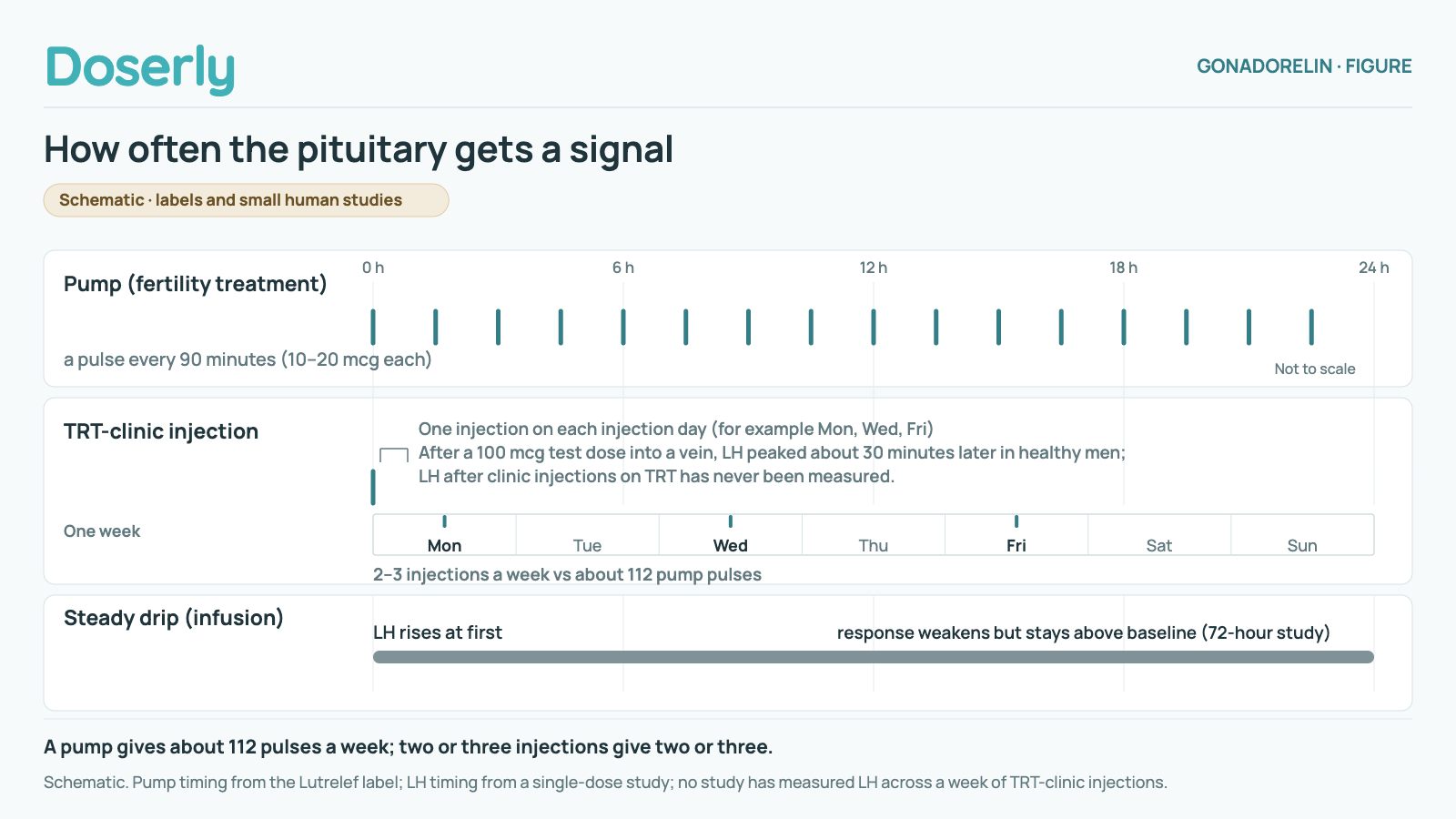
How often the pituitary gets a signal
Pump (fertility treatment)
A pulse every 90 minutes (10–20 mcg each): 16 a day.
TRT-clinic injection
One injection on each injection day (for example Mon, Wed, Fri): 2–3 injections a week vs about 112 pump pulses. After a 100 mcg test dose into a vein, LH peaked about 30 minutes later in healthy men; LH after clinic injections on TRT has never been measured.
Steady drip (infusion)
LH rises at first; then the response weakens but stays above baseline (72-hour study).
Schematic. Pump timing from the Lutrelef label; LH timing from a single-dose study; no study has measured LH across a week of TRT-clinic injections.
A pump gives about 112 pulses a week; two or three injections give two or three.
Every day, twice a day or two or three times a week?
All three appear. In the public forum threads we reviewed, the two most repeated claims, each coming up in dozens of threads, are that gonadorelin must be injected daily or more often and that its half-life is very short, often given as the reason two or three injections a week are pointless. The half-life part is true: blood levels of each dose halve about every 4 minutes. But it does not follow that daily injections work better. No study has compared daily with two- or three-times-weekly gonadorelin during TRT, and the older studies of injections several times a day often saw the response fade. [72], [73], [1], [74], [65]
Can more gonadorelin shut the pituitary down?
Steady, continuous exposure can. This is why older guides warn about desensitization. In rhesus monkeys without their own GnRH, hourly pulses restored LH and FSH release, but a constant infusion did not. In healthy men, pulses every 20 minutes raised LH more than a constant drip over 4 hours; in four men with GnRH deficiency, the same total amount given as pulses raised LH and FSH, while given continuously it did not. During a 72-hour infusion in four healthy men, LH shot up and then fell back toward, but stayed above, its starting level. [75], [70], [76], [77]
Repeated large injections can blunt the response too. After 4 weeks of 500 mcg every 8 hours, the LH response to a test dose roughly halved in ten men with normal hormone levels (they were being treated for erection problems). Where two or three injections a week fall on this scale has never been measured. The UK label notes doses up to 3 mg twice daily for 28 days without signs of overdose; that does not establish the safety of TRT-clinic use or show whether the pituitary kept responding. The drugs designed to shut the system down, such as leuprolide, are long-acting GnRH agonist analogues, not gonadorelin. [74], [1], [4]
Do sources start low and step up?
Some do. Pump treatment adjusts each person's dose by LH measured 30 minutes after a pulse. Among TRT sources, two pages use the same step-up table (50 mcg for 2 weeks, then 100 mcg, then 100–150 mcg), and most give a fixed 100 mcg. Stepping up because testicles still feel small has no tested rule behind it, and a standard LH blood test cannot guide it unless it is timed to the injection (see monitoring). [20], [15], [21], [22]
How long do people use it, and do they take breaks?
Sources split. Several TRT pages describe gonadorelin as ongoing for as long as TRT continues; others describe 4–8-week courses, some add rest days, and many give no duration. Sources that add rest days say they "prevent desensitization". None cites a study of cycling gonadorelin. [16], [23], [21], [43] In community education groups, educators teach that GnRH analogues as a group need breaks; no one gave a break schedule for gonadorelin, and no study has tested one.
What about gonadorelin after a steroid cycle?
Websites give very different schedules: 100 mcg once daily for 1–3 days after a cycle, a 14-day post-cycle table that starts with 200 mcg daily, and a clinic page that adds 100 mcg three times a week during steroid use alongside clomiphene and anastrozole. None has been tested. [46], [22], [39]
How do micrograms convert to syringe units?
Gonadorelin products come either as a freeze-dried (lyophilized) powder that is mixed with liquid before use (reconstitution) or as a ready-made solution, and the concentration on the product label sets the volume. Syringe units on an insulin syringe measure volume, not gonadorelin: on a U-100 syringe, 100 units equal 1 mL. [25], [24]
For example, if a 2 mg vial is mixed with 2 mL, it holds 1 mg (1,000 mcg) per mL, so 100 mcg is 0.1 mL, or 10 units. A pharmacy solution at 0.2 mg per mL holds 200 mcg per mL, so the same 100 mcg is 0.5 mL, or 50 units. That is why one man's "10 units" and another's "50 units" can be the same dose. Gonadorelin medicines are labeled in mcg, so a dose written as "25 IU" or ".25 ui" cannot be converted without knowing what the writer meant and the vial's strength. [25], [78], [72], [79] Doserly's reconstitution calculator works out the arithmetic for any vial and shows each step.
What happens when you stop gonadorelin?
No study has followed men who stop gonadorelin while staying on testosterone, so what is known comes from the drug's timing and from pump studies. [1], [51]
- The drug itself. Once in the blood, gonadorelin has a half-life of about 4 minutes, though after a subcutaneous injection, blood levels took more than 2 hours to return to baseline in one small study. Whether tapering or stopping a TRT schedule matters has not been studied. [1], [80]
- On TRT. In a separate 3-week trial of healthy men (none of whom used gonadorelin), testosterone alone cut testosterone inside the testicles by 94%. Public accounts of switching from gonadorelin to hCG while staying on TRT describe testicles filling out again within one to two weeks for some, and a crash in libido with hot flashes for another; these cannot separate stopping gonadorelin from starting hCG. [47], [81], [82]
- After long-term pump treatment. When 10 men with a lifelong GnRH deficiency stopped the pump, 6 had no LH pulses of their own; 4 did, and 3 of those kept normal testosterone. In healthy men, LH fell when an 88-hour course of pulses stopped, and a test dose 32 hours later still gave a normal response. [83], [84]
- Recovery of the brain's own signal. A minority of people with a lifelong GnRH deficiency later start making their own hormones after treatment stops (reversal): 5 of 50 men in a prospective US study and 44 of 308 people in a larger cohort. Some relapse; 5 of the 39 men who reversed in that cohort became deficient again. This happened after various treatments, not only the pump. [85], [86]
- Keeping sperm after the pump. In one clinic, 58 of 68 men made sperm on pulsatile GnRH; once they did, many were switched to hCG once or twice a week, and sperm production was maintained or improved. [87]
- Nasal spray in boys. Some testicles that moved down went back up: 2 of 16 over 5 years in one study, and 9% by 6 months in another. [88], [89]
- Withdrawal or rebound. Stopping pulses lets LH fall, but no study has described a separate withdrawal or rebound effect for gonadorelin. [84]
Does it matter whether gonadorelin is injected, pumped or sprayed?
Yes, because the route changes both how fast gonadorelin reaches the pituitary and what pattern of signal the pituitary sees. An intravenous (IV) injection goes straight into a vein. A subcutaneous injection is absorbed from the fatty layer under the skin more slowly. A pump repeats small subcutaneous or IV doses every 90 minutes. A nasal spray is absorbed through the lining of the nose. [80], [6], [11]
The difference between injection routes has been measured. After a small 5 mcg dose, gonadorelin in the blood peaked at about 400 pg/mL when given IV but only about 94 pg/mL when given subcutaneously. During a 6-hour infusion, steady blood levels were 34% lower by the subcutaneous route. Both routes still produce an LH response, which is why the UK test can be given either way. [80], [1]
How long does gonadorelin stay in the body?
Minutes. The UK label says gonadorelin is broken down quickly in the blood and removed in the urine with a half-life of about 4 minutes. Studies measured an early half-life of about 2.5 minutes in women and 5.5–8 minutes in healthy people after an infusion; kidney failure slowed it to 12–16.5 minutes. A study that tagged gonadorelin with a radioactive label found a later, slower phase of about 57 minutes, but that tag also counts breakdown products, not active gonadorelin. [1], [90], [91], [92]
The effect lasts longer than the drug. After a 100 mcg dose, LH peaked at about 30 minutes and FSH at about 60 minutes in healthy men; the historical US Factrel label gives an average LH peak at 27 minutes after IV and 34 minutes after subcutaneous injection. That timing matters when reading a blood test (see monitoring). [71], [93]
Nasal sprays, troches and under-the-tongue forms
- Nasal spray. Kryptocur is a licensed gonadorelin nasal spray, but only for boys with an undescended testicle, at 1,200 mcg a day. In one 1987 case, a man with a lifelong GnRH deficiency made sperm and fathered a child using 200 mcg sprays every 2 hours while awake. A vendor's 400 mcg-a-day spray schedule for adults comes with no absorption data. [11], [94], [44]
- Troches (lozenges that dissolve in the mouth) and sublingual (under-the-tongue) forms. One compounding pharmacy's handout describes sublingual gonadorelin, and some men on TRT report using it, but no published study has measured how much gonadorelin is absorbed this way. [95], [96], [97]
- Swallowed. No oral gonadorelin product or study exists.
Is gonadorelin acetate different from gonadorelin hydrochloride?
Not in the active peptide. Both are salt forms, the same 10-amino-acid chain paired with acetic acid or hydrochloric acid, and both have official US Pharmacopeia quality standards. The UK test product and US cattle Factrel are the hydrochloride; Lutrepulse and many compounded vials are the acetate. The salt changes the weight: the peptide itself weighs 1,182, the hydrochloride about 1,219–1,255 and one acetate form 1,374 (in grams per mole). Because acetate products contain varying amounts of acetate and water, there is no single "gonadorelin acetate" weight. [98], [99], [1], [2], [13], [24], [3]
How should gonadorelin be stored, and how long does it last?
It depends on the product; there is no single rule. Official labels set very different limits. No human product label gives the 28–30 days in the fridge after mixing that is repeated online; one compounding pharmacy's insert says to discard its vial 28 days after the first puncture. [1], [6], [31], [95]
- UK test vial. Keep the powder below 25 °C (3-year shelf life). Mix it with 1 mL of sterile water immediately before use; once mixed, refrigerate and use within 1 day. [1]
- French test ampoule. Keep at 2–8 °C; use immediately once opened. Germany's diagnostic ampoules also say to use opened solution immediately. [9], [100]
- Pump products. Lutrelef powder is kept below 25 °C; once mixed, the solution is stable for 3 days in the pump's pod. Canada's Lutrepulse monograph also calls for a new vial and pod after 72 hours. [6], [101], [36]
- Nasal spray. Kryptocur is kept in the fridge (2–8 °C) and must not be frozen; an opened bottle lasts 4 weeks at room temperature. [11]
- Compounded vials. Follow the pharmacy label. Under US pharmacy standards, a multi-dose compounded vial may not be used after its labeled beyond-use date or 28 days after first puncture, whichever comes first; one pharmacy's insert says to discard 28 days after first puncture. [102], [95]
- Research-chemical powder. One chemical supplier lists −20 °C for the dry powder and advises against keeping it dissolved in water for more than one day. [103]
Websites claim anywhere from 14 to 60 days in the fridge after mixing, without citing stability tests. [104], [105], [31], [106]
The chemistry is known in part. Gonadorelin is most stable in slightly acidic solution (pH 5–5.5), and one pump formulation stayed chemically stable for at least 45 days after mixing at 24 °C or 37 °C. Chemical stability is not the same as staying sterile once a needle has pierced the stopper, which is why pharmacy limits are shorter. This guide does not cover mixing or injection technique; the Academy note below covers practical handling. [107], [108], [102]
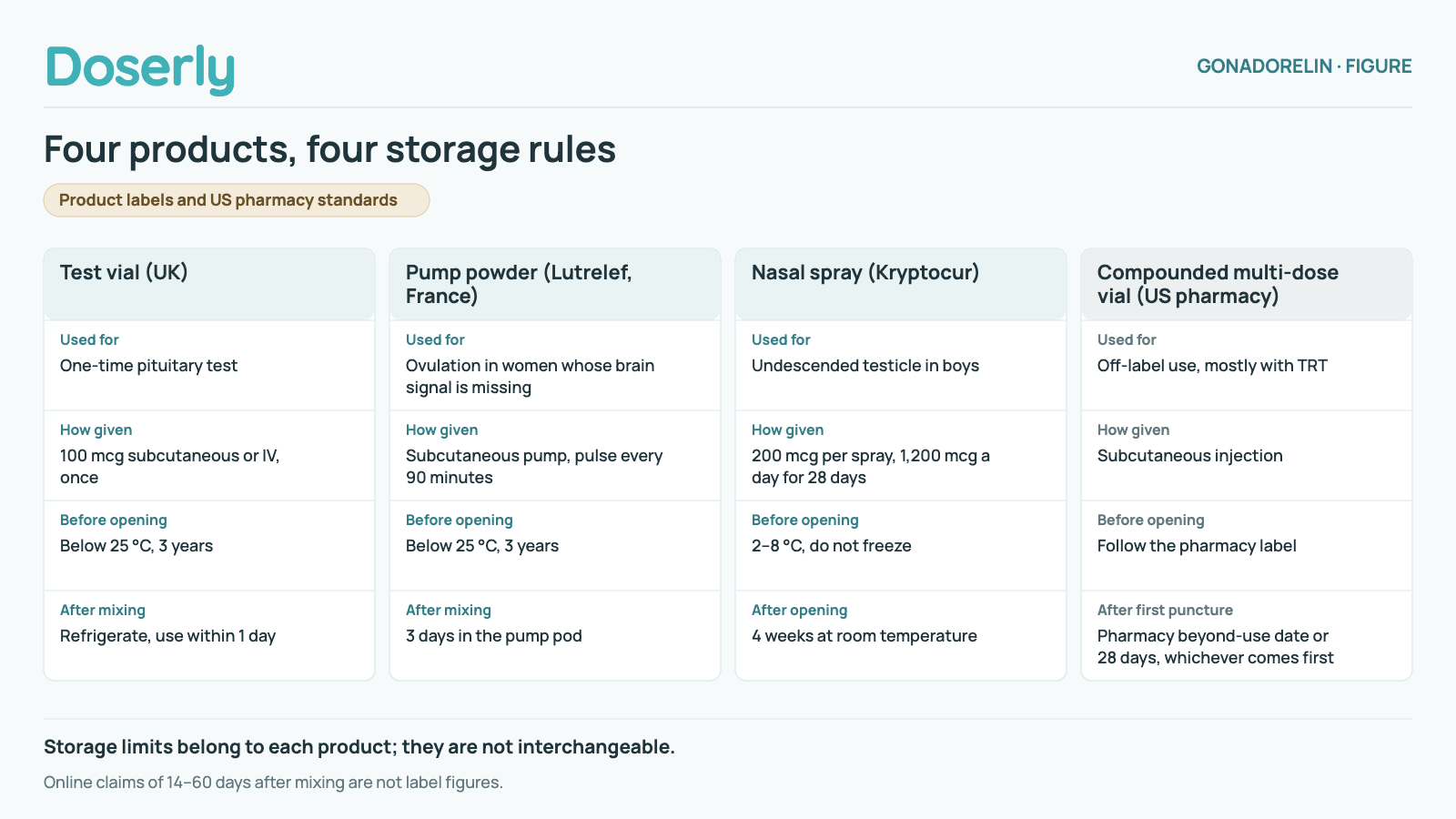
Four products, four storage rules
Test vial (UK)
- Used for
- One-time pituitary test
- How given
- 100 mcg subcutaneous or IV, once
- Before opening
- Below 25 °C, 3 years
- After mixing
- Refrigerate, use within 1 day
Pump powder (Lutrelef, France)
- Used for
- Ovulation in women whose brain signal is missing
- How given
- Subcutaneous pump, pulse every 90 minutes
- Before opening
- Below 25 °C, 3 years
- After mixing
- 3 days in the pump pod
Nasal spray (Kryptocur)
- Used for
- Undescended testicle in boys
- How given
- 200 mcg per spray, 1,200 mcg a day for 28 days
- Before opening
- 2–8 °C, do not freeze
- After opening
- 4 weeks at room temperature
Compounded multi-dose vial (US pharmacy)
- Used for
- Off-label use, mostly with TRT
- How given
- Subcutaneous injection
- Before opening
- Follow the pharmacy label
- After first puncture
- Pharmacy beyond-use date or 28 days, whichever comes first
Online claims of 14–60 days after mixing are not label figures.
Storage limits belong to each product; they are not interchangeable.
What do we actually know about gonadorelin in people?
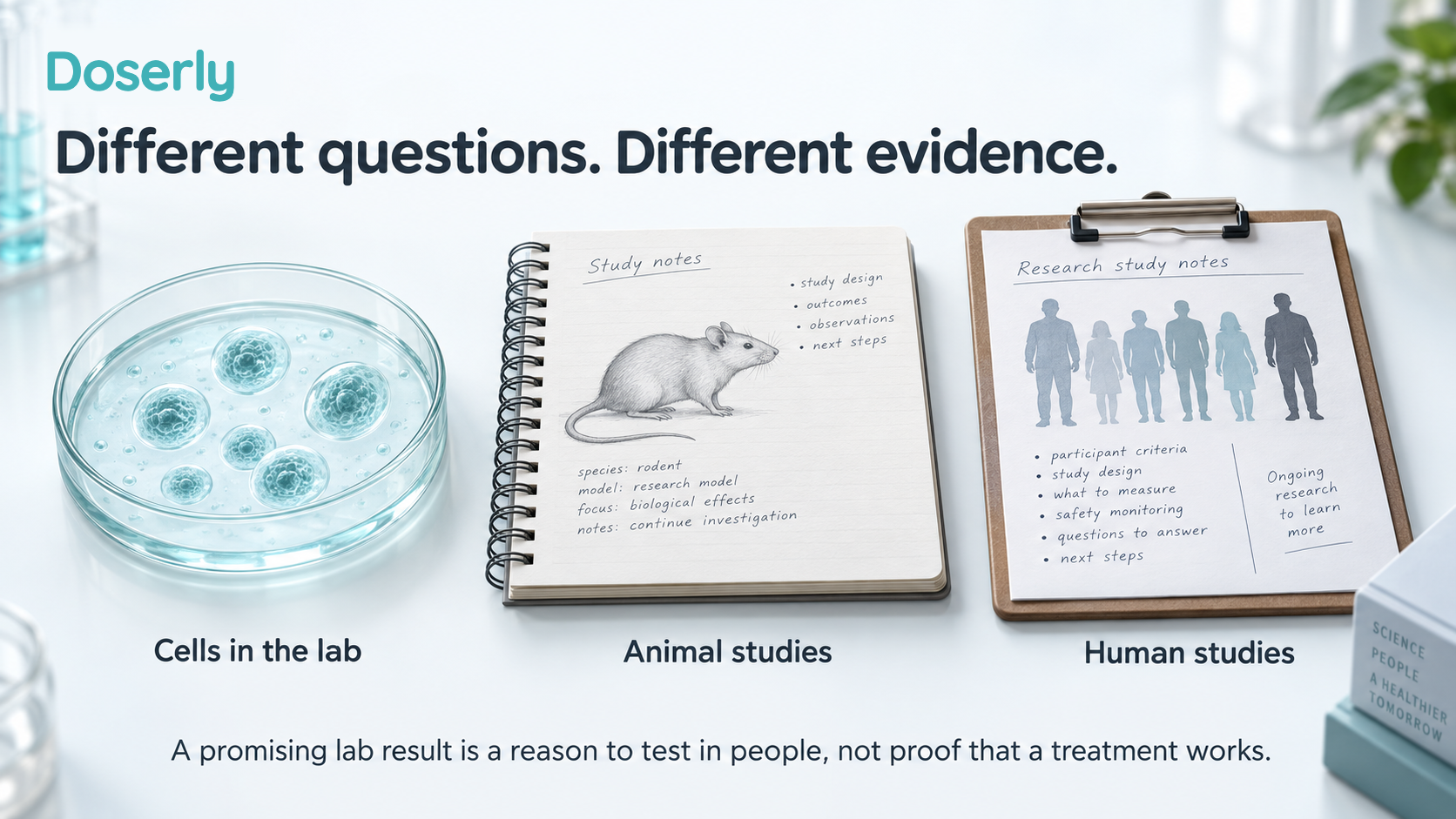
A lot, but mostly about uses that are not the one most readers have in mind. Gonadorelin has been studied in people since the 1970s, as a test, in pumps and as repeated injections. None of it tested the injections men on testosterone therapy use.
| How it was given | What was studied | What it showed | What it cannot tell you |
|---|---|---|---|
| Single test dose | Children and adults with suspected pituitary or hypothalamic problems | A normal LH rise shows working pituitary cells; results overlap between groups in delayed puberty [1], [54] | The cause of a poor response, or anything about treatment |
| Pump in men | Men with a lifelong or acquired GnRH deficiency, off testosterone | Testosterone rises in most; sperm appear in most, after months [57], [58] | What injections a few times a week do, or anything about TRT |
| Pump in women | Women whose periods stopped because the brain signal was missing | Ovulation in most cycles in case series; a placebo-controlled trial found more ovulation than placebo [61], [109] | Anything about men |
| Repeated injections, no pump | Small 1970s–80s series in men with deficiencies or healthy men | Responses kept up in some and faded in others; a pump did better in the one comparison [64], [65], [110] | Whether 2–3 injections a week work, because none tested that |
| Nasal spray | Boys with an undescended testicle | Few testicles moved, similar to hCG or placebo [66], [67] | Adult uses |
| Clinic injections alongside TRT | Nothing | No study, trial registration or guideline found | Everything |
Has gonadorelin been tested alongside TRT?
Not the way clinics use it. Searches of published studies, trial registries, guidelines and conference abstracts found no study of gonadorelin injections, at any frequency, given to men on testosterone therapy to protect the testicles. That means there are no data on testicle size, sperm, pregnancy or long-term safety for this use. The closest studies are short hormone experiments in men with GnRH deficiency, in which a pump supplied gonadorelin while researchers gave testosterone and measured LH. [111], [53], [69], [51]
What does exist points in two directions. In favor of the idea: a pituitary that receives GnRH pulses can keep releasing LH and FSH, as pump studies show. Against it: in men with GnRH deficiency whose pulses came from a pump, a 4-day testosterone infusion still cut LH output by about 28% (and by 58% in healthy men), and estradiol had a similar dampening effect. Blocking the conversion of testosterone to estradiol prevented the drop. On TRT, the pituitary is getting both signals to stand down. But the testosterone effect appeared only with physiological, pump-sized doses: the response to large doses, including a 100 mcg injection in healthy men, was not reduced, so how much it applies to clinic-sized injections is unknown. [57], [51], [112]
hCG, the drug gonadorelin replaced in many clinics, has at least some direct data: a 3-week trial in 29 healthy men given testosterone, in which 250–500 IU every other day kept testosterone inside the testicles near or above its starting level, and a series of 26 men on TRT whose semen results stayed stable, 9 of whom went on to father a pregnancy. Nothing comparable exists for gonadorelin. [47], [52]
What happened when injections replaced the pump?
The results depended on the dose, the schedule and the person, and they often faded. [64], [74], [113], [65], [114], [110]
- 500 mcg every 8 hours, up to a year, in 12 men with hypothalamic or pituitary disease: androgen levels rose in all 12, and the four treated for more than 4 months made sperm. [64]
- 500 mcg every 8 hours for 4 weeks in 10 men with normal hormone levels who were being treated for erection problems: the LH response to a test dose fell from 35.7 to 16.8 mU/mL, and testosterone did not change. [74]
- 500 mcg twice a day for at least a year in four patients: the response waned, hormone levels were not maintained and puberty did not happen. [113]
- 1,000 mcg two or three times a day for 6 months in four men: two had a brief testosterone rise, then all four returned to their starting levels. [65]
- 500 mcg three times a day for 3 days by intramuscular injection in nine healthy men: a marked LH response that shrank with each injection. [114]
- Injections compared with a pump in 30 men: the pump gave better hormone, sperm and fertility results. [110]
The same era tested daily injections for men with low sperm counts but normal hormones. In one small series, 100–500 mcg a day by intramuscular injection for at least 60 days was followed by partner pregnancies in 3 of 5 men in one group and 1 of 5 in another, without a comparison group. Later pump studies in similar men found no improvement in semen in one small series and improvement in 8 of 14 selected men in another. [115], [116], [117]
How well does the pump work for male fertility?
In men with congenital or acquired GnRH deficiency, it usually works, slowly. Testosterone rose from 77 to 520 ng/dL within a month in an early six-man series. In later cohorts, sperm appeared in 33 of 45 men, 27 of 34 who gave semen samples, and 46 of 56. The first sperm appeared after a median of about 6 months in two Chinese cohorts, and after a mean of about 12 months in another. [118], [119], [120], [121], [122], [15]
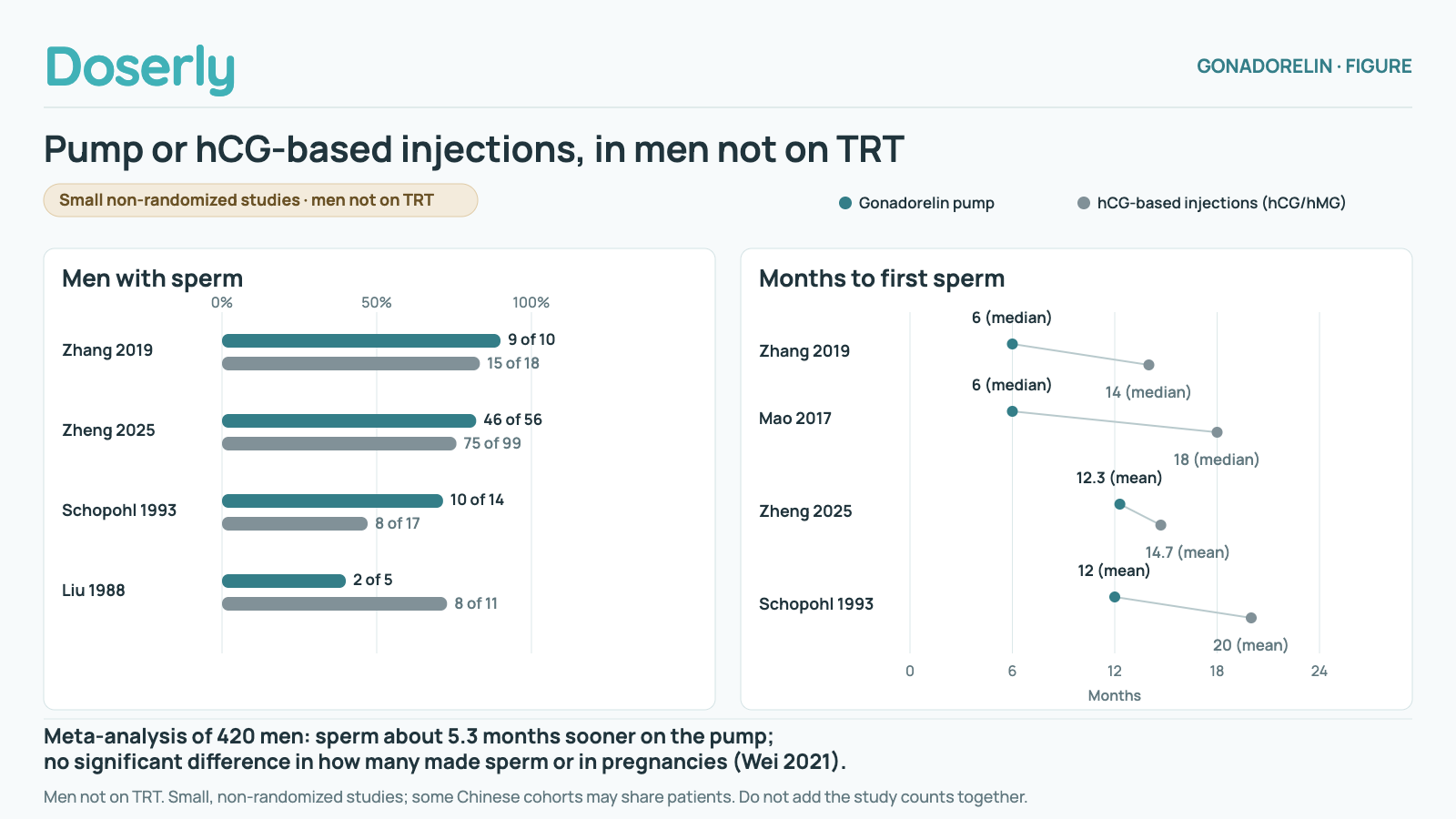
Pump or hCG-based injections, in men not on TRT
Men with sperm
Bars: share of men, 0–100%
- Zhang 2019
- Pump: 9 of 10 · hCG-based: 15 of 18
- Zheng 2025
- Pump: 46 of 56 · hCG-based: 75 of 99
- Schopohl 1993
- Pump: 10 of 14 · hCG-based: 8 of 17
- Liu 1988
- Pump: 2 of 5 · hCG-based: 8 of 11
Months to first sperm
Dots: months, on a 0–24 month scale
- Zhang 2019
- Pump: 6 (median) · hCG-based: 14 (median)
- Mao 2017
- Pump: 6 (median) · hCG-based: 18 (median)
- Zheng 2025
- Pump: 12.3 (mean) · hCG-based: 14.7 (mean)
- Schopohl 1993
- Pump: 12 (mean) · hCG-based: 20 (mean)
Men not on TRT. Small, non-randomized studies; some Chinese cohorts may share patients. Do not add the study counts together.
Meta-analysis of 420 men: sperm about 5.3 months sooner on the pump; no significant difference in how many made sperm or in pregnancies (Wei 2021).
The comparisons with hCG-based treatment (hCG plus human menopausal gonadotropin, hMG, a medicine with FSH activity) point the same way but are small and not randomized: sperm appeared sooner on the pump in most, with no significant difference in the share of men who made sperm. [58], [15], [121]
Study-by-study comparison of the pump and hCG-based treatment
- Zhang 2019: sperm in 9 of 10 on the pump and 15 of 18 on hCG and hMG; median 6 versus 14 months. [15]
- Mao 2017: 20 pump patients versus 182 on injections; median 6 versus 18 months to first sperm. [122]
- Zheng 2025: sperm in 46 of 56 versus 75 of 99, a difference that could be chance; mean 12.3 versus 14.7 months; larger testicles at the end on the pump. Men who had already used testosterone were excluded. [121]
- Schopohl 1993 (one 36-man cohort reported twice): sperm in 10 of 14 on the pump versus 8 of 17 on injections; the testicles grew more on the pump, while testosterone and estradiol were higher on injections, and five men on injections developed breast enlargement. [123]
- Liu 1988: sperm in 2 of 5 on the pump versus 8 of 11 on injections, a difference that could be chance. [124]
- Wei 2021, pooling 420 men from seven studies: sperm about 5.3 months sooner on the pump, with no significant difference in the share who made sperm, sperm counts or pregnancies. Allergic reactions were more common on the pump; breast enlargement and acne on hCG. [58]
Who responds matters more than which drug. Men with very small testicles, a history of undescended testicles or low inhibin B (a marker of the sperm-supporting cells) do worse on either treatment, and in a small randomized trial, all 7 men given 4 months of FSH before the pump made sperm, compared with 4 of 6 on the pump alone. [57], [125], [126]
What about women?
The pump restores ovulation in most women whose brain signal is missing. In a placebo-controlled trial of women with lifelong low LH and FSH, ovulation occurred in 1 of 9 at 10 mcg per pulse, 4 of 9 at 15 mcg and 5 of 9 at 20 mcg, compared with none of 10 on placebo. Other series report ovulation in 83–96% of cycles, and in a small 1987 series, ovulation occurred in 80% of cycles at the lowest pulse dose and in all three cycles at the highest, too few to show a dose effect. The evidence is too thin to tell whether the pump helps women with polycystic ovary syndrome (PCOS), a condition that can disrupt ovulation. [109], [127], [62], [128], [129]
How reliable is the pituitary test?
It answers a narrow question. A normal LH rise after 100 mcg shows the pituitary's LH-making cells can respond on that day; it cannot say whether the hypothalamus makes its own pulses. In teenagers with delayed puberty, the results of boys with a lasting deficiency and boys who are simply late overlap, and in a 16-child study, a kisspeptin test predicted who would go through puberty better than the GnRH test. [1], [54], [55], [130]
How does gonadorelin work?
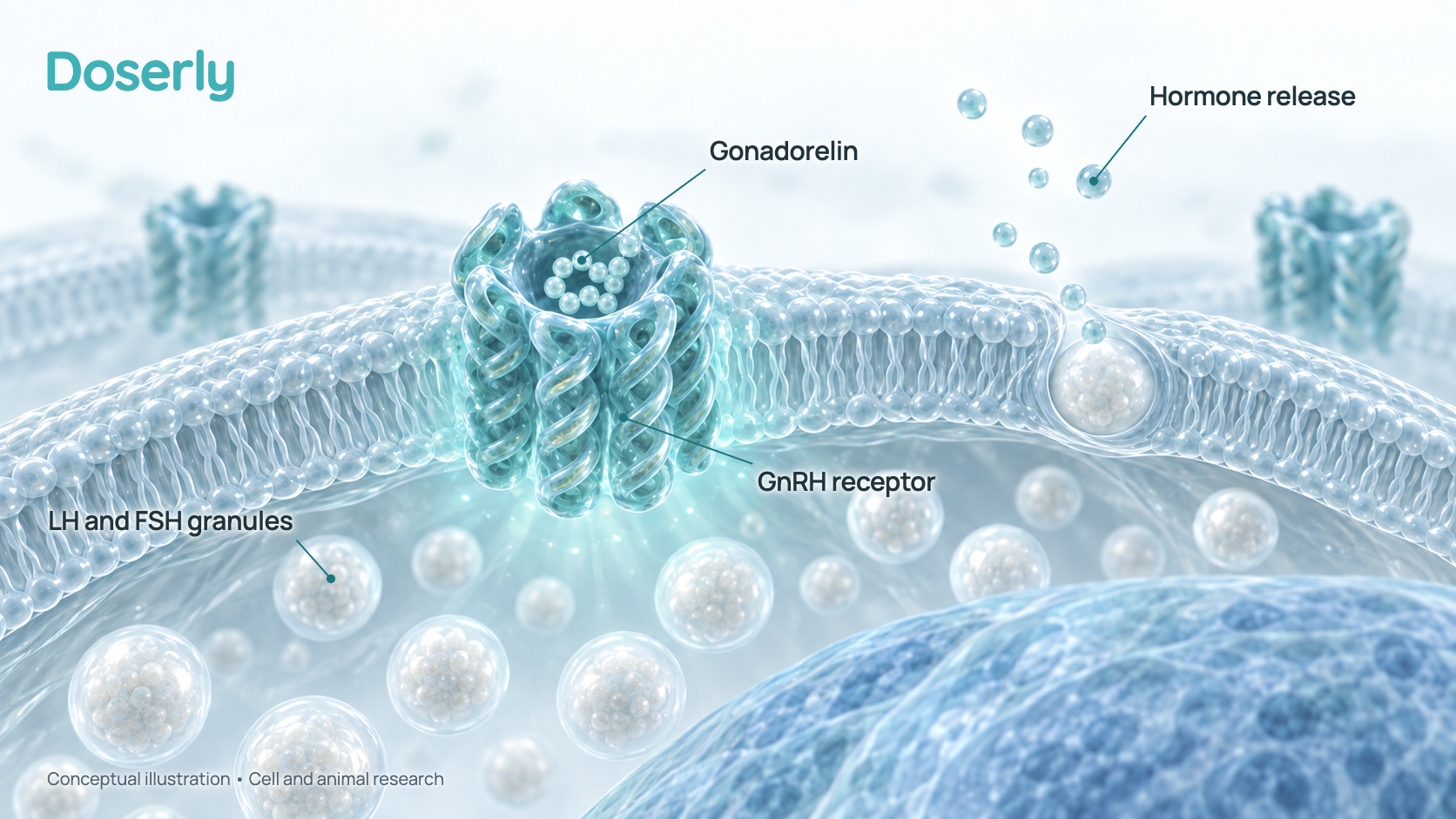
Gonadorelin works the way the body's own GnRH does. It attaches to GnRH receptors on the pituitary's gonadotroph cells, the cells that make LH and FSH, and tells them to release those hormones and make more. The receptor passes the signal inside the cell through a chain of messengers that ends in a rise in calcium, which releases stored hormone. [1], [131], [132]
LH then reaches the Leydig cells in the testicles, which make testosterone, and FSH reaches the Sertoli cells, which support developing sperm. In women, the same two hormones mature an egg and trigger ovulation. Because gonadorelin acts one step above the testicles, it needs a working pituitary and working testicles or ovaries. hCG, by contrast, copies LH itself and acts on the testicles directly. [1], [5]
Why does the timing of the signal matter?
How GnRH arrives changes the pituitary's response: repeated pulses keep it going, while a steady level weakens it. In a classic 1978 animal study, rhesus monkeys without their own GnRH regained normal LH and FSH release with hourly pulses, but not with a steady infusion, and switching from pulses to a steady infusion shut the response down. Human studies show a similar pattern over hours to days, though in one 72-hour infusion LH stayed above its starting level. [75], [70], [76], [77]
The speed of the pulses matters too: in rats, faster pulses favored LH and slower pulses favored FSH. [133], [134] Explore the animal experiments.
Why might testosterone therapy blunt the response?
Testosterone, and the estradiol the body makes from it, tell the pituitary to release less LH for each GnRH pulse; that is how the body normally keeps testosterone in range. The pump studies above show this still happens when GnRH is supplied in pump-sized pulses, so on TRT those pulses have to push against these signals. The same study found no such blunting of the response to large doses, so whether clinic-sized injections are affected has not been tested. [51], [112]
Why doesn't it help everyone?
Because it depends on the steps below it. If the pituitary is damaged, there is nothing for gonadorelin to stimulate; if the testicles have failed (primary hypogonadism), extra LH and FSH cannot help. In one 1981 study, men whose testosterone did not stay up on gonadorelin still responded to hCG, showing their testicles could work when stimulated directly. Rarely, people make antibodies to gonadorelin that block its effect. [1], [65], [135], [136]
Is gonadorelin a GnRH agonist like leuprolide or triptorelin?
Not in the usual sense. Leuprolide, triptorelin and similar drugs are altered versions of GnRH built to resist breakdown and last for weeks. Given continuously, they first raise LH and FSH and then switch them off, which is why they are used to lower testosterone in prostate cancer. Gonadorelin is the unaltered hormone and is gone in minutes. Some websites credit gonadorelin with preventing breast cancer or dementia, but the studies they cite used long-acting agonists that suppress hormones, the opposite of what gonadorelin is used for. [4], [1], [137], [138]
What are the risks and unanswered questions?
Is gonadorelin safe?
As a single test dose, gonadorelin has a long record with mostly rare side effects, and as a supervised fertility pump its main problems are skin reactions at the needle site, which were common in some small studies. Its safety in the way most people now use it, as injections alongside TRT for months or years, has never been studied. The known serious risks are rare allergic reactions and, in people with pituitary tumors, bleeding into the tumor. [1], [15], [119], [58], [32]
What side effects does the label list?
The UK label lists these, from clinical trials and reports after approval: [1]
- Uncommon (up to 1 in 100 people): pain, swelling and itching.
- Rare (up to 1 in 1,000): headache, dizziness, nausea, stomach discomfort, flushing, a fast heartbeat, hardening of the skin at the injection site, hives, redness (including of the eyelids), wheezing from narrowed airways (bronchospasm), allergic reactions and antibodies against gonadorelin.
- Frequency unknown: rash, heavy periods, vein inflammation (thrombophlebitis) and blood infection (sepsis).
In women with normal cycles, a dose given in the first half of the cycle (the follicular phase) can bring on early ovulation, and the label advises steps to prevent an unwanted pregnancy in that case. [1]
What problems have pump users had?
Mostly skin reactions where the needle sits. In the 2019 men's study, the pump caused redness and hardened skin at the needle site, while men on hCG and hMG had more acne and breast tenderness. In a 45-man series, 8 developed breast enlargement, 6 hardened skin at the site and 3 allergic reactions. The 420-man analysis found allergic reactions more often on the pump and breast enlargement and acne more often on hCG-based treatment. [15], [119], [58]
In women, twins or more are the main concern: about 12% of pregnancies in the US IV pump experience, but 1 twin pregnancy among 66 women in a subcutaneous pump cohort. Ovarian hyperstimulation syndrome (OHSS) was rare, and the one case in the US report happened with clomiphene added. [61], [62]
Can gonadorelin cause an allergic reaction?
Rarely, yes, including severe anaphylaxis. An 8-year-old girl had anaphylaxis within 3 minutes of an IV test dose. A man who had developed hives during pump treatment collapsed with low blood pressure when given an IV test dose a week later, and two other men reacted to IV testing after earlier pump treatment. In one series, 5 of 163 treated patients developed antibodies to gonadorelin and 4 had hives. The UK label asks for careful observation when gonadorelin is given again, especially by vein. [139], [33], [34], [136], [1]
What if you have a pituitary tumor?
The label says gonadorelin is not recommended, because it can trigger bleeding into a pituitary tumor (pituitary apoplexy). A 54-year-old man with a large pituitary tumor developed a severe headache 20 minutes after a single 100 mcg test dose and was blind within 5 hours; another had a sudden, severe headache 2 minutes after an IV dose. Japan's label lists pituitary apoplexy at below 0.1% overall and warns about use in people with a pituitary adenoma, without a separate rate for them. Some reported cases involved combined tests with other hormones. [1], [32], [140], [10], [141]
Could product quality change the risk?
Yes. In the US, gonadorelin for TRT comes from compounding pharmacies or "research" sellers, not from an approved product. FDA inspection reports have named gonadorelin batches at three compounding pharmacies: bacteria found in the air of a sterile room while a batch was made (2021), problems with sterile filling (2024) and an inadequate check of sterile technique (2025). Another pharmacy recalled gonadorelin acetate with other injectables in 2022 because it could not assure sterility. These are inspection findings, not proof that any vial was contaminated. In June 2026, FDA warned a seller of a "research" gonadorelin 5 mg product that it was an unapproved new drug. No independent purity testing of gonadorelin sold online has been published. [142], [143], [144], [24], [145]
Is gonadorelin legal? Is it FDA-approved?
Checked September 23, 2026. Rules differ by country and change often.
United States. No human gonadorelin product is currently sold, and none has ever been approved for use with TRT. The key steps:
- Approvals. Factrel (a diagnostic injection) was approved on September 30, 1982, and the Lutrepulse pump kit on October 10, 1989. Both appear on FDA's discontinued list. [13]
- Cattle products. The Factrel and Cystorelin sold in the US today are cattle-breeding drugs, and both labels say they are not for use in people. [2], [146]
- Compounding. Federal law lets pharmacies compound from a bulk ingredient that meets an official US Pharmacopeia standard, and gonadorelin acetate has one. Gonadorelin is not among the ingredients FDA is reviewing for safety risks under the pharmacy rules, and for outsourcing facilities, gonadorelin acetate is listed as "under evaluation". [147], [98], [148], [149]
- March 23, 2020. hCG became a biologic and could no longer be routinely compounded, which is when TRT clinics began switching patients to gonadorelin. Claims online that FDA "banned" gonadorelin compounding are not supported by FDA's lists. [7], [150]
- June 17, 2026. FDA's warning letter to a peptide seller called its "research" gonadorelin an unapproved new drug. [145]
- Controlled status. Gonadorelin is not on the US federal controlled-substances list. State rules were not checked. [151]
Canada. No human gonadorelin product is marketed. The last one, Lutrepulse 0.8 mg, was cancelled on December 24, 2024, and the 3.2 mg version has been dormant since 2017. Veterinary products are still sold. [14], [152], [153]
United Kingdom. Gonadorelin 100 micrograms is a prescription-only medicine for the pituitary test. [1]
European Union. France has valid authorizations for Lutrelef (pump) and LHRH Ferring (test). Kryptocur (nasal spray for boys) has product leaflets in Germany and Austria, and Relefact LH-RH (test) in Germany. Whether each is on pharmacy shelves was not confirmed. A 2024 US guideline says pulsatile GnRH is "not currently approved in the U.S. or Europe", which does not match the French Lutrelef authorization. [6], [9], [11], [12], [100], [59]
Japan. LH-RH 0.1 mg is a prescription diagnostic injection (label revised April 2025). [10]
Australia. Gonadorelin is a Schedule 4 (prescription-only) substance; we could not confirm a current human product on the national register. [154]
A "research use only" label does not make any product legal or approved.
Is gonadorelin banned in sport? Does it show up on a drug test?
Yes, for males. The World Anti-Doping Agency (WADA) 2026 Prohibited List names "gonadotrophin-releasing hormone (GnRH, gonadorelin)" among testosterone-stimulating peptides banned in males at all times, in and out of competition, and the 2027 list, in force from January 1, 2027, keeps the same wording. Anti-doping laboratories have a urine test that includes gonadorelin; we found no published human study of how long a dose stays detectable, and detection times measured in animals do not apply to people. [35], [155], [156]
Does gonadorelin cause cancer?
No study has shown that it does, but none has measured cancer risk from months or years of injections alongside TRT. The UK label reports no special hazard in standard animal safety studies, including studies of cancer risk. Claims that gonadorelin prevents breast cancer or dementia come from studies of long-acting agonists such as leuprolide, which work in the opposite direction. [1], [137], [138]
Who should be especially cautious?
- Pregnancy and breastfeeding. The label lists known or suspected pregnancy as a reason not to use it and says it should not be given to pregnant women or nursing mothers. [1]
- People with a pituitary tumor. Because of the risk of bleeding into the tumor. [1], [32]
- Anyone who has reacted to gonadorelin before, including hives during pump treatment. [1], [33]
- Men on TRT who want children. Gonadorelin has not been shown to protect sperm on TRT, and public reports include men with no sperm on it. The Endocrine Society advises against starting testosterone when fertility is planned soon. [111], [157]
- Children and teenagers. Only with specialist care; the test and nasal spray are specialist uses in children. The spray's leaflet warns that a testicle can twist in boys with a blockage, with or without hormone treatment, and that severe testicular pain needs urgent care. This guide is written for adults. [1], [11]
- Drug-tested male athletes. Banned at all times. [35]
- People taking other hormones or medicines; see the next question.
Can gonadorelin be taken with other medicines?
It is usually taken alongside testosterone, but no formal study has looked at that combination. What is known: [1], [51], [158], [159]
- Hormones. The UK label says androgens, estrogens, progestogens and corticosteroids directly affect the pituitary and change the test result; testosterone blunts the response (see how it works). [1], [51]
- Other medicines on the label. Spironolactone and methyldopa can raise LH slightly; oral contraceptives and digoxin lower it; medicines that raise prolactin, such as phenothiazines and other dopamine blockers, blunt the response. [1]
- SERM tablets. After 5 days of clomiphene, the LH response to a GnRH test dose fell in healthy men. [158]
- Steroid tablets. One week of dexamethasone did not change the LH response to GnRH in one small study. [159]
- Fertility drugs. In the US and Canadian pump studies, the one reported case of moderate OHSS happened when clomiphene was added. [36], [61]
- Kisspeptin or other peptides. Not studied together.
Bring a full list of everything you take, including supplements, to a pharmacist or doctor.
What should be monitored while using gonadorelin?
The labels set monitoring rules for the pituitary test and for pump treatment. For TRT use, no label or guideline gives a schedule, so what clinics check varies. Use this summary to prepare questions for your prescriber; it is not a personal testing plan. [1], [36], [38]
| Why it matters | What labels, guidelines and studies measure | Tracking category |
|---|---|---|
| Pituitary test | LH 15 minutes before and just before the dose, then at 15, 30, 45, 60 and 120 minutes | Blood work |
| Pump treatment in men | LH, FSH and testosterone about 30 minutes after a pulse, with testicular size and semen every 1–3 months; one Chinese consensus checks LH after 3 days, then monthly, then every 3 months once stable | Blood work; Hormonal Symptoms; Other (semen result) |
| Pump treatment in women | Ovarian ultrasound at least weekly, estradiol and progesterone, the infusion site, and watching for OHSS and multiple pregnancy | Hormonal Symptoms; Side Effect Burden |
| Allergic reactions | Careful observation when gonadorelin is given again, especially by vein | Side Effect Burden; Skin Health |
| Pituitary tumor | Sudden severe headache or vision change within minutes to hours of a dose | Side Effect Burden |
| Breast changes and skin | Breast enlargement and needle-site hardening in pump studies | Hormonal Symptoms; Skin Health |
| TRT use (clinic practice, not validated) | One men's-health website proposes testosterone, free testosterone, estradiol, LH, FSH and a blood count at each follow-up, and semen analysis at 90 days | Blood work; Libido; Sexual Function; Mood & Wellbeing |
[1], [122], [15], [38], [36], [160], [32], [119], [161]
Why can an LH test on gonadorelin read near zero?
Because of timing. After a 100 mcg dose, LH peaks at about 30 minutes and FSH at about 60 minutes, and pump studies draw blood 30 minutes after a pulse for that reason. A routine morning blood test taken a day or more after the last injection measures the pituitary between doses, when testosterone therapy is holding LH down. So an LH or FSH result near zero on TRT does not show whether each injection produced a rise, and a normal result does not show that sperm are protected. [71], [93], [15], [51]
Many public reports show exactly this: LH and FSH below 0.3 after more than 6 weeks of twice-weekly injections, or LH below 0.2 and FSH 1.0 after 8 months, with no timing given. One man measured LH at 2.1 about 90 minutes after a 100 mcg dose. [162], [163], [150]
What did the studies measure?
The pump studies measured LH, FSH, testosterone, estradiol, testicular volume, semen and pregnancies, and some tracked bone density, which rose in young men after 6 months of pump treatment. The old injection studies measured the LH response to a test dose, androgen levels and semen. None measured anything in men on TRT. [122], [121], [164], [74], [64]
Symptoms matter too: libido, energy, mood, testicle size and skin changes are what most people notice. Tracking them alongside dose changes and timed lab results makes a conversation with your prescriber more useful.
What do people in public communities report?
Most public accounts come from men on TRT whose clinic prescribed compounded gonadorelin, many after being switched from hCG in 2020 or later. They are mixed: some describe fuller testicles and better libido, more describe no change or feeling worse, and a few describe sperm counts of zero. The most useful posts give the dose in mcg, the schedule, what else was taken and what happened later. [165], [50], [49]
What do the positive reports look like?
One man on 200 mg of testosterone a week started 100 mcg twice a week and said his testicles returned to their former size within 10 days and his libido improved; early acne and irritability settled, and two months later he said the benefit had held. Another reported no shrinkage after 8 months on 200 mg of testosterone a week, without testing fertility. [150], [163]
A few men describe pregnancies. One said his wife became pregnant in the first month of trying while he was on TRT and gonadorelin, with no semen test; another reported two children during or after treatment. A third went from a sperm count of zero to a partner pregnancy after 3 months of gonadorelin and hCG every other day while staying on TRT, so the hCG may explain the result. [166], [167], [168]
Does everyone respond?
No. After 3 months, one man said his testicles were about half their pre-TRT size; another said gonadorelin "basically did nothing" over 3 months; a third reported testicles at about 60% of normal size and said his clinic told him it "only works for about half the guys". Several said their testicles filled out again within one or two weeks of switching to hCG. [169], [170], [171], [81], [172]
The fertility reports are the most sobering. One man had a sperm count of zero after 2 years on gonadorelin with TRT, compared with just under 100 million on hCG before; another had zero sperm after 8 years of TRT that included about a year and a half of gonadorelin and years of hCG, and sperm returned a few months after he stopped treatment. These accounts cannot show which drug caused the change. [157], [173]
Two men who used gonadorelin without TRT reported their own LH falling: from 6.9 to 3.3 after 2 months in one case, and LH, FSH and testosterone all lower after about a year in another. Neither gave blood-draw timing, and neither account can show why. [174], [175]
What about unwanted effects?
The recurring complaints are acne, often on the belly, sides and buttocks, irritability or moodiness, hot flashes and lower libido or erection problems. [170], [167], [176], [177] One man given 200 mcg once a week described a rash, hot flashes, severe testicular pain and lightheadedness, and said he felt normal again after stopping; another said his blood pressure rose from the 120s to the 160s after a dose. One man blamed severe joint pain on gonadorelin troches. [73], [97]
Almost everyone reporting side effects was also taking testosterone, and often an aromatase inhibitor or other drugs, so these accounts cannot show that gonadorelin caused them or how often they happen. [177], [178]
What do women on the pump describe?
The few public accounts from women with hypothalamic amenorrhea describe pregnancies after one or two pump cycles, and the minor burden of a device that beeps every 90 minutes. [179], [180]
Are unit mix-ups common?
Yes. Public posts give gonadorelin doses as ".25 ui", "25IU" and "500 units", none of which can be converted to mcg without knowing the vial's strength. One clinic's instructions made sense only once the concentration was known: 0.5 mL of a 0.2 mg/mL solution is 100 mcg. [72], [79], [178], [78]
What do community education groups discuss?
In the community education groups we reviewed, no member described actually using gonadorelin. Educators there stress that only a pump reproduces natural pulses, that continuous exposure shuts the system down and that the cause of low hormones should be diagnosed first; they do not call gonadorelin a testosterone booster. Members' questions show three common mix-ups: calling gonadorelin "generic hCG", treating it as the same as triptorelin, and seeing it as a "natural" alternative to TRT for older men. Members also ask about combining gonadorelin with kisspeptin, but no one gave a dose or an outcome.
How can you judge a gonadorelin story?
Ask: What was the dose in mcg, not syringe units? How often, and for how long? Was the person on TRT, and at what dose? What else changed, such as hCG, clomiphene, enclomiphene or an aromatase inhibitor? Was there a semen test or a lab result, and how long after the last injection was the blood drawn? What happened months later?
These selected discussions show what people experience and the questions research should answer. They are not a survey of all users, a success rate or a substitute for the studies.
How does gonadorelin compare with hCG, kisspeptin, enclomiphene and clomiphene?
These are the options most often weighed against gonadorelin for keeping or restarting a man's own hormone production. They act at different points: kisspeptin above GnRH, gonadorelin on the pituitary, clomiphene and enclomiphene tablets by removing estrogen's brake on the pituitary, and hCG on the testicles directly. Status was checked on September 23, 2026.
| Option | What it is | Route and schedule in labels or studies | Human evidence in men | Status |
|---|---|---|---|---|
| Gonadorelin (this guide) | Copy of GnRH; makes the pituitary release LH and FSH [1] | 100 mcg once for the test; pump pulses every 90–120 minutes for fertility [1], [15] | Pump studies in men with GnRH deficiency; nothing on TRT [58] | Prescription in the UK, France, Germany and Japan; no approved US human product, compounded versions used off-label [1], [13], [95] |
| hCG | Copies LH and acts on the testicles directly, so it works without the pituitary [5] | Intramuscular injection 2–3 times a week on US labels [5] | Decades of use for low LH and FSH; a 3-week trial and a 26-man series on TRT [47], [52] | Approved prescription medicine; a biologic in the US since 2020 [7] |
| Kisspeptin | Signal above GnRH that tells the hypothalamus to release it [181] | Infusions in short studies; 12 days of daily subcutaneous infusions in a 2026 study [182] | Raises LH in healthy men; no fertility trials in men and no trials as an add-on to TRT [181], [182] | Not approved; FDA lists kisspeptin-10 among compounding substances with significant safety risks [183] |
| Enclomiphene | SERM tablet that raises the pituitary's own LH and FSH [184] | 12.5–25 mg by mouth daily in trials [184], [48] | Phase 3 trials: raised testosterone and kept sperm counts, unlike testosterone gel [184] | Not approved in the US or EU; under FDA review for compounding [185], [183] |
| Clomiphene | Older SERM tablet [186] | Often 50 mg in men's studies [187], [188] | Raised testosterone as much as hCG in a 3-month randomized trial [188] | Approved only for ovulation problems in women; used off-label in men [186] |
The only direct comparisons involving gonadorelin used a pump or a single test, never TRT-clinic injections. Against hCG-based treatment in men with GnRH deficiency, the pump produced sperm sooner, with no significant difference in success; in healthy men given the same 3-hour infusion rate, GnRH released about 2.4 times more LH than kisspeptin-54 and 3.2 times more than kisspeptin-10. No study has compared any of these options in men on TRT, so the table cannot rank them. The practical difference is where each acts: gonadorelin, kisspeptin and SERMs all depend on a pituitary that TRT is suppressing, while hCG does not. [58], [189], [51]
Common questions about gonadorelin
Is gonadorelin the same as hCG?
No. Gonadorelin copies GnRH and asks the pituitary to release LH and FSH; hCG copies LH and acts on the testicles directly. That is why hCG still works when the pituitary is switched off, and why calling gonadorelin "generic hCG" is wrong. Public posts describe clinics switching from hCG after the 2020 US compounding change, which does not mean the two work alike. [1], [5], [7] See how it works.
Does gonadorelin stop testicular shrinkage on TRT?
Nobody knows, because it has never been studied. Some men report fuller testicles on it, and many report no difference. Testosterone therapy dampens the pituitary's response even to pump pulses, and no study has measured testicle size or sperm in men using gonadorelin injections with TRT. [51], [150], [169] See what the studies found.
Can gonadorelin raise LH and FSH?
Yes, if the pituitary can respond. A single 100 mcg dose raises LH within about 30 minutes, and pump pulses keep LH and FSH up in most men with GnRH deficiency. A short-lived LH rise after an injection is not the same as protecting fertility, and repeated large injections have faded in some studies. [1], [71], [57], [74] See why the timing matters.
How long does gonadorelin take to work?
LH rises within minutes and peaks at about 30 minutes after a dose. On a pump, testosterone rose to the normal range within about a month in an early study, and sperm took a median of about 6 months in two Chinese cohorts. For TRT use, there is no measured timeline. [71], [118], [122], [15] See monitoring.
Can gonadorelin replace TRT or raise testosterone without it?
Not reliably, based on the evidence. Repeated injections raised androgen levels in some older studies but lost their effect in others, and no study has tested gonadorelin for age-related or lifestyle-related low testosterone. The pump works for men whose brain does not make GnRH, but it is a specialist treatment worn around the clock. [64], [65], [57] See raising testosterone without TRT.
Can you take gonadorelin and kisspeptin together?
No study has tested the combination, and no source gives a tested dose or blend ratio. Kisspeptin acts one step above gonadorelin, and both depend on a pituitary that can respond. FDA lists kisspeptin-10 among compounding substances with significant safety risks. [181], [183] Read the Doserly guide to kisspeptin.
Is gonadorelin a controlled substance? Is it banned in sport?
It is not on the US federal controlled-substances list, but it is a prescription-only medicine where it is sold, and WADA bans it in male athletes at all times. [151], [154], [35] See legal status.
Why did my clinic switch me from hCG to gonadorelin?
Often because of a US rule change, not new evidence. On March 23, 2020, hCG became a biologic in the US, and compounding pharmacies could no longer make routine copies; forum posts from 2020 onward describe clinics switching patients to gonadorelin, though they cannot show why any one clinic switched. hCG itself is still available by prescription as an approved product. [7], [8], [50] See how the options compare.
Glossary
Plain explanations of the medical, dosing and research terms used in this guide. Underlined terms in the text link here.
- Adverse event
- A harmful or unwanted medical event reported after someone used a treatment. A report alone does not prove the treatment caused it.
- GnRH agonist analogue
- An altered, long-lasting version of GnRH, such as leuprolide or triptorelin. Given continuously, it first raises and then switches off LH and FSH. Gonadorelin is the unaltered hormone, not one of these.
- Amino acid
- A small chemical building block. Chains of amino acids make up peptides and proteins. Gonadorelin is a chain of 10.
- Anaphylaxis
- A sudden, severe allergic reaction that can cause breathing trouble and a drop in blood pressure. It needs emergency treatment.
- Animal study
- Research in animals such as rats, sheep or monkeys. It shows what a substance does in a living body, but results in people can differ.
- Beyond-use date
- The date after which a pharmacy-made (compounded) medicine should not be used. Once a multi-dose vial is first punctured, US pharmacy standards add a second limit: use it by the beyond-use date or within 28 days, whichever comes first.
- Congenital hypogonadotropic hypogonadism (CHH)
- A condition present from birth in which the brain makes too little GnRH, so the pituitary sends too little LH and FSH and puberty and fertility do not happen on their own. Kallmann syndrome is one form.
- Compounding
- When a pharmacy prepares a customized medicine from individual ingredients. In the US, gonadorelin for TRT comes from compounding pharmacies, not from an approved product.
- Controlled trial
- A study that compares people who receive a treatment with a similar group who do not, often receiving a placebo instead. Randomly assigning people to each group makes the comparison fairer.
- Course and cycle
- A course is the period of repeated use, such as six weeks. A cycle is a course plus a planned break before any further use.
- Undescended testicle (cryptorchidism)
- A testicle that has not moved down into the scrotum by the usual age. Surgery is the standard treatment; a gonadorelin nasal spray is licensed for it in some European countries.
- Daily total
- All the amounts given in one day, added together. For example, 10 mcg every 90 minutes on a pump is 160 mcg a day.
- Desensitization
- A drop in a tissue's response after strong or constant stimulation. The pituitary becomes desensitized to steady GnRH exposure; how much repeated injections cause it has not been measured for TRT schedules.
- Dose (amount each time)
- The amount given on one occasion. A protocol lists both the dose and how often it is given.
- FSH (follicle-stimulating hormone)
- A pituitary hormone that acts on the Sertoli cells in the testicles, which support sperm production, and on the follicles in the ovaries. GnRH and gonadorelin make the pituitary release it.
- GnRH (gonadotropin-releasing hormone)
- The brain signal that tells the pituitary to release LH and FSH. It is released in pulses about every 1–2 hours. Gonadorelin is a manufactured copy with the same 10 amino acids.
- Gonadotroph
- A cell in the pituitary gland that makes LH and FSH. GnRH and gonadorelin act on receptors on these cells.
- Half-life
- The time it takes for the level of a substance in the blood to fall by half. For gonadorelin it is about 4 minutes. It is not the same as how long an effect lasts.
- hCG (human chorionic gonadotropin)
- A hormone that copies LH and acts on the testicles directly, without needing the pituitary. It is an approved prescription medicine and the most studied add-on to TRT.
- hMG (human menopausal gonadotropin)
- A medicine containing FSH and LH activity, purified from urine. It is given with hCG to start sperm production in men with low LH and FSH.
- Hypothalamic amenorrhea
- Absent periods because the hypothalamus is releasing too little GnRH, for example after weight loss, heavy exercise or stress, or from birth.
- Hypothalamus
- A small area at the base of the brain that controls many hormones. It releases GnRH to the pituitary gland.
- Intramuscular (IM)
- Injected into a muscle. Japan's gonadorelin test can be given this way.
- Intranasal
- Sprayed into the nose and absorbed through its lining. Kryptocur is an intranasal gonadorelin spray.
- Intravenous (IV)
- Given directly into a vein, so it enters the bloodstream immediately.
- Kisspeptin
- A brain signal one step above GnRH that tells the hypothalamus to release it. It is being studied as a medicine but is not approved.
- Leydig cells
- Cells in the spaces between the testicle's tubules that make testosterone when LH reaches them.
- LH (luteinizing hormone)
- A pituitary hormone that tells the testicles to make testosterone and triggers ovulation in women. GnRH and gonadorelin make the pituitary release it.
- Freeze-dried (lyophilized)
- Dried by freezing and removing the water, leaving a powder. Many gonadorelin products are sold this way and mixed with liquid before use.
- mcg and mg
- Micrograms and milligrams. 1 mg equals 1,000 mcg. Gonadorelin medicine labels give doses in mcg, not IU.
- Ovarian hyperstimulation syndrome (OHSS)
- An over-response of the ovaries to fertility treatment, in which they swell and fluid shifts into the belly. It is rare with the gonadorelin pump.
- Post-cycle therapy (PCT)
- Drugs taken after an anabolic-steroid cycle to try to speed the return of the body's own testosterone. The gonadorelin schedules used for this have not been tested.
- Peptide
- A short chain of amino acids. Gonadorelin is a chain of 10.
- Pituitary gland
- A pea-sized gland below the brain that releases hormones, including LH and FSH, when the hypothalamus signals it.
- Pituitary apoplexy
- Sudden bleeding into, or loss of blood supply to, a pituitary tumor. It causes a severe headache and can damage vision. Rare cases have followed a gonadorelin test dose.
- Placebo
- A dummy treatment with no active ingredient, used as a comparison in studies.
- Primary hypogonadism
- Low testosterone because the testicles themselves do not work well, even though the pituitary sends plenty of LH and FSH. Gonadorelin cannot help.
- Pulsatile
- Given in short bursts at regular intervals, like the body's own GnRH, rather than steadily. A pump makes gonadorelin pulsatile; two or three injections a week do not.
- Reconstitution
- Mixing a freeze-dried powder with a liquid so it can be measured and injected. The amount of liquid sets how much gonadorelin each syringe unit holds.
- Research use only
- A label on products sold for laboratory research. It does not mean a product is approved, tested for human use or legal to sell as a medicine.
- Reversal
- When someone with a long-term GnRH deficiency starts making their own reproductive hormones again after treatment stops. It happens in a minority, and some later relapse.
- Schedule 4 (Australia)
- Australia's prescription-only medicine category. Gonadorelin is listed there.
- SERM (selective estrogen receptor modulator)
- A tablet, such as clomiphene or enclomiphene, that blocks estrogen's feedback in the brain so the pituitary releases more LH and FSH.
- Sertoli cells
- Cells lining the testicle's tubules that support developing sperm. They respond to FSH and to the high testosterone level inside the testicle.
- Subcutaneous (SC)
- Injected into the fatty layer just under the skin. Gonadorelin pumps and most TRT clinic schedules use this route.
- Sublingual
- Placed under the tongue to dissolve. How much gonadorelin is absorbed this way has not been measured.
- Syringe units
- Markings on an insulin syringe that measure volume. On a U-100 syringe, 100 units equal 1 mL. The mcg of gonadorelin per unit depends on the vial's concentration.
- Titration
- Adjusting a dose in steps, usually starting lower and increasing if needed.
- TRT (testosterone replacement therapy)
- Prescribed testosterone, by injection, gel or other forms, for men with low testosterone. It switches off the brain's LH and FSH signals.
- WADA
- The World Anti-Doping Agency, which publishes the list of substances banned in sport. Gonadorelin is banned in males at all times.
- Withdrawal and rebound
- Withdrawal effects are symptoms caused by stopping a substance. A rebound is a problem returning worse than before after stopping. No gonadorelin-specific rebound has been described in studies.
Supporting research: pulse timing in animal studies
Explore the monkey, rat and sheep experiments behind the pulse rule
The rule that GnRH works in pulses and fails as a steady drip was worked out in animals before it was confirmed in people. These experiments explain the logic of pump treatment; they do not test TRT schedules.
Pulses versus a steady drip in monkeys
Model: Rhesus monkeys whose own GnRH production had been stopped by damage to the hypothalamus.
Finding: Hourly GnRH pulses restored LH and FSH release; a continuous infusion did not, and switching from pulses to a continuous infusion shut the response down. [75]
Limit: A monkey model with no GnRH of its own is not a man on TRT.
Fast and slow pulses in rats
Model: Castrated male rats given testosterone, with GnRH delivered at controlled pulse intervals.
Finding: Faster pulses favored making LH, slower pulses favored FSH, and pulses were needed to switch on the hormone genes. [133], [134], [190], [191]
Limit: These rats had no testicles, so the studies show how the pituitary reads the signal, not effects on sperm or testosterone production.
Restoring the signal in rams
Model: Rams whose brain-pituitary connection had been surgically cut.
Finding: Pulses every 2 hours restored LH and testosterone pulses to about 50% and 62% of their earlier strength; pulses every 4 hours lowered testosterone. [192]
Limit: Surgical sheep models use doses and timings that do not translate directly to people.
How this guide was researched
This guide is built from a thorough review of the sources cited throughout it: product labels from several countries, clinical guidelines, published clinical studies, regulatory documents, registered trials and published dosing descriptions. We also reviewed public online forums and community education groups where people describe their own experiences with gonadorelin.
The guide cites 192 sources, including 70 original studies and case reports in people and 6 animal studies. Each type of source answers a different question. Labels, guidelines and trials show what was approved and measured. Dosing descriptions show how gonadorelin is typically discussed and used. Personal accounts show what individual people experienced. Every numbered citation links to its entry below, labeled by source type.
How this guide was made
Research and drafting were AI-assisted. Every cited source was checked against the original, and the guide was reviewed and edited by Doserly before publication. It has not had an independent clinical review, and Doserly does not currently have medical reviewers. Doserly makes a medication and health-tracking app and runs Doserly Academy, both of which are promoted in this guide. Read our editorial policy for how guides are researched, updated and corrected.
This guide is for educational purposes. It summarizes what the reviewed sources report so the research is easier to understand; it is not medical advice. For a deeper dive, or to check any point for yourself, go straight to the cited sources.
Explore the sources
These are the documents cited in this guide. Labels, guidelines, studies, website advice and personal accounts answer different questions. A source being listed does not mean every statement on its page is endorsed.
Showing 192 sources
- 01
Gonadorelin 100 micrograms powder for solution for injection (HRF) ↗
Product label (UK)
Full summary of product characteristics reviewed.
Detail: Diagnostic 100 mcg subcutaneous or IV test with seven LH samples; half-life about 4 minutes; contraindicated in pregnancy; not recommended with pituitary adenoma; mixed solution refrigerated and used within 1 day.
- 02
Factrel veterinary injection ↗
Veterinary label (US)
Full label reviewed.
Detail: Current US Factrel: gonadorelin hydrochloride for cattle only, "Not for human use".
- 03
CYSTORELIN Environmental Assessment ↗
Regulator document (US, veterinary)
Full document reviewed.
Detail: Gonadorelin molecular weight 1182.32; diacetate tetrahydrate 1374.48.
- 04
LUTRATE DEPOT- leuprolide acetate kit ↗
Product label (US)
Full label reviewed; comparison context only.
Detail: Leuprolide depot: continuous administration lowers LH, FSH and testosterone after an initial rise.
- 05
PREGNYL (chorionic gonadotropin for injection, USP) ↗
Product label (US)
Full label reviewed.
Detail: Pregnyl (hCG): action "virtually identical to that of pituitary LH"; intramuscular.
- 06
Lutrelef 3.2 mg ↗
Product label (France)
Official product record and summary reviewed.
Detail: Subcutaneous pump for hypothalamic anovulation: 10 mcg per pulse every 90 minutes, range 10–20 mcg, 120 minutes possible; mixed solution stable 3 days in the pod.
- 07
Notice to Compounders: Changes that affect compounding as of March 23, 2020 ↗
Regulator notice (US)
Full notice reviewed.
Detail: hCG became a licensed biological product on March 23, 2020 and no longer qualified for 503A/503B compounding exemptions.
- 08
Gonadorelin: Dosage Conversion ↗
Community account
Public forum thread reviewed.
Detail: A forum member reported his clinic's switch from hCG to gonadorelin at 50 mcg once weekly; another member described 20 mcg six times daily.
- 09
LHRH Ferring 100 microgrammes/1 mL ↗
Product label (France)
Official product record reviewed.
Detail: Diagnostic use only; 100 mcg per ampoule; stored at 2–8 °C and used immediately after opening.
- 10
LH-RH Injection 0.1 mg Nipro ↗
Product label (Japan)
Full label reviewed (Japanese).
Detail: Diagnostic 100 mcg once by IV, subcutaneous or intramuscular injection; lists pituitary apoplexy below 0.1% overall and warns about use in pituitary adenoma.
- 11
Kryptocur 200 mcg per spray ↗
Patient leaflet (Germany)
Full leaflet reviewed.
Detail: Kryptocur nasal spray: 200 mcg per spray, one spray in each nostril three times daily (1,200 mcg a day) for 28 days; opened bottle 4 weeks at room temperature.
- 12
Kryptocur — Gebrauchsinformation ↗
Patient leaflet (Austria)
Full leaflet reviewed.
Detail: Kryptocur authorization 17.612; each spray contains 200 mcg gonadorelin; 28-day treatment.
- 13
Orange Book discontinued drug product list: Factrel (gonadorelin hydrochloride), NDA 018123, and Lutrepulse Kit (gonadorelin acetate), NDA 019687 ↗
Regulator record (US)
Full list entries reviewed.
Detail: Factrel (NDA 018123, approved September 30, 1982) and the Lutrepulse Kit (NDA 019687, approved October 10, 1989) are both listed on the discontinued drug product list.
- 14
LUTREPULSE 0.8 mg/vial (gonadorelin acetate) ↗
Regulator record (Canada)
Database record reviewed.
Detail: Lutrepulse 0.8 mg: cancelled post market, December 24, 2024.
- 15
The Pulsatile Gonadorelin Pump Induces Earlier Spermatogenesis Than Cyclical Gonadotropin Therapy in Congenital Hypogonadotropic Hypogonadism Men. ↗
Human cohort
Original full text reviewed.
Detail: Pump 10 mcg every 90 minutes (adjusted 3–15 mcg) in 10 men versus hCG/hMG in 18: sperm in 9 of 10 versus 15 of 18; median 6 versus 14 months; needle-site redness and hardening on the pump.
- 16
Gonadorelin: Dosing Protocols ↗
Dosing website
Original page reviewed; describes practice, not a tested dose.
Detail: Lists 100–200 mcg per subcutaneous injection 2–3 times weekly, ongoing during TRT or as a 4–8-week course; pump examples 5–20 mcg per pulse.
- 17
Gonadorelin Dosage Protocol ↗
Dosing website
Original page reviewed; describes practice, not a tested dose.
Detail: Describes 100 mcg 2–3 times weekly during TRT, titrated.
- 18
Gonadorelin — dosing, safety and storage ↗
Dosing website
Original page reviewed; describes practice, not a tested dose.
Detail: Describes 100–200 mcg two to three times weekly as reported community practice and says no trial establishes the TRT interval.
- 19
Gonadorelin vs HCG on TRT: Which Is Better for Fertility Preservation? ↗
Dosing website
Original page reviewed; describes practice, not a tested dose.
Detail: Lists 100 mcg 2–3 times weekly for testicular maintenance and 100–200 mcg daily or twice daily as "enhanced preservation"; notes no randomized trial against hCG on TRT.
- 20
Predictive factors for pituitary response to pulsatile GnRH therapy in patients with congenital hypogonadotropic hypogonadism ↗
Human study
Original full-text methods reviewed.
Detail: Pump protocol: 10 mcg every 90 minutes; plus 2 mcg per pulse if LH below 2 IU/L (to 16 mcg), minus 1 mcg if above 10 IU/L; follow-up every 1–2 months.
- 21
Gonadorelin (2 mg Vial) Dosage & Reconstitution ↗
Dosing website
Original page reviewed; describes practice, not a tested dose.
Detail: Step-up table: 50 mcg in weeks 1–2, 100 mcg in weeks 3–4, 100–150 mcg in weeks 5–8, 2–3 times weekly on non-consecutive days.
- 22
Gonadorelin (2 mg Vial) Dosage Protocol ↗
Dosing website
Original page reviewed; describes practice, not a tested dose.
Detail: Shares the same 8-week step-up table as The Peptide Dosing Guide and adds a 14-day post-cycle table starting at 200 mcg.
- 23
Gonadorelin Research, Dosing & Protocols ↗
Dosing website
Original page reviewed; describes practice, not a tested dose.
Detail: Describes 100 mcg on non-consecutive days (Monday, Wednesday, Friday) "to mimic pulsatile GnRH release", rising in phases to 500 mcg, for 4–8 weeks.
- 24
FDA alerts customers to voluntary recall of compounded drugs due to sterility issues by Drug Depot, LLC, dba APS Pharmacy ↗
Regulator notice (US)
Full notice and recall list reviewed.
Detail: Recall of compounded drugs for lack of sterility assurance included gonadorelin acetate 0.2 mg/mL vials.
- 25
Gonadorelin Reconstitution Calculator & Dosage Chart — Water, Syringe Units & Doses ↗
Dosing website
Original page reviewed; describes practice, not a tested dose.
Detail: Reconstitution arithmetic: 2 mg in 2 mL gives 1 mg/mL, so 100 mcg is 10 units on a U-100 syringe.
- 26
Gonadorelin on TRT: Does It Actually Replace HCG? (2026 Guide) ↗
Dosing website
Original page reviewed; describes practice, not a tested dose.
Detail: Table: 50–100 mcg subcutaneously daily for low-dose maintenance, or 100 mcg twice daily.
- 27
Gonadorelin ↗
Dosing website
Original page reviewed; describes practice, not a tested dose.
Detail: Lists 100 mcg twice daily subcutaneously as a standard TRT adjunct, ongoing with TRT.
- 28
Gonadorelin Community Protocols & Anecdotal Reports ↗
Dosing website
Original page reviewed; describes practice, not a tested dose.
Detail: Describes 100–200 mcg 2–3 times weekly with TRT and a community 20–50 mcg several-times-daily approach.
- 29
Gonadorelin Dosage Guide ↗
Dosing website
Original page reviewed; describes practice, not a tested dose.
Detail: Describes 100–200 mcg three times weekly with concurrent therapy and a 25–50 mcg daily "microdose".
- 30
Gonadorelin and TRT: Uses, Evidence, Risks & Cost ↗
Dosing website
Original page reviewed; describes practice, not a tested dose.
Detail: Describes 100–500 mcg subcutaneously 2–3 times weekly as an adjunct to TRT.
- 31
Gonadorelin - Dosing, Research and Side Effects ↗
Dosing website
Original page reviewed; describes practice, not a tested dose.
Detail: Lists 25–50 mcg 2–3 times daily as "maintenance" and 25–75 mcg every 2–3 hours, and claims 28–30 days refrigerated after mixing, without cited sources or a stability test.
- 32
Pituitary apoplexy and sudden blindness following the administration of gonadotrophin releasing hormone. ↗
Case report
Indexed abstract text reviewed.
Detail: Pituitary apoplexy and blindness after a single 100 mcg dose in a 54-year-old man with a macroadenoma.
- 33
Anaphylactic reaction to gonadotropin-releasing hormone. ↗
Case report
Indexed text reviewed.
Detail: Hives during pump treatment, then anaphylaxis with low blood pressure at an IV test a week later.
- 34
Hypersensitivity reaction with intravenous GnRH after pulsatile subcutaneous GnRH treatment in male hypogonadotrophic hypogonadism. ↗
Case report
Indexed text reviewed.
Detail: Two men reacted to IV GnRH testing after earlier subcutaneous pump treatment.
- 35
The 2026 Prohibited List ↗
Anti-doping list
Full list reviewed.
Detail: Section S2.2.1 names "gonadotrophin-releasing hormone (GnRH, gonadorelin)" among testosterone-stimulating peptides in males; prohibited at all times.
- 36
Lutrepulse 3.2 mg/vial ↗
Product monograph (Canada)
Full monograph (2016) reviewed.
Detail: Lutrepulse 3.2 mg: 5–20 mcg per pulse every 90 minutes by subcutaneous pump for primary hypothalamic amenorrhea; new vial and pod after 72 hours.
- 37
Mayo Clinic gonadorelin drug monograph ↗
Drug monograph
Full monograph reviewed.
Detail: Diagnostic 100 mcg once; pump 5 mcg every 90 minutes for 21 days, adjusted 1–20 mcg.
- 38
Chinese expert consensus on endocrine treatment of male infertility (2023) ↗
Guideline (China)
Full consensus reviewed (Chinese).
Detail: Expert consensus: pump 10 mcg every 90 minutes; LH checked after 3 days, then monthly hormone and semen checks, every 3 months once stable.
- 39
Post-Cycle Therapy: Essential Care for PED Users ↗
Dosing website
Original page reviewed; describes practice, not a tested dose.
Detail: Clinic post-cycle page: 100 mcg three times weekly during anabolic-steroid use alongside clomiphene and anastrozole.
- 40
Gonadorelin — mechanism, dosing, evidence ↗
Dosing website
Original page reviewed; describes practice, not a tested dose.
Detail: Describes 100–200 mcg subcutaneously twice weekly for testicular maintenance on TRT.
- 41
Gonadorelin / GnRH (2 mg Vial) Dosage Protocol ↗
Dosing website
Original page reviewed; describes practice, not a tested dose.
Detail: Describes 100 mcg three times weekly for HPG-axis maintenance, with 8- and 12-week supply examples.
- 42
Gonadorelin Overview, Dosing & Safety ↗
Dosing website
Original page reviewed; describes practice, not a tested dose.
Detail: Lists 100–200 mcg 2–3 times weekly as a TRT adjunct and 5–20 mcg pump pulses.
- 43
Gonadorelin: GnRH Peptide Research Overview ↗
Dosing website
Original page reviewed; describes practice, not a tested dose.
Detail: Describes 100–200 mcg per injection 2–3 times weekly with TRT and separates this from published pump research.
- 44
Gonadorelin Nasal Spray | A Comprehensive Overview ↗
Dosing website
Original page reviewed; describes practice, not a tested dose.
Detail: Vendor nasal protocol: 100 mcg per spray, one spray in each nostril morning and evening (400 mcg a day).
- 45
Sex Peptides 2024 presentation ↗
Dosing website
Original page reviewed; describes practice, not a tested dose.
Detail: Presentation slide: 150 mcg subcutaneously daily (alternatively twice weekly); the deck also describes GnRH as an 89-amino-acid peptide.
- 46
Gonadorelin Dosage Calculator and Chart ↗
Dosing website
Original page reviewed; describes practice, not a tested dose.
Detail: Post-cycle chart: 100 mcg subcutaneously once daily for 1–3 consecutive days.
- 47
Low-dose human chorionic gonadotropin maintains intratesticular testosterone in normal men with testosterone-induced gonadotropin suppression ↗
Human trial (randomized)
Original abstract reviewed.
Detail: 29 men on testosterone enanthate 200 mg weekly: intratesticular testosterone fell 94% on placebo; changed −25%, −7% and +26% with hCG 125, 250 and 500 IU every other day.
- 48
Enclomiphene citrate stimulates testosterone production while preventing oligospermia: a randomized phase II clinical trial comparing topical testosterone ↗
Human trial (randomized)
Original abstract reviewed.
Detail: Topical testosterone suppressed gonadotropins and sperm counts, while enclomiphene maintained them.
- 49
Need Help! After MANY pharmacy calls, no hCG alternative. Now what? ↗
Community account
Public thread reviewed: opening post and comments.
Detail: May 2020: members unable to fill compounded hCG noted that clinics were moving to gonadorelin.
- 50
Gonadorelin alternative to hCG - Kisspeptin a peptide ↗
Community account
Public thread reviewed: opening post and comments.
Detail: A May 2020 thread about gonadorelin and kisspeptin as hCG alternatives after hCG compounding ended.
- 51
Sex steroid control of gonadotropin secretion in the human male. I. Effects of testosterone administration in normal and gonadotropin-releasing hormone-deficient men ↗
Human study
Original abstract reviewed.
Detail: Testosterone infusion lowered LH by 28% in GnRH-deficient men receiving GnRH pulses and by 58% in healthy men, only at physiological GnRH doses; aromatase inhibition prevented this.
- 52
Concomitant intramuscular human chorionic gonadotropin preserves spermatogenesis in men undergoing testosterone replacement therapy ↗
Human report
Original abstract reviewed.
Detail: 26 men on TRT with hCG 500 IU every other day: none lost all sperm; 9 contributed to a pregnancy.
- 53
AUA testosterone deficiency guideline and male infertility guidance ↗
Guideline
Indexed guideline text reviewed.
Detail: AUA testosterone guidance lists hCG, SERMs, aromatase inhibitors or combinations for men who want to maintain fertility; no gonadorelin regimen.
- 54
Role of Gonadotropin-releasing Hormone Stimulation Test in Diagnosing Gonadotropin Deficiency in Both Males and Females with Delayed Puberty ↗
Human study (diagnostic)
Original full text reviewed.
Detail: Peak LH below 9.74 IU/L after 100 mcg subcutaneously identified male hypogonadotropic hypogonadism with 80% sensitivity and 86.4% specificity.
- 55
GnRH stimulation testing and serum inhibin B in males: insufficient specificity for discriminating between congenital hypogonadotropic hypogonadism from constitutional delay of growth and puberty ↗
Human study (diagnostic)
Original abstract reviewed.
Detail: In 127 boys with CHH and 74 with constitutional delay, GnRH-test LH peaks overlapped in almost half of the CHH group.
- 56
Diagnostic Usefulness of Subcutaneous Triptorelin Stimulation Testing in the Evaluation of Central Precocious Puberty in Girls. ↗
Human study (diagnostic)
Original abstract reviewed.
Detail: Limited availability of gonadorelin has increased use of triptorelin testing; gonadorelin LH responses peaked at 30 minutes.
- 57
Predictors of outcome of long-term GnRH therapy in men with idiopathic hypogonadotropic hypogonadism. ↗
Human cohort
Indexed abstract text reviewed.
Detail: 76 men with IHH on the pump for 12–24 months: LH normal in 97%, testosterone in 93%; 18% of prepubertal men remained without sperm.
- 58
Spermatogenesis of Male Patients with Congenital Hypogonadotropic Hypogonadism Receiving Pulsatile Gonadotropin-Releasing Hormone Therapy Versus Gonadotropin Therapy: A Systematic Review and Meta-Analysis. ↗
Systematic review and meta-analysis
Original abstract reviewed.
Detail: 420 men, seven studies: sperm about 5.3 months sooner with the pump; no significant difference in sperm detection, concentration or pregnancy; allergic reactions more common on the pump.
- 59
Diagnosis and Treatment of Infertility in Men: AUA/ASRM Guideline (2020; Amended 2024) ↗
Guideline
Indexed guideline text reviewed; direct PDF not opened.
Detail: Discusses pulsatile GnRH for men with idiopathic hypogonadotropic hypogonadism and states it "is not currently approved in the U.S. or Europe".
- 60
Male Hypogonadism ↗
Guideline
Guideline page text reviewed.
Detail: Gonadotropin therapy "should be considered the standard" for men with secondary hypogonadism who want children.
- 61
Efficacy and safety of intravenous pulsatile gonadotropin-releasing hormone: Lutrepulse for injection. ↗
Human report
Original abstract reviewed.
Detail: 109 women on IV Lutrepulse: ovulation 91% (primary) and 96% (secondary amenorrhea); multiple pregnancy about 12%; one OHSS case with clomiphene.
- 62
Use of pulsatile gonadotropin-releasing hormone (GnRH) in patients with functional hypothalamic amenorrhea (FHA) results in monofollicular ovulation and high cumulative live birth rates: a 25-year cohort. ↗
Human cohort
Indexed abstract text reviewed.
Detail: 66 women with functional hypothalamic amenorrhea: ovulation in 96% of cycles, live birth in 65.9% of treatments, one twin pregnancy.
- 63
The Response to Gonadotropin-Releasing Hormone and hCG in Men with Prior Chronic Androgen Steroid Abuse and Clinical Hypogonadism. ↗
Human study (diagnostic)
Original abstract reviewed.
Detail: Five of 13 former anabolic-steroid users had an LH peak above 9.6 U/L after a single 100 mcg test; diagnostic only.
- 64
Gonadotrophin-releasing hormone therapy in hypogonadal males with hypothalamic or pituitary dysfunction. ↗
Human report
Original abstract reviewed.
Detail: 500 mcg subcutaneously every 8 hours for up to a year in 12 men: androgens rose in all; sperm in the 4 treated beyond 4 months.
- 65
Long term therapy with luteinizing hormone-releasing hormone in isolated gonadotropin deficiency: failure of therapeutic response. ↗
Human report
Original abstract reviewed.
Detail: 1,000 mcg two or three times daily for 6 months in four men: testosterone back at baseline; hCG still raised it.
- 66
Hormonal therapy of cryptorchidism. A randomized, double-blind study comparing human chorionic gonadotropin and gonadotropin-releasing hormone. ↗
Human trial (randomized)
Original abstract reviewed.
Detail: 33 boys: testicular descent in 3 of 16 on intranasal GnRH versus 1 of 17 on hCG (P = 0.23).
- 67
LH-RH nasal spray treatment for cryptorchidism. A double-blind, placebo-controlled study. ↗
Human trial (randomized, placebo)
Original abstract reviewed.
Detail: 252 boys: initial descent in 9% of testes on LH-RH spray versus 8% on placebo.
- 68
GnRH replacement rescues cognition in Down syndrome. ↗
Human report (pilot)
Original abstract reviewed.
Detail: Seven men with Down syndrome on pump GnRH for 6 months: cognitive scores rose in 6 of 7; no control group.
- 69
GnRH Therapy on Cognition in Down Syndrome ↗
Registered study plan
Registry record reviewed; last update February 2024.
Detail: Placebo-controlled trial of GnRH therapy for cognition in Down syndrome; recruiting, estimated 56 participants, completion planned for December 2028; no results posted.
- 70
The effect of pulsatile and continuous intravenous luteinizing hormone-releasing hormone administration on pituitary luteinizing hormone and follicle-stimulating hormone release in normal men. ↗
Human study
Original abstract reviewed.
Detail: 14 healthy men: 20 mcg IV every 20 minutes raised LH more than a continuous 1 mcg/min infusion over 4 hours.
- 71
Serum LH and FSH responses to synthetic LH-RH in normal men ↗
Human study
Original abstract reviewed.
Detail: In five healthy men given 100 mcg IV, LH peaked at about 30 minutes and FSH at about 60 minutes.
- 72
Gonadorelin ↗
Community account
Public thread reviewed: opening post and 2 comments.
Detail: The poster's doctor recommended ".25 ui" once weekly, a unit that cannot be converted; he reported extreme irritability.
- 73
Gonadorelin-My clinic gave me 1ml (200MCG) of gonadorelin Acetate once a week and it really kicked my ass anyone with similar experiences? ↗
Community account
Public thread reviewed: opening post and 4 comments.
Detail: The poster described a rash, hot flashes, severe testicular pain and lightheadedness on 200 mcg once weekly, and feeling normal after stopping; another member reported blood pressure rising from the 120s to the 160s.
- 74
Reduced 'gonadotrophin response to releasing hormone' after chronic administration to impotent men. ↗
Human report
Indexed abstract text reviewed.
Detail: 500 mcg every 8 hours for 4 weeks in 10 healthy men: LH response to a test dose fell from 35.7 to 16.8 mU/mL; testosterone unchanged.
- 75
Hypophysial responses to continuous and intermittent delivery of hypopthalamic gonadotropin-releasing hormone. ↗
Animal study (monkeys)
Original abstract reviewed.
Detail: Hourly GnRH pulses restored gonadotropin release in monkeys with hypothalamic lesions; continuous infusion did not.
- 76
The physiological significance of pulsatile LHRH secretion in man: gonadotrophin responses to physiological doses of pulsatile versus continuous LHRH administration. ↗
Human study
Original abstract reviewed.
Detail: Four GnRH-deficient men: 10 mcg every 2 hours raised bioactive LH and FSH; the same total given continuously did not.
- 77
Seventy-Two Hour Infusions of LHRH in Normal Men: Gonadotropin and Testicular Steroid Responses ↗
Human study
Original abstract reviewed.
Detail: 72-hour infusion in four healthy men: LH rose from 7.7 to a peak of 120, then fell to 28–34 but stayed above baseline.
- 78
3 Month Labs ↗
Community account
Public thread reviewed: opening post and comments.
Detail: A clinic protocol of gonadorelin acetate 0.2 mg/mL, 0.5 mL twice weekly (100 mcg per dose).
- 79
How much for anastrozole ↗
Community account
Public thread reviewed: opening post and comments.
Detail: A member described a schedule of "25IU" gonadorelin twice weekly with testosterone and anastrozole.
- 80
Pharmacokinetics of gonadotropin-releasing hormone: comparison of subcutaneous and intravenous routes. ↗
Human study
Original abstract reviewed.
Detail: Peak blood level about 400 pg/mL IV versus 93.5 pg/mL subcutaneous after 5 mcg; infusion plateau 34% lower subcutaneously.
- 81
HCG is far superior to gonadorelin ↗
Community account
Public thread reviewed: opening post and comments.
Detail: After about 20 weeks on gonadorelin, the poster reported testicular size recovering about 1.5 weeks after switching back to hCG.
- 82
Switched to HCH-Libido immediately crashed and trouble with erections? ↗
Community account
Public thread reviewed: opening post and comments.
Detail: After switching from gonadorelin to hCG on TRT, the poster reported a libido crash, erection problems and hot flashes.
- 83
Pulsatile gonadotropin secretion after discontinuation of long term gonadotropin-releasing hormone (GnRH) administration in a subset of GnRH-deficient men ↗
Human study
Original abstract reviewed.
Detail: After long-term pump treatment in 10 IHH men, 6 had no LH pulses; 4 did, and 3 of those kept normal testosterone.
- 84
Effects of changing gonadotrophin-releasing hormone pulse frequency on gonadotrophin secretion in men ↗
Human study
Original abstract reviewed.
Detail: In 4 of 8 healthy men who stopped 88 hours of pulses, the response to a GnRH test was normal 32 hours later.
- 85
Reversal of Idiopathic Hypogonadotropic Hypogonadism ↗
Human study
Original abstract reviewed.
Detail: 5 of 50 men with IHH prospectively met the definition of sustained reversal after treatment stopped.
- 86
Reversal and Relapse of Hypogonadotropic Hypogonadism: Resilience and Fragility of the Reproductive Neuroendocrine System ↗
Human cohort
Original full text reviewed.
Detail: 44 of 308 people with IHH/CHH reversed; 5 of 39 men who reversed later relapsed.
- 87
Application of gonadotropin releasing hormone in hypogonadotropic hypogonadism--diagnostic and therapeutic aspects. ↗
Human report
Original abstract reviewed.
Detail: Spermatogenesis in 58 of 68 men with HH on pulsatile GnRH; after switching to hCG once or twice weekly, sperm production was maintained or improved.
- 88
Intranasal LH-RH treatment of cryptorchidism: a clinical trial and 5 years follow-up ↗
Human report
Original abstract reviewed.
Detail: 16 of 68 testes descended on intranasal treatment; 2 re-ascended over 5 years.
- 89
[Effects of the treatment using synthetic LH-RH nasal spray in cryptorchism] (Italian; Pediatr Med Chir 1990) ↗
Human report
Original abstract reviewed.
Detail: 40 boys: descent 46.7%, relapse 9% by 6 months.
- 90
Estrogen induced enhancement of LHRH clearance in amenorrheic women. ↗
Human study
Original abstract reviewed.
Detail: Initial half-life 2.45 minutes after a 500 ng IV dose in six women.
- 91
Metabolic clearance and plasma half disappearance time of exogenous gonadotropin releasing hormone in normal subjects and in patients with liver disease and chronic renal failure. ↗
Human study
Original abstract reviewed.
Detail: First-phase half-disappearance of 5.5–8 minutes in healthy people; 12–16.5 minutes in kidney failure.
- 92
The half-life, metabolism and excretion of tritiated luteinizing hormone-releasing hormone (LH-RH) in man. ↗
Human study
Indexed record and excerpt reviewed; no abstract available; full text not opened.
Detail: Radiolabelled gonadorelin: initial phase about 4 minutes and a later 57-minute phase that includes breakdown products.
- 93
Factrel (Gonadorelin): Side Effects, Uses, Dosage, Interactions, Warnings ↗
Historical product label (US, reproduced)
Reproduced label text reviewed; not an FDA-hosted copy.
Detail: Historical Factrel label: mean LH peak 27 ± 14 minutes after IV and 34 ± 13 minutes after subcutaneous injection in men.
- 94
Stimulation of spermatogenesis and biological paternity by intranasal (low dose) gonadotropin-releasing hormone (GnRH) in a male with Kallmann's syndrome: intraindividual comparison of GnRH and gonadotropins for stimulation of spermatogenesis. ↗
Case report
Original abstract reviewed.
Detail: A man with Kallmann syndrome made sperm and fathered a child on 200 mcg intranasal GnRH every 2 hours while awake.
- 95
Gonadorelin Acetate Compound ↗
Pharmacy insert
Full insert reviewed.
Detail: Compounded gonadorelin acetate: discard 28 days after first puncture; the handout also describes sublingual forms.
- 96
Advice for starting HCG after 1 year of TRT ↗
Community account
Public thread reviewed: opening post and comments.
Detail: A member on TRT and sublingual gonadorelin twice weekly for a year reported LH below 0.3 and shrinking testicles.
- 97
Enclomiphene for restoring sperm count ↗
Community account
Public thread reviewed: opening post and 1 comment.
Detail: A man with azoospermia attributed severe joint pain to gonadorelin troches.
- 98
Gonadorelin Acetate ↗
Pharmacopeia standard
Public preview reviewed.
Detail: USP monograph for gonadorelin acetate: variable acetate and water content; 95.0–105.0% content.
- 99
Gonadorelin Hydrochloride ↗
Pharmacopeia standard
Public preview reviewed.
Detail: Separate USP monograph for gonadorelin hydrochloride.
- 100
Relefact LH-RH 0.1 mg ↗
Patient leaflet (Germany)
Full leaflet reviewed.
Detail: Relefact LH-RH diagnostic: adults 100 mcg once, usually IV; opened ampoules used immediately.
- 101
Lutrelef 3,2 mg Summary of Product Characteristics ↗
Product label (Netherlands)
Full summary reviewed.
Detail: Lutrelef 3.2 mg: mixed solution usable for 3 days in the pod; no preservative.
- 102
USP General Chapter <797> Frequently Asked Questions ↗
Pharmacy standard (US)
Full document reviewed.
Detail: A punctured multiple-dose compounded vial may not be used beyond its assigned beyond-use date or 28 days, whichever is shorter.
- 103
Gonadorelin (acetate), Item No. 24240 ↗
Supplier specification
Full product sheet reviewed; not a human medicine.
Detail: Research material: store dry at −20 °C (at least 4 years); aqueous solution not recommended for more than one day.
- 104
Gonadorelin Acetate Solubility for Nasal Spray Delivery ↗
Dosing website
Original page reviewed; describes practice, not a tested dose.
Detail: Claims a 14-day in-use period at 2–8 °C for a nasal formulation, without a published assay.
- 105
Gonadorelin Reconstitution Calculator: Vial Size to Syringe Units ↗
Dosing website
Original page reviewed; describes practice, not a tested dose.
Detail: Claims reconstituted gonadorelin lasts 28 days refrigerated, without a cited stability test.
- 106
Gonadorelin ↗
Dosing website
Original page reviewed; describes practice, not a tested dose.
Detail: Claims up to 60 days refrigerated after mixing, without a cited stability test.
- 107
Degradation kinetics of gonadorelin in aqueous solution ↗
Laboratory stability study
Original abstract reviewed.
Detail: Gonadorelin is most stable at pH 5–5.5.
- 108
Stability and purity profile of gonadorelin acetate: a high-purity gonadotropin-releasing hormone. ↗
Laboratory stability study
Original abstract reviewed.
Detail: Reconstituted gonadorelin acetate stayed chemically stable for at least 45 days at 24 °C or 37 °C in the formulation tested.
- 109
LutrePulse Hypogonadotropic Hypogonadism ↗
Registered trial with results
Registry record and posted results reviewed.
Detail: Women with primary amenorrhea and HH: ovulation 1 of 9 (10 mcg), 4 of 9 (15 mcg) and 5 of 9 (20 mcg per pulse) versus 0 of 10 on placebo.
- 110
Treatment of idiopathic hypogonadotropic hypogonadism in men with luteinizing hormone-releasing hormone: a comparison of treatment with daily injections and with the pulsatile infusion pump. ↗
Human study
Original abstract reviewed.
Detail: 30 men with IHH: 500 mcg twice daily by injection versus pump pulses every 90 minutes; "The pump proved to yield better results".
- 111
Testosterone Therapy in Men With Hypogonadism: An Endocrine Society Clinical Practice Guideline ↗
Guideline
Guideline text reviewed.
Detail: Recommends against starting testosterone in men planning fertility in the near term.
- 112
Sex steroid control of gonadotropin secretion in the human male. II. Effects of estradiol administration in normal and gonadotropin-releasing hormone-deficient men ↗
Human study
Original abstract reviewed.
Detail: Estradiol infusion reduced the pituitary response to supplied GnRH in the same models.
- 113
Induction of puberty: long-term treatment with high-dose LHRH. ↗
Human report
Indexed abstract text reviewed.
Detail: 500 mcg twice daily for at least a year in four patients: response waned and puberty did not occur.
- 114
The effect of repeated intramuscular gonadotrophin-releasing hormone injections on luteinizing hormone, follicle-stimulating hormone, testosterone, oestrogens, dehydroepiandrosterone and dehydroepiandrosterone sulfate in normal men. ↗
Human report
Indexed abstract text reviewed.
Detail: 500 mcg IM three times daily for 3 days in nine healthy men: marked but declining LH response.
- 115
Treatment of idiopathic normogonadotropic oligoasthenospermia with synthetic luteinizing hormone-releasing hormone. ↗
Human report
Indexed abstract text reviewed.
Detail: Daily 100–500 mcg intramuscular injections for at least 60 days in men with low sperm counts: partner pregnancies in 3 of 5 and 1 of 5.
- 116
Long-term, pulsatile, low dose, subcutaneous luteinizing hormone-releasing hormone administration in men with idiopathic oligozoospermia. Failure of therapeutic and hormonal response. ↗
Human report
Original abstract reviewed.
Detail: Three months of low-dose pump pulses in men with low sperm counts: no improvement in semen or hormones.
- 117
Pulsatile LHRH therapy in patients with oligozoospermia and disturbed LH pulsatility. ↗
Human report
Indexed abstract text reviewed.
Detail: Pump pulses in 14 selected men with low sperm counts: sperm improved in 8; partner pregnancies in 3.
- 118
Induction of puberty in men by long-term pulsatile administration of low-dose gonadotropin-releasing hormone. ↗
Human report
Original abstract reviewed.
Detail: Six men on the pump: testosterone 77 to 520 ng/dL at one month; sperm in 3 by 43 weeks.
- 119
[Effect and safety of pulsatile GnRH therapy for male congenital hypogonadotropic hypogonadism]. ↗
Human report
Original abstract reviewed.
Detail: 45 men on the pump: sperm in 33; breast enlargement 8, needle-site hardening 6, allergic reaction 3.
- 120
Therapeutic effects of a pulsatile GnRH pump on adult male patients with congenital hypogonadotropic hypogonadism (CHH): a retrospective study. ↗
Human report
Original abstract reviewed.
Detail: 54 men on the pump: testosterone 48 to 381 ng/dL at 24 months; sperm in 27 of 34 who gave samples.
- 121
Comparison of outcomes between pulsatile gonadotropin releasing hormone and combined gonadotropin therapy of spermatogenesis in patients with congenital hypogonadotropic hypogonadism. ↗
Human cohort
Original full text reviewed.
Detail: 56 men on the pump versus 99 on hCG/HMG: sperm in 82.1% versus 75.8% (not significant); mean 12.3 versus 14.7 months; prior testosterone users excluded.
- 122
Pulsatile gonadotropin-releasing hormone therapy is associated with earlier spermatogenesis compared to combined gonadotropin therapy in patients with congenital hypogonadotropic hypogonadism ↗
Human cohort
Original full text reviewed.
Detail: 20 men on the pump versus 182 on hCG/hMG: median 6 versus 18 months to first sperm.
- 123
Pulsatile gonadotrophin releasing hormone versus gonadotrophin treatment of hypothalamic hypogonadism in males. ↗
Human cohort
Original abstract reviewed.
Detail: One 36-man cohort (1991 and 1993 reports): sperm 10 of 14 on the pump versus 8 of 17 on gonadotropins; larger testicular growth on the pump; higher testosterone and estradiol on gonadotropins.
- 124
Two-year comparison of testicular responses to pulsatile gonadotropin-releasing hormone and exogenous gonadotropins from the inception of therapy in men with isolated hypogonadotropic hypogonadism. ↗
Human cohort
Original abstract reviewed.
Detail: Sperm appeared in 2 of 5 men on the pump and 8 of 11 on gonadotropins by 24 months (not significant).
- 125
Trial of recombinant follicle-stimulating hormone pretreatment for GnRH-induced fertility in patients with congenital hypogonadotropic hypogonadism. ↗
Human trial (randomized)
Original abstract reviewed.
Detail: Sperm in 7 of 7 men given FSH before the pump versus 4 of 6 on the pump alone.
- 126
Expert consensus document: European Consensus Statement on congenital hypogonadotropic hypogonadism--pathogenesis, diagnosis and treatment. ↗
Expert consensus
Abstract and full text reviewed.
Detail: European consensus on congenital hypogonadotropic hypogonadism: small testes and a history of undescended testes predict poorer fertility response.
- 127
Induction of ovulation and fertility in amenorrheic women by pulsatile low-dose gonadotropin-releasing hormone. ↗
Human report
Original abstract reviewed.
Detail: 14 women on 5–15 mcg subcutaneous pulses: ovulation in 30 of 36 cycles.
- 128
The impact of dosage on ovulation induction by pulsatile gonadotropin-releasing hormone (Gn-RH) in hypothalamic amenorrhea. ↗
Human report
Original abstract reviewed.
Detail: Ovulation 80%, 92.3% and 100% of cycles at 2.5, 5 and 10–12.5 mcg per pulse.
- 129
Pulsatile luteinising hormone releasing hormone for ovulation induction in subfertility associated with polycystic ovary syndrome. ↗
Systematic review
Original abstract reviewed.
Detail: Four small trials of pulsatile GnRH in polycystic ovary syndrome: insufficient evidence.
- 130
Using Kisspeptin to Predict Pubertal Outcomes for Youth With Pubertal Delay ↗
Human study (diagnostic)
Original full text reviewed.
Detail: In 16 children with delayed puberty, the kisspeptin test predicted later puberty better than the GnRH test.
- 131
Molecular Mechanisms of Gonadotropin-Releasing Hormone Signaling: Integrating Cyclic Nucleotides into the Network ↗
Review
Indexed text reviewed.
Detail: Describes GnRH receptor signalling through G proteins, phospholipase C and calcium.
- 132
Gonadotropin regulation by pulsatile GnRH: signaling and gene expression ↗
Review
Indexed text reviewed.
Detail: Describes how pulsatile GnRH controls gonadotropin gene expression.
- 133
The frequency of gonadotropin-releasing-hormone stimulation differentially regulates gonadotropin subunit messenger ribonucleic acid expression. ↗
Animal study (rats)
Indexed abstract text reviewed.
Detail: GnRH pulse frequency differentially regulated LH and FSH subunit messenger RNA.
- 134
A pulsatile gonadotropin-releasing hormone stimulus is required to increase transcription of the gonadotropin subunit genes: evidence for differential regulation of transcription by pulse frequency in vivo. ↗
Animal study (rats)
Original abstract reviewed.
Detail: A pulsatile GnRH stimulus was required to increase gonadotropin gene transcription.
- 135
Secondary drug failure occurring during chronic treatment with LHRH: appearance of an antibody. ↗
Case report
Original abstract reviewed.
Detail: Loss of response during long-term treatment, coinciding with antibodies to LHRH.
- 136
Human anti-luteinizing hormone-releasing hormone antibodies in patients treated with synthetic luteinizing hormone-releasing hormone. ↗
Human study
Original abstract reviewed.
Detail: Specific antibodies in 5 of 163 treated patients; hives in 4.
- 137
The prevention of breast cancer through reduced ovarian steroid exposure ↗
Review
Original abstract reviewed.
Detail: Breast cancer prevention concept using a long-acting GnRH agonist (leuprolide) with hormone add-back, not gonadorelin.
- 138
Not All Androgen Deprivation Therapies Are Created Equal: Leuprolide and the Decreased Risk of Developing Alzheimer's Disease ↗
Commentary
Indexed text reviewed.
Detail: Letter about leuprolide and Alzheimer disease risk; not gonadorelin data.
- 139
Anaphylaxis to gonadorelin acetate in a girl with central precocious puberty. ↗
Case report
Original abstract reviewed.
Detail: Anaphylaxis within 3 minutes of an IV gonadorelin acetate test in an 8-year-old girl.
- 140
Pituitary apoplexy caused by luteinizing hormone-releasing hormone in prolactin-producing adenoma. ↗
Case report
Original full text reviewed.
Detail: Pituitary apoplexy 2 minutes after IV LH-RH in a man with a prolactin-producing macroadenoma.
- 141
Pituitary apoplexy after pituitary function test: a report of two cases and review of the literature. ↗
Case report
Indexed abstract text reviewed.
Detail: Two cases of pituitary apoplexy after combined pituitary stimulation tests.
- 142
Pharmcore Inc. dba Hallandale Pharmacy, Fort Lauderdale, FL — Form FDA 483 issued 09/24/2021 ↗
Inspection report (US)
Full report reviewed; observations are not final agency findings.
Detail: Form 483 (September 2021): Staphylococcus epidermidis found in an ISO 5 air sample during a gonadorelin lot.
- 143
Empower Clinic Services, LLC dba Empower Pharmacy, FDA Form 483 issued 10/04/2024 ↗
Inspection report (US)
Full report reviewed; observations are not final agency findings.
Detail: Form 483 (October 2024): aseptic filling and line-clearance observations during gonadorelin 1 mg/mL filling.
- 144
FDA Forms 483 naming gonadorelin (Empower Pharmacy, 2024; Revive Rx, 2025) ↗
Inspection report (US)
Full report reviewed; observations are not final agency findings.
Detail: Form 483 (February 2025): gonadorelin 2 mg vials among products covered by an inadequate media-fill program.
- 145
Wholesale Peptide MARCS-CMS 729447 — June 17, 2026 ↗
Warning letter (US)
Full letter reviewed.
Detail: June 17, 2026: a seller's "Gonadorelin 5 mg" research-labeled product found to be an unapproved new drug.
- 146
Cystorelin ↗
Veterinary label (US)
Full label reviewed.
Detail: Cystorelin: gonadorelin diacetate tetrahydrate for cattle.
- 147
Bulk Drug Substances Used in Compounding ↗
Regulator page (US)
Full page reviewed.
Detail: 503A compounders may use bulk substances that comply with a USP or NF monograph, are components of FDA-approved drugs, or are on FDA's 503A bulks list.
- 148
Bulk Drug Substances Nominated for Use in Compounding Under Section 503A ↗
Regulator list (US)
Full list reviewed.
Detail: Gonadorelin does not appear in 503A nomination categories 1–3 (list updated May 2026).
- 149
Bulk Drug Substances Nominated for Use in Compounding Under Section 503B of the Federal Food, Drug, and Cosmetic Act ↗
Regulator list (US)
Full list reviewed.
Detail: Gonadorelin acetate listed in 503B Category 1, "under evaluation" (component of an FDA-approved drug).
- 150
Gonadorelin Works For Me. But How? ↗
Community account
Public thread reviewed: opening post and 11 comments.
Detail: On 100 mcg twice weekly with testosterone 200 mg a week, the poster reported testicular size returning within 10 days and better libido, with early acne and irritability that settled; benefit reported again two months later. Another member reported LH 2.1 about 90 minutes after 100 mcg.
- 151
Controlled Substances - Alphabetical Order (DEA Diversion Control Division "Orange Book") ↗
Regulator list (US)
Full list reviewed.
Detail: Gonadorelin does not appear on the federal alphabetical list of controlled substances.
- 152
LUTREPULSE 3.2 mg/vial (gonadorelin acetate) ↗
Regulator record (Canada)
Database record reviewed.
Detail: Lutrepulse 3.2 mg: dormant since April 21, 2017.
- 153
Health Canada Drug Product Database search results for Factrel, Lutrepulse, Ovarelin and GONAbreed ↗
Regulator record (Canada)
Database search results reviewed.
Detail: Human Factrel products cancelled in 1996 and 1999; veterinary gonadorelin products marketed.
- 154
Therapeutic Goods (Poisons Standard—June 2026) Instrument 2026 ↗
Regulator instrument (Australia)
Full instrument reviewed.
Detail: Gonadorelin listed in Schedule 4 (prescription only).
- 155
The 2027 Prohibited List ↗
Anti-doping list
Full list reviewed.
Detail: The 2027 list, in force January 1, 2027, keeps the same gonadorelin wording.
- 156
Determination of prohibited, small peptides in urine for sports drug testing by means of nano-liquid chromatography/benchtop quadrupole orbitrap tandem-mass spectrometry. ↗
Laboratory testing method
Indexed abstract text reviewed.
Detail: Anti-doping urine method covering 11 small peptides including gonadorelin.
- 157
Gonadorelin vs HCG ↗
Community account
Public thread reviewed: opening post and 4 comments.
Detail: A member reported a sperm count of zero after 2 years on gonadorelin with TRT, compared with just under 100 million on hCG before.
- 158
The role of estrogen in the modulation of pituitary sensitivity of LRF (luteinizing hormone-releasing factor) in men ↗
Human study
Original abstract reviewed.
Detail: After 5 days of clomiphene 100 mg, basal LH rose but the LH response to a 150 mcg GnRH dose fell in six men.
- 159
Divergent effects of short-term glucocorticoid excess on the gonadotropic and somatotropic axes in normal men ↗
Human study
Original abstract reviewed.
Detail: One week of dexamethasone did not change the LH response to exogenous GnRH.
- 160
LUTREPULSE Gonadorelin Acetate for Injection, 0.8 mg and 3.2 mg Product Monograph ↗
Product monograph (Canada)
Full monograph reviewed.
Detail: Lutrepulse 0.8 and 3.2 mg (2010): ovarian ultrasound at least weekly during treatment, luteal assessment and infusion-site checks.
- 161
Gonadorelin vs HCG for Men on TRT (2026) — Which Is Better? ↗
Dosing website
Original page reviewed; describes practice, not a tested dose.
Detail: Proposes testosterone, free testosterone, estradiol, LH, FSH and a blood count at each follow-up and semen analysis at 90 days.
- 162
Testicular Shut down and the mental effects while on TRT ↗
Community account
Public thread reviewed: opening post and comments.
Detail: A member reported LH and FSH below 0.3 after more than 6 weeks of twice-weekly subcutaneous gonadorelin on TRT.
- 163
Does gonadorelin shrink your balls or keep your balls normal size? Why do people hate it? ↗
Community account
Public thread reviewed: opening post and 4 comments.
Detail: One member reported no shrinkage after 8 months on testosterone 200 mg a week; another reported LH below 0.2 and FSH 1.0 after 8 months, without draw timing.
- 164
Changes in bone mineral density and metabolic parameters after pulsatile gonadorelin treatment in young men with hypogonadotropic hypogonadism ↗
Human study
Original full text reviewed.
Detail: 22 young men with HH on 10 mcg every 90 minutes (160 mcg a day) for 6 months: bone density rose.
- 165
Gonadorelin effective as HCG replacement on TRT? ↗
Community account
Public thread reviewed: opening post and 3 comments.
Detail: Members described switching from hCG to gonadorelin on clinic advice; one reported very low LH and FSH, another no shrinkage after 6 weeks.
- 166
Anyone taking gonadorelin? How do you feel? Any benefits? ↗
Community account
Public thread reviewed: opening post and 1 comment.
Detail: A member on TRT and gonadorelin reported his wife became pregnant in the first month of trying; no semen analysis reported.
- 167
Gonaderelin ↗
Community account
Public thread reviewed: opening post and 5 comments.
Detail: Members reported two children during or after twice-weekly use; size maintained with near-zero sperm; and persistent acne with very low LH and FSH that improved on hCG.
- 168
Experience with Gonadorelin? ↗
Community account
Public thread reviewed: opening post and 3 comments.
Detail: A member on TRT went from zero sperm to a partner pregnancy after 3 months of gonadorelin and hCG every other day.
- 169
Has anybody had a positive experience with gonadorelin? ↗
Community account
Public thread reviewed: opening post and 2 comments.
Detail: Posters reported testicles about half their pre-TRT size after 3 months and no difference when doses were skipped or doubled.
- 170
If you've tried Gonadorelin... ↗
Community account
Public thread reviewed: opening post and 4 comments.
Detail: Members reported no effect over 3 months, LH and FSH at zero, and acne on the abdomen, flanks and buttocks that resolved after switching to hCG.
- 171
Gonadorelin VS HCG ↗
Community account
Public thread reviewed: opening post and 3 comments.
Detail: A member reported testicles at about 60% of normal size and said his clinic told him gonadorelin "only works for about half the guys".
- 172
gonadorelin hcl good and bad experiences ? ↗
Community account
Public thread reviewed: opening post and comments.
Detail: After about six months on gonadorelin, the poster reported rapid testicular recovery after switching to hCG.
- 173
TRT fertility ↗
Community account
Public thread reviewed: opening post and 1 comment.
Detail: A member reported zero sperm after about a year and a half of gonadorelin with TRT; sperm returned after stopping TRT.
- 174
Man boobs (gonadorelin) ↗
Community account
Public thread reviewed: opening post and comments.
Detail: A member on gonadorelin alone for 2 months reported LH falling from 6.9 to 3.3 and no other change.
- 175
TRT testosterone crash LH and FSH ↗
Community account
Public thread reviewed: opening post and 2 comments.
Detail: A man prescribed gonadorelin alone reported LH falling from 4.2 to 1.5 and FSH from 3.8 to 0.6 over about a year, with lower testosterone; units and timing not given.
- 176
Has anyone tried Gonadorelin or Kisspeptin as a short term alternative to hCG? ↗
Community account
Public thread reviewed: opening post and 3 comments.
Detail: A member reported no meaningful change in LH, FSH, testosterone or estradiol on gonadorelin and stopped because of moodiness.
- 177
So recently started taking gonadorelin as... ↗
Community account
Public thread reviewed: opening post and 1 comment.
Detail: A man new to TRT reported erection problems, hot flashes and weight gain after adding gonadorelin twice weekly.
- 178
My experience with gonadorelin with HCG and Clomid ↗
Community account
Public thread reviewed: opening post and 2 comments.
Detail: The poster described "500 units" of gonadorelin with hCG, clomiphene and other drugs twice weekly.
- 179
GnRH pump: Amenorrhea treatment ↗
Community account
Public page reviewed.
Detail: Patient interview: pump pulses every 90 minutes for hypothalamic amenorrhea, a nuisance beep, and pregnancy in the second cycle.
- 180
Secondary Infertility Success Megathread - 2021 ↗
Community account
Public thread reviewed: opening post and 1 comment.
Detail: A member described a first pregnancy after one GnRH pump cycle for ovulation induction.
- 181
Kisspeptin-10 is a potent stimulator of LH and increases pulse frequency in men ↗
Human study
Original abstract reviewed.
Detail: IV kisspeptin-10 raised LH in healthy men and increased LH pulse frequency.
- 182
Chronic subcutaneous kisspeptin-10 stimulates gonadotropin secretion for 12 days in healthy men ↗
Human study
Original abstract reviewed.
Detail: Subcutaneous kisspeptin-10, 8 hours on and 16 off, raised LH for 12 days in healthy men.
- 183
503A Bulks List ↗
Regulator list (US)
Full list reviewed.
Detail: Enclomiphene citrate in 503A Category 1 (under evaluation); kisspeptin-10 in Category 2 (significant safety risks).
- 184
Oral enclomiphene citrate raises testosterone and preserves sperm counts in obese hypogonadal men, unlike topical testosterone: restoration instead of replacement ↗
Human trial (randomized)
Indexed abstract text reviewed.
Detail: Two phase 3 trials: enclomiphene 12.5–25 mg daily raised testosterone and preserved sperm counts, unlike testosterone gel.
- 185
Questions and answers on the refusal of the marketing authorisation for EnCyzix (enclomifene) ↗
Regulator decision (EU)
Full document reviewed.
Detail: EU marketing authorisation for enclomiphene (EnCyzix) refused in 2018.
- 186
CLOMIPHENE CITRATE tablet ↗
Product label (US)
Full label reviewed.
Detail: Clomiphene is indicated for ovulatory dysfunction in women desiring pregnancy.
- 187
Effects of clomiphene citrate on male obesity-associated hypogonadism: a randomized, double-blind, placebo-controlled study ↗
Human trial (randomized)
Original abstract reviewed.
Detail: 78 obese men: clomiphene 50 mg for 12 weeks raised testosterone, LH and FSH versus placebo.
- 188
Clomiphene citrate and human chorionic gonadotropin are both effective in restoring testosterone in hypogonadism: a short-course randomized study ↗
Human trial (randomized)
Original abstract reviewed.
Detail: Clomiphene 50 mg, hCG 5,000 IU twice weekly or both for 3 months raised testosterone similarly.
- 189
Direct comparison of the effects of intravenous kisspeptin-10, kisspeptin-54 and GnRH on gonadotrophin secretion in healthy men ↗
Human study
Original full text reviewed.
Detail: Same infusion rate in healthy men: LH area under the curve 34.06 with GnRH versus 14.43 with kisspeptin-54 and 10.81 with kisspeptin-10 (h·IU/L).
- 190
Gonadotropin-releasing hormone differentially regulates expression of the genes for luteinizing hormone alpha and beta subunits in male rats. ↗
Animal study (rats)
Original abstract reviewed.
Detail: GnRH differentially regulated LH alpha and beta gene expression depending on the pulse dose.
- 191
Regulation of pituitary gonadotropin-releasing hormone receptors by pulsatile gonadotropin-releasing hormone injections in male rats. Modulation by testosterone. ↗
Animal study (rats)
Original abstract reviewed.
Detail: Pulsatile GnRH regulated pituitary GnRH receptor numbers.
- 192
Effects of gonadotropin-releasing hormone pulse-frequency modulation on luteinizing hormone, follicle-stimulating hormone and testosterone secretion in hypothalamo/pituitary-disconnected rams. ↗
Animal study (rams)
Original abstract reviewed.
Detail: Pulses every 2 hours restored LH and testosterone pulses to about 50% and 62% of earlier amplitude; 4-hourly pulses lowered testosterone.
No matching sources
Try a different term or show the full list.
Updates and corrections
Updated September 23, 2026. This version replaces the earlier gonadorelin guide with a full rewrite. It adds the current UK, French, German, Austrian and Japanese product information, a table of the doses TRT clinics use with their sources and the finding that none has been tested, the 1970s–80s studies of injections without a pump, the pump-versus-hCG comparisons, storage rules by product, what labels and studies monitor, what happens when gonadorelin stops, a comparison with hCG, kisspeptin, enclomiphene and clomiphene, and a dated legal-status summary including sport rules. It corrects the earlier guide's description of all human treatment evidence as pump-based and widens its summary of the doses TRT clinics use. The date describes this revision, not a fresh check of every source.
Found an error or a relevant study we missed? Report a correction with the guide title, the specific passage and a supporting source if available. Please leave out personal health records. See our editorial policy for how we handle attribution, evidence limits and corrections.