
In this guide
What is Bronchogen?
Bronchogen is a very short lab-made peptide, a chain of just four amino acids, that people take hoping to support the lungs and airways, especially for chronic bronchitis, smoking damage and slow recovery after chest infections.
It comes from a Russian research program led by Vladimir Khavinson, whose group calls these short peptides bioregulators and names each one after the organ it is meant to target: “broncho” for the airways. The patent describes the chain alanine, glutamic acid, aspartic acid and leucine, written Ala-Glu-Asp-Leu or AEDL. [1], [2]
The name now covers two different products. In Russia, Bronchogen is a dietary-supplement capsule declaring 100 mcg of a peptide complex in each capsule. Western peptide vendors sell 20 mg vials of powder for injection, usually as “research” chemicals. The capsule has a label and a few small human reports; the injectable vials have neither. Neither is an approved medicine. [3], [4], [5], [6]
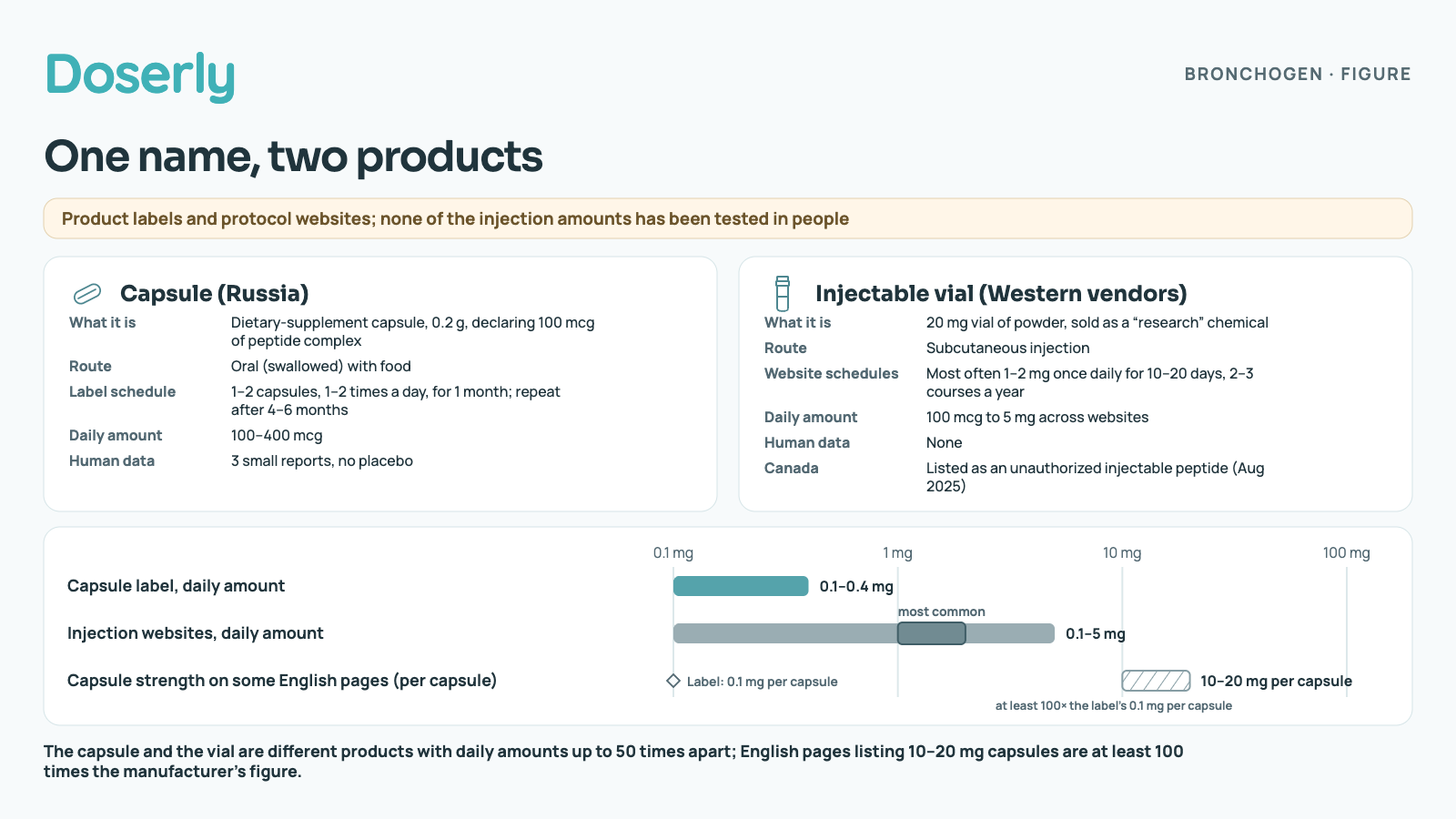
One name, two products
- Capsule (Russia)
- What it is: Dietary-supplement capsule, 0.2 g, declaring 100 mcg of peptide complexRoute: Oral (swallowed) with foodLabel schedule: 1–2 capsules, 1–2 times a day, for 1 month; repeat after 4–6 monthsDaily amount: 100–400 mcgHuman data: 3 small reports, no placebo
- Injectable vial (Western vendors)
- What it is: 20 mg vial of powder, sold as a “research” chemicalRoute: Subcutaneous injectionWebsite schedules: Most often 1–2 mg once daily for 10–20 days, 2–3 courses a yearDaily amount: 100 mcg to 5 mg across websitesHuman data: NoneCanada: Listed as an unauthorized injectable peptide (Aug 2025)
- Daily amounts compared
- Capsule label 0.1–0.4 mg a day; injection websites 0.1–5 mg a day (most often 1–2 mg); some English pages list 10–20 mg per capsule, at least 100× the label's 0.1 mg per capsule.
The capsule and the vial are different products with daily amounts up to 50 times apart; English pages listing 10–20 mg capsules are at least 100 times the manufacturer's figure.
Typical Bronchogen Protocols
| Example | Amount each time | Frequency | Total per day | Duration |
|---|---|---|---|---|
| Low | 1 capsule (100 mcg) | Once daily | 100 mcg | 1 month, repeated after 4–6 months Lower end of the label range [3] |
| Mid | 1 capsule (100 mcg) | Twice daily | 200 mcg | 1 month, repeated after 4–6 months Distributor's prevention schedule [7] |
| High | 2 capsules (200 mcg) | Twice daily, morning and evening | 400 mcg | 30 days Schedule used in the 2014 human report; also the top of the label range [4] |
The most common capsule protocol in the reviewed sources is 1–2 capsules, 1–2 times a day with food (100–400 mcg a day), for one month, repeated after 4–6 months. The same label wording appears on twelve pharmacy, retailer and reference pages, so it is one source copied many times rather than twelve independent opinions. [3], [8], [9], [10]
- Titration Changing the amount in steps
- The label does not step the amount up or down. It gives a range, and the capsule count within that range is left open. [3]
Read the units: mcg means micrograms; 1 mg equals 1,000 mcg. The capsule itself weighs 0.2 g (200 mg), but only 100 mcg of that is the declared peptide complex; the rest is filler. A newer 0.275 g capsule is also sold, and the pages we could read do not state its peptide content. [3], [9]
Each row is a complete schedule from one source, so its amount and duration belong together. Low, mid and high are alternatives, not steps to move through. These capsule schedules come from the product label and small human reports without a placebo; the cited references give the full details.
What about injectable vials?
| Example | Amount each time | Frequency | Total per day | Duration |
|---|---|---|---|---|
| Low | 100–200 mcg | Once daily | 100–200 mcg | 10–20 days, 2–3 courses a year Protocol website; gives the amount per day [11] |
| Mid | 1 mg (1,000 mcg) | Once daily | 1 mg | 10 days, 2–3 courses a year Called the “conservative course” by its source [12] |
| High | 2 mg (2,000 mcg) | Once daily | 2 mg | 10 days, 2–3 courses a year Called the “standard course” by its source [12] |
The most common injectable pattern in the reviewed sources is 1–2 mg once a day by subcutaneous injection for 10–20 days, repeated two or three times a year. Other pages range from 100 mcg to 5 mg a day. [11], [13], [12], [14], [15], [5], [16]
The human reports all used oral capsules, and no study of Bronchogen injections in people was found in the published research or trial registries, so none of these amounts has been tested for effect or safety. [18], [4], [23], [17] The usual 1–2 mg a day is 2.5 to 20 times the capsule label's 100–400 mcg. [3]
In community education groups, educators mostly describe 0.5–2 mg a day by subcutaneous injection for 20–40 days, repeated one to four times a year, without citing a source. One educator declined to give injectable amounts at all and pointed to the capsule label instead.
Where protocols differ: products, units, course length and breaks ↓
Where these numbers come from
The capsule rows come from the manufacturer-approved product description (reference [3]; approved in 2012 and still listed), a Serbian distributor's schedule (reference [7]) and the 2014 human report (reference [4]). The low row is the bottom of the label's own range. The high row matches both the report and the top of the label range. The 100 mcg per capsule figure appears in the label, the 2007 report and the 2014 report. [18], [4], [3]
The injection rows come from two protocol websites that each publish a complete schedule: reference [11] for the low row and reference [12] for the mid and high rows. References [13], [14], [15], [5] and [16] cross-check the recurring 1–2 mg, 10–20-day pattern. Seventeen independent web origins were compared; twelve capsule pages copy one label and count once.
Excluded from the typical comparison: pages giving capsules of 10–20 mg or “20 mg capsules”, which conflict with every manufacturer document found by at least 100 times; a 2–5 mg range with no source; a 12-week, five-peptide lung stack; and Doserly's own earlier page, which relied on a website whose research citations lead to unrelated papers. [19], [20], [21], [16], [22]
What is Bronchogen commonly used for?
People usually look into Bronchogen because breathing has become harder work: a cough that lingers for months, a smoker's morning sputum, asthma that never quite settles, or slow recovery after bronchitis, pneumonia or COVID-19.
A Russian product directory files the capsule under acute bronchitis, chronic bronchitis and chronic obstructive pulmonary disease (COPD), and the label says it supports lung and airway function. Online, people also discuss it for asthma, quitting smoking or vaping, and lung aging. The reports below describe that interest; they do not establish that Bronchogen treats any of these conditions. [3]
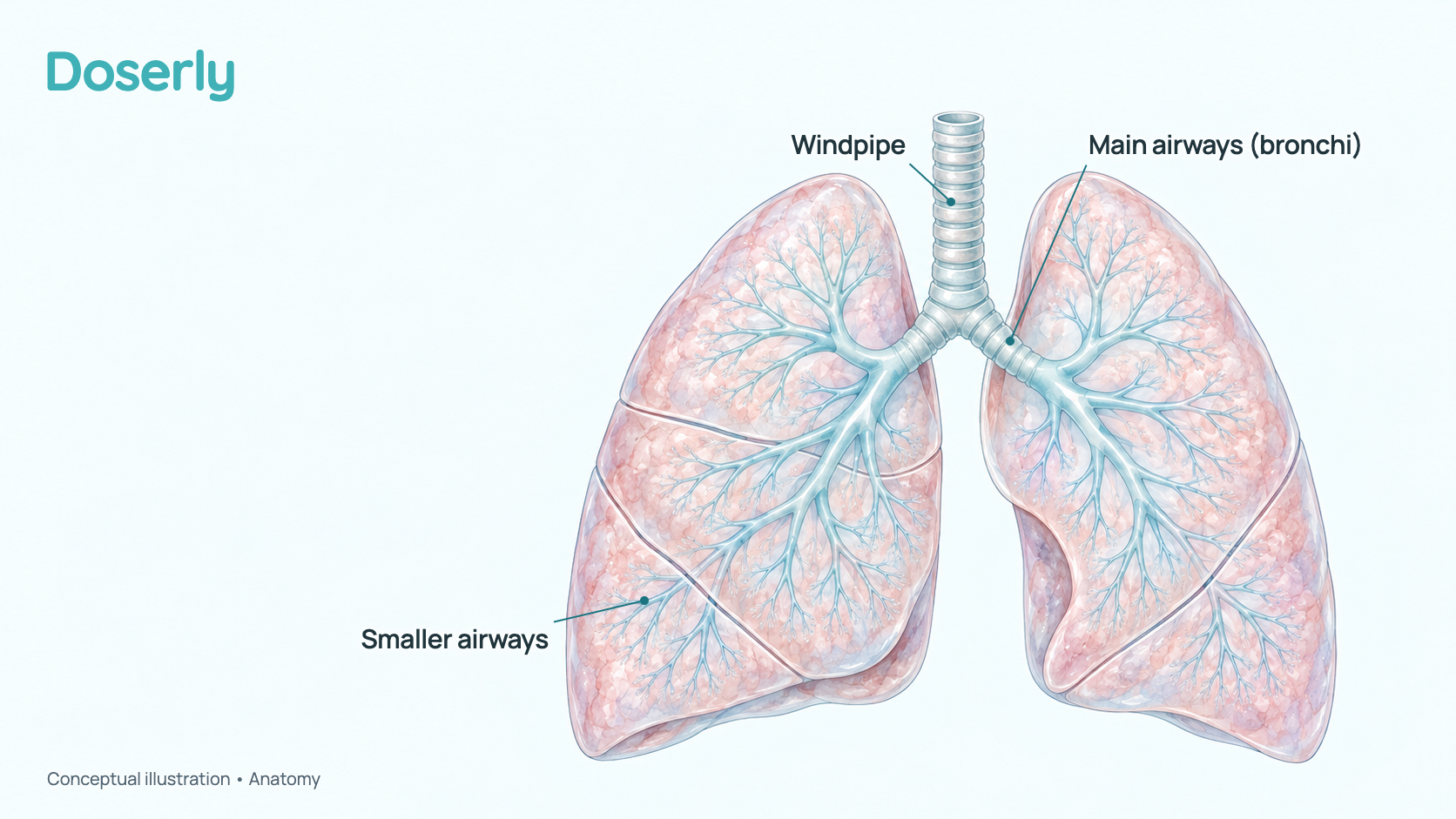
Chronic bronchitis and COPD
This is where the only human research sits. The small Russian capsule reports enrolled adults with chronic bronchitis (a long-lasting cough with mucus from inflamed airways) that also had an asthma-like component, during a calm spell between flare-ups. A 2012 hospital note from Kazakhstan added five older people with COPD. [18], [4], [23]
They describe people feeling better and breathing tests improving over 20–30 days, but none had a placebo group. What the human reports can and cannot show.
Smokers and ex-smokers
Smokers and people who have recently quit are a large share of the public accounts. Russian reviewers describe less cough and sputum on the capsules; English-language posts describe easier breathing after quitting cigarettes, cannabis or vaping. Quitting itself improves cough and breathing, which makes it hard to tell what the peptide added. [24], [25], [26]
Asthma
People with asthma describe mixed experiences: some felt it helped at first, and one person said symptoms returned strongly a few months later. [27], [28] The rat and cell research does not test asthma, and the label's condition list does not include it. Bronchogen has not been shown to work as a bronchodilator (a medicine that quickly opens narrowed airways), and none of the human reports tested it for quick relief of an asthma attack. [3], [18], [4]
Recovery after chest infections and COVID-19
Many positive stories begin during recovery from bronchitis, pneumonia or long COVID. Coughs after an infection often fade on their own over weeks, so a story that starts at the worst point is likely to end better whatever was taken. The developer's group has suggested its lung peptides for further study in COVID-19, but that was a proposal in a review article, not a test. [29], [30], [31], [32]
Other uses you may come across
Some pages describe Bronchogen as “repairing” lung tissue, preventing lung aging or helping emphysema, scarring lung disease or lung cancer. Those claims go far beyond the evidence. The tissue findings behind them come from rats, cells in a dish and test-tube experiments, and none of them tested these diseases in people. [33], [1]
Where do Bronchogen protocols differ?
The capsule label is easy to summarize. The disagreements start when a page mixes up the two products, the units or the course length. Here is what varies and why it matters.
Capsule or vial: which product is the number for?
Always check this first. Some pages put capsule and injection amounts in one table. The capsules declare 100 mcg of peptide complex each; the vials contain 20 mg (20,000 mcg) of powder. The label's highest daily amount, 400 mcg, is 2.5 to 5 times lower than the 1–2 mg a day most injection pages describe. Some people also use the name loosely for other Russian lung products that are different substances. [3], [12] Is Bronchogen the same as Chonluten?
Why do some websites give 10–20 mg capsules?
Several English pages give 10–20 mg capsules, or a “20 mg capsule”. Every manufacturer document found says 0.1 mg (100 mcg) per capsule, so those figures are at least 100 times too high; they may confuse the capsule weight or the 20 mg vial with the peptide content. Another page claims 200–400 mcg per capsule. [19], [20], [21], [16], [34], [3]
Is the number for one dose or the whole day?
Two capsules twice a day is four capsules, or 400 mcg, for the day. The label's “1–2 capsules, 1–2 times a day” therefore covers anything from 100 to 400 mcg a day. The distributor's treatment schedule of 2 capsules two or three times a day reaches 600 mcg. For injections, most pages give a single daily amount, so the dose and the daily total are the same number. [3], [7]
How many days, and how often is a course repeated?
Capsule sources agree on about a month, though some shops say 20–30 days or 1–3 months, and the Serbian distributor describes 2–4 months. Injection pages use shorter courses of 10–20 days. Community education groups describe 20–40 days. [3], [35], [7], [12]
Repeats vary from every 60–90 days to every 4–6 months, and one protocol page describes a 12-week daily course inside a five-peptide lung stack. These are different conventions, not results from a trial comparing course lengths. A 10-day, 30-day or 40-day course has not been shown to work better than another. [16], [13], [22]
Do sources start low and step up?
Almost none do. The label and most injection pages use one fixed amount for the whole course. The only step-ups found were a community education lesson (0.5 mg a day for a week, then 2 mg a day to day 40, six days on and one off) and one public account that moved from 500 mcg a day to 1 mg in a second course. [36]
How do milligrams convert to syringe units?
Injection pages often give amounts as “units” on an insulin syringe. A U-100 syringe holds 100 units per millilitre, so units measure volume, not an amount of Bronchogen. How much Bronchogen each unit holds depends on how much water was added to the vial.
For example, a 20 mg vial mixed with 2 mL of water holds 10 mg per mL, so 1 mg is 0.1 mL, or 10 units. Mixed with 3 mL, the same 1 mg is 15 units. One page lists 1 mg as 20 units because it assumes a smaller vial. Doserly's reconstitution calculator works this out for any vial and shows each step. [12], [5], [13]
Source-by-source comparison
Capsules
Unit key: 1 milligram (mg) = 1,000 micrograms (mcg). A 0.2 g capsule weighs 200 mg but declares 100 mcg of peptide complex.
The RLS directory reproduces the manufacturer-approved description: 1–2 capsules 1–2 times a day with food for one month, repeated after 4–6 months, with side effects listed as “not identified”. Twelve Russian and Kazakh pharmacy, retailer and reference pages repeat this wording, sometimes changing the course to 20–30 days or 1–3 months. [3], [8], [35], [9], [10]
Green Wave, the Serbian importer, prints two schedules in one document: 1 capsule twice daily for a month as prevention, and 2 capsules twice daily for 2–4 months as treatment. The same document also recommends 2 capsules two or three times a day for 30 days in COPD. [7]
A Kazakh retailer sells a two-month kit that pairs Bronchogen with Cardiogen capsules, with Bronchogen at 2 capsules twice daily in month one and 1 capsule twice daily in month two. That is a combination schedule, not a Bronchogen-only protocol. [37]
Injections
Optimal Health Manifesto describes about 100–200 mcg a day for 10–20 days, 2–3 times a year, and says no human dose-finding data exist. PeptideDosage.org gives 1 mg (conservative) or 2 mg (standard) once daily for 10 days, 2–3 times a year. Peptides.ID gives 1 mg once daily for 10–20 days, repeated every 4–6 months. The Peptide Catalog gives about 0.5–2 mg once daily for 10–20 days, labeled “self-reported; no validated human dose”. Peptides.wiki gives 1–2 mg daily for 10–30 days. PeptideDosages lists 1 mg or 2 mg once daily for 10 or 20 days. BodyHackGuide calls 2–5 mg a day for 10 days “the community pattern”, followed by 60–90 days off. [11], [12], [13], [14], [15], [5], [16]
Peptide Schedule gives 200–500 mcg a day by injection on one part of its page and 10–20 mg capsules on another. [19]
Citation problems
Many of these pages cite rat, cell or DNA studies next to human dose numbers; none of those studies tested a human dose. Peptides.ID also cites four PubMed numbers that lead to unrelated papers (on rodent chromosomes, school nursing, a protein screen and fat-tissue cells). Peptadex lists AEDG, which is a different peptide (Epitalon), as another name for Bronchogen. [13], [38]
What happens when you stop Bronchogen?
This has not been studied. None of the three human reports checked on people after their course ended, so nobody knows how long any change lasted or whether stopping causes withdrawal effects or a rebound. The 2007 and 2014 reports say no drug dependence was seen during treatment, but they did not look for effects after stopping. [18], [4], [23]
- Repeat courses. The capsule label suggests another course after 4–6 months. It does not explain why, and no study has measured how long any effect lasts. [3]
- Animal studies. The rat lung studies report no follow-up of the animals after treatment ended. [33], [49]
- Personal accounts. In the most detailed public account, home peak-flow readings drifted back down after the course ended, and a commenter said breathing and allergy symptoms returned whenever they paused for more than four days. A person with asthma who used Bronchogen with Chonluten said symptoms came back strongly over the following months. These are single stories with other changes going on at the same time. [36], [27] Read the accounts in full.
Do capsules and injections of Bronchogen behave the same way?
No one has measured this in people. An oral capsule has to survive stomach acid and digestive enzymes and then cross the gut wall before anything reaches the blood. A subcutaneous injection skips digestion and is absorbed from the fatty layer under the skin. Those are different starting points, so a matching amount would not mean a matching exposure, and here the amounts do not even match.
Bioavailability is how much of a dose reaches the blood in the form being measured. For Bronchogen it is unknown for every route. A 2023 computer-modelling study predicted that very short peptides like this one could fit gut transporter proteins, but a prediction is not a measurement of absorption. [39]
How long does Bronchogen last in the body?
The only data come from rats, in a Russian patent for a modified version of the peptide. It describes two separate experiments. In the first, researchers mixed a radioactively tagged form with rat blood plasma in a tube, and half of it was broken down within about 3 minutes. In the second, living rats were given a large oral dose (50 mg per kg of body weight), and the measured half-life in their blood was about 5 minutes. [40]
Two cautions apply. In the tube experiment, the tag can still be counted after the peptide has been cut up, so that number may not describe intact Bronchogen. And a rat half-life says nothing on its own about how often a person should take it or how long an effect lasts. Websites that give a human half-life in “minutes” are borrowing these rat numbers at best. [40], [16]
Does it collect in the lungs?
Some teaching materials claim that Bronchogen builds up in airway tissue. No study we found measured where Bronchogen goes in the body. The idea comes from the bioregulator theory that each short peptide acts on its own tissue, which has been tested only in cell and organ cultures. [41], [42]
How should Bronchogen be stored, and how long does it last?
It depends on the product. The capsules come with storage instructions on the label; for injectable vials, nobody has published a stability test.
- Capsules. The label says to keep them in a dry place, protected from light, at 2–25 °C (36–77 °F) and out of children's reach, with a shelf life of five years. [3], [8]
- Vial powder, before mixing. Protocol pages say to keep the freeze-dried powder frozen at −20 °C (−4 °F) or refrigerated, away from light. One claims it keeps for up to two years in a refrigerator before mixing, without citing stability data. [12], [13], [19]
- After mixing. Once the powder is mixed with liquid (reconstituted), the pages say to keep it refrigerated at 2–8 °C (36–46 °F), but their “use within” times range from 24 hours to about a month. None cites a stability test of Bronchogen. [19], [12], [11], [13], [14], [16]
We found no published stability study of Bronchogen: the capsules’ five-year shelf life is the manufacturer’s statement, and the vial times are website claims. The rat experiment in which it broke down within minutes measured blood plasma, not shelf life. [40] Health Canada warns that unauthorized injectable peptides may not have been made or stored safely, and cold storage cannot tell you what is in a vial (see product quality). [6]
What do we actually know about Bronchogen in people?
Three small human reports exist, all on the oral capsules, and two come from the developer's own institute. None used a placebo, none hid from patients or doctors who got the peptide, and none reports a clear statistical comparison of the treated and usual-care groups. ClinicalTrials.gov has no Bronchogen study, and no other registry search found one. [17]
What did the human reports find?
| Report | What researchers reported | What it cannot establish |
|---|---|---|
| Chronic bronchitis, 2007 institute report | 23 adults took 1–2 capsules twice daily with usual care for 20–30 days; 19 had usual care only. 73% of the Bronchogen group and 62% of the usual-care group felt better. Forced vital capacity was 2,851 mL at the start (one value given for both groups), then 3,801 mL after Bronchogen versus 3,201 mL after usual care alone. | Whether Bronchogen caused the change. The report is unsigned, was not published in a journal and gives no method for recording side effects. [18] |
| Chronic bronchitis, 2014 journal paper | 58 adults took 2 capsules twice daily (400 mcg a day) for 30 days with usual care; 20 had usual care only. 86% of the Bronchogen group felt better. Forced vital capacity rose 38.7%, from 2,741 to 3,801 mL; in the usual-care group it rose from 2,850 to 3,211 mL. | Whether the difference between groups was real. The paper says patients were randomly assigned by strata and that group differences were analyzed, but there was no placebo or blinding, and its lung-function table does not clearly report a comparison of the Bronchogen group with the usual-care group. [4] |
| COPD in older adults, 2012 hospital note | 5 people with COPD took 1 capsule twice daily for 20 days, alongside 12 heart patients taking a different peptide, Cardiogen. Fifteen people had usual care only, including 5 with COPD. Results were pooled across conditions and peptides, so there is no Bronchogen-only result. | Anything specific to Bronchogen. [23] |
All three state that no side effects or complications were seen, but none says how side effects were looked for. The 2014 paper was written by Khavinson's group, whose members are the patent's inventors, and it includes no funding or conflict-of-interest statement. [18], [4], [23], [1]
Why do the 2007 and 2014 reports look so alike?
Their lung-function numbers are nearly identical even though the group sizes differ. Forced vital capacity after Bronchogen was 3,800.8 mL in the 2007 report and 3,800.7 mL in the 2014 paper. The 2007 report gives a single starting value of 2,850.6 mL, and the 2014 paper gives its usual-care group a starting value of 2,850.0 mL. Both come from the same institute. The most likely explanation is that the 2014 paper reuses the earlier data, so they should be counted as one probably overlapping dataset, not two trials. [18], [4]
The same numbers appear a third time. A report on Chonluten, a different peptide, in the manufacturer's own collection of clinical reports describes a 2005–2006 study with the same 23 treated and 19 usual-care patients, the same sex split and age range, and a lung-function table identical to the 2007 Bronchogen report, value for value. Two different products are very unlikely to produce identical results, so at least one report appears to reuse another's data, and these figures cannot be treated as evidence about Bronchogen alone. [77], [18]
What do those breathing tests measure?
Forced vital capacity (FVC) is the total amount of air you can blow out, as hard as you can, after the deepest possible breath. Vital capacity and total lung capacity, also reported, are related measures of lung volume. They matter because a test result is more objective than “I feel better”, but a single test done before and after, without a comparison group given a dummy capsule, can still shift with practice, effort and recovery from a flare-up.
The reports did not measure the outcomes that matter over years: flare-ups, hospital stays, walking distance or how fast lung function declines. A useful change is one that lasts and shows up the same way on repeated tests: fewer bad days, less breathlessness on the stairs, fewer flare-ups.
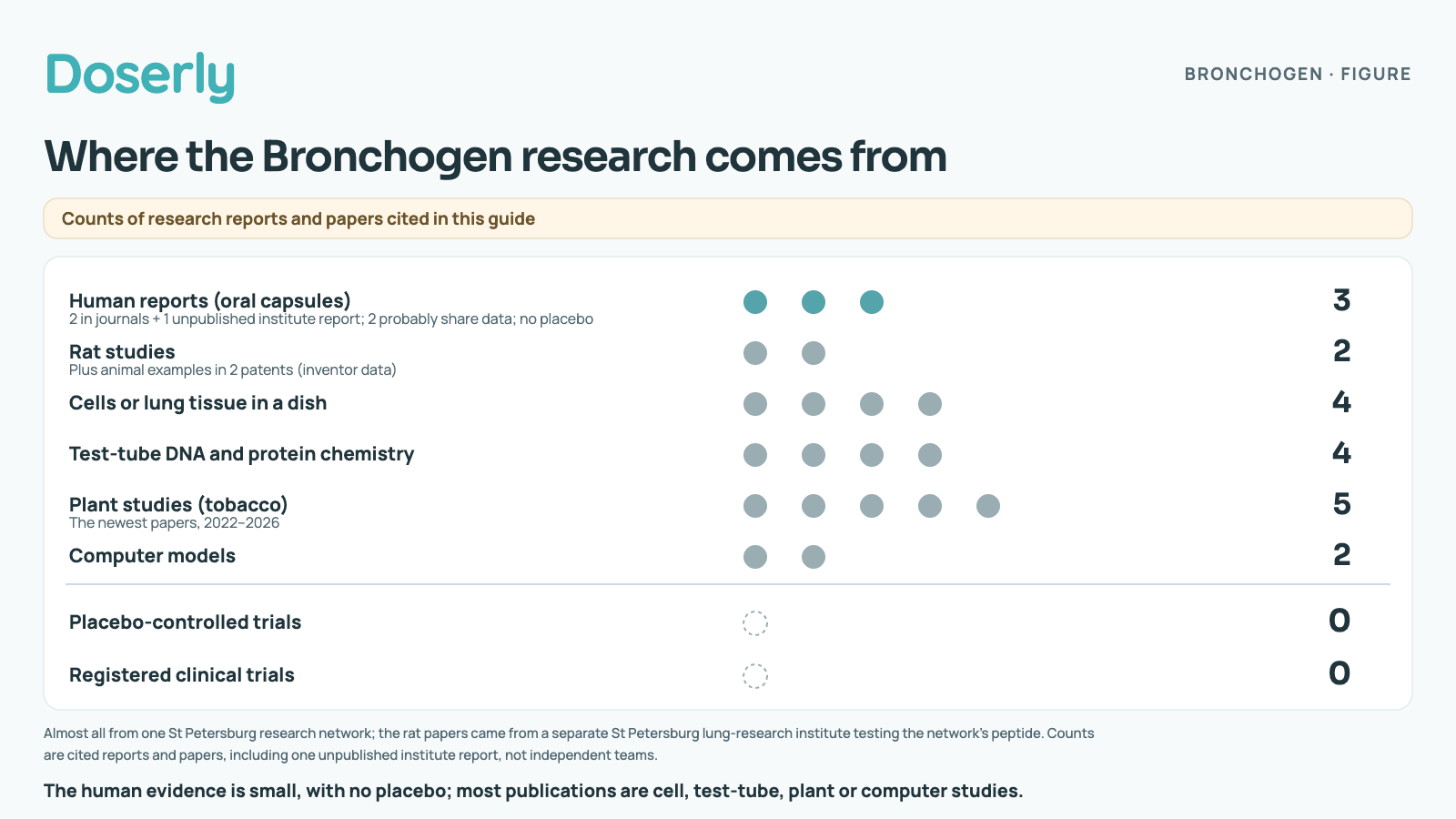
Where the Bronchogen research comes from
- Human reports (oral capsules)
- 3 reports. 2 in journals + 1 unpublished institute report; 2 probably share data; no placebo
- Rat studies
- 2 publications. Plus animal examples in 2 patents (inventor data)
- Cells or lung tissue in a dish
- 4 publications.
- Test-tube DNA and protein chemistry
- 4 publications.
- Plant studies (tobacco)
- 5 publications. The newest papers, 2022–2026
- Computer models
- 2 publications.
- Placebo-controlled trials
- None.
- Registered clinical trials
- None.
Almost all from one St Petersburg research network; the rat papers came from a separate St Petersburg lung-research institute testing the network's peptide. Counts are cited reports and papers, including one unpublished institute report, not independent teams.
The human evidence is small, with no placebo; most publications are cell, test-tube, plant or computer studies.
How might Bronchogen work?
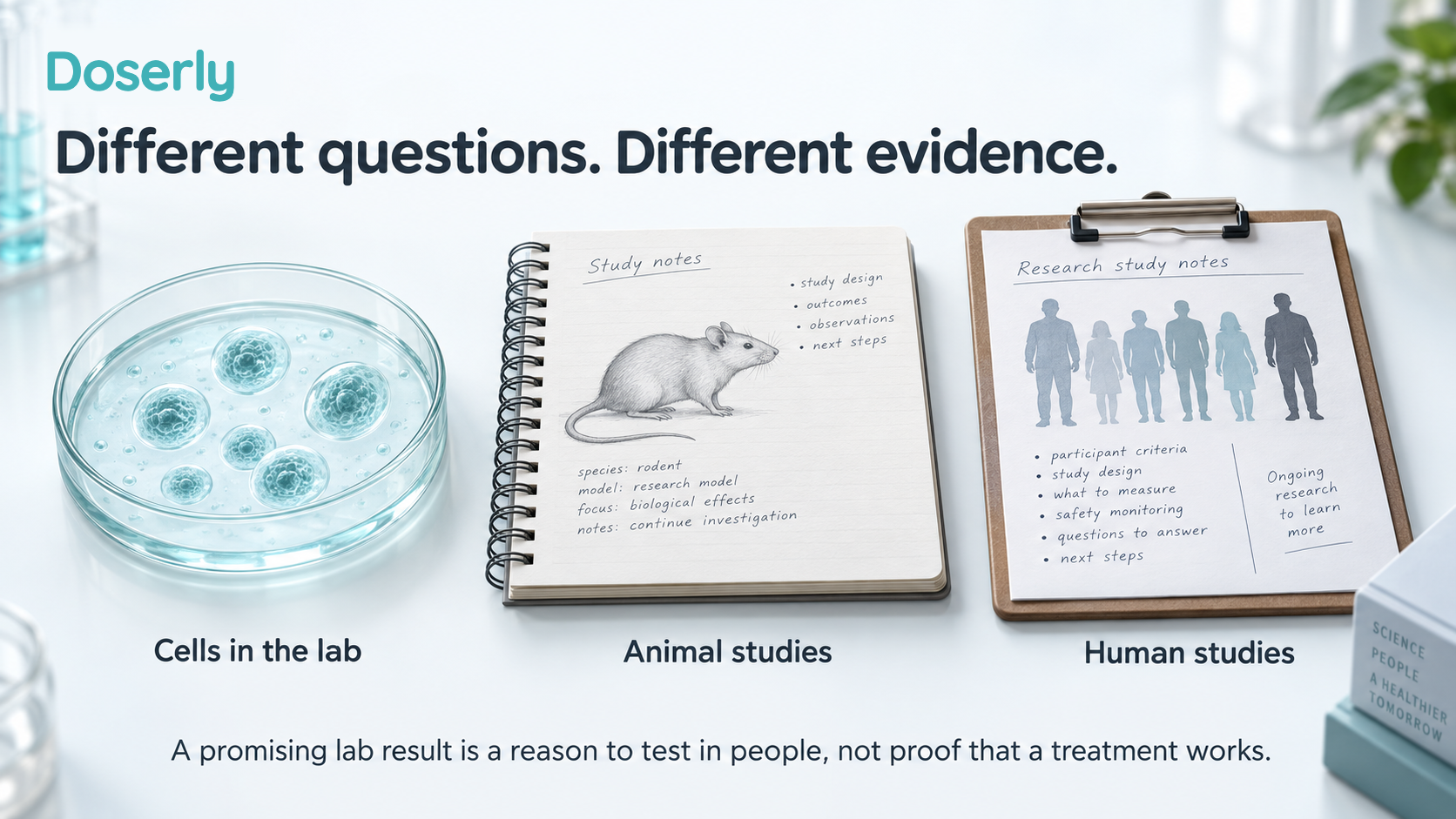
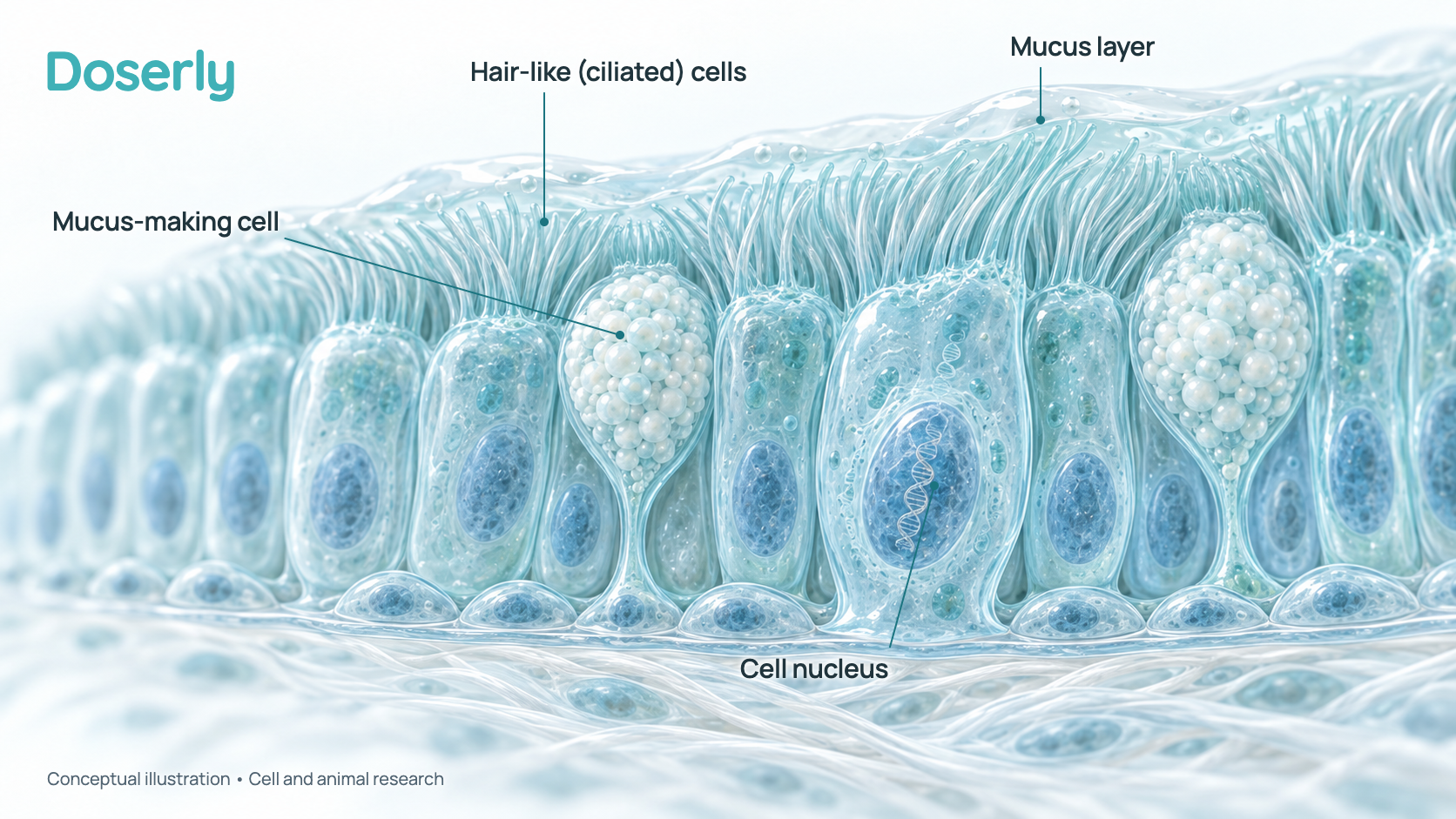
The developers' idea is that short peptides act as tissue-specific signals, switching genes on or off in airway-lining cells. The experiments below test pieces of that idea. They are preclinical (in cells, animals and test tubes), and almost all come from one research network.
What happens in airway cells grown in a dish?
In cell studies using human embryonic bronchial cells (airway-lining cells grown in a dish, not people), Bronchogen changed the activity of genes and proteins linked to cell renewal and to the specialized cells of the airway lining, including mucus-making cells. Some effects were larger in older, repeatedly grown cultures, which the authors treat as a model of aging. Not every marker changed. [43], [4], [44], [45]
A related experiment kept small pieces of lung from young and old rats alive in a dish; tiny amounts of Bronchogen increased their growth. A dish is a long way from a working lung. [41]
Does it really bind DNA?
In test-tube experiments with DNA extracted from animals, the peptide attached to DNA and made it slightly more resistant to heat, raising its melting point by 3.1 °C. It also bound certain short DNA pieces more than others and loosened packed DNA from rat liver cells. The group proposes that this is how it switches genes, but these experiments did not show it happening inside a living lung. [46], [47], [48]
What did the rat lung studies find?
In rats that breathed nitrogen dioxide (an air pollutant) for 60 days to cause COPD-like damage, a one-month course of Bronchogen was followed by less inflammation, fewer abnormal mucus cells, more healthy hair-like (ciliated) cells and more of a protective antibody in the airways. These studies came from a St Petersburg lung-research institute outside the developer's own, although they tested the developer's peptide. [33], [49]
The patent adds rat experiments in lung infection, lung scarring and oxygen damage. In the scarring model, the peptide “did not utterly prevent” scar tissue but the changes were less severe. These results are the inventors' own data and were not independently published. [1]
Which sequence is it: AEDL or ADEL?
The patent and the PubChem chemical database give Ala-Glu-Asp-Leu (AEDL). Three papers from the same network print Ala-Asp-Glu-Leu (ADEL), which is a different molecule with the same formula and weight. A 2014 Russian paper reports the same airway-cell experiments with AEDL, which suggests a misprint, but that has not been confirmed. The capsule label lists the four amino acids without giving their order. [1], [2], [43], [46], [4], [3]
Explore every Bronchogen experiment in the research library.
What are the risks and unanswered questions?
Is Bronchogen safe?
Its safety in people has not been established. The capsule reports and the label say no side effects were seen, but no study described how side effects were collected, the reports were small and short, and we found no human data at all for injected Bronchogen. [18], [4], [23], [3]
The patent's animal tests found no obvious toxicity in mice, rats and guinea pigs, including daily injections for up to six months at amounts far above the rat treatment dose. The same tests did record a rise in white blood cells (leukocytes) in guinea pigs at six months. That is an animal finding by the inventors, and its meaning is unclear. [1]
What problems have actually been reported?
Very few, and none formally. In one public thread, a person using injected Bronchogen reported immediate flushing and a heart rate of 106 beats a minute after injections. Community education groups reviewed for this guide contained no reported side effects, but the reports were few and several members who started it never posted an outcome, so silence is not evidence of safety. [36] No published case report of harm from Bronchogen was found. Health Canada's warning about one company's unauthorized injectable peptides names Bronchogen but does not describe any harm from it. [6]
Could product quality change the risk?
Yes. The vials are sold as unregulated “research” chemicals, and no manufacturer has published the peptide sequence, purity, sterility or testing of an injectable Bronchogen product that we could find. Health Canada says the injectable peptides it seized, Bronchogen among them, “have not been assessed for safety, efficacy, and quality”. Injecting any unapproved product adds risks of infection, contamination and allergic reaction. [6]
Is Bronchogen legal? Is it FDA-approved?
Checked September 23, 2026. Rules differ by country and change quickly. A “research use only” label does not make a product legal to sell or safe to use.
United States. Bronchogen is not an FDA-approved medicine: a search of FDA's approved-drug database found no entry. [76] It is not on FDA's list of compounding ingredients that may pose significant safety risks (page current as of April 22, 2026), but absence from that list is not an FDA safety judgment. [50]
Canada. Health Canada's August 1, 2025 advisory lists Bronchogen among “unauthorized injectable peptide drugs” seized from and sold by one Canadian company. Injectable peptides are regulated as prescription drugs in Canada, and selling unauthorized drugs is illegal. The advisory concerns injectable products; it does not assess the Russian capsules. [6]
Australia. Bronchogen is not approved in Australia. Searches of the Australian Register of Therapeutic Goods found no entry, and it is not named in the June 2026 Poisons Standard. The TGA's May 2026 warning on imported peptides warns of significant risks to patient safety and says personal importation is permitted only if products are clearly and accurately labelled. Labelling is one condition, so a well-labelled vial is not automatically legal to import. [51], [52], [53]
United Kingdom. A search of UK government sites, which include the medicines regulator (MHRA), found no record for Bronchogen. [54]
Russia. The capsules are sold as a dietary supplement (a biologically active food additive), not as a registered medicine. [3]
Is Bronchogen banned in sport? Does it show up on a drug test?
Bronchogen is not named on the World Anti-Doping Agency's 2026 list or on the 2027 list that takes effect on January 1, 2027. Category S0 bans at all times any substance “with no current approval by any governmental regulatory health authority for human therapeutic use”, and the 2027 list adds “peptides” to its examples. WADA has not ruled on Bronchogen specifically, and a Russian supplement registration is not a medicine approval, so tested athletes should assume S0 can apply. [55], [56]
No published anti-doping test for Bronchogen was found, and how long it could be detected is unknown.
Does Bronchogen cause cancer?
Nobody knows. There are no long-term human data and no standard long-term animal cancer studies. In airway cells, Bronchogen increased markers of cell division, most in “old” cultures; that neither shows a cancer risk nor rules one out. Claims that it treats lung cancer have no evidence behind them. [43], [1]
Who should be especially cautious?
These groups have no safety data in people. That is a reason for caution, not proof of harm.
- Pregnancy and breastfeeding. The capsule label lists both as reasons not to use it. [3]
- Children and teenagers. No study included anyone under 34, and this guide is written for adults. One community discussion involved a parent considering it for a child with severe asthma; there is no evidence for that use.
- Serious lung disease. People with COPD, emphysema, lung scarring, lung infections or suspected lung cancer need medical care. Bronchogen has been tried in only five people with COPD and not at all in the others, and community suggestions to use it for them carry no evidence. [23]
- A history of cancer. Because of the unanswered growth-signal questions above.
- Competitive athletes. See the anti-doping section above. [56]
- People taking other medicines. Interactions have not been studied; see the next question.
Has Bronchogen been tested alongside other medicines?
Not in any way that answers the question. In the human reports, everyone also received usual care for bronchitis, but the reports do not describe any interactions. Nothing is known about combining Bronchogen with inhalers, steroids, antibiotics, blood thinners or other peptides. Bring a complete list of everything you take to a pharmacist or doctor. [4], [18]
It is not a substitute for any of them: an inhaler, an antibiotic for pneumonia or oxygen treats a problem now, and Bronchogen has no evidence of doing so.
What should be monitored while using Bronchogen?
No regulator has written a monitoring plan for Bronchogen. The capsule label only advises talking to a doctor before use, and the injectable vials are sold for laboratory research, with no approved label or monitoring plan. What exists is a record of what the small human reports and the patent's animal safety tests checked. It can help you prepare questions for a clinician; it is not a personal testing plan. [3]
What did the human reports check?
- Breathing tests. All three repeated spirometry, a breathing test that measures how much air you can blow out and how fast. [18], [4], [23]
- Symptoms and sputum. The 2007 and 2014 reports recorded complaints such as cough, sputum (mucus coughed up) and breathlessness, and examined the sputum under a microscope. The 2007 report also listened to the chest. [18], [4]
- Blood, urine and X-rays. The 2007 report says it ran routine blood and urine tests, blood chemistry and chest X-rays, but it published no results for them. The 2012 note checked laboratory tests, heart tracings (ECG) and blood pressure after two weeks and reported only a pooled improvement across two peptides. [18], [23]
- Side effects. All three say none were seen, without saying how they were looked for. [18], [4], [23]
What did the animal safety tests check?
The patent's toxicity tests gave mice a single injection, rats daily injections for 90 days and guinea pigs daily injections for six months. The inventors examined the animals' general health, blood counts, blood chemistry, heart, lung, liver and kidney function, and their internal organs under a microscope. The only change they reported was a rise in white blood cells (leukocytes) in guinea pigs at six months. [1]
Which measures matter, and why?
| Why it matters | What studies measured or reported | Tracking category |
|---|---|---|
| Breathing, the reason most people try it | Spirometry, cough, sputum and breathlessness in the human reports [18], [4] | Physical Performance; Daily Functioning |
| Chest infections and flare-ups | Not measured in any report, although they matter most over the years | Immune Function |
| White blood cells | Rose in guinea pigs after six months; the human reports published no blood results [1], [18] | Blood work |
| Heart rate and flushing | One public account of flushing and a heart rate of 106 beats a minute after injections [36] | Heart Rate & Palpitations; Temperature Regulation |
| Injection problems | Health Canada warns that unauthorized injectable peptides may cause infection or allergic reactions [6] | Side Effect Burden |
| Other changes in your routine | Quitting smoking, a new inhaler or recovery from an infection can explain an improvement | Cravings & Impulse Control; Treatment Adherence |
Health Canada advises anyone who has used an unauthorized injectable peptide and has health concerns to talk to a doctor, nurse practitioner or pharmacist, and to report side effects. [6]
What do people in public communities report?
Public accounts split along the two products. English-language Reddit users mostly inject vials, often alongside other peptides. Russian-language reviewers mostly take the capsules. Across both, the stories are usually short, positive and hard to interpret, with a few detailed exceptions worth reading closely. [36], [57]
What do the positive reports look like?
The capsule reviews describe less cough and sputum and easier breathing. One reviewer took 1 capsule twice daily for 18 days during recovery from a bronchitis flare, noticed nothing in the first week, then coughed less and could manage without their steroid inhaler. Another took two monthly courses after two bouts of pneumonia, antibiotics and physiotherapy, and said the cough, breathlessness and weakness were gone by the end of the first month. [57], [29]
Injection users describe deeper breaths and better “lung function”. One took 1 mg a day of Bronchogen together with 1 mg a day of Chonluten while recovering from long COVID. Another said 500 mcg a day for a month “made such a difference” without saying what changed. [31], [58]
Most positive stories begin while an infection is clearing or soon after quitting smoking, and many include Chonluten, other peptides or new inhalers.
How long did those changes last?
The most detailed public account used a home spirometer (a breathing-test device). Over a 40-day course of 500 mcg a day by subcutaneous injection, peak flow (how fast you can blow air out) rose from 490 to 574 litres a minute. A second course at 1 mg, six days on and one off, followed. The readings drifted back down after stopping. The same person was also taking BPC-157 and TB-500, powerlifting, using a rescue inhaler as needed and getting ill at times. [36]
A commenter on that thread said symptoms came back whenever they paused for more than four days. A person with asthma said Bronchogen and Chonluten seemed to help at first, then symptoms returned strongly over the following months. [36], [27]
Does everyone notice a difference?
No. Several capsule reviewers wrote that they noticed nothing, or that the effect was “very weak”. One injection user found the results inconclusive after a week and later traced the problem to their ribs, not their lungs. [59], [60], [61], [62]
The most careful self-test, by a person investigating mild emphysema, ran 1 mg a day by subcutaneous injection for 20 days with home spirometry and a CT scan. The person was also taking N-acetylcysteine (a mucus-thinning supplement) and compared home readings with a clinic baseline. Their conclusion: “it is not possible to say if the treatment had any effects.” Weeks later they described “a small improvement”. [63], [64]
What about unwanted effects?
Only one public account described a reaction: immediate flushing and a faster heart rate after injections. One self-report cannot show how common that is or what caused it. See reported problems. [36]
What do community education groups teach?
Educators in community education groups describe Bronchogen as a slow-acting peptide meant to restore the airway lining, not a bronchodilator, and often pair it with Chonluten or VIP (vasoactive intestinal peptide). Some treat Bronchogen, Chonluten and Bronchalamin as interchangeable lung options, although they are different substances.
Members' experiences follow the public pattern: a handful of positive reports, mostly during recovery from an illness or after quitting smoking and usually with other peptides, a couple of unsure results, and several people who started and never reported back. Some advice went beyond any evidence, such as calling bioregulators harmless for someone with a cancer history or suggesting Bronchogen for serious lung infections and lung cancer.
How can you judge a breathing story?
Ask: Was an infection already clearing? Capsule or vial, and how much? What else changed: quitting smoking, inhalers, steroids, antibiotics, other peptides? Was anything measured the same way before and after? What happened months later?
These selected discussions are not a survey of all users, a response rate or a substitute for controlled studies. Public posts include a vendor-run forum and review sites that may reward reviewers, so some accounts may be promotional. [65], [26]
How does Bronchogen compare with Cardiogen, Epitalon and VIP?
Bronchogen is often discussed alongside other short peptides from the same Russian program and alongside VIP, which some people pair with it for the lungs. The table compares what each one is and how much human evidence exists.
| Compound | What it is | How it is taken | How often | Human evidence | Approval status |
|---|---|---|---|---|---|
| Bronchogen (this guide) | Four amino acids (AEDL) from a Russian research program, promoted for the airways [1] | Capsules by mouth; vials by subcutaneous injection, according to protocol websites [3], [12] | Capsules 1–2 times a day for a month; vial websites once daily for 10–20 days [3], [12] | Three small capsule reports without a placebo, two probably sharing data [18], [4], [23] | Supplement in Russia; not an approved medicine [3], [76] |
| Cardiogen | Four amino acids (Ala-Glu-Asp-Arg, AEDR) from the same program, promoted for the heart [80] | Capsules by mouth [78] | 1–2 capsules 1–2 times a day for a month, repeated after 4–6 months [78] | Two small capsule reports without a placebo: 27 treated versus 15 on usual care in 2007, and the pooled 2012 note [79], [23] | Supplement in Russia; we found no medicine approval [78] |
| Epitalon | Four amino acids (Ala-Glu-Asp-Gly, AEDG) from the same program; not the same as epithalamin, a pineal-gland extract [81] | Subcutaneous injection in the compounded products FDA reviewed; the human studies used a spray under the tongue or an injection beside the eye [81] | Not established for injection [81] | Three small human studies, including one placebo-controlled study of a spray under the tongue; none tested the injected products FDA reviewed [81] | Not FDA-approved; in 2026 FDA proposed not adding it to the list of ingredients pharmacies may compound from [81] |
| VIP | A 28-amino-acid hormone made by the body's nerve tissue; the lab-made drug is called aviptadil [82] | Into a vein in the largest trial; with phentolamine, as an injection for erection problems in an approved product [84], [86] | 12-hour infusions on 3 days in the largest trial [84] | A placebo-controlled trial in 471 people with severe COVID-19 found no significant benefit by day 90 [83] | Not FDA-approved [87]; approved in Sweden since 2015 in the erection-problem product [85], [86] |
The real differences are in how much has been tested, not in proven results. Bronchogen, Cardiogen and Epitalon differ by only one or two amino acids. Bronchogen and Cardiogen have only a few small Russian capsule reports without a placebo, and Epitalon's three small human studies include one placebo-controlled study. VIP is a natural, longer peptide that has been tested in larger trials, including one that found no clear benefit in severe COVID-19. No human study has compared any of them with Bronchogen. Chonluten, a three-amino-acid peptide (Glu-Asp-Gly) that some people take with Bronchogen, has no Doserly guide yet; the only human report on it we found repeats the Bronchogen report's numbers (see above). [66], [31], [27], [77]
Common questions about Bronchogen
Is Bronchogen a pill or an injection?
Both are sold, and they are different products. The original Russian Bronchogen is a capsule taken with food, declaring 100 mcg of peptide complex. Western vendors sell 20 mg vials of powder for injection. Only the capsule has a product label and human reports; we found no study of the injection. [3], [4], [17] See the two protocol tables.
How long does Bronchogen take to work?
There is no reliable answer. The human reports measured results after 20–30 days. Public accounts range from “day one” to about three weeks, and some people noticed nothing at all. Early changes during recovery from an infection are especially hard to credit to the peptide, since coughs often ease on their own. The educators who promote it describe it as slow-acting rather than immediate. [4], [65], [57], [59] See what people reported over time.
Is Bronchogen the same as Chonluten or Bronchalamin?
No. Chonluten is a different, three-amino-acid peptide (Glu-Asp-Gly, or EDG) from the same Russian program, also promoted for the airways. Bronchalamin is a powder made from the airway lining of cattle and pigs, sold as tablets, not a single lab-made peptide. People often take Bronchogen with Chonluten, which is one reason their stories cannot show what Bronchogen did on its own. Research on Chonluten or Bronchalamin cannot be counted as research on Bronchogen. [32], [66], [67], [68]
Is Bronchogen the same as AEDG or Epitalon?
No. AEDG (Ala-Glu-Asp-Gly) is Epitalon, a different four-amino-acid peptide from the same program, even though at least one website lists AEDG as another name for Bronchogen. One letter differs, and so does the molecule. Bronchogen's patent sequence is AEDL. [32], [38], [1] Read the Doserly Epitalon guide.
Can Bronchogen replace an inhaler or COPD treatment?
The reviewed evidence gives no reason to think so. In every human report, Bronchogen was added to usual treatment, not used instead of it, and it has not been shown to work as a bronchodilator. Stopping prescribed inhalers, antibiotics or oxygen to try it could be dangerous. [18], [4] See interactions and cautions.
Is it legal to buy Bronchogen?
It depends on the country and the product. The capsules are sold as a supplement in Russia. Injectable Bronchogen is not approved in the United States, and Health Canada lists it among unauthorized injectable peptides. A “research use only” label does not make a product legal or safe. See the dated legal-status summary. [3], [50], [6]
Is a longer course more likely to work?
Nothing shows that. Courses range from 10 days to 4 months across the sources, and no one has compared them. Longer use also raises safety questions that short, small reports cannot answer. [12], [7], [4]
Glossary
Plain explanations of the route, dosing and research terms used in this guide. Underlined terms in the text link here.
- Adverse event
- A harmful or unwanted medical event reported after someone used a treatment. A report alone does not prove the treatment caused it.
- Amino acid
- A small chemical building block. Chains of amino acids make up peptides and proteins.
- Animal study
- Research in animals such as rats or mice. It shows what a substance does in a living body, but results in people can differ.
- Bioavailability
- How much of a dose reaches the bloodstream in a usable form. It depends heavily on the route. For Bronchogen it has not been measured by any route.
- Bioregulator
- The name a Russian research group uses for very short peptides it believes act on particular tissues. It is a marketing and research label, not a regulatory category.
- Bronchodilator
- A medicine that relaxes the muscles around the airways so they open quickly, such as a rescue inhaler. Bronchogen has not been shown to work as one.
- Cell study (in vitro)
- Research on cells grown in a dish. It gives early clues about biology, but it is far from proof of benefit in people.
- Controlled trial
- A study that compares people who receive a treatment with a similar group who do not, often receiving a placebo instead. Randomly assigning people to each group makes the comparison fairer.
- COPD
- Chronic obstructive pulmonary disease: long-term lung damage, usually from smoking, that narrows the airways and makes breathing out harder. It includes chronic bronchitis and emphysema.
- Course and cycle
- A course is the period of repeated use, such as one month. A cycle is a course plus a planned break before any further use.
- Daily total
- All the amounts given in one day, added together. For example, 2 capsules of 100 mcg twice daily is a 400 mcg daily total.
- Dietary supplement
- A product sold as a food additive rather than a medicine. In Russia these are registered with lighter requirements than medicines and do not have to prove they work.
- Dose (amount each time)
- The amount given on one occasion. A protocol lists both the dose and how often it is given.
- ECG (electrocardiogram)
- A quick, painless recording of the heart's electrical activity through stickers placed on the skin. A 2012 report that included Bronchogen checked it during treatment.
- Forced vital capacity (FVC)
- The total amount of air a person can blow out as hard as possible after the deepest possible breath. It is a standard breathing test.
- Half-life
- The time it takes for the measured level of a substance in the blood to fall by half. It is not the same as how long an effect lasts.
- Investigational
- Still being studied and not approved by a regulator, such as the FDA, to treat any condition.
- mcg and mg
- Micrograms and milligrams. 1 mg equals 1,000 mcg. Bronchogen capsules declare 100 mcg each; injection amounts are usually written in mg.
- Oral
- Taken by mouth, as a capsule, tablet or liquid.
- Peptide
- A short chain of amino acids. Bronchogen is a chain of four, called a tetrapeptide.
- Pharmacokinetics
- How the body absorbs, moves, breaks down and removes a substance. For Bronchogen, only rat data exist.
- Placebo
- A dummy treatment with no active ingredient, used as a comparison in studies.
- Preclinical research
- Studies done before research in people: cell studies, test-tube experiments and animal studies.
- Reconstitution
- Mixing a freeze-dried powder with a sterile liquid so it becomes a solution. How long mixed Bronchogen stays usable has not been tested.
- Research use only
- A label on products sold for laboratory research. It does not mean a product is approved, tested for human use or legal to sell as a medicine.
- Spirometry
- A breathing test in which you blow as hard and fast as you can into a device that measures how much air comes out and how quickly. Forced vital capacity is one of its results.
- Subcutaneous (SC)
- Injected into the fatty layer just under the skin. This is the route most injectable Bronchogen descriptions use.
- Syringe units
- Markings on an insulin syringe that measure volume. On a U-100 syringe, 100 units equal 1 mL. The amount of drug per unit depends on the vial's concentration.
- Titration
- Adjusting a dose in steps, usually starting lower and increasing if needed.
- WADA
- The World Anti-Doping Agency, which publishes the list of substances banned in sport.
Explore more of the research
Go deeper into the experiments behind the claims.
Across this guide, the citations include 19 original scientific papers on Bronchogen: two small human reports in journals and 17 preclinical papers on cells, test-tube chemistry, rats, plants and computer models. Two patents and an unpublished institute report are counted separately, and the comparison section adds two papers on VIP. The library below explores 18 of the Bronchogen papers and both patents, grouped by question. Paper counts are not counts of independent research teams: almost all come from one research network, and some may share data.
Airway cells and lung tissue in a dish · 5 papers
Does it change airway-lining cells?
Model: Human embryonic airway-lining (bronchial) cells grown in a dish, at early, middle and late passages.
Finding: Bronchogen changed levels of proteins linked to cell division and survival (Ki67, Mcl-1, p53) and the activity of genes that mark specialized airway cells, including mucus-cell genes (MUC4, MUC5AC). The strongest effect on cell-division markers was in the late-passage (“old”) cultures. This paper prints the sequence as ADEL.
Limit: Cells in a dish; a change in gene activity is not a healthier lung. More cell division is not automatically good.
Is the same experiment reported with AEDL?
Model: The same airway-cell model, reported in a Russian journal alongside the capsule study.
Finding: Similar gene and protein changes, this time with the sequence printed as AEDL, at 20 nanograms per mL of culture medium.
Limit: Same group, possibly the same data; it cannot confirm the other paper independently.
Does it matter how old the cells are?
Model: Airway cells, pancreas cells and connective-tissue cells at different culture ages.
Finding: Markers of cell specialization fell as cultures aged. Bronchogen raised two of them (CXCL12 and Hoxa3) in airway cells, more so in aged cultures; other peptides did the same in their own tissues.
Limit: Culture “aging” is repeated growth in a dish, not an older person.
Does it change how genes are switched on or off?
Model: Aging airway-cell and pancreas-cell cultures; DNA methylation (chemical tags that silence genes).
Finding: Methylation of two airway genes (NKX2-1 and SCGB1A1) changed with age and with Bronchogen. Several other genes changed activity without any methylation change.
Limit: A selective, mixed result; not every gene followed the proposed mechanism.
Does lung tissue grow faster with it?
Model: Small pieces of lung from 3-week-old and 18-month-old rats kept alive in a dish.
Finding: At 0.05 nanograms per mL, Bronchogen increased explant growth compared with untreated pieces; related peptides did the same in heart, prostate and pancreas tissue.
Limit: Explant growth is not lung repair in a living animal.
DNA, chromatin and computer models · 6 papers
Does it bind DNA?
Model: DNA extracted from calf thymus and mouse liver, in a test tube.
Finding: The peptide raised DNA's melting temperature by 3.1 °C at low peptide-to-DNA ratios, then plateaued.
Limit: A physical-chemistry result; it does not show the peptide reaches DNA in a living cell.
Does it loosen packed DNA?
Model: Chromatin (DNA wound around proteins) from rat liver, in a test tube.
Finding: About 15% of the tightly wound core DNA was released, which the authors say could make genes easier to read.
Limit: Liver chromatin in a tube, not airway cells in a lung.
Does it prefer certain DNA sequences?
Model: Short labeled DNA pieces and whole DNA in a test tube, plus human cancer-derived cells for other peptides.
Finding: Bronchogen bound DNA pieces containing a CNG pattern more strongly than others. The images of peptides entering cell nuclei were for three other peptides, not Bronchogen.
Limit: Binding in a tube is not gene control in a lung.
Does it bind the proteins that package DNA?
Model: Histone proteins from wheat, in a test tube.
Finding: Bronchogen and five related peptides bound wheat histones.
Limit: Plant proteins; no airway cells were involved.
Where would it dock on DNA?
Model: Computer docking models of 19 short peptides and DNA.
Finding: The model placed AEDL on a “ctcc” DNA sequence.
Limit: A computer prediction, not an experiment.
Could gut transporters carry it into cells?
Model: Computer models of three transporter proteins (LAT1, LAT2, PEPT1) and 26 short peptides.
Finding: AEDL and similar peptides scored as likely to fit these transporters.
Limit: A prediction; no absorption was measured.
Rat lung studies and patent examples · 2 papers, 2 patents
What happened to the airway lining?
Model: The same rat nitrogen-dioxide model, one month of Bronchogen.
Finding: Less mucus-cell overgrowth, scarring-type lining changes, lymphocyte build-up and emphysema; more ciliated cells and more secretory IgA (a protective antibody).
Limit: The abstract gives no dose, route or group size; the animals may overlap with the group's other paper.
Did airway inflammation settle?
Model: The same model; fluid washed from the lungs was analyzed.
Finding: Less neutrophil (a type of white blood cell) inflammation and more normal cytokine levels, with more secretory IgA and surfactant protein B.
Limit: Same group and model; not an independent replication.
What do the patent's own experiments claim?
Model: Rats with lung infection, lung scarring (bleomycin) or oxygen damage; toxicity tests in mice, rats and guinea pigs.
Finding: Faster recovery in the infection model at 0.2 mcg/kg a day into the abdominal cavity; less severe but not prevented scarring; no obvious toxicity, with a higher white-cell count in guinea pigs at six months.
Limit: Inventor data in a patent, not peer-reviewed; animal doses cannot be converted to human doses.
How fast is it broken down?
Model: Two separate rat experiments: a radioactively tagged peptide mixed with rat blood plasma in a tube, and living rats given the peptide by mouth or into a vein, with blood levels measured by mass spectrometry.
Finding: Half of the tagged AEDL was broken down in plasma in about 3 minutes; after 50 mg/kg by mouth, the blood half-life was about 5 minutes.
Limit: Rat data from a patent for a modified version; in the tube experiment the tag may not track intact peptide.
Plant studies · 5 papers
Why is a lung peptide tested on tobacco plants?
Model: Tobacco callus (clumps of plant cells) and seedlings grown with tiny amounts of AEDL.
Finding: AEDL increased callus growth and leaf formation and changed plant growth genes. Later papers reported longer roots under salt stress, 3.24 times more glutathione (an antioxidant), and changes in how root cells recycle their contents (autophagy).
Limit: Plant biology. These are the most recent AEDL papers (2022–2026), and none says anything about human lungs.
How this guide was researched
This guide is built from a thorough review of the sources cited throughout it: published scientific studies, patents, trial-registry searches, regulatory documents, product labels and published protocol descriptions. We also reviewed public online forums and review sites, and community education groups, where people describe their own experiences with Bronchogen.
The guide cites 87 sources, including 21 original scientific papers. Each type of source answers a different question. Studies show what researchers measured. Protocol descriptions show how Bronchogen is typically used. Personal accounts show what individual people experienced. Every numbered citation links to its entry below, labeled by source type.
How this guide was made
Research and drafting were AI-assisted. Every cited source was checked against the original, and the guide was reviewed and edited by Doserly before publication. It has not had an independent clinical review, and Doserly does not currently have medical reviewers. Doserly makes a medication and health-tracking app and runs Doserly Academy, both of which are promoted in this guide. Read our editorial policy for how guides are researched, updated and corrected.
This guide is for educational purposes. It summarizes what the reviewed sources report so the research is easier to understand; it is not medical advice. For a deeper dive, or to check any point for yourself, go straight to the cited sources.
Explore the sources
These are the documents cited in this guide. Studies, product labels, website advice and personal accounts answer different questions. A source being listed does not mean every statement on its page is endorsed.
Showing 87 sources
- 01
Peptide substance restoring respiratory organs function (US7625870B2; same family as RU2255757C1) ↗
Patent (animal data)
Full text of the US equivalent reviewed.
Result detail: Gives the sequence Ala-Glu-Asp-Leu. Rat lung-injury examples used 0.2 mcg/kg into the abdominal cavity; toxicity tests in mice, rats and guinea pigs reported no obvious toxicity but a higher white-cell count in guinea pigs at six months. Inventor data, not independently published.
- 02
Bronchogen (PubChem CID 11690869) ↗
Chemical database
Record checked.
Result detail: Ala-Glu-Asp-Leu, formula C18H30N4O9, 446.5 g/mol. A CAS-style number on the page is a depositor-supplied synonym, not a verified registry entry.
- 03
Бронхоген (Bronchogen) capsules 0.2 g: description based on the manufacturer-approved instruction ↗
Product label
Full text reviewed (Russian): 100 mcg AKS-B peptide complex per 0.2 g capsule; 1–2 capsules 1–2 times daily with food for 1 month; repeat after 4–6 months.
- 04
[Prospects of tetrapeptide application in treatment of chronic bronchitis: molecular mechanisms] (Russian) ↗
Human report
Full text reviewed.
Result detail: 58 adults on 2 capsules twice daily for 30 days vs 20 on usual care; reports stratified random assignment but no placebo or blinding; lung-function results do not clearly compare the two groups; also includes airway-cell experiments with AEDL.
- 05
- 06
Unauthorized injectable peptide drugs seized and sold by Canada Peptide may pose serious health risks ↗
Regulator
Checked 23 Sep 2026; Bronchogen listed among unauthorized injectable peptide drugs.
- 07
Rezultati kliničkih ispitivanja: Preparat Bronhogen® (clinical results and dosing, Serbian) ↗
Protocol source
Full text reviewed; translation of the 2007 report plus prevention and treatment schedules.
- 08
Бронхоген капсулы 60 шт (Bronchogen, 60 capsules) ↗
Protocol source
Page checked; repeats the label schedule.
- 09
Instruction: PeptideBio Bronchogen capsules 0.275 g ↗
Protocol source
Page checked; label schedule for the 0.275 g capsule.
- 10
Bronchogen® Instruction ↗
Protocol source
Leaflet checked; 1–2 capsules 1–2 times daily for 20–30 days.
- 11
Bronchogen: Dosing, Benefits & Side Effects ↗
Protocol source
Page checked; source of the low injection row.
- 12
Bronchogen Dosage Chart, Schedule & Reconstitution Protocol ↗
Protocol source
Page checked; source of the mid and high injection rows.
- 13
Bronchogen Research, Dosing & Protocols ↗
Protocol source
Page checked; four of its PubMed citations lead to unrelated papers.
- 14
- 15
- 16
- 17
ClinicalTrials.gov searches for Bronchogen, Bronhogen, AEDL and Khavinson ↗
Registry search
Searched directly; no Bronchogen study found (one unrelated lung-cancer match).
- 18
[Report on the clinical study of the dietary supplement Bronchogen] (Russian-language institute report) ↗
Human report
Full text reviewed.
Limitation: Unsigned and not published in a journal; 23 vs 19 adults, no placebo or blinding; lung-function values nearly match the 2014 paper, so the two probably share data.
- 19
- 20
- 21
- 22
- 23
[Role of peptide bioregulators in improving treatment effectiveness in elderly patients] (Russian) ↗
Human report
Full text reviewed.
Limitation: Only 5 people with COPD took Bronchogen; their results were pooled with 12 heart patients taking Cardiogen.
- 24
Курильщикам на заметку! (For smokers to note) ↗
Community account
Post and relevant comments read. Personal account, not a study.
- 25
Отличный препарат для очистки легких (Excellent product for clearing lungs) ↗
Community account
Post and relevant comments read. Personal account, not a study.
- 26
Bronchogen ↗
Community account
Post and relevant comments read. Seller-run forum; read with that in mind.
- 27
- 28
“Бронхоген”: отзывы курильщиков (smokers' reviews) ↗
Community account
Post and relevant comments read. Personal account, not a study.
- 29
Помогает восстановлению легких (Helps lung recovery) ↗
Community account
Post and relevant comments read. Personal account, not a study.
- 30
Bronchogen PeptidBio capsules: product review ↗
Community account
Post and relevant comments read. Personal account, not a study.
- 31
Bioregulator peptides ↗
Community account
Post and relevant comments read. Personal account, not a study.
- 32
Peptides: Prospects for Use in the Treatment of COVID-19. ↗
Review
Full text reviewed.
Limitation: Proposes lung peptides for COVID-19 study; contains no COVID-19 experiment.
- 33
Modulating Effect of Peptide Therapy on the Morphofunctional State of Bronchial Epithelium in Rats with Obstructive Lung Pathology. ↗
Cell / animal research
Original abstract reviewed.
- 34
- 35
БРОНХОГЕН® peptide complex for the respiratory system ↗
Protocol source
Page checked; label schedule with a 1–3 month course.
- 36
My Bronchogen Results ↗
Community account
Post and relevant comments read. Detailed self-report with home peak-flow readings; includes a comment reporting flushing and a faster heart rate.
- 37
Peptide Bio “Free Breathing” peptide kit, 180 capsules ↗
Protocol source
Page checked; combination kit schedule with Cardiogen.
- 38
Bronchogen: Dosing, Side Effects & Research ↗
Protocol source
Page checked; lists AEDG as an alias in error.
- 39
Feasibility of Transport of 26 Biologically Active Ultrashort Peptides via LAT and PEPT Family Transporters. ↗
Computer modelling
Original abstract reviewed.
- 40
Peptide compound restoring respiratory function and having immunomodulatory activity (RU2667466C1) ↗
Patent (animal data)
Full text reviewed.
Result detail: Rat data only: tagged AEDL was half broken down in rat plasma in about 3 minutes; oral half-life about 5 minutes at 50 mg/kg.
- 41
[The tissue-specific effect of synthetic peptides-biologic regulators in organotypic tissues culture in young and old rats]. ↗
Cell / animal research
Original abstract reviewed.
- 42
- 43
Peptide regulation of gene expression and protein synthesis in bronchial epithelium. ↗
Cell / animal research
Original abstract reviewed.
Result detail: Human embryonic airway cells in a dish; prints the sequence as ADEL.
- 44
Peptides tissue-specifically stimulate cell differentiation during their aging. ↗
Cell / animal research
Original abstract reviewed.
- 45
Epigenetic mechanisms of peptidergic regulation of gene expression during aging of human cells. ↗
Cell / animal research
Original abstract reviewed.
- 46
Effect of the peptide bronchogen (Ala-Asp-Glu-Leu) on DNA thermostability. ↗
Test-tube research
Original abstract reviewed.
- 47
Influence of tetrapeptide on chromatin thermostability. ↗
Test-tube research
Original abstract reviewed.
- 48
Penetration of short fluorescence-labeled peptides into the nucleus in HeLa cells and in vitro specific interaction of the peptides with deoxyribooligonucleotides and DNA. ↗
Cell / test-tube research
Original abstract reviewed.
Limitation: The nucleus-entry images were for other peptides, not Bronchogen.
- 49
[ANTIINFLAMMATORY AND REGENERATIVE EFFECT OF PEPTIDE THERAPY IN THE MODEL OF OBSTRUCTIVE LUNG PATHOLOGY]. ↗
Cell / animal research
Original abstract reviewed.
- 50
Certain Bulk Drug Substances for Use in Compounding that May Present Significant Safety Risks ↗
Regulator
Checked 23 Sep 2026; Bronchogen not listed.
- 51
TGA warning on the risks of importing unapproved peptide products ↗
Regulator
Checked 23 Sep 2026; a general peptide warning that does not name Bronchogen.
- 52
Australian Register of Therapeutic Goods (ARTG) search: Bronchogen ↗
Regulator
Searched for Bronchogen and Ala-Glu-Asp-Leu; no matching results.
- 53
Therapeutic Goods (Poisons Standard—June 2026) Instrument 2026 ↗
Regulator
Instrument text searched 23 Sep 2026; Bronchogen and its sequence are not named.
- 54
- 55
- 56
The 2027 Prohibited List ↗
Regulator
Full text checked; Bronchogen not named; S0 examples now include peptides.
- 57
Дышите полной грудью (Breathe fully) ↗
Community account
Post and relevant comments read. Personal account, not a study.
- 58
Bronchogen, cardiogen, pancreagen ↗
Community account
Post and relevant comments read. Personal account, not a study.
- 59
Bronchogen PeptidBio capsules: product review ↗
Community account
Post and relevant comments read. Personal account, not a study.
- 60
Bronchogen PeptidBio capsules: product review ↗
Community account
Post and relevant comments read. Personal account, not a study.
- 61
Bronchogen PeptidBio capsules: product review ↗
Community account
Post and relevant comments read. Personal account, not a study.
- 62
Bronchogen for Lungs ↗
Community account
Post and relevant comments read. Personal account, not a study.
- 63
Results of 20 day testing of Bronchogen therapy for mild emphysema ↗
Community account
Post and relevant comments read. Detailed self-test with home spirometry; author could not tell whether it worked.
- 64
Peptides for lung health (long covid / post covid) ↗
Community account
Post and relevant comments read. Personal account, not a study.
- 65
Day one of trying Bronchogen peptide for my asthma! ↗
Community account
Post and relevant comments read. Seller-run forum; day-by-day posts; read with that in mind.
- 66
Peptides Regulating Proliferative Activity and Inflammatory Pathways in the Monocyte/Macrophage THP-1 Cell Line. ↗
Cell research (Chonluten, not Bronchogen)
Original abstract reviewed.
- 67
Бронхаламин Классик (Bronchalamin Classic) ↗
Product information (different product)
Page checked: tablets containing 10 mg of powder from cattle and pig tracheal and bronchial lining; renamed Bronchalamin Classic from 1 Jan 2025.
- 68
Bronchogen bioregulator dosage? ↗
Community account
Post and relevant comments read. Personal account, not a study.
- 69
Interaction of short peptides with FITC-labeled wheat histones and their complexes with deoxyribooligonucleotides. ↗
Test-tube research
Original abstract reviewed.
- 70
- 71
Short Exogenous Peptides Regulate Expression of CLE, KNOX1, and GRF Family Genes in Nicotiana tabacum. ↗
Plant research
Original abstract reviewed.
- 72
Elongating Effect of the Peptide AEDL on the Root of Nicotiana tabacum under Salinity. ↗
Plant research
Original abstract reviewed.
- 73
Peptide AEDL and Glutathione Stimulates Root Development Nicotiana tabacum. ↗
Plant research
Original abstract reviewed.
- 74
Peptide AEDL Activates Metabolism and Autophagy in Root Cells of Nicotiana tabacum. ↗
Plant research
Original abstract reviewed.
- 75
Structural Features of Root Cells of Nicotiana tabacum Grown in the Presence of Short Peptides AEDL and Its Methylated Analog AED(OMe)L. ↗
Plant research
Original abstract reviewed.
- 76
Drugs@FDA search: Bronchogen ↗
Regulator
Searched for Bronchogen and Bronhogen; no matching approved product.
- 77
Отчеты о результатах клинического изучения пептидных биорегуляторов класса «Цитомаксы» и «Цитогены» (Reports on clinical studies of Cytomax and Cytogen peptide bioregulators), Chonluten report ↗
Manufacturer report (Chonluten, not Bronchogen)
Chonluten section reviewed in full. Same 23 vs 19 patients, 15 men and 8 women aged 38–65, and the same lung-function table values as the 2007 Bronchogen report [18].
- 78
Кардиоген (Cardiogen) capsules: description based on the manufacturer-approved instruction ↗
Product label (Cardiogen)
Page reviewed (comparison section): dietary supplement; 100 mcg AKS-K peptide complex per capsule; 1–2 capsules 1–2 times a day with food for one month, repeat after 4–6 months.
- 79
Препарат Кардиоген: клинические исследования (Cardiogen: clinical studies) ↗
Human report (Cardiogen)
Page reviewed (comparison section): 42 people with angina, 27 given Cardiogen with usual care and 15 usual care only; no placebo described.
- 80
Peptide substance restoring myocardium function (US7662789B2) ↗
Patent (Cardiogen)
Sequence checked (comparison section): Ala-Glu-Asp-Arg.
- 81
FDA Briefing Document: Epitalon-related bulk drug substances (Pharmacy Compounding Advisory Committee, July 23–24, 2026) ↗
Regulatory source (Epitalon)
Document reviewed (comparison section): epitalon and epithalamin are different substances; subcutaneous products proposed; three human studies found (two sublingual, one parabulbar injection); FDA proposes not adding epitalon to the 503A bulks list.
- 82
Structure of the human vasoactive intestinal polypeptide gene ↗
Lab research (VIP)
Original abstract reviewed (comparison section): VIP is a 28-amino-acid hormone produced mainly by nerve tissue.
- 83
Intravenous aviptadil and remdesivir for treatment of COVID-19-associated hypoxaemic respiratory failure in the USA (TESICO): a randomised, placebo-controlled trial ↗
Human trial (VIP / aviptadil)
Original abstract reviewed (comparison section): 471 randomized to aviptadil or placebo; no significant improvement in clinical outcomes up to day 90.
- 84
ACTIV-3b: Therapeutics for Severely Ill Inpatients With COVID-19 (TESICO) (NCT04843761) ↗
Registered study (VIP / aviptadil)
Record checked (comparison section): aviptadil by IV infusion over 12 hours a day for 3 days.
- 85
Invicorp 25 mikrogram/2 mg injektionsvätska, lösning (aviptadil + fentolamin) ↗
Regulator record (VIP / aviptadil)
Record checked (comparison section): prescription medicine containing aviptadil and phentolamine, approved in Sweden on 7 May 2015.
- 86
Invicorp 25 mikrogram/2 mg injektionsvæske, opløsning: indlægsseddel (patient leaflet) ↗
Official label (VIP / aviptadil)
Leaflet reviewed (comparison section): aviptadil with phentolamine, an injection used for erection problems.
- 87
Drugs@FDA search: aviptadil ↗
Regulator
Searched for aviptadil (comparison section); no approved product. FDA's orphan-drug record lists aviptadil as designated but “Not FDA Approved for Orphan Indication”.
No matching sources
Try a different term or show the full list.
Updates and corrections
Updated September 23, 2026. This is a full rewrite of Doserly's Bronchogen guide. It separates the Russian capsules from injectable vials, replaces injectable amounts taken from a website with faulty citations, adds the three human reports and their limits, and adds dated legal status, safety questions and a searchable source list. The date describes this revision, not a fresh check of every source.
Updated September 23, 2026. Added sections on storage, what happens after stopping, what studies monitored and how Bronchogen compares with Cardiogen, Epitalon and VIP, with new sources appended to the end of the source list. Added that a manufacturer report on a different peptide, Chonluten, repeats the 2007 Bronchogen report’s patient numbers and lung-function table, and replaced “uncontrolled” with “without a placebo”, because the 2007 and 2014 reports did have usual-care comparison groups.
Found an error or a relevant study we missed? Report a correction with the guide title, the specific passage and a supporting source if available. Please leave out personal health records. See our editorial policy for how we handle attribution, evidence limits and corrections.