
In this guide
What is VIP?
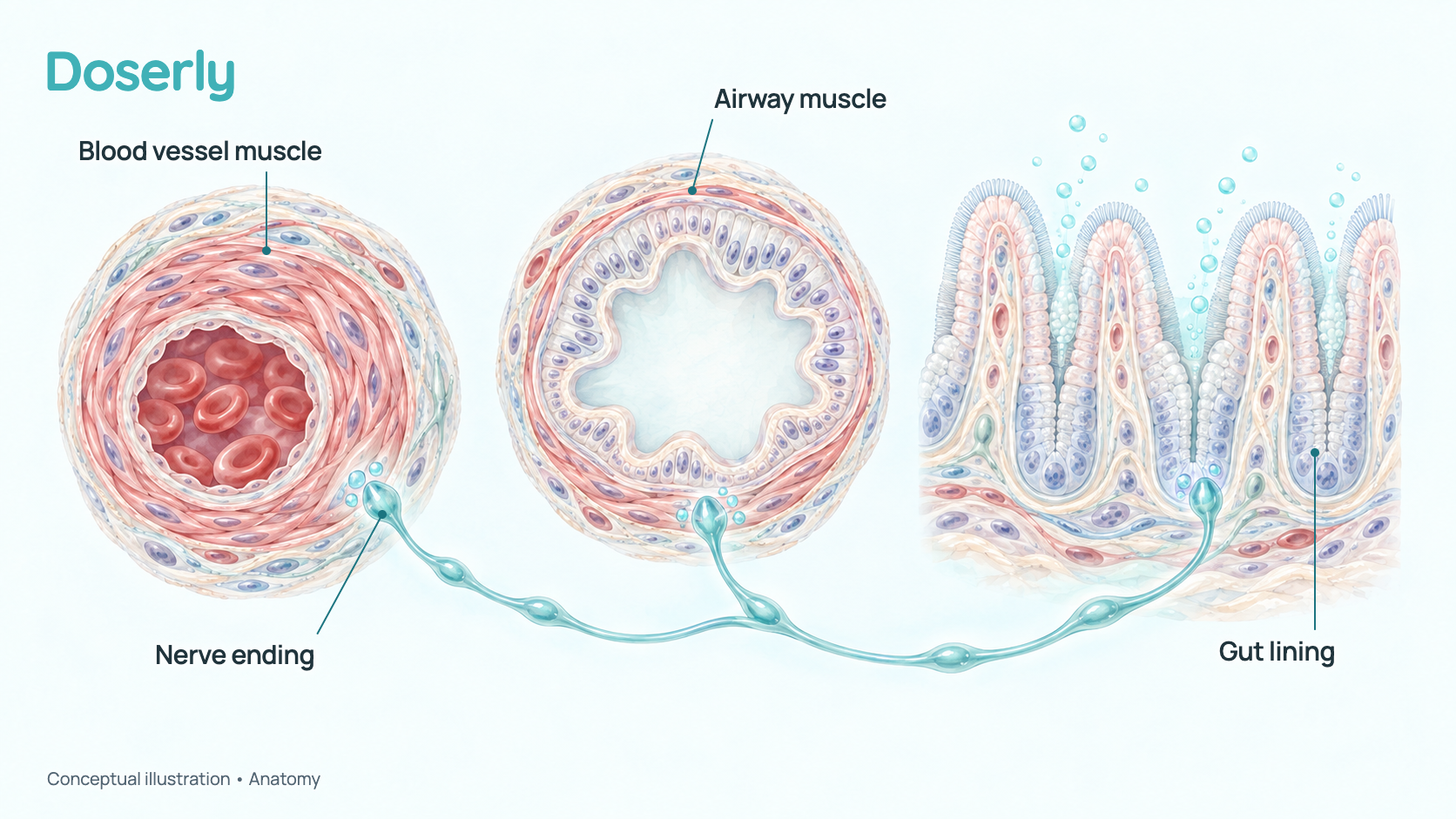
VIP, short for vasoactive intestinal peptide, is a small signaling molecule your body makes. Nerves release it in the gut, airways, blood vessels and brain, where it relaxes smooth muscle, widens blood vessels and tells the gut lining to release water. Its lab-made copy, called aviptadil, has been tested in hospital trials for lung failure and is sold as a pharmacy-made nasal spray and as "research" vials. [1], [2], [3]
It is a peptide: a chain of 28 amino acids (HSDAVFTDNYTRLRKQMAVKKYLNSILN, with an amide cap at the end). Its formula is C147H238N44O42S and its molecular weight is about 3,326. "Vasoactive" means it acts on blood vessels; "intestinal" is where it was first found. Human and pig VIP have the same sequence. It works through two receptors, VPAC1 and VPAC2, which it shares with a related peptide called PACAP. [2], [1]
The same molecule turns up in very different settings, and the setting changes everything: how much is given, how it gets into the body, what it was tested for and whether it is legal. A 12-hour hospital drip, an inhaled mist, a nasal spray and a home injection are not interchangeable. [4], [5], [6], [7]
| Product or setting | Where | How it is given | Status |
|---|---|---|---|
| Aviptadil for lung failure (ZYESAMI, RLF-100) | US hospital trials | Intravenous (IV) drip, 12 hours a day for 3 days | Not approved; FDA declined emergency use in 2021 |
| Aviptadil injection, 15 mcg/mL | India | IV | Restricted emergency use for severe COVID-19 lung failure (2022) |
| Inhaled aviptadil | Research studies in Europe, the US and Turkey | Breathed in through a nebulizer | Investigational; orphan designations only |
| Invicorp (aviptadil 25 mcg + phentolamine 2 mg) | United Kingdom and several European countries | Intracavernosal (injected into the penis) | Licensed for erectile dysfunction |
| Compounded VIP nasal spray, 50 mcg per spray | US compounding pharmacies | Intranasal (sprayed into the nose) | Not approved; made to an individual prescription |
| "Research" freeze-dried vials (5–10 mg) | Online sellers | Mixed with water for subcutaneous injection or a homemade spray | Not approved for human use |
[4], [8], [9], [10], [2], [7], [11], [12], [13]
One more name causes confusion. Pemziviptadil (PB1046) is a different, long-acting drug built by fusing VIP to a larger protein. It is the only VIP-type drug ever tested by subcutaneous injection in people, and both of its trials were stopped early. Results for pemziviptadil say nothing about plain VIP. [14], [15]
Typical VIP Protocols
| Schedule | Amount each time | Frequency | Total per day | Duration |
|---|---|---|---|---|
| Standard · 2020 clinician protocol summary | 50 mcg (one spray) | Four times a day | 200 mcg | About 6 months while lipase is checked, then tapered to a low maintenance dose, sometimes less than once a day [18] |
| Stepped up · 2017 clinic series | 50 mcg in month 1, then 100 mcg (two sprays) if symptoms persist | Four times a day | 200 mcg, then 400 mcg | No fixed end; continued while improving (analyzed up to 6 months) [16], [19] |
| Twice a day · telehealth consent form | 50 mcg in weeks 1–2, 100 mcg in weeks 3–4, then 200 mcg | Twice a day | 100, then 200, then 400 mcg | Ongoing; lab tests at 3 months, then every 6–12 months [17] |
The most common protocol in the reviewed sources is 50 mcg per spray, one spray four times a day in alternating nostrils (200 mcg a day), started only after a first test spray in a clinic and raised to 400 mcg a day after a month if symptoms persist. A 2020 clinician summary continues it for about six months and then tapers to a low maintenance dose; another summary of the same protocol tapers to a stop instead. All of these figures trace back to one clinician's protocol for a condition called CIRS (chronic inflammatory response syndrome, a label used for illness blamed on water-damaged, moldy buildings). [6], [16], [20], [13], [21], [22]
- Titration Adjusting the dose in steps
- The originating protocol gives the first spray in a clinic, with blood tests before and 15 minutes after, then 50 mcg four times a day at home. The 2017 series raised this to two sprays four times a day after a month if symptoms had not resolved. A telehealth schedule instead starts at 50 mcg twice a day and doubles twice, reaching 200 mcg twice a day by month 2. Some protocol pages start lower, at 25 mcg two or three times a day, and pharmacy information notes the spray can be diluted for people who need to work up slowly. [20], [16], [17], [23], [18]
- Breaks and cycles
- The nasal protocol does not cycle, and its two practitioner summaries end differently. One runs it about 6 months while lipase (a pancreas enzyme) is checked, then tapers to a low maintenance dose, sometimes less than once a day. The other sets no fixed length and, once symptoms and lab tests are stable, tapers to a stop: 50 mcg twice a day for 30 days, then once a day for 30 days, then stop, with a re-evaluation at 6 months (a heart ultrasound during exercise, lipase and a vision test). Injection websites describe cycles no study has tested, such as 8 weeks on and 8 weeks off. [18], [20], [24]
Read the units: mcg means micrograms; 1 mg equals 1,000 mcg. The "amount each time" is one dose; the daily total adds up every dose in a day. "One spray" means one press of the pump into one nostril. The pharmacy spray holds 500 mcg per mL and each press delivers 0.1 mL, so one spray is 50 mcg and a 12 mL bottle gives 120 sprays, a 30-day supply at four sprays a day. Some websites write "50 mcg per nostril", which doubles every dose if read as one spray in each side. [12], [25], [26], [22]
The nasal rows come from a clinical protocol, pharmacy instructions and a telehealth consent form, not from controlled trials; the cited references give the full details. Each row is a separate source's complete schedule: they are alternatives, not a ladder to climb from one row to the next.
What doses have human studies used?
These are the schedules actually tested in people. None of them is a home protocol, and each belongs to its own route and condition.
| Study and route | Amount each time | Frequency | Total per day | Duration and main result |
|---|---|---|---|---|
| TESICO · IV drip · 461 critically ill COVID-19 patients | 50, then 100, then 150 pmol/kg per hour | One 12-hour drip a day | 600, 1,200, then 1,800 pmol/kg | 3 days · no benefit at day 90; stopped for futility [4] |
| Sarcoidosis · inhaled · 20 patients | 50 mcg | Four times a day | 200 mcg | 4 weeks · lower inflammatory signals in lung-wash cells; no control group [5], [27] |
| Pulmonary hypertension · inhaled · 8 patients | About 50 mcg (200 mcg split into four inhalations) | Four times a day | 200 mcg | Up to 24 weeks · lower lung blood pressure; no control group [28] |
| COPD · inhaled · 34 patients | 50 mcg | Four times a day | 200 mcg | 12 weeks · small lung-function gain versus placebo; published 20 years later [29] |
| COVID-19 pneumonia · inhaled · 80 patients | 100 mcg, twice, 30 minutes apart | Once a day | 200 mcg | Hospital stay · discharged about 2 days sooner than placebo [10] |
| CIRS · nasal spray · 20 patients | 50 mcg | Four times a day | 200 mcg | At least 18 months (assessed at 12 and 18 months) · symptoms and blood markers improved; no control group [6] |
| Erectile dysfunction · intracavernosal · UK label | 25 mcg aviptadil with 2 mg phentolamine | No more than once a day or three times a week | 25 mcg of aviptadil | As needed · licensed combination, not VIP alone [7] |
The inhaled studies cluster around 50 mcg four times a day, the same numbers as the nasal protocol, but a nebulizer delivers the drug deep into the lungs, not onto the lining of the nose. A single 100 mcg inhaled dose also caused a short-lived drop in lung blood pressure during a heart catheter test in 20 patients. [30] Read the full study summaries.
What amounts do websites describe for injections?
| Example | Amount each time | Frequency | Total per day | Duration |
|---|---|---|---|---|
| Low | 50 mcg | Twice a day, morning and evening | 100 mcg | 8 weeks, then 8 weeks off [24] |
| Mid | 100 mcg in week 1, 150 mcg in weeks 2–3, then 200 mcg | Once a day, 5 days a week | 100–200 mcg on dosing days | 8 weeks [31] |
| High | 200 mcg | Once or twice a day | 200–400 mcg | Ongoing [13] |
Across 11 website pages that give injection amounts, single doses range from 25 to 300 mcg, taken one to three times a day. None cites a human study of subcutaneous VIP, because none exists. In the community education groups we reviewed, the most common practice was about 100 mcg injected once a day, and a number of people stayed at 25–75 mcg because larger amounts made them flush too strongly. That is reported practice, not a tested dose. [13], [32], [33], [22], [34], [14] See what people report.
Cautions for every schedule above:
- Blood pressure and fainting. VIP widens blood vessels within minutes. In a healthy-volunteer study, an IV infusion dropped systolic blood pressure from 108 to 88 mmHg and raised the pulse from 71 to 95 beats a minute. People with low blood pressure, or who take blood pressure medicines or other drugs that widen blood vessels, are most at risk of light-headedness or fainting. Do not stop or cut a prescribed blood pressure medicine without your prescriber. [35], [4]
- Migraine and cluster headache. IV VIP triggers attacks in many people prone to them (numbers in the risks section). [36], [37]
- Diarrhea. VIP makes the intestine secrete water; a 10-hour infusion caused heavy watery diarrhea in all five healthy volunteers. Frequent or bloody diarrhea needs medical care. [3]
- Pancreas. The nasal protocol checks lipase before starting and stops VIP if lipase rises with belly pain; we found no published case of pancreatitis caused by VIP (details in the risks section). [20]
- Spray and syringe mistakes. "Per nostril" doubles a nasal dose, and the number of syringe units depends on how the vial was mixed. Never convert a nasal amount into the same injected amount: injection flushes far more strongly. [22], [31] Check the units first.
- Pregnancy, children and cancer. There are no safety data in pregnancy or in children, and many tumours carry VIP receptors. This guide is written for adults. [38], [39]
Where schedules differ: sprays, units, injections, breaks and stopping ↓
Where these numbers come from
Nasal rows. The standard row is one source's schedule: a 2020 clinician summary of the protocol hosted on the originator's website (50 mcg four times a day, generally for 6 months while lipase is monitored, then tapered to low maintenance doses that may be less than once a day). The same dose and frequency appear in Shoemaker and colleagues' 2013 CIRS series and in a compounding pharmacy's patient sheet (one spray in a single nostril four times a day; 12 mL gives 120 sprays). A second practitioner summary on the same website (in-clinic first spray with lipase and TGF-beta1 tests before and 15 minutes after; once stable, 50 mcg twice daily, then once daily, for 30 days each, then stop) gives no treatment length and ends with a stop rather than maintenance, so it is described in the text, not merged into the row. The stepped-up row comes from the 2017 series (one spray four times a day for a month, then two sprays four times a day), which Strive Pharmacy reproduces. The twice-daily row is Superpower's informed-consent schedule for a telehealth prescription. [6], [20], [18], [25], [16], [19], [17]
Cross-checks, not independent confirmation. Peptide Dosing Protocols, PeptideX, Professor Peptides, The Peptide Catalog, Peptide Assistant, Bioalmanac, The Peptide Toolkit and Peptides.media repeat 50 mcg per spray, four to eight sprays a day. They trace to the same originator, so repetition is not corroboration. Of 16 website pages that give nasal amounts, most state 50 mcg per spray. [13], [21], [40], [24], [23], [41], [22], [42]
Subcutaneous rows. Low: The Peptide Catalog (50 mcg morning and evening, 8 weeks on and 8 off; the page labels this the Shoemaker protocol, which is incorrect, because that protocol is a nasal spray). Mid: OptimalDosages (100 to 200 mcg, 5 days a week, 8 weeks). High: Peptide Dosing Protocols (200 mcg once or twice a day, ongoing). Other pages give ranges without full schedules: 25 to 100 mcg up to twice a day (PeptaBase, Peptides Institute), 50 to 200 mcg once or twice a day (The Peptide Toolkit, PeptideFox) and 50 to 300 mcg one to three times a day (a vendor page). [24], [31], [13], [33], [34], [22], [43], [32]
Not used for any row: PeptideWiki's and Peptides Institute's "50 mcg per nostril" wording, which doubles the originating dose; a vendor range of 25 to 200 mcg per nasal dose; a daily nasal range of 200 to 600 mcg without a schedule; and higher nasal tiers described in some community education material, which no published source supports. [26], [34], [32], [33]
Study rows are each trial's own schedule; the UK row is the Invicorp label. [4], [5], [28], [29], [10], [6], [7]
What is VIP commonly used for?
People look into VIP for problems that are hard to treat: long-lasting illness after living or working in a moldy building, lung conditions, high blood pressure, migraine, gut inflammation, or a general wish to calm an overactive immune system. Some of these ideas come from real human studies; others come from how VIP behaves in animals or in the body's own nerves.
The one use with a licensed product, erectile dysfunction, relies on VIP combined with another drug. The uses people discuss most online have the thinnest evidence. The sections below describe each use and what has actually been tested.
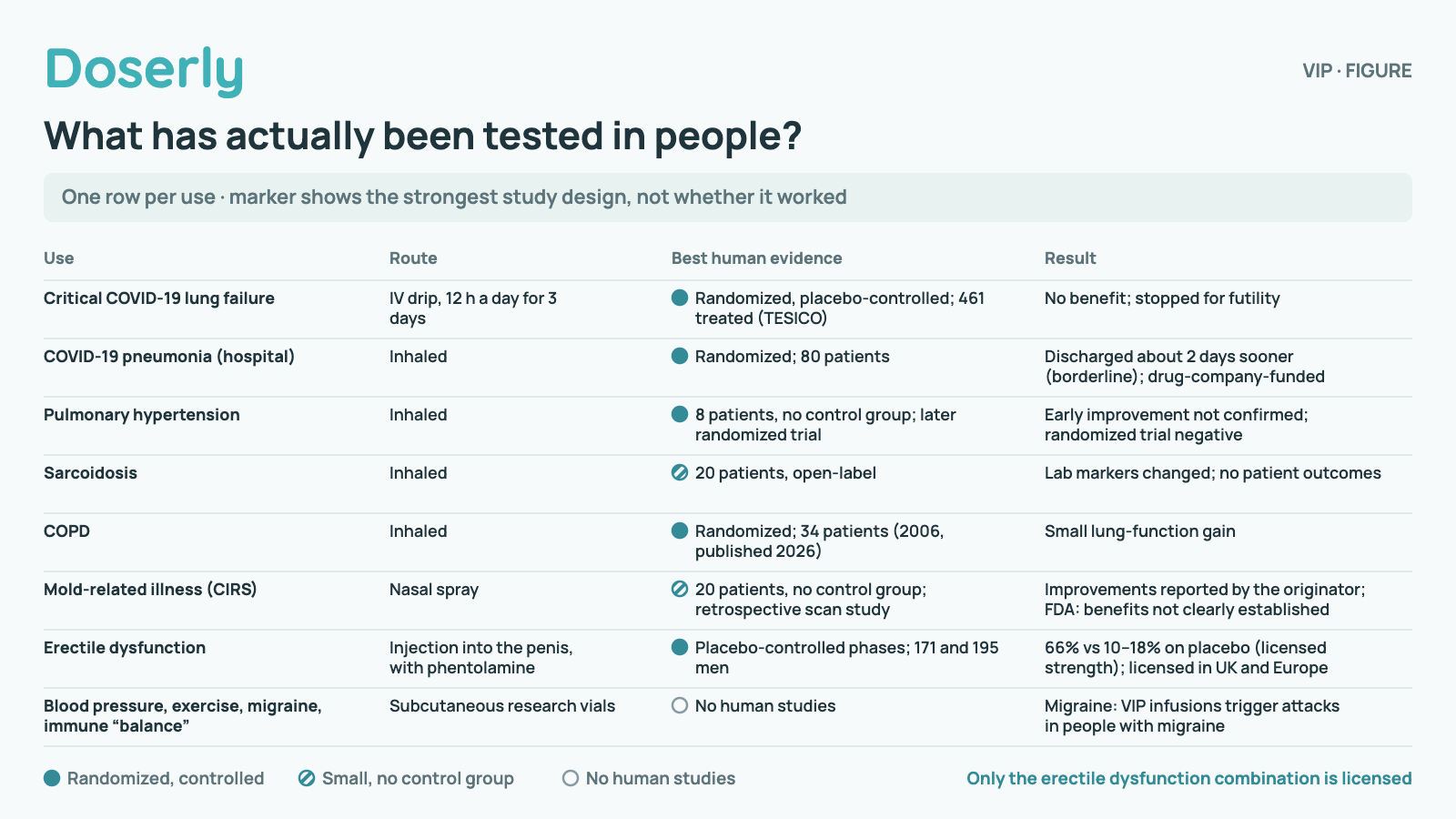
What has actually been tested in people?
Marker: filled = randomized, controlled; half = small, no control group; empty = no human studies. It shows study design, not whether it worked.
Critical COVID-19 lung failure
- Route
- IV drip, 12 h a day for 3 days
- Best human evidence
- Randomized, placebo-controlled; 461 treated (TESICO)
- Result
- No benefit; stopped for futility
COVID-19 pneumonia (hospital)
- Route
- Inhaled
- Best human evidence
- Randomized; 80 patients
- Result
- Discharged about 2 days sooner (borderline); drug-company-funded
Pulmonary hypertension
- Route
- Inhaled
- Best human evidence
- 8 patients, no control group; later randomized trial
- Result
- Early improvement not confirmed; randomized trial negative
Sarcoidosis
- Route
- Inhaled
- Best human evidence
- 20 patients, open-label
- Result
- Lab markers changed; no patient outcomes
COPD
- Route
- Inhaled
- Best human evidence
- Randomized; 34 patients (2006, published 2026)
- Result
- Small lung-function gain
Mold-related illness (CIRS)
- Route
- Nasal spray
- Best human evidence
- 20 patients, no control group; retrospective scan study
- Result
- Improvements reported by the originator; FDA: benefits not clearly established
Erectile dysfunction
- Route
- Injection into the penis, with phentolamine
- Best human evidence
- Placebo-controlled phases; 171 and 195 men
- Result
- 66% vs 10–18% on placebo (licensed strength); licensed in UK and Europe
Blood pressure, exercise, migraine, immune “balance”
- Route
- Subcutaneous research vials
- Best human evidence
- No human studies
- Result
- Migraine: VIP infusions trigger attacks in people with migraine
Only the erectile dysfunction combination is licensed; the largest trial was negative and the home uses have no human studies.
Mold-related illness (CIRS)
This is the use most people meet. In the CIRS protocol, VIP nasal spray is the final step, given only after a person has left the moldy building, finished other treatments and passed several tests. The idea is to replace VIP that the protocol's originator measured as low in these patients. [18], [20]
The evidence is one clinician's work. In 2013 he reported 20 patients who had not recovered after all earlier steps (an average of 36 months of prior treatment); after nasal VIP, their symptoms and several blood markers improved, and he reported no dropouts from side effects over 18 months. There was no comparison group, the paper appeared in a journal outside the main medical database, and a promised placebo-controlled trial was never published or registered. A 2017 follow-up looked back at brain scans in about 30 patients. When FDA reviewed VIP for pharmacy compounding, it found only one study in this condition and said it "failed to clearly establish benefits". FDA also noted in 2019 that CIRS is not listed in the World Health Organization's disease classification (ICD-10) or in the MedDRA regulatory dictionary. [6], [16], [44]
Lung conditions: pulmonary hypertension, sarcoidosis, COPD and asthma
VIP relaxes airway and lung blood-vessel muscle, so researchers tested it inhaled. The results are small and mixed:
- Pulmonary hypertension (high blood pressure in the lungs). An uncontrolled 2003 study in 8 patients reported lower lung blood pressure and longer walking distance. A later randomized, placebo-controlled trial of inhaled aviptadil was negative, according to its own investigators, and development stopped. [28], [45]
- Sarcoidosis (an inflammatory disease that forms small lumps in the lungs). In an open-label study of 20 patients, four weeks of inhaled VIP lowered an inflammatory signal from lung-wash cells and raised regulatory immune cells. These were laboratory markers, not breathing or survival outcomes. [5]
- COPD (chronic obstructive pulmonary disease). A 34-person placebo-controlled trial finished in 2006 and was published in 2026, reporting a small gain in lung function and walking distance. [29], [46]
- Asthma. In 1980s studies, IV VIP gave a small airway-opening effect, weaker than salbutamol given the same way (by IV), and inhaled VIP did not open the airways at all, though it partly blunted a histamine challenge. [47], [48]
COVID-19 and lung failure
Aviptadil was one of many drugs tried for COVID-19. The large US trial, TESICO, gave IV aviptadil to critically ill patients and found no improvement in recovery or survival at 90 days; its monitoring board stopped it for futility. A smaller sponsor-run trial missed its main goal. A small inhaled trial in less severely ill hospital patients reported faster discharge. [4], [49], [10] Details in the human evidence section.
Blood pressure
This is the most common reason people give for using VIP injections in the community education groups we reviewed. The human evidence behind it is about lung blood pressure (pulmonary hypertension), which is a different condition from everyday high blood pressure. VIP does lower blood pressure during an IV infusion, but with a half-life of minutes that effect is short. We found no study that tested VIP as a treatment for high blood pressure. [35], [28], [50]
Erectile dysfunction
VIP injected into the penis on its own did not produce an erection firm enough for sex in a small placebo-controlled trial. Combined with phentolamine, a drug that also relaxes blood vessels, it worked in about two thirds of men at the licensed 2 mg phentolamine strength (66% versus 10–18% on placebo) and about three quarters at 1 mg, in the placebo-controlled phases of two trials (171 and 195 men). This combination became Invicorp. Facial flushing followed a third or more of injections. [51], [52], [53], [7]
Gut inflammation and "leaky gut"
VIP helps control the gut, and mouse studies of colitis (bowel inflammation) are often cited. The results point both ways: VIP injections eased chemically induced colitis in mice, yet mice bred without VIP got milder colitis, not worse. No human trial of VIP for inflammatory bowel disease was found. [54], [55] See the animal research.
Migraine
Some people report fewer migraines while using VIP. The human research points the other way: VIP is used in laboratories to trigger migraine. Details are in the risks section. [36]
Other uses you may come across
Websites also market VIP for immune "balance", brain fog, sleep and body-clock problems, exercise, long COVID and mast cell conditions. These claims come from preclinical research, from VIP's role in the brain's master clock in mice, and from personal accounts. None has been tested in a human trial of VIP. [56], [57] See the supporting research.
Where do VIP protocols differ?
The recurring nasal amount is easy to state. The details around it vary widely: what "one spray" means, how often to use it, whether injections can stand in for sprays, and how long to continue. Here is what each difference means.
One spray, or one spray in each nostril?
The originating protocol is one 50 mcg spray, into one nostril, four times a day, switching sides each time. Some websites write "50 mcg per nostril", and at least one page combines that with "alternating nostrils" in the same sentence. Read as a spray in each side, that is 100 mcg per dose and 400 mcg a day from the start, double the usual starting amount. One protocol page warns about exactly this misreading. [25], [26], [34], [22]
The mix-up shows up in real accounts: one person described starting at 400 mcg a day after confusion about sprays per nostril, and went on to have stomach problems and weeks of migraines. [58]
Four times a day, or twice?
The clinic protocol uses four sprays a day; VIP disappears from the blood within minutes, which is the usual explanation for frequent dosing. A telehealth schedule uses twice-daily doses instead, but larger ones: 200 mcg twice a day, the same 400 mcg daily total as the stepped-up clinic row. Websites for injections mostly say once or twice a day. No study has compared these schedules. [20], [17], [13], [50]
Can an injection replace the nasal spray?
Not by matching the numbers. The nasal amounts come from one clinic's practice; the injection amounts come from websites, with no human study behind them. How much of a nasal dose reaches the blood has never been measured, so there is no known conversion. In the community education groups we reviewed, people who switched from a nasal spray to the same amount by injection described much stronger flushing, a racing heart and near-fainting, and a public forum user described escalating reactions over a series of injections. [22], [59] See how routes differ.
Start low, or start at the full dose?
The clinic protocol starts at the full 50 mcg four times a day after a supervised test spray. Many patients in public forums instead describe starting with a diluted spray (a 1-in-10 or even 1-in-100 dilution) and taking weeks or months to reach the full dose because of anxiety, insomnia, headache or low blood pressure. One person reported feeling very unwell after starting the full dose by mistake. Pharmacy information notes the spray can be diluted for people who need to work up slowly. [20], [18], [60], [61], [62], [63]
How long do people use it, and do they take breaks?
Summaries of the clinic protocol disagree on how it ends. A 2020 clinician summary runs it about six months, then tapers to a low maintenance dose, sometimes less than once a day, with no stated end. Another summary of the same protocol sets no fixed length and tapers to a stop over two months once symptoms and lab tests are stable. The 2017 series let patients continue "as long as they felt improvement". Injection websites describe 8 weeks on and 8 weeks off, or continuous use with a check every 8 weeks. No study has tested any of these approaches, and none has been linked to a better or safer outcome. [18], [20], [16], [24], [13], [33]
Where do the sources disagree most?
- Route. Some sources treat the nasal spray as the proper route; others focus on injection. The evidence supports neither choice: the controlled human trials used IV drips and inhalers. [20], [13], [4], [5]
- Daily amount. Nasal totals range from 200 mcg to 400 mcg a day in published schedules, and forum posts describe anything from half a microgram to 900 mcg a day. [20], [17], [60], [59]
- Who should take it. The clinic protocol reserves VIP for people who have finished every earlier step and left the moldy building. Research-vial websites present it as a general wellness injection. [18], [13]
- Mislabeling. One website calls a twice-daily injection schedule "the Shoemaker protocol", although that protocol is a nasal spray. [24]
How do micrograms convert to syringe units?
Research vials contain powder that has to be mixed with liquid (reconstituted) before injection. On an insulin syringe, units measure volume, not an amount of VIP: a U-100 syringe holds 100 units per mL. How much VIP each unit carries depends on how much liquid went into the vial.
For example, 10 mg (10,000 mcg) mixed into 3 mL gives about 3,333 mcg per mL, so 100 mcg is 0.03 mL, or 3 units. A different page mixes its vial to 1,000 mcg per mL, where 5 units is 50 mcg. The same "5 units" would be about 167 mcg in the first vial. Copying a number of units from someone else's protocol is behind several of the frightening doses described in community accounts. Doserly's reconstitution calculator works out the units for any vial and shows each step. [31], [24]
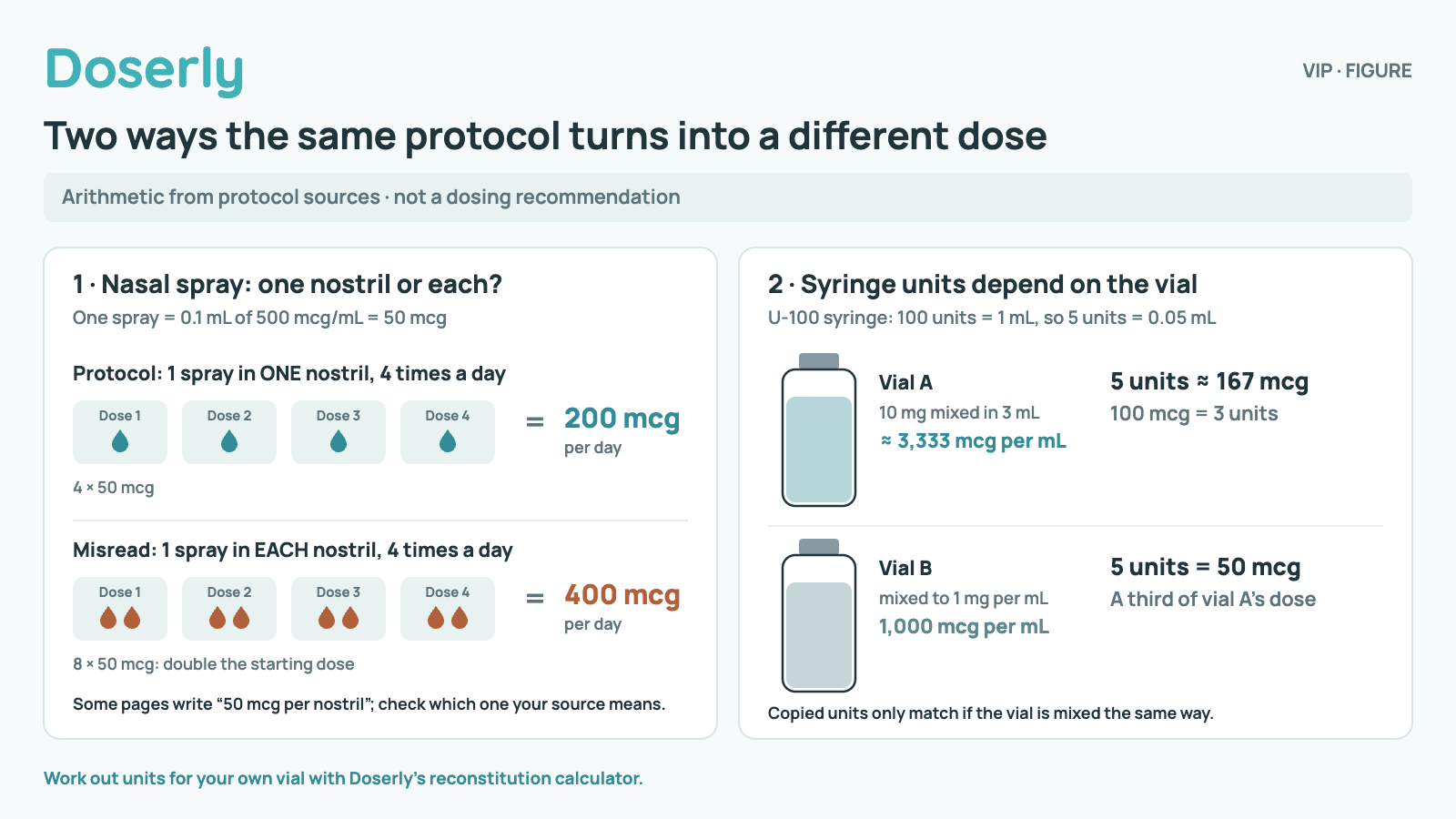
Two ways the same protocol turns into a different dose
Arithmetic from protocol sources; not a dosing recommendation.
Nasal spray: one nostril or each?
- One spray
- 0.1 mL of 500 mcg/mL = 50 mcg
- Protocol: 1 spray in one nostril, 4 times a day
- 200 mcg a day
- Misread: 1 spray in each nostril, 4 times a day
- 400 mcg a day, double the starting dose
Syringe units depend on the vial
- U-100 syringe
- 100 units = 1 mL, so 5 units = 0.05 mL
- Vial A: 10 mg in 3 mL (≈3,333 mcg/mL)
- 5 units ≈ 167 mcg; 100 mcg = 3 units
- Vial B: 1,000 mcg/mL
- 5 units = 50 mcg
Work out units for your own vial with Doserly’s reconstitution calculator.
Check whether a nasal dose is per nostril, and never copy syringe units from a vial mixed differently.
Registered study plans without published results
Several inhaled aviptadil trials were registered during the COVID-19 pandemic but never reported results. Registered plans are not protocols, and an unfinished trial is not evidence either way. Status was checked on ClinicalTrials.gov in September 2026.
100 mcg three times a day by mesh nebulizer
Sponsor-run trial that enrolled 144 people.
Terminated (sponsor decision). Last update February 2023. No results posted.
[64]67 mcg three times a day for 10 days
University Hospital Basel placebo-controlled trial; 83 people enrolled of 132 planned.
Terminated because of recruitment difficulties. No results posted.
[65], [66]100 mcg three times a day for up to 14 days
Aviptadil was one arm of a larger platform trial.
Arm closed. No aviptadil results located.
[67]What happens when you stop VIP?
No trial has studied stopping VIP after long-term use, so withdrawal or rebound effects are unknown. With a half-life of 1–2 minutes, the drug itself is gone from the blood within minutes of the last dose; what happens to symptoms afterwards is a separate question. [50], [7]
- The clinic protocol tapers rather than stopping suddenly. One summary steps down over two months to a stop, then re-evaluates at 6 months with a heart ultrasound during exercise, lipase and a vision test; another tapers to a low maintenance dose instead of stopping. The taper is a protocol choice, not a response to proven withdrawal effects. [20], [18]
- In the 2013 series, doses were lowered to zero to find the smallest amount that worked, then raised again "for maximum improvement". The paper implies symptoms returned in some patients but does not report how many. [6]
- Public forum accounts mostly describe problems after stopping. Several people said they kept feeling worse for weeks or months after they stopped, and one person's restart after a two-year break went badly. These are personal reports, and other illness or treatment changes could explain them. [68], [69], [70], [71], [72]
- In community education groups, people who used VIP for blood pressure and cut back once their readings settled did not describe a rebound, but nobody posted measured readings after stopping completely.
Do nasal sprays, injections and inhalers deliver the same VIP?
No. VIP is broken down quickly in the blood and by enzymes on the surface of the lungs, so the route decides how much reaches the tissue and for how long. This is why the hospital trials used 12-hour drips and the lung studies used nebulizers. A nasal spray, a subcutaneous injection and an inhaled mist are different exposures, not stronger or weaker versions of one dose. [50], [73]
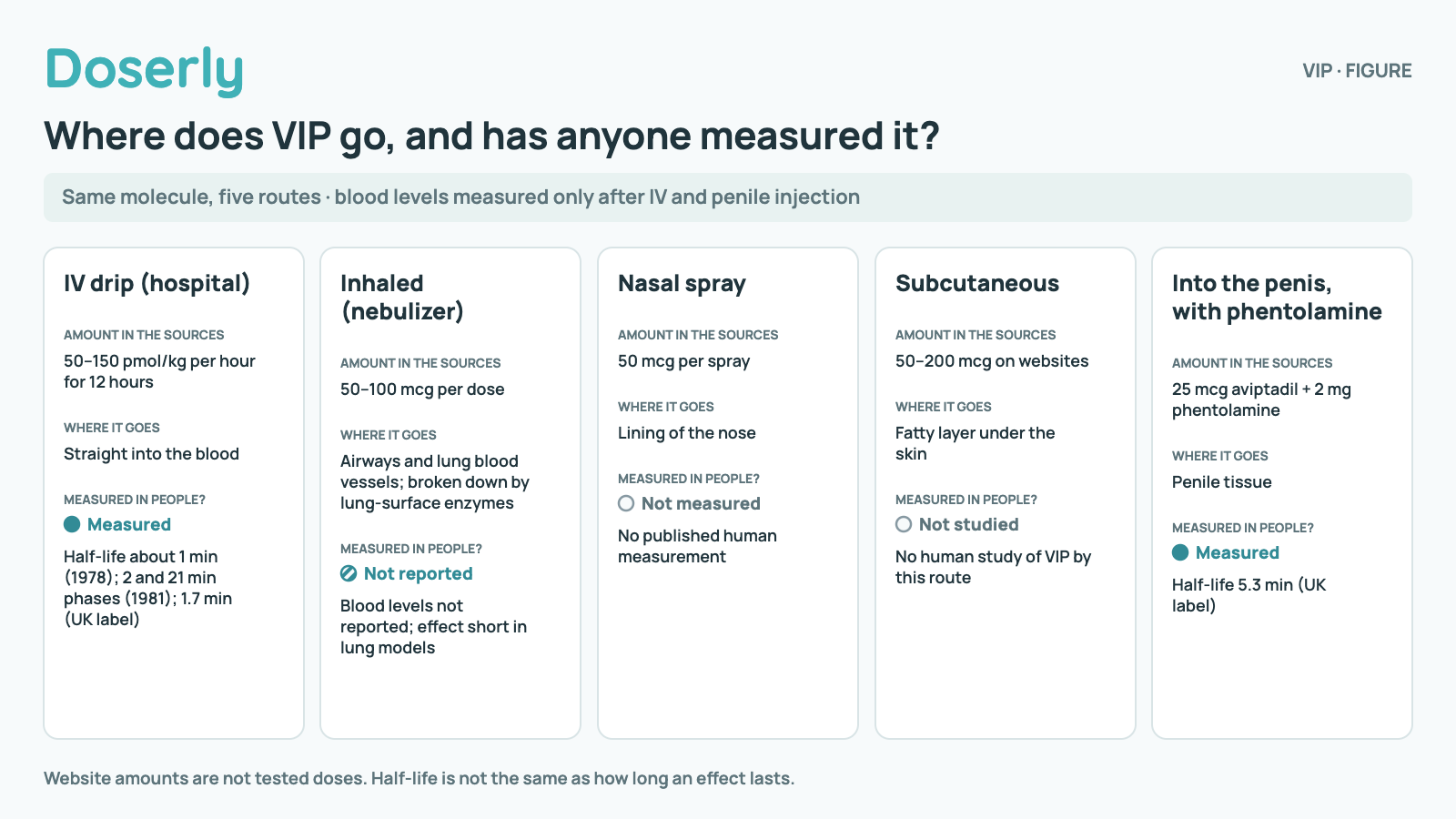
Where does VIP go, and has anyone measured it?
IV drip (hospital)
- Amount in the sources
- 50–150 pmol/kg per hour for 12 hours
- Where it goes
- Straight into the blood
- Measured in people?
- Measured: Half-life about 1 min (1978); 2 and 21 min phases (1981); 1.7 min (UK label)
Inhaled (nebulizer)
- Amount in the sources
- 50–100 mcg per dose
- Where it goes
- Airways and lung blood vessels; broken down by lung-surface enzymes
- Measured in people?
- Not reported: Blood levels not reported; effect short in lung models
Nasal spray
- Amount in the sources
- 50 mcg per spray
- Where it goes
- Lining of the nose
- Measured in people?
- Not measured: No published human measurement
Subcutaneous
- Amount in the sources
- 50–200 mcg on websites
- Where it goes
- Fatty layer under the skin
- Measured in people?
- Not studied: No human study of VIP by this route
Into the penis, with phentolamine
- Amount in the sources
- 25 mcg aviptadil + 2 mg phentolamine
- Where it goes
- Penile tissue
- Measured in people?
- Measured: Half-life 5.3 min (UK label)
Website amounts are not tested doses. Half-life is not the same as how long an effect lasts.
Blood levels have been measured only after IV and penile injections; not after a nasal spray or a subcutaneous injection.
How long does VIP stay in the body?
Only minutes. In pharmacokinetic studies (which track how the body handles a drug), blood levels fell by half in about one minute after an IV infusion in four healthy volunteers. A second study found two phases, with half-lives of about 2 and 21 minutes. The UK label gives 1.7 minutes after an IV injection and 5.3 minutes after an injection into the penis. [50], [74], [7]
Half-life is not the same as how long an effect lasts, but it does explain why effects on blood pressure and flushing come on fast and fade fast. It is also why skeptics question whether a single daily injection can do much at all, a question no study has answered. Half-life is defined in the glossary.
What about a nasal spray?
A nasal spray lands on the lining of the nose. Some of it may be absorbed into the blood (its bioavailability), and some sources claim it travels from the nose to the brain, but no human study has measured either. The 2017 clinic paper argues the nasal route avoids enzymes that break VIP down; that is a rationale, not a measurement. [16]
What about inhaled VIP?
Inhaled VIP reaches the airways and lung blood vessels directly. In an isolated rabbit lung, the effect of inhaled VIP was short and lasted longer only when an enzyme blocker was added, showing how quickly the lung surface inactivates it. Researchers have tried coating VIP in fat bubbles (liposomes) to protect it. [73], [75]
What about subcutaneous injection?
We found no published human study of VIP given subcutaneously. The only VIP-type drug tested this way was pemziviptadil, a different molecule designed to last a week, and both of its trials were stopped. How much of a subcutaneous VIP dose reaches the blood, and for how long, is unknown. [14], [15]
Are VIP tablets or capsules an option?
A few people describe compounded tablets taken by mouth. There is no published study of VIP taken by mouth, and as a peptide it would face digestion in the stomach and gut. [76]
How should VIP be stored, and how long does it last?
- Licensed injection. The UK label for the aviptadil and phentolamine ampoules says to store them in a refrigerator at 2–8 °C, not to freeze them, and gives a shelf life of 6 months. [7]
- Pharmacy nasal spray. The spray studied in 2017 passed a 90-day stability test, but the pharmacy still dispensed it with a 60-day beyond-use date, kept refrigerated, as a margin of safety. Pharmacy sheets say to refrigerate at 2–8 °C, not to freeze, store the bottle upright, and not to use it if it smells acrid or sour. [16], [12], [25], [18]
- Research vials. Protocol websites say to keep the powder frozen at −20 °C for long-term storage and to use a mixed vial within about 14–28 days in the fridge. These are website claims, not tested expiry dates. [23], [24], [22], [41]
Storage is also about purity. FDA noted that VIP synthesis without proper controls can produce chains of the wrong length or sequence. Cloudy solutions and particles are a reason not to use a vial. This guide does not cover mixing or injection technique; the Academy note below covers practical handling. [44]
What do we actually know about VIP in people?
VIP has more human research than most peptides sold online, but almost none of it matches how people use it at home. The controlled trials that could answer a clear question, such as whether it saves lives in lung failure, gave a clear answer: no. The studies behind nasal and injected home use are small, uncontrolled or missing.

Did aviptadil help people with COVID-19?
The idea came from laboratory work: in nonclinical studies, VIP protected the lung cells that make surfactant (the film that keeps air sacs open) and damped inflammatory signals. The trials tested whether that translated into recovery and survival. [49]
It did not in the most reliable trial. TESICO, funded by the US National Institutes of Health and run within the ACTIV-3b research program, randomly assigned 471 adults with COVID-19 lung failure, 94% of them in intensive care, to IV aviptadil or placebo. Among the 461 who received an infusion, the odds of a better recovery at 90 days were no different (odds ratio 1.11, 95% confidence interval 0.80–1.55), and 38% died with aviptadil versus 36% with placebo. The monitoring board stopped the aviptadil comparison for futility in May 2022. [4], [77]
An earlier trial of 196 patients, funded by the drug's developers, who also took part in its design, data collection and interpretation, missed its main goal (being alive and free of respiratory failure at day 60). It reported better survival as a secondary result, which TESICO did not confirm. A 2025 review that pooled both trials found no survival difference (odds ratio 1.01). [49], [78]
A smaller trial in Turkey, funded by a drug company (Centurion Pharma; the paper states the funder had no role in design, data collection, analysis or reporting), tested inhaled aviptadil in 80 hospital patients with COVID-19 pneumonia who were less severely ill. Patients left hospital after 7.8 days on average versus 10 days with placebo, a borderline result (p = 0.049), and lung CT scans looked better at day 28. [10]
What did the lung studies find?
| Study | What researchers reported | What it cannot establish |
|---|---|---|
| Pulmonary hypertension, 2003 (8 patients, inhaled, no control group) | Mean lung artery pressure fell from 59 to 46 mmHg at 3 months; walking distance rose by 113 m at 12 weeks; no side effects reported. | Whether VIP caused the change; a later randomized trial was negative. [28], [45] |
| Pulmonary hypertension, 2008 (20 patients, single inhaled dose) | A small, temporary widening of lung blood vessels during a heart catheter test, without a fall in body blood pressure. | Any long-term benefit. [30] |
| Sarcoidosis, 2010 (20 patients, inhaled for 4 weeks, no control group) | Lung-wash cells made less of the inflammatory signal TNF-alpha, and regulatory immune cells increased; described as well tolerated. | Better breathing, fewer flares or any other patient outcome. [5] |
| COPD, 2026 (34 patients, inhaled for 12 weeks, placebo-controlled) | A lung-function measure (FEV1) rose by about 0.1 L, and walking distance by 24 m versus a 9 m fall with placebo. | A current, repeated result; the trial finished in 2006 and was published 20 years later outside the main medical database. [29], [46] |
Early asthma studies add one more lesson. IV VIP opened the airways a little in people with asthma, less than salbutamol, but it did not change airway function in healthy volunteers, where it mostly lowered blood pressure and raised the pulse. [79], [47], [35]
What did the nasal-spray studies find?
The 2013 CIRS series followed 20 patients who used 50 mcg four times a day for at least 18 months (assessed at 12 and 18 months). The author reported that symptoms fell to the level of healthy comparison people, blood markers of inflammation (C4a, TGF-beta1, MMP9, VEGF) normalized, and the rise in lung blood pressure during exercise returned to normal. Lipase did not rise. The design has major limits: no placebo, no blinding, selected patients who had already been through years of other treatment, and outcomes measured by the prescribing clinic. [6]
The 2017 paper looked back at brain MRI measurements in about 30 patients, including four who could not get VIP and served as a rough comparison. Its co-authors included the pharmacist who compounded the spray and a laboratory company the originator works with, and the paper's summary also cites a survey of prescribing doctors rather than measured outcomes. Neither paper appears in the main medical database. [16]
What did healthy-volunteer studies show?
These small studies explain most of VIP's side effects. IV VIP caused flushing, a faster pulse and a drop in blood pressure; in one study systolic pressure fell from 108 to 88 mmHg. A 10-hour infusion caused profuse watery diarrhea in all five volunteers, averaging about 2.4 kg of stool, with a shift in blood chemistry (acidosis). A 90-minute infusion cut urine flow to about a third and tripled renin, a hormone that helps raise blood pressure. Blood sugar rose slightly at the highest dose in another study. [35], [3], [80], [50]
Which outcomes did the studies actually measure?
VIP studies measured very different things: survival and recovery in critical care, pressure inside the lungs, laboratory markers in lung-wash fluid, blood markers in CIRS, and symptoms reported to the treating clinic. A change in a blood marker is not the same as feeling better, and feeling better in an uncontrolled study is not the same as proof that VIP caused it. When the question was survival and the trial was large and blinded, the answer was negative. [4], [5], [6]
How does VIP work?
VIP's effects in people are well documented for blood vessels and the gut, because infusion studies measured them directly. Its effects on the immune system, the brain and the body clock come mostly from animal studies and cell studies. The sections below keep those apart.
What does VIP do to blood vessels and airways? (Human studies)
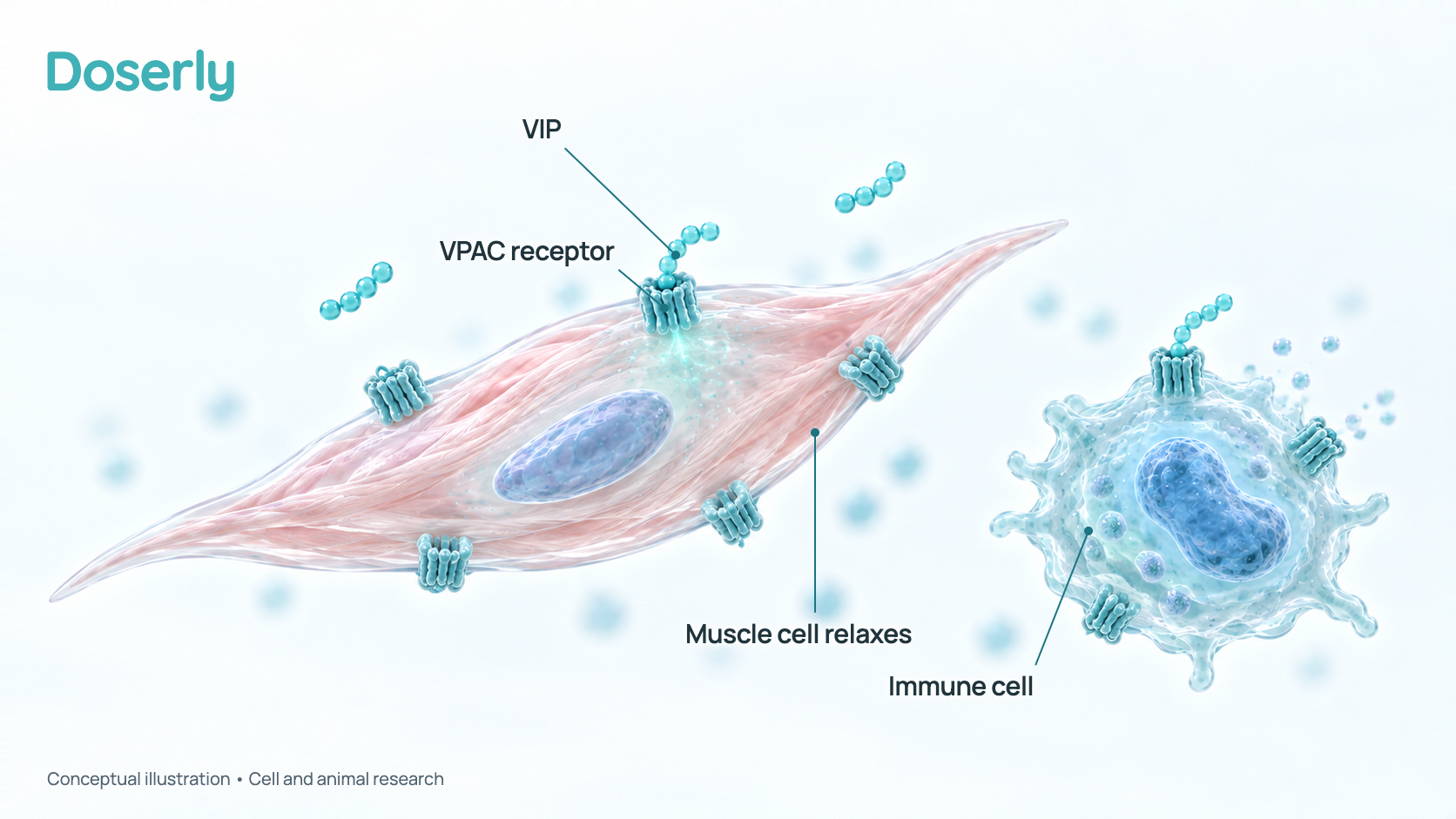
VIP binds VPAC1 and VPAC2 receptors on smooth muscle cells, which raises a messenger inside the cell called cyclic AMP and makes the muscle relax. In blood vessels this causes vasodilation (widening), which explains flushing, a drop in blood pressure and a reflex rise in heart rate. Injected into an artery in the forearm, VIP markedly increased blood flow. In the airways, the same relaxation opens the breathing tubes slightly. [1], [81], [35], [79]
Why does it cause diarrhea? (Human studies)
In the gut, VIP tells the lining cells to pump salt and water into the intestine. Rare tumours that release VIP, called VIPomas, cause severe watery diarrhea and low potassium for this reason, and an IV infusion of VIP in healthy volunteers reproduced the diarrhea. [82], [3]
Does VIP calm the immune system? (Animal and cell studies, one small human study)
In mice, VIP reduced inflammatory signals such as TNF-alpha, protected against a lethal bacterial toxin, and eased models of arthritis and multiple sclerosis, partly by increasing regulatory T cells, immune cells that restrain other immune cells. The sarcoidosis study saw a similar pattern in lung-wash cells from 20 patients. Whether a nasal spray or injection does this in people has not been tested. [83], [84], [85], [86], [5]
Does it stabilize mast cells or set them off?
Websites often say VIP "stabilizes mast cells", the immune cells that release histamine. The published evidence is mixed. In rat mast cells, VIP triggered histamine release, and when injected into human skin it produced a raised wheal and a red flare. In a trial of IV VIP in people with cluster headache, blood markers of mast cell activity did not change. No study has tested VIP as a treatment for mast cell problems. [87], [88]
What about the body clock and the brain? (Animal studies)
In the brain's master clock, a small group of nerve cells uses VIP to keep time together. Mice bred without VIP or its VPAC2 receptor lose normal daily rhythms, most clearly when kept in constant darkness. That shows VIP matters for the clock inside the brain; it does not show that a nasal spray resets anyone's sleep. Studies in rodents and nerve cells in a dish also report that VIP protects nerve cells, but no human brain study of VIP treatment exists. [89], [56], [90], [91]
Can VIP affect cancer? (Cell and animal studies)
This is an open question worth knowing about. Many human tumours carry VIP receptors. In lab studies, VIP helped prostate cancer cells grow and spread, and blocking VIP shrank lung cancer grown in mice and helped the immune system fight pancreatic and colon tumours in mice. Other experiments found the opposite in small-cell lung cancer and kidney cancer cells, and mice bred without VIP fared worse with bladder cancer. There are no human data either way on VIP treatment and cancer. [39], [92], [93], [94], [95], [96], [97]
What are the risks and unanswered questions?
Is VIP safe?
Its safety for home use by nasal spray or injection has not been established. VIP has a known set of short-term effects from hospital and volunteer studies, a licensed use with years of safety data in one narrow setting (a small dose injected into the penis with phentolamine), and almost no long-term data for the ways people use it at home.
What is known points to predictable problems rather than hidden organ damage: blood pressure drops, a fast heart rate, flushing, diarrhea and headache. What is not known is how often these happen with daily nasal or injected use over months, what long-term use does, and whether rarer immune or pancreas effects occur. Small studies that report no adverse events are too small and short to answer those questions. [4], [7], [6]
What side effects did the trials report?
In TESICO, infusion reactions over the three infusion days affected 86.6% of patients on aviptadil versus 57.4% on placebo:
| Effect during IV aviptadil (TESICO) | Aviptadil | Placebo |
|---|---|---|
| Low blood pressure (hypotension) | 58.4% | 41.3% |
| Diarrhea | 39.8% | 11.3% |
| Facial flushing | 14.7% | 6.1% |
| Fast heart rate (tachycardia) | 9.5% | 4.8% |
| Infusion paused | 30.7% | 15.2% |
| Infusion stopped for a side effect | 10% | 6% |
In the smaller COVID-AIV trial, diarrhea affected 43 of 131 patients on aviptadil versus 1 of 65 on placebo, and atrial fibrillation (an irregular heart rhythm) 15 of 131 versus 3 of 65. TESICO did not show more atrial fibrillation (5 of 231 versus 12 of 230). These were critically ill patients receiving large IV doses, so the rates do not transfer to a nasal spray. [4], [98], [99]
For the licensed combination injection, the UK label says about 10% of men have side effects: flushing is common; headache, dizziness, a fast heart rate and palpitations are uncommon; prolonged erection is rare; and heart attack and angina are very rare. [7]
Can VIP trigger migraine or cluster headache?
Yes, in susceptible people. A 25-minute IV infusion gave healthy volunteers only a mild headache, but a 2-hour infusion triggered migraine attacks in 15 of 21 people with migraine (71%) versus 1 of 21 after placebo. In cluster headache, 20-minute infusions triggered attacks in 5 of 14 people in an active cluster period and 7 of 15 with chronic cluster headache. Reports of fewer migraines on VIP are real experiences, but they run against the laboratory evidence. [100], [36], [37]
Can VIP cause pancreatitis?
This is uncertain. The concern comes from the CIRS protocol, which checks lipase, an enzyme released by an inflamed pancreas, before starting, 15 minutes after the first spray and at 30 days, and says to stop VIP if lipase rises with belly pain. In the 2013 series, lipase did not rise. We found no published case report of pancreatitis caused by VIP treatment. TESICO's posted results list pancreatitis in 1 of 231 critically ill patients on aviptadil and none on placebo, which cannot establish cause. [20], [18], [6], [99]
Could product quality change the risk?
Yes. Research vials sold online are not made or tested to medicine standards, and no regulator checks what is in them. When FDA reviewed VIP, it noted that synthesis without sufficient controls is likely to produce peptides of the wrong length or sequence, and that VIP has been associated with severe immune reactions, although it gave no case details. A pharmacy spray and a research vial with the same label amount can contain very different things. [44], [13]
Is VIP legal? Is it FDA-approved?
Checked September 24, 2026. Rules differ by country and change quickly. A "research use only" label does not make a product legal to sell or use as a medicine.
United States. VIP is not an FDA-approved medicine for any use. The key steps:
- November 3, 2016. FDA's pharmacy compounding advisory committee, asked about VIP for CIRS, voted not to add it to the list of ingredients pharmacies may use. [101], [44]
- September 5, 2019. FDA proposed a rule that would leave VIP off that list, citing quality concerns, severe immune reactions and a lack of proof of benefit in CIRS. [44]
- November 4, 2021. FDA declined to issue an emergency use authorization for aviptadil (ZYESAMI) in critical COVID-19, citing insufficient data, according to the company. [8]
- May 2022. TESICO was stopped for futility. [4]
- 2026. The 2019 proposal was never finalized: VIP is on neither the approved nor the excluded list in the federal regulation (checked in the September 1, 2026 version), and FDA's list dated May 14, 2026 still places it in "Category 1: under evaluation". In practice, US compounding pharmacies still prepare VIP nasal spray on prescription. That does not make it FDA-approved. [102], [103], [19], [12]
FDA has given VIP or aviptadil three orphan drug designations: acute respiratory distress syndrome (March 9, 2001), pulmonary arterial hypertension (February 22, 2005) and sarcoidosis (July 23, 2020). A designation supports development of a drug for a rare disease; it is not an approval. [104], [105], [106]
United Kingdom. Aviptadil is licensed only as Invicorp (25 mcg aviptadil with 2 mg phentolamine) for erectile dysfunction, injected into the penis. A product of this kind was first approved in the UK in October 2000, and the Scottish Medicines Consortium accepted it for restricted use in 2017. There is no UK license for VIP alone or for a nasal spray. [7], [107], [108]
European Union and nearby countries. The same aviptadil and phentolamine injection for erectile dysfunction is authorized country by country, not EU-wide: EMA's 2022 list names Invicorp and related brands (Corpin, Procivni, Procorp) in Denmark, Finland, France, Germany, Norway and Sweden, and Sweden's pricing agency approved a price rise in 2025. The EU has also granted four orphan designations: pulmonary arterial hypertension and chronic blood-clot pulmonary hypertension (December 22, 2003), acute lung injury (August 28, 2006), sarcoidosis (September 14, 2007) and acute respiratory distress syndrome (February 23, 2026). Designation is not approval. We found no European authorization for VIP alone or for a nasal spray. [11], [109], [110], [111], [112], [113]
India. In April 2022, India's drug regulator approved aviptadil injection (15 mcg per mL) for restricted emergency use in severe COVID-19 with acute respiratory distress syndrome. [9]
Canada. Health Canada's Drug Product Database lists no product containing aviptadil or VIP. [114]
Australia. Aviptadil is listed in Schedule 4 of the national Poisons Standard, making it a prescription-only medicine. We could not confirm whether any aviptadil product is registered for sale. [115]
Is VIP banned in sport?
VIP and aviptadil are not named on the World Anti-Doping Agency's 2026 Prohibited List. Its catch-all category S0 bans substances with no government approval for human therapeutic use anywhere. Because aviptadil is approved in some form in the UK, several European countries and India, whether S0 applies is unclear. Drug-tested athletes should check with their national anti-doping organization before using it. [116]
Who should be especially cautious?
These groups have little or no safety data. That is a reason for caution, not proof of harm.
- People with low blood pressure, or who take blood pressure medicines or other drugs that widen blood vessels (such as erectile dysfunction pills or nitrates). VIP lowers blood pressure within minutes. Combinations have not been studied. [35], [4]
- People with migraine or cluster headache, because VIP infusions trigger attacks. [36], [37]
- People with heart rhythm problems. Atrial fibrillation was more common with aviptadil in one COVID-19 trial, though not in TESICO. [98], [99]
- People with bowel disease or ongoing diarrhea, because VIP increases fluid secretion in the gut. [3]
- People with a history of pancreatitis, given the protocol's lipase rule. [20]
- People with active cancer or a history of it, because many tumours carry VIP receptors and the lab evidence is mixed. [39]
- Pregnancy and breastfeeding. The only report is a single critically ill pregnant patient treated in hospital. There are no safety data. [38]
- Under 18. No studies include children. This guide is written for adults.
- Men taking blood thinners should know that the UK label rules out the penile injection for people on anticoagulants such as warfarin; that warning is tied to that injection route. [7]
- Drug-tested athletes, because the sport status is unclear. [116]
Can VIP be taken with other medicines?
Interactions have not been studied in people. The main theoretical concern is additive blood pressure lowering with blood pressure medicines, erectile dysfunction drugs, nitrates and other vasodilators. One public forum user taking ivabradine, a heart-rate-lowering drug, reported no problems with a low heart rate; one report cannot show a combination is safe. Bring a complete list of everything you take to a pharmacist or doctor. [35], [117]
People often combine VIP with other peptides such as KPV, BPC-157 or thymosin alpha-1, or use it alongside weight-loss medicines such as semaglutide or tirzepatide. No study has tested any of these combinations. When someone is losing weight at the same time, it is hard to tell what VIP added to any change in blood pressure. See the related guides.
What should be monitored while using VIP?
No regulator has written a monitoring plan for nasal or injected VIP, because none has approved those uses. What exists is what the trials measured, what the one licensed label asks for, and what the CIRS protocol requires. It can help you prepare questions for a clinician; it is not a personal testing plan.
What did studies and protocols check?
- Hospital IV trials checked blood pressure at least every 2 hours during each 12-hour infusion and for 2 hours after, and counted stools. The infusion was held that day if a patient needed high doses of blood-pressure-raising drugs or had more than three liquid stools in 24 hours. [4]
- The CIRS protocol gives the first spray in the clinic with blood tests before and 15 minutes after (lipase and TGF-beta1, plus a baseline panel of VIP, MSH, C4a, MMP-9 and VEGF). At 30 days it repeats lipase and inflammatory markers, a visual contrast test, blood pressure and an exercise heart ultrasound, and it stops VIP if lipase rises with belly pain. [20], [18]
- The 2013 series also tracked blood counts, a standard chemistry panel, sex hormones and vitamin D. [6]
- A telehealth provider repeats inflammatory markers at 3 months and then every 6–12 months. [17]
- The UK label for the penile injection advises regular review, for example every 3 months at first. [7]
Which signals matter, and why?
| Why it matters | What studies or protocols measured | Tracking category |
|---|---|---|
| Blood pressure drops and fainting | Blood pressure in IV trials and at clinic visits | Blood Pressure |
| Fast or irregular heartbeat | Heart rate; atrial fibrillation in one IV trial | Heart Rate & Palpitations |
| Gut fluid loss | Stool counts in IV trials | Nausea & GI Tolerance; Digestive Comfort |
| Pancreas | Lipase before, 15 minutes after the first dose, then at 30 days (protocol rule) | Side Effect Burden |
| Headache and migraine | Headache scores in infusion studies | Pain Management |
| Flushing and skin reactions | Flushing counted in trials and on the label | Side Effect Burden; Skin Health |
| The problem you care about | Symptoms, breathing, energy, thinking | Energy Levels; Focus & Mental Clarity; Physical Performance; Inflammation |
Because VIP's blood pressure effect peaks within minutes and fades, a single reading taken right after a dose says little about blood pressure over the day. Readings at the same times each day, before a dose, give a steadier picture. [50], [35]
What do people in public communities report?
Most public accounts come from people with CIRS using the pharmacy nasal spray, usually alongside other protocol steps such as binder medicines, nasal antibiotic sprays and moving out of a moldy home. The accounts include clear improvements, no change at all, and strong reactions that made people stop, often in the same thread. Threads about bad reactions draw more replies, so the balance of stories is not a response rate. [58], [118]
What do the positive reports look like?
The encouraging accounts usually describe change over months, not days. One person who worked up slowly to the full dose over about four months said they were "a different person" and were exercising again, while also taking binders. Another, on 12 sprays a day for about four months, described better blood tests, passing a vision test used in CIRS and improving memory. A third said fatigue, hormone problems, nerve pain and headaches improved after four months, but had also moved home and corrected low iron. [118], [119], [120]
A few people described using research-vial injections instead. One said breathing felt better after 100 mcg injections, taken alongside another peptide, KPV. [121]
How long did it take, and did it last?
Timelines vary from days to more than a year. Some people said it took months just to reach a full dose because of side effects such as low blood pressure. One person continued for about a year and a half with gradual improvement, alongside other treatments. The accounts cannot give an average time to benefit. [63], [58]
Does everyone describe an improvement?
No. "I spent the money, did the regime, noticed nothing," one person wrote. Another said their VIP and MSH blood levels rose over a year but they felt no difference. Others reported nothing after 6 months, 7 weeks, 2 months or one month. [122], [123], [124], [125], [126]
Does getting worse mean it is working?
The accounts do not show that. Early worsening is the most common report: anxiety and irritability, insomnia, headaches, flu-like fatigue or being stuck in bed. Some people pushed through and later improved; others stopped and took weeks or months to recover, and some said they still had not recovered. Forum replies often call early worsening a detox or "clearing" reaction, but no study has shown that. [72], [127], [128], [129], [68], [70]
What unwanted effects do people describe?
- Blood pressure and heart: feeling faint with low blood pressure; a blood pressure drop with hot and cold flashes and shaking about an hour after a dose; a racing heart with skipped beats; flushing for more than an hour. [72], [124], [59]
- One injection account stands out. A person using research-vial injections described worsening reactions over seven doses, with sweating, a fast heart rate, a red face and near-fainting, and a reading of 75/35 mmHg before they stopped. [59]
- Gut: diarrhea soon after spraying, and severe bloating. [130]
- Weight: one long-term user gained weight and was unsure whether VIP was the cause. [62]
These are reports, not measured rates, and other illness, other treatments or product problems could explain some of them. The risks section covers what trials measured.
What do community education groups discuss?
In the community education groups we reviewed, the picture was different from the public forums. Most people injected research-vial VIP rather than using a pharmacy spray, most often about 100 mcg once a day, and used it mainly for blood pressure, exercise, breathing and migraine rather than CIRS. Several practical themes stood out:
- Flushing was almost universal with injections, usually lasting 10–45 minutes, sometimes with a racing heart or a sharp blood pressure drop. People who used both routes said the nasal spray flushed much less.
- Blood pressure stories were hard to interpret. Many people reporting lower blood pressure were also losing weight on GLP-1 medicines, and people who timed their readings saw drops that faded within minutes to an hour. Several stopped or cut prescribed blood pressure medicines on their own.
- The most alarming events came from dose mistakes, such as drawing up about ten times the intended amount after a unit or mixing error, or switching from spray to injection at the same number.
- Single reports included new breathlessness after a nasal dose, a rise in a type of white blood cell (eosinophils) on blood tests, new histamine-type reactions after restarting, nosebleeds, and very frequent diarrhea with blood that led to an emergency visit in someone with existing bowel disease.
That is reported practice and experience, not evidence that VIP works or is safe.
How can you judge a VIP story?
Useful questions to ask: Which product and route was used, and at what strength? Was "one spray" one nostril or both? What else changed at the same time: a move out of a moldy home, binders, weight loss, new inhalers or medicine changes? Were blood pressure readings taken minutes after a dose or at steady times? Did the person post an update weeks later? Selected discussions like these help identify questions for research; they are not a survey of everyone who has tried VIP.
How does VIP compare with KPV, thymosin alpha-1 and oxytocin?
These peptides come up alongside VIP: KPV and thymosin alpha-1 are also marketed for inflammation and immunity and are often combined with it, and oxytocin is another short-lived peptide sold as a nasal spray and in research vials. The route column describes what labels, trials or protocol sources say, not tested home doses.
| Peptide | What it is | Route and schedule | Human evidence | Approval and sport status |
|---|---|---|---|---|
| VIP (this guide) | Natural 28-amino-acid signaling peptide; lab-made as aviptadil [2] | Nasal spray 50 mcg four times a day in the CIRS protocol; research-vial injections on websites [20], [13] | Negative large IV trial; small inhaled studies; one uncontrolled nasal series [4], [6] | Not FDA-approved; licensed in the UK and several European countries only in an erectile dysfunction combination; not named by WADA [7], [11], [116] |
| KPV | Lab-made three-amino-acid fragment of alpha-MSH, a hormone the body makes [131] | Subcutaneous injection or capsules on protocol websites [132] | None; FDA found no human exposure data [131] | Not approved; covered by WADA's ban on unapproved substances [116] |
| Thymosin alpha-1 | Lab-made copy of a 28-amino-acid peptide first purified from the thymus [133] | Subcutaneous injection, 1.6 mg twice a week in hepatitis B (label) [134] | Mixed hepatitis B trials; no fewer deaths in a 1,106-person sepsis trial [135] | Prescription medicine in some countries; not FDA-approved; not named by WADA [134], [133], [116] |
| Oxytocin | Natural 9-amino-acid hormone [136] | IV drip in labor; nasal sprays in trials [136], [137] | Proven for labor; a large nasal trial in autism was negative [137] | Prescription medicine for labor and after birth; not named by WADA [136], [116] |
The real differences are in identity and evidence, not proven results. VIP and oxytocin both vanish from the blood within minutes, and both are given in hospitals as continuous drips. VIP has more human trials than KPV, but its biggest trial was negative. No study has compared these peptides with each other, so the table cannot say which works better for any problem.
Common questions about VIP
Is VIP the same as aviptadil?
Yes. Aviptadil is the official drug name for lab-made VIP, with the same 28-amino-acid sequence as the peptide your body makes. It is not the same as pemziviptadil, a longer-acting fusion drug, or as PACAP, a related peptide that shares VIP's receptors. [2], [14], [1] See what VIP is.
Is VIP or aviptadil FDA-approved?
No. FDA has not approved VIP or aviptadil for any use, and it declined an emergency use authorization for COVID-19 in 2021. US pharmacies can still compound VIP nasal spray on prescription while FDA's review of it for compounding remains open, but a compounded product is not an approved drug. [8], [103] See the dated legal summary.
Does VIP nasal spray work for mold illness (CIRS)?
It has not been shown to. The only published studies come from the protocol's originator: 20 patients without a comparison group in 2013 and a look back at brain scans in 2017. Both reported improvements; neither can separate VIP's effect from time, other treatments and expectation. FDA said the evidence "failed to clearly establish benefits". Public accounts range from strong improvement to none, and some people feel much worse early on. [6], [16], [44] See what people report.
Can VIP lower blood pressure?
It lowers blood pressure for minutes, not as a proven treatment. IV VIP dropped systolic pressure by about 20 mmHg in volunteers, and people using it at home describe similar short drops. The studies behind "VIP for blood pressure" were about pressure in the lungs, not everyday high blood pressure. No trial has tested VIP for high blood pressure, and stopping prescribed medicines because of it can be dangerous. [35], [28] See the cautions.
Should VIP be injected or used as a nasal spray?
Neither route has controlled evidence. The published home protocol is a nasal spray; injections come from websites with no human study behind them. In the community education groups we reviewed, people who had used both said injections flush much more strongly, and switching routes at the same number of micrograms caused frightening reactions. The two routes' doses cannot be converted. [6], [22] See how routes differ.
How long does VIP take to work?
There is no reliable answer. The 2013 series followed patients for 18 months, with changes reported over time. Public accounts range from benefits within days to improvement after many months, and many people report no benefit at all after months of use. Some took months simply to reach a full dose. [6], [63], [122] See what people report.
Does VIP cause pancreatitis?
It has not been shown to. The CIRS protocol's lipase check is a precaution, not evidence of a known effect. [20] See the risks section.
Can VIP be combined with KPV, BPC-157 or weight-loss medicines?
People do, but no study has tested these combinations, and KPV itself has no human safety data at all. Combining several compounds also makes it impossible to tell which one helped or caused a side effect. In the community education groups we reviewed, many people who credited VIP with lower blood pressure were also losing weight on GLP-1 medicines at the same time. Read the Doserly guides to KPV, BPC-157 and semaglutide. [131] See interactions.
Glossary
Plain explanations of the route, dosing and research terms used in this guide. Underlined terms in the text link here.
- Adverse event
- A harmful or unwanted medical event reported after someone used a treatment. A report alone does not prove the treatment caused it.
- Amino acid
- A small chemical building block. Chains of amino acids make up peptides and proteins.
- Animal study
- Research in animals such as rats or mice. It shows what a substance does in a living body, but results in people can differ.
- Acute respiratory distress syndrome (ARDS)
- Sudden, severe lung failure in which fluid fills the air sacs. Severe COVID-19 can cause it, and patients usually need intensive care.
- Aviptadil
- The official drug name for lab-made VIP. It has the same sequence as the VIP the body makes.
- Beyond-use date
- The date after which a pharmacy-made (compounded) product should not be used. It is set by the pharmacy, often more cautiously than stability tests require.
- Bioavailability
- How much of a dose reaches the bloodstream in a usable form. It depends heavily on the route.
- Cell study (in vitro)
- Research on cells grown in a dish. It gives early clues about biology, but it is far from proof of benefit in people.
- CIRS
- Chronic inflammatory response syndrome: a label used by one group of clinicians for long-lasting illness they attribute to water-damaged, moldy buildings. FDA noted in 2019 that it is not listed in the World Health Organization's ICD-10 disease classification.
- Compounding
- When a pharmacy prepares a customized medicine from individual ingredients. In the US, federal lists control which bulk ingredients pharmacies may use.
- Controlled trial
- A study that compares people who receive a treatment with a similar group who do not, often receiving a placebo instead. Randomly assigning people to each group makes the comparison fairer.
- Course and cycle
- A course is the period of repeated use, such as six months. A cycle is a course plus a planned break before any further use.
- Daily total
- All the amounts given in one day, added together. For example, 50 mcg four times a day is a 200 mcg daily total.
- Dose (amount each time)
- The amount given on one occasion. A protocol lists both the dose and how often it is given.
- Emergency use authorization
- A temporary US permission to use an unapproved medicine during a public health emergency. FDA declined one for aviptadil in 2021.
- Half-life
- The time it takes for the measured level of a substance in the blood to fall by half. It is not the same as how long an effect lasts. VIP's is about 1 to 2 minutes.
- Intracavernosal
- Injected into the spongy tissue of the penis. This is how the UK-licensed aviptadil and phentolamine product is given.
- Intranasal
- Sprayed into the nose and absorbed through its lining. The CIRS protocol uses a pharmacy-made VIP nasal spray.
- Intravenous (IV)
- Given directly into a vein, so it enters the bloodstream immediately. The hospital COVID-19 trials gave aviptadil as a 12-hour IV drip.
- Investigational
- Still being studied and not approved by a regulator, such as the FDA, to treat the condition in question.
- Freeze-dried (lyophilized)
- Dried by freezing and removing the water, leaving a powder. Research vials of VIP are sold this way and must be mixed with liquid before use.
- mcg and mg
- Micrograms and milligrams. 1 mg equals 1,000 mcg. VIP amounts are usually written in mcg.
- Nebulizer
- A machine that turns a liquid medicine into a fine mist to breathe deep into the lungs. The inhaled VIP studies used one.
- Open-label study
- A study in which everyone knows what treatment is being given. Without a placebo group or blinding, expectations and time can explain some of the results.
- Orphan drug designation
- A regulator's status that supports developing a medicine for a rare disease. It is not an approval and does not show the drug works.
- PACAP
- Pituitary adenylate cyclase-activating polypeptide, a natural peptide closely related to VIP that shares its receptors. Both can trigger migraine attacks in laboratory studies.
- Peptide
- A short chain of amino acids. VIP is a chain of 28.
- Pharmacokinetics
- How the body absorbs, moves, breaks down and removes a substance.
- Placebo
- A dummy treatment with no active ingredient, used as a comparison in studies.
- pmol/kg
- Picomoles per kilogram of body weight: a way of measuring a drug by number of molecules for each kilogram of the patient. The IV trials dosed aviptadil this way, so their amounts cannot be compared directly with micrograms in a spray.
- Preclinical research
- Studies done before research in people: cell studies and animal studies.
- Pulmonary hypertension
- High blood pressure in the arteries of the lungs, which strains the right side of the heart. It is a different condition from ordinary high blood pressure.
- Reconstitution
- Mixing a freeze-dried powder with a liquid so it can be measured and used. The amount of liquid sets how much peptide each unit holds.
- Regulatory T cells
- Immune cells that calm and restrain other immune cells. Animal studies and one small human lung study found more of them after VIP.
- Research use only
- A label on products sold for laboratory research. It does not mean a product is approved, tested for human use or legal to sell as a medicine.
- Sarcoidosis
- An inflammatory disease in which small clumps of immune cells form in organs, most often the lungs.
- Schedule 4 (Australia)
- Australia's prescription-only medicine category. Aviptadil is listed there in the national Poisons Standard.
- Subcutaneous (SC)
- Injected into the fatty layer just under the skin. No human study has tested VIP given this way.
- Syringe units
- Markings on an insulin syringe that measure volume. On a U-100 syringe, 100 units equal 1 mL. The amount of drug per unit depends on the vial's concentration.
- Tachycardia
- A fast heart rate, usually above 100 beats a minute at rest. VIP can cause it as the heart responds to widened blood vessels.
- Titration
- Adjusting a dose in steps, usually starting lower and increasing if needed.
- Vasodilation
- Widening of blood vessels as the muscle in their walls relaxes. It lowers blood pressure and causes flushing.
- VIPoma
- A rare tumour, usually in the pancreas, that releases large amounts of VIP and causes severe watery diarrhea.
- VPAC1 and VPAC2 receptors
- The two main receptors VIP binds on cells. They are found on smooth muscle, gut lining, immune cells and nerve cells.
- WADA
- The World Anti-Doping Agency, which publishes the list of substances banned in sport.
- Withdrawal and rebound
- Withdrawal effects are symptoms caused by stopping a substance. A rebound is a problem returning worse than before after stopping. Neither has been studied for VIP.
Supporting research: VIP in animal and cell studies
Explore the immune, gut, lung, brain and cancer experiments
These experiments explain why researchers became interested in VIP. They were done in animals or in cells, usually with VIP injected into the abdomen or the bloodstream, and none tests a nasal spray or a home injection in people.
Immune system and inflammation
In mice given a lethal bacterial toxin, VIP lowered the inflammatory signals TNF-alpha and IL-6 and improved survival; drugs acting on VPAC1 and VPAC2 did the same. In mouse models of arthritis and of multiple sclerosis, VIP reduced disease, including when treatment started after the disease was established. It also increased regulatory T cells in living mice, and it changed an immune pathway in a mouse model of Sjogren's syndrome (a disease that dries the eyes and mouth). In rats, VIP reduced joint damage in an osteoarthritis model. [83], [138], [84], [139], [85], [86], [140], [141]
Gut
VIP injections eased chemically induced colitis in mice, and immune cells treated with VIP did the same. In mice infected with gut bacteria, VIP helped protect the gut lining barrier, and it reduced radiation damage to the intestine. A modified VIP eased colitis in rats. The contradiction matters: mice bred without VIP had milder colitis, not worse, so VIP's role in gut inflammation is not simple. [54], [142], [143], [144], [145], [146], [55]
Lungs and blood vessels
Male mice bred without VIP developed moderate pulmonary hypertension, which supported the idea of replacing VIP in that disease. In rats, VIP reduced injury in transplanted lungs. In an isolated rabbit lung, inhaled VIP widened lung blood vessels only briefly unless an enzyme blocker was added. [147], [148], [73]
Brain and nerves
VIP protected nerve cells in a dish and reduced damage caused by activated immune cells in the brain. In rats, it protected dopamine-making nerve cells in a Parkinson's disease model and, given directly into the brain after a stroke, increased new nerve cell formation. [91], [149], [90], [150]
Body clock and metabolism
Mice without VIP or its VPAC2 receptor lose the normal coordination of their daily rhythms, and their metabolism and feeding rhythms change. These are studies of the body's own VIP, not of VIP given as a treatment. [89], [56], [151], [152]
Cancer
Most human tumour types carry VIP receptors. VIP pushed prostate cancer cells toward spreading behavior in the lab and transformed normal prostate cells. Blocking VIP slowed lung cancer grown in mice and helped immune treatments against pancreatic and colon tumours in mice. In the other direction, VIP slowed small-cell lung cancer and kidney cancer cells, and mice without VIP did worse with bladder cancer. [39], [92], [153], [93], [94], [154], [95], [96], [97]
Stable versions of VIP
Because VIP breaks down so quickly, researchers have designed longer-lasting versions and protective carriers such as liposomes. These are different products from plain VIP. [155], [75], [156]
How this guide was researched
This guide is built from a thorough review of the sources cited throughout it: published scientific studies, registered clinical-trial plans, regulatory documents, product labels and published protocol descriptions. We also reviewed public online forums and community education groups where people describe their own experiences with VIP.
The guide cites 156 sources, including 66 original scientific papers. Each type of source answers a different question. Studies show what researchers measured. Protocol descriptions show how VIP is typically used. Personal accounts show what individual people experienced. Every numbered citation links to its entry below, labeled by source type.
How this guide was made
Research and drafting were AI-assisted. Every cited source was checked against the original, and the guide was reviewed and edited by Doserly before publication. It has not had an independent clinical review, and Doserly does not currently have medical reviewers. Doserly makes a medication and health-tracking app and runs Doserly Academy, both of which are promoted in this guide. Read our editorial policy for how guides are researched, updated and corrected.
This guide is for educational purposes. It summarizes what the reviewed sources report so the research is easier to understand; it is not medical advice. For a deeper dive, or to check any point for yourself, go straight to the cited sources.
Explore the sources
These are the documents cited in this guide. Studies, website advice and personal accounts answer different questions. A source being listed does not mean every statement on its page is endorsed.
Showing 156 sources
- 01
Pituitary adenylate cyclase-activating polypeptide/vasoactive intestinal peptide [Part 1]: biology, pharmacology, and new insights into their cellular basis of action/signaling which are providing new therapeutic targets ↗
Review
Original abstract reviewed.
Detail: Background review of VIP and PACAP: shared receptors VPAC1 and VPAC2, which raise cyclic AMP inside cells.
- 02
AVIPTADIL (UNII A67JUW790C) ↗
Substance registry (US FDA)
Official record reviewed through the FDA substance database.
Detail: Aviptadil sequence HSDAVFTDNYTRLRKQMAVKKYLNSILN with an amide end; formula C147H238N44O42S; calculated molecular weight 3,326; UNII A67JUW790C; FDA orphan designations for sarcoidosis and pulmonary arterial hypertension; EU orphan designation EU/3/06/395 for acute lung injury.
- 03
Production of secretory diarrhea by intravenous infusion of vasoactive intestinal polypeptide ↗
Human study (healthy volunteers)
Original abstract reviewed.
Detail: 5 healthy volunteers, IV VIP 400 pmol/kg per hour for 10 hours: watery diarrhea in all 5 within about 4 hours, mean stool 2,441 g, with metabolic acidosis.
- 04
Intravenous aviptadil and remdesivir for treatment of COVID-19-associated hypoxaemic respiratory failure in the USA (TESICO): a randomised, placebo-controlled trial ↗
Human trial (randomized, placebo-controlled)
Original full text reviewed.
Detail: 471 randomized, 461 treated (94% in intensive care); 12-hour IV infusions for 3 days. Day-90 odds ratio 1.11 (0.80–1.55); deaths 38% versus 36%; stopped for futility. Hypotension 58.4% versus 41.3%, diarrhea 39.8% versus 11.3%, flushing 14.7% versus 6.1%. NIH-funded.
- 05
Inhaled vasoactive intestinal peptide exerts immunoregulatory effects in sarcoidosis ↗
Human study (open-label phase 2)
Original abstract reviewed.
Detail: 20 patients with active sarcoidosis, nebulized VIP for 4 weeks: lower TNF-alpha from lung-wash cells and more regulatory T cells; described as safe and well tolerated. Laboratory outcomes only.
- 06
Vasoactive intestinal polypeptide (VIP) corrects chronic inflammatory response syndrome (CIRS) acquired following exposure to water-damaged buildings ↗
Human report (open-label, no control group)
Original full text reviewed; journal not indexed in PubMed.
Detail: 20 patients with refractory CIRS after all prior protocol steps; 50 mcg VIP four times a day by nasal spray; followed up to 18 months; symptoms and markers improved; lipase did not rise; no dropouts for side effects; no control group. A placebo-controlled trial announced in the paper was never published.
- 07
Invicorp 25 micrograms / 2 mg solution for injection: Summary of Product Characteristics ↗
Product label (UK)
Full product information text reviewed through a public copy of the UK label; content matches the Scottish Medicines Consortium advice.
Detail: Invicorp, aviptadil 25 mcg with phentolamine 2 mg, intracavernosal injection for erectile dysfunction (UK PL 44616/0001). No more than once daily or three times weekly; about 10% have side effects, flushing common; half-life 1.7 minutes IV and 5.3 minutes intracavernosal; refrigerate at 2–8 °C, do not freeze, shelf life 6 months; contraindicated with anticoagulants.
- 08
US FDA Declines Emergency Use Authorization for ZYESAMI (aviptadil) for Critical COVID-19 with Respiratory Failure (company press release) ↗
Company statement
Original press release reviewed; FDA's own letter is not public.
Detail: 4 Nov 2021: the company reported that FDA would not issue an emergency use authorization for ZYESAMI because of insufficient data on benefits and risks.
- 09
List of new drugs approved in the year 2022 till date ↗
Regulator approval list (India)
Official document reviewed.
Detail: 29 Apr 2022: aviptadil injection (15 mcg per mL) approved for severe COVID-19 with acute respiratory distress syndrome, for restricted emergency use.
- 10
Inhaled Aviptadil Is a New Hope for Recovery of Lung Damage due to COVID-19 ↗
Human trial (randomized, placebo-controlled)
Original full text reviewed.
Detail: 80 hospital patients with COVID-19 pneumonia at 9 centres in Turkey; inhaled aviptadil 100 mcg twice, 30 minutes apart, once daily. Discharge 7.8 versus 10 days (p = 0.049); better CT score at day 28; no dropouts for side effects. Funded by Centurion Pharma; the paper states the funder had no role in design, data collection, analysis or reporting.
- 11
List of nationally authorised medicinal products: aviptadil / phentolamine mesilate (PSUSA/00010814/202202) ↗
Regulator product list (EU/EEA)
Official document reviewed.
Detail: EMA/855871/2022 (27 Oct 2022): aviptadil 25 mcg with phentolamine 2 mg (Invicorp, Corpin, Procivni, Procorp; Evolan Pharma AB) nationally authorised in Denmark, Finland, France, Germany, Norway, Sweden and Northern Ireland.
- 12
VIP Nasal Spray ↗
Dosing website
Original page reviewed; describes practice, not a tested dose.
Detail: Compounding pharmacy product page: 500 mcg per mL, 0.1 mL per spray; store at 2–8 °C, do not freeze.
- 13
VIP Peptide Dosing Guide: Vasoactive Intestinal Peptide Protocol (2026) ↗
Dosing website
Original page reviewed; describes practice, not a tested dose.
Detail: Subcutaneous research-vial table: 50 mcg once daily to start, 100 or 200 mcg once or twice daily, or 200 mcg five times a week; 4–8 week supply cycles. Nasal: 50 mcg per spray, 4–8 sprays a day. Lipase checked before and during use.
- 14
Phase 2 Study to Assess Safety, Tolerability and Efficacy of Once Weekly SC Pemziviptadil (PB1046) in Subjects With Symptomatic PAH ↗
Registered study (different molecule)
Registry record reviewed (checked 24 Sep 2026).
Detail: Pemziviptadil (PB1046), a once-weekly subcutaneous VIP fusion drug, in pulmonary arterial hypertension; 35 enrolled; terminated because of a drug resupply delay.
- 15
Pemziviptadil (PB1046), a Long-acting, Sustained Release Human VIP Analogue, Intended to Provide Clinical Improvement to Hospitalized COVID-19 Patients at High Risk for Rapid Clinical Deterioration and Acute Respiratory Distress Syndrome (ARDS) ↗
Registered study (different molecule)
Registry record reviewed (checked 24 Sep 2026).
Detail: Pemziviptadil in hospitalized COVID-19; 54 enrolled; terminated because the company was no longer pursuing the indication.
- 16
Intranasal VIP safely restores volume to multiple grey matter nuclei in patients with CIRS ↗
Human report (retrospective, originator-led)
Original full text reviewed; journal not indexed in PubMed.
Detail: Retrospective brain MRI volumes in CIRS patients using compounded nasal VIP (500 mcg/mL, 50 mcg per spray): one spray four times a day for a month, then two sprays four times a day if needed; 4 patients who could not obtain VIP as comparison. Spray passed a 90-day stability test; dispensed with a 60-day beyond-use date. Co-authors include the compounding pharmacist.
- 17
Informed Consent for VIP Nasal Spray ↗
Dosing website
Original page reviewed; describes practice, not a tested dose.
Detail: Telehealth consent form: 50 mcg twice daily in weeks 1–2, 100 mcg twice daily in weeks 3–4, 200 mcg twice daily from month 2; labs at baseline, 3 months, then every 6–12 months.
- 18
The Shoemaker Protocol ↗
Dosing website
Original page reviewed; describes practice, not a tested dose.
Detail: Clinician summary of the protocol: 50 mcg four times a day after all prior steps; first spray in clinic with TGF-beta1 before and 15 minutes after; stop if lipase rises; usually 6 months, then tapered; store refrigerated and upright.
- 19
VIP (Vasoactive Intestinal Peptide) ↗
Dosing website
Original page reviewed; describes practice, not a tested dose.
Detail: Compounding pharmacy page: one 50 mcg spray four times a day in alternating nostrils for the first month, then two sprays four times a day.
- 20
Steps of the Shoemaker Protocol for treating Chronic Inflammatory Response Syndrome acquired following exposure to Water Damaged Buildings [CIRS-WDB] ↗
Dosing website
Original page reviewed; describes practice, not a tested dose.
Detail: Practitioner summary of the 12-step protocol: in-office first dose with pre-dose and 15-minute labs (including lipase); stop if belly pain with raised lipase; 30-day labs; taper to 50 mcg twice daily for 30 days, then once daily for 30 days, then stop; retest 3 days after stopping and at 6 months.
- 21
VIP (vasoactive intestinal peptide) (Aviptadil, VIP) ↗
Dosing website
Original page reviewed; describes practice, not a tested dose.
Detail: 50 mcg per spray, one spray four times daily in alternating nostrils, optionally two sprays per dose; refrigerated.
- 22
VIP Peptide Guide 2026: Vasoactive Intestinal Peptide Review ↗
Dosing website
Original page reviewed; describes practice, not a tested dose.
Detail: Nasal: one 50 mcg spray four times daily, alternating nostrils, and warns that "per nostril" readings double the dose. Subcutaneous: community ranges of 50–200 mcg once or twice daily; states no trial-validated subcutaneous dosing exists.
- 23
VIP (Vasoactive Intestinal Peptide): Dosage, Benefits & Side Effects (2026 Guide) ↗
Dosing website
Original page reviewed; describes practice, not a tested dose.
Detail: Nasal 50 mcg four times daily, some starting at 25 mcg two or three times daily; subcutaneous 50–100 mcg daily; powder at −20 °C; mixed solution 14–21 days refrigerated.
- 24
VIP Dosage Chart: 50mcg SubQ AM/PM Protocol (2026) ↗
Dosing website
Original page reviewed; describes practice, not a tested dose.
Detail: Subcutaneous 50 mcg (5 units at 1 mg per mL) morning and evening, 8 weeks on and 8 weeks off, labeled as the Shoemaker protocol; mixed vial refrigerated and used within 28 days.
- 25
VIP Spray Patient Instructions ↗
Dosing website
Original page reviewed; describes practice, not a tested dose.
Detail: Pharmacy patient sheet: 50 mcg per spray; one spray in a single nostril four times a day; 12 mL gives 120 sprays (30 days); refrigerate at 2–8 °C, do not freeze; do not use if it smells acrid or sour.
- 26
VIP Dosage Guide: Vasoactive Intestinal Peptide — Intranasal, SubQ & IV Protocols for CIRS, Lung & Immune Support ↗
Dosing website
Original page reviewed; describes practice, not a tested dose.
Detail: Writes "50 mcg per nostril (100 mcg total)" for nasal use and 25–50 mcg once daily for injection.
- 27
AVISARCO: inhaled aviptadil in patients with active sarcoidosis (DRKS00000184) ↗
Registered study (Germany)
Registry record reviewed (checked 24 Sep 2026).
Detail: AVISARCO: 50 mcg aviptadil four times daily by ultrasonic nebulizer for 28 days; 20 enrolled; completed 2009.
- 28
Vasoactive intestinal peptide as a new drug for treatment of primary pulmonary hypertension ↗
Human study (no control group)
Original full text reviewed.
Detail: 8 patients with primary pulmonary hypertension, 200 mcg a day in four inhalations for up to 24 weeks: mean lung artery pressure 59 to 46 mmHg at 3 months; walk distance +113 m at 12 weeks; no side effects reported; no control group.
- 29
Chronic obstructive pulmonary disease: effective treatment with vasoactive intestinal peptide (VIP) ↗
Human trial (randomized, placebo-controlled)
Original article page reviewed; journal not indexed in PubMed.
Detail: 34 people with COPD, randomized, 50 mcg inhaled four times daily for 12 weeks: FEV1 +0.107 L; 6-minute walk +24 m versus −9 m with placebo. Trial completed in 2006.
- 30
Inhalation of vasoactive intestinal peptide in pulmonary hypertension ↗
Human study (single dose, no control group)
Original abstract reviewed.
Detail: 20 patients with pulmonary hypertension, single 100 mcg inhaled dose during right-heart catheterization: small, short-lived lung vessel widening; no fall in body blood pressure; no side effects.
- 31
VIP Dosage Calculator & Research Doses ↗
Dosing website
Original page reviewed; describes practice, not a tested dose.
Detail: Subcutaneous 100 mcg in week 1, 150 mcg in weeks 2–3, 200 mcg in weeks 4–8, five days a week; at 10 mg in 3 mL (3.33 mg/mL), 100 mcg is 3 units on a U-100 syringe.
- 32
Ideal dose and dosing for VIP peptide ↗
Dosing website
Original page reviewed; describes practice, not a tested dose.
Detail: Vendor page: subcutaneous 50–300 mcg and intranasal 25–200 mcg, one to three times daily.
- 33
VIP Protocol - Dosing & Research ↗
Dosing website
Original page reviewed; describes practice, not a tested dose.
Detail: Subcutaneous 25–100 mcg up to twice daily with reassessment every 8 weeks; intranasal 200–600 mcg a day in 2–3 doses.
- 34
VIP: Research Profile & Guide ↗
Dosing website
Original page reviewed; describes practice, not a tested dose.
Detail: Writes "50 mcg per nostril, 4x daily alternating nostrils" (internally inconsistent); subcutaneous 25–100 mcg once or twice daily.
- 35
Effect of infused vasoactive intestinal peptide on airway function in normal subjects ↗
Human study (healthy volunteers, placebo-controlled)
Original abstract reviewed.
Detail: Healthy volunteers, IV VIP 1, 3 and 6 pmol/kg per minute: at the top dose systolic pressure fell from 108 to 88 mmHg and heart rate rose from 71 to 95; no change in airway conductance.
- 36
Effect of Vasoactive Intestinal Polypeptide on Development of Migraine Headaches: A Randomized Clinical Trial ↗
Human trial (randomized crossover)
Original abstract reviewed.
Detail: 21 people with migraine without aura, 2-hour IV infusion: migraine attacks in 15 (71%) after VIP versus 1 (5%) after placebo.
- 37
The effect of pituitary adenylate cyclase-activating peptide-38 and vasoactive intestinal peptide in cluster headache ↗
Human trial (randomized crossover)
Original abstract reviewed.
Detail: 20-minute IV infusions: VIP triggered cluster-like attacks in 5 of 14 people in an active episodic phase and 7 of 15 with chronic cluster headache; none in remission.
- 38
Brief Report: Rapid Clinical Recovery From Critical Coronavirus Disease 2019 With Respiratory Failure in a Pregnant Patient Treated With IV Vasoactive Intestinal Peptide ↗
Case report
Original abstract reviewed.
Detail: One pregnant patient with critical COVID-19 treated with IV aviptadil under expanded access; recovered. A single case cannot establish safety in pregnancy.
- 39
In vitro identification of vasoactive intestinal peptide receptors in human tumors: implications for tumor imaging ↗
Laboratory study (human tumour tissue)
Original abstract reviewed.
Detail: Receptor measurements in 339 human tumour samples: VIP receptors were present in most breast, prostate, bladder, colon, pancreatic and non-small-cell lung carcinomas, among others.
- 40
VIP (Vasoactive Intestinal Peptide) - Peptide Research Guide ↗
Dosing website
Original page reviewed; describes practice, not a tested dose.
Detail: 50 mcg per spray, 4–8 sprays a day for the CIRS protocol; 50–100 mcg two to four times daily for general use.
- 41
VIP — dosing, safety and storage ↗
Dosing website
Original page reviewed; describes practice, not a tested dose.
Detail: Labels 50 mcg four times daily as community practice from a single clinician's protocol; nasal solution refrigerated, 14 days.
- 42
VIP Evidence Summary ↗
Dosing website
Original page reviewed; describes practice, not a tested dose.
Detail: About 50 mcg per spray, one to four sprays daily, titrated with blood pressure and lipase monitoring.
- 43
Vasoactive Intestinal Peptide and Immune Tolerance ↗
Dosing website
Original page reviewed; describes practice, not a tested dose.
Detail: Intranasal 50–100 mcg per dose; subcutaneous 50–200 mcg, timed in the morning.
- 44
Amendments to the List of Bulk Drug Substances That Can Be Used to Compound Drug Products in Accordance With Section 503A (proposed rule) ↗
Regulator proposed rule (US)
Original full text reviewed.
Detail: 84 FR 46688, 5 Sep 2019: FDA proposed not to add VIP to the 503A bulks list; synthesis without sufficient controls likely yields peptides of different length or sequence; most adverse reactions mild but associated with severe immunologic reactions; the one CIRS study failed to clearly establish benefits; CIRS not in ICD-10. Advisory committee voted against inclusion on 3 Nov 2016.
- 45
Vasoactive Intestinal Peptide in Pulmonary Arterial Hypertension ↗
Letter (investigators)
Letter text reviewed; the trial it describes was never fully published.
Detail: Investigators of the randomized MG-101 trial of inhaled aviptadil in pulmonary arterial hypertension describe negative results of the acute test and of 3 months of treatment; size and dose not reported.
- 46
Vasoactive Intestinal Peptide in COPD ↗
Registered study plan
Registry record reviewed (checked 24 Sep 2026).
Detail: VIP in COPD, Medical University of Vienna; 34 enrolled; completed July 2006; last updated April 2007; no results posted on the registry.
- 47
Vasoactive intestinal peptide as a bronchodilator in severe asthma ↗
Human study (controlled)
Original abstract reviewed.
Detail: Patients recovering from severe asthma: IV VIP raised peak flow by 26 L/min versus 39 L/min with salbutamol.
- 48
The effect of inhaled vasoactive intestinal peptide on bronchial reactivity to histamine in humans ↗
Human trial (randomized crossover)
Original abstract reviewed.
Detail: 6 people with asthma, inhaled VIP 100 mcg: no bronchodilation; histamine sensitivity reduced less than with salbutamol; no change in heart rate or blood pressure.
- 49
The Use of IV Vasoactive Intestinal Peptide (Aviptadil) in Patients With Critical COVID-19 Respiratory Failure: Results of a 60-Day Randomized Controlled Trial ↗
Human trial (randomized, placebo-controlled)
Original full text reviewed.
Detail: 196 patients, randomized 2:1, three 12-hour IV infusions: main goal missed (odds ratio 1.6, 0.86–3.11); survival odds ratio 2.0 as a secondary result. Funded by NRx and Relief Therapeutics, which took part in design, conduct and interpretation.
- 50
Vasoactive intestinal peptide in man: pharmacokinetics, metabolic and circulatory effects ↗
Human pharmacokinetic study
Original abstract reviewed.
Detail: 4 healthy volunteers, IV VIP up to 3.3 pmol/kg per minute: blood levels halved in about 1 minute; flushing, faster pulse, and slightly higher blood glucose, fatty acids and calcium at the top dose.
- 51
A clinical trial of intracavernous vasoactive intestinal peptide to induce penile erection ↗
Human trial (randomized, placebo-controlled)
Original abstract reviewed.
Detail: 24 men, VIP alone 200 or 400 pmol injected into the penis: measurable swelling but no erection firm enough for intercourse.
- 52
Treating men with predominantly nonpsychogenic erectile dysfunction with intracavernosal vasoactive intestinal polypeptide and phentolamine mesylate in a novel auto-injector system: a multicentre double-blind placebo-controlled study ↗
Human trial (placebo-controlled)
Original abstract reviewed.
Detail: 236 men in the dose phase, 171 in the placebo-controlled phase; VIP 25 mcg with phentolamine 1 or 2 mg by auto-injector: 75% responded to the 1 mg mix versus 12% with placebo, and 66% to the 2 mg mix versus 18%; flushing after 40% of 1,711 injections; one priapism episode.
- 53
A double blind, placebo controlled study of intracavernosal vasoactive intestinal polypeptide and phenotolamine mesylate in a novel auto-injector for the treatment of non-psychogenic erectile dysfunction ↗
Human trial (placebo-controlled)
Original abstract reviewed.
Detail: 304 men in the dose phase, 195 in the placebo-controlled phase: 75.1% responded to the 1 mg phentolamine mix versus 12% with placebo, and 66.5% to the 2 mg mix versus 10.3%; flushing after 33.9% of injections; two priapism episodes.
- 54
Therapeutic effects of vasoactive intestinal peptide in the trinitrobenzene sulfonic acid mice model of Crohn's disease ↗
Animal study (mice)
Original abstract reviewed.
Detail: Mice with chemically induced (TNBS) colitis: VIP reduced disease and inflammatory signals.
- 55
Vasoactive intestinal peptide-deficient mice exhibit reduced pathology in trinitrobenzene sulfonic acid-induced colitis ↗
Animal study (mice)
Original abstract reviewed.
Detail: Mice bred without VIP had milder TNBS colitis than normal mice, the opposite of what a protective role predicts.
- 56
Vasoactive intestinal polypeptide mediates circadian rhythmicity and synchrony in mammalian clock neurons ↗
Animal study (mice)
Original abstract reviewed.
Detail: Clock neurons in the mouse brain need VIP to keep daily rhythms and stay synchronized.
- 57
A Clinical Approach for the Use of VIP Axis in Inflammatory and Autoimmune Diseases ↗
Review
Original abstract reviewed.
Detail: Review of VIP-based approaches in inflammatory and autoimmune disease; background only.
- 58
VIP megathread: Real Experiences (after one month or longer) ↗
Community account
Public thread and its available comments read; usernames removed.
- 59
VIP bad reaction ↗
Community account
Public thread and its available comments read; usernames removed.
- 60
Documenting my experience microdosing VIP (RN + Shoemaker training) ↗
Community account
Public thread and its available comments read; usernames removed.
- 61
Vasoactive intestinal peptide (VIP) experience ↗
Community account
Public thread and its available comments read; usernames removed.
- 62
VIP & Weight gain ↗
Community account
Public thread and its available comments read; usernames removed.
- 63
How fast does VIP work? ↗
Community account
Public thread and its available comments read; usernames removed.
- 64
Inhaled ZYESAMI™ (Aviptadil Acetate) for the Treatment of Severe COVID-19 ↗
Registered study plan
Registry record reviewed (checked 24 Sep 2026).
Detail: AVICOVID-2: inhaled aviptadil 100 mcg three times daily by mesh nebulizer; 144 enrolled; terminated by sponsor; no results posted.
- 65
Inhaled Aviptadil for the Treatment of COVID-19 in Patients at High Risk for ARDS ↗
Registered study plan
Registry record reviewed (checked 24 Sep 2026).
Detail: Inhaled aviptadil 67 mcg three times daily for 10 days in COVID-19 at high risk of lung failure; 83 enrolled; terminated for recruitment difficulty; no results.
- 66
Inhaled aviptadil for the possible treatment of COVID-19 in patients at high risk for ARDS: study protocol for a randomized, placebo-controlled, and multicenter trial ↗
Published trial protocol
Original abstract reviewed.
Detail: Protocol for the Basel trial: 132 patients planned; 67 mcg inhaled three times daily for 10 days versus saline.
- 67
I-SPY COVID-19 TRIAL: An Adaptive Platform Trial for Critically Ill Patients ↗
Registered study plan
Registry record reviewed (checked 24 Sep 2026).
Detail: I-SPY COVID platform: aviptadil arm (inhaled 100 mcg three times daily up to 14 days) closed; no aviptadil results located.
- 68
Getting progressively worse even after stopping VIP ↗
Community account
Public thread and its available comments read; usernames removed.
- 69
Trying to figure out if my adverse reaction to VIP is from immunomodulation or from MAR-CONS still being at play ↗
Community account
Public thread and its available comments read; usernames removed.
- 70
Anyone have depression or worsening symptoms after VIP? ↗
Community account
Public thread and its available comments read; usernames removed.
- 71
Bad reaction to peptide — any thoughts? ↗
Community account
Public thread and its available comments read; usernames removed.
- 72
Finally starting VIP! ↗
Community account
Public thread and its available comments read; usernames removed.
- 73
Augmentation of the effects of vasoactive intestinal peptide aerosol on pulmonary hypertension via coapplication of a neutral endopeptidase 24.11 inhibitor ↗
Animal study (isolated rabbit lung)
Original abstract reviewed.
Detail: Isolated rabbit lungs: inhaled VIP widened lung vessels only briefly; adding an enzyme (neutral endopeptidase) blocker strengthened and prolonged the effect.
- 74
Infusion of vasoactive intestinal polypeptide in man: pharmacokinetics and effect on gastric acid secretion ↗
Human pharmacokinetic study
Original abstract reviewed.
Detail: 6 healthy volunteers, stepped IV VIP: two elimination phases with half-lives of 2 and 21 minutes.
- 75
Liposomal vasoactive intestinal peptide for lung application: protection from proteolytic degradation ↗
Laboratory study
Original abstract reviewed.
Detail: Liposome coating protected VIP from enzyme breakdown in laboratory tests aimed at lung delivery.
- 76
How to know when to power through symptoms from VIP or if you need to continue to clear toxins? ↗
Community account
Public thread and its available comments read; usernames removed.
- 77
ACTIV-3b: Therapeutics for Severely Ill Inpatients With COVID-19 ↗
Registered study plan
Registry record reviewed (checked 24 Sep 2026).
Detail: TESICO master protocol (ACTIV-3b); 473 enrolled; the aviptadil comparison is also registered separately as NCT06729606.
- 78
Aviptadil Therapy in Acute Respiratory Distress Syndrome Patients: A Systematic Review and Meta-analysis ↗
Systematic review and meta-analysis
Original abstract reviewed.
Detail: 2 randomized trials and 7 case series, 665 patients: pooled survival odds ratio 1.01 (0.72–1.42) for aviptadil versus placebo.
- 79
Vasoactive intestinal peptide causes bronchodilatation and protects against histamine-induced bronchoconstriction in asthmatic subjects ↗
Human trial (double-blind)
Original abstract reviewed.
Detail: 7 people with asthma, IV VIP 6 pmol/kg per minute: bronchodilation and less histamine-induced narrowing, with fast heart rate and flushing.
- 80
Effects of vasoactive intestinal polypeptide on renal function in man ↗
Human study (healthy volunteers)
Original abstract reviewed.
Detail: 6 healthy men, IV VIP for 90 minutes: urine flow fell to about a third, sodium excretion fell, plasma renin rose about 3-fold, and blood became more concentrated.
- 81
The actions of calcitonin gene related peptide and vasoactive intestinal peptide as vasodilators in man in vivo and in vitro ↗
Human and laboratory study
Original abstract reviewed.
Detail: VIP infused into the forearm artery markedly increased forearm blood flow; it relaxed human artery segments in the laboratory.
- 82
All you need to know about VIPoma: Review on the latest studies ↗
Review
Original abstract reviewed.
Detail: VIP-secreting tumours cause watery diarrhea, low potassium and low stomach acid from unregulated VIP release.
- 83
Vasoactive intestinal peptide (VIP) and pituitary adenylate cyclase-activation polypeptide (PACAP) protect mice from lethal endotoxemia through the inhibition of TNF-alpha and IL-6 ↗
Animal study (mice)
Original abstract reviewed.
Detail: VIP and PACAP protected mice from lethal endotoxin shock and lowered TNF-alpha and IL-6.
- 84
Vasoactive intestinal peptide prevents experimental arthritis by downregulating both autoimmune and inflammatory components of the disease ↗
Animal study (mice)
Original abstract reviewed.
Detail: VIP prevented and treated collagen-induced arthritis in mice, reducing inflammatory and autoimmune responses.
- 85
Therapeutic effect of vasoactive intestinal peptide on experimental autoimmune encephalomyelitis: down-regulation of inflammatory and autoimmune responses ↗
Animal study (mice)
Original abstract reviewed.
Detail: VIP reduced experimental autoimmune encephalomyelitis (a multiple sclerosis model) in mice, including established disease.
- 86
Vasoactive intestinal peptide generates CD4+CD25+ regulatory T cells in vivo: therapeutic applications in autoimmunity and transplantation ↗
Animal study (mice)
Original abstract reviewed.
Detail: VIP generated regulatory T cells in living mice, with protective effects in autoimmunity models.
- 87
On the actions of substance P, somatostatin, and vasoactive intestinal polypeptide on rat peritoneal mast cells and in human skin ↗
Laboratory and human skin study
Original abstract reviewed.
Detail: VIP released histamine from rat mast cells; injected into human skin, it caused a wheal and flare.
- 88
PACAP38- and VIP-induced cluster headache attacks are not associated with changes of plasma CGRP or markers of mast cell activation ↗
Human trial (randomized)
Original abstract reviewed.
Detail: 44 people with cluster headache given 20-minute infusions of VIP or PACAP38: tryptase and histamine in the blood did not change during provoked attacks.
- 89
Disrupted circadian rhythms in VIP- and PHI-deficient mice ↗
Animal study (mice)
Original abstract reviewed.
Detail: Mice lacking VIP and the related peptide PHI kept normal rhythms under a light-dark cycle but had abnormal circadian rhythms in constant darkness.
- 90
Vasoactive intestinal peptide enhances striatal plasticity and prevents dopaminergic cell loss in Parkinsonian rats ↗
Animal study (rats)
Original abstract reviewed.
Detail: In parkinsonian rats, VIP prevented loss of dopamine-making nerve cells and improved striatal plasticity.
- 91
Vasoactive intestinal peptide (VIP) prevents neurotoxicity in neuronal cultures: relevance to neuroprotection in Parkinson's disease ↗
Cell study
Original abstract reviewed.
Detail: VIP protected cultured nerve cells from toxins used to model Parkinson's disease.
- 92
Vasoactive intestinal peptide behaves as a pro-metastatic factor in human prostate cancer cells ↗
Cell study (human prostate cancer cells)
Original abstract reviewed.
Detail: In human prostate cancer cells in the lab, VIP promoted behaviour linked to spreading.
- 93
A vasoactive intestinal peptide antagonist inhibits non-small cell lung cancer growth ↗
Animal study (mice, human tumour cells)
Original abstract reviewed.
Detail: A VIP-blocking peptide slowed growth of human non-small cell lung cancer in mice.
- 94
Targeting vasoactive intestinal peptide-mediated signaling enhances response to immune checkpoint therapy in pancreatic ductal adenocarcinoma ↗
Animal and cell study (mice)
Original abstract reviewed.
Detail: Blocking VIP signaling improved the response to immune checkpoint treatment in mouse pancreatic cancer models.
- 95
Vasoactive intestinal peptide inhibits human small-cell lung cancer proliferation in vitro and in vivo ↗
Cell and animal study
Original abstract reviewed.
Detail: VIP slowed growth of human small-cell lung cancer cells in the lab and in mice.
- 96
Antitumoral effects of vasoactive intestinal peptide in human renal cell carcinoma xenografts in athymic nude mice ↗
Animal study (mice, human tumour cells)
Original abstract reviewed.
Detail: VIP had anti-tumour effects on human kidney cancer grown in mice.
- 97
Enhanced Mortality to Metastatic Bladder Cancer Cell Line MB49 in Vasoactive Intestinal Peptide Gene Knockout Mice ↗
Animal study (mice)
Original abstract reviewed.
Detail: Mice lacking the VIP gene had higher mortality with implanted bladder cancer.
- 98
Intravenous Aviptadil for Critical COVID-19 With Respiratory Failure ↗
Registered study with posted results
Registry results record reviewed (checked 24 Sep 2026).
Detail: COVID-AIV registry results: diarrhea 43 of 131 versus 1 of 65; hypotension 34 of 131 versus 14 of 65; atrial fibrillation 15 of 131 versus 3 of 65.
- 99
Aviptadil for Severely Ill Inpatients With COVID-19 (An ACTIV-3b/TESICO Treatment Trial) ↗
Registered study with posted results
Registry results record reviewed (checked 24 Sep 2026).
Detail: TESICO aviptadil results posted October 2025: atrial fibrillation 5 of 231 versus 12 of 230; pancreatitis 1 of 231 versus 0 of 230; flushing 34 versus 14; hypotension 159 versus 140.
- 100
Vasoactive intestinal polypeptide evokes only a minimal headache in healthy volunteers ↗
Human trial (randomized crossover)
Original abstract reviewed.
Detail: 12 healthy volunteers, 25-minute IV VIP: only very mild headache; marked widening of a scalp artery; higher heart rate.
- 101
Pharmacy Compounding Advisory Committee; Notice of Meeting ↗
Regulator notice (US)
Original full text reviewed.
Detail: Notice of the November 2016 advisory committee meeting to discuss VIP, nominated for a condition described as chronic inflammatory response syndrome.
- 102
21 CFR 216.23: Bulk drug substances that can be used to compound drug products in accordance with section 503A ↗
Federal regulation (US)
Official text reviewed (version dated 1 Sep 2026).
Detail: The list of bulk substances pharmacies may use, and the list of those they may not, as of 1 Sep 2026; VIP appears on neither.
- 103
Bulk Drug Substances Nominated for Use in Compounding Under Section 503A of the Federal Food, Drug, and Cosmetic Act ↗
Regulator list (US)
Official document reviewed.
Detail: List updated 14 May 2026: Vasoactive Intestinal Peptide is in Category 1, bulk drug substances under evaluation.
- 104
Orphan designation: vasoactive intestinal peptide, treatment of acute respiratory distress syndrome ↗
Orphan designation record (US)
Official record reviewed.
Detail: Vasoactive intestinal peptide designated 9 Mar 2001 for acute respiratory distress syndrome. Designation, not approval.
- 105
Orphan designation: aviptadil, treatment of pulmonary arterial hypertension ↗
Orphan designation record (US)
Official record reviewed.
Detail: Aviptadil designated 22 Feb 2005 for pulmonary arterial hypertension. Designation, not approval.
- 106
Orphan designation: aviptadil, treatment of sarcoidosis ↗
Orphan designation record (US)
Official record reviewed.
Detail: Aviptadil designated 23 Jul 2020 for sarcoidosis (Relief Therapeutics). Designation, not approval.
- 107
Aviptadil (Senatek) ↗
Review (drug development history)
Original abstract reviewed.
Detail: Development history of the aviptadil and phentolamine injection, including UK marketing approval in October 2000.
- 108
aviptadil / phentolamine 25 micrograms / 2mg solution for injection (Invicorp®) ↗
Health technology advice (Scotland)
Official document reviewed.
Detail: SMC 1284/17 (Nov 2017): Invicorp accepted for restricted use in erectile dysfunction; no more than once daily or three times weekly; regular monitoring, for example every 3 months.
- 109
Invicorp får ett högre pris (Invicorp gets a higher price) ↗
Regulator pricing decision (Sweden)
Official page reviewed.
Detail: Sweden's Dental and Pharmaceutical Benefits Agency approved a higher price for Invicorp (phentolamine and aviptadil) injection from 1 June 2025, for erectile dysfunction.
- 110
EU/3/03/173: vasoactive intestinal peptide for pulmonary arterial hypertension and chronic thromboembolic pulmonary hypertension ↗
Orphan designation record (EU)
Official record reviewed.
Detail: EU/3/03/173, granted 22 Dec 2003: vasoactive intestinal peptide for pulmonary arterial hypertension and chronic thromboembolic pulmonary hypertension.
- 111
EU/3/06/395: aviptadil for the treatment of acute lung injury ↗
Orphan designation record (EU)
Official record reviewed.
Detail: EU/3/06/395, granted 28 Aug 2006: aviptadil for acute lung injury.
- 112
EU/3/07/473: aviptadil for the treatment of sarcoidosis ↗
Orphan designation record (EU)
Official record reviewed.
Detail: EU/3/07/473, granted 14 Sep 2007: aviptadil for sarcoidosis.
- 113
EU/3/26/3200: aviptadil for the treatment of acute respiratory distress syndrome ↗
Orphan designation record (EU)
Official record reviewed.
Detail: EU/3/26/3200, granted 23 Feb 2026 (Clinicuro ApS): aviptadil for acute respiratory distress syndrome.
- 114
Drug Product Database: active ingredient search for aviptadil and vasoactive intestinal peptide ↗
Regulator database (Canada)
Database searched by the research team on 24 Sep 2026; no matching product.
Detail: No Canadian product with aviptadil or vasoactive intestinal peptide as an ingredient.
- 115
Poisons Standard June 2026 ↗
Legislation (Australia)
Official text searched by the writer on 24 Sep 2026.
Detail: Aviptadil is listed in Schedule 4 (prescription only medicine) of the June 2026 Poisons Standard.
- 116
World Anti-Doping Code International Standard: Prohibited List 2026 ↗
Anti-doping list
Original full text reviewed.
Detail: VIP and aviptadil are not named. S0 prohibits substances with no current approval by any government health authority for human therapeutic use.
- 117
VIP Spray and Metoprolol ↗
Community account
Public thread and its available comments read; usernames removed.
- 118
What is your experience with VIP? ↗
Community account
Public thread and its available comments read; usernames removed.
- 119
How long did you VIP? Do you taper off ir cold turkey? ↗
Community account
Public thread and its available comments read; usernames removed.
- 120
When do you quit VIP? ↗
Community account
Public thread and its available comments read; usernames removed.
- 121
VIP peptide subq injection. ↗
Community account
Public thread and its available comments read; usernames removed.
- 122
Has anyone used VIP, and if so, was it of any benefit? I hear it is very expensive. I am not at this point yet but curious as to the results of anyone who has tried it! Thanks and hope everyone is having a great night! ↗
Community account
Public thread and its available comments read; usernames removed.
- 123
VIP Before and After Stories ↗
Community account
Public thread and its available comments read; usernames removed.
- 124
I would like to know other people's experience with VIP spray? ↗
Community account
Public thread and its available comments read; usernames removed.
- 125
VIP is amazing!!! ↗
Community account
Public thread and its available comments read; usernames removed.
- 126
VIP - Vasoactive intestinal Peptide ↗
Community account
Public thread and its available comments read; usernames removed.
- 127
VIP Causing Insomnia and Other Weird Symptoms ↗
Community account
Public thread and its available comments read; usernames removed.
- 128
VIP ruined all of my progress and I have been in bed for 2 weeks now. ↗
Community account
Public thread and its available comments read; usernames removed.
- 129
Started VIP getting side effects ↗
Community account
Public thread and its available comments read; usernames removed.
- 130
Just Started VIP, Felt Benefits but Causing Digestive Upset ↗
Community account
Public thread and its available comments read; usernames removed.
- 131
FDA Evaluation of KPV-Related Bulk Drug Substances (KPV (Free Base) and KPV acetate) for Inclusion on the 503A Bulk Drug Substances List ↗
Regulatory review
Reviewed for Doserly's KPV guide; cited here for comparison only.
Detail: FDA found no clinical studies or human exposure data for KPV by any route.
- 132
KPV Peptide Dosage Chart, Protocol & Reconstitution Guide (2026) ↗
Dosing website
Reviewed for Doserly's KPV guide; describes practice, not a tested dose.
Detail: Protocol page describing KPV injections and capsules.
- 133
FDA Evaluation of Thymosin Alpha-1 (Ta1)-Related Bulk Drug Substances (Ta1 free base and Ta1 acetate) for Inclusion on the 503A Bulks List (PCAC briefing, Dec 4 2024) ↗
Regulatory review
Reviewed for Doserly's thymosin alpha-1 guide; cited here for comparison only.
Detail: FDA evaluation of thymosin alpha-1 for the compounding list; describes its identity as a 28-amino-acid acetylated peptide.
- 134
ZADAXIN INJECTION [SIN07483P] - National Drug Formulary (Singapore) ↗
Product label (Singapore)
Reviewed for Doserly's thymosin alpha-1 guide; cited here for comparison only.
Detail: Zadaxin (thymosin alpha-1) product information in Singapore, including 1.6 mg subcutaneous twice weekly for chronic hepatitis B.
- 135
The efficacy and safety of thymosin α1 for sepsis (TESTS): multicentre, double blinded, randomised, placebo controlled, phase 3 trial ↗
Human trial (thymosin alpha-1, for comparison)
Reviewed for Doserly's thymosin alpha-1 guide; cited here for comparison only.
Detail: 1,106 adults with sepsis: 28-day deaths 23.4% versus 24.1%; no survival benefit.
- 136
Pitocin (oxytocin injection, USP), 10 USP units/mL vials, Revised March 2026 ↗
Product label (US)
Reviewed for Doserly's oxytocin guide; cited here for comparison only.
Detail: US oxytocin label: IV drip for labor and injection after birth; half-life about 1–6 minutes.
- 137
Intranasal Oxytocin in Children and Adolescents with Autism Spectrum Disorder ↗
Human trial (oxytocin, for comparison)
Reviewed for Doserly's oxytocin guide; cited here for comparison only.
Detail: 290 children and teens with autism, nasal oxytocin for 24 weeks: no benefit over placebo for social withdrawal.
- 138
Anti-inflammatory properties of the type 1 and type 2 vasoactive intestinal peptide receptors: role in lethal endotoxic shock ↗
Animal study (mice)
Original abstract reviewed.
Detail: Drugs acting on VPAC1 and VPAC2 receptors protected mice from lethal endotoxic shock.
- 139
Vasoactive intestinal peptide induces CD4+,CD25+ T regulatory cells with therapeutic effect in collagen-induced arthritis ↗
Animal study (mice)
Original abstract reviewed.
Detail: VIP induced regulatory T cells that protected mice with collagen-induced arthritis.
- 140
Vasoactive intestinal peptide exerts therapeutic action by regulating PTEN in a model of Sjögren's disease ↗
Animal study (mice)
Original abstract reviewed.
Detail: VIP improved a mouse model of Sjogren's disease through the PTEN pathway.
- 141
Vasoactive intestinal peptide alleviates osteoarthritis effectively via inhibiting NF-κB signaling pathway ↗
Animal study (rats)
Original abstract reviewed.
Detail: VIP reduced osteoarthritis damage in rats through the NF-kB pathway.
- 142
Therapeutic treatment of experimental colitis with regulatory dendritic cells generated with vasoactive intestinal peptide ↗
Animal study (mice)
Original abstract reviewed.
Detail: Immune (dendritic) cells treated with VIP reduced experimental colitis in mice.
- 143
Vasoactive intestinal peptide ameliorates intestinal barrier disruption associated with Citrobacter rodentium-induced colitis ↗
Animal study (mice)
Original abstract reviewed.
Detail: VIP reduced gut barrier damage in mice infected with Citrobacter rodentium.
- 144
Vasoactive intestinal peptide prevents PKCε-induced intestinal epithelial barrier disruption during EPEC infection ↗
Animal and cell study (mice)
Original abstract reviewed.
Detail: VIP prevented gut barrier disruption during a bacterial (EPEC) infection in mice and cells.
- 145
Vasoactive intestinal peptide promotes secretory differentiation and mitigates radiation-induced intestinal injury ↗
Animal study (mice)
Original abstract reviewed.
Detail: VIP reduced radiation damage to the intestine in mice.
- 146
Recombinant expressed vasoactive intestinal peptide analogue ameliorates TNBS-induced colitis in rats ↗
Animal study (rats)
Original abstract reviewed.
Detail: A lab-made VIP analogue eased TNBS colitis in rats.
- 147
Moderate pulmonary arterial hypertension in male mice lacking the vasoactive intestinal peptide gene ↗
Animal study (mice)
Original abstract reviewed.
Detail: Male mice lacking the VIP gene developed moderate pulmonary arterial hypertension.
- 148
Vasoactive intestinal peptide ameliorates reperfusion injury in rat lung transplantation ↗
Animal study (rats)
Original abstract reviewed.
Detail: VIP reduced reperfusion injury in rat lung transplants.
- 149
Vasoactive intestinal peptide prevents activated microglia-induced neurodegeneration under inflammatory conditions: potential therapeutic role in brain trauma ↗
Cell study
Original abstract reviewed.
Detail: VIP prevented nerve cell damage caused by activated microglia (brain immune cells) in culture.
- 150
Vasoactive intestinal peptide administration after stroke in rats enhances neurogenesis and improves neurological function ↗
Animal study (rats)
Original abstract reviewed.
Detail: VIP given into the brain after stroke in rats increased new nerve cell formation and improved function.
- 151
Metabolic rhythm abnormalities in mice lacking VIP-VPAC2 signaling ↗
Animal study (mice)
Original abstract reviewed.
Detail: Mice lacking VIP-VPAC2 signaling had abnormal daily metabolic rhythms.
- 152
Regulation of Appetite, Body Composition, and Metabolic Hormones by Vasoactive Intestinal Polypeptide (VIP) ↗
Animal study (mice)
Original abstract reviewed.
Detail: Mice lacking VIP were leaner, with altered feeding rhythm and metabolic hormones.
- 153
Vasoactive intestinal peptide (VIP) induces malignant transformation of the human prostate epithelial cell line RWPE-1 ↗
Cell study (human prostate cells)
Original abstract reviewed.
Detail: VIP transformed a normal human prostate cell line toward malignant behaviour in the lab.
- 154
Vasoactive intestinal peptide blockade suppresses tumor growth by regulating macrophage polarization and function in CT26 tumor-bearing mice ↗
Animal study (mice)
Original abstract reviewed.
Detail: Blocking VIP slowed CT26 colon tumour growth in mice by changing macrophages.
- 155
Therapeutic efficacy of stable analogues of vasoactive intestinal peptide against pathogens ↗
Animal and cell study
Original abstract reviewed.
Detail: Stable lab-made VIP analogues had anti-infective activity in cell and animal tests.
- 156
Clinical potential of VIP by modified pharmaco-kinetics and delivery mechanisms ↗
Review
Original abstract reviewed.
Detail: Review of approaches to extend VIP's short half-life, such as modified molecules and carriers.
No matching sources
Try a different term or show the full list.
Updates and corrections
Updated September 24, 2026. This version replaces the earlier VIP reference page. It adds the nasal, study and injection protocol tables; a dated legal-status summary for the United States, the United Kingdom, the European Union, India, Canada and Australia; sections on storage, stopping, monitoring and comparison with related peptides; the migraine, diarrhea and blood pressure evidence from volunteer studies; and public and community experience. It corrects three points from the earlier page: an approved aviptadil product does exist outside the US (the UK erectile dysfunction combination, and restricted emergency use in India); the earlier pulmonary hypertension report was an 8-patient uncontrolled study, and a later randomized trial was negative; and one protocol source's web address. It drops two unsupported descriptions: that VIP supports the gut barrier and body clock as a product, and that it is an antioxidant. The date describes this revision, not a fresh check of every source.
Found an error or a relevant study we missed? Report a correction with the guide title, the specific passage and a supporting source if available. Please leave out personal health records. See our editorial policy for how we handle attribution, evidence limits and corrections.