
In this guide
What is CJC-1295?
CJC-1295 is a lab-made version of growth-hormone-releasing hormone, the signal the brain uses to tell the pituitary gland to release growth hormone. The name is used for two different peptides: the original version with DAC, which lasts about a week in the body, and a version without DAC that is expected to wear off much sooner, though that has never been measured in people. Neither is an approved medicine. [1], [2]
Growth-hormone-releasing hormone (GHRH) comes from the hypothalamus at the base of the brain, and its first 29 amino acids are enough to switch on the pituitary gland's growth-hormone-making cells. CJC-1295 copies those 29 with four swapped to resist breakdown. Because it makes the body release its own growth hormone, it is called a growth hormone secretagogue. [1], [3]
What is the difference between CJC-1295 with DAC and without DAC?
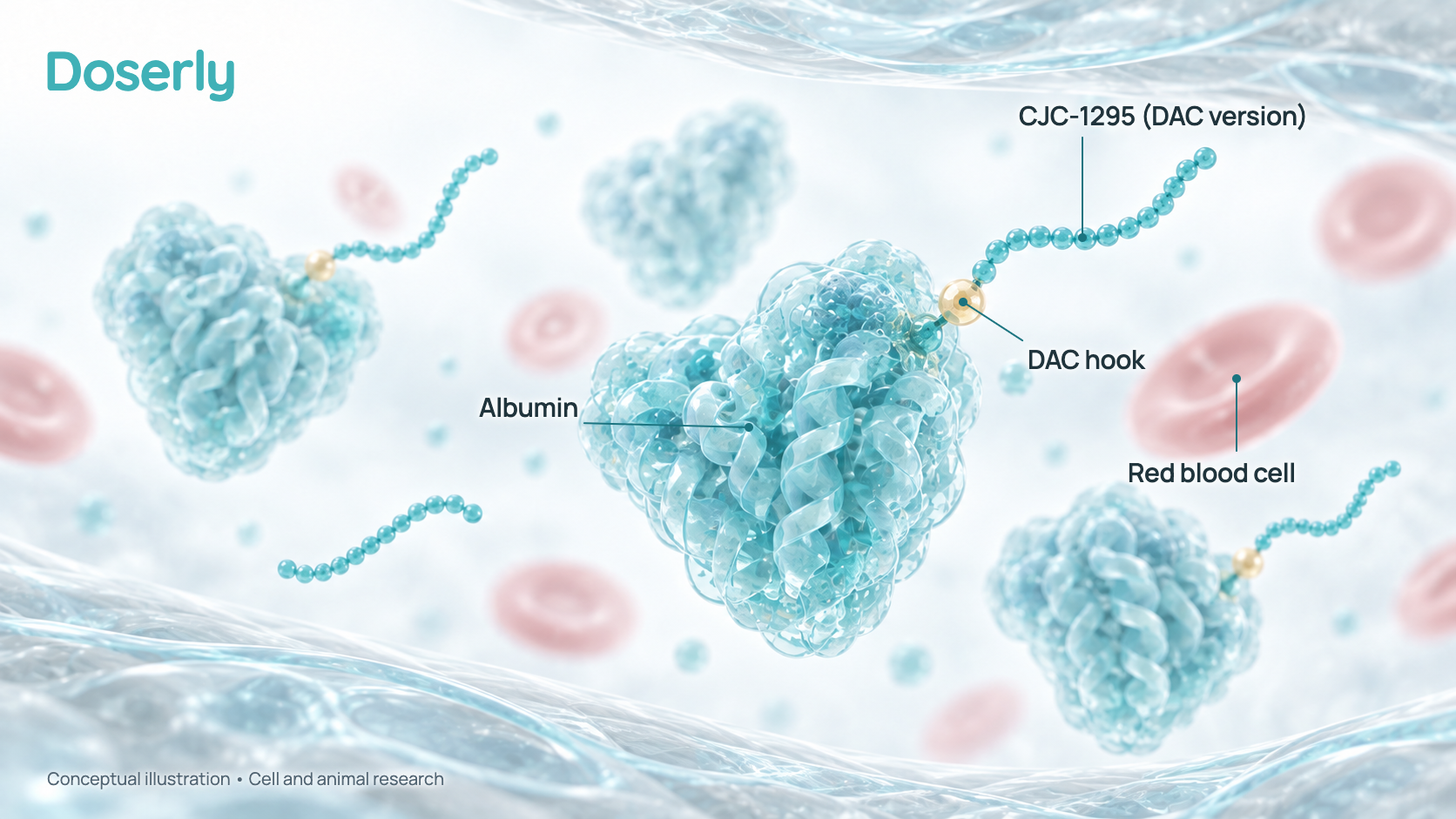
With DAC is the molecule its developer, the Canadian company ConjuChem, tested in people. DAC (“Drug Affinity Complex”) is an extra amino acid with a chemical hook that bonds to albumin, the most common blood protein; this version lasted about 6 to 8 days in healthy adults. [3], [2], [1]
Without DAC is the same chain with no hook, also sold as “Mod GRF 1-29” and usually mixed with ipamorelin. FDA treats the two as different, non-interchangeable active ingredients and found no study of this version in people. [1]
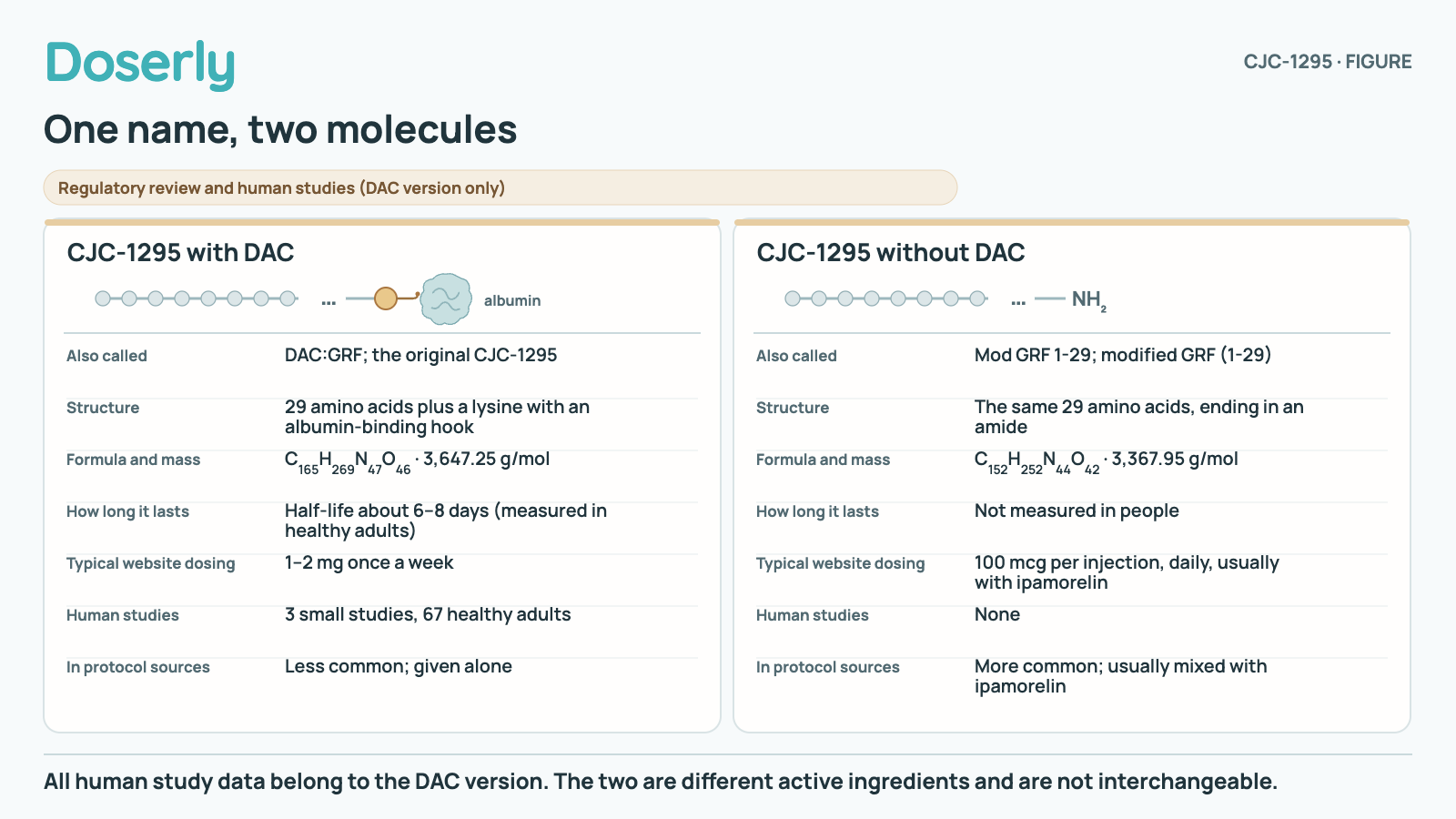
One name, two molecules
CJC-1295 with DAC
- Also called
- DAC:GRF; the original CJC-1295
- Structure
- 29 amino acids plus a lysine with an albumin-binding hook
- Formula and mass
- C165H269N47O46 · 3,647.25 g/mol
- How long it lasts
- Half-life about 6–8 days (measured in healthy adults)
- Typical website dosing
- 1–2 mg once a week
- Human studies
- 3 small studies, 67 healthy adults
- In protocol sources
- Less common; given alone
CJC-1295 without DAC
- Also called
- Mod GRF 1-29; modified GRF (1-29)
- Structure
- The same 29 amino acids, ending in an amide
- Formula and mass
- C152H252N44O42 · 3,367.95 g/mol
- How long it lasts
- Not measured in people
- Typical website dosing
- 100 mcg per injection, daily, usually with ipamorelin
- Human studies
- None
- In protocol sources
- More common; usually mixed with ipamorelin
All human study data belong to the DAC version. The two are different active ingredients and are not interchangeable.
FDA calls the inconsistent naming “a safety risk for patients”, and this guide names the version wherever it matters. CJC-1295 is investigational: ConjuChem stopped its only patient trial in 2006, and no other trial is registered. [1], [4], [5], [6]
Typical CJC-1295 Protocols
| Example | Amount each time | Frequency | Weekly total | Duration |
|---|---|---|---|---|
| Low | 1 mg | Once weekly | 1 mg | 8 weeks, then 8 weeks off |
| Standard | 2 mg | Once weekly | 2 mg | 12 weeks, then 4 weeks off |
| Split | 1 mg | Twice weekly, 3–4 days apart | 2 mg | 12 weeks, then 4 weeks off |
| Longer course | 2 mg | Once weekly | 2 mg | 16 weeks, then 4 weeks off Same weekly amount as the standard row, over a longer course |
The most common patterns in the reviewed sources are 1–2 mg of CJC-1295 with DAC once a week, or 100 mcg of CJC-1295 without DAC per injection at bedtime, usually mixed with ipamorelin and often taken 5 nights a week, each for about 8–12 weeks. [7], [8], [9], [10], [11], [12]
Protocol sources give the version without DAC daily, in micrograms, on the assumption that it wears off quickly:
| Example | Amount each time | Frequency | Total per day | Duration |
|---|---|---|---|---|
| Low | 100 mcg | Once daily, at bedtime | 100 mcg | 8–12 weeks |
| Mid | 200 mcg | Once daily, at bedtime | 200 mcg | 8–12 weeks |
| High | 100 mcg | Three times daily | 300 mcg | 8–12 weeks |
- Titration Changing the amount in steps
- For the DAC version, the usual approach starts at 1 mg once a week and moves to 2 mg after the first 1–4 weeks, depending on tolerance. For the version without DAC, and for the ipamorelin blend, sources start at 100 mcg per injection and raise it to 200–300 mcg. [13], [14], [8], [11], [12] In community education groups, common advice is a half dose for the first injection to soften the flush, and not restarting at the previous dose after a break.
- Breaks and cycles
- After 8–16 weeks, sources describe 4–8 weeks off before another course, and a few list continuous use. Schedules for the version without DAC often also skip two days a week, a pattern written as 5 days on, 2 off. Breaks are meant to rest the pituitary, but no study has tested whether they are needed. [7], [8], [9], [12], [32] Educators in community education groups disagree, and some people report using the blend for years.
Read the units: the DAC version is written in milligrams and the version without DAC in micrograms. 1 mg equals 1,000 mcg, so a 2 mg DAC dose is 20 times a 100 mcg dose of the version without DAC. Copying a DAC amount onto the version without DAC, or the reverse, is a large dosing error. In a blend, the amounts are for each peptide, not the vial total.
Each row is a complete schedule as its source published it, and the rows in each table are alternatives, not steps to move through. These schedules come from protocol websites and clinics, not clinical trials: the trials of the DAC version dosed by body weight and gave one to three injections over two weeks, and no trial has tested the version without DAC. [9], [2], [1]
What are the usual CJC-1295 and ipamorelin blend amounts?
Most protocol sources and personal accounts pair the version without DAC with ipamorelin, a different growth-hormone-releasing peptide, either premixed in one vial or drawn from two vials into one syringe. The amounts below are per peptide. [12], [1]
| Example | Amount each time | Frequency | CJC-1295 per day | Duration |
|---|---|---|---|---|
| Low | 100 mcg CJC-1295 + 100 mcg ipamorelin | Once daily at bedtime, 5 days a week | 100 mcg | 8–12 weeks |
| Mid | 200 mcg + 200 mcg | Once daily at bedtime, 5–7 days a week | 200 mcg | 8–12 weeks |
| High | 300 mcg + 300 mcg | 1–3 times daily | 300–900 mcg | 8–12 weeks Its source also allows 150 mcg of each twice daily (300 mcg a day) and describes this level for experienced patients under close supervision |
A clinic protocol gives 200 mcg of each, five nights a week, for the first month, then 400 mcg of each. [15] In community education groups, the most common routine is 250 mcg of each at bedtime on an empty stomach, often 5 days on and 2 off, for 12–16 weeks followed by 4–6 weeks off.
Where these numbers come from
The rows for the DAC version come from reference [7], a UK protocol page that describes all its schedules as forum convention without controlled-trial validation. References [8], [9], [10], [12] and [11] cross-check the recurring 1–2 mg weekly amount. Some pages go higher: one lists 2–3 mg twice a week (4–6 mg a week) as an “advanced” level. [16]
The rows for CJC-1295 without DAC alone come from reference [11]. References [17], [16], [18] and [7] cross-check the 100 mcg per injection anchor; several place it two or three times a day, up to 900 mcg a day at the top of one range. FDA's 2024 review found online bodybuilding doses from 250 mcg a day to 100–200 mcg two or three times a day. [1]
The blend rows come from reference [12]; references [9], [19], [15] and [14] cross-check them. Many pages copy one another nearly word for word, so matching pages are not counted as independent confirmation.
We keep amount, frequency and course length together rather than taking a low number from one page and a duration from another. Excluded from the typical comparison: blends described only by the combined vial amount, doses per kilogram of body weight from the trials (shown separately), under-the-tongue troche amounts, and pages whose dose text we could not match to the live page.
What is CJC-1295 commonly used for?
People usually look into CJC-1295 hoping more of their own growth hormone will bring less body fat, especially around the middle, more muscle or easier recovery, deeper sleep, better skin or a general “anti-aging” effect. Clinics present it as a gentler alternative to prescription growth hormone, and some people add it while losing weight on a GLP-1 medicine, one of the newer weight-loss injections such as semaglutide or tirzepatide. [1], [20], [19], [21]
The honest summary is short. No human study has measured any of those outcomes. What exists is a measured rise in growth hormone and IGF-1 in healthy adults given the DAC version, a small number of animal studies, one patient trial that stopped without results, and personal accounts. [2], [22], [5]
Raising growth hormone and IGF-1
This is the one effect measured in people, and only for the DAC version. After a single injection in healthy adults, average growth hormone rose 2 to 10 times for at least 6 days, and IGF-1 rose 1.5 to 3 times for 9 to 11 days. IGF-1, a hormone the liver makes in response to growth hormone, is the blood test people use to check for a change. [2]
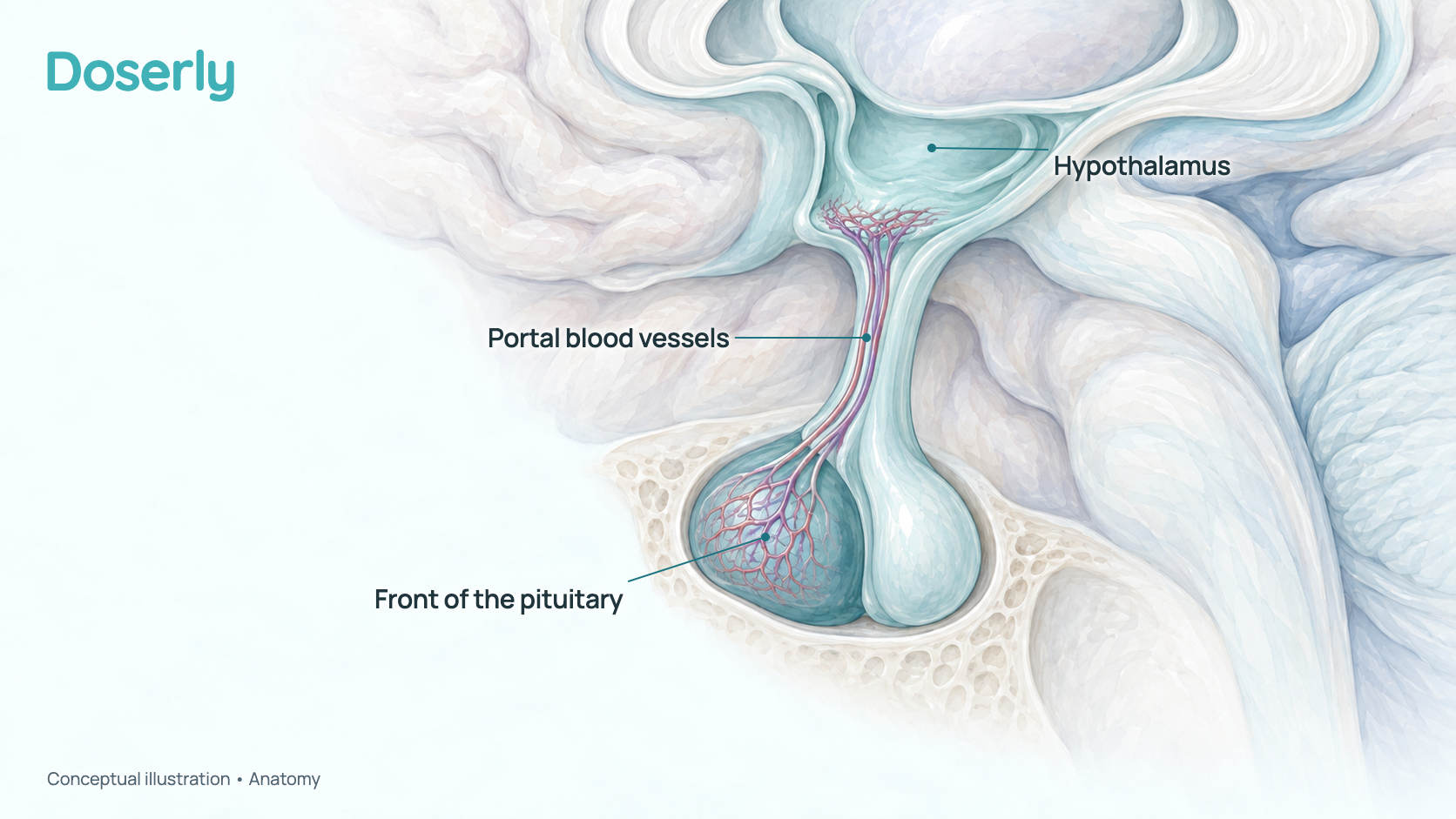
Because it works through the pituitary, CJC-1295 can only raise growth hormone if the pituitary can still make it. FDA notes that people with complete growth-hormone deficiency will not respond. [1]
Losing body fat
The only planned test of a body-composition outcome was ConjuChem's trial in people with HIV and excess abdominal fat, and it stopped before reporting any result. Tesamorelin, a different GHRH medicine, is FDA-approved to reduce excess abdominal fat in adults with HIV and lipodystrophy. That approval shows what one GHRH drug did in one specific group of patients; it is not evidence that CJC-1295 reduces body fat. [5], [23]
People who report a leaner body are almost always also dieting, training, or taking a GLP-1 medicine or testosterone, so the peptide's share cannot be separated. See what people report.
Muscle, strength and recovery
No human study has tested CJC-1295 for muscle, strength, injuries or recovery. In mice born without their own GHRH, daily injections of the DAC version restored normal growth, which shows the molecule works as a growth signal; it says nothing about building muscle in adults. [24], [25]
Sleep
Better sleep is one of the most common reasons people try it, but no study has measured sleep after CJC-1295. Protocol sources schedule it at bedtime to match the body's night-time growth-hormone release, and personal accounts go both ways: deeper sleep and vivid dreams for some, lying awake and next-day exhaustion for others. [12], [26], [27], [28] See the sleep reports.
Other uses you may come across
FDA's review found websites claiming benefits for bone density, joints, immune and heart health, memory, mood, energy, libido and insulin sensitivity, and people also discuss it for skin. None of these has been studied in people. [1], [20]
Where do CJC-1295 protocols differ?
Sources disagree about more than the amount. The first question is which molecule a protocol is written for; after that come trial doses, timing, starting amounts, breaks and combinations.
Which CJC-1295 is the protocol for?
Check the version before reading any number. DAC protocols give milligrams once or twice a week; protocols for the version without DAC give micrograms once to three times a day. The names are used loosely: an unidentified preparation seized in Norway in 2009 turned out to be the peptide then marketed as “CJC-1295”, which was the version without DAC; a powder labelled “CJC-1295” seized in France and tested by mass spectrometry was also the version without DAC; and Health Canada seized vials labelled “CJC-1295” and “CJC-1295 DAC” from the same seller. [4], [108], [29] In community education groups, members describe buying the DAC version by mistake when they meant to buy the blend.
A protocol for one version cannot be used for the other. The DAC version stays in the body for days and builds up with repeated doses; the version without DAC has no albumin hook and is expected to clear much faster, so sources repeat it daily. Public accounts show how easily this goes wrong: one person started the DAC version at 200 mcg every night, a schedule written for the version without DAC, and another realized six weeks in that they had been dosing a DAC vial as if it were the other version. [2], [9], [28], [30]
What doses were tested in people, and why per kilogram?
The human studies dosed the DAC version by body weight: 20 to 250 micrograms per kilogram (mcg/kg) per injection. For a 70 kg adult, the lowest dose tested (20 mcg/kg) works out to 1.4 mg and 60 mcg/kg to 4.2 mg, so the usual 1–2 mg weekly website dose sits near the bottom of the tested range. [2], [7]
The bigger difference is time. The multiple-dose study gave two or three injections over two weeks and followed people for 7 weeks. Website courses give 8 to 16 weekly injections. The trial authors saw IGF-1 build up with each injection and suggested a minimum of 7 days between injections. [2] The 12-week patient trial came closest to a website-length course, but it stopped without publishing results; the participant who died had received 11 weekly injections. No course of the version without DAC has been studied. [5], [52]
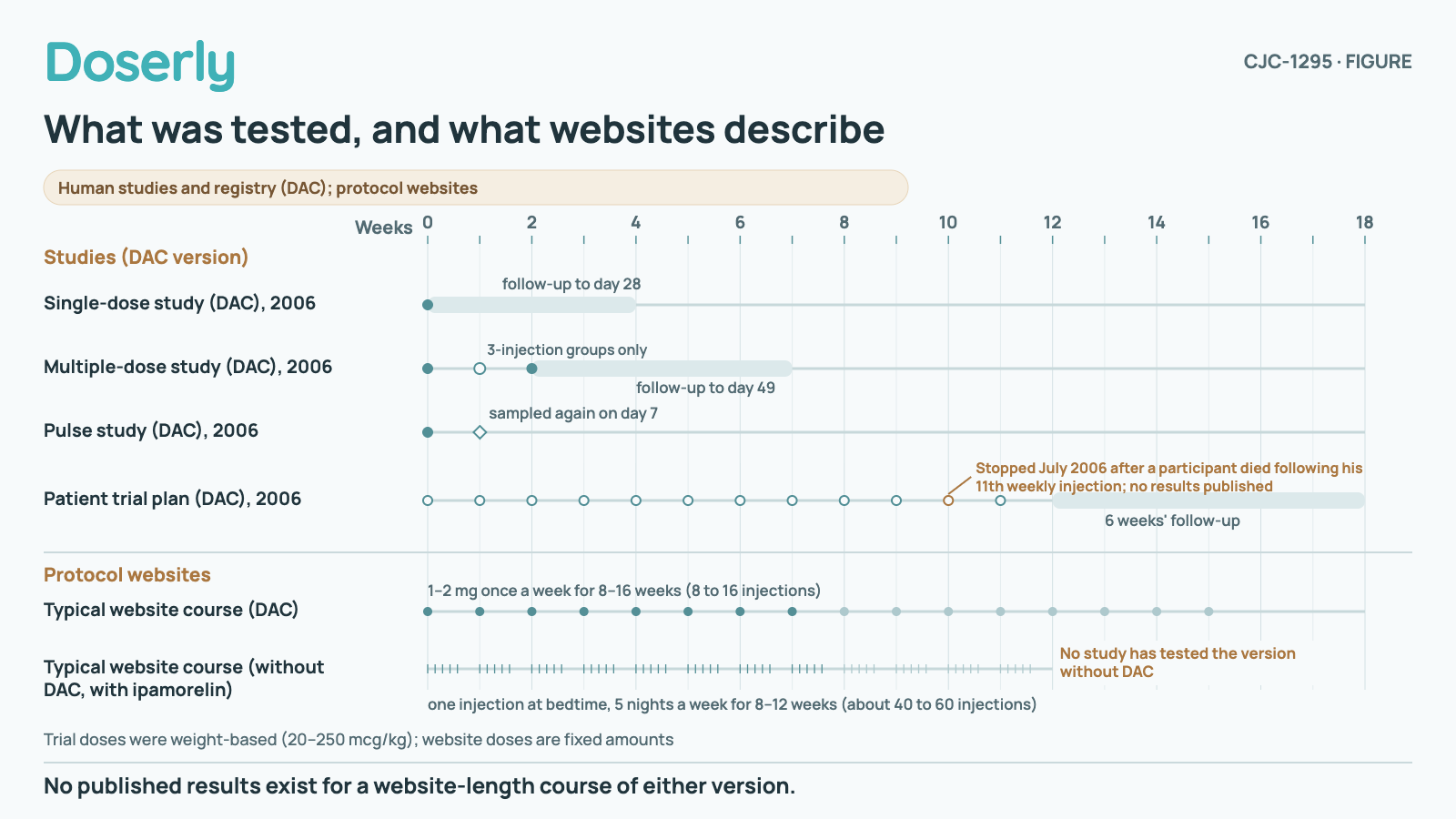
What was tested, and what websites describe
- Single-dose study (DAC), 2006
- 1 injection on day 0; follow-up to day 28
- Multiple-dose study (DAC), 2006
- 2 injections (days 0 and 14) or 3 injections (days 0, 7 and 14); follow-up to day 49
- Pulse study (DAC), 2006
- 1 injection on day 0; sampled again on day 7
- Patient trial plan (DAC), 2006
- 12 weekly injections, then 6 weeks' follow-up. Stopped July 2006 after a participant died following his 11th weekly injection; no results published
- Typical website course (DAC)
- 1–2 mg once a week for 8–16 weeks (8 to 16 injections)
- Typical website course (without DAC, with ipamorelin)
- one injection at bedtime, 5 nights a week for 8–12 weeks (about 40 to 60 injections)
No study has tested the version without DAC
Trial doses were weight-based (20–250 mcg/kg); website doses are fixed amounts
No published results exist for a website-length course of either version.
Once a week or twice a week?
Both appear for the DAC version: some sources split 2 mg into 1 mg twice a week for “smoother” levels. The only human comparison tested injections one or two weeks apart, not twice weekly. [7], [31], [2]
Once at night or several times a day?
For the version without DAC, sources range from one bedtime injection to three a day (on waking, after training and at bedtime), and no study has compared them. [11], [16], [17] In community education groups, a large minority move the dose to the morning because a bedtime dose disturbs their sleep or raises their heart rate, while others move it back because morning doses leave them sluggish.
Does it have to be taken on an empty stomach?
Nearly every source says so, usually 2–3 hours after carbohydrates and nothing for 20–30 minutes afterwards, but no study has tested CJC-1295 with and without food. [12], [17] In community education groups, people on GLP-1 medicines, which slow stomach emptying, often wait longer.
What is the “saturation dose”?
Many pages say the version without DAC reaches its maximum effect at 100 mcg, or 1 mcg per kilogram. That advice was circulating on forums by 2016; no human study has measured a dose-response for this peptide. [17], [16], [20]
Can it be combined with tesamorelin or sermorelin?
People do, but tesamorelin and sermorelin are also GHRH-type peptides acting on the same receptor. Educators in community education groups split: some call the pairing redundant, others a “premium” stack. No study has tested either combination. [33], [23] Read the Doserly guides to tesamorelin and sermorelin.
What about ipamorelin and other blends?
Ipamorelin works on a different receptor, the ghrelin receptor, which is the reason for pairing them; how that works is explained below. Websites also sell CJC-1295 with GHRP-2, GHRP-6, hexarelin or tesamorelin, and FDA notes that labels often do not say which CJC-1295 is inside. [34], [1] Read the Doserly guides to ipamorelin and the CJC-1295 and ipamorelin blend.
Can it be combined with IGF-1 LR3?
Some people add IGF-1 LR3, a lab-made variant of IGF-1, the hormone CJC-1295 raises. [2] No study has tested the combination. Educators in community education groups disagree: some courses suggest the pairing for recovery or muscle, while others say never to combine them, because it adds IGF-1 signalling on top of the rise CJC-1295 already causes and they worry about long-term cancer risk. Read the Doserly guide to IGF-1 LR3.
How do micrograms convert to syringe units?
A U-100 insulin syringe has 100 units per millilitre, so units measure volume, not an amount of peptide. How much each unit holds depends on how much liquid was added to the vial.
For example, a 2 mg DAC vial mixed with 2 mL holds 1 mg per mL, so a 1 mg dose is 100 units, a full 1 mL syringe. A 5 mg vial of the version without DAC mixed with 2 mL holds 25 mcg per unit, so 100 mcg is 4 units. A blend vial of 5 mg plus 5 mg mixed with 2 mL holds 25 mcg of each per unit, so 10 units gives 250 mcg of each. [7], [12] Doserly's reconstitution calculator works this out for any vial and shows each step.
Source-by-source comparison
Which pages share the same numbers?
Most DAC pages repeat “1–2 mg once weekly for 8–12 weeks”, with or without a twice-weekly split, including PEPEtides, TrimRX, PeptideProbe, Peptidología, Beverly Hills Rejuvenation Center and Peptides.ID. A stepped schedule of 300, 500, 750 and 1,000 mcg per injection appears almost word for word on PeptideDosages and Research Protocols. [7], [8], [9], [10], [12], [11], [35], [36]
For the version without DAC, “100 mcg per injection” is the anchor on Peptides.ID, PeptideWiki, Peptides Institute and PeptidesExplorer, which differ mainly in how many injections a day they add. [11], [16], [18], [17]
Which pages cite research that does not support them?
TrimRX says the stopped patient trial used 1 to 2 mg once weekly and is “likely the origin” of the convention; a report of that trial describes weight-based doses of 60 to 240 mcg/kg. Delta Peptides says “clinical studies” show the blend raises peak growth hormone by 400–800%; no such study exists. Several pages, including PEPEtides, repeat a 30-minute half-life for the version without DAC, which has never been measured, and describe the DAC version as flattening the growth-hormone rhythm, which the human study that tested this did not find. [8], [37], [38], [7], [22]
Which pages are more careful?
PeptideProbe states that no-DAC schedules and the ipamorelin pairing are clinic and vendor convention, not protocols from the DAC studies. Peptifact sets the trial doses beside clinic doses and explains why the two do not connect. Peptide Dosing Protocols lists the stopped trial's weight-based doses separately from its fixed schedule. [9], [39], [31]
What happens when you stop CJC-1295?
For the DAC version, the effect fades over weeks. After one injection, IGF-1 held steady for up to 7 days, then drifted back toward its starting level. After two or three injections, the last on day 14, it was still above its starting level on day 28. Follow-up ended at day 28 or 49. [2]
No study has looked for withdrawal effects or a rebound, such as growth hormone falling below its starting level, or checked whether any benefit lasts, for either version. That is missing data, not proof that none exist. [2], [1]
Related GHRH medicines give context, not proof about CJC-1295:
- Hormones. In five men given natural GHRH by continuous drip into a vein for 14 days, IGF-1 returned to its starting level after the drip stopped. [40]
- Belly fat. People switched from tesamorelin to placebo after 26 weeks regained the abdominal fat they had lost, close to their starting level, within 13 weeks. [41]
- Growth in children. After six months of nightly sermorelin, children's growth rates fell back, on average, to pre-treatment levels within six months of stopping. [42]
In community education groups, educators disagree: one advises cutting back over about four weeks to avoid a “crash”, another says stopping at once is fine. Some members describe sleeping worse for a while after stopping. Neither approach has been tested. Reactions reported on restarting after a break are covered under allergic reactions.
Does CJC-1295 work the same by injection, nasal spray or by mouth?
Nobody has measured it. Every human study gave the DAC version by subcutaneous injection. No study has measured how either version is absorbed through the nose, under the tongue or by mouth. [2], [1]
Those products exist anyway: a 2020 compounding catalog listed 500 mcg under-the-tongue troches, FDA found websites claiming oral tablets, and a 2026 nasal-spray page itself states that no human trial has measured that route. Peptides are normally broken down in the gut, so these cannot be assumed to match an injection. [43], [1], [44]
How long does CJC-1295 last in the body?
The DAC version has a half-life of about 6 to 8 days. In healthy adults it was 5.8 to 8.1 days after one injection, it stayed measurable for 10 to 13 days, and IGF-1 stayed above its starting level for up to 28 days after repeated doses. [2]
The version without DAC has no measured half-life in people. The “30 minutes” repeated across websites has no published source. Natural GHRH lasts about 7 minutes in the blood, and a related lab-made version with only one of CJC-1295's four changes lasted 6.7 minutes in 10 men, compared with 4.3 minutes for the natural hormone. Those figures describe different molecules. [2], [45], [1]
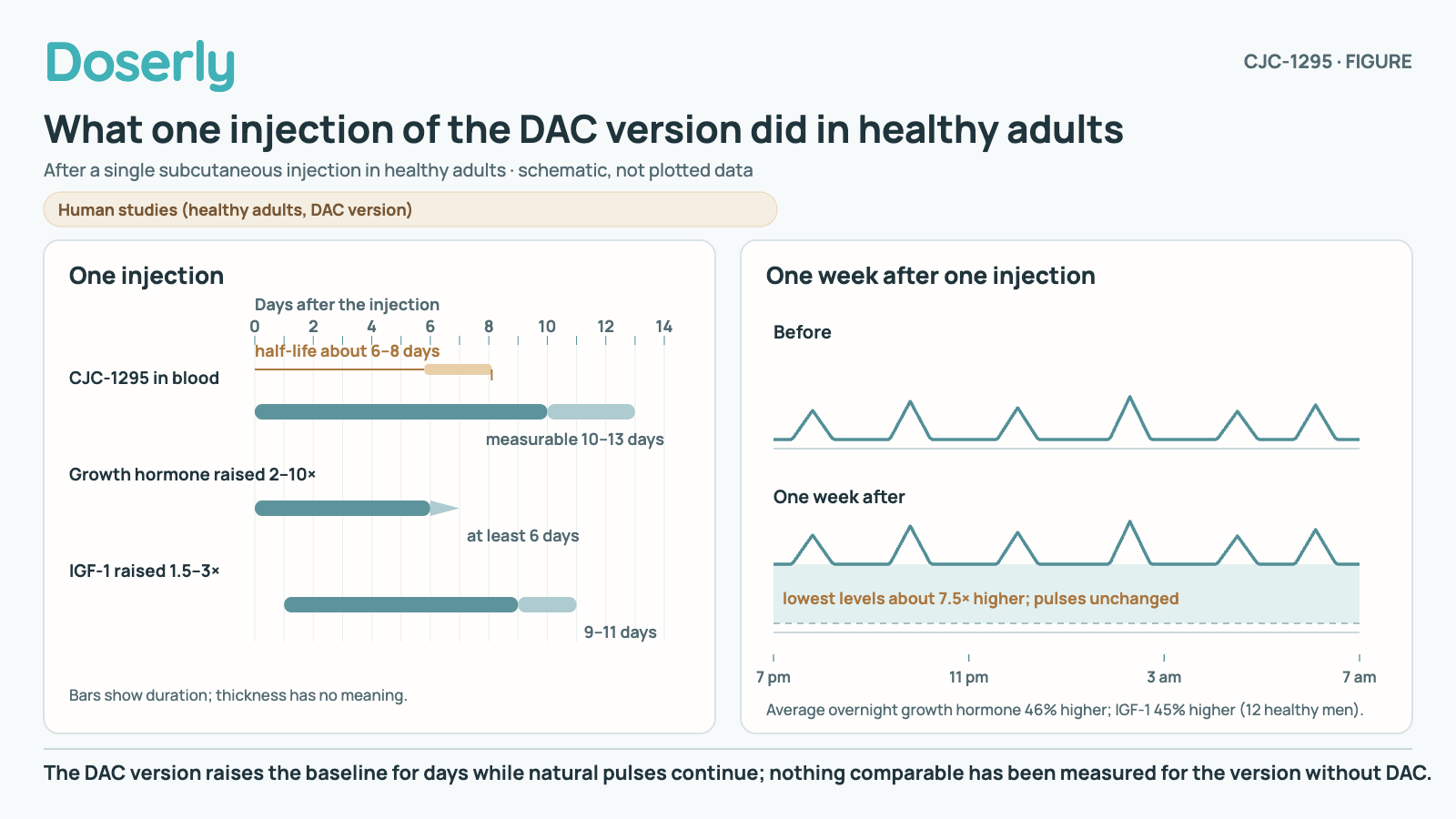
What one injection of the DAC version did in healthy adults
- One injection
- One injection: CJC-1295 half-life about 6–8 days, measurable for 10–13 days; growth hormone raised 2–10× for at least 6 days; IGF-1 raised 1.5–3× for 9–11 days.
- One week after one injection
- One week later: the same overnight growth-hormone pulses on a baseline about 7.5× higher; average growth hormone 46% higher and IGF-1 45% higher (12 healthy men).
Schematic, not plotted data.
The DAC version raises the baseline for days while natural pulses continue; nothing comparable has been measured for the version without DAC.
FDA adds a caveat: nobody has compared the two versions directly, so how much of the long half-life comes from the albumin hook rather than the four swapped amino acids has not been shown. [1]
Does the DAC version make growth hormone “bleed” all day?
The one human study that tested this says no. In 12 healthy young men, a single injection raised the lowest overnight growth-hormone levels about 7.5-fold, but the number and size of the natural pulses did not change: the pulses continued on top of a higher baseline. Average growth hormone rose 46% and IGF-1 45%. [22]
A 2026 sports-medicine review and many websites nonetheless describe the DAC version as producing a flat, non-pulsing rise. That claim is not supported by the study that measured it. [46], [7]
Is CJC-1295 acetate different from CJC-1295?
The acetate is the same peptide in a common salt form used to make a stable powder. FDA counts five substances under the CJC-1295 name: the version without DAC as a free base or acetate, and the DAC version as a free base, acetate or trifluoroacetate. It also notes that the DAC hook might bind proteins other than albumin; the developer reported only trace amounts on two other blood proteins, from unpublished data. [1], [2]
Does the injection site matter?
Sources use the belly, thigh or upper arm, and no study has compared sites. FDA notes that subcutaneous injection may carry a particular risk of immune reactions to a peptide. [8], [1]
How should CJC-1295 be stored, and how long does it last?
We found no published study of how long either version keeps its strength once mixed, so storage advice comes from suppliers and protocol pages, not from a tested medicine label.
- Powder, before mixing. CJC-1295 is sold as a freeze-dried powder. Supplier information quoted by FDA says to keep it frozen at −20 °C. One supplier says powder of the version without DAC lasts three weeks at room temperature but belongs below −18 °C. [1], [47]
- After mixing. For the mixed (reconstituted) DAC solution, FDA's summary gives 4 °C (fridge temperature), split into portions to avoid repeated freezing and thawing, with no time limit. Supplier and protocol pages range from 2–7 days in the fridge to 28 days, and none cites a stability test. The label of bacteriostatic water, the mixing liquid these pages often name, says not to store drug solutions made with it unless the drug's maker says so. [1], [47], [38], [35], [48]
- Approved relatives are stricter. One tesamorelin product must be used straight after mixing; the other is kept at room temperature and thrown away 7 days after mixing. Sermorelin (sold as Geref) was kept at 2–8 °C away from light and mixed just before use. Those tested rules belong to those products, not to CJC-1295. [49], [23], [50]
FDA notes that heat, acidity and concentration can make peptides like CJC-1295 break down or clump together (aggregation), and that clumps and impurities could make an injection more likely to trigger an immune reaction. This guide does not cover mixing or injection technique; the Academy note below covers practical handling. [1]
What do we actually know about CJC-1295 in people?
Very little, and none of it involves the version most protocol sources describe. The human research is three small studies of the DAC version in healthy volunteers (two of them reported in one paper), a follow-up analysis of stored blood samples, and one patient trial that stopped early.

What did the human studies find?
| Study | What researchers reported | What it cannot establish |
|---|---|---|
| Two dose studies, 2006 | Two randomized, placebo-controlled trials in 66 healthy men and women aged 21 to 61 (55 received CJC-1295 with DAC). One gave a single injection of 30 to 250 mcg/kg; the other gave two or three injections of 20 to 60 mcg/kg over two weeks. Growth hormone and IGF-1 rose in step with the dose and stayed up for days; the half-life was about 6 to 8 days. | Any change in body fat, muscle, sleep or health; the effects of months of use; anything about the version without DAC. [2] |
| Pulse study, 2006 | 12 healthy men aged 20 to 34 were given one injection of 60 or 90 mcg/kg. A week later, growth-hormone pulses continued at the same rate on a higher baseline, and IGF-1 rose from 165 to 240 ng/mL on average. | Longer-term effects or any health outcome. The paper also describes 20 men while reporting results for 12. [22] |
| Blood-protein analysis, 2009 | Stored blood from 11 of the same men showed shifts in several blood proteins a week after the injection. | Whether those shifts matter for health. It is not a new group of people. [51] |
In all, 67 healthy adults have received CJC-1295 in published studies, all of it the DAC version and none of them for longer than two weeks of dosing. The 2006 dose studies were sponsored by ConjuChem, and company scientists are among the authors. In those studies, IGF-1 response did not differ by sex; age was the only predictor the authors identified. [2], [22]
What happened in the patient trial?
ConjuChem's Phase 2 trial tested weekly injections of the DAC version against placebo for 12 weeks in adults with HIV and excess abdominal fat. It was stopped in July 2006. Status checked September 23, 2026:
Adults with HIV and excess abdominal fat
Low-dose and high-dose CJC-1295 with DAC against placebo, once weekly for 12 weeks with 6 weeks of follow-up. A news report describes doses stepped up over three weeks to 120 or 240 mcg/kg. The registry lists 120 participants; the company said 192 had enrolled.
Terminated 2006. No results posted, and none published. Last registry update October 2006.
[5], [37], [52]According to the company, a participant in Argentina developed chest discomfort about 2 hours after his 11th weekly injection, was found to be having a heart attack, and died about an hour later. ConjuChem said earlier studies had shown no sign of harm to the heart, and the attending physician's most likely explanation was undiagnosed coronary artery disease. No independent assessment of the cause and no trial results were ever published. [52], [53], [37], [1]
That leaves an open question rather than a verdict: the death does not prove CJC-1295 caused it, and the absence of published results means it was never ruled out. No later trial has been registered. [5], [6]
Has the version without DAC ever been tested in people?
No. FDA's 2024 review found no human study of it, and a 2026 review of growth-hormone-axis peptides reached the same conclusion. Everything said about its effects in people is carried over from the DAC studies or from personal accounts. [1], [54]
Does more growth hormone mean better health?
Not automatically. A rise in growth hormone, an IGF-1 number, a change in body fat and feeling better are four different outcomes, and only the first two have been measured for CJC-1295, briefly. An IGF-1 result shows that signalling changed, not that anything a person cares about improved or that the change is safe over months. [2], [1]
How does CJC-1295 work?
Growth hormone is released in bursts, up to 8 to 10 pulses a day. GHRH from the hypothalamus drives each pulse, and a second hormone, somatostatin, acts as the brake between them. Growth hormone then prompts the liver and other tissues to make IGF-1. CJC-1295 acts on the same GHRH receptors on the pituitary's growth-hormone-making cells, so it pushes the “release” side of that system. [1], [22]
In rats, the DAC version released about four times as much growth hormone over two hours as the natural 29-amino-acid hormone, and it was still in the blood more than 72 hours later; a separate test found it attached to albumin for more than 24 hours. In human volunteers, the result was a raised baseline with the natural pulses continuing on top. [3], [22]
Why is it paired with ipamorelin?
The two act on different switches: CJC-1295 on the GHRH receptor and ipamorelin on the ghrelin receptor. In healthy men, natural GHRH and a ghrelin-type peptide (GHRP-6) given together into a vein released more growth hormone than the two added together, which is the reasoning behind the blend. A smaller study pairing the 29-amino-acid GHRH with a different ghrelin-type peptide (GHRP-2) found only an added effect, not a multiplied one. Neither tested CJC-1295 or ipamorelin, and that combination has never been studied in people. [34], [55], [56], [1]
Can the pituitary grow or change with long-term use?
It is a real question, and the evidence so far is from animals. In mice given the DAC version three times a week for 8 weeks, the pituitary glands weighed 47% more than in untreated mice and showed markers of DNA damage. In mice born without their own GHRH, the DAC version increased the growth-hormone-making cells of the pituitary. Mice engineered to make too much GHRH develop enlarged pituitaries and tumors, and FDA says a similar risk from long-term CJC-1295 use “cannot be ruled out”. None of this has been studied in people. [57], [24], [1]
Does the body get used to it?
There is no human evidence that the response fades. In the multiple-dose study the opposite happened over two weeks: IGF-1 peaked higher after each injection than after the one before, which the authors linked to a pituitary “priming” effect. Whether that continues, levels off or reverses over months is unknown. Older studies of natural GHRH point both ways: a 10-hour drip into a vein reduced the response to a later test dose in four men, though unevenly, while a 14-day drip in five men left the response intact. [2], [58], [40]
What are the risks and unanswered questions?
Is CJC-1295 safe?
Its safety has not been established for either version. The short studies of the DAC version found side effects in almost everyone who received it, the only patient trial stopped after a death that was never explained, and there are no published safety data for the version without DAC or for any course longer than two weeks. [2], [5], [1]
What side effects appeared in the human studies?
In the single-dose study, 33 of 35 people given CJC-1295 with DAC reported side effects, compared with 2 of 7 on placebo. None was classed as serious, and the authors called the drug “relatively well tolerated, particularly at doses of 30 or 60” mcg/kg. [2]
- Injection-site reactions in about 70%: redness, pain, itching and hardening, usually gone within hours but sometimes lasting up to 5 days. About 30% had hive-like rashes at the injection site.
- Headache in 63% (14% on placebo) and diarrhea in 43%.
- Flushing, warmth and brief drops in blood pressure in 30%, mostly at the higher doses. In the multiple-dose study, flushing began within 30 minutes and faded within 1–2 hours.
- Single events in the multiple-dose study: brief dizziness with low blood pressure in two people, and short-lived involuntary leg-muscle contractions with loss of coordination in one. Across both studies, three people withdrew because of side effects.
The pulse study added a dose-dependent rise in heart rate. FDA's compounding-risk page says it has “identified serious adverse events associated with CJC-1295 including increased heart rate and systemic vasodilatory reaction”, and its 2024 review flags these effects for people at risk of falls or with heart disease. [22], [59], [1]
Can CJC-1295 cause an allergic reaction?
It can cause reactions that look allergic, and some are serious. Hive-like rashes at the injection site were common in the DAC studies, and FDA lists immune reactions to the peptide, or to clumped peptide and impurities, among its main concerns. [2], [1]
Public accounts go further. One person developed sudden hives, facial swelling and a racing heart after about 7 weeks on a CJC-1295 and ipamorelin blend; when they later tested the two peptides separately, 25 mcg of CJC-1295 alone raised a hive and ipamorelin did not. Another describes reactions they call anaphylaxis, including on retrying. In community education groups, members describe whole-body hives, itchy palms and soles, numb lips, throat tightness, wheezing or fainting, often starting when they restarted after a break or in a later cycle. [60], [61]
A brief flush is a known effect of GHRH itself: in a 1990 study, 16 of 18 men given natural GHRH into a vein flushed for 1 to 3 minutes. An allergic reaction is different. The label of tesamorelin, an approved GHRH medicine, lists hypersensitivity reactions such as itching, flushing and hives in about 4% of trial patients and tells people to stop it and get prompt medical attention. Hives, swelling of the lips, face or tongue, throat tightness, wheezing or fainting after an injection need urgent medical care. Australia's regulator has reported severe allergic reactions needing hospital treatment among harms linked to unapproved peptides, a group it says includes CJC-1295. [55], [23], [62]
Can it affect heart rate, blood pressure or the heart?
Yes, in the short term. The DAC studies recorded a dose-dependent rise in heart rate and brief drops in blood pressure, and personal accounts describe a racing heart after injections and a higher resting heart rate on wearables. The fatal heart attack in the Phase 2 trial has never been explained either way. [22], [2], [63], [64], [52]
Does it cause water retention, numbness or carpal tunnel symptoms?
It might; this has not been measured for CJC-1295. Approved growth-hormone labels list swelling, joint and muscle pain and nerve compression such as carpal tunnel syndrome. The 2006 study authors noted that none of their volunteers had swelling, joint pain or glucose problems. Personal accounts describe early water retention and numb or painful hands, usually easing after a lower dose or stopping. [65], [2], [66], [67]
Does CJC-1295 raise blood sugar?
Not in the short studies of the DAC version, which checked blood sugar and found no consistent change. They cannot show what months of use, or the version without DAC, would do. [2] Growth hormone can make the body less sensitive to insulin, approved growth-hormone labels warn about diabetes, and FDA found nothing to suggest CJC-1295 would differ. A few personal accounts describe higher fasting glucose, usually alongside other growth-hormone-raising drugs or testosterone. [65], [1], [68], [30]
Does CJC-1295 cause cancer?
Nobody knows. There are no human data, and no carcinogenicity studies, the long-term animal studies designed to detect cancer risk. Growth-hormone medicines carry a tumor warning, and the mouse pituitary findings described above add an open question, not an answer. [1], [65], [57]
Could product quality change the risk?
Yes. Besides the naming confusion, a Belgian laboratory testing peptides from illegal online pharmacies found widely varying amounts of powder per vial between sellers, and small chemical changes in several peptides, including CJC-1295 without DAC. A 2026 analysis of more than 6,000 third-party lab reports found that CJC-1295 samples failed identity testing 9.1% of the time, the second-highest rate of any peptide; it did not separate the two versions and has not been peer reviewed. [69], [70]
Is CJC-1295 legal? Is it FDA-approved?
Checked September 23, 2026. Rules differ by country and change quickly.
United States. Neither version is an FDA-approved medicine or part of any approved drug.
- April 2020. An FDA warning letter to a compounding pharmacy listed CJC-1295 among ingredients that did not qualify under the federal compounding rules. [71]
- December 2024. FDA recommended against adding any of the five nominated forms to the list of bulk substances that pharmacies may use in compounding, and its advisory committee agreed: 0 to 13 for the version without DAC, 1 to 12 for its acetate, and 0 to 13 for each DAC form. A committee vote is advice, not a final rule. [1], [72]
- 2026. FDA's list of compounding substances with safety concerns shows CJC-1295 as “nominated but withdrawn”, with its concerns stated; that is not an approval. In July 2026 FDA used it as the example of different molecules sold under one name. [59], [73]
Canada. Health Canada has not authorized CJC-1295. It seized unauthorized products in 2025, including vials labelled “CJC-1295” and “CJC-1295 DAC”, and its April 2026 advisory lists CJC-1295 among unauthorized injectable peptides. [74], [29], [75], [76]
Australia. The TGA names CJC-1295 among unapproved peptide products, and in August 2026 it reported seizing illegal peptide products, including CJC-1295, from a seller who allegedly advertised them on social media. [78], [107] It is a prescription-only substance (Schedule 4) and on the list of substances that are illegal to possess without authority. [77]
Both Health Canada and the TGA say a research use only label does not make a product legal. [74], [78]
Is CJC-1295 banned in sport? Does it show up on a drug test?
Yes, it is banned. The World Anti-Doping Agency names CJC-1295 in its 2026 and 2027 lists, prohibited at all times. USADA has sanctioned athletes over it, including one in 2025 for promoting it on social media. Anti-doping laboratories have published methods that detect both versions in urine samples prepared in the lab; how long it stays detectable after someone uses it has not been published. [33], [79], [80], [81], [82], [83]
Who should be especially cautious?
These groups have no safety data in people. That is a reason for caution, not proof of harm.
- Pregnancy and breastfeeding. A rat study found no harm to fetuses, but there are no human data, and the label of tesamorelin, an approved GHRH medicine, says not to use it in pregnancy. [84], [1], [23]
- Heart disease, fainting or fall risk, because of the heart-rate rise, the blood-pressure drops and the unexplained trial death. [1]
- Cancer, diabetes or diabetic eye disease. There is no CJC-1295 label, but labels for approved growth hormone and tesamorelin list active cancer as a reason not to use them and warn about blood sugar and diabetic eye disease. [85], [23], [65]
- Anyone who has reacted to a peptide injection before.
- Under 18. No studies include young people. This guide is written for adults.
- Competitive athletes. It is banned at all times.
- People taking other medicines. See the next question.
Has CJC-1295 been tested alongside other medicines?
Not in people, including with testosterone, GLP-1 medicines or other peptides, although many of the personal accounts we reviewed combine it with at least one of them. Growth-hormone labels carry warnings involving blood sugar, thyroid and adrenal hormones, which matters for people treated for those conditions. Bring a complete list of everything you take to a pharmacist or doctor. [65], [1]
What should be monitored while using CJC-1295?
There is no official monitoring plan, because no regulator has approved CJC-1295. What exists is what the DAC studies checked, plus what labels require for related approved medicines. It can help you prepare questions for a clinician; it is not a personal testing plan. [1]
What did the human studies check?
- Routine safety tests. The 2006 dose studies repeated vital signs, physical exams, blood chemistry, blood counts and urine tests until day 28 or 49, recorded heart tracings (ECGs) and tested for antibodies against the drug. They found no consistent changes, including in blood sugar and liver tests, and no significant antibodies. [2]
- Other hormones. In one dose group, cortisol, prolactin, thyroid-stimulating hormone (TSH) and luteinizing hormone (LH) did not rise significantly. [2]
- IGF-1 went above the normal range for age and sex only at the highest single dose, 250 mcg/kg, and stayed within it in the pulse study. [1], [22]
These were short studies of the DAC version. There are no monitoring data for the version without DAC or for courses lasting months.
What do labels for related medicines ask for?
These are class-based considerations from approved medicines that also raise growth hormone, not CJC-1295 findings.
- Tesamorelin, an approved GHRH medicine: check IGF-1 and consider stopping if it stays high; check blood sugar before and during treatment, and the eyes of people with diabetes; watch for swelling, joint pain, carpal tunnel symptoms and allergic reactions. In its trials, 5% of patients developed blood sugar in the diabetes range (an HbA1c, a three-month average, of 6.5% or higher), compared with 1% on placebo. [23]
- Growth hormone itself (somatropin): periodic blood sugar and thyroid checks, an eye check for raised pressure in the skull before starting, and watching existing moles for changes. [85]
Which signals matter, and why?
| Why it matters | Where it comes from | Tracking category |
|---|---|---|
| Growth-hormone activity (IGF-1) | DAC studies; tesamorelin label | Blood work |
| Blood sugar (glucose, HbA1c) | DAC studies; related labels | Blood work |
| Heart rate and blood pressure | DAC studies; FDA's safety concerns | Heart Rate & Palpitations; Blood Pressure |
| Flushing, hives and injection-site reactions | DAC studies; tesamorelin label | Temperature Regulation; Side Effect Burden |
| Swelling, joint pain, hand numbness | Related labels | Fluid Retention; Joint Health |
| Thyroid and other pituitary hormones | One DAC dose group; growth-hormone label | Blood work |
| Sleep | Personal accounts only; never measured in a study | Sleep Quality |
Every row except sleep comes from the studies, FDA's safety summary and the labels above. [2], [59], [23], [85]
A single IGF-1 result is hard to read without a starting value. In community education groups, educators commonly advise testing IGF-1 before starting and again after 6–12 weeks, and some treat a rising fasting insulin as a reason to stop, but many members skip the first test. See what people report about IGF-1.
What do people in public communities report?
Almost every public account we reviewed describes CJC-1295 without DAC mixed with ipamorelin, usually alongside testosterone, a GLP-1 medicine, tesamorelin or other peptides. Reports on the DAC version are rare. The accounts below cannot separate what CJC-1295 did from everything else.
What do the positive reports look like?
Better sleep is the most common one. One person who had taken the blend “fairly regularly for over a year” saw little change in strength or size but kept taking it because “the sleep benefits and vivid dreams are worth it”. Another, 7 weeks into a third cycle, described better recovery, vivid dreams, small strength gains and less elbow tendonitis. [26], [86]
Body-composition reports are almost always tied to a diet. One person on a calorie deficit said sleep improved “drastically” in the first week, but later found no significant difference from a normal cut without compounds. [87]
What happens to IGF-1?
It varies. One person's IGF-1 went from 47 to 173 after a month on 250 mcg of each; another went from 140 to 177 on 175 mcg of each and called the result underwhelming. Others report a rise from 161 to 194 with “no real positive gains”, an IGF-1 below the lab's range while taking the blend, a fall from 211 to 177 after switching from sermorelin, and no rise at all on another person's labs. [88], [89], [90], [91], [92]
Many of these numbers have no proper starting value, were taken at different times after an injection, or come from people eating in a deficit, which lowers IGF-1 by itself.
Can it make sleep worse?
Yes, for some. One person described improved sleep for a week or two, then insomnia that stopped when they dropped the evening dose. Another, who had started the DAC version on a nightly schedule with ipamorelin, had “pretty bad insomnia” and felt like “a complete zombie” after the first two nights, and slept well again after skipping a dose and changing the timing. Others with existing insomnia, or on a GLP-1 medicine, found their sleep got worse after adding the blend. [27], [28], [93], [94]
What unwanted effects come up?
- Flushing and head rush, often for about 30 minutes after an injection, sometimes only with the first few doses. Some people take a strong flush as a sign the product is working; the studies show flushing rises with the dose, which makes it a side effect, not a measure of benefit. [95], [89], [88], [90], [2]
- A racing or pounding heart, including waking at 3 am with a pounding heart and a heart rate that climbed during exercise, easing after stopping. [63]
- Numb, tingling or painful hands, sometimes described as carpal tunnel, which usually settled within days to weeks of lowering the dose or stopping. [66], [67], [96]
- Water retention in the first weeks, which one person said resolved after about 6 weeks. [89]
- Dizziness, cold sweats and a brief faint in someone also taking retatrutide on a low-calorie diet, who later switched to tesamorelin, unsure whether they could not tolerate CJC-1295 or had a bad batch. [97]
- Hives and allergic-type reactions, described in the risks section. [60]
What about CJC-1295 with DAC?
The few DAC accounts mostly describe injection-site problems: repeated red, swollen “goose eggs”, and hard, itchy swellings lasting about a week after a 2 mg injection. One person taking 1 mg three times a week alongside MK-677 and testosterone reported an IGF-1 of 396 and a morning blood sugar around 125, and began insulin. Another, who had dosed a DAC vial daily for six weeks by mistake while also taking retatrutide, reported some muscle gain but otherwise noticed little. [98], [99], [68], [30]
How can you judge a CJC-1295 story?
Useful questions to ask: Which version was it, and was that confirmed? Was the amount per peptide or for the whole blend? What else was the person taking: testosterone, a GLP-1 medicine, tesamorelin? Was there an IGF-1 result from before they started, and was the diet the same? Did they post an update weeks later? Follow-ups often change the story, especially for sleep.
These selected discussions help identify questions and experiences that research should examine. They are not a survey of all users, a response rate or a substitute for controlled human studies.
How does CJC-1295 compare with sermorelin, tesamorelin and ipamorelin?
Sermorelin and tesamorelin are other lab-made versions of GHRH, and ipamorelin is the peptide most often mixed with CJC-1295. Schedules for CJC-1295 and ipamorelin describe protocol sources, not tested doses.
| Peptide | What it is | How it is given | Half-life | Human evidence | Approval and sport status |
|---|---|---|---|---|---|
| CJC-1295 with DAC (this guide) | GHRH's first 29 amino acids, four swapped, plus an albumin hook [1] | Subcutaneous; 1–2 mg weekly in protocol sources [7] | About 6–8 days [2] | 67 healthy adults in three small studies; one stopped patient trial [2], [22], [5] | Not approved; banned in sport [1], [33] |
| CJC-1295 without DAC (this guide) | The same chain without the hook [1] | Subcutaneous; 100 mcg one to three times a day in protocol sources [11] | Never measured in people [1] | None [1] | Not approved; banned in sport [1], [33] |
| Sermorelin | Natural GHRH's first 29 amino acids, unchanged [50] | Subcutaneous, nightly in children's trials [100] | 6–7 minutes, given into a vein [50] | Children's growth trials; small studies in older men [100], [101] | US approvals in 1990 and 1997 (Geref), discontinued in 2008 but not for safety or effectiveness reasons; banned in sport [102], [33] |
| Tesamorelin | A lab-made version of the full 44-amino-acid GHRH [23] | Subcutaneous, daily [23] | 8–11 minutes [49], [23] | Placebo-controlled trials in adults with HIV [23] | FDA-approved for excess abdominal fat in adults with HIV and lipodystrophy; banned in sport [23], [33] |
| Ipamorelin | Acts on the ghrelin receptor instead of the GHRH receptor [34] | Subcutaneous; 100–300 mcg with CJC-1295 in blend protocols [12] | About 2 hours, given into a vein [103] | A dosing study in healthy men; a bowel-surgery trial that did not beat placebo [103], [104] | Not approved; banned in sport [34], [33] |
The real differences are how long each one lasts and how much is known. The DAC version lasts about a week; sermorelin, tesamorelin and ipamorelin last minutes to hours, and the version without DAC has never been measured. Tesamorelin is the only one approved in the United States today, for one condition. Ipamorelin works through a different receptor, which is why it is combined with CJC-1295 rather than used instead of it. No study has compared these with each other in people, so the table cannot say which works better. See also the Doserly guide to the CJC-1295 and ipamorelin blend.
Common questions about CJC-1295
Is CJC-1295 the same as Mod GRF 1-29?
Mod GRF 1-29 is another name for CJC-1295 without DAC. It is a different active ingredient from the DAC version that was studied in people, and FDA treats them as not interchangeable. Always check which one a product or protocol means: their doses differ about tenfold or more, and their schedules differ from daily to weekly. [1] See the two versions.
How long does CJC-1295 take to work?
If “work” means raising hormone levels, one injection of the DAC version raised growth hormone for at least 6 days and IGF-1 for 9 to 11 days in the studies. If it means feeling or looking different, there is no study to say. Personal accounts describe sleep changes within the first nights and body changes over months, alongside diet and other drugs, and some people notice nothing. [2], [87], [95] See what people report.
Is CJC-1295 growth hormone? Is it a steroid?
Neither. It is a peptide that prompts the pituitary to release the body's own growth hormone, so it only works if the pituitary can respond. Anabolic steroids are a different kind of molecule that act on hormone receptors directly. Growth hormone itself is a prescription medicine; CJC-1295 is not approved at all, and all three are banned in sport. [1], [33]
Should CJC-1295 be taken with ipamorelin?
Most protocol sources and personal accounts pair the version without DAC with ipamorelin, on the reasoning that the two act on different receptors and release more growth hormone together. That combination has never been tested in people, and adding a second peptide adds a second set of side effects and makes any reaction harder to trace. [12], [55] Read the ipamorelin guide.
Can you take CJC-1295 with semaglutide, tirzepatide or retatrutide?
Many people do, often hoping to hold on to muscle while losing weight, but the combination has never been studied, and taking several drugs at once makes any side effect harder to trace. Accounts from people combining them include worse sleep, and both more hunger and no change in appetite. [21], [94] See interactions.
Has CJC-1295 been studied in women?
Yes, but only in the 2006 dose studies of the DAC version, where 56% of the 66 volunteers were women and the IGF-1 response did not differ by sex. There are no data on pregnancy, menopause or women's hormone therapy. A 2016 study of women's forum posts found them using CJC-1295 for weight loss, muscle, skin and sleep, and discussing flushing, water retention and trouble sleeping. [2], [20]
Is it legal to buy CJC-1295?
It depends on where you live. It is not approved in the United States, and FDA's advisers voted against adding any of its five nominated forms to the list of substances pharmacies may use in compounding; it is unauthorized in Canada, and unapproved and prescription-only in Australia. A “research use only” label does not make a product legal or safe to use. See the dated legal-status summary. [1], [72], [74], [78], [77]
Can CJC-1295 be used long term?
Nobody has studied it long term. The longest human dosing was two weeks in healthy volunteers, and the one 12-week patient trial stopped after a death. The long-term questions, including pituitary changes, blood sugar and cancer risk, remain open. [2], [5], [1]
Glossary
Plain explanations of the route, dosing and research terms used in this guide. Underlined terms in the text link here.
- Adverse event
- A harmful or unwanted medical event reported after someone used a treatment. A report alone does not prove the treatment caused it.
- Aggregation
- Peptide molecules clumping together. Clumps can make a product weaker and, when injected, more likely to trigger an immune reaction.
- Albumin
- The most common protein in blood. The DAC version of CJC-1295 bonds to it, which keeps the peptide in the body for about a week.
- Amino acid
- A small chemical building block. Chains of amino acids make up peptides and proteins.
- Anaphylaxis
- A severe, fast allergic reaction that can include hives, swelling of the face or throat, trouble breathing and a drop in blood pressure. It needs emergency care.
- Animal study
- Research in animals such as rats or mice. It shows what a substance does in a living body, but results in people can differ.
- Blend
- A product that combines CJC-1295 with another peptide, usually ipamorelin. The blend's total amount is not its CJC-1295 amount.
- Carcinogenicity study
- A long-term animal study designed to detect whether a substance can cause cancer. None has been published for CJC-1295.
- Carpal tunnel syndrome
- Numbness, tingling or pain in the hand caused by pressure on a nerve at the wrist. Fluid retention can bring it on.
- Cell study (in vitro)
- Research on cells grown in a dish. It gives early clues about biology, but it is far from proof of benefit in people.
- Compounding
- When a pharmacy prepares a customized medicine from individual ingredients. In the US, federal lists control which bulk ingredients pharmacies may use.
- Controlled trial
- A study that compares people who receive a treatment with a similar group who do not, often receiving a placebo instead. Randomly assigning people to each group makes the comparison fairer.
- Course and cycle
- A course is the period of repeated use, such as 12 weeks. A cycle is a course plus a planned break before any further use.
- DAC (Drug Affinity Complex)
- An extra amino acid with a chemical hook added to CJC-1295 so that it bonds to albumin in the blood. The DAC version lasted about a week in human studies; how long the version without it lasts has never been measured in people.
- Daily total
- All the amounts given in one day, added together. For example, 100 mcg three times daily is a 300 mcg daily total.
- Dose (amount each time)
- The amount given on one occasion. A protocol lists both the dose and how often it is given.
- GHRH
- Growth-hormone-releasing hormone, the brain's own signal telling the pituitary to release growth hormone. CJC-1295, sermorelin and tesamorelin are lab-made versions.
- Growth hormone (GH)
- A hormone released in pulses by the pituitary gland. It affects growth, metabolism and body composition, and prompts the body to make IGF-1.
- Half-life
- The time it takes for the measured level of a substance in the blood to fall by half. It is not the same as how long an effect lasts.
- Hypothalamus
- A small region at the base of the brain that controls the pituitary gland, including by releasing GHRH and somatostatin.
- IGF-1
- Insulin-like growth factor 1, a hormone made mainly in response to growth hormone. A blood test for IGF-1 is the usual way to check growth-hormone activity.
- Investigational
- Still being studied and not approved by a regulator, such as the FDA, to treat any condition.
- Ipamorelin
- A lab-made peptide that releases growth hormone through the ghrelin receptor, a different switch from the one CJC-1295 uses. It is the peptide most often mixed with CJC-1295 without DAC.
- Freeze-dried (lyophilized)
- Dried by freezing and removing the water, leaving a powder. CJC-1295 is sold this way and mixed with liquid before injection.
- mcg and mg
- Micrograms and milligrams. 1 mg equals 1,000 mcg. DAC doses are usually written in mg, and doses of the version without DAC in mcg.
- mcg/kg
- Micrograms per kilogram of body weight. The CJC-1295 studies dosed this way, so a heavier person received more. For example, 30 mcg/kg for a 70 kg adult is 2,100 mcg (2.1 mg).
- Oral
- Taken by mouth, as a capsule, tablet, troche or liquid.
- Peptide
- A short chain of amino acids. CJC-1295 is a chain of 29, with an extra 30th on the DAC version.
- Pharmacokinetics
- How the body absorbs, moves, breaks down and removes a substance.
- Pituitary gland
- A pea-sized gland at the base of the brain that releases growth hormone and several other hormones.
- Placebo
- A dummy treatment with no active ingredient, used as a comparison in studies.
- Preclinical research
- Studies done before research in people: cell studies and animal studies.
- Reconstitution
- Mixing a freeze-dried powder with a liquid so it can be measured and injected. The amount of liquid sets how much peptide each unit holds.
- Research use only
- A label on products sold for laboratory research. It does not mean a product is approved, tested for human use or legal to sell as a medicine.
- Schedule 4 (Australia)
- Australia's prescription-only medicine category. CJC-1295 is also on a list of substances that are illegal to possess without authority.
- Secretagogue
- A substance that makes a gland release a hormone. A growth hormone secretagogue makes the pituitary release growth hormone rather than supplying it.
- Sermorelin
- A lab-made copy of the first 29 amino acids of natural GHRH, without CJC-1295's changes. It is short-acting.
- Somatostatin
- A hormone from the hypothalamus that acts as the brake on growth-hormone release between pulses.
- Subcutaneous (SC)
- Injected into the fatty layer just under the skin. Every human study of CJC-1295 used this route.
- Syringe units
- Markings on an insulin syringe that measure volume. On a U-100 syringe, 100 units equal 1 mL. The amount of drug per unit depends on the vial's concentration.
- Tesamorelin
- An FDA-approved, lab-made growth-hormone-releasing hormone used to reduce excess abdominal fat in adults with HIV and lipodystrophy.
- Titration
- Adjusting a dose in steps, usually starting lower and increasing if needed.
- WADA
- The World Anti-Doping Agency, which publishes the list of substances banned in sport.
- Withdrawal and rebound
- Withdrawal effects are symptoms caused by stopping a substance. A rebound is a problem returning worse than before after stopping. Neither has been studied for CJC-1295.
Explore more of the research
Go deeper into the laboratory and animal studies behind the claims. The published preclinical record for CJC-1295 is small: 4 papers and a handful of conference abstracts, all on the DAC version.
Growth in animals · 2 papers
Does CJC-1295 restore growth in mice that cannot make GHRH?
Model: Mice bred without their own GHRH, treated from 1 week of age for 5 weeks.
Finding: 2 micrograms of the DAC version every day brought weight and body length back to normal; injections every 2 or 3 days helped only partly. Growth-hormone-making cells in the pituitary increased.
Limit: Young, hormone-deficient mice are a model of missing GHRH, not of healthy adults taking it on top of their own.
Can it rescue growth when the brain's control of the pituitary is faulty?
Model: Mice lacking a brain receptor needed for normal pituitary development, treated daily for 8 weeks.
Finding: The DAC version restored body growth, pituitary size, growth hormone and IGF-1.
Limit: A genetic mouse model; it shows the pituitary can respond, not that the peptide is useful or safe in people.
The pituitary safety signal · 1 paper
What did the 2020 pituitary DNA-damage study find?
Model: Mouse pituitary cells in a dish, and adult male mice given 10 mcg/kg of CJC-1295 three times a week for 8 weeks (16 treated, 15 untreated).
Finding: In cells, CJC-1295 raised the growth-hormone signal and markers of DNA damage. In the mice whose glands were weighed (10 treated, 9 untreated), pituitary glands weighed 47% more; IGF-1 was higher and DNA-damage markers rose; liver and heart weights did not change.
Limit: The study was about how pituitary tumors form; it did not look for tumors and cannot say whether the same happens in people.
How the DAC version was designed · 1 paper
Why did the developers choose this molecule?
Model: Rats, and blood-enzyme tests in the laboratory.
Finding: Of three albumin-binding versions of GHRH, CJC-1295 resisted breakdown best and released about four times as much growth hormone over 2 hours as the natural 29-amino-acid hormone. The drug was still in rat blood after 72 hours, and albumin-bound drug was detected beyond 24 hours.
Limit: Developer-run animal work; the human half-life came later.
Animal toxicology · 3 conference abstracts
What did the high-dose animal safety tests show?
Model: Rats and dogs given milligram-per-kilogram doses for up to 14 days; pregnant rats during fetal development.
Finding: Short courses caused lower food intake and soft stools, and at every dose tested small drops in red blood cells, heavier livers and injection-site bleeding, inflammation or tissue death. Dogs had injection-site irritation at every dose and vomited at the higher doses. The pregnancy study reported no harm to mothers or fetuses.
Limit: These are short conference abstracts with limited detail, at exposures far above human doses; FDA notes that no long-term or cancer studies exist.
Detection and product testing · 4 papers
What do laboratories find in products sold as CJC-1295?
Finding: An unidentified preparation seized in Norway in 2009 contained the 29-amino-acid version without DAC, the peptide then marketed as CJC-1295. A French laboratory reported in 2017 that a seized powder labelled CJC-1295 was also this version, without DAC. A 2018 Belgian analysis of 27 illegally sold peptide vials found widely varying amounts of powder between sellers and small chemical changes to several growth-hormone-releasing peptides. [4], [108], [69]
Can anti-doping labs detect it?
Finding: Validated methods detect both versions and several related peptides in urine at very low levels. No study has measured how long it stays detectable after use. [82]
How this guide was researched
This guide is built from a thorough review of the sources cited throughout it: published scientific studies, a registered clinical trial, regulatory documents and published protocol descriptions. We also reviewed public online forums and community education groups where people describe their own experiences with CJC-1295.
The guide cites 107 sources, including 21 original scientific papers: 13 human studies, 4 cell and animal studies and 4 laboratory testing papers. Only three of the human studies tested CJC-1295 itself, all on the DAC version; the others tested related peptides such as natural GHRH, sermorelin or ipamorelin, and are labelled that way. We have not padded that count. Each type of source answers a different question. Studies show what researchers measured. Protocol descriptions show how CJC-1295 is typically used. Personal accounts show what individual people experienced. Every numbered citation links to its entry below, labeled by source type.
How this guide was made
Research and drafting were AI-assisted. Every cited source was checked against the original, and the guide was reviewed and edited by Doserly before publication. It has not had an independent clinical review, and Doserly does not currently have medical reviewers. Doserly makes a medication and health-tracking app and runs Doserly Academy, both of which are promoted in this guide. Read our editorial policy for how guides are researched, updated and corrected.
This guide is for educational purposes. It summarizes what the reviewed sources report so the research is easier to understand; it is not medical advice. For a deeper dive, or to check any point for yourself, go straight to the cited sources.
Explore the sources
These are the documents cited in this guide. Studies, website advice and personal accounts answer different questions. A source being listed does not mean every statement on its page is endorsed.
Showing 108 sources
- 01
CJC-1295-Related Bulk Drug Substances ↗
Regulatory source
Original briefing document reviewed (full text).
Note: FDA's pooled count of 63 exposed volunteers, 87% men, does not match the original papers (55 active participants in the dose studies plus 12 in the pulse study; 44% men in the dose studies). This guide uses the papers' figures.
- 02
Prolonged stimulation of growth hormone (GH) and insulin-like growth factor I secretion by CJC-1295, a long-acting analog of GH-releasing hormone, in healthy adults ↗
Human study
Original full text reviewed.
Result detail: Two randomized, placebo-controlled trials in healthy adults; 66 randomized, 55 given CJC-1295 with DAC; half-life 5.8–8.1 days; 44% of participants were men.
- 03
Human growth hormone-releasing factor (hGRF)1-29-albumin bioconjugates activate the GRF receptor on the anterior pituitary in rats: identification of CJC-1295 as a long-lasting GRF analog ↗
Cell / animal research
Original abstract reviewed.
- 04
Identification of CJC-1295, a growth-hormone-releasing peptide, in an unknown pharmaceutical preparation ↗
Laboratory testing research
Original abstract reviewed; an unidentified preparation seized in 2009 was the version without DAC, the peptide then marketed as CJC-1295.
- 05
A Study to Evaluate CJC 1295 in HIV Patients With Visceral Obesity ↗
Study registry
Registry record checked on 23 Sep 2026. Terminated in 2006; no results posted; no reason for stopping recorded.
- 06
ClinicalTrials.gov search: CJC-1295 ↗
Registry search
ClinicalTrials.gov searched for CJC-1295, CJC1295, DAC:GRF and CJC-1293 on 23 Sep 2026; the only CJC-1295 record was NCT00267527.
- 07
CJC-1295 DAC Dose: Complete UK Protocol Reference (2026) ↗
Dosing website
Selected original page sections reviewed.
- 08
CJC-1295 Dosing Protocol: Cycling, Frequency & Best Practices ↗
Clinic page
Selected original page sections reviewed.
- 09
- 10
CJC-1295: con DAC o sin DAC, efectos y evidencia disponible ↗
Dosing website
Selected original page sections reviewed.
- 11
CJC-1295 (No DAC) – Research, Dosing & Protocols ↗
Dosing website
Selected original page sections reviewed.
- 12
CJC-1295 Ipamorelin Dosage Guide: Complete Protocol for Safe Administration ↗
Clinic page
Selected original page sections reviewed.
- 13
- 14
CJC-1295 Dosage Guide: DAC vs No DAC, Protocols & Timing ↗
Dosing website
Selected original page sections reviewed.
- 15
- 16
- 17
- 18
- 19
- 20
Netnography of Female Use of the Synthetic Growth Hormone CJC-1295: Pulses and Potions ↗
Forum study (netnography)
Original full text reviewed (accepted manuscript); a study of 23 public threads by women across 9 sites.
- 21
Considering adding CJC/IPA blend on top of Reta but I have a concern… ↗
Community account
Public thread reviewed from an archived copy; usernames omitted.
- 22
Pulsatile secretion of growth hormone (GH) persists during continuous stimulation by CJC-1295, a long-acting GH-releasing hormone analog ↗
Human study
Original author manuscript reviewed (full text).
Note: The manuscript describes 20 men but reports results for 12 (4 at 60 mcg/kg, 8 at 90 mcg/kg).
- 23
EGRIFTA WR (tesamorelin) kit ↗
Label
Current FDA-approved label reviewed on DailyMed. Tesamorelin is a different GHRH medicine; its label is not evidence about CJC-1295.
- 24
Once-daily administration of CJC-1295, a long-acting growth hormone-releasing hormone (GHRH) analog, normalizes growth in the GHRH knockout mouse ↗
Cell / animal research
Original abstract reviewed.
- 25
Neuronal M3 muscarinic acetylcholine receptors are essential for somatotroph proliferation and normal somatic growth ↗
Cell / animal research
Original abstract reviewed.
- 26
Peptides for muscle growth ↗
Community account
Public thread reviewed from an archived copy; usernames omitted.
- 27
Paradoxical sleep disturbances/insomnia with Ipamorelin and/or CJC-1295 (no dac) ↗
Community account
Public thread reviewed from an archived copy; usernames omitted.
- 28
Feeling cracked out on CJC / Ipamorelin & can’t sleep ↗
Community account
Public thread reviewed from an archived copy; usernames omitted.
- 29
Unauthorized health products sold online and seized at Rize Fitness may pose serious health risks ↗
Regulatory source
Original advisory reviewed.
- 30
Lets talk about CJC 1295 with DAC ↗
Community account
Public thread reviewed from an archived copy; usernames omitted.
- 31
CJC-1295 with DAC Dosing Guide: Schedule, Half-Life & Safety (2026) ↗
Dosing website
Selected original page sections reviewed.
- 32
Ipamorelin and CJC insulin resistance? ↗
Community account
Public thread reviewed from an archived copy; usernames omitted.
- 33
- 34
Ipamorelin-Related Bulk Drug Substances ↗
Regulatory source
Selected original briefing sections reviewed (ipamorelin's receptor and mechanism).
- 35
- 36
- 37
Lipodystrophy study halted after patient death ↗
News report
Original article reviewed; the source for the Phase 2 dose arms.
- 38
CJC-1295: Clinical Profile of a Long-Acting GHRH Analog ↗
Dosing website
Selected original page sections reviewed.
- 39
CJC-1295 and Ipamorelin Dosage: The Trial Doses, the Clinic Doses, and the Gap Between Them ↗
Dosing website
Selected original page sections reviewed.
- 40
Lack of in vivo somatotroph desensitization or depletion after 14 days of continuous growth hormone (GH)-releasing hormone administration in normal men and a GH-deficient boy ↗
Human study (natural GHRH)
Original abstract reviewed. Natural GHRH by continuous drip for 14 days in five men and one boy; not CJC-1295.
- 41
EGRIFTA (tesamorelin) NDA 22-505 medical review ↗
Regulatory source
Selected original review sections checked (fat regained after stopping). Tesamorelin is a different GHRH medicine.
- 42
Growth during and after a trial of growth hormone releasing hormone 1-29 in children with idiopathic short stature or growth hormone neurosecretory dysfunction ↗
Human study (sermorelin)
Original abstract reviewed. Six months of nightly GHRH(1-29) in children, with six months of follow-up; not CJC-1295.
- 43
- 44
CJC-1295 Nasal Spray – how it works, dosage and effectiveness compared to injection ↗
Dosing website
Selected original page sections reviewed.
- 45
Incorporation of D-Ala2 in growth hormone-releasing hormone-(1-29)-NH2 increases the half-life and decreases metabolic clearance in normal men ↗
Human study (related molecule)
Original abstract reviewed. Tests [D-Ala2]GRF(1-29), which has one of CJC-1295's four changes; it is not CJC-1295.
- 46
Safety and Efficacy of Approved and Unapproved Peptide Therapies for Musculoskeletal Injuries and Athletic Performance ↗
Review
Checked for its description of CJC-1295; its statement that the DAC version causes a sustained rather than pulsatile rise conflicts with the primary study, and it misprints the name as CJC-1259.
- 47
CJC-1295 (product page) ↗
Supplier product page
Current storage statement checked (version without DAC); supplier claim, not a stability study.
- 48
- 49
EGRIFTA SV (tesamorelin) for injection, prescribing information ↗
Label
Current FDA-approved label reviewed (storage and half-life). Tesamorelin is a different GHRH medicine; its label is not evidence about CJC-1295.
- 50
Geref 50 (sermorelin) Summary of Product Characteristics ↗
Product information
Original product information reviewed (storage and half-life of a sermorelin product). Not evidence about CJC-1295.
- 51
Activation of the GH/IGF-1 axis by CJC-1295, a long-acting GHRH analog, results in serum protein profile changes in normal adult subjects ↗
Human study
Original full text reviewed.
Note: A re-analysis of stored blood from 11 men in the 2006 pulse study, not a new group of participants.
- 52
ConjuChem Provides Findings Of DAC(TM):GRF HIV Lipodystrophy Trial Investigation ↗
Company statement
Original press release reviewed (complete copy republished by NATAP, archived); the company's account, not an independent assessment.
- 53
ConjuChem Halts Phase 2 HIV Drug Test After Patient Death; Stock Drops 50% ↗
Company statement
Original press release reviewed (republished copy).
- 54
The emerging landscape of performance-enhancing peptides modulating GH-IGF1 axis: bridging the gap between clinical evidence and patient self-administration ↗
Review
Full text checked for its statement on the version without DAC; its description of CJC-1295's FDA list status predates FDA's current page.
- 55
Growth hormone (GH)-releasing peptide stimulates GH release in normal men and acts synergistically with GH-releasing hormone ↗
Human study (related peptides)
Original abstract reviewed. GHRP-6 and GHRH given into a vein in 18 men; not a test of CJC-1295 or ipamorelin.
- 56
GH responses to intravenous bolus infusions of GH releasing hormone and GH releasing peptide 2 separately and in combination in adult volunteers ↗
Human study (related peptides)
Original abstract reviewed. GHRH(1-29) and GHRP-2 given into a vein in eight men; no synergy shown; not CJC-1295 or ipamorelin.
- 57
DNA damage and growth hormone hypersecretion in pituitary somatotroph adenomas ↗
Cell / animal research
Selected original full-text sections reviewed.
Result detail: Male mice given 10 mcg/kg three times a week for 8 weeks had 47% heavier pituitary glands and more DNA-damage markers than untreated mice; tumors were not assessed.
- 58
Does growth hormone releasing factor desensitize the somatotroph? Interpretation of responses of growth hormone during and after 10-hour infusion of GRF 1-29 amide in man ↗
Human study (natural GHRH)
Original abstract reviewed. A 10-hour drip of GRF(1-29) in four men; not CJC-1295.
- 59
Certain Bulk Drug Substances for Use in Compounding that May Present Significant Safety Risks ↗
Regulatory source
Original page reviewed (content current as of 22 Apr 2026).
- 60
- 61
Reaction to CJC 1295/GHRP-2 ↗
Community account
Public thread reviewed from an archived copy; usernames omitted.
- 62
Concerns regarding the public health risks associated with unapproved peptide products ↗
Regulatory source
Original statement reviewed; harms are reported for unapproved peptides as a group, not for CJC-1295 specifically.
- 63
Anyone experienced increased heart rate response to exercise on cjc/ipa? ↗
Community account
Public thread reviewed from an archived copy; usernames omitted.
- 64
I don't seem to be tolerating ipamorelin/CJC 1295 well ↗
Community account
Public thread reviewed from an archived copy; usernames omitted.
- 65
HUMATROPE (somatropin) kit ↗
Label
Current FDA-approved label reviewed on DailyMed. These are warnings for approved growth hormone, not measured CJC-1295 risks.
- 66
Any tips on how to combat the carpal tunnel side effects while taking ipa/cjc (no dac)? ↗
Community account
Public thread reviewed from an archived copy; usernames omitted.
- 67
2 weeks into CJC(no dac)/Ipa, tingling pain in hands and feet, thoughts about my options? ↗
Community account
Public thread reviewed from an archived copy; usernames omitted.
- 68
CJC 1295 w/DAC + MK677 combo ↗
Community account
Public thread reviewed from an archived copy; usernames omitted.
- 69
Impurity profiling of the most frequently encountered falsified polypeptide drugs on the Belgian market ↗
Laboratory testing research
Original full text reviewed.
- 70
Evaluation of Research Grade Peptides Marketed Directly to Consumers Reveals Extensive Variability in Purity and Measured Abundance ↗
Preprint (not peer reviewed)
Preprint (not peer reviewed) checked for its CJC-1295 identity-testing result; it re-analyzes public lab reports and does not separate the two versions.
- 71
Tailor Made Compounding LLC MARCS-CMS 594743 — April 01, 2020 ↗
Regulatory source
Original warning letter reviewed.
- 72
Final Summary Minutes of the Pharmacy Compounding Advisory Committee Meeting, December 4, 2024 ↗
Regulatory source
Original meeting minutes reviewed; committee votes are advice, not a final rule.
- 73
FDA Introductory Remarks: Pharmacy Compounding Advisory Committee Meeting ↗
Regulatory source
Original meeting slides reviewed (CJC-1295 cited on the naming slide).
- 74
Think twice before injecting peptides bought online: unauthorized products can seriously harm you ↗
Regulatory source
Original advisory reviewed.
- 75
Unauthorized injectable peptide drugs seized from Optimum Wellness Centre in Calgary, Alberta may pose serious health risks ↗
Regulatory source
Original advisory reviewed.
- 76
Unauthorized injectable peptide drugs seized and sold by Canada Peptide may pose serious health risks ↗
Regulatory source
Original advisory reviewed.
- 77
Therapeutic Goods (Poisons Standard—June 2026) Instrument 2026 ↗
Regulatory source
Original legislation text reviewed (Schedule 4 and Appendix D entries).
- 78
Understanding your responsibilities when importing, compounding and supplying unapproved peptide products ↗
Regulatory source
Original page reviewed.
- 79
The 2027 Prohibited List ↗
Anti-doping rule
Original list reviewed (section S2.2.4, unchanged from 2026).
- 80
Triathlon Athlete Anthony McCauley Accepts Sanction for Anti-Doping Rule Violations ↗
Anti-doping decision
Original sanction notice reviewed.
- 81
U.S. Weightlifting Athlete Scott Hisaka Accepts Sanction for Anti-Doping Rule Violation ↗
Anti-doping decision
Original sanction notice reviewed.
- 82
Advances in the detection of growth hormone releasing hormone synthetic analogs ↗
Laboratory testing research
Original accepted manuscript reviewed (full text); detection method, not a detection window after use.
- 83
Qualitative identification of growth hormone-releasing hormones in human plasma by means of immunoaffinity purification and LC-HRMS/MS ↗
Laboratory testing research
Original abstract reviewed; a plasma detection method that includes CJC-1295, not a detection window after use.
- 84
CJC-1295 is not teratogenic in rats ↗
Animal study (conference abstract)
Conference abstract; findings checked against FDA's 2024 summary.
- 85
GENOTROPIN (somatropin) for injection, prescribing information ↗
Label
Current FDA-approved label reviewed (warnings, monitoring and contraindications). These apply to approved growth hormone, not to CJC-1295.
- 86
90 Day Update - CJC 1295/Ipamorelin ↗
Community account
Public thread reviewed from an archived copy; usernames omitted.
- 87
CJC-1295+Ipamorelin experience ↗
Community account
Public thread reviewed from an archived copy; usernames omitted.
- 88
Anyone get IGF-1 labs checked before and after beginning CJC (modGRF) and Ipamorelin? ↗
Community account
Public thread reviewed from an archived copy; usernames omitted.
- 89
Cjc1295/ipamorelin 2 months ↗
Community account
Public thread reviewed from an archived copy; usernames omitted.
- 90
How long does CJC/Ipa raise IGF-1 and when to test. ↗
Community account
Public thread reviewed from an archived copy; usernames omitted.
- 91
IGF-1 lab results significantly lower from switching from 500mcg Semorelin to 300/300mcg CJC 1295/Ipamorelin (without DAC) ↗
Community account
Public thread reviewed from an archived copy; usernames omitted.
- 92
Experiences with Ipamorelin or semorelin on trt? ↗
Community account
Public thread reviewed (reply about a CJC-1295 and ipamorelin combination); usernames omitted.
- 93
Why are GH releasing peptides ruining my sleep instead of fixing it? ↗
Community account
Public thread reviewed from an archived copy; usernames omitted.
- 94
I can't sleep! HELP! ↗
Community account
Public thread reviewed from an archived copy; usernames omitted.
- 95
Just Started Using CJC-1295. What Can I Expect? ↗
Community account
Public thread reviewed; usernames omitted.
- 96
Heavy, painful nerve side effects from Ipa/CJC ↗
Community account
Public thread reviewed from an archived copy; usernames omitted.
- 97
CJC + ipamorelin side effects 3 weeks in ↗
Community account
Public thread reviewed from an archived copy; usernames omitted.
- 98
CJC1295 w/dac injection site redness/swelling/soreness goose eggs. ↗
Community account
Public thread reviewed from an archived copy; usernames omitted.
- 99
Need advice on CJC-1295 & Ipamorelin change up ↗
Community account
Public thread reviewed from an archived copy; usernames omitted.
- 100
Once daily subcutaneous growth hormone-releasing hormone therapy accelerates growth in growth hormone-deficient children during the first year of therapy ↗
Human study (sermorelin)
Original abstract reviewed. One year of bedtime GHRH(1-29) injections in 110 children; not CJC-1295.
- 101
Effects of single nightly injections of growth hormone-releasing hormone (GHRH 1-29) in healthy elderly men ↗
Human study (sermorelin)
Original abstract reviewed. Six weeks of nightly GHRH(1-29) in 11 men aged 64 to 76; not CJC-1295.
- 102
Determination That GEREF (Sermorelin Acetate) Injection, 0.5 Milligrams Base/Vial and 1.0 Milligrams Base/Vial, and GEREF (Sermorelin Acetate) Injection, 0.05 Milligrams Base/Amp, Were Not Withdrawn From Sale for Reasons of Safety or Effectiveness ↗
Regulatory source
Original notice reviewed (approval dates 1990 and 1997; discontinued 2008, not for safety or effectiveness reasons).
- 103
Pharmacokinetic-pharmacodynamic modeling of ipamorelin, a growth hormone releasing peptide, in human volunteers ↗
Human study (ipamorelin)
Original abstract reviewed. Ipamorelin by 15-minute infusion into a vein in healthy men; half-life about 2 hours.
- 104
Prospective, randomized, controlled, proof-of-concept study of the Ghrelin mimetic ipamorelin for the management of postoperative ileus in bowel resection patients ↗
Human study (ipamorelin)
Original abstract reviewed. Phase 2 trial in 114 patients; time to first tolerated meal did not differ significantly from placebo.
- 105
CJC-1295, a long-acting growth hormone release factor analogue, is well tolerated in rats up to 14 days ↗
Animal study (conference abstract)
Conference abstract; findings checked against FDA's 2024 summary.
- 106
CJC-1295, a long-acting growth hormone release factor analogue, is well tolerated in dogs up to 14 days; Immunogenicity and immunotoxicity assessments of two drug affinity complex compounds in cynomolgus monkeys ↗
Animal study (conference abstract)
Conference abstract; findings checked against FDA's 2024 summary.
- 107
TGA flexes its muscle against illegal peptides and steroids ↗
Regulatory source
Original page reviewed. Seizure in New South Wales; listed products include CJC-1295.
- 108
Identification d’un analogue peptidique de la GHRH, le CJC-1295, par CL-SM/SMHR ↗
Laboratory testing research
Article in French; original abstract reviewed (French, with an English summary); not indexed in PubMed. A white powder labelled CJC-1295, found among 19 seized anabolic products, had the mass of the 29-amino-acid peptide without the DAC attachment.
No matching sources
Try a different term or show the full list.
Updates and corrections
Updated September 27, 2026. Added a 2017 French laboratory report to which CJC-1295 the protocol is for: a powder labelled CJC-1295, seized in France, turned out to be the version without DAC. The same report was also added to what laboratories find in products. Earlier citation numbers are unchanged; the new source is number 108.
Updated September 24, 2026. Corrected the description of a preparation seized in Norway in 2009, the dose levels at which animal safety tests found harm, which side effects came from which 2006 study, what is known about the DAC version binding other blood proteins and the molar mass of the DAC version, and linked the complete text of ConjuChem's statement about the trial death.
Updated September 23, 2026 (evening). This revision adds sections on storage, what happens when people stop, what the studies monitored and how CJC-1295 compares with sermorelin, tesamorelin and ipamorelin, with 15 new sources. It also checks every claim from the earlier version of this page: points that held up are kept, and several are corrected, including the ages in the 2006 pulse study, the wording about the trial death, and the evidence for combining CJC-1295 with ipamorelin.
Updated September 23, 2026. This is a full rewrite of the CJC-1295 guide. It separates the versions with and without DAC throughout, adds protocol tables for each version and for the ipamorelin blend, the human study results, the stopped patient trial, a dated legal-status summary for the United States, Canada and Australia, and answers to common questions. The date describes this revision, not a fresh check of every source.
Found an error or a relevant study we missed? Report a correction with the guide title, the specific passage and a supporting source if available. Please leave out personal health records. See our editorial policy for how we handle attribution, evidence limits and corrections.