
In this guide
What is sermorelin?
Sermorelin is a lab-made peptide that copies the first 29 amino acids of growth-hormone-releasing hormone, the signal the brain uses to tell the pituitary gland to release growth hormone. It makes the body release its own growth hormone rather than supplying it. It was once an FDA-approved medicine called Geref, but no approved product is sold today. [1], [2], [3]
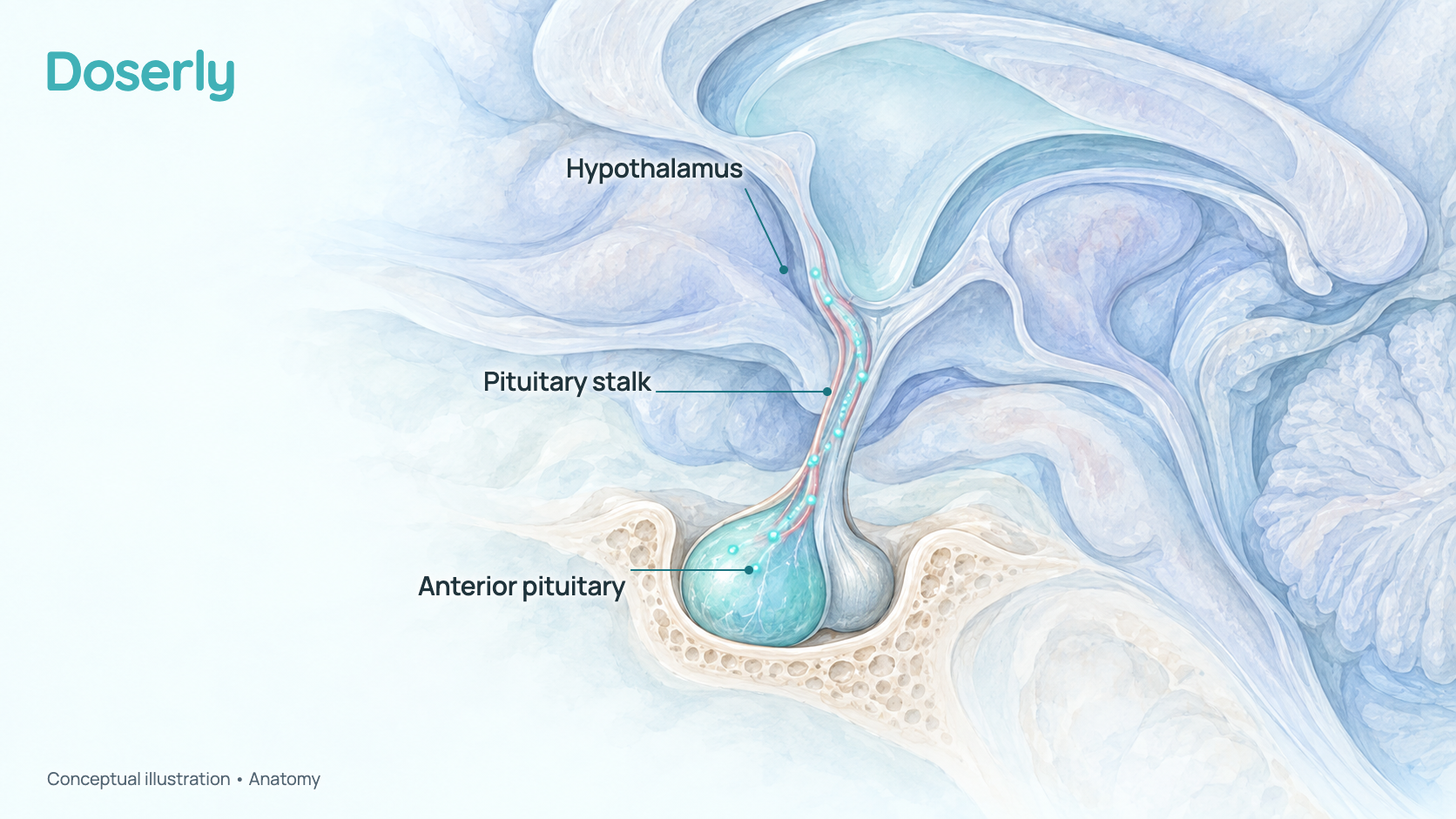
Growth-hormone-releasing hormone (GHRH) comes from the hypothalamus at the base of the brain and travels a very short distance to the pituitary gland. The natural hormone has 44 amino acids, but the first 29 are enough to switch on the pituitary's growth-hormone-making cells, which is why the fragment works. Sermorelin's chain matches the human sequence exactly, with a small chemical cap on its end. Because it makes the body release its own growth hormone, it is called a growth hormone secretagogue. [2], [4], [1]
Why was the approved version discontinued?
Geref was approved in the United States twice: in 1990 as a one-time intravenous test of whether the pituitary can release growth hormone, and in 1997 as a nightly injection for children with growth-hormone deficiency who were growing too slowly. The maker discontinued both in 2008, and FDA withdrew the approvals in 2009. [5], [6], [3]
In 2013, FDA formally determined that Geref was not withdrawn for reasons of safety or effectiveness. An FDA review later described the withdrawal as a business decision, because the active ingredient was no longer being manufactured. [3], [7]
That history explains the mix of sources you will find. The old label gives weight-based doses for children and a test dose, while today's sermorelin is compounded by pharmacies on prescription or sold as "research" vials, and adult protocols come from clinics and websites rather than from the label. FDA does not review compounded drugs for safety, effectiveness or quality before they are sold. [2], [8], [9], [10]
Typical Sermorelin Protocols
| Example | Amount each time | Frequency | Weekly total | Duration |
|---|---|---|---|---|
| Low (starting) | 100–200 mcg | Once nightly, 5 nights a week | 500–1,000 mcg | 3 months Its source starts at 100 mcg for two weeks, then moves to 200 mcg |
| Mid (most common) | 200–300 mcg | Once nightly, 5 nights a week | 1,000–1,500 mcg | 3–6 months |
| High | 300–500 mcg | Once nightly, 5–7 nights a week | 1,500–3,500 mcg | 4–6 months Its source describes this level for people several courses in, usually under a clinician's care |
Most reviewed sources give sermorelin as one subcutaneous injection at bedtime, somewhere in the range of 200–500 mcg, and the source of the table above puts most people at 200–300 mcg, 5 nights a week, for about 3–6 months. Across 27 current protocol pages that state an amount or range, the median low end was 200 mcg and the median high end 500 mcg. Of the 25 pages that say how often to take it, 13 give it every night, 6 give it on 5 nights and 6 allow either. [11], [10], [12], [13], [14], [15], [16]
- Titration Changing the amount in steps
- The usual approach starts at 100–200 mcg for the first 1–2 weeks and moves to 200–300 mcg once sleep and the injection site are settled. Some pages continue upward by about 100 mcg every 1–2 weeks to 300–500 mcg, and several clinics adjust the dose by an IGF-1 blood test at 6–8 weeks, up to 500–600 mcg. [11], [17], [18], [19], [20] In community education groups, members most often start at 200 mcg and some work up to 500 mcg over about 12 weeks; several cut back after side effects.
- Breaks and cycles
- About a quarter of the pages that give a frequency skip two nights a week (5 nights on, 2 off); the rest give it every night or allow either. Courses of 3–6 months are the most often described, sometimes followed by 1–3 months off. The stated reason is to keep the pituitary responsive, but no study has tested whether breaks are needed or helpful. [11], [21], [10], [22] Educators in community education groups give anything from 8 to 16 weeks on with 4–8 weeks off to continuous use, and some members report using it nightly for one to two years.
Read the units: these amounts are in micrograms. 1 mg equals 1,000 mcg, so 0.3 mg is 300 mcg. The amount each time and the weekly total are separate columns: 300 mcg on 5 nights is a 1,500 mcg weekly total. Compounded liquids come in different strengths, so the same number of syringe units can hold very different amounts; see how micrograms convert to syringe units.
Each row is a complete schedule as its source published it, and the rows are alternatives, not steps to move through. These schedules come from clinic and protocol websites, not clinical trials: the approved label dosed children by body weight, and the adult studies used larger amounts (see the next table). [11], [2], [10]
Cautions for every schedule above: allergic reactions can appear after weeks or months of trouble-free use and come back on restarting (see allergic reactions). The old label warned that the recommended dose "should not be exceeded", required thyroid tests before and during treatment, and was not tested in people whose growth-hormone problem came from a brain tumor or other lesion. Sermorelin is banned in sport at all times, and it has not been studied in pregnancy or in people with cancer. [2], [23]
What doses did the approved label and the studies use?
| Label or study | Amount each time | Frequency | Total per day | Duration |
|---|---|---|---|---|
| Geref label, children with growth-hormone deficiency (subcutaneous) | 30 mcg per kg (900 mcg for a 30 kg child) | Once daily at bedtime | 30 mcg per kg | Initial 6 months; continued while growth responded, stopped when the growth plates closed Only for children whose pituitary responded to a Geref test first [2] |
| Geref diagnostic test (intravenous) | 1 mcg per kg | Once, in the morning after an overnight fast | Not applicable | A single test with blood samples over 1–2 hours A test, not a treatment [24] |
| Older men, 1992 study (subcutaneous) | 0.5 mg or 1 mg | Twice daily | 1–2 mg | 14 days at each dose 10 healthy men averaging 68 years [25] |
| Older men, 1997 study (subcutaneous) | 2 mg | Once nightly | 2 mg | 6 weeks 11 men aged 64–76 with low IGF-1 [26] |
| Older men and women, placebo-controlled trials (subcutaneous) | About 1 mg (14 mcg per kg) | Once each evening | About 1 mg | 5–6 months University of Washington trials; results known mainly from the investigators' reviews [27], [28] |
The largest adult study doses were several times the typical website amount: about 1 mg every evening for months, and up to 2 mg a day for shorter periods. No study has tested the flat 200–500 mcg bedtime dose that most clinics and websites use, and the one page that claims an "FDA-era label" set adult doses of 0.2–0.3 mg a day is wrong: the only approved adult use was the one-time intravenous test. [27], [25], [26], [12], [29]
What are the usual sermorelin and ipamorelin blend amounts?
Many clinics and users pair sermorelin with ipamorelin, a peptide that releases growth hormone through a different receptor, either drawn into one syringe or sold premixed. One protocol source gives these combinations, with the amounts per peptide; compounding pharmacies have sold premixed vials such as 15 mg of ipamorelin with 9 or 18 mg of sermorelin. [30], [31]
| Combination | Amount each time | Frequency | Sermorelin per day | Duration |
|---|---|---|---|---|
| With ipamorelin | 200–300 mcg sermorelin + 200–300 mcg ipamorelin | 1–2 times daily | 200–600 mcg | Not stated |
| With GHRP-6 | 200–300 mcg sermorelin + 100–200 mcg GHRP-6 | 1–2 times daily | 200–600 mcg | Not stated |
No study has tested sermorelin with ipamorelin. In community education groups, typical pairings are 200–300 mcg of sermorelin with 100–200 mcg of ipamorelin at bedtime, often 5 nights a week. In a premixed blend, the dose on the syringe is the blend total: one forum member worked out that a "500 mcg" dose of a three-peptide blend held only 200 mcg of sermorelin. [32]
Where these numbers come from
The first table comes from reference [11], a dosing chart that lists beginner, intermediate and advanced tiers and says the tiers "track experience, not a ladder to climb". References [10], [12], [17], [21], [33], [13], [14], [34] and [35] cross-check the recurring 200–300 mcg bedtime amount and the 5-nights-a-week pattern, although more pages give it every night than on 5 nights. Across 27 current pages that state an amount or range, the lower bound ran from 100 to 300 mcg and the upper bound from 300 to 600 mcg. Many pages copy one another nearly word for word (for example, two clinic pages both give "0.2 ml" as 300 mcg, five nights a week), so matching pages are not counted as independent confirmation.
The label and study table comes from the historical US Geref label, the Irish Geref 50 summary of product characteristics and the original study reports. [2], [24], [25], [26], [27]
The blend table comes from reference [30], which gives no course length.
Not used for any row: an 8-week ladder of 200, 300, 400 and 500 mcg that one page no longer shows and others copy [22]; weight-based conversions of 1–5 mcg per kg a day, which mix up the intravenous test dose with injections for treatment [36], [37]; age-banded doses with no stated source [38]; and a 2013–2017 telehealth practice of starting at 1,000 mcg nightly, kept as history [39].
What is sermorelin commonly used for?
Most adults who look into sermorelin want better sleep, easier recovery from training, less body fat, more lean muscle or a general "anti-aging" effect, and they usually get it through telehealth clinics, compounding pharmacies or research vendors. Many are also taking testosterone, hormone therapy for menopause or a GLP-1 weight-loss medicine such as tirzepatide or semaglutide. [40], [41], [33]
The evidence behind those goals is thin. Sermorelin's approved uses were a pituitary test and growth treatment in children. In adults, what exists is a handful of small studies in older people that measured hormones, body composition and a few functional outcomes, plus personal accounts. A 2026 review concluded that its benefits in healthy people are uncertain because the human evidence is "limited and largely indirect". [2], [40]
Sleep
Better sleep is the benefit people report most, often within the first week or two. It is also where the studies disagree with the stories. In the one placebo-controlled trial of sermorelin that had sleep as an aim, about 1 mg every evening for months did not improve sleep quality in healthy older adults; the sermorelin group's sleep questionnaire scores got slightly worse. [27], [28], [42]
Laboratory studies that gave GHRH as quick injections into a vein at night did deepen sleep in young men under some conditions, but the effect was much weaker in older people, absent with a steady infusion and reversed in young women. Those studies do not say which form of GHRH they used, and none tested a bedtime injection of sermorelin. See what the sleep studies found and what people report.
Body fat, muscle and strength
In the placebo-controlled trials in older adults, sermorelin shifted body composition a little: body fat fell about 5% with a matching gain in lean mass, less so in women taking oral estrogen. Strength and aerobic fitness did not improve. A shorter study of 2 mg nightly for 6 weeks in older men found no change in body composition at all. [27], [28], [26]
No study has tested sermorelin for building muscle or losing fat in younger adults. People who report visible changes are nearly always also dieting, training, or taking testosterone or a GLP-1 medicine.
Recovery, joints and injuries
No study has measured recovery, joint pain or injury healing with sermorelin, in people or in animals. Some users on testosterone therapy credit it with easier recovery or less joint pain, while others notice nothing, and one clinic operator said it helped general recovery but not a rotator-cuff injury. [43], [44], [45]
Memory and thinking
The same placebo-controlled program reported small improvements on several thinking tests after 6 months in 89 healthy older adults. That is one study, reported alongside tests that did not change, and it has not been repeated with sermorelin. [46], [27]
Testing and treating growth-hormone problems
Doctors once used Geref to test the pituitary and to treat children with growth-hormone deficiency whose pituitary could still respond to it. Both uses ended with the product in 2008, and in the trials that compared them in children, growth hormone did better than sermorelin at its usual dose. See the children's studies. [47], [48], [49]
Other uses you may come across
Websites also claim benefits for skin, hair, bone density, immunity, libido and mood. None of these has been tested for sermorelin in people. One 2021 computer analysis of drugs for brain tumors named sermorelin, but it contains no treatment data and is not evidence of any effect against cancer. [50]
Where do sermorelin protocols differ?
Sources disagree about more than the amount: where a dose comes from, whether it is scaled to body weight, how often and when it is taken, how long a course runs, and what to combine it with.
Is the dose from the old label, a study or a clinic?
Check the source before copying a number. The label gives 30 mcg per kilogram for children and 1 mcg per kilogram for an intravenous test; the adult studies used 0.5–2 mg; and clinics and websites use a flat 100–500 mcg. These come from different people, goals and routes, and none of the adult website schedules was tested. [2], [24], [25], [26], [10]
Several pages get the research wrong. The most common error is to describe "the adult sermorelin trial" as a 1997 study of 19 older adults: that study used a modified version of GHRH with one amino acid swapped, not sermorelin. Another page says the 1997 study of 2 mg nightly raised IGF-1, when it did not, and one cites a "2018 trial of 500 mcg nightly" that we could not find in any database. [51], [52], [53], [54], [26]
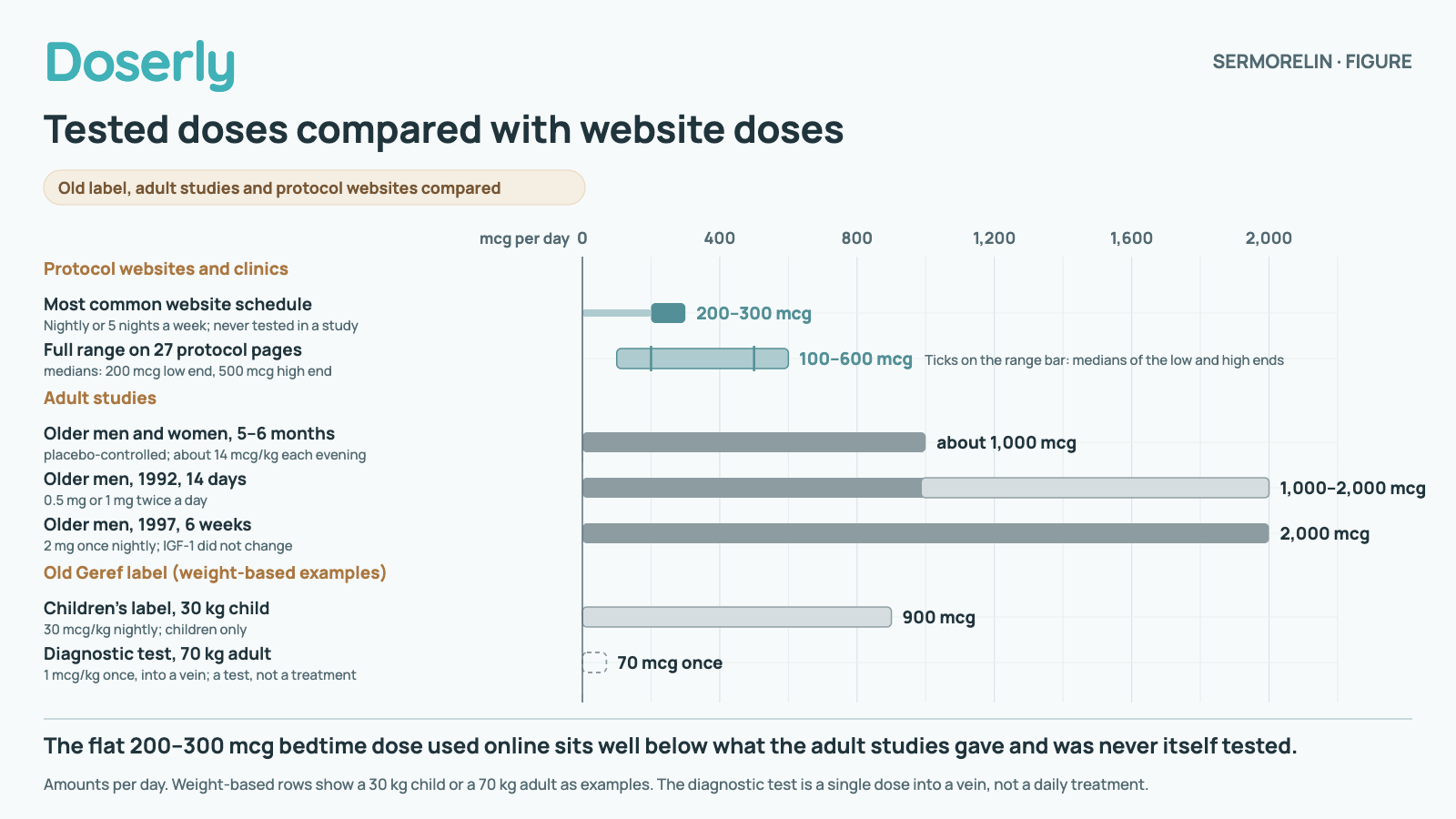
Tested doses compared with website doses
Bars share one scale from 0 to 2,200 mcg a day.
- Most common website schedule: 200–300 mcg
- Nightly or 5 nights a week; never tested in a study.
- Full range on 27 protocol pages: 100–600 mcg
- medians: 200 mcg low end, 500 mcg high end.
- Older men and women, 5–6 months: about 1,000 mcg
- placebo-controlled; about 14 mcg/kg each evening.
- Older men, 1992, 14 days: 1,000–2,000 mcg
- 0.5 mg or 1 mg twice a day.
- Older men, 1997, 6 weeks: 2,000 mcg
- 2 mg once nightly; IGF-1 did not change.
- Children's label, 30 kg child: 900 mcg
- 30 mcg/kg nightly; children only.
- Diagnostic test, 70 kg adult: 70 mcg once
- 1 mcg/kg once, into a vein; a test, not a treatment.
Amounts per day. Weight-based rows show a 30 kg child or a 70 kg adult as examples.
The flat 200–300 mcg bedtime dose used online sits well below what the adult studies gave and was never itself tested.
Flat dose or per kilogram?
The label and the University of Washington trials dosed by body weight, so a heavier person got more. Some websites try to bring this back with 1–5 mcg per kilogram a day, but that range comes from the one-time intravenous test dose, not from any treatment schedule. A subcutaneous injection delivers only about 6% as much drug to the blood as the same amount given into a vein, so the two cannot be swapped. [2], [27], [36], [37]
Every night, or 5 nights a week?
Both are common. The label gave it every night, and so do just over half of the websites that state a frequency; many clinics and protocol pages instead skip two nights a week, a pattern written as 5 on, 2 off, to "prevent desensitization". No study has compared the two, and the evidence on whether the pituitary gets used to sermorelin is mixed (see "Does the body get used to it?"). [2], [16], [11], [17]
Bedtime, morning or twice a day?
Most sources give one dose at bedtime, to line up with the body's largest growth-hormone release early in the night. The label also said bedtime, but no study has compared dosing times in adults, and in the placebo-controlled trial the evening dose produced one large growth-hormone burst without restoring the normal night-time pattern. [2], [27]
Some clinics prescribe it two or three times a day, and a compounding pharmacist told one user that some people feel wired rather than sleepy and take it in the morning. Users whose sleep got worse often moved it to the morning. [55], [56], [57], [58], [59]
Does it have to be taken on an empty stomach?
Most sources say to inject at least 1–2 hours after eating, and members of community education groups taking GLP-1 medicines, which slow digestion, often wait 3 hours or more. There is a reason behind the advice: in a lab test, a glucose drink lowered the growth-hormone peak after GHRH from 11.6 to 7.4 mcg/L. But a different study found that GHRH given 3.5 hours after glucose produced a larger peak, and no study has tested sermorelin injections with and without food. [11], [37], [60], [61]
Start low, or start high?
Most current sources start at 100–200 mcg and move up. Others do not: some telehealth clinics have prescribed 600–1,000 mcg from the first night, and a 2013–2017 telehealth practice started at 1,000 mcg nightly and reduced it over time. [11], [17], [62], [63], [39]
Personal accounts suggest that a lower start is easier to tolerate. One user prescribed 600 mcg found it too strong and cut back to 200 mcg; others describe sleeping worse, or waking after 4–5 hours, above about 200–300 mcg, and sleeping well again after lowering the dose. [64], [65], [66], [67]
How long is a course, and are breaks needed?
Sources most often describe 3–6 months on, some followed by 1–3 months off; some members of community education groups use it nightly for years. The case for breaks rests on short-term data. In children given a continuous subcutaneous infusion from a small pump, the growth-hormone response rose at first and then declined over 3–6 months, and in cells the receptor stops responding within hours of constant exposure. Nobody has tested nightly injections with and without breaks. [11], [21], [68], [69]
Is more always better?
No, and "you cannot overdose" is a myth. Some pages claim the brain's own brake on growth hormone makes an overdose "difficult if not impossible"; that comes from a two-page opinion article, not data. In children, higher continuous doses raised baseline growth hormone, and twice-daily injections raised fasting blood sugar and insulin. The label itself says the recommended dose "should not be exceeded". [70], [71], [72], [2]
At the other end, some pages say doses above 500 mcg add nothing. In the 1992 study, only the higher dose (1 mg twice daily) brought growth hormone and IGF-1 up to young-adult levels in older men, so the ceiling claim is not established either. [11], [37], [25]
Can it be combined with ipamorelin, GHRP-2 or GHRP-6?
People often do, on the reasoning that ipamorelin and the GHRPs act on a different receptor. In single intravenous tests, GHRH plus GHRP-6 released more growth hormone in healthy adults than the two added together, while the 29-amino-acid GHRH plus GHRP-2 simply added up. Neither study used ipamorelin or repeated injections, and no human study has tested sermorelin with ipamorelin. [73], [74], [31]
Combinations also make side effects harder to trace. Users describe flushing and sweating, pounding heartbeat on waking and hunger more often with blends than with sermorelin alone. [75], [76], [77] Read the Doserly guides to ipamorelin, GHRP-2 and GHRP-6.
Can it be combined with CJC-1295 or tesamorelin?
Educators in community education groups consistently advise against it, because CJC-1295 and tesamorelin act on the same GHRH receptor, so a second one adds exposure without a new mechanism. A few members do it anyway. No study has tested either combination. Read the Doserly guides to CJC-1295 and tesamorelin.
How do micrograms convert to syringe units?
A U-100 insulin syringe has 100 units per millilitre, so units measure volume, not an amount of peptide. How much sermorelin each unit holds depends on how much liquid is in the vial.
For example, a 9 mg vial mixed with 9 mL holds 1,000 mcg per mL, so each unit holds 10 mcg and a 300 mcg dose is 30 units. Pharmacy premixed liquids differ: at 0.9 mg per mL, 300 mcg is 33 units; at 2 mg per mL, 10 units is 200 mcg. The same "20 units" can therefore mean anywhere from 180 to 400 mcg. [11], [34], [39] Doserly's reconstitution calculator works this out for any vial and shows each step.
Mix-ups are common. Users describe prescriptions written only in millilitres or "IU" with no microgram amount, and one pharmacy's syringe instruction that doubled a prescribed 150 mcg dose. [78], [79], [80]
Source-by-source comparison
Which pages share the same numbers?
"200–500 mcg once nightly at bedtime" appears on most pages, including PeptideDosage.org, PeptideProbe, Sermorelin.com, Formblends, PeptidesExplorer and Eden. A lower band of 100–300 mcg appears on Peptide Initiative, Testing.com and Heally. [16], [10], [33], [36], [37], [13], [21], [81], [82]
A step-up schedule of 200, 300, 400 and 500 mcg over 8 weeks appears on RetaCalc and PeptideDosages.com; PeptiJournal and Peptide Dosing Protocols start at 100 mcg. Clinic pages from Advanced TRT Clinic and Helimeds adjust by IGF-1 tests every 6–8 weeks. [22], [18], [17], [12], [19], [38]
Pharmacy directions are the most specific: Olympia gives 300 mcg nightly from a 0.9 mg per mL liquid; Strive gives 0.15–0.3 mL of a 1 mg per mL liquid on 5 nights a week, or a 600 mcg troche, or a nasal spray up to 3 times a day. [34], [35]
Which pages cite research that does not support them?
PeptideDosage.org describes the 1997 older-men study as 1 mg nightly in 24 people for 12 weeks, with a rise in IGF-1; it was 2 mg nightly in 11 men for 6 weeks, and IGF-1 did not change. Peptide Dosing Protocols says an "FDA-era label" set adult doses at 0.2–0.3 mg a day; the only adult use was the intravenous test. TrimRx cites a "2018 trial" of 500 mcg nightly that we could not find. Standard Peptides lists the modified-GHRH study among sermorelin's studied doses, and TriScience describes it as a sermorelin trial. [16], [12], [54], [52], [53], [26], [51]
Which pages are more careful?
PeptideProbe says the adult clinic convention is not derived from the children's study. A 2026 review in a medical journal describes the 200–300 mcg nightly pattern as forum practice and says the benefits in healthy people are uncertain. [10], [40]
What happens when you stop sermorelin?
No study has followed adults after stopping sermorelin. The adult studies ended with the last dose, and none looked for withdrawal effects or a rebound. That is missing data, not proof that nothing happens. [26], [25], [27]
Related data give context, not proof:
- Children. After a year of twice-daily injections, growth slowed below its usual pace for about 3 months, then returned to the rate before treatment. In another group, growth rates 6 months after stopping matched those before treatment, although 6 of 21 children kept growing faster. Antibodies to the drug had nearly disappeared 9 months after stopping. [72], [83], [48]
- A related medicine. In healthy men given tesamorelin for 2 weeks, IGF-1 went back to its starting level within 2 weeks of stopping. [84]
Allergic reactions can come back when people restart after a break, sometimes months later. See allergic reactions.
Personal accounts go both ways. Some people notice no change in sleep after stopping, or keep sleeping well for months; others describe sleep getting "horrible" about two weeks into a break, feeling "smaller and looser" after a month off, or an old shoulder pain returning after about two months. One user relayed that his doctor's patients had come off it without issue, losing the benefit gradually rather than all at once. Some claims online, such as "sermorelin shuts down your own growth hormone", have no evidence behind them. [85], [65], [86], [87], [59], [88], [89]
Does sermorelin work the same as an injection, troche or nasal spray?
Only injections and a research nasal spray have been measured. The approved product was a subcutaneous injection for treatment and an intravenous injection for the pituitary test, and even by subcutaneous injection only about 6% of the dose reaches the blood. [2]
Other forms are sold anyway: compounding pharmacies list 600 mcg troches that dissolve against the cheek, nasal sprays and clinic-prescribed tablets that dissolve under the tongue, some combined with ipamorelin. [35], [90], [91]
- Nasal spray. In healthy men, only 3–5% of a nasal dose reached the blood compared with an injection into a vein. In children with growth-hormone deficiency, a nasal version caused nasal irritation and antibodies and did not increase growth after 6 months. [92], [93]
- Troches and under-the-tongue tablets. No study has measured how much sermorelin they deliver. Peptides are normally broken down in the gut, so a swallowed or dissolved dose cannot be assumed to match an injection. One user's IGF-1 rose from 152 to 182 on a 0.75 mg troche, another's fell on a troche, and a woman who switched from injections to a tablet after an allergic reaction noticed no benefit over 4 months. [94], [87], [95]
How long does sermorelin last in the body?
Minutes. The US label gives a half-life of 11–12 minutes after either an intravenous or a subcutaneous injection, and the Irish label 6–7 minutes after an intravenous dose. In a 1994 study of 10 men, sermorelin disappeared from the blood with a half-time of about 4 minutes. [2], [24], [96]
After a subcutaneous injection, blood levels peak within 5–20 minutes. After the intravenous test dose, growth hormone peaked at about 30 minutes and stayed raised for about 2–3 hours. Enzymes in the blood, mainly one called DPP-4, cut the chain almost immediately. When an anti-doping laboratory tested a healthy 59-year-old man after a 500 mcg injection of a compounded product, intact sermorelin was undetectable at 30, 90 and 270 minutes; only a shortened fragment was found, at 30 minutes. [2], [24], [97], [98]
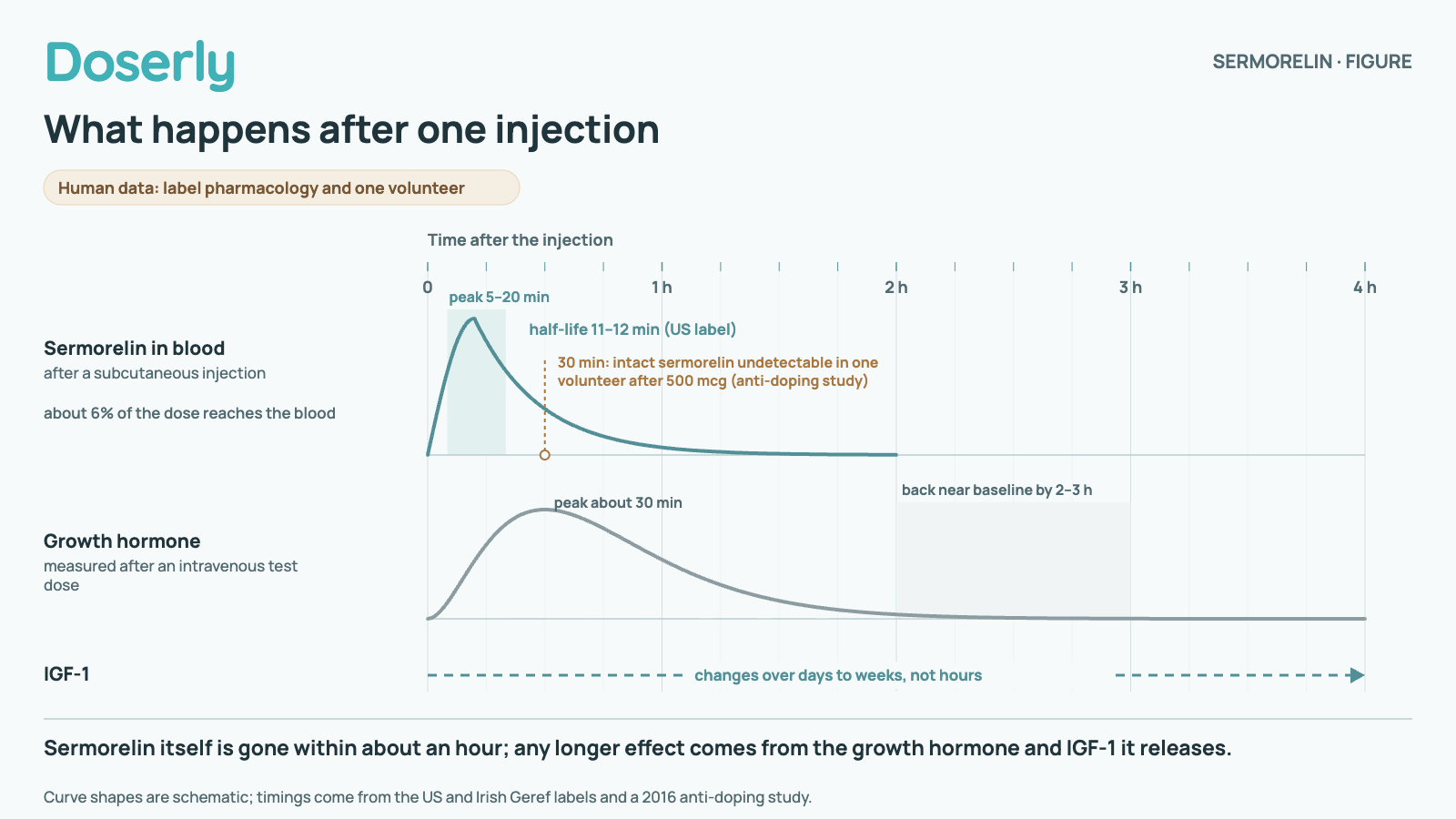
What happens after one injection
- Sermorelin in blood
- After a subcutaneous injection, levels peak within 5–20 minutes and halve about every 11–12 minutes (US label). Only about 6% of the dose reaches the blood. In one volunteer given 500 mcg, intact sermorelin was already undetectable at 30 minutes.
- Growth hormone
- After the intravenous test dose, growth hormone peaked at about 30 minutes and was back near baseline within 2–3 hours.
- IGF-1
- Changes over days to weeks of use, not hours.
Curve shapes are schematic; timings come from the US and Irish Geref labels and a 2016 anti-doping study.
Sermorelin itself is gone within about an hour; any longer effect comes from the growth hormone and IGF-1 it releases.
You may see "10–20 minutes" quoted online; the primary figures run from about 4 to 12 minutes, depending on how it was measured. A very short half-life is not the same as a short effect: what matters afterwards is the growth hormone and IGF-1 it releases. Some pages also claim a steady level builds up with regular dosing, but a drug that is gone within an hour does not accumulate between nightly doses. [2], [96], [24]
Is sermorelin acetate different from sermorelin?
No. Sermorelin acetate is the same peptide in its salt form, which makes a stable powder; Geref was sermorelin acetate. Some products add other ingredients: users describe a pharmacy mix with glycine, and blends with ipamorelin or GHRP-2 and GHRP-6. [2], [99], [100]
Does the injection site matter?
The label said only to rotate injection sites. No study has compared sites. Stinging is common with some products, and two users traced burning to the mixing water or to alcohol still wet on the skin rather than to sermorelin itself. [2], [101], [102]
How should sermorelin be stored, and how long does it last?
The approved product had clear rules; today's compounded and research products mostly do not, and no study has measured how long mixed sermorelin keeps its strength.
- Powder, before mixing. Geref vials were kept in the fridge at 2–8 °C, and the Irish test product was also kept away from light. FDA extended the shelf life of the unopened, refrigerated diagnostic powder from 12 to 24 months in 1991, based on the maker's stability data. [2], [24], [103]
- After mixing. Both labels said to mix the powder with sterile saline just before use, inject it immediately and throw away what is left, and the US label added not to use a cloudy solution or one with particles. In water, sermorelin breaks down at two points in its chain into much weaker fragments, and it is most stable in slightly acidic conditions; the label's solution was mildly acidic (pH 5.0–5.5). [2], [24], [104]
- Compounded and research products. Websites give anywhere from 10–14 days to 4–6 weeks in the fridge after reconstitution, and one clinic page says 72 hours at room temperature is fine; none cites stability data. Compounded products carry a beyond-use date set by general pharmacy rules rather than sermorelin-specific testing, and users describe dates that conflict: 28 days after mixing from one pharmacy, "45 days from the time of dispensing" for a premixed liquid from another. [16], [12], [11], [33], [13], [105], [106], [107]
Premixed liquids are often shipped without cold packs. One supplier's handling sheet claims its product kept its strength after 7 days at 40 °C (104 °F), from an unpublished internal test, while users describe warm deliveries after 4–5 days in transit with no answer from the prescriber. Cloudy or clumpy vials after mixing are also reported, and one user who mixed a new pharmacy's vial with too little liquid, leaving it milky, went to the emergency room with swelling of the lips and throat. [108], [109], [110], [111]
This guide does not cover mixing or injection technique; the Academy note below covers practical handling.
What do we actually know about sermorelin in people?
More than for most peptides sold online, but little of it answers the questions adults ask today. The human research is a pituitary test, growth trials in children, three small studies in older men, and one placebo-controlled program in older men and women whose main results were never published in full.
What did the children's studies find?
In the study behind the 1997 approval, 110 children with growth-hormone deficiency were given 30 mcg per kilogram every night. Of 56 who could be evaluated at 12 months, average growth went from 4.1 cm a year before treatment to 8.0 cm a year at 6 months and 7.2 cm a year at 12 months. The other 54 were not counted: 24 did not meet the entry criteria, 10 met the rules for stopping and 20 had not responded well enough by 6 months. The study had no comparison group. [2], [112]
- Longer use. In 16 children given one nightly injection for 12–24 months, 11 responded, growing about 6.5 cm a year throughout. [113]
- Against growth hormone. In a randomized study of 60 children, those on sermorelin grew 9.2–9.3 cm a year and those on growth hormone 14.6 cm a year. Another randomized study of 43 children found that only growth hormone improved height compared with bone age. Children who did not respond to Geref generally did well when switched to growth hormone. [48], [49], [114]
- What was never shown. The label says its effect beyond one year and on final adult height "remains to be determined", and the recommended dose was never compared directly with growth hormone at its recommended dose. [2], [4]
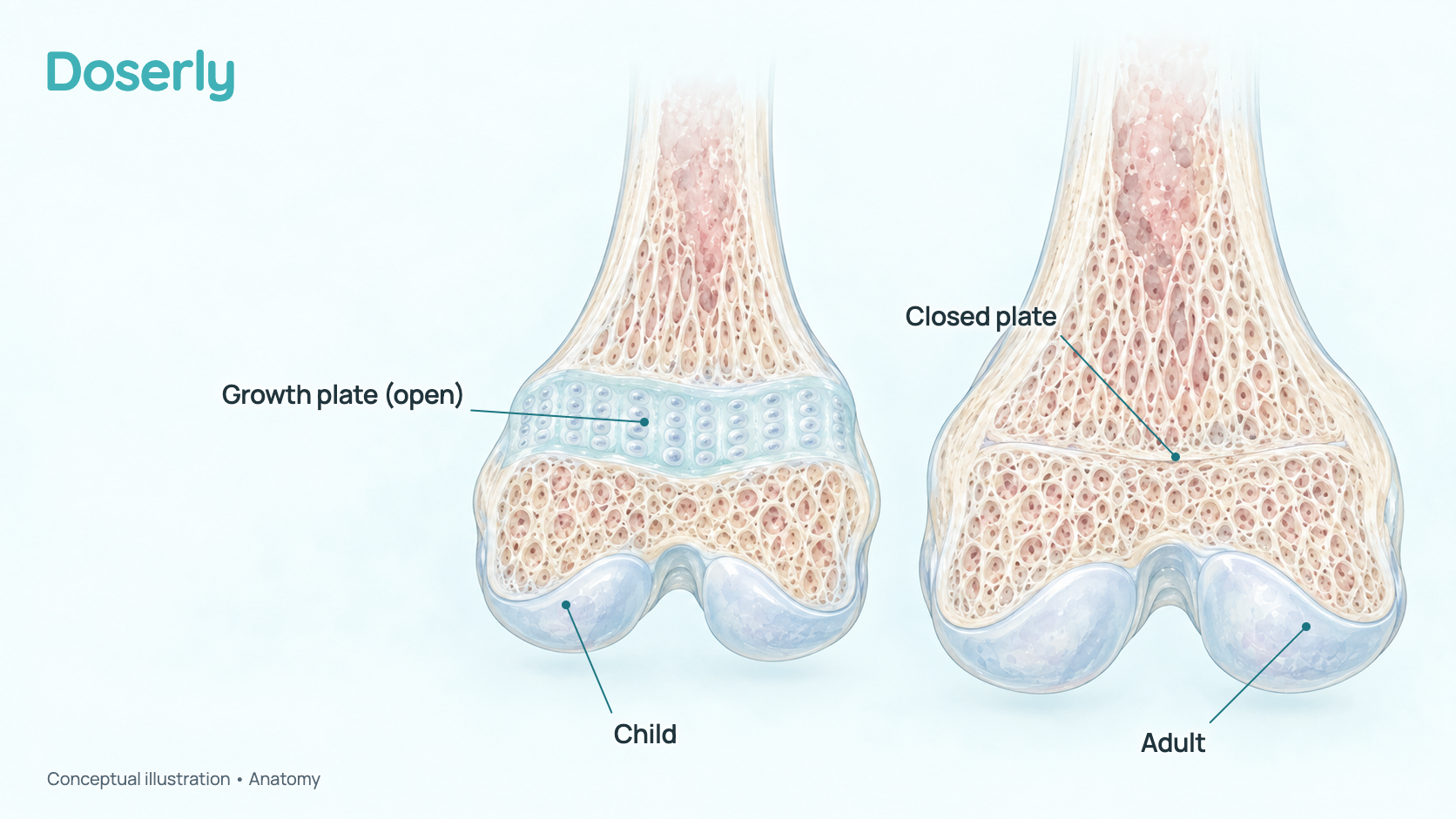
That is why sermorelin cannot make an adult taller: height gain happens at the growth plates, and the label said to stop treatment once they closed. [2]
What did the adult studies find?
| Study | What researchers reported | What it cannot establish |
|---|---|---|
| Older men, 1992 | 10 healthy men averaging 68 years took 0.5 mg and 1 mg twice daily for 14 days each, in random order. Only the higher dose raised 24-hour growth hormone and IGF-1 to the levels of young men. Blood sugar, blood pressure and routine blood tests did not change. | Any effect on body, function or sleep; anything beyond 2 weeks. [25] |
| Older men, 1997 | 11 men aged 64–76 with low IGF-1 injected 2 mg every night for 6 weeks. Night-time growth hormone rose, but IGF-1, body composition, weight, blood sugar, insulin and cholesterol did not change; 2 of 6 strength tests and 1 endurance test improved. The authors concluded one nightly dose works less well than several a day. | A fair comparison: there was no placebo group. [26] |
| Older men and women, University of Washington trials | Two NIH-funded, placebo-controlled trials gave about 1 mg (14 mcg per kg) every evening for 5–6 months. IGF-1 rose about 40% in men and 30% in women not taking estrogen, but under 10% in women taking oral estrogen. Body fat fell about 5% with a matching gain in lean mass. Strength and aerobic fitness did not improve, and sleep did not get better. | These results come mainly from the investigators' own reviews, with preliminary figures; only the thinking-test results were published as a full paper. [27], [28], [115] |
| Thinking tests, 2006 | 89 healthy older adults from the same program scored better on several thinking and problem-solving tests after 6 months than those on placebo. | Whether the change matters in daily life; it has not been repeated. [46] |
| Men on testosterone, 2017 | In a review of clinic records, 14 men on testosterone took sermorelin together with GHRP-2 and GHRP-6 (100 mcg of each, three times daily) for about 4 months; IGF-1 rose from 159.5 to 239.0 ng/mL. | What sermorelin did on its own; the paper did not report side effects. [116] |
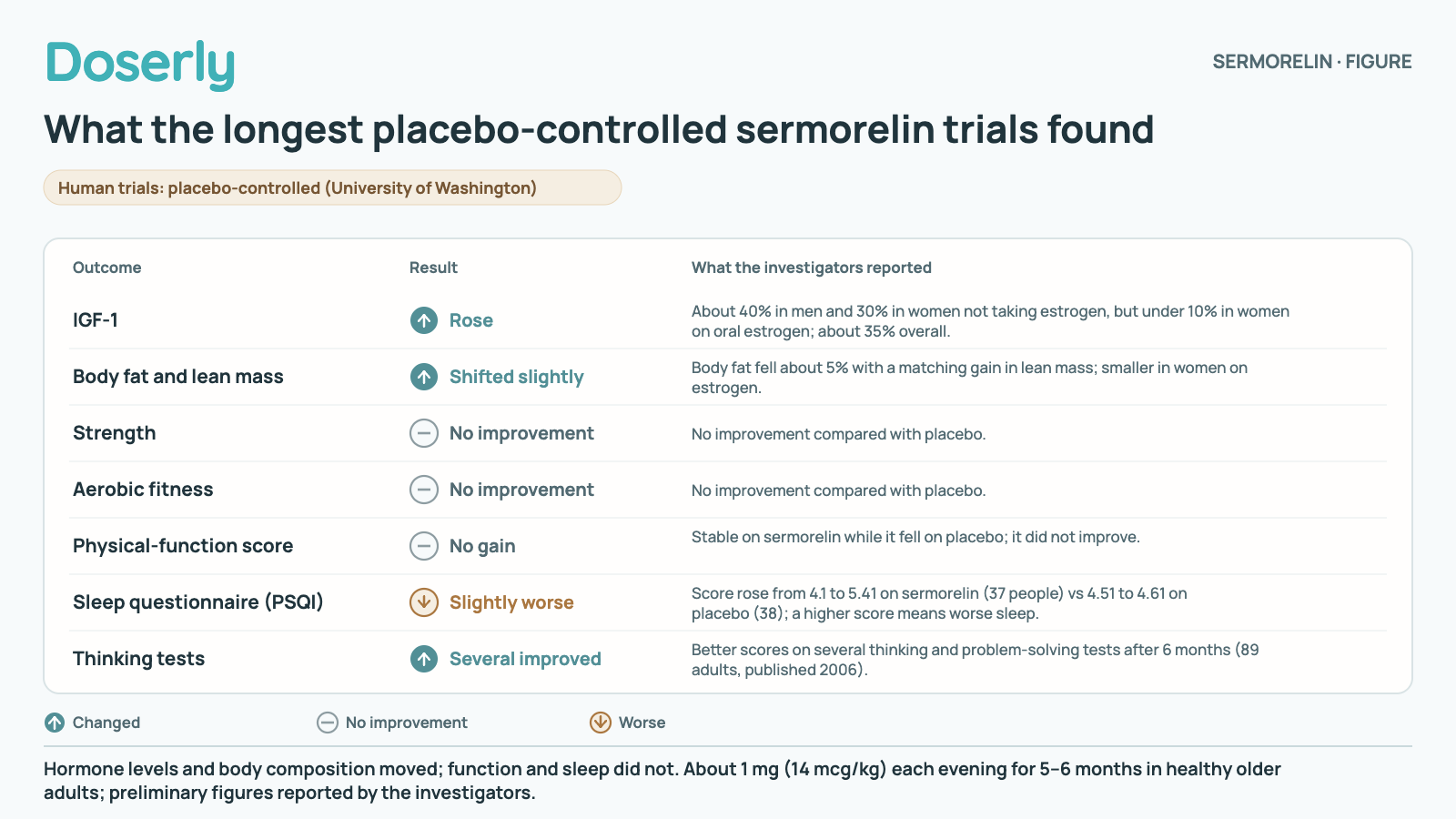
What the longest placebo-controlled sermorelin trials found
- IGF-1: rose
- About 40% in men and 30% in women not taking estrogen, but under 10% in women on oral estrogen; about 35% overall.
- Body fat and lean mass: shifted slightly
- Body fat fell about 5% with a matching gain in lean mass; smaller in women on estrogen.
- Strength: no improvement
- No improvement compared with placebo.
- Aerobic fitness: no improvement
- No improvement compared with placebo.
- Physical-function score: no gain
- Stable on sermorelin while it fell on placebo; it did not improve.
- Sleep questionnaire (PSQI): slightly worse
- Score rose from 4.1 to 5.41 on sermorelin (37 people) vs 4.51 to 4.61 on placebo (38); a higher score means worse sleep.
- Thinking tests: several improved
- Better scores on several thinking and problem-solving tests after 6 months (89 adults, published 2006).
About 1 mg (14 mcg/kg) each evening for 5–6 months in healthy older adults; preliminary figures reported by the investigators. Filled marker: changed; grey dash: no improvement; amber: worse.
Hormone levels and body composition moved; function and sleep did not.
Beyond single test doses, sermorelin has been given to healthy adults in only two small studies of older men and one placebo-controlled program in older men and women. No study has tested it in younger adults, in women on today's hormone therapy, or with the schedules clinics use. [25], [26], [46]
Which trials were registered?
No registered trial names sermorelin as its drug. The University of Washington sleep trial is registered under "GHRH"; its investigators and the NIH grant records identify the drug as Geref. Status checked September 24, 2026:
GHRH treatment for age-related sleep problems (University of Washington)
About 1 mg of sermorelin (Geref) or placebo each evening for 5 months in 40 older men and 40 older women taking estrogen. Sleep was the main aim; thinking tests and hormones were also measured.
Completed. No results posted. Only preliminary sleep questionnaire results were published, showing no improvement.
[42], [27], [115]A search of European, UK and Australian–New Zealand trial registries found no sermorelin trials. [117], [118]
Is the popular "adult sermorelin study" really about sermorelin?
No. The study most often quoted online, 19 adults aged 55–71 given 10 mcg per kilogram nightly for 16 weeks, used a modified GHRH with one amino acid swapped ([Nle27]GHRH(1-29)). It found higher growth hormone and IGF-1, thicker skin, and better lean mass and insulin sensitivity in men only, with sleep quality unaffected. Those results belong to that molecule, not to sermorelin. [51], [52]
What do the sleep studies show?
The sleep laboratory studies behind many sleep claims gave GHRH as quick injections into a vein during the night, and their summaries do not say whether they used the 29- or the 44-amino-acid form. Their results depend heavily on conditions:
- In young men, night-time injections increased deep (slow-wave) sleep in some studies, especially when given later in the night, but not in another study that gave GHRH before or at sleep onset; after sleep loss, injections reduced time awake. [119], [120], [121]
- The effect was much smaller in older people, even after 2 weeks of "priming" doses. [122], [123]
- A steady infusion, or a dose in the early morning, had no sleep effect. [124], [125]
- In young women, the same kind of injections made sleep worse. [126], [127]
- A 300 mcg nasal dose increased deep and dreaming sleep in the second half of the night in young and older men. [128]
None of these used a bedtime subcutaneous injection of sermorelin, and the one trial that did, in older adults, found no improvement. A 2003 review of the research on aging concluded that long-term treatment with short-acting GHRH did not improve sleep. [27], [129]
Does raising IGF-1 mean better health?
Not automatically. Growth hormone, an IGF-1 number, body composition, strength and how someone feels are different outcomes. In sermorelin's longest trials, IGF-1 and body composition changed while strength, fitness and sleep did not, and nothing is known about effects on heart disease, fractures or lifespan. [28], [129]
How does sermorelin work?
Growth hormone is released in bursts through the day and night, with the largest usually early in sleep. GHRH from the hypothalamus drives each burst, and a second hormone, somatostatin, acts as the brake between them. Growth hormone then prompts the liver and other tissues to make IGF-1. Sermorelin binds the same GHRH receptors on the pituitary's growth-hormone-making cells, so it pushes the "release" side of that system. [2], [130]
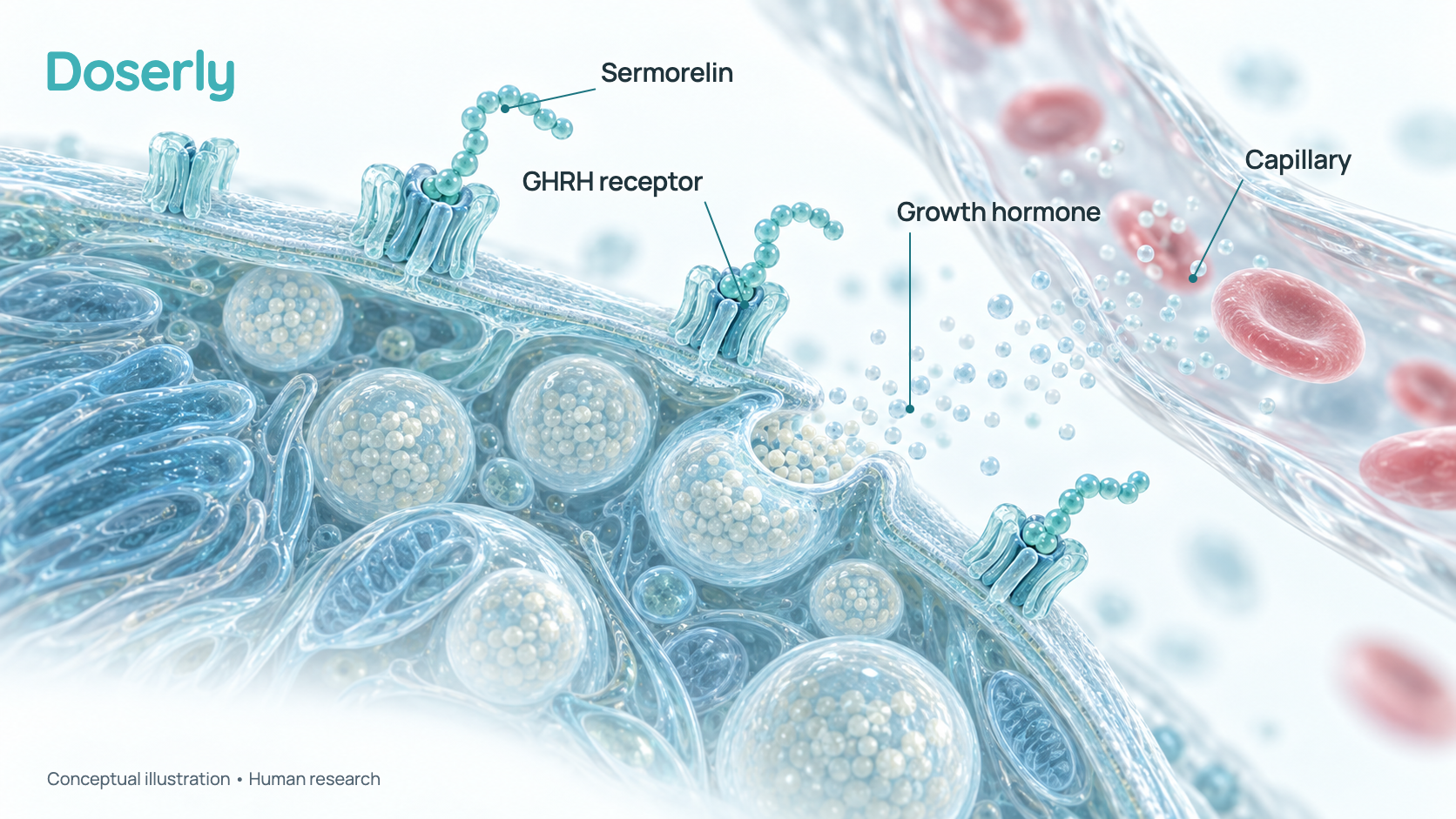
The effect is selective. In 5 healthy men, intravenous sermorelin raised growth hormone without changing prolactin, thyroid, reproductive or stress hormones, insulin or blood sugar. Larger doses mainly make the growth-hormone release last longer rather than peak higher. [131], [132], [133]
Why does it need a working pituitary?
Because sermorelin only asks the pituitary to release growth hormone, it does nothing if the pituitary cannot respond. The label excluded children whose pituitary did not respond to a Geref test, and the Irish label notes that obesity, high blood sugar, an underactive thyroid and somatostatin blunt the response. After radiation to the head, the response is weaker. [2], [24], [134]
Does the body get used to it?
The evidence points both ways. After a 10-hour drip of GHRH, 4 men released less growth hormone to a later test dose, and children on a continuous subcutaneous infusion showed a rise, then a decline over 3–6 months. In cells, the receptor stops responding within hours of constant exposure. [135], [68], [69]
On the other hand, children on one nightly injection kept growing faster for up to 2 years, and a continuous infusion of a related GHRH did not lose its effect over 8 days in men. No study has tested whether nightly adult use fades over months, or whether breaks restore it. Some users report weaker effects in their second course. [113], [136], [137]
Is sermorelin "natural", and does the body's brake keep it safe?
Sermorelin is synthetic, although its chain matches part of the human hormone. The body's brake, somatostatin, keeps working while it is used, but that does not cap the dose: higher exposure raised baseline growth hormone in children and twice-daily injections raised blood sugar and insulin. The claim that feedback makes overdose "impossible" is not supported. [2], [71], [72], [70]
What are the risks and unanswered questions?
Is sermorelin safe?
In short courses under medical supervision, it caused mostly mild problems, but its safety over months in adults has never been properly studied, and allergic reactions are a real risk. The children's trials and small adult studies found mostly injection-site reactions, while personal accounts and FDA reports describe allergic reactions that the trials did not capture. [2], [25], [26], [138]
What side effects did the label and studies report?
In children's trials, the most common side effect was an injection-site reaction (pain, swelling or redness) in about 1 in 6; 3 of 350 children stopped because of it. Headache, flushing, difficulty swallowing, dizziness, hyperactivity, sleepiness and hives each affected fewer than 1%. [2], [29]
- The intravenous test occasionally caused facial flushing, nausea, vomiting, a strange taste, paleness and chest tightness. [2], [24]
- Antibodies to the drug were common: in 39 of 40 children in one study and 6 of 11 at 12 months in another. They did not appear to affect growth and had nearly disappeared 9 months after stopping, and the label says no generalized allergic reactions were reported in its trials. [48], [113], [2]
- In older adults, the short studies found no significant side effects, and the investigators of the longer trials described leg swelling and joint pain as "very uncommon". [25], [26], [27]
Can sermorelin cause an allergic reaction?
Yes, and the pattern people describe is easy to miss. The label warns that local or whole-body allergic reactions may occur and that prompt medical attention is needed. FDA's adverse-event database holds 61 reports naming sermorelin through July 2026, 32 of them as a suspected cause; 15 of those 32 involve allergic or skin reactions, including 4 describing anaphylaxis (two may describe the same event) and a hospital stay for fainting with low blood pressure and flushing. These are unverified reports, not rates. [2], [138]
Public accounts describe a consistent course, usually after weeks or months without problems:
- Itchy injection sites first. Red, itchy welts that last days, often starting around weeks 4–12, sometimes after 5–12 months. [139], [140], [141]
- Then a fast, whole-body reaction within minutes of a dose: itchy or burning palms and soles, flushing, hives, a racing heart and, in some accounts, fainting or collapse. One person's heart rate went from 63 to 118. [142], [66], [143], [141]
- Old injection sites flare at the same time. [144], [139]
- It comes back on restarting, even after 3–6 months off or with a different seller's product, and lowering the dose did not stop it for some people. [66], [141], [140]
- It can spread to related peptides. Several people then reacted to CJC-1295, a modified GRF or ipamorelin. [145], [141], [66] In community education groups, members describe the same with tesamorelin, though some tolerated ipamorelin alone.
The most serious accounts include a physician-confirmed anaphylaxis with throat tightening and wheezing in someone who had reacted to CJC-1295 before, and an emergency visit for swelling of the lips, mouth and throat after an over-concentrated, milky vial. Two clinic or pharmacy staff members described the same sudden reactions in several patients, with product from at least three pharmacies. [146], [111], [141]
Why this happens is not known. In rat cells in a dish, sermorelin released histamine, the chemical behind hives and itching, and product impurities are another possible trigger. [147], [148] Hives, swelling of the lips, face, tongue or throat, wheezing, trouble breathing, vomiting or fainting after an injection need urgent medical care. The label of tesamorelin, an approved GHRH medicine, tells people with signs of an allergic reaction to stop it and get prompt medical attention. [149]
Can it cause flushing, a racing heart or chest symptoms?
Flushing affected fewer than 1% of children in trials but is reported far more often by adults, usually a warm face or head rush for 5–20 minutes after injecting; some notice none. More worrying accounts come mostly from blends. [2], [150], [151], [75]
In week 3 of 300 mcg of sermorelin plus 300 mcg of ipamorelin, one person had palpitations, an odd feeling in the chest and tingling in the left arm, with normal blood tests and heart tracing; the symptoms stopped after cutting to 150 mcg, and another user had the same experience. A first 200 mcg dose raised another person's heart rate enough to keep them awake. [59], [152] Chest pain or pressure, or a racing heart that does not settle, needs prompt medical assessment.
Does it cause hunger, water retention or joint pain?
The label lists none of these, and the older-adult trials called swelling and joint pain very uncommon. Labels for growth hormone itself list fluid retention, joint pain and nerve compression such as carpal tunnel syndrome. [2], [27], [153]
Personal accounts describe all three, often alongside other drugs. A prescriber on a forum said about three of his patients stopped because of uncomfortable hunger, and a user on low-dose tirzepatide described hunger "through the roof" on 400–600 mcg. Others describe water retention and sore hips, old sports injuries flaring with dizzy spells, and elbow and wrist pain on a sermorelin and GHRP-2 blend that lasted a month after stopping. FDA's ipamorelin review records elbow pain in a man using a compounded ipamorelin and sermorelin product. [154], [155], [156], [157], [158], [31]
Does sermorelin affect blood sugar?
Not in the short adult studies, which found no change in fasting blood sugar or insulin over 2–6 weeks. But in children with short stature, twice-daily injections for a year raised fasting blood sugar and insulin, and a longer-acting form of GHRH impaired glucose handling in older adults. Labels for growth hormone and tesamorelin require blood-sugar checks. [25], [26], [72], [159], [153], [149]
Can it affect the thyroid?
Possibly. During the children's trials, 6.5% developed an underactive thyroid (hypothyroidism): 8 of 110 children in the largest study were already on thyroid medicine and 5 more needed it after starting. Children with growth-hormone deficiency have a higher background risk, so the drug's role is uncertain, but the label required thyroid tests before and during treatment because an underactive thyroid blunts the response. [2]
What other effects do people report?
Single or occasional reports include acne, hair shedding, loss of taste, vivid dreams or hallucinations in the first nights, a feeling of "forgetting how to breathe" while falling asleep, running out of energy early on long fasted runs, and hours of severe abdominal cramping during an allergic reaction in a woman using hormone pellets. Causes are unclear, and some posters later doubted their own attribution. [160], [161], [162], [145], [163], [164], [165], [166], [139] In community education groups, two women on hormone therapy describe cramps after each dose of a sermorelin and ipamorelin blend.
Does sermorelin cause cancer?
Nobody knows. The label notes that no long-term animal studies for cancer (carcinogenicity) were done, and there are no long-term data in adults. Growth-hormone medicines carry warnings about tumors, and the labels of growth hormone and tesamorelin list active cancer as a reason not to use them. [2], [153], [149]
Could product quality change the risk?
Yes. In 2022 a compounding pharmacy recalled two lots of 9 mg sermorelin vials that were out of specification, and in 2024 FDA warned a seller offering "SERMORELIN" as a research product. A Belgian laboratory found chemical changes and widely varying amounts in illegally sold peptides including sermorelin, and falsified injectables seized in Europe in 2014 included it. A 2026 analysis of consumer lab reports found sermorelin had the lowest median measured amount of the 14 peptides tested, 97.45% of the label claim, and one of the highest rates of failing on both amount and purity; it is a preprint and has not been peer reviewed. [167], [168], [148], [169], [170]
Is sermorelin legal? Is it FDA-approved?
Checked September 24, 2026. Rules differ by country and change quickly.
United States. No approved sermorelin product is marketed.
- 1990 and 1997. FDA approved Geref for the pituitary test (December 1990) and for children with growth-hormone deficiency (September 1997). [5], [6], [171]
- 2008–2009. The maker discontinued both products in 2008; FDA withdrew approval effective June 18, 2009. [3]
- 2013. FDA determined the products were not withdrawn for safety or effectiveness reasons, which would allow a generic version; none is marketed. [3], [172]
- Compounding today. FDA's list of bulk substances nominated for outsourcing facilities places sermorelin acetate in the group under evaluation and marks it as a component of FDA-approved drugs, and federal rules let pharmacies compound components of approved drugs on prescription. Unlike CJC-1295 and ipamorelin, it is not on FDA's list of compounding substances that may present significant safety risks. Compounded drugs are still not FDA-approved or reviewed before sale. [8], [173], [174], [9]
- 2024. FDA warned a seller whose sermorelin was labelled "for research use only" that its products were unapproved new drugs intended for human use: a research-use label does not make a product legal to sell for people. [168]
Canada. Sermorelin is on Health Canada's Prescription Drug List, but no sermorelin product is authorized for sale, and Health Canada included it in a 2025 advisory about unauthorized injectable peptides seized from a seller. [175], [176], [177]
Australia. Sermorelin is a prescription-only medicine (Schedule 4), and no product is registered with the TGA. [178], [179]
Europe and the United Kingdom. Ireland authorized the Geref 50 test in 1991 and withdrew it in 2007. We found no current sermorelin product in the EU's central register or the UK's medicines database. [180], [179]
Is sermorelin banned in sport? Does it show up on a drug test?
Yes, it is banned. The World Anti-Doping Agency names sermorelin among growth-hormone-releasing factors prohibited at all times in its 2026 and 2027 lists, and USADA says a therapeutic use exemption is "highly unlikely" to be approved. Anti-doping laboratories can detect sermorelin and its breakdown fragment in blood and urine, although intact sermorelin cleared from one volunteer's blood within 30 minutes. [23], [181], [41], [98], [182]
Who should be especially cautious?
These groups have no safety data for sermorelin. That is a reason for caution, not proof of harm.
- Anyone who has reacted to a peptide injection before, especially to CJC-1295, ipamorelin or tesamorelin. [146], [141]
- Pregnancy and breastfeeding. The label rated it pregnancy category C after minor fetal changes in rats and rabbits, and it is not known whether it passes into breast milk. The Irish label said not to use it in pregnancy or breastfeeding. [2], [24]
- Cancer, diabetes or diabetic eye disease. There are no data, and related labels list active cancer as a reason not to use them and warn about blood sugar and diabetic eye disease. [153], [149]
- Thyroid disease, because of the label's thyroid findings. [2]
- A pituitary or brain tumor, or a growth-hormone problem caused by one: the label says such patients were not studied and should not be treated with it. [2]
- Epilepsy. The Irish label advised caution. [24]
- Under 18. The children's approval was for a diagnosed deficiency under specialist care; this guide is written for adults.
- Competitive athletes. It is banned at all times.
- People taking other medicines. See the next question.
Has sermorelin been tested alongside other medicines?
Only in the context of the label. It says steroid medicines such as prednisone (glucocorticoids) may blunt the response and that formal interaction studies were never done; the Irish label adds that somatostatin-type drugs, insulin, aspirin and similar pain relievers, some bladder and stomach medicines (antimuscarinics) and antithyroid drugs can distort the test result. It has not been tested with testosterone, GLP-1 medicines or other peptides, although most personal accounts combine it with at least one. Bring a complete list of everything you take to a pharmacist or doctor. [2], [24]
What should be monitored while using sermorelin?
There is no current monitoring plan for adults, because no approved sermorelin product exists today. What exists is what the old label required for children, what the adult studies measured, and what labels for related medicines ask for. It can help you prepare questions for a clinician; it is not a personal testing plan.
What did the approved label require?
- Thyroid tests before starting and throughout treatment, because an underactive thyroid developed in 6.5% of children and blunts the response. [2]
- Growth checks: height at least every 6 months and bone age from time to time, with a switch to growth hormone for children whose response was poor or fading. [2]
- Blood tests that may rise: phosphorus, alkaline phosphatase, growth hormone and IGF-1. [2]
What did the adult studies measure?
The 1992 study tracked 24-hour growth hormone, IGF-1, fasting blood sugar, blood pressure and routine blood tests; the 1997 study added a glucose tolerance test, cholesterol, a body-composition scan and strength tests; and the University of Washington trials measured IGF-1, body composition, strength, physical function, sleep and thinking tests. Blood sugar, blood pressure and routine tests did not change in the short studies. Children's studies also checked antibodies, blood sugar and, in one group treated after radiation, blood counts, cholesterol and thyroid function every 3 months. [25], [26], [27], [183]
What do labels for related medicines ask for?
These are class-based considerations from approved medicines that also raise growth hormone, not sermorelin findings.
- Tesamorelin, an approved GHRH medicine: check IGF-1 and consider stopping if it stays very high; check blood sugar before and during treatment, and the eyes of people with diabetes; watch for swelling, joint pain and allergic reactions. In its trials, 5% of patients developed blood sugar in the diabetes range (an HbA1c, a three-month average, of 6.5% or higher), compared with 1% on placebo. [149]
- Growth hormone itself (somatropin): periodic blood sugar and thyroid checks, an eye check for raised pressure in the skull before starting, and watching existing moles for changes. [153]
Which signals matter, and why?
| Why it matters | Where it comes from | Tracking category |
|---|---|---|
| Growth-hormone activity (IGF-1) | Sermorelin label and studies; tesamorelin label | Blood work |
| Thyroid function | Sermorelin label | Blood work |
| Blood sugar (glucose, HbA1c) | Children's studies; related labels | Blood work |
| Hives, itching, flushing and injection-site reactions | Sermorelin label; FDA reports; personal accounts | Side Effect Burden; Temperature Regulation |
| Heart rate and blood pressure | 1992 study (blood pressure); personal accounts | Heart Rate & Palpitations; Blood Pressure |
| Swelling, joint pain, hand numbness | Related labels; personal accounts | Fluid Retention; Joint Health |
| Sleep | The placebo-controlled trial; personal accounts | Sleep Quality |
| Hunger | Personal accounts only | Appetite & Satiety |
Every row comes from the label, the studies, FDA reports or related labels cited above, except hunger, which comes only from personal accounts. [2], [25], [27], [138], [149], [153]
A single IGF-1 result is hard to read without a starting value, and it can move for other reasons: oral estrogen blunted the rise in the placebo-controlled trials, and eating in a calorie deficit or other drugs can change it too. Some clinics adjust the dose by an IGF-1 test at 6–8 weeks. [27], [19] In community education groups, educators commonly advise testing IGF-1, fasting insulin and HbA1c before starting and again after 6–12 weeks, but few members report doing it. See what people report about IGF-1.
What do people in public communities report?
Most public accounts we reviewed come from adults who get sermorelin through a clinic or telehealth prescription or from research vendors, and almost all are also taking testosterone, menopause hormone therapy, a GLP-1 medicine, ipamorelin or other peptides. The accounts below cannot separate what sermorelin did from everything else.
What do the positive reports look like?
Better sleep is by far the most common. People describe deeper, unbroken sleep and vivid dreams, often within the first week: "some of the best nights of sleep I've ever had" in week one, dreaming by week one and restful sleep by month one on 200 mcg five nights a week, and "sleep is amazing" after 4 months at 200 mcg. One person with insomnia was able to halve a prescribed sleep medicine. [184], [185], [186], [187]
Other positive reports describe faster recovery from training (sore for about a day instead of 2–3), more energy and, over months, a slightly leaner build. The body changes almost always come with dieting, training, testosterone or a GLP-1 medicine; one person lost 18 lb over 4 months while their doctor also prescribed tirzepatide, and another said sermorelin helped their build but not their belly fat. [188], [189], [190], [191]
How long does it take, according to these accounts?
Sleep changes are usually described within the first nights to 2 weeks, while body changes are described over 2–6 months. One person said it took about 3 months to feel the full effect, and another person's doctor said two or three courses may be needed. [185], [65], [188], [192] In community education groups, educators say visible change, if any, comes at around 5–12 weeks.
Does everyone respond? What happens to IGF-1?
No. Nonresponse is common: "I haven't felt or noticed any change" after 4 months of 200 mcg; "4 months didn't do anything"; "My IGF numbers barely moved" after 3 months. [193], [194], [195]
IGF-1 results go both ways:
- Rises: 81 to 159 ng/mL after 4 months; from below the lab's range to mid-range after about 6 months; 152 to 182 on a troche. [196], [65], [94]
- Little or no rise: 108 to 138 after 4 months at 1,000 mcg nightly; 211 after 6 months at 500 mcg on testosterone. A 67-year-old concluded after 6 months at 1,000 mcg that it did not work for him, and his IGF-1 rose from 99 to 160 only after ipamorelin was added. [197], [198], [199]
- Falls: 154 to 134 after 9 months on testosterone despite feeling better; lower after 3 months at 1,000 mcg; 246 to 114 on sermorelin and ipamorelin during a long calorie deficit. [200], [201], [202]
Many of these numbers have no proper starting value, were taken at different times, or come from people eating in a deficit or changing hormone doses. A common path is to try sermorelin first and later move to CJC-1295 and ipamorelin, tesamorelin or growth hormone for a stronger effect; others prefer sermorelin because it causes fewer side effects. [87], [45], [203], [151]
Can it make sleep worse?
Yes, for some. Accounts describe deep and REM sleep on a wearable dropping from 1–2 hours to under 45 minutes each; great sleep for a month, then "the worst it's ever been" on injection nights from month two; being unable to sleep in, waking at about 5:30 every day; and months of waking every 2–3 hours, with one person nearly falling asleep while driving. [204], [205], [206], [207]
Others sleep deeply but wake groggy, feeling "drugged". One person's grogginess went away when a new vial of lower strength cut the dose at the same syringe mark, and several people who slept worse did better on a lower dose or a morning dose. [208], [209], [66], [58]
What unwanted effects come up?
Stinging, bruising or itching at the injection site is common, often early and sometimes settling within a couple of weeks. [187], [210], [102] The other effects people describe, including flushing, a racing heart, hunger, water retention, joint pain and delayed allergic reactions, are covered with the study data in the risks section; most of the more worrying accounts involve blends with ipamorelin or other peptides. [75], [59], [211], [212]
What about people on testosterone, menopause hormone therapy or GLP-1 medicines?
Many men on testosterone describe sermorelin as adding little: "negligible", or "okay, but it's expensive" after two years. Women on menopause hormone therapy describe better deep sleep over two 3-month rounds but no change in skin or muscle, or "amazing sleep" and more energy by 6 weeks. [77], [213], [214], [215]
People on GLP-1 medicines report both sides: one gained 7 lb in 3 weeks after adding it to semaglutide and slept worse in the first week, another found it fixed insomnia they had on tirzepatide. [216], [87] In community education groups, many of the detailed accounts come from middle-aged and older women taking a GLP-1 medicine, often with hormone therapy.
How can you judge a sermorelin story?
Useful questions to ask: What was the dose in micrograms, not just units or millilitres, and was it from a pharmacy or a research vial? Was ipamorelin or another peptide in the same syringe? What else started or changed: testosterone, estrogen, a GLP-1 medicine, diet or training? Was there an IGF-1 result from before, taken the same way? Did they post an update weeks later? Follow-ups often change the story, especially for sleep and for allergic reactions.
These selected discussions help identify questions and experiences that research should examine. They are not a survey of all users, a response rate or a substitute for controlled human studies.
How does sermorelin compare with CJC-1295, tesamorelin, ipamorelin and growth hormone?
CJC-1295 and tesamorelin are other lab-made versions of GHRH, ipamorelin is the peptide most often paired with sermorelin, and growth hormone is what all of them aim to raise.
| Compound | What it is | How it is given | Half-life | Human evidence | Approval and sport status |
|---|---|---|---|---|---|
| Sermorelin (this guide) | The first 29 amino acids of human GHRH, unchanged [2] | Subcutaneous, nightly | About 11–12 minutes [2] | Children's growth trials; small studies and one placebo-controlled program in older adults [112], [27] | US approvals in 1990 and 1997 (Geref), discontinued in 2008 for business reasons; compounded on prescription; banned in sport [3], [23] |
| CJC-1295 | The same 29 amino acids with four swapped; one version adds a hook that binds a blood protein [217] | Subcutaneous [218] | About 6–8 days with the hook; never measured without it [218], [217] | Short studies of the hooked version in healthy adults; none of the other version [218], [217] | Not approved; on FDA's list of compounding substances with significant safety risks (nomination withdrawn); banned in sport [174], [23] |
| Tesamorelin | A lab-made version of the full 44-amino-acid GHRH with an added chemical group [149] | Subcutaneous, daily [149] | About 8 minutes [219] | Placebo-controlled trials in adults with HIV [220] | FDA-approved to reduce excess abdominal fat in adults with HIV and lipodystrophy; banned in sport [149], [23] |
| Ipamorelin | Acts on the ghrelin receptor instead of the GHRH receptor [31] | Subcutaneous; often with sermorelin | About 2 hours [31] | Short dosing studies; no approved use [31] | Not approved; on FDA's list of compounding substances with significant safety risks; banned in sport [174], [23] |
| Growth hormone (somatropin) | The hormone itself, made by recombinant technology [153] | Subcutaneous, usually daily [153] | Not comparable: it is the hormone itself | Decades of trials; grew children faster than sermorelin at its usual dose [48], [49] | Prescription medicine for growth-hormone deficiency and other conditions; banned in sport [153], [23] |
The real differences are how long each lasts, how much is known and where it stands legally. Sermorelin and tesamorelin last minutes, ipamorelin about 2 hours and the hooked CJC-1295 about a week. Tesamorelin is the only one of the peptides approved today; sermorelin was approved in the past, and unlike CJC-1295 and ipamorelin it is not on FDA's list of compounding substances with significant safety risks. Growth hormone supplies the hormone directly and does not need a working pituitary. No study has compared sermorelin with the other peptides in adults, so the table cannot say which works better. See also the Doserly guides to MK-677, an oral drug that also raises growth hormone, and the CJC-1295 and ipamorelin blend.
Common questions about sermorelin
Is sermorelin FDA-approved?
Not today. FDA approved it as Geref for a pituitary test in 1990 and for children with growth-hormone deficiency in 1997, but the maker discontinued it in 2008 for business reasons and no approved product has been sold since. What clinics prescribe now is compounded by pharmacies, which FDA does not review before sale, and "research" vials are unapproved drugs. [3], [7], [9] See the dated legal-status summary.
How long does sermorelin take to work?
In the intravenous test, growth hormone peaked about 30 minutes after the dose, but how long it takes to feel or see anything is not known from studies. People usually describe sleep changes within the first nights to 2 weeks and body changes over months, and many notice nothing. In the placebo-controlled trials, IGF-1 and body composition had changed after 5–6 months, while sleep had not improved. [24], [27], [185] See what people report.
Is sermorelin the same as HGH? Is it a steroid?
Neither. Sermorelin is a peptide that prompts the pituitary to release the body's own growth hormone (HGH), so it only works if the pituitary can respond; growth hormone itself is a prescription medicine that supplies the hormone directly. Anabolic steroids are a different kind of molecule that act on hormone receptors. All three are banned in sport. [2], [23] See how it compares.
Can sermorelin make you taller?
Not in adults. Height grows at the growth plates near the ends of the long bones, which close after puberty. Geref was approved only for young children who had not reached puberty and whose growth was slowed by growth-hormone deficiency, and the label said to stop it once the growth plates closed. Even in those children, growth hormone worked better. [2], [48] See the children's studies.
Should sermorelin be taken with ipamorelin?
Many clinics and users pair them, on the reasoning that the two act on different receptors and release more growth hormone together. That reasoning comes from single intravenous tests of related peptides; sermorelin and ipamorelin together have never been tested, and a second peptide adds its own side effects and makes any reaction harder to trace. Several people who reacted to one later reacted to the other. [73], [74], [141] Read the ipamorelin guide.
Is sermorelin weaker than tesamorelin or CJC-1295?
Nobody has compared them in a study. Sermorelin lasts minutes and only about 6% of an injected dose reaches the blood, and in personal accounts many people describe it as the mildest option and later switch to tesamorelin or CJC-1295 with ipamorelin for a stronger effect; one person who used both could not tell it apart from tesamorelin, and others prefer it for its milder side effects. Mild does not mean safer: it carries its own risk of allergic reactions. [2], [87], [221], [151] See how they compare.
Can you take sermorelin with semaglutide or tirzepatide?
Many people do, often hoping to protect muscle while losing weight, and some doctors prescribe them together. The combination has never been studied. Accounts include weight gain and worse sleep after adding sermorelin to semaglutide, hunger on tirzepatide and, for others, better sleep. People taking GLP-1 medicines, which slow digestion, often wait longer after eating before a dose. [190], [216], [155], [87] See interactions.
Has sermorelin been studied in women?
Yes, in the University of Washington trials, which included older women taking and not taking estrogen. IGF-1 rose about 30% in women not taking estrogen but under 10% in those taking oral estrogen, and the body-composition change was smaller. In young women, night-time GHRH injections into a vein made sleep worse in a sleep laboratory study. There are no data on pregnancy or on today's menopause hormone therapy. [27], [126], [2]
Glossary
Plain explanations of the route, dosing and research terms used in this guide. Underlined terms in the text link here.
- Adverse event
- A harmful or unwanted medical event reported after someone used a treatment. A report alone does not prove the treatment caused it.
- Amino acid
- A small chemical building block. Chains of amino acids make up peptides and proteins.
- Anaphylaxis
- A severe, fast allergic reaction that can include hives, swelling of the face or throat, trouble breathing and a drop in blood pressure. It needs emergency care.
- Animal study
- Research in animals such as rats or monkeys. It shows what a substance does in a living body, but results in people can differ.
- Antibodies
- Proteins the immune system makes against something it sees as foreign. Children treated with sermorelin often made antibodies to it; in the trials these did not seem to affect growth.
- Beyond-use date
- The date after which a pharmacy-made (compounded) product should not be used. It is set by general pharmacy rules, not by testing of each drug.
- Bioavailability
- The share of a dose that reaches the bloodstream. After a subcutaneous injection, only about 6% of a sermorelin dose did.
- Blend
- A product that combines sermorelin with another peptide, such as ipamorelin. The blend's total amount is not its sermorelin amount.
- Carcinogenicity study
- A long-term animal study designed to detect whether a substance can cause cancer. None was done for sermorelin.
- Carpal tunnel syndrome
- Numbness, tingling or pain in the hand caused by pressure on a nerve at the wrist. Fluid retention can bring it on.
- Cell study (in vitro)
- Research on cells grown in a dish. It gives early clues about biology, but it is far from proof of benefit in people.
- Compounding
- When a pharmacy prepares a medicine from individual ingredients for a prescription. Compounded drugs are not FDA-approved or reviewed before sale.
- Controlled trial
- A study that compares people who receive a treatment with a similar group who do not, often receiving a placebo instead. Randomly assigning people to each group makes the comparison fairer.
- Course and cycle
- A course is the period of repeated use, such as 3 months. A cycle is a course plus a planned break before any further use.
- Daily total
- All the amounts given in one day, added together. For example, 0.5 mg twice daily is a 1 mg daily total.
- Dose (amount each time)
- The amount given on one occasion. A protocol lists both the dose and how often it is given.
- DPP-4
- Dipeptidyl peptidase-4, an enzyme in the blood that cuts the first two amino acids off sermorelin and helps explain why it lasts only minutes.
- Freeze-dried (lyophilized)
- Dried by freezing and removing the water, leaving a powder. Sermorelin is sold this way and mixed with liquid before injection.
- GHRH
- Growth-hormone-releasing hormone, the brain's own signal telling the pituitary to release growth hormone. Sermorelin copies its first 29 amino acids; CJC-1295 and tesamorelin are other lab-made versions.
- Growth hormone (GH)
- A hormone released in pulses by the pituitary gland. It affects growth, metabolism and body composition, and prompts the body to make IGF-1.
- Growth plate
- A band of cartilage near the end of a child's long bones where growth in height happens. The plates close after puberty, after which height cannot increase.
- Growth-hormone deficiency
- A condition in which the pituitary releases too little growth hormone. In children it slows growth; Geref was approved for children whose deficiency had no known cause and whose pituitary could still respond to it.
- Half-life
- The time it takes for the measured level of a substance in the blood to fall by half. It is not the same as how long an effect lasts.
- Hypersensitivity (allergic reaction)
- An immune reaction to a substance, from itching and hives at an injection site to a whole-body reaction. With sermorelin, reactions have been described after weeks or months of use.
- Hypothalamus
- A small region at the base of the brain that controls the pituitary gland, including by releasing GHRH and somatostatin.
- Hypothyroidism
- An underactive thyroid gland. It developed in 6.5% of children during sermorelin trials and can blunt the response to it.
- IGF-1
- Insulin-like growth factor 1, a hormone made mainly in response to growth hormone. A blood test for IGF-1 is the usual way to check growth-hormone activity.
- Intranasal
- Given as a spray into the nose. Only a small share of a nasal sermorelin dose reached the blood.
- Intravenous (IV)
- Injected into a vein. The approved sermorelin test was given this way.
- Ipamorelin
- A lab-made peptide that releases growth hormone through the ghrelin receptor, a different switch from the one sermorelin uses. It is often paired with sermorelin.
- Label (prescribing information)
- The official document approved with a medicine, giving its uses, doses, warnings and storage. Sermorelin's US label dates from its time as Geref.
- mcg and mg
- Micrograms and milligrams. 1 mg equals 1,000 mcg, so 0.3 mg is 300 mcg.
- mcg per kg
- Micrograms per kilogram of body weight. The children's label dosed this way: 30 mcg per kg is 900 mcg for a 30 kg child.
- Oral, troche and sublingual
- Taken by mouth. A troche dissolves against the cheek and a sublingual tablet under the tongue. No study has measured how much sermorelin these forms deliver.
- Peptide
- A short chain of amino acids. Sermorelin is a chain of 29.
- Pharmacokinetics
- How the body absorbs, moves, breaks down and removes a substance.
- Pituitary gland
- A pea-sized gland at the base of the brain that releases growth hormone and several other hormones.
- Placebo
- A dummy treatment with no active ingredient, used as a comparison in studies.
- Preclinical research
- Studies done before or alongside research in people: cell studies and animal studies.
- Reconstitution
- Mixing a freeze-dried powder with a liquid so it can be measured and injected. The amount of liquid sets how much peptide each unit holds.
- Research use only
- A label on products sold for laboratory research. It does not mean a product is approved, tested for human use or legal to sell as a medicine.
- Schedule 4 (Australia)
- Australia's prescription-only medicine category.
- Secretagogue
- A substance that makes a gland release a hormone. A growth hormone secretagogue makes the pituitary release growth hormone rather than supplying it.
- Slow-wave (deep) sleep
- The deepest stage of sleep, when the body's largest growth-hormone release usually happens.
- Somatostatin
- A hormone from the hypothalamus that acts as the brake on growth-hormone release between pulses.
- Stimulation test
- A test that gives a substance to see whether the pituitary can release growth hormone. Geref was approved as one.
- Subcutaneous (SC)
- Injected into the fatty layer just under the skin. The approved treatment and the adult studies used this route.
- Syringe units
- Markings on an insulin syringe that measure volume. On a U-100 syringe, 100 units equal 1 mL. The amount of drug per unit depends on the vial's concentration.
- Tesamorelin
- An FDA-approved, lab-made version of GHRH used to reduce excess abdominal fat in adults with HIV and lipodystrophy.
- Titration
- Adjusting a dose in steps, usually starting lower and increasing if needed.
- WADA
- The World Anti-Doping Agency, which publishes the list of substances banned in sport.
- Withdrawal and rebound
- Withdrawal effects are symptoms caused by stopping a substance. A rebound is a problem returning worse than before after stopping. Neither has been studied for sermorelin.
Explore more of the research
Go deeper into the laboratory and animal studies behind the claims. Sermorelin's preclinical record is small and mostly about how the body clears it; there is no tissue-repair or longevity research on sermorelin itself.
How the body handles sermorelin · 5 papers
How quickly do rats clear it, and by which routes?
Model: Anaesthetized rats given sermorelin into a vein or subcutaneously, and rats given it by nose or inhaled.
Finding: It cleared within minutes (elimination half-life about 10 minutes), and subcutaneous exposure was only about 4% of intravenous exposure; nasal doses also worked poorly, while inhaled doses worked better than subcutaneous ones. [222], [223], [224]
Limit: Rat data; the human label gives about 6% for subcutaneous injection.
Why was it redesigned into longer-lasting versions?
Finding: In rats, only about 2% of a subcutaneous dose was absorbed, compared with 20–50% for chemically stabilized versions. In human blood samples in the laboratory, the enzyme DPP-4 cuts the chain between its second and third amino acids, and trypsin-like enzymes cut it further along. [225], [97]
Limit: Laboratory and animal findings that explain the short half-life; they say nothing about benefit.
Clues to allergic reactions · 2 papers
Can sermorelin release histamine?
Model: Mast cells, the immune cells behind hives, taken from rats and exposed to sermorelin in a dish.
Finding: Sermorelin made the cells release histamine.
Limit: Rat cells in a dish; this has not been shown in people. [147]
Do animals form antibodies?
Model: African green monkeys given GHRH or a stabilized version for 6 months.
Finding: 1 of 6 animals in each group formed low levels of antibodies that did not block the hormone.
Limit: Monkeys and related molecules; in children, antibodies to sermorelin were far more common. [226], [48]
Stability in solution · 3 papers
Why does mixed sermorelin lose strength?
Finding: In water, the chain breaks down at two points: near its third amino acid (an aspartic acid) and at its eighth (an asparagine), which loses a chemical group. All the breakdown products are much weaker, and the peptide is most stable in slightly acidic solutions (pH 4–5). A related stabilized version lost its activity within 14 days at body temperature and neutral pH through the same kind of change, and a sulfur-containing amino acid near the end of the chain can also be damaged by oxygen. [104], [227], [228]
Limit: Laboratory chemistry at set conditions; there is no study of how long a mixed vial of sermorelin keeps its strength in a fridge.
Detection in sport · 4 papers
Can anti-doping laboratories find it?
Finding: Validated methods detect sermorelin and its main breakdown fragment in blood and urine, along with several related GHRH peptides. After a 500 mcg injection in one volunteer, intact sermorelin was not found in any blood sample, and its fragment was found only at 30 minutes. [98], [182], [229], [230]
Limit: Detection windows after real-world use have not been published.
How this guide was researched
This guide is built from a thorough review of the sources cited throughout it: published scientific studies, the historical approved label, registered clinical trials, regulatory documents and published protocol descriptions. We also reviewed public online forums and community education groups where people describe their own experiences with sermorelin.
The guide cites 230 sources, including 61 original scientific papers: 42 human studies, 10 cell, animal and computer studies and 9 laboratory and product-testing studies. Many of the human studies tested GHRH of an unstated form, related molecules or other peptides rather than sermorelin itself, and are labelled that way. We have not padded that count. Each type of source answers a different question. Studies show what researchers measured. Protocol descriptions show how sermorelin is typically used. Personal accounts show what individual people experienced. Every numbered citation links to its entry below, labeled by source type.
How this guide was made
Research and drafting were AI-assisted. Every cited source was checked against the original, and the guide was reviewed and edited by Doserly before publication. It has not had an independent clinical review, and Doserly does not currently have medical reviewers. Doserly makes a medication and health-tracking app and runs Doserly Academy, both of which are promoted in this guide. Read our editorial policy for how guides are researched, updated and corrected.
This guide is for educational purposes. It summarizes what the reviewed sources report so the research is easier to understand; it is not medical advice. For a deeper dive, or to check any point for yourself, go straight to the cited sources.
Explore the sources
These are the documents cited in this guide. Studies, labels, website advice and personal accounts answer different questions. A source being listed does not mean every statement on its page is endorsed.
Showing 230 sources
- 01
Sermorelin (PubChem CID 16132413) and FDA Global Substance Registration System record ↗
Chemical database
Database record checked on 24 Sep 2026.
- 02
Geref (sermorelin acetate for injection) prescribing information ↗
Label
Archived copy of the full label text reviewed.
Note: No official copy of the US Geref label survives on FDA's or DailyMed's websites. This guide quotes the label text as reproduced by RxList in 2007; that copy also contains one paragraph from the separate diagnostic product's label.
- 03
Determination That GEREF (Sermorelin Acetate) Injection ... Were Not Withdrawn From Sale for Reasons of Safety or Effectiveness (78 FR 14095, 2013-03-04) ↗
Regulatory source
Original document reviewed (full text).
- 04
Sermorelin: a review of its use in the diagnosis and treatment of children with idiopathic growth hormone deficiency ↗
Review
Original abstract reviewed.
- 05
Drugs@FDA: Geref (sermorelin acetate) 0.05 mg ampule, NDA 019863 ↗
Regulatory source
Database record checked on 24 Sep 2026.
- 06
Drugs@FDA: Geref (sermorelin acetate) 0.5 mg and 1 mg vials, NDA 020443 ↗
Regulatory source
Database record checked on 24 Sep 2026.
- 07
Macrilen (macimorelin) NDA 205598 medical review ↗
Regulatory source
Original document reviewed (full text).
- 08
FDA: Bulk Drug Substances Nominated for Use in Compounding Under Section 503B (Updated March 21, 2025) ↗
Regulatory source
Original document reviewed (full text).
- 09
- 10
Sermorelin Dosage Chart: Pre-Bed Subcutaneous Protocol & Cycle ↗
Dosing website
Original page reviewed on 24 Sep 2026; dose wording checked against the saved page.
- 11
Sermorelin Dosage Chart – Complete Dosing Guide ↗
Dosing website
Original page reviewed on 24 Sep 2026; dose wording checked against the saved page.
- 12
Sermorelin Peptide Dosing Guide: Nightly GHRH Schedule & Side Effects (2026) ↗
Dosing website
Original page reviewed on 24 Sep 2026; dose wording checked against the saved page.
Note: Wrongly says an "FDA-era label" set adult doses.
- 13
Sermorelin Dosage Chart & Dosing Calculator ↗
Clinic or telehealth page
Original page reviewed on 24 Sep 2026; dose wording checked against the saved page.
- 14
SERMORELIN/IPAMORELIN ↗
Clinic or telehealth page
Original page reviewed on 24 Sep 2026; dose wording checked against the saved page.
- 15
Sermorelin Dosage Calculator: How Often to Inject Sermorelin ↗
Clinic or telehealth page
Original page reviewed on 24 Sep 2026; dose wording checked against the saved page.
- 16
Sermorelin Dosage Chart, Schedule & Reconstitution Protocol ↗
Dosing website
Original page reviewed on 24 Sep 2026; dose wording checked against the saved page.
Note: Misdescribes the 1997 older-men study.
- 17
Sermorelin Research Protocol Reference ↗
Dosing website
Original page reviewed on 24 Sep 2026; dose wording checked against the saved page.
- 18
Sermorelin Dosage: 10 mg Vial | PeptideDosages ↗
Dosing website
Original page reviewed on 24 Sep 2026; dose wording checked against the saved page.
- 19
Sermorelin Therapy: Dosage, Results and What to Expect ↗
Clinic or telehealth page
Original page reviewed on 24 Sep 2026; dose wording checked against the saved page.
- 20
Sermorelin Dosage Guidelines: Complete Guide (Starting Dose, Titration & Optimization) ↗
Clinic or telehealth page
Original page reviewed on 24 Sep 2026; dose wording checked against the saved page.
- 21
Sermorelin Dosage, Safety & Stacks ↗
Dosing website
Original page reviewed on 24 Sep 2026; dose wording checked against the saved page.
- 22
Sermorelin dosage and protocol evidence ↗
Dosing website
Original page reviewed on 24 Sep 2026; dose wording checked against the saved page.
- 23
- 24
Geref 50 micrograms (sermorelin) summary of product characteristics ↗
Label
Original document reviewed (full text).
- 25
Growth hormone (GH)-releasing hormone-(1-29) twice daily reverses the decreased GH and insulin-like growth factor-I levels in old men ↗
Human study
Original abstract reviewed.
- 26
Effects of single nightly injections of growth hormone-releasing hormone (GHRH 1-29) in healthy elderly men ↗
Human study
Original abstract reviewed.
- 27
Treating age-related changes in somatotrophic hormones, sleep, and cognition ↗
Review by the trial investigators
Original full text reviewed.
Note: An investigator-written review that reports preliminary results of the University of Washington placebo-controlled sermorelin trials, including IGF-1, body composition and a sleep questionnaire.
- 28
Growth hormone (GH)-releasing hormone and GH secretagogues in normal aging: Fountain of Youth or Pool of Tantalus? ↗
Review by the trial investigators
Original full text reviewed.
- 29
Egrifta (tesamorelin) NDA 22-505 medical review, section on Geref ↗
Regulatory source
Original document reviewed (full text).
- 30
Sermorelin Clinical Profile | GHRH Research ↗
Vendor page
Original page reviewed on 24 Sep 2026; dose wording checked against the saved page.
- 31
Ipamorelin: FDA briefing for the Pharmacy Compounding Advisory Committee ↗
Regulatory source
Original document reviewed (full text).
- 32
Sermorelin, GHRP2 and GHRP6 : How does your Doc Prescribe? ↗
Community account
Public discussion reviewed; quoted words checked against the archived text.
- 33
Sermorelin Dosage: How Much to Take, When to Inject & What to Expect ↗
Clinic or telehealth page
Original page reviewed on 24 Sep 2026; dose wording checked against the saved page.
- 34
Sermorelin Dosage Chart ↗
Pharmacy page
Original page reviewed on 24 Sep 2026; dose wording checked against the saved page.
- 35
Sermorelin for Providers: Clinical Guide & Dosing Overview ↗
Pharmacy page
Original page reviewed on 24 Sep 2026; dose wording checked against the saved page.
- 36
Sermorelin Dosage Protocols: Standard Ranges, Timing, and Reconstitution ↗
Clinic or telehealth page
Original page reviewed on 24 Sep 2026; dose wording checked against the saved page.
- 37
Sermorelin Dosage Chart by Goal & Weight ↗
Dosing website
Original page reviewed on 24 Sep 2026; dose wording checked against the saved page.
- 38
Sermorelin Dosage Guide: Injection Protocols, Charts & Calculator ↗
Clinic or telehealth page
Original page reviewed on 24 Sep 2026; dose wording checked against the saved page.
- 39
Medication and Injection Instructions - Sermorelin ↗
Clinic or telehealth page
Archived page captures reviewed.
Note: Historical page (2014–2016 archive captures), not current practice.
- 40
- 41
What Should Athletes Know About Sermorelin? (USADA Spirit of Sport) ↗
Anti-doping agency guidance
Original document reviewed (full text).
- 42
GHRH Treatment for Age-Related Sleep Disturbances ↗
Study registry
Registry record checked on 24 Sep 2026.
- 43
TRT, BPC157 and healing ↗
Community account
Public discussion reviewed; quoted words checked against the archived text.
- 44
Steroids / Peptides for injury? ↗
Community account
Public discussion reviewed; quoted words checked against the archived text.
- 45
Sermorelin and muscle mass. ↗
Community account
Public discussion reviewed; quoted words checked against the archived text.
- 46
Growth hormone releasing hormone improves the cognition of healthy older adults ↗
Human study (sermorelin, per the investigators)
Original abstract reviewed.
- 47
- 48
A comparative study of growth hormone (GH) and GH-releasing hormone(1-29)-NH2 for stimulation of growth in children with GH deficiency ↗
Human study
Original abstract reviewed.
- 49
Growth response to growth hormone-releasing hormone(1-29)-NH2 compared with growth hormone ↗
Human study
Original abstract reviewed.
- 50
A potentially effective drug for patients with recurrent glioma: sermorelin ↗
Computer analysis
Original abstract reviewed.
- 51
Endocrine and metabolic effects of long-term administration of [Nle27]growth hormone-releasing hormone-(1-29)-NH2 in age-advanced men and women ↗
Human study (related molecule, not sermorelin)
Original abstract reviewed.
Note: Often cited online as a sermorelin study, but it used [Nle27]GHRH(1-29), a modified molecule.
- 52
Sermorelin dosing — the labelled doses and the commonly reported pattern ↗
Vendor page
Original page reviewed on 24 Sep 2026; dose wording checked against the saved page.
- 53
Sermorelin (GHRH 1-29, Geref) — Research Profile | Triscience ↗
Vendor page
Original page reviewed on 24 Sep 2026; dose wording checked against the saved page.
- 54
TrimRX | Sermorelin Cycle Length — What Science Actually Shows ↗
Clinic or telehealth page
Original page reviewed on 24 Sep 2026; dose wording checked against the saved page.
Note: Cites a "2018 trial" that we could not find in PubMed, Europe PMC or ClinicalTrials.gov.
- 55
My clinic wants me to do sermorelin .1 3 times a day, but I don’t see anyone here doing that. ↗
Community account
Public discussion reviewed; quoted words checked against the archived text.
- 56
Sermorelin twice a day? ↗
Community account
Public discussion reviewed; quoted words checked against the archived text.
- 57
Sermorelin Timing ↗
Community account
Public discussion reviewed; quoted words checked against the archived text.
- 58
MORNING VERSUS EVENING SERMORELIN DOSE ↗
Community account
Public discussion reviewed; quoted words checked against the archived text.
- 59
sermorelin/ipamorelin causing heart issues? ↗
Community account
Public discussion reviewed; quoted words checked against the archived text.
- 60
Arginine abolishes the inhibitory effect of glucose on the growth hormone response to growth hormone-releasing hormone in man ↗
Human study (GHRH, molecule not stated)
Original abstract reviewed.
- 61
Effect of oral glucose on the late growth hormone rise and growth hormone responses to GHRH in normal subjects ↗
Human study (GHRH, molecule not stated)
Original abstract reviewed.
- 62
1st dose of Sermorelin 600mcg - 5 days/wk ↗
Community account
Public discussion reviewed; quoted words checked against the archived text.
- 63
1000mcgs Sermorelin too much? ↗
Community account
Public discussion reviewed; quoted words checked against the archived text.
- 64
Sermorelin Order from LSH: Review/BUD & Dosing Issues ↗
Community account
Public discussion reviewed; quoted words checked against the archived text.
- 65
Sermorelin Experiences? ↗
Community account
Public discussion reviewed; quoted words checked against the archived text.
- 66
Sermorelin allergic reaction ↗
Community account
Public discussion reviewed; quoted words checked against the archived text.
- 67
Anyone here taking Sermorelin? ↗
Community account
Public discussion reviewed; quoted words checked against the archived text.
- 68
Growth hormone (GH) profiles in response to continuous subcutaneous infusion of GH-releasing hormone(1-29)-NH2 in children with GH deficiency ↗
Human study
Original abstract reviewed.
- 69
The growth hormone-releasing hormone receptor: desensitisation following short-term agonist exposure ↗
Cell study
Original abstract reviewed.
- 70
Sermorelin: a better approach to management of adult-onset growth hormone insufficiency? ↗
Opinion article
Original full text reviewed.
- 71
- 72
Treatment with GHRH(1-29)NH2 in children with idiopathic short stature induces a sustained increase in growth velocity ↗
Human study
Original abstract reviewed.
- 73
Growth hormone (GH) secretion in active acromegaly after the combined administration of GH-releasing hormone and GH-releasing peptide-6 ↗
Human study (GHRH with GHRP-6)
Original abstract reviewed.
- 74
GH responses to intravenous bolus infusions of GH releasing hormone and GH releasing peptide 2 separately and in combination in adult volunteers ↗
Human study (GHRH with GHRP-2)
Original abstract reviewed.
- 75
Does anyone else get severe hot flashes after Ipamorelin/Sermorelin dosing? ↗
Community account
Public discussion reviewed; quoted words checked against the archived text.
- 76
Sermorelin and ipamorelin sleep issues ↗
Community account
Public discussion reviewed; quoted words checked against the archived text.
- 77
Tell me your experience with Sermorelin while on TRT ↗
Community account
Public discussion reviewed; quoted words checked against the archived text.
- 78
Sermorelin double tap? ↗
Community account
Public discussion reviewed; quoted words checked against the archived text.
- 79
Bloodwork Round Two and Functional Doc's Plan ↗
Community account
Public discussion reviewed; quoted words checked against the archived text.
- 80
Sermorelin Dosage ↗
Community account
Public discussion reviewed; quoted words checked against the archived text.
- 81
Sermorelin: How It Works, Safety, and Access ↗
Dosing website
Original page reviewed on 24 Sep 2026; dose wording checked against the saved page.
- 82
Sermorelin Dosage Guide For Safe Treatment ↗
Clinic or telehealth page
Original page reviewed on 24 Sep 2026; dose wording checked against the saved page.
- 83
- 84
Effects of a growth hormone-releasing hormone analog on endogenous GH pulsatility and insulin sensitivity in healthy men ↗
Human study (tesamorelin)
Selected original full-text sections reviewed.
- 85
Sermorelin Results - 4 months ↗
Community account
Public discussion reviewed; quoted words checked against the archived text.
- 86
Sermorelin or Ipamorelin? ↗
Community account
Public discussion reviewed; quoted words checked against the archived text.
- 87
Tirz users on Sermorelin ↗
Community account
Public discussion reviewed; quoted words checked against the archived text.
- 88
Does Sermorelin Suppress GHRH, or Down-Regulate Any Receptors? ↗
Community account
Public discussion reviewed; quoted words checked against the archived text.
- 89
sermorelin and ipamorelin used together ↗
Community account
Public discussion reviewed; quoted words checked against the archived text.
- 90
Sermorelin Tablets? ↗
Community account
Public discussion reviewed; quoted words checked against the archived text.
- 91
23m sermorelin usage? ↗
Community account
Public discussion reviewed; quoted words checked against the archived text.
- 92
- 93
- 94
Bloodwork results after three-ish months on sermorelin oral troche 0.75mg (34M) ↗
Community account
Public discussion reviewed; quoted words checked against the archived text.
- 95
Sermorelin Troche? ↗
Community account
Public discussion reviewed; quoted words checked against the archived text.
- 96
Incorporation of D-Ala2 in growth hormone-releasing hormone-(1-29)-NH2 increases the half-life and decreases metabolic clearance in normal men ↗
Human study (sermorelin and a related molecule)
Original abstract reviewed.
- 97
Dipeptidylpeptidase IV and trypsin-like enzymatic degradation of human growth hormone-releasing hormone in plasma ↗
Cell study
Original abstract reviewed.
- 98
Qualitative identification of growth hormone-releasing hormones in human plasma by means of immunoaffinity purification and LC-HRMS/MS ↗
Anti-doping laboratory research
Original full text reviewed.
- 99
Sermorelin Dosage and Frequency ↗
Community account
Public discussion reviewed; quoted words checked against the archived text.
- 100
Sermorelin/Ghrp2&6 Blend ↗
Community account
Public discussion reviewed; quoted words checked against the archived text.
- 101
Sermorelin injection burns ↗
Community account
Public discussion reviewed; quoted words checked against the archived text.
- 102
Normal for sermorelin to burn? ↗
Community account
Public discussion reviewed; quoted words checked against the archived text.
- 103
FDA approval package NDA 19-863/S001: Geref (sermorelin acetate for injection), Serono Laboratories; approval letter 26 August 1991 and chemist review ↗
Regulatory source
Original document reviewed (full text).
- 104
Degradation of aspartic acid and asparagine residues in human growth hormone-releasing factor ↗
Laboratory chemistry study
Original abstract reviewed.
- 105
USP Compounding Standards: Beyond-Use Dates fact sheet ↗
Regulatory source
Original document reviewed (full text).
- 106
Sermorelin Expiration ↗
Community account
Public discussion reviewed; quoted words checked against the archived text.
- 107
Sermorelin Past BUD ↗
Community account
Public discussion reviewed; quoted words checked against the archived text.
- 108
warm sermorelin? ↗
Community account
Public discussion reviewed; quoted words checked against the archived text.
- 109
Received warm sermorelin shipment — safe to inject? ↗
Community account
Public discussion reviewed; quoted words checked against the archived text.
- 110
Sermorelin after reconstition ↗
Community account
Public discussion reviewed; quoted words checked against the archived text.
- 111
Sermorelin - Dosing, concentration, and how I ended up in the ER last night ↗
Community account
Public discussion reviewed; quoted words checked against the archived text.
- 112
- 113
- 114
Outcome of growth hormone therapy in children with growth hormone deficiency showing an inadequate response to growth hormone-releasing hormone ↗
Human study
Original abstract reviewed.
- 115
NIH RePORTER project records: growth factors, sleep and cognition (University of Washington) ↗
Grant records
Grant abstracts reviewed; they name the study drug as Geref.
- 116
Growth Hormone Secretagogue Treatment in Hypogonadal Men Raises Serum Insulin-Like Growth Factor-1 Levels ↗
Human study (peptide combination)
Original full text reviewed.
- 117
Trial registry searches for sermorelin and Geref (EU Clinical Trials Register, CTIS, ISRCTN, ANZCTR) ↗
Registry search
Database record checked on 24 Sep 2026.
- 118
ClinicalTrials.gov searches for sermorelin, Geref and GHRH 1-29 ↗
Registry search
Registry record checked on 24 Sep 2026.
- 119
Effects of growth hormone-releasing hormone and somatostatin on sleep EEG and nocturnal hormone secretion in male controls ↗
Human sleep study (GHRH, molecule not stated)
Original abstract reviewed.
- 120
Sleep-promoting effects of growth hormone-releasing hormone in normal men ↗
Human sleep study (GHRH, molecule not stated)
Original abstract reviewed.
- 121
The effect of GRF on the EEG sleep of normal males ↗
Human sleep study (GHRH, molecule not stated)
Original abstract reviewed.
- 122
Reduced efficacy of growth hormone-releasing hormone in modulating sleep endocrine activity in the elderly ↗
Human sleep study (GHRH, molecule not stated)
Original abstract reviewed.
- 123
Longtime administration of growth hormone-releasing hormone (GHRH) does not restore the reduced efficiency of GHRH on sleep endocrine activity in 2 old-aged subjects--a preliminary study ↗
Human sleep study (GHRH, molecule not stated)
Original abstract reviewed.
- 124
Greater efficacy of episodic than continuous growth hormone-releasing hormone (GHRH) administration in promoting slow-wave sleep (SWS) ↗
Human sleep study (GHRH, molecule not stated)
Original abstract reviewed.
- 125
Changes in sleep-endocrine activity after growth hormone-releasing hormone depend on time of administration ↗
Human sleep study (GHRH, molecule not stated)
Original abstract reviewed.
- 126
Systemic growth hormone-releasing hormone (GHRH) impairs sleep in healthy young women ↗
Human sleep study (GHRH, molecule not stated)
Original abstract reviewed.
- 127
Sexually dimorphic effects of GHRH on sleep-endocrine activity in patients with depression and normal controls - part I: the sleep eeg ↗
Human sleep study (GHRH, molecule not stated)
Original abstract reviewed.
- 128
Sleep and endocrine changes after intranasal administration of growth hormone-releasing hormone in young and aged humans ↗
Human sleep study (GHRH, molecule not stated)
Original abstract reviewed.
- 129
Growth hormone-releasing hormone and growth hormone secretagogues in normal aging ↗
Review
Original abstract reviewed.
- 130
Molecular cloning and expression of a human anterior pituitary receptor for growth hormone-releasing hormone ↗
Cell study
Original abstract reviewed.
- 131
Growth hormone responses to growth hormone-releasing hormone (1-29)-NH2 and a D-Ala2 analog in normal men ↗
Human study (sermorelin and a related molecule)
Original abstract reviewed.
- 132
Responses to analogues of growth hormone-releasing hormone in normal subjects, and in growth-hormone deficient children and young adults ↗
Human study (GHRH forms)
Original abstract reviewed.
- 133
Low-dose growth hormone-releasing hormone tests: a dose-response study ↗
Human study
Original abstract reviewed.
- 134
- 135
- 136
Continuous subcutaneous growth hormone releasing factor analogue augments growth hormone secretion in normal male subjects with no desensitization of the somatotroph ↗
Human study (related molecule)
Original abstract reviewed.
- 137
Sermorelin ↗
Community account
Public discussion reviewed; quoted words checked against the archived text.
- 138
FDA Adverse Event Reporting System: reports naming sermorelin (openFDA query) ↗
Adverse-event database
Database record checked on 24 Sep 2026.
Note: Spontaneous reports, mostly from consumers; duplicates are possible, causes are not confirmed and there is no denominator, so these are counts, not rates.
- 139
I Had a Severe Mast Cell Reaction to Sermorelin at Week 10 — Here’s What Happened (Perimenopausal Female, HRT + Peptide Stack) ↗
Community account
Public discussion reviewed; quoted words checked against the archived text.
- 140
Sermorelin for sleep ↗
Community account
Public discussion reviewed; quoted words checked against the archived text.
- 141
Question regarding allergic reaction after injecting Sermorelin ↗
Community account
Public discussion reviewed; quoted words checked against the archived text.
- 142
Sermorelin Reaction? ↗
Community account
Public discussion reviewed; quoted words checked against the archived text.
- 143
Sermorelin reaction. Thankfully Benadryl is helping but f*** this hurts. When someone says don't use this stuff don't use it. Knowing is half the battle GI Joooe. ↗
Community account
Public discussion reviewed; quoted words checked against the archived text.
- 144
Hives from Sermorelin ↗
Community account
Public discussion reviewed; quoted words checked against the archived text.
- 145
Was Sermorelin worth it? Share your experiences ↗
Community account
Public discussion reviewed; quoted words checked against the archived text.
- 146
Anaphylaxis from sermorelin ↗
Community account
Public discussion reviewed; quoted words checked against the archived text.
- 147
Histamine release on rat pleural and peritoneal mast cells elicited by human GRF(1-29)NH2 ↗
Cell study
Original abstract reviewed.
- 148
Impurity profiling of the most frequently encountered illicitly sourced peptides ↗
Product testing research
Original full text reviewed.
- 149
EGRIFTA WR (tesamorelin) for injection, prescribing information ↗
Label
Original document reviewed (full text).
- 150
Before and after sermorelin ↗
Community account
Public discussion reviewed; quoted words checked against the archived text.
- 151
Sermorelin, no face flush? ↗
Community account
Public discussion reviewed; quoted words checked against the archived text.
- 152
Started Sermorelin last night ↗
Community account
Public discussion reviewed; quoted words checked against the archived text.
- 153
- 154
Sermorelin for HRT? ↗
Community account
Public discussion reviewed; quoted words checked against the archived text.
- 155
Tirz and Sermorelin Hunger ↗
Community account
Public discussion reviewed; quoted words checked against the archived text.
- 156
Sermorelin and water retention ↗
Community account
Public discussion reviewed; quoted words checked against the archived text.
- 157
Sermorelin negative effects ↗
Community account
Public discussion reviewed; quoted words checked against the archived text.
- 158
Peptide Side Effects (Sermorelin/GHRP2) ↗
Community account
Public discussion reviewed; quoted words checked against the archived text.
- 159
Polyethylene glycol-conjugated growth hormone-releasing hormone is long acting and stimulates GH in healthy young and elderly subjects ↗
Human study (long-acting GHRH)
Original abstract reviewed.
- 160
Sermorelin and acne ↗
Community account
Public discussion reviewed; quoted words checked against the archived text.
- 161
Sermorelin causing acne ↗
Community account
Public discussion reviewed; quoted words checked against the archived text.
- 162
Hair falling out on sermorelin? ↗
Community account
Public discussion reviewed; quoted words checked against the archived text.
- 163
Sermorelin injection and taste loss ↗
Community account
Public discussion reviewed; quoted words checked against the archived text.
- 164
Sermorelin ↗
Community account
Public discussion reviewed; quoted words checked against the archived text.
- 165
Sermorelin unusual side effect? ↗
Community account
Public discussion reviewed; quoted words checked against the archived text.
- 166
Sermorelin and Running ↗
Community account
Public discussion reviewed; quoted words checked against the archived text.
- 167
Olympia Pharmacy voluntary nationwide recall of seven compounded products (out of specification) ↗
Regulatory source
Original document reviewed (full text).
- 168
FDA warning letter to Xcel Research LLC (694608) ↗
Regulatory source
Original document reviewed (full text).
- 169
Operation resistance: A snapshot of falsified antibiotics and biopharmaceutical injectables in Europe ↗
Product testing research
Original abstract reviewed.
- 170
Evaluation of Research Grade Peptides Marketed Directly to Consumers Reveals Extensive Variability in Purity and Measured Abundance ↗
Preprint (not peer reviewed)
Original full text reviewed.
Note: Not peer reviewed; based on a self-selected set of consumer and vendor lab reports.
- 171
FDA orphan drug designation and approval: sermorelin acetate (Geref) ↗
Regulatory source
Original document reviewed (full text).
- 172
FDA Orange Book: Geref (sermorelin acetate) product entries ↗
Regulatory source
Database record checked on 24 Sep 2026.
- 173
Bulk Drug Substances Used in Compounding Under Section 503A (content current as of 05/14/2026) ↗
Regulatory source
Original document reviewed (full text).
- 174
Certain Bulk Drug Substances for Use in Compounding that May Present Significant Safety Risks (content current as of 04/22/2026) ↗
Regulatory source
Original document reviewed (full text).
- 175
Health Canada Prescription Drug List (human use): sermorelin or its salts ↗
Regulatory source
Original document reviewed (full text).
- 176
Health Canada Drug Product Database: active ingredient sermorelin ↗
Regulatory source
Database record checked on 24 Sep 2026.
- 177
Unauthorized injectable peptide drugs seized and sold by Canada Peptide may pose serious health risks ↗
Regulatory source
Original document reviewed (full text).
- 178
Standard for the Uniform Scheduling of Medicines and Poisons (Poisons Standard June 2026) ↗
Regulatory source
Original document reviewed (full text).
- 179
Regulator product searches for sermorelin and Geref (TGA ARTG, EMA, EC Union Register, MHRA) ↗
Regulatory source
Database record checked on 24 Sep 2026.
- 180
HPRA withdrawn human medicines list: Geref 50 ↗
Regulatory source
Database record checked on 24 Sep 2026.
- 181
WADA 2027 Prohibited List (published 26 Aug 2026) ↗
Anti-doping rule
Original document reviewed (full text).
- 182
Analysis of growth hormone releasing hormone and its analogs in urine using nano liquid chromatography coupled with quadrupole/orbitrap mass spectrometry ↗
Anti-doping laboratory research
Original abstract reviewed.
- 183
Treatment of radiation-induced growth hormone deficiency with growth hormone-releasing hormone ↗
Human study
Original abstract reviewed.
- 184
Sermorelin Sleep ↗
Community account
Public discussion reviewed; quoted words checked against the archived text.
- 185
Sermorelin, when do the sleep benefits begin? ↗
Community account
Public discussion reviewed; quoted words checked against the archived text.
- 186
Sermorelin ↗
Community account
Public discussion reviewed; quoted words checked against the archived text.
- 187
Happy with Sermorelin ↗
Community account
Public discussion reviewed; quoted words checked against the archived text.
- 188
Experience with sermorelin? ↗
Community account
Public discussion reviewed; quoted words checked against the archived text.
- 189
Starting Sermorelin ↗
Community account
Public discussion reviewed; quoted words checked against the archived text.
- 190
Mounjaro + Sermorelin together? ↗
Community account
Public discussion reviewed; quoted words checked against the archived text.
- 191
I’ve been taking sermorelin now for three months and have noticed improvement in my body composition, I decided to switch to tesamorelin ↗
Community account
Public discussion reviewed; quoted words checked against the archived text.
- 192
Wondering if sermorelin is for me ↗
Community account
Public discussion reviewed; quoted words checked against the archived text.
- 193
Does sermorelin actually do anything? ↗
Community account
Public discussion reviewed; quoted words checked against the archived text.
- 194
Should I add Sermorelin? ↗
Community account
Public discussion reviewed; quoted words checked against the archived text.
- 195
Advice Changing from GH to Sermorelin? ↗
Community account
Public discussion reviewed; quoted words checked against the archived text.
- 196
Post Sermorelin ↗
Community account
Public discussion reviewed; quoted words checked against the archived text.
- 197
Sermorelin -What's Your Experience? ↗
Community account
Public discussion reviewed; quoted words checked against the archived text.
- 198
Anyone Taking Sermorelin and Test? ↗
Community account
Public discussion reviewed; quoted words checked against the archived text.
- 199
Benefits of Estrogen for TRT Patients ↗
Community account
Public discussion reviewed; quoted words checked against the archived text.
- 200
Sermorelin Question ↗
Community account
Public discussion reviewed; quoted words checked against the archived text.
- 201
Starting 350 mcg Sermorelin for 4 days a week for 12 weeks. ↗
Community account
Public discussion reviewed; quoted words checked against the archived text.
- 202
IGF has crashed while taking Sermorelin ↗
Community account
Public discussion reviewed; quoted words checked against the archived text.
- 203
IGF-1 Cruising and Blasting ↗
Community account
Public discussion reviewed; quoted words checked against the archived text.
- 204
Sleep is worse on sermorelin ↗
Community account
Public discussion reviewed; quoted words checked against the archived text.
- 205
Sermorelin made me sleep worse and NAD+ was a bust! ↗
Community account
Public discussion reviewed; quoted words checked against the archived text.
- 206
Sermorelin vs ipamoralin experiences ↗
Community account
Public discussion reviewed; quoted words checked against the archived text.
- 207
Can not sleep on sermorelin help! ↗
Community account
Public discussion reviewed; quoted words checked against the archived text.
- 208
Sermorelin timing? ↗
Community account
Public discussion reviewed; quoted words checked against the archived text.
- 209
Sermorelin and shitty sleep ↗
Community account
Public discussion reviewed; quoted words checked against the archived text.
- 210
TRT, HCG, Sermorelin users.. share your thoughts. ↗
Community account
Public discussion reviewed; quoted words checked against the archived text.
- 211
Sermorelin - help I'm so hungry ↗
Community account
Public discussion reviewed; quoted words checked against the archived text.
- 212
Sermorelin, GHRP-6, GHRP-2 9mg Blend -Crazy Water Retention ↗
Community account
Public discussion reviewed; quoted words checked against the archived text.
- 213
Sermorelin + TRT ↗
Community account
Public discussion reviewed; quoted words checked against the archived text.
- 214
Thinking about trying Sermorelin ↗
Community account
Public discussion reviewed; quoted words checked against the archived text.
- 215
Sermorelin or testosterone? ↗
Community account
Public discussion reviewed; quoted words checked against the archived text.
- 216
Sermorelin weight gain? ↗
Community account
Public discussion reviewed; quoted words checked against the archived text.
- 217
CJC-1295-related bulk drug substances: FDA briefing for the Pharmacy Compounding Advisory Committee ↗
Regulatory source
Original document reviewed (full text).
- 218
Prolonged stimulation of growth hormone (GH) and insulin-like growth factor I secretion by CJC-1295, a long-acting analog of GH-releasing hormone, in healthy adults ↗
Human study (CJC-1295)
Original full text reviewed.
- 219
EGRIFTA SV (tesamorelin) for injection, prescribing information ↗
Label
Original document reviewed (full text).
- 220
Effects of tesamorelin (TH9507), a growth hormone-releasing factor analog, in human immunodeficiency virus-infected patients with excess abdominal fat: a pooled analysis of two multicenter, double-blind placebo-controlled phase 3 trials with safety extension data ↗
Human study (tesamorelin)
Original abstract reviewed.
- 221
What are the reasons to choose Tesamorelin over Sermorelin? ↗
Community account
Public discussion reviewed; quoted words checked against the archived text.
- 222
Growth hormone-releasing factor analogue (hGRF1-29NH2): immunoreactive-GRF plasma levels after intravenous and subcutaneous administration ↗
Animal study
Original abstract reviewed.
- 223
- 224
- 225
An evaluation of intravenous, subcutaneous, and in vitro activity of new agmatine analogs of growth hormone-releasing hormone hGH-RH (1-29)NH2 ↗
Animal study
Original abstract reviewed.
- 226
Effect of human growth hormone-releasing factor and a potent analog on antibody formation in African green monkeys ↗
Animal study
Original abstract reviewed.
- 227
Degradation of growth hormone releasing factor analogs in neutral aqueous solution is related to deamidation of asparagine residues. Replacement of asparagine residues by serine stabilizes ↗
Laboratory chemistry study
Original abstract reviewed.
- 228
Enhanced stability and potency of novel growth hormone-releasing factor (GRF) analogues derived from rodent and human GRF sequences ↗
Laboratory chemistry study
Original abstract reviewed.
- 229
Immunoaffinity purification of peptide hormones prior to liquid chromatography-mass spectrometry in doping controls ↗
Anti-doping laboratory research
Original abstract reviewed.
- 230
Advances in the detection of growth hormone releasing hormone synthetic analogs ↗
Anti-doping laboratory research
Original full text reviewed.
No matching sources
Try a different term or show the full list.
Updates and corrections
Updated September 26, 2026. This is a full rewrite of the sermorelin guide. It adds typical protocols alongside the old label and study doses, the University of Washington placebo-controlled trials, what the sleep research does and does not show, delayed allergic reactions, storage, monitoring, what happens when people stop, a comparison with related peptides, and a dated legal-status summary for the United States, Canada, Australia and Europe. It also checks every claim from the earlier version of this page: points that held up are kept, and several are corrected, including the approval dates, the half-life, which studies used sermorelin and the claim that no sermorelin sleep trial exists. The date describes this revision, not a fresh check of every source.
Found an error or a relevant study we missed? Report a correction with the guide title, the specific passage and a supporting source if available. Please leave out personal health records. See our editorial policy for how we handle attribution, evidence limits and corrections.