
In this guide
What is ipamorelin?
Ipamorelin is a lab-made peptide, a chain of five amino acids, that prompts the pituitary gland to release a pulse of growth hormone. People use it mainly for sleep, body composition and recovery, usually with another peptide, CJC-1295. It has never been approved as a medicine anywhere. [1], [2]
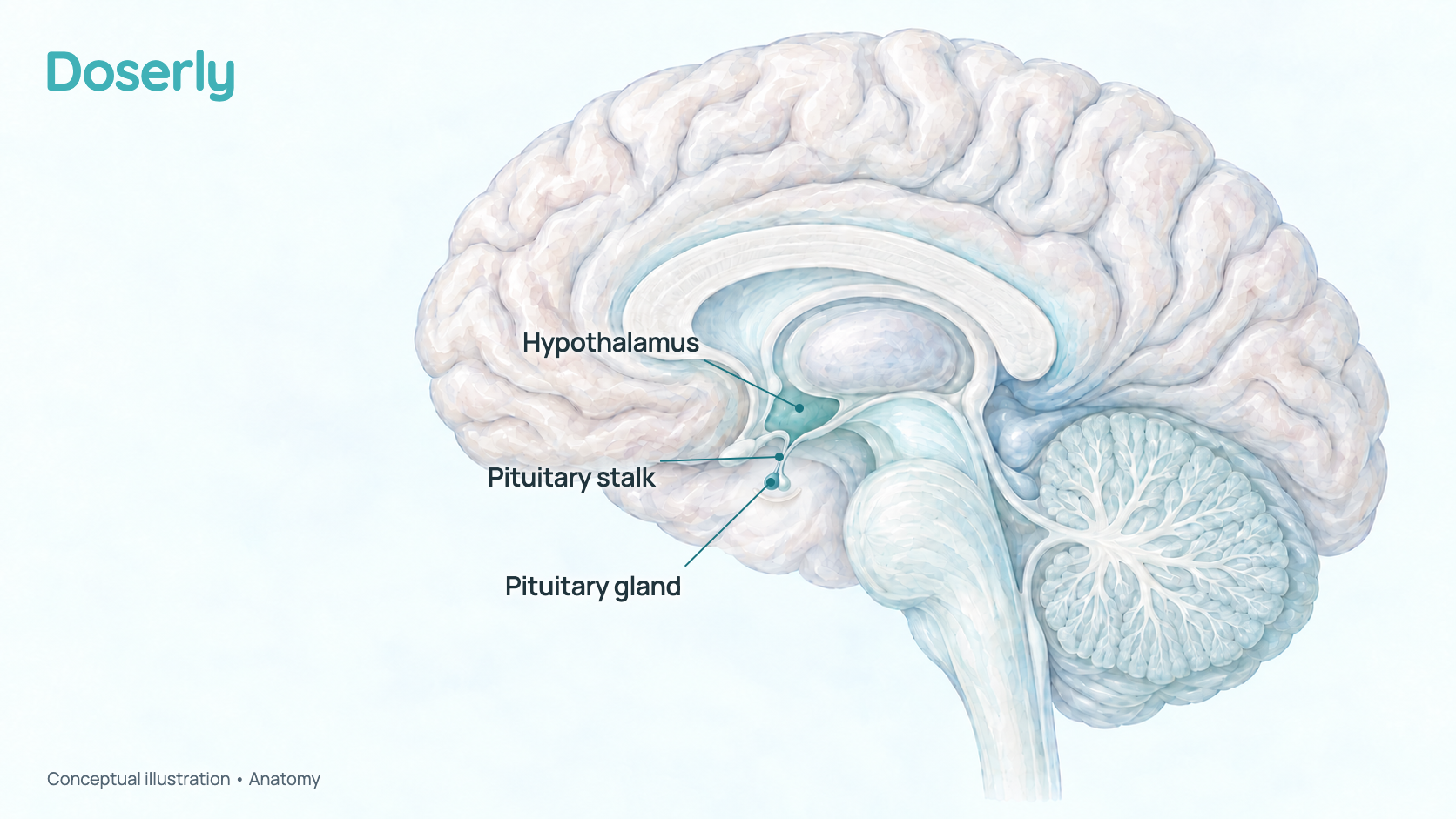
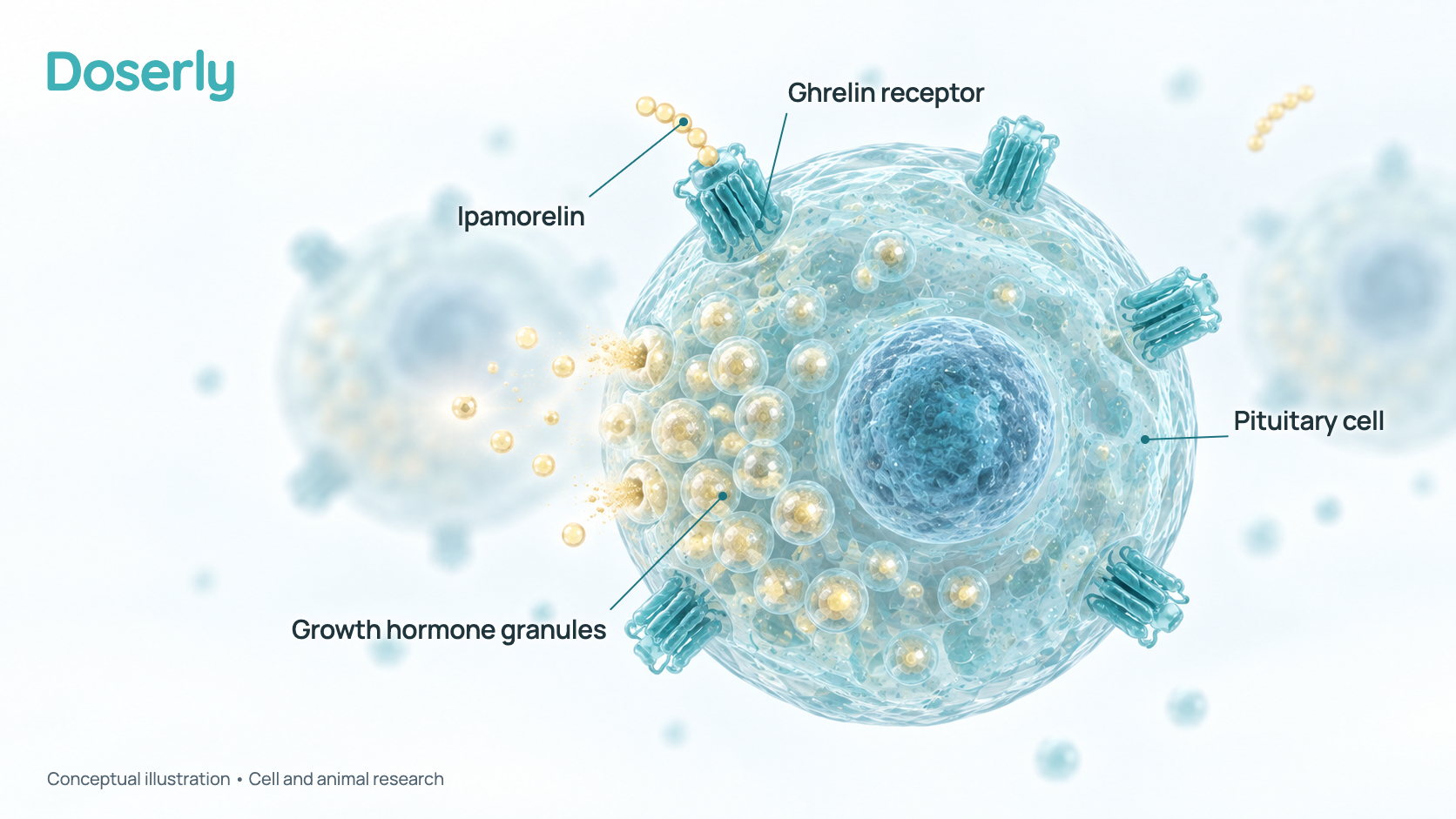
It works by copying the action of ghrelin, a hormone made in the stomach, at the ghrelin receptor. That receptor is one of the switches that tells the pituitary gland (a pea-sized gland at the base of the brain) to release growth hormone. Because ipamorelin makes the body release its own hormone rather than supplying the hormone itself, it is called a growth hormone secretagogue. [1], [2], [3]
Scientists at Novo Nordisk described ipamorelin in 1998, under the code NNC 26-0161. A later developer tested it in hospital as an intravenous drug to restart the bowel after surgery. That trial found no benefit over placebo, and development was reportedly stopped. It remains investigational: no regulator has approved it, and there is no approved dose. [1], [4], [5], [6], [2]
Typical Ipamorelin Protocols
| Example | Amount each time | Frequency | Total per day | Duration |
|---|---|---|---|---|
| Low | 100 mcg | Once daily, at bedtime | 100 mcg | 8–12 weeks |
| Mid | 100–200 mcg | Twice daily (morning and bedtime) | 200–400 mcg | 8–12 weeks |
| High | 200 mcg | 2–3 times daily | 400–600 mcg | 8–12 weeks Its source adds that this level is often combined with CJC-1295 |
The most common pattern in the reviewed sources is 100–300 mcg per injection, given one to three times a day with bedtime as the most common timing, on an empty stomach, for 8–12 weeks followed by about 4 weeks off. Sources that use one injection a day put it at bedtime. [7], [8], [9], [10], [11], [12], [13]
- Titration Changing the amount in steps
- The usual approach starts at 100 mcg once a day at bedtime and moves up to 200–300 mcg over the first weeks, depending on tolerance. One published schedule uses 100 mcg in week 1, 200 mcg a day in weeks 2–3 and 200–300 mcg a day from week 4. Several near-identical pages instead step through 100, 150, 200 and 250 mcg over 12 weeks. [8], [13], [14]
Read the units: mcg means micrograms; 1 mg equals 1,000 mcg. The amounts refer to ipamorelin itself. In a CJC-1295 blend, the vial total is not the ipamorelin amount, so blend amounts have their own table below.
Each row is a complete schedule as its source published it. Low, mid and high are alternatives, not steps to move through. These schedules come from protocol websites and clinic guides rather than clinical trials; the human studies that measured its effects gave it into a vein, in hospital or a research unit. [7], [2]
Before relying on any row: no amount in these tables has been tested for safety in people, and FDA found no human safety data for subcutaneous injection. In the only efficacy trial, given into a vein after surgery, two people on ipamorelin died (FDA says it is unclear whether ipamorelin was involved), and low potassium and high blood sugar were more common than on placebo. There are no data in pregnancy, breastfeeding or people under 18, and people with diabetes or prediabetes have extra reason for caution. [2], [71] Allergic-type reactions are a recurring report in community education groups, several on restarting after a break; swelling of the face or tongue, or trouble breathing, needs emergency care. [75] No approved product exists, so strength and sterility depend on the maker: one compounded sermorelin and ipamorelin injection was recalled in 2021 for lack of sterility assurance. [78] Check whether a vial label gives the ipamorelin amount or a blend total before converting to syringe units. Ipamorelin is banned in sport at all times. [86] Full risks and who should be cautious.
What are the usual CJC-1295 and ipamorelin blend amounts?
In the protocol pages and personal accounts reviewed, ipamorelin is most often taken with CJC-1295 without DAC (a lab-made version of the brain's growth-hormone-releasing hormone, also sold as Mod GRF 1-29). DAC, short for drug affinity complex, is an add-on that makes the other version last for days. The two come premixed in one vial or are drawn from two vials into one syringe. The amounts below are per peptide. [16], [2]
| Example | Amount each time | Frequency | Ipamorelin per day | Duration |
|---|---|---|---|---|
| Low | 100 mcg CJC-1295 + 100 mcg ipamorelin | Once daily at bedtime, 5 days a week | 100 mcg | 8–12 weeks |
| Mid | 200 mcg + 200 mcg | Once daily at bedtime, 5–7 days a week | 200 mcg | 8–12 weeks |
| High | 300 mcg + 300 mcg (or 150 mcg + 150 mcg, twice) | 1–3 times daily | 300–900 mcg | 8–12 weeks Its source describes this level for experienced users with monitoring |
A clinic patient sheet gives 200 mcg of each, five evenings a week, for 3 months on and 1 month off. In community education groups, the most common routine is 250 mcg of each at bedtime on an empty stomach, 5 days on and 2 off, for 12–16 weeks. Blends with tesamorelin or sermorelin are covered in where protocols differ. [17]
Where these numbers come from
The complete low, mid and high rows for ipamorelin alone come from reference [7], which lists them as beginner, intermediate and advanced protocols with an 8–12-week course and 4–8 weeks off. References [8], [9], [13], [11] and [12] cross-check the recurring amounts. Several of them place the same numbers higher, at 200–300 mcg per injection two or three times a day, so the top of the website range reaches 900 mcg a day. The blend rows come from reference [16]; references [17], [12] and [15] cross-check them.
We keep amount, frequency and course length together rather than taking a low number from one page and a duration from another. Many pages copy one another word for word, so matching pages are not counted as independent confirmation. Excluded from the typical comparison: blend schedules that give only the combined vial amount without the ipamorelin part, doses per kilogram of body weight with no fixed amount, isolated community reports of 1 mg or more per injection, and the hospital dose from the post-surgery trial (0.03 mg per kilogram into a vein), which is a different route and population. [18], [19], [6]
What is ipamorelin commonly used for?
People usually look into ipamorelin because they hope more growth hormone will bring something they want: deeper sleep, less body fat, easier recovery from training, or a way to hold on to muscle while losing weight on a GLP-1 medicine (a weight-loss drug such as semaglutide). Clinics and websites also market it for “anti-aging”, skin, joints and energy. [2]
The honest summary is short. The only use tested in a clinical trial was restarting the bowel after surgery, and ipamorelin did not beat placebo. None of the popular uses has been tested in people. What exists is a measured growth-hormone pulse after a single IV dose, a small set of animal and cell studies, and personal accounts. [6], [20], [2]
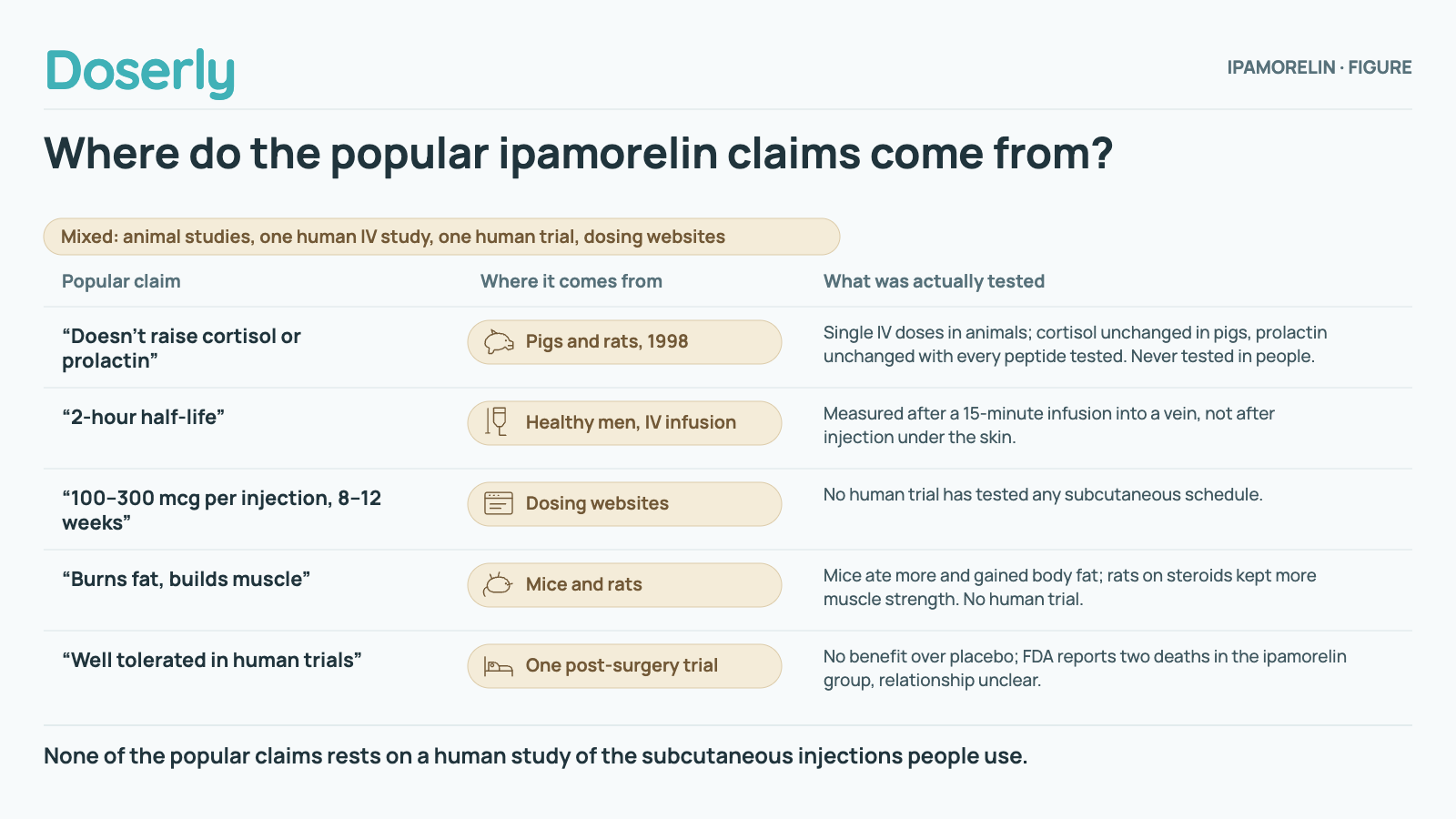
Where do the popular ipamorelin claims come from?
- “Doesn't raise cortisol or prolactin”
- Pigs and rats, 1998. Single IV doses in animals; cortisol unchanged in pigs, prolactin unchanged with every peptide tested. Never tested in people.
- “2-hour half-life”
- Healthy men, IV infusion. Measured after a 15-minute infusion into a vein, not after injection under the skin.
- “100–300 mcg per injection, 8–12 weeks”
- Dosing websites. No human trial has tested any subcutaneous schedule.
- “Burns fat, builds muscle”
- Mice and rats. Mice ate more and gained body fat; rats on steroids kept more muscle strength. No human trial.
- “Well tolerated in human trials”
- One post-surgery trial. No benefit over placebo; FDA reports two deaths in the ipamorelin group, relationship unclear.
None of the popular claims rests on a human study of the subcutaneous injections people use.
Raising growth hormone and IGF-1
This is the one effect measured in people: after a single 15-minute IV infusion in healthy men, growth hormone rose in one pulse, peaking at about 40 minutes. [20], [2]
Growth hormone in turn prompts the body to make IGF-1 (insulin-like growth factor 1), the blood test people use to check for a change. No published human study reports IGF-1 after ipamorelin. Animal results are mixed: IGF-1 rose in rats given a steroid, but in another rat study and in diabetic mice growth hormone rose without a matching IGF-1 rise. Community blood-test reports range from little change to large rises. [21], [22], [23] See what people reported.
A secretagogue only works if the pituitary can still make growth hormone, so FDA notes that people with complete growth-hormone deficiency will not respond. [2]
Sleep
Better sleep is one of the most common reasons people try it, but no study has measured sleep after ipamorelin. In the post-surgery trial, insomnia was reported more often in the ipamorelin group (10.7%) than on placebo (5.2%). Personal accounts go both ways: some describe deeper sleep from the first nights, others lie awake or wake early, sometimes only at higher doses. [2], [24], [25], [26], [27]
The sleep claim borrows from a related drug. Ibutamoren (MK-677), a swallowed drug that acts on the same receptor, lengthened deep sleep in a small 1997 study of eight young adults. That result has not been tested for ipamorelin. [28]
Fat loss, muscle and body “recomposition”
No human trial has tested ipamorelin for body fat or muscle. The animal results point in different directions. In mice, twice-daily injections increased body fat, even in mice that could not make growth hormone, and increased food intake in mice with normal growth hormone. In adult rats given a steroid, ipamorelin reduced the steroid's loss of muscle strength and bone formation. [29], [30]
People who report leaner bodies are usually also dieting, training and often taking a GLP-1 medicine, so the peptide's share cannot be separated. Several longer accounts describe little or no change in muscle or fat. [31], [32], [33], [34] A 2026 review attributed a muscle result to “CJC-1295 plus ipamorelin in mice”; the original study used ipamorelin alone, in rats. [35], [30]
Recovery and injuries
We found no published study of ipamorelin in tendon, ligament, wound or fracture healing; the rat bone studies measured growth, not repair. Recovery claims come from marketing and personal accounts of less soreness alongside training. [22], [36], [2], [25]
Restarting the gut after surgery: the one tested use
Ipamorelin improved bowel recovery in rats after abdominal surgery, so it went into human trials for postoperative ileus (the bowel's temporary shutdown after surgery). In the published Phase 2 trial, it did not shorten recovery compared with placebo. [37], [38], [6] See the trial results.
Other uses you may come across
Websites also claim benefits for skin, collagen, joints, libido, memory and immunity. These have not been studied in people. Individual animal experiments exist for gut pain in rats and for weight loss during chemotherapy in ferrets. [2], [39], [40] Explore the animal research.
Where do ipamorelin protocols differ?
Is the number for one injection or the whole day?
The same “200–300 mcg” can mean very different amounts. One guide uses it as the whole day's total, split into one to three smaller injections. Another uses it per injection, two or three times a day, which adds up to 400–900 mcg a day. One page even does both: its chart shows one daily injection of 100–250 mcg, while its summary line says 100–300 mcg two or three times a day. [41], [9], [14]
Once, twice or three times a day?
All three appear. Sources that favour several injections point to a half-life of about 2 hours, but that figure was measured after an IV infusion, and no study has compared one daily injection with several. [9], [7], [20], [2]
Bedtime is the usual anchor because protocol sources aim to line up with the body's own night-time growth-hormone release. People who sleep worse after a bedtime dose often move it to the morning. [7], [8], [26]
Do sources start low?
Many do, though several pages repeat the same schedule. The four-step 100, 150, 200 and 250 mcg schedule appears on several pages with near-identical wording, so it is one schedule repeated, not several independent ones. Another starts with a one-week “assessment” at 100 mcg, and one clinic blog advises cutting by 50–100 mcg if flushing or lightheadedness persists. [14], [42], [43], [44], [13], [45]
In community education groups, a common piece of advice is to start one peptide at a time, a few days apart, before combining them, so that any reaction can be traced to one ingredient.
How long, and what happens between courses?
The course length most often given is 8–12 weeks, sometimes 16. Breaks range from 4 weeks to 1–2 months or as long as the course; one clinic sheet uses 3 months on and 1 month off. Many schedules also skip two days each week. [7], [46], [47], [17], [15], [13]
Breaks are meant to stop the body getting used to the peptide. Whether that happens in people has not been studied; the rat results are under does the body get used to it? [22], [2]
Does it have to be taken on an empty stomach?
Nearly every source says so, usually at least 2 hours after food and nothing for about 30 minutes afterwards; one page says eating “negates the injection entirely”. No study has tested ipamorelin with and without food in people. [48], [8], [9]
What is the “saturation dose”?
Many pages say ipamorelin reaches its maximum effect at 100 mcg or 1 mcg per kilogram of body weight. That rule of thumb traces to bodybuilding forum advice from the early 2010s that was applied to all similar peptides at once; no human study has identified a ceiling dose for injections. [49], [8], [10], [20], [2]
What about tesamorelin or sermorelin blends?
Tesamorelin is an FDA-approved growth-hormone-releasing hormone medicine with one specific use: reducing excess abdominal fat in adults with HIV and lipodystrophy. In community education groups it is often combined with ipamorelin, typically 1–2 mg of tesamorelin with 200–300 mcg of ipamorelin at night. Members argue for ratios from 1:1 to 4:1, and none of them has been tested. [50]
Premixed vials tie the doses together. FDA warned two sellers of tesamorelin and ipamorelin blends in August 2026; in one, sold as 10 mg plus 3 mg, a 2 mg tesamorelin dose also delivers 600 mcg of ipamorelin. [51], [52]
Sermorelin is another GHRH-type peptide. One clinic blog describes 200 mcg of ipamorelin with 200–300 mcg of sermorelin at bedtime. [45] Read the Doserly guides to tesamorelin, sermorelin and the CJC-1295 and ipamorelin blend.
How do micrograms convert to syringe units?
A U-100 insulin syringe has 100 units per millilitre, so units measure volume. How much ipamorelin each unit holds depends on how much liquid was added to the vial.
For example, 5 mg (5,000 mcg) mixed into 2 mL gives 2,500 mcg per mL, or 25 mcg per unit. So 100 mcg is 4 units and 300 mcg is 12 units. A blend vial of 5 mg CJC-1295 plus 5 mg ipamorelin mixed into 2 mL holds 25 mcg of each per unit, so 10 units gives 250 mcg of each, not 250 mcg in total. [9], [8], [16], [100]
Published tables get this wrong: one 2026 guide lists 40 units for 100 mcg from a 5 mg vial mixed into 2 mL, ten times the correct 4 units. [53] Doserly's reconstitution calculator works this out for a single-peptide vial and shows each step; for a blend, it cannot split the vial into its ingredients. The arithmetic assumes the vial holds what its label says; it cannot check a product's strength, purity or sterility.
Source-by-source comparison
Which pages share the same numbers?
Many ipamorelin pages reuse a few schedules. The 100, 150, 200 and 250 mcg ladder appears on PeptideDosage, Peptides.ID, PeptideDosages and Research Protocols with near-identical tables. Peptide Dosing Protocols and PeptiJournal share the assessment, titration and standard phases. The broad “200–300 mcg, one to three times a day” convention appears on more than a dozen pages, including Guide to Peptide, Peptides Institute, Bioalmanac, PeptideProbe, PeptaBase and PeptideX. [14], [42], [43], [44], [13], [54], [55], [9], [11], [12], [46], [47]
Which pages cite research that does not support them?
Several pages attribute the 2-hour half-life to injections, although it was measured after IV infusion. One says the 1998 selectivity study tested eight healthy men (it used rats and pigs) and that the post-surgery trial used three doses a day (it used two). A 2026 prescribing guide for physicians cites a dose study that turns out to be an unrelated article. Ipamorelin.eu labels its injection schedule “Clinical studies”. [14], [15], [56], [1], [6]
Which pages are more careful?
Peptide Dosing Protocols states that its schedule is community-derived and that no human trial has tested ipamorelin for growth-hormone optimization, body composition or anti-aging. Bioalmanac and PeptideFox also separate community convention from trials. [13], [11], [57]
Where does the blend table come from?
Beverly Hills Rejuvenation Center's blend guide gives amounts for each peptide by tier. Extension Health's patient sheet uses a 5 mg plus 5 mg vial in 5 mL, so 20 units hold 0.2 mg of each. PeptideProbe gives 100–200 mcg of each, one to three times a day, and Rx Direct's physician guide pairs 100–200 mcg of each at bedtime with weekends off. [16], [17], [12], [15]
What happens when you stop ipamorelin?
This has not been studied. The bowel-surgery trial recorded safety events after the week of treatment ended, but no study has looked specifically for withdrawal effects or a rebound, or at hormone recovery, after ipamorelin, and none have been documented. That is missing data, not proof that none exist. [2]
What is known is short-term. After a single IV infusion, growth hormone fell back to very low levels within about 6 hours. In one report to FDA, elbow pain during an ipamorelin and sermorelin course became less severe after stopping but did not fully go away. [20], [2]
In community education groups, educators disagree about stopping. Some say stopping at once is fine because nothing is suppressed; others advise cutting back over about four weeks, saying an abrupt stop drops growth hormone below its usual level. Neither side cites evidence. One member described worse sleep after stopping, and allergic-type reactions reported on restarting after a break are covered under allergic reactions.
Protocol sources schedule breaks to let the body “resensitize”, but that idea has not been tested for ipamorelin in people, and the rat results point both ways (see whether the body gets used to it). Related peptides give context, not proof about ipamorelin:
- Hexarelin, a related six-amino-acid peptide: in adults given subcutaneous injections twice daily for 16 weeks, the growth-hormone response shrank by almost half, then returned to its starting level four weeks after stopping. IGF-1 and body composition did not change significantly. [101]
- GHRP-2: in nine healthy young men, the peak growth-hormone response fell by about 40% over five days of daily injections. Yet in 17 healthy older adults, a 30-day continuous infusion kept growth-hormone release well above its starting level. [102], [103]
Does ipamorelin work the same by injection, nasal spray, cream or by mouth?
No full published study has compared routes in people. Every human blood-level measurement of ipamorelin in a full published paper comes from an intravenous infusion, which puts the drug straight into a vein. FDA found no information on how ipamorelin is absorbed (pharmacokinetics) or how it acts after subcutaneous injection, the route people actually use, or after any other route. [20], [2]
The route changes how much reaches the blood and how fast: an intranasal spray has to cross the lining of the nose, and an oral product has to survive digestion. Bioavailability, the share of a dose that reaches the circulation, has not been reported in people for any route in a full published paper.
Is there a nasal spray or oral ipamorelin?
Both are sold by clinics and compounders, including oral troches and dissolving tablets. In rats, about 20% of a nasal dose reached the blood; in people, the only nasal use on record is one volunteer in an anti-doping study that measured urine, not effects. [2], [58], [59]
No published study has measured whether ipamorelin passes through the skin from a cream or patch (transdermal use), and FDA found no human data for any route other than IV. [2] A 1998 conference abstract, a short meeting summary that counts as low-grade evidence, reports ipamorelin blood levels in volunteers after iontophoresis, which uses a small electric current to move a drug through the skin, and after IV dosing. We could find only its title and citation, so we could not check how many people took part, how much reached the blood or whether there were side effects, and it says nothing about creams or patches used without a current. [123]
A 1998 animal study reported a growth-hormone rise after a swallowed dose of 2.7 mg per kilogram, far larger than any injected amount, and researchers then developed a separate oral molecule (NN703) instead. No study has measured oral ipamorelin in people. [60], [61]
How long does ipamorelin last in the body?
After an IV infusion in healthy men, the half-life was about 2 hours. The growth-hormone pulse it triggered peaked at about 40 minutes and was close to gone by about 6 hours. [20], [2]
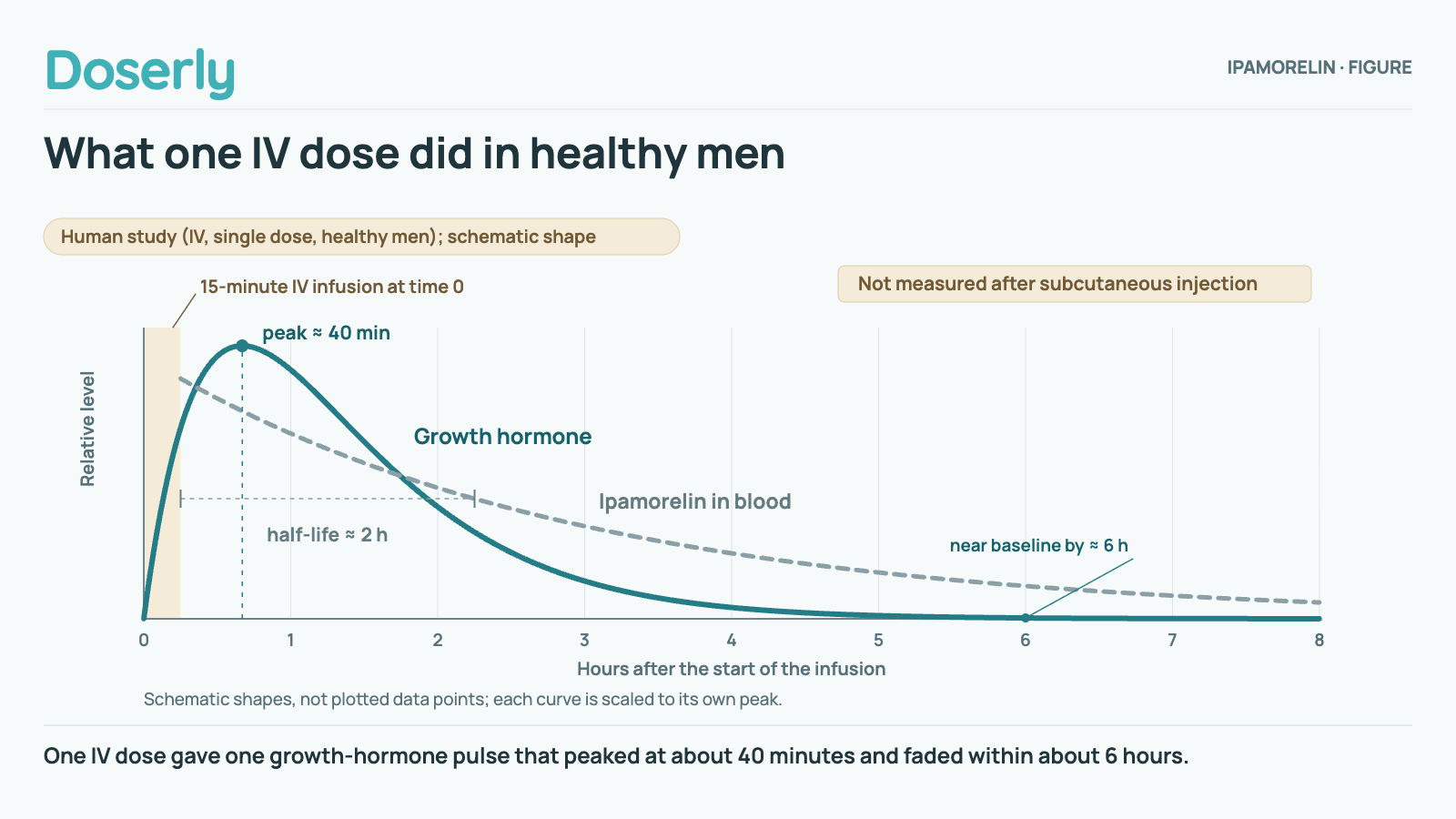
What one IV dose did in healthy men
- Growth hormone
- One pulse after a 15-minute IV infusion: peak at about 40 minutes (0.67 h), near baseline by about 6 hours.
- Ipamorelin in blood
- Half-life about 2 hours after the infusion ended.
Schematic shapes, not plotted data. Not measured after subcutaneous injection.
One IV dose gave one growth-hormone pulse that peaked at about 40 minutes and faded within about 6 hours.
Half-life is not the same as how long any benefit lasts, and an IV half-life cannot be copied over to a subcutaneous injection, which is absorbed more slowly. The “2-hour half-life” on dosing pages is this IV figure.
Is ipamorelin acetate different from ipamorelin?
It is the same peptide paired with acetate, a common salt form for making peptides into a stable powder. FDA treats the free base and the acetate as separate substances and noted that the pharmacies nominating ipamorelin did not make clear which one they meant. Other related molecules exist: N-acetyl ipamorelin is registered as a separate substance, and anti-doping laboratories have found glycine-modified versions of ipamorelin in seized products sold under ordinary names. [2], [3], [62], [63]
Does the injection site matter?
Sources use the belly, thigh or upper arm, and no study has compared sites. FDA notes that peptides given by subcutaneous injection are generally more likely to trigger an immune response than the same peptide given into a vein. [9], [2]
How should ipamorelin be stored, and how long does it last?
How long ipamorelin keeps its strength once mixed is not established. No published study has set a use-by period for a vial mixed from ipamorelin powder, so the windows below come from suppliers, not from a tested medicine label. [2]
- Powder, before mixing. Ipamorelin is sold as a freeze-dried powder. Supplier information quoted by FDA says the powder is stable at room temperature for 3 weeks but should be kept dry below −18 °C. For the acetate form, FDA cites a supplier's certificate of analysis for sealed storage at 2–8 °C and reports a claim of up to 4 years at −20 °C. Neither says how long a mixed vial stays usable. [2]
- After mixing. For ipamorelin free base mixed into a solution (reconstituted), FDA's summary repeats a supplier's figures of 2–3 weeks at 4 °C (fridge temperature) and 3–4 months frozen. That supplier's own page now says 2–7 days in the fridge. Other suppliers give 14–21 days, 4 weeks, 4–6 weeks or as long as 60 days, and none cites a stability test. [2], [104], [105], [106], [107], [108]
- The mixing liquid. The label of bacteriostatic water, the liquid these pages usually name, says not to store drug solutions made with it unless the drug's maker says so. [109]
- Light. Some suppliers say to protect it from light. That has not been tested for ipamorelin. [110], [108]
Tested rules for related approved medicines are much stricter. Mixed macimorelin must be used within 30 minutes; Japan's GHRP-2 diagnostic is used as soon as possible after mixing, with stability confirmed for only 24 hours; and one tesamorelin product is thrown away 7 days after mixing. Those rules belong to those products, not to ipamorelin. [111], [112], [50]
FDA notes that peptides like ipamorelin are sensitive to heat, acidity and impurities, which can make them clump together (aggregation) and lose activity, and that clumps could make an injection more likely to trigger an immune reaction. This guide does not cover mixing or injection technique; the Academy note below covers practical handling. [2]
What do we actually know about ipamorelin in people?
Very little, and none of it involves the way ipamorelin is used today. The human studies asked narrow questions: how the drug moves through the blood after one IV dose, whether IV doses help the bowel recover after surgery, and how anti-doping labs can detect it.
What did the human studies find?
| Study | What researchers reported | What it cannot establish |
|---|---|---|
| Healthy men, 1999 | A single 15-minute IV infusion at five dose levels. Ipamorelin had a half-life of about 2 hours and triggered a single growth-hormone pulse; FDA notes the lowest dose produced very little. The abstract describes eight men per dose level; FDA's review describes 48 men including placebo. | Anything about repeated doses, subcutaneous injection, IGF-1, body composition or long-term safety. Side effects were not reported, which is not the same as none occurring. [20], [2] |
| After bowel surgery, 2014 | A randomized, placebo-controlled trial (Phase 2) in 114 adults: 0.03 mg per kilogram into a vein twice daily for up to 7 days. No benefit over placebo on recovery. Two deaths in the ipamorelin group. | Any effect outside hospital, by injection, or over more than a week. [6], [2] |
| Anti-doping test, 2015 | One volunteer took a nasal dose so that researchers could identify ipamorelin and its breakdown products in urine. | Any health effect; it was a detection study with one person. [59] |
These studies were small, and the post-surgery trial was funded by the company developing ipamorelin at the time. [6]
What did the post-surgery trial show?
Adults having part of the bowel removed received ipamorelin or a dummy infusion from the day after surgery. The median time until they could eat a solid meal was 25.3 hours with ipamorelin and 32.6 hours with placebo, not a statistically significant difference (p = 0.15), and other recovery measures also showed none. [6], [2]
The abstract calls the treatment “well tolerated” and does not mention deaths. FDA's 2024 review of the same trial reports two deaths in the ipamorelin group and none on placebo, with the relationship unclear. See the safety details. [6], [2]
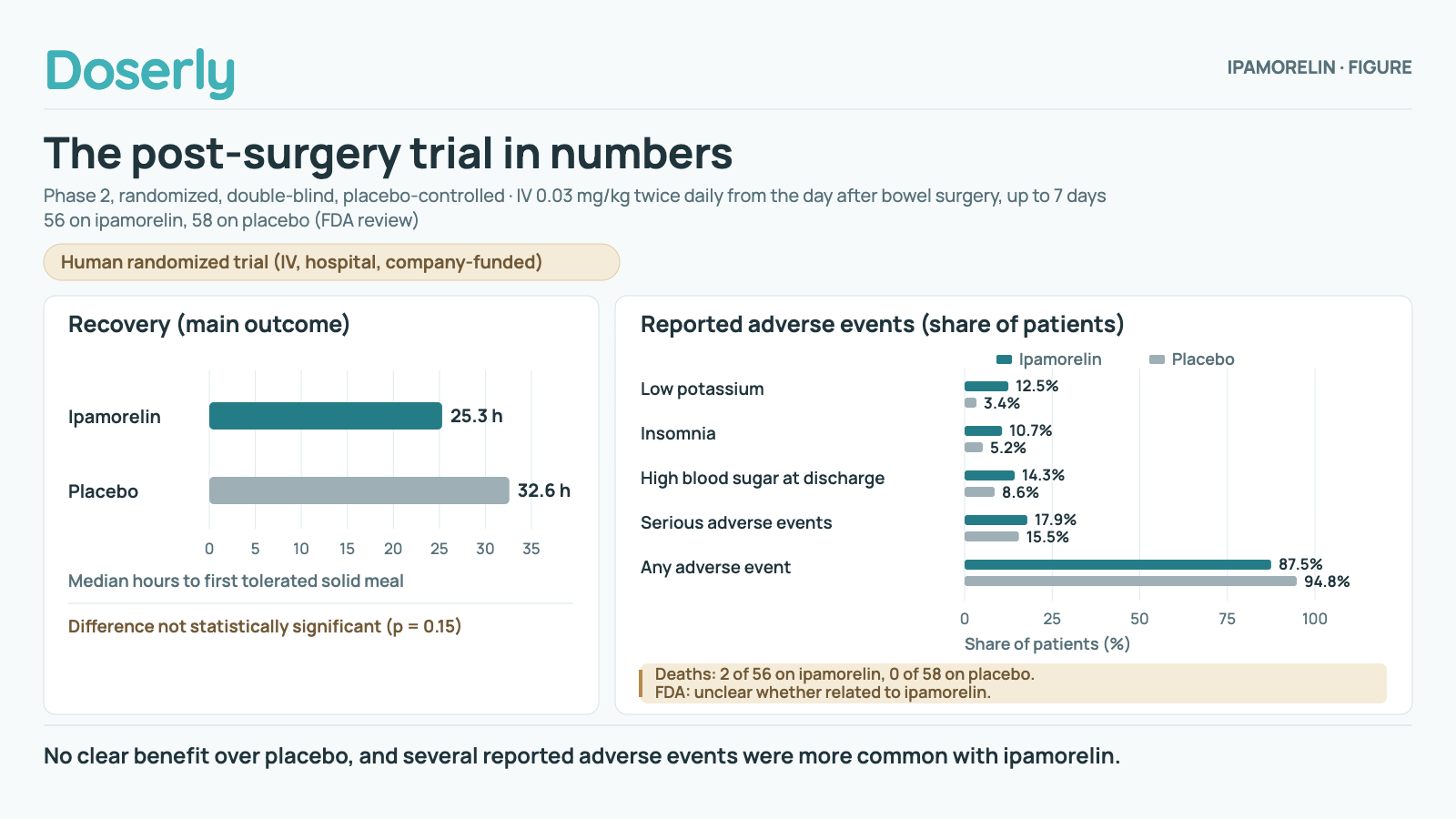
The post-surgery trial in numbers
- Recovery (main outcome)
- Median hours to first tolerated solid meal: ipamorelin 25.3 h; placebo 32.6 h. Difference not statistically significant (p = 0.15).
- Reported adverse events (share of patients)
- Low potassium 12.5% vs 3.4%; insomnia 10.7% vs 5.2%; high blood sugar at discharge 14.3% vs 8.6%; serious adverse events 17.9% vs 15.5%; any adverse event 87.5% vs 94.8% (ipamorelin vs placebo).
- Deaths
- Deaths: 2 of 56 on ipamorelin, 0 of 58 on placebo. FDA: unclear whether related to ipamorelin.
No clear benefit over placebo, and several reported adverse events were more common with ipamorelin.
What happened to the larger trial?
A second, larger trial finished in 2014 and has never reported results. Status checked September 23, 2026:
320 adults after bowel surgery
Three IV dose schedules (0.03–0.06 mg per kilogram, two or three times daily) against placebo. Completed May 2014.
No results posted, no publication found. Last update April 2017.
[64]117 adults after bowel surgery
The trial described above, completed December 2009.
No results posted on the registry; published in 2014.
[5]Veterans receiving several treatments
Lists ipamorelin only as one of several supplements, with no dose.
First posted July 2026.
[65]Does more growth hormone mean better health?
Not automatically. A growth-hormone pulse, an IGF-1 number, a change in body fat and feeling better are four different outcomes. Only the first has been measured for ipamorelin in people, after an IV dose. An IGF-1 result shows that growth-hormone signalling changed; it does not show that sleep, muscle or recovery improved, or that the change is safe. [20], [2]
How does ipamorelin work?
Ipamorelin activates the ghrelin receptor (also called GHS-R1a) on nerve cells in the hypothalamus and on the growth-hormone-making cells of the pituitary gland. The pituitary answers with a burst of growth hormone. In rat pituitary cells in a dish, ipamorelin released growth hormone about as strongly as GHRP-6, an older peptide of the same type. [1], [2]
Why is it called “selective”?
In the 1998 study that introduced it, GHRP-6 and GHRP-2 raised the stress hormone cortisol, and ACTH, the pituitary hormone that triggers cortisol release, in pigs, while ipamorelin did not, even at doses more than 200 times higher than needed for a growth-hormone response. None of the three changed prolactin or the reproductive and thyroid hormones measured. [1]
That is the source of the claim, repeated on most dosing pages, that ipamorelin “doesn't raise cortisol or prolactin”. It comes from pigs and rats. No human study has tested it, and it says nothing about months of repeated injections. [1], [2]
Why is it paired with CJC-1295?
The pituitary has two main “release” switches. GHRH (growth-hormone-releasing hormone) presses one; ghrelin presses the other. CJC-1295 without DAC is a lab-made GHRH, and ipamorelin mimics ghrelin. In healthy men, an older peptide of ipamorelin's type given together with GHRH released more growth hormone than either alone. [2], [66]
No study has tested ipamorelin with CJC-1295 in people. The claim that the pair releases 3–5 times more growth hormone than ipamorelin alone comes from a clinic website that FDA quoted without endorsing. [2]
Does it affect appetite, blood sugar and the gut?
Ghrelin receptors are found well beyond the brain, including in the stomach, intestine, pancreas and fat tissue. In mice, ipamorelin increased food intake and body fat. In rat pancreas tissue in a dish, it increased insulin release. In rats after abdominal surgery, repeated IV doses sped up the bowel. [2], [29], [67], [37]
These effects are why dosing pages that promise no effect on appetite are at odds with both the animal results and many personal accounts. In people, the only related measurement is the higher rate of high blood sugar at hospital discharge in the post-surgery trial. [42], [2], [68], [25]
Does the body get used to it?
In adult rats given three injections a day for 15 days, a later test dose produced a slightly smaller growth-hormone response. In young rats treated for 21 days, pituitary cells taken afterwards still responded to further stimulation. FDA adds a caution for people with partial growth-hormone deficiency: repeated stimulation might deplete the pituitary's limited stores. None of this has been tested in people. [22], [69], [70], [2]
What are the risks and unanswered questions?
Is ipamorelin safe?
Its safety has not been established. FDA found no human safety data for subcutaneous injection, the way people use it, and none of the standard animal safety studies of repeated-dose toxicity, genetic damage, cancer risk or effects on fertility and pregnancy. [2], [71]
Fewer than 100 people are known to have received ipamorelin in full published papers: one IV infusion each in the healthy-volunteer study, up to a week of IV doses in 56 hospital patients, and one nasal dose. Short, small studies can miss uncommon problems and anything that takes months to appear. [20], [6]
What happened in the human studies?
In the post-surgery trial, most reported adverse events were typical of surgery, such as nausea and vomiting, and slightly less common with ipamorelin. Hypokalemia (low potassium, 12.5% versus 3.4% on placebo), insomnia (10.7% versus 5.2%) and hyperglycemia (high blood sugar) at discharge (14.3% versus 8.6%) went the other way. Serious adverse events occurred in 17.9% versus 15.5%, and three people in each group stopped treatment. [2]
Two people given ipamorelin died after colon-cancer surgery complicated by a leak where the bowel was rejoined. FDA says it is unclear whether ipamorelin was involved, but lists the deaths, with the potassium and blood-sugar findings, as reasons for concern. [2], [71]
What side effects do people report?
FDA's search of its adverse-event database through September 2023 found two non-serious reports: tearing and headache from a compounded nasal spray, and elbow pain from an ipamorelin and sermorelin injection that eased but did not resolve after stopping. [2]
Personal accounts add flushing and a racing heart after injection, water retention, hunger, numb hands, carpal-tunnel-like wrist pain and sleep problems, mostly on CJC-1295 blends. FDA has linked CJC-1295 itself to increased heart rate and a “systemic vasodilatory reaction” (widespread flushing), so a blend's flushing may not come from ipamorelin. [32], [72], [68], [31], [71] Read the accounts.
Fluid retention, joint pain and carpal tunnel symptoms are listed effects of growth hormone itself in approved growth-hormone labels, which makes them plausible here, though no study has measured them with ipamorelin. [73], [2]
Can ipamorelin cause an allergic reaction?
It is possible, and it is a concern FDA raises specifically. FDA says injected peptides like ipamorelin can trigger immune reactions, especially if the product contains clumped peptide (aggregation) or manufacturing impurities, and that such reactions range from none noticeable to life-threatening. [71], [2]
In community education groups, allergic-type reactions are a recurring theme: hives, intense itching, flushing with a drop in blood pressure, numb or swollen lips and tongue, throat tightness and trouble breathing. Several happened when people restarted after a break, and most involved blends, so the ingredient responsible is usually unknown. In June 2026 Australia's medicines regulator reported severe allergic reactions requiring hospital treatment among people using unapproved peptide products, without naming ipamorelin. [74]
Swelling of the face, eyes or tongue, or difficulty breathing, can be signs of anaphylaxis, a severe allergic reaction that needs emergency care right away. [75]
Does ipamorelin raise blood sugar?
It might. High blood sugar at discharge was more common with ipamorelin in the post-surgery trial, and ipamorelin increased insulin release from rat pancreas tissue. FDA lists glucose intolerance and diabetes among the growth-hormone risks it expects could apply to ipamorelin. Another drug that acts on the same receptor, ibutamoren (MK-677), raised fasting blood sugar and lowered insulin sensitivity in a randomized trial of healthy adults aged 60 to 81. [2], [67], [76]
Does ipamorelin cause cancer?
Nobody knows. There are no human data and no animal cancer studies. FDA's concern comes from growth hormone itself: approved growth-hormone medicines carry a warning about an increased risk of neoplasms (tumours), and FDA says it has no data to rule out similar risks for ipamorelin. [2], [73]
Could product quality change the risk?
Yes. There is no approved ipamorelin product. Products are compounded or sold under “research use only” labels, and that label does not make a product suitable for human use. FDA does not review compounded drugs for safety, effectiveness or quality before they are sold. [113] FDA has warned a pharmacy over ipamorelin compounding, cited a 2021 recall of a sermorelin and ipamorelin injection that lacked assurance of sterility, and warned two blend sellers in 2026. Anti-doping laboratories have found altered versions of ipamorelin in seized products. [77], [78], [51], [52], [62]
Is ipamorelin legal? Is it FDA-approved?
Checked September 23, 2026. Rules differ by country and change quickly.
United States. Ipamorelin is not an FDA-approved medicine, and no approved product contains it. The recent steps:
- September 29, 2023. FDA placed ipamorelin acetate in “Category 2” for outsourcing facilities (larger-scale compounding pharmacies): substances that may present significant safety risks. It is still there. [71], [79]
- October 29, 2024. FDA's Pharmacy Compounding Advisory Committee voted 0 in favour, 12 against, 1 abstaining on adding either form of ipamorelin to the list of ingredients ordinary compounding pharmacies may use, citing a lack of information on safety and effectiveness. The vote is advice, not a final rule. [80]
- Now. FDA lists the pharmacy-compounding nomination as withdrawn, and ipamorelin is not on that list. In August 2026 FDA sent warning letters to two companies selling tesamorelin and ipamorelin blends as unapproved drugs. Some websites claim ipamorelin moved to a more favourable category in 2026; we found no FDA record of that. [81], [71], [51], [52]
Canada. Health Canada has not authorized ipamorelin. Its April 2026 advisory lists it among seized unauthorized injectable peptides and says a “For Research Use Only” label does not make such products legal. [82], [83]
Australia. Ipamorelin is a prescription-only medicine (Schedule 4) and is also listed among substances that are illegal to possess without authority, such as a legal prescription. No medicine containing it is on the Australian Register of Therapeutic Goods. [84], [85]
A “research use only” label does not make a product legal to sell for human use, or safe.
Is ipamorelin banned in sport? Does it show up on a drug test?
Yes, it is banned. The World Anti-Doping Agency names ipamorelin in section S2.2.4 of its Prohibited List, among growth hormone secretagogues, prohibited in and out of competition on both the 2026 list and the 2027 list that takes effect on January 1, 2027. [86], [87]
It is detectable. Anti-doping laboratories identify ipamorelin and its breakdown products in urine, and athletes have been sanctioned both for a positive out-of-competition test and for use and possession without a positive test. [59], [88], [89], [90] No reliable detection window has been published for the injected products people use. In a one-person nasal-dose study, an ipamorelin breakdown product was still found in urine after the peptide itself had cleared, and the authors note that detection time depends on the person's metabolism, the product and the route. [59]
Who should be especially cautious?
These groups have no safety data in people. That is a reason for caution, not proof of harm.
- Pregnancy and breastfeeding. There are no ipamorelin studies. In mice, both switching the ghrelin receptor on and blocking it harmed fertilization and fetal development, which FDA considers a possible class effect. [2]
- Diabetes, prediabetes or insulin resistance. Because of the blood-sugar findings above. [2]
- A history of cancer. Approved growth-hormone labels carry a tumour warning. [73]
- Heart rhythm problems. An approved drug acting on the same receptor, macimorelin, carries a warning about QT prolongation, a change in heart rhythm. [2]
- Under 18. No studies include young people. This guide is written for adults.
- Competitive athletes. It is banned at all times. [86]
- People taking other medicines. Interactions have not been studied; see the next question.
Has ipamorelin been tested alongside other medicines?
Not in people. Nothing has been published on interactions with approved GLP-1 medicines such as semaglutide or tirzepatide, the investigational drug retatrutide, hormone therapy or diabetes medicines, even though accounts often combine them. A rat study found a steroid did not block ipamorelin's growth-hormone release, which says nothing about side effects in people. Bring a complete list of everything you take to a pharmacist or doctor. [2], [21]
What should be monitored while using ipamorelin?
There is no official monitoring plan, because no regulator has approved ipamorelin. What exists is what the few human studies checked, plus what labels require for related approved medicines. It can help you prepare questions for a clinician; it is not a personal testing plan. [2]
What did the human studies check?
- Growth hormone and drug levels. The healthy-volunteer study measured ipamorelin and growth hormone in the blood after one IV dose. [20]
- Side effects and lab tests. The bowel-surgery trial tracked adverse events and laboratory tests, without naming the tests in its abstract. FDA's review reported low potassium and high blood sugar more often with ipamorelin, and three people stopped treatment because of nausea, high blood pressure or low blood pressure. [6], [2]
- What was not reported. No published ipamorelin study reports IGF-1, cortisol, prolactin, thyroid hormones, heart tracings (ECGs) or antibodies against the drug. Not reported does not mean not measured, but there are no results to go on. [20], [6], [2]
What do approved labels and related-drug trials show?
The first four examples come from approved medicine labels or a regulator's review; the MK-677 findings come from trials of a drug that has not been approved. They are class-based considerations for medicines that raise growth hormone or act on the same receptor, not ipamorelin findings or a testing schedule.
- Tesamorelin, an approved GHRH medicine: check IGF-1 and consider stopping if it stays high, and check blood sugar before starting and periodically after. [50]
- Growth hormone itself (somatropin): periodic blood sugar and thyroid checks, and watching for swelling, joint pain and carpal tunnel symptoms. [114], [73]
- Macimorelin, an approved ghrelin-receptor drug swallowed once as a diagnostic test: it lengthens the QT interval by about 11 milliseconds, so its label warns against combining it with other drugs that do the same. [111]
- Anamorelin, a ghrelin-receptor tablet approved in Japan for cachexia (weight and muscle loss) in some cancers: Japan's regulator asked for regular ECGs. In its trial, ECG abnormalities were reported in 12.0% of people on the drug versus 2.2% on placebo, and blood-sugar-related side effects in 12.0% versus 3.3%. [115]
- MK-677 (ibutamoren), a swallowed drug acting on the same receptor: fasting blood sugar rose and insulin sensitivity fell in a two-year trial in older adults, and a trial in people recovering from hip fracture was stopped early because of a signal of heart failure. [76], [116]
Which signals matter, and why?
| Why it matters | Where it comes from | Tracking category |
|---|---|---|
| Potassium | Low potassium in 12.5% on ipamorelin versus 3.4% on placebo in the bowel-surgery trial | Blood work |
| Blood sugar (glucose, HbA1c) | The ipamorelin trial; MK-677 and anamorelin trials; growth-hormone and tesamorelin labels | Blood work |
| Growth-hormone activity (IGF-1) | Tesamorelin label; never reported for ipamorelin | Blood work |
| Heart rhythm (ECG) | Macimorelin label; anamorelin review | Heart Health; Heart Rate & Palpitations |
| Blood pressure | Treatment stopped for high or low blood pressure in the ipamorelin trial | Blood Pressure |
| Swelling, joint pain, hand numbness | Growth-hormone labels | Fluid Retention; Joint Health |
| Allergic and injection-site reactions | FDA's main concern for injected peptides | Side Effect Burden; Skin Health |
| Sleep and appetite | Insomnia in the ipamorelin trial; appetite in animal and related-drug studies | Sleep Quality; Appetite & Satiety |
| Cortisol and prolactin | Raised by related peptides in people; never tested for ipamorelin in people | Blood work |
Every row comes from the studies, FDA's review and the labels above, plus the animal and related-drug appetite studies cited earlier. [2], [50], [114], [111], [115], [117], [29], [76]
A single IGF-1 result is hard to read without a starting value. In community education groups, educators commonly advise testing IGF-1, fasting insulin, blood sugar and HbA1c before starting and again after 8–12 weeks, and deciding in advance which result would be a reason to stop. No study has tested that timing or set a stopping point, so any testing is worth discussing with a clinician. Many members skip the first test or test at times that cannot be compared, one reason their IGF-1 stories vary so much.
What do people in public communities report?
Almost nobody in these discussions uses ipamorelin alone. Most accounts involve a CJC-1295 blend, often on top of a GLP-1 medicine, hormone therapy, other peptides and a new diet or training plan. What follows are experiences with ipamorelin-containing routines, not effects that can be pinned on ipamorelin. [31], [32], [91]
What do the positive reports look like?
Sleep comes up most. One person taking a blend an hour before bed described “fantastic sleep”, and another said ipamorelin alone had been “a game changer” for their sleep. A third, in their first week of 150 mcg of each peptide twice daily reported deeper sleep with fewer awakenings while still seeing no training effect. [24], [25]
Recovery and body changes are described more cautiously: soreness lasting one day instead of two after five weeks of a nightly blend, or, after 90 days, more muscle and a better shoulder but less fat loss than hoped, with welts at nearly every injection. [25], [31]
What happens to IGF-1?
The numbers vary widely: 140 to 177 after six weeks of a daily blend (“pretty underwhelmed”), 121 to 134 after six weeks of 100 mcg of each at bedtime, and one result that went down after switching to the blend from sermorelin. Another person was above the lab's range on 250 mcg of each twice daily. In community education groups, results range from no rise at all to roughly double. [92], [93], [94], [95]
Different labs, timing, diets and baselines make these numbers hard to compare.
Does everyone notice a difference?
No. One person took about 250 mcg of ipamorelin alone for a month and “never noticed a thing”, then noticed nothing on a clinic blend either. Another took a blend containing 200 mcg of ipamorelin five nights a week for two months and reported no change in sleep, energy or fat loss. Others describe lower doses as “practically unnoticeable” or say ipamorelin by itself “did nothing”. [34], [32], [26], [96]
Can it make sleep worse?
Yes, for some people. One person took 500 mcg on two nights and was “up all night” with a pounding chest. Another added ipamorelin to sermorelin and began waking after three hours with a loud heartbeat. A person with a history of insomnia said it returned within a week of starting a blend. [26], [97], [27]
In community education groups, the usual response is to move the injection to the morning or to lower the dose, and some keep only ipamorelin at night because they blame CJC-1295 for the sleep disruption. Neither choice has been tested.
What unwanted effects come up?
- Flushing and lightheadedness in the minutes after injecting, often easing after the first weeks. [32], [92]
- Water retention: bloating and puffy eyes on 100–150 mcg of ipamorelin alone, facial puffiness on a blend. [72], [25]
- Hunger: “it made me hungry”, and more appetite despite a GLP-1 medicine. [68], [32]
- Numbness and carpal tunnel symptoms, severe enough for one person to stop. [68], [72]
- Pelvic pain and spotting in several women, alongside hormone therapy or perimenopause. [98]
- Low libido that improved during a two-week break and returned on restarting, in a man also taking retatrutide. [91]
In community education groups, the more serious reports are allergic-type reactions and sudden changes in heart rate or blood pressure right after injecting. Peers sometimes treat ankle swelling as normal, although fluid retention is a listed warning for growth-hormone medicines. [73] See the risks section.
How can you judge an ipamorelin story?
Ask what exactly was taken and how much; what else changed (a GLP-1 medicine, hormones, diet, training); whether IGF-1 was measured before starting; and what happened weeks later. A blend story cannot tell you which peptide did what.
These selected discussions show which questions and experiences matter to people. They are not a survey of all users, a response rate or a substitute for controlled studies.
How does ipamorelin compare with GHRP-2, GHRP-6, MK-677 and CJC-1295?
GHRP-2, GHRP-6 and MK-677 act on the same ghrelin receptor as ipamorelin. CJC-1295 works through the GHRH receptor instead and is the peptide most often combined with it. Schedules for ipamorelin describe protocol sources, not tested doses.
| Compound | What it is | How it is given | Half-life | Human evidence | Approval and sport status |
|---|---|---|---|---|---|
| Ipamorelin (this guide) | Lab-made chain of five amino acids [1] | Subcutaneous, 100–300 mcg one to three times a day in protocol sources; studies used IV [7], [20] | About 2 hours, given into a vein [20] | A dosing study in healthy men; a bowel-surgery trial with no benefit; a 320-person trial never reported [20], [6], [64] | Not approved; on FDA's compounding safety-risk list; banned in sport [71], [86] |
| GHRP-2 (pralmorelin) | Lab-made peptide [112] | A single IV dose as a diagnostic test in Japan; daily subcutaneous injections in small studies [112], [102] | About 25–40 minutes, given into a vein [112] | Small hormone studies; raised prolactin, cortisol and food intake in people [117], [118] | Approved in Japan as a one-dose diagnostic test; not FDA-approved; on FDA's compounding safety-risk list (injected and nasal forms); banned in sport [112], [71], [86] |
| GHRP-6 | An older lab-made peptide [66] | Into a vein or the nose in studies [66], [119] | About 2.5 hours, given into a vein [120] | Small hormone studies; raised prolactin and cortisol in people [66], [119] | No approved medicine found; on FDA's compounding safety-risk list; banned in sport [71], [86] |
| MK-677 (ibutamoren) | A swallowed drug, not a peptide [76] | By mouth, once daily in trials [121], [76] | Not verified in the sources reviewed | Several randomized trials in older adults; raised blood sugar; a hip-fracture trial stopped early [76], [116] | Not approved; on FDA's compounding safety-risk list; banned in sport [71], [86] |
| CJC-1295 | A lab-made version of GHRH, acting on a different receptor [122] | Subcutaneous; the long-acting version with DAC was given weekly or every other week in studies [122] | About 6–8 days (version with DAC) [122] | Two small trials of the version with DAC in healthy adults [122] | Not approved; formerly in FDA's compounding safety-risk category until its nomination was withdrawn; banned in sport; see its guide for US status [71], [86] |
The real differences are in how each one is taken, how long it lasts and what has been measured in people. MK-677 is swallowed and has randomized trial data in older adults, including the blood-sugar and heart-failure signals above. In people, GHRP-2, GHRP-6 and hexarelin (another related peptide) raised prolactin and cortisol; ipamorelin did not raise cortisol in pigs but has never been tested for this in people. No study has compared ipamorelin with any of these in people, so the table cannot say which works better. [117], [66], [1] See also the Doserly guides to the CJC-1295 and ipamorelin blend and hexarelin.
Common questions about ipamorelin
How long does ipamorelin take to work?
There is no established timeline. After one IV dose, growth hormone peaks within about 40 minutes, but that is a blood measurement, not a felt benefit. Personal accounts describe sleep changes from the first nights, soreness or body changes after several weeks, or nothing at all. [20], [25], [34] See what people reported.
Is ipamorelin the same as CJC-1295? What does “CJC/Ipa” mean?
No. CJC-1295 is a lab-made version of growth-hormone-releasing hormone, while ipamorelin acts on the ghrelin receptor. “CJC/Ipa” is shorthand for the two taken together, usually CJC-1295 without DAC. The version with DAC lasts far longer and is dosed weekly, so its amounts do not transfer. No study has tested the combination in people. [2], [16] Read the CJC-1295 and CJC-1295 and ipamorelin blend guides.
Is ipamorelin a steroid, or is it growth hormone?
Neither. It is a five-amino-acid peptide that prompts the body to release its own growth hormone. Growth hormone itself is a much larger protein sold as prescription medicines, and anabolic steroids are a different kind of molecule altogether. It is still banned in sport. [1], [2], [86]
Does ipamorelin make you hungry?
It can. Many dosing pages say it has no effect on appetite, but in mice it increased food intake and body fat, and people describe new hunger, including while taking a GLP-1 medicine. Appetite has not been measured in a human study of ipamorelin. [29], [68], [25] See appetite and blood sugar.
Can you take ipamorelin with semaglutide, tirzepatide or retatrutide?
Some public accounts describe these combinations, but none has been studied. Retatrutide itself is still investigational. GLP-1 medicines change appetite and weight on their own, which makes any ipamorelin effect impossible to separate in personal accounts, and ipamorelin may raise blood sugar. Check the combination with a pharmacist or doctor. [32], [91], [2] See interactions.
Does ipamorelin raise cortisol or prolactin?
Not in the animals tested, but it has never been checked in people. The finding comes from pigs, where ipamorelin did not raise cortisol while two older peptides did; prolactin did not change with any of them. In people, related peptides such as GHRP-2 and hexarelin do raise prolactin and cortisol, so whether ipamorelin differs in humans is unknown. [1], [117] See why it is called selective.
Is it legal to buy ipamorelin?
It depends on where you live. It is not approved in the United States, where FDA flags ipamorelin acetate as a compounding substance that may present significant safety risks; it is unauthorized in Canada; and in Australia it is prescription-only and illegal to possess without authority. [71], [82], [84] See the dated legal-status summary.
Can ipamorelin be used long term?
Some sources say it can be used continuously, but nobody has studied use beyond one week in people. Most protocol sources cycle it for 8–12 weeks with breaks, and long-term questions about blood sugar, fluid retention and cancer risk are unanswered. [48], [7], [2]
Glossary
Plain explanations of the route, dosing and research terms used in this guide. Underlined terms in the text link here.
- Adverse event
- A harmful or unwanted medical event reported after someone used a treatment. A report alone does not prove the treatment caused it.
- Aggregation
- Peptide molecules clumping together in a product. Clumps can make a peptide less effective and more likely to trigger an immune reaction.
- Amino acid
- A small chemical building block. Chains of amino acids make up peptides and proteins.
- Animal study
- Research in animals such as rats or mice. It shows what a substance does in a living body, but results in people can differ.
- Bioavailability
- How much of a dose reaches the bloodstream in a usable form. It depends heavily on the route.
- Blend
- A product that combines ipamorelin with another peptide, such as CJC-1295. The blend's total amount is not its ipamorelin amount.
- Cachexia
- Severe loss of weight and muscle caused by a long-term illness such as cancer.
- Cell study (in vitro)
- Research on cells grown in a dish. It gives early clues about biology, but it is far from proof of benefit in people.
- CJC-1295
- A lab-made version of growth-hormone-releasing hormone. The version without DAC (drug affinity complex), also sold as Mod GRF 1-29, is short-acting and is the one usually combined with ipamorelin; the version with DAC lasts much longer.
- Compounding
- When a pharmacy prepares a customized medicine from individual ingredients. In the US, federal lists control which bulk ingredients pharmacies and larger outsourcing facilities may use.
- Controlled trial
- A study that compares people who receive a treatment with a similar group who do not, often receiving a placebo instead. Randomly assigning people to each group makes the comparison fairer.
- Course and cycle
- A course is the period of repeated use, such as 12 weeks. A cycle is a course plus a planned break before any further use.
- Daily total
- All the amounts given in one day, added together. For example, 200 mcg twice daily is a 400 mcg daily total.
- Dose (amount each time)
- The amount given on one occasion. A protocol lists both the dose and how often it is given.
- ECG (electrocardiogram)
- A recording of the heart's electrical activity, sometimes called a heart tracing. It can show rhythm changes such as a lengthened QT interval.
- Freeze-dried (lyophilized)
- Dried by freezing and removing the water, leaving a powder. Ipamorelin is sold this way and mixed with liquid before injection.
- Ghrelin
- A hormone made mainly in the stomach. It acts on the ghrelin receptor to trigger growth-hormone release and also affects the gut and appetite.
- Ghrelin receptor (GHS-R1a)
- The receptor that ghrelin, ipamorelin and similar peptides switch on. It is found in the brain, the pituitary gland and many other organs.
- GHRH
- Growth-hormone-releasing hormone, the brain's own signal telling the pituitary to release growth hormone. CJC-1295, sermorelin and tesamorelin are lab-made versions.
- GLP-1 medicine
- A drug that copies the gut hormone glucagon-like peptide-1 (GLP-1), used for diabetes or weight loss, such as semaglutide or tirzepatide.
- Growth hormone (GH)
- A hormone released in pulses by the pituitary gland. It affects growth, metabolism and body composition, and prompts the body to make IGF-1.
- Half-life
- The time it takes for the measured level of a substance in the blood to fall by half. It is not the same as how long an effect lasts.
- HbA1c
- A blood test that reflects average blood sugar over roughly the previous three months.
- Hyperglycemia
- Blood sugar that is higher than normal.
- Hypokalemia
- Potassium in the blood that is lower than normal. Potassium matters for the heart and muscles.
- IGF-1
- Insulin-like growth factor 1, a hormone made mainly in response to growth hormone. A blood test for IGF-1 is the usual way to check growth-hormone activity.
- Intranasal
- Sprayed or dropped into the nose, to be absorbed through its lining.
- Intravenous (IV)
- Given directly into a vein, so it enters the bloodstream immediately.
- Investigational
- Still being studied and not approved by a regulator, such as the FDA, to treat any condition.
- mcg and mg
- Micrograms and milligrams. 1 mg equals 1,000 mcg. Ipamorelin protocol amounts are usually written in mcg.
- Oral
- Taken by mouth, as a capsule, tablet, troche or liquid.
- Peptide
- A short chain of amino acids. Ipamorelin is a chain of five.
- Pharmacokinetics
- How the body absorbs, moves, breaks down and removes a substance.
- Pituitary gland
- A pea-sized gland at the base of the brain that releases growth hormone and several other hormones.
- Placebo
- A dummy treatment with no active ingredient, used as a comparison in studies.
- Preclinical research
- Studies done before research in people: cell studies and animal studies.
- QT interval
- A measurement on an ECG of how long the heart takes to recharge between beats. A lengthened (prolonged) QT interval can raise the risk of dangerous heart rhythms.
- Reconstitution
- Mixing a freeze-dried powder with a liquid so it can be measured and injected. The amount of liquid sets how much peptide each unit holds.
- Research use only
- A label on products sold for laboratory research. It does not mean a product is approved, tested for human use or legal to sell as a medicine.
- Schedule 4 (Australia)
- Australia's prescription-only medicine category. Ipamorelin is also on a list of substances that are illegal to possess without authority.
- Secretagogue
- A substance that makes a gland release a hormone. A growth hormone secretagogue makes the pituitary release growth hormone rather than supplying it.
- Subcutaneous (SC)
- Injected into the fatty layer just under the skin. This is the route most ipamorelin protocol descriptions use.
- Syringe units
- Markings on an insulin syringe that measure volume. On a U-100 syringe, 100 units equal 1 mL. The amount of drug per unit depends on the vial's concentration.
- Tesamorelin
- An FDA-approved, lab-made growth-hormone-releasing hormone used to reduce excess abdominal fat in adults with HIV and lipodystrophy. It is often combined with ipamorelin outside that use.
- Titration
- Adjusting a dose in steps, usually starting lower and increasing if needed.
- Transdermal
- Absorbed through the skin, for example from a cream or patch.
- WADA
- The World Anti-Doping Agency, which publishes the list of substances banned in sport.
- Withdrawal and rebound
- Withdrawal effects are symptoms caused by stopping a substance. A rebound is a problem returning worse than before after stopping. Neither has been studied for ipamorelin.
Explore more of the research
Go deeper into the preclinical experiments behind the claims.
Across this guide, the citations include 37 original scientific papers: 16 reports of human studies (only three of them on ipamorelin itself; the rest are on related drugs, cited for context) and 21 laboratory, animal or anti-doping analysis papers. Paper counts are not counts of independent research teams: ipamorelin's discovery paper came from the company that developed it, and several of the animal studies share authors. Registry plans, reviews, websites and personal accounts are counted separately.
In the route details, intraperitoneal means into the abdominal cavity, and an osmotic pump is a small implanted device that releases a drug continuously.
Pharmacology and selectivity · 2 papers
How was ipamorelin discovered?
Model: Rat pituitary cells in a dish; anaesthetised rats; conscious pigs.
Finding: Ipamorelin released growth hormone about as strongly as GHRP-6. In pigs, GHRP-6 and GHRP-2 raised ACTH and cortisol, while ipamorelin did not, even at more than 200 times its effective dose. None changed prolactin.
Limit: Animal pharmacology from the discovering company. It does not show selectivity in people or over months.
How is it handled by the body in rats?
Model: Male rats given IV, nasal and other routes.
Finding: Ipamorelin was cleared five times more slowly than GHRP-6, left mainly in urine, and about 20% of a nasal dose reached the blood.
Limit: Rat measurements cannot be carried over to human injections or nasal sprays.
Bone, muscle and steroid models · 5 papers
Did it make bones grow?
Model: Adult female rats; three subcutaneous injections a day for 15 days.
Finding: Bone lengthening rose from 42 to 52 micrometres a day at the highest dose, with no change in total IGF-1. A later test dose gave a slightly smaller growth-hormone response.
Limit: Growth-plate lengthening in rats is not fracture or injury healing.
Did it make bones stronger?
Model: Young adult female rats; continuous infusion by osmotic pump for 12 weeks.
Finding: Bone mineral content rose as the bones grew larger. Density measured over the shin bone's area rose, but whole-body and spine density and true volumetric density did not change.
Limit: Bigger bones are not the same as denser or stronger bones.
Did it offset steroid damage?
Model: Eight-month-old female rats given a corticosteroid for 3 months, with or without ipamorelin three times a day.
Finding: Ipamorelin reduced the steroid's loss of calf-muscle strength and fourfold increased bone formation on the bone surface compared with steroid alone.
Limit: A rat steroid model, not evidence for athletes or older adults.
Did steroids stop it working?
Model: Rats given methylprednisolone with or without IV ipamorelin four times a day for 10 days.
Finding: The steroid did not block ipamorelin's growth-hormone release, and growth measures improved compared with steroid alone.
Did it reduce protein loss?
Model: Rats given prednisolone for 7 days.
Finding: Ipamorelin reduced the liver's urea production by about 20%, less than growth hormone itself (about 33%), and improved nitrogen balance.
Limit: A short rat experiment, not a human muscle result.
Appetite, fat and blood sugar · 3 papers
Did it change body fat?
Model: Mice with and without the ability to make growth hormone; twice-daily subcutaneous injections for up to 9 weeks.
Finding: Ipamorelin increased body fat even in mice without growth hormone, so the fat effect did not depend on growth hormone. Food intake and leptin rose in the mice with normal growth hormone.
Limit: Mouse genetics and doses; the effect in people is unknown.
Did it affect insulin?
Model: Pancreas tissue from normal and diabetic rats, tested in a dish.
Finding: Ipamorelin increased insulin release from both.
Limit: Tissue in a dish is not blood-sugar control in a person.
What happened in diabetic mice?
Model: Mice made diabetic with a chemical, given IV ipamorelin.
Finding: Growth hormone rose more than in normal mice, but IGF-1 did not rise to match.
Limit: A disease model; it shows that a growth-hormone rise does not guarantee an IGF-1 rise.
Pituitary response over time · 2 papers
Do pituitary cells keep responding after weeks of treatment?
Model: Young female rats given daily subcutaneous ipamorelin for 21 days; their pituitary cells were then grown in a dish.
Finding: Cells from treated rats released more growth hormone at rest and still responded to further stimulation. Treated rats also gained more weight.
Limit: Six rats per group; the two papers may describe the same experimental programme.
Gut, pain and chemotherapy models · 4 papers
Did it restart the bowel in rats?
Model: Rats after abdominal surgery; IV doses.
Finding: A single dose shortened the time to the first bowel movement; repeated doses improved bowel transit, eating and weight over 48 hours.
Limit: The later human trial did not confirm a benefit.
Did it speed stomach emptying?
Model: Rats after abdominal surgery; one IV dose.
Finding: The share of a test meal left in the stomach fell from 78% to 52%.
Did it reduce pain?
Model: Rats with an irritated colon; IV doses.
Finding: Gut and paw pain responses fell, clearly at the highest dose, and a ghrelin-receptor blocker stopped the effect.
Limit: An acute pain model, not evidence of pain relief in people.
Did it help during chemotherapy?
Model: Ferrets given the chemotherapy drug cisplatin; injections into the abdominal cavity.
Finding: Ipamorelin reduced weight loss by about a quarter but did not reduce vomiting.
Oral versions and anti-doping analysis · 6 papers
Can ipamorelin work when swallowed?
Model: Animals given ipamorelin by mouth at 2.7 mg per kilogram.
Finding: Growth hormone rose more than tenfold. The same paper describes more potent relatives of ipamorelin.
Limit: A very large dose, and the species is not stated in the abstract.
What is NN703?
Model: Pigs, dogs and rats.
Finding: A separate, orally active molecule derived from ipamorelin, with about 30% oral bioavailability in dogs.
Limit: NN703 is not ipamorelin.
How do anti-doping labs find it?
Finding: Researchers identified breakdown products of ipamorelin and related peptides to build urine tests; ipamorelin's breakdown product stayed detectable after the parent peptide was gone.
What turns up in seized products?
Finding: Laboratories found glycine-modified versions of ipamorelin and similar peptides in seized black-market material.
Limit: These analyses do not show how common such products are or whether they caused harm.
How this guide was researched
This guide is built from a thorough review of the sources cited throughout it: published scientific studies, registered clinical-trial plans, regulatory documents and published protocol descriptions. We also reviewed public online forums and community education groups where people describe their own experiences with ipamorelin.
The guide cites 123 sources, including 37 original scientific papers. Each type of source answers a different question. Studies show what researchers measured. Protocol descriptions show how ipamorelin is typically used. Personal accounts show what individual people experienced. Every numbered citation links to its entry below, labeled by source type.
How this guide was made
Research and drafting were AI-assisted. Every cited source was checked against the original, and the guide was reviewed and edited by Doserly before publication. It has not had an independent clinical review, and Doserly does not currently have medical reviewers. Doserly makes a medication and health-tracking app and runs Doserly Academy, both of which are promoted in this guide. Read our editorial policy for how guides are researched, updated and corrected.
This guide is for educational purposes. It summarizes what the reviewed sources report so the research is easier to understand; it is not medical advice. For a deeper dive, or to check any point for yourself, go straight to the cited sources.
Explore the sources
These are the documents cited in this guide. Studies, website advice and personal accounts answer different questions. A source being listed does not mean every statement on its page is endorsed.
Showing 123 sources
- 01
Ipamorelin, the first selective growth hormone secretagogue. ↗
Cell / animal research
Original abstract reviewed.
Result detail: in pigs, GHRP-6 and GHRP-2 raised ACTH and cortisol; ipamorelin did not. No human testing.
- 02
FDA Briefing Document Pharmacy Compounding Advisory Committee (PCAC) Meeting October 29, 2024 ↗
Regulator review
Full document reviewed.
Result detail: FDA's full review: no data for subcutaneous use; two deaths in the ipamorelin group of the post-surgery trial, relationship unclear; more low potassium, insomnia and high blood sugar than placebo.
- 03
- 04
- 05
Safety and Efficacy of Ipamorelin for Management of Post-Operative Ileus ↗
Registered study plan
Registry record reviewed.
- 06
Prospective, randomized, controlled, proof-of-concept study of the Ghrelin mimetic ipamorelin for the management of postoperative ileus in bowel resection patients ↗
Human study
Original abstract reviewed.
Result detail: 114 adults after bowel surgery, IV 0.03 mg/kg twice daily; time to first tolerated meal 25.3 vs 32.6 hours (p = 0.15). The abstract does not mention the two deaths reported by FDA.
- 07
Ipamorelin Dosage Guide: Protocols, Timing & How Much to Take (2026) ↗
Protocol source
Page checked; protocol wording confirmed.
- 08
Ipamorelin Dosage Guide: Complete Protocol for Safe Administration ↗
Protocol source
Page checked; protocol wording confirmed.
- 09
- 10
Ipamorelin Dosage Guide: Timing & Protocols ↗
Protocol source
Page checked; protocol wording confirmed.
- 11
- 12
Ipamorelin Dosage Chart: Solo, With CJC-1295 & Reconstitution Guide ↗
Protocol source
Page checked; protocol wording confirmed.
- 13
Ipamorelin Peptide Dosing Guide: Timing, Protocol & Side Effects (2026) ↗
Protocol source
Page checked; protocol wording confirmed.
- 14
Ipamorelin Dosage Chart, Schedule & Reconstitution Protocol ↗
Protocol source
Page checked; protocol wording confirmed.
- 15
Peptide Therapeutics in Clinical Practice: A Physician's Prescribing Reference 2026 ↗
Protocol source
Page checked; protocol wording confirmed.
Limitation: cites a dose study that resolves to an unrelated article.
- 16
CJC-1295 Ipamorelin Dosage Guide: Complete Protocol for Safe Administration ↗
Protocol source
Page checked; protocol wording confirmed.
- 17
CJC/Ipamorelin (5mg/5mg/5mL) Injectable Peptide Patient Information ↗
Protocol source
Page checked; protocol wording confirmed.
- 18
CJC-1295/Ipamorelin Dosage: Dosing & Cycle Guide ↗
Protocol source
Page checked; protocol wording confirmed.
- 19
Ipamorelin Clinical Profile | Growth Hormone Research ↗
Protocol source
Page checked; protocol wording confirmed.
- 20
Pharmacokinetic-pharmacodynamic modeling of ipamorelin, a growth hormone releasing peptide, in human volunteers ↗
Human study
Original abstract reviewed.
Result detail: single 15-minute IV infusions in healthy men; half-life about 2 hours; one growth-hormone pulse peaking at about 40 minutes. Adverse events not reported.
- 21
Methylprednisolone does not inhibit the release of growth hormone after intravenous injection of a novel growth hormone secretagogue in rats. ↗
Animal study
Original abstract reviewed.
- 22
Ipamorelin, a new growth-hormone-releasing peptide, induces longitudinal bone growth in rats. ↗
Animal study
Original abstract reviewed.
- 23
Growth hormone (GH) hypersecretion and GH receptor resistance in streptozotocin diabetic mice in response to a GH secretagogue. ↗
Animal study
Original abstract reviewed.
- 24
Anyone have success with peptides for sleep? 👀 ↗
Community account
Public thread read in full; quotes checked against the original.
- 25
CJC-1295+Ipamorelin experience ↗
Community account
Public thread read in full; quotes checked against the original.
- 26
Ipamorelin terrible sleep at higher dosage ↗
Community account
Public thread read in full; quotes checked against the original.
- 27
Why are GH releasing peptides ruining my sleep instead of fixing it? ↗
Community account
Public thread read in full; quotes checked against the original.
- 28
Prolonged oral treatment with MK-677, a novel growth hormone secretagogue, improves sleep quality in man. ↗
Human study (related drug)
Original abstract reviewed.
Result detail: in eight young adults, MK-677 increased the deepest sleep stage by about 50% versus placebo. Not a study of ipamorelin.
- 29
Growth hormone (GH)-independent stimulation of adiposity by GH secretagogues ↗
Animal study
Original abstract reviewed.
Result detail: in mice, ipamorelin increased body fat even without growth hormone; food intake rose in mice with normal growth hormone.
- 30
The growth hormone secretagogue ipamorelin counteracts glucocorticoid-induced decrease in bone formation of adult rats ↗
Animal study
Original abstract reviewed.
- 31
90 Day Update - CJC 1295/Ipamorelin ↗
Community account
Public thread read in full; quotes checked against the original.
- 32
LADIES: share your experience/results with CJC+IPAMORELIN ↗
Community account
Public thread read in full; quotes checked against the original.
- 33
Peptides for muscle growth ↗
Community account
Public thread read in full; quotes checked against the original.
- 34
- 35
Injectable Peptide Therapy: A Primer for Orthopaedic and Sports Medicine Physicians ↗
Review
Original abstract reviewed.
Limitation: attributes a muscle result to CJC-1295 plus ipamorelin in mice; the original study tested ipamorelin alone in rats.
- 36
The GH secretagogues ipamorelin and GH-releasing peptide-6 increase bone mineral content in adult female rats. ↗
Animal study
Original abstract reviewed.
- 37
Efficacy of ipamorelin, a novel ghrelin mimetic, in a rodent model of postoperative ileus ↗
Animal study
Full text reviewed.
- 38
Efficacy of ipamorelin, a ghrelin mimetic, on gastric dysmotility in a rodent model of postoperative ileus. ↗
Animal study
Original abstract reviewed.
- 39
Attenuation of Visceral and Somatic Nociception by Ghrelin Mimetics ↗
Animal study
Original abstract reviewed.
- 40
- 41
Ipamorelin Mixing, Dosing & Administration Guide ↗
Protocol source
Page checked; protocol wording confirmed.
- 42
- 43
- 44
- 45
Ipamorelin Dosing Protocol: Cycling, Frequency & Best Practices ↗
Protocol source
Page checked; protocol wording confirmed.
- 46
- 47
- 48
- 49
- 50
- 51
- 52
- 53
Ipamorelin Dosage Guide: Exact mcg per Injection, Reconstitution Steps and 8-Week Cycle Schedule ↗
Protocol source
Page checked; protocol wording confirmed.
Limitation: its mixing table gives ten times the correct number of syringe units.
- 54
- 55
- 56
Ipamorelin Dosage Research Protocols ↗
Protocol source
Page checked; protocol wording confirmed.
Limitation: labels a subcutaneous schedule “Clinical studies”, although no such study exists.
- 57
- 58
Pharmacokinetic evaluation of ipamorelin and other peptidyl growth hormone secretagogues with emphasis on nasal absorption ↗
Animal study
Original abstract reviewed.
- 59
Determination of growth hormone releasing peptides metabolites in human urine after nasal administration of GHRP-1, GHRP-2, GHRP-6, Hexarelin, and Ipamorelin ↗
Human study
Original abstract reviewed.
Result detail: one volunteer per peptide, nasal dose; ipamorelin and a breakdown product found in urine. A detection study, not a health study.
- 60
A new series of highly potent growth hormone-releasing peptides derived from ipamorelin ↗
Animal study
Original abstract reviewed.
- 61
Pharmacological characterisation of a new oral GH secretagogue, NN703 ↗
Animal study
Original abstract reviewed.
- 62
Glycine-modified growth hormone secretagogues identified in seized doping material. ↗
Laboratory analysis
Original abstract reviewed.
- 63
Analysis of new growth promoting black market products ↗
Laboratory analysis
Original abstract reviewed.
- 64
Safety and Efficacy of Ipamorelin Compared to Placebo for the Recovery of Gastrointestinal Function ↗
Registered study plan
Registry record reviewed.
Status: 320 adults, completed May 2014; no results posted.
- 65
Trifecta Research Study ↗
Registered study plan
Registry record reviewed.
Limitation: an observational multi-treatment study that lists ipamorelin only as a supplement; not an ipamorelin trial.
- 66
Growth hormone (GH)-releasing peptide stimulates GH release in normal men and acts synergistically with GH-releasing hormone. ↗
Human study (related peptide)
Original abstract reviewed.
Result detail: IV GHRP-6 and GHRH, alone and together, in 18 normal men; together they released growth hormone synergistically. Not a study of ipamorelin or CJC-1295.
- 67
Mechanism of ipamorelin-evoked insulin release from the pancreas of normal and diabetic rats. ↗
Cell / animal research
Full text reviewed.
- 68
Any females on here? ↗
Community account
Public thread read in full; quotes checked against the original.
- 69
- 70
Influence of chronic treatment with the growth hormone secretagogue Ipamorelin, in young female rats: somatotroph response in vitro ↗
Animal study
Original abstract reviewed.
- 71
Certain Bulk Drug Substances for Use in Compounding that May Present Significant Safety Risks ↗
Regulator
Full document reviewed.
Result detail: ipamorelin acetate in 503B Category 2 since September 29, 2023; the page also carries FDA's CJC-1295 risk text.
- 72
Ipamorelin Issues ↗
Community account
Public thread read in full; quotes checked against the original.
- 73
HUMATROPE- somatropin kit ↗
Drug label (growth hormone)
Label reviewed.
Result detail: warnings include increased risk of neoplasms, glucose intolerance and fluid retention (edema, joint pain, carpal tunnel syndrome). Growth hormone itself, not ipamorelin.
- 74
Concerns regarding the public health risks associated with unapproved peptide products ↗
Regulator
Statement reviewed; it does not name ipamorelin.
- 75
- 76
Effects of an oral ghrelin mimetic on body composition and clinical outcomes in healthy older adults: a randomized trial. ↗
Human trial (related drug)
Original abstract reviewed.
Result detail: 65 healthy adults aged 60–81 given oral MK-677 or placebo; fasting glucose rose about 5 mg/dL and insulin sensitivity decreased. Not a study of ipamorelin.
- 77
- 78
- 79
Bulk Drug Substances Nominated for Use in Compounding Under Section 503B of the Federal Food, Drug, and Cosmetic Act ↗
Regulator
Full document reviewed.
- 80
Final Summary Minutes of the Pharmacy Compounding Advisory Committee Meeting October 29, 2024 ↗
Regulator
Full document reviewed.
Result detail: vote on each form of ipamorelin: 0 yes, 12 no, 1 abstain.
- 81
Bulk Drug Substances Nominated for Use in Compounding Under Section 503A of the Federal Food, Drug, and Cosmetic Act ↗
Regulator
Full document reviewed.
- 82
Think twice before injecting peptides bought online: unauthorized products can seriously harm you ↗
Regulator
Full document reviewed.
- 83
Unauthorized health products sold online and seized at Rize Fitness may pose serious health risks ↗
Regulator
Full document reviewed.
- 84
- 85
- 86
- 87
- 88
- 89
David Branch Receives Sanction for Violation of UFC Anti-Doping Policy ↗
Anti-doping case
Full document reviewed.
- 90
U.S. Track & Field Athlete, Jason Young, Accepts Sanction for Non-Analytical Anti-Doping Rule Violation ↗
Anti-doping case
Full document reviewed.
- 91
My experience on Retatrutide, CJC-1295+Ipamorelin ↗
Community account
Public thread read in full; quotes checked against the original.
- 92
Anyone get IGF-1 labs checked before and after beginning CJC (modGRF) and Ipamorelin? ↗
Community account
Public thread read in full; quotes checked against the original.
- 93
CJC-1295 (No DAC) + Ipamorelin for 6 Weeks – IGF-1 Barely Increased. Underdosed, Fake, or Expected? ↗
Community account
Public thread read in full; quotes checked against the original.
- 94
IGF-1 lab results significantly lower from switching from 500mcg Semorelin to 300/300mcg CJC 1295/Ipamorelin (without DAC) ↗
Community account
Public thread read in full; quotes checked against the original.
- 95
CJC-1295(No DAC)/Ipamorelin vs HGH my personal experiment ↗
Community account
Public thread read in full; quotes checked against the original.
- 96
Mod GRF: Insomnia and overstimulation ↗
Community account
Public thread read in full; quotes checked against the original.
- 97
Sermorelin and ipamorelin sleep issues ↗
Community account
Public thread read in full; quotes checked against the original.
- 98
Pelvic Pain & CJC1295/Ipamorelin ↗
Community account
Public thread read in full; quotes checked against the original.
- 99
Growth hormone and growth hormone secretagogue effects on nitrogen balance and urea synthesis in steroid treated rats. ↗
Animal study
Original abstract reviewed.
- 100
IPAMORELIN Dosage Calculator: Reconstitution and Units ↗
Protocol source
Page checked; calculator arithmetic confirmed.
- 101
Growth hormone status during long-term hexarelin therapy. ↗
Human study (related peptide)
Original abstract reviewed.
Result detail: adults given subcutaneous hexarelin twice daily for 16 weeks; the growth-hormone response shrank by almost half, then recovered 4 weeks after stopping. Not a study of ipamorelin.
- 102
A five day treatment with daily subcutaneous injections of growth hormone-releasing peptide-2 causes response attenuation and does not stimulate insulin-like growth factor-I secretion in healthy young men. ↗
Human study (related peptide)
Original abstract reviewed.
Result detail: nine healthy young men given subcutaneous GHRP-2 daily for five days; peak growth hormone fell from 83 to 51 mcg/L. Not a study of ipamorelin.
- 103
Sustained elevation of pulsatile growth hormone (GH) secretion and insulin-like growth factor I (IGF-I), IGF-binding protein-3 (IGFBP-3), and IGFBP-5 concentrations during 30-day continuous subcutaneous infusion of GH-releasing peptide-2 in older men and women. ↗
Human study (related peptide)
Original abstract reviewed.
Result detail: 17 healthy older adults given a 30-day continuous subcutaneous GHRP-2 infusion; growth-hormone release stayed raised. Not a study of ipamorelin.
- 104
ProSpec-Tany TechnoGene: ipamorelin storage statement ↗
Supplier storage statement
Page checked; storage wording confirmed.
Result detail: the supplier FDA cites for its storage figures; its current page says a mixed vial keeps 2–7 days at 4 °C. A supplier claim, not a stability study.
- 105
Peptronic Labs: ipamorelin storage statement ↗
Supplier storage statement
Document checked; storage wording confirmed.
Result detail: 14–21 days at 2–8 °C after mixing. A supplier claim, not a stability study.
- 106
Pyrova Labs: ipamorelin storage statement ↗
Supplier storage statement
Page checked; storage wording confirmed.
Result detail: use within 4 weeks after mixing, kept at 2–8 °C. A supplier claim, not a stability study.
- 107
ERP Peptides: ipamorelin storage statement ↗
Supplier storage statement
Page checked; storage wording confirmed.
Result detail: use within 4–6 weeks after mixing. A supplier claim, not a stability study.
- 108
First Labs: ipamorelin storage statement ↗
Supplier storage statement
Page checked; storage wording confirmed.
Result detail: 60 days after mixing, refrigerated and protected from light. A supplier claim, not a stability study.
- 109
BACTERIOSTATIC WATER for Injection, USP ↗
Drug label (mixing liquid)
Label reviewed.
Result detail: do not store drug solutions made with it unless the drug's manufacturer says so.
- 110
PrimeGen Co.: ipamorelin storage statement ↗
Supplier storage statement
Page checked; storage wording confirmed.
Result detail: use within 21 days after mixing at 2–8 °C and protect from direct light. A supplier claim, not a stability study.
- 111
MACRILEN- macimorelin acetate granule, for solution ↗
Drug label (related drug)
Label reviewed.
Result detail: macimorelin, a swallowed ghrelin-receptor drug for diagnosing adult growth-hormone deficiency; lengthens the QT interval by about 11 ms; mixed solution used within 30 minutes. Not ipamorelin.
- 112
GHRP Kaken 100 for Injection (pralmorelin hydrochloride) package insert (Japanese) ↗
Drug label (related drug, Japan)
Label reviewed (Japanese).
Result detail: pralmorelin (GHRP-2) for diagnosing growth-hormone secretion deficiency, a single slow IV dose; half-life about 0.42–0.69 hours; use promptly after dissolving. Not ipamorelin.
- 113
- 114
GENOTROPIN- somatropin kit ↗
Drug label (growth hormone)
Label reviewed.
Result detail: periodic blood sugar and thyroid monitoring; fluid retention, joint pain and carpal tunnel syndrome. Growth hormone itself, not ipamorelin.
- 115
Report on the Deliberation Results / Review Report: Adlumiz Tablets 50 mg (anamorelin hydrochloride) ↗
Regulator review (related drug, Japan)
Full document reviewed (English translation).
Result detail: anamorelin, approved in Japan in January 2021 for cancer cachexia; regular ECGs advised; ECG-related adverse events 12.0% versus 2.2% and blood-sugar-related adverse drug reactions 12.0% versus 3.3% on placebo. Not ipamorelin.
- 116
MK-0677 (ibutamoren mesylate) for the treatment of patients recovering from hip fracture: a multicenter, randomized, placebo-controlled phase IIb study. ↗
Human trial (related drug)
Original abstract reviewed.
Result detail: 123 older adults after hip fracture given oral MK-677 or placebo; stopped early for a congestive heart failure signal. Not a study of ipamorelin.
- 117
Effects of GHRP-2 and hexarelin, two synthetic GH-releasing peptides, on GH, prolactin, ACTH and cortisol levels in man. Comparison with the effects of GHRH, TRH and hCRH. ↗
Human study (related peptides)
Original abstract reviewed.
Result detail: in six healthy young adults, IV GHRP-2 and hexarelin raised prolactin, ACTH and cortisol. Not a study of ipamorelin.
- 118
Obese subjects respond to the stimulatory effect of the ghrelin agonist growth hormone-releasing peptide-2 on food intake. ↗
Human study (related peptide)
Original abstract reviewed.
Result detail: 10 lean and 9 obese adults; a GHRP-2 infusion increased food intake by about 10% and 34% at two doses. Not a study of ipamorelin.
- 119
Intranasal administration of His-D-Trp-Ala-Trp-D-Phe-LysNH2 (growth hormone releasing peptide) increased plasma growth hormone and insulin-like growth factor-I levels in normal men. ↗
Human study (related peptide)
Original abstract reviewed.
Result detail: GHRP-6 by nose and vein; IV dosing slightly raised prolactin and cortisol. Not a study of ipamorelin.
- 120
Pharmacokinetic study of Growth Hormone-Releasing Peptide 6 (GHRP-6) in nine male healthy volunteers. ↗
Human study (related peptide)
Original abstract reviewed.
Result detail: GHRP-6 elimination half-life of about 2.5 hours after IV dosing in nine healthy men. Not a study of ipamorelin.
- 121
Stimulation of the growth hormone (GH)-insulin-like growth factor I axis by daily oral administration of a GH secretogogue (MK-677) in healthy elderly subjects. ↗
Human trial (related drug)
Original abstract reviewed.
Result detail: daily oral MK-677 in older adults; fasting glucose rose from 5.4 to 6.8 mmol/L at 4 weeks. Not a study of ipamorelin.
- 122
Prolonged stimulation of growth hormone (GH) and insulin-like growth factor I secretion by CJC-1295, a long-acting analog of GH-releasing hormone, in healthy adults. ↗
Human study (related peptide)
Original abstract reviewed.
Result detail: two small placebo-controlled trials of CJC-1295 with DAC in healthy adults aged 21–61; estimated half-life 5.8–8.1 days. Not a study of ipamorelin.
- 123
Pharmacokinetics of ipamorelin, a new GH secretagogue, after iontophoretic and intravenous administration to volunteers ↗
Conference abstract (human, low-grade evidence)
Title and citation reviewed; abstract text not publicly accessible.
Result detail: meeting abstract on ipamorelin blood levels after delivery through the skin with an electric current (iontophoresis) and after IV dosing in volunteers. Only the title and citation could be checked; we could not find the number of people, doses or results.
No matching sources
Try a different term or show the full list.
Updates and corrections
Updated September 27, 2026. Added a 1998 conference abstract (low-grade evidence) on ipamorelin blood levels after delivery through the skin with an electric current (iontophoresis) to the routes section, and clarified that every blood-level measurement in a full published paper comes from IV dosing. Only the abstract's title and citation are publicly available. Earlier citation numbers are unchanged; the new source is number 123.
First published September 23, 2026. This guide replaces Doserly's earlier ipamorelin page with a full review of the human studies, FDA's 2024 assessment, current legal status, protocol sources and personal accounts. The date describes this revision, not a fresh check of every source.
Found an error or a relevant study we missed? Report a correction with the guide title, the specific passage and a supporting source if available. Please leave out personal health records. See our editorial policy for how we handle attribution, evidence limits and corrections.