
In this guide
What is Crystagen?
Crystagen is a very short lab-made peptide, a chain of just three amino acids, that people take hoping to support the immune system, especially in older age, during frequent colds, or after illness, radiation or chemotherapy.
It comes from a Russian research program led by Vladimir Khavinson, whose group calls these short peptides bioregulators and links each one to an organ. Crystagen is sold as a “thymus peptide”: the thymus is the small organ in the chest where immune cells called T cells mature. Its patent describes the chain glutamic acid, aspartic acid and proline, written Glu-Asp-Pro or EDP, and the developers' own papers name it Crystagen (EDP) and give it the laboratory code T-36. [1], [2], [3], [4], [5]
The name now covers three kinds of product. In Russia, Crystagen is a registered dietary supplement sold as capsules and tablets, plus “Crystagen Lingval” drops held under the tongue. The manufacturer declares 0.1 mg of a “peptide complex AC-6” in each capsule and in each millilitre of drops, and lists its ingredients as proline, glutamic acid and aspartic acid without giving an order or a purity test. Western vendors sell 20 mg vials of powder for injection, usually as “research” chemicals. The capsules and drops have a label, and the capsules a small manufacturer report; the injectable vials have neither. None is an approved medicine. [6], [7], [8], [9], [10]
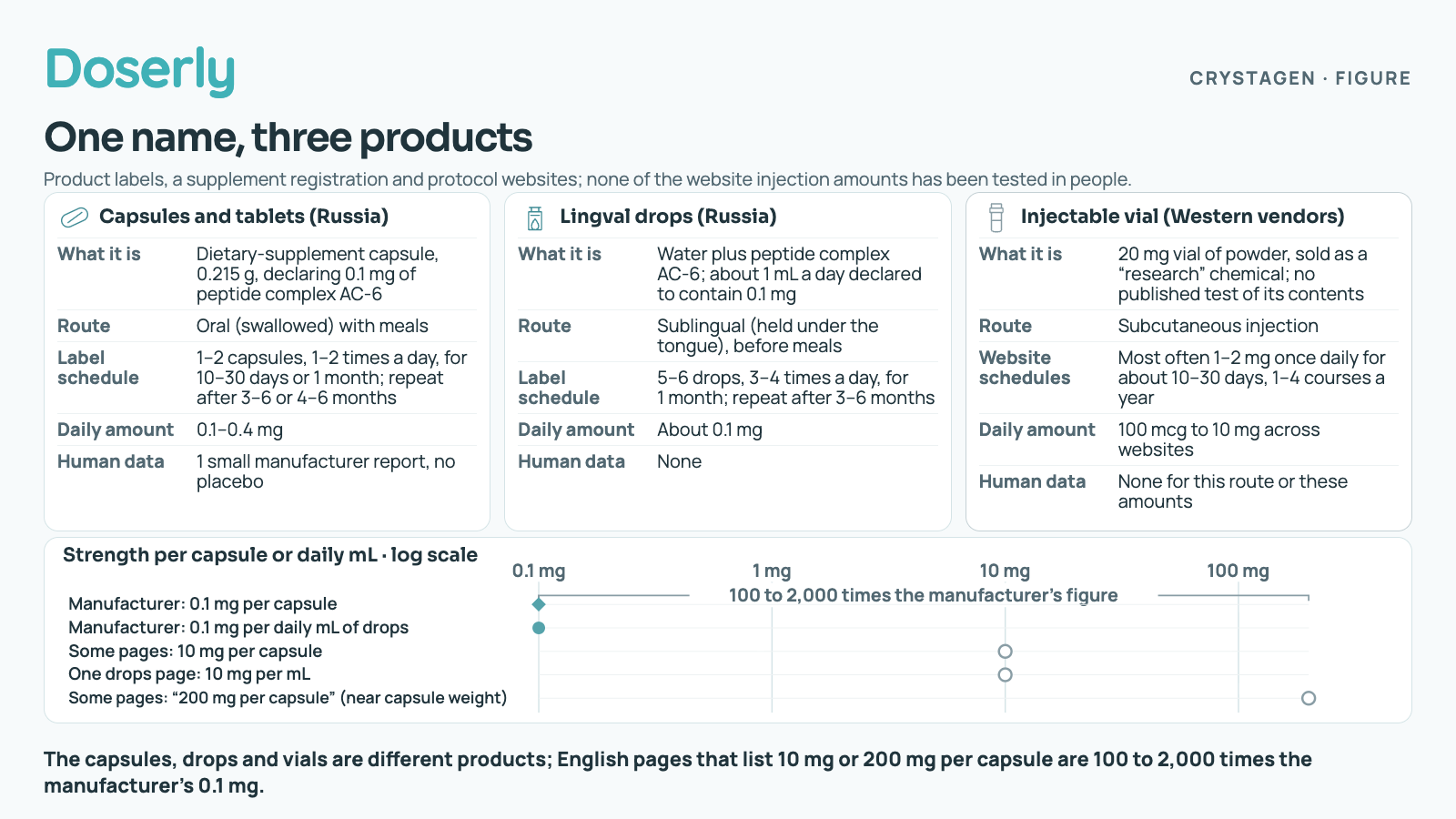
One name, three products
Product labels, a supplement registration and protocol websites; none of the website injection amounts has been tested in people.
- Capsules and tablets (Russia)
- What it is: Dietary-supplement capsule, 0.215 g, declaring 0.1 mg of peptide complex AC‑6Route: Oral (swallowed) with mealsLabel schedule: 1–2 capsules, 1–2 times a day, for 10–30 days or 1 month; repeat after 3–6 or 4–6 monthsDaily amount: 0.1–0.4 mgHuman data: 1 small manufacturer report, no placebo
- Lingval drops (Russia)
- What it is: Water plus peptide complex AC‑6; about 1 mL a day declared to contain 0.1 mgRoute: Sublingual (held under the tongue), before mealsLabel schedule: 5–6 drops, 3–4 times a day, for 1 month; repeat after 3–6 monthsDaily amount: About 0.1 mgHuman data: None
- Injectable vial (Western vendors)
- What it is: 20 mg vial of powder, sold as a “research” chemical; no published test of its contentsRoute: Subcutaneous injectionWebsite schedules: Most often 1–2 mg once daily for about 10–30 days, 1–4 courses a yearDaily amount: 100 mcg to 10 mg across websitesHuman data: None for this route or these amounts
- Strength per capsule or daily mL · log scale
- Manufacturer: 0.1 mg per capsule and per daily mL of drops. Some English pages: 10 mg per capsule, 10 mg per mL of drops, or “200 mg per capsule” (near the capsule weight), 100 to 2,000 times the manufacturer's figure.
The capsules, drops and vials are different products; English pages that list 10 mg or 200 mg per capsule are 100 to 2,000 times the manufacturer's 0.1 mg.
Typical Crystagen Protocols
| Example | Amount each time | Frequency | Total per day | Duration |
|---|---|---|---|---|
| Low | 1 capsule (0.1 mg) | Once daily | 0.1 mg | 10–30 days, repeated after 4–6 months Lower end of the manufacturer's label range [7] |
| Mid | 1 capsule (0.1 mg) | Twice daily | 0.2 mg | 1 month, repeated after 3–6 months Manufacturer catalog and 2025 registration [9], [6] |
| High | 2 capsules (0.2 mg) | Twice daily, with meals | 0.4 mg | 1 month, repeated after 3–6 months Top of the label range [9], [6] |
The most common capsule protocol in the reviewed sources is 1–2 capsules, 1–2 times a day with meals (0.1–0.4 mg a day), for 10–30 days (repeated after 4–6 months) or one month (repeated after 3–6 months). The same label wording appears on more than a dozen manufacturer, pharmacy and retailer pages in several languages, so it is one source copied many times rather than a dozen independent opinions. [6], [7], [9], [11], [12], [13]
- Titration Changing the amount in steps
- The label does not step the amount up or down. It gives a range, and the capsule count within that range is left open. The manufacturer's 2006 report instead chose 1–3 capsules, 2–3 times a day, depending on how abnormal each person's immune tests were. [7], [8]
Read the units: mcg means micrograms; 1 mg equals 1,000 mcg. A capsule weighs 0.215 g (215 mg), but only 0.1 mg of that is the declared peptide complex; the rest is filler and the capsule shell. A page that lists “200 mg per capsule” of active complex conflicts with the manufacturer's 0.1 mg; 200 mg is close to the whole capsule's weight, which is the most likely source of the error. [6], [8], [14]
Each row is a complete schedule from one source, so its amount and duration belong together. Low, mid and high are alternatives, not steps to move through. These capsule schedules come from the product label, not from trials that compared doses; the cited references give the full details.
Before using any of these numbers: check which product the number is for (capsule, drops or vial), because the usual amounts differ up to twentyfold and some pages are off by far more. Pages describing Crystagen vials give at least four wrong sequences, and no seller has published a test showing a vial contains Glu-Asp-Pro. Crystagen is marketed as an immune stimulant but has not been studied in people taking immune-suppressing medicines, in autoimmune disease, in pregnancy or breastfeeding, or in anyone under 18. It is not a substitute for vaccines, antibiotics or cancer treatment. [15], [16], [17], [18], [6] Read the risks.
What about the drops under the tongue?
| Example | Amount each time | Frequency | Total per day | Duration |
|---|---|---|---|---|
| Drops | 5–6 drops (0.25–0.35 mL) | 3–4 times daily, 10–15 minutes before meals | About 1 mL (about 0.1 mg) | 1 month, repeated after 3–6 months Manufacturer page and supplement directory [7], [19] |
| Ampoule | One 1 mL ampoule | Once daily | 1 mL (0.1 mg) | 1 month, repeated after 3–6 months Supplement directory listing for the ampoule form [19] |
Six drops four times a day is 24 drops, about 1.4 mL, while five drops three times a day is about 0.75 mL, so the label's “average daily dose of 1 mL” is an approximation. One Kazakh seller spells it out as 5 drops four times a day, 20 drops in all. [7], [20]
What about injectable vials?
| Example | Amount each time | Frequency | Total per day | Duration |
|---|---|---|---|---|
| Low | Not stated | Daily | 100–500 mcg | 10–20 days Protocol website; gives the amount per day and says it is extrapolated from general bioregulator advice [21] |
| Mid | 1 mg (1,000 mcg) | Once daily, at bedtime | 1 mg | 20 days, repeated 3–4 times a year Protocol website [10] |
| High | 1 mg in week 1, 1.5 mg in week 2, then 2 mg | Once daily | 1–2 mg | 12 weeks Step-up schedule from a vial-protocol website; the longest course found [22] |
The most common injectable pattern in the reviewed sources is 1–2 mg once a day by subcutaneous injection for about 10–30 days, repeated one to four times a year. Other pages range from 100 mcg to 10 mg a day. [23], [10], [24], [25], [26], [21], [17]
No study of subcutaneous Crystagen injections was found. The only injected human doses on record are 10 mcg or 5 mg into a muscle once a day for 10 days, in a patent example, and no website schedule traces back to it. No study has tested any of these website schedules, for effect or for safety. The usual 1–2 mg a day is 2.5 to 20 times the capsule label's 0.1–0.4 mg. [1], [27], [7]
In community education groups, educators give inconsistent amounts without citing a source: 1 mg a day by subcutaneous injection at bedtime for 20 days, three or four times a year; or an unclear 2–5 mg per course, in a 10-day course twice a year. Members mostly apply a general rule of 1–2 mg a day for 10–30 days to every bioregulator, and one educator described it as a blanket rule used because no established protocol exists.
Where protocols differ: products, units, study doses and course length ↓
Where these numbers come from
The capsule rows come from the manufacturer's product page (reference [7]), its English-language catalog (reference [9]) and the 2025 Russian supplement registration (reference [6]). The low row is the bottom of the label's own range; the mid and high rows are the catalog's “1 or 2 capsules twice daily”, which it says contain 0.2 or 0.4 mg. The 0.1 mg per capsule figure appears in the manufacturer's 2006 report and matches the catalog. [8]
The drop rows come from the manufacturer's page and a Russian supplement directory. [7], [19]
The injection rows come from three protocol websites that each publish a complete schedule: reference [21] for the low row, [10] for the mid row and [22] for the high row. References [23], [24], [25], [26] cross-check the recurring 1–2 mg pattern. Two other pages share the high row's 1 mg, 1.5 mg and 2 mg step-up. [18], [25]
Excluded from the typical comparison: pages that name the wrong molecule (Lys-Glu-Asp, Glu-Asp-Gly, Thr-Glu-Asp or an IGF-1 fragment); oral amounts of 10–200 mg a day, which are 100 to 2,000 times the manufacturer's capsule content; capsule strengths of 10 mg or 200 mg; and a page that states 10 mg per millilitre of drops, 100 times the manufacturer's figure. [15], [16], [17], [18], [28], [29], [30], [31], [14], [32]
What is Crystagen commonly used for?
People usually look into Crystagen because their immune system seems to be letting them down: an older relative who catches everything, colds that come one after another, slow recovery after COVID-19 or surgery, or low blood counts after radiation or chemotherapy.
The manufacturer lists a long range of uses, from frequent colds and age-related immune decline to infections “of any type”, recovery after surgery, heart attacks and strokes, weakened immunity after chemotherapy and radiation, and cancer prevention. It also says Crystagen is not a medicine and is taken alongside main treatment. Online, people also discuss it for longevity and for autoimmune conditions. The reports below describe that interest; they do not establish that Crystagen prevents or treats any of these conditions. [7]
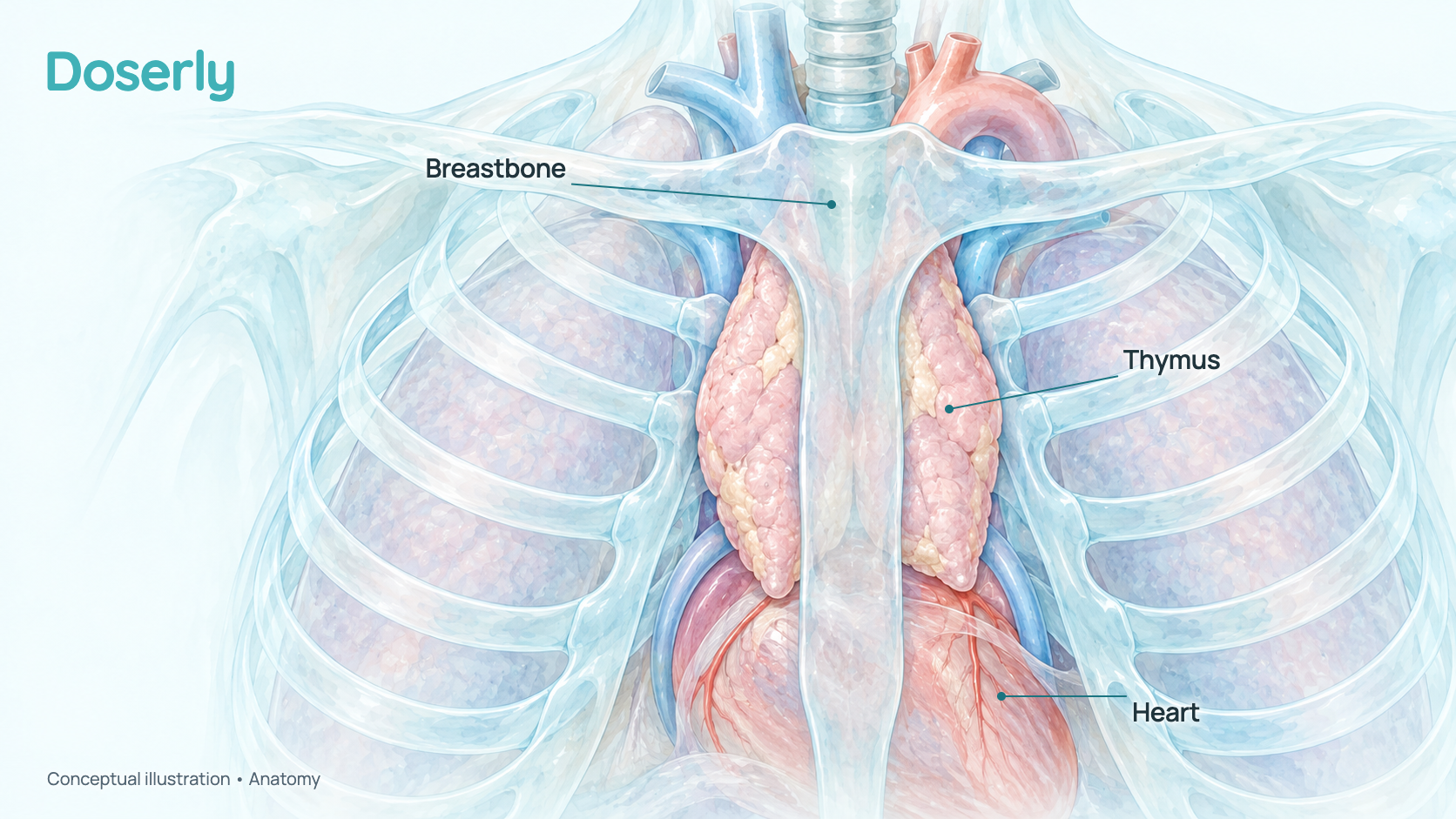
Age-related immune decline
This is where the human research sits. The patent's human series enrolled 38 people aged 62–83 with weakened immune test results after long-term exposure to low-dose radiation. The manufacturer's 2006 report enrolled 40 adults aged 38–69, half after low-dose radiation exposure and half after cancer radiation or chemotherapy. [2], [8]
Both describe immune blood tests moving toward normal over 10–20 days, but neither used a placebo, and both come from the developer's network. What the human reports can and cannot show.
Frequent colds and seasonal infections
Seasonal “immune prep” is a common reason in public accounts. Reviewers describe taking capsules at the first sign of a cold, getting through a family illness “easily”, or recovering faster from recurring infections. Colds come and go on their own, and none of these accounts counted infections before and after, so they cannot show that Crystagen changed anything. No study has measured whether Crystagen reduces infections. [33], [34], [35]
After radiation, chemotherapy or surgery
The 2006 report included 20 people after cancer radiation or chemotherapy and reported that all of them completed their treatment, compared with 79% of the control group. The report does not explain how completion was decided, and no random assignment is described. Retail reviews describe using capsules around fibroid surgery, alongside usual care. [8], [36], [37]
Crystagen is not a cancer treatment. Anyone having chemotherapy or radiation should talk with their oncology team before adding any supplement.
Autoimmune conditions
Some people with rheumatoid arthritis or other autoimmune conditions ask about Crystagen, and one retail reviewer took it alongside methotrexate. No study has tested Crystagen in autoimmune disease. Because it is marketed as an immune stimulant, this is a group with more reason for caution, not less. [38] Who should be especially cautious?
Other uses you may come across
Some pages describe Crystagen as a longevity or brain peptide, or as a treatment for COVID-19, cancer or “immune aging reversal”. Those claims go beyond the evidence. The brain description appears to be copied from a different peptide, and no human study has tested Crystagen for any of these outcomes. [7], [26], [15]
Where do Crystagen protocols differ?
The capsule label is easy to summarize. The disagreements start when a page mixes up the three products, the units, or Crystagen itself with a different peptide. Here is what varies and why it matters.
Capsule, drops or vial: which product is the number for?
Always check this first. The capsules declare 0.1 mg of peptide complex each; the drops declare 0.1 mg per average daily millilitre; the vials contain 20 mg (20,000 mcg) of powder. The label's highest daily amount, 0.4 mg, is 2.5 to 5 times lower than the 1–2 mg a day most injection pages describe. One calculator page warns readers not to convert capsule counts into vial milligrams, and that is good advice. [9], [7], [23]
Why do some pages list 10 mg, 200 mg or 100–200 mg a day by mouth?
Several English pages give capsules of 10 mg of active peptide, or 200 mg per capsule, and some databases give oral amounts of 10–20, 20–40 or 100–200 mg a day. Every manufacturer document found says 0.1 mg per capsule, so those figures are 100 to 2,000 times too high. The 200 mg figure is close to the capsule's weight (215 mg), and the others have no traceable source. A page selling the drops states 10 mg per millilitre, 100 times the manufacturer's 0.1 mg. [31], [14], [28], [29], [30], [32], [8]
Is it even the same molecule?
Not always. Some vial and database pages give Crystagen's sequence as Lys-Glu-Asp (a different peptide, Vesugen), Glu-Asp-Gly, Thr-Glu-Asp, or even a fragment of insulin-like growth factor 1 (IGF-1). One lists it under the code T-38, which belongs to Lys-Glu-Asp in the original research; Crystagen's code is T-36. Retail pages disagree too: some list glycine or alanine instead of proline, and one Swedish page describes an “AC-5” formula with arginine. [15], [16], [17], [18], [39], [5], [40], [41], [14], [42]
A dose table cannot fix a molecule mismatch. A page that names the wrong peptide cannot tell you anything about Crystagen.
Is the number for one dose or the whole day?
Two capsules twice a day is four capsules, or 0.4 mg, for the day. The label's “1–2 capsules, 1–2 times a day” therefore covers anything from 0.1 to 0.4 mg a day. The 2006 report's “1–3 capsules, 2–3 times a day” reaches 0.9 mg. For injections, most pages give a single daily amount, so the dose and the daily total are the same number. [6], [8]
Which amounts were actually used in people?
Three human schedules have been published for Crystagen's peptide or its capsules, and none matches the injection websites. A separate skin study used the peptide only inside a four-peptide mixture, so it has no Crystagen schedule of its own.
| Where it was used | Product and route | Amount and schedule | What it can tell you |
|---|---|---|---|
| Patent example (older adults) | Lab-made Glu-Asp-Pro, intramuscular injection (into a muscle) | 10 mcg or 5 mg once daily for 10 days, chosen by severity [2], [1] | The only injected human doses on record; the two amounts differ 500 times, and the patent does not say how many people got each |
| 2006 manufacturer report | Supplement capsules, oral | 1–3 capsules (0.1 mg each), 2–3 times daily before meals, for 15–20 days (0.2–0.9 mg a day) [8] | The only published oral schedule used in patients |
| 2012 athlete report | Crystagen capsules plus Pinealon capsules, oral | 1 capsule of each, twice daily with meals, for 20 days [43] | A combination; it cannot show what Crystagen did on its own |
The patent is not consistent with itself here. Its animal safety section says the single doses given to mice, up to 5 mg per kg, exceeded the therapeutic dose recommended for clinical use “by more than 5000 times”, which points to a microgram-range dose like the 10 mcg arm rather than 5 mg. The patent never states that recommended dose, and an animal safety margin cannot set a human dose. [2]
How far apart are the amounts?
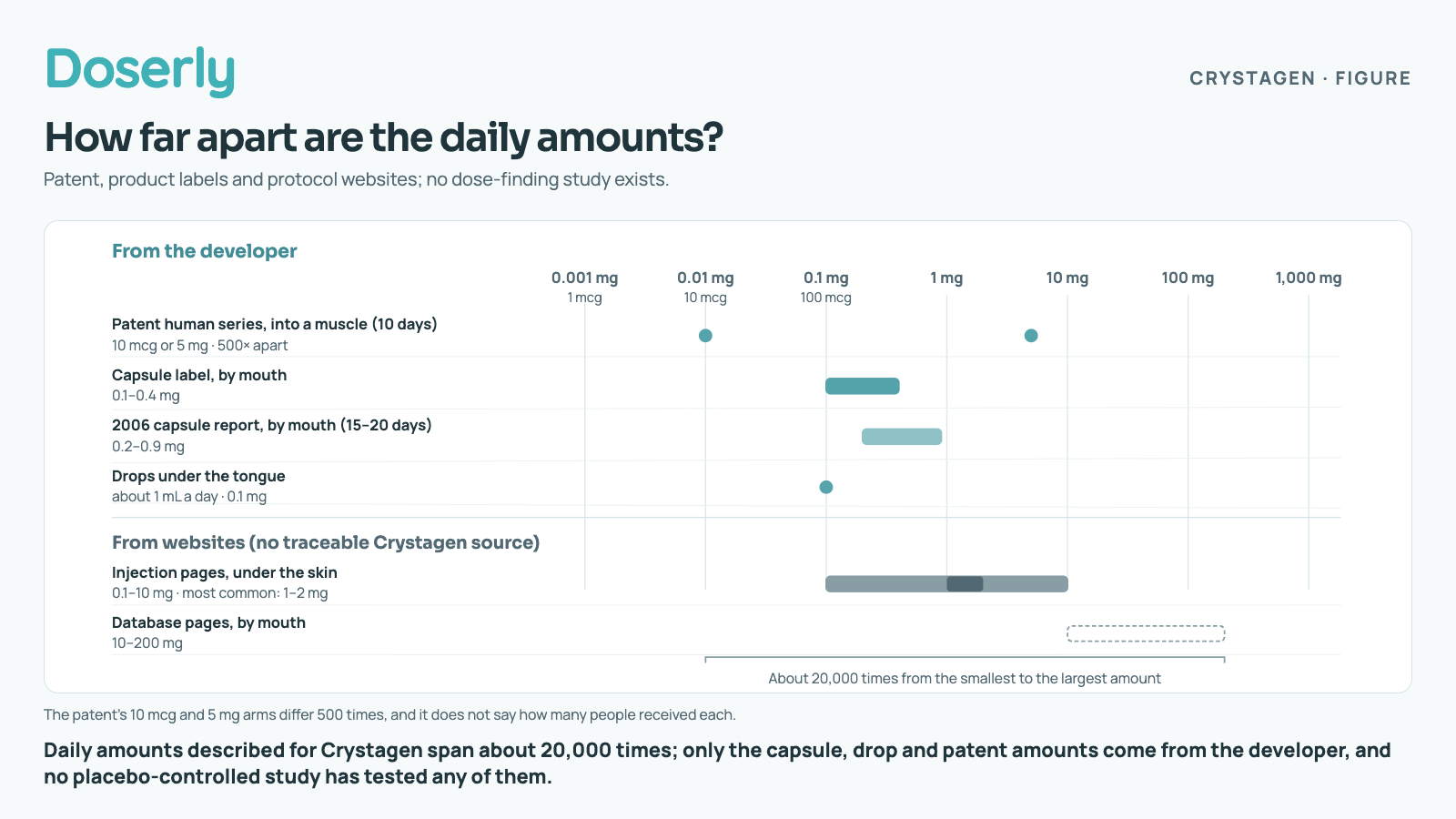
How far apart are the daily amounts?
From the developer
- Patent human series, into a muscle (10 days)
- 10 mcg or 5 mg a day into a muscle, chosen by severity.
- Capsule label, by mouth
- 0.1–0.4 mg a day by mouth.
- 2006 capsule report, by mouth (15–20 days)
- 0.2–0.9 mg a day by mouth.
- Drops under the tongue
- About 0.1 mg a day under the tongue, about 1 mL a day.
From websites (no traceable Crystagen source)
- Injection pages, under the skin
- 0.1–10 mg a day under the skin; most common 1–2 mg.
- Database pages, by mouth
- 10–200 mg a day by mouth.
About 20,000 times from the smallest to the largest amount. The patent's 10 mcg and 5 mg arms differ 500 times, and it does not say how many people received each.
Daily amounts described for Crystagen span about 20,000 times; only the capsule, drop and patent amounts come from the developer, and no placebo-controlled study has tested any of them.
How long is a course, and how often is it repeated?
Capsule sources agree on about 10–30 days or one month, repeated after 3–6 or 4–6 months. The manufacturer's combination programs, which pair Crystagen with other products, run longer, up to 3–6 months. Injection pages range from a 10-day course to 12 weeks, repeated anywhere from once or twice a year to four times a year. [7], [6], [44], [24], [22], [10], [23]
These are different conventions, not results from a trial comparing course lengths. The patent's human series lasted 10 days and the 2006 report 15–20 days; nothing longer has been studied, and a 12-week daily injection course is far outside anything tested. [2], [8]
Do sources start low and step up?
The capsule label does not. Three injection pages share the same step-up ladder: 1 mg a day in the first week, 1.5 mg in the second, then 2 mg. No source explains where it came from, and no study has tested a step-up. The 2006 report did the opposite of a ladder, choosing the amount at the start by how abnormal each person's immune tests were. [22], [18], [25], [8]
How do milligrams convert to syringe units?
Injection pages often give amounts as “units” on an insulin syringe. A U-100 syringe holds 100 units per millilitre, so units measure volume, not an amount of Crystagen. How much Crystagen each unit holds depends on how much water was added to the vial (reconstitution).
For example, a 20 mg vial mixed with 2 mL of water holds 10 mg per mL, so 1 mg is 0.1 mL, or 10 units. Mixed with 3 mL, the same 1 mg is 15 units. Check the arithmetic on any page you read: one tells readers to add 2.5 mL to a 20 mg vial and calls the result 2 mg per mL, when it is actually 8 mg per mL, so its “10 units = 200 mcg” would deliver 800 mcg, four times the stated amount. Another adds 2 mL and calls it 5 mg per mL instead of 10. Doserly's reconstitution calculator works this out for any vial and shows each step. [10], [22], [15], [18]
Source-by-source comparison
Capsules
Unit key: 1 milligram (mg) = 1,000 micrograms (mcg). A 0.215 g capsule weighs 215 mg but declares 0.1 mg of peptide complex.
The manufacturer's page gives 1–2 capsules 1–2 times a day with meals for 10–30 days, repeated after 4–6 months, and 2–3 courses a year for chronic illness. The 2025 registration gives 1–2 tablets or capsules 1–2 times a day with meals for one month, repeated after 3–6 months. Russian, Latvian and Bulgarian retailer pages repeat this wording, sometimes as 20–30 days. [7], [6], [11], [12], [13], [45]
The English-language catalog says “1 or 2 capsules twice daily during meals” for a month, repeated after 3–6 months, and that 2 or 4 capsules contain 0.2 or 0.4 mg. Another retailer gives the same schedule but 30 minutes before meals, and a third gives 2 capsules each morning for 1–3 months, repeated after 1–2 months. [9], [41], [46]
The manufacturer's combination programs list 2 capsules each morning (or 12–14 drops under the tongue) for set days of a multi-product program. [47]
Injections
PeptScope describes 100–500 mcg a day for 10–20 days and says the doses are extrapolated from general bioregulator advice. Research Dosing gives 1 mg once daily at bedtime for 20 days, 3–4 times a year. CalcMyPeptide describes about 1–2 mg a day for about 10 days. OnePin lists 1 mg in a 10-day course followed by 4–6 months off. DosagePeptide gives 1 mg, then 1.5 mg, then 2 mg a day for 12 weeks; Peptide Doser and VERIX publish the same step-up over shorter periods. Peptide Mind gives 2 mg a day for three weeks, but its schedule describes a brain-performance course copied from another peptide. PeptideAssistant gives 10 mg a day and names the wrong sequence. [21], [10], [23], [24], [22], [18], [25], [26], [17]
Some pages quote the patent instead of a website template, two of them cited here: 0.01–100 mcg per kg of body weight at least once a day, and the 10 mcg or 5 mg intramuscular example. [48], [49], [2]
Citation and identity problems
MyPeptideMatch calls Crystagen Lys-Glu-Asp; Peptide Protocol calls it Glu-Asp-Gly and gives 5–25 mg twice a week; Peptide Doser describes an IGF-1 fragment. Two Peptide Initiative pages credit Crystagen with a 266-person study of mortality that actually tested thymus and pineal extracts. PeptideInsight uses the code T-38 and a molecular weight of about 345; Crystagen is T-36 and weighs 359.33. [15], [16], [18], [50], [51], [39], [5], [2]
What happens when you stop Crystagen?
This has not been studied. Neither human report describes checking on people after their course ended, so nobody knows how long any change in immune tests lasted, or whether stopping causes a rebound. [2], [8]
- Repeat courses. The label suggests another course after 3–6 or 4–6 months, and 2–3 courses a year for chronic illness. It does not explain why, and no study has measured how long any effect lasts. [7], [6]
- Animal studies. In the irradiated-rat experiment, the thymus was examined on days 14 and 21 of the experiment, shortly after the 10-day course ended; nothing later was reported. [2]
- Personal accounts. The one public account with blood tests found no significant change in lymphocytes (a type of white blood cell) about two months after a thymus-peptide stack that included Crystagen, so there was no effect to fade. Read the accounts. [52]
Do capsules, drops and injections of Crystagen behave the same way?
No one has measured this in any species. An oral capsule has to survive stomach acid and digestive enzymes and then cross the gut wall before anything reaches the blood. Sublingual drops are held under the tongue, where some substances pass into small blood vessels, although any liquid that is swallowed takes the oral route. A subcutaneous injection skips digestion and is absorbed from the fatty layer under the skin. Those are different starting points, so a matching amount would not mean a matching exposure, and here the amounts do not even match.
Bioavailability is how much of a dose reaches the blood in the form being measured. For Crystagen it is unknown for every route. Computer-modelling studies by the developer's group predicted that Glu-Asp-Pro could fit gut transporter proteins (PEPT1, PEPT2 and LAT1), but a prediction is not a measurement of absorption. [3], [53]
How long does Crystagen last in the body?
Nobody knows. We found no pharmacokinetic study of Crystagen in people or animals: no half-life, no blood levels and no test of how quickly digestive enzymes break it down. Websites that give a half-life for Crystagen are not citing a measurement. [3], [2], [23], [30]
A half-life, even if one were measured, would not by itself say how often to take it or how long an effect lasts.
Does it go to the thymus?
Some pages say Crystagen “targets” the thymus. No study we found measured where Crystagen goes in the body. The idea comes from the bioregulator theory that each short peptide acts on its own tissue, which has been tested only in tissue pieces kept alive in a dish, where Crystagen's peptide also made brain-cortex, prostate and skin tissue grow. [2], [54], [55]
How should Crystagen be stored, and how long does it last?
It depends on the product. The capsules and drops come with storage instructions; for injectable vials, nobody has published a stability test.
- Capsules and tablets. The 2025 registration says to store them in a dry place, protected from light, at 2–25 °C (36–77 °F), with a shelf life of three years. [6]
- Drops. A supplement directory gives the same dry, dark, 2–25 °C storage and a three-year shelf life for unopened drops. Once a bottle is opened, the manufacturer says to keep it in the refrigerator and use it within 10 days. [19], [7]
- Vial powder and mixed vials. Protocol pages say to keep the freeze-dried powder frozen at −20 °C (−4 °F) and, once mixed, to refrigerate it at 2–8 °C (36–46 °F) and use it within 2–4 weeks or about 28 days. One claims a 24-month shelf life without any data. None cites a stability test of Crystagen. [18], [25], [15], [17]
The three-year shelf life is the manufacturer's statement, and the vial times are website claims. Health Canada warns that unauthorized peptide drugs may be improperly manufactured or stored, and cold storage cannot tell you what is in a vial (see product quality). [56]
What do we actually know about Crystagen in people?
Two small human reports exist, one on injections and one on capsules, and both come from the developer's network. Neither used a placebo, neither hid from patients or doctors who got the peptide, and we found neither published in a peer-reviewed journal. ClinicalTrials.gov has no Crystagen study. [2], [8], [27]
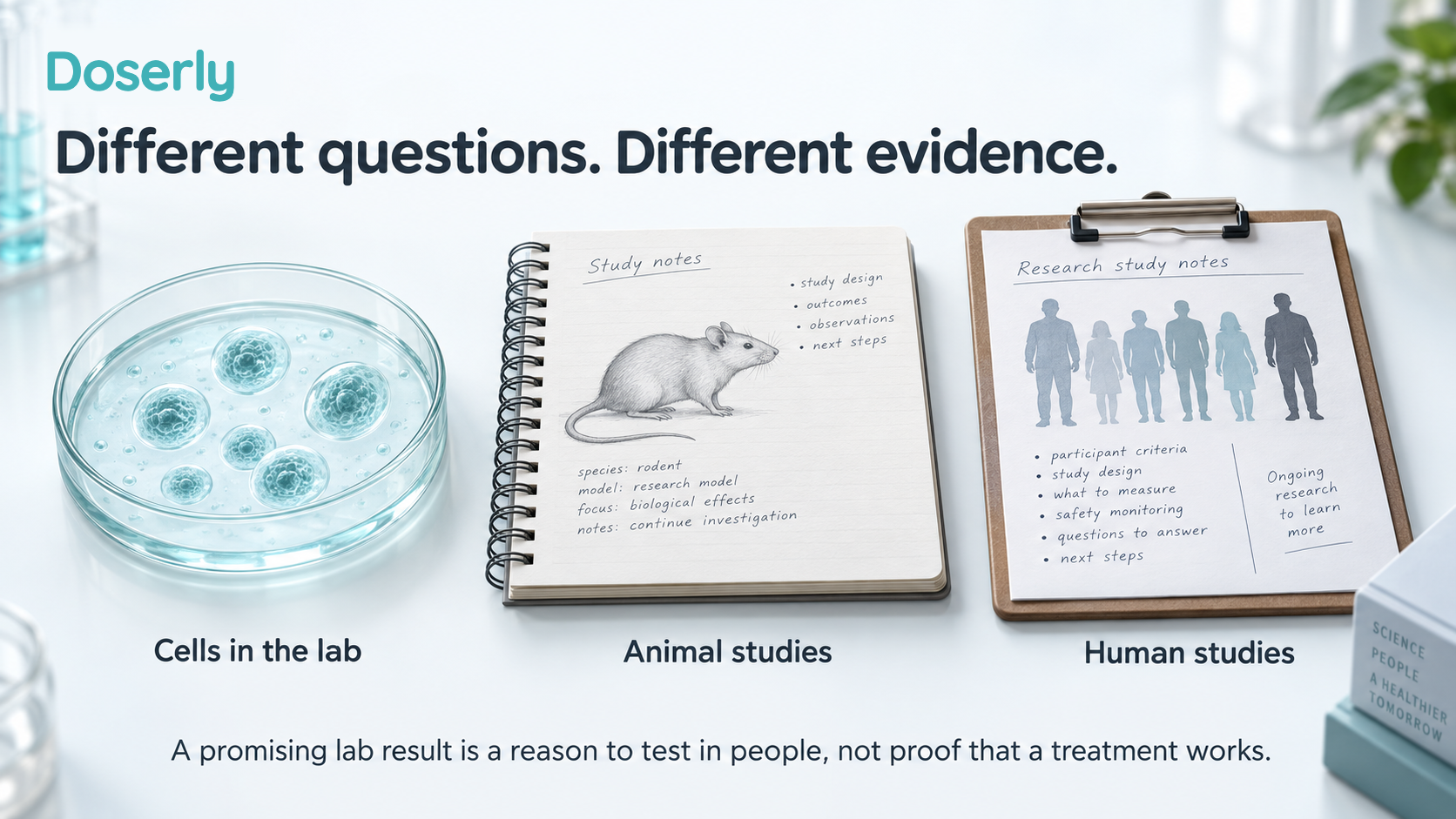
What did the human reports find?
| Report | What researchers reported | What it cannot establish |
|---|---|---|
| Patent example, older adults (filed 2006) | 38 people aged 62–83, exposed long-term to low-dose radiation, received 10 mcg or 5 mg of lab-made Glu-Asp-Pro by intramuscular injection daily for 10 days with usual treatment; 32 received usual treatment only. Immune test results “normalized” in 82% of the treated group and 56% of the control group. The share of CD3 cells (all T cells) rose from 43.5% to 55.7% and of CD4 cells (helper T cells) from 28.5% to 34.6%, and tiredness and weakness eased. | Whether Crystagen caused the change. Group assignment is not described, statistics were mainly tested against starting values, and the patent does not say how many people received each dose. [2], [1] |
| Manufacturer report on the capsules (2006) | 40 adults aged 38–69, half after low-dose radiation and half after cancer radiation or chemotherapy, took 1–3 capsules 2–3 times a day for 15–20 days with usual care; 30 had usual care only. Immune results normalized in 78%. In the radiation group, CD3 cells rose from 45.1% to 53.3% and CD4 cells from 26.3% to 32.1%; B cells and antibody levels did not change. | Whether the capsules caused the change. The report is unpublished, no random assignment is described, its table gives one “before treatment” column for both groups, and it gives no method for recording side effects. [8] |
Both state that no side effects were seen, but neither says how side effects were looked for. Both come from the developer's network: Khavinson is an inventor on the patent and approved the 2006 report. [2], [8]
Where does the “82% versus 56%” figure come from?
It is quoted on many websites, often as a result for oral Crystagen. It comes from the patent's human example, in which the peptide was injected into a muscle, not swallowed. A 2021 review by the developer's group described the same figures as coming from “oral administration”, and that error has spread. The capsule report gives a different figure, 78%, with no matching control percentage. [2], [4], [8]
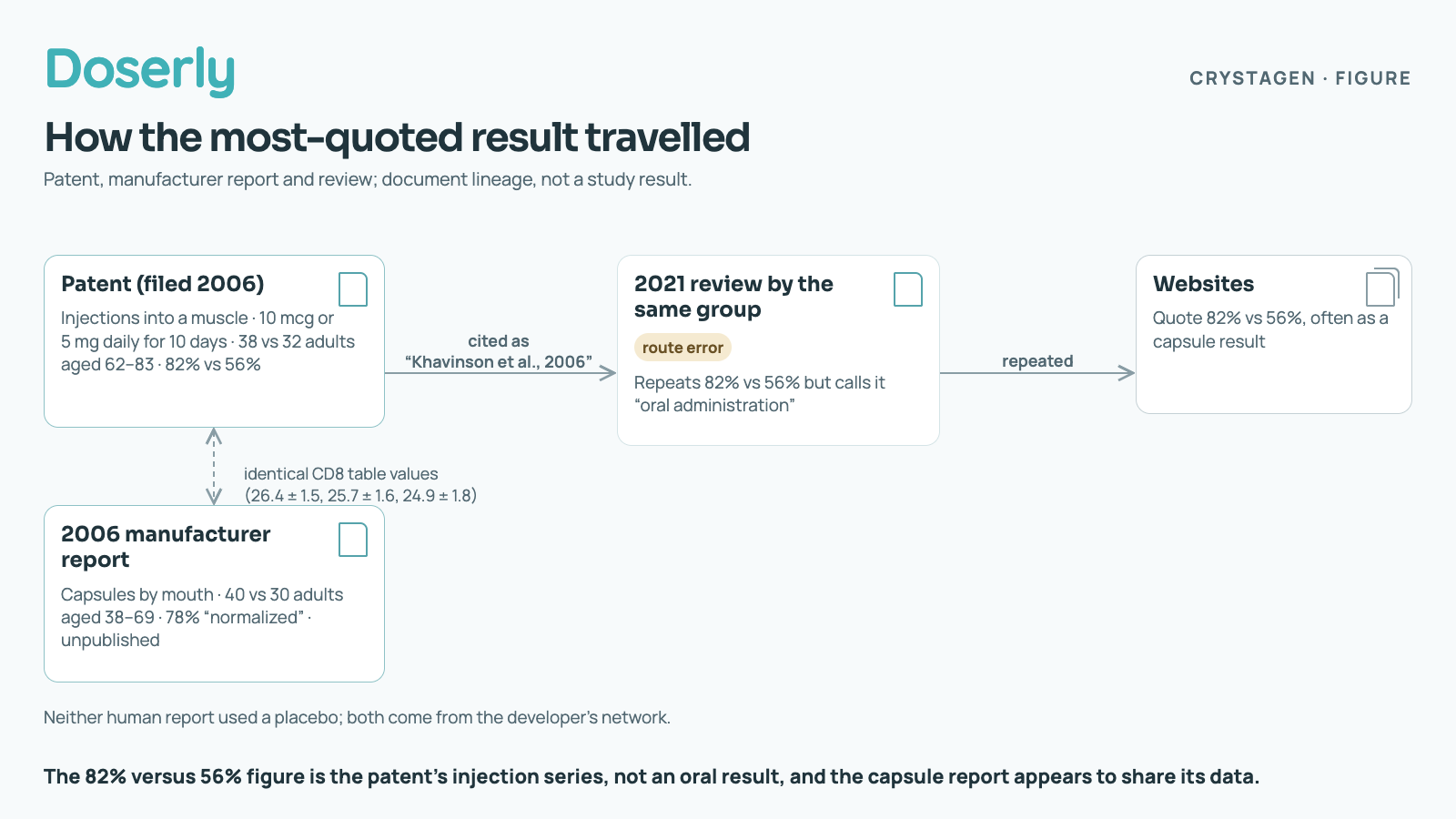
How the most-quoted result travelled
- Patent (filed 2006)
- Injections into a muscle · 10 mcg or 5 mg daily for 10 days · 38 vs 32 adults aged 62–83 · 82% vs 56%Cited by the 2021 review as “Khavinson et al., 2006”.
- 2006 manufacturer report
- Capsules by mouth · 40 vs 30 adults aged 38–69 · 78% “normalized” · unpublishedShares identical CD8 table values with the patent: 26.4 ± 1.5, 25.7 ± 1.6, 24.9 ± 1.8.
- 2021 review by the same group
- Repeats 82% vs 56% but calls it “oral administration”Repeated by websites.
- Websites
- Quote 82% vs 56%, often as a capsule result
Neither human report used a placebo; both come from the developer's network.
The 82% versus 56% figure is the patent's injection series, not an oral result, and the capsule report appears to share its data.
Why do the patent and the 2006 report look so alike?
Their tables share numbers that should not match. The CD8 cell values (26.4 ± 1.5, 25.7 ± 1.6 and 24.9 ± 1.8) are identical in both, even though one describes 38 adults aged 62–83 given injections and the other 40 adults aged 38–69 given capsules. Long passages of the two texts are also worded almost the same, and both come from the same institute and the same period. The most likely explanation is that at least part of one dataset appears in the other, so they should be read as one probably overlapping body of data, not two independent studies. [2], [8]
Some reseller pages also describe a 96-patient cancer study (58 treated, 38 controls, 83% improvement). We could not find any original document for it, and it is not counted as evidence here. [57], [45]
Does the athlete study show that Crystagen works?
No. A 2012 report from the developer's institute gave 12 elite rhythmic gymnasts Crystagen and Pinealon capsules together for 20 days and compared them with 8 gymnasts who received nothing. Activity of several genes linked to stress protection and energy use rose in the treated group. Because two peptides were given together and there was no placebo, the result cannot be credited to Crystagen. A 2012 review describes the same work as Crystagen alone against a vitamin comparison, which does not match the original. [43], [58]
A 2020 study of facial skin in 30 women used a mixture of four peptides applied with a mild electric current; Crystagen's peptide was one of the four, so that study cannot show anything about it alone either. [59]
What do immune blood tests measure?
The reports tracked the numbers of different white blood cells: CD3 cells (all T cells), CD4 cells (“helper” T cells that coordinate immune responses), CD8 cells (T cells that kill infected cells) and CD20 cells (B cells, which make antibodies), plus antibody levels (immunoglobulins). A standard full blood count does not show these subsets. [2], [8]
These tests matter because they are more objective than “I feel better”. But a lab value moving toward normal is not the same as fewer infections, better vaccine responses or a longer life, and neither report measured those outcomes. Without a comparison group given a dummy treatment, results can also drift toward normal on their own when people are first tested at their worst.
How might Crystagen work?
The developers' idea is that very short peptides act as signals that switch genes on or off in the cells of a particular tissue, here the thymus and other immune organs. The experiments below test pieces of that idea. They are preclinical (in cells, tissue pieces, animals and computer models), and almost all come from one research network.
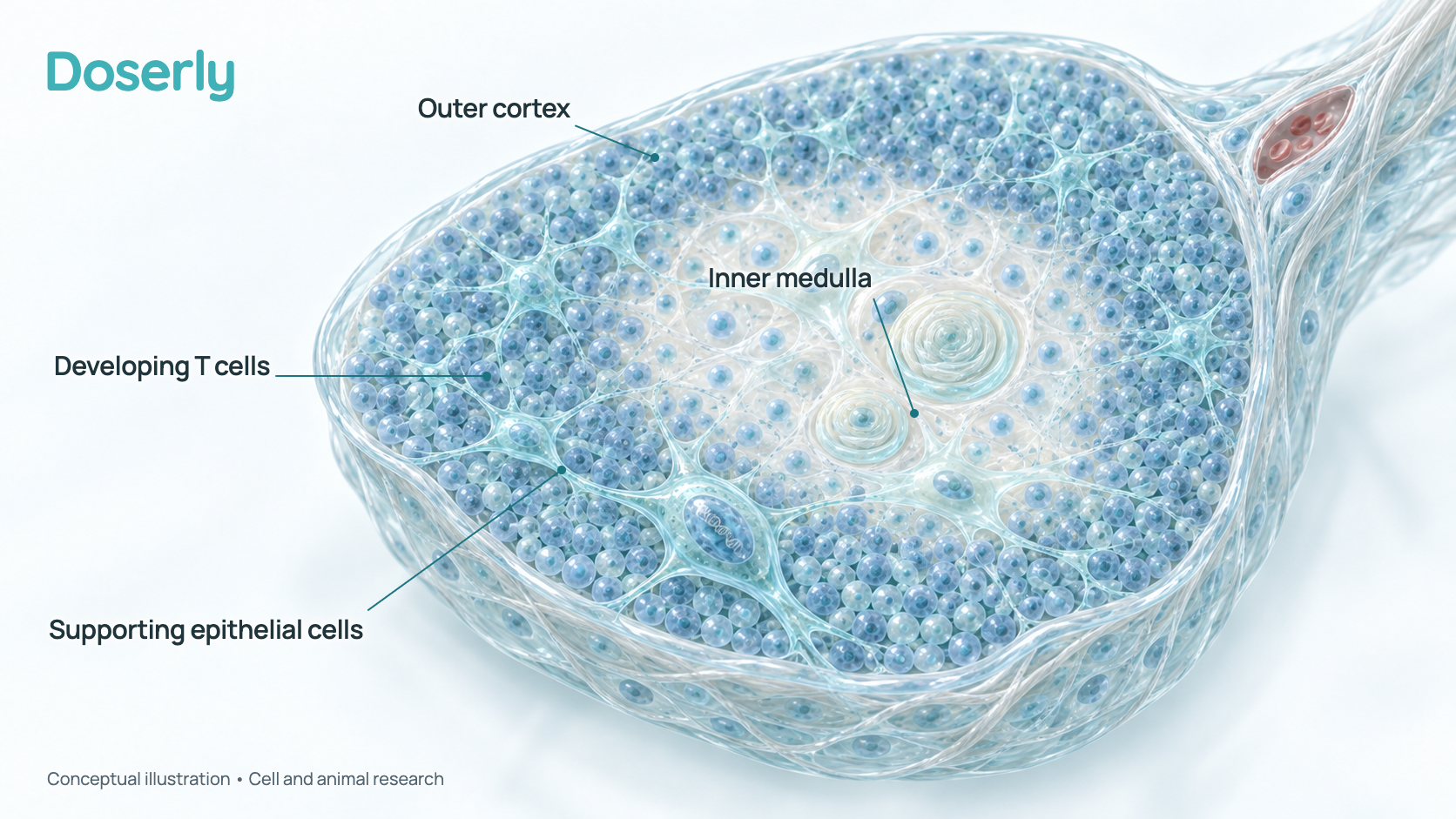
What happens to thymus and spleen tissue in a dish?
In tissue-culture experiments, researchers keep small pieces of organ alive in a dish and measure how much they grow. In the patent, the peptide increased growth of thymus pieces from 24-month-old rats by 24% and of spleen pieces by 28%, at tiny concentrations. Later papers from the same group reported spleen growth increases of 19–29% in young and old rats. [2], [60], [40]
A 2014 paper found that in spleen tissue from old rats, Crystagen raised a marker of B cells. The authors concluded it did not affect cell renewal, although their own table marks one small change in a renewal marker (p53) as significant. In a six-tissue screen that did not include any immune organ, it increased growth of brain-cortex and prostate tissue and had no effect on heart, liver, pancreas or deeper brain tissue. A 2025 paper said it tested Glu-Asp-Pro, but its results tables list a different peptide, so its numbers cannot be used. [61], [54], [62]
What happens in immune cells?
In cell studies (cells grown in a dish, not people), the peptide increased the share of human lymphocytes that transformed into actively dividing cells, from 2.3% to 10.0%. In a line of human thymus epithelial cells, the supporting cells that help T cells mature, it increased cell division, most clearly in older cultures (the seventh passage). In macrophages (immune cells that engulf germs) from old mice, it increased the release of signals that activate lymphocytes. [5], [2]
In lymphocytes from 95 healthy people aged 75–88, the patent reports that the peptide loosened tightly packed DNA (chromatin), which the authors read as reactivating silenced genes. A 2021 review by the same group describes the opposite effect, another sign that its summaries of the original work are unreliable. [2], [4]
Does Crystagen fight leukemia cells?
The original experiment says no. A 2011 paper tested Crystagen's peptide (T-36) and a different peptide (T-38) on K-562 leukemia cells. Its results state that T-36 did not change their growth; only T-38 slowed it. The paper's own summary, and later reviews, credit both peptides, and that error now appears on websites as a claim that Crystagen fights leukemia. [5], [4], [63]
What happened in irradiated rats?
In the patent, young rats given five days of radiation, which makes the thymus shrink as it does with age, then received 0.5 mcg of the peptide by subcutaneous injection daily for 10 days. Their thymus showed less shrinkage under the microscope and more dividing cells than untreated irradiated rats. The group sizes are not given, and these are the inventors' own unpublished data. [2]
Is Crystagen part of Thymalin?
In a sense. Thymalin is a medicine extracted from calf thymus that contains many peptides. A 2021 chemical analysis by the developer's group found Glu-Asp-Pro in Thymalin at 0.04 mg per gram. That makes Crystagen one small component of the extract, not a copy of it, and results for Thymalin cannot be transferred to Crystagen. A 2021 review credits this finding to an earlier 2020 paper, but that paper analysed other organ extracts and does not report Glu-Asp-Pro. [64], [4], [65] Is Crystagen the same as Thymalin?
Does it bind DNA?
A 2016 computer-modelling study predicted that Glu-Asp-Pro could attach to a particular short DNA sequence. That is a prediction, not an experiment, and nothing has shown it happening inside a living immune cell. [66]
Has anyone outside the developer's group tested it?
Almost every Crystagen experiment comes from one research network. We found a listing for one small 2016 experiment by another Russian team, which added Crystagen to blood cells from healthy volunteers in a dish and measured immune signals. The original is no longer online and we could not check it, so its results are not used in this guide. [67]
What are the risks and unanswered questions?
Is Crystagen safe?
Its safety in people has not been established. Both human reports say no side effects were seen, but neither described how side effects were collected, both were small and short, and no study has tested the 1–2 mg a day by subcutaneous injection that websites describe. [2], [8]
The patent's animal tests found no toxicity: single injections of up to 5 mg per kg in mice, and daily injections for 90 days in rats and six months in guinea pigs at up to 1 mg per kg, with blood tests and organ examinations. All the animals were male, and the patent reports no tests for damage to genes, effects on fertility or pregnancy, or cancer. These are the inventors' own data. [2]
What problems have actually been reported?
None attributed to Crystagen. The public forum account with blood tests mentioned “weird and unexpected side-effects” from one supplier's products in general, not from Crystagen specifically. Community education groups reviewed for this guide contained no first-hand reports of anyone using Crystagen at all, so their silence says nothing about safety. No published case report of harm from Crystagen was found, and no regulator warning names it. [52], [68], [69]
Could product quality change the risk?
Yes, and for Crystagen this is a bigger problem than usual. The capsules and drops declare a “peptide complex” without a published sequence, purity or test method. Injectable vials are sold as unregulated “research” chemicals under the Crystagen name with at least four different wrong sequences, and we found no published test showing that any vial contains Glu-Asp-Pro. [7], [15], [16], [17], [18]
Health Canada says unauthorized peptide drugs “have not been assessed for safety, efficacy, and quality”, may “contain too much, too little, or none of the active ingredient”, and could cause infection or allergic reactions. It has named several sister peptides from the same program (including Vilon, Pinealon and Epitalon) among seized unauthorized injectables. [56], [70], [71]
Does Crystagen cause cancer, or fight it?
Neither has been shown. There are no long-term human data and no animal cancer studies. In cells, the peptide increased division of lymphocytes and thymus cells but did not change the growth of leukemia cells either way. Claims that it prevents cancer or fights leukemia have no evidence behind them. [2], [5], [7]
Anyone with a history of cancer, or having cancer treatment, should raise any immune supplement with their oncology team. The 2006 report included people after cancer treatment, but it was not designed to judge cancer safety. [8]
Is Crystagen legal? Is it FDA-approved?
Checked September 24, 2026. Rules differ by country and change quickly. A “research use only” label does not make a product legal to sell or safe to use.
United States. Crystagen is not an FDA-approved medicine: searches of FDA's approved-drug database found no entry for Crystagen, Kristagen or Cristagen. It does not appear in FDA's categories of bulk substances nominated for pharmacy compounding (updated May 14, 2026) or on FDA's list of compounding ingredients that may pose significant safety risks. Absence from those lists is not an FDA judgment of safety or legality. [72], [73], [69]
Canada. No Health Canada notice names Crystagen. Health Canada says most injectable peptides are regulated as prescription drugs in Canada and that selling unauthorized drugs is illegal, and it has listed sister peptides such as Vilon and Pinealon among seized unauthorized injectables. [68], [70], [71]
Australia. We found no record that Crystagen is approved in Australia, and it is not named in the June 2026 Poisons Standard; a direct search of the Australian Register of Therapeutic Goods could not be completed. The TGA's May 2026 warning on imported peptides says they “may pose significant risks to patient safety” and that personal importation is permitted only if products are clearly and accurately labelled; its April 2026 guidance adds that importers need a prescription when one is required. A well-labelled product is therefore not automatically legal to import. [74], [75], [76]
United Kingdom. A search of UK government sites, which include the medicines regulator (MHRA), found no record for Crystagen. [77]
Russia. The capsules and tablets are registered as a dietary supplement (a “source of peptides”) under a 2025 certificate, and the drops under a 2015 registration whose current status on the official register we could not check. That is not a registration as a medicine, and the manufacturer says so. [6], [78], [7]
Is Crystagen banned in sport? Does it show up on a drug test?
Crystagen is not named on the World Anti-Doping Agency's 2026 list or on the 2027 list that takes effect on January 1, 2027. Category S0 bans at all times any substance “with no current approval by any governmental regulatory health authority for human therapeutic use”, and the 2027 list adds “peptides” to its examples. WADA has not ruled on Crystagen specifically, and a Russian supplement registration is not a medicine approval, so tested athletes should assume S0 can apply. [79], [80]
No published anti-doping test for Crystagen was found, and how long it could be detected is unknown.
Who should be especially cautious?
These groups have no safety data in people. That is a reason for caution, not proof of harm.
- Pregnancy and breastfeeding. The Russian registration lists both as reasons not to use it. [6]
- Children and teenagers. No study of Crystagen on its own included anyone younger than 38, and this guide is written for adults. The manufacturer labels the drops for ages 14 and up. [8], [2], [7]
- Autoimmune disease, transplants and immune-suppressing medicines. Crystagen is promoted as an immune stimulant and has never been tested in these groups. Whether it could work against those medicines is unknown; that is a theoretical concern, not a documented interaction. Never stop a prescribed immune medicine to try it.
- Cancer or cancer treatment. See the cancer question above.
- Bowel problems. The registration lists a tendency to bowel disorders as a reason not to use the tablets. [6]
- Competitive athletes. See the anti-doping section above. [80]
- People taking other medicines. Interactions have not been studied; see the next question.
Has Crystagen been tested alongside other medicines?
Not in any way that answers the question. In the human reports, everyone also received usual treatment, but the reports do not describe any interactions. Nothing is known about combining Crystagen with immune-suppressing medicines, vaccines, antibiotics, cancer treatment, blood thinners or other peptides. Bring a complete list of everything you take to a pharmacist or doctor. [2], [8]
It is also often taken in combinations: the manufacturer's own programs pair it with other bioregulators, and people stack it with Thymalin, Vilon, Thymogen, thymosin alpha-1, Epitalon or Pinealon. None of these combinations has been studied, and a stack makes any benefit or reaction impossible to attribute. [47], [52], [81], [43]
What should be monitored while using Crystagen?
No regulator has written a monitoring plan for Crystagen. The supplement is not a medicine, and the injectable vials are sold for laboratory research, with no approved label. What exists is a record of what the two human reports and the patent's animal safety tests checked. It can help you prepare questions for a clinician; it is not a personal testing plan. [6], [7]
What did the human reports check?
- Immune cell counts. Both measured CD3, CD4, CD8 and CD20 cells in the blood, the CD4 to CD8 ratio, and a test of how actively T cells respond. [2], [8]
- Antibodies. Both measured immunoglobulin M, G and A levels. [2], [8]
- Routine tests. Both list standard blood and urine tests. [2], [8]
- Symptoms and side effects. Complaints such as tiredness and weakness were recorded; side effects were reported as none, without saying how they were looked for. [2], [8]
What did the animal safety tests check?
The patent's toxicity tests examined blood counts, blood chemistry, clotting, potassium and sodium, the heart, breathing, liver and kidney function, and more than 20 organs under a microscope, in mice, rats and guinea pigs. The inventors reported no abnormal findings. [2]
Which measures matter, and why?
| Why it matters | What studies measured or reported | Tracking category |
|---|---|---|
| Infections, the reason most people try it | Not measured in any report, although fewer or milder infections is the outcome people want | Immune Function |
| Immune cell subsets | CD3, CD4, CD8 and CD20 cells in both human reports; a standard blood count does not show them [2], [8] | Blood work (Immune Function) |
| Tiredness and weakness | Reported to ease in the patent series [2] | Energy Levels; Daily Functioning |
| Autoimmune symptoms | Not studied; relevant for anyone with an autoimmune condition | Inflammation; Joint Health |
| Injection problems | Health Canada warns that unauthorized injectable peptides may cause infection or allergic reactions [70] | Side Effect Burden |
| Other changes in your routine | Seasonal illness, vaccination, recovery from surgery and other peptides can explain a change | Treatment Adherence |
Community education groups that discuss immune peptides often suggest testing before a course and 4–6 weeks after, and stopping after two measured courses that show no change. That is advice, not evidence. Health Canada advises anyone who has used an unauthorized injectable peptide and has health concerns to talk to a healthcare professional and to report side effects. [70]
What do people in public communities report?
Public accounts of Crystagen are few. Only three first-hand reports come from independent forums; most others are reviews on the websites of shops that sell it, usually from people who were also taking other products or recovering from an illness or operation. Community education groups mention Crystagen often but contained no first-hand reports of anyone using it. [82], [83], [52]
What do the positive reports look like?
The shop reviews describe a family getting through COVID-19 “easily” on 2 capsules twice a day alongside other treatments, a sore throat clearing after a few capsules, blood tests “normalizing” after fibroid surgery, and faster recovery from recurring infections. One reviewer who took it near the end of recovery from fibroid surgery wrote that it was hard to say whether time, the peptides or both had helped. [33], [84], [36], [37], [35]
On independent forums, one person who had used many peptides over six years described “only positive results” without singling out Crystagen. Another took a vial at 1 mg a day, at first thinking it was Thymalin, felt it was “pretty good” for their immune system and bought a second vial. [82], [83]
Most positive stories begin during an illness or recovery, and many include other peptides, supplements or medicines.
Does everyone notice a difference?
No. The most careful public account came from a person with low lymphocyte counts after COVID-19 who took Crystagen at 1–2 mg together with Vilon, Thymogen and thymulin. After about two months, they reported that the stack “didn't produce any significant effect on my lymphocites”. [52]
Community education groups teach that feeling nothing is the most likely outcome with this class of peptides, and members describe the same for its sister thymus peptide, Vilon, including one person whose immune blood panels did not change after two courses.
What about unwanted effects?
No public account described a reaction attributed to Crystagen. One rheumatoid arthritis patient who took it alongside methotrexate and two other peptides reported feeling better within a week; no disease measures were given, and that single account says nothing about safety in autoimmune disease. [38] See reported problems.
What do community education groups teach?
Educators describe Crystagen inconsistently. One described it as coming from bronchial (airway) tissue, which is the profile of a different lung peptide. Another reproduced a retailer's list of disease claims, from COVID-19 to cancer prevention. A third offered it as an add-on to Thymalin for immune and nervous-system support, with an unclear amount of 2–5 mg per course. One educator suggested 10–30 day courses two or three times a year for older adults, paired with thymosin alpha-1.
Their more general advice is more cautious: short courses rather than continuous use, one new compound at a time, measuring immune cell subsets before and after, and stopping after two measured courses that show no change. Members, by contrast, often order five to eight bioregulators at once, and several noted that the vials come without test certificates, with bulk-order minimums and interrupted supply.
How can you judge an immunity story?
Ask: Was an infection already clearing, or a season ending? Capsule, drops or vial, and how much? What else changed: other peptides, vitamins, a vaccine, recovery after surgery? Was anything measured the same way before and after, such as sick days or lymphocyte counts? What happened months later?
These selected discussions are not a survey of all users, a response rate or a substitute for controlled studies. Several reviews sit on shop websites that may moderate or select them, so some accounts may be promotional. [33], [36]
How does Crystagen compare with Thymalin, thymosin alpha-1 and Pinealon?
Crystagen is often discussed alongside Thymalin, the thymus extract that contains its peptide, thymosin alpha-1, the best-studied immune peptide, and Pinealon, the sister peptide it was paired with in the athlete report. The table compares what each one is and how much human evidence exists.
| Compound | What it is | How it is taken | How often | Human evidence | Approval status |
|---|---|---|---|---|---|
| Crystagen (this guide) | Three amino acids (Glu-Asp-Pro) from a Russian research program, promoted for the thymus [2] | Capsules and drops by mouth; vials by subcutaneous injection, according to protocol websites [6], [10] | Capsules 1–2 times a day for 10–30 days; vial websites once daily for 10–30 days [7], [23] | Two small reports on immune blood tests without a placebo, probably sharing data [2], [8] | Supplement in Russia; not an approved medicine [6], [72] |
| Thymalin (no Doserly guide) | An extract of calf thymus containing many peptides, including Crystagen's [64] | Injection into a muscle [85] | 10 mg once daily for 10 days in a 2021 trial [85] | A small randomized, placebo-controlled, single-blind trial in 80 adults with severe COVID-19, from the same network, reported faster recovery of immune cell counts [85] | Registered medicine in Russia; not FDA-approved [85], [72] |
| Thymosin alpha-1 | A lab-made copy of a 28-amino-acid peptide first purified from calf thymus [86] | Subcutaneous injection [87] | 1.6 mg twice a week for 6–12 months in hepatitis B (label) [87] | Many trials: a Cochrane review of 10 hepatitis B trials was “not sure” it helps, and a 1,106-person sepsis trial found no fewer deaths [88], [89] | Prescription medicine in Singapore; not FDA-approved [87], [86] |
| Pinealon | Three amino acids (Glu-Asp-Arg) from the same research program [90] | Capsules by mouth in the published reports; injectable vials are also sold [91], [71] | One report: a 100 mcg capsule twice a day for two weeks [91] | A small report in railway workers and the combination athlete report, neither with a placebo [91], [43] | Not approved; Health Canada lists injectable Pinealon among seized unauthorized drugs [71] |
The real differences are in how much has been tested. Thymosin alpha-1 is a licensed medicine in some countries and has been through placebo-controlled trials, with mixed results. Thymalin has a small randomized trial from the developer's network. Crystagen and Pinealon have only a few small reports from the same network. No study has compared Crystagen with any of them. People also stack Crystagen with Vilon, a two-amino-acid sister peptide (Lys-Glu) tested alongside it in the 2014 spleen experiment, and with Epitalon; those combinations are untested too. [4], [61], [81]
Common questions about Crystagen
Is Crystagen a pill or an injection?
Both are sold, and they are different products. The original Russian Crystagen is a capsule taken with meals, declaring 0.1 mg of peptide complex, and there are also drops held under the tongue. Western vendors sell 20 mg vials of powder for injection. Only the capsules and drops have a product label, and the only human report on capsules is the manufacturer's own. [6], [7], [8] See the three protocol tables.
Is Crystagen the same as Thymalin?
No. Thymalin is an extract of calf thymus containing many peptides; Crystagen is one lab-made three-amino-acid peptide found in that extract in small amounts (0.04 mg per gram). Thymogen (Glu-Trp) and Vilon (Lys-Glu) are other short peptides from the same thymus research, and thymulin and thymosin alpha-1 are different thymus peptides again. People often confuse them, and one public poster bought Crystagen thinking it was Thymalin. Research on one cannot be counted as research on another. [64], [4], [83]
Is Crystagen the same as Vesugen, T-38 or “Cytogen”?
No. Crystagen's research code is T-36 (Glu-Asp-Pro). T-38 is Lys-Glu-Asp, the peptide sold as Vesugen, and some websites mix them up, including the claim that Crystagen slows leukemia cells, which belongs to T-38. “Cytogen” is the manufacturer's name for its line of lab-made peptide supplements, of which Crystagen is one. A different molecule, Glu-Asp-Pro amide, studied for testosterone in rats, is not Crystagen either. [5], [40], [39], [9], [46], [92]
How long does Crystagen take to work?
There is no reliable answer. The human reports measured immune blood tests after 10–20 days. Retail reviewers describe feeling better within days to weeks, often while an illness was already clearing, and the one person with before-and-after blood tests saw no change after two months. [2], [8], [38], [52] See what people reported.
Can Crystagen replace vaccines or immune treatments?
The reviewed evidence gives no reason to think so. In both human reports, Crystagen was added to usual treatment, not used instead of it, and no study has measured whether it prevents or shortens infections. Stopping a vaccine, antibiotic, cancer treatment or prescribed immune medicine to try it could be dangerous. [2], [8], [7] See cautions.
Is it legal to buy Crystagen?
It depends on the country and the product. The capsules and drops are registered as supplements in Russia. Crystagen is not approved as a medicine in the United States, and Health Canada says most injectable peptides are prescription drugs there. A “research use only” label does not make a product legal or safe. See the dated legal-status summary. [6], [72], [70]
Is a longer course more likely to work?
Nothing shows that. Courses range from 10 days to 12 weeks across the sources, and no one has compared them. The longest course studied in people was 20 days. Longer use also raises safety questions that short, small reports cannot answer. [22], [8]
Glossary
Plain explanations of the route, dosing and research terms used in this guide. Underlined terms in the text link here.
- Adverse event
- A harmful or unwanted medical event reported after someone used a treatment. A report alone does not prove the treatment caused it.
- Amino acid
- A small chemical building block. Chains of amino acids make up peptides and proteins.
- Animal study
- Research in animals such as rats or mice. It shows what a substance does in a living body, but results in people can differ.
- Bioavailability
- How much of a dose reaches the bloodstream in a usable form. It depends heavily on the route. For Crystagen it has not been measured by any route.
- Bioregulator
- The name a Russian research group uses for very short peptides it believes act on particular tissues. It is a marketing and research label, not a regulatory category.
- CD3, CD4, CD8 and CD20 cells
- Types of white blood cells counted by a special blood test. CD3 marks all T cells, CD4 “helper” T cells, CD8 T cells that kill infected cells, and CD20 B cells, which make antibodies.
- Cell study (in vitro)
- Research on cells grown in a dish. It gives early clues about biology, but it is far from proof of benefit in people.
- Controlled trial
- A study that compares people who receive a treatment with a similar group who do not, often receiving a placebo instead. Randomly assigning people to each group makes the comparison fairer.
- Course and cycle
- A course is the period of repeated use, such as one month. A cycle is a course plus a planned break before any further use.
- Daily total
- All the amounts given in one day, added together. For example, 2 capsules of 0.1 mg twice daily is a 0.4 mg daily total.
- Dietary supplement
- A product sold as a food additive rather than a medicine. In Russia these are registered with lighter requirements than medicines and do not have to prove they work.
- Dose (amount each time)
- The amount given on one occasion. A protocol lists both the dose and how often it is given.
- Explant (tissue culture)
- A small piece of organ kept alive in a dish so researchers can watch it grow. Growth in a dish is not the same as a healthier organ in a living body.
- Half-life
- The time it takes for the measured level of a substance in the blood to fall by half. It is not the same as how long an effect lasts. Crystagen's has never been measured.
- Immunoglobulins (antibodies)
- Proteins made by B cells that recognize germs. Blood tests measure types such as IgM, IgG and IgA.
- Intramuscular (IM)
- Injected into a muscle. The patent's human series gave Crystagen's peptide this way.
- Investigational
- Still being studied and not approved by a regulator, such as the FDA, to treat any condition.
- Lymphocyte
- A type of white blood cell. T cells and B cells are lymphocytes.
- mcg and mg
- Micrograms and milligrams. 1 mg equals 1,000 mcg. Crystagen capsules declare 0.1 mg (100 mcg) each; injection amounts are usually written in mg.
- Oral
- Taken by mouth and swallowed, as a capsule, tablet or liquid.
- Peptide
- A short chain of amino acids. Crystagen is a chain of three, called a tripeptide.
- Pharmacokinetics
- How the body absorbs, moves, breaks down and removes a substance. For Crystagen, no such data exist in any species.
- Placebo
- A dummy treatment with no active ingredient, used as a comparison in studies.
- Preclinical research
- Studies done before research in people: cell studies, tissue cultures, test-tube experiments and animal studies.
- Reconstitution
- Mixing a freeze-dried powder with a sterile liquid so it becomes a solution. How long mixed Crystagen stays usable has not been tested.
- Research use only
- A label on products sold for laboratory research. It does not mean a product is approved, tested for human use or legal to sell as a medicine.
- Subcutaneous (SC)
- Injected into the fatty layer just under the skin. This is the route most injectable Crystagen descriptions use.
- Sublingual
- Held under the tongue so some of it can pass into small blood vessels there. Crystagen Lingval drops are taken this way.
- Syringe units
- Markings on an insulin syringe that measure volume. On a U-100 syringe, 100 units equal 1 mL. The amount of drug per unit depends on the vial's concentration.
- Thymus
- A small organ in the upper chest, behind the breastbone, where T cells mature. It shrinks and fills with fat with age.
- Titration
- Adjusting a dose in steps, usually starting lower and increasing if needed.
- WADA
- The World Anti-Doping Agency, which publishes the list of substances banned in sport.
Explore more of the research
Go deeper into the experiments behind the claims.
Across this guide, the citations include 11 original scientific papers on Crystagen's peptide: one small human study of a four-peptide mixture, seven cell and tissue-culture studies, one chemical analysis and two computer-modelling studies. The patent family and the unpublished manufacturer report are counted separately. The library below groups the Crystagen experiments by question. Paper counts are not counts of independent research teams: almost all come from one research network, and some may share data.
Thymus and spleen tissue in a dish · 5 papers, 1 patent
Does it make old thymus and spleen tissue grow?
Model: Thymus (35 pieces) and spleen (45 pieces) from 24-month-old rats kept alive in a dish for 48 hours, with the peptide at 0.5, 10 and 100 ng per mL.
Finding: Growth increased by 24% in thymus pieces at 0.5 ng per mL and by 28% in spleen pieces at 10 ng per mL.
Limit: Inventor data in a patent; growth in a dish is not a healthier immune system.
Does it change B cells in the aging spleen?
Model: Spleen pieces from 24-month-old male rats, 3 days in a dish at 0.05 ng per mL, alongside Vilon, Thymogen and another peptide.
Finding: Crystagen raised the area stained for CD20, a B-cell marker, from 0.032 to 0.048. The authors concluded it did not affect cell renewal, but their table marks a small p53 change (0.027 to 0.030) as significant; Ki67 and CXCL12 did not change.
Limit: The number of tissue pieces per group is not reported.
Does adding proline strengthen the effect?
Model: Spleen pieces from young (3-month) and old (20-month) rats at 0.05 ng per mL, with or without the amino acid proline.
Finding: Growth rose 22% in young and 19% in old spleen pieces with the peptide alone, and 31% and 45% with proline added. This paper names the peptide “Crystagen (Glu-Asp-Pro)”.
Limit: Same group; about 12–15 tissue pieces per group.
Is the spleen effect repeatable?
Model: Spleen pieces from young and old rats.
Finding: Glu-Asp-Pro increased growth by 29% in young and 23% in old spleen pieces.
Limit: Same group and method; not an independent replication.
Does it act on every tissue?
Model: Pieces of six rat tissues, each exposed to a panel of short peptides including T-36.
Finding: T-36 increased growth by 21% in one tissue and 24% in another, and had no effect on the other four.
Limit: A screening experiment; the group size per tissue is not reported.
Which 2025 result belongs to it?
Model: Immune organ pieces from rats.
Finding: The methods list Glu-Asp-Pro, but the results tables list a different peptide (Lys-Glu-Arg) instead.
Limit: An identity error; none of its numbers can be assigned to Crystagen.
Immune cells, skin cells and irradiated rats · 2 papers, 1 patent
Does it activate lymphocytes, and does it affect leukemia cells?
Model: Human lymphocytes and granulocytes, rat stem cells and fibroblasts, and K-562 human leukemia cells, with T-36 (Glu-Asp-Pro) and T-38 (Lys-Glu-Asp) at 0.01–1,000 ng per mL.
Finding: T-36 raised spontaneous lymphocyte transformation from 2.3% to 10.0% and slowed the growth of densely seeded rat stem cells. It did not change the growth of fibroblasts or K-562 leukemia cells; only T-38 slowed the leukemia cells.
Limit: The paper's abstract credits both peptides with the leukemia effect, contradicting its own results, and gives the key concentration inconsistently (1.0 versus 0.1 ng per mL).
Does it affect young and old skin tissue?
Model: Skin pieces from young and old rats with five three-amino-acid peptides (T-32, T-33, T-34, T-36 and T-38).
Finding: In young-rat skin, every peptide except T-34 stimulated cell growth, which includes T-36; in old-rat skin, the abstract highlights T-38.
Limit: Abstract only; concentrations and group sizes are not given.
What do the patent's cell and rat experiments claim?
Model: Macrophages from 2-month-old and 19–20-month-old mice; a human embryonic thymus epithelial cell line; lymphocytes from 95 people aged 75–88 and 25 young donors; and 40 rats given five days of radiation.
Finding: The peptide increased lymphocyte-activating signals from old-mouse macrophages, increased thymus epithelial cell division at later passages, loosened packed DNA in older people's lymphocytes, and was followed by less thymus shrinkage in irradiated rats given 0.5 mcg daily for 10 days.
Limit: Inventor data in a patent, not peer reviewed; rat group sizes not given; animal amounts cannot be converted to human doses.
Computer models and chemical analysis · 3 papers, 1 review
Where would it dock on DNA?
Model: Computer docking of 19 short peptides to DNA.
Finding: The model placed EDP on an “agat” DNA sequence.
Limit: A computer prediction, not an experiment.
Could gut transporters carry it?
Model: Computer models of the transporters PEPT1, PEPT2 and LAT1 with dozens of short peptides.
Finding: Crystagen (EDP) scored as able to fit these transporters, in the middle of the range.
Limit: A prediction; no absorption was measured.
Is it really in Thymalin?
Model: Chemical analysis (liquid chromatography with mass spectrometry) of the calf-thymus extract Thymalin.
Finding: Glu-Asp-Pro was present at 0.04 mg per gram, alongside Lys-Glu (Vilon) at 0.025 mg per gram.
Limit: Shows the peptide is a minor component of the extract; it says nothing about what Crystagen does on its own.
How this guide was researched
This guide is built from a thorough review of the sources cited throughout it: published scientific studies, patents, trial-registry searches, regulatory documents, product registrations and labels, and published protocol descriptions. We also reviewed public online forums and review sites, and community education groups, where people describe their own experiences with Crystagen.
The guide cites 92 sources, including 18 original scientific papers. Each type of source answers a different question. Studies show what researchers measured. Protocol descriptions show how Crystagen is typically used. Personal accounts show what individual people experienced. Every numbered citation links to its entry below, labeled by source type.
How this guide was made
Research and drafting were AI-assisted. Every cited source was checked against the original, except one listed paper that is no longer online and is marked as such, and the guide was reviewed and edited by Doserly before publication. It has not had an independent clinical review, and Doserly does not currently have medical reviewers. Doserly makes a medication and health-tracking app and runs Doserly Academy, both of which are promoted in this guide. Read our editorial policy for how guides are researched, updated and corrected.
This guide is for educational purposes. It summarizes what the reviewed sources report so the research is easier to understand; it is not medical advice. For a deeper dive, or to check any point for yourself, go straight to the cited sources.
Explore the sources
These are the documents cited in this guide. Studies, product labels, website advice and personal accounts answer different questions. A source being listed does not mean every statement on its page is endorsed.
Showing 92 sources
- 01
Пептид, обладающий иммуногеропротекторным действием, фармацевтическая композиция на его основе и способ ее применения (Peptide with an immunogeroprotective effect; RU2301074C1) ↗
Patent (human series and animal data)
Full text of the Russian original reviewed.
Result detail: Confirms the human doses as “5,0 мг” and “10,0 мкг” by intramuscular injection once daily for 10 days, and the 82% versus 56% result.
- 02
Peptide substance revealing an immunogeroprotective effect, pharmaceutical composition on its base and the method of its application (US8057810B2) ↗
Patent (human series and animal data)
Full text reviewed (US grant and WO publication).
Result detail: Claims H-Glu-Asp-Pro-OH (C14H21N3O8, 359.33 without counter-ion; acetate salt) at 0.01–100 mcg/kg at least once daily. Examples: rat thymus and spleen tissue, mouse macrophages, a human thymus epithelial cell line, lymphocytes from 95 people aged 75–88, irradiated rats (0.5 mcg per rat daily for 10 days), toxicity in male mice, rats and guinea pigs, and 38 older adults versus 32 controls given 10 mcg or 5 mg intramuscularly daily for 10 days (82% versus 56%). Inventor data, not peer reviewed; no allocation method; per-dose group sizes not given.
- 03
Transport of Biologically Active Ultrashort Peptides Using POT and LAT Carriers ↗
Review with computer modelling
Full text reviewed.
Result detail: Its table lists “Crystagen (EDP)” as an immunoprotector with transporter docking scores. Modelling only; no absorption measured.
- 04
The Use of Thymalin for Immunocorrection and Molecular Aspects of Biological Activity ↗
Review
Full text reviewed.
Limitation: Names “the tripeptide EDP (crystagen)”, but misreports its sources: calls the patent’s injection series “oral administration”, credits Crystagen with the leukemia-cell effect of a different peptide, describes the opposite chromatin effect to the patent, and cites the wrong paper for finding EDP in Thymalin.
- 05
Effect of tripeptides on lymphoid and stem cells ↗
Cell study
Full text reviewed.
Result detail: T-36 (H-Glu-Asp-Pro-OH) raised spontaneous lymphocyte transformation from 2.3% to 10.0% and did not change K-562 leukemia-cell or fibroblast growth; only T-38 (Lys-Glu-Asp) slowed K-562 cells. The abstract wrongly credits both.
- 06
Свидетельство о государственной регистрации RU.77.99.88.003.R.002096.08.25: БАД «КРИСТАГЕН®» (state registration certificate for the dietary supplement Crystagen) ↗
Supplement registration
Scanned certificate reviewed (Russian); read from a seller-hosted copy, not the live register.
Result detail: Tablets (0.215 g and 0.08 g) and capsules (0.215 g) registered as a dietary supplement; adults 1–2 tablets or capsules 1–2 times daily with meals for one month, repeated after 3–6 months; contraindications: individual intolerance, pregnancy, breastfeeding, tendency to bowel disorders (tablets); shelf life 3 years; store dry, protected from light, at 2–25 °C.
- 07
Кристаген: пептид тимуса (Crystagen: thymus peptide, capsules and Lingval drops) ↗
Manufacturer product page
Page reviewed (Russian): composition, indications, capsule and drop schedules, storage and contraindications.
- 08
Отчет о результатах клинического изучения биологически активной добавки к пище Кристаген (Report on the clinical study of the dietary supplement Crystagen) ↗
Human report
Full scanned report reviewed page by page (Russian).
Limitation: Unpublished and manufacturer-linked; 40 adults on 1–3 capsules (0.1 mg each) 2–3 times daily for 15–20 days versus 30 on usual care; no random assignment or blinding described; one “before treatment” column for both groups; its CD8 table values are identical to the patent’s.
- 09
Crystagen: Khavinson Peptide Products ↗
Manufacturer product page
Page checked: 1 or 2 capsules twice daily with meals for a month; 2 or 4 capsules contain 0.2 or 0.4 mg of peptide complex AC-6.
- 10
Crystagen: Research Dosing ↗
Protocol source
Page checked; source of the mid injection row (20 mg vial with 2 mL water; 10 units = 1 mg).
- 11
Кристаген: пептид для иммунной системы (Crystagen: peptide for the immune system) ↗
Protocol source
Page checked; repeats the label schedule.
- 12
Кристаген: биорегулятор иммунной системы, 60 капсул (Crystagen immune bioregulator, 60 capsules) ↗
Protocol source
Page checked; label schedule with a 20–30 day course.
- 13
- 14
Buy CRYSTAGEN® for immune system, 200 mg/cap, 60 caps/pack ↗
Protocol source
Page checked; gives “200 mg/cap” (the capsule weight, not the peptide) and lists alanine in its text but proline in its ingredient line.
- 15
Crystagen Dosing Protocol: 20 mg Vial ↗
Protocol source
Page checked; names the wrong sequence (Lys-Glu-Asp) and states 2 mg/mL for a 20 mg vial mixed with 2.5 mL (actually 8 mg/mL).
- 16
Crystagen: Research Profile ↗
Protocol source
Page checked; names the wrong sequence (Glu-Asp-Gly) and gives 5–25 mg twice weekly.
- 17
Crystagen: Dosage, Benefits & Side Effects (2026 Guide) ↗
Protocol source
Page checked; names the wrong sequence (Thr-Glu-Asp), gives 10 mg a day and claims a 24-month shelf life without data.
- 18
Crystagen (20 mg Vial) Dosage Protocol ↗
Protocol source
Page checked; describes an IGF-1 fragment instead of Crystagen, states 5 mg/mL for 20 mg in 2 mL (actually 10 mg/mL), and gives storage advice without stability data.
- 19
КРИСТАГЕН лингвал: инструкция по применению (Crystagen Lingval: directions for use) ↗
Supplement directory (label text)
Page checked (Russian): 5–6 drops (0.25–0.35 mL) 3–4 times daily or one ampoule daily, 10–15 minutes before meals, for a month; repeat in 3–6 months; store dry, out of sunlight, at 2–25 °C; shelf life 3 years.
- 20
Кристаген лингвал: биорегулятор иммунной системы (Crystagen Lingval: immune bioregulator) ↗
Protocol source
Page checked: 5 drops four times a day; 20 drops = 1 mL = 0.1 mg.
- 21
Crystagen ↗
Protocol source
Page checked; source of the low injection row. Also claims retail capsules contain about 10 mg of peptide, which conflicts with the manufacturer’s 0.1 mg.
- 22
Crystagen Peptide 20mg Dosage Chart & Reconstitution ↗
Protocol source
Page checked; source of the high injection row (1 mg, 1.5 mg, then 2 mg daily for 12 weeks; 20 mg vial with 3 mL water).
- 23
Crystagen Dosing Guide: Half-Life, Reconstitution & Protocol ↗
Protocol source
Page checked; describes about 1–2 mg a day for about 10 days for vials and warns not to convert capsule counts into vial milligrams.
- 24
Peptide Dosage Chart: 280 Compounds, Doses & Reconstitution ↗
Protocol source
Chart row checked: 1 mg, 10-day course, then 4–6 months off; labelled anecdotal.
- 25
Crystagen reconstitution and dosing (20 mg vial) ↗
Protocol source
Page checked; 1 mg for days 1–10 then 1.5 mg for days 11–30 (optional 2 mg), 3 mL per 20 mg vial, mixed vials refrigerated and used within about 28 days.
- 26
Crystagen Peptide Dosage Guide, Benefits & Side Effects ↗
Protocol source
Page checked; 2 mg a day for three weeks, but the schedule describes a brain-performance course copied from another peptide.
- 27
ClinicalTrials.gov searches for Crystagen, Cristagen, Kristagen, thymalin, Khavinson, “peptide bioregulator” and Glu-Asp-Pro ↗
Registry search
No Crystagen study found; the Glu-Asp-Pro search returned only unrelated matches.
- 28
Crystagen Overview, Dosing & Safety ↗
Protocol source
Page checked; gives 10–20 mg a day by mouth, 100 times or more the manufacturer’s capsule content.
- 29
Crystagen Protocol: Dosing & Research ↗
Protocol source
Page checked; gives 20–40 mg by mouth with no traceable source.
- 30
Crystagen (Glu-Asp-Pro): Dosage, Half-Life & Research ↗
Protocol source
Page checked; gives 100–200 mg a day by mouth, about 1,000 times the manufacturer’s capsule content.
- 31
Crystagen: what it is, composition and use ↗
Protocol source
Indexed text checked; claims 10 mg of active substance per capsule.
- 32
Crystagen® lingual: peptide complex for immunity ↗
Protocol source
Page checked; states that 1 mL provides 10 mg of active substance, 100 times the manufacturer’s 0.1 mg.
- 33
Кристаген: отзыв покупателя, июль 2021 (customer review) ↗
Community account
Review read. Seller-hosted testimonial; personal account, not a study.
- 34
Отзывы о БАД Peptides Кристаген (reviews of Crystagen capsules) ↗
Community account
Review read: 4 capsules morning and evening at the first signs of a cold. Personal account, not a study.
- 35
Кристаген: комментарий покупателя, декабрь 2020 (customer comment) ↗
Community account
Comment read. Seller-hosted; personal account, not a study.
- 36
Кристаген: комментарий покупателя, декабрь 2020 (customer comment after surgery) ↗
Community account
Comment read. Seller-hosted; the reviewer says it is hard to tell what helped.
- 37
Кристаген: комментарий покупателя, февраль 2021 (customer comment around surgery) ↗
Community account
Comment read. Seller-hosted; no test values given.
- 38
Кристаген: отзыв покупателя, август 2021 (customer review, rheumatoid arthritis) ↗
Community account
Review read. Seller-hosted; taken with methotrexate and two other peptides.
- 39
Crystagen: Research Evidence & Safety Profile ↗
Protocol source
Page checked; calls Crystagen “T-38” with a molecular weight of about 345 (Crystagen is T-36, 359.33).
- 40
Сочетанное действие коротких пептидов и аминокислот на рост органотипических культур тканей молодых и старых животных (Combined action of short peptides and amino acids on tissue cultures from young and old animals) ↗
Tissue-culture study
Full text reviewed through an archived copy (Russian): names “кристаген (Glu-Asp-Pro)”; spleen growth +22% (young) and +19% (old), +31% and +45% with proline.
- 41
Crystagen® Immune System Bioregulator ↗
Protocol source
Page checked; 1–2 capsules 1–2 times daily 30 minutes before meals for a month; lists glycine instead of proline.
- 42
Crystagen immunsystempeptid ↗
Protocol source
Page checked; describes an “AC-5” formula with arginine.
- 43
Методика повышения резервных возможностей организма спортсменов высокой квалификации… с помощью пептидных биорегуляторов (Method for increasing the reserve capacity of elite athletes with peptide bioregulators) ↗
Human report (combination)
Web transcription reviewed; printed original not inspected.
Limitation: 12 gymnasts took Pinealon and Crystagen capsules together (1 of each twice daily for 20 days) versus 8 untreated controls; no Crystagen-only group and no placebo.
- 44
Application of peptide bioregulators to maintain the function of the male reproductive system ↗
Protocol source (combination program)
Page checked; Crystagen 1–2 capsules daily within a 3–6 month multi-product program.
- 45
Кристаген (Crystagen): пептиди клас Цитогени, 20 или 60 капсули ↗
Protocol source
Page checked; 0.1 mg per capsule; repeats an untraceable 83% oncology claim.
- 46
Crystagen® 60 capsules for immune protection ↗
Protocol source
Page checked; 2 capsules each morning for 1–3 months, repeated after 1–2 months.
- 47
Complex application of peptide bioregulators (program guide, 2021) ↗
Protocol source (combination program)
Document checked; Crystagen 2 capsules each morning (or Lingval 12–14 drops) within multi-product programs.
- 48
Crystagen ↗
Protocol source
Page checked; reproduces the patent’s dose range and its 5 mg or 10 mcg intramuscular example as reference, not clinical validation.
- 49
Crystagen Peptide: Uses, Safety, Dosage & Research ↗
Protocol source
Page checked; quotes the patent’s 0.01–100 mcg/kg claim and separates it from approved dosing.
- 50
Crystagen Injection Dosage & Protocol ↗
Protocol source
Page checked; credits Crystagen with a 266-person thymus and pineal extract study and gives conflicting course lengths.
- 51
Crystagen Dosage, Safety & Stacks ↗
Protocol source
Page checked; claims “zero serious adverse events” for Crystagen from a study that used thymus and pineal extracts.
- 52
Some research results to share ↗
Community account
Thread read. Personal account: Crystagen 1–2 mg with Vilon, Thymogen and thymulin; no significant lymphocyte change after about two months.
- 53
Feasibility of Transport of 26 Biologically Active Ultrashort Peptides via LAT and PEPT Family Transporters ↗
Computer modelling study
Full text reviewed; EDP docked to LAT1, PEPT1 and PEPT2 in the middle of the range. No transport measured.
- 54
Зависимость активности тканеспецифических пептидов от количества аминокислот в пептиде (Activity of tissue-specific peptides depends on the number of amino acids) ↗
Tissue-culture study
Full text reviewed (Russian).
Result detail: T-36 (Glu-Asp-Pro) increased growth of brain-cortex tissue by 21% and prostate tissue by 24%, with no effect on deeper brain, heart, liver or pancreas tissue. No immune organ was tested.
- 55
Effect of bioregulatory tripeptides on the culture of skin cells from young and old rats ↗
Tissue-culture study
Original abstract reviewed; names T-36 as Glu-Asp-Pro.
- 56
Think twice before injecting peptides bought online: unauthorized products can seriously harm you ↗
Regulator
Checked 24 Sep 2026: general warning; Crystagen not named.
- 57
КРИСТАГЕН® №60, пептид для иммунитета (Crystagen No. 60, peptide for immunity) ↗
Protocol source
Page checked; describes a 96-patient study (58 versus 38, 83%) for which no original document was found.
- 58
Heat Shock Proteins: Changes Related to Aging, Development of Thrombotic Complications, and Peptide Regulation of the Genome ↗
Review
Full text reviewed; describes the athlete work as Crystagen alone against a multivitamin, which does not match the original report.
- 59
Применение пептидных биорегуляторов для восстановления структуры кожи у женщин среднего возраста (Peptide bioregulators to restore skin structure in middle-aged women) ↗
Human study (peptide mixture)
Full text reviewed; 3 groups of 10 women; a mixture of four peptides including Glu-Asp-Pro; no Crystagen-only group.
- 60
Стимулирующее влияние коротких пептидов на пролиферацию клеток в органотипической культуре тканей (Stimulating effect of short peptides on cell proliferation in tissue culture) ↗
Tissue-culture study
Full text reviewed (Russian); Glu-Asp-Pro increased spleen tissue growth by 29% (young rats) and 23% (old rats).
- 61
Molecular aspects of immunoprotective activity of peptides in spleen during the ageing process ↗
Tissue-culture study
Abstract and English full text reviewed.
Result detail: Spleen tissue from 24-month-old rats, 0.05 ng/mL for 3 days: Crystagen raised the B-cell (CD20) marker but “doesn’t cause cell renewal”.
- 62
Пролиферотропное действие пептидов на иммунные органы крыс (Proliferative action of peptides on rat immune organs) ↗
Tissue-culture study
Full text reviewed; methods list Glu-Asp-Pro but the results tables list Lys-Glu-Arg, so no result can be assigned to Crystagen.
- 63
Effect of short peptides on neuronal differentiation of stem cells ↗
Lab study (cited for its background statement)
Full text reviewed; its introduction repeats that EDP inhibits immortalized-cell growth, which the 2011 original results do not show for EDP.
- 64
Идентификация коротких пептидов: оптимизация целевых терапевтических свойств тималина (Identification of short peptides in thymalin) ↗
Chemical analysis
Full text reviewed (Russian); EDP measured in thymalin at 0.04 mg per gram (Lys-Glu at 0.025 mg per gram).
- 65
Идентификация коротких пептидов в составе полипептидных комплексов, выделенных из органов животных (Short peptides in polypeptide complexes from animal organs) ↗
Chemical analysis (other extracts)
Abstract reviewed; analysed vessel, cartilage, bronchial, brain and pancreas extracts, not thymalin, and does not report EDP.
- 66
Short Peptides Regulate Gene Expression ↗
Computer modelling study
Original abstract reviewed; EDP modelled binding the “agat” DNA sequence.
- 67
Влияние природных и синтетических пептидов на продукцию цитокинов клетками периферической крови (Natural and synthetic peptides and cytokine production by blood cells) ↗
Cell study
Original not accessible: the address no longer serves the paper and no archived copy was found. Listed for transparency; not used as evidence.
- 68
Health Canada recalls and safety alerts search: crystagen, kristagen, bioregulator, thymalin ↗
Regulator search
No results for any of the four terms.
- 69
Certain Bulk Drug Substances for Use in Compounding that May Present Significant Safety Risks ↗
Regulator
Checked 24 Sep 2026; Crystagen not named.
- 70
Unauthorized injectable peptide drugs seized from Optimum Wellness Centre in Calgary, Alberta may pose serious health risks ↗
Regulator
Checked 24 Sep 2026: most injectable peptides are regulated as prescription drugs in Canada; lists Vilon, Pinealon and Vesugen among seized products; Crystagen not named.
- 71
Unauthorized injectable peptide drugs seized and sold by Canada Peptide may pose serious health risks ↗
Regulator
Checked 24 Sep 2026: names Vilon, Pinealon, Epitalon, Cortagen, Bronchogen and Prostamax; Crystagen not named.
- 72
Drugs@FDA search (openFDA): crystagen, kristagen, cristagen and thymalin ↗
Regulator search
No approved product under any of the searched names.
- 73
Bulk Drug Substances Nominated for Use in Compounding Under Section 503A of the FD&C Act (Categories 1–3) ↗
Regulator
Document searched 24 Sep 2026; Crystagen and Glu-Asp-Pro not listed.
- 74
Therapeutic Goods (Poisons Standard—June 2026) Instrument 2026 (F2026L00633) ↗
Regulator
Full instrument text searched; no entry for Crystagen or Glu-Asp-Pro. A direct ARTG register search could not be completed.
- 75
TGA warning on the risks of importing unapproved peptide products ↗
Regulator
Page checked (archived copy, July 2026): personal importation is permitted only if goods are clearly and accurately labelled; products may pose significant risks to patient safety. Does not name Crystagen.
- 76
Understanding your responsibilities when importing, compounding and supplying unapproved peptide products ↗
Regulator
Page checked (archived copy, July 2026): importers must meet all conditions, including a prescription when required. Does not name Crystagen.
- 77
GOV.UK search: crystagen, kristagen and cristagen ↗
Regulator search
Search API returned no results for any spelling.
- 78
Кристаген® лингвал: registration data (RU.77.99.11.003.Е.004851.03.15) ↗
Supplement registration (secondary)
Record reviewed: water plus peptide complex AC-6 (“tripeptide of proline, glutamic acid, aspartic acid”); contraindications: intolerance, pregnancy, breastfeeding. Current status on the official register not verified.
- 79
World Anti-Doping Code International Standard: Prohibited List 2026 ↗
Sport rules
Document reviewed; Crystagen not named; category S0 quoted.
- 80
World Anti-Doping Code International Standard: Prohibited List 2027 ↗
Sport rules
Document reviewed; Crystagen not named; S0 examples now include “peptides”.
- 81
Epitalon & Crystagen logevity peptide cycle ↗
Community discussion
Thread read; a planned cycle with Epitalon and Pinealon, not a use report.
- 82
Long Covid Brain Fog/Damage? ↗
Community account
Post and relevant comments read. Personal account across many peptides over six years.
- 83
Thymalin: Benefits and Uses ↗
Community account
Post and relevant comments read. Personal account: a vial at 1 mg a day, first thought to be Thymalin.
- 84
Кристаген: отзыв покупателя, июль 2021 (customer review, sore throat) ↗
Community account
Review read. Seller-hosted testimonial; personal account, not a study.
- 85
Peptide Drug Thymalin Regulates Immune Status in Severe COVID-19 Older Patients ↗
Human trial (Thymalin)
Full text reviewed (comparison section): randomized, single-blind; Thymalin 10 mg intramuscularly daily for 10 days (36 patients) versus saline placebo (44), with standard treatment.
- 86
FDA Evaluation of Thymosin Alpha-1 (Ta1)-Related Bulk Drug Substances for Inclusion on the 503A Bulks List (Pharmacy Compounding Advisory Committee briefing) ↗
Regulator (thymosin alpha-1)
Official document reviewed for the Doserly thymosin alpha-1 guide (comparison section).
- 87
ZADAXIN INJECTION [SIN07483P]: National Drug Formulary (Singapore) ↗
Official label (thymosin alpha-1)
Official document reviewed for the Doserly thymosin alpha-1 guide (comparison section): 1.6 mg subcutaneously twice a week.
- 88
Thymosin-ɑ1 for people with chronic hepatitis B ↗
Systematic review (thymosin alpha-1)
Original abstract reviewed (comparison section): 10 trials, 1,349 adults; very low certainty; authors “not sure” of any effect.
- 89
The efficacy and safety of thymosin α1 for sepsis (TESTS): multicentre, double blinded, randomised, placebo controlled, phase 3 trial ↗
Human trial (thymosin alpha-1)
Full text reviewed for the Doserly thymosin alpha-1 guide (comparison section): 1,106 people; 28-day deaths 23.4% versus 24.1%.
- 90
Pinealon increases cell viability by suppression of free radical levels and activating proliferative processes ↗
Cell study (Pinealon)
Original abstract reviewed (comparison section): identifies Pinealon as the tripeptide Glu-Asp-Arg.
- 91
[Analysis of some parameters of biological age and adaptation possibilities of workers of locomotive brigades] (Russian) ↗
Human report (Pinealon)
Original abstract reviewed (comparison section): one 100 mcg Pinealon capsule twice a day for two weeks; group size and comparison not given in the abstract.
- 92
Gonadins, a novel family of glutamyl-tripeptide amides present in the testis ↗
Animal study (different molecule)
Original abstract reviewed: Glu-Asp-Pro amide, a different molecule from Crystagen, raised testosterone in rats.
No matching sources
Try a different term or show the full list.
Updates and corrections
Updated September 24, 2026. This is a full rewrite of Doserly's Crystagen guide. It separates the Russian capsules and drops from injectable vials, traces the “82% versus 56%” figure to the patent's injection series (the previous guide called it untraceable and oral), adds the manufacturer's 2006 capsule report, the cell and tissue studies and their limits, and adds dated legal status, storage, monitoring, stopping, safety questions and a searchable source list. It also corrects claims repeated online that Crystagen slows leukemia cells and that the athlete study tested Crystagen alone. The date describes this revision, not a fresh check of every source.
Found an error or a relevant study we missed? Report a correction with the guide title, the specific passage and a supporting source if available. Please leave out personal health records. See our editorial policy for how we handle attribution, evidence limits and corrections.