
In this guide
What is the difference between hCG, gonadorelin and enclomiphene?
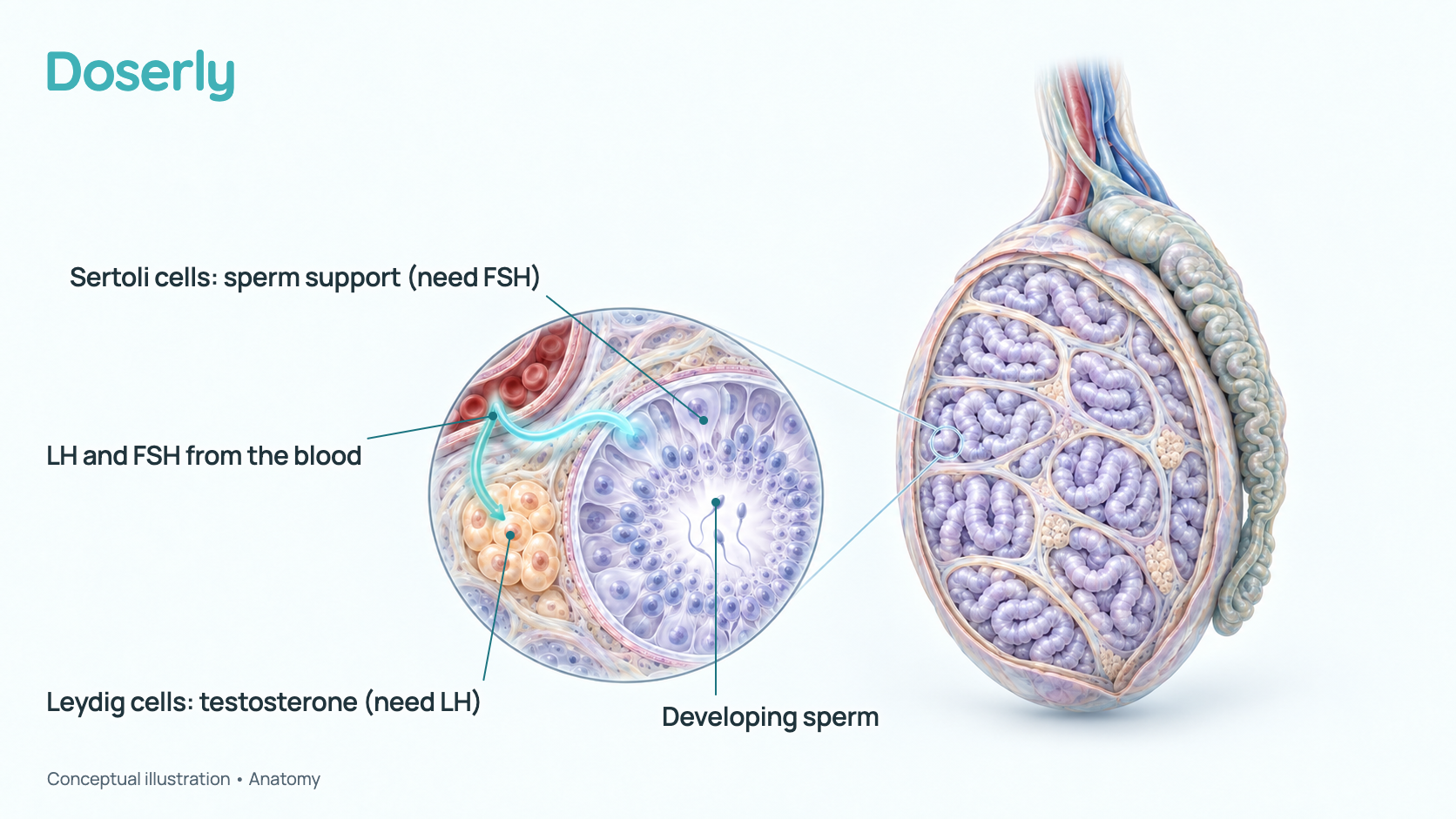
All three try to keep or restart a man's own testosterone and sperm production, but they act at different points in the same hormone chain. hCG copies LH and works directly on the testicles. Gonadorelin copies GnRH and works on the pituitary gland. Enclomiphene is a daily tablet that makes the pituitary release more LH and FSH. [1], [2], [3]
The difference matters most on TRT. Testosterone from outside tells the brain to stop sending LH and FSH, and without them sperm production slows or stops. In a 3-week trial, testosterone alone cut the testosterone level inside the testicles (intratesticular testosterone) by 94%. In a World Health Organization trial, weekly 200 mg testosterone enanthate left 65% of healthy men with no sperm (azoospermia) within 6 months. US labels warn the loss may be irreversible in some men. [5], [21], [22]
Options that work through the pituitary have little to act on while TRT continues; hCG acts below it. [23] This guide also covers kisspeptin, and clomiphene where studies used it. Doses live in each medicine's own guide: hCG, gonadorelin, enclomiphene and clomiphene.
hCG vs gonadorelin vs enclomiphene at a glance
Status was checked in September 2026. Doses appear only as label or guideline figures for context, not as a plan.
How they work
| Option | What it does | Where it acts | Needs a working pituitary? | Form | How long it lasts in the blood |
|---|---|---|---|---|---|
| hCG (Pregnyl, Novarel, generic) | Copies LH | Testicles (Leydig cells) | No | Injection; intramuscular (into a muscle) on US labels | Half-life about 32–33 hours after one dose (measured in women); about 5.8 days after repeated doses in men |
| Gonadorelin | Copies GnRH | Pituitary | Yes | Injection; small pulses from a pump in studies | About 4 minutes |
| Enclomiphene | Blocks estrogen's brake on the brain | Hypothalamus and pituitary | Yes | Daily tablet in trials | About 8–10 hours |
| Kisspeptin | The signal above GnRH | Hypothalamus | Yes | Infusions or injections in short studies | 4 minutes (kisspeptin-10) to 28 minutes (kisspeptin-54) |
[1], [24], [25], [2], [3], [26], [4], [27], [28]
What the evidence and rules say
| Option | Raises testosterone? | Studied alongside TRT? | Sperm evidence | US status |
|---|---|---|---|---|
| hCG | Yes, if the testicles can respond | Yes: 3-week hormone trial, 26-man semen series, 6,999-man records study without semen data | No man became azoospermic in the 26-man series (no comparison group); needs FSH added to start sperm in men with low LH and FSH | FDA-approved; use with TRT is off-label; not compoundable since 2020 |
| Gonadorelin | By pump in men whose brain makes too little GnRH; injections faded in older studies | No | By pump, sperm in most men with GnRH deficiency, about as often as with hCG-based treatment | No approved human product; FDA called one seller's "research" gonadorelin an unapproved new drug (June 2026) |
| Enclomiphene | Yes: about 4 in 5 men reached the normal range in 12 weeks | No; tested instead of TRT | Kept sperm concentration up versus gel, but fell by half or more in 14.2%; no pregnancy data | Not approved; under FDA evaluation for compounding |
| Kisspeptin | Briefly, in healthy men | No | No male fertility trials | Not approved; kisspeptin-10 listed as a significant safety risk for compounding |
[5], [6], [29], [30], [17], [31], [32], [33], [34], [9], [10], [11], [19], [35]
Label and guideline schedules for men, for context only: US hCG labels for men with low LH and FSH start at 500–1,000 units three times a week, and the US testosterone guideline says doctors may add hCG 250 or 500 IU every other day to TRT. Gonadorelin's labels cover a single 100 mcg pituitary test dose (UK) and, in France, a pump giving a pulse every 90 minutes to women who do not ovulate because of a hypothalamus problem. No gonadorelin label covers men on TRT. Enclomiphene has no label; trials used 12.5 or 25 mg daily. A 2026 British position statement suggests 6.25 mg daily, rising weekly as tolerated to 25 mg (up to 50 mg if the response is inadequate), in specialist care only. Kisspeptin has no label. [36], [13], [2], [37], [9], [38]
hCG is dosed in international units (IU), gonadorelin and kisspeptin in micrograms and enclomiphene in milligrams, so doses cannot be compared across options. The 300 ng/dL testosterone line in the enclomiphene trials is about 10.4 nmol/L (unit converter). Clomiphene (Clomid) is enclomiphene mixed with zuclomiphene (30–50%), which lingers for over a month. [11], [39], [40]
Where these numbers come from
The hCG rows come from the US Pregnyl and Novarel labels, a single-dose study of Pregnyl in 18 women and a 2024 analysis of repeated doses in 52 men. The gonadorelin rows come from the UK Gonadorelin 100 micrograms summary of product characteristics (a pituitary test, text revised August 2022) and the French Lutrelef pump label, which covers women with ovulation problems, not men. The enclomiphene rows come from its phase 3 results on ClinicalTrials.gov, the European Medicines Agency's 2018 assessment and FDA's 2022 compounding review. The kisspeptin rows come from human physiology studies. Status comes from FDA's compounding lists (May 14, 2026) and FDA's June 2026 warning letter. [1], [36], [24], [25], [2], [37], [9], [10], [26], [3], [41], [27], [28], [19], [34]
The enclomiphene half-life is given three ways: 8–10 hours in the European assessment, about 10 hours in FDA's briefing and about 7 hours in a 2013 trial report citing another paper. We use the European figure. A figure of 10–12 hours on older pages had no source we could find, nor did several hCG and gonadorelin cost ranges, so we left them out.
What is the real difference?
Where each option acts decides whether it can work while TRT continues. The differences in sperm, estradiol and schedule follow from that.
Where does each one act, and why does that matter on TRT?
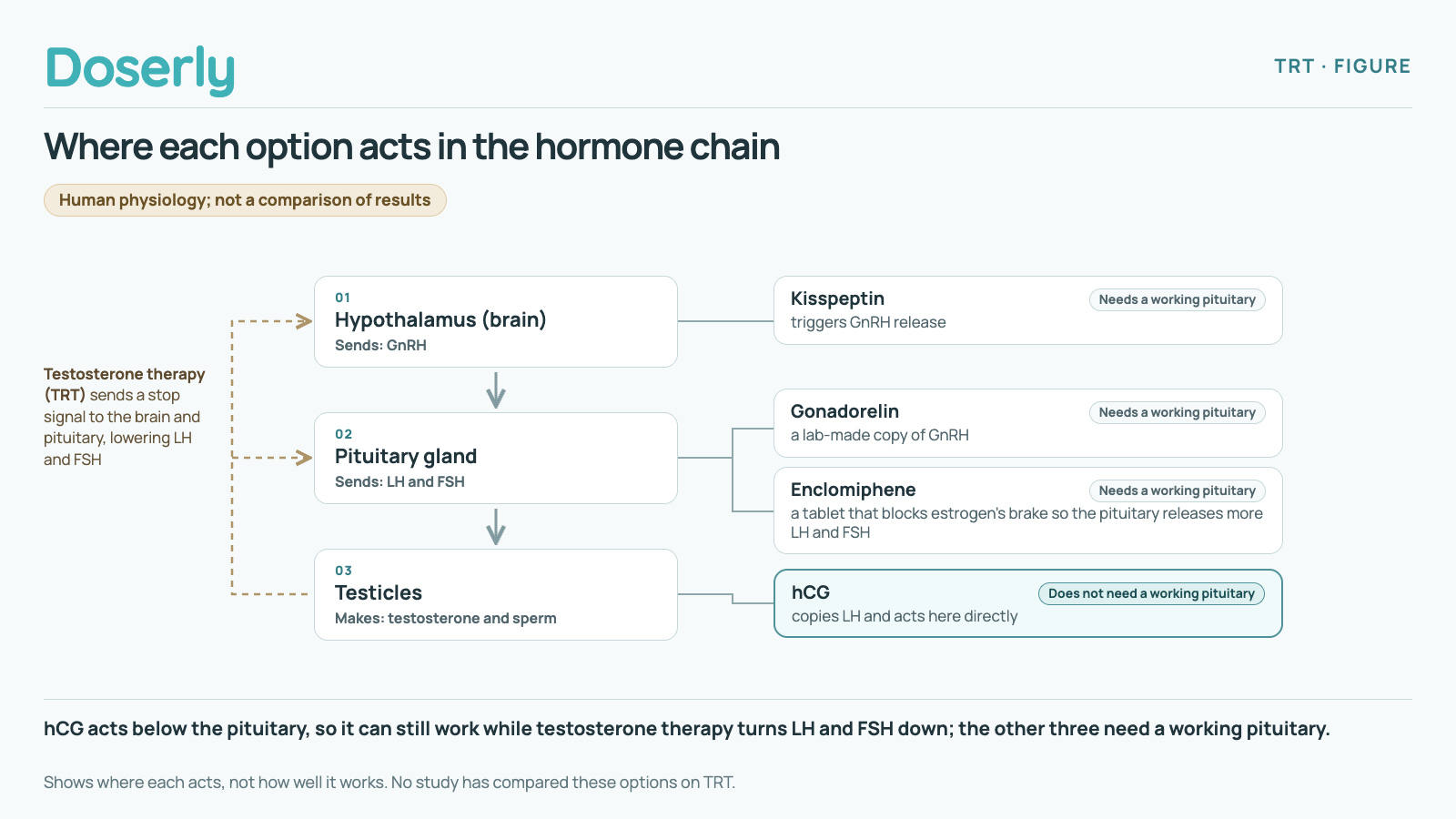
Where each option acts in the hormone chain
Human physiology; not a comparison of results
Hypothalamus (brain)
Sends: GnRH
- Kisspeptin
- triggers GnRH release
- Needs a working pituitary
Pituitary gland
Sends: LH and FSH
- Gonadorelin
- a lab-made copy of GnRH
- Needs a working pituitary
- Enclomiphene
- a tablet that blocks estrogen’s brake so the pituitary releases more LH and FSH
- Needs a working pituitary
Testicles
Makes: testosterone and sperm
- hCG
- copies LH and acts here directly
- Does not need a working pituitary
hCG acts below the pituitary, so it can still work while testosterone therapy turns LH and FSH down; the other three need a working pituitary.
- hCG skips the pituitary. It binds the LH receptor on the testicle's Leydig cells, so it can raise testosterone inside the testicles while TRT has the pituitary switched off. It does not replace FSH, the second signal sperm production needs. [1], [30]
- The other three work through the pituitary, which testosterone blunts even when GnRH arrives on time. In men with GnRH deficiency on pumps giving normal pulses, a 4-day testosterone infusion cut LH output by 28% (58% in healthy men). [23]
- Gonadorelin needs pulses. The body releases GnRH in short bursts, which is why pumps give a pulse every 90 minutes. A dose lasts minutes, and LH peaks about 30 minutes later. Repeated large doses made the pituitary less responsive in healthy men. [37], [42], [43]
- Kisspeptin sits highest. It needs working GnRH nerve cells, a pituitary and testicles, and no study has measured its effect in men on TRT. [4], [8]
None of the four can help when the testicles themselves have failed (primary hypogonadism); see the primary vs secondary hypogonadism guide. [1], [2]
Are they used with TRT or instead of it?
- hCG: both. Its labels cover men with low LH and FSH, without TRT; adding it to TRT is off-label, and it is the only add-on any guideline mentions. [1], [13]
- Enclomiphene: instead. Every trial tested it in place of testosterone, including in men switched off testosterone gel. It has never been studied as an add-on, and it needs the pituitary that TRT suppresses. [44], [7]
- Gonadorelin: sold as a TRT add-on, never studied that way. No trial, registered study or guideline covers gonadorelin injections alongside TRT. [7], [8]
- Kisspeptin: neither, in practice. No study has tested it with TRT or for weeks in men with low testosterone. [8], [35]
Do they raise testosterone?
hCG and enclomiphene clearly do, in men whose testicles can respond. Gonadorelin does by pump in men with GnRH deficiency; kisspeptin has only short studies.
- hCG vs clomiphene. In a randomized controlled trial of 282 men who wanted to keep their fertility, clomiphene 50 mg, hCG 5,000 IU twice a week and both together raised testosterone equally over 3 months. Symptom scores improved most with both. [12]
- Enclomiphene. In two 12-week phase 3 trials, 78.8% of 113 men and 81.3% of 134 men reached an average testosterone of 300–1,040 ng/dL (10.4–36.1 nmol/L); no placebo figure was reported. A 2025 meta-analysis found clomiphene or enclomiphene raised testosterone about 274 ng/dL (9.5 nmol/L) more than placebo, similar to testosterone gel. [9], [10], [45]
- Gonadorelin. On a pump, testosterone became normal in 93% of 76 men with GnRH deficiency. Without a pump, results were mixed: in one small series, 1,000 mcg two or three times a day left testosterone back at its starting level after 6 months. [31], [32]
- Kisspeptin. It raised LH and testosterone in healthy men during infusions lasting hours, and daily 8-hour infusions kept LH up for 12 days. [4], [35]
A higher number is not the same as feeling better. US and European regulators both judged that enclomiphene raised testosterone without showing better symptoms, and a 2026 meta-analysis found libido improved less on clomiphene than on TRT. [3], [26], [46]
What happens to sperm?
- hCG with TRT. In the 3-week trial, intratesticular testosterone changed by −94% on placebo and by −25%, −7% and +26% with hCG 125, 250 and 500 IU every other day. In 26 men on TRT plus 500 IU every other day, followed for an average of 6.2 months, none became azoospermic and 9 contributed to a pregnancy. There was no comparison group, and one published case had almost no sperm despite hCG. [5], [6], [47]
- hCG without FSH has limits. In a meta-analysis of 1,240 men born with low LH and FSH (not on TRT), adding FSH to hCG brought sperm back sooner (10 vs 33 months) and more often (66.76% vs 51.9%). [30]
- Enclomiphene instead of TRT. In two 16-week phase 3 trials, sperm concentration stayed normal on enclomiphene and fell sharply on testosterone gel. But in the two 12-week trials, sperm concentration fell by half or more in 14.2% of men on enclomiphene (of 113 and of 134 men), against 2.6% of 38 and 4.3% of 47 men on placebo. No study has measured pregnancies. In 2016, an FDA advisory committee voted that raising testosterone and keeping sperm concentration up was not enough to show a benefit. [11], [10], [9], [3]
- Gonadorelin by pump. In 420 men born with GnRH deficiency (not on TRT), sperm appeared about 5.3 months sooner than with hCG-based treatment, with no significant difference in success or pregnancies. [33]
- Kisspeptin. No male fertility trials. [35]
Blood testosterone does not show sperm production; only a semen analysis does. The TRT and fertility guide covers semen testing and sperm banking.
Has anyone compared them directly?
Only a few studies compare two of them, mostly outside TRT. None compares hCG with enclomiphene, and none tests any of them against each other in men staying on TRT (searched September 2026). [7]
| Comparison | Who was studied | What it found |
|---|---|---|
| hCG vs clomiphene vs both | 282 men wanting fertility, randomized, 3 months | Same testosterone rise; best symptom scores with both [12] |
| Gonadorelin pump vs hCG-based treatment | 420 men born with GnRH deficiency | Sperm about 5.3 months sooner on the pump; similar success [33] |
| GnRH vs kisspeptin-54 vs kisspeptin-10 | Healthy men, 3-hour infusions | GnRH released about 2.4 and 3.2 times more LH [48] |
| Enclomiphene vs clomiphene | Two records studies (66 and 78 men) | Conflicting estradiol results; no clear difference in hormones [49], [50] |
| Enclomiphene vs testosterone gel | Phase 2 and 3 trials | Similar testosterone; LH, FSH and sperm kept up only on enclomiphene [11], [51] |
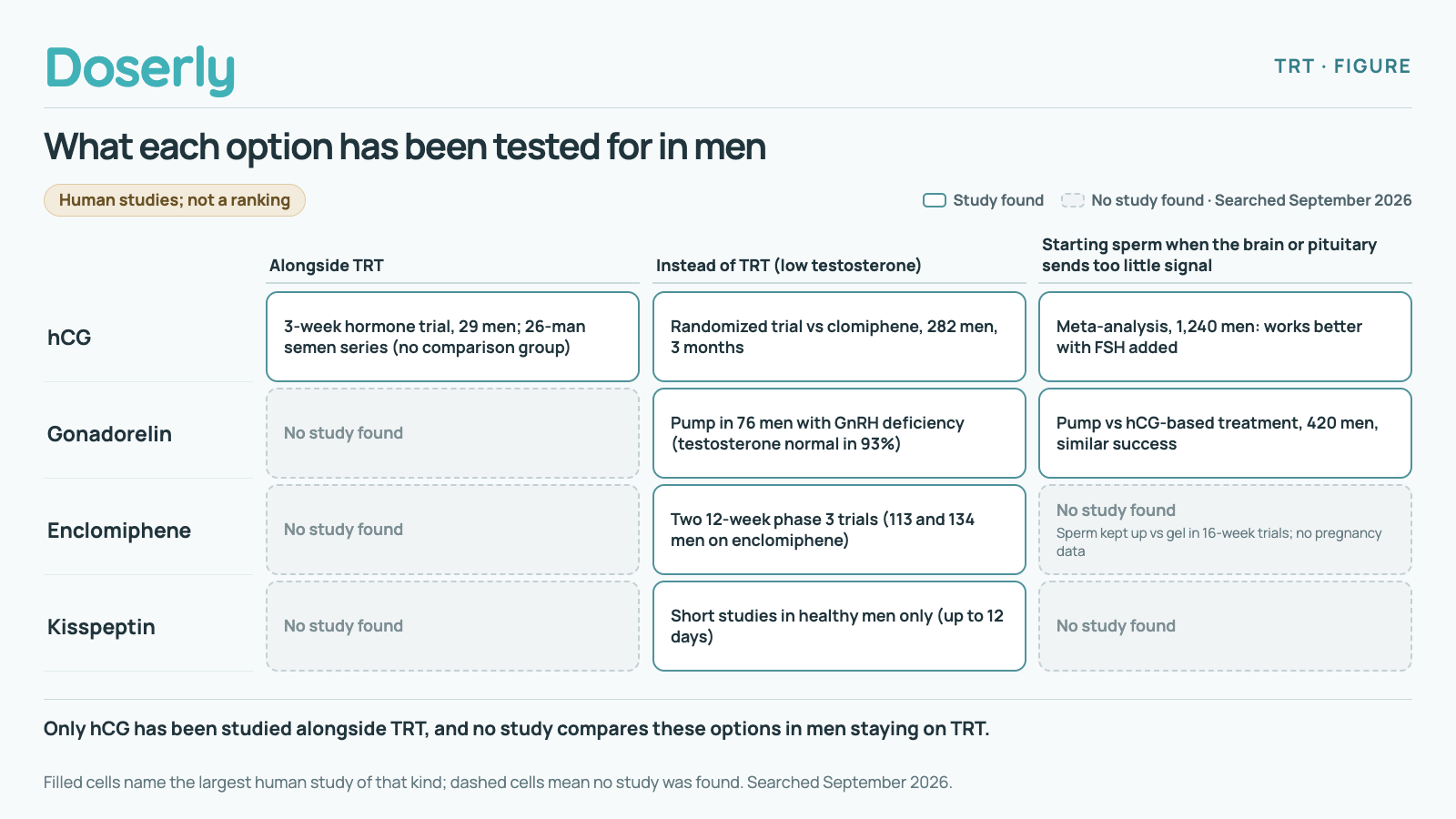
What each option has been tested for in men
Human studies; not a ranking
hCG
- Alongside TRT
- 3-week hormone trial, 29 men; 26-man semen series (no comparison group)
- Instead of TRT (low testosterone)
- Randomized trial vs clomiphene, 282 men, 3 months
- Starting sperm when the brain or pituitary sends too little signal
- Meta-analysis, 1,240 men: works better with FSH added
Gonadorelin
- Alongside TRT
- No study found
- Instead of TRT (low testosterone)
- Pump in 76 men with GnRH deficiency (testosterone normal in 93%)
- Starting sperm when the brain or pituitary sends too little signal
- Pump vs hCG-based treatment, 420 men, similar success
Enclomiphene
- Alongside TRT
- No study found
- Instead of TRT (low testosterone)
- Two 12-week phase 3 trials (113 and 134 men on enclomiphene)
- Starting sperm when the brain or pituitary sends too little signal
- No study found (Sperm kept up vs gel in 16-week trials; no pregnancy data)
Kisspeptin
- Alongside TRT
- No study found
- Instead of TRT (low testosterone)
- Short studies in healthy men only (up to 12 days)
- Starting sperm when the brain or pituitary sends too little signal
- No study found
Study found No study found
Only hCG has been studied alongside TRT, and no study compares these options in men staying on TRT.
What about estradiol?
hCG and enclomiphene can both raise estradiol, because both raise the body's own testosterone. hCG labels list breast enlargement (gynecomastia). In a 1990s comparison, estradiol was higher on hCG plus a combined FSH-and-LH medicine than on the gonadorelin pump. For enclomiphene the records conflict: estradiol fell slightly in 66 men switched from clomiphene, but median estradiol rose from 29.5 to 67 pg/mL (about 108 to 246 pmol/L) in 18 men in another study. [1], [52], [49], [50]
No guideline sets an estradiol target on these medicines; the US testosterone guideline acts on breast symptoms, and the VA does not generally recommend aromatase inhibitors. See the estrogen on TRT guide. [13], [53]
Which suits which situation, according to guidelines?
No guideline ranks these options against each other, and all agree on the starting point: men trying to father a child should not use testosterone. This section describes what guidelines say; it is not a personal plan.
| Guideline (year) | Options it names | Gonadorelin or kisspeptin |
|---|---|---|
| AUA, American Urological Association, testosterone deficiency (2018, reconfirmed 2024) | hCG, SERMs, aromatase inhibitors or a combination (conditional); only hCG is FDA-approved in men; doctors may offer hCG 250 or 500 IU every other day with TRT | Not mentioned |
| AUA/ASRM male infertility (2020, amended 2024) | Aromatase inhibitors, hCG, SERMs or a combination (conditional) | None for TRT |
| Endocrine Society (2018) | Gonadotropins; clomiphene is used without proof from randomized trials; consider sperm banking | None for TRT |
| EAU, European Association of Urology (2026) | Gonadotropins as the standard for men with a pituitary or brain cause who want children; SERMs off-label, poor evidence, possible clot risk | None for TRT |
| ICSM (2024) | hCG with a lowered testosterone dose (50–100 mg a week), called well-established off-label practice with scant evidence | Not listed |
| BSSM, British Society for Sexual Medicine (2023; 2026 statement) | hCG, off-label SERMs, aromatase inhibitors; enclomiphene unlicensed, specialist settings only | Not listed |
| CUA, Canadian Urological Association (2021) | hCG, SERMs, aromatase inhibitors, all off-label; nasal testosterone may suppress less | Not listed |
| VA, US Department of Veterans Affairs (January 2026) | hCG only through specialists for men with a pituitary or brain cause; clomiphene case by case first; aromatase inhibitors not generally recommended | Not listed |
[13], [14], [54], [55], [56], [16], [38], [15], [53]
What do guidelines say for each situation?
- Trying to conceive now: no testosterone, in every guideline. [13], [14], [55], [56], [15]
- Low testosterone from a pituitary or brain cause, wanting children: gonadotropins (hCG, with FSH when needed) are the EAU's standard; the VA tries clomiphene case by case first. [55], [53]
- Not yet on TRT, may want children later: hCG, SERMs and aromatase inhibitors are listed options, and sperm banking is worth considering. The CUA notes nasal testosterone may suppress less: in a 6-month Natesto study, 93.9% of men kept a total motile sperm count above 5 million. [13], [54], [15], [57]
- On TRT, wanting to keep the testicles working: the AUA says doctors may offer hCG, and the ICSM describes hCG with a lowered testosterone dose. No guideline mentions the other three for this. [13], [56]
- Stopping TRT to try for a child: no guideline gives a restart protocol. After hormonal contraception trials in 1,549 men, sperm counts recovered to 20 million/mL in an estimated 67% within 6 months and in all within 24 months. After TRT, specialist clinics used hCG-based combinations. In one series, sperm returned or improved in 47 of 49 men. In another, 70% of 66 men reached more than 5 million moving sperm within 12 months, more slowly in older men and after longer use. See stopping TRT. [58], [59], [60]
- Failed testicles: none of these can help. Drug-tested athletes: all four are prohibited. [20]
What gets checked, and when?
The AUA says to check testosterone no sooner than 4 weeks after starting clomiphene or hCG. For fertility, the measure that matters is a semen analysis. Because gonadorelin's LH rise peaks about 30 minutes after a dose, an LH test the next day says little about whether injections work. [13], [14], [42]
What are the risks, and how do they differ?
The evidence behind each is uneven: hCG has decades of labeled use, enclomiphene has regulator reviews from its failed applications, gonadorelin has warnings from its diagnostic use, and kisspeptin has only short studies.
Is each one safe?
- hCG. US labels list headache, irritability, restlessness, depression, tiredness, fluid retention, injection-site reactions and occasional breast enlargement. Allergic reactions have been reported, rarely including anaphylaxis (a severe whole-body reaction). The labels advise caution with heart or kidney disease, high blood pressure, epilepsy, migraine or asthma. They say not to use it with prostate or breast tumors in men, tumors of the pituitary or hypothalamus, or other androgen-dependent tumors. In one analysis, 6 of 16 illegal products labeled as hCG contained none. [1], [36], [61]
- Enclomiphene. Among 1,403 men who took enclomiphene in the European review, 4 had blood clots or a stroke (one fatal), and all four had other risk factors. One man on placebo had a heart attack, and no such event occurred on testosterone. Blurred vision affected 1.0% on enclomiphene and 0.8% on placebo. Hematocrit rose in 3% on enclomiphene, 6.1% on testosterone gel and 0.3% on placebo. In one 48-week trial, 1 heart attack and 1 stroke occurred among 18 men on 12.5 mg. [26], [62]
- Gonadorelin. In men with a pituitary tumor, a single 100 mcg test dose has caused bleeding into the tumor (pituitary apoplexy), and the UK label advises against use with one. Severe allergic reactions are rare. [63], [2], [64]
- Kisspeptin. Long-term safety is unknown. FDA's advisory committee voted 0 to 11 against allowing kisspeptin-10 in compounding. [65], [66]
Men who stay on TRT also carry testosterone's own risks. TRAVERSE compared testosterone gel with placebo in 5,204 men at high heart risk, about 2,600 in each group. Heart attack, stroke or cardiovascular death occurred in 182 men on testosterone (7.0%) and 190 on placebo (7.3%), a hazard ratio of 0.96. Atrial fibrillation (3.5% vs 2.4%), acute kidney injury (2.3% vs 1.5%) and clots in the lungs (0.9% vs 0.5%) were more common on testosterone. The trial tested only a gel, men used it for an average of 21.7 months, and about 61% stopped early. See TRT and heart health. [67], [68]
Who should be especially cautious?
- Men trying to conceive now, who should not use testosterone. [14]
- Men with a pituitary tumor (gonadorelin and hCG) or prostate, breast or other androgen-dependent tumors (hCG). [2], [1], [36]
- Men with past blood clots, stroke or eye problems, given enclomiphene's clot and vision signals and the EAU's clot warning for SERMs. [26], [55], [39]
- Drug-tested athletes, since all four are prohibited. [20]
- Under-18s, for whom treatment belongs only in specialist care.
- Women. This guide is for men; see testosterone therapy for women.
Can they be taken together, or with other medicines?
Specialist fertility clinics combine hCG with a SERM, FSH or an aromatase inhibitor, and the 282-man trial tested hCG plus clomiphene. No trial has tested hCG plus enclomiphene, or enclomiphene added to TRT, and the VA does not generally recommend aromatase inhibitors. Bring a full list of what you take, including supplements, to a pharmacist or prescriber. Checked September 2026. [59], [12], [7], [53]
Are they legal, and are they allowed in sport?
Checked September 2026. Rules differ by country and change often.
- United States. hCG (Pregnyl, Novarel, generic) is an approved prescription biologic; Ovidrel is labeled only for women. Since March 23, 2020, pharmacies cannot compound it, and New York lists it in Schedule III. The human gonadorelin products Factrel and Lutrepulse are discontinued (today's Factrel is for cattle), and gonadorelin is on none of FDA's compounding nomination lists. FDA declined to approve enclomiphene in 2015, in a formal letter called a Complete Response Letter. It sits in FDA's compounding Category 1 (still under evaluation), even though an advisory committee voted 4 to 8 against it. Kisspeptin-10 is in Category 2 (significant safety risks). [69], [70], [17], [71], [72], [73], [19], [3], [74]
- United Kingdom. hCG is a Class C controlled drug; gonadorelin is a prescription-only diagnostic; enclomiphene is unlicensed. [75], [2], [38]
- European Union. The EU refused enclomiphene (EnCyzix) in 2018: raising testosterone alone was not enough, and it carried a potential clot risk. Recombinant hCG (Ovitrelle) is authorized, and France authorizes the Lutrelef gonadorelin pump. [18], [26], [76], [37]
- Canada. Pregnyl, a generic chorionic gonadotropin and Ovidrel are marketed. No enclomiphene or kisspeptin product is listed. No human gonadorelin product is marketed: Lutrepulse 0.8 mg was cancelled in December 2024, and the 3.2 mg product has been dormant since 2017. [77], [78], [79], [80], [81]
- Australia. hCG and gonadorelin are Schedule 4 prescription-only medicines; Pregnyl was cancelled in 2023, and Choriomon is supplied under a special approval until August 2027. Clomifene is Schedule 4, a listing that by our reading covers enclomiphene; kisspeptin has no entry. [82], [83], [84]
- Sport. The World Anti-Doping Agency (WADA) prohibits hCG, gonadorelin and kisspeptin in males, and SERMs in everyone, at all times, and its 2027 list keeps the bans. An exemption for hCG is granted only for low testosterone with an organic cause, such as a genetic condition or damage to the testicles or pituitary, not for low testosterone linked to aging, weight or past steroid use. [20], [85], [86]
What do people on TRT report about hCG, gonadorelin and enclomiphene?
The threads below are recent public Reddit discussions, read with their replies; they show what people experience, not how often it happens.
What happens when hCG is added to TRT?
Reports are mixed, and estradiol comes up in most. One man found his testicles hung lower, with no change in ejaculate volume. [87] Another, on 1,000 IU a week, reported water retention, swollen hands, anxiety and a faster heart rate with a high estradiol result, and was urged to get a semen test. [88] Others describe flushing and nipple sensitivity, less penile sensitivity, or feeling much better as a very low estradiol rose. [89], [90], [91] One man had genital skin wounds during each of three trials of hCG that healed after stopping; the cause was not established. [92]
What happens when men stop TRT to try for a child?
The first months are often hard. Several men switched to hCG with enclomiphene after a semen test showed no sperm. One felt better within three weeks but later noticed muscle loss. [93] Others describe libido collapsing within three weeks, or exhaustion two to four months in with testosterone results between 180 and 380 (units not stated) and no repeat semen result yet. [94], [95], [96] One man's testicles regained much of their size on hCG, but enclomiphene brought headaches, loss of libido and low mood that eased after he stopped it. [97]
Some stories end with sperm. One man with none after years of topical testosterone recovered sperm production on hCG and clomiphene and had a child through in vitro fertilization (IVF). [98] Another's sperm concentration rose from 2.8 to 29 million/mL after he stopped testosterone and his hCG dose was raised. [99]
What do people report on enclomiphene alone?
A clear rise in testosterone is common; feeling better is less predictable. One man went from 387 to 1,042 ng/dL (13.4 to 36.1 nmol/L) in 7 weeks but stopped because of poor libido, blurry vision, brain fog and poor sleep. [100] Another had good energy over two years, but his estradiol climbed. [101] One man's own comparison put testosterone highest on hCG alone (654), lowest on enclomiphene alone (444) and in between on both (549; units not stated). [102] A man who took enclomiphene alongside TRT for two and a half years said his testicles were about half their former size, as the mechanism predicts. [103]
What about gonadorelin and kisspeptin?
First-hand reports are scarce. One man on TRT using gonadorelin dissolved under the tongue twice a week had LH below 0.3 and FSH 0.3, with smaller, sometimes painful testicles, and was switching to hCG. [104] Replies about kisspeptin are mostly skeptical. [105]
What gets in the way?
Access. Men describe insurers refusing hCG, pharmacies unable to fill prescriptions, and a cheaper product sold as Pregnyl that commenters judged counterfeit after the man's testicles shrank on it. [106], [107], [108]
How can you judge these stories?
Ask: Was the man on TRT, coming off it or never on it? Was fertility measured with a semen analysis, or guessed from testicle size? What else changed at the same time? Were the products from a pharmacy? What did the next test show? These selected discussions are not a survey of all men using these medicines, a success rate or a substitute for the studies above.
Common questions about hCG, gonadorelin and enclomiphene
Is gonadorelin the same as hCG?
No. Gonadorelin copies GnRH and asks the pituitary to release LH and FSH; hCG copies LH and acts on the testicles directly. That is why hCG still works when TRT has switched the pituitary off, and why gonadorelin is not a "generic hCG". [2], [1] See where each acts.
Which is better for fertility on TRT, hCG or enclomiphene?
No study has compared them. hCG is the only one tested alongside TRT, in small studies without a comparison group; enclomiphene kept sperm counts up only in men who took it instead of TRT. Men trying to conceive now should not use testosterone at all. [5], [6], [11], [13] See what happens to sperm.
Can you take enclomiphene with TRT?
It has not been studied, and it is unlikely to do much while TRT continues: enclomiphene works through the pituitary, which TRT switches off. No guideline suggests it for this. [7], [23] See with TRT or instead.
Can you take hCG and enclomiphene together?
Specialist fertility clinics combine hCG with SERMs, usually after TRT stops, and hCG plus clomiphene improved symptom scores more than either alone in a 282-man trial. No trial has tested hCG plus enclomiphene. [59], [12] See taking them together.
Why did clinics switch from hCG to gonadorelin?
Because of a rule change, not new evidence. On March 23, 2020, hCG became a biologic in the US and pharmacies could no longer compound it; forum posts from 2020 describe clinics switching patients to compounded gonadorelin then. Gonadorelin has never been tested alongside TRT. [17], [109], [7] See legal status.
Does kisspeptin work on TRT?
No study has tested it. It acts above the pituitary, which TRT suppresses, so it has the same problem as gonadorelin and enclomiphene. [8], [23] See where each acts.
Is enclomiphene FDA-approved?
No. FDA declined to approve it in 2015 (a Complete Response Letter). In 2022, an FDA advisory committee voted 4 to 8 against allowing it in compounding, and it remains under FDA evaluation for compounding. The EU refused it in 2018. [3], [74], [19], [18] See legal status.
Which one keeps the testicles from shrinking on TRT?
Only hCG has evidence alongside TRT: it kept testosterone inside the testicles near or above its starting level for 3 weeks, though the trial measured hormones, not size. Men report fuller testicles on hCG and smaller ones on TRT with enclomiphene or gonadorelin, but these are personal accounts. [5], [87], [103], [104] See what people report.
Glossary
Plain explanations of the medical, lab and research terms used in this guide. Underlined terms in the text link here.
- Aromatase inhibitor
- A medicine, such as anastrozole, that blocks the enzyme that turns testosterone into estradiol.
- Azoospermia
- No sperm at all in a semen sample.
- Compounding
- When a pharmacy prepares a customized medicine from individual ingredients. In the US, federal lists control which bulk ingredients pharmacies may use, and hCG can no longer be compounded.
- Controlled trial
- A study that compares people who receive a treatment with a similar group who do not, often receiving a placebo instead. Randomly assigning people to each group makes the comparison fairer.
- Estradiol
- The main form of estrogen. In men it is made mostly from testosterone, so it tends to rise when a medicine raises the body's own testosterone.
- FSH (follicle-stimulating hormone)
- A pituitary hormone that acts on the Sertoli cells in the testicles and is needed for sperm production. hCG does not replace it.
- GnRH (gonadotropin-releasing hormone)
- The brain signal that tells the pituitary to release LH and FSH. It is released in pulses about every 1–2 hours. Gonadorelin is a medicine that copies it.
- Gonadorelin
- A manufactured copy of GnRH with the same 10 amino acids. It is licensed in some countries as a one-time pituitary test and for pump treatment of female infertility, not for use with TRT.
- Gynecomastia
- Growth of breast tissue in men, often tender at first. It is linked to a higher estrogen-to-testosterone balance.
- Half-life
- The time it takes for the level of a substance in the blood to fall by half. It is not the same as how long an effect lasts.
- Hazard ratio
- A measure comparing how often an event happens over time in two groups. A hazard ratio of 1 means no difference; 0.96 means about 4% lower in the first group.
- hCG (human chorionic gonadotropin)
- A pregnancy hormone used as a prescription medicine. It copies LH and acts on the testicles directly, without needing the pituitary.
- Hematocrit
- The share of the blood made up of red blood cells. Testosterone therapy can raise it, which is why it is checked.
- Hypothalamus
- A small area at the base of the brain that controls many hormones. It releases GnRH to the pituitary gland.
- Intratesticular testosterone
- The testosterone level inside the testicles, normally many times higher than in the blood. Sperm production depends on it, and TRT lowers it sharply.
- Intramuscular (IM)
- Injected into a muscle. The US labels for urinary hCG use this route.
- IU and USP units
- Units that measure a hormone's biological activity rather than its weight. US labels write hCG doses in USP units; most other sources use international units (IU).
- Kisspeptin
- A brain signal one step above GnRH that tells the hypothalamus to release it. It is being studied as a medicine but is not approved.
- Leydig cells
- Cells in the spaces between the testicle's tubules that make testosterone when LH or hCG reaches them.
- LH (luteinizing hormone)
- A pituitary hormone that tells the testicles to make testosterone. hCG copies it and lasts much longer.
- Meta-analysis
- A study that combines the results of several earlier studies on the same question to get a more precise overall answer.
- Off-label
- Using an approved medicine for a purpose, group or dose its official label does not cover. Doctors may prescribe off-label, but the regulator has not approved that use.
- Pituitary gland
- A pea-sized gland below the brain that releases hormones, including LH and FSH, when the hypothalamus signals it.
- Pituitary apoplexy
- Sudden bleeding into, or loss of blood supply to, a pituitary tumor. It causes a severe headache and can damage vision. Rare cases have followed a gonadorelin test dose.
- Placebo
- A dummy treatment with no active ingredient, used as a comparison in studies.
- Primary hypogonadism
- Low testosterone because the testicles themselves do not work well, even though the pituitary sends plenty of LH and FSH. None of the medicines in this guide can fix it.
- Pulsatile
- Given in short bursts at regular intervals, like the body's own GnRH, rather than steadily. A pump makes gonadorelin pulsatile; two or three injections a week do not.
- SERM (selective estrogen receptor modulator)
- A tablet, such as clomiphene, enclomiphene or tamoxifen, that blocks estrogen's feedback in the brain so the pituitary releases more LH and FSH.
- TRT (testosterone replacement therapy)
- Prescribed testosterone, by injection, gel or other forms, for men with low testosterone. It switches off the brain's LH and FSH signals.
- WADA
- The World Anti-Doping Agency, which publishes the list of substances banned in sport. hCG, gonadorelin and kisspeptin are banned in males at all times, and SERMs in everyone.
How this guide was researched
This guide is built from a thorough review of the sources cited throughout it: product labels and regulator records from several countries, clinical guidelines, published trials and studies, trial registrations and public online forums where men describe their own experience with these medicines. It draws on the research behind Doserly's hCG, gonadorelin and kisspeptin guides, rechecked for this comparison.
The guide cites 109 sources, including 36 original studies and trial results in people, 9 clinical guidelines and position statements, 34 labels, regulator records and anti-doping documents, and 23 public community discussions. Each type of source answers a different question. Labels and guidelines show what clinicians are told to do. Trials and studies show what was measured. Personal accounts show what individual people experienced. Every numbered citation links to its entry below, labeled by source type.
How this guide was made
Research and drafting were AI-assisted. Every cited source was checked against the original, and the guide was reviewed and edited by Doserly before publication. It has not had an independent clinical review, and Doserly does not currently have medical reviewers. Doserly makes a medication and health-tracking app and runs Doserly Academy, both of which are promoted in this guide. Read our editorial policy for how guides are researched, updated and corrected.
This guide is for educational purposes. It summarizes what the reviewed sources report so the research is easier to understand; it is not medical advice. For a deeper dive, or to check any point for yourself, go straight to the cited sources.
Explore the sources
These are the documents cited in this guide. Labels, guidelines, studies, trial registrations and personal accounts answer different questions. A source being listed does not mean every statement on its page is endorsed.
Showing 109 sources
- 01
Pregnyl (chorionic gonadotropin) for injection 10,000 USP units prescribing information ↗
Product label (US)
Full label reviewed.
Detail: Pregnyl: labeled for men with hypogonadism from a pituitary deficiency; intramuscular; the same two regimens as Novarel; lists headache, irritability, restlessness, depression, fatigue, edema, occasional gynecomastia, injection-site pain and hypersensitivity reactions including anaphylaxis; caution with heart or kidney disease, high blood pressure, epilepsy, migraine or asthma; contraindicated with tumors of the hypothalamus or pituitary and breast or prostate tumors in men.
- 02
Gonadorelin 100 micrograms powder for solution for injection (HRF) ↗
Product label (UK)
Full summary of product characteristics reviewed.
Detail: Diagnostic 100 mcg subcutaneous or IV test with seven LH samples; half-life about 4 minutes; contraindicated in pregnancy; not recommended with pituitary adenoma; mixed solution refrigerated and used within 1 day.
- 03
FDA Briefing Document, Pharmacy Compounding Advisory Committee, June 8, 2022 (Tab 1: Enclomiphene citrate) ↗
Regulator review (US)
Full document reviewed.
Detail: Recommends against listing enclomiphene for compounding: half-life about 10 hours; cardiac and thromboembolic safety concerns; trials did not show a meaningful improvement in symptoms; records the 2015 Complete Response Letter and a 2016 advisory committee vote that raising testosterone and keeping sperm concentration was not enough to show benefit.
- 04
Kisspeptin-10 is a potent stimulator of LH and increases pulse frequency in men ↗
Human study
Selected original full-text sections reviewed.
Detail: Kisspeptin-10 raised LH in healthy men; a 22.5-hour infusion raised testosterone from 16.6 to 24.0 nmol/L in 4 men.
- 05
Low-dose human chorionic gonadotropin maintains intratesticular testosterone in normal men with testosterone-induced gonadotropin suppression ↗
Human trial (randomized)
Original full text reviewed.
Detail: In 29 men on testosterone, intratesticular testosterone changed −94% with placebo and −25%, −7%, +26% across ascending hCG doses.
- 06
Concomitant intramuscular human chorionic gonadotropin preserves spermatogenesis in men undergoing testosterone replacement therapy ↗
Human study (records)
Original abstract reviewed.
Detail: 26 men on testosterone plus hCG 500 IU every other day, mean follow-up 6.2 months: none became azoospermic and 9 contributed to a pregnancy; no comparison group.
- 07
ClinicalTrials.gov search inventory: enclomiphene / Androxal (Repros program) ↗
Trial registry search
Registry search reviewed.
Detail: Lists the enclomiphene trial program; no registered trial of enclomiphene added to TRT, or of gonadorelin injections with TRT.
- 08
Emerging peptide and neuroendocrine strategies for TRT-induced reproductive suppression and functional male hypogonadism: a narrative review. ↗
Review
Original abstract reviewed.
Detail: Narrative review of kisspeptin and GnRH approaches for TRT-related suppression: direct evidence of restoring sperm production or fertility remains limited.
- 09
ZA-301: Phase III enclomiphene vs placebo, men with secondary hypogonadism (results posted) ↗
Trial registry results
Posted results reviewed.
Detail: ZA-301 phase 3: 78.8% of 113 men on enclomiphene had testosterone in the normal range at 12 weeks; sperm concentration fell by half or more in 14.2% vs 2.6% on placebo.
- 10
ZA-302: Phase III, enclomiphene 12.5/25 mg vs placebo, overweight men with acquired hypogonadotropic hypogonadism (results posted) ↗
Trial registry results
Posted results reviewed.
Detail: ZA-302 phase 3: 81.3% of 134 men on enclomiphene had average testosterone of 300–1,040 ng/dL at 12 weeks; sperm concentration fell by half or more in 14.2% on enclomiphene vs 4.3% on placebo.
- 11
Oral enclomiphene citrate raises testosterone and preserves sperm counts in obese hypogonadal men, unlike topical testosterone: restoration instead of replacement ↗
Human trial
Original abstract reviewed.
Detail: Two phase 3 trials in overweight men, 16 weeks: enclomiphene raised testosterone, LH and FSH and kept sperm concentration normal; testosterone gel (AndroGel 1.62%) markedly reduced sperm production.
- 12
Clomiphene citrate and human chorionic gonadotropin are both effective in restoring testosterone in hypogonadism: a short-course randomized study ↗
Human trial
Original abstract reviewed.
Detail: 282 men wanting to keep fertility randomized to clomiphene 50 mg, hCG 5,000 IU twice weekly or both for 3 months: testosterone rose equally; symptom scores improved most with both.
- 13
Evaluation and Management of Testosterone Deficiency: AUA Guideline ↗
Clinical guideline (US)
Full guideline reviewed.
Detail: Testosterone should not be prescribed to men currently trying to conceive (strong); clinicians may use aromatase inhibitors, hCG, SERMs or a combination for men who want to keep fertility (conditional), and only hCG is FDA-approved in men; the discussion says doctors may offer hCG 250 or 500 IU every other day with testosterone; check testosterone no sooner than 4 weeks after starting clomiphene or hCG; estradiol is checked for breast symptoms.
- 14
Diagnosis and Treatment of Infertility in Men: AUA/ASRM Guideline (2020; Amended 2024) ↗
Clinical guideline (US)
Full guideline reviewed.
Detail: Statement 41: clinicians may use aromatase inhibitors, hCG, SERMs or a combination for infertile men with low testosterone (conditional); Statement 42: do not prescribe testosterone to men interested in current or future fertility.
- 15
Canadian Urological Association guideline on testosterone deficiency in men: Evidence-based Q&A ↗
Clinical guideline (Canada)
Full text reviewed.
Detail: Men wanting fertility should avoid testosterone alone (strong); hCG, SERMs (clomiphene, tamoxifen) and aromatase inhibitors are off-label alternatives; nasal testosterone may suppress less.
- 16
The British Society for Sexual Medicine Guidelines on Male Adult Testosterone Deficiency, with Statements for Practice ↗
Clinical guideline (UK)
Full text reviewed.
Detail: An active desire for children is a main contraindication to testosterone; alternatives in secondary testosterone deficiency are hCG, off-label SERMs and aromatase inhibitors.
- 17
Notice to Compounders: Changes that affect compounding as of March 23, 2020 ↗
Regulator notice (US)
Official page reviewed.
Detail: From March 23, 2020, biological products including chorionic gonadotropin are no longer eligible for the 503A and 503B compounding exemptions.
- 18
EnCyzix (enclomifene): refusal of marketing authorisation ↗
Regulator decision (EU)
Official page reviewed.
Detail: EnCyzix (enclomiphene) was refused: it raised testosterone, but benefit on symptoms was not shown and it carried a potential risk of blood clots.
- 19
Bulk Drug Substances Nominated for Use in Compounding Under Section 503A (categories list) ↗
Regulator list (US)
Official list reviewed.
Detail: 503A bulk-substance nominations: enclomiphene citrate in Category 1 (under evaluation); kisspeptin-10 in Category 2 (significant safety risks); gonadorelin not listed in any category.
- 20
World Anti-Doping Code International Standard: Prohibited List 2026 ↗
Anti-doping list
Full list reviewed.
Detail: hCG, LH, gonadorelin and kisspeptin are prohibited at all times in males (S2.2.1); anti-estrogens including clomifene are prohibited at all times (S4.2).
- 21
Contraceptive efficacy of testosterone-induced azoospermia in normal men (WHO Task Force) ↗
Human trial
Original abstract reviewed.
Detail: Weekly 200 mg testosterone enanthate made 65% of healthy men azoospermic within 6 months.
- 22
Xyosted (testosterone enanthate) subcutaneous autoinjector 50, 75, 100 mg/0.5 mL prescribing information ↗
Product label (US)
Relevant label section reviewed.
Detail: Xyosted (testosterone class wording): large doses of androgens suppress sperm production, and reduced fertility on testosterone may be irreversible in some men.
- 23
Sex steroid control of gonadotropin secretion in the human male. I. Effects of testosterone administration in normal and gonadotropin-releasing hormone-deficient men ↗
Human study
Original abstract reviewed.
Detail: Testosterone infusion lowered LH by 28% in GnRH-deficient men receiving GnRH pulses and by 58% in healthy men, only at physiological GnRH doses; aromatase inhibition prevented this.
- 24
A randomized three-way cross-over study in healthy pituitary-suppressed women to compare the bioavailability of human chorionic gonadotrophin (Pregnyl) after intramuscular and subcutaneous administration ↗
Pharmacokinetic study
Original abstract reviewed.
Detail: 18 women: 10,000 IU gave the same total exposure intramuscularly or subcutaneously; elimination half-life 32–33 hours; under 10% of peak activity left after 8 days.
- 25
Single and multi-dose pharmacology of recombinant and urinary human chorionic gonadotrophin in men ↗
Pharmacokinetic study
Original abstract reviewed.
Detail: In a multi-dose context involving 52 men, the pooled apparent hCG half-life was 5.8 days.
- 26
EnCyzix (enclomifene) public assessment report, refusal (EMA/88321/2018) ↗
Regulator assessment (EU)
Full document reviewed.
Detail: Enclomiphene half-life 8–10 hours; 4 thromboembolic events on enclomiphene (including one fatal stroke) vs 1 heart attack on placebo; blurred vision 1.0% vs 0.8%; hematocrit increase 3% vs 6.1% on AndroGel vs 0.3% on placebo; raising testosterone alone judged not sufficient.
- 27
The effects of kisspeptin-10 on reproductive hormone release show sexual dimorphism in humans ↗
Human study
Selected original full-text sections reviewed.
Detail: Kisspeptin-10 half-life about 4 minutes in men.
- 28
Kisspeptin-54 stimulates the hypothalamic-pituitary gonadal axis in human males ↗
Human study
Original abstract reviewed.
Detail: Kisspeptin-54 half-life about 28 minutes in men.
- 29
Pituitary Axis Impacts and Effectiveness of Clomiphene and Human Chorionic Gonadotropin in Treating Hypogonadism: Cohort Study ↗
Human report (cohort)
Original full text reviewed.
Detail: 6,999 men: hCG plus TRT, clomiphene plus TRT (552) or clomiphene alone; hCG plus TRT kept LH and FSH suppressed; no semen data. Several authors work for the UK provider.
- 30
Evaluating Sperm Recovery Time and Efficacy of Monotherapy vs. Combination Therapies in Men with Congenital Hypogonadotropic Hypogonadism: A Systematic Review and Meta-Analysis. ↗
Systematic review
Original full text reviewed.
Detail: 1,240 men with congenital hypogonadotropic hypogonadism: combination gonadotropin therapy recovered sperm sooner (10 vs 33 months) and more often (66.76% vs 51.9%) than hCG alone.
- 31
Predictors of outcome of long-term GnRH therapy in men with idiopathic hypogonadotropic hypogonadism. ↗
Human cohort
Indexed abstract text reviewed.
Detail: 76 men with IHH on the pump for 12–24 months: LH normal in 97%, testosterone in 93%; 18% of prepubertal men remained without sperm.
- 32
Long term therapy with luteinizing hormone-releasing hormone in isolated gonadotropin deficiency: failure of therapeutic response. ↗
Human report
Original abstract reviewed.
Detail: 1,000 mcg two or three times daily for 6 months in four men: testosterone back at baseline; hCG still raised it.
- 33
Spermatogenesis of Male Patients with Congenital Hypogonadotropic Hypogonadism Receiving Pulsatile Gonadotropin-Releasing Hormone Therapy Versus Gonadotropin Therapy: A Systematic Review and Meta-Analysis. ↗
Systematic review and meta-analysis
Original abstract reviewed.
Detail: 420 men, seven studies: sperm about 5.3 months sooner with the pump; no significant difference in sperm detection, concentration or pregnancy; allergic reactions more common on the pump.
- 34
Wholesale Peptide MARCS-CMS 729447 — June 17, 2026 ↗
Warning letter (US)
Full letter reviewed.
Detail: June 17, 2026: a seller's "Gonadorelin 5 mg" research-labeled product found to be an unapproved new drug.
- 35
Chronic subcutaneous kisspeptin-10 stimulates gonadotropin secretion for 12 days in healthy men ↗
Human trial
Original full text reviewed.
Detail: Daily eight-hour kisspeptin-10 infusions sustained gonadotropin increases over 12 days; hCG was not a comparator.
- 36
Novarel (chorionic gonadotropin) for injection 5,000 and 10,000 USP units prescribing information ↗
Product label (US)
Full label reviewed.
Detail: Novarel: labeled for men with hypogonadism from a pituitary deficiency; 500–1,000 USP units three times a week for 3 weeks, then twice a week for 3 weeks, or 4,000 units three times a week for 6–9 months then 2,000 units; not to be used with prostate cancer or other androgen-dependent tumors.
- 37
Lutrelef 3.2 mg ↗
Product label (France)
Official product record and summary reviewed.
Detail: Subcutaneous pump for hypothalamic anovulation: 10 mcg per pulse every 90 minutes, range 10–20 mcg, 120 minutes possible; mixed solution stable 3 days in the pod.
- 38
British Society of Sexual Medicine: Position Statement for the Potential Use of Enclomiphene in the Treatment of Male Hypogonadism ↗
Position statement (UK)
Full text reviewed.
Detail: Enclomiphene is unlicensed and not recommended for routine use outside specialist settings, ideally within research; suggested dosing starts at 6.25 mg daily, rising weekly as tolerated to 25 mg (up to 50 mg if the response is inadequate).
- 39
Clomid (clomiphene citrate) 50 mg tablets prescribing information ↗
Product label (US)
Full label reviewed.
Detail: Clomid: approved for ovulation problems in women; no adequate studies show it works for male infertility; testicular tumors and gynecomastia reported in men; a mix of zuclomiphene (30–50%) and enclomiphene, with zuclomiphene detectable for over a month.
- 40
Single-dose pharmacokinetics of clomiphene citrate in normal volunteers. ↗
Human study
Original abstract reviewed.
Detail: Clomiphene's zuclomiphene half was eliminated much more slowly than enclomiphene and was still detected up to a month after treatment.
- 41
Testosterone Restoration by Enclomiphene Citrate in Men with Secondary Hypogonadism: Pharmacodynamics and Pharmacokinetics. ↗
Human trial
Original full text reviewed.
Detail: Phase 2 comparison with testosterone gel; cites an enclomiphene half-life of about 7 hours from another paper; effects on LH and testosterone persisted at least a week after stopping.
- 42
Serum LH and FSH responses to synthetic LH-RH in normal men ↗
Human study
Original abstract reviewed.
Detail: In five healthy men given 100 mcg IV, LH peaked at about 30 minutes and FSH at about 60 minutes.
- 43
Reduced 'gonadotrophin response to releasing hormone' after chronic administration to impotent men. ↗
Human report
Indexed abstract text reviewed.
Detail: 500 mcg every 8 hours for 4 weeks in 10 healthy men: LH response to a test dose fell from 35.7 to 16.8 mU/mL; testosterone unchanged.
- 44
Oral enclomiphene citrate stimulates the endogenous production of testosterone and sperm counts in men with low testosterone: comparison with testosterone gel ↗
Human trial
Original abstract reviewed.
Detail: Men previously on topical testosterone switched to enclomiphene or testosterone gel: testosterone rose on both; sperm counts rose only on enclomiphene.
- 45
Clomiphene or enclomiphene citrate for the treatment of male hypogonadism: a systematic review and meta-analysis of randomized controlled trials ↗
Systematic review
Original abstract reviewed.
Detail: Randomized trials of clomiphene or enclomiphene: total testosterone up 273.76 ng/dL vs placebo, with LH and FSH also rising; no difference from testosterone gel.
- 46
Clomiphene citrate versus testosterone replacement therapy in male hypogonadism: a systematic review of literature and meta-analysis ↗
Systematic review
Original abstract reviewed.
Detail: 11 studies, 1,512 men: no testosterone difference between clomiphene and testosterone gel; libido scores lower on clomiphene than TRT (mean difference −0.54).
- 47
Azoospermia With Testosterone Therapy Despite Concomitant Intramuscular Human Chorionic Gonadotropin: NYU Case of the Month, July 2018 ↗
Case report
Full-text passages reviewed through an indexed copy.
Detail: On testosterone 100 mg weekly with hCG 500 IU and anastrozole twice weekly, almost no sperm; after testosterone was stopped, clomiphene started and hCG raised to 3,000 IU every other day, 15 million/mL at 3 months.
- 48
Direct comparison of the effects of intravenous kisspeptin-10, kisspeptin-54 and GnRH on gonadotrophin secretion in healthy men ↗
Human study
Original full text reviewed.
Detail: Same infusion rate in healthy men: LH area under the curve 34.06 with GnRH versus 14.43 with kisspeptin-54 and 10.81 with kisspeptin-10 (h·IU/L).
- 49
Safety and efficacy of enclomiphene and clomiphene for hypogonadal men ↗
Human study (records)
Original abstract reviewed.
Detail: 66 men switched from clomiphene to enclomiphene: estradiol change −5.92 vs +17.50 pg/mL; fewer recorded adverse events on enclomiphene (odds ratio 0.18).
- 50
Efficacy of Clomiphene Citrate Versus Enclomiphene Citrate for Male Infertility Treatment: A Retrospective Study. ↗
Human study (records)
Original full text reviewed.
Detail: 78 men on enclomiphene or clomiphene: no significant difference between groups; median estradiol rose from 29.5 to 67 pg/mL in 18 men on enclomiphene.
- 51
Enclomiphene citrate stimulates testosterone production while preventing oligospermia: a randomized phase II clinical trial comparing topical testosterone ↗
Human trial
Original abstract reviewed.
Detail: Phase 2: enclomiphene raised testosterone like topical testosterone gel while raising LH and FSH and keeping sperm counts.
- 52
Pulsatile gonadotrophin releasing hormone versus gonadotrophin treatment of hypothalamic hypogonadism in males. ↗
Human cohort
Original abstract reviewed.
Detail: One 36-man cohort (1991 and 1993 reports): sperm 10 of 14 on the pump versus 8 of 17 on gonadotropins; larger testicular growth on the pump; higher testosterone and estradiol on gonadotropins.
- 53
Evaluation for and Management of Males with Low Testosterone: Recommendations for Use (January 2026) ↗
Clinical recommendations (US)
Full document reviewed.
Detail: hCG is reserved for hypogonadotropic men seeking fertility, through specialists; clomiphene case by case for fertility before hCG; aromatase inhibitors are not generally recommended.
- 54
Testosterone Therapy in Men With Hypogonadism: An Endocrine Society Clinical Practice Guideline ↗
Clinical guideline
Full guideline reviewed.
Detail: Testosterone is not appropriate for men with hypogonadotropic hypogonadism wanting fertility in the next 6–12 months; consider sperm banking; clomiphene is used empirically but its efficacy and safety are not shown in randomized trials.
- 55
EAU Guidelines on Sexual and Reproductive Health, Chapter 3: Male Hypogonadism (2026 edition) ↗
Clinical guideline (Europe)
Full guideline chapter reviewed.
Detail: Do not use testosterone for male infertility or in men wishing to be fathers (strong); gonadotropins are standard for secondary hypogonadism wanting paternity; SERMs and aromatase inhibitors are off-label with poor evidence, and SERMs may raise the risk of blood clots.
- 56
Male hypogonadism: recommendations from the Fifth International Consultation on Sexual Medicine (ICSM 2024) ↗
Consensus recommendations
Full text reviewed.
Detail: Do not use testosterone in men seeking to father children (strong); calls hCG with a lowered testosterone dose (50–100 mg a week) a well-established off-label practice supported by scant literature.
- 57
Effect of Natesto on Reproductive Hormones, Semen Parameters and Hypogonadal Symptoms: A Single Center, Open Label, Single Arm Trial ↗
Human study
Original abstract reviewed.
Detail: Natesto 11 mg three times daily for 6 months: total motile sperm count stayed above 5 million in 93.9% of men; single-arm study.
- 58
Rate, extent, and modifiers of spermatogenic recovery after hormonal male contraception: an integrated analysis ↗
Human study (pooled trials)
Original abstract reviewed.
Detail: After hormonal male contraception in 1,549 men, sperm returned to 20 million/mL in 67% within 6 months, 90% within 12, 96% within 16 and 100% within 24 months.
- 59
The Use of HCG-Based Combination Therapy for Recovery of Spermatogenesis after Testosterone Use ↗
Human study (case series)
Original abstract reviewed.
Detail: 49 men with azoospermia or severe oligospermia after testosterone: hCG 3,000 IU every other day plus a SERM, anastrozole or FSH; sperm returned or improved in 47 (95.9%), on average after 4.6 months.
- 60
Age and duration of testosterone therapy predict time to return of sperm count after human chorionic gonadotropin therapy ↗
Human study (records)
Original abstract reviewed.
Detail: 66 men with infertility after testosterone, treated with hCG plus a SERM: 46 (70%) reached a total motile count above 5 million within 12 months; older age and longer use slowed recovery.
- 61
Illegal and falsified medicines self-administrated in not approved post-cycle therapy after the cessation of anabolic-androgenic steroids - qualitative analysis ↗
Product analysis
Original full text reviewed.
Detail: Of 16 illegal post-cycle products labeled as hCG, 10 contained hCG and 6 had none detected, only mannitol.
- 62
ZA-205: 48-week enclomiphene 12.5/25 mg vs placebo with diet and exercise (results posted) ↗
Trial registry results
Posted results reviewed.
Detail: ZA-205, 48 weeks: 1 heart attack and 1 ischemic stroke among 18 men on 12.5 mg; none on 25 mg (17) or placebo (15).
- 63
Pituitary apoplexy and sudden blindness following the administration of gonadotrophin releasing hormone. ↗
Case report
Indexed abstract text reviewed.
Detail: Pituitary apoplexy and blindness after a single 100 mcg dose in a 54-year-old man with a macroadenoma.
- 64
Anaphylactic reaction to gonadotropin-releasing hormone. ↗
Case report
Indexed text reviewed.
Detail: Hives during pump treatment, then anaphylaxis with low blood pressure at an IV test a week later.
- 65
FDA Evaluation of Kisspeptin-10: briefing document for the October 29, 2024 Pharmacy Compounding Advisory Committee ↗
Regulator review (US)
Full document reviewed (identity, stability, human exposure, safety database search and conclusions).
Detail: FDA's review found limited human exposure data and safety concerns for kisspeptin-10 in compounding.
- 66
Pharmacy Compounding Advisory Committee, October 29, 2024: final summary minutes ↗
Regulator minutes (US)
Full minutes reviewed; vote 0 yes, 11 no on kisspeptin-10.
Detail: The committee voted 0 to 11 against allowing kisspeptin-10 in compounding.
- 67
Cardiovascular Safety of Testosterone-Replacement Therapy ↗
Human trial
Original abstract reviewed.
Detail: TRAVERSE, 5,204 men at high heart risk: heart attack, stroke or cardiovascular death in 182 men on testosterone gel (7.0%) vs 190 on placebo (7.3%) (hazard ratio 0.96); mean treatment 21.7 months.
- 68
KYZATREX (testosterone undecanoate) capsules, prescribing information, section 5 and 6.1 (TRAVERSE class text) ↗
Product label (US)
Relevant label section reviewed.
Detail: Class TRAVERSE text: atrial fibrillation 3.5% vs 2.4%, acute kidney injury 2.3% vs 1.5%, pulmonary embolism 0.9% vs 0.5%; about 61% stopped gel or placebo early.
- 69
List of Approved NDAs for Biological Products That Were Deemed to be BLAs on March 23, 2020 ↗
Regulator list (US)
Official list reviewed.
Detail: Lists Pregnyl, Novarel, generic chorionic gonadotropin and Ovidrel among approved products deemed biologics licenses on March 23, 2020.
- 70
Ovidrel (choriogonadotropin alfa) prefilled syringe prescribing information ↗
Product label (US)
Full label reviewed.
Detail: Ovidrel (recombinant hCG): labeled only for infertile women; after a single 250 mcg dose, terminal half-life 29 ± 6 hours.
- 71
New York Public Health Law §3306 ↗
Controlled-drug law
Selected full-text passages reviewed.
Detail: New York's Schedule III includes preparations containing chorionic gonadotropin.
- 72
Orange Book discontinued drug product list: Factrel (gonadorelin hydrochloride), NDA 018123, and Lutrepulse Kit (gonadorelin acetate), NDA 019687 ↗
Regulator record (US)
Full list entries reviewed.
Detail: Factrel (NDA 018123, approved September 30, 1982) and the Lutrepulse Kit (NDA 019687, approved October 10, 1989) are both listed on the discontinued drug product list.
- 73
Factrel veterinary injection ↗
Veterinary label (US)
Full label reviewed.
Detail: Current US Factrel: gonadorelin hydrochloride for cattle only, "Not for human use".
- 74
Pharmacy Compounding Advisory Committee meeting transcript, 8 June 2022 ↗
Advisory committee transcript (US)
Official transcript reviewed.
Detail: The committee voted 4 to 8 against placing enclomiphene citrate on the 503A bulks list; FDA had proposed not listing it.
- 75
List of most commonly encountered drugs currently controlled under the misuse of drugs legislation ↗
Controlled-drug list
Original page reviewed.
Detail: The UK list places chorionic gonadotrophin in Class C and Schedule 4 Part II.
- 76
Ovitrelle: EPAR product information ↗
Product information (EU)
Full label reviewed.
Detail: Each 250 mcg Ovitrelle dose is described as approximately 6,500 IU for this product.
- 77
Drug Product Database search results for chorionic gonadotropin and Ovidrel ↗
Drug database listing
Official database records reviewed.
Detail: Pregnyl (intramuscular), Fresenius Kabi chorionic gonadotropin (subcutaneous or intramuscular) and two Ovidrel products (subcutaneous) are listed as marketed prescription drugs.
- 78
Health Canada Drug Product Database: active-ingredient search enclomiphene / enclomifene (none); clomiphene (4 drug codes) ↗
Regulator database (Canada)
Database search reviewed.
Detail: No product found for enclomiphene or enclomifene. A negative search, not a Health Canada statement.
- 79
Drug Product Database: active-ingredient search for kisspeptin and metastin ↗
Regulator database (Canada)
Both searches returned no products. A negative search, not a legal ruling.
Detail: No product found for kisspeptin or metastin. A negative search, not a legal ruling.
- 80
LUTREPULSE 0.8 mg/vial (gonadorelin acetate) ↗
Regulator record (Canada)
Database record reviewed.
Detail: Lutrepulse 0.8 mg: cancelled post market, December 24, 2024.
- 81
LUTREPULSE 3.2 mg/vial (gonadorelin acetate) ↗
Regulator record (Canada)
Database record reviewed.
Detail: Lutrepulse 3.2 mg: dormant since April 21, 2017.
- 82
Therapeutic Goods (Poisons Standard—June 2026) Instrument 2026 ↗
Legislation (Australia)
Full text searched.
Detail: hCG (except pregnancy tests) and gonadorelin are Schedule 4; clomifene is Schedule 4 with an Appendix D condition; a listed substance includes every stereoisomer; no entry for enclomiphene or kisspeptin.
- 83
PREGNYL gonadotrophin - chorionic human 5000IU powder for injection vial with diluent vial Cancelled under Section 30(1)(c) of the Act ↗
Regulator notice (Australia)
Selected full-text passages reviewed.
Detail: The Australian Pregnyl registration was cancelled effective 31 August 2023.
- 84
CHORIOMON 5000 I.E gonadotropinum chorionicum (hCG, human chorionic gonadotropin) freeze-dried powder and solvent for the preparation of the solution for injection (Switzerland) ↗
Section 19A approval (Australia)
Original page reviewed.
Detail: Australian Section 19A approval for Choriomon runs through 31 August 2027.
- 85
World Anti-Doping Code International Standard: Prohibited List 2027 (and explanatory note) ↗
Anti-doping list
Full list reviewed.
Detail: Keeps hCG, LH, gonadorelin and kisspeptin (in males) and SERMs prohibited.
- 86
TUE Physician Guidelines – Male Hypogonadism, Version 9 (January 2026) ↗
Anti-doping guidance
Full document reviewed.
Detail: A therapeutic use exemption for testosterone or hCG is granted only for organic hypogonadism, not for functional low testosterone such as from aging, obesity or past anabolic steroid use.
- 87
Adding HCG to compliment my TRT ↗
Community account
Public thread reviewed: opening post and 42 comments.
Detail: Adding hCG to TRT (500 IU two, then three times a week, with a lower testosterone dose): testicles hung lower, ejaculate volume unchanged.
- 88
1000iu HCG Vs 500iu per week ↗
Community account
Public thread reviewed: opening post and 32 comments.
Detail: On TRT plus 1,000 IU of hCG a week for 9 weeks: an estradiol result of 96.2 (units not stated) with water retention, swollen hands, anxiety and a faster heart rate; no semen result.
- 89
My TRT Experience. Any input would be appreciated. ↗
Community account
Public thread reviewed: opening post and 15 comments.
Detail: TRT plus hCG 1,500 IU a week: better mood and energy by weeks 4 to 6, then irritability, flushing, water retention and nipple sensitivity; hCG lowered, then stopped.
- 90
What adjustments do I need to make to my Pregnyl/HCG dose? ↗
Community account
Public thread reviewed: opening post and 5 comments.
Detail: Two weeks after adding hCG 150 IU three times a week to long-term TRT: less penile sensitivity and difficulty ejaculating.
- 91
My TRT experiance so far (blood tests, side effects, subq vs IM) ↗
Community account
Public thread reviewed: opening post and 3 comments.
Detail: Adding hCG 250 IU twice weekly to TRT: estradiol rose from below 48 to 111 pmol/L alongside better libido; other changes followed when hCG ran out.
- 92
Can’t tolerate HCG, looking for alternstives ↗
Community account
Public thread reviewed: opening post and 32 comments.
Detail: Three separate trials of hCG added to TRT over 6 months were each followed by genital skin wounds that began healing after stopping.
- 93
HCG and Enclomiphene has me feeling better than injectionable test? ↗
Community account
Public thread reviewed: opening post and 41 comments.
Detail: Three weeks after stopping TRT on hCG 500 IU three times a week plus enclomiphene 12.5 mg daily: better mood, energy and erections, later some loss of muscle size; no semen result.
- 94
Came off TRT, started HCG and Enclo for fertility. Libido gone. ↗
Community account
Public thread reviewed: opening post and 13 comments.
Detail: About three weeks after switching from TRT to hCG and enclomiphene to conceive: libido collapsed, with tiredness and low mood.
- 95
Post-TRT fertility protocol issues (HCG and Enclo) ↗
Community account
Public thread reviewed: opening post and 8 comments.
Detail: Two months on hCG 500 IU twice weekly plus enclomiphene after TRT-related zero sperm count: testosterone 180 and estradiol 5 (units not stated), exhaustion and low libido; no repeat semen result.
- 96
HCG and Enclo absolutely suck ↗
Community account
Public thread reviewed: opening post and 27 comments.
Detail: After a zero sperm count on TRT, daily enclomiphene 25 mg plus hCG raised testosterone from the 100s to 380; at about day 110 he felt somewhat better but libido had not recovered.
- 97
My TRT Journey Log (includes coming off) ↗
Community account
Public thread reviewed: opening post and 31 comments.
Detail: After stopping TRT: four weeks of hCG, then enclomiphene; testicles regained much of their size, but enclomiphene brought headaches, loss of libido and low mood that eased after stopping it.
- 98
Hypogonadism (undertreatment for a decade) ↗
Community account
Public thread reviewed: opening post and 3 comments.
Detail: No sperm found after years of topical testosterone; hCG and clomiphene during fertility treatment restored sperm production, and a child was born through IVF.
- 99
Will Enclomiphene Counteract Suppression from HCG for Fertility? ↗
Community account
Public thread reviewed: opening post and 5 comments.
Detail: After cancer treatment and TRT: sperm concentration 2.8 million/mL on TRT plus hCG 1,500 IU weekly, 29 million/mL after stopping TRT on hCG 4,500 IU weekly; LH and FSH stayed near zero.
- 100
My Enclo Experience ↗
Community account
Public thread reviewed: opening post and 17 comments.
Detail: Enclomiphene 25 mg three days a week for 7 weeks: testosterone 387 to 1,042 ng/dL, but poor libido, blurry vision, brain fog and poor sleep led him to stop.
- 101
My T and E levels 2 years on enclomiphene ↗
Community account
Public thread reviewed: opening post and 11 comments.
Detail: About two years of enclomiphene instead of TRT: testosterone, LH and FSH rose and energy was good, but estradiol climbed; semen test planned.
- 102
Enclomphine vs HCG results ↗
Community account
Public thread reviewed: opening post and 3 comments.
Detail: One man's blood tests: testosterone 654 on hCG alone, 444 on enclomiphene alone and 549 on both (units not stated); no sperm or testicle measurements.
- 103
Already on TRT for 2 and half years with enclomiphene. Considering swapping enclomiphene to hCG. Please give advice: ↗
Community account
Public thread reviewed: opening post and 4 comments.
Detail: Two and a half years of enclomiphene alongside TRT: testicles about half their former size and less ejaculate.
- 104
Advice for starting HCG after 1 year of TRT ↗
Community account
Public thread reviewed: opening post and 37 comments.
Detail: After a year on TRT with sublingual gonadorelin twice weekly: LH below 0.3 and FSH 0.3, smaller and sometimes painful testicles; hCG being arranged.
- 105
Kisspeptin-10 Bloodwork Consideration ↗
Community account
Public thread reviewed: opening post and 4 comments.
Detail: A man asking about kisspeptin, enclomiphene or hCG; commenters were skeptical of kisspeptin.
- 106
I’m currently having trouble getting Pregnyl (hCG) approved by insurance… ↗
Community account
Public thread reviewed: opening post and 26 comments.
Detail: A man on TRT could not get hCG approved by his insurer; commenters discussed coverage and cost.
- 107
The HCG circus ↗
Community account
Public thread reviewed: opening post and 41 comments.
Detail: Several pharmacies could not fill a prescription for hCG alongside TRT.
- 108
How to test HCG/pregnyl quality? ↗
Community account
Public thread reviewed: opening post and 22 comments.
Detail: Testicular volume fell after switching to a cheaper product sold as Pregnyl; commenters pointed to packaging errors suggesting a counterfeit.
- 109
Gonadorelin: Dosage Conversion ↗
Community account
Public forum thread reviewed.
Detail: A forum member reported his clinic's switch from hCG to gonadorelin at 50 mcg once weekly; another member described 20 mcg six times daily.
No matching sources
Try a different term or show the full list.
Updates and corrections
Published September 28, 2026. This is a new guide. It replaces the earlier TRT pages on hCG and gonadorelin, whose full medicine details now live in Doserly's hCG and gonadorelin guides, and corrects several of their statements: hCG does not keep the pituitary's LH and FSH switched on during TRT; the US urology guideline lists hCG as an option rather than recommending it; the 3-week hCG trial measured a hormone, not fertility; enclomiphene's half-life is about 8–10 hours, not 10–12; and the gonadorelin pump works about as often as hCG-based treatment, not more often. Unsourced cost ranges and dose schedules from the earlier pages were removed. The date describes this version, not a fresh check of every source.
Found an error or a relevant study we missed? Report a correction with the guide title, the specific passage and a supporting source if available. Please leave out personal health records. See our editorial policy for how we handle attribution, evidence limits and corrections.