
In this guide
What is tamoxifen?
Tamoxifen is a prescription tablet that blocks the effect of estrogen in some tissues, including the breast, while acting like estrogen in others. Doctors prescribe it mainly for breast cancer, in women and men. Men on testosterone therapy meet it when breast tissue grows or becomes tender, and sometimes as a way to raise their own testosterone. [1], [2], [3]
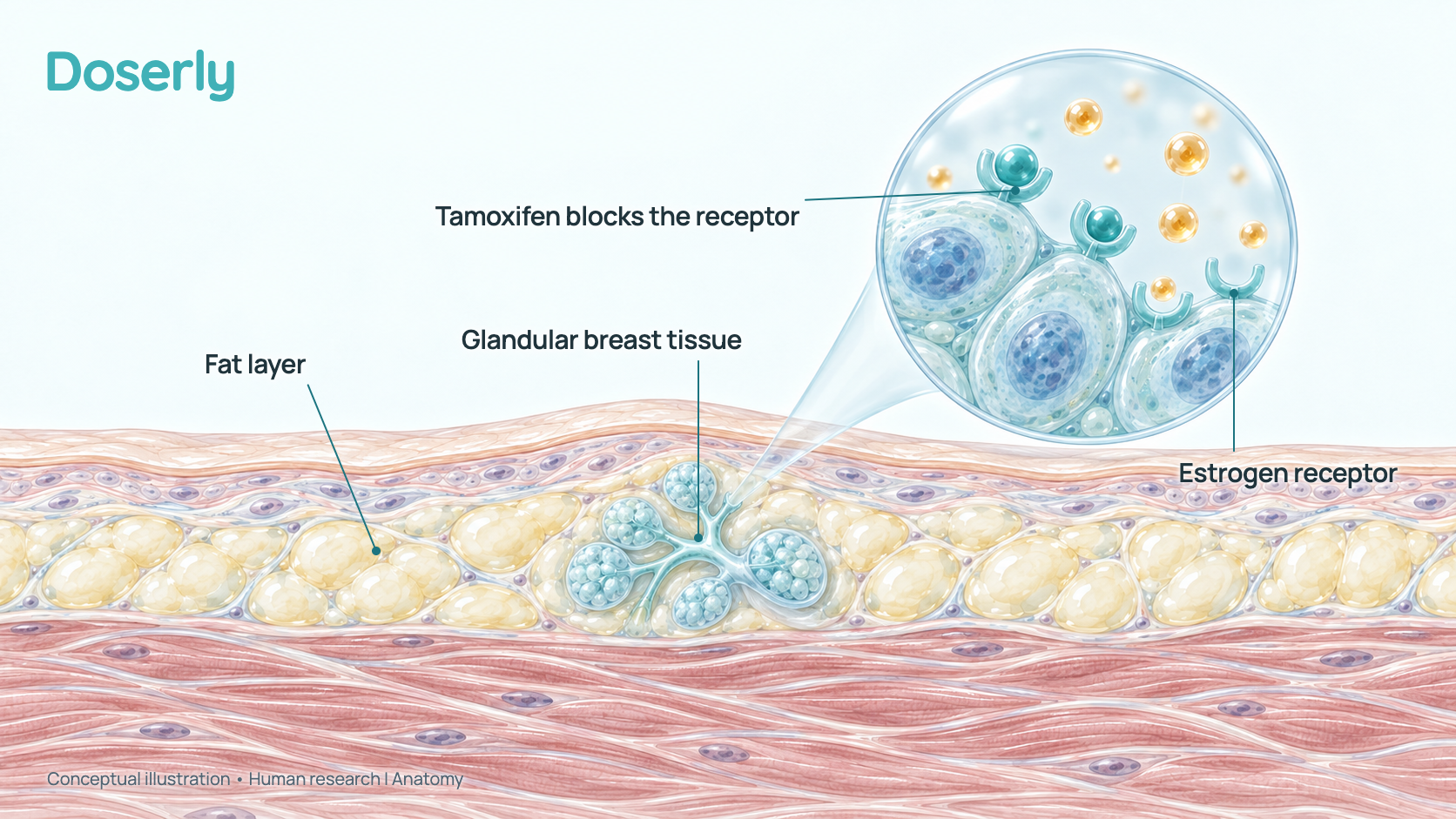
It belongs to a group called SERMs (selective estrogen receptor modulators). "Selective" is the key word: tamoxifen sits in the estrogen receptor, the docking site estrogen uses to switch on a cell, and blocks it in breast tissue but partly switches it on in other tissues. The US label calls it an "estrogen agonist/antagonist". It is not a steroid; the label describes it as a nonsteroidal agent. [2], [1]
Two things surprise many men. First, tamoxifen does not lower estrogen. It blocks estrogen's signal while blood estradiol rises: in oligospermic men (men with low sperm counts) the US label reports that LH, FSH, testosterone and estrogen all went up. Second, its only labeled use in men is breast cancer. The US tablet label says it is effective "in the treatment of metastatic breast cancer in women and men", and none of the current US, UK or Canadian labels lists gynecomastia or TRT. [4], [5]
It was first approved in the United States on December 30, 1977, as Nolvadex. [6]
| Product | Where | Form and strength | Status (checked September 2026) |
|---|---|---|---|
| Generic tamoxifen tablets | United States | 10 mg and 20 mg tablets from several makers | Prescription |
| Soltamox | United States | Oral solution, 20 mg in 10 mL | Prescription |
| Nolvadex | United States | Tablets | Discontinued |
| Nolvadex and generic tablets; oral solution | United Kingdom | 10 mg and 20 mg tablets; solution 10 mg in 5 mL | Nolvadex 20 mg listed; Nolvadex 10 mg discontinued |
| APO-TAMOX, TEVA-TAMOXIFEN | Canada | 10 mg and 20 mg tablets | Marketed; Nolvadex-D cancelled in March 2023 |
This guide also covers raloxifene (Evista), a related SERM approved for bone loss after menopause that some men use for the same breast symptoms. Its US label says it is not recommended in men (see raloxifene). [11]
Typical Tamoxifen Protocols
| Source | Amount each time | How often | Weekly total | Course and adjustment | Source type |
|---|---|---|---|---|---|
| US label · metastatic breast cancer (the only labeled use in men) | 20–40 mg a day; doses above 20 mg split into morning and evening | Daily | 140–280 mg | No fixed course; not adjusted by a lab value | Label The label's 5-year course after breast cancer surgery (adjuvant treatment) is labeled for women only; its trials found no sign that more than 20 mg a day worked better |
| UK label · breast cancer | 20 mg (normally) | Daily | 140 mg | No fixed course stated for treatment | Label |
| Canadian label · breast cancer in women | 20–40 mg a day, in one or two doses | Daily | 140–280 mg | Label covers women only; says not to split the 20 mg tablet | Label |
| American Urological Association (AUA) 2018 · alternative to testosterone for low T | 20 mg | Once daily | 140 mg | LH 4 weeks after starting if testosterone stays low; higher dose only if LH stays low or normal | Guideline Listed in the guideline's table of SERMs and marked not FDA-approved in men; the guideline gives no course length |
| Trial · preventing breast growth in men on bicalutamide (prostate cancer) | 20 mg | Once daily | 140 mg | 48 weeks; fixed dose | Human trial |
| Trial · same setting, lower dose | 10 mg | Once daily | 70 mg | 24 weeks; fixed dose | Human trial |
| Trial · treating breast symptoms after they start (bicalutamide) | 20 mg | Once daily, started within 1 month of symptoms | 140 mg | Up to 1 year; fixed dose | Human trial |
| Trial · unexplained breast growth, crossover with placebo | 10 mg | Twice daily | 140 mg | 1 month; fixed dose | Human trial |
| Study · breast growth in adult men aged 18–64, no comparison group | 20 mg | Once daily | 140 mg | 6–12 weeks; fixed dose | Human report |
| Study · unexplained breast growth in men (average age 43), no comparison group | 10 mg | Once daily | 70 mg | Course not reported in the abstract | Human report |
| Study · men with low sperm counts of unknown cause (hormone study comparing three SERMs, no placebo group) | 20 mg | Once daily | 140 mg | Course not reported in the abstract | Human report Men's fertility guidelines say this use has limited or no routine role; see the fertility section |
Most male studies and the AUA table use 10 or 20 mg once a day, or 10 mg twice a day. Two trials went higher: 30 mg a day in a fertility trial and 20 mg twice a day in a small trial in men with liver cirrhosis. The breast-cancer labels allow up to 40 mg a day. Courses for breast growth ran from 1 month to 1 year, and 20 mg daily is the most common single schedule. [1], [3], [14], [17], [18], [21], [22]
- Titration Adjusting the dose
- No label adjusts tamoxifen for men. When a SERM is used to raise testosterone, the AUA measures LH four weeks after starting if testosterone stays low. It considers a higher dose only if LH is still low or normal; a high LH points to failing testicles, where a higher dose is unlikely to help. In the bicalutamide trials, 20 mg a day prevented more breast symptoms than 10 mg (8.8% vs 23.5% of men had them at 6 months), and 20 mg once a week was clearly worse than 20 mg daily (74.4% vs 31.7% developed breast growth). [3], [23], [24]
- Breaks and courses
- Courses for breast growth in studies were time-limited, from 1 month to 1 year. Tamoxifen is not part of continuous TRT. When the cause keeps going, the benefit fades after tamoxifen stops: in the dose-response trial, breast symptoms became common in every group once tamoxifen ended while bicalutamide continued (what happens when you stop). [17], [14], [23]
Read the units. Tablets come as 10 mg or 20 mg. The US oral solution holds 20 mg in 10 mL, so 10 mg is 5 mL; the UK solution holds 10 mg in 5 mL. A 20 mg tablet once a day gives the same blood levels as a 10 mg tablet twice a day, according to the US label. The Canadian monograph says not to split the 20 mg tablet, so a 10 mg dose normally means a 10 mg tablet or measured liquid. No syringe arithmetic applies. [2], [9], [1], [13]
These doses come from breast-cancer labels, one guideline table and trials in men taking prostate cancer drugs or with unexplained breast growth. Prescribers choose the dose and course for each person. These guides are for men; testosterone therapy for women is covered in testosterone therapy for women.
Cautions for every schedule above. Tamoxifen raises the risk of blood clots in the legs and lungs, and the UK labels rule out its fertility use in anyone with a personal or family history of unexplained clots. Testosterone gel also raised vein clots slightly in the TRAVERSE trial (blood clots). It must not be taken with anastrozole, it strengthens the effect of warfarin, and it needs periodic blood counts and liver tests (monitoring). Before any course, breast growth on TRT is usually first managed by watching and adjusting the testosterone dose (what guidelines say). [12], [25], [1], [26], [3]
Where these numbers come from
The label rows come from the US Mylan tamoxifen tablet label (DailyMed, effective July 2, 2021; the Mayne tablet label revised November 2025 carries the same male wording) and the Soltamox oral solution label (effective November 29, 2021), the UK Wockhardt SmPC (revised May 14, 2026; the Milpharm SmPC revised September 7, 2026 matches), and the Canadian APO-TAMOX monograph (revised September 2, 2025). Weekly totals are simple multiplications; the labels do not state them. [1], [4], [2], [12], [27], [13]
The guideline row comes from Table 6 of the AUA testosterone deficiency guideline (2018), which lists tamoxifen 20 mg daily among SERMs used as alternatives to testosterone and marks it not FDA-approved in men. The trial and study rows each come from one published study, read as an abstract: Boccardo 2005, Perdonà 2005, Serretta 2012, Parker 1986, Khan 2004, Mannu 2018 and Tsourdi 2009. [3], [14], [15], [16], [17], [18], [19], [20]
No clinic-practice row is shown: no peer-reviewed practice paper or published clinic protocol read for this guide gives a tamoxifen dose for breast growth on TRT. One 2025 practice review says only "low-dose tamoxifen". [28]
Not used for any row: post-cycle tapers such as 40 mg then 20 mg (steroid-cycle regimens with no controlled evidence), every-other-day or twice-weekly "estrogen management" schedules (no source, and weekly dosing did worse than daily in a randomized trial), the 30 mg daily arm of an older fertility trial, and doses people describe online. The full text of the 2026 Italian (SIAMS) guideline, including any dose it gives, could not be checked. [29], [30], [24], [21], [31]
What is tamoxifen commonly used for in men?
Its one labeled use in men is breast cancer: the ASCO guideline for male breast cancer recommends tamoxifen for an initial five years when the cancer is hormone receptor-positive. Everything else in this guide is off-label use, and the evidence behind each use differs a great deal. [1], [32]
- Breast growth or tenderness (gynecomastia). The best evidence comes from men taking bicalutamide, an antiandrogen (a drug that blocks testosterone's action) for prostate cancer. Smaller studies cover other kinds of breast growth, including unexplained growth in adults.
- Raising testosterone without TRT. The AUA lists tamoxifen 20 mg daily as an alternative for men with low or low-normal LH, especially men who want to keep their fertility. Most of the research on this idea used clomiphene or enclomiphene instead.
- Fertility. Tamoxifen raises the pituitary hormones that drive sperm production, but pregnancy benefits are uncertain, and men's fertility guidelines give it a limited role.
- Recovery after stopping TRT or steroids ("post-cycle therapy"). Widely discussed online; no controlled study has isolated tamoxifen's effect.
[14], [17], [3], [33], [34], [29]
Does tamoxifen help gynecomastia (breast growth in men)?
Yes, in the settings where it has been tested, and most clearly in men on prostate cancer drugs. In a double-blind trial of 114 men taking bicalutamide, breast growth developed over 48 weeks in 73% on placebo, 10% on tamoxifen 20 mg daily and 51% on anastrozole 1 mg daily. Breast pain developed in 39%, 6% and 27%. Other randomized trials found the same pattern with 10 mg daily, and a 2025 meta-analysis found that tamoxifen cut the risk of breast growth and breast pain by about 82%, while anastrozole showed no significant benefit. [14], [15], [35], [36]
Outside prostate cancer care, the evidence is smaller. In a placebo-controlled crossover trial of 10 men, one month of 10 mg twice daily shrank the breast tissue in 7, only partly, and relieved pain in all 4 who had it. In a 2004 audit of 36 men aged 18 to 64 given 20 mg daily for 6–12 weeks, the lump resolved or improved to the man's satisfaction in 30. Firm "lump" tissue responded in every case, fatty tissue in 62.5%. In a series of 43 patients aged 12 to 62, mostly teenagers with breast growth during puberty, 6 months of 20 mg daily cleared the breast tissue in 26 (62%). It came back in 27% of those. Growths under 4 cm disappeared far more often than larger ones (90% vs 52%). [17], [18], [37]
What it does not do well is shrink long-standing, scarred (fibrous) tissue. In a 2023 comparison of 170 patients treated with tamoxifen or surgery, the authors concluded that surgery is better for the most advanced grade, and a high estrogen level predicted tamoxifen failure. Both European andrology guidelines send long-lasting breast growth to surgery. [38], [39], [31]
In teenagers, breast growth during puberty resolves on its own in more than 90% within 24 months, according to the European Academy of Andrology; treatment of adolescents is specialist care. [39]
Can tamoxifen treat gynecomastia caused by TRT?
It is sometimes prescribed for this, but no trial has tested it, and the major guidelines do not include it as a step. Breast symptoms are uncommon on TRT. In the trials the AUA reviewed, gynecomastia appeared in 1 of 73 men on a 50 mg gel, 3 of 78 on a 100 mg gel and none of 76 on a patch. Two of those four men already had it before treatment. A 2026 review found that only 17% of TRT trials even reported it. [3], [40]
What the guidelines actually say:
- AUA (US, 2018). Watch first, because "breast symptoms sometimes abate". If symptoms persist with high estradiol, lower the testosterone dose when the on-treatment level is upper-normal, or use an aromatase inhibitor when it is low or normal. There is no SERM step. [3]
- European Academy of Andrology (2019). Remove the cause and wait; no SERMs, aromatase inhibitors or non-aromatizable androgens for gynecomastia in general; surgery for long-lasting growth. [39]
- Italian Society of Andrology and Sexual Medicine (SIAMS, 2026). Drug treatment "may be considered in selected idiopathic or painful forms"; otherwise observation or surgery. [31]
- A 2025 practice review. "Low-dose tamoxifen" for symptomatic growth on TRT, with no dose given, and waiting when estrogen is not raised. [28]
The form of testosterone may matter more than any add-on. A 24-week trial compared a skin patch with injections every 2 weeks. The injections produced above-normal testosterone and estradiol for several days after each dose. Existing breast growth resolved in 4 of 10 men on the patch but only 1 of 9 on injections. [41] See estrogen on TRT for how estradiol behaves on each form.
Can tamoxifen raise testosterone instead of TRT?
It can raise testosterone in men whose testicles work, but it is not approved for low testosterone, and the evidence is about blood levels, not symptoms. By blocking estrogen's feedback in the brain, tamoxifen makes the pituitary release more LH and FSH. In an open-label study of 10 healthy men, two weeks of 20 mg daily raised testosterone by an average of 52%. In a randomized trial of 76 men with low sperm counts, 30 mg daily raised average testosterone from 4.9 to 7.9 ng/mL (about 490 to 790 ng/dL, or 17 to 27 nmol/L), against 5.3 to 5.6 ng/mL on placebo. [42], [21]
In a clinic series of 57 men treated for low sperm counts, 3 months raised median testosterone from 3.4 to 5.3 ng/mL (about 12 to 18 nmol/L), with no comparison group. [43]
It only works when the brain-to-testes chain is intact. The European urology guideline says SERMs "cannot work" in primary hypogonadism (failing testicles) or in secondary hypogonadism caused by damage to the pituitary or hypothalamus. The US infertility guideline adds that they will not help after pituitary surgery. [26], [33]
A rise in the number is not the same as feeling better. No trial of tamoxifen in men with low testosterone has measured symptoms. A 2020 review concluded that clomiphene and tamoxifen "should not be used in routine clinical practice" to treat sexual symptoms in men whose low testosterone comes from the brain or pituitary (central hypogonadism). Most of the SERM evidence for low testosterone comes from clomiphene and enclomiphene: a 2025 meta-analysis found they raised testosterone by about 274 ng/dL (about 9.5 nmol/L) more than placebo. See the clomiphene and enclomiphene guides. [44], [45], [46]
Does tamoxifen help fertility?
It raises the hormones that drive sperm production, but whether it leads to more pregnancies is uncertain. In men with low sperm counts, tamoxifen consistently raised LH, FSH and testosterone. Sperm results were mixed: one study found better sperm movement after 3 months, but an older study of 9 men and a randomized trial of 76 found no significant change in sperm counts. [5], [47], [21]
Reviews disagree. A Cochrane review found no difference in pregnancy rates in the trials with secure randomization (odds ratio 1.26, 95% confidence interval 0.99 to 1.56). A 2013 meta-analysis that pooled clomiphene and tamoxifen found higher pregnancy rates (odds ratio 2.42). A 2025 review could not pool tamoxifen against placebo at all. [48], [49], [50]
Guidelines split by situation:
- For infertile men with low testosterone, the AUA/ASRM guideline allows SERMs, hCG or aromatase inhibitors (Conditional; Grade C). [33]
- For unexplained infertility with normal testosterone, the same guideline says SERMs have "limited benefits" compared with assisted reproduction, and the European urology guideline says not to use them routinely. [33], [34]
Tamoxifen does not protect sperm production during TRT. The AUA/ASRM guideline calls the evidence for add-on medicines to testosterone "too limited to recommend", and testosterone should not be prescribed to men who want to conceive. An older trial combined tamoxifen with oral testosterone undecanoate (36 vs 11 pregnancies on placebo, among 106 couples each). It studied men with low sperm counts of unknown cause, not men with low testosterone, and is not a model for TRT. [33], [51] See TRT and fertility.
Is tamoxifen used after stopping TRT or steroids?
It is often used this way, but there is no controlled evidence that it speeds recovery. A review set out to do a meta-analysis on treating steroid-induced low testosterone and found that no quality studies qualified. A 2023 survey of 470 men linked post-cycle therapy to milder withdrawal symptoms but noted the practice "has no objective evidence of effectiveness". In a 2026 cohort of 79 recreational bodybuilders, clomiphene (not tamoxifen), alone or with hCG, sped up hormone recovery, but men who took nothing also recovered, and hormone levels were normal in every group by month 6. [29], [30], [52]
For men who need to recover sperm production, the European urology guideline advises stopping steroids for 6–12 months before trying SERMs or gonadotropins, and the VA says there is no standard protocol. Published recovery regimens after TRT are built around hCG, sometimes with a SERM added. See stopping TRT and hCG. [34], [53], [54]
How long does tamoxifen take to work for gynecomastia?
Pain usually eases before size changes. In the 6-month series, breast pain had gone in every patient by 3 months, and in the crossover trial one month already brought partial shrinkage. In a study of teenagers, measurable shrinkage began after the fourth month and continued to month 6. Tamoxifen itself takes about 4 weeks to reach steady levels, and its main breakdown product about 8 weeks. [37], [17], [55], [1]
Relapse is common when the cause persists or the course ends: 27% in the 6-month series, and 5 of 23 men in an older comparison with danazol. [37], [56]
The guide does not teach how to judge breast symptoms at home. The Academy note below covers a structured way to think them through before any add-on medicine.
Where do tamoxifen protocols differ?
Most of the disagreement is not about the dose. It is about whether tamoxifen belongs in the plan at all, and that depends on what caused the breast growth, how long it has been there and which guideline you read.
Should tamoxifen be used for gynecomastia at all?
The sources genuinely disagree, because they describe different men and different evidence.
| Source | Who it is about | Position |
|---|---|---|
| Bicalutamide trials and meta-analyses | Men on antiandrogen drugs for prostate cancer | Strong, repeated benefit from 10–20 mg daily |
| European Academy of Andrology 2019 | Gynecomastia in general | Does not recommend SERMs, aromatase inhibitors or non-aromatizable androgens |
| SIAMS 2026 | Adolescents and adults | Drug treatment may be considered in selected unexplained or painful cases |
| AUA 2018 | Men on TRT | Watch, then lower the testosterone dose or use an aromatase inhibitor; no SERM step |
| Practice review 2025 | Men on TRT | Low-dose tamoxifen for symptomatic growth, no dose given |
The practical consequence: in prostate cancer care, where the cause cannot be removed, tamoxifen is a well-tested option. On TRT, where the cause is usually a changeable dose or form, guidelines start by changing the testosterone.
Tamoxifen or anastrozole for breast tissue?
In head-to-head trials, tamoxifen won. In men on bicalutamide, anastrozole 1 mg daily left 51% with breast growth versus 10% on tamoxifen; a systematic review found tamoxifen better than anastrozole, and a 2025 meta-analysis found no significant benefit from anastrozole at all. In boys with pubertal breast growth, anastrozole also failed against placebo. [14], [57], [58], [36], [59]
Yet the AUA's path for breast symptoms on TRT names aromatase inhibitors, not SERMs, while the VA's 2026 recommendations do not generally recommend aromatase inhibitors for men on testosterone, citing heart, belly-fat and bone concerns. The two approaches work differently: anastrozole lowers estradiol throughout the body, and a year of it lowered spine bone density in older men; tamoxifen leaves estradiol high and blocks it in breast tissue. They should not be taken together (interactions). [3], [53], [60] See the anastrozole guide.
Prevent it, or treat it once it starts?
In men starting bicalutamide, taking 10 mg daily from day one left fewer and milder breast symptoms than waiting and treating with 20 mg once symptoms began. Symptoms persisted in 27.7% after treatment, and treated symptoms that remained were more intense. [16]
On TRT, no guideline recommends preventive tamoxifen. Breast symptoms are uncommon on TRT and sometimes settle on their own, which makes a daily clot-raising drug for everyone hard to justify. [3], [39]
10 mg or 20 mg? Daily or less often?
In the only dose-finding trial (282 men on bicalutamide), breast symptoms at 6 months fell with each step up in dose: 96.7% on placebo, 86.2% on 1 mg, 60.0% on 2.5 mg, 55.3% on 5 mg, 23.5% on 10 mg and 8.8% on 20 mg. Hot flushes became more common from 5 mg upward. Other trials still found large benefits with 10 mg. [23], [15], [35]
Taking it less often did worse. In a randomized trial of 80 men, switching to 20 mg once a week after 8 weeks of daily dosing let breast growth develop in 74.4%, against 31.7% on 20 mg daily throughout. No study supports every-other-day or twice-weekly schedules, which appear online for "estrogen control". [24]
A SERM or TRT for low testosterone?
They are different strategies. A SERM asks working testicles to make more testosterone and keeps sperm production running; TRT replaces testosterone and switches both off. The AUA treats SERMs, tamoxifen included, as off-label options for men with low or low-normal LH, especially men who want fertility. The Canadian urology guideline lists them as off-label alternatives for men who want fertility. The Endocrine Society and the European Academy of Andrology say the evidence is weak (details). [3], [61], [62], [45]
What happens when you stop tamoxifen?
The drug leaves slowly, and what happens next depends on whether the original cause is still there. [1], [23]
- The drug itself. With a half-life of about 5–7 days, and about 14 days for its main breakdown product, tamoxifen takes weeks to clear. In one study, testosterone and SHBG were still raised 9 weeks after a course ended. [1], [12], [47]
- Breast symptoms. When the cause continues, they tend to come back: in the dose-response trial, breast symptoms were common in every group a year after tamoxifen stopped while bicalutamide continued. After treatment of unexplained breast growth, relapse rates of 27% and 5 of 23 have been reported. [23], [37], [56]
- Hormones. A tamoxifen-driven rise in testosterone depends on taking it; no study has followed men who used it long term for low testosterone after they stopped. Nothing suggests a taper is needed; labels give no tapering instructions. [1]
For stopping testosterone itself, see stopping TRT.
How do tamoxifen tablets, liquid and raloxifene compare?
Tamoxifen is swallowed, once or twice a day, and behaves the same whether taken as a tablet or liquid. What changes its effect more is how each person's liver converts it, and the medicines taken with it.
How long does tamoxifen last in the body?
After a 20 mg dose, blood levels peak at about 5 hours. The half-life is about 5–7 days, and the main breakdown product, N-desmethyltamoxifen, lasts about 14 days. Because of that long tail, steady levels take about 4 weeks for tamoxifen and about 8 weeks for the breakdown product. About 65% of a dose leaves the body within 2 weeks, mostly in the stool. [1], [12]
Food does not matter: the Soltamox label says it can be taken without regard to meals. [2]
Why does the liver enzyme CYP2D6 matter?
Tamoxifen is partly a "pro-drug". The liver turns a small share of it into endoxifen and 4-hydroxytamoxifen, which bind the estrogen receptor about 100 times more strongly than tamoxifen itself. The liver enzyme CYP2D6 makes that conversion. [2], [13]
People differ in how well CYP2D6 works. In a large US study of women with breast cancer, the label reports average endoxifen levels of 15.9 ng/mL in normal metabolizers and 5.6 ng/mL in poor metabolizers. Some antidepressants and other medicines block CYP2D6 (interactions). The labels say the effect of these differences on how well tamoxifen works "is not well established", and all the outcome data come from breast cancer, not breast growth in men. [2]
Raloxifene (Evista): how is it different?
Raloxifene is a related SERM approved for bone loss after menopause and for breast cancer risk reduction in women. Its US label says there is no indication for use in men and its use is not recommended. Men still discuss it for breast symptoms because of one study. [11]
| Source | Amount each time | How often | Weekly total | Course | Source type |
|---|---|---|---|---|---|
| US label (Evista) · women after menopause | 60 mg | Once daily | 420 mg | Ongoing | Label |
| Study · men with low sperm counts of unknown cause, no placebo group | 60 mg | Once daily | 420 mg | Not reported in the abstract | Human report |
| Trial · healthy men aged 60–70 (hormone study) | 120 mg | Once daily | 840 mg | 3 months | Human trial |
What the evidence shows in men and boys:
- Breast growth. In a review of 38 teenagers' records (not randomized), a greater share had their breast tissue shrink by more than half on raloxifene (86%) than on tamoxifen (41%). The authors said more study was needed to confirm a true treatment effect. No trial has compared the two in adults. [64]
- Hormones. In healthy men aged 60 to 70, 120 mg daily for 3 months raised LH by 29%, FSH by 21%, testosterone by 20%, estradiol by 21% and PSA by 17%, with no clear benefit overall. In men with low sperm counts, the rise in LH and FSH was larger with tamoxifen than with raloxifene. [63], [20]
- Bone. In men receiving hormone-blocking treatment for prostate cancer, raloxifene 60 mg daily raised hip bone density by 1.1% while it fell by 2.6% without it. No similar bone study of tamoxifen in men was found. [65]
- Risks. Evista carries a boxed warning for blood clots and death from stroke, and its label says to stop it at least 72 hours before long periods of immobility, such as after surgery. Its half-life is about 28 hours. [11]
In Canada, the Evista brand was cancelled on January 30, 2026, while generic raloxifene remains marketed (checked September 2026). [66]
How should tamoxifen be stored?
Store it at room temperature and away from light. Each product's label sets its own details, so the leaflet in your box is the final word. [1], [2], [13]
| Product | Storage | After opening |
|---|---|---|
| US tamoxifen tablets | 20–25 °C; protect from light | No in-use limit stated |
| Soltamox oral solution (US) | 20–25 °C (15–30 °C allowed); do not freeze or refrigerate; keep in the original bottle | Discard 3 months after first opening |
| APO-TAMOX tablets (Canada) | 15–30 °C; protect from light | No in-use limit stated |
What does tamoxifen do to fertility, estrogen and red blood cells?
Each of these has its own hub guide. Here is what is specific to tamoxifen.
Fertility. Tamoxifen raises LH and FSH, the opposite of testosterone therapy, but sperm counts often did not improve in trials, and it does not overcome the sperm shutdown caused by TRT (details above). See TRT and fertility. [4], [21], [33]
Estrogen. Tamoxifen raises estradiol in men. In 9 men with low sperm counts taking 10 mg daily, estradiol rose from 185 to 631 pmol/L (about 50 to 172 pg/mL) over 6 months. In a trial of men with breast cancer, median estradiol rose 67% in 3 months. For comparison, the AUA suggests referral to an endocrinologist when estradiol before TRT stays above 40 pg/mL (about 147 pmol/L). A high estradiol result while taking tamoxifen is expected and does not mean the drug has failed. See estrogen on TRT. [5], [67], [3]
Red blood cells. No study read for this guide measured tamoxifen's effect on hematocrit, so there is no basis for saying it raises or protects against it. The label reports falls in platelets and white cells in some patients. Men on TRT keep the usual hematocrit checks; see hematocrit on TRT. [1]
What tamoxifen does to hormone results in men
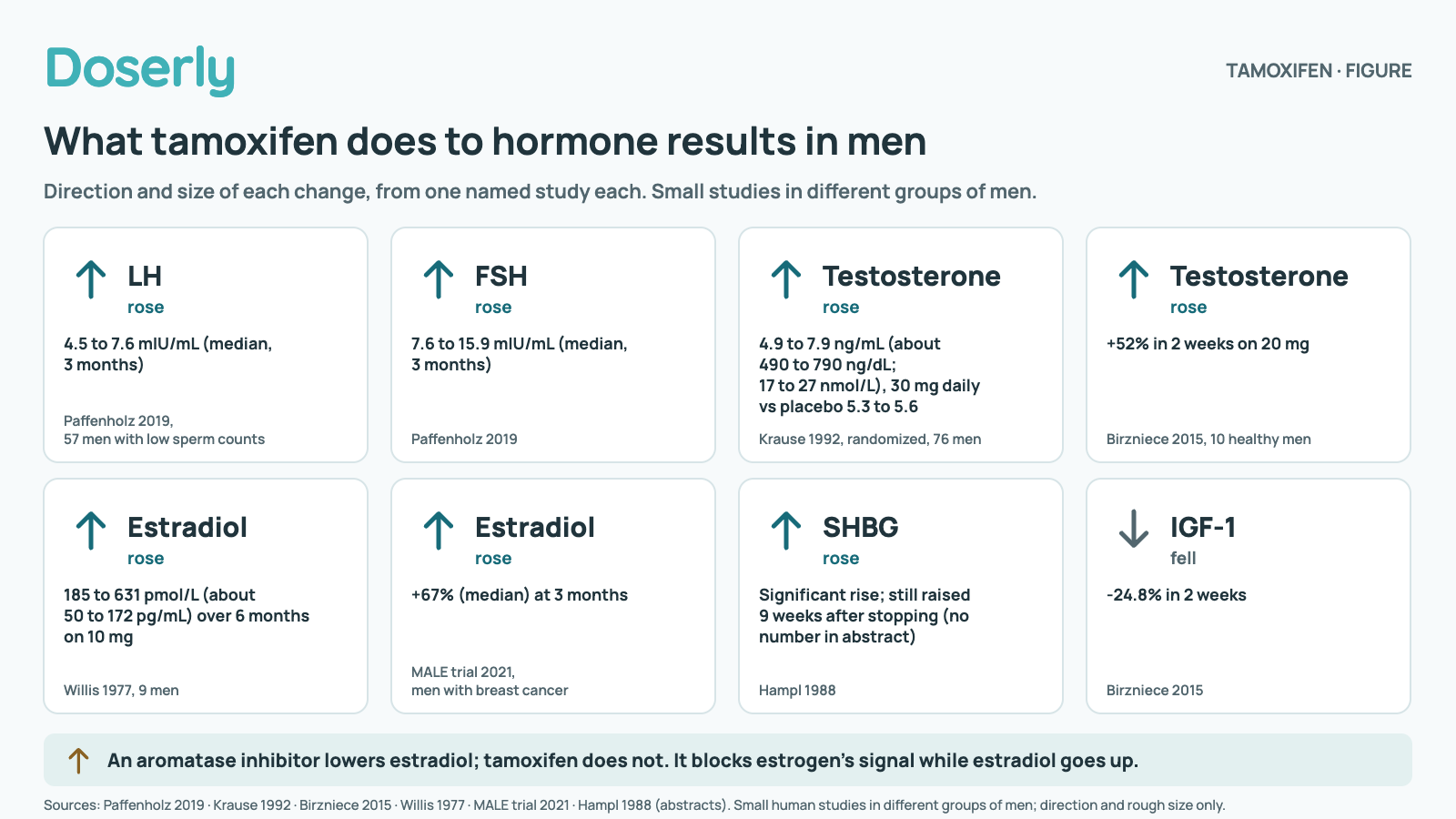
- LH rose
- 4.5 to 7.6 mIU/mL (median, 3 months)Paffenholz 2019, 57 men with low sperm counts
- FSH rose
- 7.6 to 15.9 mIU/mL (median, 3 months)Paffenholz 2019
- Testosterone rose
- 4.9 to 7.9 ng/mL (about 490 to 790 ng/dL; 17 to 27 nmol/L), 30 mg daily vs placebo 5.3 to 5.6Krause 1992, randomized, 76 men
- Testosterone rose
- +52% in 2 weeks on 20 mgBirzniece 2015, 10 healthy men
- Estradiol rose
- 185 to 631 pmol/L (about 50 to 172 pg/mL) over 6 months on 10 mgWillis 1977, 9 men
- Estradiol rose
- +67% (median) at 3 monthsMALE trial 2021, men with breast cancer
- SHBG rose
- Significant rise; still raised 9 weeks after stopping (no number in abstract)Hampl 1988
- IGF-1 fell
- -24.8% in 2 weeksBirzniece 2015
An aromatase inhibitor lowers estradiol; tamoxifen does not.
Small human studies in different groups of men; direction and rough size only.
What do we actually know about tamoxifen in men?
A good deal about breast growth caused by prostate cancer drugs, a little about unexplained breast growth, hormones and fertility, and nothing from trials about breast growth caused by TRT.

What did the randomized trials in men find?
| Study | Who and what | What it found | What it cannot show |
|---|---|---|---|
| Boccardo 2005 (controlled trial) | 114 men on bicalutamide; tamoxifen 20 mg, anastrozole 1 mg or placebo daily, 48 weeks | Breast growth 10% vs 51% vs 73%; breast pain 6% vs 27% vs 39% | Men on TRT; long-term effects [14] |
| Perdonà 2005 (randomized trial) | 151 men on bicalutamide; tamoxifen 10 mg daily, a single dose of breast radiotherapy, or neither, 24 weeks | Breast growth in 4 of 50 on tamoxifen, 17 of 50 with radiotherapy, 35 of 51 with neither | Men on TRT [15] |
| Fradet 2007 (dose-response trial) | 282 men on bicalutamide; tamoxifen 1–20 mg or placebo daily | Breast symptoms at 6 months fell from 96.7% (placebo) to 8.8% (20 mg); common again after stopping | Men on TRT [23] |
| Bedognetti 2010 (randomized trial) | 80 men on bicalutamide; 20 mg daily throughout vs 20 mg weekly after 8 weeks of daily dosing | Breast growth 31.7% daily vs 74.4% weekly | Men on TRT [24] |
| Parker 1986 (crossover trial) | 10 men with unexplained breast growth; 10 mg twice daily or placebo for 1 month each | Size fell in 7; pain relieved in all 4 who had it; shrinkage partial | Lasting results; small [17] |
| Krause 1992 (randomized trial) | 76 men with low sperm counts; 30 mg daily or placebo | Testosterone 4.9 → 7.9 ng/mL; sperm count change not significant | Symptoms; pregnancy [21] |
| MALE 2021 (randomized trial) | 56 men with breast cancer (52 started treatment); tamoxifen alone, tamoxifen plus a GnRH analogue (an injection that shuts down testosterone production), or an aromatase inhibitor plus a GnRH analogue, 6 months | Tamoxifen alone raised median estradiol 67% at 3 months; sexual function and quality of life unchanged | Men without cancer [67] |
The bicalutamide trials and the five reviews that pool them are one body of evidence, not several independent confirmations. Every trial is also in older men with prostate cancer, whose breast growth comes from testosterone being blocked, while on TRT it comes from estradiol made from extra testosterone. The biology overlaps but is not the same. [58], [68], [69], [36], [70]
Breast growth in the tamoxifen trials in men
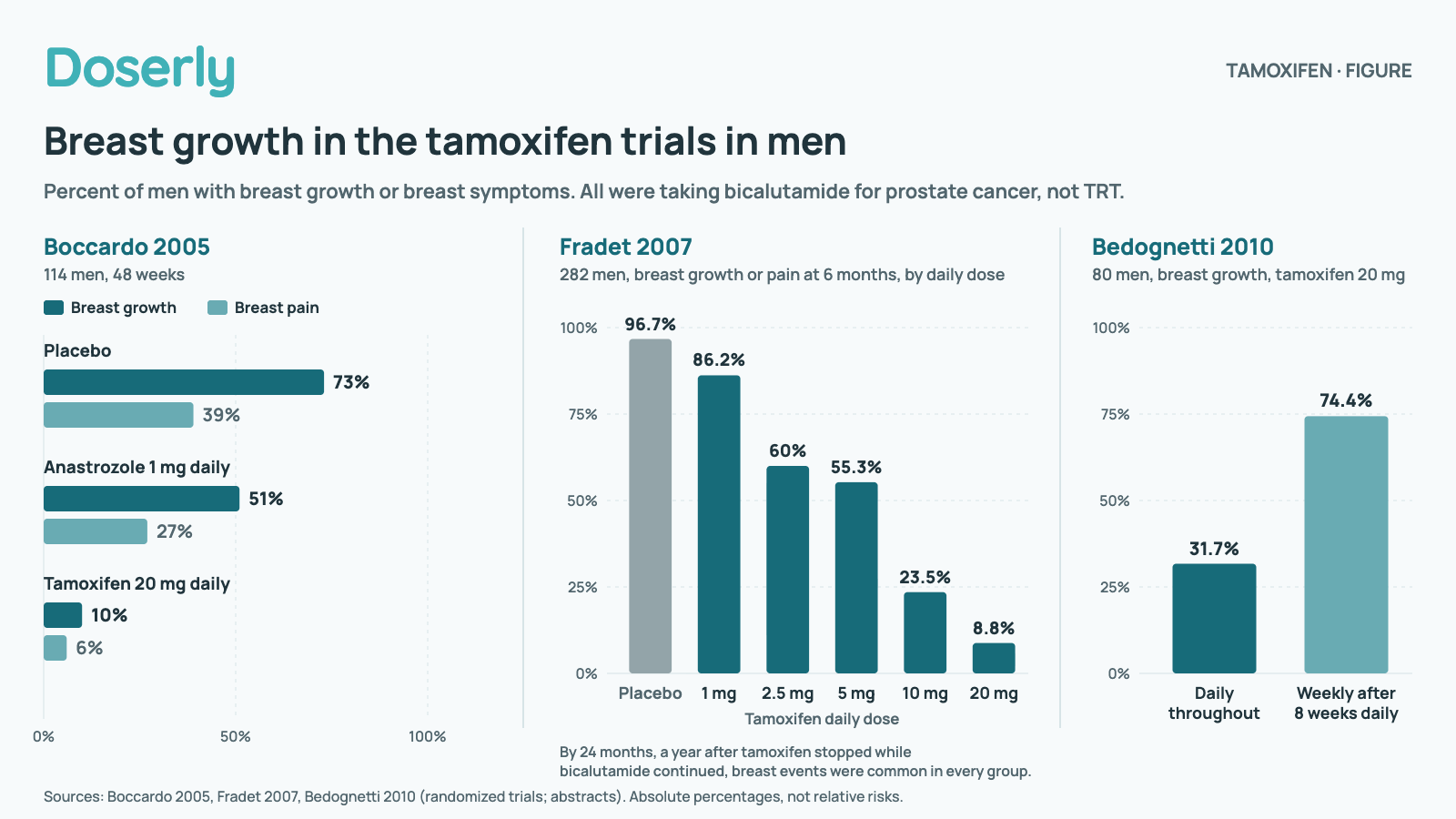
Percent of men. All were taking bicalutamide for prostate cancer, not TRT.
Boccardo 2005: 114 men, 48 weeks
Breast growthBreast pain
- Placebo
- Breast growth 73%; breast pain 39%
- Anastrozole 1 mg daily
- Breast growth 51%; breast pain 27%
- Tamoxifen 20 mg daily
- Breast growth 10%; breast pain 6%
Fradet 2007: 282 men, breast growth or pain at 6 months
- Placebo
- 96.7%
- Tamoxifen 1 mg daily
- 86.2%
- Tamoxifen 2.5 mg daily
- 60%
- Tamoxifen 5 mg daily
- 55.3%
- Tamoxifen 10 mg daily
- 23.5%
- Tamoxifen 20 mg daily
- 8.8%
Breast events became common in all groups by 24 months, after tamoxifen stopped while bicalutamide continued.
Bedognetti 2010: 80 men, breast growth
- 20 mg daily throughout
- 31.7%
- 20 mg weekly after 8 weeks daily
- 74.4%
Men on bicalutamide for prostate cancer, not TRT. Source: randomized trials (abstracts).
What do the smaller studies add?
Studies of unexplained breast growth without a placebo group report high response rates. In a cohort of 81 men on 10 mg daily, 73 had a complete response. A records comparison with danazol (ages 13 to 82) found complete resolution in 18 of 23 patients on 20 mg against 8 of 20 on danazol, but all 5 relapses were on tamoxifen. Without a placebo group, some of that improvement may have happened anyway. In men with liver cirrhosis and breast pain, 14 of 16 had less pain or none during tamoxifen in a randomized crossover study. For teenagers, a 2013 systematic review found no randomized trials. [19], [56], [22], [71]
What is still unknown?
- Whether tamoxifen helps breast growth caused by TRT, and at what dose and for how long.
- Whether it improves symptoms, not just testosterone numbers, in men with low testosterone.
- Its long-term effect on bone in men; European urology guidance warns that long-term SERM use can reduce bone density. [26]
- Its effect on hematocrit.
- Long-term safety in men without cancer: a review of adverse events in men concluded that long-term studies are lacking. [72]
How does tamoxifen work?
Tamoxifen works by occupying the estrogen receptor, not by removing estrogen. [2]
In breast tissue, breast growth in men comes from glandular tissue that responds to estradiol. Tamoxifen competes with estradiol for the receptor, so gland cells receive a weaker growth signal even when blood estradiol is high. The US label describes this as competition with estrogen for binding to the receptor, reducing receptor-driven growth in breast tissue. [2], [1]
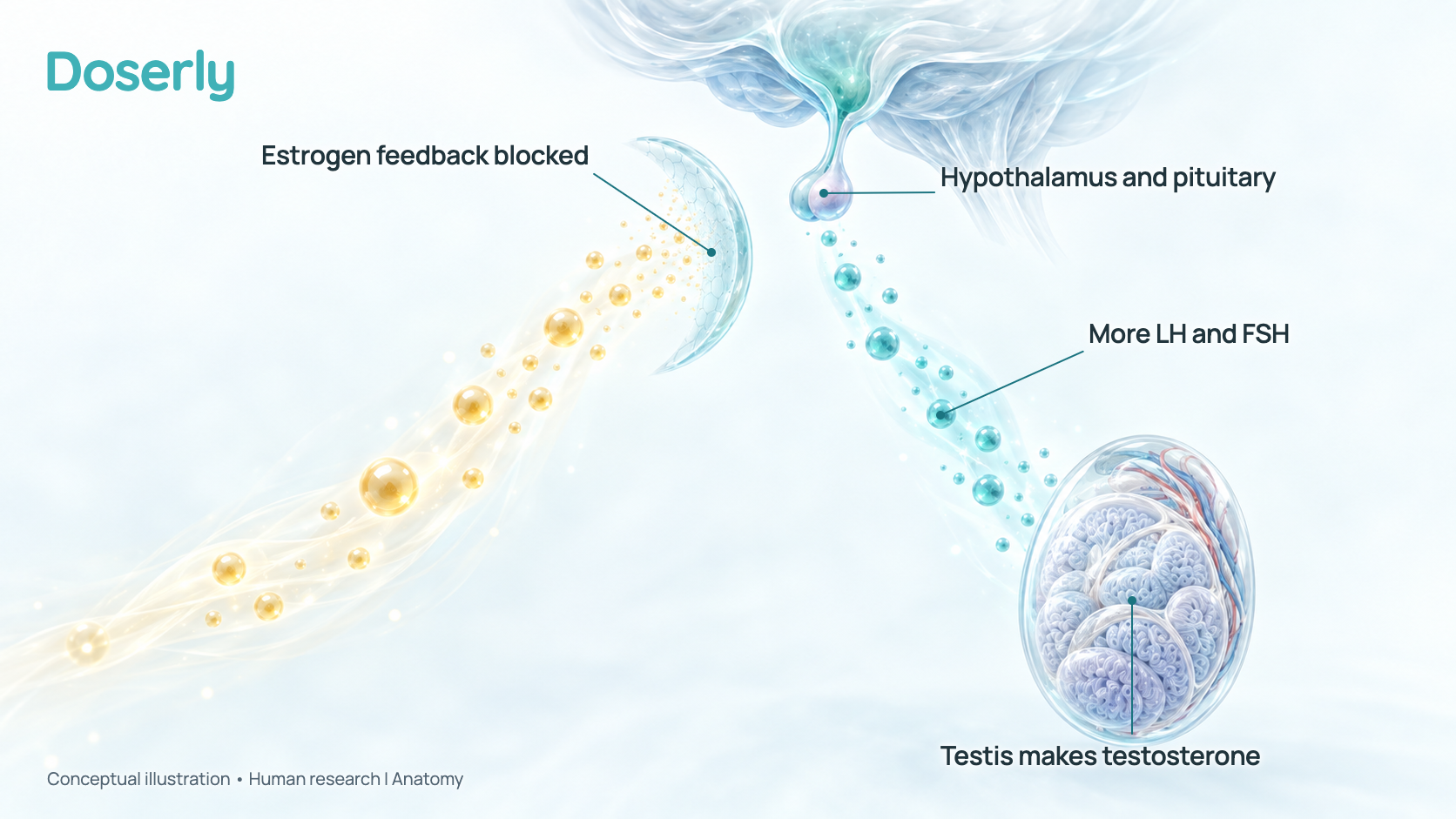
In the brain, the hypothalamus and pituitary use estradiol as a thermostat reading: when estradiol is high, they send less LH and FSH to the testicles. Tamoxifen blocks that reading, so the pituitary sends more LH and FSH, and working testicles make more testosterone. Some of that extra testosterone becomes estradiol, which is why estradiol rises too. The AUA describes tamoxifen as blocking estrogen's negative feedback at the hypothalamus and pituitary, and the European urology guideline adds that the effect needs an intact axis. [3], [33], [26]
Other effects. Tamoxifen raises SHBG (sex hormone-binding globulin, the protein that carries testosterone in the blood). In the Boccardo trial, free testosterone stayed unchanged on tamoxifen because SHBG rose. It also lowered IGF-1, a growth-hormone marker, by about 25% in healthy men. [47], [14], [42]
What are the risks and unanswered questions?
Is tamoxifen safe?
For a short, supervised course it is usually tolerated, but it has real risks that a TRT add-on should justify: blood clots, eye and liver effects, and side effects that lead many men to stop. Most of the male safety data come from men with breast cancer, who are older and take it for years. In those men, clot risk was highest in the first 18 months, so a short course does not avoid it. Long-term effects in men without cancer are unknown. [73], [74], [72]
What side effects do men report?
In three series of men taking tamoxifen for breast cancer:
- 24 men: 62.5% had at least one side effect: lower sex drive (29.2%), weight gain (25%), hot flashes (20.8%), mood changes (20.8%), depression (16.6%), insomnia (12.5%) and one leg clot. One in five (20.8%) stopped within a year because of side effects. [74]
- 38 men: half reported side effects, most often hot flashes (18.4%); 23.7% stopped. [75]
- 64 men: 53% had side effects, most often weight gain (22%) and sexual problems (22%); 20.3% stopped, 4 of them because of clots. [76]
The US label adds that loss of libido and impotence have led men to stop. In contrast, a randomized trial found sexual function and quality of life unchanged on tamoxifen alone, and a review found few side effects in men treated for infertility or unexplained breast growth, with under 5% stopping overall. Adherence in men with breast cancer falls over time: only 64.6% were still taking it after a year in one study. [4], [67], [72], [77]
Does tamoxifen cause blood clots?
Yes, it raises the risk. In a cohort of 218 men with breast cancer (median age 69), clots occurred in 21 of 177 men on tamoxifen (11.9%) and 1 of 41 not taking it. That is about 52 versus 22 per 1,000 person-years. Most clots (81%) happened in the first 18 months, and men over 71 were at higher risk. [73]
The US label reports rates from the large US prevention trial in women. Pulmonary embolism (a clot in the lungs) occurred at 0.75 versus 0.25 per 1,000 women-years on placebo. Deep vein thrombosis occurred at 1.26 versus 0.79 (30 vs 19 cases), a difference that did not reach statistical significance. The European urology guideline says men should be warned of the possible clot risk with SERMs. Leg pain or swelling, sudden breathlessness or chest pain need urgent care. [1], [26]
Testosterone adds a small clot signal of its own. TRAVERSE, a randomized trial in about 5,200 men aged 45 to 80 with heart disease or high heart risk, compared daily testosterone gel with a placebo gel. Among the 2,596 men on testosterone and the 2,602 on placebo:
- Heart attack, stroke or heart death: 7.0% vs 7.3% (hazard ratio 0.96), which met the trial's safety margin. [78], [25]
- Clots in veins: 1.7% vs 1.2%, including pulmonary embolism in 0.9% vs 0.5%. [25]
- Heart rhythm and kidneys: atrial fibrillation (an irregular heartbeat) 3.5% vs 2.4%; acute kidney injury (a sudden drop in kidney function) 2.3% vs 1.5%. [25]
Its limits: it tested only a gel, the average man used it for 21.7 months, and about 61% stopped their study gel early. Nothing read for this guide measured how the clot risks of tamoxifen and testosterone combine. See TRT and heart health. [78], [25]
What does the boxed warning say?
The US boxed warning is headed "For Women with Ductal Carcinoma in Situ (DCIS) and Women at High Risk for Breast Cancer". DCIS is an early breast cancer confined to the milk ducts. The warning covers uterine cancers, stroke and pulmonary embolism when tamoxifen is used in that setting (US labels, checked September 2026). The uterine risks do not apply to men; the clot risk has been seen in men too, as the cohort above shows. [4], [1]
What about the eyes, liver and blood counts?
- Eyes. The label reports changes to the cornea, reduced color vision, a clot in a retinal vein and damage to the retina, plus more cataracts and cataract surgery. In one study of women, five or more years of use raised the risk of cataracts. Any change in vision needs checking. [1], [79]
- Liver. Tamoxifen can change liver enzymes and, rarely, cause fatty liver, hepatitis or worse. [1]
- Blood counts. Falls in platelets and white cells have been reported. [1]
Is tamoxifen legal? Is it FDA approved?
Checked September 2026. Rules differ by country and change often.
- United States. Tamoxifen is FDA-approved as a prescription medicine for breast cancer; generic tablets and Soltamox solution are marketed, and the Nolvadex brand is discontinued. It is not a controlled substance; its label carries no controlled-substance schedule. Every use discussed here for men without breast cancer is off-label, and the AUA marks it not FDA-approved in men for low testosterone. FDA's drug shortage data list no tamoxifen or raloxifene shortage (updated September 26, 2026). [6], [7], [3], [80]
- Canada. Prescription-only. APO-TAMOX and TEVA-TAMOXIFEN are marketed; Nolvadex-D was cancelled on March 22, 2023 and Tamofen in January 2011. Canadian labeling covers breast cancer in women only. The Evista brand of raloxifene was cancelled on January 30, 2026; generics remain. [10], [13], [66]
- United Kingdom. Tablets and an oral solution are licensed for breast cancer and, in women, for infertility caused by lack of ovulation. Nolvadex 20 mg is still listed; the 10 mg strength is discontinued. [12], [8], [9]
- Australia. Tamoxifen is listed on the Pharmaceutical Benefits Scheme only for hormone receptor-positive breast cancer. Australian product information could not be checked for this guide. [81]
Buying tamoxifen labeled "for research use only" does not make it legal, tested or the same as a licensed medicine.
Is tamoxifen banned in sport?
Yes. Tamoxifen, raloxifene and clomiphene are anti-estrogenic substances in class S4.2 of the World Anti-Doping Agency (WADA) Prohibited List, banned in and out of competition, and the 2027 list keeps them banned from January 1, 2027. [82], [83]
Who should be especially cautious?
- Anyone with a past blood clot, a clotting disorder or a family history of clots. The UK labels rule out its fertility use in these people, and clots were the most common reason men stopped in one breast cancer series. [12], [76]
- Men over about 70. Clot risk was higher in men over 71. [73]
- People with liver disease or eye problems, given the label warnings. [1]
- Men who have had depression. Low mood and depression were among the commonest side effects in men. [74]
- Men taking warfarin, anastrozole or antidepressants that block CYP2D6 (see the next question).
- Men with failing testicles (primary hypogonadism). Tamoxifen cannot raise testosterone there. [26]
- Teenagers. Pubertal breast growth usually settles on its own; any treatment is specialist care. [39]
- Drug-tested athletes. Banned at all times. [82]
- Women who are or may become pregnant. Tamoxifen can harm an unborn baby; these guides are for men. [2]
Can tamoxifen be taken with other medicines?
The labels list several interactions that matter to men on TRT:
- Anastrozole: do not combine. The US label says tamoxifen "should not be coadministered with anastrozole", and UK labels list it as a contraindication. In the large ATAC breast cancer trial, the combination worked no better than tamoxifen alone. Taking both also lowered anastrozole levels by 27%, a drop the researchers judged unlikely to matter clinically. Tamoxifen also lowered letrozole levels by 37–38%. [4], [84], [12], [85]
- Warfarin and similar blood thinners. The anticoagulant effect can rise significantly; the label advises careful monitoring of clotting times, and it is a contraindication for women using tamoxifen to reduce breast cancer risk. [1], [2]
- Medicines that block CYP2D6, such as paroxetine, fluoxetine, bupropion, quinidine and cinacalcet. The UK label says to avoid strong inhibitors whenever possible; the US label says their effect on how well tamoxifen works is not well established. A pharmacogenetics guideline for breast cancer advises avoiding moderate and strong inhibitors, and found that raising the dose to 40 mg does not bring poor metabolizers to normal endoxifen levels. [12], [2], [86], [87]
- Rifampin (an antibiotic for tuberculosis). It lowered tamoxifen exposure by 86%. [1]
Testosterone itself is not listed as an interaction. Bring a full list of everything you take, including supplements, to a pharmacist or prescriber.
What should be monitored while taking tamoxifen?
The labels ask for periodic blood counts, including platelets, and periodic liver tests, and for prompt checks of any vision change or clot symptoms. The AUA adds hormone checks when a SERM is used to raise testosterone. Use this summary to prepare questions for your prescriber; it is not a personal testing plan. [1], [2], [3]
| Why it matters | What labels and guidelines say | Tracking category |
|---|---|---|
| Blood counts | Labels: periodic complete blood count, including platelets | Blood work |
| Liver | Labels: periodic liver function tests | Blood work |
| Clot symptoms | Labels and EAU: warn about clots; report leg swelling or pain, breathlessness or chest pain at once | Other (symptoms) |
| Vision | Labels: report any change in vision | Other (symptoms) |
| Testosterone and LH (when used to raise testosterone) | AUA: LH 4 weeks after starting if testosterone stays low; estradiol optional on SERMs | Blood work; Libido; Energy Levels |
| Breast symptoms | AUA: watch first; estradiol measured before TRT only when breast symptoms are present | Hormonal Symptoms |
| Mood and sexual function | Male series: lower sex drive, depression and mood changes are common | Mood & Wellbeing; Libido |
| TRT markers | Hematocrit, PSA and testosterone monitoring continue as for any TRT | Blood work |
For men also on TRT, the usual checks continue unchanged; see TRT blood work. When a tamoxifen course starts or stops, note the date next to any lab result: in one study, testosterone and SHBG stayed raised for 9 weeks after a course ended. [47]
What do people in public communities report?
Public forums hold every kind of tamoxifen story: tender nipples that settled, lumps that did not shrink, and men who stopped because of how it made them feel. The accounts below come from public Reddit threads posted between September 2025 and September 2026, described without identifying anyone. Threads about non-prescribed steroid cycles appear only where they show something about tamoxifen itself, and are marked.
What do men describe when it is prescribed for breast symptoms on TRT?
Most stories start early in treatment. One man felt nipple sensitivity within days of starting 125 mg of testosterone a week, split into injections every other day. His doctor prescribed tamoxifen 20 mg daily for 14 days, then 10 mg. He felt good for the first two weeks, but then his sex drive fell while his estradiol climbed from 55 to 210 pmol/L, and he could not tell whether tamoxifen or the hormone changes were responsible. A month in, his energy was rising, his nipples were still sensitive, and he planned to discuss a lower testosterone dose after his next blood test. [88]
Another man developed burning nipples and small lumps after switching from gel to injections. He started tamoxifen and exemestane (an aromatase inhibitor), felt horrible on the exemestane, and by week 4 of tamoxifen most of the lumps had gone, though burning and swelling still came and went. He had also lowered his testosterone dose and split it into three injections a week, so two things changed at once. [89]
A man on 100 mg a week with a small hard lump was prescribed tamoxifen 20 mg daily for 4 weeks plus exemestane twice a week, and planned to start the tamoxifen alone for fear of low-estradiol symptoms. [90]
Some courses have no clear end. A 20-year-old with breast tissue that predated his treatment for secondary hypogonadism described taking tamoxifen alongside TRT for months, because his nipple sensitivity came back whenever he stopped. [91]
Does it always work?
No. The reports match the studies: pain and tenderness often ease before any lump shrinks, and firm, older tissue may not shrink at all.
- Pain gone, lump unchanged. After a two-month non-prescribed cycle, one man took 20 mg daily, then 30 mg; nearly two months later the tenderness had resolved, but the lump was the same size. (Steroid cycle.) [92]
- Partial shrinkage, then surgery. A man on TRT with many hormone changes said 40 mg a day halved his breast tissue over two months, but enough remained that he had it removed surgically. [93]
- No response. A man not on TRT, who had already had breast surgery once, noticed no improvement in a painful lump after two months of 20 mg daily. With later medicine changes the tissue grew, and he was careful not to blame tamoxifen for the growth. [94]
What unwanted effects come up?
Mood effects are the most striking. A man with a history of depression, who had earlier felt better on clomiphene, described brief good spells on doctor-directed tamoxifen followed by severe depression with suicidal thoughts, plus weight gain and food cravings; he told his doctor. Thoughts of suicide need urgent help, whatever the cause. [95]
- Anxiety within hours. Coming off long-term testosterone, one man twice had severe anxiety, low mood and shakiness within hours of a 10 mg morning dose; taking it at night was more tolerable. He also noticed vision problems that improved after he stopped. (His history included higher-dose steroid use.) [96]
- Brain fog and sleep. Another man, 11 days into 20 mg after stopping self-administered testosterone, described brain fog, poor appetite, broken sleep and severe anxiety that eased when he skipped a dose and returned on 10 mg; he planned to see a doctor. [97]
- Sex drive and erections. Lower sex drive appears in several threads, but almost always alongside a testosterone or hormone change, as in the first story above. [88], [98]
- Worry about the eyes. Vision comes up often. One man asking about preventive use said reports of lasting vision problems made him hesitate; another chose a low tamoxifen dose because clomiphene had left him with floaters that never went away. [99], [100]
Does tamoxifen lower estrogen? The most common mix-up
Many threads start from the belief that tamoxifen lowers estradiol, and replies often correct it. [101]
- One man, after five years on 100 mg a week, said an online TRT clinic proposed doubling his dose to 200 mg a week and adding tamoxifen twice weekly because of an estradiol result of 53, drawn four days after an injection. Replies questioned raising the dose when his levels were already high, and explained that tamoxifen is not an aromatase inhibitor. [102]
- An endocrinologist recommended 10 mg daily for 60 days to a man with an estradiol result of 82 and chest tension that came and went; a reply noted that tamoxifen blocks estrogen's effects without lowering the number. [103]
- A man taking tamoxifen after a steroid cycle found his estradiol and LH above the reference range while testosterone had recovered, which is the pattern the drug is expected to produce. (Steroid cycle.) [104]
Do people take it to prevent breast growth, or with an aromatase inhibitor?
Yes, and replies usually push back, citing side effects and clot risk. [99], [105]
Combinations with aromatase inhibitors are common, despite the labels. One man was prescribed weekly hCG, nightly anastrozole, tamoxifen every other morning and daily tadalafil at once, and many replies questioned starting tamoxifen and anastrozole together. Another objected to TRT refills that bundled tamoxifen and anastrozole he was not using. [106], [107]
What do people report after stopping TRT?
- Recovery, with a confounder. One man came off about a year of TRT with hCG and then tamoxifen, had several weeks of low energy, and gradually regained libido and energy. He had varicocele surgery in the same period and had not yet had blood tests. [100]
- No sperm, and a hard few months. A man who stopped TRT to try for a baby learned that a semen sample taken before stopping showed no sperm. After 4 weeks of tamoxifen and 6 weeks of hCG he stopped everything, and three months later described fatigue, very low libido and depression while waiting for his fertility team. [108]
- Symptoms returned. A man who stopped after a few months of TRT and took tamoxifen afterwards found his old low energy and anxiety gradually came back, and planned to restart TRT. [109]
Others weighed tamoxifen as an alternative to starting TRT at all. One man with low testosterone and low-normal LH said his urologist first suggested tamoxifen, but he preferred clomiphene because of joint pain he had been told tamoxifen might worsen. [110]
How can you judge a tamoxifen story?
Ask: Was it prescribed, and for what: tender nipples, a firm lump, prevention or recovery? What dose, and for how long? What else changed at the same time, such as the testosterone dose, injection frequency, an aromatase inhibitor, hCG or a steroid cycle? Was the lump examined or imaged, and was estradiol measured, and when relative to the last injection? What happened a few months after stopping?
These selected discussions show what people experience and the questions research should answer. They are not a survey of all users, a success rate or a substitute for the studies.
How does tamoxifen compare with other options?
These are the medicines most often weighed against tamoxifen by men on TRT. Status was checked in September 2026.
| Medicine | What it is | Taken as | What stands out | US status |
|---|---|---|---|---|
| Tamoxifen (this guide) | SERM: blocks estrogen in breast tissue and at the brain | 10–20 mg tablet daily in studies | Best-tested drug for breast growth caused by prostate cancer drugs; raises estradiol; clot risk | Approved for breast cancer; off-label in men for other uses [1], [14] |
| Raloxifene (above) | SERM | 60 mg tablet daily | One non-randomized teen study favors it; label says not recommended in men | Approved for women only [11], [64] |
| Anastrozole | Aromatase inhibitor: lowers estradiol | 1 mg tablet | No significant benefit for breast growth in bicalutamide trials or in a trial in boys; lowered spine bone density in older men | Approved for breast cancer in women [59], [60] |
| Clomiphene | SERM | Tablet | The most studied SERM for raising testosterone | Approved for women's ovulation problems; its label notes no adequate male studies [111] |
| Enclomiphene | One isomer of clomiphene | Capsule | Raised testosterone in trials; the EU refused approval in 2018 over missing symptom benefit and clot risk | Not approved [112] |
The practical differences between these medicines are what each does to estradiol, bone and clots, and whether it can be combined with the others. Changing the testosterone dose or form, and surgery for long-standing tissue, are options every guideline discusses before or alongside any of them. [3], [39] See estrogen on TRT.
Common questions about tamoxifen
Does tamoxifen lower estrogen?
No. It blocks estrogen's action in breast tissue and at the brain, while blood estradiol usually rises, by 67% in 3 months in one trial of men. Lowering estradiol itself is what an aromatase inhibitor does, with its own risks. [67], [5] See estrogen.
Can I take tamoxifen while on TRT?
Prescribers sometimes do prescribe it, off-label, for breast growth or tenderness. Its evidence comes from men on prostate cancer drugs. The AUA's path for breast symptoms on TRT does not include it, and the European Academy of Andrology recommends against SERMs for gynecomastia in general. Guidelines start by watching and adjusting the testosterone dose or form. [3], [39] See gynecomastia on TRT.
Can tamoxifen and anastrozole be taken together?
No. The US label says they should not be coadministered, and UK labels list the combination as a contraindication. In a large breast cancer trial, taking both worked no better than tamoxifen alone. They also pull in different directions: anastrozole lowers estradiol, while tamoxifen raises it. [4], [84], [12] See interactions.
How long does tamoxifen take to work for gynecomastia?
Pain usually eases first: it had gone in every patient by 3 months in one series, while shrinkage was still being measured at 6 months. Firm, recent tissue under 4 cm responds best, and relapse is common when the cause continues. [37], [17] See how long it takes.
Tamoxifen or raloxifene for breast growth?
There is no fair comparison in adults. One review of teenagers' records found more shrinkage with raloxifene, but it was not randomized, and the Evista label says raloxifene is not recommended in men. Tamoxifen has the randomized evidence, from men on prostate cancer drugs. [64], [11], [14] See raloxifene.
Does tamoxifen cause blood clots?
Yes, it raises the risk. In a cohort of men with breast cancer, 11.9% of those on tamoxifen had a clot, mostly in the first 18 months, and the risk was higher over age 71. Anyone with a history of clots should raise it with the prescriber before starting. [73], [12] See blood clots.
Should I have a CYP2D6 test before taking tamoxifen?
It is not routine outside breast cancer care. Poor CYP2D6 metabolizers make much less endoxifen, and a breast cancer pharmacogenetics guideline uses the test to guide therapy. But the labels say the effect on how well tamoxifen works is not well established, and no study has tested it for breast growth in men. Avoiding medicines that block CYP2D6 is the more practical step. [2], [86] See CYP2D6.
Is tamoxifen a steroid? Is it a controlled substance?
No to both. It is a nonsteroidal prescription medicine and not a controlled substance in the US or Canada, but it is banned in sport at all times. [1], [6], [10], [82] See legal status.
Glossary
Plain explanations of the medical, dosing and research terms used in this guide. Underlined terms in the text link here.
- Adverse event
- A harmful or unwanted medical event reported after someone used a treatment. A report alone does not prove the treatment caused it.
- Antiandrogen
- A medicine that blocks testosterone's action on its receptor, such as bicalutamide for prostate cancer. Breast growth is a common side effect.
- Aromatase inhibitor
- A medicine, such as anastrozole, that blocks the enzyme that turns testosterone into estradiol, so estradiol falls. Tamoxifen is not one.
- Boxed warning
- The most serious type of warning on a US drug label, printed in a box at the top. Tamoxifen's covers uterine cancers, stroke and lung clots in women.
- Cohort study
- A study that follows a group of people over time and records what happens to them. Without random assignment, other differences between people can explain some results.
- Confidence interval
- The range within which the true result probably lies. A 95% confidence interval for an odds ratio that includes 1 means the study cannot rule out no effect.
- Controlled substance
- A medicine that the law restricts beyond an ordinary prescription because it can be misused, such as testosterone in the US. Tamoxifen is not one.
- Controlled trial
- A study that compares people who receive a treatment with a similar group who do not, often receiving a placebo instead. Randomly assigning people to each group makes the comparison fairer.
- Crossover trial
- A trial in which each person takes both the treatment and the comparison (often a placebo) in turn, so each serves as their own comparison.
- CYP2D6
- A liver enzyme that turns tamoxifen into its most active forms. How well it works varies between people and can be blocked by some medicines, such as paroxetine and fluoxetine.
- Endoxifen
- A breakdown product of tamoxifen, made by CYP2D6, that binds the estrogen receptor about 100 times more strongly than tamoxifen itself.
- Estradiol
- The main form of estrogen. In men it is made mostly from testosterone, and it rises when tamoxifen raises testosterone.
- Estrogen receptor
- The docking site inside a cell that estrogen binds to switch the cell's response on. Tamoxifen occupies it and blocks estrogen in breast tissue.
- FSH (follicle-stimulating hormone)
- A pituitary hormone that supports sperm production. Tamoxifen raises it; testosterone therapy lowers it.
- Gynecomastia
- Growth of breast tissue in men, often tender at first. It is linked to a higher estrogen-to-testosterone balance.
- Half-life
- The time it takes for the level of a substance in the blood to fall by half. For tamoxifen it is about 5–7 days, and about 14 days for its main breakdown product. It is not the same as how long an effect lasts.
- Hazard ratio
- How often an event happens in one group compared with another over time. A hazard ratio of 1 means no difference; 0.96 means about 4% fewer events.
- Hematocrit
- The share of the blood made up of red blood cells. Testosterone therapy can raise it, which is why it is checked.
- Hypogonadotropic hypogonadism
- Low testosterone because the brain and pituitary send too little LH and FSH to the testicles. Also called secondary hypogonadism. SERMs can only help if the pituitary itself still works.
- Idiopathic
- Of unknown cause. Idiopathic gynecomastia is breast growth for which no cause is found.
- LH (luteinizing hormone)
- A pituitary hormone that tells the testicles to make testosterone. Tamoxifen raises it; testosterone therapy switches it off.
- Meta-analysis and systematic review
- A systematic review gathers all studies on a question in a planned way. A meta-analysis combines their results statistically.
- Odds ratio
- A way of comparing how likely an outcome is in two groups. An odds ratio of 1 means no difference; above 1 means the outcome was more likely in the treated group.
- Off-label use
- Prescribing an approved medicine for a use, dose or group of people that its label does not cover. It is legal for prescribers but means the regulator has not reviewed evidence for that use.
- Oligozoospermia
- A low sperm count in a semen sample.
- Post-cycle therapy (PCT)
- Drugs taken after an anabolic-steroid cycle to try to speed the return of the body's own testosterone, usually SERM tablets and sometimes hCG. The schedules used online have not been tested in trials.
- Person-years
- A way of counting time in a study: one person followed for one year is one person-year. Rates per 1,000 person-years allow for people being followed for different lengths of time.
- Placebo
- A dummy treatment with no active ingredient, used as a comparison in studies.
- Primary hypogonadism
- Low testosterone because the testicles themselves do not work well, even though the pituitary sends plenty of LH and FSH. Tamoxifen cannot raise testosterone here.
- Raloxifene
- A SERM (brand name Evista) approved for bone loss after menopause. Its US label says it is not recommended in men.
- SERM (selective estrogen receptor modulator)
- A tablet, such as tamoxifen, raloxifene, clomiphene or enclomiphene, that blocks estrogen's action in some tissues and mimics it in others. At the brain it blocks estrogen's feedback, so the pituitary releases more LH and FSH.
- SHBG (sex hormone-binding globulin)
- A blood protein that carries testosterone. Testosterone bound to it is not immediately available to tissues. Tamoxifen raises it.
- Steady state
- The point, after repeated doses, when the amount taken in each day matches the amount cleared, so blood levels stop climbing. For tamoxifen it takes about 4 weeks.
- Titration
- Adjusting a dose in steps, usually based on blood tests and symptoms.
- TRT (testosterone replacement therapy)
- Prescribed testosterone, by injection, gel or other forms, for men with low testosterone. It switches off the brain's LH and FSH signals.
- Venous thromboembolism (VTE)
- A blood clot in a vein, usually in the leg (deep vein thrombosis), which can travel to the lungs (pulmonary embolism).
- WADA
- The World Anti-Doping Agency, which publishes the list of substances banned in sport. Tamoxifen and other SERMs are banned at all times.
- Weekly total
- All the amounts taken in one week, added together. For example, 20 mg once a day is a 140 mg weekly total.
How this guide was researched
This guide is built from a thorough review of the sources cited throughout it: product labels from the United States, the United Kingdom and Canada, clinical guidelines from the United States, Canada, the United Kingdom and Europe, published clinical trials and studies, and regulatory records. We also reviewed public online forums where men describe their own experiences with tamoxifen and raloxifene.
The guide cites 112 sources, including 12 product labels, 12 clinical guidelines and 41 original studies in people, plus 23 public community threads. Each type of source answers a different question. Labels and guidelines show what is approved and what clinicians are told to do. Trials and studies show what was measured, and in whom. Personal accounts show what individual people experienced. Every numbered citation links to its entry below, labeled by source type.
How this guide was made
Research and drafting were AI-assisted. Every cited source was checked against the original, and the guide was reviewed and edited by Doserly before publication. It has not had an independent clinical review, and Doserly does not currently have medical reviewers. Doserly makes a medication and health-tracking app and runs Doserly Academy, both of which are promoted in this guide. Read our editorial policy for how guides are researched, updated and corrected.
This guide is for educational purposes. It summarizes what the reviewed sources report so the research is easier to understand; it is not medical advice. For a deeper dive, or to check any point for yourself, go straight to the cited sources.
Explore the sources
These are the documents cited in this guide. Labels, guidelines, studies and personal accounts answer different questions. A source being listed does not mean every statement on its page is endorsed.
Showing 112 sources
- 01
Tamoxifen citrate tablets (Mylan) prescribing information ↗
Product label (US)
Full label reviewed.
Detail: 20–40 mg a day, split above 20 mg; peak about 5 hours; half-life 5–7 days (breakdown product about 14 days); steady state about 4 and 8 weeks; boxed warning (uterine cancers, stroke, lung clots); periodic blood counts and liver tests; store at 20–25 °C.
- 02
SOLTAMOX (tamoxifen citrate) oral solution prescribing information ↗
Product label (US)
Full label reviewed.
Detail: Soltamox oral solution 20 mg in 10 mL; 20–40 mg a day; anastrozole levels 27% lower and letrozole 38% lower with tamoxifen; CYP2D6 effects on efficacy not well established; take without regard to meals; discard 3 months after opening.
- 03
Evaluation and Management of Testosterone Deficiency: AUA Guideline ↗
Clinical guideline (US)
Original full text reviewed.
Detail: Table 6 lists tamoxifen 20 mg daily among SERMs (not FDA-approved in men); LH at 4 weeks on a SERM if testosterone stays low; breast symptoms on TRT: watch, then lower the testosterone dose or use an aromatase inhibitor; gynecomastia in 1 of 73, 3 of 78 and 0 of 76 men in trials.
- 04
Tamoxifen citrate tablets (Mayne Pharma) prescribing information ↗
Product label (US)
Full label reviewed.
Detail: Effective for metastatic breast cancer in women and men; loss of libido and impotence have led men to stop; in oligospermic men LH, FSH, testosterone and estrogen rose; should not be coadministered with anastrozole.
- 05
Hormonal effects of tamoxifen in oligospermic men ↗
Human study
Original abstract reviewed.
Detail: 9 men with low sperm counts on 10 mg daily: estradiol 185 to 631 pmol/L by 6 months; LH and FSH rose; sperm counts unchanged.
- 06
Drugs@FDA records for tamoxifen ↗
FDA approval records (US)
Structured data reviewed.
Detail: Nolvadex (NDA 017970) approved Dec 30, 1977 and now discontinued; Soltamox and generic tablets listed as prescription products.
- 07
DailyMed labels for tamoxifen ↗
Label listing (US)
Structured data reviewed.
Detail: 18 current tamoxifen labels: generic tablets from several makers and Soltamox oral solution.
- 08
Nolvadex 20 mg Film-Coated Tablet SmPC (AstraZeneca UK) ↗
Product information (UK)
Full SmPC and listing reviewed.
Detail: Nolvadex 20 mg still listed; Nolvadex 10 mg marked discontinued.
- 09
Tamoxifen Rosemont 10mg/5ml Oral Solution SmPC ↗
Product information (UK)
Full SmPC reviewed.
Detail: Oral solution 10 mg in 5 mL; 20 mg a day as one dose or two.
- 10
Drug Product Database: tamoxifen products ↗
Drug product database (Canada)
Structured data reviewed.
Detail: APO-TAMOX and TEVA-TAMOXIFEN marketed; Nolvadex-D cancelled Mar 22, 2023; Tamofen cancelled Jan 2011; schedule: prescription.
- 11
EVISTA (raloxifene hydrochloride) tablets prescribing information ↗
Product label (US)
Full label reviewed.
Detail: Evista (raloxifene) 60 mg daily for women; no indication in men and use not recommended; boxed warning for clots and stroke death; stop 72 hours before prolonged immobility; half-life 27.7 hours.
- 12
Tamoxifen 10mg Film-Coated Tablets SmPC (Wockhardt UK) ↗
Product information (UK)
Full SmPC reviewed.
Detail: Licensed for breast cancer and anovulatory infertility (women); normally 20 mg a day; concurrent anastrozole contraindicated; avoid potent CYP2D6 inhibitors; half-life about 7 days (breakdown product 14 days).
- 13
APO-TAMOX (tamoxifen tablets) Product Monograph ↗
Product monograph (Canada)
Full monograph reviewed.
Detail: Breast cancer in women only; 20–40 mg a day in one or two doses; splitting the 20 mg tablet not recommended; pro-drug activated by CYP2D6; store at 15–30 °C.
- 14
Evaluation of tamoxifen and anastrozole in the prevention of gynecomastia and breast pain induced by bicalutamide monotherapy of prostate cancer ↗
Human trial
Original abstract reviewed.
Detail: 114 men on bicalutamide for 48 weeks: breast growth 73% placebo, 10% tamoxifen 20 mg, 51% anastrozole 1 mg; breast pain 39%, 6%, 27%; free testosterone unchanged on tamoxifen because SHBG rose.
- 15
Efficacy of tamoxifen and radiotherapy for prevention and treatment of gynaecomastia and breast pain caused by bicalutamide in prostate cancer: a randomised controlled trial ↗
Human trial
Original abstract reviewed.
Detail: 151 men on bicalutamide: breast growth in 35 of 51 with no prevention, 4 of 50 on tamoxifen 10 mg and 17 of 50 with radiotherapy.
- 16
A randomized trial comparing tamoxifen therapy vs. tamoxifen prophylaxis in bicalutamide-induced gynecomastia ↗
Human trial
Original abstract reviewed.
Detail: 176 men: 10 mg from the start of bicalutamide prevented more breast symptoms than 20 mg started after symptoms appeared; symptoms persisted in 27.7% after treatment.
- 17
Treatment of gynecomastia with tamoxifen: a double-blind crossover study ↗
Human trial (crossover)
Original abstract reviewed.
Detail: 10 men with unexplained breast growth: 10 mg twice daily for 1 month shrank it in 7 (partly) and relieved pain in all 4 with pain.
- 18
Management of physiological gynaecomastia with tamoxifen ↗
Human study (audit)
Original abstract reviewed.
Detail: 36 men aged 18–64 on 20 mg daily for 6–12 weeks: lump resolved or satisfactorily improved in 30; firm lump type 100% vs fatty type 62.5%.
- 19
Role of tamoxifen in idiopathic gynecomastia: A 10-year prospective cohort study ↗
Human study (cohort)
Original abstract reviewed.
Detail: 81 men with unexplained breast growth on 10 mg daily: complete response in 73.
- 20
The effect of SERM administration on the hypothalamic-pituitary-testicular axis in men with idiopathic oligozoospermia ↗
Human study (no placebo group)
Original abstract reviewed.
Detail: 284 men with low sperm counts on tamoxifen 20 mg, toremifene 60 mg or raloxifene 60 mg daily: gonadotropins rose more with tamoxifen and toremifene than raloxifene.
- 21
Treatment of idiopathic oligozoospermia with tamoxifen: a randomized controlled study ↗
Human trial
Original abstract reviewed.
Detail: 76 men with low sperm counts: 30 mg daily raised testosterone from 4.9 to 7.9 ng/mL vs 5.3 to 5.6 on placebo; sperm count change not significant.
- 22
Treatment of mastalgia with tamoxifen in male patients with liver cirrhosis: a randomized crossover study ↗
Human trial (crossover)
Original abstract reviewed.
Detail: 16 men with cirrhosis and breast pain: 14 had less pain or none on tamoxifen 20 mg twice daily.
- 23
Tamoxifen as prophylaxis for prevention of gynaecomastia and breast pain associated with bicalutamide 150 mg monotherapy in patients with prostate cancer: a randomised, placebo-controlled, dose-response study ↗
Human trial
Original abstract reviewed.
Detail: 282 men: breast symptoms at 6 months 96.7% placebo vs 86.2%, 60.0%, 55.3%, 23.5% and 8.8% on 1, 2.5, 5, 10 and 20 mg; common again after tamoxifen stopped; more hot flushes from 5 mg.
- 24
An open, randomised, multicentre, phase 3 trial comparing the efficacy of two tamoxifen schedules in preventing gynaecomastia induced by bicalutamide monotherapy in prostate cancer patients ↗
Human trial
Original abstract reviewed.
Detail: 80 men: breast growth in 31.7% on 20 mg daily vs 74.4% when switched to 20 mg weekly after 8 weeks.
- 25
KYZATREX (testosterone undecanoate) capsules, prescribing information, section 5 and 6.1 (TRAVERSE class text) ↗
Product label (US)
Full label reviewed.
Detail: Kyzatrex label, TRAVERSE results: vein clots 1.7% vs 1.2% (pulmonary embolism 0.9% vs 0.5%), atrial fibrillation 3.5% vs 2.4%, acute kidney injury 2.3% vs 1.5%; about 61% stopped the study gel.
- 26
EAU Guidelines on Sexual and Reproductive Health: Male Hypogonadism ↗
Clinical guideline (Europe)
Original full text reviewed.
Detail: SERMs need an intact brain-to-testes axis; patients should be warned of a possible clot risk; long-term SERM or aromatase inhibitor use can reduce bone density.
- 27
Tamoxifen 20mg Tablets SmPC (Milpharm / Aurobindo) ↗
Product information (UK)
Full SmPC reviewed.
Detail: Same indications and anastrozole contraindication as other UK tablets.
- 28
Management of Adverse Effects in Testosterone Replacement Therapy ↗
Review (practice)
Original full text reviewed.
Detail: Symptomatic gynecomastia on TRT can be treated with low-dose tamoxifen (no dose given); wait and observe when estrogen is not raised.
- 29
Anabolic steroid-induced hypogonadism: diagnosis and treatment ↗
Review
Original abstract reviewed.
Detail: Intended as a meta-analysis of treatments for steroid-induced low testosterone; no quality studies met the criteria.
- 30
The use of post-cycle therapy is associated with reduced withdrawal symptoms from AAS use: a survey of 470 men ↗
Human study (survey)
Original abstract reviewed.
Detail: 470 men using anabolic steroids: post-cycle therapy linked to milder withdrawal symptoms, but it has no objective evidence of effectiveness.
- 31
SIAMS clinical practice guidelines: management of gynecomastia in adolescence and adults (Pozza 2026) ↗
Clinical guideline (Italy)
Original abstract reviewed.
Detail: Observation for recent cases; drug treatment may be considered in selected unexplained or painful cases; surgery for long-standing scarred tissue.
- 32
Management of Male Breast Cancer: ASCO Guideline ↗
Clinical guideline (US)
Original abstract reviewed.
Detail: Men with hormone receptor-positive breast cancer should be offered tamoxifen for an initial five years.
- 33
Diagnosis and Treatment of Infertility in Men: AUA/ASRM Guideline ↗
Clinical guideline (US)
Original full text reviewed.
Detail: Statement 41: SERMs, hCG or aromatase inhibitors may be used for infertile men with low testosterone; Statement 44: SERMs have limited benefit in unexplained infertility; add-ons to testosterone too limited to recommend; no benefit after pituitary surgery.
- 34
EAU Guidelines on Sexual and Reproductive Health: Male Infertility ↗
Clinical guideline (Europe)
Original web edition reviewed.
Detail: Do not routinely treat unexplained infertility with SERMs (weak); stop anabolic steroids 6–12 months before SERM or gonadotropin treatment.
- 35
Gynecomastia and breast pain induced by adjuvant therapy with bicalutamide after radical prostatectomy in patients with prostate cancer: the role of tamoxifen and radiotherapy ↗
Human trial
Original abstract reviewed.
Detail: 102 men on adjuvant bicalutamide after prostate surgery: breast growth 67% without prevention, 8% on tamoxifen 10 mg, 34% with radiotherapy.
- 36
Prevention of bicalutamide-induced breast events in patients with prostate cancer: a meta-analysis of randomized controlled trials ↗
Meta-analysis
Original abstract reviewed.
Detail: Nine randomized trials: tamoxifen cut breast growth and breast pain risk by 82%; anastrozole showed no significant benefit.
- 37
Influence of size and duration of gynecomastia on its response to treatment with tamoxifen ↗
Human study (case series)
Original abstract reviewed.
Detail: 43 patients aged 12–62 on 20 mg daily for 6 months: pain gone in all by 3 months; breast tissue disappeared in 62%, with relapse in 27%; under 4 cm 90% vs over 4 cm 52%.
- 38
A retrospective cohort study of tamoxifen versus surgical treatment for ER-positive gynecomastia ↗
Human study (records)
Original abstract reviewed.
Detail: 170 patients treated with tamoxifen or surgery; a high estrogen level predicted tamoxifen failure.
- 39
EAA clinical practice guidelines: gynecomastia evaluation and management (Kanakis 2019) ↗
Clinical guideline (Europe)
Original abstract reviewed.
Detail: R12 watchful waiting after removing the cause; R14 SERMs, aromatase inhibitors and non-aromatizable androgens not recommended for gynecomastia in general; R15 surgery for long-lasting cases; pubertal gynecomastia resolves in more than 90% within 24 months.
- 40
A critical analysis of the quality of testosterone therapy randomized controlled trials ↗
Review
Original abstract reviewed.
Detail: Only 17% of 30 TRT trials reported gynecomastia, none with its grade.
- 41
Pharmacokinetics, efficacy, and safety of a permeation-enhanced testosterone transdermal system in comparison with bi-weekly injections of testosterone enanthate ↗
Human trial
Original abstract reviewed.
Detail: 66 men with hypogonadism: a patch vs enanthate injections every 2 weeks; injections gave above-normal testosterone and estradiol for days after each dose; existing breast growth resolved in 4 of 10 on the patch vs 1 of 9 on injections.
- 42
Estrogen receptor antagonism uncovers gender-dimorphic suppression of whole body fat oxidation in humans: differential effects of tamoxifen on the GH and gonadal axes ↗
Human study
Original abstract reviewed.
Detail: 10 healthy men on 20 mg daily for 2 weeks: testosterone up 52%, IGF-1 down 24.8%.
- 43
Efficacy of the Oestrogen Antagonist Tamoxifen on Sperm Parameters in Patients with Idiopathic Oligoathenoteratozoospermia ↗
Human study (records)
Original abstract reviewed.
Detail: 57 men with low sperm counts: after 3 months, median testosterone 3.4 to 5.3 ng/mL and LH 4.5 to 7.6 mIU/mL; no comparison group.
- 44
Treatment of Men with Central Hypogonadism: Alternatives for Testosterone Replacement Therapy ↗
Review
Original abstract reviewed.
Detail: Clomiphene and tamoxifen raise testosterone but should not be used routinely to treat sexual symptoms in central hypogonadism.
- 45
European Academy of Andrology guidelines on investigation, treatment and monitoring of functional hypogonadism in males ↗
Clinical guideline (Europe)
Original full text reviewed.
Detail: Anti-estrogens such as tamoxifen are off-label for functional hypogonadism, and the evidence is poor.
- 46
Clomiphene or enclomiphene citrate for the treatment of male hypogonadism: a systematic review and meta-analysis of randomized controlled trials ↗
Meta-analysis
Original abstract reviewed.
Detail: Clomiphene or enclomiphene raised total testosterone by about 274 ng/dL vs placebo.
- 47
Hormonal changes in tamoxifen treated men with idiopathic oligozoospermia ↗
Human study
Original abstract reviewed.
Detail: Men with low sperm counts: testosterone, estradiol, LH, FSH and SHBG rose; testosterone and SHBG still raised 9 weeks after stopping.
- 48
Clomiphene or tamoxifen for idiopathic oligo/asthenospermia (Cochrane review) ↗
Systematic review (Cochrane)
Original abstract reviewed.
Detail: In securely randomized trials of clomiphene or tamoxifen for unexplained low sperm counts, no difference in pregnancy rates (odds ratio 1.26). The 2007 update was later withdrawn.
- 49
Revisiting oestrogen antagonists (clomiphene or tamoxifen) as medical empiric therapy for idiopathic male infertility: a meta-analysis ↗
Meta-analysis
Original abstract reviewed.
Detail: Pooled clomiphene and tamoxifen trials: higher pregnancy rates than controls (odds ratio 2.42).
- 50
Efficacy of clomiphene citrate and tamoxifen on pregnancy rates in idiopathic male subfertility: SR and MA ↗
Meta-analysis
Original abstract reviewed.
Detail: Tamoxifen vs placebo pregnancy rates could not be pooled; effect uncertain.
- 51
Effectiveness of combined tamoxifen citrate and testosterone undecanoate treatment in men with idiopathic oligozoospermia ↗
Human trial
Original abstract reviewed.
Detail: 212 men with low sperm counts of unknown cause: tamoxifen 20 mg plus oral testosterone undecanoate vs placebo, 36 vs 11 pregnancies.
- 52
Post-cycle therapy after short-term AAS use: comparative outcomes in recreational bodybuilders ↗
Human study (records)
Original abstract reviewed.
Detail: 79 recreational steroid users: clomiphene, alone or with hCG, sped recovery; untreated men also recovered; hormones normal in all groups by month 6.
- 53
Evaluation for and Management of Males with Low Testosterone: Recommendations for Use (January 2026) ↗
Health-system clinical recommendations (US)
Original full text reviewed.
Detail: Aromatase inhibitors not generally recommended for men on testosterone (heart events, belly fat, bone loss); no standard protocol for managing anabolic steroid use.
- 54
The Use of HCG-Based Combination Therapy for Recovery of Spermatogenesis after Testosterone Use ↗
Human study (records)
Original abstract reviewed.
Detail: Men with low sperm counts after testosterone use recovered on hCG-based combinations, with a SERM added by some physicians.
- 55
Tamoxifen Treatment for Pubertal Gynecomastia: When to Start and How Long to Continue ↗
Human study (records)
Original abstract reviewed.
Detail: 83 teenagers: measurable shrinkage began after month 4 of tamoxifen and continued to month 6.
- 56
Comparison of tamoxifen with danazol in the management of idiopathic gynecomastia ↗
Human study (records)
Original abstract reviewed.
Detail: Complete resolution in 18 of 23 on tamoxifen 20 mg vs 8 of 20 on danazol; 5 relapses, all on tamoxifen.
- 57
Prevention and management of bicalutamide-induced gynecomastia and breast pain: randomized endocrinologic and clinical studies with tamoxifen and anastrozole ↗
Human trial
Original abstract reviewed.
Detail: 107 men on bicalutamide: tamoxifen 20 mg, but not anastrozole 1 mg, reduced breast growth and pain, both as prevention and as treatment.
- 58
Tamoxifen for the management of breast events induced by non-steroidal antiandrogens in patients with prostate cancer: a systematic review ↗
Systematic review
Original abstract reviewed.
Detail: Tamoxifen reduced antiandrogen-induced breast growth (risk ratio 0.10 vs no treatment) and did better than anastrozole.
- 59
Arimidex (anastrozole) 1 mg tablets prescribing information ↗
Product label (US)
Full label reviewed.
Detail: Arimidex (anastrozole) is approved for breast cancer in postmenopausal women; a trial in 80 boys with pubertal gynecomastia showed no benefit over placebo.
- 60
Effects of aromatase inhibition on bone mineral density and bone turnover in older men with low testosterone levels ↗
Human trial
Original abstract reviewed.
Detail: Older men with low testosterone: anastrozole 1 mg daily for a year raised testosterone but lowered spine bone density vs placebo.
- 61
Canadian Urological Association guideline on testosterone deficiency in men: Evidence-based Q&A ↗
Clinical guideline (Canada)
Original full text reviewed.
Detail: Men wanting fertility should avoid testosterone alone; hCG, SERMs (clomiphene, tamoxifen) and aromatase inhibitors are off-label alternatives.
- 62
Testosterone Therapy in Men With Hypogonadism: An Endocrine Society Clinical Practice Guideline ↗
Clinical guideline (US)
Original full text reviewed.
Detail: Clomiphene has been used empirically in hypogonadotropic hypogonadism, but its efficacy and safety have not been shown in randomized trials.
- 63
Effects of raloxifene on gonadotrophins, sex hormones, bone turnover and lipids in healthy elderly men ↗
Human trial
Original abstract reviewed.
Detail: 30 healthy men aged 60–70: raloxifene 120 mg daily for 3 months raised LH 29%, FSH 21%, testosterone 20%, estradiol 21% and PSA 17%.
- 64
Beneficial effects of raloxifene and tamoxifen in the treatment of pubertal gynecomastia ↗
Human study (records)
Original abstract reviewed.
Detail: 38 teenagers with persistent pubertal breast growth: more than 50% shrinkage in 86% on raloxifene vs 41% on tamoxifen; not randomized.
- 65
Raloxifene to prevent GnRH agonist-induced bone loss in men with prostate cancer: a randomized controlled trial ↗
Human trial
Original abstract reviewed.
Detail: 48 men on hormone-blocking treatment for prostate cancer: hip bone density +1.1% on raloxifene 60 mg vs −2.6% without, over 12 months.
- 66
Drug Product Database: raloxifene products ↗
Drug product database (Canada)
Structured data reviewed.
Detail: Evista cancelled post-market Jan 30, 2026; generic raloxifene marketed.
- 67
Efficacy of Endocrine Therapy for the Treatment of Breast Cancer in Men: Results from the MALE Phase 2 RCT ↗
Human trial
Original abstract reviewed.
Detail: MALE trial, 56 men with breast cancer randomized to tamoxifen alone, tamoxifen plus a GnRH analogue, or an aromatase inhibitor plus a GnRH analogue: median estradiol up 67% at 3 months on tamoxifen alone; sexual function and quality of life unchanged on tamoxifen alone.
- 68
Prevention of gynecomastia and breast pain caused by androgen deprivation therapy in prostate cancer: tamoxifen or radiotherapy? ↗
Meta-analysis
Original abstract reviewed.
Detail: Number needed to treat of 1.56 to prevent one case of breast growth in men on antiandrogens.
- 69
Gynecomastia in Patients with Prostate Cancer: A Systematic Review ↗
Systematic review
Original abstract reviewed.
Detail: Antiandrogen-induced breast growth can be managed with oral tamoxifen 10–20 mg daily or radiotherapy.
- 70
Incidence, Management, and Prevention of Gynecomastia and Breast Pain in Patients with Prostate Cancer Undergoing Antiandrogen Therapy: SR and MA of RCTs ↗
Meta-analysis
Original abstract reviewed.
Detail: Preventive tamoxifen or radiotherapy reduced breast growth and pain on bicalutamide.
- 71
Tamoxifen therapy for the management of pubertal gynecomastia: a systematic review ↗
Systematic review
Original abstract reviewed.
Detail: No randomized trials of tamoxifen for pubertal breast growth; flawed but promising studies.
- 72
Tamoxifen in men: a review of adverse events ↗
Review
Original abstract reviewed.
Detail: Adverse events in men on tamoxifen vary by population; under 5% withdrew; long-term male safety studies lacking.
- 73
Tamoxifen treatment for male breast cancer and risk of thromboembolism: prospective cohort analysis ↗
Human study (cohort)
Original abstract reviewed.
Detail: 218 men with breast cancer: clots in 21 of 177 on tamoxifen (51.9 per 1,000 person-years) vs 1 of 41 not on it (21.5); 81% in the first 18 months; higher risk over 71.
- 74
Tamoxifen administration is associated with a high rate of treatment-limiting symptoms in male breast cancer patients ↗
Human study (records)
Original abstract reviewed.
Detail: 24 men with breast cancer: lower libido 29.2%, weight gain 25%, hot flashes 20.8%, mood changes 20.8%, depression 16.6%; 20.8% stopped within a year.
- 75
Endocrine therapy for male breast cancer: rates of toxicity and adherence ↗
Human study (records)
Original abstract reviewed.
Detail: 38 men with breast cancer on tamoxifen: 50% reported side effects, hot flashes most often (18.4%); 23.7% stopped.
- 76
Retrospective review of male breast cancer patients: analysis of tamoxifen-related side-effects ↗
Human study (records)
Original abstract reviewed.
Detail: 64 men with breast cancer: 53% had side effects, weight gain and sexual problems 22% each; 20.3% stopped, 4 because of clots.
- 77
Tamoxifen adherence and its relationship to mortality in 116 men with breast cancer ↗
Human study (cohort)
Original abstract reviewed.
Detail: 116 men with breast cancer: 64.6% still taking tamoxifen after 1 year.
- 78
Cardiovascular Safety of Testosterone-Replacement Therapy ↗
Human trial
Original abstract reviewed.
Detail: TRAVERSE: about 5,200 men aged 45–80 with heart disease or high heart risk on daily testosterone gel or placebo gel; heart attack, stroke or heart death in 7.0% vs 7.3% (hazard ratio 0.96); average treatment 21.7 months.
- 79
Eye problems in breast cancer patients treated with tamoxifen ↗
Human study
Original abstract reviewed.
Detail: Women with breast cancer: five or more years of tamoxifen linked to more cataracts.
- 80
openFDA Drug Shortages dataset (FDA Drug Shortages Database) ↗
Drug shortage data (US)
Structured data reviewed.
Detail: No entry for tamoxifen or raloxifene.
- 81
National Health (Listing of Pharmaceutical Benefits) Instrument 2024: tamoxifen and raloxifene ↗
Government benefit listing (Australia)
Official text reviewed.
Detail: Tamoxifen listed only for hormone receptor-positive breast cancer; raloxifene for established postmenopausal osteoporosis with fracture.
- 82
World Anti-Doping Code International Standard: Prohibited List 2026 ↗
Anti-doping list
Full list reviewed.
Detail: Anti-estrogenic substances including tamoxifen, raloxifene and clomifene are prohibited at all times (S4.2).
- 83
World Anti-Doping Code International Standard: Prohibited List 2027 (and explanatory note) ↗
Anti-doping list
Full list reviewed.
Detail: Keeps aromatase inhibitors and SERMs prohibited at all times.
- 84
Pharmacokinetics of anastrozole and tamoxifen alone, and in combination (ATAC sub-protocol) ↗
Human study (pharmacokinetics)
Original abstract reviewed.
Detail: Women in the ATAC trial: anastrozole levels 27% lower when taken with tamoxifen.
- 85
Impact of tamoxifen on the pharmacokinetics and endocrine effects of letrozole ↗
Human study (pharmacokinetics)
Original abstract reviewed.
Detail: Letrozole levels 37.6% lower with tamoxifen.
- 86
Clinical Pharmacogenetics Implementation Consortium (CPIC) Guideline for CYP2D6 and Tamoxifen Therapy ↗
Pharmacogenetics guideline
Original full text reviewed.
Detail: Avoid moderate and strong CYP2D6 inhibitors with tamoxifen; 40 mg a day raises but does not normalize endoxifen in poor metabolizers.
- 87
Tamoxifen Dose Escalation in Patients With Diminished CYP2D6 Activity Normalizes Endoxifen Concentrations Without Increasing Toxicity ↗
Human study
Original abstract reviewed.
Detail: Raising the dose normalized endoxifen in intermediate but not poor CYP2D6 metabolizers.
- 88
1 Month on TRT (125 mg/week) – Rising E2, Nolvadex Use, and When to Consider an AI? ↗
Community account
Public thread reviewed: opening post and 11 comments.
Detail: Nipple sensitivity in the first days of TRT; tamoxifen 20 mg for 14 days, then 10 mg; libido fell as estradiol rose; plan to discuss a lower testosterone dose.
- 89
On Tamoxifen and still burning Gyno ↗
Community account
Public thread reviewed: opening post and 15 comments.
Detail: Burning nipples and lumps after switching from gel to injections; most lumps gone by week 4 of tamoxifen, while the testosterone dose was also lowered and split.
- 90
100mg Enanthate/week Early Gyno symptoms -> Doc prescribed Tamoxifen 20mg daily + Exemestane 6.25mg 2x/week. ↗
Community account
Public thread reviewed: opening post and 3 comments.
Detail: Early nipple sensitivity and a small lump on 100 mg a week; prescribed tamoxifen 20 mg for 4 weeks plus exemestane.
- 91
20M on TRT for 1.5 years — can't build muscle. Need advice. ↗
Community account
Public thread reviewed: opening post and 43 comments.
Detail: Pre-existing breast tissue; tamoxifen taken alongside TRT for months because sensitivity returned when stopped.
- 92
If Nolvadex helped for your gyno, how long did it take? ↗
Community account
Public thread reviewed: opening post and 8 comments.
Detail: After a non-prescribed cycle, tamoxifen 20 then 30 mg: tenderness resolved in about 2 months, lump unchanged.
- 93
I may have the worst libido story of anyone on TRT, no lie ↗
Community account
Public thread reviewed: opening post and 111 comments.
Detail: Tamoxifen 40 mg daily halved breast tissue over 2 months; surgery for the rest; many hormone changes.
- 94
tamoxifen not working / making gyno worse ↗
Community account
Public thread reviewed: opening post and 30 comments.
Detail: Not on TRT; no improvement in a painful lump after 2 months of 20 mg daily; later growth not attributed to tamoxifen.
- 95
Tamoxifen and depression ↗
Community account
Public thread reviewed: opening post and 11 comments.
Detail: Doctor-directed tamoxifen followed by severe depression with suicidal thoughts in a man with a history of depression.
- 96
PCT experience after long term TRT ↗
Community account
Public thread reviewed: opening post and 31 comments.
Detail: Severe anxiety within hours of 10 mg morning doses after stopping long-term testosterone; better at night; vision problems eased after stopping.
- 97
Are SERMs even worth it? ↗
Community account
Public thread reviewed: opening post and 19 comments.
Detail: Brain fog, poor sleep and severe anxiety 11 days into 20 mg after stopping self-administered testosterone.
- 98
600 mg Testo cycle, startet Tamoxifen got low libido and erection problems ↗
Community account
Public thread reviewed: opening post and 6 comments.
Detail: Low libido and erection problems after 3 days of tamoxifen during a non-prescribed cycle.
- 99
Nolvadex to prevent gyno? ↗
Community account
Public thread reviewed: opening post and 21 comments.
Detail: Asked about daily preventive tamoxifen with high estradiol and no symptoms; replies opposed; worried about vision.
- 100
TRT PCT Nolva + HCG synergism ↗
Community account
Public thread reviewed: opening post and 21 comments.
Detail: Came off TRT with hCG then tamoxifen; weeks of low energy then gradual recovery; varicocele surgery in the same period.
- 101
Does Tamoxifen decrease E2? ↗
Community account
Public thread reviewed: opening post and 7 comments.
Detail: Asked whether tamoxifen lowers estradiol; replies explained that it does not.
- 102
Tamoxifen and testosterone ↗
Community account
Public thread reviewed: opening post and 14 comments.
Detail: Online clinic proposed doubling testosterone and adding twice-weekly tamoxifen for an estradiol of 53; replies questioned the plan.
- 103
trt, high e2 and tamoxifen ↗
Community account
Public thread reviewed: opening post and 2 comments.
Detail: Endocrinologist recommended 10 mg daily for 60 days for high estradiol and chest tension.
- 104
High E2 & LH after PCT – normal or something off? ↗
Community account
Public thread reviewed: opening post and 3 comments.
Detail: On tamoxifen after a steroid cycle, estradiol and LH above the reference range with recovered testosterone.
- 105
Taking raloxifene preemptively to prevent gyno ↗
Community account
Public thread reviewed: opening post and 13 comments.
Detail: Considered preventive raloxifene early in TRT; replies raised clot risk and opposed it.
- 106
I'm concerned about the HCG dosage that my doctor has prescribed to me ↗
Community account
Public thread reviewed: opening post and 42 comments.
Detail: Prescribed hCG, anastrozole, tamoxifen every other morning and tadalafil together; replies questioned combining tamoxifen and anastrozole.
- 107
Paying for meds I don’t use with my TRT refill is this standard practice? ↗
Community account
Public thread reviewed: opening post and 39 comments.
Detail: TRT refills bundled tamoxifen and anastrozole the poster was not using.
- 108
Depression after stopping TRT ↗
Community account
Public thread reviewed: opening post and 39 comments.
Detail: Stopped TRT to conceive with no sperm on a pre-stop sample; 4 weeks of tamoxifen and 6 of hCG; depression and low libido at 3 months.
- 109
Going back on TRT after spending years trying to fix my testosterone naturally ↗
Community account
Public thread reviewed: opening post (no comments).
Detail: Took tamoxifen after stopping a few months of TRT; low energy and anxiety gradually returned; restarting TRT.
- 110
Low T with low-normal LH, Clomid 50 mg daily vs Tamoxifen / hCG ↗
Community account
Public thread reviewed: opening post and 8 comments.
Detail: Low testosterone with low-normal LH; urologist suggested tamoxifen; poster preferred clomiphene because of joint pain.
- 111
Clomid (clomiphene citrate) 50 mg tablets prescribing information ↗
Product label (US)
Full label reviewed.
Detail: Clomid is approved for ovulation problems in women; the label says no adequate studies show effectiveness in male infertility.
- 112
EnCyzix (enclomifene): refusal of marketing authorisation ↗
Regulator decision (EU)
Official document reviewed.
Detail: Marketing authorisation for enclomiphene (EnCyzix) refused in January 2018.
No matching sources
Try a different term or show the full list.
Updates and corrections
Updated September 28, 2026. This version replaces the earlier tamoxifen guide with a rewrite based on the current US, UK and Canadian labels, current guidelines and the original trials. It adds a protocol table with each schedule's source, a raloxifene section, the guideline disagreement over treating breast growth on TRT, storage rules, what happens when tamoxifen stops, dated legal status and a comparison with related medicines. It corrects the earlier page on several points: tamoxifen raises estradiol in men rather than leaving it unchanged; the Boccardo trial enrolled 114 men (not 451) and breast pain occurred in 6%, 27% and 39% of the three groups; the clot rates from the US prevention trial were misquoted; dose escalation does not normalize endoxifen in poor CYP2D6 metabolizers; tamoxifen's effect on bone in men is unknown rather than protective; and Nolvadex 20 mg is still listed in the UK while Canada's Nolvadex-D and Tamofen are cancelled. Every-other-day "estrogen management" and post-cycle taper schedules were removed because no study supports them. The date describes this revision, not a fresh check of every source.
Found an error or a relevant study we missed? Report a correction with the guide title, the specific passage and a supporting source if available. Please leave out personal health records. See our editorial policy for how we handle attribution, evidence limits and corrections.