
In this guide
What is TRT with a GLP-1 medicine?
TRT with a GLP-1 medicine means taking prescribed testosterone and a GLP-1 weight or diabetes medicine at the same time. The two do different jobs. Testosterone replaces a hormone your body is not making enough of. A GLP-1 receptor agonist acts like GLP-1, a hormone the gut releases after meals: it reduces appetite and slows the emptying of the stomach, and these medicines are approved to treat type 2 diabetes and obesity. [25], [16], [26]
The GLP-1 medicines discussed alongside TRT include semaglutide (Ozempic, Wegovy, and the tablets Wegovy and Rybelsus), tirzepatide (Mounjaro, Zepbound), which also acts on a second gut-hormone receptor called GIP, and liraglutide (Saxenda, Victoza). Orforglipron (Foundayo), a daily GLP-1 pill, was approved in the US in April 2026. Retatrutide, often discussed alongside TRT online, is not approved anywhere. Checked September 2026. [16], [17], [27], [28], [29]
Men combine them for three main reasons: to lose weight hoping their own testosterone recovers (extra body fat lowers it), to lose weight while already on TRT, or because they were offered one instead of the other. Each medicine has been studied in thousands of people, but no randomized trial has tested them together, and the registered trials we found compare them rather than combine them. [30], [31], [32]
TRT and GLP-1 medicines: the key numbers
No guideline sets a number for combining the two medicines. What guidelines address is the order of steps when excess weight is behind low testosterone. Most put weight loss first; two pair lifestyle change with testosterone. This table shows what each body says, checked in September 2026.
| Guideline (version, year) | Weight and low testosterone | Testosterone to lose weight or treat diabetes | After weight loss |
|---|---|---|---|
| Endocrine Society statement (July 2026) | For low testosterone from overweight or obesity (BMI above 27) with no other cause, weight loss is typically first-line | Not addressed | Not addressed |
| Endocrine Society guideline (2018) | Look for reversible causes first | Recommends against testosterone to improve blood sugar control in type 2 diabetes | Not addressed |
| AUA, American Urological Association (2018) | Men with overweight or obesity should be counseled about weight-loss programs alongside testosterone therapy (conditional) | Not addressed | Not addressed |
| EAU, European Association of Urology (2026) | Improve lifestyle and reduce weight before starting testosterone (strong) | Do not use testosterone to reduce weight or improve heart and metabolic health (weak) | Not addressed |
| EAA, European Academy of Andrology (2020) | Lifestyle change and weight reduction for men with overweight or obesity and weight-related low testosterone | Recommends against TRT as a treatment for weight reduction in obese men | TRT withdrawal may be considered following weight reduction |
| Brazilian societies (SBEM, SBU and ABEMSS, 2026) | Lifestyle change is first-line for men with overweight or obesity and weight-related low testosterone (Class I, Level A) | TRT only for blood sugar, weight loss or heart risk is not recommended (Class III, Level C) | Not addressed |
| ADA, American Diabetes Association (2026) | Weight loss and medicines to prevent diabetes | Does not recommend testosterone therapy to prevent type 2 diabetes in men with low testosterone | Not addressed |
| VA, US Department of Veterans Affairs (January 2026) | Low total testosterone from obesity may return to normal with weight loss | Not addressed | Significant weight loss or gain may prompt earlier testosterone checks |
| BSSM, British Society for Sexual Medicine (2023) | Lifestyle change alone is not supported as first-line treatment; lifestyle change together with testosterone in men with symptoms of low testosterone (Level 2, Grade A) | Not addressed | Not addressed |
| ICSM, International Consultation on Sexual Medicine (2024) | A meta-analysis suggests a possible role for GLP-1 medicines in obesity-related low testosterone | Not addressed | Not addressed |
| ESA, Endocrine Society of Australia (2016) | A 10% weight loss raises testosterone by 2–3 nmol/L (about 58–87 ng/dL) | Not addressed | Testosterone that stays low despite successful weight loss should prompt a search for another cause |
| Obesity Canada (2025) | An obesity guideline, not a testosterone guideline | Insufficient evidence for hormonal treatments such as testosterone to manage obesity | Not addressed |
[6], [25], [10], [7], [8], [9], [33], [21], [11], [34], [35], [36]
Most bodies (the Endocrine Society, EAU, EAA, the Brazilian societies and ESA) put weight loss first when excess weight is behind low testosterone; the AUA and BSSM pair lifestyle change with testosterone instead. None recommends testosterone as a treatment for weight or diabetes. They differ because they weigh different things. The weight-loss-first bodies treat weight-related low testosterone as functional: a problem that can reverse when its cause is treated, because weight loss raises a man's own testosterone. The BSSM points to a trial in which only men given testosterone during a diet kept their lean muscle and felt better, and argues that men with symptoms need relief now. The EAU adds that the rise from diet and exercise is small and that most lost weight comes back within a few years. [6], [7], [11]
Only the ICSM 2024 recommendations mention GLP-1 medicines. No guideline gives rules for taking a GLP-1 medicine with TRT, and the EAA is the only body that mentions stopping TRT after weight loss. [34], [8]
Why don't guidelines say more?
Because the combination is newer than most of the guidance: several of these documents date from 2018 to 2020, before the first studies of men taking both. Testosterone trials shaped them instead. In T4DM, testosterone injections given with a lifestyle program cut new diabetes at 2 years to 12% vs 21% on placebo, while in TRAVERSE, testosterone gel without a structured program did not significantly slow the move from prediabetes to diabetes. [10], [25], [8], [37], [38]
How do the units work?
Testosterone is reported in ng/dL in the US and in nmol/L in most other countries. One nmol/L equals 28.84 ng/dL, so a rise of 2.5 nmol/L is about 72 ng/dL. Estradiol is reported in pg/mL or pmol/L, and SHBG (the protein that carries testosterone in the blood) in nmol/L. The testosterone unit converter switches between units, and the TRT blood work guide explains when to draw each test.
Where these numbers come from
Each guideline row comes from that body's current document: the Endocrine Society's statement (16 July 2026) and guideline (2018), the AUA testosterone deficiency guideline (2018), the EAU guidelines on sexual and reproductive health (2026 edition), the EAA guideline on functional hypogonadism (2020, endorsed by the European Society of Endocrinology), the Brazilian joint position statement (2026), the ADA Standards of Care (2026, Section 3), the VA recommendations (January 2026), the BSSM guideline (2023), the ICSM 2024 recommendations on male hypogonadism, the Endocrine Society of Australia position statement (2016) and Obesity Canada's pharmacotherapy chapter (2025). Of these, only ICSM mentions GLP-1 medicines. [6], [25], [10], [7], [8], [9], [33], [21], [35], [36], [34], [11]
The label facts in this guide come from the current US labels for Wegovy (June 2026), Ozempic (July 2026), Zepbound and Mounjaro (August 2026), Saxenda (February 2026), Depo-Testosterone, Jatenzo, Kyzatrex and Tlando, and the EU product information for Wegovy and Mounjaro. None lists an interaction between testosterone and a GLP-1 medicine. [16], [19], [17], [26], [27], [39], [40], [41], [42], [18], [43]
Not used: a claim that the share of men with normal testosterone rose from 53% to 77% on GLP-1 medicines (we could not find the original abstract); a meta-analysis result quoted online as a '1.39 ng/mL' rise, which is a unitless statistic, not a change in testosterone; and a claim that 10% weight loss raises testosterone by 50–150 ng/dL, for which we found no source.
How do GLP-1 medicines change testosterone?
Mostly by lifting the brake that extra body fat puts on your own testosterone production. That only works while your own production is running, which is why the picture changes once you are on TRT.
Why does extra weight lower testosterone?
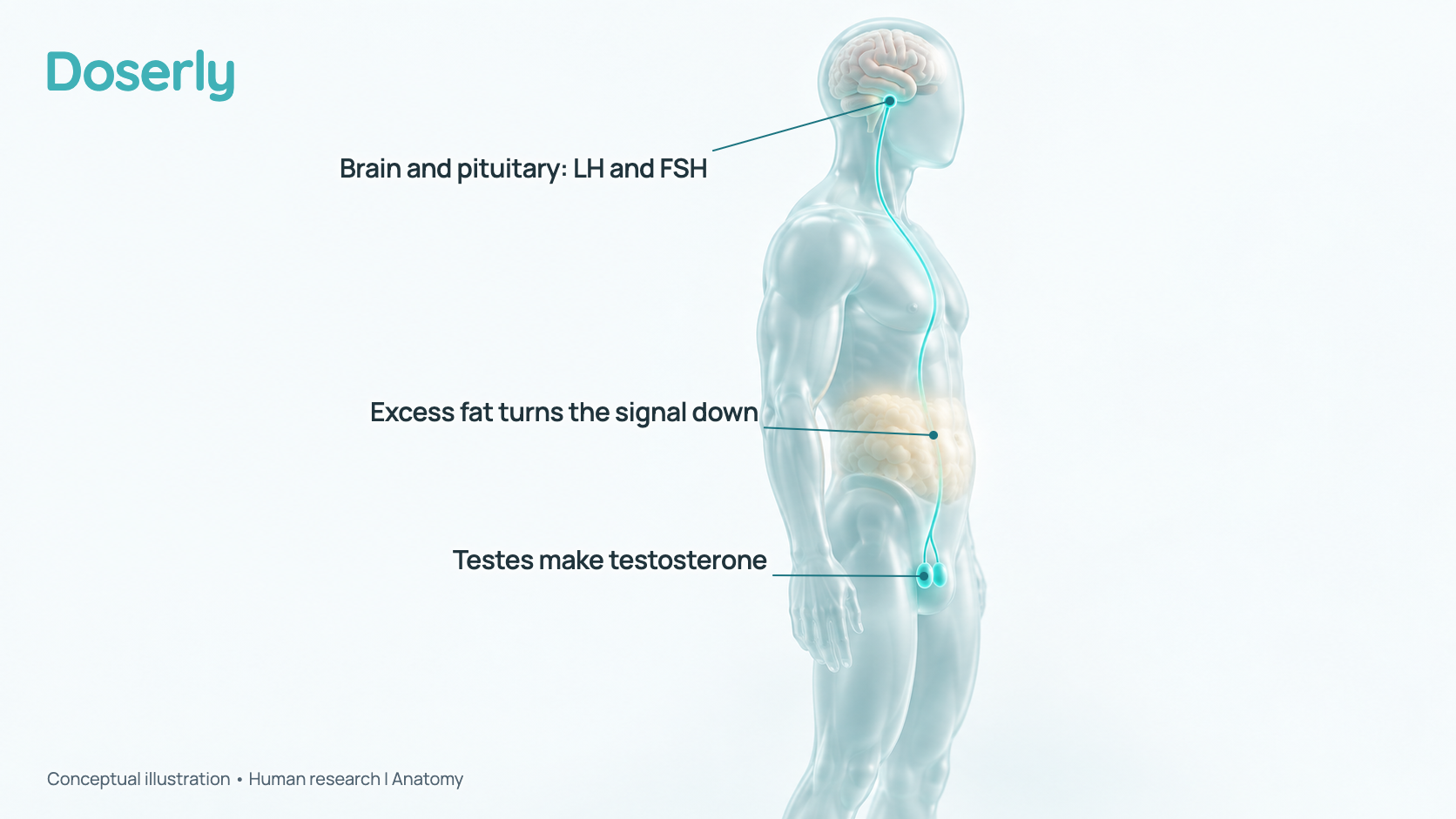
Testosterone production is controlled by a chain of signals: the brain and pituitary gland send two hormones, LH and FSH, to the testes, which answer with testosterone and sperm. In men with obesity this chain often runs low, a pattern doctors call obesity-related or functional hypogonadism. Weight loss turns it back up: in a 2013 meta-analysis, weight loss raised testosterone, SHBG and the pituitary hormones, with bigger losses giving bigger rises. [30]
How much? In that meta-analysis of 24 studies, total testosterone rose about 2.9 nmol/L (about 83 ng/dL) with a low-calorie diet and 8.7 nmol/L (about 250 ng/dL) after weight-loss surgery. A long-term study found men's testosterone rose about 0.6% for each kilogram lost. [30], [44]
Guidelines put the gain from diet at different sizes. The Endocrine Society of Australia says a 10% weight loss raises testosterone by 2–3 nmol/L (about 58–87 ng/dL). The EAU calls the rise after a low-calorie diet and exercise small; it puts the gain at about 1–2 nmol/L (about 29–58 ng/dL) and notes that 60–86% of lost weight is regained within three years. Part of the gap is what each describes: the ESA figure assumes a 10% weight loss, while the EAU describes typical diet and exercise programs. [35], [7]
Total and free testosterone do not move equally. In the European Male Ageing Study (2,395 men followed for 4.4 years), weight loss raised total testosterone and SHBG together, and free testosterone changed significantly only in men whose weight changed by 15% or more. [45]
Is it the weight loss or the medicine?
Reviews disagree. A 2026 review of these medicines found rises of about 2.5–5.2 nmol/L and concluded they were largely explained by weight loss and better insulin resistance rather than a direct effect on the testes. A 2025 meta-analysis of 7 studies (680 men) also found the rise tracked weight loss. A 2026 meta-analysis of 8 studies (375 men) took the opposite view, judging the effect independent of weight loss and suggesting a direct action. [5], [46], [47]
Studies in lean, healthy men point toward weight loss doing most of the work. Four weeks of dulaglutide in normal-weight men with normal testosterone changed neither their hormones nor their sexual desire, and a single dose of exenatide in healthy volunteers caused only a brief, small dip in LH and testosterone two hours later. [48], [49]
What happens to SHBG and free testosterone?
SHBG often rises as weight falls, so total testosterone can rise more than free testosterone. In one liraglutide study, SHBG went from 14 to 36 nmol/L over 4 months. A 2026 review found free testosterone results inconsistent across studies, and a small 2025 meta-analysis found no significant change in free testosterone or SHBG. [50], [12], [51]
What changes once you are on TRT?
Testosterone from outside switches LH and FSH down, so the testes make little of their own. A GLP-1 medicine can only lift a signal that is still running, so on TRT your blood test mostly reflects your dose, when blood was drawn and your SHBG. That is our reading of the physiology, and the closest evidence fits it: in a records study of 11,931 matched men per group, presented at a 2026 urology meeting, testosterone levels did not differ between men on TRT alone and men who also took a GLP-1 medicine. No study has measured SHBG, free testosterone or estradiol in men taking both. [12], [4]
Estradiol, the main estrogen, is made partly from testosterone. In a 2-month tirzepatide pilot in men not on TRT, median estradiol fell from 33 to 11 pg/mL (about 121 to 40 pmol/L), against 33 to 40 pg/mL (about 121 to 147 pmol/L) in a group using testosterone gel; men chose their own treatment, so the groups are not directly comparable. See the estrogen on TRT guide. [52]
What does the research show?
Each medicine has been studied in thousands of people; the combination has not. For men taking both, there are four small or early studies and no randomized trial.
Do GLP-1 medicines raise testosterone in men not on TRT?
Yes, modestly, in men whose low testosterone is linked to their weight: across small, short studies, total testosterone rose by about 2.5–5.2 nmol/L (about 72–150 ng/dL). [5]
| Study | Who and what | Testosterone result | What it cannot show |
|---|---|---|---|
| Review of 10 studies (2026) | 639 men with obesity or diabetes | Total testosterone rose while LH and FSH kept working; free testosterone results were inconsistent | Mixed study designs [12] |
| Liraglutide vs testosterone gel (controlled trial, 2019) | Men with obesity-related low testosterone, 16 weeks | Testosterone up 2.6 nmol/L (about 75 ng/dL) on liraglutide vs 5.9 nmol/L (about 170 ng/dL) on gel; weight down 7.9 kg vs 0.9 kg | Short; the two were not combined [53] |
| Semaglutide vs testosterone injections (controlled trial, 2025) | Men with obesity, type 2 diabetes and weight-related low testosterone, 24 weeks | Both raised testosterone; sperm shape improved only on semaglutide | Did not combine the two [54] |
| Tirzepatide pilot (2025) | 83 men, 2 months, treatment chosen by counseling and preference | Median 186.5 to 424.0 ng/dL (6.5 to 14.7 nmol/L) on tirzepatide, vs rises of 44% with lifestyle change and 46% with testosterone gel | Not randomized; very short [52] |
| Records study (2026) | 215 men starting GLP-1-type medicines, about 5% weight loss | 332 to 399 ng/dL (11.5 to 13.8 nmol/L) on average; normal testosterone in 67% before vs 86% during treatment | No comparison group [55] |
| Exenatide cohort (2021) | 51 men with type 2 diabetes, 6 months, 2.27 kg lost | No overall change; a rise only in men who started below 320 ng/dL (11.1 nmol/L) | Little weight lost [56] |
| Glucose-lowering medicines (2020) | 71 men with obesity, diabetes and low testosterone, 12 months | 34% reached 300 ng/dL (10.4 nmol/L) or more, including 94% of men who lost more than 10% of their weight | Weight loss, not blood sugar, tracked recovery [57] |
The pattern is consistent: the more weight lost and the lower testosterone starts, the bigger the rise. A 2026 network meta-analysis of 23 randomized trials (1,899 men) compared weight loss, GLP-1 medicines, testosterone and other options for obesity-related low testosterone and found no single strategy best on every outcome; testosterone raised hematocrit. [58]
One records study pointed the other way. Among 3,094 matched pairs of men aged 18–50 without diabetes, those prescribed semaglutide for weight loss had more new diagnoses of low testosterone (1.53% vs 0.80%) and erectile dysfunction (1.47% vs 0.32%). It counted diagnosis codes, not blood tests, and it cannot show that semaglutide caused either. [59]
What do studies of men taking both show?
Very little, and nothing randomized. We found four studies of men taking testosterone and a GLP-1 medicine together.
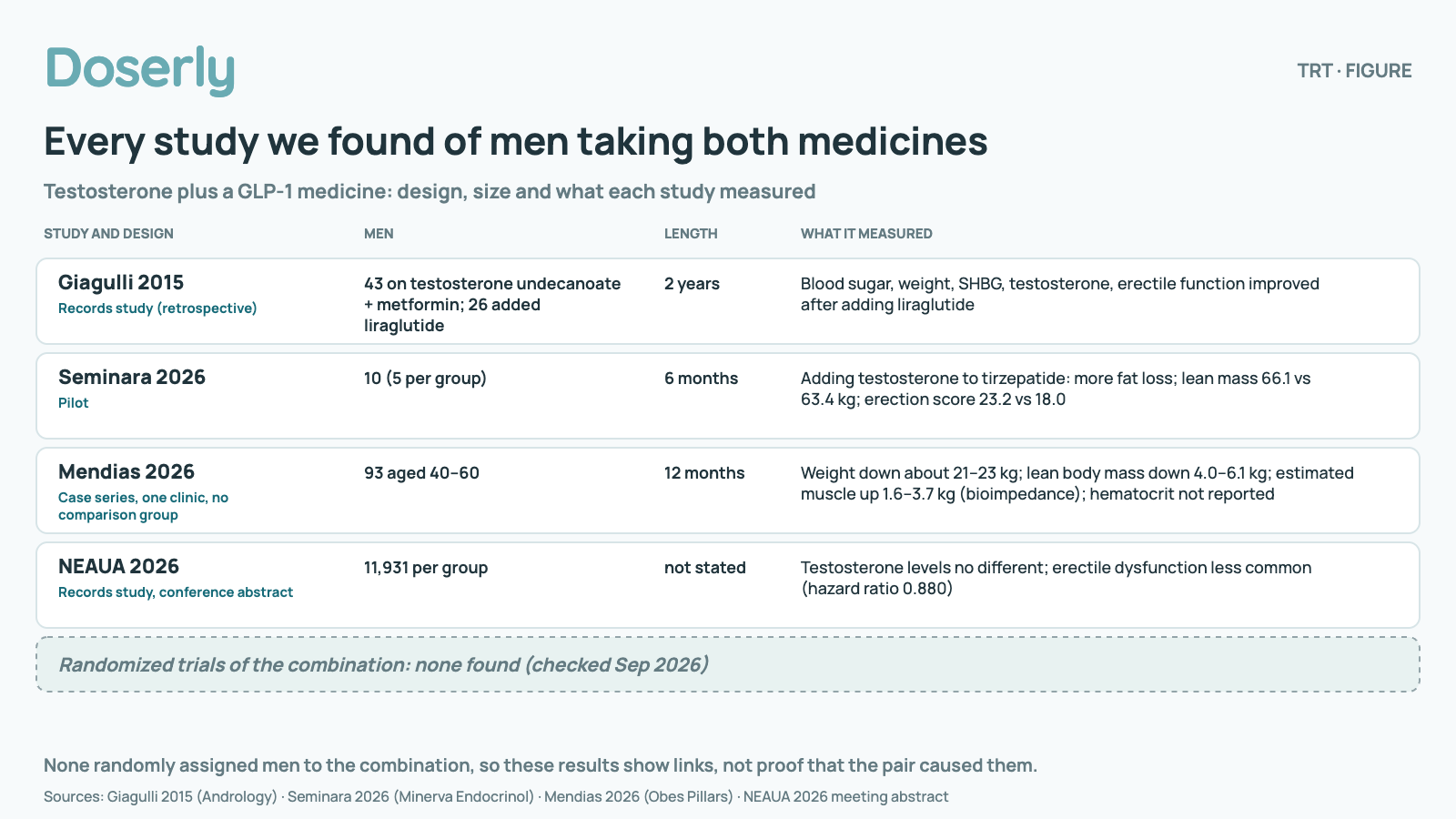
Every study we found of men taking both medicines
Testosterone plus a GLP-1 medicine: design, size and what each study measured.
- Giagulli 2015Records study (retrospective)
43 on testosterone undecanoate + metformin; 26 added liraglutide · 2 years
Blood sugar, weight, SHBG, testosterone, erectile function improved after adding liraglutide
- Seminara 2026Pilot
10 (5 per group) · 6 months
Adding testosterone to tirzepatide: more fat loss; lean mass 66.1 vs 63.4 kg; erection score 23.2 vs 18.0
- Mendias 2026Case series, one clinic, no comparison group
93 aged 40–60 · 12 months
Weight down about 21–23 kg; lean body mass down 4.0–6.1 kg; estimated muscle up 1.6–3.7 kg (bioimpedance); hematocrit not reported
- NEAUA 2026Records study, conference abstract
11,931 per group · not stated
Testosterone levels no different; erectile dysfunction less common (hazard ratio 0.880)
Randomized trials of the combination: none found (checked Sep 2026)
None randomly assigned men to the combination, so these results show links, not proof that the pair caused them.
- Liraglutide added to testosterone (2015). In a records study of 43 men with obesity, type 2 diabetes and clearly low testosterone, all on testosterone undecanoate injections and metformin, the 26 who responded poorly added liraglutide in the second year and improved their blood sugar, weight, SHBG, testosterone and erectile function. Men got the add-on because they were doing poorly, and some had low testosterone for reasons other than weight. [1]
- Testosterone added to tirzepatide (2026). In a pilot of 10 men who were slow to respond to tirzepatide, the 5 who added testosterone undecanoate injections for 6 months lost more fat, had more lean mass (66.1 vs 63.4 kg) and better erection scores (23.2 vs 18.0) than the 5 who did not. How men were assigned is unclear. [2]
- Tirzepatide, testosterone and coaching (2026). At one clinic, 93 men aged 40–60 took tirzepatide with testosterone cypionate (100 mg a week or less) and lifestyle coaching. Over 12 months they lost about 21 to 23 kg; lean body mass fell 4.0–6.1 kg, while estimated muscle rose 1.6–3.7 kg and grip strength 5.7–7.1 kg. There was no comparison group, muscle was estimated by bioimpedance, and hematocrit was measured but not reported. The authors say the design cannot credit any single part. [3]
- Records study (2026 conference abstract). In a US health-records database, 11,931 men with obesity and low testosterone on TRT alone were matched with 11,931 who also took a GLP-1 medicine. Testosterone levels did not differ (average 420 vs 431 ng/dL, about 14.6 vs 14.9 nmol/L); erectile dysfunction was less common with a GLP-1 medicine added (hazard ratio 0.88; the abstract gives no absolute rates); low libido, infertility and ejaculation problems did not differ. It is a conference abstract and has not been published as a full paper. [4]
The authors of the 2026 meta-analysis of 8 studies wrote that "a combination of TRT and GLP1-RAs can be considered in selected cases", an opinion, not a guideline. The registered trials we found compare semaglutide with testosterone or test GLP-1 medicines for male fertility; none tests the two together. [47], [31], [32]
Do GLP-1 medicines cost muscle, and can testosterone protect it?
Some, yes: roughly a quarter to a third of the weight lost is lean mass, similar to other ways of losing weight. Whether testosterone protects muscle during GLP-1 weight loss has not been properly tested. Lean mass on a DXA body scan is everything that is not fat or bone, including water and organs, so a fall in lean mass is not the same as a fall in strength.
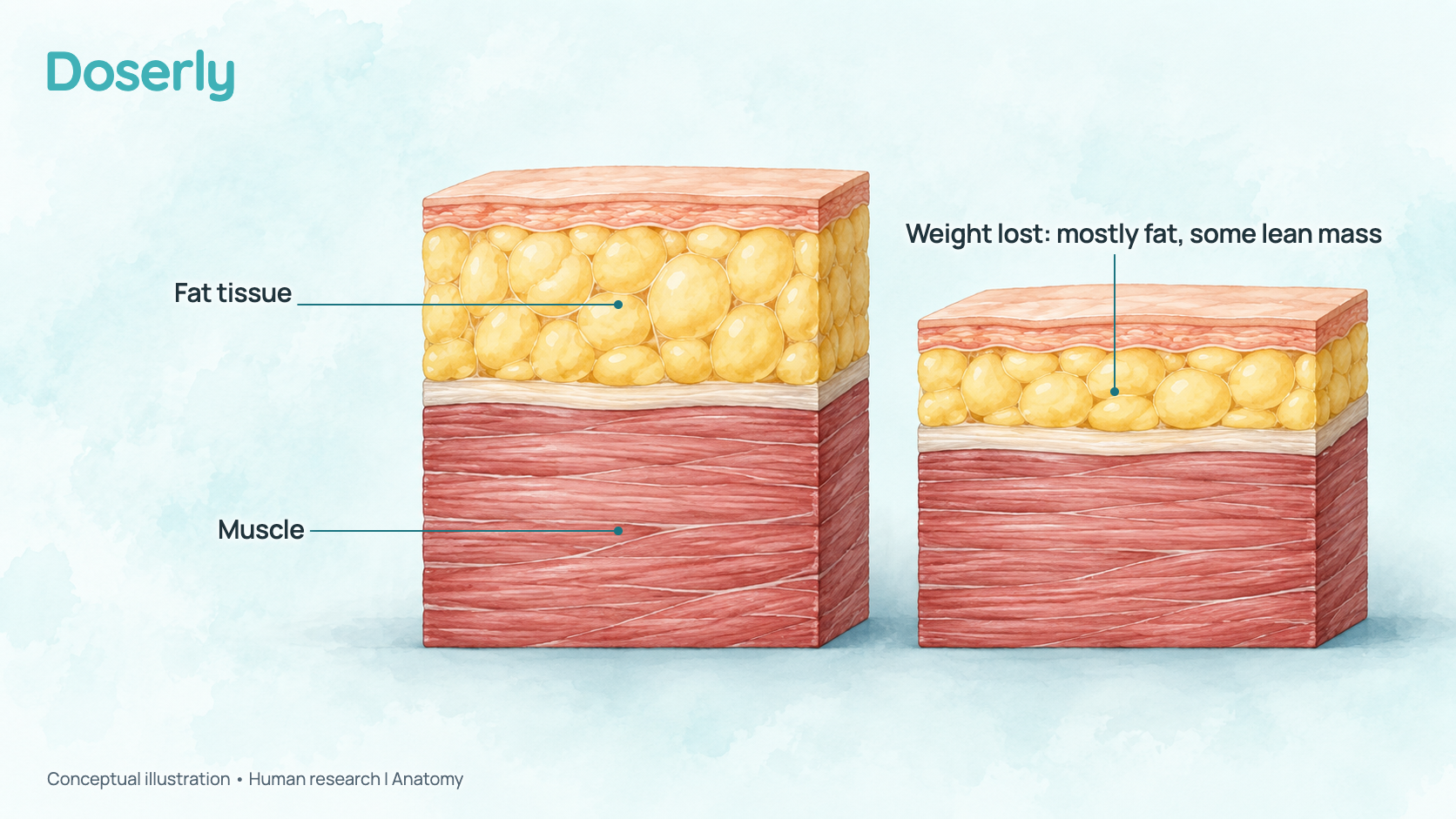
- Tirzepatide. In a SURMOUNT-1 body-scan substudy of 160 adults (73% women), about three quarters of the weight lost over 72 weeks was fat and one quarter lean (74% and 26%), the same split as on placebo (75% and 25%); tirzepatide simply caused far more weight loss (21.3% vs 5.3%). In men, 73% of the loss was fat. MRI scans in another tirzepatide trial showed thigh muscle shrinking in line with the weight lost. [13], [60]
- Semaglutide. In STEP 1 (140 adults, 76% women), lean mass fell 9.7% while fat mass fell 19.3%, reported as a conference abstract. [61]
- Pooled trials. A 2026 meta-analysis of 20 trials (15,782 people) found lean mass made up 35.2% of the weight lost on semaglutide, 25.4% on tirzepatide and 26.8% on liraglutide, against 26.2% with lifestyle change and 17.5% with lifestyle change plus resistance training. [62]
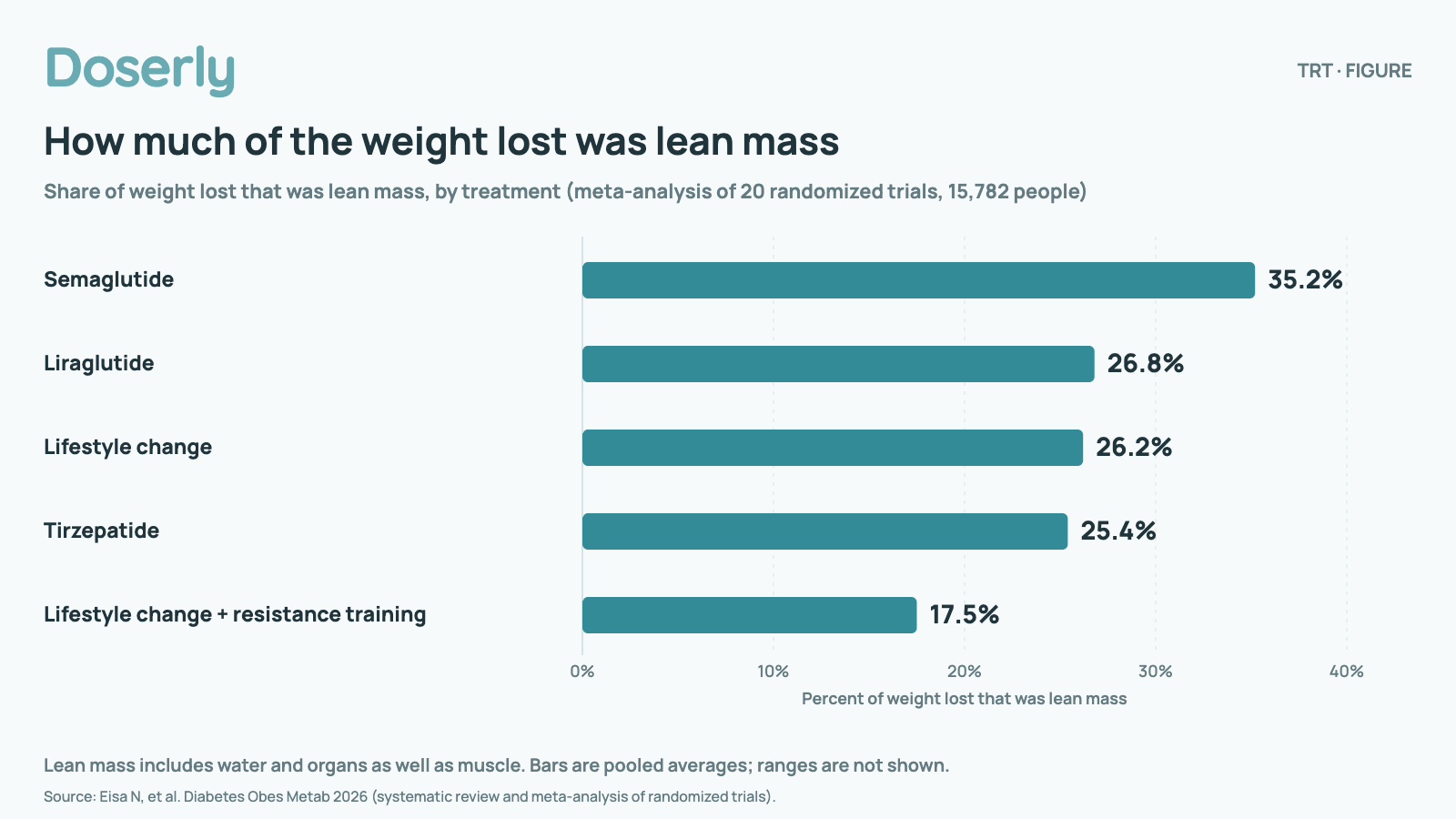
How much of the weight lost was lean mass
Share of weight lost that was lean mass, by treatment (meta-analysis of 20 randomized trials, 15,782 people).
Bars run from 0% to 40% of the weight lost.
- Semaglutide
- 35.2% of weight lost was lean mass
- Liraglutide
- 26.8% of weight lost was lean mass
- Lifestyle change
- 26.2% of weight lost was lean mass
- Tirzepatide
- 25.4% of weight lost was lean mass
- Lifestyle change + resistance training
- 17.5% of weight lost was lean mass
Lean mass includes water and organs as well as muscle. Bars are pooled averages; ranges are not shown.
What testosterone did during other kinds of weight loss:
- On a very low energy diet, testosterone injections gave 2.9 kg more fat loss and 3.4 kg less lean-mass loss than placebo over 56 weeks, an advantage that was gone 82 weeks after they stopped. [14], [15]
- In T4DM, with every man in a lifestyle program, fat mass fell 4.6 kg on testosterone vs 1.9 kg on placebo over 2 years, and skeletal muscle rose 0.4 kg vs fell 1.3 kg. [63]
- In older men in an intensive lifestyle program, testosterone limited the loss of lean mass and thigh muscle but did not improve strength or physical function, and it added no metabolic benefit. [64], [65]
None of these trials used a GLP-1 medicine. Resistance training has better support (see protecting muscle), and the TRT, muscle and fat loss guide covers training on TRT.
What about erections, libido and fertility?
The erection data point both ways and are almost all observational. On the positive side, adding a GLP-1 medicine to metformin raised erection scores 2.26 points over a year in men with diabetes and erectile dysfunction. Tirzepatide was linked with less erectile dysfunction than injectable semaglutide (relative risk 0.67; the abstract gives no absolute rates). And on TRT, adding a GLP-1 medicine went with less erectile dysfunction in the conference records study. [66], [67], [4]
On the negative side, the semaglutide records study above found more new erectile dysfunction. In men with type 2 diabetes, GLP-1 starters were diagnosed with erectile dysfunction at 35.2 vs 28.0 per 1,000 person-years compared with starters of another diabetes medicine (hazard ratio 1.26), but the link weakened and was no longer significant after a check for hidden bias. Side-effect reports also gave a signal for semaglutide. A 2026 meta-analysis reporting better erection scores gives search dates that had not yet happened, so treat it with caution. [59], [68], [69], [70]
Libido has almost no data. Dulaglutide did not change sexual desire in healthy men, and low libido was no more common with a GLP-1 medicine added to TRT in the records study. In TRAVERSE, testosterone raised desire in men with low libido but did not improve erections. See the TRT and sexual health guide. [48], [4], [71]
Fertility differs sharply between the two medicines. Testosterone therapy suppresses sperm production, so the AUA says it should not be prescribed to men trying to conceive. GLP-1 medicines did not suppress sperm in small studies: sperm shape improved on semaglutide while testosterone injections lowered sperm concentration, sperm motility rose from 14% to 34% on liraglutide in a nonrandomized study, and sperm-count gains from dieting held in men who kept the weight off with exercise or liraglutide. The EU labels say the effect on human fertility is unknown, and no study has counted pregnancies or births. See TRT and fertility. [10], [54], [50], [72], [39], [40]
Is it safe to take TRT and a GLP-1 medicine together?
Nobody knows for certain, because no study has tested the safety of the combination. Each medicine has a well-studied safety record on its own, no label lists an interaction between them, and their known risks overlap in a few specific places. [16], [17], [27], [73]
Where do the risks overlap?
- Heart rate and rhythm. GLP-1 labels report resting heart rate rising 1 to 4 beats per minute on Wegovy, 2 to 3 on Ozempic and Saxenda, 1 to 3 on Zepbound and 2 to 4 on Mounjaro; in the SURPASS-CVOT trial, tirzepatide raised average heart rate by up to 6 beats per minute. In its phase 2 trial, retatrutide raised heart rate in a dose-dependent way, peaking at 24 weeks (see the retatrutide guide). [74] In TRAVERSE, testosterone gel increased atrial fibrillation and other rhythm problems (see below). No study has measured heart rate or rhythm on both. [16], [19], [27], [17], [26], [40], [18]
- Kidneys. GLP-1 labels warn that vomiting, diarrhea and dehydration can injure the kidneys and advise checking kidney function when these side effects are severe. Testosterone gel increased acute kidney injury in TRAVERSE (see below). [16], [40], [18]
- Blood sugar. Testosterone labels say testosterone may lower blood sugar in people with diabetes, so doses of insulin or other diabetes medicines may need lowering. GLP-1 labels warn that low blood sugar (hypoglycemia) is more likely when they are combined with insulin or a sulfonylurea. [41], [42], [18], [19], [26]
- Red blood cells. Testosterone raises hematocrit; GLP-1 medicines have not been shown to lower it (see Does a GLP-1 medicine lower hematocrit?). The diabetes medicines that add to the rise are SGLT2 inhibitors, covered below. [37], [20], [75]
- Sleep apnea. This overlap can work in your favor. Zepbound is approved to treat moderate to severe obstructive sleep apnea with obesity; at 52 weeks, breathing pauses fell by 25.3 vs 5.3 events an hour in people not using a breathing machine. Testosterone can make apnea worse for a while: injections worsened nighttime oxygen drops at 7 weeks (not at 18) in obese men with severe apnea, and new apnea diagnoses were more common on testosterone during T4DM (3.0% vs 0.4%). [76], [77], [78], [79]
- Tiredness and mood. Fatigue is a listed GLP-1 side effect (see tiredness). In pooled liraglutide trials, depression (2.1 vs 2.1 events per 100 person-years) and anxiety (1.9 vs 1.7) were no more common than on placebo. [80]
What did TRAVERSE and the GLP-1 heart trials show?
No trial has tested heart safety for the combination, and the results of separate trials cannot simply be added together.
TRAVERSE is the largest trial of testosterone and heart safety: 5,204 men aged 45–80 with low testosterone and existing heart disease or high heart risk used a daily testosterone gel or a placebo gel. Heart attack, stroke or cardiovascular death occurred in 182 of 2,596 men on testosterone (7.0%) and 190 of 2,602 on placebo (7.3%) (hazard ratio 0.96), which met the trial's safety goal. Atrial fibrillation (3.5% vs 2.4%), other rhythm problems needing treatment (5.2% vs 3.3%), acute kidney injury (2.3% vs 1.5%) and pulmonary embolism (0.9% vs 0.5%) were more common on testosterone. In a substudy, clinical fractures were also more common: 91 of 2,601 men (3.50%) vs 64 of 2,603 (2.46%), hazard ratio 1.43. Its limits: it tested only a gel, men used it for an average of 21.7 months, and about 61% stopped their study gel early. [73], [18], [81]
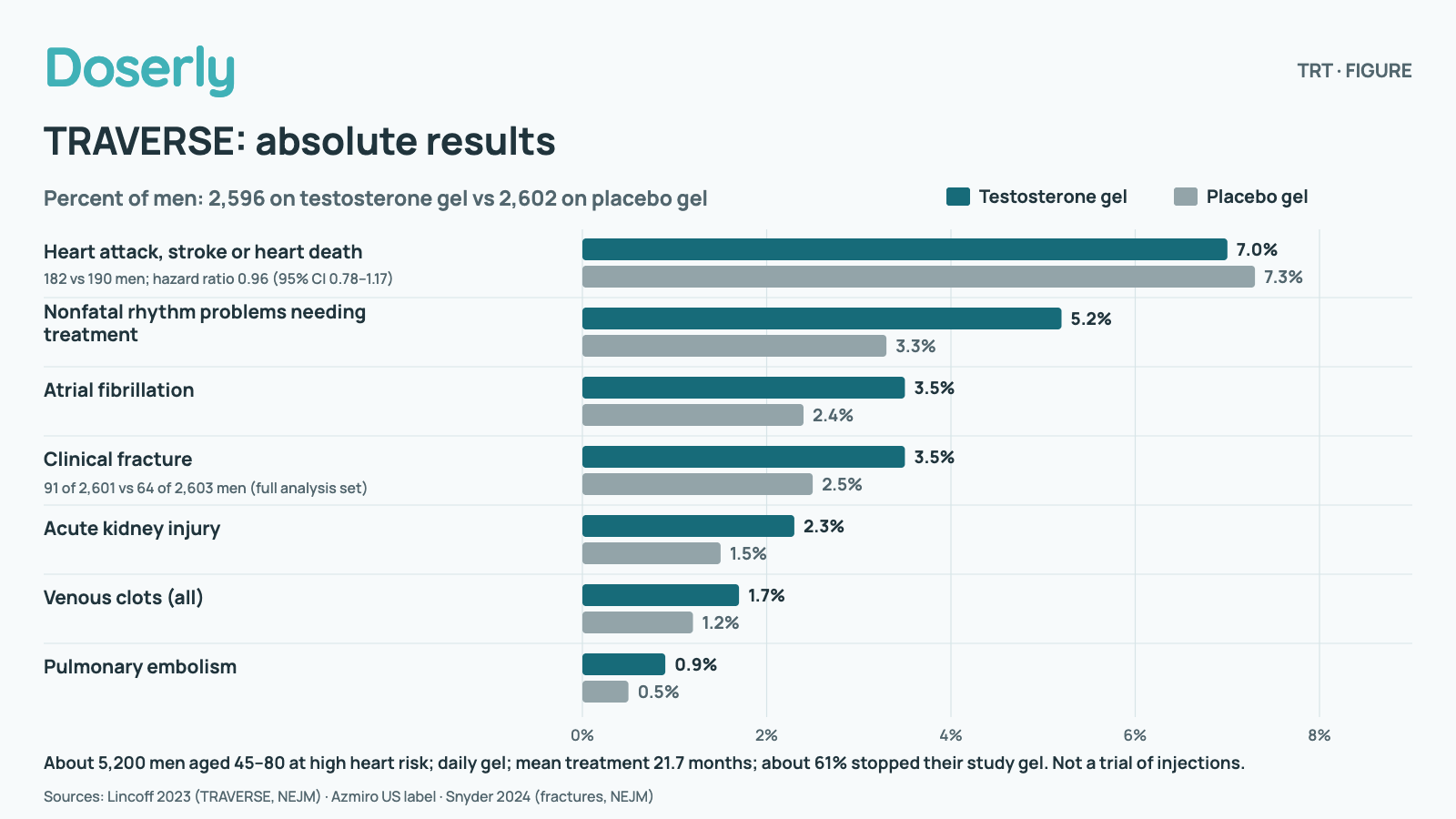
TRAVERSE: absolute results
Testosterone gel (2,596 men)Placebo gel (2,602 men)
- Heart attack, stroke or heart death
- Testosterone 7.0% vs placebo 7.3% (182 vs 190 men; hazard ratio 0.96, 95% CI 0.78–1.17; met the 1.5 safety margin)
- Nonfatal rhythm problems needing treatment
- Testosterone 5.2% vs placebo 3.3%
- Atrial fibrillation
- Testosterone 3.5% vs placebo 2.4%
- Clinical fracture
- Testosterone 3.5% vs placebo 2.5% (91 of 2,601 vs 64 of 2,603 in the full analysis set)
- Acute kidney injury
- Testosterone 2.3% vs placebo 1.5%
- Venous clots (all)
- Testosterone 1.7% vs placebo 1.2%
- Pulmonary embolism
- Testosterone 0.9% vs placebo 0.5%
About 5,200 men aged 45–80 at high heart risk; daily gel; mean treatment 21.7 months; about 61% stopped their study gel. Not a trial of injections.
The GLP-1 heart trials tested their own medicines. In SELECT, 17,604 people aged 45 or older with heart disease and a BMI of 27 or more, but no diabetes, took semaglutide or placebo: heart attack, stroke or cardiovascular death occurred in 6.5% vs 8.0% (hazard ratio 0.80). In SURPASS-CVOT, in people with type 2 diabetes, tirzepatide matched dulaglutide (12.2% vs 13.1%, hazard ratio 0.92), meeting its goal of not being worse but not proving it better. The TRT and heart health guide covers TRAVERSE in full. [82], [83]
Who should be especially cautious?
- Men who use insulin or a sulfonylurea, because both medicines can lower blood sugar. [41], [19]
- Men with a fast heart rate, atrial fibrillation or other rhythm problems, because GLP-1 medicines raise heart rate and testosterone raised atrial fibrillation in TRAVERSE. [16], [18]
- Men with kidney disease or who get dehydrated easily, especially while vomiting or diarrhea last. [16]
- Men taking oral testosterone, men with a high hematocrit and men taking an SGLT2 inhibitor. [42], [75]
- Men with untreated severe sleep apnea. The Endocrine Society and the VA advise against starting testosterone; Zepbound is an approved treatment for the apnea itself. [25], [21], [17]
- Men trying to conceive. Testosterone suppresses sperm production; the AUA advises against it, and the BSSM calls an active wish for children a main contraindication. [10], [11]
- Men using products from outside a pharmacy, whose content is unknown (see compounded and "research" products). [29]
- Men with the conditions GLP-1 labels warn about, which the semaglutide and tirzepatide guides cover.
- Drug-tested athletes. Testosterone is prohibited in sport at all times. [23]
- Under-18s. Testosterone for teenagers belongs only in specialist care.
- Women. This guide is written for men. Testosterone for women uses different doses and products; see testosterone therapy for women.
Which medicines interact?
- Testosterone and GLP-1 medicines. None of the current US labels for Wegovy, Ozempic, Zepbound, Mounjaro or Saxenda, nor the EU product information for Wegovy and Mounjaro, lists an interaction with testosterone. That means none has been identified, not that the pair has been tested. [16], [19], [17], [26], [27], [39], [40]
- Oral medicines, insulin and sulfonylureas. GLP-1 labels ask for care with oral medicines, which matters for oral testosterone, and warn about low blood sugar with insulin or a sulfonylurea. [16], [19], [26]
- Two GLP-1 medicines at once. The Saxenda label says not to combine it with any other GLP-1 receptor agonist; some men in forums take two at the same time. [27], [84]
- SGLT2 inhibitors (such as empagliflozin and dapagliflozin). These diabetes and heart medicines raise hematocrit: SGLT2 starters had hematocrit 1.50 points higher than GLP-1 starters, and in US veterans with diabetes, adding an SGLT2 inhibitor to testosterone gave about 2.5 times the odds of hematocrit above 54% within a year compared with testosterone alone (adjusted odds ratio 2.49). Across all 53,971 veterans in that study, 756 (1.4%) reached that level; the abstract does not give each group's rate. UK testosterone labels now warn about the combination, and an EU safety review in September 2025 recommended adding the warning to all testosterone products. [85], [75], [86], [87]
Bring a complete list of what you take, including supplements, to a pharmacist or prescriber. Checked September 2026.
What about compounded and "research" GLP-1 medicines?
In the US, the shortage-era allowance for mass-compounded semaglutide and tirzepatide has ended: FDA declared the tirzepatide injection shortage resolved on 19 December 2024 and the semaglutide shortage on 21 February 2025, and compounded drugs are not FDA-approved. In February 2026 FDA announced action against non-approved GLP-1 drugs, and in April 2026 it proposed stopping outsourcing facilities from compounding semaglutide, tirzepatide and liraglutide from bulk ingredients, a proposal that is still pending. Checked September 2026. [88], [89], [90]
Retatrutide is not approved anywhere. FDA says it cannot be used in compounding and is not a component of any approved drug, and it has warned sellers of GLP-1 products falsely labeled "for research purposes" or "not for human consumption". Lilly has said it plans to submit retatrutide to the FDA in the first quarter of 2027. A product sold for research use only has not been tested for human use, which adds one more unknown to every lab result and side effect. [29], [91]
Is it legal, and is it allowed in sport?
Checked September 2026. Rules differ by country and change often.
- United States. Testosterone and its esters are Schedule III controlled substances, prescription only. GLP-1 medicines are prescription only; recent approvals include Wegovy tablets (December 2025), Wegovy HD (March 2026) and Foundayo (April 2026). [22], [92], [93], [28]
- United Kingdom. Testosterone is a Class C controlled drug. [94]
- Canada. Testosterone is a Schedule IV controlled substance. [95]
- Australia. Testosterone is a Schedule 4 prescription-only medicine. [96]
- European Union. Wegovy and Mounjaro are approved EU-wide. [39], [40]
- Sport. The World Anti-Doping Agency (WADA) prohibits testosterone at all times, and its 2027 list keeps the ban. An exemption for medical use is granted only for low testosterone with a clear medical cause, not for low testosterone linked to obesity. Semaglutide and tirzepatide are on WADA's Monitoring Program for 2026 and 2027, which means WADA tracks their use but does not ban them. Retatrutide is not named, but the list bans any substance with no current approval for human use, which by its wording covers retatrutide. [23], [97], [98], [99], [24]
What do guidelines say to do?
Guidelines describe the order of steps rather than how to combine the medicines. For a man whose low testosterone is weight-related and who has not started TRT, most favor treating the weight first and retesting, while the AUA and BSSM pair lifestyle change with testosterone (see the key numbers). For a man already on TRT who adds a GLP-1 medicine, no guideline changes the usual TRT monitoring. This table summarizes the other choices clinicians weigh; it is not a personal plan. [6], [7], [8], [10], [11]
| Situation | What guidelines say | What the evidence shows |
|---|---|---|
| A GLP-1 medicine for obesity-related low testosterone | ICSM: a possible role; no other guideline mentions it | Rises of 2.5–5.2 nmol/L in small, short studies [5] |
| Untreated severe sleep apnea | Endocrine Society (2018) and VA: do not start testosterone; Brazilian societies: consider it with mild to moderate or treated apnea and close monitoring | Tirzepatide is approved to treat moderate to severe apnea with obesity [76] |
| Large weight change during treatment | VA: may prompt earlier testosterone checks; EAA: TRT withdrawal may be considered after weight reduction; ESA: if testosterone stays low despite successful weight loss, look for another cause | One small withdrawal pilot and one case report [100], [101] |
| Trying to conceive | AUA: no testosterone; BSSM: an active wish for children is a main contraindication | GLP-1 medicines did not suppress sperm in small studies [54] |
Practical questions about taking both
Should you start a GLP-1 medicine or TRT first?
When excess weight is the likely cause of low testosterone, most guidelines put weight loss first, and a GLP-1 medicine is one way to get there. Testosterone may no longer be low after large weight loss, so starting TRT first can make it hard to know whether you still need it. TRT suppresses sperm production, while GLP-1 medicines did not in small studies. And starting one medicine at a time makes it easier to tell which one caused a change. [6], [7], [57], [10], [54]
Men with low testosterone from a testicular or pituitary problem are a different case: weight loss will not fix that. The Endocrine Society of Australia says testosterone that stays low despite successful weight loss should prompt a search for another cause. [35]
Will a GLP-1 medicine change your testosterone results on TRT?
Probably not much for injections and gels: in the large records study, testosterone levels did not differ between men on TRT alone and men who added a GLP-1 medicine. SHBG tends to rise as weight falls, so total and free testosterone may move differently, although nobody has measured this in men taking both. Oral testosterone is the exception, because its absorption depends on meals (see below). [4], [45]
Some men report much higher results after large weight loss on the same dose. In one forum account, total testosterone went from 1,265 to 2,678 ng/dL (about 44 to 93 nmol/L) over two years on TRT and tirzepatide, but the sample was drawn 36 to 40 hours after an injection and the cause was not established. Have blood drawn at the time your product's label or your guideline specifies, so results can be compared; the testosterone level visualizer shows how injection timing changes peaks and troughs. [102]
How long after weight loss should testosterone be rechecked?
No study sets a time. Testosterone rose within 2 months in the tirzepatide pilot, and the exenatide cohort measured it at 6 months. The VA says significant weight loss or gain may prompt earlier testosterone checks, and some forum posters wait until their weight has been stable for a few months. [52], [56], [21], [103]
For a man already on TRT, his own production can only be measured after stopping. In a pilot of severely obese men, the 12 who took testosterone during a diet were back to low testosterone within 24 weeks of stopping it. [100]
Can you stop TRT after losing weight?
Sometimes, but the evidence is thin, and nobody has studied it after GLP-1 weight loss. The EAA says "TRT withdrawal may be considered following weight reduction"; no other guideline addresses it. [8]
- In a pilot of 24 severely obese men on a diet with or without testosterone undecanoate for 54 weeks, stopping testosterone meant "a return back to hypogonadism within 6 months". Fat loss held, but lean-mass gains were lost. [100]
- In a case report, one man stopped testosterone after weight-loss surgery (he lost 53% of his weight) and later measured 15.8 nmol/L (about 456 ng/dL) without treatment. [101]
- About five years after T4DM, 6% of former testosterone users and 2.8% of former placebo users had restarted testosterone. [79]
Whether it works depends on why testosterone was low in the first place. The stopping TRT guide covers what happens when testosterone stops, and the obesity-related hypogonadism guide covers weight-related low testosterone.
How should oral testosterone be taken with a GLP-1 medicine?
With a meal, as its label says, and with a blood test after the GLP-1 medicine starts or its dose goes up. No study has tested the pair, so this comes from the two sets of labels.
- Food matters for oral testosterone undecanoate. It is absorbed with dietary fat through the lymphatic system. Jatenzo taken with a 15 g fat breakfast gave 25% less testosterone than with a 30 g fat breakfast; Kyzatrex exposure was 37%, 87% and 94% higher with 16%, 33% and 45% fat breakfasts than fasting; and fasting cut Tlando's peak level by about 65% and total exposure by about 38%. [42], [18], [43]
- GLP-1 medicines slow the stomach. Their labels ask for closer monitoring of some oral medicines, most of all when starting and after each dose increase. This applies to medicines that need a certain blood level to work or that require clinical monitoring. Oral testosterone's dose is set by blood tests: drawn 6 hours after the morning dose for Jatenzo, 3–5 hours for Kyzatrex and 8–9 hours for Tlando. So it fits that description, although no label names it. [16], [17], [40], [42], [18], [43]
- If your GLP-1 medicine is a tablet. Wegovy tablets must be taken at least 30 minutes before food, drinks or other oral medicines, which clashes with taking oral testosterone at breakfast. Foundayo does not need to be taken on an empty stomach. No study sets a spacing between the two. [16], [28]
The oral testosterone guide covers each product in detail.
Does a GLP-1 medicine lower hematocrit on TRT?
No study shows that it does, and no study reports hematocrit in men taking both. On a GLP-1 medicine alone, hematocrit did not change significantly (45.1% to 45.7% over 6 months on semaglutide), and in the trial comparing semaglutide with testosterone injections it moved about 1 point in both groups. Some records studies found slightly lower hemoglobin or more anemia on GLP-1 medicines: in one, of 700 users with no comparison group, median hemoglobin fell 0.2 g/dL and 59 (8.4%) developed anemia. A 2026 review found the evidence not enough to show that the medicines cause it. The hematocrit on TRT guide covers what does lower hematocrit. [20], [54], [104], [105], [106]
Is it the GLP-1 medicine or low testosterone making you tired?
It can be either, or simply eating too little, and only a blood test can show whether testosterone is low. Fatigue is a listed GLP-1 side effect (Wegovy 11% vs 5% on placebo; Zepbound 5–7% vs 3%; Saxenda 7.5% vs 4.6%), and low energy is a common symptom of low testosterone. In forums, men describe exhaustion on a GLP-1 medicine while their measured testosterone was rising, and tiredness that faded after the first weeks of tirzepatide. No trial has tested TRT for tiredness on a GLP-1 medicine. [16], [17], [27], [25], [107], [108]
The same goes for sex drive: a drop in desire that starts with a GLP-1 medicine has not been studied, and in TRAVERSE, testosterone raised desire but not erections in men with low testosterone and low libido. [109], [71]
How can you protect muscle while losing weight?
Resistance training has the best evidence; protein is being tested. In pooled trials, lifestyle change with resistance training had the smallest lean share of weight lost (17.5%). In a trial after dieting, exercise plus liraglutide kept weight off best and cut body fat by 3.9 percentage points. A trial now under way is testing 1.6 g of protein per kilogram of body weight a day, resistance training or both on semaglutide and tirzepatide, with no results yet. [62], [110], [111]
Many men on a GLP-1 medicine struggle to eat enough protein because their appetite is so low (see what people report). The whey protein guide covers one common option.
What do men report when they combine TRT and a GLP-1 medicine?
Public forums are full of men combining testosterone with semaglutide, tirzepatide or, very often, retatrutide bought outside a pharmacy. The threads below are public Reddit discussions from September 2025 to September 2026, read with their replies; they show what people experience, not how often it happens. Accounts involving testosterone doses well above replacement (steroid cycles) are not TRT and are left out.
Which came first, and did it matter?
Men are often torn. One man with testosterone around 370 ng/dL (12.8 nmol/L) was advised by two clinicians to try a GLP-1 medicine before TRT, and most replies favored losing weight and retesting. [112] Another, at 296 ng/dL (10.3 nmol/L) with sleep apnea, was offered Zepbound and worried about fertility if he chose TRT instead. [113] A man weighing both agreed that trying one treatment at a time would make each easier to judge, and in another thread a reply described TRT as easier to tolerate after losing weight on tirzepatide. [114], [115]
Did weight loss raise testosterone on its own?
Sometimes. One man went from 289 to about 196 lb on Zepbound, and his repeatedly low total testosterone (216–237 ng/dL, 7.5–8.2 nmol/L) rose to 521 ng/dL (18.1 nmol/L) without TRT while his sleep apnea was also treated; one reply described a similar rise and another said testosterone stayed low despite major weight loss. [116] Men who had lost from 20 to more than 60 kg planned to retest once their weight settled, and wondered whether an ongoing calorie deficit was holding their result down. [103], [117] A rising number did not always mean feeling better: two men whose testosterone rose during GLP-1 weight loss still had fatigue, and one also low libido. [118], [107]
What happened when TRT started after a GLP-1 medicine?
Scale weight often went up first. One man lost 42 lb on retatrutide, then gained 7 lb and felt hungry all the time in his first two weeks of self-prescribed testosterone; replies pointed to early water retention. [119] Another's hunger and weight gain began to settle by about week 10. [120] Some started TRT because of what the weight loss cost them: one man's body scan suggested nearly 10 lb of the 35 lb he lost on retatrutide was muscle, as his libido, motivation and strength fell. [121]
What do the success stories look like?
The strongest accounts involve long efforts with many changes at once. One man with severe obesity, poorly controlled diabetes, very low testosterone and severe sleep apnea started Mounjaro and testosterone together after losing 20 lb on his own; about 9 months later he had gone from about 365 to 240 lb and his HbA1c from 11.6 to 5.6, with regular training. [122] Another went from 330 to 220 lb over nearly two years, losing the first 50 lb without medicines. [123] Nonresponse appears too: one man saw no weight change after six months of TRT, and another's weight loss stalled on both medicines when joint pain cut his training. [124], [125]
What happened to muscle and strength?
Accounts split. A man on TRT for five years added retatrutide for four months, went from 111 to 99 kg, felt healthier and watched his main lifts fall substantially, with protein intake that varied on one meal a day. [126] Another lost 83 lb over 14 months on TRT and a GLP-1 medicine while lifting, and lost some strength and muscle. [127] Early scan changes are hard to read: replies noted that lean mass rising three weeks into TRT, or muscles feeling flat after fast early weight loss, often reflect water. [128], [129] Eating enough protein is the recurring struggle, with men relying on shakes and small protein-rich meals. [130], [131]
What side effects come up?
- Stomach. One man on TRT raised semaglutide to 0.75 mg and had severe bloating, nausea and repeated vomiting until he dropped back; another became nauseated whenever either injection was due, which disrupted his testosterone schedule. [132], [133]
- Heart rate. A woman described her partner's resting heart rate rising during retatrutide he managed himself, and replies in several threads report higher resting heart rates on retatrutide. [134], [135], [136]
- Mood. One man had detachment and panic attacks days after adding retatrutide to a new, underground testosterone source, which left the cause unclear; another said anhedonia (an inability to enjoy things) on a higher retatrutide dose went away after he lowered it. [137], [138]
- Libido. A man with long-standing low testosterone lost desire and erections after starting the lowest dose of Mounjaro, with his testosterone unchanged; a reply said tirzepatide dampened his desire and TRT raised it somewhat. [109]
Are serious problems reported?
Some posts describe worrying symptoms, but selected accounts cannot show how often they happen or what caused them. One man developed chest burning or pressure after raising his testosterone and retatrutide doses at the same time; his blood pressure rose from about 116/70 to about 135/85, an ECG was described as normal, and later blood work showed a hematocrit of 0.55. The cause was not established. [139] Chest pain or pressure needs prompt medical assessment, not a forum answer.
What do lab results on both medicines look like?
They are hard to read because several things usually change at once. One man's hematocrit went from 50.1% to 48.1% over two years of weight loss on TRT and tirzepatide while his testosterone roughly doubled (see above). [102] Another had hematocrit of 52% while taking two GLP-1 medicines at once; replies said their own hematocrit had not changed on GLP-1 medicines. [84] One man's testosterone jumped and estradiol fell after he added retatrutide, hCG and dutasteride and raised his dose in the same month; replies pointed to the hCG and dutasteride. [140] Replies about SHBG, and about whether retatrutide affects labs, disagreed. [141], [142]
What about products bought outside a pharmacy?
Many threads involve retatrutide or other GLP-1 medicines from unregulated sellers, with men asking whether they bought a fake product or were cheated by a supplier. When a product's content is unknown, no lab result or side effect can be pinned on it with confidence (see compounded and "research" products). [143], [144]
How can you judge a TRT and GLP-1 story?
Ask: Was the testosterone prescribed, and at a replacement dose? Was the GLP-1 an approved product from a pharmacy? What else changed at the same time: diet, training, alcohol, sleep apnea treatment, other drugs such as hCG? Was the change measured on a scale, a home device or a DXA scan, and could water explain it? Were blood tests drawn at the same point in the dosing schedule? How long had each medicine been taken? And what happened next?
These selected discussions show what people experience and the questions research has not answered. They are not a survey of all men taking both medicines, a success rate or a substitute for the studies above.
What should you track?
The usual monitoring for each medicine still applies, plus a few checks where they overlap. Use this summary to prepare questions for your prescriber; it is not a personal testing plan.
| What | Why it matters when you take both | Tracking category |
|---|---|---|
| Testosterone | Checked at TRT follow-up visits, drawn at the time your product's label specifies; the VA says a significant weight change may prompt an earlier check | Blood work |
| Hematocrit | Testosterone raises it; the Endocrine Society stops treatment above 54% until it falls; GLP-1 medicines have not been shown to lower it | Blood work |
| Blood pressure and resting heart rate | GLP-1 medicines raise heart rate; in TRAVERSE, testosterone gel raised systolic blood pressure 1.5 mm Hg more than placebo and increased atrial fibrillation | Blood Pressure; Heart Rate & Palpitations |
| Kidney function | Worth checking if vomiting, diarrhea or dehydration occur; TRAVERSE saw more acute kidney injury on testosterone | Blood work |
| Blood sugar | If you use insulin or a sulfonylurea, both medicines can push it lower | Blood work |
| Weight, waist and body composition | The scale hides changes in fat and lean mass; a DXA scan's lean mass includes water | Weight Management; Fat Loss; Muscle Growth |
| Energy, appetite, libido and stomach symptoms | Helps separate GLP-1 side effects from symptoms of low testosterone | Energy Levels; Appetite & Satiety; Libido; Nausea & GI Tolerance |
| Semen analysis, if you want children | Testosterone suppresses sperm production | Other |
[25], [21], [16], [18], [19], [41], [13], [10]
Draw timing, hydration and weight change all move the numbers, so a trend of results drawn under similar conditions says more than any one test. The TRT blood work guide covers when to draw each test.
Common questions about TRT and GLP-1 medicines
Can you take TRT and Ozempic (or another GLP-1 medicine) at the same time?
Yes. Doctors do prescribe both (one US records database held nearly 12,000 men taking TRT and a GLP-1 medicine), and no label lists an interaction between them. But the combination has never been tested in a randomized trial, so its safety rests on each medicine's own record. Watch heart rate, kidney strain from vomiting or diarrhea, low blood sugar with insulin, and absorption of oral testosterone. [16], [19], [17], [4] See where the risks overlap.
Will semaglutide or tirzepatide raise my testosterone?
If you are not on TRT and your low testosterone is linked to your weight, probably a little: small studies found rises of about 2.5–5.2 nmol/L (72–150 ng/dL), bigger with more weight lost. If you are on TRT, your own production is switched down, so your result mostly reflects your testosterone dose; a large records study found no difference in testosterone between men on TRT alone and men who added a GLP-1 medicine. [5], [55], [4] See how they change testosterone.
Should I try a GLP-1 medicine before starting TRT?
If excess weight is the likely cause of your low testosterone, most guidelines favor weight loss first (the AUA and BSSM pair lifestyle change with testosterone), and a GLP-1 medicine is one way to get there. Retesting afterward shows whether testosterone is still low, and holding off on TRT protects sperm production. If low testosterone has another cause, weight loss will not fix it. [6], [7], [35], [10], [11] See which comes first.
Can I come off TRT after losing weight on a GLP-1 medicine?
Possibly, but it has not been studied after GLP-1 weight loss. The EAA says stopping may be considered after weight reduction. In a small pilot, 12 severely obese men on a diet plus testosterone were back to low testosterone within 6 months of stopping it; one man in a case report kept a normal level after weight-loss surgery. [8], [100], [101] See stopping after weight loss.
Does TRT prevent muscle loss on a GLP-1 medicine?
It has not been properly tested. In a diet trial without a GLP-1 medicine, testosterone reduced lean-mass loss by 3.4 kg over 56 weeks, but the benefit was gone after it stopped. With a GLP-1 medicine there is only a 10-man pilot and a 93-man clinic series without a comparison group. Resistance training has the best evidence. [14], [15], [2], [3], [62] See muscle and lean mass.
Is retatrutide safe to take with TRT?
Nobody knows. Retatrutide is not approved anywhere, it has never been studied with testosterone, and no human study has reported its effect on male hormones. FDA says it cannot be compounded and has warned sellers of products labeled for research use. Lilly plans to submit it to the FDA in 2027. [29], [91] See compounded and "research" products and the retatrutide guide.
Glossary
Plain explanations of the medical, lab and research terms used in this guide. Underlined terms in the text link here.
- Atrial fibrillation
- An irregular, often fast heart rhythm that starts in the heart's upper chambers. It raises the risk of stroke and was more common on testosterone gel in TRAVERSE.
- Bioimpedance
- A body-composition estimate made by passing a tiny electrical current through the body. It is quick but less precise than a DXA scan, and shifts in body water can change its muscle estimates.
- Cohort study (records study)
- A study that follows a group of people, or looks back at their records, without assigning treatments. It can show links but not prove that one thing caused another.
- Compounding
- When a pharmacy prepares a customized medicine from individual ingredients. Compounded medicines are not FDA-approved, and in the US the shortage-era allowance to mass-compound semaglutide and tirzepatide has ended.
- Conference abstract
- A short summary of a study presented at a medical meeting. It has usually not been fully peer reviewed, so it is weaker evidence than a published paper.
- Controlled trial
- A study that compares people who receive a treatment with a similar group who do not, often receiving a placebo instead. Randomly assigning people to each group makes the comparison fairer.
- DXA scan
- Dual-energy X-ray absorptiometry: a low-dose X-ray scan that splits the body into fat, bone and lean mass. It is the standard body-composition measure in trials.
- Estradiol
- The main form of estrogen. In men it is made mostly from testosterone, so it rises when testosterone rises.
- Free testosterone
- The small share of testosterone in the blood that is not bound to proteins and is available to tissues. It is measured or calculated from total testosterone, SHBG and albumin.
- Functional hypogonadism
- Low testosterone caused by something that can change, such as obesity, rather than by damage to the testes or pituitary gland. It may improve when the cause is treated.
- GIP
- Glucose-dependent insulinotropic polypeptide, a second gut hormone that helps control blood sugar. Tirzepatide acts on both the GIP and GLP-1 receptors.
- GLP-1 receptor agonist (GLP-1 medicine)
- A medicine that acts like GLP-1, a hormone the gut releases after meals. These medicines reduce appetite, slow stomach emptying and lower blood sugar. Examples are semaglutide, tirzepatide, liraglutide and orforglipron.
- Hazard ratio
- A measure comparing how often an event happens over time in two groups. A hazard ratio of 1 means no difference; 0.96 means about 4% lower in the first group.
- Hematocrit
- The share of the blood made up of red blood cells. Testosterone therapy can raise it, which is why it is checked.
- Hypoglycemia
- Blood sugar that is too low, causing shakiness, sweating, confusion or, if severe, fainting. It is mainly a risk for people taking insulin or a sulfonylurea.
- Lean mass
- Everything in the body that is not fat or bone, including muscle, organs and water. A fall in lean mass is not the same as a fall in muscle strength.
- LH and FSH
- Luteinizing hormone and follicle-stimulating hormone: the pituitary gland's two signals to the testicles, telling them to make testosterone and sperm. Testosterone therapy switches them down.
- Meta-analysis and systematic review
- A systematic review gathers all studies on a question in a planned way. A meta-analysis combines their results statistically. A network meta-analysis compares several treatments at once, even ones never tested head to head.
- Obstructive sleep apnea
- Repeated blocking of the airway during sleep, causing pauses in breathing and drops in oxygen. Loud snoring and daytime sleepiness are common signs.
- Odds ratio
- A measure comparing the odds of an outcome in two groups. An odds ratio of 2 means roughly twice the odds; 1 means no difference.
- Placebo
- A dummy treatment with no active ingredient, used as a comparison in studies.
- Product label (prescribing information)
- The official document approved by a medicines regulator for a product, describing its approved uses, doses, warnings and side effects. In the UK it is called the summary of product characteristics.
- Relative risk
- How much more or less likely an event is in one group than another. A relative risk of 0.67 means about a third less likely; 1 means no difference.
- Research use only
- A label on products sold for laboratory research. It does not mean a product is approved, tested for human use or legal to sell as a medicine.
- SGLT2 inhibitor
- A group of diabetes, heart and kidney medicines, such as empagliflozin (Jardiance) and dapagliflozin (Farxiga), that make the kidneys remove sugar in urine. They raise hematocrit on their own.
- SHBG (sex hormone-binding globulin)
- A blood protein that carries testosterone. Testosterone bound to it is not immediately available to tissues, so SHBG affects how much free testosterone there is. It tends to be low with obesity and to rise with weight loss.
- TRT (testosterone replacement therapy)
- Prescribed testosterone, by injection, gel or other forms, for men with low testosterone. It switches down the pituitary's LH and FSH signals.
- WADA
- The World Anti-Doping Agency, which publishes the list of substances banned in sport. Testosterone is prohibited at all times.
How this guide was researched
This guide is built from a thorough review of the sources cited throughout it: clinical guidelines and position statements, product labels from the US and the EU, published trials and studies, trial registries and regulatory documents. We also reviewed public online forums where men describe taking testosterone and GLP-1 medicines together.
The guide cites 144 sources, including 49 original studies in people, 12 clinical guidelines and position statements, 31 product labels and regulatory or anti-doping documents, and 39 public community discussions. Each type of source answers a different question. Guidelines and labels show what clinicians are told to do. Trials and studies show what was measured. Personal accounts show what individual people experienced. Every numbered citation links to its entry below, labeled by source type.
How this guide was made
Research and drafting were AI-assisted. Every cited source was checked against the original, and the guide was reviewed and edited by Doserly before publication. It has not had an independent clinical review, and Doserly does not currently have medical reviewers. Doserly makes a medication and health-tracking app and runs Doserly Academy, both of which are promoted in this guide. Read our editorial policy for how guides are researched, updated and corrected.
This guide is for educational purposes. It summarizes what the reviewed sources report so the research is easier to understand; it is not medical advice. For a deeper dive, or to check any point for yourself, go straight to the cited sources.
Explore the sources
These are the documents cited in this guide. Guidelines, labels, studies, regulator statements and personal accounts answer different questions. A source being listed does not mean every statement on its page is endorsed.
Showing 144 sources
- 01
Adding liraglutide to lifestyle changes, metformin and testosterone therapy boosts erectile function in diabetic obese men with overt hypogonadism ↗
Human study (records)
Original abstract reviewed.
Detail: 43 men on testosterone undecanoate injections and metformin; the 26 who responded poorly added liraglutide and improved blood sugar, weight and erectile function.
- 02
Effects of testosterone undecanoate as add-on therapy in obese hypogonadal men that are late responders to tirzepatide: a pilot study ↗
Human study (pilot)
Original abstract reviewed.
Detail: 10 men, 5 per group, 6 months: adding testosterone to tirzepatide went with more fat loss and more lean mass; how men were assigned is unclear.
- 03
Increasing skeletal muscle mass and strength during incretin-based weight loss ↗
Human study (case series)
Original full text reviewed.
Detail: 93 men at one clinic on tirzepatide, testosterone cypionate (100 mg a week or less) and coaching, with no comparison group; hematocrit was collected but not reported.
- 04
GLP-1 Receptor Agonist Addition to Testosterone Replacement Therapy is Associated with Reduced Erectile Dysfunction: A Propensity-Matched Analysis ↗
Conference abstract
Original abstract reviewed.
Detail: 11,931 matched men per group: testosterone levels did not differ, erectile dysfunction was less common with a GLP-1 added (hazard ratio 0.880), and low libido and infertility did not differ.
- 05
Effects of Incretin-Based Therapies on Testosterone Levels and Incretin Response in Men with Hypogonadism: A Systematic Literature Review ↗
Systematic review
Original abstract reviewed.
Detail: Average rises of 2.5 to 5.2 nmol/L in small, short studies, largely explained by weight loss and better insulin resistance.
- 06
Statement on Testosterone Replacement Therapy ↗
Society statement
Full statement reviewed.
Detail: For low testosterone due to overweight or obesity (BMI above 27) with no other cause, weight loss is typically first-line.
- 07
EAU Guidelines on Sexual and Reproductive Health, Chapter 3: Male Hypogonadism (2026 edition) ↗
Clinical guideline (Europe)
Full guideline chapter reviewed.
Detail: Improve lifestyle and reduce weight before starting testosterone (strong); do not use testosterone to reduce weight or improve heart and metabolic health (weak).
- 08
European Academy of Andrology (EAA) guidelines on investigation, treatment and monitoring of functional hypogonadism in males ↗
Clinical guideline (Europe)
Full guideline reviewed.
Detail: Recommends against TRT as a treatment for weight reduction; TRT withdrawal may be considered following weight reduction.
- 09
Care of Patients with Male Hypogonadism: A Joint Position Statement from SBEM, SBU and ABEMSS ↗
Clinical guideline (Brazil)
Full text reviewed.
Detail: Lifestyle change first for men with overweight or obesity and functional hypogonadism (Class I, Level A); TRT only for weight, glucose or heart risk not recommended (Class III, Level C); GLP-1 medicines not mentioned.
- 10
Evaluation and Management of Testosterone Deficiency: AUA Guideline ↗
Clinical guideline (US)
Full guideline reviewed.
Detail: Men with overweight or obesity should be counseled about weight-loss programs alongside testosterone; no testosterone for men trying to conceive.
- 11
The British Society for Sexual Medicine Guidelines on Male Adult Testosterone Deficiency, with Statements for Practice ↗
Clinical guideline (UK)
Full text reviewed.
Detail: An active wish for children is a main reason not to use testosterone; fertility can take 12 months to recover after stopping.
- 12
Effects of glucagon-like peptide-1 receptor agonists on male reproductive hormones, semen parameters, and metabolic outcomes: a systematic review ↗
Systematic review
Original abstract reviewed.
Detail: 10 studies, 639 men: total testosterone rose while LH and FSH kept working; free testosterone results were inconsistent.
- 13
Body composition changes during weight reduction with tirzepatide in the SURMOUNT-1 study of adults with obesity or overweight ↗
Human trial (substudy)
Original full text reviewed.
Detail: Body scans in 160 adults (73% women): about three quarters of weight lost was fat on tirzepatide and on placebo; in men, 73% was fat.
- 14
Effects of testosterone treatment on body fat and lean mass in obese men on a hypocaloric diet: a randomised controlled trial ↗
Human trial
Original abstract reviewed.
Detail: On a very low energy diet, testosterone injections gave 2.9 kg more fat loss and 3.4 kg less lean-mass loss than placebo over 56 weeks.
- 15
The effects of testosterone on body composition in obese men are not sustained after cessation of testosterone treatment ↗
Human trial (follow-up)
Original abstract reviewed.
Detail: 82 weeks after testosterone stopped, the body-composition advantage from the diet trial was gone.
- 16
WEGOVY (semaglutide) injection and tablets: US prescribing information ↗
Product label (US)
Full label reviewed.
Detail: No testosterone interaction listed; extra monitoring for oral medicines that need clinical monitoring; tablets need a 30-minute wait before food, drink or other oral medicines; resting heart rate up 1 to 4 beats per minute; fatigue 11% vs 5%; check kidney function with vomiting or diarrhea.
- 17
ZEPBOUND (tirzepatide) injection: US prescribing information ↗
Product label (US)
Full label reviewed.
Detail: Approved for weight and for moderate to severe obstructive sleep apnea with obesity; monitor oral medicines with a narrow therapeutic index; heart rate up 1 to 3 beats per minute; fatigue 5–7% vs 3%.
- 18
KYZATREX (testosterone undecanoate) capsules: US prescribing information ↗
Product label (US)
Full label reviewed.
Detail: Take with food; exposure 37%, 87% and 94% higher with 16%, 33% and 45% fat meals than fasting; testosterone checked 3–5 hours after the morning dose. Sections 5 and 6.1 carry the TRAVERSE results: atrial fibrillation 3.5% vs 2.4%, acute kidney injury 2.3% vs 1.5%, pulmonary embolism 0.9% vs 0.5%, rhythm problems needing treatment 5.2% vs 3.3%; about 61% stopped their study gel.
- 19
OZEMPIC (semaglutide) injection: US prescribing information ↗
Product label (US)
Full label reviewed.
Detail: Heart rate up 2 to 3 beats per minute; higher risk of low blood sugar with insulin or a sulfonylurea; caution with oral medicines.
- 20
Efficacy and safety of semaglutide in glycemic control, body weight management, lipid profiles and other biomarkers among obese type 2 diabetes patients initiated or switched to semaglutide from other GLP-1 receptor agonists ↗
Human study
Original full text reviewed.
Detail: 50 patients, 6 months: hematocrit 45.1% before and 45.7% after, not a significant change.
- 21
Evaluation for and Management of Males with Low Testosterone: Recommendations for Use (January 2026) ↗
Clinical recommendations (US)
Full document reviewed.
Detail: Significant weight loss or gain may prompt earlier testosterone checks; severe untreated sleep apnea is a reason not to start.
- 22
21 CFR 1308.13(f) Schedule III: anabolic steroids ↗
Regulation (US)
Official text reviewed.
Detail: Lists anabolic steroids, including testosterone and its esters, in Schedule III.
- 23
World Anti-Doping Code International Standard: Prohibited List 2026 ↗
Anti-doping list
Full list reviewed.
Detail: Testosterone is prohibited at all times (S1.1).
- 24
The 2027 Monitoring Program ↗
Anti-doping document
Full document reviewed.
Detail: 'GLP-1 Agonists: semaglutide and tirzepatide' stay on the Monitoring Program for 2027.
- 25
Testosterone Therapy in Men With Hypogonadism: An Endocrine Society Clinical Practice Guideline ↗
Clinical guideline
Full guideline reviewed.
Detail: Recommends against testosterone to improve blood sugar control in type 2 diabetes and against starting it with untreated severe sleep apnea.
- 26
MOUNJARO (tirzepatide) injection: US prescribing information ↗
Product label (US)
Full label reviewed.
Detail: Heart rate up 2 to 4 beats per minute; low blood sugar risk with insulin or a sulfonylurea; caution with oral medicines.
- 27
SAXENDA (liraglutide) injection: US prescribing information ↗
Product label (US)
Full label reviewed.
Detail: Not to be combined with another GLP-1 receptor agonist; heart rate up 2 to 3 beats per minute; fatigue 7.5% vs 4.6%.
- 28
FDA Approves First New Molecular Entity Under National Priority Voucher Program (Foundayo, orforglipron) ↗
Regulator decision (US)
Official page reviewed.
Detail: Foundayo, a daily GLP-1 pill for weight that does not need to be taken on an empty stomach.
- 29
FDA's Concerns with Unapproved GLP-1 Drugs Used for Weight Loss ↗
Regulator statement (US)
Official page reviewed.
Detail: Retatrutide cannot be used in compounding and is not a component of any approved drug; FDA has warned sellers of products labeled 'for research purposes'.
- 30
Body weight loss reverts obesity-associated hypogonadotropic hypogonadism: a systematic review and meta-analysis ↗
Systematic review
Original abstract reviewed.
Detail: Weight loss raised total testosterone, SHBG and pituitary hormones, with bigger rises after bigger losses.
- 31
Sex Steroids Balance for Metabolic and Reproductive Health in Klinefelter Syndrome (NCT05586802) ↗
Registered study plan
Registry record reviewed.
Detail: Recruiting: compares semaglutide with testosterone after stopping testosterone, not the two together.
- 32
GLP-1 receptor agonist therapy for infertility in obese men (NCT07179120) ↗
Registered study plan
Registry record reviewed.
Detail: A planned 180-man trial of semaglutide or tirzepatide against lifestyle change, with sperm concentration as the main outcome; not yet recruiting.
- 33
3. Prevention or Delay of Diabetes and Associated Comorbidities: Standards of Care in Diabetes-2026 ↗
Clinical guideline (US)
Full text reviewed.
Detail: Does not recommend testosterone therapy to prevent type 2 diabetes in men with hypogonadism.
- 34
Male hypogonadism: recommendations from the Fifth International Consultation on Sexual Medicine (ICSM 2024) ↗
Clinical recommendations
Full text reviewed.
Detail: A meta-analysis suggests a possible role for GLP-1 receptor agonists in obesity-related functional hypogonadism.
- 35
Endocrine Society of Australia position statement on male hypogonadism (part 1): assessment and indications for testosterone therapy ↗
Position statement (Australia)
Full text reviewed.
Detail: A 10% weight loss raises testosterone by 2–3 nmol/L; testosterone that stays low despite successful weight loss should prompt a search for another cause.
- 36
Canadian Adult Obesity Clinical Practice Guideline: Pharmacotherapy for obesity management in adults (2025 update) ↗
Clinical guideline (Canada)
Full text reviewed.
Detail: Insufficient evidence to support hormonal treatments such as testosterone for managing obesity.
- 37
Testosterone treatment to prevent or revert type 2 diabetes in men enrolled in a lifestyle programme (T4DM): a randomised, double-blind, placebo-controlled, 2-year, phase 3b trial ↗
Human trial
Original abstract reviewed.
Detail: 1,007 men in a lifestyle program: diabetes at 2 years 12% on testosterone vs 21% on placebo; hematocrit above 54% in 22% vs 1%.
- 38
Effect of Testosterone on Progression From Prediabetes to Diabetes in Men With Hypogonadism: A Substudy of the TRAVERSE Randomized Clinical Trial ↗
Human trial (substudy)
Original abstract reviewed.
Detail: Testosterone gel did not significantly slow progression from prediabetes to diabetes or improve blood sugar control.
- 39
Wegovy: EPAR product information (summary of product characteristics) ↗
Product label (EU)
Full product information reviewed.
Detail: Caution with oral medicines that need rapid absorption; effect on human fertility unknown; dehydration can rarely worsen kidney function.
- 40
Mounjaro: EPAR product information (summary of product characteristics) ↗
Product label (EU)
Full product information reviewed.
Detail: Monitor narrow-therapeutic-index oral medicines, especially when starting and after dose increases; effect on human fertility unknown; heart rate rose by up to 6 beats per minute in SURPASS-CVOT.
- 41
DEPO-TESTOSTERONE (testosterone cypionate) injection: US prescribing information ↗
Product label (US)
Full label reviewed.
Detail: In people with diabetes, androgens may lower blood sugar and so insulin needs.
- 42
JATENZO (testosterone undecanoate) capsules: US prescribing information ↗
Product label (US)
Full label reviewed.
Detail: Take with food; a 15 g fat breakfast gave 25% less testosterone than a 30 g fat breakfast; testosterone checked 6 hours after the morning dose; diabetes medicine doses may need lowering.
- 43
TLANDO (testosterone undecanoate) capsules: US prescribing information ↗
Product label (US)
Full label reviewed.
Detail: Absorbed mainly through the lymphatic system; fasting cut peak level and total exposure by about 65% and 38%; testosterone checked 8–9 hours after the morning dose.
- 44
Sex-differential testosterone response to long-term weight loss ↗
Human study
Original abstract reviewed.
Detail: Over 36 months, men's total testosterone rose about 0.6% for each kilogram lost.
- 45
Age-associated changes in hypothalamic-pituitary-testicular function in middle-aged and older men are modified by weight change and lifestyle factors: longitudinal results from the European Male Ageing Study ↗
Human study
Original abstract reviewed.
Detail: 2,395 men over 4.4 years: total testosterone and SHBG rose with weight loss; free testosterone changed significantly only with a 15% weight change.
- 46
Effects of glucagon-like peptide 1 receptor agonists on testicular dysfunction: A systematic review and meta-analysis ↗
Systematic review
Original abstract reviewed.
Detail: 7 studies, 680 men: total testosterone rose, and the rise tracked weight loss; a direct action on the testes was not shown.
- 47
Emerging Effects of GLP-1 Receptor Agonists and SGLT2 Inhibitors on Male Sexual Hormones and Behaviors: Systematic Review and Meta-Analysis ↗
Systematic review
Original abstract reviewed.
Detail: 8 studies, 375 men: testosterone and pituitary hormones rose with GLP-1 medicines, which the authors judged independent of weight loss.
- 48
Effects of the GLP-1 receptor agonist dulaglutide on sexuality in healthy men: a randomised, double-blind, placebo-controlled crossover study ↗
Human trial
Original abstract reviewed.
Detail: Healthy normal-weight men, 4 weeks: no change in sexual desire, testosterone (0.9 nmol/L difference, not significant) or sperm.
- 49
GLP-1 Receptor Agonists Induce Growth Hormone Secretion in Healthy Volunteers ↗
Human study
Original abstract reviewed.
Detail: One dose of exenatide in healthy volunteers, no comparison group: a small dip in LH and testosterone two hours later.
- 50
Sexual and Reproductive Outcomes in Obese Fertile Men with Functional Hypogonadism after Treatment with Liraglutide: Preliminary Results ↗
Human study
Original full text reviewed.
Detail: 110 men aged 18–35, grouped by wish to father a child, not randomized: on liraglutide, sperm motility rose from 14% to 34% and SHBG from 14 to 36 nmol/L.
- 51
Effect of GLP-1 agonists on testosterone levels: a systematic review and meta-analysis ↗
Systematic review
Original full text reviewed.
Detail: 4 studies: total testosterone about 130 ng/dL higher after treatment, with very high variation between studies; free testosterone and SHBG did not change significantly.
- 52
Short-term impact of tirzepatide on metabolic hypogonadism and body composition in patients with obesity: a controlled pilot study ↗
Human study
Original full text reviewed.
Detail: 83 men, 2 months, treatment chosen by counseling, clinical need and preference: median testosterone 186.5 to 424.0 ng/dL on tirzepatide vs rises of 44% (lifestyle) and 46% (testosterone gel).
- 53
Effects of liraglutide on obesity-associated functional hypogonadism in men ↗
Human trial
Original abstract reviewed.
Detail: 16 weeks: liraglutide raised testosterone 2.6 nmol/L and cut weight 7.9 kg; testosterone gel raised testosterone 5.9 nmol/L and cut weight 0.9 kg.
- 54
Semaglutide improved sperm morphology in obese men with type 2 diabetes mellitus and functional hypogonadism ↗
Human trial
Original full text reviewed.
Detail: Semaglutide vs testosterone undecanoate injections for 24 weeks: both raised testosterone; sperm fared better on semaglutide; hematocrit moved about 1 point in both groups.
- 55
Effect of Incretin-Based Weight Loss Drugs on Testosterone Concentrations in Men ↗
Human study (records)
Original abstract reviewed.
Detail: 215 men, about 5% weight loss: total testosterone 332 to 399 ng/dL; normal testosterone in 67% before and 86% during treatment.
- 56
Neutral effect of exenatide on serum testosterone in men with type 2 diabetes mellitus: A prospective cohort ↗
Human study
Original abstract reviewed.
Detail: 51 men, 6 months, 2.27 kg lost: no overall change; testosterone rose only in men who started below 320 ng/dL.
- 57
Weight loss more than glycemic control may improve testosterone in obese type 2 diabetes mellitus men with hypogonadism ↗
Human study
Original abstract reviewed.
Detail: 71 men over 12 months: 34% reached 300 ng/dL or more, including 94% of those who lost more than 10% of their weight.
- 58
Treatment strategies for functional hypogonadism in obese men: a systematic review and network meta-analysis ↗
Systematic review
Original abstract reviewed.
Detail: 23 randomized trials, 1,899 men: no single strategy came out best on every outcome, and testosterone raised hematocrit.
- 59
Prescribing semaglutide for weight loss in non-diabetic, obese patients is associated with an increased risk of erectile dysfunction: a TriNetX database study ↗
Human study (records)
Original abstract reviewed.
Detail: 3,094 matched pairs of men aged 18–50: new erectile dysfunction 1.47% vs 0.32% and new low-testosterone diagnoses 1.53% vs 0.80%, based on diagnosis codes.
- 60
Tirzepatide and muscle composition changes in people with type 2 diabetes (SURPASS-3 MRI) ↗
Human trial (substudy)
Original abstract reviewed.
Detail: Thigh muscle volume fell 0.64 L, in line with the weight lost, and fat inside the muscle fell.
- 61
Impact of Semaglutide on Body Composition in Adults With Overweight or Obesity: Exploratory Analysis of the STEP 1 Study ↗
Conference abstract
Original abstract reviewed.
Detail: 140 adults (76% women): weight down 15.0%, fat mass 19.3% and lean mass 9.7%; the lean share of the body rose 3.0 points.
- 62
Lean Mass Changes With Incretin Therapy Versus Lifestyle Intervention: A Systematic Review and Meta-Analysis of RCTs ↗
Systematic review
Original abstract reviewed.
Detail: 20 trials, 15,782 people: lean mass made up 35.2% of weight lost on semaglutide, 25.4% on tirzepatide, 26.8% on liraglutide, 26.2% with lifestyle change and 17.5% with lifestyle change plus resistance training.
- 63
Mediation analysis of the testosterone treatment effect to prevent type 2 diabetes in the Testosterone for Diabetes Mellitus trial ↗
Human trial (analysis)
Original full text reviewed.
Detail: In T4DM, fat mass fell 4.6 vs 1.9 kg and skeletal muscle rose 0.4 kg vs fell 1.3 kg; fat loss mainly explained the lower diabetes rate.
- 64
Testosterone Replacement Therapy Added to Intensive Lifestyle Intervention in Older Men With Obesity and Hypogonadism ↗
Human trial
Original abstract reviewed.
Detail: In older men losing weight, testosterone limited the loss of lean mass and thigh muscle and preserved hip bone density, without better physical function.
- 65
Metabolic Effects of Testosterone Added to Intensive Lifestyle Intervention in Older Men With Obesity and Hypogonadism ↗
Human trial
Original abstract reviewed.
Detail: Testosterone added no metabolic benefit to intensive lifestyle change and blunted the rise in HDL cholesterol.
- 66
Long-acting glucagon-like peptide 1-receptor agonists boost erectile function in men with type 2 diabetes mellitus complaining of erectile dysfunction: A retrospective cohort study ↗
Human study (records)
Original abstract reviewed.
Detail: 108 men over a year: testosterone rose about 41 ng/dL and erectile function scores 2.26 points with a GLP-1 medicine added to metformin.
- 67
Association of tirzepatide with erectile dysfunction in people with type 2 diabetes ↗
Human study (records)
Original abstract reviewed.
Detail: Tirzepatide was linked with less erectile dysfunction than injectable semaglutide (relative risk 0.67).
- 68
GLP-1 receptor agonist and risk of erectile dysfunction in men with type 2 diabetes: a target trial emulation ↗
Human study (records)
Original abstract reviewed.
Detail: GLP-1 starters had slightly more erectile dysfunction than DPP-4 inhibitor starters (hazard ratio 1.26), a link that did not hold after statistical calibration.
- 69
Sexual Safety Signals of Common Antidiabetic Drugs: A Disproportionality Analysis of the FDA Adverse Event Reporting System ↗
Human study (side-effect reports)
Original abstract reviewed.
Detail: 49 reports of erectile dysfunction with semaglutide gave a reporting odds ratio of 1.53; reports cannot give rates.
- 70
Glucagon-like receptor-1 agonists and impotence: A meta-analysis ↗
Systematic review
Original abstract reviewed.
Detail: 7 studies, 237 men: erectile function scores rose 2.73 points; the abstract's search dates are impossible (November and December 2026), so treat it with caution.
- 71
Effect of Testosterone Replacement Therapy on Sexual Function and Hypogonadal Symptoms in Men with Hypogonadism ↗
Human trial (substudy)
Original abstract reviewed.
Detail: In TRAVERSE men with low libido, testosterone raised sexual activity and desire but did not improve erections.
- 72
Sperm count is increased by diet-induced weight loss and maintained by exercise or GLP-1 analogue treatment: a randomized controlled trial ↗
Human trial (substudy)
Original abstract reviewed.
Detail: 56 men: an 8-week diet raised sperm concentration 1.49-fold, and the gain held in men who kept the weight off with exercise or liraglutide.
- 73
Cardiovascular Safety of Testosterone-Replacement Therapy (TRAVERSE) ↗
Human trial
Original abstract reviewed.
Detail: 5,204 men aged 45–80 at high heart risk: heart attack, stroke or cardiovascular death in 7.0% on testosterone gel vs 7.3% on placebo (hazard ratio 0.96).
- 74
Triple-Hormone-Receptor Agonist Retatrutide for Obesity - A Phase 2 Trial ↗
Human trial
Original abstract reviewed.
Detail: 338 adults with obesity, 48 weeks, retatrutide vs placebo: dose-dependent increases in heart rate peaked at 24 weeks and declined thereafter.
- 75
Increased risk of erythrocytosis in men with type 2 diabetes treated with combined sodium-glucose cotransporter-2 inhibitor and testosterone replacement therapy ↗
Human study (records)
Original abstract reviewed.
Detail: US veterans with diabetes on testosterone plus an SGLT2 inhibitor had about 2.5 times the odds of hematocrit above 54% (adjusted odds ratio 2.49).
- 76
FDA Approves First Medication for Obstructive Sleep Apnea ↗
Regulator decision (US)
Official page reviewed.
Detail: Zepbound approved for moderate to severe obstructive sleep apnea in adults with obesity.
- 77
Tirzepatide for the Treatment of Obstructive Sleep Apnea and Obesity (SURMOUNT-OSA) ↗
Human trial
Original abstract reviewed.
Detail: At 52 weeks, breathing pauses fell by 25.3 vs 5.3 events an hour without a breathing machine and 29.3 vs 5.5 with one.
- 78
Effects of testosterone therapy on sleep and breathing in obese men with severe obstructive sleep apnoea: a randomized placebo-controlled trial ↗
Human trial
Original abstract reviewed.
Detail: In obese men with severe sleep apnea, testosterone injections worsened nighttime oxygen drops at 7 weeks but not at 18 weeks.
- 79
Long-term Outcomes of Testosterone Treatment in Men: A T4DM Postrandomization Observational Follow-up Study ↗
Human study (follow-up)
Original abstract reviewed.
Detail: About five years after T4DM, more former testosterone users had restarted testosterone (6% vs 2.8%); new sleep apnea was more common on testosterone during the trial (3.0% vs 0.4%).
- 80
Neuropsychiatric safety with liraglutide 3.0 mg for weight management: Results from randomized controlled phase 2 and 3a trials ↗
Human trials (pooled)
Original abstract reviewed.
Detail: 5,325 people: depression 2.1 vs 2.1 and anxiety 1.9 vs 1.7 events per 100 person-years on liraglutide vs placebo.
- 81
Testosterone Treatment and Fractures in Men with Hypogonadism (TRAVERSE fracture substudy) ↗
Human trial
Original abstract reviewed.
Detail: 5,204 TRAVERSE men: clinical fractures in 91 of 2,601 on testosterone gel (3.50%) vs 64 of 2,603 on placebo (2.46%); hazard ratio 1.43 (95% CI 1.04 to 1.97).
- 82
Semaglutide and Cardiovascular Outcomes in Obesity without Diabetes (SELECT) ↗
Human trial
Original abstract reviewed.
Detail: Heart attack, stroke or cardiovascular death in 6.5% on semaglutide vs 8.0% on placebo (hazard ratio 0.80) in people aged 45 or older with heart disease.
- 83
Cardiovascular Outcomes with Tirzepatide versus Dulaglutide in Type 2 Diabetes (SURPASS-CVOT) ↗
Human trial
Original abstract reviewed.
Detail: Heart attack, stroke or cardiovascular death in 12.2% on tirzepatide vs 13.1% on dulaglutide (hazard ratio 0.92): noninferior, not superior.
- 84
Does GLP medication really lower your hematocrit? ↗
Community account
Public thread reviewed: opening post and replies.
Detail: Hematocrit 52% on testosterone while taking two GLP-1 medicines at once; no retest after lowering the testosterone dose.
- 85
Sodium-Glucose Cotransporter 2 Inhibitors, Erythrocytosis, and Thrombosis in Adults With Type 2 Diabetes ↗
Human study (records)
Original abstract reviewed.
Detail: Compared with GLP-1 starters, SGLT2 inhibitor starters had hemoglobin 0.37 g/dL and hematocrit 1.50 points higher.
- 86
Nebido 1000 mg/4 ml solution for injection: summary of product characteristics ↗
Product label (UK)
Full label reviewed.
Detail: Warns that combining testosterone with an SGLT2 inhibitor has been linked with more erythrocytosis.
- 87
Minutes of the PRAC meeting 1-4 September 2025 (testosterone periodic safety reviews) ↗
Regulator review (EU)
Official minutes reviewed.
Detail: Recommended adding an SGLT2 inhibitor interaction (higher hemoglobin and hematocrit) to all testosterone products.
- 88
FDA clarifies policies for compounders as national GLP-1 supply begins to stabilize ↗
Regulator statement (US)
Official page reviewed.
Detail: Tirzepatide shortage resolved 19 Dec 2024 and semaglutide 21 Feb 2025; compounded drugs are not FDA-approved.
- 89
FDA Intends to Take Action Against Non-FDA-Approved GLP-1 Drugs ↗
Regulator statement (US)
Official page reviewed.
Detail: FDA announced steps to restrict GLP-1 ingredients meant for mass-marketed, non-approved compounded drugs.
- 90
FDA Proposes to Exclude Semaglutide, Tirzepatide, and Liraglutide on 503B Bulks List ↗
Regulator proposal (US)
Official page reviewed.
Detail: A proposal, not a final decision: FDA found no clinical need for outsourcing facilities to compound these three medicines from bulk ingredients.
- 91
Lilly investor release: retatrutide phase 3 results and planned submission ↗
Company statement
Official release reviewed.
Detail: Lilly plans to submit retatrutide to the FDA in the first quarter of 2027.
- 92
NDA 218316 approval letter: Wegovy (semaglutide) tablets ↗
Regulator decision (US)
Official letter reviewed.
Detail: Wegovy tablets approved, effective on the date of the letter.
- 93
FDA Approves Fourth Product Under National Priority Voucher Program, Higher Dose Semaglutide ↗
Regulator decision (US)
Official page reviewed.
Detail: Wegovy HD, a 7.2 mg dose of semaglutide injection, approved.
- 94
Misuse of Drugs Act 1971, Schedule 2 Part III (Class C drugs) ↗
Legislation (UK)
Official text reviewed.
Detail: Testosterone is a Class C drug.
- 95
Controlled Drugs and Substances Act (S.C. 1996, c. 19), Schedule IV ↗
Legislation (Canada)
Official text reviewed.
Detail: Anabolic steroids, including testosterone, are in Schedule IV.
- 96
Therapeutic Goods (Poisons Standard, June 2026) Instrument 2026 ↗
Legislation (Australia)
Official text reviewed.
Detail: Testosterone is a Schedule 4 prescription-only medicine.
- 97
World Anti-Doping Code International Standard: Prohibited List 2027 ↗
Anti-doping list
Full list reviewed.
Detail: Keeps testosterone prohibited; section S0 bans any substance with no current approval for human therapeutic use.
- 98
TUE Physician Guidelines: Male Hypogonadism, Version 9 (January 2026) ↗
Anti-doping guidance
Full document reviewed.
Detail: A therapeutic use exemption for testosterone is granted only for organic hypogonadism, not for low testosterone linked to obesity or aging.
- 99
The 2026 Monitoring Program ↗
Anti-doping document
Full document reviewed.
Detail: Semaglutide and tirzepatide are monitored in 2026; monitored substances are not on the Prohibited List.
- 100
Effects of testosterone undecanoate replacement and withdrawal on cardio-metabolic, hormonal and body composition outcomes in severely obese hypogonadal men: a pilot study ↗
Human study (pilot)
Original abstract reviewed.
Detail: 24 severely obese men: after testosterone stopped, hormones went back to where they started within 24 weeks; fat loss held, lean-mass gains did not.
- 101
Obesity-related hypogonadism: a reversible condition ↗
Case report
Original full text reviewed.
Detail: One man stopped testosterone after weight-loss surgery and later measured 15.8 nmol/L without treatment.
- 102
2 years TRT + GLP-1 = Down 82lbs ↗
Community account
Public thread reviewed: opening post and replies.
Detail: 82 lb lost over two years on TRT and tirzepatide; hematocrit 50.1% to 48.1% and total testosterone 1,265 to 2,678 ng/dL, drawn 36 to 40 hours after an injection.
- 103
How long after weight loss would you check your test levels and what if any impact do you notice TRT have on weight loss medications like Mounjaro/Zepbound/Ozempic/Wegovy etc? ↗
Community account
Public thread reviewed: opening post and replies.
Detail: After losing more than 60 kg, a man measured 19.7 nmol/L and planned to retest after about 3 months of stable weight.
- 104
GLP-1 analog therapy and hemoglobin levels: Insights from a retrospective study ↗
Human study (records)
Original abstract reviewed.
Detail: 700 users, no comparison group: median hemoglobin fell 0.2 g/dL and 8.4% developed anemia.
- 105
Use of SGLT2 Inhibitors vs GLP-1 RAs and Anemia in Patients With Diabetes and CKD ↗
Human study (records)
Original abstract reviewed.
Detail: In people with diabetes and kidney disease, SGLT2 inhibitor users had fewer anemia outcomes than GLP-1 users (hazard ratio 0.81).
- 106
The Possible Hematological Cost of Metabolic Success: Do Incretin-Based Therapies Silently Trigger Anemia? ↗
Review
Original abstract reviewed.
Detail: Evidence is not enough to show that these medicines cause anemia.
- 107
Could TRT help with low energy while on GLP-1? ↗
Community account
Public thread reviewed: opening post and replies.
Detail: Extreme fatigue after 12 weeks on a GLP-1 medicine while measured testosterone rose from 300 to 420; the poster ate one main meal a day.
- 108
TRT & Tirz - 6 Weeks In… ↗
Community account
Public thread reviewed: opening post and replies.
Detail: On TRT and compounded tirzepatide, early fatigue resolved around week 4 and weight fell from 212 to 194 lb.
- 109
TRT to treat loss of libido due to Mounjaro? ↗
Community account
Public thread reviewed: opening post and replies.
Detail: Marked loss of desire and erections after starting the lowest Mounjaro dose, with testosterone (7.54 nmol/L) unchanged.
- 110
Healthy Weight Loss Maintenance with Exercise, Liraglutide, or Both Combined (S-LITE) ↗
Human trial
Original abstract reviewed.
Detail: After an 8-week diet, exercise plus liraglutide kept weight off best and cut body fat by 3.9 points, about twice the exercise-only group.
- 111
LEAN-PREP: resistance exercise and protein supplementation during semaglutide and tirzepatide therapy (trial protocol) ↗
Registered study plan
Original abstract reviewed.
Detail: A planned trial of 232 adults testing resistance exercise, protein or both on these medicines; no results yet.
- 112
Endo/Urologist suggest GLP-1 over TRT. Thoughts? ↗
Community account
Public thread reviewed: opening post and replies.
Detail: Two clinicians suggested a GLP-1 medicine before TRT at a testosterone level around 370 ng/dL; most replies favored weight loss and a retest.
- 113
Has anyone tried Zepbound vs TRT? Looking for people who tried both for insight ↗
Community account
Public thread reviewed: opening post and replies.
Detail: A man at 296 with sleep apnea was offered Zepbound and weighed it against TRT and future fertility; replies disagreed on the order.
- 114
AI is making me do TRT, Reta and Tesamorelin ↗
Community account
Public thread reviewed: opening post and replies.
Detail: A man considering TRT and a GLP-1 medicine together agreed that trying one at a time would make each easier to judge.
- 115
TRT or a GLP1? Or both ↗
Community account
Public thread reviewed: opening post and replies.
Detail: A man two weeks into a GLP-1 medicine asked about adding TRT; one reply found TRT smoother after losing weight on tirzepatide.
- 116
T doubled on zepbound / weight loss ↗
Community account
Public thread reviewed: opening post and replies.
Detail: Total testosterone rose from 216–237 to 521 ng/dL without TRT after losing about 93 lb on Zepbound, with sleep apnea also treated.
- 117
50y/o Aussie. Low-ish Test. Post Tirz/Reta Weightloss. What now? ↗
Community account
Public thread reviewed: opening post and replies.
Detail: After 20.5 kg of GLP-1 weight loss, testosterone improved but stayed lower than the poster hoped.
- 118
Reta causing low T symptoms and raised E2 ↗
Community account
Public thread reviewed: opening post and replies.
Detail: Testosterone rose from 327 to 414 ng/dL during retatrutide weight loss while fatigue and low libido persisted.
- 119
Lost 42lbs on retatrutide in 3 months, started Testosterone and ive gained 7lbs in 2 weeks. Im hungry ALL the time. When does this level out/stop? ↗
Community account
Public thread reviewed: opening post and replies.
Detail: After losing 42 lb on retatrutide, the poster gained 7 lb and felt constantly hungry in his first two weeks of self-prescribed testosterone.
- 120
retatrutide and TRT .. ↗
Community account
Public thread reviewed: opening post and replies.
Detail: Hunger and weight gain after starting TRT began to settle by about week 10; replies noted uncertain retatrutide supply and quality.
- 121
Started 100 mg TRT After Months on Retatrutide – What Should I Expect? ↗
Community account
Public thread reviewed: opening post and replies.
Detail: About 35 lb lost on retatrutide, with a scan suggesting nearly 10 lb of muscle loss, before starting testosterone cypionate.
- 122
One Year (9 months on Mounjaro & Testosterone) ↗
Community account
Public thread reviewed: opening post and replies.
Detail: Mounjaro and testosterone started together: about 365 to 240 lb and HbA1c 11.6 to 5.6 over about 9 months, with training.
- 123
Test and reta is my personal fave ↗
Community account
Public thread reviewed: opening post and replies.
Detail: 330 to 220 lb over nearly two years, the first 50 lb without medicines, then testosterone with tirzepatide and later retatrutide.
- 124
Trt and tirzepatide experiences ↗
Community account
Public thread reviewed: opening post and replies.
Detail: Six months of TRT with lifting and cycling brought no weight change; the poster asked about adding tirzepatide.
- 125
Reta + TRT transformations ↗
Community account
Public thread reviewed: opening post and replies.
Detail: Weight loss stalled on TRT and retatrutide while joint pain reduced training and food intake varied widely.
- 126
Just wanted to share my results trt + Reta ↗
Community account
Public thread reviewed: opening post and replies.
Detail: Four months of retatrutide on top of five years of TRT: 111 to 99 kg, with a substantial fall in main lifts.
- 127
TRT + GLP1 Sucess ↗
Community account
Public thread reviewed: opening post and replies.
Detail: 83 lb lost over 14 months on TRT and a GLP-1 medicine while lifting, with some strength and muscle loss and bloating at meals.
- 128
3 weeks in TRT — lean mass going UP while cutting on a GLP-1 ↗
Community account
Public thread reviewed: opening post and replies.
Detail: Three weeks into TRT during a GLP-1 cut, a scan showed lean mass up slightly; a reply noted early changes may be water.
- 129
Seeking Advice: TRT and Tirzepatide ↗
Community account
Public thread reviewed: opening post and replies.
Detail: 11 lb lost in two weeks on tirzepatide with flatter-feeling muscles and low thirst; a reply suggested water and glycogen loss.
- 130
Guys taking tirzepatide, how do you make sure to get enough protein? ↗
Community account
Public thread reviewed: opening post and replies.
Detail: On TRT, hCG and Zepbound, the poster struggled to eat enough protein, reaching about 120 g a day.
- 131
TRT and GLP1-A question ↗
Community account
Public thread reviewed: opening post and replies.
Detail: On testosterone cypionate and tirzepatide, workouts were manageable but eating enough whole food and protein was hard.
- 132
if you had bulk vials of sema, would you switch to tirz? ↗
Community account
Public thread reviewed: opening post and replies.
Detail: On TRT, raising semaglutide to 0.75 mg brought severe bloating, nausea and repeated vomiting; a lower dose was tolerated.
- 133
For people on GLP-1’s alongside TRT or their cycle, which one do you use and why. ↗
Community account
Public thread reviewed: opening post and replies.
Detail: Nausea at injection times on semaglutide disrupted the poster's testosterone schedule until he stopped semaglutide.
- 134
Concerned about my boyfriend’s long term health from TRT, peptides, experimental weight loss drug and nootropics ↗
Community account
Public thread reviewed: opening post and replies.
Detail: A partner describes a rise in resting heart rate during self-managed retatrutide alongside long-term TRT.
- 135
Retatrutide dosage and potential side effects? ↗
Community account
Public thread reviewed: opening post and replies.
Detail: Replies describe side effects of retatrutide with testosterone, including one person who switched back to tirzepatide over a raised resting heart rate.
- 136
Tirz or Reta with TRT? ↗
Community account
Public thread reviewed: opening post and replies.
Detail: A man on TRT and tirzepatide weighed retatrutide; replies compared appetite control and reported higher heart rate on retatrutide.
- 137
Anyone else experience derealization/anxiety on retatrutide? ↗
Community account
Public thread reviewed: opening post and replies.
Detail: Detachment, panic attacks and brain fog began days after adding retatrutide to a new testosterone source; the cause stayed unclear.
- 138
Added HGH to TRT + Reta and appetite came back. Looking for input ↗
Community account
Public thread reviewed: opening post and replies.
Detail: Anhedonia on a higher retatrutide dose resolved after lowering it, in a man also on TRT.
- 139
Chest burning / mild pressure after TRT dose increase + Reta – looking for insight ↗
Community account
Public thread reviewed: opening post and replies.
Detail: Chest burning after raising testosterone and retatrutide together, with blood pressure up and a later hematocrit of 0.55; the cause was not established.
- 140
Crazy lab swing; possible interaction with reta? ↗
Community account
Public thread reviewed: opening post and replies.
Detail: Testosterone jumped and estradiol fell after retatrutide, hCG, dutasteride and a testosterone dose increase were added in the same month.
- 141
Low SHBG - Can Tirz help? ↗
Community account
Public thread reviewed: opening post and replies.
Detail: A long-term TRT user with low SHBG asked whether tirzepatide could raise it; replies reported different SHBG changes after weight loss.
- 142
will Reta effect labs? ↗
Community account
Public thread reviewed: opening post and replies.
Detail: A man starting TRT asked whether retatrutide would affect his first follow-up labs; replies disagreed.
- 143
Retatrutide - Did I buy fake Reta ↗
Community account
Public thread reviewed: opening post and replies.
Detail: Appetite control from retatrutide faded within days of each dose, and the poster wondered whether the product was fake.
- 144
Mixing TRT with GLPs ↗
Community account
Public thread reviewed: opening post and replies.
Detail: A discussion of TRT with GLP-1 medicines in which the poster later suspected a supplier had cheated him.
No matching sources
Try a different term or show the full list.
Updates and corrections
Published September 28, 2026. This is a new guide. It brings together the GLP-1 information that was scattered across the earlier TRT guides and corrects several of their statements: a claim that the share of men with normal testosterone rose from 53% to 77% on GLP-1 medicines could not be traced to its original source and was removed; a meta-analysis result had been reported as a '1.39 ng/mL' rise when it is a unitless statistic; a '50–150 ng/dL from 10% weight loss' figure had no source; the idea that tirzepatide beats TRT for testosterone rested on a 2-month pilot without random assignment; and the statement that the medicines have no interactions now carries the oral-testosterone, blood-sugar and kidney points from the labels. The date describes this version, not a fresh check of every source.
Found an error or a relevant study we missed? Report a correction with the guide title, the specific passage and a supporting source if available. Please leave out personal health records. See our editorial policy for how we handle attribution, evidence limits and corrections.