
In this guide
What is testosterone undecanoate injection?
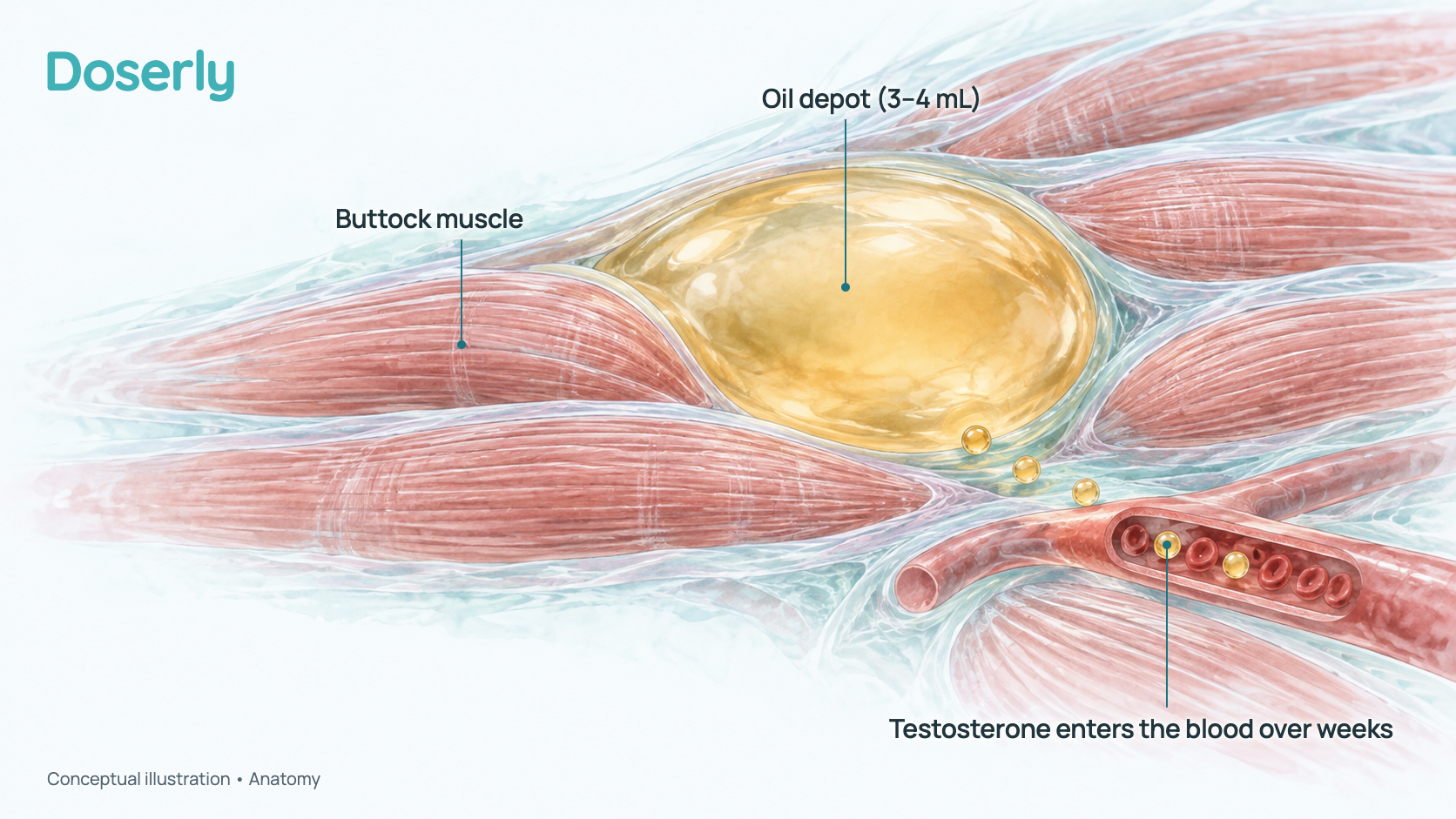
Testosterone undecanoate injection is a prescription form of testosterone that lasts for months. It is testosterone with a long chemical tail attached, dissolved in castor oil and injected deep into the buttock muscle by a nurse or doctor. One injection keeps levels up for about 10 to 14 weeks, so most men need 4 or 5 injections a year once treatment settles. [1], [2]
"Undecanoate" is an 11-carbon ester (a chemical tail) joined to testosterone. The long tail makes the hormone leave the oil very slowly; the body then clips it off to release ordinary testosterone. Because the tail adds weight, a 1000 mg dose contains 631.5 mg of testosterone. [1], [2]
It is labeled for adult men with hypogonadism (low testosterone from a medical cause): primary hypogonadism, where the testicles fail, or hypogonadotropic hypogonadism, where the brain and pituitary do not send enough signal. The US label says its safety and benefit in "age-related" low testosterone, and in anyone under 18, have not been established. [1]
| Product | Where | Strength and container | Labeled schedule |
|---|---|---|---|
| Aveed | United States | 750 mg in 3 mL (250 mg/mL), single-use vial | At the start, after 4 weeks, then every 10 weeks |
| Nebido | United Kingdom, Ireland, France, the Netherlands and other countries | 1000 mg in 4 mL, ampoule or vial | Every 10 to 14 weeks |
| Roxadin | United Kingdom | 1000 mg in 4 mL | Every 10 to 14 weeks |
| Reandron 1000, Rejunon 1000, Gonadron | Australia | 1000 mg in 4 mL | Every 10 to 14 weeks |
| Generic testosterone undecanoate 1000 mg/4 mL | France, Spain | 1000 mg in 4 mL | Every 10 to 14 weeks |
[1], [2], [3], [4], [5], [6], [7], [8]
Every product is 250 mg/mL in castor oil with benzyl benzoate. No injectable form is sold in Canada, and Aveed is the only version approved in the United States (checked September 2026). [1], [2], [9], [10]
It is not the same as oral testosterone undecanoate. Jatenzo, Kyzatrex, Tlando and the older Andriol capsules contain the same ester but are swallowed with food twice a day and absorbed through the gut's lymph vessels. They are different products with different doses; see oral testosterone. [11]
Testosterone undecanoate is a controlled substance: Schedule III in the United States. Unlicensed vials sold outside medical care are not covered by the labels described here, and doses above the natural range are not testosterone replacement therapy, or TRT (see TRT vs steroids). [12]
Typical Testosterone Undecanoate Injection Protocols
| Source | Amount each time | How often | Weekly total | Adjusted by | Source type |
|---|---|---|---|---|---|
| US label · Aveed | 750 mg (3 mL) | At the start, after 4 weeks, then every 10 weeks | Averages 75 mg a week once on 10-week intervals | Not adjusted: the label says titration is not necessary | Label Given only in a certified healthcare setting, with 30 minutes' observation after every injection |
| UK label · Nebido and Roxadin | 1000 mg (4 mL) | Every 10–14 weeks; the first interval can be shortened to as little as 6 weeks | Averages about 71–100 mg a week | Level at the end of the interval, aiming for the lower third of normal, plus symptoms | Label |
| Australian label · Reandron 1000, Rejunon 1000, Gonadron | 1000 mg (4 mL) | Every 10–14 weeks; the first interval can be shortened to as little as 6 weeks | Averages about 71–100 mg a week | Level at the end of the interval: shorten the interval if low; if high, lengthen it or consider a smaller volume | Label |
| Endocrine Society 2018 (US regimen) | 750 mg | At the start, after 4 weeks, then every 10 weeks | Averages 75 mg a week | Level just before the next injection, aiming for the low to middle part of normal | Guideline |
| American Urological Association (AUA) 2018 (US regimen) | 750 mg | At the start, after 4 weeks, then every 10 weeks; 9 weeks if the trough is low, 11 if it is high | Averages about 68–83 mg a week | Trough at the end of a 10-week cycle: under 300 ng/dL (about 10.4 nmol/L) shortens the gap to 9 weeks; over 600 ng/dL (about 20.8 nmol/L) lengthens it to 11 | Guideline |
| European Association of Urology (EAU) 2026 | 1000 mg | Second injection at 6 weeks, then every 12 weeks (range 10–14) | Averages about 83 mg a week at 12 weeks | Trough after 3–5 injections; usual target above 12 and below 18 nmol/L (about 350–520 ng/dL) | Guideline |
| British Society for Sexual Medicine (BSSM) 2023 | 1000 mg | Second injection at 6 weeks, third 12 weeks later, then every 10–14 weeks | Averages about 71–100 mg a week | Trough before the third injection; keep it above 12 nmol/L (about 350 ng/dL) | Guideline |
| Society for Endocrinology (UK) 2022 | 1000 mg | First two injections 6–8 weeks apart, third 12 weeks later, then usually every 10–14 weeks | Averages about 71–100 mg a week | Trough and blood count before the third injection, aiming for the lower end of normal | Guideline |
| Endocrine Society of Australia 2016 | 1000 mg | Every 3 months | Averages about 77–83 mg a week | Morning trough before the fourth injection, aiming for 10–15 nmol/L (about 290–430 ng/dL) | Guideline Allow 2 or 3 injections after any change before checking again |
The US and UK labels and the guidelines above use one whole vial per injection and change only the gap between injections: Aveed every 10 weeks after a second dose at 4 weeks, and the 1000 mg products every 10 to 14 weeks, most often about every 12 weeks. The Australian labels also allow a smaller volume when levels run high. [1], [2], [4], [15], [16], [17]
- Titration Adjusting the schedule in steps
- Aveed's label keeps the dose and the 10-week interval fixed; the AUA guideline allows 9 or 11 weeks by the end-of-cycle trough. The 1000 mg labels and non-US guidelines mainly adjust the interval, using the testosterone level just before the next injection: a low trough shortens the gap and a high one lengthens it. The Australian labels also allow a smaller volume when levels are high, without giving an amount. The sources differ on when to check first and on the target. [2], [4], [14], [15], [16], [17], [18] See when blood should be drawn.
- Breaks and cycles
- Not applicable. Testosterone replacement is continuous treatment; no label or guideline describes planned breaks or cycles. Stopping is a separate decision, and the depot keeps releasing testosterone for months after the last injection (what happens when you stop). [17]
Read the units. Doses are written in milligrams (mg), and every product is 250 mg/mL, so 750 mg is 3 mL (the whole Aveed vial) and 1000 mg is 4 mL (the whole Nebido ampoule or vial). Insulin-syringe units do not apply: the volume is far more than a 1 mL syringe holds, and the labels use the full single-use container (the Australian labels also allow a smaller volume when levels are high). The weekly figures in the table are averages for comparing with weekly injections, not doses anyone gives: 750 mg every 10 weeks averages 75 mg a week. For shorter-acting injections, where you draw part of a vial, Doserly's TRT dose calculator does the mg-to-mL arithmetic. [1], [2]
These are labeled and guideline doses; prescribers adjust them using blood tests and symptoms. The schedules above are for adult men. For women, see testosterone therapy for women, which uses different products and far smaller doses.
Cautions for every schedule above. The labels rule out testosterone with breast or prostate cancer, pregnancy and allergy to the ingredients, including castor oil or benzyl benzoate; the UK label adds liver tumors. Every injection carries a small risk of an oil cough or allergic reaction (POME), testosterone shuts down sperm production (fertility), and hematocrit, blood pressure and PSA (prostate-specific antigen, a prostate blood test) need checking (monitoring). [1], [2]
Where these numbers come from
The US row comes from the current Aveed label (DailyMed, revised July 2025), which states the dose, the schedule and that titration is not necessary. The UK row comes from the Nebido product information (text revised December 15, 2025) and matches the Roxadin label. The Australian row comes from the Reandron 1000 product information (revised December 11, 2025), which the Rejunon 1000 and Gonadron documents match on dosing, including the option of a smaller volume when levels are high (no amount is given). The optional 6-week second injection is written into the UK and Australian labels as a choice, not a requirement. Weekly averages are simple arithmetic; no label states them. [1], [2], [3], [4], [5], [6]
The guideline rows each come from one document: the Endocrine Society guideline (2018, formulation and monitoring tables), the AUA testosterone deficiency guideline (2018, dosing strategies), the EAU male hypogonadism guideline (2026 edition), the BSSM guideline (2023, Table 5), the Society for Endocrinology guideline (2022) and the Endocrine Society of Australia position statement (2016, treatment table). The Australian statement names Reandron 1000 at 1 g every 3 months. [13], [14], [15], [16], [17], [18]
Not used for any row: an 8-week Aveed interval (tested only in a computer simulation), divided weekly or two-weekly doses from a single vial (no published study was found), a smaller volume than the whole vial (the Australian labels allow it but give no amount), subcutaneous injection (one small crossover study), the monthly 500 mg regimen of Chinese male-contraception trials (a different product in tea seed oil) and any dose above replacement. Each is discussed below where it comes up. Checked September 2026.
What do clinic protocol sources use?
| Source | Amount each time | How often | Weekly total | Adjusted by | Source type |
|---|---|---|---|---|---|
| Sydney university andrology clinic (297 men, 6,300 injections, 2006–2019) | 1000 mg | First dose, a second at 6 weeks, then every 12 weeks, adjusted per person | Averages about 83 mg a week at 12 weeks | The man's own symptoms returning before the next dose together with a low trough; lengthened when the trough was high | Clinic protocol source Final intervals: median 12.0 weeks; 23% ended on 14 weeks or longer and 7.4% on 10 weeks or shorter |
About 70% of men in that clinic ended on an interval between 10 and 14 weeks after adjustment, with a median of 12.0 weeks. The clinic also treated transgender men, so its numbers are not limited to men with hypogonadism. [19]
What is testosterone undecanoate injection commonly used for?
Its approved use is replacing testosterone in adult men whose bodies cannot make enough because of testicular failure or a missing signal from the brain or pituitary, when the benefit outweighs the risk of the injection reactions described below. [1], [20]
Is it a good first choice? Guidelines disagree. The BSSM and the Australian statement list convenience and steadier levels as advantages; at 10 to 14 week gaps that is about 4 or 5 injections a year. But it cannot be self-injected or stopped quickly once given, so the Society for Endocrinology does not recommend it first-line, and the EAU prefers a gel when starting treatment in men at higher risk. [16], [18], [17], [15]
What does testosterone replacement improve?
Mainly sexual desire and function in men with clearly low levels. Trials of undecanoate injections show that pattern:
- Men with type 2 diabetes (BLAST). In 199 men randomized to undecanoate injections or placebo for 30 weeks, erectile function improved only in men with severe deficiency (total testosterone 8 nmol/L or lower, about 230 ng/dL, with low free testosterone) and only by week 30. Desire and satisfaction improved from week 6 in that group. [21]
- Men with prediabetes (T4DM). Over 2 years, 10 more men in every 100 had a meaningful gain in sexual desire than on placebo (32% vs 22%); the difference in erectile function, 3 more in 100, was not significant. [22]
- Men with low libido on a daily gel (TRAVERSE). In 1,161 men, testosterone gave more sexual activity and desire through 24 months but did not improve erections. This trial tested a gel, not injections. [23]
- Compared with enanthate. In a German trial of 40 men, sexual function improved as much on undecanoate as on enanthate over 30 weeks and stayed improved for 65 more weeks. [24]
Body composition shifts too. In T4DM, where every man was in a lifestyle program, fat mass fell 4.6 kg on testosterone vs 1.9 kg on placebo over 2 years. In obese men on a very low energy diet, undecanoate injections led to 2.9 kg more fat loss and 3.4 kg less lean-mass loss than placebo over 56 weeks. [25], [26] See the evidence and the muscle and fat loss guide.
Does it prevent diabetes?
Not on its own. In T4DM, 1,007 men aged 50 to 74 with a large waist and prediabetes or newly diagnosed diabetes all joined a lifestyle program, and half also received 1000 mg undecanoate injections. At 2 years, 12% of the testosterone group (55 of 443) had diabetes, compared with 21% on placebo (87 of 413). [27]
TRAVERSE, which used a daily gel without a structured lifestyle program, found no significant diabetes prevention, and the American Diabetes Association does not recommend testosterone to prevent type 2 diabetes. The T4DM result also came with more high hematocrit (below). [28], [29]
How long does testosterone undecanoate injection take to work?
Blood levels rise from the first day, but effects take weeks. After an Aveed injection, levels peak at a median of 7 days and reach a steady state with the third injection at week 14; on Nebido every 10 weeks, between the third and fifth injections. [1], [2]
A German study of 40 men on undecanoate or enanthate timed each effect. Sexual interest and morning erections improved quickly and leveled off after 3 weeks, erections after 9 weeks, and sexual satisfaction after 12. Depression scores leveled off after 6 weeks and fatigue improved after 9 to 12 weeks. Concentration took 9 weeks on undecanoate compared with 3 on enanthate. [30] See the results timeline guide.
Where do testosterone undecanoate protocols differ?
The dose is one vial on the US and UK labels, and the Australian labels also allow a smaller volume when levels run high. The main disagreements are about timing: the second injection, the gap, blood tests and splitting the vial.
Fixed every 10 weeks, or adjusted between 10 and 14?
The US and the rest of the world run the same drug on different rules. Aveed's label gives 750 mg every 10 weeks after a 4-week second dose and says titration is not necessary. For the same regimen, the AUA guideline allows a 9-week gap if the trough at the end of a cycle is under 300 ng/dL (about 10.4 nmol/L) and an 11-week gap if it is over 600 ng/dL (about 20.8 nmol/L). The 1000 mg labels in the UK and Australia let the interval move between 10 and 14 weeks, set by the testosterone level at the end of each interval, and the Australian labels also allow a smaller volume when levels are high, without giving an amount. [1], [14], [2], [4]
In practice, the adjusted schedules tend to settle near 12 weeks. In the Sydney clinic, 23% of men ended on 14 weeks or longer and 7.4% on 10 weeks or shorter. Early studies that kept injecting every 6 weeks found peaks and troughs creeping upward with each injection, and the Australian label says that interval caused testosterone to build up, so a longer gap was needed. [19], [31], [4]
Is the second injection at 4 or 6 weeks a loading dose?
Yes. The early second injection, a loading dose, brings levels to a steady pattern sooner. Aveed builds it in at 4 weeks. The 1000 mg labels allow the first interval to be shortened to a minimum of 6 weeks as an option, not a requirement, while UK and European guidelines routinely give it at 6 weeks (6 to 8 in the Society for Endocrinology guideline), with the third injection 12 weeks later. On Nebido, that second injection produced the highest peak, about 50 nmol/L (about 1,440 ng/dL), before levels settled. [1], [2], [4], [15], [16], [17]
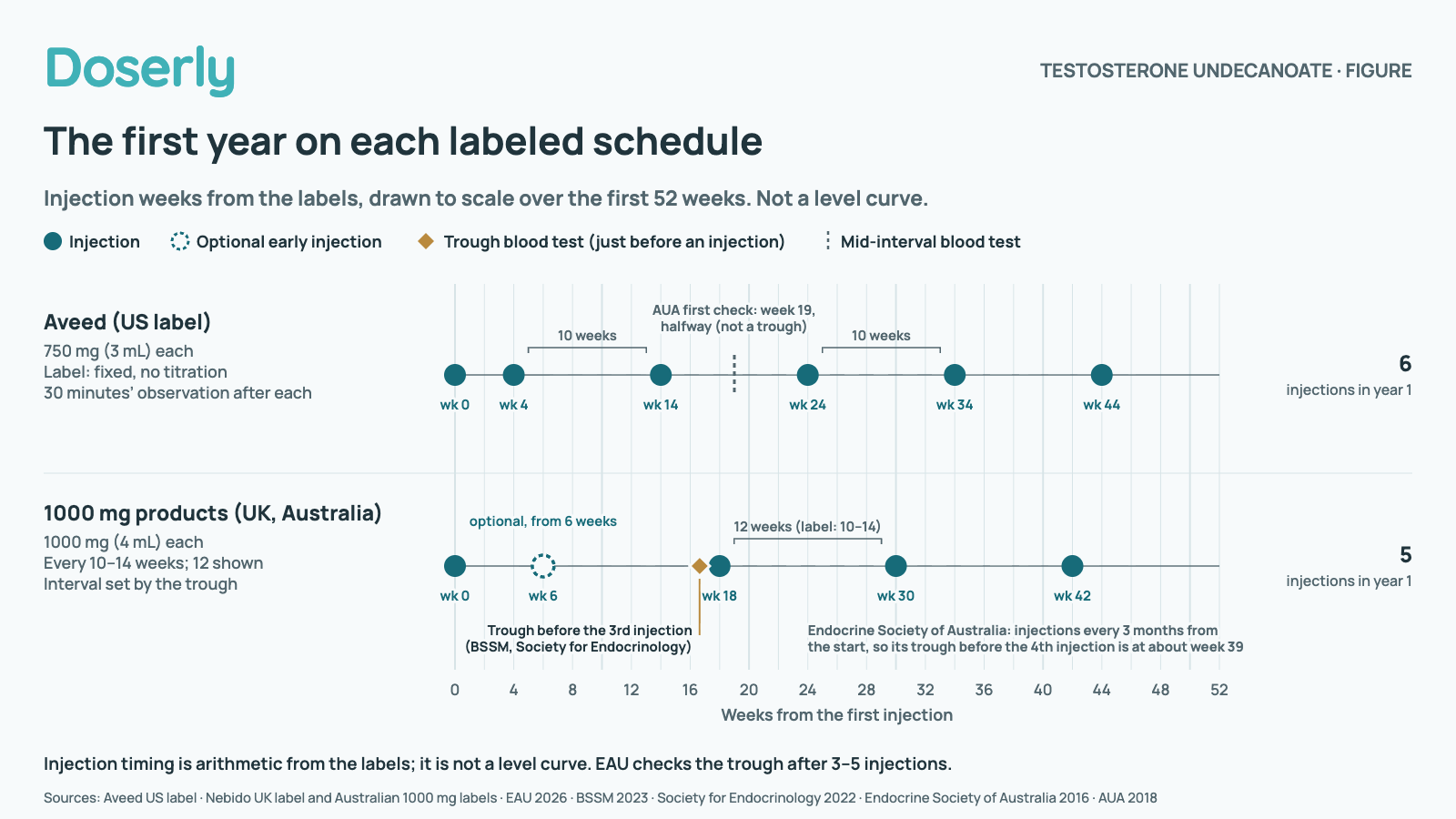
The first year on each labeled schedule
Weeks 0 to 52, drawn to scale. Dots are injections; a dashed ring is an optional early injection; amber diamonds are trough blood tests; a dashed line is a mid-interval test.
- Aveed (US label): 6 injections in year 1
- 750 mg (3 mL) each at weeks 0, 4, 14, 24, 34 and 44. The label is fixed, with no titration; 30 minutes’ observation after each. The AUA’s first check falls halfway between the first two 10-week injections (week 19), a mid-interval level, not a trough; the AUA also allows a 9 or 11 week gap, set by the trough at the end of a 10-week cycle.
- 1000 mg products (UK, Australia): 5 injections in year 1
- 1000 mg (4 mL) each at weeks 0, 6 (optional early second injection), 18, 30 and 42: every 12 weeks shown, within the labeled 10–14, with the interval set by the trough. BSSM and the Society for Endocrinology draw the trough before the 3rd injection (week 18). The Endocrine Society of Australia gives injections every 3 months from the start, so its trough before the 4th injection falls at about week 39, not on this track.
Injection timing is arithmetic from the labels; it is not a level curve. EAU checks the trough after 3–5 injections.
Why do some men feel it wear off before the next injection?
It is the most common complaint in public forums, and no study has measured how often it happens. On Aveed at steady state, the average lowest level just before the next injection was 324 ng/dL (about 11.2 nmol/L), with wide variation between men. The Nebido label reports that the trough varied by 22% within the same man and 34% between men. [1], [2]
Body size matters. On the Aveed label, men weighing 100 kg or more averaged 426 ng/dL across the interval, compared with 568 ng/dL in men weighing 65 to 100 kg. [1]
One clinic shortened intervals only when a man's own symptoms returned early and his trough was low; 7.4% ended on 10 weeks or less. A computer model by authors linked to Aveed's maker predicted that every 8 weeks instead of 10 would keep the trough above 300 ng/dL in 76.1% of simulated men instead of 66.7%; that is a simulation, and 8 weeks is not in the label. [19], [32]
Late-interval symptoms have other causes too, such as poor sleep, weight change or other medicines; a trough drawn just before the next injection shows whether the level really is low. See what people describe in the community section.
When should blood be drawn?
Just before the next injection, according to the labels and most guidelines, but the first check and the target differ. A result from the middle of the interval looks higher than one from the end, so a mid-interval level cannot be judged against a trough target. [2], [13], [14]
| Source | When to draw on undecanoate | Target |
|---|---|---|
| Nebido UK label | At the end of an injection interval | Lower third of the normal range |
| Endocrine Society 2018 | Just before the next injection | Low to middle part of normal |
| EAU 2026 | Before an injection, after 3–5 injections | Above 12 and below 18 nmol/L (about 350–520 ng/dL) |
| BSSM 2023 | Before the third injection | Keep the trough above 12 nmol/L (about 350 ng/dL) |
| Society for Endocrinology (UK) 2022 | Before the third injection, then every 3–5 injections or yearly | Lower end of normal |
| Endocrine Society of Australia 2016 | Morning, before the fourth injection | 10–15 nmol/L (about 290–430 ng/dL) |
| American Urological Association (AUA) 2018 | First check halfway between the first two 10-week Aveed injections; trough at the end of a 10-week cycle when adjusting the interval | First check is mid-interval, not a trough; a trough under 300 ng/dL (about 10.4 nmol/L) shortens the gap to 9 weeks, and over 600 ng/dL (about 20.8 nmol/L) lengthens it to 11 |
[2], [13], [15], [16], [17], [18], [14]
The Nebido label also asks for every testosterone test to be done at the same laboratory, because results vary between labs. [2] See TRT blood work for the full picture.
Can the vial be split into smaller, more frequent doses?
Not established. No published study has tested dividing a castor-oil undecanoate vial into weekly or two-weekly doses, and no label or guideline describes dividing a vial that way. The Australian labels do allow a smaller volume when levels are high, but they give no amount and treat each container as single use. The labels treat each ampoule or vial as a single use: the Nebido label says to inject it immediately after opening and discard any leftover, and Aveed's vial is single use. [2], [1], [4]
Splitting is still widely discussed, and some prescribers outside the labels have tried it (what people report). The labels give no in-use period once a container is opened. If the aim is weekly dosing, the labeled options are cypionate or enanthate, which come in multi-dose vials; see testosterone cypionate and testosterone enanthate.
Can it be injected subcutaneously?
Only in one small study. In a randomized crossover study of 20 long-term users (11 men with hypogonadism and 9 transgender men), a full 1000 mg dose injected subcutaneously (into the fatty layer under the skin) gave testosterone, dihydrotestosterone (DHT) and estradiol levels similar to an injection into muscle, with a later peak (8.0 vs 3.3 days). It was more painful 24 hours later, and 11 of the 20 preferred the muscle injection. The labels allow intramuscular use only. [33], [1], [2]
How do people switch from cypionate or enanthate?
There is no fixed rule, and the only trial schedule comes from one German study. Men moving from enanthate 250 mg every 3 weeks received two 1000 mg undecanoate injections 8 weeks apart, then one every 12 weeks. In the same trial, enanthate troughs were always below 10 nmol/L before the next injection, while undecanoate troughs averaged 14.1 nmol/L after the first two doses and 16.3 nmol/L after the first 9-week interval. [34]
No guideline sets a gap between the two products, so ask the prescriber whether the first undecanoate injection replaces your next due short-ester injection and when to draw the first trough. Switching back to a short ester raises the same question in reverse, because undecanoate clears slowly (stopping). [2]
What happens when you stop testosterone undecanoate injection?
The drug leaves slowly, and your own hormone production returns even more slowly. [2], [35]
- After the last injection. Levels fall over months, because the depot keeps releasing testosterone (release half-life 90 ± 40 days on the Nebido label). [2]
- Your own testosterone. Injected testosterone switches off the pituitary's signals to the testicles, luteinizing hormone (LH) and follicle-stimulating hormone (FSH). In T4DM, in men who did not have a medical cause of low testosterone, LH and FSH recovered slowly over 12 months after 2 years of 1000 mg injections, and full recovery may take longer. For men with a verified diagnosis of hypogonadism, the Society for Endocrinology expects treatment to continue lifelong. [35], [17]
- Sperm. In a small series of 8 men in couples trying to conceive who had been given Nebido, sperm disappeared after a median of 8 months, and sperm counts and FSH returned to normal a median of 8.5 months (range 7 to 10) after stopping. [36]
- Restarting. About five years after T4DM ended, 6% of men from the testosterone group had restarted testosterone, compared with 2.8% from the placebo group. [37]
See stopping TRT for the full picture, including fertility recovery and what men describe.
How long does testosterone undecanoate injection last, and how is it given?
It is the longest-acting testosterone injection. Compared with cypionate or enanthate, it needs 4 or 5 injections a year instead of 13 to 52, gives smoother levels between injections and, in a network meta-analysis, raised hematocrit less. In exchange, it must be given in a clinic, it cannot be removed once injected, and it carries the injection-reaction warning. [1], [34], [38]
How long does testosterone undecanoate last in the body?
Much longer than any other injectable ester, but published half-life figures differ by source and method, so each needs its label:
| Source | Half-life figure | What it measured |
|---|---|---|
| Nebido UK label | 90 ± 40 days | Release from the depot |
| Reandron Australian label | About 53 days after one injection; about 90 days at steady state | Decline after the peak |
| Phase I study (Behre 1999) | 33.9 ± 4.9 days (mean ± standard error) | One 1000 mg injection in 14 men |
| EAU 2026 guideline table | 34 days | Guideline summary figure |
These figures describe the depot; testosterone itself is cleared from the blood within minutes to about an hour. The "34 days" often repeated online comes from a single injection, not repeated dosing. [1], [39]
What do the levels look like between injections?
Smoother than on short-acting injections, but not flat:
| Product and phase | Peak | Average | Lowest (trough) |
|---|---|---|---|
| Aveed 750 mg at steady state (117 men) | 891 ng/dL (about 31 nmol/L) | 495 ng/dL (about 17 nmol/L) | 324 ng/dL (about 11 nmol/L) |
| Nebido 1000 mg, first injection | 38 nmol/L (about 1,100 ng/dL) at day 7 | Not reported | Not reported |
| Nebido 1000 mg at steady state, every 10 weeks | About 37 nmol/L (about 1,070 ng/dL) | Not reported | About 16 nmol/L (about 460 ng/dL) |
On Aveed, 94% of men kept an average level within 300 to 1,000 ng/dL (5.1% below, 0.9% above), and 7.7% peaked above 1,500 ng/dL, none above 1,800. [1] Doserly's testosterone level visualizer sketches a simplified undecanoate curve next to other esters.
Aveed (United States)
Aveed is testosterone undecanoate 750 mg in a 3 mL single-use vial, given only through a restricted safety program. FDA approved it on March 5, 2014, after an application first filed in August 2007 was turned back three times (an approvable letter in 2008 and complete response letters in 2009 and 2013), largely over the oil-cough and allergic reactions. [40], [41]
- The restricted program (REMS). Under FDA's Risk Evaluation and Mitigation Strategy (REMS), prescribers train, pass a knowledge test and enroll, and every clinic giving Aveed must be certified, keep equipment and trained staff on site for severe reactions, and watch each patient for 30 minutes after every injection. The current document dates from October 2024. [42], [43]
- Only one US version. A generic 750 mg/3 mL undecanoate injection from Hikma has had tentative approval since December 9, 2016, but no final approval, so Aveed remains the only approved US product (checked September 2026). [10]
- Label changes. A July 2025 update removed the old "Cardiovascular Risk" warning section and added blood-pressure warnings and TRAVERSE results, following FDA's February 2025 class-wide letter. This was a warnings section, not the boxed warning, which is unchanged. [44], [1]
- Why 750 mg, not 1000 mg. No 1000 mg product such as Nebido has US approval; Aveed's approval rests on studies of its own 750 mg schedule. [10], [45], [46]
Nebido and other 1000 mg brands
Nebido is testosterone undecanoate 1000 mg in a 4 mL ampoule or vial, first authorized in the UK on October 20, 2004. Its UK license holder is now Grünenthal; a 2014 review dates the injection to 2003. [2], [47]
The same 1000 mg/4 mL product is sold under other names: Roxadin in the UK; Reandron 1000, Rejunon 1000 and Gonadron in Australia, where the PBS also lists a Testosterone ADVZ 1000 brand; and generics in France and Spain. Their labels share the 10 to 14 week schedule. [3], [4], [5], [6], [48], [7], [8]
Outside the US there is no REMS. The Nebido label asks for the patient to be observed "during and immediately after each injection," without a fixed number of minutes. [2]
Aveed vs Nebido: what is the difference?
The same drug in different amounts and on different rules:
| Aveed | Nebido and other 1000 mg brands | |
|---|---|---|
| Amount | 750 mg in 3 mL | 1000 mg in 4 mL |
| Schedule | Start, 4 weeks, then every 10 weeks | Every 10–14 weeks; optional second injection from 6 weeks |
| Adjusted by trough level | Not on the label (the AUA guideline allows 9 or 11 weeks) | Yes; the interval changes, and the Australian labels also allow a smaller volume |
| Injection speed on the label | Over 60–90 seconds | Over about 2 minutes |
| After the injection | 30 minutes' observation in a certified setting | Observe during and immediately after |
| Where sold | United States only | UK, Europe, Australia and other countries; not the US or Canada |
How is it given, and can you inject it yourself?
No. Aveed is given only by a healthcare professional in a certified setting ("Your doctor will inject AVEED deep into the muscle of your buttock"), and UK and Australian guidelines say the 1000 mg products cannot be self-administered. [1], [16], [17], [18]
The labels describe a slow, careful injection:
- Site. Aveed goes into the gluteus medius, the muscle in the upper outer part of the buttock, avoiding the arteries and the sciatic nerve; the side alternates between injections. [1]
- Speed. Aveed over 60 to 90 seconds, after checking that no blood is drawn back; Nebido "very slowly (over two minutes)", warmed first according to the Society for Endocrinology. [1], [2], [17]
- Bleeding risk. The Nebido label reminds prescribers of the usual limits on muscle injections with bleeding disorders, and the Australian statement calls deep injection unsuitable with a clotting disorder or low platelets; one clinic saw no blood collections (hematomas) after 269 injections in men on blood thinners or antiplatelet drugs. [2], [18], [49]
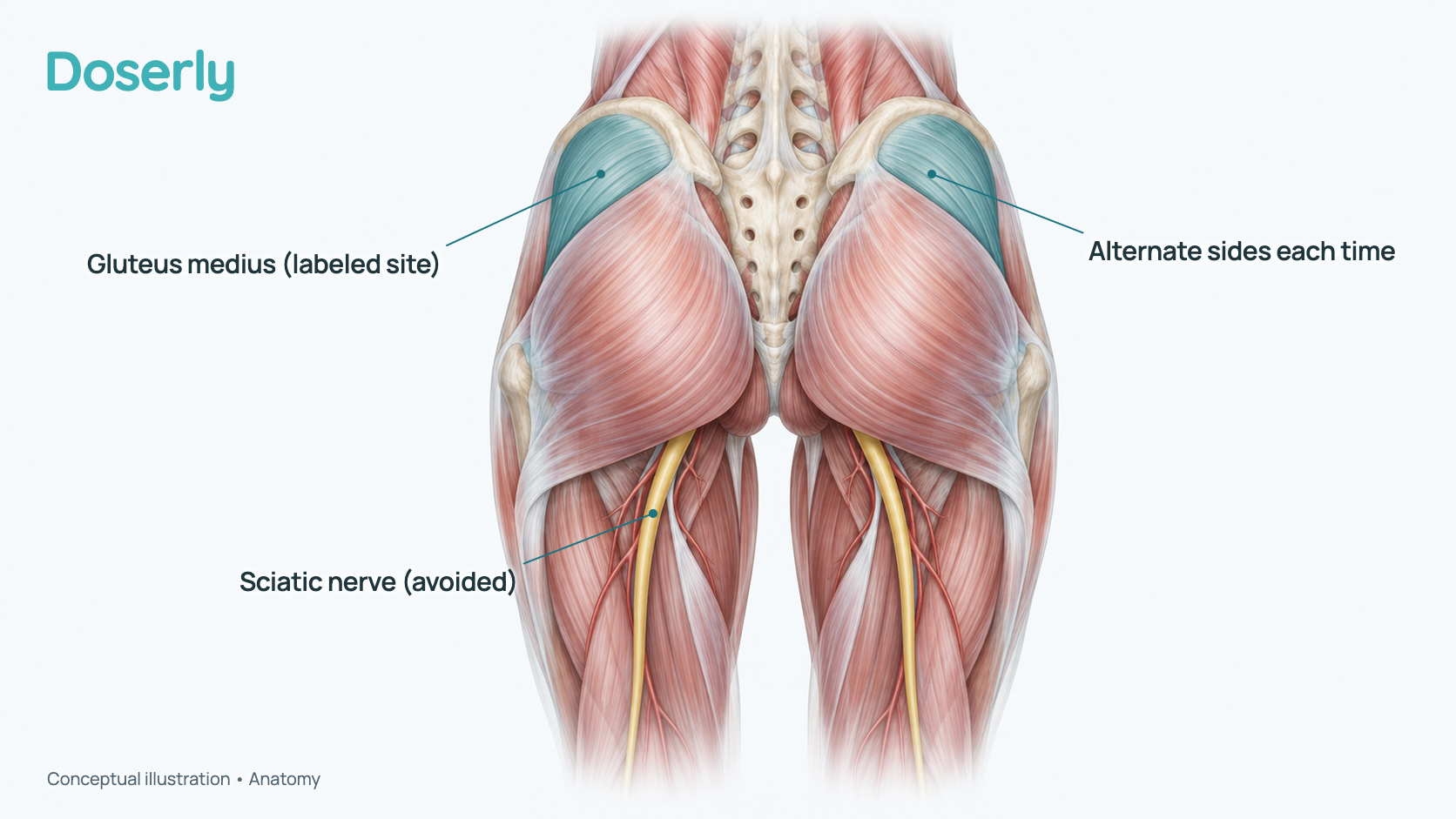
This guide does not teach injection technique. How to inject testosterone covers sites and needles for the forms people inject themselves.
How should testosterone undecanoate injection be stored?
At room temperature, in the carton, and used as soon as it is opened. The leaflet in your box is the final word. [1], [2]
| Product | Storage | After opening |
|---|---|---|
| Aveed | 25 °C; brief temperature swings between 15 and 30 °C are allowed; keep in the original carton | Single-use vial; discard any unused portion |
| Nebido | No special storage conditions; shelf life 5 years | Use immediately after opening |
Why it might look cloudy. Cold makes the oil thicker and cloudy for a while; the Nebido label says to bring it to room or body temperature and use only a clear solution. [2]
For carrying medicine on a trip, see traveling with testosterone; undecanoate's long interval often means an injection can be planned around travel instead.
What does testosterone undecanoate injection do to fertility, estrogen and red blood cells?
Each of these has its own hub guide; here is what is specific to undecanoate injections.
Fertility. The labels warn that testosterone suppresses sperm production and that the effect may be irreversible for some men. Undecanoate was even tested as a male contraceptive: in a Chinese trial of 1,045 healthy men, monthly 500 mg injections of a different undecanoate product (in tea seed oil) suppressed sperm to zero or near zero in 95% within 6 months, and sperm recovered in all but two after stopping. Because the depot lasts, recovery starts late. The AUA says testosterone should not be prescribed to men trying to conceive. See TRT and fertility and the hCG guide. [1], [50], [36], [14]
Estrogen. Some testosterone becomes estradiol, which rose in step with testosterone and stayed in the normal range in the German studies; Aveed's label lists "estradiol increased" in 2.6% of 153 men. No guideline sets a routine estradiol target. See estrogen on TRT. [31], [34], [1], [14]
Red blood cells. The evidence points both ways, from different kinds of studies:
- Across 29 randomized trials, a network meta-analysis found undecanoate injections raised hematocrit about 1.6 points more than placebo, vs about 4.0 for enanthate and cypionate injections and 3.0 for gel. [38]
- In one German registry of 802 men, not randomized, hematocrit went above 50% in 69 of 304 on undecanoate injections vs 25 of 498 on gel. [51]
- In T4DM, hematocrit went above 54% in 22% of men on testosterone (106 of 491) vs 1% on placebo (6 of 484). [27]
- In one clinic's routine practice, 25 of 347 men (7%) had hematocrit above 50% and 3 (1%) above 54%. [49]
The UK label adds that SGLT-2 inhibitor diabetes medicines can add to the rise. See hematocrit on TRT. [2]
What do we actually know about testosterone undecanoate injection in people?
That it restores testosterone is settled. Undecanoate injections also have one of the larger randomized trials of any testosterone form, T4DM, though it studied diabetes prevention rather than symptoms of low testosterone.

Which studies used undecanoate injections?
| Study | Who and what | What it found | What it cannot show |
|---|---|---|---|
| Aveed US study (single-arm) | 130 men with hypogonadism on 750 mg at weeks 0, 4 and 14; 153 in the 84-week safety extension | 94% of 117 men kept an average level in the normal range; hematocrit rose from 43.3% to 45.7% at 24 weeks | No comparison group [45], [46], [1] |
| T4DM (controlled trial) | 1,007 men aged 50 to 74 with prediabetes or new diabetes, all in a lifestyle program; 1000 mg or placebo for 2 years | Diabetes 12% vs 21%; hematocrit above 54% in 22% vs 1% | Men without a weight and sugar problem; heart safety [27] |
| BLAST (controlled trial) | 199 men with type 2 diabetes; undecanoate or placebo for 30 weeks | Erections improved only with severe deficiency, by week 30 | A secondary outcome [21] |
| German comparison with enanthate (randomized, open) | 40 men; undecanoate vs enanthate for 30 weeks, then undecanoate for about 2 years | Steadier troughs; similar sexual-function gains; blood counts rose then leveled off | Hard outcomes; the four reports share one cohort [34], [52], [24], [30] |
| Sydney clinic (prospective, observational) | 347 men, 3,022 injections by experienced nurses | Oil cough after 19 per 1,000 injections; no hematomas; hematocrit above 54% in 1% | Other clinics' technique [49] |
Heart safety rests mainly on TRAVERSE, a trial of gel (heart). [53] A 2014 meta-analysis of 33 undecanoate studies found better fat mass, blood sugar (HbA1c) and erectile function; changes in blood pressure, cholesterol and waist size appeared only in uncontrolled studies. [47]
What about the large registries?
Large observational studies of undecanoate are often quoted with dramatic results. Read them with care. Industry surveillance studies of 1,438 men in 23 countries (side effects in 6%) and 870 German men had no comparison group; the German one has a published correction we could not read. Long-running German registries reported large differences in weight, heart events and death between men who chose undecanoate and men who declined it, but men chose their own group and authors declared employment by the manufacturer, so the differences cannot be read as drug effects. [54], [55], [56], [57]
How does testosterone undecanoate injection work?
Once injected, the oil forms a depot in the muscle. The undecanoate ester slowly moves out of the oil into the blood, where enzymes called esterases cut off the undecanoic acid tail and free testosterone. That slow exit sets the 10 to 14 week interval. [1], [2]
Testosterone then acts like the body's own hormone; some is converted to dihydrotestosterone (DHT) and some to estradiol. [1]
Why it switches off your own production. The brain senses testosterone from any source. When levels are high, the pituitary lowers its LH and FSH signals to the testicles, so they make little testosterone and fewer sperm. [1]
Why it raises red blood cells. Androgens stimulate red blood cell production, so hematocrit rises on every form of testosterone. [1], [38]
What are the risks and unanswered questions?
Is testosterone undecanoate injection safe?
For men with a confirmed diagnosis, given in a clinic that follows the label, it is an established treatment with well-known risks. The risk specific to this form is a reaction during or just after the injection. The others are shared with all testosterone: more red blood cells, blood clots, higher blood pressure, prostate effects and loss of fertility. Long-term heart and prostate safety remain uncertain, since the largest safety trial used a gel: in TRAVERSE, heart attacks and strokes were no more common than on placebo, but atrial fibrillation, acute kidney injury and blood clots in the lung were, and it lasted under 2 years on average (see the heart section). [1], [2], [53]
Why does Aveed have a boxed warning? What is POME?
Aveed's boxed warning covers serious pulmonary oil microembolism (POME) and anaphylaxis, and it is the only US testosterone boxed warning about the injection itself. [1], [58], [59]
- What POME is. Tiny droplets of the injected oil reach the lungs. The label lists an urge to cough, shortness of breath, throat tightening, chest pain, dizziness and fainting, during or immediately after the injection. [1]
- Anaphylaxis is a severe allergic reaction, which can be life-threatening. [1]
- When it happens. After any injection, including the first, and not only early in treatment. [1], [20]
- Why the 30 minutes. FDA found that about 90% of severe reactions happened during the injection or within 30 minutes of it, so the label requires every patient to stay under observation in the clinic for 30 minutes. [20], [1]
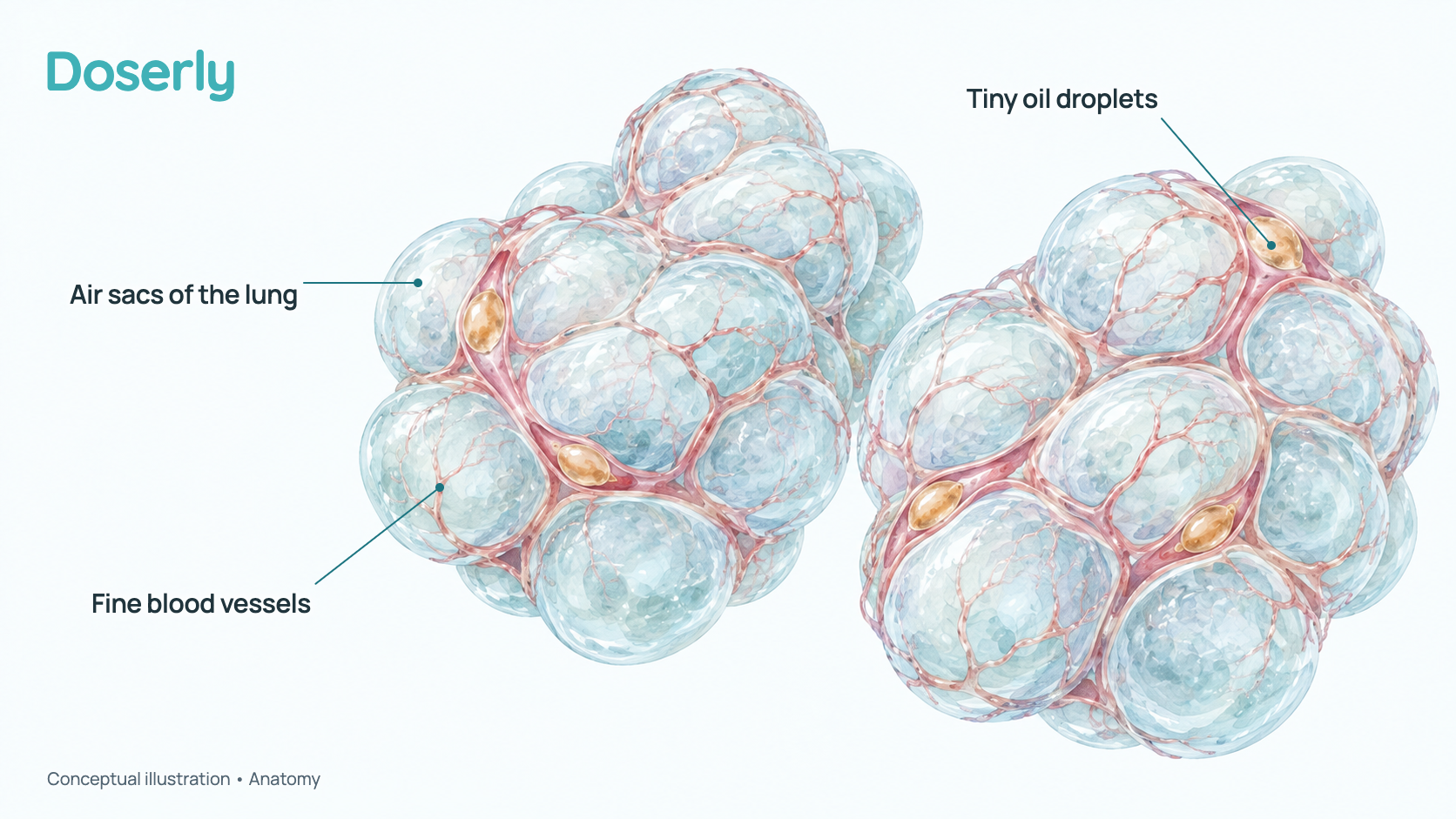
How often do injection reactions happen?
Rarely, but the published numbers differ widely because they count differently:
- Aveed's own 84-week trial: 1 man had a mild coughing fit lasting 10 minutes after his third injection. [1]
- Across 18 clinical trials of 3,556 men, reviewers counted 9 POME events in 8 men and 2 episodes of anaphylaxis. [1], [20]
- The Nebido label: suspected POME after at least 1 in 10,000 and fewer than 1 in 1,000 injections in trials. [2]
- A clinic that watched every injection: Sydney nurses recorded POME after 56 of 3,022 injections (19 per 1,000) in 43 of 347 men; 66% were mild and 19% severe, 40% began before the injection was finished, and repeat reactions were more likely than chance. [49]
- Reports after Aveed's launch: 28 POME reports for 90,092 doses distributed over 4.3 years, under 0.1% per injection; 13 of 17 with a recorded end time resolved within 30 minutes. Voluntary reports miss many events, and two authors worked for the manufacturer. [60]
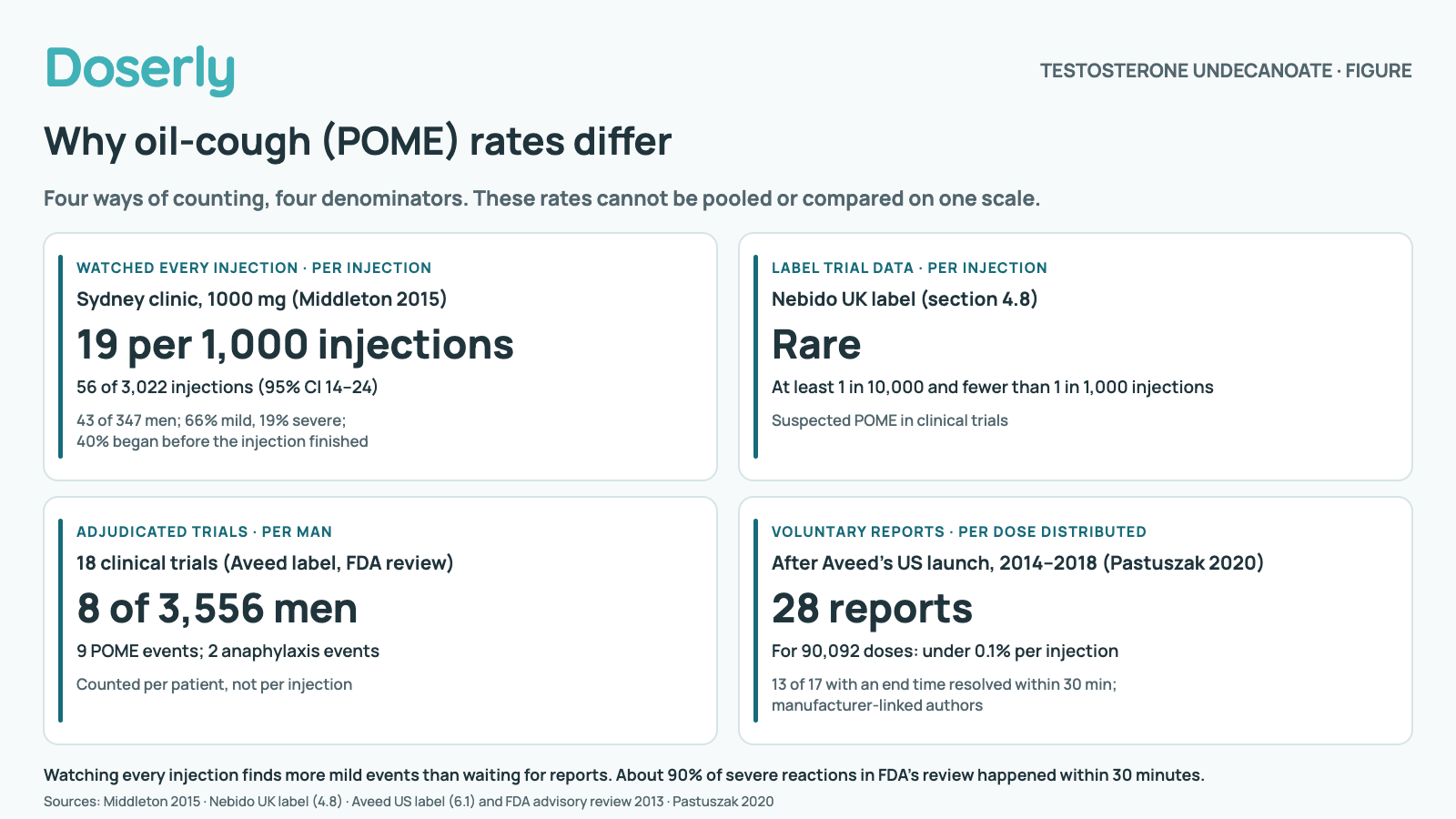
Why oil-cough (POME) rates differ
Four ways of counting, four denominators. These rates cannot be pooled.
- Watched every injection · per injectionSydney clinic, 1000 mg (Middleton 2015)
- 19 per 1,000 injections56 of 3,022 injections (95% CI 14–24). 43 of 347 men; 66% mild, 19% severe; 40% began before the injection finished.
- Label trial data · per injectionNebido UK label (section 4.8)
- RareAt least 1 in 10,000 and fewer than 1 in 1,000 injections. Suspected POME in clinical trials.
- Adjudicated trials · per man18 clinical trials (Aveed label, FDA review)
- 8 of 3,556 men9 POME events; 2 anaphylaxis events. Counted per patient, not per injection.
- Voluntary reports · per dose distributedAfter Aveed’s US launch, 2014–2018 (Pastuszak 2020)
- 28 reportsFor 90,092 doses: under 0.1% per injection. 13 of 17 with an end time resolved within 30 min; manufacturer-linked authors.
Watching every injection finds more mild events than waiting for reports. About 90% of severe reactions in FDA's review happened within 30 minutes.
How FDA decided. At an April 2013 advisory meeting, experts split 9 to 9 on whether the drug was safe for its use, and 17 of 18 voted that a slow injection plus 30 minutes in the office would not be enough on its own. FDA then approved Aveed in 2014 with the restricted REMS program. [20], [40]
What to do. Tell the nurse at once about any urge to cough, difficulty breathing, sweating, throat tightness, chest pain or dizziness, during or after the injection. Most episodes last a few minutes; some last hours and need emergency care, and the Aveed patient guide says to get emergency help if symptoms get worse over the 24 hours after an injection. In 3 of 4 postmarketing reports that needed an emergency visit, problems with injection technique or dosing were identified as a possible contributing factor. [1], [60]
POME can follow other oil injections too; in 2025 the European Union's safety committee recommended listing it as a rare effect for all oil-based testosterone injections. [61]
What side effects do the labels list?
In Aveed's 84-week study of 153 men, the most common side effects were:
| Side effect | Men affected |
|---|---|
| Acne | 8 (5.2%) |
| Pain at the injection site | 7 (4.6%) |
| PSA increased | 7 (4.6%) |
| Estradiol increased | 4 (2.6%) |
| Low testosterone symptoms (hypogonadism) | 4 (2.6%) |
| Fatigue, irritability, raised hemoglobin, insomnia, mood swings | 3 each (2%) |
Seven men (4.6%) stopped because of side effects. The Nebido label lists acne and injection-site pain as the most frequent, and names irritability, nervousness, weight gain and prolonged or frequent erections as signs of too much androgen. [1], [2]
Does testosterone undecanoate injection affect the heart?
No heart-outcome trial has tested undecanoate injections. The best evidence comes from TRAVERSE, a randomized trial of about 5,200 men aged 45 to 80 with heart disease or high heart risk, given daily testosterone gel or a placebo gel. Among the 2,596 men who used testosterone gel and the 2,602 who used placebo gel, it found:
- Heart attack, stroke or heart death (major adverse cardiovascular events, MACE): 182 men (7.0%) on testosterone vs 190 (7.3%) on placebo; hazard ratio 0.96, with a 95% confidence interval of 0.78 to 1.17. The top of that range stayed below the trial's safety margin of 1.5, so a large rise in risk was ruled out. [53], [1]
- Heart rhythm: atrial fibrillation 3.5% vs 2.4%; nonfatal rhythm problems needing treatment 5.2% vs 3.3%. [1]
- Kidneys: acute kidney injury 2.3% vs 1.5%. [1]
- Clots: venous clots 1.7% vs 1.2%, including pulmonary embolism 0.9% vs 0.5%. [1]
- Fractures: 91 of 2,601 men (3.50%) vs 64 of 2,603 (2.46%), counting every randomized man. [62]
- Blood pressure: systolic pressure rose 1.0 mm Hg on testosterone and fell 0.5 mm Hg on placebo by 36 months. [1]
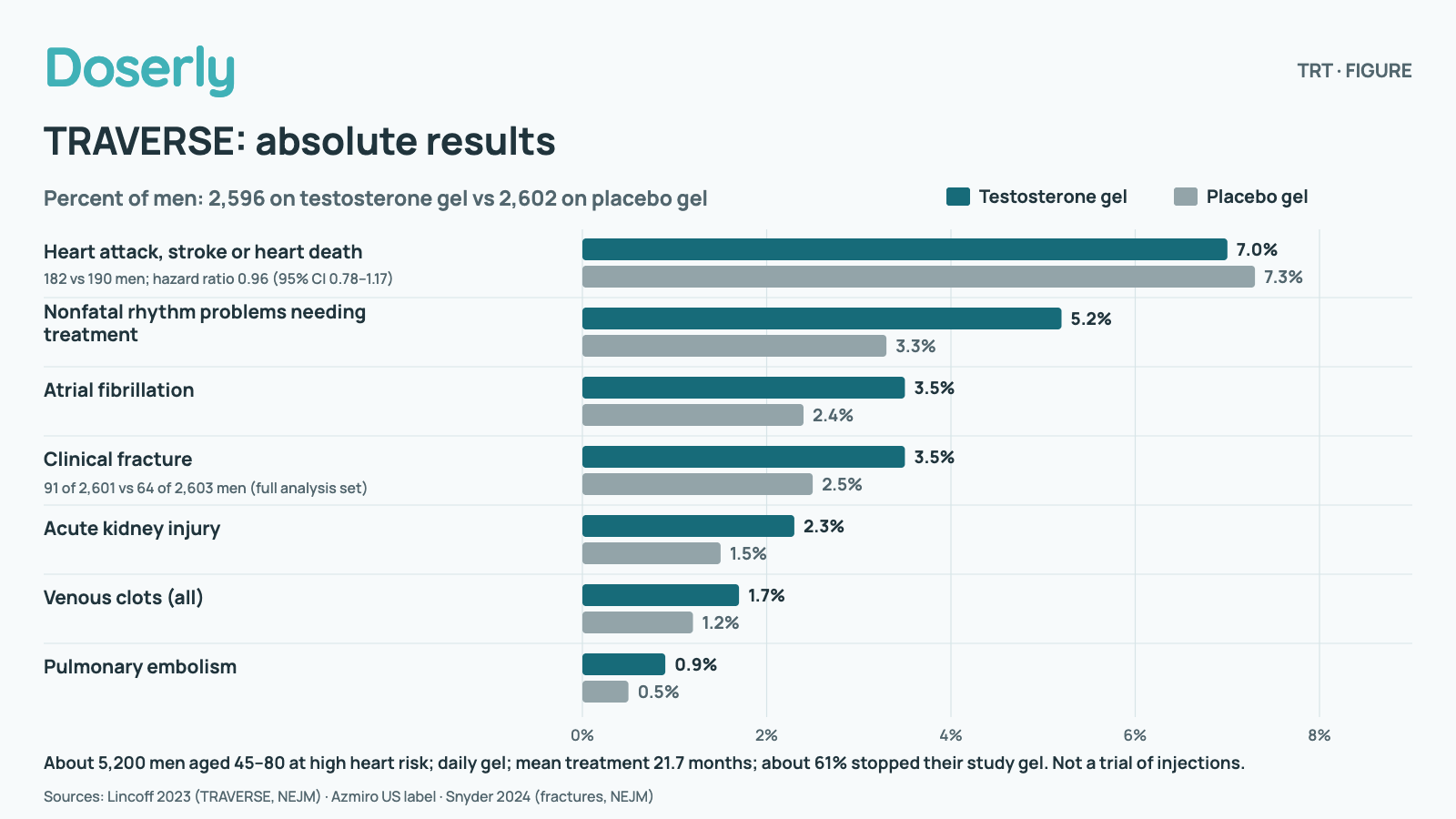
TRAVERSE: absolute results
Testosterone gel (2,596 men)Placebo gel (2,602 men)
- Heart attack, stroke or heart death
- Testosterone 7.0% vs placebo 7.3% (182 vs 190 men; hazard ratio 0.96, 95% CI 0.78–1.17; met the 1.5 safety margin)
- Nonfatal rhythm problems needing treatment
- Testosterone 5.2% vs placebo 3.3%
- Atrial fibrillation
- Testosterone 3.5% vs placebo 2.4%
- Clinical fracture
- Testosterone 3.5% vs placebo 2.5% (91 of 2,601 vs 64 of 2,603 in the full analysis set)
- Acute kidney injury
- Testosterone 2.3% vs placebo 1.5%
- Venous clots (all)
- Testosterone 1.7% vs placebo 1.2%
- Pulmonary embolism
- Testosterone 0.9% vs placebo 0.5%
About 5,200 men aged 45–80 at high heart risk; daily gel; mean treatment 21.7 months; about 61% stopped their study gel. Not a trial of injections.
Its limits matter for undecanoate. TRAVERSE tested only a gel, the average man used it for 21.7 months, about 61% stopped their study gel early, and it enrolled men at high heart risk. [53], [1]
Blood pressure on Aveed itself. In a 24-hour monitoring study, Aveed raised average blood pressure by 3.1/2.0 mm Hg after 16 weeks, and 8 of 222 men (3.6%) had high blood pressure reported as a side effect. The label advises against use with uncontrolled high blood pressure. [1], [63]
See TRT and heart health for the full picture.
What about blood clots, sleep apnea and fluid retention?
- Blood clots. The labels report clots in the legs (deep vein thrombosis) and lungs (pulmonary embolism); leg pain, swelling, warmth or redness, or sudden shortness of breath hours or days after an injection need urgent assessment. That is different from POME, which starts during or just after the injection. [1], [2]
- Sleep apnea. In obese men with severe sleep apnea, undecanoate injections worsened night-time drops in oxygen at 7 weeks, though not at 18. In a T4DM follow-up survey, a new sleep apnea diagnosis during the trial was more common on testosterone (3.0% vs 0.4%). [64], [37]
- Fluid retention. Swelling, with or without heart failure, can be serious in people with heart, kidney or liver disease. [1]
Could testosterone undecanoate injection affect the prostate?
Testosterone can enlarge the prostate and raise PSA. In Aveed's 84-week study, average PSA rose from 1.0 to 1.5 ng/mL, 14 men (10.9%) went from below 4 to above 4 ng/mL, and prostate cancer was found in 2 men (1.3%); there was no comparison group. In TRAVERSE, which excluded men with PSA above 3.0 ng/mL, high-grade prostate cancer occurred in 5 of 2,596 men on testosterone (0.19%) vs 3 of 2,602 on placebo (0.12%), a difference that was not significant. [1], [65]
US labels rule out testosterone in known or suspected prostate cancer; the UK label words it as "androgen-dependent carcinoma of the prostate". See TRT and the prostate. [1], [2]
Is testosterone undecanoate injection legal? Is it FDA approved?
Checked September 2026. Rules differ by country and change often.
United States. Aveed is FDA-approved and testosterone is a Schedule III controlled substance. The key steps:
- 2014. Aveed approved on March 5 with its REMS, last modified October 8, 2024. [40], [43], [66]
- February 28, 2025. FDA added TRAVERSE results and blood-pressure warnings to testosterone labels; Aveed's label took them in July 2025. [63], [44]
- June 18, 2026. The Department of Health and Human Services (HHS) announced that FDA is requesting label changes: removing the age-related limitation, contraindicating testosterone only in metastatic prostate cancer, and revising the prostate-enlargement warning. These are requests; the current Aveed label still carries the old wording. [67], [1]
- Telehealth. Temporary rules let clinicians prescribe controlled medicines without an in-person visit through December 31, 2026, but Aveed itself must still be injected in a certified healthcare setting. [68], [42]
Canada. Testosterone is a Schedule IV controlled substance. No injectable testosterone undecanoate is marketed; the undecanoate sold there is oral capsules. [69], [9]
United Kingdom. Testosterone is a Class C controlled drug (Schedule 4 Part II), prescription-only. Nebido and Roxadin have current UK product information. [70], [2], [3]
Australia. Testosterone is a Schedule 4 (prescription-only) medicine with extra controls on possession. Reandron 1000, Rejunon 1000 and Gonadron have current product information, and the injection is PBS-listed with authority (cost). [71], [4], [48]
European Union. Rules are national. France reimburses a generic but not Nebido, Spain funds a generic, the Netherlands has reimbursed Nebido since October 1, 2022, and Ireland needs a new prescription for each supply. See TRT in Europe. [7], [8], [72], [73]
A "research use only" label on a vial does not make it legal, tested or the same as a licensed product.
Is testosterone undecanoate banned in sport?
Yes. Testosterone and its esters are on the World Anti-Doping Agency (WADA) Prohibited List in class S1, banned in and out of competition, and the 2027 list keeps that from January 1, 2027. The Nebido label warns athletes that it can cause a positive doping test. A therapeutic use exemption is granted only when low testosterone has an organic cause (such as a testicular or pituitary disorder), not for age, obesity or earlier steroid use. [74], [75], [2], [76]
Who should be especially cautious?
- Men who want children now or soon. Testosterone suppresses sperm production, and after undecanoate the suppression outlasts the last injection by months. [14], [36]
- Men who want to be able to stop quickly. A depot cannot be removed. [17]
- Allergy to castor oil or benzyl benzoate, or earlier reactions to injections. Known allergy to the ingredients rules it out. [1]
- Bleeding disorders or low platelets. Deep muscle injections need care; see how it is given. [2], [18]
- Prostate or breast cancer, or liver tumors. Contraindicated on current labels (liver tumors on the UK label). [1], [2]
- Heart, kidney or liver disease, or high blood pressure. These can worsen. [1]
- High hematocrit, sleep apnea or obesity. A BMI of 30 or more was linked to less favorable safety values in one long-term German study. [77]
- Epilepsy or migraine. The UK label says these can be aggravated. [2]
- Women and children. Contraindicated in pregnancy; these guides are for men. Safety and benefit under 18 have not been established; any use in older teenagers, such as inducing puberty, is for a specialist, and the Society for Endocrinology says the early loading injection is left out then. [1], [17]
- Drug-tested athletes. Banned at all times. [74]
Can testosterone undecanoate be taken with other medicines?
The labels list these interactions:
- Blood thinners (warfarin and other oral anticoagulants). Testosterone can change their effect; the Aveed label advises more frequent clotting tests (INR and prothrombin time), especially when starting and stopping. [1], [2]
- Insulin and diabetes medicines. Testosterone can lower blood sugar and insulin needs. [1]
- SGLT-2 inhibitors (a type of diabetes medicine). The UK label warns the combination has been linked to more erythrocytosis and advises monitoring hematocrit. [2]
- Corticosteroids. Together they can increase fluid retention. [1]
Testosterone can also lower thyroxine-binding globulin, which changes total thyroid hormone results without changing thyroid function. Bring a full list of everything you take, including supplements, to a pharmacist or doctor. [1]
Is it available, and what does it cost?
Checked September 2026. Official figures only; what you pay depends on your country, insurance and clinic fees.
- United States. Medicare's Part B payment limit for Aveed is $2.149 per mg for July to September 2026, about $1,612 for a 750 mg injection, and $2.203 per mg (about $1,652) from October 1, 2026, before the clinic's fee; the same July list prices cypionate at 2.5 cents per mg. Medicare Part B spent about $1,361 per Aveed claim in 2024. FDA lists no testosterone shortage. [78], [79], [80]
- Australia. PBS item 10205D needs an authority: men without a known pituitary or testicular disorder must be 40 or older, with testosterone below 6 nmol/L on two morning tests (or 6 to 15 nmol/L with a high LH), and a named specialist. The government price is A$92.91; a general patient pays up to A$25.00. Short shortages of Gonadron and Rejunon 1000 in mid-2026 are resolved. [48], [81], [82]
- United Kingdom. NHS prescriptions in England cost £9.90 per item. [83]
- France. The generic 1000 mg injection costs €21.88 before the dispensing fee and is reimbursed at 65%; Nebido is not reimbursed. [7]
- Canada. Not available as an injection. [9]
What should be monitored while using testosterone undecanoate injection?
Labels ask for blood tests before and during treatment; guidelines supply the numbers. Use this to prepare questions for your prescriber; it is not a personal testing plan. [1], [2]
| Why it matters | What labels and guidelines say | Tracking category |
|---|---|---|
| Testosterone level | Trough at the end of an interval; first check varies by guideline (timing) | Blood work; Libido; Energy Levels |
| Hematocrit | Aveed label: before starting, at 3–6 months, then yearly; stop if elevated. Endocrine Society: stop above 54% until it falls. EAU: act above 54% | Blood work |
| PSA and prostate | UK label: PSA and a prostate exam at least yearly. Endocrine Society: urology referral if PSA rises by more than 1.4 ng/mL in the first year or exceeds 4.0 ng/mL | Blood work; Urinary Symptoms |
| Blood pressure | Aveed label: check periodically; not for uncontrolled high blood pressure | Blood Pressure |
| Lipids and liver | Aveed label: lipids periodically. UK label: liver tests and lipids | Blood work |
| Reaction after injection | Aveed: 30 minutes' observation every time. UK: during and immediately after | Adverse Reactions |
| Fertility | Semen analysis only if fertility matters | Other (semen result) |
The Society for Endocrinology repeats testosterone and a full blood count every 3 to 5 injections or yearly after the first check, and the EAU monitors testosterone and hematocrit at 3, 6 and 12 months, then yearly. [17], [15] See TRT blood work and hematocrit on TRT.
What do people in public communities report?
Public forums hold every kind of undecanoate story: men who feel steady for the first time on treatment, men who feel it fading weeks before the next injection, and men who switched away. The accounts below come from public Reddit threads from the past year, mostly about Nebido and Reandron, and are described without identifying anyone.
What do the positive reports look like?
Steady energy and sex drive with few injections. A man with Kallmann syndrome (a condition present from birth in which the brain does not trigger puberty) returned to Nebido after using gel; on 8-week intervals, his trough before the fourth injection was 19.2 nmol/L, with better energy, libido and sexual function. Another described two years of clear benefit after gel and pellets, though weight loss, new exercise and stopping antidepressants happened over the same period. [84], [85]
Early reports are mixed. One man starting Nebido for low testosterone and low mood noticed better mood and motivation but still had some low days after his second injection. [86]
Does it wear off before the next injection?
This is the most common theme, and the experiences vary:
- Fading by weeks 4 to 6. One man on 1000 mg every 3 months, then every 2, felt good for about a month after each injection and tired by week 6. Another's total testosterone was 6 nmol/L just before his 6-week second injection. [87], [88]
- The last two weeks. One man on 10-week intervals described depressed mood, anxiety and afternoon sleepiness in the final two weeks; 8-week intervals had raised his blood count. [85]
- Low results before the next dose. On Aveed, one man's level 10 weeks after his second injection was 225 ng/dL. Another on Nebido reported about 1,000 ng/dL after an injection and about 300 ng/dL before the next; his doctor would not change the schedule. [89], [90]
Replies in several threads suggest shorter intervals, and some men describe 8-week gaps. [91], [84], [85] The threads rarely include a trough drawn at the right time with a unit, which is what prescribers use to decide (timing).
What happens when people split the vial?
Some prescribers have agreed to smaller doses outside the labels, and the results are mixed:
- One man who felt poorly by week 8 moved to 250 mg every 14 days from prescribed Nebido; a later test showed 26.4 nmol/L, and he continued. [92]
- A man treated after testicular cancer started 500 mg every 5 to 6 weeks with his endocrinologist; he described 1 to 2 days of muscle soreness after injections, much less after changing position. [93]
- One doctor worried about dividing a 4 mL container accurately. [94]
No study has tested these schedules (splitting the vial), and some add up to more testosterone a week than any label: 250 mg every 14 days averages 125 mg a week, while Aveed averages 75 mg and the 1000 mg products 71 to 100 mg.
What unwanted effects come up?
- After the first injection. One man reported headaches, much more anxiety and higher blood pressure two weeks after his first injection; another had a hangover-like feeling, water retention and insomnia by day 4, alongside better mood. [95], [96]
- Acne. One man with a pituitary condition developed marked facial and back acne on 3-monthly Nebido, with fatigue and low libido returning near each injection; he later stopped and tried a gel. [97]
- Headaches and blood counts. One man had headaches and a rising hematocrit on Nebido, then felt better on another ester until his hematocrit reached 52.1%. [98]
None of the threads in this set described an oil cough (POME) during an injection, so the figures in the risks section rest on labels and studies.
What do people report about switching, supply and access?
Undecanoate is often the only injection offered locally, and switching is common. One man who moved from the United States to Europe had to change from cypionate to Nebido; another in France considered returning to enanthate during a Nebido shortage. One wife asked about an instruction for her husband to inject 3 mL of Aveed at home monthly, which differs from the label (given in a certified clinic, every 10 weeks after the 4-week dose). [99], [100], [101]
One man whose specialists stopped Nebido after 18 months to reassess his own production described severe symptoms and low levels 18 months later. [102] Threads about non-prescribed doses above replacement are outside this guide (TRT vs steroids).
How can you judge an undecanoate story?
Ask: Aveed or a 1000 mg product, and the whole container? How many weeks after the injection was blood drawn, and in which unit (ng/dL, nmol/L or ng/mL)? Is the schedule still in its first months, before levels settle? What else changed, such as weight, sleep or other medicines? What happened months later?
These selected discussions show what people experience and the questions research should answer. They are not a survey of all users, a success rate or a substitute for the studies.
How does testosterone undecanoate injection compare with other testosterone forms?
These are the forms most often weighed against undecanoate injections. Status was checked in September 2026.
| Form | What it is | Route and labeled schedule | What stands out | US status |
|---|---|---|---|---|
| Testosterone undecanoate injection (this guide) | Long-acting ester in castor oil | Intramuscular; Aveed 750 mg every 10 weeks after a 4-week second dose; 1000 mg every 10–14 weeks elsewhere | 4–5 clinic injections a year; boxed warning for injection reactions | Approved (Aveed); Schedule III [1], [2] |
| Testosterone cypionate | Short-acting ester in oil | Intramuscular, 50–400 mg every 2–4 weeks | Self-injected; levels rise and fall across each interval | Approved [58] |
| Testosterone enanthate | Short-acting ester in oil | Intramuscular vials, 50–400 mg every 2–4 weeks | Same US vial dosing as cypionate | Approved [59] |
| Testosterone gel | Daily gel on the skin | For example AndroGel 1.62%: 40.5 mg each morning | Daily; easy to stop; boxed warning about transfer to children and partners | Approved [103] |
| Oral testosterone undecanoate (Jatenzo, Kyzatrex, Tlando) | The same ester in capsules | Twice daily with food | No injections; absorbed through the gut's lymph vessels | Approved [11], [104] |
| Testosterone pellets (Testopel) | Small pellets implanted subcutaneously (under the skin) near the hip | 150–450 mg every 3–6 months | The other long-acting option; hard to adjust once inserted | Approved [105] |
No trial ranks these forms on long-term outcomes; in the one randomized comparison, sexual function improved as much on undecanoate as on enanthate. [24] The practical differences are how often you dose, who gives it, how much levels swing, how easily treatment stops and how much hematocrit rises. See Sustanon 250 for the mixed-ester injection.
Common questions about testosterone undecanoate injection
How long does one testosterone undecanoate injection last?
About 10 to 14 weeks. Aveed is given every 10 weeks after the 4-week second dose, and the 1000 mg products every 10 to 14 weeks, most often about 12. Levels peak about a week after the injection and fall slowly, and the depot keeps releasing some testosterone for months. [1], [2], [19] See typical protocols.
What is the difference between Aveed and Nebido?
The same drug in different amounts and under different rules. Aveed (US) is 750 mg in 3 mL on a fixed schedule, given only in certified clinics with 30 minutes' observation. Nebido and other 1000 mg brands (UK, Europe, Australia) are 1000 mg in 4 mL every 10 to 14 weeks, adjusted by the trough level. [1], [2], [42] See Aveed vs Nebido.
Can I inject Aveed or Nebido myself?
No. Aveed is given only by a healthcare professional in a certified setting, and UK and Australian guidelines say the 1000 mg products cannot be self-administered, because of the slow, deep injection and the need to watch for an oil cough or allergic reaction afterwards. [1], [42], [16], [17], [18] See how it is given.
What does POME feel like, and why do I have to wait 30 minutes?
POME usually feels like a sudden urge to cough or a coughing fit, sometimes with difficulty breathing, throat tightness, chest pain, sweating or dizziness, during or just after the injection. Most episodes last a few minutes. About 90% of severe reactions in FDA's review happened within 30 minutes, which is why Aveed requires a 30-minute wait. Tell the nurse at once if anything feels wrong. [1], [20], [49] See the oil cough.
Why do I feel worse in the last weeks before my injection?
Some men feel symptoms return before the next injection; no study has measured how often. The level is lowest then, varies between men and is lower on average in heavier men. Prescribers check a trough drawn just before the injection and, outside the US, can shorten the interval if it is low; other causes of fatigue are worth ruling out too. [1], [2], [19] See wearing off.
Can Nebido be split into smaller, more frequent doses?
No label or guideline describes it. Each ampoule or vial is single use, to be injected immediately after opening; the Australian labels allow a smaller volume when levels are high, but not dividing a vial into weekly doses; and no published study has tested divided doses. For weekly dosing, cypionate and enanthate come in multi-dose vials. [2], [1], [4] See splitting the vial.
Is injectable testosterone undecanoate the same as Jatenzo or Kyzatrex?
No. The capsules contain the same ester, but they are swallowed twice a day with food and absorbed through the gut's lymph vessels, at completely different doses. The injection is a castor-oil depot given every 10 to 14 weeks. They are not interchangeable. [11], [104], [1] See oral testosterone.
What if an injection is late?
US labels give no missed-dose instruction, and the Nebido leaflet says not to miss injection appointments. Levels are already at their lowest near the end of an interval, so a late injection means more time at a low level; if a blood test is due, tell the prescriber when your last injection actually was. [106], [1]
Glossary
Plain explanations of the medical, dosing and research terms used in this guide. Underlined terms in the text link here.
- Acne
- Spots and blocked pores caused partly by androgens, which increase oil production in the skin. It was the most common side effect in Aveed's long-term study.
- Anaphylaxis
- A severe, whole-body allergic reaction that can affect breathing and blood pressure and can be life-threatening. It is one of the two reactions in Aveed's boxed warning.
- Boxed warning
- The strongest warning on a US drug label, printed in a box at the top. Aveed's covers oil reaching the lungs and severe allergic reactions.
- Controlled substance
- A medicine whose prescribing and possession are restricted by law because it can be misused. Testosterone is Schedule III in the US, Schedule IV in Canada and Class C in the UK.
- Controlled trial
- A study that compares people who receive a treatment with a similar group who do not, often receiving a placebo instead. Randomly assigning people to each group makes the comparison fairer.
- Depot
- A pool of medicine left in the body, such as oil in a muscle, that releases the drug slowly over days, weeks or months.
- Dose (amount each time)
- The amount given on one occasion. On the US and UK labels for testosterone undecanoate injection it is one whole vial or ampoule; the Australian labels also allow a smaller volume when levels are high.
- Ester
- A chemical tail joined to testosterone that makes it dissolve in oil and release slowly after injection. The body removes the tail to free testosterone. Undecanoate is the longest ester used in testosterone injections.
- Estradiol
- The main form of estrogen. In men it is made mostly from testosterone, so it rises when testosterone rises.
- FSH (follicle-stimulating hormone)
- A pituitary hormone that acts on the cells supporting sperm production. Testosterone therapy lowers it.
- Half-life
- The time it takes for the level of a substance to fall by half. For undecanoate injections, published figures range from about 34 to 90 days depending on what was measured; they describe the depot, not testosterone itself.
- Hematocrit
- The share of the blood made up of red blood cells. Testosterone raises it, and most guidelines act when it reaches about 54%.
- Hypogonadotropic hypogonadism
- Low testosterone because the brain and pituitary send too little LH and FSH to the testicles. It can be present from birth or start later. Also called secondary hypogonadism.
- Hypogonadism
- Low testosterone caused by a problem in the testicles or in the brain and pituitary signals that control them, confirmed with symptoms and repeated morning blood tests.
- Intramuscular (IM)
- Injected into a muscle. Testosterone undecanoate is injected deep into the buttock muscle.
- LH (luteinizing hormone)
- A pituitary hormone that tells the testicles to make testosterone. Testosterone therapy switches it off.
- Loading dose
- An early extra injection that brings levels up to a steady pattern sooner, such as Aveed's second injection at 4 weeks or an optional second Nebido injection at 6 weeks.
- MACE (major adverse cardiovascular events)
- A combined measure used in heart-safety trials. In TRAVERSE it meant heart attack, stroke or death from heart disease.
- Placebo
- A dummy treatment with no active ingredient, used as a comparison in studies.
- Pulmonary oil microembolism (POME)
- Tiny droplets of injected oil reaching the lungs, causing a sudden urge to cough, breathlessness or dizziness during or soon after the injection. It is the main reason for Aveed's boxed warning.
- Primary hypogonadism
- Low testosterone because the testicles themselves do not work well, even though the pituitary sends plenty of LH and FSH.
- PSA (prostate-specific antigen)
- A blood test for a protein made by the prostate. It rises slightly on testosterone and is used to decide whether prostate checks are needed.
- REMS (Risk Evaluation and Mitigation Strategy)
- A US safety program FDA can require for a medicine with serious risks. Aveed's requires trained prescribers, certified clinics and 30 minutes' observation after every injection.
- Steady state
- The point when levels follow the same pattern from one interval to the next. On Aveed it is reached with the third injection at week 14.
- Subcutaneous (SC)
- Injected into the fatty layer just under the skin. It is not a labeled route for testosterone undecanoate injection.
- Tentative approval
- An FDA decision that a generic meets the scientific standards but cannot yet be sold, often because of patents or exclusivity. A generic undecanoate injection has held one since 2016.
- Titration
- Adjusting a dose or schedule in steps, usually based on blood tests and symptoms. For undecanoate, the interval usually changes rather than the dose.
- Trough level
- The lowest level of a drug in the blood, measured just before the next dose. Labels and most guidelines judge undecanoate injections by it.
- TRT (testosterone replacement therapy)
- Prescribed testosterone, by injection, gel or other forms, for men with low testosterone. It switches off the brain's LH and FSH signals.
- WADA
- The World Anti-Doping Agency, which publishes the list of substances banned in sport. Testosterone is banned at all times.
- Weekly total
- All the amounts given in one week, added together. For long-acting injections it is an average for comparison: 750 mg every 10 weeks averages 75 mg a week.
How this guide was researched
This guide is built from a thorough review of the sources cited throughout it: product labels from the United States, the United Kingdom, Australia, France and Spain, FDA approval and safety-program documents, clinical guidelines from the United States, the United Kingdom, Europe and Australia, published clinical trials and studies, and government price and reimbursement records. We also reviewed public online forums where people describe their own experiences with testosterone undecanoate injections.
The guide cites 106 sources, including 13 product labels and leaflets, 7 guidelines and position statements, and 34 original studies in people, plus 19 public community threads. Each type of source answers a different question. Labels, guidelines and trials show what was approved and measured. Practice papers show how prescribers typically use it. Personal accounts show what individual people experienced. Every numbered citation links to its entry below, labeled by source type.
How this guide was made
Research and drafting were AI-assisted. Every cited source was checked against the original, and the guide was reviewed and edited by Doserly before publication. It has not had an independent clinical review, and Doserly does not currently have medical reviewers. Doserly makes a medication and health-tracking app and runs Doserly Academy, both of which are promoted in this guide. Read our editorial policy for how guides are researched, updated and corrected.
This guide is for educational purposes. It summarizes what the reviewed sources report so the research is easier to understand; it is not medical advice. For a deeper dive, or to check any point for yourself, go straight to the cited sources.
Explore the sources
These are the documents cited in this guide. Labels, regulator records, guidelines, studies and personal accounts answer different questions. A source being listed does not mean every statement on its page is endorsed.
Showing 106 sources
- 01
AVEED (testosterone undecanoate) injection, for intramuscular use, CIII ↗
Product label (US)
Full label and Medication Guide reviewed.
Detail: 750 mg (3 mL) at start, at 4 weeks, then every 10 weeks, no titration; boxed warning for oil microembolism (POME) and anaphylaxis with 30 minutes' observation; steady state Cavg 495, Cmax 891, Cmin 324 ng/dL; carries TRAVERSE results.
- 02
Nebido 1000 mg/4 ml solution for injection: Summary of Product Characteristics ↗
Product label (UK)
Full product information reviewed.
Detail: 1000 mg every 10 to 14 weeks; first interval can be shortened to 6 weeks; trough aiming for the lower third of normal; inject over two minutes; suspected POME in at least 1 in 10,000 and fewer than 1 in 1,000 injections; release half-life 90 ± 40 days.
- 03
Roxadin 1000 mg/4 ml solution for injection: Summary of Product Characteristics ↗
Product label (UK)
Full product information reviewed.
Detail: Same 1000 mg every-10-to-14-week schedule as Nebido.
- 04
Reandron 1000 (testosterone undecanoate 1000 mg/4 mL): Australian product information ↗
Product information (Australia)
Full product information reviewed.
Detail: 1000 mg every 10 to 14 weeks; at high levels a longer interval or a smaller volume may be considered (no amount given); a 6-week interval caused accumulation in registration studies; post-peak half-life about 53 days after one injection and about 90 days at steady state.
- 05
Rejunon 1000 (testosterone undecanoate 1000 mg/4 mL): Australian product information ↗
Product information (Australia)
Full product information reviewed.
Detail: Same 1000 mg every-10-to-14-week schedule.
- 06
Gonadron 1000 (testosterone undecanoate 1000 mg/4 mL): Australian product information ↗
Product information (Australia)
Full product information reviewed.
Detail: Same 1000 mg every-10-to-14-week schedule.
- 07
TESTOSTERONE BESINS 1000 mg/4 mL, solution injectable (Base de données publique des médicaments) ↗
Product and price record (France)
Original record reviewed.
Detail: Generic marketed since September 1, 2024; €21.88, reimbursed at 65%; Nebido not reimbursed.
- 08
BIFIMED: Testosterona SIT 1.000 mg/4 ml solución inyectable EFG ↗
Funding record (Spain)
Original record reviewed.
Detail: Generic undecanoate injection publicly funded since October 1, 2024.
- 09
Drug Product Database: testosterone products and status history ↗
Regulator database (Canada)
Structured database records reviewed.
Detail: Marketed injections are Taro cypionate and Hikma enanthate; the undecanoate products are oral capsules; no injectable undecanoate is listed.
- 10
Drugs@FDA: ANDA 207583, testosterone undecanoate injection 750 mg/3 mL (Hikma) ↗
FDA product record
Structured data reviewed.
Detail: Tentative approval since December 9, 2016; no final approval.
- 11
TLANDO (testosterone undecanoate) capsules, for oral use ↗
Product label (US)
Full label reviewed.
Detail: Oral testosterone undecanoate is absorbed mainly through the lymphatic system; taken with food.
- 12
21 CFR 1308.13 Schedule III (anabolic steroids) ↗
Regulation (US)
Original page reviewed.
Detail: Anabolic steroids, including testosterone and its esters, are Schedule III.
- 13
Testosterone Therapy in Men With Hypogonadism: An Endocrine Society Clinical Practice Guideline ↗
Clinical practice guideline
Original full text reviewed.
Detail: Undecanoate 750 mg, 750 mg at 4 weeks, then every 10 weeks; measure just before the next injection, aiming for a low to mid-normal level; stop if hematocrit is above 54%.
- 14
Evaluation and Management of Testosterone Deficiency: AUA Guideline ↗
Clinical practice guideline
Original full text reviewed.
Detail: 750 mg at weeks 0 and 4, then every 10 weeks; first check halfway between the first two 10-week injections; interval shortened to 9 weeks if the end-of-cycle trough is under 300 ng/dL or lengthened to 11 weeks if over 600 ng/dL; no testosterone for men trying to conceive; estradiol measured mainly with breast symptoms.
- 15
EAU Guidelines on Sexual and Reproductive Health, Chapter 3: Male Hypogonadism ↗
Clinical practice guideline
Original full text reviewed.
Detail: Undecanoate 1000 mg every 12 weeks after a 6-week loading dose (10–14 weeks), trough after 3–5 injections, usual target above 12 and below 18 nmol/L; gels preferred when starting in high-risk men; half-life table gives 34 days.
- 16
The British Society for Sexual Medicine Guidelines on Male Adult Testosterone Deficiency, with Statements for Practice ↗
Clinical practice guideline
Original full text reviewed.
Detail: Undecanoate every 10–14 weeks keeping the trough above 12 nmol/L, checked before the third injection; cannot be self-administered.
- 17
Society for Endocrinology guidelines for testosterone replacement therapy in male hypogonadism ↗
Clinical practice guideline
Original full text reviewed.
Detail: Loading injections 6–8 weeks apart, third 12 weeks later, trough before the third injection; loading injection omitted when inducing puberty in older teenagers; warmed and injected slowly; not recommended first-line because it cannot be withdrawn quickly; cannot be self-administered; expects lifelong treatment after a verified diagnosis of hypogonadism.
- 18
Endocrine Society of Australia position statement on male hypogonadism (part 2): treatment and therapeutic considerations ↗
Position statement
Original full text reviewed.
Detail: Reandron 1 g every 3 months; morning trough before the fourth injection aiming for 10–15 nmol/L; cannot be self-administered; deep injection unsuitable with coagulopathy or low platelets.
- 19
Optimal injection interval for testosterone undecanoate treatment of hypogonadal and transgender men ↗
Human study (clinic cohort; clinic protocol source)
Original full text reviewed.
Result detail: 297 men, 6,300 injections; median final interval 12.0 weeks; 23% on 14 weeks or longer, 7.4% on 10 weeks or shorter.
- 20
Aveed (NDA 22-219): Division Deputy Director for Safety summary review ↗
FDA review
Original full text reviewed.
Detail: 18 trials with 3,556 subjects; 9 POME events in 8 patients and 2 anaphylaxis events; about 90% of severe reactions within 30 minutes; April 2013 advisory committees voted 9–9 on safety and 1–17 that slow injection plus 30 minutes' observation alone would suffice.
- 21
Testosterone undecanoate improves sexual function in men with type 2 diabetes and severe hypogonadism: results from a 30-week randomized placebo-controlled study ↗
Human trial (randomized; secondary outcome)
Original abstract reviewed.
Result detail: 199 men; erectile function improved only in severe deficiency, by week 30; desire and satisfaction from week 6 in that group.
- 22
Testosterone Treatment and Sexual Function in Men: Secondary Analysis of the T4DM (Testosterone for Diabetes) Trial ↗
Human trial (randomized; secondary analysis)
Original full text reviewed.
Result detail: Meaningful gain in desire 32% vs 22%; erectile function 23% vs 20%, not significant.
- 23
Effect of Testosterone Replacement Therapy on Sexual Function and Hypogonadal Symptoms in Men with Hypogonadism ↗
Human trial (randomized; TRAVERSE substudy)
Original abstract reviewed.
Result detail: 1,161 men with low libido on daily gel or placebo gel; more sexual activity (0.49 acts per day at 6 months) and desire, kept to 24 months; erectile function not improved.
- 24
Comparison of long-acting testosterone undecanoate formulation versus testosterone enanthate on sexual function and mood in hypogonadal men ↗
Human trial (randomized, open)
Original abstract reviewed.
Result detail: Same cohort; similar sexual-function gains over 30 weeks, maintained for 65 more weeks on undecanoate.
- 25
Mediation analysis of the testosterone treatment effect to prevent type 2 diabetes in the T4DM trial ↗
Human trial (randomized; secondary analysis)
Original full text reviewed.
Result detail: Fat mass fell 4.6 kg vs 1.9 kg over 2 years.
- 26
Effects of testosterone treatment on body fat and lean mass in obese men on a hypocaloric diet: a randomised controlled trial ↗
Human trial (randomized)
Original abstract reviewed.
Result detail: 2.9 kg more fat loss and 3.4 kg less lean-mass loss than placebo over 56 weeks.
- 27
Testosterone treatment to prevent or revert type 2 diabetes in men enrolled in a lifestyle programme (T4DM) ↗
Human trial (randomized)
Original abstract reviewed.
Result detail: 1,007 men; undecanoate 1000 mg injections or placebo for 2 years with a lifestyle program; diabetes 12% vs 21%; hematocrit above 54% in 22% vs 1%.
- 28
Effect of Testosterone on Progression From Prediabetes to Diabetes in Men With Hypogonadism: A Substudy of the TRAVERSE Randomized Clinical Trial ↗
Human trial (randomized; TRAVERSE substudy)
Original abstract reviewed.
Result detail: No significant reduction in progression from prediabetes to diabetes.
- 29
3. Prevention or Delay of Diabetes and Associated Comorbidities: Standards of Care in Diabetes 2026 ↗
Clinical practice guideline
Original full text reviewed.
Detail: Does not recommend testosterone to prevent type 2 diabetes in men with hypogonadism.
- 30
Timetable of effects of testosterone administration to hypogonadal men on variables of sex and mood ↗
Human study
Original abstract reviewed.
Result detail: Same cohort; desire plateaued at 3 weeks, erections at 9, satisfaction at 12; concentration 9 weeks on undecanoate vs 3 on enanthate.
- 31
Repeated intramuscular injections of testosterone undecanoate for substitution therapy in hypogonadal men ↗
Human study
Original abstract reviewed.
Result detail: 6-week intervals led to rising peaks and troughs; estradiol and DHT followed testosterone within normal limits.
- 32
Population Pharmacokinetic Modeling and Simulations to Evaluate a Potential Dose Regimen of Testosterone Undecanoate in Hypogonadal Males ↗
Human study (modeling)
Original full text reviewed.
Result detail: Simulated Aveed every 8 vs 10 weeks: trough above 300 ng/dL in 76.1% vs 66.7%. Model only; authors linked to the manufacturer.
- 33
Pharmacokinetics and Acceptability of Subcutaneous Injection of Testosterone Undecanoate ↗
Human trial (randomized crossover)
Original abstract reviewed.
Result detail: 20 users; similar testosterone, DHT and estradiol; later peak with subcutaneous injection (8.0 vs 3.3 days); more pain at 24 hours; 11 preferred muscle injection.
- 34
Intramuscular testosterone undecanoate: pharmacokinetic aspects of a novel testosterone formulation during long-term treatment of men with hypogonadism ↗
Human trial (randomized, open)
Original abstract reviewed.
Result detail: 40 men; enanthate troughs always below 10 nmol/L vs undecanoate troughs of 14.1 and 16.3 nmol/L; men switching from enanthate had two injections 8 weeks apart, then every 12 weeks.
- 35
Recovery of male reproductive endocrine function after ceasing prolonged testosterone undecanoate injections ↗
Human study (trial follow-up)
Original abstract reviewed.
Result detail: After 2 years of undecanoate injections, LH and FSH recovered slowly over 12 months; full recovery may take longer.
- 36
Reversible infertility associated with testosterone therapy for symptomatic hypogonadism in infertile couple ↗
Human report (case series)
Original abstract reviewed.
Result detail: 8 men given Nebido; sperm absent after a median of 8 months; recovery a median of 8.5 months after stopping.
- 37
Long-term Outcomes of Testosterone Treatment in Men: A T4DM Postrandomization Observational Follow-up Study ↗
Human study (trial follow-up)
Original abstract reviewed.
Result detail: About five years later, 6% vs 2.8% had restarted testosterone; new sleep apnea during the trial 3.0% vs 0.4%.
- 38
The Effect of Route of Testosterone on Changes in Hematocrit: A Systematic Review and Bayesian Network Meta-Analysis of Randomized Trials ↗
Meta-analysis of trials
Original abstract reviewed.
Result detail: 29 trials; hematocrit rise vs placebo about 4.0 points for enanthate or cypionate injections, 3.0 for gel, 1.6 for undecanoate injections.
- 39
Intramuscular injection of testosterone undecanoate for the treatment of male hypogonadism: phase I studies ↗
Human study (phase I)
Original abstract reviewed.
Result detail: One 1000 mg injection in castor oil: half-life 33.9 ± 4.9 days (mean ± standard error, 14 men).
- 40
NDA 022219 approval letter: Aveed (testosterone undecanoate) injection ↗
FDA approval letter
Original document reviewed.
Detail: Approval of Aveed 750 mg/3 mL after an application dated August 24, 2007, with a REMS to address serious POME reactions and anaphylaxis.
- 41
NDA 022219 other action letters (approvable letter 2008; complete response letters 2009 and 2013) ↗
FDA action letters
Original document reviewed.
Detail: Three earlier actions before approval, largely over post-injection reactions and risk management.
- 42
Aveed Risk Evaluation and Mitigation Strategy (REMS) document ↗
FDA safety program document
Original document reviewed.
Detail: Certified prescribers and healthcare settings, patient counseling before every injection, on-site equipment and trained staff, 30 minutes' observation after each injection.
- 43
Drugs@FDA: NDA 022219 (Aveed) products and submission history ↗
FDA product record
Structured data reviewed.
Detail: REMS modifications approved 2016, 2018 (twice), 2021, 2022 and October 8, 2024; labeling supplement S-021 approved July 11, 2025.
- 44
NDA 022219/S-021 supplement approval letter (Aveed labeling) ↗
FDA approval letter
Original document reviewed.
Detail: Labeling changes implementing FDA's February 28, 2025 class-wide safety letter: blood-pressure warnings and TRAVERSE results; the Cardiovascular Risk warnings section removed.
- 45
Long acting testosterone undecanoate therapy in men with hypogonadism: results of a pharmacokinetic clinical study ↗
Human study (single-arm)
Original abstract reviewed.
Result detail: 130 men on 750 mg at weeks 0, 4 and 14; 94% average level 300–1,000 ng/dL; hematocrit 43.3% to 45.7% at 24 weeks.
- 46
Pharmacokinetics and safety of long-acting testosterone undecanoate injections in hypogonadal men: an 84-week phase III clinical trial ↗
Human study (single-arm)
Original abstract reviewed.
Result detail: The 84-week extension of the Aveed study.
- 47
Injectable testosterone undecanoate for the treatment of hypogonadism ↗
Review with meta-analysis
Original abstract reviewed.
Detail: 33 studies (11 placebo-controlled); fat mass, HbA1c and erectile function improved; available since 2003.
- 48
PBS item 10205D: testosterone undecanoate 1 g/4 mL injection ↗
Government subsidy listing (Australia)
Original page reviewed.
Detail: Authority required; one vial with one repeat; dispensed price A$92.91; brands Gonadron, Rejunon 1000, Reandron 1000 and Testosterone ADVZ 1000; eligibility criteria for men with and without a known pituitary or testicular disorder.
- 49
Complications of injectable testosterone undecanoate in routine clinical practice ↗
Human study (prospective, observational)
Original abstract reviewed.
Result detail: POME after 56 of 3,022 injections (19 per 1,000) in 43 of 347 men; no hematomas, including 269 injections in men on antiplatelet or anticoagulant drugs; hematocrit above 54% in 3 (1%).
- 50
Multicenter contraceptive efficacy trial of injectable testosterone undecanoate in Chinese men ↗
Human trial (single-arm)
Original abstract reviewed.
Result detail: 1,045 healthy men on 500 mg monthly of an undecanoate product in tea seed oil; 95% suppressed within 6 months; recovery in all but two.
- 51
The HEAT-Registry (HEmatopoietic Affection by Testosterone): comparison of a transdermal gel vs long-acting intramuscular testosterone undecanoate in hypogonadal men ↗
Human study (registry)
Original abstract reviewed.
Result detail: 802 men; hematocrit above 50% in 69 of 304 on undecanoate injections vs 25 of 498 on gel at 26–30 weeks.
- 52
Comparison of a new long-acting testosterone undecanoate formulation vs testosterone enanthate for intramuscular androgen therapy in male hypogonadism ↗
Human trial (randomized, open)
Original abstract reviewed.
Result detail: Same cohort as Schubert 2004; hemoglobin and hematocrit rose in both groups, then leveled off.
- 53
Cardiovascular Safety of Testosterone-Replacement Therapy (TRAVERSE) ↗
Human trial (randomized)
Original abstract reviewed.
Result detail: 5,204 men on daily gel or placebo; heart attack, stroke or heart death 7.0% vs 7.3% (hazard ratio 0.96); mean treatment 21.7 months.
- 54
IPASS: a study on the tolerability and effectiveness of injectable testosterone undecanoate for the treatment of male hypogonadism in a worldwide sample of 1,438 men ↗
Human study (post-authorization surveillance)
Original abstract reviewed.
Result detail: 155 centers in 23 countries; side effects in 6%; no comparison group; sponsor-run.
- 55
Effectiveness and tolerability of parenteral testosterone undecanoate: a post-marketing surveillance study ↗
Human study (post-marketing surveillance)
Original abstract reviewed.
Result detail: 870 men for about a year; no comparison group; a published erratum exists.
- 56
Long-Term Testosterone Therapy Improves Cardiometabolic Function and Reduces Risk of Cardiovascular Disease in Men with Hypogonadism: A Real-Life Observational Registry Study ↗
Human study (registry)
Original abstract reviewed.
Result detail: Men chose treatment or not; an author declared employment by the manufacturer; differences cannot be read as drug effects.
- 57
The effects of long-term testosterone treatment on endocrine parameters in hypogonadal men: 12-year data from a prospective controlled registry study ↗
Human study (registry)
Original abstract reviewed.
Result detail: Same registry group; 12-weekly undecanoate for up to 12 years; observational.
- 58
DEPO-Testosterone (testosterone cypionate) injection, USP CIII ↗
Product label (US)
Full label reviewed.
Detail: 50–400 mg every 2–4 weeks by intramuscular injection; no boxed warning.
- 59
Testosterone enanthate injection, USP (Hikma) ↗
Product label (US)
Full label reviewed.
Detail: 50 to 400 mg every 2 to 4 weeks in sesame oil.
- 60
Occurrence of Pulmonary Oil Microembolism After Testosterone Undecanoate Injection: A Postmarketing Safety Analysis ↗
Human study (postmarketing reports)
Original full text reviewed.
Result detail: 28 POME reports for 90,092 Aveed doses distributed over 4.3 years; 13 of 17 with a recorded end time resolved within 30 minutes. Two authors were employees of the manufacturer.
- 61
Minutes of the PRAC meeting, 1–4 September 2025 (testosterone periodic safety reviews) ↗
Regulator minutes (EU)
Original document reviewed.
Detail: Recommended adding rare pulmonary oil microembolism to oil-based testosterone injections and an SGLT-2 inhibitor interaction; national label dates vary.
- 62
Testosterone Treatment and Fractures in Men with Hypogonadism ↗
Human trial (randomized; TRAVERSE substudy)
Original abstract reviewed.
Result detail: Clinical fractures 91 of 2,601 (3.50%) vs 64 of 2,603 (2.46%).
- 63
FDA issues class-wide labeling changes for testosterone products ↗
Regulator notice (US)
Original page reviewed.
Detail: Adds TRAVERSE results and blood-pressure warnings to testosterone labels; ambulatory blood-pressure studies confirmed all testosterone products raise blood pressure.
- 64
Effects of testosterone therapy on sleep and breathing in obese men with severe obstructive sleep apnoea: a randomized placebo-controlled trial ↗
Human trial (randomized)
Original abstract reviewed.
Result detail: Night-time oxygen drops worsened at 7 weeks (by 10.3 events an hour), not at 18 weeks.
- 65
Prostate Safety Events During Testosterone Replacement Therapy in Men With Hypogonadism: A Randomized Clinical Trial ↗
Human trial (randomized; TRAVERSE substudy)
Original full text reviewed.
Result detail: High-grade prostate cancer 5 of 2,596 (0.19%) vs 3 of 2,602 (0.12%); not significant.
- 66
NDA 022219/S-020 supplement approval letter (Aveed REMS modification) ↗
FDA approval letter
Original document reviewed.
Detail: Latest REMS modification; the program's requirements are otherwise unchanged.
- 67
HHS Announces Requested Updates to Testosterone Therapy Product Labels ↗
Regulator notice (US)
Original page reviewed.
Detail: FDA is requesting removal of the age-related limitation, a contraindication only in metastatic prostate cancer and a revised prostate-enlargement warning; requested, not yet in labels (checked September 2026).
- 68
Fourth Temporary Extension of COVID-19 Telemedicine Flexibilities for Prescription of Controlled Medications ↗
Regulation (US)
Original page reviewed.
Detail: Flexibilities run through December 31, 2026.
- 69
Controlled Drugs and Substances Act (S.C. 1996, c. 19), Schedule IV ↗
Legislation (Canada)
Original page reviewed.
Detail: Anabolic steroids, including testosterone, are Schedule IV.
- 70
Misuse of Drugs Act 1971, Schedule 2 Part III (Class C drugs) ↗
Legislation (UK)
Original page reviewed.
Detail: Testosterone and its esters are Class C controlled drugs.
- 71
Therapeutic Goods (Poisons Standard, June 2026) Instrument 2026 ↗
Legislation (Australia)
Original page reviewed.
Detail: Testosterone is Schedule 4 (prescription only), with Appendix D controls on possession.
- 72
GVS-advies herbeoordeling testosteronundecanoaat (Nebido) ↗
Reimbursement decision (Netherlands)
Original document reviewed.
Detail: Nebido reimbursed from basic insurance since October 1, 2022.
- 73
HPRA: Nebido 1000 mg/4 ml solution for injection (PA2242/015/001) ↗
Regulator record (Ireland)
Original record reviewed.
Detail: Prescription-only; each supply needs a new prescription.
- 74
World Anti-Doping Code International Standard: Prohibited List 2026 ↗
Anti-doping rule
Original document reviewed.
Detail: Testosterone and its esters are S1 anabolic agents, prohibited at all times.
- 75
World Anti-Doping Code International Standard: Prohibited List 2027 ↗
Anti-doping rule
Original document reviewed.
Detail: Keeps testosterone prohibited at all times.
- 76
TUE Physician Guidelines: Male Hypogonadism, Version 9 ↗
Anti-doping guidance
Original document reviewed.
Detail: Exemptions only for organic hypogonadism, not functional low testosterone from aging, obesity or earlier steroid use.
- 77
Androgen receptor gene CAG repeat length and body mass index modulate the safety of long-term intramuscular testosterone undecanoate therapy in hypogonadal men ↗
Human study (observational)
Original abstract reviewed.
Result detail: 66 men over 118 treatment-years; a BMI of 30 or more was linked to less favorable safety values.
- 78
Medicare Part B Payment Allowance Limits, July and October 2026: HCPCS J3145 (testosterone undecanoate, 1 mg) ↗
Government payment data (US)
Structured data reviewed.
Detail: $2.149 per mg for July to September 2026 and $2.203 per mg from October 1, 2026, with inflation-adjusted coinsurance; cypionate $0.025 per mg in the July file. Payment limits are not patient prices and exclude administration.
- 79
Medicare Part B Spending by Drug, data year 2024: HCPCS J3145 (Aveed) ↗
Government spending data (US)
Structured data reviewed.
Detail: $19.94 million for 3,821 people (14,649 claims), about $1,361 per claim, in 2024.
- 80
FDA Drug Shortages data (openFDA) ↗
Regulator database (US)
Structured data reviewed.
Detail: No shortage record for any testosterone product.
- 81
PBS: Fees, Patient Contributions and Safety Net Thresholds ↗
Government subsidy rules (Australia)
Original page reviewed.
Detail: General patient co-payment A$25.00.
- 82
TGA Medicine Shortage Reports: testosterone undecanoate injection (Gonadron, Rejunon 1000) ↗
Regulator database (Australia)
Original records reviewed.
Detail: Gonadron shortage May 12 to July 23, 2026, and Rejunon 1000 on July 7, 2026; both resolved.
- 83
Get a prescription prepayment certificate (PPC) ↗
Government guidance (England)
Original page reviewed.
Detail: The NHS prescription charge in England is £9.90 per item.
- 84
Nebido result - 8 week interval. ↗
Community account
Public thread reviewed: opening post and 4 comments.
Detail: A man with Kallmann syndrome on Nebido every 8 weeks reports a trough of 19.2 nmol/L before his fourth injection and better energy and libido.
- 85
My Experience With Nebido Injections ↗
Community account
Public thread reviewed: opening post and 2 comments.
Detail: Two years of overall benefit; 8-week intervals raised his blood count, and he felt low in the last two weeks of 10-week intervals.
- 86
TRT helped my mood… but I still crash some days. Anyone else on Nebido? ↗
Community account
Public thread reviewed: opening post and 18 comments.
Detail: Better mood and motivation with some low days, just after a second injection 6 weeks after the first.
- 87
TRT does not seem to be helping...please share your views. ↗
Community account
Public thread reviewed: opening post and 10 comments.
Detail: Felt good for about a month after each 1000 mg injection and tired by week 6, on 3-monthly then 2-monthly schedules.
- 88
Nebido protocol to long? ↗
Community account
Public thread reviewed: opening post and 7 comments.
Detail: Felt good for about 4 weeks; total testosterone 6 nmol/L just before the 6-week second injection.
- 89
Results on Aveed ↗
Community account
Public thread reviewed: opening post and 4 comments.
Detail: Aveed: a level of 225 ng/dL ten weeks after the second injection.
- 90
Optimizing Nebido, supplementing with Test E and HCG ↗
Community account
Public thread reviewed: opening post and 12 comments.
Detail: Nebido every 10 weeks: about 1,000 ng/dL after an injection and about 300 before the next; mildly raised hematocrit.
- 91
Need opinions on my Nebido HRT response — levels peak hard then drop faster than expected ↗
Community account
Public thread reviewed: opening post and 10 comments.
Detail: Two 1000 mg injections 23 days apart; a high result 10 days after the second and a lower one 6 days later, with exercise and fluid intake differing between tests.
- 92
NEBIDO Split Protocol - 1ml every 14 days ↗
Community account
Public thread reviewed: opening post and 1 comments.
Detail: Prescribed Nebido split into 250 mg every 14 days after feeling poorly by week 8; a later result of 26.4 nmol/L.
- 93
Experience with splitting Undecanoate/Nebido? ↗
Community account
Public thread reviewed: opening post and 10 comments.
Detail: 500 mg every 5–6 weeks after testicular cancer; 1–2 days of muscle soreness, less after a change of position.
- 94
Does anyone do weekly Nebido to balance it out? ↗
Community account
Public thread reviewed: opening post and 7 comments.
Detail: Nebido every 7 weeks with acne; his doctor raised concerns about dividing the 4 mL container accurately.
- 95
Just Started Nebido in Ireland ↗
Community account
Public thread reviewed: opening post and 2 comments.
Detail: Headaches, more anxiety and higher blood pressure two weeks after a first Nebido injection.
- 96
Nebido side effects insomnia ↗
Community account
Public thread reviewed: opening post and 3 comments.
Detail: A hangover-like feeling, water retention and insomnia by day 4 after a first injection, with better mood.
- 97
TRT options? Hypogonadism (29M) ↗
Community account
Public thread reviewed: opening post and 4 comments.
Detail: Marked facial and back acne on 3-monthly Nebido, with symptoms returning near each injection; later stopped and tried a gel.
- 98
TRT journey: Nebido gave me headaches, Sustanon made me feel great but now my hematocrit is high ↗
Community account
Public thread reviewed: opening post and 7 comments.
Detail: Headaches and rising hematocrit on Nebido; later hematocrit 52.1% on another ester.
- 99
Have to change from cypionate to nebido ↗
Community account
Public thread reviewed: opening post and 10 comments.
Detail: Moving from the US to Europe required a change from cypionate to Nebido.
- 100
switch from nebido to androtardyl ↗
Community account
Public thread reviewed: opening post and 6 comments.
Detail: A Nebido shortage in France prompted a question about returning to enanthate.
- 101
How do we do this? 3ml once a month of Aveed? ↗
Community account
Public thread reviewed: opening post and 34 comments.
Detail: A spouse asks about a doctor's instruction to inject 3 mL of Aveed at home monthly; no dose taken is reported.
- 102
First I received TRT, now I am being denied any further treatment. ↗
Community account
Public thread reviewed: opening post and 36 comments.
Detail: Nebido stopped after 18 months for reassessment; severe symptoms and low levels reported 18 months later.
- 103
ANDROGEL (testosterone gel) 1.62% ↗
Product label (US)
Full label reviewed.
Detail: Starts at 40.5 mg each morning; boxed warning on secondary exposure of children.
- 104
KYZATREX (testosterone undecanoate) capsules ↗
Product label (US)
Full label reviewed.
Detail: Starts at 200 mg twice daily with food; not interchangeable with other oral undecanoate products.
- 105
TESTOPEL (testosterone pellets) for subcutaneous implantation ↗
Product label (US)
Full label reviewed.
Detail: 150–450 mg (two to six 75 mg pellets) every 3 to 6 months.
- 106
Nebido 1000 mg/4 ml solution for injection: Patient Information Leaflet ↗
Patient leaflet (UK)
Original leaflet reviewed.
Detail: "Do not miss your injection appointments."
No matching sources
Try a different term or show the full list.
Updates and corrections
Updated September 29, 2026. This version replaces the earlier testosterone undecanoate injection guide with a rewrite based on the current US, UK and Australian labels, the Aveed safety-program documents and current clinical guidelines. It adds a protocol table with each schedule's source, the guideline disagreement over trough testing, what happens when the injection wears off, the evidence on splitting the vial, storage rules, the full TRAVERSE results, dated legal status and official prices. It corrects the earlier page on several points: oil-cough rates are now given with their real denominators (for example 56 of 3,022 injections in a clinic that watched every injection, not 2.3%); the side-effect percentages now come from the current label; the July 2025 Aveed label change removed a warnings section, not a boxed warning, and followed FDA's February 2025 class-wide letter, not the December 2025 panel; the 33.9-day half-life came from a single injection; the 6-week second Nebido injection is optional in the labels; Nebido cannot be self-injected; its UK license holder is Grünenthal; and the Aveed safety program was last modified in October 2024. The date describes this revision, not a fresh check of every source.
Found an error or a relevant study we missed? Report a correction with the guide title, the specific passage and a supporting source if available. Please leave out personal health records. See our editorial policy for how we handle attribution, evidence limits and corrections.