
In this guide
How does TRT affect mental health?
For most men with confirmed low testosterone, treatment brings a small lift in mood and depressive symptoms, on average. It is not a treatment for clinical depression on its own, and it has not improved memory or thinking in large trials. A minority of men feel more anxious or irritable on it. [3], [4], [8], [9]
Low testosterone and low mood often travel together. The Endocrine Society lists feeling sad or blue, depressed mood, low energy and motivation, poor concentration and poor sleep as symptoms of testosterone deficiency, but calls them nonspecific: many other things cause them too. [4] In cross-sectional studies, 35% to 50% of men with low testosterone (hypogonadism) have depressive symptoms. [18]
That overlap cuts both ways. The UK Society for Endocrinology says mood, sleep and thinking symptoms are less specific to low testosterone than sexual symptoms and "much less likely to improve" with treatment. Several guidelines tell clinicians to look for depression, sleep problems and other illnesses before blaming low testosterone. [19], [15], [14]
This guide covers mood and depression, anxiety, irritability, energy, and thinking and memory ("brain fog"): what trials, guidelines and product labels say about each, and what men on TRT report.
TRT and mental health: the key numbers
There is no single threshold for mood, so this table shows what each major clinical guideline says about low mood, depression and thinking, and when it says to reconsider treatment that is not helping. Checked September 2026.
| Guideline (version, year) | Low mood as a sign of low T | Testosterone for depression | Thinking and memory | If symptoms do not improve |
|---|---|---|---|---|
| AUA, American Urological Association (2018, validity reconfirmed 2024) | Not stated separately | Tell patients it may improve depressive symptoms | Evidence inconclusive; also for energy and fatigue | Discuss stopping at 3–6 months if levels are normal but symptoms have not improved |
| Endocrine Society (2018) | Nonspecific symptom | Small effect on mood; does not improve depressive symptoms in clinical depression; limited evidence in late-onset, low-grade persistent depression | No benefit in trials | Evaluate at 3–12 months, then yearly |
| EAU, European Association of Urology (2026) | Linked with low testosterone; the relationship is "still unclear" | May improve mild depressive symptoms (evidence level 1a); use standard treatments for severe depressive symptoms (strong) | Do not use to improve thinking, vitality or strength in ageing men (strong) | Not stated as a time |
| EAA, European Academy of Andrology (2020) | Not stated separately | Recommends against TRT as the sole treatment for depressive symptoms; prefers antidepressants, cognitive behavioural therapy and psychiatric consultation | Recommends against TRT to improve thinking in ageing men | Not stated as a time |
| ICSM, International Consultation on Sexual Medicine (2024) | Less specific symptom | Do not use TRT alone for clinical depressive disorders (weak) | Not stated | Not stated |
| BSSM, British Society for Sexual Medicine (2023) | Depressed mood is often present | Not stated | Memory changes can be associated | Stop if there is no benefit within 6 months |
| CUA, Canadian Urological Association (2021) | Mood changes and depression listed | Rule out depression when testosterone is normal | Not stated | Stop after about 3 months without improvement despite normal levels |
| Society for Endocrinology, UK (2022) | Less specific; "much less likely to improve" | Depressive symptoms can change within 3–6 weeks | Less likely to improve | Rejects time-limited trials for a confirmed diagnosis; use a symptoms diary |
| VA, US Department of Veterans Affairs (January 2026) | Evaluate depression and other chronic conditions first | Not stated | Not stated | Stop if symptoms have not improved after 6–12 months despite in-range levels |
| ESA, Endocrine Society of Australia (2016) | In older men with low-normal levels, manage mood disorders first | Treat depression first | Not stated | Not stated |
| ACP, American College of Physicians (2020, now listed as inactive) | Not stated | Not stated | Do not start testosterone for energy, vitality or thinking | Reassess sexual function within 12 months |
[20], [4], [5], [6], [7], [21], [15], [19], [14], [22], [23]
Every guideline treats low mood as a nonspecific symptom, and none recommends testosterone on its own for clinical depression. They differ in emphasis. The AUA tells men testosterone may improve depressive symptoms, and the EAU accepts a benefit for mild symptoms. The EAA, ICSM, Society for Endocrinology and Endocrine Society of Australia stress that mood symptoms respond least and that depression needs its own treatment. [20], [5], [6], [7], [19], [22]
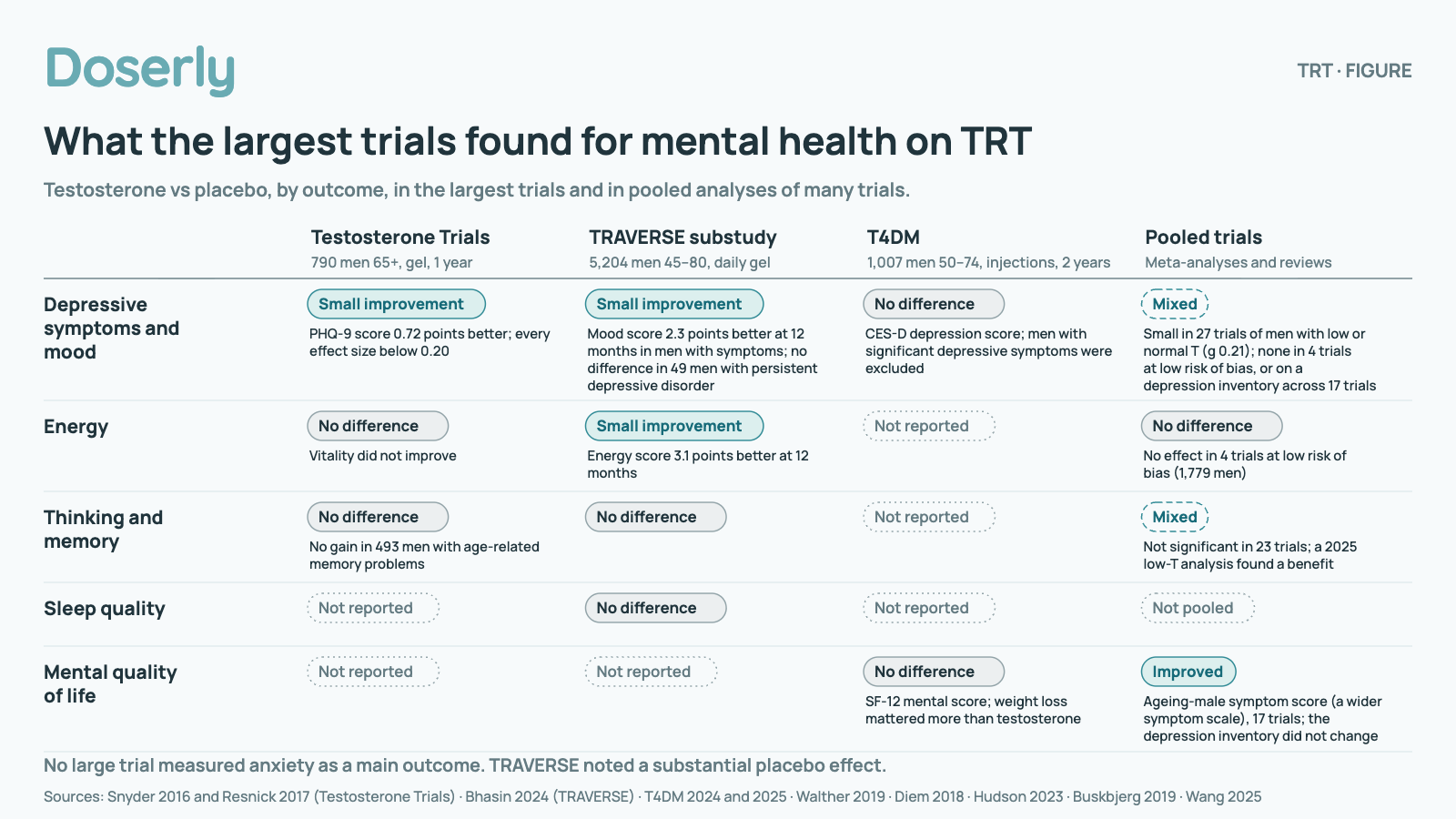
What the largest trials found for mental health on TRT
Testosterone vs placebo, by outcome, in the largest trials and in pooled analyses of many trials.
Testosterone Trials: 790 men 65+, gel, 1 year; TRAVERSE substudy: 5,204 men 45–80, daily gel; T4DM: 1,007 men 50–74, injections, 2 years; Pooled trials: Meta-analyses and reviews.
Depressive symptoms and mood
- Testosterone Trials: small improvement. PHQ-9 score 0.72 points better; every effect size below 0.20.
- TRAVERSE substudy: small improvement. Mood score 2.3 points better at 12 months in men with symptoms; no difference in 49 men with persistent depressive disorder.
- T4DM: no difference. CES-D depression score; men with significant depressive symptoms were excluded.
- Pooled trials: mixed. Small in 27 trials of men with low or normal T (g 0.21); none in 4 trials at low risk of bias, or on a depression inventory across 17 trials.
Energy
- Testosterone Trials: no difference. Vitality did not improve.
- TRAVERSE substudy: small improvement. Energy score 3.1 points better at 12 months.
- Pooled trials: no difference. No effect in 4 trials at low risk of bias (1,779 men).
- Not reported: T4DM.
Thinking and memory
- Testosterone Trials: no difference. No gain in 493 men with age-related memory problems.
- TRAVERSE substudy: no difference.
- Pooled trials: mixed. Not significant in 23 trials; a 2025 low-T analysis found a benefit.
- Not reported: T4DM.
Sleep quality
- TRAVERSE substudy: no difference.
- Not reported: Testosterone Trials, T4DM, Pooled trials (not pooled).
Mental quality of life
- T4DM: no difference. SF-12 mental score; weight loss mattered more than testosterone.
- Pooled trials: improved. Ageing-male symptom score (a wider symptom scale), 17 trials; the depression inventory did not change.
- Not reported: Testosterone Trials, TRAVERSE substudy.
No large trial measured anxiety as a main outcome. TRAVERSE noted a substantial placebo effect.
Why do guidelines disagree?
Because the trials disagree about how big the benefit is. Pooled analyses that include many small trials find a small benefit. A review commissioned by the Endocrine Society kept only 4 large trials at low risk of bias (1,779 men) and found no effect on mood or energy. In an editorial published alongside the largest meta-analysis, two researchers wrote that "we do not know whether these improvements are clinically meaningful." [3], [24], [25]
How big is a "small" effect?
The main meta-analysis reports a standardized effect size (Hedges g) of 0.21, with a likely range of 0.10 to 0.32. Researchers usually call an effect around 0.2 small. In everyday terms, the Testosterone Trials found depression questionnaire scores improved by less than 1 point more than on placebo, and every mood effect size in that trial was below 0.20. [3], [1]
How do the units work?
Mood is measured on questionnaires, not in the blood, so the numbers above are scores. Testosterone levels in the studies are reported in ng/dL (US) or nmol/L (most other countries): 1 nmol/L is about 28.8 ng/dL, so 7.7 nmol/L is about 222 ng/dL. The testosterone unit converter switches between the two, and the TRT blood work guide explains when to draw each test.
Where these numbers come from
Each guideline row comes from that body's current document: the AUA testosterone deficiency guideline (published 2018, validity reconfirmed 2024; Statements 14 and 15), the Endocrine Society guideline (2018), the EAU guidelines on sexual and reproductive health (2026 edition), the EAA functional hypogonadism guideline (2020; Recommendations 14 and 18), the ICSM 2024 recommendations (published 2025; Recommendation 14), the BSSM guidelines (2023), the CUA guideline (2021), the Society for Endocrinology guideline (2022), the VA clinical recommendations (January 2026), the Endocrine Society of Australia position statement (2016, still current) and the ACP guideline (2020, which ACP now lists as inactive). [20], [4], [5], [6], [7], [21], [15], [19], [14], [22], [23]
The effect sizes come from the 2019 JAMA Psychiatry meta-analysis of 27 randomized trials and the Testosterone Trials; the TRAVERSE figures come from its published depression substudy. [3], [1], [2]
Not used: a claim that the benefit is "comparable to an antidepressant" (no comparison trial exists, and earlier versions of this page also said the opposite), a figure of "22% less fatigue in about 800 men" that we could not trace to a study, and a statement that TRAVERSE found no aggression (the papers we reviewed do not report it).
Why might testosterone affect mood?
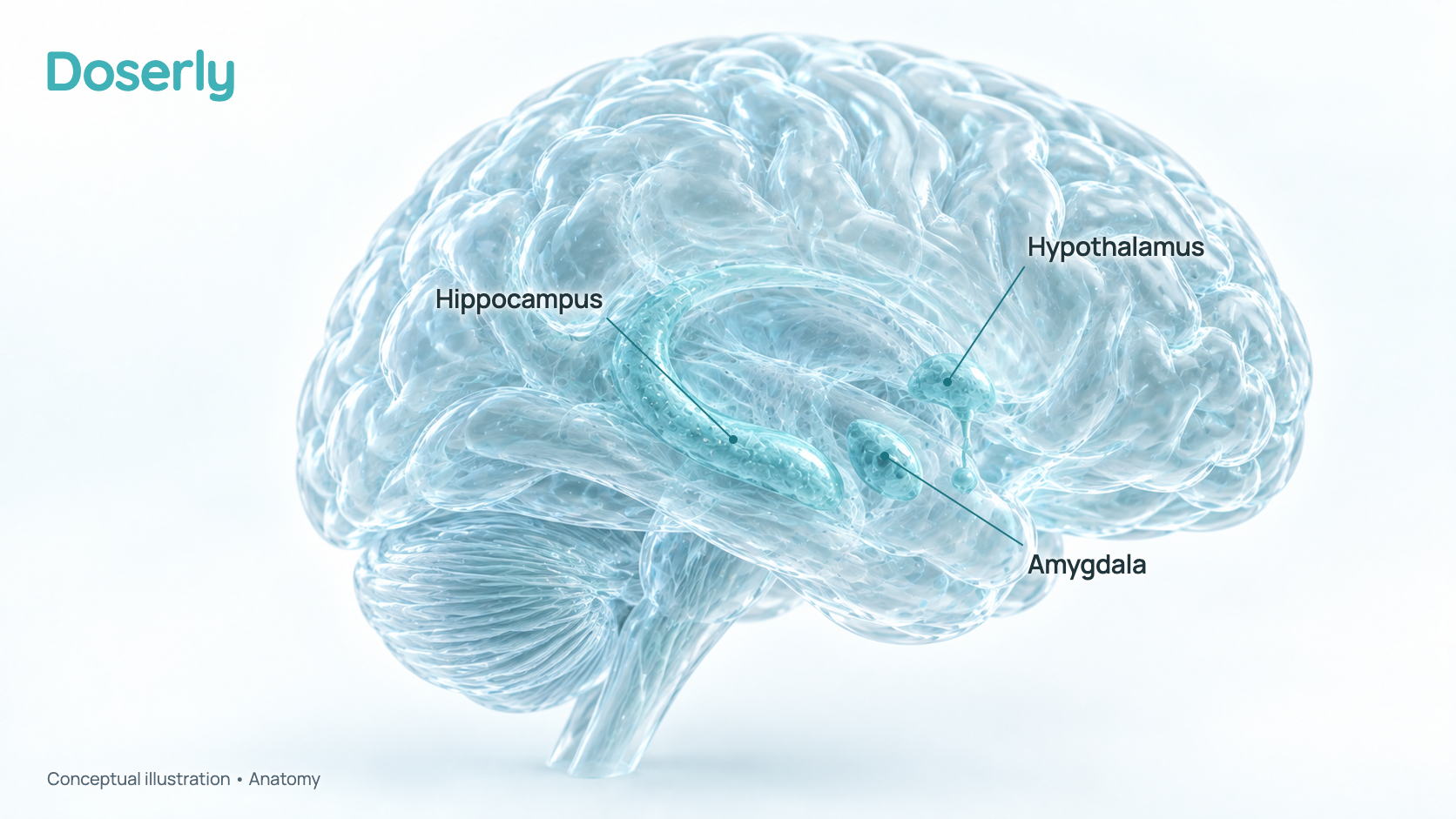
Testosterone and estradiol, the estrogen the body makes from testosterone, act on brain areas involved in mood, fear and memory. That much is established in animal and human imaging research. How those effects translate into how a man feels is much less certain, and no study has shown that fixing a lab number fixes a mood problem. [18]
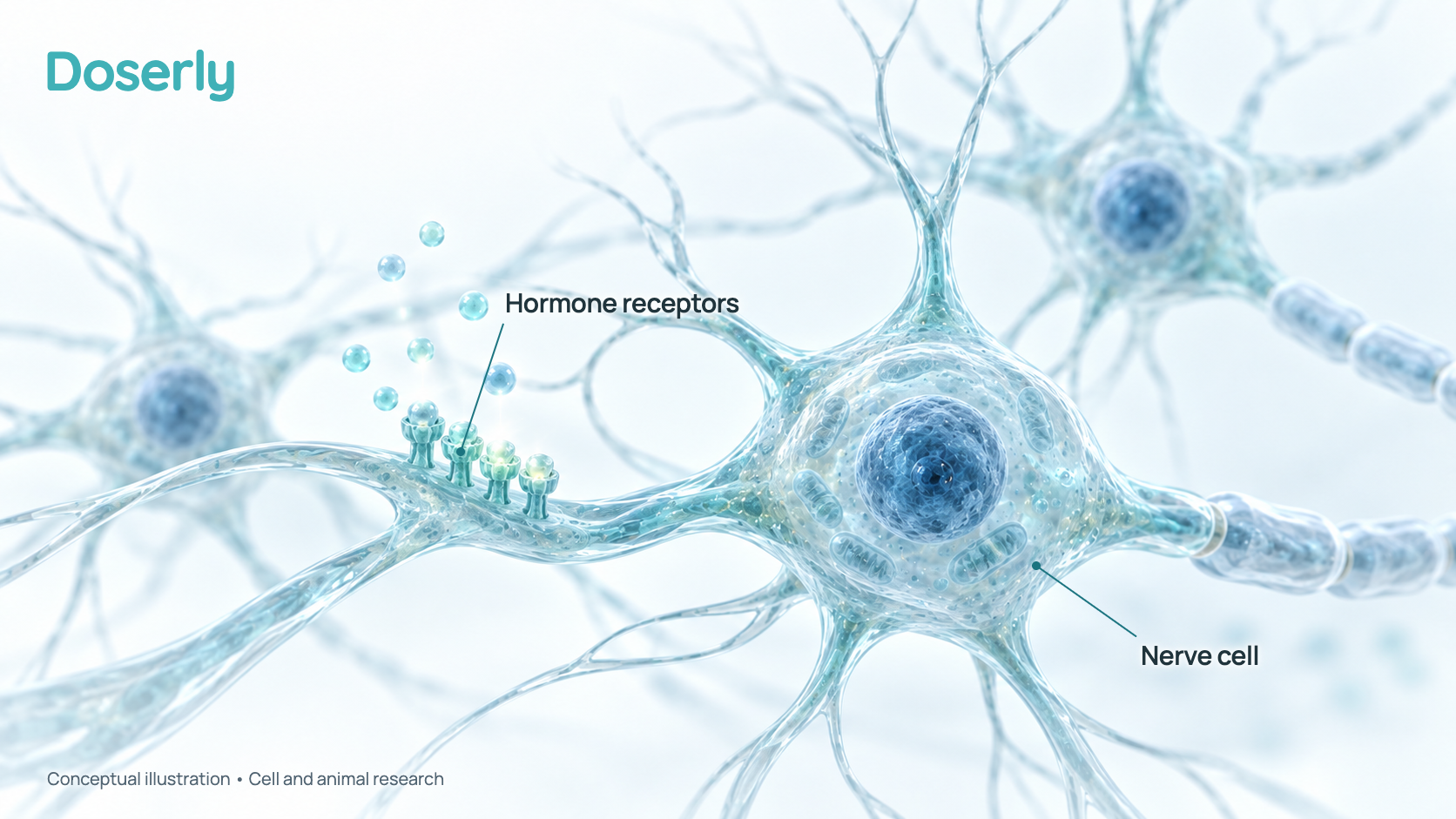
- Receptors in mood areas. Androgen receptors are found in the amygdala and nearby areas in animal studies, and testosterone and estradiol act on the hippocampus and amygdala, areas linked with mood disorders. [18]
- Conversion to estradiol in the brain. According to a 2023 review, a brain scan study in healthy people found the enzyme aromatase, which turns testosterone into estradiol, mostly in the thalamus and amygdala. In a 6-week trial in 60 healthy older men, testosterone improved verbal memory only when estradiol was allowed to rise. Blocking the conversion with anastrozole removed that gain, while spatial memory improved either way. [18], [26]
- Brain chemistry. Reviews describe testosterone influencing dopamine and serotonin signalling, mostly from animal research. These are proposed explanations, not measured effects in men on TRT. [18], [27]
Does low testosterone cause depression?
It goes with it in many studies, but not all, and cause is not proven. The studies of older men point in different directions:
| Study | Who | What it found |
|---|---|---|
| VA records (2004) | 278 men aged 45 or older, no prior depression | Depression diagnosed over 2 years in 21.7% with low testosterone vs 7.1% without (adjusted hazard ratio 4.2) [28] |
| VA records (2005) | 748 men aged 50 or older | 18.5% vs 10.4% over 2 years (hazard ratio 2.1) [29] |
| Health in Men Study, Australia (2016) | 3,179 older men followed a median of 9.4 years | Total testosterone below 6.4 nmol/L (about 185 ng/dL) linked with new depression (hazard ratio 1.86); free testosterone was not [30] |
| ASPREE, Australia and US (2025) | 4,107 men aged 70 or older, median 8.4 years | No link between testosterone and new depression, including in men with low levels [31] |
| UK Biobank (2026) | 133,733 men aged 40–70 | Both low (hazard ratio 1.48) and high (1.27) total testosterone linked with more depression; low free testosterone 1.99 [32] |
These are cohort studies: they show links, not cause. Illness, weight gain, poor sleep and inactivity can lower testosterone and mood at the same time. In 200 men referred to one clinic for borderline testosterone (200–350 ng/dL, 6.9–12 nmol/L), 56% had depression or depressive symptoms and 25% were already taking an antidepressant. [33]
Can depression or its treatment lower testosterone?
Sometimes. The Society for Endocrinology notes that serotonin-acting antidepressants and some antipsychotics can raise prolactin, a pituitary hormone, and may cause low testosterone. The Endocrine Society of Australia lists the effect of depression itself on the hormone system as an open research question. [19], [34] In a large Dutch study, men taking SSRIs had slightly higher saliva testosterone than non-users, so this is not a rule for every medicine. [35] Obesity and sleep apnea are common shared causes of low energy, low mood and low testosterone; see the obesity-related hypogonadism guide.
What does the research show?
On depressive symptoms, the evidence points to a small benefit in men with low testosterone, largest in milder, long-lasting low mood and absent in major depression. On energy, results conflict. On thinking and memory, large trials found nothing. On anxiety, there is almost no trial evidence. [3], [13], [8]
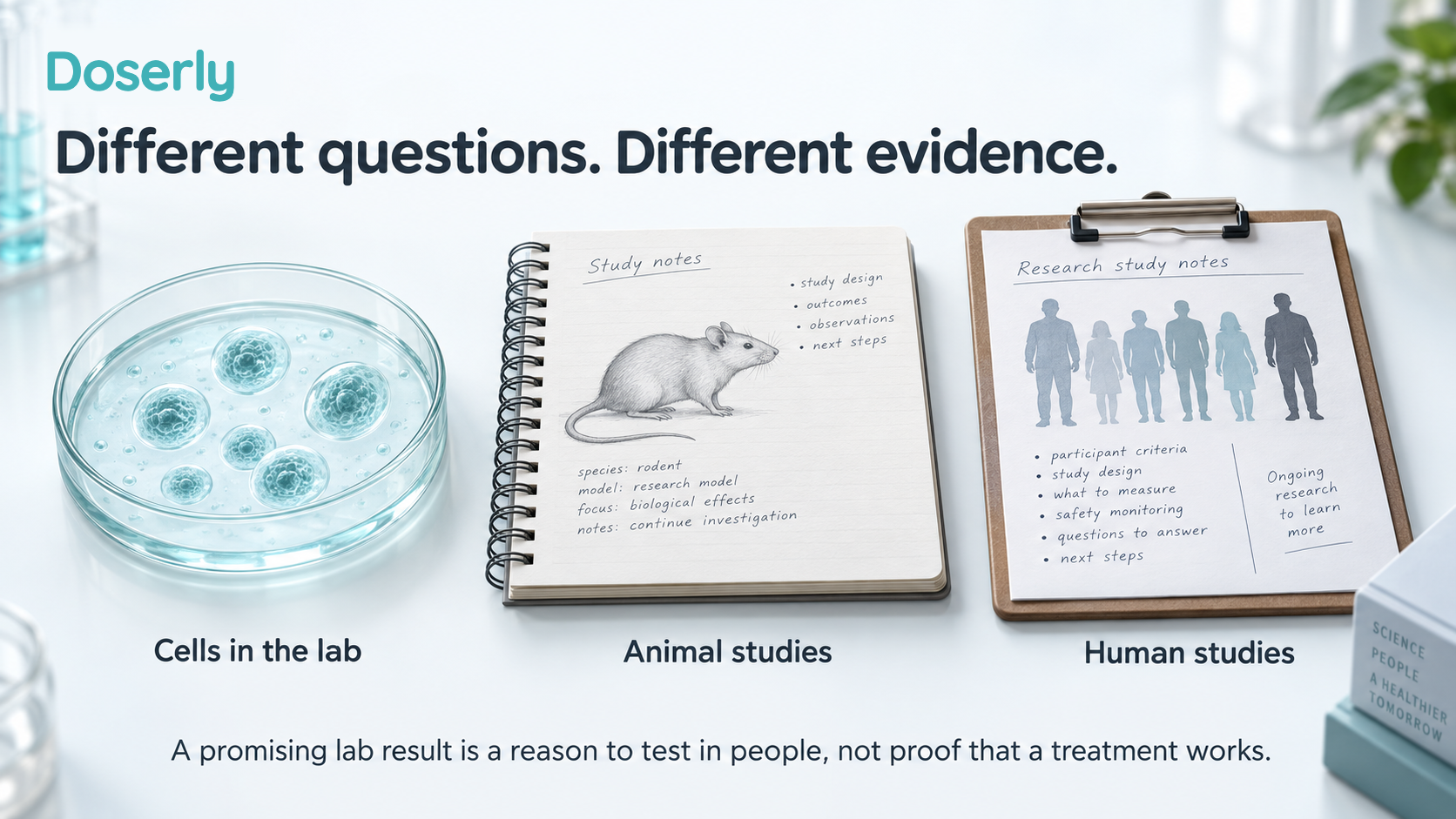
Does TRT help depression?
A little, on average, in the right men. Here is what the pooled analyses found:
| Review | What it pooled | Result |
|---|---|---|
| Walther 2019 (meta-analysis) | 27 randomized trials, 1,890 men with low or normal testosterone | Small reduction in depressive symptoms (Hedges g 0.21, range 0.10 to 0.32); twice the odds of a 50% symptom drop (odds ratio 2.30); men stopped testosterone no more often than placebo. The effect held most clearly with more than 0.5 g (500 mg) a week, a research dose far above replacement, in carefully selected samples [3] |
| Vartolomei 2020 | 15 trials, 1,586 men with late-onset low testosterone | Benefit in mild depression; no benefit in major depressive disorder [13] |
| Amanatkar 2014 | 16 trials, 944 men | Significant benefit in men with low testosterone, and in trials whose men averaged under 60; not significant in men with normal testosterone or in trials averaging over 60; larger in milder than in major depression [12] |
| Elliott 2017 (network meta-analysis) | 87 randomized trials of men with low testosterone | Small improvement in depression as a class (standardized difference −0.23); no single product showed a clear benefit on its own [36] |
| Endocrine Society review (2018) | 4 large trials at low risk of bias, 1,779 men | No effect on energy or mood [24] |
| Hudson 2023 (individual patient data) | 17 trials, 3,431 men with testosterone below 12 nmol/L (about 346 ng/dL) | Improved ageing-male symptom scores, but not the Beck Depression Inventory [37] |
The 500 mg a week in the first row is about five times the top of the Endocrine Society's weekly injection example (75–100 mg). It is a research signal, not a treatment dose, and the accompanying editorial said such doses are not recommended. [4], [25]
What did the largest trials find?
- Testosterone Trials (790 men aged 65 or older with testosterone under 275 ng/dL (about 9.5 nmol/L), 1 year of gel). Mood and depressive symptoms improved slightly: 0.72 points on the PHQ-9 depression questionnaire, with every effect size below 0.20. Energy (vitality) did not improve. [1]
- TRAVERSE (5,204 men aged 45–80 at high heart risk, daily 1.62% gel or placebo). 2,643 men (50.8%) had at least mild depressive symptoms at the start, and 9.9% had moderately severe or severe symptoms. In men with symptoms, testosterone improved a mood score by 2.3 points (range 1.0 to 3.6) and an energy score by 3.1 points (range 1.2 to 5.0) more than placebo at 12 months. Thinking and sleep quality did not differ. Only 49 men met strict criteria for late-life persistent depressive disorder (26 on testosterone, 23 on placebo), too few to show a difference. The authors noted a substantial placebo effect. [2]
- T4DM (1,007 men aged 50–74 at high risk of type 2 diabetes, testosterone undecanoate injections or placebo for 2 years, everyone in a lifestyle program). Depressive symptoms and mental quality of life did not differ from placebo; weight loss, not testosterone, went with better mental quality of life. The trial excluded men with significant depressive symptoms at the start (a score of 16 or more on the CES-D depression questionnaire), and 648 men had complete data. [38], [39]
- A 2026 review of the T Trials and TRAVERSE concluded that testosterone improves sexual function and mood, but not vitality, physical function or thinking. [40]
A controlled trial in 184 men with low testosterone and metabolic syndrome is one of the few to report a larger change. Testosterone undecanoate injections lowered a depression score by 2.5 points more than placebo at 30 weeks. The change was largest in men starting below 7.7 nmol/L (about 222 ng/dL). [41] An uncontrolled registry of 849 men on gel reported a much bigger drop (5.62 PHQ-9 points at 12 months), but without a placebo group that number includes placebo effects and time. [42]
What about trials in men with depression?
They are small, and the results split by the kind of depression:
| Trial | Who | Treatment | Result |
|---|---|---|---|
| Seidman 2001 | 30 men with major depression and testosterone at or below 350 ng/dL (12.1 nmol/L) | Enanthate injections, 6 weeks | Response 38.5% vs 41.2% on placebo: no difference [43] |
| Seidman 2009 | 23 men with dysthymia (long-lasting low-grade depression), testosterone below 350 ng/dL (12.1 nmol/L) | Cypionate injections, 6 weeks | Remission 7 of 13 (53.8%) vs 1 of 10 (10%) [44] |
| Shores 2009 | 33 men aged 50 or older, testosterone at or below 280 ng/dL (9.7 nmol/L), milder depression | Gel, 12 weeks | Remission 52.9% vs 18.8%; no difference after both groups took testosterone openly [45] |
| Pope 2003 | 22 men with depression not helped by antidepressants, low testosterone | Gel added to the antidepressant, 8 weeks | Better on a clinician-rated scale, not on a self-rated one [46] |
| Pope 2010 | 100 men with major depression partly helped by a serotonin-acting antidepressant | Gel added, 6 weeks | No difference (−0.4 points, range −2.6 to 1.8); "not generally effective" [47] |
| Seidman 2005 | 26 men on an SSRI, mostly normal testosterone | Injections added, 6 weeks | Response 53.8% vs 23.1%, not statistically significant [48] |
| Orengo 2005 | 18 men over 50 on antidepressants | Gel, crossover | No difference [49] |
The pattern: small positive trials in milder, longer-lasting depression that starts later in life, alongside low testosterone. There was no benefit in major depression, including the largest add-on trial. The Endocrine Society puts it the same way. [4], [13] (The doses in these trials are study regimens, not treatment advice; see the TRT dosage guide for labeled doses.)
Does TRT help energy?
The large trials disagree. TRAVERSE found a small energy improvement, the Testosterone Trials found none in vitality, and the Endocrine Society's commissioned review found no effect on energy. The AUA calls the evidence on energy and fatigue inconclusive. [2], [1], [24], [20]
Does TRT help brain fog, memory or thinking?
Not in the large trials. In the Testosterone Trials, a year of gel did not improve memory or other thinking skills in 493 men with age-related memory problems. In TEAAM, 3 years of gel in 308 men aged 60 or older changed no area of thinking. In a Dutch trial of 237 older men with low-normal levels, 6 months of oral testosterone undecanoate did not change thinking either. [8], [50], [51]
Most pooled analyses agree. Across 23 randomized trials, none in men with diagnosed low testosterone, the overall effect on thinking was tiny and not significant (Hedges g 0.09). A review of 14 trials in healthy older men found only a small gain in executive function (planning and switching tasks). [52], [53] The EAU cites a meta-analysis of 17 studies (1,438 men) with no effect on any area of thinking. The EAU, the EAA and the ACP all advise against testosterone to improve thinking. [5], [6], [23]
Tiny trials in men with early memory loss or Alzheimer's disease are mixed. Six weeks of injections improved spatial memory in 32 men, and 6 months improved one verbal memory test in 22 men. In 38 men, 24 weeks of gel made no difference. [54], [55], [56]
One analysis points the other way. A 2025 meta-analysis of 14 studies in men with low testosterone reported a benefit between small and medium (standardized difference 0.45). It found signs of publication bias, but the benefit held after the authors adjusted for it. They called the effects modest, and the studies measured thinking in different ways. [57] A Korean study often cited for memory gains was not randomized: its comparison group received lifestyle advice only. Overall scores on a dementia screening test did not rise significantly in either group. [58] The Endocrine Society notes there are no studies of testosterone's effect on progression from mild memory problems to dementia. [4]
Some men do report feeling sharper (see what people report), but the large trials did not find it.
Does TRT help anxiety?
Nobody knows. We found no randomized trial with anxiety as its main outcome. [27]
- In a single-blind trial of 160 Chinese men with late-onset low testosterone, anxiety scores fell from 3.47 to 1.72 over 6 months on oral testosterone undecanoate. Scores did not change significantly on vitamin capsules, but the paper does not report a direct comparison between the groups. [59]
- In a German population study of 993 men followed for 10 years, testosterone did not predict new anxiety disorders. [60]
- In UK Biobank, 3,398 men developed anxiety during follow-up; the published summary gives risks for depression, not anxiety. [32]
Product labels list anxiety as a reported reaction (see Is TRT safe?).
Does TRT cause aggression or "roid rage"?
Rarely at replacement doses. Product labels list anger or aggression in about 1% to 3% of men in their trials. Experiments that gave men testosterone found no clear causal effect on aggression (correlation 0.046, not significant). [9], [61], [62]
- Above-replacement doses in men with normal levels. Thirty men with normal testosterone were randomly given 200 mg of enanthate or salt-water injections weekly for 8 weeks. That dose is about twice the top of the Endocrine Society's weekly example. Aggression and mood did not change on testosterone. In 8 men with low testosterone, treatment every two weeks (without a placebo group) came with less tension, anger and fatigue. [63], [4]
- One standard injection in men with normal levels. In 28 young men who already had normal testosterone, one 1,000 mg undecanoate injection (the usual Nebido dose) raised anger-hostility scores at week 2 (7.48 to 10.71). It did not increase aggressive behavior. [64], [65]
- Doses far above replacement. Of 50 healthy men given up to 600 mg of cypionate a week (about six times the top of the Endocrine Society's weekly example), 84% had minimal mental effects. Another 12% became mildly hypomanic and 4% markedly so. In another trial, 600 mg of enanthate weekly for 10 weeks did not change anger scores. [66], [67], [4]
- Anabolic steroids. Across 12 trials in healthy men, anabolic steroids raised self-reported aggression slightly (Hedges g 0.171), but not aggression rated by observers. [68]
High-dose use belongs to a different world from TRT; see TRT vs steroids.
How long does TRT take to affect mood?
Weeks for any change, months for the full effect. A literature review found effects on depressive mood detectable after 3 to 6 weeks, with a maximum after 18 to 30 weeks. The Society for Endocrinology says sexual interest, depressive symptoms and energy can change within 3 to 6 weeks. In a 180-day gel study without a placebo group, mood improved most by day 30 with no further gain. [69], [19], [70]
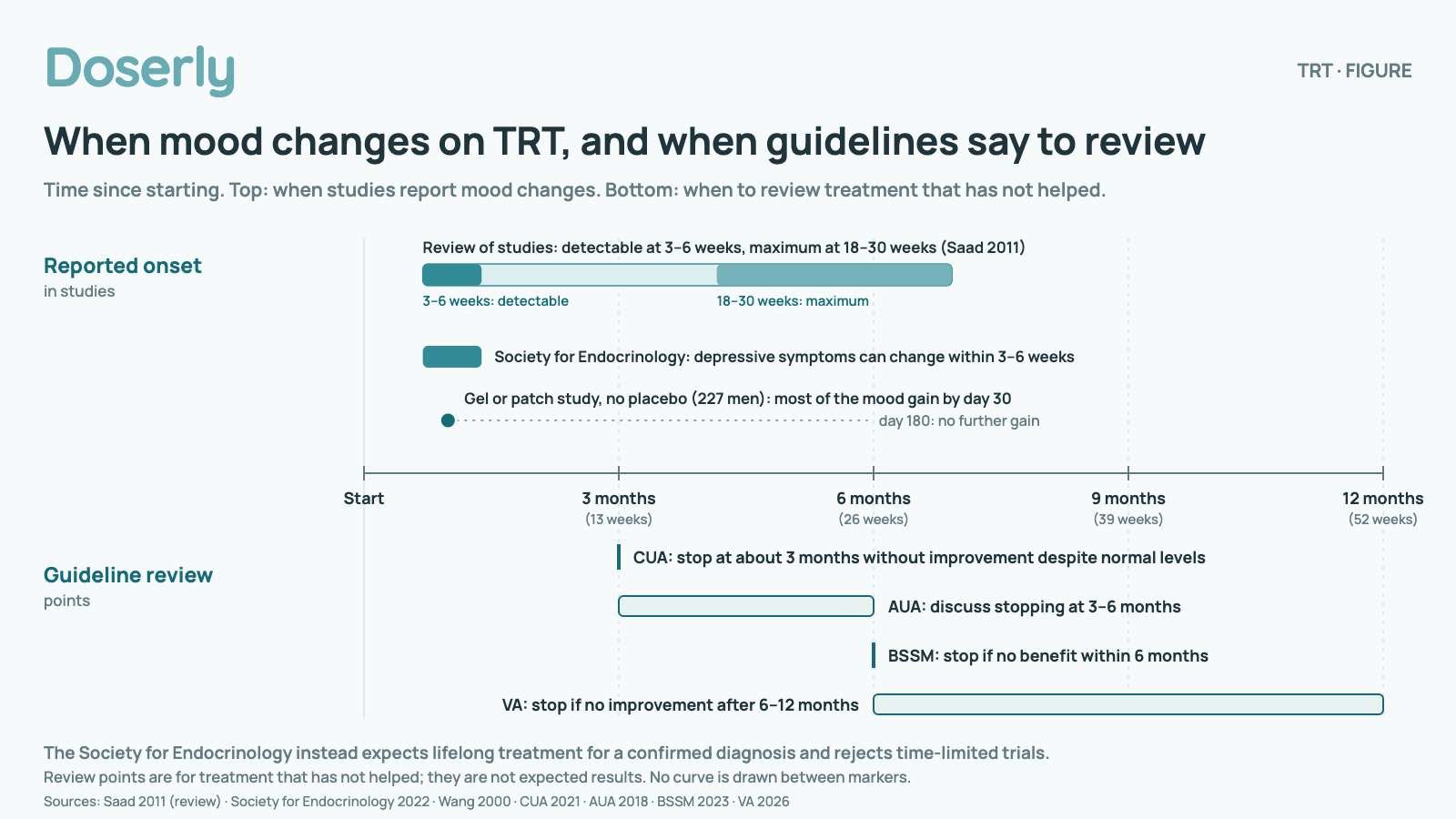
When mood changes on TRT, and when guidelines say to review
When studies report mood changes
- 3–6 weeks
Review of studies (Saad 2011): mood changes become detectable. The Society for Endocrinology also says depressive symptoms can change within 3–6 weeks.
- About day 30
Gel or patch study without placebo (227 men): most of the mood gain had happened; there was no further gain by day 180.
- 18–30 weeks
Review of studies (Saad 2011): the maximum effect on mood.
When guidelines say to review treatment that has not helped
- About 3 months
CUA: stop if there is no improvement despite normal levels.
- 3–6 months
AUA: discuss stopping if levels are normal but symptoms have not improved.
- 6 months
BSSM: stop if there is no benefit.
- 6–12 months
VA: stop if symptoms have not improved despite in-range testosterone.
The Society for Endocrinology instead expects lifelong treatment for a confirmed diagnosis and rejects time-limited trials. Review points are for treatment that has not helped; they are not expected results. No curve is drawn between markers.
Is TRT safe for your mental health?
For most men, yes, but not for every man. Two US labels carry a warning about depression and suicide, some men feel more anxious or irritable, and a large records study linked testosterone use with more depression diagnoses, without proving cause. Men with a history of depression, anxiety or suicidal thoughts should raise it with their prescriber before starting. [10], [11], [71], [72]
What do the product labels say about mood?
Checked September 2026.
| Product (label date) | What it reports |
|---|---|
| Xyosted (US, 2025) | Warning 5.15, Risk of Depression and Suicide. In two year-long trials (283 men), 2 had depression requiring them to stop and 2 others attempted suicide (one completed): 4 men, 1.4%. The label tells patients and caregivers to seek care for suicidal thoughts, new or worse depression, anxiety or other mood changes [10] |
| Jatenzo (US, 2025) | Warning 5.15. 2 of 166 men (1.2%) reported new or worse depression; 1 of 569 men (0.2%) in the trials had suicidal thoughts [11] |
| AndroGel 1.62% (US) | Emotional lability (mood swings, affective disorder, impatience, anger and aggression) in 6 of 234 men (2.6%) vs none of 40 on placebo over 182 days; anxiety, depression, hostility and nervousness reported after marketing [9] |
| Aveed (US, 2025) | In an 84-week study of 153 men: irritability 2%, insomnia 2%, mood swings 2%, aggression 1.3% [61] |
| Kyzatrex (US) | Anxiety among the reactions in a 12-month open study of 212 men [73] |
| Depo-Testosterone (US) | Anxiety and depression listed among nervous system reactions [74] |
| Nebido (UK) | Depression, emotional disorder, insomnia, restlessness, aggression and irritability are uncommon (between 1 in 1,000 and 1 in 100 people); irritability and nervousness may signal too much testosterone and a need to adjust the dose [65] |
| Testogel 16.2 mg/g (UK) | Mood disorders and emotional symptoms (mood swings, anger, aggression, impatience, insomnia) listed [75] |
Most of these numbers come from single-arm studies or small placebo groups, so they cannot say how many of the reactions testosterone caused. The Tlando, Xyosted and Jatenzo Medication Guides ask patients to tell their prescriber about any history of depression, anxiety, mood disorder or suicidal thoughts. [72], [10], [11]
Is the depression warning specific to Xyosted and Jatenzo?
Probably not. FDA first refused to approve Xyosted in October 2017, citing blood pressure and the depression and suicide cases. In its later review, FDA found each case had other possible explanations. It concluded that the data did not show a higher risk "as compared to other TRT products" and approved Xyosted in 2018 with the warning. In the Jatenzo program, 4 of the 6 men with depression reported as a side effect had depression before the trial. [76], [77]
What did the records study show?
In US health records, 263,579 men who used testosterone were compared with 17,838,316 who did not. Testosterone use went with about twice the odds of a new major depression diagnosis (odds ratio 1.99). It also went with higher odds of a suicide attempt or self-harm (1.52), and both links held in men with low testosterone. The published summary does not give absolute rates. [71]
The authors list the limits: possible coding errors, no information on whether men took their treatment, possible unrecorded steroid use in the comparison group, and no data on stopping testosterone. The groups were matched on age, race, ethnicity, obesity and alcohol problems; the published summary lists no matching on past mental health. It shows a link, not cause, and it conflicts with the placebo-controlled trials above. [71]
What happens with doses far above replacement?
The risks change. US labels warn that abuse of testosterone at doses above treatment levels has been linked with major depression, mania, psychosis, hostility and aggression. Withdrawal after such use can bring depressed mood, major depression, irritability and insomnia for weeks or months. Dependence has not been documented at approved doses for approved uses. All US testosterone labels have carried this abuse and dependence warning since 2016. [74], [78]
In 24 former long-term anabolic steroid users, 7 (29%) had a major depressive episode while coming off. The Endocrine Society notes that withdrawal after long, high-dose steroid use can bring depressed mood, sometimes clinical depression and even suicidal thoughts or behavior. [79], [4]
Is TRT safe overall?
For heart safety, the largest trial is reassuring on heart attacks and strokes but not on everything. In TRAVERSE, heart attack, stroke or cardiovascular death occurred in 182 of 2,596 men on testosterone gel (7.0%) and 190 of 2,602 on placebo (7.3%) (hazard ratio 0.96). That met the trial's safety margin, so a large rise in risk was ruled out. In the same two groups of about 2,600 men, some problems were more common on testosterone: atrial fibrillation 3.5% vs 2.4%, acute kidney injury 2.3% vs 1.5%, and pulmonary embolism 0.9% vs 0.5%. Clinical fractures occurred in 91 of 2,601 men (3.50%) vs 64 of 2,603 (2.46%). The trial tested only a daily gel. Men used it for an average of 21.7 months, about 61% stopped their study gel early, and it enrolled men at high heart risk. [80], [81], [82] The TRT and heart health guide and the side effects guide cover the rest.
Who should be especially cautious?
- Men with current depression, bipolar disorder or past suicidal thoughts. Guidelines put standard depression treatment first, and the Xyosted, Jatenzo and Tlando Medication Guides ask you to tell your prescriber about this history. No guideline we reviewed gives specific advice for bipolar disorder. [5], [6], [72]
- Men with anxiety or panic disorders. Anxiety has almost no trial data, labels list it as a reaction, and many of the harder community accounts come from men with long-standing anxiety (see what people report). [27], [73]
- Men with normal testosterone hoping for a mood boost. The EAU says not to use testosterone in men with normal levels, and the benefit in trials was not significant in them. [5], [12]
- Men with untreated severe sleep apnea. The Endocrine Society lists it as a reason not to start, and poor sleep can drive low mood by itself. [4]
- Men coming off anabolic steroids, because of withdrawal depression (see above). [79]
- Drug-tested athletes. Testosterone is prohibited in sport at all times. [17]
- Under-18s. Testosterone for teenagers belongs only in specialist care, and low mood in a teenager needs its own assessment.
- Women. This guide is written for men. Testosterone for women uses different doses and products; see testosterone therapy for women.
If you have thoughts of suicide or self-harm, or your mood drops sharply, contact your prescriber or emergency services right away. The Xyosted label tells patients and caregivers to seek care for these changes. [10]
Which medicines interact with testosterone?
The US labels list interactions with insulin and other diabetes medicines, warfarin-type blood thinners and corticosteroids (more fluid retention). Xyosted and the oral undecanoate labels (Jatenzo, Kyzatrex and Tlando) also list other medicines that raise blood pressure. No antidepressant is listed. [10], [11], [73], [72]
- Antidepressants. Adding testosterone gel to serotonin-acting antidepressants improved sexual function in a 6-week trial of 100 depressed men (erectile function score 16.8 points higher than placebo). Its effect on depression itself was mixed across trials. [83], [47] In a small pilot, fluoxetine did not change testosterone levels. [84] Never stop an antidepressant without your prescriber: see Can I take TRT with an antidepressant?.
- Aromatase inhibitors (such as anastrozole). They lower estradiol, and no trial shows that lowering estradiol improves mood on TRT (see estradiol). See the anastrozole guide.
- Finasteride and dutasteride (hair loss and prostate medicines). The Society for Endocrinology describes self-reported depression and anxiety with finasteride that can persist after stopping, though the long-term impact is unclear. [19]
- Opioid painkillers lower the body's own testosterone; see the low testosterone guide. [4]
Bring a complete list of what you take, including supplements, to a pharmacist or prescriber. Checked September 2026.
Is testosterone legal, and is it allowed in sport?
Checked September 2026. Rules differ by country and change often.
- United States. Testosterone and its esters are Schedule III controlled substances, prescription only, and no proposal to change that has been published. In June 2026, HHS announced that FDA had requested label changes, including removing the limitation on age-related low testosterone; these are requested, not yet in any label. [16], [85]
- United Kingdom. Testosterone is a Class C controlled drug, in Schedule 4 Part II of the Misuse of Drugs Regulations. [86]
- Canada. Testosterone is a Schedule IV controlled substance. [87]
- Australia. Testosterone is a Schedule 4 prescription-only medicine. [88]
- Sport. The World Anti-Doping Agency (WADA) prohibits testosterone at all times, and its 2027 list, published in September 2026, keeps the ban. [17], [89]
What do guidelines say to do about mood symptoms?
Confirm the diagnosis, treat depression in its own right, give testosterone time, and stop it if nothing improves. This section describes the choices clinicians weigh; it is not a personal plan. [4], [6], [15]
| Choice | Which guidelines name it | What the evidence shows |
|---|---|---|
| Confirm low testosterone with repeat morning tests before blaming it | Endocrine Society, AUA, CUA | Over 20% of US men with depression or anxiety who started TRT had no testosterone test first [90] |
| Look for depression, sleep apnea and other illnesses first | CUA, VA, Endocrine Society of Australia | Obesity, sleep apnea and depression share symptoms with low testosterone [15], [14], [22] |
| Treat depression with standard care | EAU (strong), EAA (antidepressants, cognitive behavioural therapy, psychiatric help), ICSM | Testosterone did not help major depression in trials [43], [47] |
| Do not treat men with normal testosterone | EAU | Benefit not significant in men with normal levels [12] |
| Adjust the dose for irritability or nervousness | UK labels | Named as signs of too much testosterone [65] |
| Keep a symptoms diary and review it with the blood results | Society for Endocrinology | Mood swings, irritability and depression also occur when treatment is too low [19] |
| Stop if nothing improves | CUA (about 3 months), AUA (3–6 months), BSSM (6 months), VA (6–12 months) | The Society for Endocrinology instead expects lifelong treatment for a confirmed diagnosis [19] |
[4], [20], [15], [14], [22], [5], [6], [7], [21]
Do peaks and troughs between injections affect mood?
Guidelines say they can. The Endocrine Society lists fluctuation in mood or libido as a side effect of injections. The Society for Endocrinology says levels that rise after an injection and dip before the next can bring mood swings and changes in energy and sex drive, more with short-acting injections. The EAA says older injections cause wide swings that patients often report as unpleasant mood and energy changes, and the Endocrine Society of Australia links mood swings to stop-start treatment or fluctuating levels. [4], [19], [6], [34]
What no one has tested is whether splitting the same weekly dose into more injections improves mood. We found no randomized trial of injection frequency and mood, and community accounts go both ways (see what people report). The testosterone level visualizer shows how frequency changes the shape of the curve, and the TRT dosage guide covers frequency choices.
Anxiety, antidepressants and estradiol: practical questions
Can TRT cause anxiety or panic attacks?
It can in some men. Labels list anxiety and nervousness, and UK labels treat nervousness and irritability as possible signs of too much testosterone. [9], [73], [65] Many community accounts describe anxiety starting in the first weeks, after a dose increase, or around injections. It often affects men who had anxiety before TRT, and it sometimes settles on its own (see what people report). There are no trial numbers for how often this happens.
Caffeine, poor sleep, new medicines and the stress of starting treatment often change at the same time. Racing heart, chest pain or breathlessness need a medical check, not an assumption that it is anxiety.
Can I take TRT with an SSRI or another antidepressant?
Yes, in general: no US testosterone label lists an antidepressant interaction, and several trials gave testosterone to men already taking antidepressants. [10], [46], [47] Testosterone did not reliably improve depression as an add-on, but it did improve sexual function in one trial, which matters because antidepressants often dampen it. [47], [83]
Do not stop or taper an antidepressant because you have started TRT; that is a decision to make with the prescriber who manages your mood, with a plan for what to watch.
Is estradiol to blame for my mood?
Maybe, but no trial has shown it. We found no trial in men on TRT that tested an estradiol target for mood. The evidence available:
- In obese men with low testosterone, the aromatase inhibitor letrozole halved estradiol (119 to 59 pmol/L, about 32 to 16 pg/mL) and more than doubled testosterone over 6 months with no psychological effect. [91]
- In older men, verbal memory improved on testosterone only when estradiol could rise. [26]
- In the 3-year TEAAM trial, changes in thinking were not related to changes in estradiol. [50]
- No guideline we reviewed sets an estradiol target for mood, and the AUA suggests measuring estradiol before treatment only in men with breast symptoms; see the estrogen on TRT guide. [20]
Community accounts blame both high and low estradiol, often after an aromatase inhibitor, and several men felt worse after taking one (see what people report).
Will TRT fix my depression?
Not if it is major depression, according to every guideline and the trials in men with major depression. [4], [5], [43] If your testosterone is confirmed low and your low mood is milder and long-lasting, testosterone may help a little, alongside, not instead of, standard care. [13], [6] The EAA places more value on antidepressants, cognitive behavioural therapy and psychiatric consultation. In T4DM, weight loss was linked with more gains in mental quality of life than testosterone was. [6], [39] The increase testosterone naturally guide covers sleep, weight and other factors.
Can I get TRT for depression if my testosterone is normal?
Guidelines say no. The EAU says not to use testosterone in men with normal levels, and in the meta-analysis of 16 trials the mood benefit was not significant in men with normal testosterone. [5], [12] The Endocrine Society recommends against screening the general population for low testosterone, and the CUA says to rule out depression when testosterone is normal. [4], [15]
What happens to mood when you stop TRT?
It has hardly been studied in men with true low testosterone. In 25 Japanese men who had benefited from treatment, symptom scores stayed improved 3 months after stopping even though testosterone fell back, and a depression score change was not significant. In a tiny study of men with depression, 3 of 4 began to relapse when testosterone was swapped for placebo. [92], [93]
T4DM gave 2 years of long-acting injections to men who did not have true low testosterone. After they stopped, the pituitary signals that drive the body's own testosterone recovered slowly over 12 months, and full recovery can take more than a year. Symptom scores in those men did not differ from placebo after 18 weeks. [94] After T4DM ended, more former testosterone users than placebo users restarted testosterone (6% vs 2.8%). [95] After high-dose steroid use, withdrawal depression is common (see risks). The stopping TRT guide covers the full picture.
Does TRT help sleep?
Not in TRAVERSE, where sleep quality did not improve. [2] Testosterone can worsen breathing at night in men with severe sleep apnea, at least for the first weeks. In a trial of 67 obese men with severe sleep apnea, undecanoate injections increased oxygen drops at 7 weeks but not at 18. [96] In the same trial, thinking and sleep-related quality of life did not change. [97] Poor sleep itself worsens mood and anxiety, so it is worth tracking; see the side effects guide.
What do people on TRT report about their mental health?
Public forums are full of men who started TRT hoping it would lift their mood, and of men who felt more anxious, irritable or flat instead. The threads below are recent public Reddit discussions, read with their replies; they show what people experience, not how often it happens.
What do positive reports look like?
Clearer thinking and more drive, usually described in the first months. A man in his late 20s said three months of treatment ended his brain fog and fatigue and made him more assertive at work and in dating, while calling it his "honeymoon phase". Replies ranged from benefits lasting years to benefits that faded to "normal". [98] Another man, six months in after a total testosterone in the low 200s ng/dL (about 7 nmol/L), described losing his afternoon mental slump at work. [99] A man in his 40s on an SSRI for panic disorder got his sex drive back on injections every other week and said his mood stayed steady through each two-week cycle. [100]
What does early anxiety look like?
Often sudden, and sometimes temporary. A man in his 40s whose level before treatment was 537 ng/dL (18.6 nmol/L) felt "like I'm drinking coffee or energy drinks all day long" after three injections. He needed an anti-anxiety medicine to get through work and decided he should probably stop. [101] Another felt anxious and low in week two and said the anxiety had gone before he lowered his dose. [102] A man in his 50s with a level of 148 ng/dL (5.1 nmol/L) described "menopause"-like surges, anxiety, hot flashes and fog two days after his first injection. He was on one injection every two weeks. [103]
One man's 17-day trial brought strong focus and confidence along with anxiety spikes and trouble relaxing; four weeks after stopping, the anxiety was gone and the brain fog was back. [104] A man of 50 with lifelong anxiety developed daily panic attacks over nine weeks at 100 mg a week, with a total testosterone of 538 ng/dL (18.7 nmol/L) on treatment. He started seeing a psychologist, which he said helped. [105]
What happened after dose changes?
One man said 120 mg a week pushed his total testosterone to about 1,500 ng/dL (52 nmol/L) and left him tense and unable to sleep. At 85 mg he felt better, and at 70 mg the wound-up feeling was gone but he felt "mentally flat". [106] After years on 120 mg a week, another man's anxiety "went through the roof" within a week of moving to 140 mg and eased when he went back. His testosterone came from outside a pharmacy, so its strength was uncertain. [107]
The opposite also appears. A man with past episodes of depression felt much better on 160 mg a week split into two injections. His mood dropped about 18 days after his prescriber lowered it to 140 mg because estradiol was high. [108]
Does injection timing matter?
Accounts point both ways. One man developed panic attacks and high blood pressure about two weeks after moving from two to three injections a week (he had also added other substances). He felt well within two weeks of going back to two. [109] A man on TRT for over ten years felt calmer after switching from twice-weekly to once-weekly injections. [110] Others describe the reverse pattern. One man's mood dropped three to four days after each weekly injection. Another had anxiety a day or so after every injection on a twice-weekly schedule, a pattern he had also had on hCG. [111], [112]
What about estradiol and aromatase inhibitors?
These threads often involve an aromatase inhibitor. The man with weekly mood drops had an estradiol of 5 pg/mL (about 18 pmol/L) on anastrozole; after his urologist stopped it, the drops were milder but still came back. [111] Another man felt his mental health "crashed" soon after starting anastrozole as his estradiol fell. He later had a breakdown with intrusive and suicidal thoughts that kept him off work for two months, despite stopping it and starting an SSRI. [113] A third developed all-day panic four days after a single anastrozole dose, alongside a recent surgery and blood clot, a lower testosterone dose and suddenly quitting heavy coffee. [114]
Irritability and anger
A man of 58 said injections restored the energy that a year of gel had not. About a month in, he felt "really angry and agitated" and snapped at his wife; hard physical work helped. [115] Another felt "amazing" for four weeks after raising his dose and cutting his aromatase inhibitor, then became irritable over small things. [116]
What if nothing changes, or the lift fades?
A man on daily injections for 11 months, with a testosterone level above his lab's range, felt his motivation and enjoyment fade over two to three months. [117] Another, on the same regimen for years, described months of good mood alternating with months of low mood and little pleasure, and was checking his thyroid and other blood tests. [118] A man who lost over 50 pounds on weight-loss medicines felt emotionally flat despite good physical sexual function, and suspected the other medicines rather than testosterone. [119]
Antidepressants and stopping
Men asking whether TRT would let them stop an antidepressant got mixed answers. Some had tapered off after starting TRT, and one described withdrawal "brain zaps" when stopping too fast. One man four years into TRT did not see himself stopping his. [120] A man who had been stable on TRT for months developed panic after a corticosteroid nasal spray, with anxiety coming in waves weeks after stopping it. [121]
Stopping can be hard too. A man who quit 250 mg a week abruptly (more than twice the top of the Endocrine Society's weekly example) developed disabling anxiety over the next two months. He later said he was doing better after starting a testosterone cream. [122] A man in his 20s who stopped after his blood pressure rose described "crippling" anxiety in week three of a recovery treatment. [123]
Are serious problems reported?
Yes, and they need prompt care. The man with suicidal and intrusive thoughts was on short-term disability. [113] Another man, who had started testosterone through an online service without a blood test, developed palpitations and a calf cramp two weeks in, and his doctor advised him to stop. [124] Selected accounts cannot show how often these things happen or what caused them.
How can you judge a mood story?
Ask: Was low testosterone confirmed with repeat morning tests before treatment? Did the man have anxiety or depression before TRT? What else changed at the same time, such as a new medicine, an aromatase inhibitor, caffeine, sleep, weight or life stress? Where was his testosterone level, and when was it drawn? Did the change last, or settle in a few weeks? And did he get help for the mood itself?
These selected discussions show what people experience and the questions research has not answered. They are not a survey of all men on TRT, a success rate or a substitute for the studies above.
What should you track?
How you feel, how you sleep, and what changed, alongside your testosterone results. The Society for Endocrinology recommends a symptoms diary checked against blood results, and the Xyosted label asks patients to report new or worse depression, anxiety or other mood changes. Use this summary to prepare questions for your prescriber; it is not a personal testing plan. [19], [10]
| Why it matters | What guidelines and labels say | Tracking category |
|---|---|---|
| Mood and depressive symptoms | Before starting and at each review; stop or rethink if no benefit after 3–12 months, depending on the guideline (see what guidelines do) | Mood & Wellbeing |
| Anxiety, irritability and nervousness | UK labels: may signal too much testosterone | Anxiety; Emotional Regulation |
| Sleep | Untreated severe sleep apnea is a reason not to start; TRAVERSE found no sleep benefit | Sleep Quality |
| Energy, motivation and focus | Inconsistent trial results for energy; no benefit for thinking in trials | Energy Levels; Motivation & Drive; Focus & Mental Clarity |
| Testosterone level | Endocrine Society: at 3–6 months, at 12 months, then yearly, drawn at the time your product needs | Blood work |
| Every dose, dose change and new medicine | Mood changes are hard to read without dates | Other |
Trials measured mood with repeated questionnaires and still found large placebo effects, so one good or bad week says little. [1], [2] A dated record of how you feel, what you took and what else changed makes a treatment effect easier to tell from a coincidence. The TRT blood work guide covers when to draw each test.
Common questions about TRT and mental health
Can low testosterone cause depression?
It is linked with depression in several studies, but cause is not proven. In US veterans, men with low testosterone were diagnosed with depression 2 to 4 times as often over 2 years. A study of 4,107 men aged 70 or older found no link at all. Depression, weight gain and poor sleep can also lower testosterone. [28], [31], [19] See does low testosterone cause depression?
Does TRT help with anxiety?
There is no good evidence either way. No randomized trial has tested anxiety as its main outcome, one single-blind trial reported lower anxiety scores on oral testosterone, and labels list anxiety as a possible reaction. Some men report feeling calmer and others more anxious. [27], [59], [73] See anxiety and panic.
How long does it take for TRT to improve mood?
Usually 3 to 6 weeks for a first change, with the full effect by about 18 to 30 weeks, according to a literature review; the Society for Endocrinology also gives 3 to 6 weeks. If nothing has improved after 3 to 12 months, depending on the guideline, it is time to review the treatment with your prescriber. [69], [19], [15], [14] See the timeline.
Can TRT make depression worse?
In some men it may. Two US labels warn about depression and suicide, and a records study linked testosterone use with more depression diagnoses, although placebo-controlled trials show a small average improvement. Report any new or worse low mood to your prescriber promptly. [10], [11], [71], [3] See is TRT safe for your mental health?
Does TRT help brain fog?
Not in the large trials. The Testosterone Trials and the 3-year TEAAM trial found no improvement in memory or thinking, and guidelines advise against using testosterone to improve thinking. Brain fog often has other causes, such as poor sleep, low mood or other medicines. [8], [50], [5] See brain fog and memory.
Should I stop my antidepressant when I start TRT?
No, not without your prescriber. Testosterone has not been shown to replace antidepressants, it did not help major depression as an add-on, and guidelines put standard depression treatment first. [47], [6] See TRT with an antidepressant.
Glossary
Plain explanations of the medical, mental health and research terms used in this guide. Underlined terms in the text link here.
- Anabolic steroids
- Testosterone and related drugs used at doses far above replacement, usually to build muscle. Their risks, including withdrawal depression, differ from those of prescribed replacement.
- Antidepressant
- A medicine used to treat depression and often anxiety. Most common ones act on serotonin; they are started, changed and stopped with a prescriber.
- Aromatase inhibitor
- A medicine, such as anastrozole or letrozole, that blocks the enzyme aromatase and so lowers the estradiol made from testosterone. Used off-label in men.
- Add-on treatment (augmentation)
- Adding a second medicine to an antidepressant that has only partly worked. Several trials tested testosterone this way.
- Cohort study (records study)
- A study that follows a group of people, or looks back at their records, without assigning treatments. It can show links but not prove that one thing caused another.
- Controlled trial
- A study that compares people who receive a treatment with a similar group who do not, often receiving a placebo instead. Randomly assigning people to each group makes the comparison fairer.
- Effect size (Hedges g, standardized difference)
- A way to compare results measured on different questionnaires. Around 0.2 is usually called small, 0.5 medium and 0.8 large.
- Estradiol
- The main estrogen. Men make it from testosterone, and it matters for bone, sexual function and possibly memory.
- Clinical guideline
- Recommendations written by a medical society or health system, based on its review of the evidence and expert judgment. Different guidelines can reach different conclusions.
- Hazard ratio
- A measure comparing how often an event happens over time in two groups. A hazard ratio of 1 means no difference; 0.96 means about 4% lower in the first group.
- Hypogonadism
- Low testosterone caused by a problem in the testes or in the brain's signals to them, confirmed with repeat morning blood tests and symptoms.
- Hypomania
- An abnormally high, driven or irritable mood with less need for sleep, milder than mania.
- Product label (prescribing information)
- The official document approved by a medicines regulator for a product, describing its approved uses, doses, warnings and monitoring. In the UK it is called the summary of product characteristics.
- Major depression (major depressive disorder)
- A clinical depression lasting at least two weeks, with low mood or loss of interest and other symptoms that affect daily life. It needs its own treatment.
- Meta-analysis and systematic review
- A systematic review gathers all studies on a question in a planned way. A meta-analysis combines their results statistically. A network meta-analysis compares several treatments at once.
- Odds ratio
- A measure comparing the odds of an outcome in two groups. An odds ratio of 2 means roughly twice the odds; 1 means no difference.
- Persistent depressive disorder (dysthymia)
- A milder, long-lasting depression, present most days for at least two years. Trials of testosterone look more promising here than in major depression.
- PHQ-9
- The Patient Health Questionnaire, a nine-question form used to score depressive symptoms. Several testosterone trials used it.
- Placebo
- A dummy treatment with no active ingredient, used as a comparison in studies. Mood often improves on placebo too, which is why comparison groups matter.
- Prolactin
- A pituitary hormone. High levels, which some antidepressants and antipsychotics can cause, can lower testosterone.
- Obstructive sleep apnea
- Repeated blocking of the airway during sleep, causing pauses in breathing and drops in oxygen. It can worsen mood, energy and concentration.
- SSRI
- Selective serotonin reuptake inhibitor, the most common type of antidepressant, such as escitalopram, sertraline or fluoxetine.
- TRT (testosterone replacement therapy)
- Prescribed testosterone, by injection, gel or other forms, for men with low testosterone.
- WADA
- The World Anti-Doping Agency, which publishes the list of substances banned in sport. Testosterone is prohibited at all times.
How this guide was researched
This guide is built from a thorough review of the sources cited throughout it: clinical guidelines from 11 medical bodies, product labels and regulatory reviews from several countries, published clinical trials, reviews and records studies, and legal and anti-doping documents. We also reviewed public online forums where men on TRT describe their own mood, anxiety and thinking.
The guide cites 124 sources, including 49 original studies in people, 12 clinical guidelines and position statements, and 27 public community discussions. Each type of source answers a different question. Guidelines and labels show what clinicians are told to do. Trials and studies show what was measured. Personal accounts show what individual people experienced. Every numbered citation links to its entry below, labeled by source type.
How this guide was made
Research and drafting were AI-assisted. Every cited source was checked against the original, and the guide was reviewed and edited by Doserly before publication. It has not had an independent clinical review, and Doserly does not currently have medical reviewers. Doserly makes a medication and health-tracking app and runs Doserly Academy, both of which are promoted in this guide. Read our editorial policy for how guides are researched, updated and corrected.
This guide is for educational purposes. It summarizes what the reviewed sources report so the research is easier to understand; it is not medical advice. For a deeper dive, or to check any point for yourself, go straight to the cited sources.
Explore the sources
These are the documents cited in this guide. Guidelines, labels, studies, regulators and personal accounts answer different questions. A source being listed does not mean every statement on its page is endorsed.
Showing 124 sources
- 01
Effects of Testosterone Treatment in Older Men ↗
Human trial
Original full text reviewed.
Detail: Testosterone Trials (790 men aged 65 or older): mood and depressive symptoms improved slightly (PHQ-9 −0.72, effect sizes below 0.20); vitality did not improve.
- 02
Depressive Syndromes in Men With Hypogonadism in the TRAVERSE Trial (full text) ↗
Human trial
Original full text reviewed.
Detail: TRAVERSE depression substudy: 50.8% had depressive symptoms, 9.9% moderately severe or severe; small gains in mood (−2.3) and energy (−3.1) at 12 months; no change in cognition or sleep.
- 03
Association of Testosterone Treatment With Alleviation of Depressive Symptoms in Men: A Systematic Review and Meta-analysis ↗
Systematic review
Original abstract reviewed.
Detail: 27 randomized trials (1,890 men): small reduction in depressive symptoms (Hedges g 0.21); response odds ratio 2.30; strongest with doses above 0.5 g a week in selected samples.
- 04
Testosterone Therapy in Men With Hypogonadism: An Endocrine Society Clinical Practice Guideline ↗
Clinical guideline
Full guideline reviewed.
Detail: Low mood is a nonspecific symptom; small effect on mood; no benefit in clinical depression; limited evidence in late-onset low-grade persistent depressive disorder; lists fluctuation in mood or libido as an injection side effect; withdrawal after long, high-dose anabolic steroid use can cause depressed mood, sometimes clinical depression and even suicidality.
- 05
EAU Guidelines on Sexual and Reproductive Health, Chapter 3: Male Hypogonadism (2026 edition) ↗
Clinical guideline (Europe)
Full guideline chapter reviewed.
Detail: Testosterone may improve mild depressive symptoms (level 1a); use conventional treatment for severe depressive symptoms (strong); do not use for cognition, vitality or strength in ageing men or in men with normal testosterone (strong).
- 06
European Academy of Andrology (EAA) guidelines on investigation, treatment and monitoring of functional hypogonadism in males (endorsed by the European Society of Endocrinology) ↗
Clinical guideline (Europe)
Full text reviewed.
Detail: Recommends against testosterone as the sole treatment for depressive symptoms and against it to improve cognition; older injections cause mood and energy swings.
- 07
Male hypogonadism: recommendations from the Fifth International Consultation on Sexual Medicine (ICSM 2024) ↗
Consensus recommendations
Full text reviewed.
Detail: Recommendation 14 (weak): do not use testosterone alone for clinical depressive disorders; depressive mood is a less specific symptom.
- 08
Testosterone Treatment and Cognitive Function in Older Men With Low Testosterone and Age-Associated Memory Impairment ↗
Human trial
Original abstract reviewed.
Detail: Testosterone Trials cognition study: a year of testosterone gel did not improve memory or other thinking in 493 men with age-associated memory impairment.
- 09
AndroGel 1.62% (testosterone gel) pump and packets prescribing information ↗
Product label (US)
Relevant label sections reviewed.
Detail: Emotional lability in 6 of 234 men (2.6%) vs 0 of 40 on placebo over 182 days; anxiety, depression, hostility and nervousness reported after marketing.
- 10
Xyosted (testosterone enanthate) subcutaneous autoinjector 50, 75, 100 mg/0.5 mL prescribing information ↗
Product label (US)
Relevant label sections reviewed.
Detail: Xyosted Warning 5.15: 4 of 283 men (1.4%) had depression requiring discontinuation or suicide attempts; seek care for suicidal thoughts or new or worse depression, anxiety or mood changes.
- 11
Jatenzo (testosterone undecanoate) oral capsules 158, 198, 237 mg prescribing information ↗
Product label (US)
Relevant label sections reviewed.
Detail: Jatenzo Warning 5.15: new or worse depression in 2 of 166 men (1.2%); suicidal thoughts in 1 of 569 (0.2%).
- 12
Impact of exogenous testosterone on mood: a systematic review and meta-analysis of randomized placebo-controlled trials ↗
Systematic review
Original abstract reviewed.
Detail: 16 trials, 944 men: benefit significant in men with low testosterone and in trials with a mean age under 60; not significant in men with normal levels or in trials with a mean age over 60.
- 13
Systematic Review of the Impact of Testosterone Replacement Therapy on Depression in Patients with Late-onset Testosterone Deficiency ↗
Systematic review
Original abstract reviewed.
Detail: 15 trials (1,586 men with late-onset low testosterone): benefit in mild depression, not in major depressive disorder.
- 14
Evaluation for and Management of Males with Low Testosterone: Recommendations for Use (January 2026) ↗
Clinical recommendations (US)
Full document reviewed.
Detail: Evaluate chronic conditions such as depression, obesity and sleep apnea first; stop if symptoms have not improved after 6–12 months despite in-range levels.
- 15
Canadian Urological Association guideline on testosterone deficiency in men: Evidence-based Q&A ↗
Clinical guideline (Canada)
Full text reviewed.
Detail: Rule out depression, hypothyroidism and sleep disorders when testosterone is normal; stop after about 3 months without improvement despite normal levels.
- 16
21 CFR 1308.13(f) Schedule III: anabolic steroids ↗
Regulation (US)
Official text reviewed.
Detail: Lists anabolic steroids, including testosterone and its esters, in Schedule III.
- 17
World Anti-Doping Code International Standard: Prohibited List 2026 ↗
Anti-doping list
Full list reviewed.
Detail: Testosterone is prohibited at all times (S1.1).
- 18
The association of hypogonadism with depression and its treatments ↗
Review
Original full text reviewed.
Detail: Review: depressive symptoms in 35–50% of men with hypogonadism; testosterone and estradiol act on the hippocampus and amygdala; aromatase found in human brain.
- 19
Society for Endocrinology guidelines for testosterone replacement therapy in male hypogonadism ↗
Clinical guideline (UK)
Full text reviewed.
Detail: Mood, sleep and thinking symptoms are much less likely to improve; mood swings between injections; side effects such as irritability and depression also occur when undertreated; symptoms diary; serotonergic antidepressants can raise prolactin; expects lifelong treatment.
- 20
Evaluation and Management of Testosterone Deficiency: AUA Guideline ↗
Clinical guideline (US)
Full guideline reviewed.
Detail: Statement 14: testosterone may improve depressive symptoms; Statement 15: evidence inconclusive for cognition, energy and fatigue; discuss stopping at 3–6 months if symptoms do not improve; estradiol measured before treatment only with breast symptoms.
- 21
The British Society for Sexual Medicine Guidelines on Male Adult Testosterone Deficiency, with Statements for Practice ↗
Clinical guideline (UK)
Full text reviewed.
Detail: Depressed mood is often present in testosterone deficiency; stop treatment if there is no benefit within 6 months.
- 22
Endocrine Society of Australia position statement on male hypogonadism (part 1): assessment and indications for testosterone therapy ↗
Position statement (Australia)
Full text reviewed.
Detail: Part 1: in older men with low-normal testosterone, the priority is to manage comorbidity or mood disorders such as depression.
- 23
Testosterone Treatment in Adult Men With Age-Related Low Testosterone: A Clinical Guideline From the American College of Physicians ↗
Clinical guideline (US, now listed as inactive)
Original abstract reviewed.
Detail: Do not start testosterone to improve energy, vitality, physical function or cognition; reassess sexual function within 12 months.
- 24
The efficacy and adverse events of testosterone replacement therapy in hypogonadal men: systematic review and meta-analysis of RCTs (Endocrine Society commissioned) ↗
Systematic review
Original abstract reviewed.
Detail: Endocrine Society review of 4 low-bias trials (1,779 men): no effect on energy or mood.
- 25
Testosterone Treatment of Depressive Disorders in Men: Too Much Smoke, Not Enough High-Quality Evidence (editorial) ↗
Editorial
Original full text reviewed.
Detail: Editorial on the 2019 meta-analysis: the clinical meaning of the small improvement is unknown, it does not show remission of major depression, and supraphysiologic doses are not recommended.
- 26
The role of aromatization in testosterone supplementation: effects on cognition in older men ↗
Human trial
Original abstract reviewed.
Detail: 60 healthy older men: verbal memory improved only when estradiol could rise; spatial memory improved either way.
- 27
Psychiatric and Cognitive Effects of Testosterone Therapy in Adult Men: A Systematic Review ↗
Systematic review
Original full text reviewed.
Detail: 2026 review of 11 trials: anxiety and global cognition results inconsistent.
- 28
Increased incidence of diagnosed depressive illness in hypogonadal older men ↗
Human study (records)
Original abstract reviewed.
Detail: 278 older men: depression diagnosed over 2 years in 21.7% with low testosterone vs 7.1% (adjusted hazard ratio 4.2).
- 29
Low testosterone levels predict incident depressive illness in older men: effects of age and medical morbidity ↗
Human study (records)
Original abstract reviewed.
Detail: 748 men aged 50 or older: depression over 2 years in 18.5% with low testosterone vs 10.4% (hazard ratio 2.1).
- 30
Prospective longitudinal study of testosterone and incident depression in older men: The Health In Men Study ↗
Human study (cohort)
Original abstract reviewed.
Detail: 3,179 older men: total testosterone below 6.4 nmol/L linked with new depression (hazard ratio 1.86).
- 31
Testosterone Concentration and Incident Depression in Older Men: A Longitudinal Cohort Study (ASPREE) ↗
Human study (cohort)
Original abstract reviewed.
Detail: 4,107 men aged 70 or older: no link between testosterone and new depression.
- 32
The complex relationship between testosterone imbalance and the risk of depression and anxiety in men (UK Biobank) ↗
Human study (cohort)
Original abstract reviewed.
Detail: 133,733 men: low and high total testosterone both linked with more depression; 3,398 developed anxiety.
- 33
High Rates of Depression and Depressive Symptoms among Men Referred for Borderline Testosterone Levels ↗
Human study
Original abstract reviewed.
Detail: 200 men referred for borderline testosterone: 56% had depression or depressive symptoms; 25% took antidepressants.
- 34
Endocrine Society of Australia position statement on male hypogonadism (part 2): treatment and therapeutic considerations ↗
Position statement (Australia)
Full text reviewed.
Detail: Part 2: mood and libido fluctuations reflect stop-start treatment or fluctuating levels; the effect of depression on the hormone axis is an open question.
- 35
Salivary testosterone: associations with depression, anxiety disorders, and antidepressant use in a large cohort study (NESDA) ↗
Human study
Original abstract reviewed.
Detail: Netherlands cohort: men and women taking SSRIs had higher saliva testosterone than non-users.
- 36
Testosterone therapy in hypogonadal men: a systematic review and network meta-analysis ↗
Systematic review
Original abstract reviewed.
Detail: Network meta-analysis of 87 randomized trials: small class effect on depression (−0.23); no single product significant.
- 37
Symptomatic benefits of testosterone treatment in patient subgroups: a systematic review, individual participant data meta-analysis, and aggregate data meta-analysis ↗
Systematic review
Original abstract reviewed.
Detail: Individual data from 17 trials (3,431 men, testosterone below 12 nmol/L): ageing-male symptom scores improved; Beck Depression Inventory did not.
- 38
Testosterone Treatment and Sexual Function in Men: Secondary Analysis of the T4DM (Testosterone for Diabetes) Trial ↗
Human trial (eligibility criteria)
Original full text reviewed.
Detail: T4DM eligibility required a baseline CES-D depression score below 16, so men with significant depressive symptoms were excluded.
- 39
Testosterone Treatment, Weight Loss, and Health-related Quality of Life and Psychosocial Function in Men: A 2-year Randomized Controlled Trial (T4DM) ↗
Human trial
Original full text reviewed.
Detail: T4DM: 2 years of undecanoate injections did not change depressive symptoms or mental quality of life vs placebo; weight loss mattered more.
- 40
Key Findings on the Efficacy and Safety of Testosterone Therapy from Two Large Randomized Trials ↗
Review
Original abstract reviewed.
Detail: Review of the T Trials and TRAVERSE: testosterone improves sexual function and mood, but not vitality, physical function or cognition.
- 41
Effects of testosterone supplementation on depressive symptoms and sexual dysfunction in hypogonadal men with the metabolic syndrome ↗
Human trial
Original abstract reviewed.
Detail: 184 men with metabolic syndrome: undecanoate injections lowered a depression score 2.5 points vs placebo at 30 weeks.
- 42
The effect of testosterone supplementation on depression symptoms in hypogonadal men from the Testim Registry in the US (TRiUS) ↗
Human study (registry)
Original abstract reviewed.
Detail: Uncontrolled registry of 849 men on gel: PHQ-9 fell 5.62 points at 12 months.
- 43
Testosterone replacement therapy for hypogonadal men with major depressive disorder: a randomized, placebo-controlled clinical trial ↗
Human trial
Original abstract reviewed.
Detail: 30 men with major depression and low testosterone: response 38.5% on enanthate vs 41.2% on placebo.
- 44
Effects of testosterone replacement in middle-aged men with dysthymia: a randomized, placebo-controlled clinical trial ↗
Human trial
Original abstract reviewed.
Detail: 23 men with dysthymia and low testosterone: remission 7 of 13 on cypionate vs 1 of 10 on placebo over 6 weeks.
- 45
A randomized, double-blind, placebo-controlled study of testosterone treatment in hypogonadal older men with subthreshold depression (dysthymia or minor depression) ↗
Human trial
Original abstract reviewed.
Detail: 33 men aged 50 or older with subthreshold depression: remission 52.9% on gel vs 18.8% on placebo at 12 weeks.
- 46
Testosterone gel supplementation for men with refractory depression: a randomized, placebo-controlled trial ↗
Human trial
Original abstract reviewed.
Detail: 22 men with refractory depression on antidepressants: gel improved a clinician-rated scale but not a self-rated one over 8 weeks.
- 47
Parallel-group placebo-controlled trial of testosterone gel in men with major depressive disorder displaying an incomplete response to standard antidepressant treatment ↗
Human trial
Original abstract reviewed.
Detail: 100 men with major depression partly helped by an antidepressant: adding gel for 6 weeks made no difference (−0.4 points).
- 48
Intramuscular testosterone supplementation to selective serotonin reuptake inhibitor in treatment-resistant depressed men: randomized placebo-controlled clinical trial ↗
Human trial
Original abstract reviewed.
Detail: 26 men on an SSRI, mostly with normal testosterone: response 53.8% with added injections vs 23.1%, not significant.
- 49
Safety and efficacy of testosterone gel 1% augmentation in depressed men with partial response to antidepressant therapy ↗
Human trial
Original abstract reviewed.
Detail: 18 men over 50 on antidepressants: no difference between gel and placebo phases.
- 50
Effects of long-term testosterone administration on cognition in older men with low or low-to-normal testosterone (TEAAM) ↗
Human trial
Original abstract reviewed.
Detail: TEAAM: 3 years of gel in 308 men aged 60 or older did not improve any area of cognition.
- 51
Effect of testosterone supplementation on functional mobility, cognition, and other parameters in older men: a randomized controlled trial ↗
Human trial
Original abstract reviewed.
Detail: 237 men aged 60–80 with low-normal testosterone: 6 months of oral undecanoate did not change cognition.
- 52
Testosterone Supplementation and Cognitive Functioning in Men-A Systematic Review and Meta-Analysis ↗
Systematic review
Original abstract reviewed.
Detail: 23 randomized trials: overall effect on cognition Hedges g 0.09, not significant.
- 53
Effects of Testosterone Supplementation on Separate Cognitive Domains in Cognitively Healthy Older Men: A Meta-analysis ↗
Systematic review
Original abstract reviewed.
Detail: 14 trials in cognitively healthy older men: small gain in executive function only (g 0.14).
- 54
Testosterone improves spatial memory in men with Alzheimer disease and mild cognitive impairment ↗
Human trial
Original abstract reviewed.
Detail: 32 men with Alzheimer disease or mild impairment: spatial memory improved on weekly enanthate for 6 weeks.
- 55
Testosterone treatment of men with mild cognitive impairment and low testosterone levels ↗
Human trial
Original abstract reviewed.
Detail: 22 men with mild cognitive impairment: one verbal memory measure and depressive symptoms improved over 6 months.
- 56
Effects of testosterone on cognition and mood in male patients with mild Alzheimer disease and healthy elderly men ↗
Human trial
Original abstract reviewed.
Detail: 38 men with mild Alzheimer disease or healthy: no cognitive differences on gel over 24 weeks.
- 57
Effects of androgen replacement therapy on cognitive function in patients with hypogonadism: A systematic review and meta-analysis ↗
Systematic review
Original abstract reviewed.
Detail: 2025 meta-analysis of 14 studies in hypogonadal men: overall cognition SMD 0.454; publication bias detected, but the adjusted effect held after trim-and-fill.
- 58
Effect of Testosterone Replacement Therapy on Cognitive Performance and Depression in Men with Testosterone Deficiency Syndrome ↗
Human study (not randomized)
Original full text reviewed.
Detail: Not randomized; the comparison group got lifestyle advice only; overall K-MMSE (dementia screening) scores did not rise significantly in either group.
- 59
Androgen replacement therapy improves psychological distress and health-related quality of life in late onset hypogonadism patients in Chinese population ↗
Human trial
Original abstract reviewed.
Detail: 160 men, single-blind: anxiety scores fell from 3.47 to 1.72 on oral undecanoate over 6 months; no direct group comparison reported.
- 60
Prospective associations of androgens and SHBG with anxiety and depressive disorders (SHIP) ↗
Human study (cohort)
Original abstract reviewed.
Detail: 993 men followed 10 years: testosterone did not predict new anxiety or depressive disorders.
- 61
Aveed (testosterone undecanoate) 750 mg/3 mL intramuscular injection prescribing information ↗
Product label (US)
Relevant label sections reviewed.
Detail: Aveed 84-week study (153 men): irritability 2%, insomnia 2%, mood swings 2%, aggression 1.3%.
- 62
Is testosterone linked to human aggression? A meta-analytic examination ↗
Systematic review
Original abstract reviewed.
Detail: Meta-analysis: causal effect of testosterone on aggression r = 0.046, not significant.
- 63
Exogenous testosterone, aggression, and mood in eugonadal and hypogonadal men ↗
Human trial
Original abstract reviewed.
Detail: 30 men with normal testosterone randomized to 200 mg enanthate or saline weekly for 8 weeks: no aggression or mood change on testosterone; 8 men with low testosterone treated every two weeks had less tension, anger and fatigue.
- 64
Effects of testosterone on mood, aggression, and sexual behavior in young men: a double-blind, placebo-controlled, cross-over study ↗
Human trial
Original abstract reviewed.
Detail: 28 young men with normal testosterone: one standard 1,000 mg undecanoate injection raised anger-hostility scores but did not increase aggressive behavior.
- 65
Nebido 1000 mg/4 ml solution for injection (testosterone undecanoate) SmPC ↗
Product information (UK)
Full SmPC reviewed.
Detail: Nebido: irritability and nervousness may indicate too much androgen and a need to adjust the dose; psychiatric reactions uncommon.
- 66
Effects of supraphysiologic doses of testosterone on mood and aggression in normal men: a randomized controlled trial ↗
Human trial
Original abstract reviewed.
Detail: 56 healthy men randomized; at up to 600 mg of cypionate a week, 84% had minimal effects, 12% mild and 4% marked hypomania.
- 67
The effects of supraphysiological doses of testosterone on angry behavior in healthy eugonadal men ↗
Human trial
Original abstract reviewed.
Detail: 43 healthy men: 600 mg enanthate weekly for 10 weeks did not change anger or mood scores.
- 68
Anabolic-androgenic steroid administration increases self-reported aggression in healthy males: meta-analysis ↗
Systematic review
Original abstract reviewed.
Detail: 12 trials in healthy men: steroids raised self-reported aggression slightly (g 0.171), not observer-rated aggression.
- 69
Onset of effects of testosterone treatment and time span until maximum effects are achieved ↗
Review
Original abstract reviewed.
Detail: Effects on depressive mood become detectable after 3–6 weeks, with a maximum after 18–30 weeks.
- 70
Transdermal testosterone gel improves sexual function, mood, muscle strength, and body composition parameters in hypogonadal men ↗
Human study
Original abstract reviewed.
Detail: 227 men on gel or patch, no placebo: mood improved most by day 30 with no further gain.
- 71
Testosterone Therapy is Associated With Depression, Suicidality, and Intentional Self-Harm: Analysis of a National Federated Database ↗
Human study (records)
Original abstract reviewed.
Detail: US records: testosterone use linked with new major depression (odds ratio 1.99) and suicide attempt or self-harm (1.52); association only.
- 72
Tlando (testosterone undecanoate) oral capsules 112.5 mg prescribing information ↗
Product label (US)
Relevant label sections reviewed.
Detail: Tlando Medication Guide: tell your prescriber about a history of suicidal thoughts, depression, anxiety or mood disorder.
- 73
Kyzatrex (testosterone undecanoate) oral capsules 50, 100, 150, 200 mg prescribing information ↗
Product label (US)
Relevant label sections reviewed.
Detail: Kyzatrex: anxiety among the reactions in a 12-month open-label study of 212 men.
- 74
Depo-Testosterone (testosterone cypionate) 100 and 200 mg/mL prescribing information ↗
Product label (US)
Relevant label sections reviewed.
Detail: Depo-Testosterone: anxiety and depression listed; abuse at supratherapeutic doses and withdrawal symptoms including depressed mood and major depression; no dependence documented at approved doses.
- 75
Testogel 16.2 mg/g gel (pump) SmPC ↗
Product information (UK)
Full SmPC reviewed.
Detail: Testogel 16.2 mg/g: mood disorders and emotional symptoms (mood swings, anger, aggression, impatience, insomnia) listed.
- 76
FDA Summary Review, NDA 209863 (Xyosted) ↗
Regulator review (US)
Relevant sections of the original document reviewed.
Detail: FDA Xyosted review: October 2017 refusal cited depression and suicide; FDA later found no higher risk than other testosterone products.
- 77
FDA Clinical Review and Summary Review, NDA 206089 (Jatenzo) ↗
Regulator review (US)
Relevant sections of the original document reviewed.
Detail: FDA Jatenzo review: depression in 6 of 569 men, 4 with depression before the trial.
- 78
ANDRODERM supplement approval letter S-034 (abuse and dependence labeling) ↗
Regulator letter (US)
Official text reviewed.
Detail: Approval of abuse and dependence labeling for testosterone products (FDA safety labeling request of August 2016).
- 79
Prolonged hypogonadism in males following withdrawal from anabolic-androgenic steroids: an under-recognized problem ↗
Human study
Original abstract reviewed.
Detail: Of 24 former long-term anabolic steroid users, 7 (29%) had major depressive episodes during withdrawal.
- 80
Cardiovascular Safety of Testosterone-Replacement Therapy ↗
Human trial
Original abstract reviewed.
Detail: TRAVERSE: heart attack, stroke or cardiovascular death in 7.0% on testosterone gel vs 7.3% on placebo (hazard ratio 0.96); mean treatment 21.7 months.
- 81
KYZATREX (testosterone undecanoate) capsules, prescribing information, section 5 and 6.1 (TRAVERSE class text) ↗
Product label (US)
Relevant label sections reviewed.
Detail: Class TRAVERSE text: atrial fibrillation 3.5% vs 2.4%, acute kidney injury 2.3% vs 1.5%, pulmonary embolism 0.9% vs 0.5%; about 61% stopped gel or placebo.
- 82
Testosterone Treatment and Fractures in Men with Hypogonadism ↗
Human trial
Original abstract reviewed.
Detail: TRAVERSE fracture study: clinical fractures 3.50% on testosterone vs 2.46% on placebo (hazard ratio 1.43).
- 83
Testosterone gel replacement improves sexual function in depressed men taking serotonergic antidepressants: a randomized, placebo-controlled clinical trial ↗
Human trial
Original abstract reviewed.
Detail: 100 depressed men on serotonergic antidepressants: gel raised erectile function scores by 16.8 points vs placebo over 6 weeks.
- 84
Fluoxetine treatment and testosterone levels ↗
Human study
Original abstract reviewed.
Detail: Pilot: fluoxetine did not change testosterone levels in the group as a whole.
- 85
HHS Announces Requested Updates to Testosterone Therapy Product Labels ↗
Government announcement (US)
Official text reviewed.
Detail: FDA requested testosterone label changes, including removing the age-related limitation of use; requested, not yet in labels (checked September 2026).
- 86
Misuse of Drugs Act 1971, Schedule 2 Part III (Class C drugs) ↗
Law (UK)
Official text reviewed.
Detail: Lists testosterone as a Class C drug.
- 87
Controlled Drugs and Substances Act (S.C. 1996, c. 19): ss. 4, 6 and Schedule IV ↗
Law (Canada)
Official text reviewed.
Detail: Lists testosterone among anabolic steroids in Schedule IV of the Controlled Drugs and Substances Act.
- 88
Therapeutic Goods (Poisons Standard—June 2026) Instrument 2026 (F2026L00633) ↗
Regulation (Australia)
Official text reviewed.
Detail: Poisons Standard: testosterone is a Schedule 4 prescription-only medicine.
- 89
World Anti-Doping Code International Standard: Prohibited List 2027 (and explanatory note) ↗
Anti-doping list
Full list reviewed.
Detail: Keeps testosterone prohibited at all times.
- 90
Testosterone prescribing in men with depression and anxiety disorders ↗
Human study (records)
Original abstract reviewed.
Detail: US claims: more TRT prescribing in men with depression or anxiety; over 20% had no testosterone test first.
- 91
Somatic and psychological effects of low-dose aromatase inhibition in men with obesity-related hypogonadotropic hypotestosteronemia ↗
Human trial
Original abstract reviewed.
Detail: 42 obese men: letrozole halved estradiol and raised testosterone with no psychological effects over 6 months.
- 92
Is discontinuation of hormone replacement therapy possible for patients with late-onset hypogonadism? ↗
Human study
Original abstract reviewed.
Detail: 25 men who had benefited: symptom scores stayed improved 3 months after stopping; depression score change not significant.
- 93
Testosterone replacement therapy for hypogonadal men with SSRI-refractory depression ↗
Human case series
Original abstract reviewed.
Detail: 5 men with SSRI-refractory depression: 3 of 4 began to relapse when testosterone was swapped for placebo.
- 94
Recovery of male reproductive endocrine function after ceasing prolonged testosterone undecanoate injections ↗
Human study
Original abstract reviewed.
Detail: In T4DM men without pathological hypogonadism, after stopping 2 years of undecanoate injections, the body's own LH and FSH recovered slowly over 12 months; symptom scores did not differ from placebo after 18 weeks.
- 95
Long-term Outcomes of Testosterone Treatment in Men: A T4DM Postrandomization Observational Follow-up Study ↗
Human study
Original abstract reviewed.
Detail: T4DM follow-up: more former testosterone users restarted testosterone than former placebo users (6% vs 2.8%).
- 96
Effects of testosterone therapy on sleep and breathing in obese men with severe obstructive sleep apnoea: a randomized placebo-controlled trial ↗
Human trial
Original abstract reviewed.
Detail: In obese men with severe sleep apnea, undecanoate injections worsened night-time oxygen drops at 7 weeks but not at 18 weeks.
- 97
Increased sexual desire with exogenous testosterone administration in men with obstructive sleep apnea ↗
Human trial
Original abstract reviewed.
Detail: Same 67-man sleep apnea trial as Hoyos 2012: no change in neurocognitive function or sleep-related quality of life.
- 98
Why do people here talk about T only in the context of lifting/muscle over the insane mental benefits/confidence T gives? ↗
Community account
Public thread reviewed: opening post and 49 comments.
Detail: Three months in, the poster described clearer thinking, more energy and confidence while calling it a possible honeymoon phase; replies ranged from lasting benefits to benefits that faded.
- 99
6 months in and the mental clarity thing is real — anyone else notice the work performance shift? ↗
Community account
Public thread reviewed: opening post and 3 comments.
Detail: Six months into weekly cypionate after a total testosterone in the low 200s ng/dL, the poster described less fatigue and better afternoon concentration at work.
- 100
41 M - Been on Lexapro for a few years, started Test Cyp 200 mg IM inj. every other week 5 mo. ago ↗
Community account
Public thread reviewed: opening post and 25 comments.
Detail: A man on an SSRI for panic disorder regained sex drive on cypionate every other week and reported steady mood through the two-week cycle.
- 101
Anxiety caused by TRT? ↗
Community account
Public thread reviewed: opening post and 33 comments.
Detail: With a pre-treatment level of 537 ng/dL, the poster had severe anxiety after three injections, needed an anti-anxiety medicine for work and said he should probably stop.
- 102
Anxiety and low mood 2 weeks in ↗
Community account
Public thread reviewed: opening post and 21 comments.
Detail: Anxiety and low mood appeared in week two; the poster later said the anxiety resolved before he lowered his dose.
- 103
First shot: anxiety, hot flashes, brain fog. ↗
Community account
Public thread reviewed: opening post and 22 comments.
Detail: With levels of 186 and 148 ng/dL, the poster described anxiety, hot flashes and brain fog two days after his first injection on a two-weekly schedule.
- 104
Short TRT trial (95 mg/week EOD) – strong mental clarity but early anxiety and trouble relaxing. Anyone experienced this? ↗
Community account
Public thread reviewed: opening post and 8 comments.
Detail: A 17-day trial brought focus and confidence with anxiety spikes and poor sleep; four weeks after stopping, anxiety was gone and brain fog had returned.
- 105
TRT and my mental health ↗
Community account
Public thread reviewed: opening post and 32 comments.
Detail: A man of 50 with lifelong anxiety had daily panic attacks over nine weeks at 100 mg a week (total testosterone 538 ng/dL) and started seeing a psychologist.
- 106
How long for my mental to level out after I dropped my dose? ↗
Community account
Public thread reviewed: opening post and 16 comments.
Detail: At 120 mg a week the poster's level was about 1,500 ng/dL and he felt tense and sleepless; at 85 mg he felt better and at 70 mg calm but mentally flat.
- 107
Anxiety going above TRT ↗
Community account
Public thread reviewed: opening post and 8 comments.
Detail: After years on 120 mg a week, anxiety surged within a week of moving to 140 mg and eased on returning; the product came from outside a pharmacy.
- 108
Has anyone experienced symptoms like depressed mood, low energy after decreasing dosage??? ↗
Community account
Public thread reviewed: opening post and 8 comments.
Detail: Mood improved on 160 mg a week split into two injections, then dropped about 18 days after the dose was lowered to 140 mg for high estradiol.
- 109
Anxiety / hypertension / near syncope on TRT fixed. Might help someone. ↗
Community account
Public thread reviewed: opening post and 2 comments.
Detail: Panic attacks and high blood pressure began about two weeks after moving from two to three weekly injections (other substances were added too) and resolved within two weeks of returning to two.
- 110
Anxiety, night sweats, overstimulation/wired like stuck in fight flight on TRT – labs included ↗
Community account
Public thread reviewed: opening post and 40 comments.
Detail: After more than ten years on TRT, the poster felt anxious and overstimulated on frequent injections, worse after an aromatase inhibitor, and calmer after switching to once weekly.
- 111
Mood Cycles from TRT ↗
Community account
Public thread reviewed: opening post and 44 comments.
Detail: Mood dropped three to four days after each weekly injection; estradiol was 5 pg/mL on anastrozole, and the drops were milder but persisted after stopping it.
- 112
Anxiety After Pinning ↗
Community account
Public thread reviewed: opening post and 12 comments.
Detail: A man with long-standing anxiety, helped by an SSRI, had anxiety about a day after each twice-weekly injection, a pattern he had also had on hCG.
- 113
Mental health ↗
Community account
Public thread reviewed: opening post and 7 comments.
Detail: Mental health crashed after starting anastrozole as estradiol fell; despite stopping it and starting an SSRI, the poster had intrusive and suicidal thoughts and two months off work.
- 114
Severe anxiety desperate for help ↗
Community account
Public thread reviewed: opening post and 14 comments.
Detail: All-day panic began four days after a single anastrozole dose, alongside recent surgery and a superficial clot, a dose reduction and abruptly stopping heavy coffee.
- 115
Anger During Testosterone Replacement. ↗
Community account
Public thread reviewed: opening post and 50 comments.
Detail: A man of 58 felt better on injections after a year of gel had not helped, then about a month in felt angry and agitated; hard physical work helped.
- 116
Increased irritability - help ↗
Community account
Public thread reviewed: opening post and 12 comments.
Detail: After raising his dose and cutting his aromatase inhibitor, the poster felt great for four weeks and then became irritable.
- 117
Anyone motivation, drive and depression worsen on trt/test? ↗
Community account
Public thread reviewed: opening post and 6 comments.
Detail: After 11 months on TRT, with testosterone above his lab's range on daily injections, the poster's motivation and enjoyment faded over two to three months.
- 118
TRT stable but libido, sensitivity and mood fluctuate massively - has anyone experienced this? ↗
Community account
Public thread reviewed: opening post and 21 comments.
Detail: On the same regimen for years, the poster described months of good mood alternating with months of low mood and anhedonia, and planned thyroid and other tests.
- 119
Emotional Flatness, empty feeling ↗
Community account
Public thread reviewed: opening post and 34 comments.
Detail: After losing over 50 pounds on weight-loss medicines, the poster felt emotionally flat with good physical sexual function and suspected the other medicines.
- 120
Anyone about to stop Antidepressants ↗
Community account
Public thread reviewed: opening post and 50 comments.
Detail: Replies to a man hoping to stop an antidepressant on TRT included men who tapered off, one who had withdrawal symptoms when stopping too fast, and one who still needed it after four years.
- 121
Anyone experience lingering anxiety after corticosteroids while on TRT? ↗
Community account
Public thread reviewed: opening post and 20 comments.
Detail: Stable on TRT for months, the poster developed panic after a corticosteroid nasal spray, with waves of anxiety weeks after stopping it.
- 122
Bad anxiety I'm talking very bad anxiety uncontrollable restlessness anxiety. HELP ↗
Community account
Public thread reviewed: opening post and 45 comments.
Detail: After abruptly stopping 250 mg a week, the poster developed disabling anxiety over two months and later felt better on testosterone cream.
- 123
Severe Anxiety During TRT Recovery – Need Advice ↗
Community account
Public thread reviewed: opening post and 18 comments.
Detail: A man in his 20s who stopped TRT after his blood pressure rose described crippling anxiety in week three of recovery treatment.
- 124
Panicked and went to the doctor ↗
Community account
Public thread reviewed: opening post and 50 comments.
Detail: Two weeks after starting testosterone through an online service without a baseline blood test, the poster had palpitations and a calf cramp, and his doctor advised stopping.
No matching sources
Try a different term or show the full list.
Updates and corrections
Published September 28, 2026. This version replaces the earlier TRT and mental health page. It corrects several of that page's statements: the evidence for depression is weak to moderate and the average benefit small, not "moderate-high"; large trials found no benefit for memory or thinking; the study most often cited for better memory scores was not randomized; and splitting injections, estradiol targets and neurosteroids have not been shown to affect mood. Unsourced figures from the earlier page were removed. The date describes this version, not a fresh check of every source.
Found an error or a relevant study we missed? Report a correction with the guide title, the specific passage and a supporting source if available. Please leave out personal health records. See our editorial policy for how we handle attribution, evidence limits and corrections.