
In this guide
What is late-onset hypogonadism?
Late-onset hypogonadism is low testosterone that appears in middle age or later and causes symptoms, most clearly lower sex drive, fewer morning erections and erection problems. It is diagnosed only when those symptoms come together with testosterone that is clearly low on repeated morning blood tests, never from age or a single result. [1], [22], [7]
Hypogonadism means the testes make too little testosterone. The 2008 joint recommendations of five andrology and urology societies defined the late-onset kind as "a clinical and biochemical syndrome associated with advancing age and characterized by symptoms and a deficiency in serum testosterone levels". It is also called age-related hypogonadism, testosterone deficiency syndrome or, informally, "andropause". [1], [23]
The name carries weight:
- US product labels carry a Limitation of Use: safety and efficacy in men with "age-related hypogonadism" (also referred to as "late-onset hypogonadism") have not been established. The FDA describes it as "certain signs and symptoms associated with low blood testosterone levels without a clear cause". [24], [25]
- Some societies say "functional hypogonadism", meaning low testosterone from causes that may reverse, such as obesity. [26], [27]
- The Endocrine Society's July 2026 statement says terms like "age-related", "late-onset" and "functional" hypogonadism "are hard to define operationally and blur the line between treatable disease and normal aging". [7]
In practice, it is the common, age-linked form of low testosterone in which no single disease of the testes or pituitary explains the result. The low testosterone guide covers low testosterone at every age; this guide covers what changes after about 40.
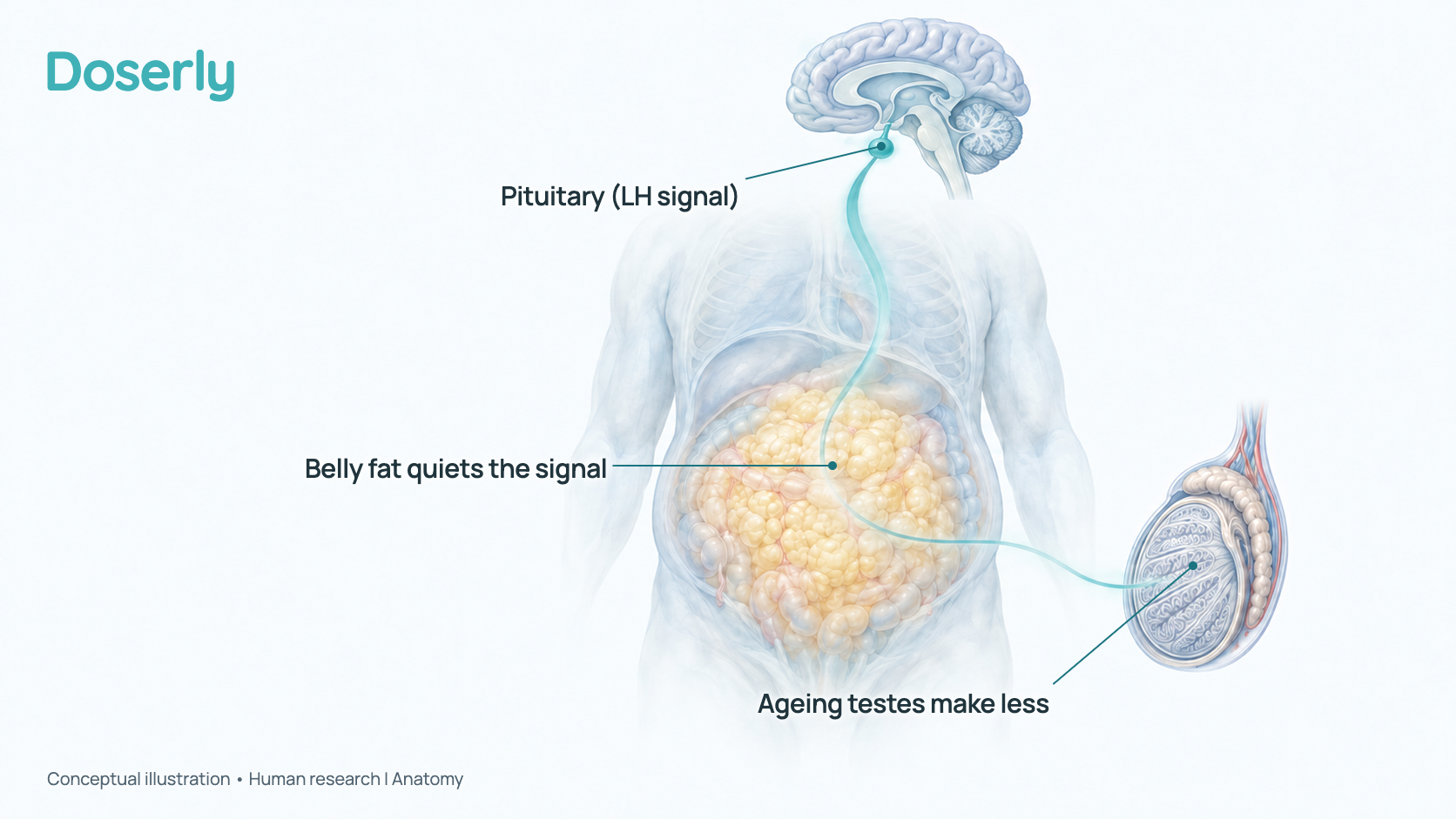
Is "male menopause" real?
Not as a sudden change every man goes through. When the same men are followed over time, testosterone falls by about 1% a year, and very healthy older men showed no average fall. Only about 2 in 100 men aged 40–79 meet the strict definition of late-onset hypogonadism. That is why guidelines say "late-onset" or "age-related hypogonadism" rather than andropause. [8], [9], [2]
How is late-onset hypogonadism diagnosed?
The same way as low testosterone at any age: symptoms or signs, total testosterone below the guideline line on at least two early-morning tests, and tests for the type and cause. Older men get neither a lower nor a higher bar, and US labels require the same two-morning confirmation. [7], [4], [5], [28]
Which symptoms point to it?
Sexual symptoms, most clearly. The European Male Ageing Study (EMAS) surveyed 3,369 men aged 40–79. It found that "only the three sexual symptoms had a syndromic association with decreased testosterone levels": fewer morning erections, low sexual desire and erectile dysfunction. [22]
Symptoms also appear at different levels. In older men at one clinic, loss of sex drive or vigor became more common below 15 nmol/L, depression and type 2 diabetes below 10, and erectile dysfunction only below 8. The authors wrote that "a clear-cut threshold for late-onset hypogonadism was not found". [29]
Tiredness, low mood, poor sleep and belly fat have many causes, and the Endocrine Society says "Symptoms alone are not diagnostic"; see the full symptom list. [7]
Do symptom questionnaires diagnose it?
No. The ADAM questionnaire caught 88% of men with low testosterone but was only 60% specific, so it also flagged about 4 in 10 men with normal levels. The Aging Males' Symptoms scale measures ageing symptoms, not testosterone. The 2008 joint recommendations advise against using either for diagnosis, and the Endocrine Society advises against screening men without symptoms. [30], [31], [1], [7]
What testosterone level counts as low in older men?
This table shows each major clinical guideline's line, plus older definitions still quoted online, checked in September 2026. No body sets a separate line for older men, and all of them also require symptoms.
| Guideline (version, year) | Threshold | How measured | Note for older men |
|---|---|---|---|
| AUA, American Urological Association (2018, validity reconfirmed 2024) | Below 300 ng/dL (about 10.4 nmol/L) | Two early-morning tests on separate days | Diagnose only with symptoms or signs |
| Endocrine Society (2018 guideline) | 264 ng/dL (9.2 nmol/L) for CDC-certified assays | Two fasting morning tests; free testosterone if borderline | Suggests against routinely treating all men 65 and older |
| Endocrine Society (statement, 16 July 2026) | A common clinical threshold near 300 ng/dL | Two early-morning fasting tests, certified assay | The same approach for a man of any age |
| VA, US Department of Veterans Affairs (January 2026) | 264 ng/dL (9.2 nmol/L) for CDC-certified assays | Two fasting tests, 6–10 am | No age adjustment |
| EAU, European Association of Urology (2026) | 12 nmol/L (about 350 ng/dL), named as the threshold for late-onset hypogonadism | Fasting, 07:00–10:00, repeated when under 12 nmol/L | No testosterone for thinking, vitality or strength in ageing men |
| ICSM, International Consultation on Sexual Medicine (2024) | 12 nmol/L (about 350 ng/dL) for late-onset hypogonadism | Fasting, 07:00–11:00, repeated | Diagnose with symptoms |
| BSSM, British Society for Sexual Medicine (2023) | Under 12 nmol/L total or 225 pmol/L free usually needs treatment | Two samples, 8–11 am | 8–14 nmol/L with symptoms may justify a trial of at least 6 months |
| Society for Endocrinology, UK (2022) | Bands: symptoms more likely under 8 nmol/L, or under 11 nmol/L with low free testosterone | Repeated morning fasting samples | Little evidence of benefit above 12 nmol/L |
| CUA, Canadian Urological Association (2021) | Under 10 nmol/L (about 290 ng/dL) | Morning, 7–11 am | Weak recommendation |
| EAA, European Academy of Andrology (2020) | No fixed line; free testosterone when total is about 8–12 nmol/L | Two fasting tests before 11 am | Lifestyle and weight loss first in overweight men |
| ESA, Endocrine Society of Australia (2016) | No single number | With LH and FSH, 08:00–10:00 | Needs a proven disorder of the testes or pituitary |
| ISSAM, International Society for the Study of the Aging Male (2015) | 12.1 nmol/L (about 350 ng/dL) as the lower limit of normal | Sample 07:00–11:00 | Some men have symptoms above it |
| Joint recommendations of five societies (2008, since replaced) | Above 12 nmol/L no treatment; below 8 nmol/L men usually benefit; 8–12 nmol/L repeat with SHBG | Morning test | The origin of the "8–12 grey zone" |
| EMAS research definition (a study, 2010) | Three sexual symptoms, total under 11 nmol/L (about 317 ng/dL) and free under 220 pmol/L | Morning samples | A research definition, not a treatment line |
| Australia's PBS (subsidy rule) | Men 40 and older: under 6 nmol/L, or 6–15 nmol/L with a high LH | Two morning samples | Low testosterone must not be due to age, obesity, heart disease, infertility or drugs |
| US product labels | Below the lab's normal range | Two separate mornings | Safety and effectiveness in "age-related hypogonadism" not established; the June 2026 request to remove this line is pending |
[4], [5], [7], [32], [6], [33], [3], [34], [35], [36], [37], [1], [22], [38], [17]
No body lowers the bar for age. North American bodies land at about 264–300 ng/dL, most European and international bodies at 12 nmol/L (about 350 ng/dL), and the UK Society for Endocrinology and the European Academy of Andrology use bands around 8–12 nmol/L. The real disagreement about older men is whether to treat, covered in should older men be treated? [7], [34], [27]
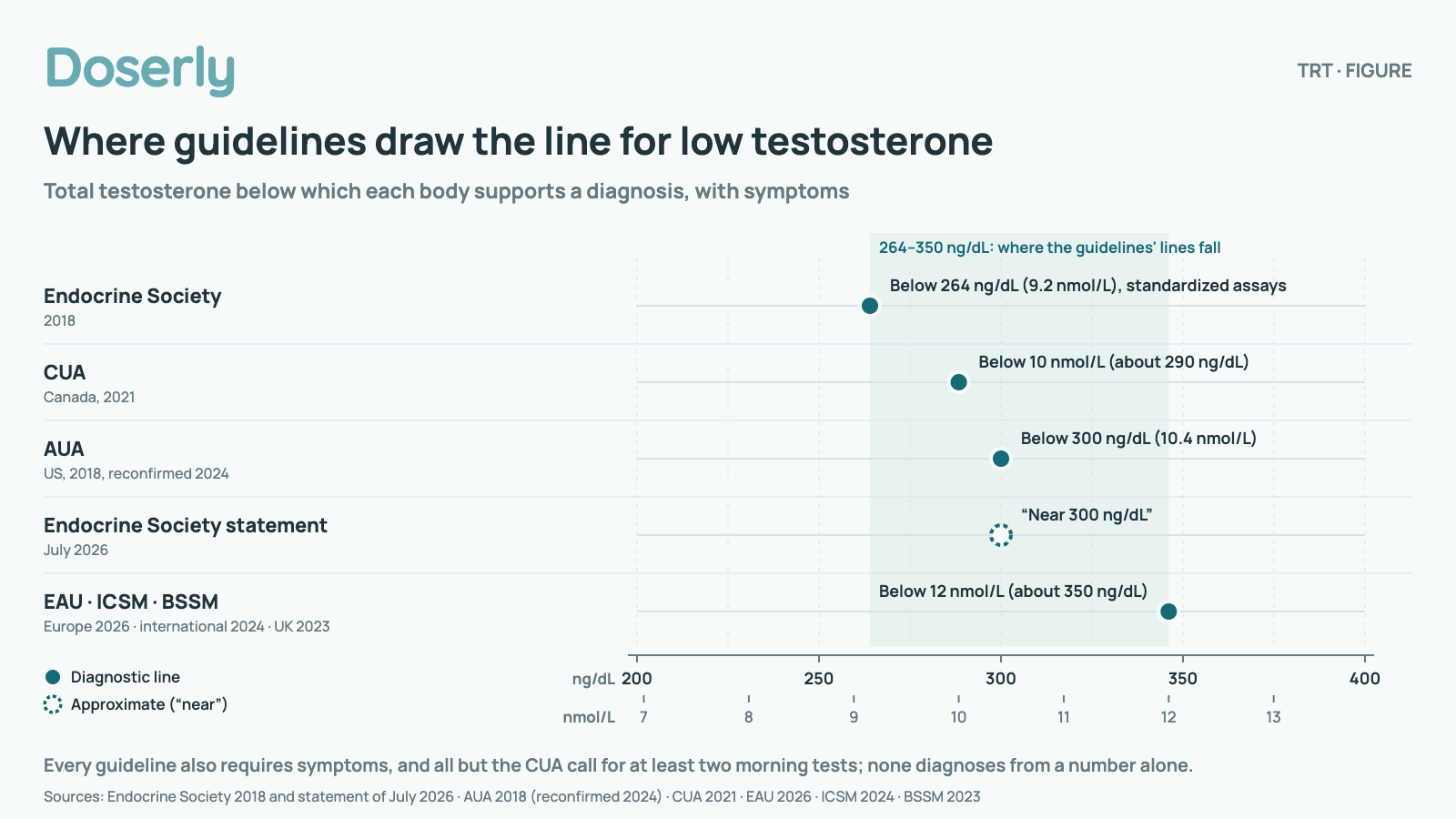
Where guidelines draw the line for low testosterone
Total testosterone below which each body supports a diagnosis, with symptoms.
Each line runs from 200 ng/dL (7 nmol/L, left) to 400 ng/dL (14 nmol/L, right); the shaded part is 264–350 ng/dL, where the guidelines' lines fall. A dashed circle means an approximate line.
- Endocrine Society (2018)
- Below 264 ng/dL (9.2 nmol/L), standardized assays
- CUA (Canada, 2021)
- Below 10 nmol/L (about 290 ng/dL)
- AUA (US, 2018, reconfirmed 2024)
- Below 300 ng/dL (10.4 nmol/L)
- Endocrine Society statement (July 2026)
- “Near 300 ng/dL”
- EAU · ICSM · BSSM (Europe 2026 · international 2024 · UK 2023)
- Below 12 nmol/L (about 350 ng/dL)
Every guideline also requires symptoms, and all but the CUA call for at least two morning tests; none diagnoses from a number alone.
Why do the numbers differ?
- Lab methods. The 264 ng/dL line is the bottom 2.5% of healthy, non-obese men aged 19–39 on one calibrated scale, which is why it needs a CDC-certified assay. In another cohort measured by mass spectrometry, the bottom 2.5% sat at 348.3 ng/dL. [39], [40]
- Where benefit clusters. Some bodies drew their lines where symptoms and trial benefit gather; the UK Society for Endocrinology sees benefit mainly below 8 nmol/L and little above 12. [34]
Units. 1 nmol/L equals 28.84 ng/dL, so 12 nmol/L is about 346 ng/dL. The testosterone unit converter does the arithmetic.
Is there a "normal level for your age"?
Studies have published age-based ranges, but no current guideline uses a lower line for older men. "Normal for your age" describes how common a level is, not whether it explains symptoms.
- Proposed age limits. The Massachusetts Male Aging Study proposed lower limits of 251, 216, 196 and 156 ng/dL (8.7, 7.5, 6.8 and 5.4 nmol/L) for men in their 40s, 50s, 60s and 70s. No major guideline adopted them. [41]
- Very healthy older men. Australia's reference interval was 6.4–25.7 nmol/L in very healthy men aged 70–89, against 10.4–30.1 nmol/L in young men. [36]
- One line at any age. The Endocrine Society and the VA use the young-men line of 264 ng/dL. [5], [32]
The low testosterone guide has typical levels by decade.
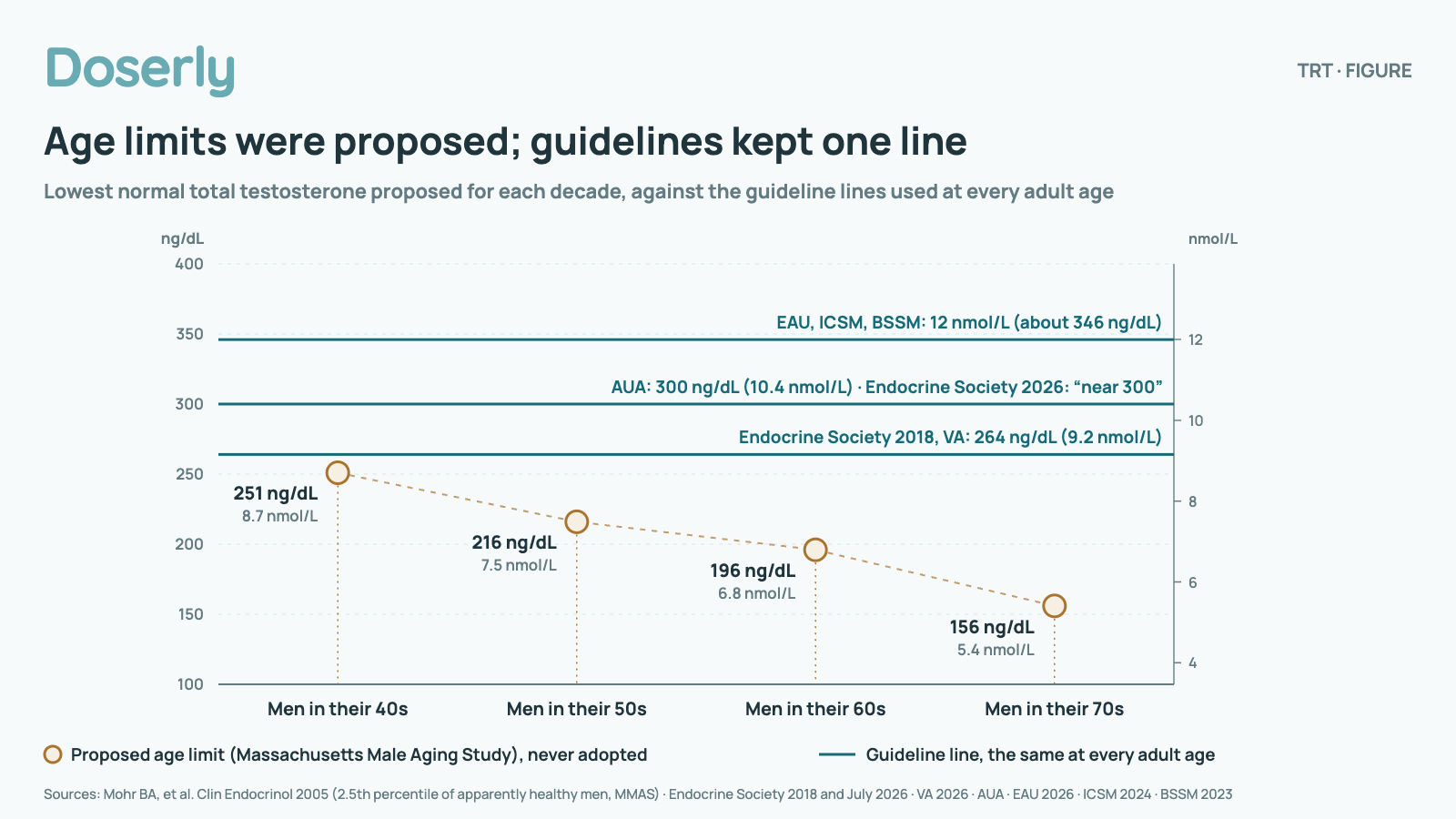
Age limits were proposed; guidelines kept one line
Lowest normal total testosterone proposed for each decade, against the guideline lines used at every adult age.
Each line runs from 100 ng/dL (left) to 400 ng/dL (right). The gold dot is the proposed age limit; the three dark ticks are the guideline lines at 264, 300 and about 346 ng/dL.
Proposed age limits (Massachusetts Male Aging Study, never adopted)
- Men in their 40s
- 251 ng/dL (8.7 nmol/L)
- Men in their 50s
- 216 ng/dL (7.5 nmol/L)
- Men in their 60s
- 196 ng/dL (6.8 nmol/L)
- Men in their 70s
- 156 ng/dL (5.4 nmol/L)
Guideline lines (the same at every adult age)
- Endocrine Society 2018 and VA
- 264 ng/dL (9.2 nmol/L)
- AUA; Endocrine Society 2026 statement
- 300 ng/dL (10.4 nmol/L); the 2026 statement says “near 300”
- EAU, ICSM and BSSM
- 12 nmol/L (about 346 ng/dL)
The age limits describe how common a level is in healthy men; no major guideline adopted them, and the Endocrine Society says the diagnosis is the same at any age.
How should older men be tested?
The same rules apply after 60:
- Morning, even though the rhythm flattens. The morning peak is much smaller in healthy older men: afternoon levels were 20–25% lower than 8 am levels at 30–40, and about 10% lower at 70. Researchers and ISSAM still recommend morning samples at every age. [42], [43], [37]
- Fasting. In healthy older men, an overnight fast raised morning testosterone by 9–16%. [9]
- When well. Acute illness is one of the reversible causes to rule out first. [35]
- Twice, with a certified lab. [7]
See the low testosterone guide for the details.
Why do free testosterone and SHBG matter more with age?
Because the main carrier protein rises with age, total testosterone can look normal while the usable part falls. In the blood, about 2% of testosterone floats free, 53–55% is loosely bound to albumin and 43–45% is tightly bound to SHBG (sex hormone-binding globulin). [44]
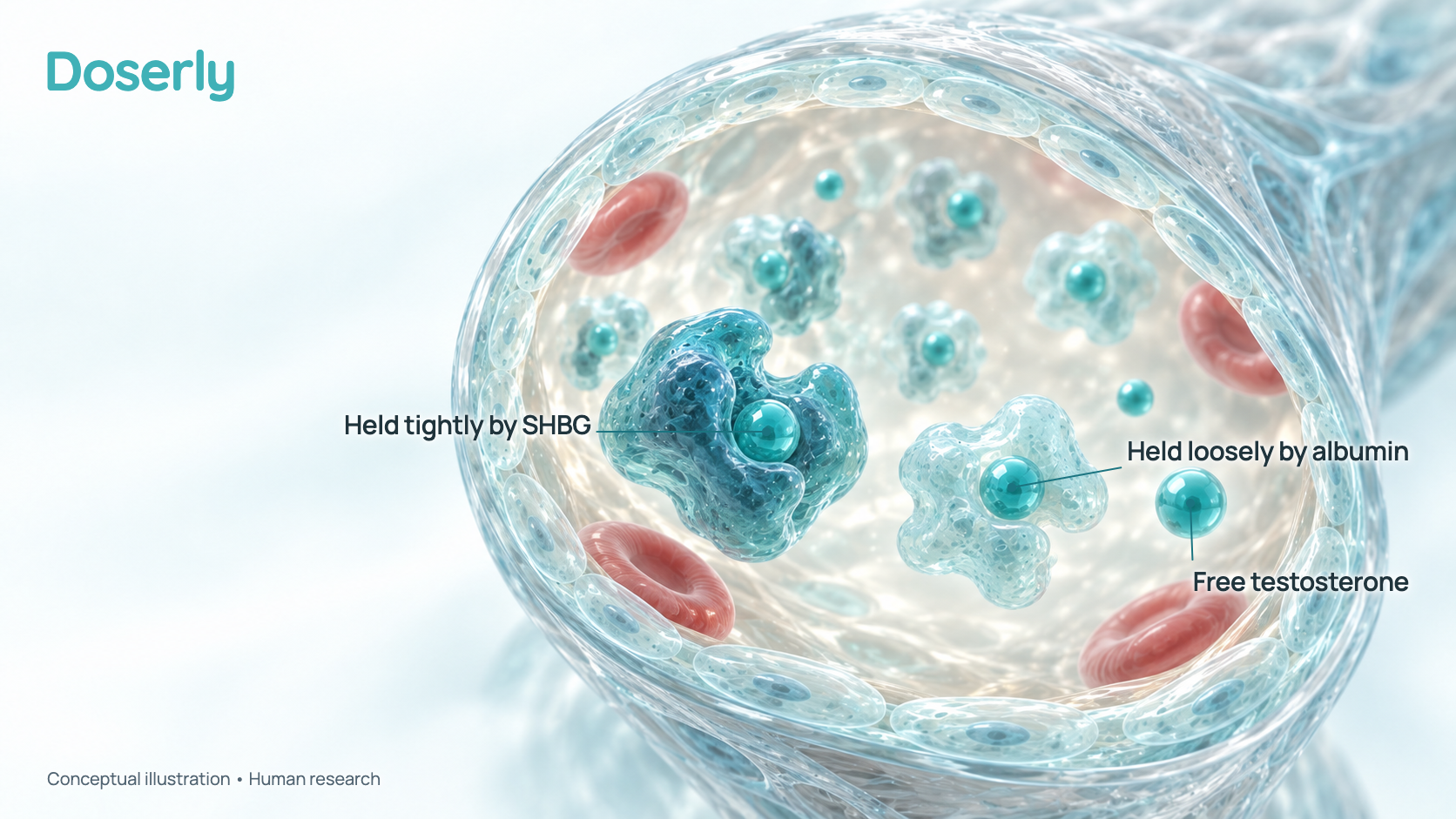
- SHBG rises with age, about 2.3–2.5% a year in two Australian cohorts of older men. [45] Obesity pushes the other way, lowering SHBG so total testosterone can read low while free testosterone is normal. [46]
- Free testosterone tracked symptoms. Over 4.3 years in EMAS, 4.9% of men developed low total with normal free testosterone and 1.9% developed low total and low free testosterone. Only the second group developed new sexual symptoms. [47]
Guidelines measure free testosterone when SHBG is likely to be altered or total testosterone is borderline, by equilibrium dialysis or calculation, not with direct kits. Their lines are 220 pmol/L (EAU, with limited evidence), 225 pmol/L (BSSM) and 225–243 pmol/L (proposed by ISSAM). [5], [6], [3], [37]
Which other tests find the type and the cause?
LH and FSH, the pituitary's signals to the testes. High LH with low testosterone points to the testes (primary hypogonadism); low or normal LH points to the brain and pituitary (secondary hypogonadism). In EMAS, 11.8% of men aged 40–79 had the secondary pattern, 2.0% the primary pattern and 9.5% normal testosterone with a high LH (compensated hypogonadism). See primary vs secondary hypogonadism. [5], [48]
Where these numbers come from
Each diagnostic row comes from that body's current document: the AUA testosterone deficiency guideline (2018, validity reconfirmed 2024), the Endocrine Society guideline (2018) and its statement of 16 July 2026, the VA recommendations (January 2026), the EAU guidelines (2026 edition), the ICSM 2024 recommendations, the BSSM guidelines (2023), the Society for Endocrinology guideline (2022), the CUA guideline (2021), the EAA guideline on functional hypogonadism (2020), the Endocrine Society of Australia position statement (2016) and the ISSAM recommendations (2015). The 2008 joint recommendations of the International Society of Andrology, ISSAM, the EAU, the EAA and the American Society of Andrology are shown because their 8 and 12 nmol/L lines still circulate; each society has since published newer guidance. The EMAS row is a research definition from a population study. The Australian row is the Pharmaceutical Benefits Scheme restriction for testosterone undecanoate injection, a subsidy rule rather than a clinical guideline. The label row comes from current US testosterone labels. [4], [5], [7], [32], [6], [33], [3], [34], [35], [27], [36], [37], [1], [22], [38], [28]
Conversions from nmol/L to ng/dL use 1 nmol/L = 28.84 ng/dL and are rounded. The EMAS paper prints its 11 nmol/L line as 3.2 ng/mL; the exact conversion is about 317 ng/dL.
Not used: the 2021 ISSAM update, whose full text we could not read; an Androgen Society-sponsored primary-care consensus published in August 2026, because only its abstract was available; a Japanese clinical manual, whose abstract gives no numbers; and figures such as "1.4% a year" or "20–40% of ageing men have symptoms", which circulate online without a traceable primary source.
What causes late-onset hypogonadism?
A mix of ageing testes and everyday health problems that quiet the brain's signal, above all obesity. In EMAS, age went with lower free testosterone and a rising LH, the pattern of testes working less. A body mass index (BMI) of 30 or more went with total testosterone about 5.09 nmol/L lower without an LH rise, the pattern of a quieter signal from the brain. [49]
How fast does testosterone fall with age?
Slowly. In studies that followed the same men for years, total testosterone fell 1.6% a year in Massachusetts (and bioavailable testosterone, the easily used part, 2–3%), and 1.3% and 0.9% a year in two Australian cohorts. EMAS and a South Australian (Adelaide) study found smaller falls, about 0.1 nmol/L a year. [8], [45], [50], [10]
Low readings become common in later life even though the condition does not. In a Baltimore study, about 20% of men over 60, 30% over 70 and 50% over 80 had readings in the low range, counted by blood level alone. An Australian population showed a gradual fall from 35 and a steeper one after 80. [51], [52]
Is it ageing or health?
Both, and studies weigh them differently.
- Health explains much of it. A five-year Australian study concluded that the decline "is not inevitable but is largely explained by smoking behavior and intercurrent changes in health status, particularly obesity and depression". In men over 40 reporting very good health, average testosterone "did not vary with age". In Massachusetts, good health added 10–15% to androgen levels. [10], [9], [8]
- Age still counts. Levels fall a little each year in the same men and fall faster after 80. Older men were more likely to have the primary pattern (relative risk ratio 3.04), while obesity drove the secondary pattern (8.74). [45], [52], [48]
Which treatable problems lower testosterone in older men?
- Obesity and weight gain, the strongest driver of the secondary pattern. See obesity-related hypogonadism. [48]
- Type 2 diabetes. A third (33%) of men with type 2 diabetes in one study had low testosterone, mostly with low or normal LH. [53]
- Opioid painkillers. Men using opioids had total testosterone about 165 ng/dL lower than men who did not, and 63% had low testosterone in a review of 15 studies. [54], [55]
- Steroid (corticosteroid) tablets. [7]
- Sleep apnea, which travels with low testosterone mostly through weight; treating it with CPAP did not significantly raise testosterone (a pooled change of 1.08 nmol/L, too uncertain to count). [56]
Do not stop a prescribed opioid or steroid on your own: both need a supervised plan.
Is low testosterone in older men dangerous?
It is linked with a higher risk of death, but no study has shown that it causes those deaths or that treatment prevents them. In EMAS, men with severe late-onset hypogonadism died at about 5 times the rate of other men over a median of 4.3 years (hazard ratio 5.5). Men with three sexual symptoms died at about 3 times the rate, whatever their testosterone level. In the TRAVERSE trial, deaths were similar on testosterone gel and placebo: 144 of 2,596 men against 148 of 2,602. [57], [16]
Does late-onset hypogonadism go away?
Sometimes, especially the secondary kind. In EMAS, 42.9% of men with secondary hypogonadism returned to normal within about four years without treatment, more often without obesity, after weight loss (odds ratio 2.24), with a normal waist and under 60. Their symptoms did not improve at the same time. Free testosterone changed significantly only in men who lost or gained 15% or more of their weight. [58], [50]
How is late-onset hypogonadism usually treated?
Guidelines treat reversible causes first, treat the most bothersome symptom, and offer testosterone when symptoms and repeatedly low levels come together, not for ageing alone. This section describes the choices clinicians weigh; it is not a personal plan. [6], [5]
| Option | Who it suits, according to guidelines | Effect on fertility | Read more |
|---|---|---|---|
| Treat the causes: weight loss, reviewing opioids and steroid tablets, treating other illness | Obesity or functional causes: first under the EAU, the Endocrine Society's 2026 statement (BMI over 27) and the EAA | Keeps the body's own production | Increasing testosterone naturally |
| Treat the symptom directly, for example an erection tablet (PDE5 inhibitor) | Men whose main problem is erections; the BSSM also suggests combining a PDE5 inhibitor with testosterone when both problems are present | None | TRT and sexual health |
| Testosterone therapy (TRT): gel, injections, capsules, nasal gel or pellets | Symptoms plus consistently low morning levels; not routinely for all men 65 and older | Switches off sperm production | TRT: the definitive guide |
| Clomiphene or enclomiphene (off-label tablets that raise LH and FSH) | Secondary low testosterone when fertility matters; not proven in randomized trials | Can keep sperm production going | Clomiphene, enclomiphene |
| hCG | Secondary low testosterone when fertility is wanted | Can keep or restart sperm production | hCG |
| GLP-1 weight-loss medicines | Obesity-related low testosterone (a possible role, per the ICSM); not approved for low testosterone | Raised LH and FSH in a small trial | TRT with GLP-1 medicines |
| Repeat testing and watchful waiting | Borderline results, unclear symptoms, recent weight change | None | TRT blood work |
[6], [7], [27], [3], [5], [28], [4], [33], [59]
Should older men be treated at all?
This is where guidelines and regulators disagree most. Checked September 2026.
| Body | Position on testosterone for older men |
|---|---|
| Endocrine Society (2018) | Suggests against routinely treating all men 65 and older with low testosterone; offer it individually to men with symptoms and consistently low morning levels |
| Endocrine Society (July 2026 statement) | Same diagnosis at any age; rule out reversible causes; long-term safety, including for the prostate, is not established |
| EAU (2026) | Diagnoses late-onset hypogonadism at 12 nmol/L; strongly advises against testosterone for thinking, vitality or physical strength in ageing men |
| American College of Physicians (2020, now listed as inactive) | Discuss testosterone only for sexual problems, review within 12 months and stop if nothing improves; not for energy, vitality, physical function or thinking |
| US FDA and labels | Approved for primary and secondary hypogonadism from named causes. Labels say safety and effectiveness in "age-related hypogonadism" are not established; the FDA requested removal of that line in June 2026, not yet in any label |
| European Union (2014 review) | Raising levels in healthy older men is not an authorized use |
| Australia's PBS | The subsidy excludes low testosterone due to age |
[5], [7], [6], [60], [24], [17], [19], [61], [38]
They weigh the same trials: clear gains in sexual function, bone density and anemia, little or none for energy, walking and memory, and more clots, rhythm problems and fractures (see the research). Bodies that stress the gains treat more symptomatic older men; bodies that stress the unknowns treat fewer. [15], [7]
How has the FDA's position changed?
Checked September 2026.
| Date | What happened | Status |
|---|---|---|
| January 2014 | Safety communication about reported strokes, heart attacks and deaths in men taking testosterone | History |
| September 2014 | Advisory committee; it led to the FDA's call for an industry-wide safety trial in men with age-related hypogonadism, which became TRAVERSE | History |
| March 2015 | Required label changes, urging caution when using testosterone for low testosterone due to aging | The age-related limitation is still in labels |
| 28 February 2025 | TRAVERSE results added to all labels; heart boxed-warning language removed; age-related limitation kept | In force |
| 10 December 2025 | FDA expert panel on testosterone therapy for men | Held |
| 16 April 2026 | Invitation to apply for a low sex drive indication in men with hypogonadism of unknown cause | An invitation, not an approval |
| 18 June 2026 | Requests to remove the age-related limitation, to contraindicate testosterone only in prostate cancer that has spread, and to revise the enlarged-prostate warning | Requested; not yet in any label |
Until the labels change, the FDA's own page says none of the approved products "are approved for use in men with low testosterone levels who lack an associated medical condition". [25]
Should weight loss come first?
Most guidelines say yes when obesity is the driver; the BSSM and the AUA prefer both together.
- Weight loss first: the EAU (strong recommendation), the Endocrine Society's 2026 statement (BMI over 27) and the EAA. [6], [7], [27]
- Both together: the BSSM says "current evidence does not support the recommendation for lifestyle intervention alone as first-line therapy", and the AUA advises weight-loss programs alongside testosterone for overweight men. [3], [4]
Pooled studies found testosterone rose about 2.5–2.9 nmol/L after diet-based weight loss and 7.2–8.7 nmol/L after bariatric surgery. In a 16-week trial, liraglutide raised testosterone by 2.6 nmol/L with 7.9 kg of weight loss, against 5.9 nmol/L and 0.9 kg with testosterone gel. Testosterone itself is not a weight-loss treatment, the EAA and EAU add. [66], [67], [59], [27], [6]
Can the symptom be treated directly?
Often, and for erections it is usually the first step. In men with erectile dysfunction and low testosterone whose sildenafil dose was first optimized, adding testosterone gave no significant extra gain (2.2 points on the erectile function score, against 7.7 from sildenafil alone). The BSSM still suggests considering both together, particularly below 8 nmol/L or after erection tablets fail. [68], [3]
Which forms and levels do guidelines aim for in older men?
- Form. The EAU suggests gels rather than long-acting injections when starting in men at high risk, and the EAA prefers a transdermal form (absorbed through the skin). The American College of Physicians, looking at cost, suggested intramuscular injections (into a muscle). [6], [27], [60]
- Target. The AUA aims for 450–600 ng/dL, the Endocrine Society for mid-normal (350–600 ng/dL), the CUA for 14–17 nmol/L and the BSSM for 15–30 nmol/L. [4], [5], [35], [3]
Doses come from each medicine's label; see TRT dosage and the TRT dose calculator. Testosterone for women uses different products; see testosterone therapy for women.
How long is treatment, and when do guidelines stop it?
Most guidelines stop testosterone if symptoms have not improved by a review point: about 3 months (CUA), 3–6 months (AUA), 6 months (BSSM), 6–12 months (VA) or 12 months for sexual function (American College of Physicians). The UK Society for Endocrinology instead expects lifelong treatment once the diagnosis is confirmed. [35], [4], [3], [32], [60], [34]
Stopping is possible, but the body's own signal returns slowly: after two years of injections in the T4DM trial, LH and FSH recovered gradually over 12 months. See stopping TRT. [69]
What if you still want children?
Testosterone switches off sperm production, and labels warn reduced fertility may not reverse in some men. The AUA says not to prescribe it to men trying to conceive; hCG, clomiphene-type tablets or aromatase inhibitors can keep fertility. See TRT and fertility. [28], [4]
What does testosterone do for older men?
It helps sexual function, bone density and anemia most, lifts mood slightly, and does not improve energy, walking or memory. Most of this comes from controlled trials in older men, mostly using gels for one to three years. [15]
What did the Testosterone Trials find?
The Testosterone Trials gave 790 men aged 65 and older with testosterone under 275 ng/dL a year of testosterone gel or placebo; 51,085 men were screened to find them. [11]
| Outcome | Testosterone compared with placebo |
|---|---|
| Sexual activity, desire and erections | Improved: 0.58 points for sexual activity, 2.93 for desire and 2.64 for erectile function (questionnaire scores, not numbers of sexual acts) |
| Walking | Main result not met: in the physical function trial, the share of men walking at least 50 m farther in 6 minutes did not differ (mean difference 4.09 m). Across all men, 20.5% on testosterone and 12.6% on placebo walked at least 50 m farther |
| Energy (vitality) | No improvement |
| Mood | A small improvement (0.72 points on a depression questionnaire) |
| Memory and thinking | No improvement in 493 men with age-related memory problems |
| Bone | Spine bone density rose 7.5% against 0.8% in 211 men |
| Anemia | Among men with unexplained anemia, 58.3% on testosterone and 22.2% on placebo were no longer anemic at 12 months |
| Heart plaque | Soft plaque in heart arteries grew more, by an estimated 41 mm³ in 138 men; no heart attacks or strokes in either group |
| PSA | Rose by 0.47 ng/mL against 0.06 ng/mL |
| Hemoglobin | Reached 17.5 g/dL or more in 7 men on testosterone and none on placebo |
[11], [14], [12], [13], [70], [71]
Men whose estradiol (the estrogen made from testosterone) rose more gained more sexual desire; see estrogen on TRT. [72]
What did other trials in older men find?
- TEAAM (308 men aged 60 and older, gel for 3 years): no difference in artery changes, sexual function or quality of life, and modest gains in stair-climbing power and muscle. The authors warned it "should not be interpreted as establishing cardiovascular safety". [73], [74]
- TOM (209 men aged 65 and older with limited mobility, average age 74): more men gained meaningful strength (43% against 18%), but walking speed, activity and fatigue did not change. It was stopped early after 23 men on testosterone and 5 on placebo had heart-related adverse events. [75], [76]
- TRAVERSE (men aged 45–80 at high heart risk): in 1,161 men with low sex drive, sexual activity and desire improved, but erections did not. It did not improve late-life low-grade depression (see TRT and mental health) or significantly prevent diabetes. [77], [78], [79]
- T4DM (1,007 men aged 50–74 with a large waist, injections plus a lifestyle program for 2 years): 12% had diabetes at 2 years against 21% on placebo. [80]
- Pooled trials (meta-analyses) in middle-aged and older men found about 1.6 kg less fat and 1.6 kg more lean mass, with no change in weight. Strength gains in men over 60 were small (Hedges g 0.21, a standard measure where 0.2 counts as small). Erectile function scores rose about 2 points regardless of age, and thinking skills did not change. [81], [82], [83], [84]
Where they disagree. Erections improved in the Testosterone Trials but not in TRAVERSE or TEAAM, and diabetes was prevented in T4DM (injections with a lifestyle program) but not in TRAVERSE (gel without one). The Endocrine Society advises against testosterone to control blood sugar. [79], [5]
Timing. Sex drive tends to improve from about 3 weeks, erections over up to 6 months and body composition over 12–16 weeks, which is why review points fall at 3–12 months. See how long TRT takes to work. [85]
What are the risks for older men?
Is testosterone therapy safe for older men?
For heart attacks and strokes over about two years, the largest trial found no increase, but it found more heart-rhythm problems, kidney injury, clots in the lungs and fractures, and long-term safety is not established. [16], [7]
What did TRAVERSE show about the heart?
TRAVERSE randomized about 5,200 men aged 45–80 with low testosterone and heart disease or high heart risk to daily testosterone gel or placebo gel. [16], [86]
- Heart attack, stroke or heart death: 7.0% on testosterone and 7.3% on placebo (182 of 2,596 men against 190 of 2,602; hazard ratio 0.96), meeting the trial's safety margin. [16]
- More common on testosterone: atrial fibrillation (an irregular heart rhythm) 3.5% against 2.4%, acute kidney injury 2.3% against 1.5%, and pulmonary embolism (a clot in the lungs) 0.9% against 0.5%. [17]
- Fractures: 3.50% against 2.46%. [18]
- Limits: only a daily gel, an average of 21.7 months of treatment, about 61% stopping their study gel early, and only men at high heart risk. [16], [17]
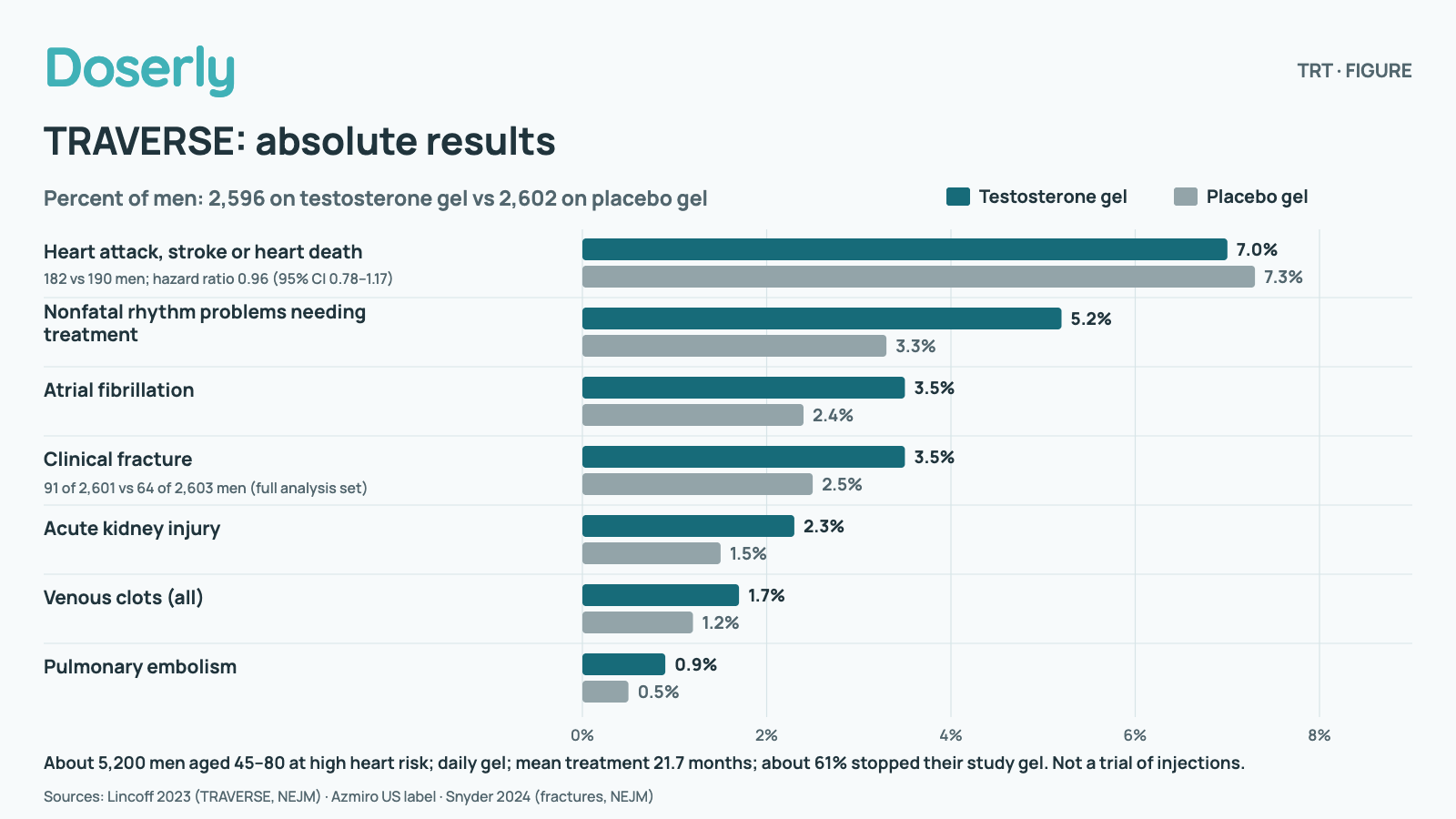
TRAVERSE: absolute results
Testosterone gel (2,596 men)Placebo gel (2,602 men)
- Heart attack, stroke or heart death
- Testosterone 7.0% vs placebo 7.3% (182 vs 190 men; hazard ratio 0.96, 95% CI 0.78–1.17; met the 1.5 safety margin)
- Nonfatal rhythm problems needing treatment
- Testosterone 5.2% vs placebo 3.3%
- Atrial fibrillation
- Testosterone 3.5% vs placebo 2.4%
- Clinical fracture
- Testosterone 3.5% vs placebo 2.5% (91 of 2,601 vs 64 of 2,603 in the full analysis set)
- Acute kidney injury
- Testosterone 2.3% vs placebo 1.5%
- Venous clots (all)
- Testosterone 1.7% vs placebo 1.2%
- Pulmonary embolism
- Testosterone 0.9% vs placebo 0.5%
About 5,200 men aged 45–80 at high heart risk; daily gel; mean treatment 21.7 months; about 61% stopped their study gel. Not a trial of injections.
Before TRAVERSE, the signals pointed both ways. Besides TOM, a US veterans records study reported more events in treated men (25.7% against 19.9% at 3 years). Its figures were later corrected, and the uncertainty range crosses zero. Another study found heart attacks in the 90 days after a first prescription at about twice the prior year's rate in men 65 and older. Pooled earlier trials found cardiovascular events in 7.5% on testosterone and 7.2% on placebo. [76], [87], [88], [89]
The Endocrine Society's 2026 statement notes "roughly a 50% relative increase in pulmonary embolism" in TRAVERSE. The FDA has found that all testosterone products raise blood pressure. After a heart attack or stroke, the Endocrine Society waits 6 months before starting testosterone, the VA 4 months and the AUA 3–6 months. See TRT and heart health. [7], [62], [5], [32], [4]
What about the prostate?
Testosterone raises PSA a little, and long-term prostate cancer risk is not settled. In a 2005 review of 19 trials in men aged 45 and older, testosterone raised prostate events (odds ratio 1.78), mostly biopsies and PSA rises. In TRAVERSE, high-grade prostate cancer occurred in 0.19% on testosterone and 0.12% on placebo, not a significant difference. Men with a PSA above 3.0 ng/mL were not enrolled. The AUA checks PSA before starting in men over 40, and the Endocrine Society refers men to a urologist if PSA rises by more than 1.4 ng/mL in the first year. [90], [86], [4], [5]
Checked September 2026. US labels do not allow testosterone with known or suspected prostate cancer. The FDA's June 2026 request to narrow this to cancer that has spread is not yet in the labels, and Health Canada opened its own review in May 2026. See TRT and the prostate. [24], [19], [91]
What other risks matter more with age?
- Red blood cells. In the same 2005 review, men on testosterone were nearly four times as likely to have a hematocrit above 50% (odds ratio 3.69). In T4DM, 22% of men on testosterone injections passed 54%, against 1% on placebo. See hematocrit on TRT. [90], [80]
- Fractures. Despite higher bone density, fractures were not prevented in TRAVERSE, and a 2026 review found more clinical fractures (risk ratio 1.55), though not more hip or spine fractures. [18], [92]
- Sleep apnea. In men with obesity and severe sleep apnea, testosterone injections worsened nighttime oxygen drops at 7 weeks, though not at 18 weeks. [93]
- Fluid retention, a concern with heart, kidney or liver disease. [94]
Who should be especially cautious?
Guidelines list different reasons not to start:
- The Endocrine Society: plans for children soon; breast or prostate cancer, a prostate lump, or a PSA above 4 ng/mL without a urologist's review; a high hematocrit; untreated severe sleep apnea; severe urinary symptoms; uncontrolled heart failure; a heart attack or stroke in the last 6 months; or an inherited clotting tendency. [5]
- The VA adds a blood clot without a clear cause, severe liver disease or kidney failure, and current anabolic steroid misuse. [32]
- The EAU adds a family history of clots and a baseline hematocrit of 48–50% as reasons for caution. [6]
- Older men with limited mobility and many health problems, the group in which TOM stopped early; drug-tested athletes (see legal status); and under-18s, for whom testosterone belongs only in specialist care. [76]
- Women. This guide is written for men; see testosterone therapy for women.
Which medicines interact with testosterone?
Older men often take several medicines. US labels list four interactions: insulin and other diabetes medicines (testosterone can lower blood sugar), blood thinners taken by mouth such as warfarin (clotting tests need closer checks), corticosteroids (more fluid retention), and other medicines that raise blood pressure. An EU safety review in 2025 also recommended warning that SGLT2 inhibitor diabetes medicines add to the rise in hematocrit. Bring a complete list, including supplements, to a pharmacist or prescriber. Checked September 2026. [24], [17], [94], [95]
Is testosterone legal, and is it allowed in sport?
Checked September 2026. Rules differ by country and change often.
- United States. Testosterone and its esters are Schedule III controlled substances, prescription only; no proposal to change that has been published. [20]
- United Kingdom. Testosterone is a Class C controlled drug under the Misuse of Drugs Act 1971, and in Schedule 4 Part II of the Misuse of Drugs Regulations 2001. [96], [97]
- Canada. Testosterone is a Schedule IV controlled substance. [98]
- Australia. Testosterone is a Schedule 4 prescription-only medicine. [99]
- Sport. The World Anti-Doping Agency (WADA) prohibits testosterone at all times, and its 2027 list keeps the ban. An exemption is granted only for low testosterone from a disease of the testes or pituitary, not for functional causes such as ageing. [21], [100], [101]
For access and cost, see the country guides for the United States, the United Kingdom, Canada, Australia and Europe.
What do people in public communities report?
Many public posts from men over 40 describe a result near the line and a doctor who calls it normal. The threads below are recent public Reddit discussions, read with their replies; they show what people go through, not how often it happens.
"My doctor says it is normal for my age"
A frequent complaint. A man of 67 who had lost muscle during a large weight loss measured 300 ng/dL and was told his level was normal for his age. A man of 60 measured 193 ng/dL after losing about 50 pounds on a weight-loss medicine and was told it was part of aging; a clinic later prescribed testosterone. A man of 40 measured 265 ng/dL, against 316 ten years earlier, and was told it was within the lab's range. [102], [103], [104]
Some of these results sit above one guideline's line and below another's, exactly where the key numbers disagree. A man of 50 in the UK measured 10 nmol/L, inside his lab's range of 8–30, and his public health service would not treat him. [105]
What if total testosterone is normal but free is low?
A recurring pattern. A man of 50 with a total of 770 ng/dL had an SHBG of 85.8 nmol/L, a low free testosterone, low libido and weaker erections; several replies urged an endocrinologist's review before treatment. A man of 40 had severe erection problems despite tadalafil. He had a total of 20.0 nmol/L on two morning tests, an SHBG of 53 nmol/L and a calculated free testosterone near the bottom of his lab's range. [106], [107]
Did weight loss change the number?
Sometimes dramatically. A man of 41 who deferred a testosterone prescription measured 144 ng/dL at 498 pounds and 625 ng/dL at 302 pounds, and felt much stronger; he had also had untreated sleep apnea. Others saw the number rise but not the symptoms. After losing about 8% of his weight and starting CPAP, a man of 41 rose from 11.9 to 21.9 nmol/L but still felt exhausted and without sex drive. [108], [109]
Is it a lifelong commitment?
This worry stops many men. A man of 54 with three monthly results of 204, 327 and 241 ng/dL wrote that the lifelong part "truly feels like a one-way ticket"; replies pointed out that men do stop. A man of 43 at 10.8 nmol/L feared starting something he could not reverse, and his hematocrit was already 53% before any treatment, which replies flagged. Guidelines differ here too (see how long). [110], [111]
What do older men report after starting?
Every direction:
- Better. A man of 55 who lost 19 kg and had his thyroid treated first described much higher libido and daily morning erections at six weeks. He had started at 21.5 nmol/L, above every guideline line in this guide, which replies raised. [112]
- Better, with a lab problem. A man of 57 felt gel "did nothing" for a year, switched to injections and reached 1,800 ng/dL before his dose was cut. A year in he reported better energy, fitness and sex life, but poor sleep and a hematocrit of 0.55 (55%). [113]
- Not better. A man of 49 who started at 350 ng/dL was "unimpressed" at 12 weeks: erections and libido were still poor even with erection tablets, and his ankles swelled. [114]
- Too high. A man of 64, five years on treatment, moved to twice-weekly injections with a second prescriber and measured 2,030 and then 2,593 ng/dL, far above any target. His primary care doctor said it was too high, and he began cutting back. [115]
How can you judge a late-onset story?
Ask: Were there two morning, fasting results, in which units? Were free testosterone, SHBG and LH measured? Was the man dieting, sleeping badly, ill or taking opioids, steroids or a weight-loss medicine at the time? Was his level on treatment within the guideline targets? And what did the next six months show?
These selected discussions show what people experience. They are not a survey of all men with late-onset hypogonadism, a success rate or a substitute for the studies above.
What should you track?
Before a diagnosis: symptoms, weight and every result with its date, time and fasting status. On treatment: usually testosterone and hematocrit at 3–6 months and 12 months, then yearly (the EAU at 3, 6 and 12 months), plus PSA. Use this to prepare questions; it is not a personal testing plan. [5], [6]
| What | Why it matters | Tracking category |
|---|---|---|
| Sexual symptoms (desire, morning erections, erections) | Most closely tied to low testosterone, and what treatment improves most | Libido; Sexual Function |
| Energy, mood, sleep | Common with age for many reasons | Energy Levels; Mood & Wellbeing; Sleep Quality |
| Each testosterone result with time, fasting status and units; free testosterone, SHBG, LH | The basis of the diagnosis and its type | Blood work |
| Weight, waist, snoring | Obesity and sleep apnea are common, reversible drivers | Weight Management; Sleep Quality |
| If treated: testosterone, hematocrit, PSA, blood pressure, and whether symptoms improved by the review point | What guidelines monitor, and what decides whether treatment continues | Blood work; Blood Pressure |
Time of day, food, weight change and the lab all move the reading, so a trend of morning results drawn under similar conditions says more than any one number. See TRT blood work. [43], [9]
Common questions about late-onset hypogonadism
What is a normal testosterone level for a man my age?
There is no official age-adjusted cut-off. Researchers proposed lower limits falling from 251 ng/dL in the 40s to 156 ng/dL in the 70s. Guidelines use one line at every adult age: about 264–300 ng/dL in North America and 12 nmol/L (about 350 ng/dL) in Europe. [41], [7], [6] See normal for your age.
Should men over 65 take testosterone?
Only when symptoms and repeatedly low morning levels come together, most guidelines say. The Endocrine Society advises against treating all men 65 and older routinely, the EAU against testosterone for vitality or strength, and the American College of Physicians' 2020 guideline (now inactive) limited it to sexual problems. [5], [6], [60] See should older men be treated?
Is testosterone FDA-approved for age-related low testosterone?
Not as of September 2026. US labels still say its safety and effectiveness in "age-related hypogonadism" have not been established. The FDA asked makers to remove that limitation on 18 June 2026, but it is not yet in any label. [17], [19], [65] See the FDA timeline.
Does late-onset hypogonadism go away on its own?
Sometimes. In EMAS, 42.9% of men with the secondary kind returned to normal within about four years without treatment, more often after weight loss, although their symptoms did not improve at the same time. [58] See does it go away?
Will testosterone help my energy or memory?
Probably not. In the largest trial in men aged 65 and older, a year of testosterone gel did not improve energy, walking or memory, while it improved sexual function and mood slightly. [11], [14], [15] See the Testosterone Trials.
What is the ICD-10 code for late-onset hypogonadism?
It has no code of its own. In the US version of the classification, the closest code is E29.1 (testicular hypofunction). Pituitary causes fall under E23.0, and N46.8 is a male infertility code. [116]
Glossary
Plain explanations of the medical, lab and research terms used in this guide. Underlined terms in the text link here.
- Andropause ("male menopause")
- An informal name for age-related low testosterone. Guidelines avoid it, because testosterone in most men falls slowly rather than stopping as it does in menopause.
- CDC-certified assay
- A testosterone test that has passed the US Centers for Disease Control and Prevention's standardization program, so its results match other certified labs. Guideline cut-offs such as 264 ng/dL assume a certified test.
- Compensated hypogonadism
- Normal testosterone with a high LH, as if the pituitary is working harder to keep testosterone up. Its meaning is unclear, and it is usually watched rather than treated.
- Controlled trial
- A study that compares people who receive a treatment with a similar group who do not, often receiving a placebo instead. Randomly assigning people to each group makes the comparison fairer.
- CPAP
- Continuous positive airway pressure: a bedside machine that blows air through a mask to keep the airway open during sleep. It is the standard treatment for obstructive sleep apnea.
- EMAS (European Male Ageing Study)
- A study of 3,369 men aged 40–79 in eight European centers that defined strict late-onset hypogonadism and followed how testosterone changes with age, weight and health.
- Free testosterone
- The small share of testosterone, about 2%, that is not attached to any protein in the blood. It is measured or calculated when SHBG is unusual or total testosterone is borderline.
- FSH (follicle-stimulating hormone)
- A pituitary hormone that acts on the cells supporting sperm production. Testosterone therapy lowers it.
- Functional hypogonadism
- Low testosterone from causes that can reverse, such as obesity, illness or some medicines, rather than a permanent disease of the testes or pituitary.
- Clinical guideline
- Recommendations written by a medical society or health system, based on its review of the evidence and expert judgment. Different guidelines can reach different conclusions.
- Hazard ratio
- A measure comparing how often an event happens over time in two groups. A hazard ratio of 1 means no difference; 0.96 means about 4% lower in the first group.
- Hematocrit
- The share of the blood made up of red blood cells. Testosterone raises it, and most guidelines act when it reaches about 54%.
- Hypogonadism
- Low testosterone caused by a problem in the testicles or in the brain and pituitary signals that control them, confirmed with symptoms and repeated morning blood tests.
- Intramuscular (IM)
- Injected into a muscle. Most testosterone cypionate and enanthate is given this way.
- Product label (prescribing information)
- The official document approved by a medicines regulator for a product, describing its approved uses, doses, warnings and monitoring.
- LH (luteinizing hormone)
- A pituitary hormone that tells the testicles to make testosterone. Testosterone therapy switches it off.
- Limitation of Use
- A line in a US drug label saying a use has not been shown to be safe or effective. Testosterone labels carry one for age-related hypogonadism; it is a caution, not a ban.
- Meta-analysis and systematic review
- A systematic review gathers all studies on a question in a planned way. A meta-analysis combines their results statistically.
- Odds ratio
- A measure comparing the odds of an outcome in two groups. An odds ratio of 2 means roughly twice the odds; 1 means no difference.
- PDE5 inhibitor
- A group of erectile dysfunction tablets, including sildenafil (Viagra) and tadalafil (Cialis), that improve blood flow to the penis.
- Placebo
- A dummy treatment with no active ingredient, used as a comparison in studies.
- Primary hypogonadism
- Low testosterone because the testicles themselves do not work well, even though the pituitary sends plenty of LH and FSH.
- PSA (prostate-specific antigen)
- A protein made by the prostate, measured in a blood test. It rises with prostate enlargement, inflammation and cancer, and a little on testosterone therapy.
- Secondary hypogonadism
- Low testosterone because the brain and pituitary send too little LH and FSH to the testicles. Also called hypogonadotropic hypogonadism.
- SHBG (sex hormone-binding globulin)
- A blood protein that carries testosterone. Testosterone bound to it is not immediately available to tissues, so SHBG affects how much free testosterone there is.
- Obstructive sleep apnea
- Repeated blocking of the airway during sleep, causing pauses in breathing and drops in oxygen. Loud snoring and daytime sleepiness are common signs.
- Testosterone Trials (T Trials)
- Seven coordinated US trials in 790 men aged 65 and older with low testosterone, comparing a year of testosterone gel with placebo on sexual function, walking, energy, mood, memory, bone, anemia and heart arteries.
- Transdermal
- Absorbed through the skin, as with testosterone gels and patches.
- TRAVERSE
- A large trial of about 5,200 men aged 45–80 with low testosterone and heart disease or high heart risk, comparing daily testosterone gel with placebo gel for heart safety.
- TRT (testosterone replacement therapy)
- Prescribed testosterone, by injection, gel or other forms, for men with low testosterone. It switches off the brain's LH and FSH signals.
- WADA
- The World Anti-Doping Agency, which publishes the list of substances banned in sport. Testosterone is banned at all times.
How this guide was researched
This guide is built from a thorough review of the sources cited throughout it: clinical guidelines and recommendations from 15 medical bodies, product labels, published clinical trials and population studies, and regulatory documents from the US, Europe, Canada and Australia. We also reviewed public online forums where men over 40 describe their own test results, treatment decisions and experiences.
The guide cites 116 sources, including 48 original studies in people, 16 clinical guidelines and position statements, and 14 public community discussions. Each type of source answers a different question. Guidelines and labels show what clinicians are told to do. Trials and population studies show what was measured. Personal accounts show what individual people experienced. Every numbered citation links to its entry below, labeled by source type.
How this guide was made
Research and drafting were AI-assisted. Every cited source was checked against the original, and the guide was reviewed and edited by Doserly before publication. It has not had an independent clinical review, and Doserly does not currently have medical reviewers. Doserly makes a medication and health-tracking app and runs Doserly Academy, both of which are promoted in this guide. Read our editorial policy for how guides are researched, updated and corrected.
This guide is for educational purposes. It summarizes what the reviewed sources report so the research is easier to understand; it is not medical advice. For a deeper dive, or to check any point for yourself, go straight to the cited sources.
Explore the sources
These are the documents cited in this guide. Guidelines, labels, studies, regulatory documents and personal accounts answer different questions. A source being listed does not mean every statement on its page is endorsed.
Showing 116 sources
- 01
Investigation, treatment and monitoring of late-onset hypogonadism in males: ISA, ISSAM, EAU, EAA and ASA recommendations ↗
Joint recommendations (historic)
Original full text reviewed.
Detail: Defined late-onset hypogonadism; above 12 nmol/L no treatment, below 8 usually benefit; symptom questionnaires not diagnostic.
- 02
Characteristics of androgen deficiency in late-onset hypogonadism: results from the European Male Aging Study (EMAS) ↗
Human study (cohort)
Original abstract reviewed.
Detail: Strict late-onset hypogonadism in 2.1% of men aged 40–79 (63 of 2,966).
- 03
The British Society for Sexual Medicine Guidelines on Male Adult Testosterone Deficiency, with Statements for Practice ↗
Clinical guideline (UK)
Full text reviewed.
Detail: Under 12 nmol/L total or 225 pmol/L free usually needs treatment; 8–14 nmol/L may justify a 6-month trial; lifestyle alone not first-line.
- 04
Evaluation and Management of Testosterone Deficiency: AUA Guideline ↗
Clinical guideline (US)
Full guideline reviewed.
Detail: Below 300 ng/dL on two early-morning tests, with symptoms; target 450–600 ng/dL; PSA before starting in men over 40; discuss stopping at 3–6 months without benefit.
- 05
Testosterone Therapy in Men With Hypogonadism: An Endocrine Society Clinical Practice Guideline ↗
Clinical guideline
Full guideline reviewed.
Detail: 264 ng/dL for certified assays; two fasting morning tests; suggests against routinely treating all men 65 and older; lists reasons not to start.
- 06
EAU Guidelines on Sexual and Reproductive Health, Chapter 3: Male Hypogonadism (2026 edition) ↗
Clinical guideline (Europe)
Full guideline chapter reviewed.
Detail: 12 nmol/L threshold to diagnose late-onset hypogonadism; lifestyle and weight first; no testosterone for vitality, thinking or strength in ageing men.
- 07
Statement on Testosterone Replacement Therapy (Endocrine Society press statement, 16 July 2026) ↗
Society statement (US)
Full statement reviewed.
Detail: Same diagnosis at any age; 'age-related', 'late-onset' and 'functional' hard to define; rule out reversible causes; TRAVERSE: about 50% relative increase in pulmonary embolism, long-term safety not established.
- 08
Age trends in the level of serum testosterone and other hormones in middle-aged men: longitudinal results from the Massachusetts male aging study ↗
Human study (cohort)
Original abstract reviewed.
Detail: Within the same men, total testosterone fell 1.6% a year.
- 09
Serum testosterone, dihydrotestosterone and estradiol concentrations in older men self-reporting very good health: the healthy man study ↗
Human study
Original abstract reviewed.
Detail: In very healthy men over 40, testosterone did not vary with age; obesity and past smoking lowered it; fasting raised morning levels 9–16%.
- 10
Longitudinal changes in testosterone over five years in community-dwelling men ↗
Human study
Original abstract reviewed.
Detail: Five-year fall of 0.13 nmol/L a year, largely explained by smoking, obesity and depression.
- 11
Effects of Testosterone Treatment in Older Men ↗
Human trial
Original full text reviewed.
Detail: 790 men aged 65 and older, a year of gel: better sexual function and slightly better mood; no gain in energy or walking.
- 12
Effect of Testosterone Treatment on Volumetric Bone Density and Strength in Older Men With Low Testosterone: A Controlled Clinical Trial ↗
Human trial
Original abstract reviewed.
Detail: Spine bone density +7.5% vs +0.8% over one year; fractures not measured.
- 13
Association of Testosterone Levels With Anemia in Older Men: A Controlled Clinical Trial ↗
Human trial
Original abstract reviewed.
Detail: Unexplained anemia corrected in 58.3% vs 22.2%.
- 14
Testosterone Treatment and Cognitive Function in Older Men With Low Testosterone and Age-Associated Memory Impairment ↗
Human trial
Original abstract reviewed.
Detail: 493 men with age-related memory problems: no improvement in memory or other thinking skills.
- 15
Key Findings on the Efficacy and Safety of Testosterone Therapy from Two Large Randomized Trials ↗
Review
Original abstract reviewed.
Detail: Review of the Testosterone Trials and TRAVERSE: helps sexual function and mood, not energy, physical function or thinking.
- 16
Cardiovascular Safety of Testosterone-Replacement Therapy ↗
Human trial
Original abstract reviewed.
Detail: TRAVERSE: heart attack, stroke or heart death 7.0% vs 7.3% (hazard ratio 0.96); deaths 144 vs 148.
- 17
KYZATREX (testosterone undecanoate) capsules, prescribing information, section 5 and 6.1 (TRAVERSE class text) ↗
Product label (US)
Full label reviewed.
Detail: Kyzatrex: TRAVERSE class text; interactions with insulin, oral anticoagulants, corticosteroids and blood-pressure-raising medicines.
- 18
Testosterone Treatment and Fractures in Men with Hypogonadism ↗
Human trial
Original abstract reviewed.
Detail: TRAVERSE fracture study: clinical fractures 3.50% vs 2.46%; testosterone did not prevent fractures.
- 19
HHS Announces Requested Updates to Testosterone Therapy Product Labels ↗
Regulator (US)
Official page reviewed.
Detail: June 2026: FDA requests to remove the age-related limitation, narrow the prostate contraindication and revise the enlarged-prostate warning.
- 20
21 CFR 1308.13(f) Schedule III: anabolic steroids ↗
Law or regulation (US)
Official page reviewed.
Detail: Anabolic steroids, including testosterone and its esters, are Schedule III.
- 21
World Anti-Doping Code International Standard: Prohibited List 2026 ↗
Anti-doping list
Official page reviewed.
Detail: Testosterone is prohibited at all times (S1.1).
- 22
Identification of late-onset hypogonadism in middle-aged and elderly men ↗
Human study
Original abstract reviewed.
Detail: EMAS, 3,369 men aged 40–79: only three sexual symptoms tracked low testosterone; research definition of late-onset hypogonadism.
- 23
Diagnosis and management of testosterone deficiency syndrome in men: clinical practice guideline ↗
Clinical guideline (Canada, 2015)
Original full text reviewed.
Detail: Canadian definition of testosterone deficiency syndrome (late-onset hypogonadism); treatment goal 14–17.5 nmol/L.
- 24
Depo-Testosterone (testosterone cypionate) 100 and 200 mg/mL prescribing information ↗
Product label (US)
Full label reviewed.
Detail: Depo-Testosterone: approved for primary and hypogonadotropic hypogonadism; safety and efficacy in 'age-related hypogonadism' (also called late-onset hypogonadism) not established.
- 25
Testosterone Information (Postmarket Drug Safety Information for Patients and Providers) ↗
Regulator (US)
Official page reviewed.
Detail: No approved product is for low testosterone without an associated medical condition; June 2026 requested label updates.
- 26
Male Hypogonadism: The Korean Society of Men's Health and Aging Position Statement ↗
Position statement (Korea)
Original full text reviewed.
Detail: Proposes about 2.6 ng/mL for Korean men; describes functional hypogonadism as a late-onset state with reversible causes.
- 27
European Academy of Andrology (EAA) guidelines on investigation, treatment and monitoring of functional hypogonadism in males: Endorsing organization: European Society of Endocrinology ↗
Clinical guideline (Europe)
Full text reviewed.
Detail: Functional hypogonadism: free testosterone when total is about 8–12 nmol/L; lifestyle and weight loss first; transdermal preferred to start; not for weight loss.
- 28
Xyosted (testosterone enanthate) subcutaneous autoinjector 50, 75, 100 mg/0.5 mL prescribing information ↗
Product label (US)
Official page reviewed.
Detail: Xyosted: confirm low testosterone on two separate mornings; warns that large doses suppress sperm production.
- 29
Association of specific symptoms and metabolic risks with serum testosterone in older men ↗
Human study
Original abstract reviewed.
Detail: Different symptoms appeared at different levels (15, 10 and 8 nmol/L); no clear-cut threshold found.
- 30
Validation of a screening questionnaire for androgen deficiency in aging males ↗
Human study
Original abstract reviewed.
Detail: ADAM questionnaire: 88% sensitive, 60% specific.
- 31
The Aging Males' Symptoms (AMS) scale: review of its methodological characteristics ↗
Review
Original abstract reviewed.
Detail: The AMS scale measures ageing-male symptoms and quality of life, not testosterone.
- 32
Evaluation for and Management of Males with Low Testosterone: Recommendations for Use (January 2026) ↗
Clinical recommendations (US)
Full document reviewed.
Detail: 264 ng/dL for certified assays on two fasting morning tests; stop after 6–12 months without benefit; lists reasons not to start.
- 33
Male hypogonadism: recommendations from the Fifth International Consultation on Sexual Medicine (ICSM 2024) ↗
Clinical recommendations (international)
Full text reviewed.
Detail: 12 nmol/L threshold for late-onset hypogonadism; fasting morning tests repeated at least twice.
- 34
Society for Endocrinology guidelines for testosterone replacement therapy in male hypogonadism ↗
Clinical guideline (UK)
Full text reviewed.
Detail: Symptoms more likely under 8 nmol/L, or under 11 with low free testosterone; benefit shown mainly below 8; expects lifelong treatment once confirmed.
- 35
Canadian Urological Association guideline on testosterone deficiency in men: Evidence-based Q&A ↗
Clinical guideline (Canada)
Full text reviewed.
Detail: Under 10 nmol/L is a reasonable threshold; target 14–17 nmol/L; stop after about 3 months without improvement.
- 36
Endocrine Society of Australia position statement on male hypogonadism (part 1): assessment and indications for testosterone therapy ↗
Position statement (Australia)
Full text reviewed.
Detail: No single cut-off; diagnosis rests on a proven disorder of the testes or pituitary; reference intervals 6.4–25.7 nmol/L in very healthy men aged 70–89.
- 37
Recommendations on the diagnosis, treatment and monitoring of hypogonadism in men ↗
Society recommendations
Original full text reviewed.
Detail: ISSAM 2015: 12.1 nmol/L lower limit of normal; free testosterone 225 or 243 pmol/L proposed.
- 38
PBS item 10205D testosterone undecanoate 1 g/4 mL injection and restrictions 6910 and 6324 ↗
Subsidy rule (Australia)
Official page reviewed.
Detail: Subsidy for men without a known testicular or pituitary disorder excludes low testosterone due to age, obesity, heart disease, infertility or drugs.
- 39
Harmonized Reference Ranges for Circulating Testosterone Levels in Men of Four Cohort Studies in the United States and Europe ↗
Human study
Original abstract reviewed.
Detail: Harmonized range in healthy non-obese men aged 19–39: 264–916 ng/dL, the basis of the 264 ng/dL line.
- 40
Reference ranges for testosterone in men generated using liquid chromatography tandem mass spectrometry in a community-based sample of healthy nonobese young men in the Framingham Heart Study and applied to three geographically distinct cohorts ↗
Human study
Original abstract reviewed.
Detail: Mass-spectrometry reference range in a community cohort: 2.5th percentile 348.3 ng/dL.
- 41
Normal, bound and nonbound testosterone levels in normally ageing men: results from the Massachusetts Male Ageing Study ↗
Human study (cohort)
Original abstract reviewed.
Detail: Proposed age-specific lower limits: 251, 216, 196 and 156 ng/dL for men in their 40s to 70s.
- 42
Loss of circadian rhythmicity in blood testosterone levels with aging in normal men ↗
Human study
Original abstract reviewed.
Detail: The morning testosterone peak is much smaller or absent in healthy older men.
- 43
The effect of diurnal variation on clinical measurement of serum testosterone and other sex hormone levels in men ↗
Human study (cohort)
Original abstract reviewed.
Detail: Afternoon testosterone 20–25% lower than morning at 30–40, about 10% at 70; morning testing advised at all ages.
- 44
Calculation of free and bound fractions of testosterone and estradiol-17 beta to human plasma proteins at body temperature ↗
Human study
Original abstract reviewed.
Detail: About 2% of testosterone is free, 53–55% bound to albumin and 43–45% to SHBG.
- 45
Age-related changes in serum testosterone and sex hormone binding globulin in Australian men: longitudinal analyses of two geographically separate regional cohorts ↗
Human study
Original abstract reviewed.
Detail: Two Australian cohorts: total testosterone fell 1.3% and 0.9% a year; SHBG rose 2.3–2.5% a year.
- 46
The association of obesity with sex hormone-binding globulin is stronger than the association with ageing--implications for the interpretation of total testosterone measurements ↗
Human study (cohort)
Original abstract reviewed.
Detail: Obesity lowered SHBG and total testosterone, but not calculated free testosterone.
- 47
Symptomatic androgen deficiency develops only when both total and free testosterone decline in obese men who may have incident biochemical secondary hypogonadism: Prospective results from the EMAS ↗
Human study (cohort)
Original abstract reviewed.
Detail: Only men whose total and free testosterone both fell developed new sexual symptoms.
- 48
Characteristics of secondary, primary, and compensated hypogonadism in aging men: evidence from the European Male Ageing Study ↗
Human study (cohort)
Original abstract reviewed.
Detail: EMAS: secondary 11.8%, primary 2.0%, compensated 9.5%; obesity linked to the secondary kind.
- 49
Hypothalamic-pituitary-testicular axis disruptions in older men are differentially linked to age and modifiable risk factors: the European Male Aging Study ↗
Human study
Original abstract reviewed.
Detail: Age went with lower free testosterone and rising LH; a BMI of 30 or more with total testosterone 5.09 nmol/L lower and no LH rise.
- 50
Age-associated changes in hypothalamic-pituitary-testicular function in middle-aged and older men are modified by weight change and lifestyle factors: longitudinal results from the European Male Ageing Study ↗
Human study
Original abstract reviewed.
Detail: EMAS over 4.4 years: testosterone fell about 0.1 nmol/L a year; weight loss raised it and weight gain lowered it.
- 51
Longitudinal effects of aging on serum total and free testosterone levels in healthy men. Baltimore Longitudinal Study of Aging ↗
Human study
Original abstract reviewed.
Detail: Average fall of 0.124 nmol/L a year; low readings in about 20% of men over 60, 30% over 70 and 50% over 80.
- 52
Age-specific population centiles for androgen status in men ↗
Human study
Original abstract reviewed.
Detail: Population testosterone falls gradually from 35, more steeply after 80.
- 53
Frequent occurrence of hypogonadotropic hypogonadism in type 2 diabetes ↗
Human study
Original abstract reviewed.
Detail: 33% of men with type 2 diabetes had low testosterone, mostly with low or normal LH.
- 54
Testosterone suppression in opioid users: a systematic review and meta-analysis ↗
Systematic review
Original abstract reviewed.
Detail: Men using opioids had total testosterone about 165 ng/dL lower than controls.
- 55
Opioids and Their Endocrine Effects: A Systematic Review and Meta-analysis ↗
Systematic review
Original abstract reviewed.
Detail: Low testosterone in 63% of men using opioids (15 studies).
- 56
Effects of CPAP on Testosterone Levels in Patients With Obstructive Sleep Apnea: A Meta-Analysis Study ↗
Systematic review
Original abstract reviewed.
Detail: CPAP did not significantly change total testosterone (12 studies, 388 patients).
- 57
Late-onset hypogonadism and mortality in aging men ↗
Human study (cohort)
Original abstract reviewed.
Detail: Severe late-onset hypogonadism linked with about 5 times the death rate (association only).
- 58
Development of and Recovery from Secondary Hypogonadism in Aging Men: Prospective Results from the EMAS ↗
Human study (cohort)
Original abstract reviewed.
Detail: 42.9% of men with secondary hypogonadism recovered without treatment over about 4 years; symptoms did not improve at the same time.
- 59
Effects of liraglutide on obesity-associated functional hypogonadism in men ↗
Human trial
Original abstract reviewed.
Detail: 16 weeks: liraglutide +2.6 nmol/L with 7.9 kg weight loss vs gel +5.9 nmol/L with 0.9 kg.
- 60
Testosterone Treatment in Adult Men With Age-Related Low Testosterone: A Clinical Guideline From the American College of Physicians ↗
Clinical guideline (US, now inactive)
Original abstract reviewed.
Detail: For age-related low testosterone: testosterone only for sexual dysfunction, review within 12 months; not for energy, vitality, physical function or thinking.
- 61
Testosterone-containing medicines: Article 31 referral (CMDh final position) ↗
Regulator (EU)
Official page reviewed.
Detail: EU 2014 review: low testosterone must be confirmed; raising levels in healthy older men is not an authorized use.
- 62
FDA issues class-wide labeling changes for testosterone products (history of 2014-2015 actions) ↗
Regulator (US)
Official page reviewed.
Detail: February 2025 class-wide labeling changes and the history: January 2014 safety communication, September 2014 advisory committee, March 2015 caution on low testosterone due to aging.
- 63
FDA Expert Panel on Testosterone Replacement Therapy for Men (meeting page) ↗
Regulator (US)
Official page reviewed.
Detail: FDA expert panel on testosterone therapy for men, 10 December 2025.
- 64
FDA Takes Step Forward on Testosterone Therapy for Men (press release) ↗
Regulator (US)
Official page reviewed.
Detail: April 2026 invitation to seek a low sex drive indication; not an approval.
- 65
DailyMed SPL: Testosterone cypionate injection (BPI Labs, ANDA 219478) ↗
Product label (US)
Official page reviewed.
Detail: A current US cypionate label (September 2026) still carries the age-related limitation and the known or suspected prostate cancer contraindication.
- 66
Body weight loss reverts obesity-associated hypogonadotropic hypogonadism: a systematic review and meta-analysis ↗
Systematic review
Original abstract reviewed.
Detail: Weight loss raised testosterone: about 2.9 nmol/L with diet and 8.7 nmol/L after bariatric surgery.
- 67
Meta-analysis and construction of simple-to-use nomograms for approximating testosterone levels gained from weight loss in obese men ↗
Systematic review
Original abstract reviewed.
Detail: Weight loss raised testosterone about 2.5 nmol/L with diet and 7.2 nmol/L after surgery.
- 68
Effect of testosterone replacement on response to sildenafil citrate in men with erectile dysfunction: a parallel, randomized trial ↗
Human trial
Original abstract reviewed.
Detail: Adding testosterone to optimized sildenafil gave no significant extra erectile benefit.
- 69
Recovery of male reproductive endocrine function after ceasing prolonged testosterone undecanoate injections ↗
Human trial
Original abstract reviewed.
Detail: After stopping 2 years of injections, LH and FSH recovered gradually over 12 months.
- 70
Testosterone Treatment and Coronary Artery Plaque Volume in Older Men With Low Testosterone ↗
Human trial
Original abstract reviewed.
Detail: Soft coronary plaque grew more on testosterone in 138 men; clinical meaning unknown.
- 71
Prostate-Specific Antigen Levels During Testosterone Treatment of Hypogonadal Older Men: Data from a Controlled Trial ↗
Human trial
Original abstract reviewed.
Detail: PSA +0.47 vs +0.06 ng/mL at 12 months; confirmed PSA above 4.0 in 1.9% vs 0.3%.
- 72
Testosterone Treatment and Sexual Function in Older Men With Low Testosterone Levels ↗
Human trial
Original abstract reviewed.
Detail: Bigger estradiol rises went with bigger gains in sexual desire.
- 73
Effects of Testosterone Administration for 3 Years on Subclinical Atherosclerosis Progression in Older Men With Low or Low-Normal Testosterone Levels: A Randomized Clinical Trial ↗
Human trial
Original abstract reviewed.
Detail: TEAAM: no difference in artery changes; no sexual or quality-of-life benefit over 3 years.
- 74
Effects of Testosterone Supplementation for 3 Years on Muscle Performance and Physical Function in Older Men ↗
Human trial
Original abstract reviewed.
Detail: TEAAM: modest gains in stair-climbing power and muscle mass; clinical meaning unclear.
- 75
Clinical meaningfulness of the changes in muscle performance and physical function associated with testosterone administration in older men with mobility limitation ↗
Human trial
Original abstract reviewed.
Detail: TOM: more men gained meaningful strength (43% vs 18%); walking speed, activity and fatigue unchanged.
- 76
Adverse events associated with testosterone administration ↗
Human trial
Original abstract reviewed.
Detail: TOM: stopped early after heart-related adverse events in 23 vs 5 men.
- 77
Effect of Testosterone Replacement Therapy on Sexual Function and Hypogonadal Symptoms in Men with Hypogonadism ↗
Human trial
Original abstract reviewed.
Detail: 1,161 men with low libido: more sexual activity and desire for 2 years; erections not improved.
- 78
Depressive Syndromes in Men With Hypogonadism in the TRAVERSE Trial: Response to Testosterone-Replacement Therapy ↗
Human trial
Original abstract reviewed.
Detail: Testosterone did not improve late-life low-grade persistent depression.
- 79
Effect of Testosterone on Progression From Prediabetes to Diabetes in Men With Hypogonadism: A Substudy of the TRAVERSE Randomized Clinical Trial ↗
Human trial
Original abstract reviewed.
Detail: Prediabetes: progression to diabetes not significantly reduced.
- 80
Testosterone treatment to prevent or revert type 2 diabetes in men enrolled in a lifestyle programme (T4DM): a randomised, double-blind, placebo-controlled, 2-year, phase 3b trial ↗
Human trial
Original abstract reviewed.
Detail: T4DM: diabetes at 2 years 12% vs 21%; hematocrit above 54% in 22% vs 1%.
- 81
Effects of testosterone on body composition, bone metabolism and serum lipid profile in middle-aged men: a meta-analysis ↗
Systematic review
Original abstract reviewed.
Detail: 29 trials: about 1.6 kg less fat and 1.6 kg more lean mass, weight unchanged.
- 82
Effects of Testosterone Replacement Therapy on Muscle Strength in Older Men with Low to Low-Normal Testosterone Levels: A Systematic Review and Meta-Analysis ↗
Systematic review
Original abstract reviewed.
Detail: 13 trials in men over 60: small strength gain (Hedges g 0.21).
- 83
Symptomatic benefits of testosterone treatment in patient subgroups: a systematic review, individual participant data meta-analysis, and aggregate data meta-analysis ↗
Systematic review
Original abstract reviewed.
Detail: Individual data: erectile function up about 2 points regardless of age; no effect on depressive symptoms.
- 84
Testosterone Supplementation and Cognitive Functioning in Men-A Systematic Review and Meta-Analysis ↗
Systematic review
Original abstract reviewed.
Detail: 23 trials: no significant effect on overall thinking skills.
- 85
Onset of effects of testosterone treatment and time span until maximum effects are achieved ↗
Review
Original abstract reviewed.
Detail: Time courses: sex drive from about 3 weeks, erections up to 6 months, body composition 12–16 weeks.
- 86
Prostate Safety Events During Testosterone Replacement Therapy in Men With Hypogonadism: A Randomized Clinical Trial ↗
Human trial
Original full text reviewed.
Detail: TRAVERSE prostate study: high-grade prostate cancer 0.19% vs 0.12%; men with PSA above 3.0 excluded.
- 87
Association of testosterone therapy with mortality, myocardial infarction, and stroke in men with low testosterone levels ↗
Human study
Original abstract reviewed.
Detail: US veterans records study (corrected): 25.7% vs 19.9% events at 3 years; uncertainty range crosses zero.
- 88
Increased risk of non-fatal myocardial infarction following testosterone therapy prescription in men ↗
Human study
Original abstract reviewed.
Detail: Heart attack rate in the 90 days after a first testosterone prescription about twice the prior-year rate in men 65 and older.
- 89
Adverse cardiovascular events and mortality in men during testosterone treatment: an individual patient and aggregate data meta-analysis ↗
Systematic review
Original abstract reviewed.
Detail: 17 trials before TRAVERSE: cardiovascular events 7.5% vs 7.2%.
- 90
Adverse events associated with testosterone replacement in middle-aged and older men: a meta-analysis of randomized, placebo-controlled trials ↗
Systematic review
Original abstract reviewed.
Detail: 19 trials in men aged 45 and older: more prostate events (odds ratio 1.78) and hematocrit above 50% (odds ratio 3.69).
- 91
Health Canada 'New safety and effectiveness reviews' (date modified 2026-09-09) and Canada-BC pharmacare agreement (date modified 2026-02-27) ↗
Regulator (Canada)
Official page reviewed.
Detail: Health Canada review of prostate cancer risk, opened May 2026; no label change announced.
- 92
Effect of testosterone replacement therapy on fracture risk in hypogonadal men: A systematic review and meta-analysis of randomized controlled trials ↗
Systematic review
Original abstract reviewed.
Detail: More clinical fractures on testosterone (risk ratio 1.55), not hip or spine fractures.
- 93
Effects of testosterone therapy on sleep and breathing in obese men with severe obstructive sleep apnoea: a randomized placebo-controlled trial ↗
Human trial
Original abstract reviewed.
Detail: Testosterone worsened nighttime oxygen drops at 7 weeks, not at 18 weeks.
- 94
Testosterone gel 1% (generic, Encube) prescribing information ↗
Product label (US)
Official page reviewed.
Detail: Testosterone gel label: warns about sodium and water retention.
- 95
Minutes of the PRAC meeting 1-4 September 2025 (items 6.3.10 and 6.3.11, testosterone PSUSAs) ↗
Regulator (EU)
Official page reviewed.
Detail: EU safety review: SGLT2 inhibitor interaction warning recommended for all testosterone forms.
- 96
Misuse of Drugs Act 1971, Schedule 2 Part III (Class C drugs) ↗
Law or regulation (UK)
Official page reviewed.
Detail: Testosterone and its esters are Class C drugs.
- 97
Misuse of Drugs Regulations 2001, regulation 4 and Schedule 4 Part II (consolidated) ↗
Law (UK)
Official consolidated text reviewed.
Detail: Misuse of Drugs Regulations 2001: testosterone and other anabolic steroids sit in Schedule 4 Part II; possessing them is not an offence under section 5(1) of the Act, but supplying them without authority is.
- 98
Controlled Drugs and Substances Act (S.C. 1996, c. 19): ss. 4, 6 and Schedule IV ↗
Law or regulation (Canada)
Official page reviewed.
Detail: Anabolic steroids, including testosterone, are Schedule IV.
- 99
Therapeutic Goods (Poisons Standard—June 2026) Instrument 2026 (F2026L00633) ↗
Law or regulation (Australia)
Official page reviewed.
Detail: Testosterone is Schedule 4 (prescription only).
- 100
World Anti-Doping Code International Standard: Prohibited List 2027 (and explanatory note) ↗
Anti-doping list
Official page reviewed.
Detail: The 2027 list keeps testosterone prohibited.
- 101
TUE Physician Guidelines – Male Hypogonadism, Version 9 (January 2026) ↗
Anti-doping guideline
Official page reviewed.
Detail: Exemptions only for organic hypogonadism, not functional causes such as ageing or obesity.
- 102
Age 67, was hoping for TRT. Doc says no… ↗
Community account
Public thread and replies reviewed.
Detail: A man in his 60s with muscle loss after major weight reduction had total testosterone of 300 ng/dL and was declined TRT.
- 103
Age 60 and starting TRT ↗
Community account
Public thread and replies reviewed.
Detail: A man in his 60s with fatigue and testosterone near 200 ng/dL chose to start 120 mg weekly after weight loss.
- 104
40M. Total T 265, Free T 60.3. PCP says it’s “normal.” What would you do? ↗
Community account
Public thread and replies reviewed.
Detail: A man in his 40s with fatigue and low libido had total testosterone of 265 ng/dL and planned a specialist assessment while losing weight.
- 105
Testosterone level of 10 at age 50 - NHS won't offer treatment. Looking for experiences ↗
Community account
Public thread and replies reviewed.
Detail: A man in his 50s with fatigue, sexual symptoms and muscle loss sought TRT after a total testosterone result of 10 nmol/L was deemed in range.
- 106
Men over 45-50 what are your pros and cons with TRT? Any regrets? ↗
Community account
Public thread and replies reviewed.
Detail: A man in his 50s with sexual symptoms, total testosterone of 770 ng/dL, and high SHBG is deciding whether to try TRT.
- 107
40M: Severe ED, no morning erections, low libido despite normal testosterone—could high SHBG be the cause? ↗
Community account
Public thread and replies reviewed.
Detail: A man in his 40s with erectile problems had total testosterone of 20.0 nmol/L, free testosterone of 0.309 nmol/L, and SHBG of 53 nmol/L before considering TRT.
- 108
I'm 41 years old and I lost 200lbs and went from 144 > 625. My doctor prescribed me TRT but I never took it. ↗
Community account
Public thread and replies reviewed.
Detail: A man in his 40s deferred TRT, and total testosterone rose from 144 to 625 ng/dL as he lost weight.
- 109
41M – massively improved metabolic health + testosterone naturally, but still exhausted with no drive. Would TRT still help? ↗
Community account
Public thread and replies reviewed.
Detail: A man in his 40s remains symptomatic after weight loss and CPAP raised total testosterone from 11.9 to 21.9 nmol/L; his doctor deferred TRT.
- 110
54M facing the "lifelong commitment" decision. How did you mentally cross the bridge to TRT? ↗
Community account
Public thread and replies reviewed.
Detail: A man in his 50s with joint pain and muscle concerns had total testosterone of 204 to 327 ng/dL on three tests and remained undecided about TRT.
- 111
43M, T at 10.8 nmol/L, struggling for years, terrified of committing to lifelong treatment ↗
Community account
Public thread and replies reviewed.
Detail: A man in his 40s with total testosterone of 10.8 nmol/L and hematocrit of 53% is awaiting repeat testing before TRT.
- 112
Age 55, 6 weeks on TRT ↗
Community account
Public thread and replies reviewed.
Detail: A man in his 50s felt substantially better after six weeks of TRT despite an estradiol rise, following weight loss and thyroid treatment.
- 113
57 M been on TRT for 1 year - Ask Me Anything! ↗
Community account
Public thread and replies reviewed.
Detail: A man in his 50s improved after switching from gel to injections, but his initial testosterone level reached 1800 and later hematocrit reached 0.55.
- 114
I’m on week 12 of TRT and fairly well unimpressed and not feeling optimistic. 49 YO and 188 lbs. Starting weight was 174. Dose is 100mg/week split into 2 shots Sub Q. ↗
Community account
Public thread and replies reviewed.
Detail: A man in his 40s with low free testosterone had little sexual improvement after 12 weeks of TRT and was awaiting repeat labs.
- 115
Thoughts on the numbers (64 M) ↗
Community account
Public thread and replies reviewed.
Detail: A man in his 60s reached total testosterone of 2593 ng/dL after increasing to twice-weekly injections and then began reducing his dose.
- 116
ICD-10-CM codes E29.1, E29.8, E29.9, N46.8, E23.0 (NLM Clinical Tables ICD-10-CM API) ↗
Official classification (US)
Official data reviewed.
Detail: E29.1 testicular hypofunction; no code specific to late-onset hypogonadism; N46.8 is a male infertility code.
No matching sources
Try a different term or show the full list.
Updates and corrections
Updated September 28, 2026. This version replaces the earlier late-onset hypogonadism guide with a rewrite built on current clinical guidelines, US labels and the major trials in older men. It adds the diagnostic lines of every major body side by side, the debate over treating older men, the FDA's actions from 2014 to the June 2026 label requests, the full Testosterone Trials and TRAVERSE results, and what guidelines say about stopping. It corrects the earlier page on several points: the 8–12 nmol/L "grey zone" comes from the 2008 joint recommendations, not ISSAM 2015; the 14–17.5 nmol/L target comes from a 2015 Canadian guideline, not ISSAM; the Testosterone Trials did not improve walking in their physical-function trial, and their 0.58 sexual-activity result is a questionnaire score, not acts per day; TRAVERSE enrolled about 5,200 men, with 2,603 on placebo; treating sleep apnea has not been shown to raise testosterone; no guideline acts at a hematocrit of 52%; and N46.8 is a male infertility code. Product doses now live in the medication guides, and restart schedules after stopping were removed because no guideline sets one. The date describes this revision, not a fresh check of every source.
Found an error or a relevant study we missed? Report a correction with the guide title, the specific passage and a supporting source if available. Please leave out personal health records. See our editorial policy for how we handle attribution, evidence limits and corrections.