
In this guide
What does testosterone do for sex, and what can TRT change?
Testosterone is one of several things behind a man's libido (sex drive) and, to a smaller degree, his erections. When testosterone is genuinely low, the sexual symptoms that show up most are low desire, fewer morning erections and erectile dysfunction (ED), meaning trouble getting or keeping an erection firm enough for sex. In men with confirmed low testosterone, testosterone therapy (TRT) improves desire and sexual activity fairly reliably, and erections modestly. [1], [2], [3], [4]
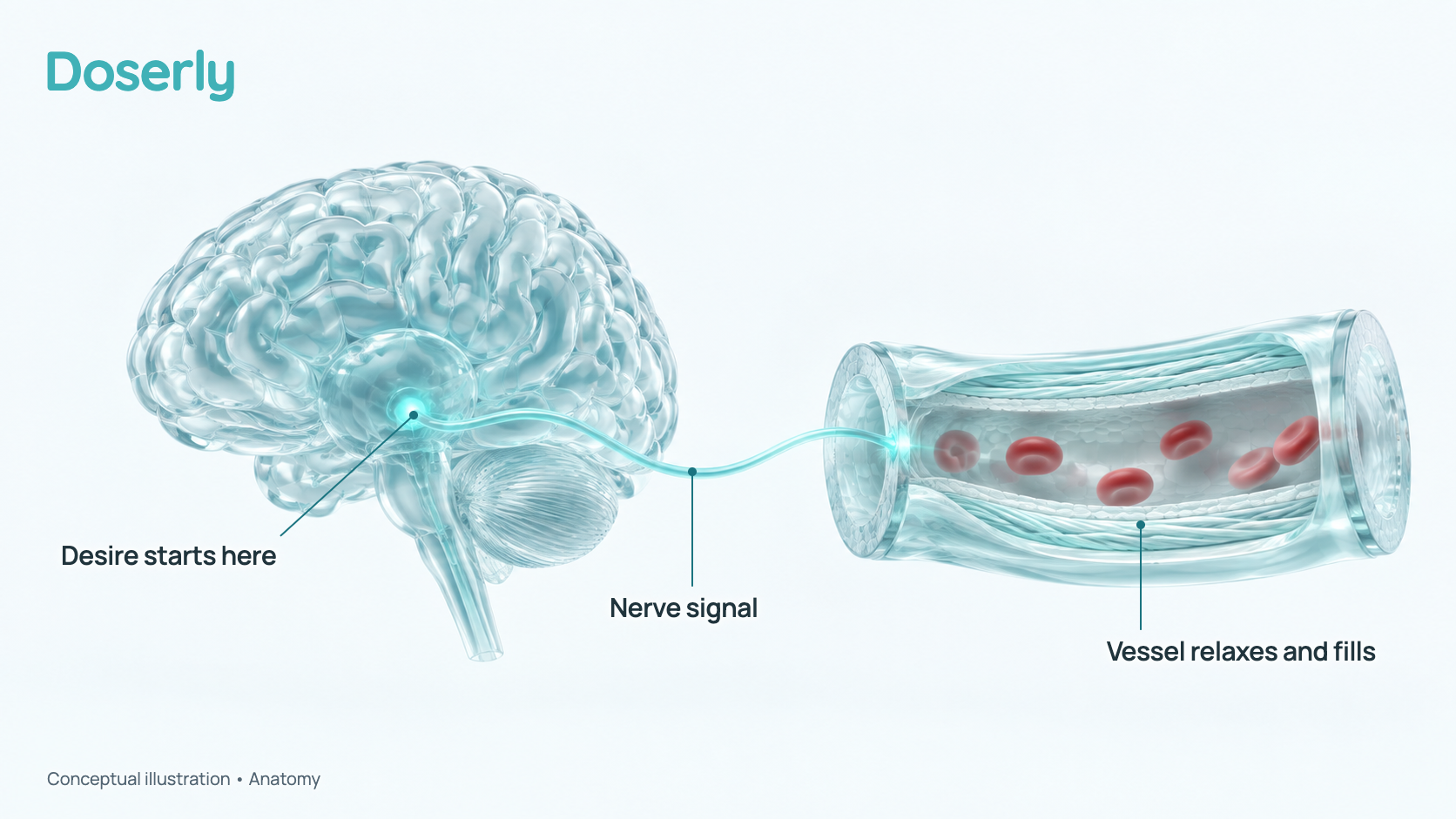
Desire and erections run on different systems. Desire starts in the brain. An erection is a blood-flow event: nerves signal the blood vessels in the penis to relax and fill, which depends on healthy arteries and nerves as much as on hormones. That is why TRT often restores wanting sex without always fixing erections, and why the ED tablets, PDE5 inhibitors such as sildenafil (Viagra) and tadalafil (Cialis), remain the main ED treatment. [11], [14]
Low testosterone (hypogonadism) is also not the usual cause of ED. In 1,022 men referred for ED, repeatedly low testosterone was found in 4% of men under 50 and 9% of men 50 or older, and 40% of first low results were normal on a repeat test. The European Association of Urology (EAU) estimates that about 30% of men with ED also have low testosterone, a figure that depends on the cut-off used. [21], [8]
TRT and sexual health: the key numbers
This table shows what each major clinical guideline says about testosterone and sexual symptoms: the level it treats as low, who it tests, what it says treatment does for sex, and when it judges the response. Checked September 2026.
| Guideline (version, year) | Low-testosterone threshold | Who gets tested | What it says about sex | When to judge the response |
|---|---|---|---|---|
| AUA, American Urological Association (2018, validity reconfirmed 2024) | Below 300 ng/dL (10.4 nmol/L) on two early-morning tests, plus symptoms | Men with symptoms or signs; also men with conditions such as unexplained anemia, bone loss, diabetes or long-term opioid use, even without symptoms | Men should be told treatment may improve erectile function and low sex drive | Discuss stopping at 3–6 months if levels are normal but symptoms have not improved |
| AUA erectile dysfunction guideline (2018) | Uses the AUA testosterone definition | Every man with ED (morning total testosterone) | A PDE5 inhibitor may work better combined with testosterone in men with low testosterone | Not stated |
| Endocrine Society (2018) | 264 ng/dL (9.2 nmol/L) with a certified assay, on repeated morning fasting tests | Men with symptoms and signs of low testosterone | Improves libido, erections and activity in men with low testosterone and low libido; no benefit without low testosterone; no extra erection gain over an optimized PDE5 inhibitor; no effect on ejaculation | Review at 3–12 months, then yearly |
| Endocrine Society statement (July 2026) | Near 300 ng/dL (about 10.4 nmol/L) on at least two early-morning fasting tests | Symptoms alone are not diagnostic; rule out reversible causes such as obesity, corticosteroids and opioids first | Not addressed | Not stated |
| EAU, European Association of Urology (2026) | Below 12 nmol/L (about 350 ng/dL) | Every man with ED; prolactin when low desire comes with secondary hypogonadism | Testosterone first for mild ED in men with low testosterone (strong); add a PDE5 inhibitor for more severe ED (weak); do not treat men with normal testosterone (strong) | First clinical review after 3 months |
| ICSM, International Consultation on Sexual Medicine (2024, published 2025) | Below 12 nmol/L (about 350 ng/dL) | Testosterone and prolactin in every man with low desire; prolactin not routine in ED; estradiol not used to judge erections | Use testosterone for low desire and for ED below 12 nmol/L (both strong; the erection gain is "significant but modest"); consider not prescribing aromatase inhibitors, or hormones that cannot turn into estradiol, for low desire. Desire can change within 2–3 weeks; erections can take 6 or even 12 months | Not stated |
| BSSM, British Society for Sexual Medicine (2023) | Below 12 nmol/L (about 350 ng/dL), or free testosterone below 225 pmol/L (about 65 pg/mL) | Not stated | Testosterone for ED works best below 8 nmol/L (about 230 ng/dL) or free testosterone below 180 pmol/L (about 52 pg/mL); consider combining it with a PDE5 inhibitor; alone it adds a modest 1–3 points on the erection score | Stop if libido or sexual function has not improved by 6 months |
| CUA, Canadian Urological Association (2021) | Below 10 nmol/L (about 290 ng/dL) | Not stated | Gains in libido and sexual function after 3 months or longer; a PDE5 inhibitor treats ED as a symptom-specific option | Stop if nothing has improved after about 3 months despite normal levels |
| Society for Endocrinology, UK (2022) | Sexual symptoms more likely below 8 nmol/L (about 230 ng/dL), or below 11 nmol/L (about 320 ng/dL) with free testosterone below 220 pmol/L (about 64 pg/mL) | Not stated | Benefit shown below 8 nmol/L; little evidence of benefit above 12 nmol/L. Sexual interest can change within 3–6 weeks | Rejects a time-limited trial of treatment; expects lifelong treatment once the diagnosis is confirmed |
| VA, US Department of Veterans Affairs (January 2026) | 264 ng/dL (9.2 nmol/L) on at least two fasting early-morning tests | Not stated | PDE5 inhibitors remain first-line for ED | Stop if symptoms have not improved after 6–12 months despite levels in range |
| ACP, American College of Physicians (2020, now listed as inactive) | No threshold of its own | Not stated | For age-related low testosterone, consider treatment only for sexual dysfunction | Re-evaluate within 12 months; stop if sexual function has not improved |
| US product labels | Low testosterone with an associated medical condition | Not stated | No sexual-function indication; FDA invited applications for a low-libido indication in April 2026, and none is approved | Not stated |
[6], [10], [7], [22], [8], [23], [11], [13], [12], [15], [14], [24], [25], [18]
The guidelines agree that testosterone helps sex only when testosterone is genuinely low, and the trials behind them show desire responding more reliably than erections. The low-testosterone line varies from 264–300 ng/dL in US documents to 12 nmol/L (about 350 ng/dL) in European and international ones. The British sexual-medicine and UK endocrine bodies see the clearest erection benefit below 8 nmol/L (about 230 ng/dL). The main disagreement is about combining testosterone with an ED tablet, covered in what guidelines do. [7], [8], [2], [13], [15]
Why do the thresholds differ?
Partly because of how testosterone is measured and partly because of who was studied. The Endocrine Society's 264 ng/dL is the lower limit of normal in healthy young men measured with a standardized, certified assay. The AUA picked 300 ng/dL as a practical cut-off. The EAU and ICSM treat 12 nmol/L as a reliable line for diagnosing low testosterone that appears in middle and older age. [7], [6], [8]
Sexual symptoms do not switch on at one number. In the European Male Ageing Study of 3,369 men aged 40 to 79, only the three sexual symptoms (poor morning erections, low desire and ED) formed a clear pattern with low testosterone. Their likelihood rose across a band from 8 to 13 nmol/L. The study's research definition of late-onset hypogonadism (low testosterone that appears with age) needs at least three sexual symptoms plus total testosterone below 11 nmol/L (about 320 ng/dL) and free testosterone below 220 pmol/L. It is a research definition, not a treatment rule. [1], [15]
Desire and erections also respond at different levels. In 434 men aged 50 to 86, loss of libido became more common below 15 nmol/L, while ED was linked to testosterone only below 8 nmol/L. The ICSM reports that each 1 nmol/L drop below 8 nmol/L raised the risk of low desire by 48%. [26], [11]
How do the units work?
US labs report testosterone in ng/dL; most other countries use nmol/L. 1 nmol/L is about 28.8 ng/dL, so 12 nmol/L is about 346 ng/dL (often rounded to 350) and 8 nmol/L is about 231 ng/dL. Free testosterone, the small share not bound to proteins, is reported in pmol/L or pg/mL: 220 pmol/L is about 64 pg/mL. The testosterone unit converter switches between them, and the TRT blood work guide explains when to draw each test. [1]
Where these numbers come from
Each row comes from that body's current document: the AUA testosterone deficiency guideline (2018, validity reconfirmed 2024) and its erectile dysfunction guideline (2018), the Endocrine Society guideline (2018) and its July 2026 statement, the EAU guidelines on sexual and reproductive health (2026 edition: the hypogonadism and erectile dysfunction chapters), the ICSM 2024 recommendations on hormones and sexual function (published 2025), the BSSM guidelines (2023), the CUA guideline (2021), the Society for Endocrinology guideline (2022), the VA clinical recommendations (January 2026) and the ACP guideline (2020, which ACP now lists as inactive). [6], [10], [7], [22], [8], [23], [11], [13], [12], [15], [14], [24]
The label row comes from FDA's testosterone information page and its April 2026 announcement inviting a low-libido indication. [25], [18]
Not used: a claim that 27.7% of men with ED have testosterone below 300 ng/dL (it is not in the paper it was attributed to), a figure of 30 million US men with ED that we could not trace to a primary source, and a statement that the Endocrine Society requires two tests below 300 ng/dL (its 2018 guideline uses 264 ng/dL; 300 ng/dL is the AUA's number).
How does testosterone affect desire, erections and orgasm?
Testosterone acts in the brain, where desire starts, and in the tissue of the penis, where erections happen. Human studies show clearly that very low testosterone reduces desire; the effects inside the penis come mostly from laboratory and animal research. [11], [27]
- Desire. The ICSM states that testosterone "significantly contributes to the regulation of male sexual desire". In 177 men aged 60 to 80 whose own testosterone was switched off and then replaced at different levels, desire and erections held up until testosterone fell below 100 ng/dL, a very low level. [11], [27]
- Estradiol helps too. Men turn some testosterone into estradiol, the main estrogen. When men's testosterone and estradiol were lowered experimentally, both hormones contributed to lower sexual function. In the Testosterone Trials, bigger rises in estradiol as well as testosterone went with bigger gains in desire and activity. [28], [29]
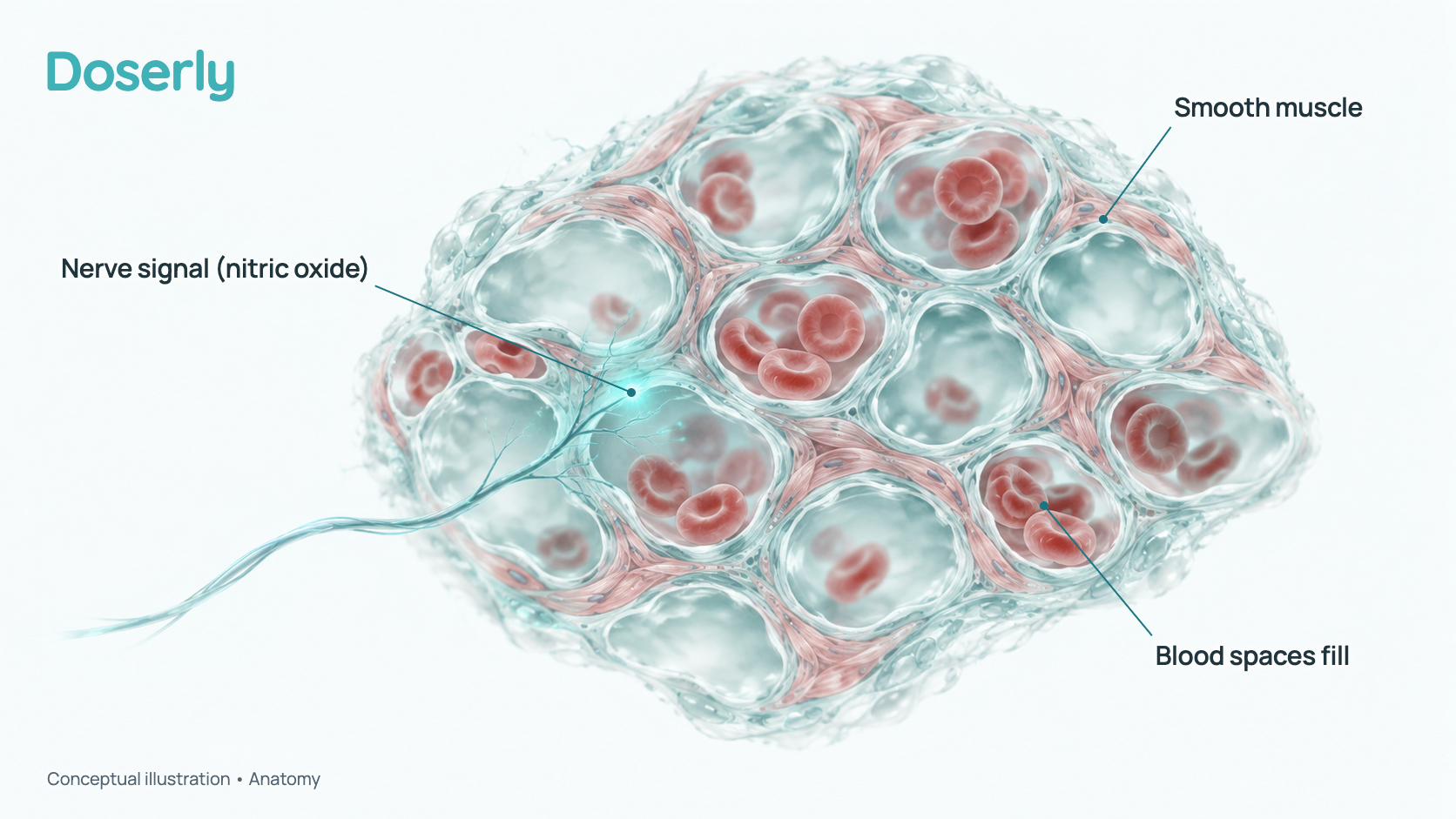
- Erections. The ICSM lists testosterone's targets in penile tissue: the nitric oxide signal that relaxes smooth muscle so blood can flow in, and the upkeep of that smooth muscle. It also notes that sustained low testosterone goes with worse erections. Most of this comes from laboratory and animal work. In a small study of 8 men with normal testosterone, one testosterone injection made night-time erections more rigid but not more frequent. [11], [30]
- DHT is not the missing piece. Testosterone is partly converted to DHT. The ICSM finds DHT's effect on erections similar to testosterone's and advises against measuring it or using DHT-based products instead of testosterone. In a 20-week trial of 139 men given testosterone, blocking DHT with dutasteride did not change sexual function. [11], [31]
Does more testosterone mean better sex?
Not reliably. In healthy young men whose own testosterone was switched off and replaced at weekly research doses, sexual function did not change significantly at any dose, including the lowest doses that left testosterone below normal. Meanwhile, hemoglobin rose and HDL ("good") cholesterol fell as the dose went up. In older men given graded research doses, overall sexual function scores and waking erections rose with dose, but how often the men had intercourse or masturbated did not. These were research doses, not treatment protocols, and no trial has shown that pushing testosterone above the normal range improves sex in daily life. [16], [32]
What does the research show?
Placebo-controlled trials in men with low testosterone agree that TRT improves sexual desire and activity. Its effect on erections is real but modest, it depends on how low testosterone was to start with, and orgasm and ejaculation change little. [2], [3], [4], [33]
Does TRT improve sex drive?
Yes, most consistently of all its sexual effects. The two largest trials both found it:
| Study | Who and what | Result for desire and activity | What it cannot show |
|---|---|---|---|
| TRAVERSE sexual substudy (controlled trial, 2024) | 1,161 men aged 45 to 80 with low testosterone and low libido, daily 1.62% transdermal gel (absorbed through the skin) or placebo | About 0.5 more sexual acts per day at 6 and 12 months, lasting to 24 months; desire improved | Erections did not improve; all men had heart disease or high heart risk [2] |
| Testosterone Trials (controlled trial, 2016) | 790 men aged 65 or older with testosterone below 275 ng/dL, 1% gel or placebo for a year; 470 had low libido | Improved sexual activity, desire (by 2.93 points on a desire scale) and erections; 10 of 12 activity measures improved, including intercourse, masturbation and night-time erections | The response was "somewhat less" at 12 months; no baseline trait predicted who responded [3], [29] |
| T4DM (controlled trial, 2025 analysis) | 1,007 men aged 50 to 74 with prediabetes or new type 2 diabetes, testosterone undecanoate injections or placebo plus a lifestyle program for 2 years | All five sexual-function areas improved; a clinically meaningful gain in desire in 32% of men on testosterone and 22% on placebo | The share of men with a meaningful erection gain did not differ significantly (23% vs 20%; see below) [34] |
| Endocrine Society review (meta-analysis, 2018) | 4 low-bias trials, 1,779 men with confirmed low testosterone | Small gains in desire, erections and satisfaction | "Small" effects on a standardized scale [35] |
| Review of placebo-controlled trials (2007) | Men with sexual dysfunction, trials in low testosterone | A large effect on libido | Satisfaction with erections did not change clearly [36] |
A September 2026 review of the Testosterone Trials and TRAVERSE concluded that testosterone improves sexual function and mood but not energy, physical function or thinking. [37] The same pattern held after prostate cancer surgery: in a 2026 trial of 136 men treated for low-grade prostate cancer, 12 weeks of testosterone cypionate 100 mg weekly improved sexual activity and desire but not erections. That trial was too short and small to judge long-term cancer safety; see the TRT and prostate guide. [38]
Other ways of raising testosterone may help desire less. A 2026 meta-analysis found that clomiphene, a pill that makes the body produce more of its own testosterone, raised testosterone about as much as testosterone gel, but libido scores improved less than with TRT. [39] The clomiphene guide covers it in full.
Does TRT improve erections?
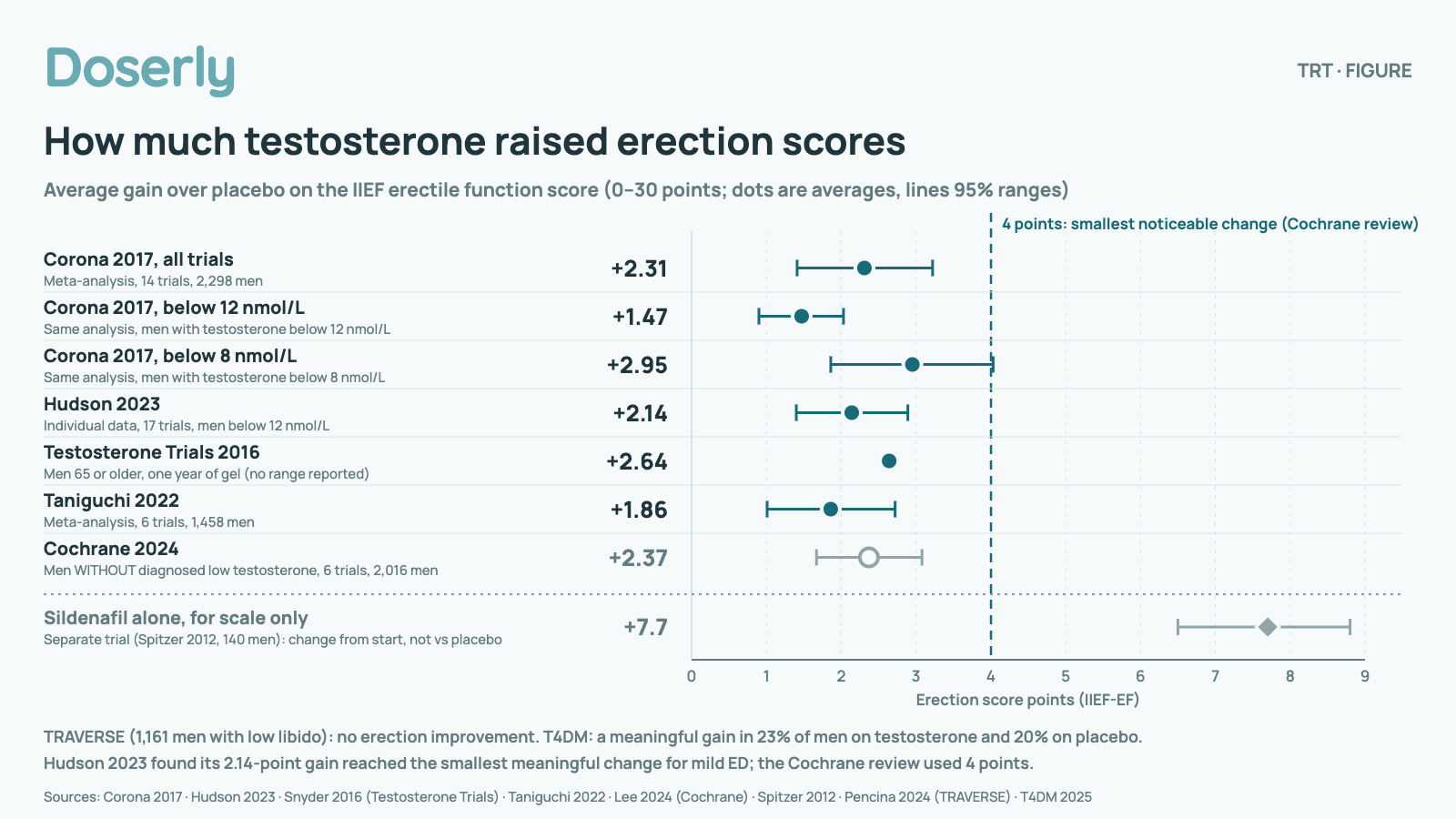
Modestly. Most trials measure erections with the IIEF erectile function score, which runs up to 30 points; higher is better. Pooled trials put TRT's average gain at about 2 points:
| Study | Who | Erection score gain vs placebo | Note |
|---|---|---|---|
| Corona 2017 (meta-analysis of 14 trials, 2,298 men) | Men in placebo-controlled trials | 2.31 overall; 1.47 if testosterone started below 12 nmol/L; 2.95 if below 8 nmol/L | Smaller with diabetes or obesity [4] |
| Hudson 2023 (pooled individual data, 17 trials) | Men with testosterone below 12 nmol/L | 2.14 | Reached the smallest meaningful change for mild ED; did not depend on age, weight, diabetes or starting testosterone [5] |
| Testosterone Trials (2016) | Men 65 or older | 2.64 | One year of gel [3] |
| Taniguchi 2022 (6 trials, 1,458 men) | Men with late-onset low testosterone | 1.86 | Clearer with gel, beyond 30 weeks and without diabetes [40] |
| Cochrane 2024 (6 trials, 2,016 men) | Men with sexual dysfunction but without diagnosed low testosterone | 2.37 | Below the 4 points the authors counted as a noticeable change; "little to no effect"; combined the full and five-question erection scores [41] |
| TRAVERSE (2024) | Men with low libido and high heart risk | No improvement | Desire and activity improved [2] |
| T4DM (2025) | Men with prediabetes or new diabetes | A meaningful gain in 23% of men on testosterone and 20% on placebo | 3 more men in 100; not significant [34] |
How much testosterone raised erection scores
Average gain over placebo on the IIEF erectile function score (0–30 points; dots are averages, lines 95% ranges).
Each strip runs from 0 (left) to 9 points (right); the dashed mark is 4 points, the smallest noticeable change used by the Cochrane review.
- Corona 2017, all trials: +2.31 points (95% range 1.41–3.22)
- Meta-analysis, 14 trials, 2,298 men
- Corona 2017, below 12 nmol/L: +1.47 points (95% range 0.90–2.03)
- Same analysis, men with testosterone below 12 nmol/L
- Corona 2017, below 8 nmol/L: +2.95 points (95% range 1.86–4.03)
- Same analysis, men with testosterone below 8 nmol/L
- Hudson 2023: +2.14 points (95% range 1.40–2.89)
- Individual data, 17 trials, men below 12 nmol/L
- Testosterone Trials 2016: +2.64 points
- Men 65 or older, one year of gel (no range reported)
- Taniguchi 2022: +1.86 points (95% range 1.01–2.72)
- Meta-analysis, 6 trials, 1,458 men
- Cochrane 2024: +2.37 points (95% range 1.67–3.08)
- Men WITHOUT diagnosed low testosterone, 6 trials, 2,016 men
- Sildenafil alone, for scale only: +7.7 points (95% range 6.5–8.8)
- Separate trial (Spitzer 2012, 140 men): change from start, not vs placebo
TRAVERSE (1,161 men with low libido): no erection improvement. T4DM: a meaningful gain in 23% of men on testosterone and 20% on placebo. Hudson 2023 found its 2.14-point gain reached the smallest meaningful change for mild ED; the Cochrane review used 4 points.
What does 2 points mean? The Hudson analysis found the 2-point gain reached the smallest change that matters to men with mild ED. The Cochrane reviewers used 4 points as the smallest change men notice (the minimal clinically important difference), and by that yardstick the average gain falls short. Averages also hide a spread: the AUA panel says it cannot tell what share of men get a meaningful improvement. [5], [41], [6]
A 2024 meta-analysis of 28 trials reported a larger average, 3.26 points. Like the Cochrane review, it combined the full erection questionnaire with a shorter five-question version, so neither number is exactly comparable with the others. [42], [41]
Does it matter how low testosterone was?
Probably, though the analyses disagree. The erection gain in Corona's analysis was twice as large below 8 nmol/L (2.95 points) as below 12 nmol/L (1.47). In a trial of 199 men with type 2 diabetes, erections improved only in men whose testosterone started at or below 8 nmol/L, and only after 30 weeks. Hudson's individual-data analysis, limited to men below 12 nmol/L, found the average gain did not depend on starting testosterone, although men who started lower ended with lower scores. [4], [43], [5]
Men with normal testosterone do not benefit. A review of trials found testosterone had no effect on erections in men with normal levels. The 3-year TEAAM trial of 308 men aged 60 or older with low or low-normal testosterone found no change in desire, erections or overall sexual function. The EAU strongly advises against treating men with normal testosterone. [9], [44], [8] The Endocrine Society concludes that testosterone does not significantly improve sexual function in men who do not have low testosterone. [7]
Does diabetes or obesity blunt the effect?
The research conflicts. The trials in men with diabetes suggest the starting level matters most.
- Smaller effect: Corona's and Taniguchi's meta-analyses found smaller erection gains in men with diabetes, obesity or metabolic syndrome. [4], [40]
- No difference: Hudson's pooled individual data from 17 trials found the erection gain did not depend on age, weight or diabetes, although older men and men with obesity started worse and so ended with lower scores. [5]
- Trials in diabetes split by starting level. In 88 men with type 2 diabetes and testosterone below 12 nmol/L, 40 weeks of testosterone undecanoate injections gave no sexual benefit; the short erection score even favored placebo by 2.0 points. The BLAST study of 211 men found benefit only in men with severe deficiency (8 nmol/L or less). In T4DM, all five sexual areas improved. [45], [46], [34]
The practical reading: TRT's benefit for erections is modest at best, the trials in men with diabetes whose testosterone was only mildly low were disappointing, and weight, blood sugar and blood-vessel health matter as much. The obesity-related low testosterone guide covers weight loss first.
Does TRT help orgasm, ejaculation or semen volume?
Not clearly. In the only randomized trial in men with both low testosterone and ejaculation problems (76 men, 16 weeks of testosterone solution), ejaculation scores rose on testosterone (3.1 points) and on placebo (2.5 points), with no real difference. Measured semen volume did not differ from placebo either. [33] A larger 12-week trial of 715 men found self-reported ejaculatory function improved, but how much the problem bothered men did not. [47] The Endocrine Society concludes that testosterone does not improve ejaculatory function. [7]
For orgasm, results differ by study: Corona's meta-analysis reported improvement, the BLAST trial in diabetes found none, and T4DM found orgasm improved, more so in older men. [4], [43], [34] No controlled study has measured genital sensation on TRT.
How long does TRT take to work for sex?
Desire usually changes first, within weeks; erections take months.
- Desire. A review of treatment time courses put the first changes in sexual interest at about 3 weeks, leveling off by 6 weeks. The ICSM reports effects on libido, ejaculation and sexual activity within 2 to 3 weeks, and the Society for Endocrinology within 3 to 6 weeks. [48], [11], [15]
- Erections. The same review found erection changes could take up to 6 months, and the ICSM says 6 or even 12 months. In men with diabetes and severe deficiency, erections improved only after 30 weeks. [48], [11], [43]
- Guideline expectations. The CUA tells men to expect gains after 3 months or longer. [12]
- Staying power. In TRAVERSE, the gain in sexual activity lasted to 24 months. In the Testosterone Trials, the response was somewhat smaller at 12 months than earlier. The AUA notes long-term observational data suggesting erection improvements may continue for up to 3 years. [2], [3], [6]
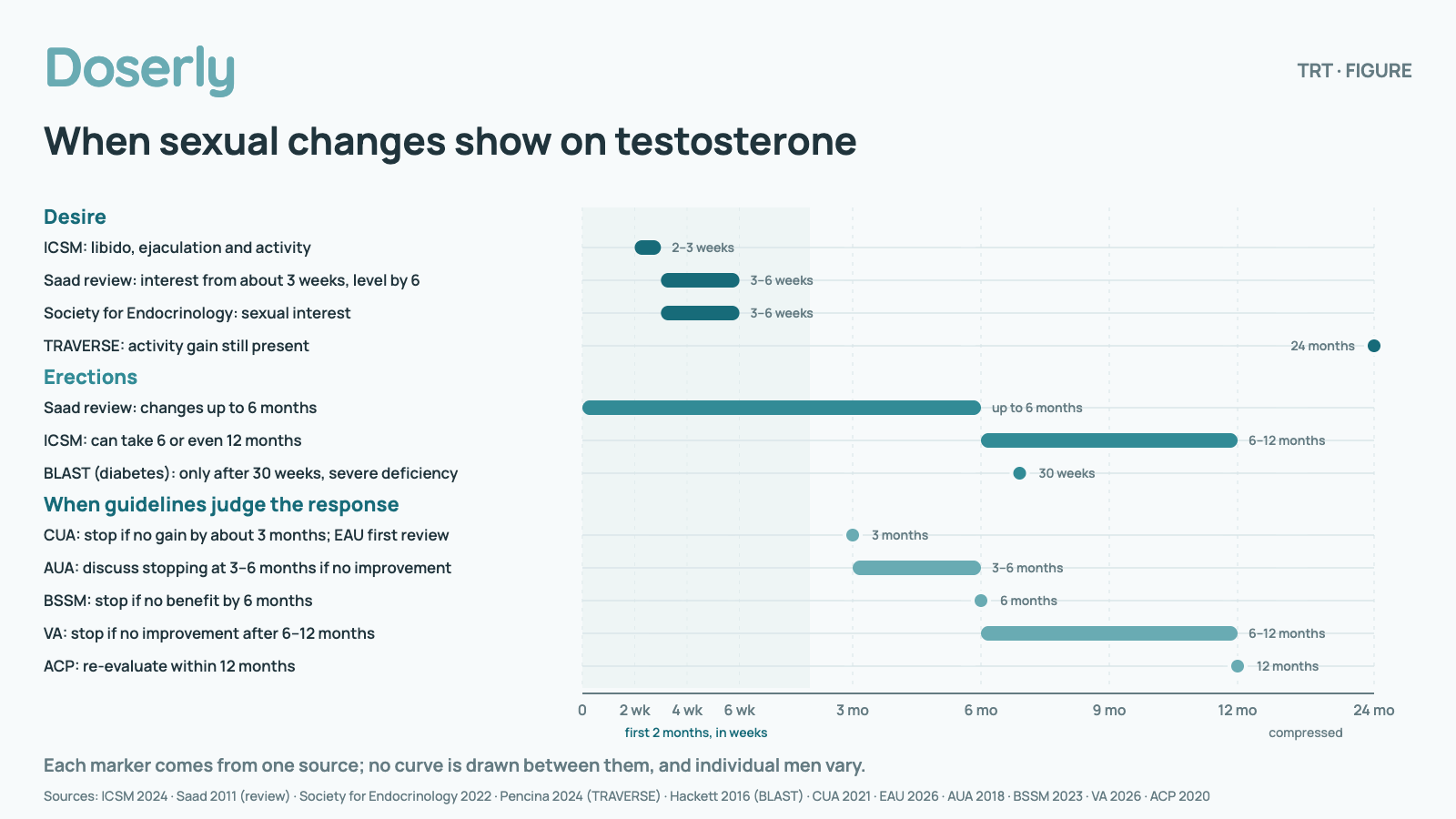
When sexual changes show on testosterone
Desire
- 2–3 weeks
ICSM: libido, ejaculation and activity.
- 3–6 weeks
Saad review: interest from about 3 weeks, level by 6.
- 3–6 weeks
Society for Endocrinology: sexual interest.
- 24 months
TRAVERSE: activity gain still present.
Erections
- Up to 6 months
Saad review: changes up to 6 months.
- 6–12 months
ICSM: can take 6 or even 12 months.
- 30 weeks
BLAST (diabetes): only after 30 weeks, severe deficiency.
When guidelines judge the response
- 3 months
CUA: stop if no gain by about 3 months; EAU first review.
- 3–6 months
AUA: discuss stopping at 3–6 months if no improvement.
- 6 months
BSSM: stop if no benefit by 6 months.
- 6–12 months
VA: stop if no improvement after 6–12 months.
- 12 months
ACP: re-evaluate within 12 months.
Each marker comes from one source; no curve is drawn between them, and individual men vary.
The TRT results timeline guide sets sexual changes beside energy, mood, muscle and red blood cells.
Does TRT help men with depression or on antidepressants?
Possibly, in one small trial. In 100 depressed men with low or low-normal testosterone taking serotonin-based antidepressants, 6 weeks of testosterone gel raised the total sexual-function score by 16.8 points more than placebo, including ejaculation. Only 63 men had complete data, and men with higher testosterone improved about as much as men with lower levels. [49] Depression itself lowers sexual function, but it did not block the benefit in T4DM. There, the gain in desire on testosterone was larger in men with more depressive symptoms, and falling depression scores went with better sexual function in both groups. [34] The TRT and mental health guide covers mood.
What research is under way?
Checked September 2026. A randomized trial of testosterone gel around prostate-removal surgery, with sexual function as its main outcome, is recruiting (140 men planned). A 20-man study of the Xyosted autoinjector for ED in multiple sclerosis was not yet recruiting, and a trial of Natesto nasal gel on erections and sexual satisfaction was withdrawn without enrolling anyone. [50], [51], [52]
Is TRT safe, and what sexual side effects can it cause?
For men with confirmed low testosterone who are monitored, TRT's main risks are not sexual: they are red blood cells, fertility, blood pressure and prostate checks. Labels list a few sexual side effects, mostly without rates, and heart safety comes from the TRAVERSE trial. [53], [7], [54], [55]
What sexual side effects do the labels list?
- Too many or too-long erections. The Depo-Testosterone label says "priapism or excessive sexual stimulation may develop", and patient information for Depo-Testosterone, AndroGel 1.62%, Xyosted and Aveed tells men to report "too frequent or persistent erections of the penis" to their prescriber. [53], [56], [57], [58]
- Changes in libido, in either direction. Labels list "increased or decreased libido". UK labels add that prolonged or frequent erections, irritability and nervousness can mean too much testosterone and a need to adjust the dose. [53], [58], [59]
- Ejaculation. In Aveed's trials, 2 men (1.3%) reported an ejaculation disorder. [58]
Labels give no rates for most of these, so they cannot say how often they happen.
Does TRT affect fertility?
Yes, and this matters for anyone planning children. Testosterone from outside the body switches off the brain's signal to the testicles, lowering sperm production. In a World Health Organization contraception trial, weekly testosterone enanthate injections left 65% of healthy men with no sperm within 6 months. Labels warn that reduced fertility can be irreversible, and the AUA says testosterone should not be prescribed to men trying to conceive. [60], [57], [6] The TRT and fertility guide and the hCG guide cover options that protect sperm production.
What did TRAVERSE show about heart safety?
TRAVERSE is the largest trial of testosterone and heart safety, and its sexual results in this guide come from the same trial. About 5,200 men aged 45 to 80 with low testosterone and heart disease or high heart risk used a daily testosterone gel or a placebo gel. Heart attack, stroke or cardiovascular death occurred in 7.0% of men on testosterone and 7.3% on placebo (182 of 2,596 men vs 190 of 2,602; hazard ratio 0.96), which met the trial's safety goal. In the same two groups, some problems were more common on testosterone: atrial fibrillation 3.5% vs 2.4%, acute kidney injury 2.3% vs 1.5%, pulmonary embolism 0.9% vs 0.5%, and other nonfatal heart-rhythm problems needing treatment 5.2% vs 3.3%. [54], [55] Clinical fractures were also more common on testosterone: 91 of 2,601 men (3.5%) vs 64 of 2,603 (2.5%), hazard ratio 1.43. [61] High-grade prostate cancer was rare in both groups, 5 of 2,596 men (0.19%) vs 3 of 2,602 (0.12%), a difference that was not significant; see the TRT and prostate guide. [62]
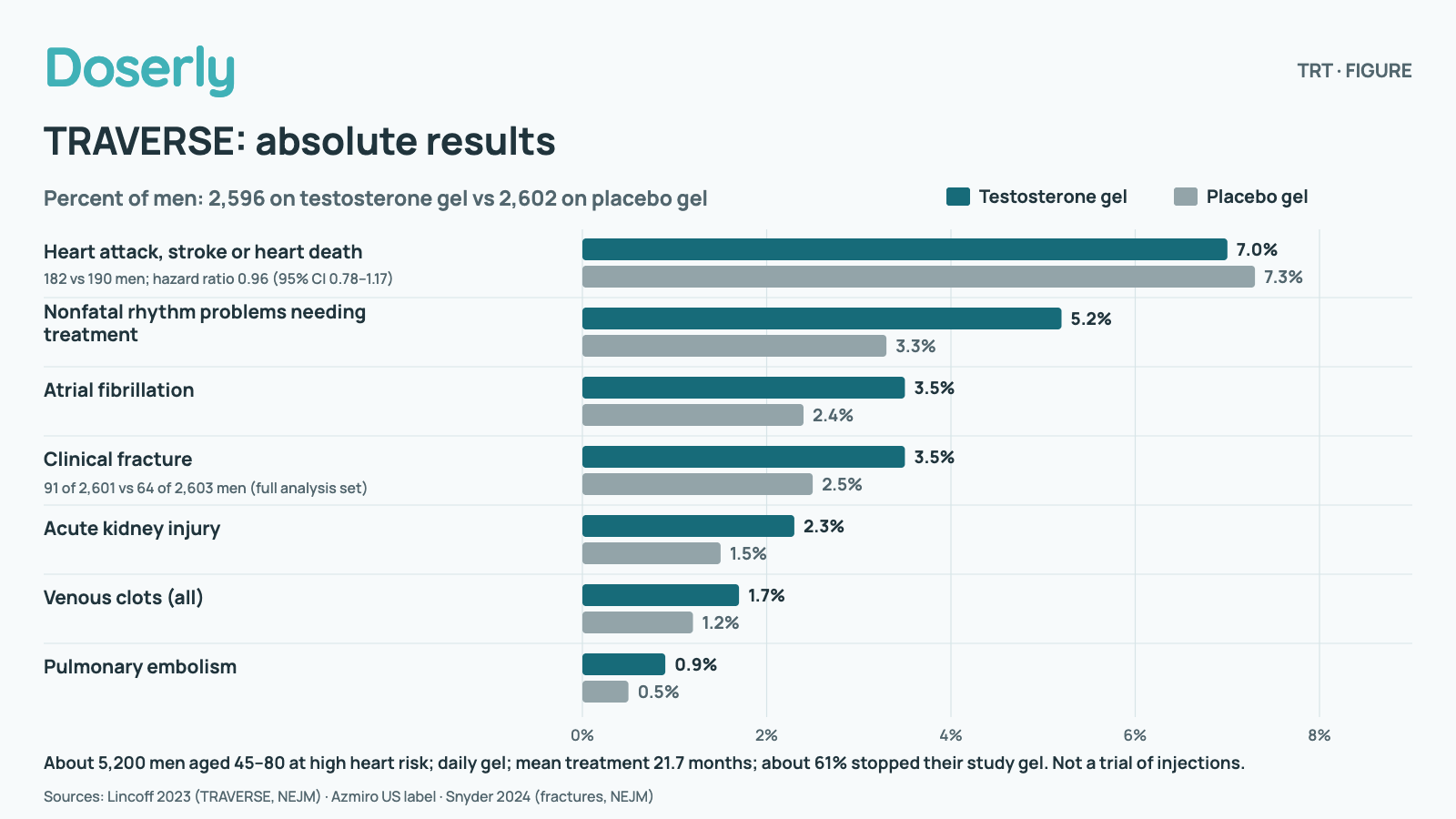
TRAVERSE: absolute results
Testosterone gel (2,596 men)Placebo gel (2,602 men)
- Heart attack, stroke or heart death
- Testosterone 7.0% vs placebo 7.3% (182 vs 190 men; hazard ratio 0.96, 95% CI 0.78–1.17; met the 1.5 safety margin)
- Nonfatal rhythm problems needing treatment
- Testosterone 5.2% vs placebo 3.3%
- Atrial fibrillation
- Testosterone 3.5% vs placebo 2.4%
- Clinical fracture
- Testosterone 3.5% vs placebo 2.5% (91 of 2,601 vs 64 of 2,603 in the full analysis set)
- Acute kidney injury
- Testosterone 2.3% vs placebo 1.5%
- Venous clots (all)
- Testosterone 1.7% vs placebo 1.2%
- Pulmonary embolism
- Testosterone 0.9% vs placebo 0.5%
About 5,200 men aged 45–80 at high heart risk; daily gel; mean treatment 21.7 months; about 61% stopped their study gel. Not a trial of injections.
Its limits matter: it tested only a daily gel, men used it for an average of 21.7 months, about 61% stopped their study gel early, and it enrolled men already at high heart risk. [54], [55] The TRT and heart health guide covers the trial in full, and the hematocrit guide covers red blood cells.
Who should be especially cautious?
- Men trying for a pregnancy now or soon. Guidelines advise against testosterone for them (see fertility above). [6], [8]
- Men who take nitrate medicines for chest pain, such as nitroglycerin, if an ED tablet is part of the plan. Taking nitrates in any form with sildenafil or tadalafil is contraindicated because blood pressure can drop dangerously. [63], [64]
- Men with very low testosterone plus low or normal LH, or with high prolactin. These can point to a pituitary problem that needs its own work-up. The AUA advises a pituitary scan when total testosterone is below 150 ng/dL with low or low-normal LH, and the EAU when secondary low testosterone comes with high prolactin. [6], [8]
- Men with depression, or taking antidepressants or other medicines that affect sex (see the next question). [17], [49]
- Men with conditions guidelines list as reasons not to start, such as a raised hematocrit, untreated severe sleep apnea, recent heart attack or stroke, or prostate or breast cancer. [7]
- Drug-tested athletes. Testosterone is prohibited in sport at all times. [20]
- Under-18s. Testosterone for teenagers belongs only in specialist care.
- Women. This guide is written for men. Testosterone for women uses different doses and products; see testosterone therapy for women.
Which medicines affect sexual function or interact?
Several common medicines lower desire or erections on their own, which is worth checking before blaming testosterone:
- Antidepressants. On the sertraline (Zoloft) label, men in trials (1,316 on sertraline, 973 on placebo) reported ejaculation failure in 8% vs 1% on placebo, decreased libido in 7% vs 2%, and ED in 4% vs 1%. [17]
- Finasteride and dutasteride (5-alpha reductase inhibitors, for hair loss or an enlarged prostate). On the Propecia label (945 men on finasteride, 934 on placebo), decreased libido was 1.8% vs 1.3% on placebo in the first year, ED 1.3% vs 0.7%, and ejaculation disorder 1.2% vs 0.7%. Reports after approval include sexual problems that continued after stopping. On the Avodart label (2,167 men on dutasteride, 2,158 on placebo), impotence was 4.7% vs 1.7% and decreased libido 3.0% vs 1.4% in the first 6 months, falling to about placebo levels later. [65], [66]
- Opioid painkillers. Long-term opioid use lowers the body's own testosterone: a 2020 meta-analysis found low testosterone in 63% of men using opioids, and opioid labels warn of androgen deficiency with long-term use. [67], [68]
- ED tablets with nitrates. Contraindicated, as above. [63], [64]
- Aromatase inhibitors such as anastrozole. In older men with low testosterone, a year of anastrozole raised testosterone but lowered spine bone density compared with placebo. The VA does not generally recommend these medicines for men on testosterone. [69], [14]
- Supplements sold for sexual enhancement. FDA does not approve dietary supplements for safety or effectiveness and warns that male enhancement products are likely to be contaminated with dangerous hidden ingredients. [70]
Bring a complete list of what you take, including supplements, to a pharmacist or prescriber. Checked September 2026.
Is testosterone legal, and is it allowed in sport?
Checked September 2026. Rules differ by country and change often.
- United States. Testosterone and its esters are Schedule III controlled substances, prescription only. FDA-approved products are for men with low testosterone plus an associated medical condition; none is approved for sexual problems. On 16 April 2026 FDA invited companies that hold approved testosterone applications to seek a low-libido indication in men whose low testosterone has no identified cause. That is an invitation, and no such indication has been approved. Separately, label changes requested in June 2026 (removing the age-related limitation, among others) are still pending and not yet in any label. [19], [25], [18], [71]
- United Kingdom. Testosterone is a Class C controlled drug, in Schedule 4 Part II of the Misuse of Drugs Regulations. [72]
- Canada. Testosterone is a Schedule IV controlled substance. [73]
- Australia. Testosterone is a Schedule 4 prescription-only medicine. [74]
- Sport. The World Anti-Doping Agency (WADA) prohibits testosterone at all times, and its 2027 list, published in September 2026, keeps the ban. Aromatase inhibitors and clomiphene are prohibited too. [20], [75]
What do guidelines say to do about sexual symptoms?
Guidelines first confirm that testosterone is genuinely low, look for other causes, then treat and judge the response within months. This section describes the choices clinicians weigh; it is not a personal plan. [6], [7], [8], [11]
| Step | Which guidelines name it | What the evidence shows |
|---|---|---|
| Measure morning testosterone in men with ED | AUA erectile dysfunction guideline, EAU (strong) | About 30% of men with ED have low testosterone, by the EAU's estimate [8] |
| Measure testosterone and prolactin in men with low desire | ICSM (both strong); EAU when low desire comes with secondary low testosterone; AUA when LH is low or low-normal | Severe high prolactin was found in 1.4% of men seeking care for low libido [11] |
| Repeat a low result before treating | AUA, Endocrine Society, EAU, VA | 40% of first low results in an ED clinic were normal on repeat [21] |
| Treat low testosterone with sexual symptoms | All; EAU and ICSM below 12 nmol/L | Desire improves reliably; erections by about 2 points on average [2], [4] |
| Add an ED tablet | AUA erectile dysfunction guideline, BSSM, EAU (for more severe ED) | Conflicting; see the next question |
| Avoid aromatase inhibitors for low desire | ICSM ("consider not prescribing" them); the VA does not generally recommend them | The one sexual-function trial was small and not significant [76] |
| Judge the response and stop if no benefit | CUA about 3 months, AUA 3–6 months, BSSM 6 months, VA 6–12 months, ACP 12 months; the Society for Endocrinology instead expects lifelong treatment once the diagnosis is confirmed | No baseline trait predicted who responded in the Testosterone Trials [29] |
[10], [23], [11], [6], [12], [13], [14], [24], [15]
Should TRT be combined with tadalafil or sildenafil?
Guidelines disagree, and so do the trials.
- For combining. The AUA's ED guideline says men with ED and low testosterone should be told a PDE5 inhibitor may work better combined with testosterone. The BSSM says to consider the combination, and the EAU suggests it for more severe ED (a weak recommendation). A 2020 meta-analysis of 8 trials (913 men) found the combination beat a PDE5 inhibitor alone, with no difference in side effects or PSA. The EAU adds that men with low testosterone who do not respond to ED tablets may respond after starting testosterone. [10], [13], [8], [77], [23]
- Against. In a randomized trial of 140 men with ED and low or low-normal testosterone, adding testosterone to an optimized sildenafil dose raised the erection score by a further 2.2 points over placebo, a difference that was not statistically clear. Before randomization, sildenafil alone had already raised it by 7.7 points, a before-and-after change with no placebo comparison. In 173 men who had not responded to tadalafil, adding testosterone gel helped overall no more than placebo; the benefit was clear only in men whose testosterone started at or below 3 ng/mL (300 ng/dL). The Endocrine Society concludes that trials failed to show extra erection benefit from adding testosterone to an optimized ED tablet, and the VA keeps ED tablets first-line. [78], [79], [7], [14]
The reading most consistent with both sides: adding testosterone helps erections most in men whose testosterone is clearly low, and guidelines add or prefer an ED tablet for more severe ED. A 2014 meta-analysis also found that, after adjusting for possible publication bias, the positive effects of testosterone on erections and libido held up only in trials partly or fully funded by drug companies. Its authors thought trial design, more than bias, might explain the difference. [79], [13], [8], [14], [78], [80]
What the ED tablet labels say. Tadalafil (Cialis) for ED starts at 10 mg before sexual activity (adjustable to 5–20 mg), or 2.5 mg once daily (up to 5 mg). Sildenafil (Viagra) is usually 50 mg about an hour before sex (25–100 mg, at most once a day). Both are contraindicated with nitrates in any form. These are label doses, set by a prescriber; the TRT dosage guide covers testosterone doses themselves. [63], [64]
What happens if TRT does not help?
Most guidelines say to stop, at review points from about 3 months (CUA) to 12 months (ACP), as the tables above show. [12], [6], [13], [14], [24] No baseline trait in the Testosterone Trials predicted who would respond, so the AUA, CUA, BSSM, VA and ACP treat the first months as a trial with a clear review date. [29] The Society for Endocrinology disagrees: it does not accept a time-limited "therapeutic trial" and expects most men with a confirmed diagnosis to stay on treatment for life. [15] The stopping TRT guide covers what happens when testosterone stops.
Why can sex drive stay low on TRT?
The short answer: testosterone is only one input. Once levels are in range, most persistent problems come from something else, and the practical questions below cover the most common ones.
Why is my libido low on TRT when my levels look good?
A higher dose is not a reliable fix: dose studies found no gain in how often men had sex from more testosterone (see does more testosterone mean better sex?). [16], [32] The causes guidelines and labels name include:
- Depression, and the medicines for it (see interactions). [17], [34]
- Finasteride or dutasteride, and opioids. [65], [66], [67]
- High prolactin (see below). [11]
- Blood-vessel health and diabetes. Erections depend on healthy arteries, and trials in men with diabetes found smaller or no erection gains unless testosterone was very low. [4], [43]
- Relationship strain, stress and performance anxiety, which come up again and again in public threads (see what people report).
- Timing. Desire can take weeks and erections months, so an early verdict can mislead. [48]
The Endocrine Society's 2026 statement also stresses ruling out reversible causes such as obesity, corticosteroids and opioids before treatment. [22]
Is it estrogen? Does an aromatase inhibitor help?
Probably not, and guidelines lean against it. The ICSM advises clinicians to "consider not prescribing" aromatase inhibitors for low desire and not to measure estrogen to judge erections, and calls estrogen's role in erections "still controversial". The AUA measures estradiol only when there are breast symptoms. [11], [6] Estradiol made from testosterone supports sexual function: in the Testosterone Trials, bigger estradiol rises went with bigger gains in desire and activity. [28], [29] The only trial of anastrozole for sexual function on TRT, in 40 men with epilepsy, found sexual function normalized in 72.2% with anastrozole plus testosterone and 47.4% with placebo plus testosterone, a difference that was not significant. [76] The estrogen on TRT guide covers estradiol in full.
Could prolactin be the cause?
Occasionally. Prolactin is a pituitary hormone; very high levels suppress desire and testosterone. The ICSM advises measuring prolactin in every man with low desire and reports severe high prolactin in 1.4% of men seeking care for low libido. It links levels above 35 ng/mL with a more than tenfold higher chance of low desire. Mild rises are unlikely to explain low desire. In an older study of 1,821 men with ED, prolactin was above 20 ng/mL in 1.86%. [11], [21] Cabergoline, a medicine that lowers prolactin, is approved for high-prolactin disorders; treating a severe rise waits until its cause is known. [81], [11] Several common medicines, including some antidepressants, opioids and antipsychotics, can raise prolactin. [6]
Do injections make libido swing?
Some men notice it, and guidelines list it. The Endocrine Society lists "fluctuation in mood or libido" as a side effect of intramuscular (into a muscle) injections, and the BSSM notes changes in mood, energy and sexual desire with injections. [7], [13] No trial has tested whether more frequent injections steady sexual function. The testosterone level visualizer shows how injection frequency changes the peaks and troughs, and the TRT dosage guide covers split schedules.
Can TRT make libido too high?
It can rise more than a partner expects. Labels list increased libido and "excessive sexual stimulation", and UK labels say prolonged or frequent erections can signal too much testosterone and a need to adjust the dose; tell your prescriber. [53], [59] Public threads describe early surges that settle and desire mismatches with partners (see what people report).
Does TRT change orgasm, semen volume or sensation?
Not reliably, in either direction (see the research). The one trial that measured semen volume found no difference from placebo. [33] Other medicines can play a part: finasteride's label lists decreased ejaculate volume, and dutasteride's lists ejaculation disorders. [65], [66] We found no controlled study of genital sensation on TRT.
Does hCG help libido or semen volume on TRT?
No trial has tested it. hCG is used with TRT mainly to protect sperm production. [6] Public threads describe both better libido and semen volume after adding it and worse orgasm or mood (see what people report). The hCG guide and the hCG, gonadorelin and enclomiphene comparison cover what it is known to do.
Does SHBG or free testosterone matter?
Sometimes. SHBG is the blood protein that carries testosterone; when it is high, less testosterone is free to act. The European Male Ageing Study followed men for about 4 years, and obesity often lowered their total testosterone. Men whose total testosterone fell while free testosterone stayed normal did not develop new sexual symptoms; only men whose total and free testosterone both fell did. [82] The Society for Endocrinology and the BSSM use calculated free testosterone alongside total testosterone for this reason. [15], [13]
Will morning erections come back?
Often, if testosterone was low. A review of trials found that in men starting below 12 nmol/L, testosterone moderately improved the number of night-time erections, sexual thoughts and motivation, and the Testosterone Trials found night-time erections improved. [9], [29] When morning erections disappear on stable treatment, the same checks as for low libido apply.
Do supplements for libido or erections work on TRT?
None has been tested in men on TRT for this purpose. FDA warns that products sold for sexual enhancement are likely to be contaminated with dangerous hidden ingredients. [70] Doserly's supplement guides, such as tongkat ali and zinc, review each one's own evidence.
What do men on TRT report about sex drive and erections?
Sex drive is one of the most discussed topics in public TRT forums. The threads below are recent public Reddit discussions, read with their replies; they show what people experience, not how often it happens.
What does a good response look like?
Usually a rise in desire within weeks. A man in his 50s who started after very low testosterone readings went from little interest in sex to wanting it daily, alongside better sleep and energy. [83] Another reported much stronger desire only at nine to ten months, after splitting his weekly dose into two injections and several other changes. [84]
Why do some men feel a surge that fades?
It is one of the most common stories. A man in his 30s had strong libido and erections soon after starting weekly injections. Both faded after about two months, and lowering the dose and splitting it did not bring them back. [85] Another felt markedly better for three months on a low weekly dose before libido and morning erections disappeared. A month of cabergoline for raised prolactin changed nothing, and at six months his prolactin was low but his libido still absent. [86], [87] A man switching from pellets to injections had strong erections for five to six weeks, then lost most morning erections, with a trough testosterone of 1,658 ng/dL and a hematocrit of 54.2% at nine weeks. [88] One poster tracked four better days around weeks six to seven, then weeks of flat desire. A higher dose first felt worse, then brought somewhat better erections but not desire by week 15. [89], [90]
What about men whose libido never came back?
These threads are long and frustrating. One man reported three years without libido, morning erections or reliable erections through injections, gel, tadalafil and an aromatase inhibitor. [91] Another described complete loss of desire and severe ED on 100 mg a week, unchanged by DHEA, pregnenolone and kisspeptin. [92] A third, with total testosterone between 1,299 and 1,533 ng/dL, still had low libido after a year; his ferritin was 14 and several other changes clouded the picture. [93] Replies to a man four months in, with a trough level of 600 ng/dL and no libido, pointed to his weight and possible sleep apnea. [94] One poster described years of very low libido across many dose and estradiol changes, during which high testosterone and hCG preceded breast tissue growth that needed surgery. [95]
Do dose, schedule or estradiol changes help?
Changes cut both ways, and most threads changed several things at once. Lowering enanthate from 110 to 90 mg a week improved one man's sleep but lowered his energy and libido without fixing erections. [96] After a prescriber cut a weekly dose because of high free testosterone and a hematocrit of 0.52 L/L, another man reported lower libido, weaker erections and less sensation over four weeks. [97] Going up did not always help either: raising a stable gel dose raised desire at first, then spontaneous erections faded. [98] Switching to every-other-day injections at the same weekly dose raised one man's measured testosterone from 15.5 to 39.8 nmol/L while his libido fell. [99]
Aromatase inhibitor stories are mostly negative or short-lived. One man lowered his dose and started an aromatase inhibitor at the same time and lost libido and morning erections, so the cause could not be separated. [100] Another had one good night after a small anastrozole dose, without a lasting change. [101] Others said an aromatase inhibitor made them feel very unwell or markedly worse. [84], [102]
What do people report about hCG?
Mixed results. One man said changing from larger hCG doses every three days to small daily doses brought stronger libido and orgasms and ended the mood swings. [103] Another felt renewed desire and sensation, and more semen, within days of adding hCG to injections that had stopped working for him. [104] A long-term user found libido and erections improved on hCG but orgasm intensity and semen volume fell. [105] A man on hCG alone had an early boost, then worse erections and less response to ED tablets. [106] No trial has tested any of this.
What do people say about tadalafil and sildenafil on TRT?
That they fix erections, not desire. A man seven weeks into TRT found ED tablets helped erections during use but did nothing for desire or spontaneous erections. [107] Another had little change in erections after three months of testosterone, while daily tadalafil made them reliably stronger; the problem returned when he stopped it. [108] After four years on TRT, one man found a lower tadalafil dose than prescribed clearly helped in the first days. [109] Daily tadalafil made erections so reliable for one poster that he could no longer use them as a signal that something else was changing. [110] Another could not tolerate it, with headache and congestion even at a very low dose. [111]
What about orgasm, sensation and semen volume?
A man in his 50s reported a strong early libido boost that eased, with erections still strong but less sensation and a longer time to climax. [112] After a vasectomy, one man found six months of TRT eased aching testicles but did not restore orgasm pleasure. [113] Another enjoyed stronger morning erections but was disappointed by small semen volume, which he thought may have been modest before treatment too. [114] A man in his 40s found ejaculation became harder after starting, while ED and low desire persisted. [115]
What else turned out to matter?
Many threads end with a cause outside testosterone:
- Finasteride. One man's erections weakened each time he used it, oral or topical. [116]
- Other medicines. An antidepressant and a viral illness in one thread, and bupropion started at the same time as TRT in another. [117], [118]
- Several changes at once. An infection, weight loss and quitting smoking and cannabis, all together. [119]
- Diet. A weight-loss medicine and a strict calorie deficit. [120]
- Sleep. Chronic poor sleep, with trouble tolerating a CPAP machine. [121]
- Thyroid. A badly out-of-range thyroid test, mentioned only late in a thread about dose changes. [122]
Before starting, men with ED asked whether TRT would help; replies described both better and worse erections. [123] A man in his 30s with a testosterone of 330 ng/dL, whose tadalafil was not working, said in a follow-up that he wanted children soon, which changes the choice of treatment. [124]
When desire outruns a partner's
Several threads come from men, and one from a partner, describing a gap in desire after TRT started. A man in his 40s found his libido much higher after two weeks and asked others how often they had sex. [125] A woman described her partner's new drive disrupting her sleep and family life. [126] A man in his 50s with a history of obsessive thoughts found restored libido came with distressing relationship worries. [127] Replies mostly recommended talking openly and, where needed, counseling.
How can you judge a libido story?
Ask: Was testosterone low before treatment, on repeat morning tests? What was the level on treatment, and when in the injection cycle was it drawn? What else changed at the same time: dose, schedule, an aromatase inhibitor, hCG, weight, sleep, alcohol, other medicines, a relationship? Were depression, prolactin and thyroid checked? How long was the wait before judging? And what did the next few months show?
These selected discussions show what people experience and the questions research has not answered. They are not a survey of all men on TRT, a success rate or a substitute for the trials above.
What should you track?
Guidelines review symptoms at each follow-up, for example at 3 months, 6 months and then yearly in the CUA schedule, and judge the sexual response within 3 to 12 months. Use this summary to prepare questions for your prescriber; it is not a personal testing plan. [12], [7], [6], [13], [14]
| What to track | Why it matters | Tracking category |
|---|---|---|
| Desire, morning erections and erection quality | The symptoms guidelines judge the response by; CUA reviews symptoms at the start, at 3 and 6 months, then yearly | Symptoms |
| ED tablet use (dose, how often, how well it worked) | Separates the tablet's effect from testosterone's; the Endocrine Society found no extra erection gain from testosterone over an optimized tablet | Medications |
| Testosterone level and draw timing | Confirms the level is in range; trials have not shown that pushing it higher improves sexual activity | Blood work |
| Prolactin, and other hormones if your clinician checks them | High prolactin can lower desire; the ICSM measures it in every man with low desire | Blood work |
| New medicines and supplements | Antidepressants, finasteride, dutasteride and opioids all affect sex | Other |
| Mood and sleep | Depression itself lowers sexual function (in the T4DM diabetes-prevention trial, desire gains were larger in men with more depressive symptoms); poor sleep features in many threads | Mood, Sleep Quality |
[12], [7], [16], [11], [17], [65], [34]
The AUA does not recommend formal questionnaires to select or monitor patients; a simple, consistent record of how things are going, noted at the same points, gives your prescriber a clearer picture. [6] The TRT blood work guide covers when to draw each test.
Common questions about TRT and sexual health
Will TRT fix erectile dysfunction?
Sometimes partly, if testosterone is genuinely low. On average TRT raises the erection score by about 2 points, more when testosterone started below 8 nmol/L, and the EAU recommends it first for mild ED in men with low testosterone. For more severe ED, guidelines add or prefer an ED tablet. Men with normal testosterone get no erection benefit. [4], [8], [14], [9] See the research.
How quickly does TRT improve sex drive?
Usually within weeks. A review of time courses found sexual interest began to change at about 3 weeks and leveled off by 6 weeks. The ICSM says 2 to 3 weeks and the Society for Endocrinology 3 to 6 weeks. Erections can take 6 to 12 months, and guidelines judge the overall response at 3 to 12 months. [48], [11], [15] See how long it takes.
Can I take Cialis or Viagra with TRT?
Yes, ED tablets are commonly prescribed alongside testosterone, and several guidelines suggest the combination for men with low testosterone and ED. Trials disagree on whether testosterone adds much once the tablet dose is right. Never take them with nitrate medicines. [10], [13], [78], [63] See combining treatments.
Is the sexual benefit from TRT just a placebo effect?
No. The largest trials compared testosterone with a placebo gel, and desire and activity improved more on testosterone. Placebo effects are real, though: in one ejaculation trial, scores rose almost as much on placebo. A 2014 review also found that, after adjusting for possible publication bias, the benefit held up only in trials partly or fully funded by drug companies, though its authors thought trial design might explain this. [2], [3], [33], [80] See the research.
Will TRT help if my testosterone is borderline?
Probably not for sex. Trials in men with normal or low-normal testosterone found no sexual benefit. The Society for Endocrinology found little evidence of benefit above 12 nmol/L, and the Cochrane review in men without diagnosed low testosterone found "little to no effect" on erections. The Testosterone Trials' finding that no testosterone threshold predicted response applied only to men already below 275 ng/dL. [44], [15], [41], [29] See the key numbers.
Can TRT make sex drive or erections worse?
It can happen. Labels list decreased as well as increased libido, and public threads describe desire fading after an early surge. In one diabetes trial the short erection score favored placebo. Changes in dose, an added aromatase inhibitor or a new medicine are common in these stories, so each needs checking. [53], [45], [11] See why libido can stay low.
Does TRT cause infertility?
It can. Testosterone therapy lowers sperm production, sometimes to zero, and labels warn that reduced fertility can be irreversible. Guidelines advise against it for men trying to conceive. [60], [57], [6] See the TRT and fertility guide.
Glossary
Plain explanations of the medical, lab and research terms used in this guide. Underlined terms in the text link here.
- 5-alpha reductase inhibitor
- A medicine, such as finasteride (Propecia) or dutasteride (Avodart), that blocks the conversion of testosterone to DHT. They are used for hair loss and an enlarged prostate, and their labels list sexual side effects.
- Aromatase inhibitor
- A medicine, such as anastrozole, that blocks the enzyme that turns testosterone into estradiol. The VA does not recommend them for men on testosterone, and the ICSM advises against using them for low desire.
- Controlled trial
- A study that compares people who receive a treatment with a similar group who do not, often receiving a placebo instead. Randomly assigning people to each group makes the comparison fairer.
- DHT (dihydrotestosterone)
- A stronger hormone made from testosterone in tissues such as the skin and prostate. Finasteride and dutasteride block its production.
- Erectile dysfunction (ED)
- Trouble getting or keeping an erection firm enough for sex. It has many causes, including blood-vessel disease, diabetes, medicines, stress and low testosterone.
- Estradiol
- The main form of estrogen. In men it is made mostly from testosterone, so it rises when testosterone rises.
- Free testosterone
- The small share of testosterone in the blood that is not bound to proteins and can act on tissues directly. It is usually calculated from total testosterone, SHBG and albumin.
- Clinical guideline
- Recommendations written by a medical society or health system, based on its review of the evidence and expert judgment. Different guidelines can reach different conclusions.
- Hazard ratio
- A measure comparing how often an event happens over time in two groups. A hazard ratio of 1 means no difference; 0.96 means about 4% lower in the first group.
- hCG (human chorionic gonadotropin)
- A hormone that acts like LH and tells the testicles to make testosterone and sperm. It is sometimes used alongside TRT to protect sperm production.
- Hypogonadism
- Low testosterone caused by a problem in the testicles or in the brain and pituitary signals that control them, confirmed with symptoms and repeated morning blood tests.
- IIEF (International Index of Erectile Function)
- A standard questionnaire about sexual function. Its erectile function part scores up to 30 points, higher is better, and trials report the change in this score.
- Intramuscular (IM)
- Injected into a muscle. Most testosterone cypionate and enanthate is given this way.
- Product label (prescribing information)
- The official document approved by a medicines regulator for a product, describing its approved uses, doses, warnings and monitoring. In the UK it is called the summary of product characteristics.
- Late-onset hypogonadism
- Low testosterone with symptoms that appears in middle or older age, often alongside weight gain or other illnesses. Research definitions require sexual symptoms as well as low blood levels.
- LH (luteinizing hormone)
- A pituitary hormone that tells the testicles to make testosterone. Testosterone therapy switches it off.
- Libido
- Sex drive: interest in and desire for sex. It is separate from erectile function, the physical ability to get an erection.
- Minimal clinically important difference
- The smallest change in a score that people notice as meaningful. The Cochrane review of testosterone used 4 points on the erection score.
- Meta-analysis and systematic review
- A systematic review gathers all studies on a question in a planned way. A meta-analysis combines their results statistically.
- Morning (nocturnal) erections
- Erections that happen during sleep and are often noticed on waking. Having fewer of them is one of the symptoms most closely tied to low testosterone.
- Nitrates
- Medicines such as nitroglycerin, taken for chest pain (angina). Taking them with sildenafil, tadalafil or another PDE5 inhibitor is contraindicated because blood pressure can drop dangerously.
- PDE5 inhibitor
- The main group of ED tablets, including sildenafil (Viagra) and tadalafil (Cialis). They help the penis fill with blood during sexual arousal; they do not raise desire.
- Placebo
- A dummy treatment with no active ingredient, used as a comparison in studies.
- Priapism
- An erection that lasts for hours without sexual stimulation. Testosterone labels list it as a possible side effect and tell men to report erections that are too frequent or persistent.
- Prolactin
- A hormone from the pituitary gland. Very high levels lower sex drive and testosterone; some medicines and pituitary tumors can raise it.
- PSA (prostate-specific antigen)
- A protein made by the prostate and measured in a blood test. It is checked before and during testosterone therapy.
- Secondary hypogonadism
- Low testosterone because the pituitary gland or brain does not send enough signal (LH) to the testicles, rather than because the testicles themselves fail.
- SHBG (sex hormone-binding globulin)
- A blood protein that carries testosterone. Testosterone bound to it is not immediately available to tissues, so SHBG affects how much free testosterone there is.
- Transdermal
- Absorbed through the skin, as with testosterone gels and patches.
- TRT (testosterone replacement therapy)
- Prescribed testosterone, by injection, gel or other forms, for men with low testosterone.
- WADA
- The World Anti-Doping Agency, which publishes the list of substances banned in sport. Testosterone is prohibited at all times.
How this guide was researched
This guide is built from a thorough review of the sources cited throughout it: clinical guidelines from medical bodies in the US, Europe, the UK, Canada and internationally, product labels, published clinical trials and reviews, trial registries and regulatory documents. We also reviewed public online forums where men on TRT describe changes in their sex drive and erections.
The guide cites 127 sources, including 30 original studies in people, 12 clinical guidelines and statements, and 45 public community discussions. Each type of source answers a different question. Guidelines and labels show what clinicians are told to do. Trials and reviews show what was measured. Personal accounts show what individual people experienced. Every numbered citation links to its entry below, labeled by source type.
How this guide was made
Research and drafting were AI-assisted. Every cited source was checked against the original, and the guide was reviewed and edited by Doserly before publication. It has not had an independent clinical review, and Doserly does not currently have medical reviewers. Doserly makes a medication and health-tracking app and runs Doserly Academy, both of which are promoted in this guide. Read our editorial policy for how guides are researched, updated and corrected.
This guide is for educational purposes. It summarizes what the reviewed sources report so the research is easier to understand; it is not medical advice. For a deeper dive, or to check any point for yourself, go straight to the cited sources.
Explore the sources
These are the documents cited in this guide. Guidelines, labels, trials, reviews and personal accounts answer different questions. A source being listed does not mean every statement on its page is endorsed.
Showing 127 sources
- 01
Identification of late-onset hypogonadism in middle-aged and elderly men (European Male Ageing Study) ↗
Human study
Original abstract reviewed.
Detail: 3,369 men aged 40–79: only the three sexual symptoms formed a syndrome with low testosterone; research definition of three sexual symptoms plus total testosterone below 11 nmol/L and free testosterone below 220 pmol/L.
- 02
Effect of Testosterone Replacement Therapy on Sexual Function and Hypogonadal Symptoms in Men with Hypogonadism ↗
Human trial
Original abstract reviewed.
Detail: TRAVERSE substudy of 1,161 men with low libido: about 0.5 more sexual acts per day at 6 and 12 months, lasting to 24 months; desire improved; erectile function did not.
- 03
Effects of Testosterone Treatment in Older Men (Testosterone Trials) ↗
Human trial
Original full text reviewed.
Detail: 790 men aged 65+ with testosterone below 275 ng/dL, 1% gel for a year: sexual activity score +0.58, desire +2.93, erectile function +2.64 vs placebo; response somewhat less at 12 months.
- 04
Meta-analysis of Results of Testosterone Therapy on Sexual Function Based on International Index of Erectile Function Scores ↗
Systematic review
Original abstract reviewed.
Detail: 14 trials, 2,298 men: erection score +2.31 overall, +1.47 below 12 nmol/L and +2.95 below 8 nmol/L; smaller with diabetes or obesity.
- 05
Symptomatic benefits of testosterone treatment in patient subgroups: a systematic review, individual participant data meta-analysis, and aggregate data meta-analysis ↗
Systematic review
Original abstract reviewed.
Detail: Individual data from 17 trials: erection score +2.14 in men below 12 nmol/L, regardless of age, weight or diabetes.
- 06
Evaluation and Management of Testosterone Deficiency: AUA Guideline ↗
Clinical guideline (US)
Full guideline reviewed.
Detail: Men should be told testosterone may improve erectile function and low sex drive (Statement 14); measure testosterone in men with ED; discuss stopping at 3–6 months without improvement; questionnaires are not recommended to select or monitor patients; pituitary imaging below 150 ng/dL with low or low-normal LH.
- 07
Testosterone Therapy in Men With Hypogonadism: An Endocrine Society Clinical Practice Guideline ↗
Clinical guideline
Full guideline reviewed.
Detail: Testosterone improves libido, erectile function and sexual activity in men with low testosterone, not in men without it; trials showed no extra erectile benefit over an optimized PDE5 inhibitor; no effect on ejaculatory function; lists fluctuation in mood or libido with injections.
- 08
EAU Guidelines on Sexual and Reproductive Health, Chapter 3: Male Hypogonadism (2026 edition) ↗
Clinical guideline (Europe)
Full guideline chapter reviewed.
Detail: 12 nmol/L threshold; about 30% of men with ED have co-existing low testosterone; testosterone first-line for mild ED in men with low testosterone (strong); PDE5 inhibitor added for more severe ED (weak); do not treat men with normal testosterone (strong).
- 09
Effects of testosterone on sexual function in men: results of a meta-analysis ↗
Systematic review
Original abstract reviewed.
Detail: Below 12 nmol/L, testosterone moderately improved night-time erections, sexual thoughts and motivation; no erectile effect in men with normal levels.
- 10
Erectile Dysfunction: AUA Guideline ↗
Clinical guideline (US)
Guideline statements reviewed.
Detail: Statement 4: measure morning total testosterone in men with ED. Statement 12: men with ED and low testosterone should be told a PDE5 inhibitor may work better combined with testosterone.
- 11
The hormonal regulation of men's sexual desire, arousal, and penile erection: recommendations from the fifth international consultation on sexual medicine (ICSM 2024) ↗
Consensus recommendations (international)
Full text reviewed.
Detail: Measure testosterone and prolactin in every man with low desire; treat below 12 nmol/L for libido and erectile function (the erection gain is significant but modest); consider not prescribing aromatase inhibitors for low desire; do not measure estrogen or DHT to assess erections.
- 12
Canadian Urological Association guideline on testosterone deficiency in men: Evidence-based Q&A ↗
Clinical guideline (Canada)
Full text reviewed.
Detail: 10 nmol/L threshold; expect libido and sexual function gains after 3 months or longer; symptoms reviewed at baseline, 3 and 6 months, then yearly.
- 13
The British Society for Sexual Medicine Guidelines on Male Adult Testosterone Deficiency, with Statements for Practice ↗
Clinical guideline (UK)
Full text reviewed.
Detail: Testosterone for ED particularly below 8 nmol/L or calculated free testosterone below 180 pmol/L; consider combining with a PDE5 inhibitor; stop if no benefit within 6 months.
- 14
Evaluation for and Management of Males with Low Testosterone: Recommendations for Use (January 2026) ↗
Clinical recommendations (US)
Full document reviewed.
Detail: PDE5 inhibitors remain first-line for ED; stop testosterone if symptoms have not improved after 6–12 months despite in-range levels; aromatase inhibitors not generally recommended.
- 15
Society for Endocrinology guidelines for testosterone replacement therapy in male hypogonadism ↗
Clinical guideline (UK)
Full text reviewed.
Detail: Sexual symptoms more likely below 8 nmol/L, or below 11 nmol/L with low calculated free testosterone; benefit shown below 8 nmol/L; little evidence above 12 nmol/L; sexual interest can change within 3–6 weeks.
- 16
Testosterone dose-response relationships in healthy young men ↗
Human trial
Original abstract reviewed.
Detail: Research doses only: sexual function did not change significantly at any dose, including doses that left testosterone low.
- 17
Zoloft (sertraline) prescribing information ↗
Product label (US)
Full label reviewed.
Detail: Men in trials: ejaculation failure 8% vs 1%, decreased libido 7% vs 2%, ED 4% vs 1%.
- 18
FDA Takes Step Forward on Testosterone Therapy for Men ↗
Regulator (US)
Official announcement reviewed.
Detail: Invited holders of approved testosterone applications to seek a low-libido indication; no such indication approved as of September 2026.
- 19
21 CFR 1308.13(f) Schedule III: anabolic steroids ↗
Regulation (US)
Official text reviewed.
Detail: Lists anabolic steroids, including testosterone and its esters, in Schedule III.
- 20
World Anti-Doping Code International Standard: Prohibited List 2026 ↗
Anti-doping list
Full list reviewed.
Detail: Testosterone prohibited at all times (S1.1); aromatase inhibitors and clomifene prohibited (S4).
- 21
Endocrine screening in 1,022 men with erectile dysfunction: clinical significance and cost-effective strategy ↗
Human study
Original abstract reviewed.
Detail: Repeatedly low testosterone in 4% under 50 and 9% at 50+; 40% of first low results normal on repeat; prolactin above 20 ng/mL in 1.86% of 1,821 men.
- 22
Statement on Testosterone Replacement Therapy ↗
Position statement (US)
Official statement reviewed.
Detail: Diagnosis on at least two early-morning fasting tests with a common threshold near 300 ng/dL; symptoms alone are not diagnostic; rule out reversible causes first.
- 23
EAU Guidelines on Sexual and Reproductive Health (2026): Management of Erectile Dysfunction ↗
Clinical guideline (Europe)
Guideline chapter reviewed (web text).
Detail: Check total testosterone with glucose and lipids in the ED work-up (strong); men with low testosterone who do not respond to PDE5 inhibitors may respond after starting testosterone.
- 24
Testosterone Treatment in Adult Men With Age-Related Low Testosterone: A Clinical Guideline From the American College of Physicians ↗
Clinical guideline (US)
Original abstract reviewed.
Detail: For age-related low testosterone, discuss treatment only for sexual dysfunction; re-evaluate within 12 months and stop if sexual function does not improve.
- 25
Testosterone Information ↗
Regulator (US)
Official page reviewed.
Detail: Approved products are for men with low testosterone and an associated medical condition.
- 26
Association of specific symptoms and metabolic risks with serum testosterone in older men ↗
Human study
Original abstract reviewed.
Detail: 434 men: loss of libido increased below 15 nmol/L; ED linked only below 8 nmol/L.
- 27
Dose-Response Relationships Between Gonadal Steroids and Bone, Body Composition, and Sexual Function in Aging Men ↗
Human trial
Original abstract reviewed.
Detail: 177 men aged 60–80: desire and erectile function held until testosterone fell below 100 ng/dL.
- 28
Gonadal steroids and body composition, strength, and sexual function in men ↗
Human trial
Original abstract reviewed.
Detail: When testosterone and estradiol were lowered experimentally, both hormones contributed to lower sexual function.
- 29
Testosterone Treatment and Sexual Function in Older Men With Low Testosterone Levels ↗
Human trial
Original abstract reviewed.
Detail: 470 men with low libido: 10 of 12 activity measures improved, including night-time erections; rises in testosterone and estradiol tracked gains; no threshold or baseline trait predicted response.
- 30
The effects of testosterone administration and visual erotic stimuli on nocturnal penile tumescence in normal men ↗
Human study
Original abstract reviewed.
Detail: 8 men: one injection increased the rigidity, not the frequency, of night-time erections.
- 31
Effect of testosterone supplementation with and without a dual 5α-reductase inhibitor on fat-free mass in men with suppressed testosterone production: a randomized controlled trial ↗
Human trial
Original abstract reviewed.
Detail: 139 men given testosterone with or without dutasteride: sexual function changes did not differ.
- 32
Dose-dependent effects of testosterone on sexual function, mood, and visuospatial cognition in older men ↗
Human trial
Original abstract reviewed.
Detail: Research doses: overall sexual function and waking erections differed by dose; intercourse and masturbation frequency did not.
- 33
Testosterone Replacement in Androgen-Deficient Men With Ejaculatory Dysfunction: A Randomized Controlled Trial ↗
Human trial
Original abstract reviewed.
Detail: 76 men, 16 weeks: ejaculation score +3.1 vs +2.5 on placebo (not different); measured ejaculate volume did not differ.
- 34
Testosterone Treatment and Sexual Function in Men: Secondary Analysis of the T4DM (Testosterone for Diabetes) Trial ↗
Human trial
Original full text reviewed.
Detail: Clinically meaningful gains: desire 32% vs 22% (P<.001), erectile function 23% vs 20% (P=.066); all five IIEF domains improved.
- 35
The efficacy and adverse events of testosterone replacement therapy in hypogonadal men: A systematic review and meta-analysis of randomized, placebo-controlled trials ↗
Systematic review
Original abstract reviewed.
Detail: Commissioned for the Endocrine Society guideline: small gains in desire, erections and satisfaction in men with confirmed low testosterone.
- 36
Testosterone use in men with sexual dysfunction: a systematic review and meta-analysis of randomized placebo-controlled trials ↗
Systematic review
Original abstract reviewed.
Detail: Large effect on libido in trials of men with low testosterone; inconsistent, non-significant effect on satisfaction with erections.
- 37
Key Findings on the Efficacy and Safety of Testosterone Therapy from Two Large Randomized Trials ↗
Review
Original abstract reviewed.
Detail: Testosterone Trials and TRAVERSE: testosterone improves sexual function and mood but not energy, physical function or cognition.
- 38
Testosterone Treatment in Prostate Cancer Survivors With Hypogonadism: A Randomized Clinical Trial ↗
Human trial
Original abstract reviewed.
Detail: 136 men after surgery for low-grade prostate cancer, 12 weeks: sexual activity and desire improved, erections did not; no PSA recurrence.
- 39
Clomiphene citrate versus testosterone replacement therapy in male hypogonadism: a systematic review of literature and meta-analysis ↗
Systematic review
Original abstract reviewed.
Detail: Clomiphene raised testosterone about as much as gel, but libido scores improved less than with TRT.
- 40
Testosterone Therapy for Late-Onset Hypogonadism Improves Erectile Function: A Systematic Review and Meta-Analysis ↗
Systematic review
Original abstract reviewed.
Detail: Erection score +1.86; clearer with gel, treatment beyond 30 weeks and no diabetes or metabolic syndrome.
- 41
Testosterone replacement in men with sexual dysfunction ↗
Systematic review
Original abstract reviewed.
Detail: Men with sexual dysfunction without diagnosed hypogonadism: erection score +2.37 (6 trials, 2,016 men, combining the IIEF-EF and IIEF-5 instruments), below the 4-point threshold for a noticeable change.
- 42
An updated systematic review and meta-analysis of the effects of testosterone replacement therapy on erectile function and prostate ↗
Systematic review
Original full text reviewed.
Detail: 28 trials, 3,461 men: IIEF +3.26, pooling the full and five-question versions.
- 43
Testosterone undecanoate improves sexual function in men with type 2 diabetes and severe hypogonadism: results from a 30-week randomized placebo-controlled study ↗
Human trial
Original abstract reviewed.
Detail: 199 men: erectile function improved only in severe deficiency and only after 30 weeks; orgasm unchanged.
- 44
Effects of Testosterone Administration for 3 Years on Subclinical Atherosclerosis Progression in Older Men With Low or Low-Normal Testosterone Levels (TEAAM) ↗
Human trial
Original abstract reviewed.
Detail: 308 men aged 60+ with low or low-normal testosterone, 3 years: sexual desire, erectile function and overall sexual function did not differ from placebo.
- 45
Effect of testosterone treatment on constitutional and sexual symptoms in men with type 2 diabetes in a randomized, placebo-controlled clinical trial ↗
Human trial
Original abstract reviewed.
Detail: 88 men with type 2 diabetes and testosterone below 12 nmol/L, 40 weeks: no sexual benefit; short erection score favored placebo by 2.0 points.
- 46
The response to testosterone undecanoate in men with type 2 diabetes is dependent on achieving threshold serum levels (the BLAST study) ↗
Human trial
Original abstract reviewed.
Detail: 211 men: sexual improvement only in severe deficiency (8 nmol/L or less); none in the mild group.
- 47
Impact of Testosterone Solution 2% on Ejaculatory Dysfunction in Hypogonadal Men ↗
Human trial
Original abstract reviewed.
Detail: 715 men, 12 weeks: self-reported ejaculatory function improved; bother did not.
- 48
Onset of effects of testosterone treatment and time span until maximum effects are achieved ↗
Review
Original abstract reviewed.
Detail: Sexual interest changes from about 3 weeks, leveling off by 6 weeks; erections up to 6 months.
- 49
Testosterone gel replacement improves sexual function in depressed men taking serotonergic antidepressants: a randomized, placebo-controlled clinical trial ↗
Human trial
Original abstract reviewed.
Detail: 100 men (63 with complete data), 6 weeks: IIEF total score +16.8 vs placebo.
- 50
Impact of Peri-operative Testosterone Levels on Oncological and Functional Outcomes in Radical Prostatectomy (NCT04833426) ↗
Registered study plan
Registry record reviewed.
Detail: Recruiting; 140 planned; main outcome sexual function (EPIC-26).
- 51
Testosterone Treatment for Erectile Dysfunction and Multiple Sclerosis (NCT04601233) ↗
Registered study plan
Registry record reviewed.
Detail: Not yet recruiting; 20 planned; change in self-reported erectile function at 12 weeks.
- 52
Natesto Testosterone Nasal Gel for Hypogonadal Men (NCT05484167) ↗
Registered study plan
Registry record reviewed.
Detail: Withdrawn with 0 enrolled; no results.
- 53
Depo-Testosterone (testosterone cypionate) injection prescribing information ↗
Product label (US)
Full label reviewed.
Detail: Lists 'priapism or excessive sexual stimulation' and 'increased or decreased libido'; patient information: report too frequent or persistent erections.
- 54
Cardiovascular Safety of Testosterone-Replacement Therapy (TRAVERSE) ↗
Human trial
Original abstract reviewed.
Detail: About 5,200 men aged 45–80 at high heart risk, daily 1.62% gel or placebo: heart attack, stroke or cardiovascular death 7.0% vs 7.3%, hazard ratio 0.96; mean treatment 21.7 months.
- 55
Kyzatrex (testosterone undecanoate) capsules prescribing information: TRAVERSE results ↗
Product label (US)
Full label reviewed.
Detail: Class TRAVERSE text: atrial fibrillation 3.5% vs 2.4%, acute kidney injury 2.3% vs 1.5%, pulmonary embolism 0.9% vs 0.5%; about 61% stopped study drug.
- 56
AndroGel 1.62% (testosterone gel) prescribing information ↗
Product label (US)
Full label reviewed.
Detail: Postmarketing: priapism (frequent or prolonged erections); patient information: report too frequent or persistent erections.
- 57
Xyosted (testosterone enanthate) subcutaneous autoinjector prescribing information ↗
Product label (US)
Full label reviewed.
Detail: Large doses of androgens suppress sperm production; reduced fertility may be irreversible.
- 58
Aveed (testosterone undecanoate) injection prescribing information ↗
Product label (US)
Full label reviewed.
Detail: Adverse reactions include libido decreased and libido increased; ejaculation disorder in 2 men (1.3%) in trials.
- 59
Nebido 1000 mg/4 ml solution for injection: Summary of Product Characteristics ↗
Product label (UK)
Full SmPC reviewed.
Detail: Irritability, nervousness, weight gain and prolonged or frequent erections may indicate too much androgen and a need to adjust the dose.
- 60
Contraceptive efficacy of testosterone-induced azoospermia in normal men ↗
Human trial
Original abstract reviewed.
Detail: Weekly testosterone enanthate made 65% of healthy men azoospermic within 6 months.
- 61
Testosterone Treatment and Fractures in Men with Hypogonadism ↗
Human trial
Original abstract reviewed.
Detail: TRAVERSE fracture substudy: clinical fractures in 91 of 2,601 men on testosterone (3.50%) vs 64 of 2,603 on placebo (2.46%), hazard ratio 1.43 (95% CI 1.04 to 1.97).
- 62
Prostate Safety Events During Testosterone Replacement Therapy in Men With Hypogonadism: A Randomized Clinical Trial ↗
Human trial
Original abstract reviewed.
Detail: TRAVERSE prostate substudy: high-grade prostate cancer in 5 of 2,596 men on testosterone (0.19%) vs 3 of 2,602 on placebo (0.12%), not significant; men with PSA above 3.0 ng/mL were excluded.
- 63
Cialis (tadalafil) tablets prescribing information ↗
Product label (US)
Full label reviewed.
Detail: ED: as needed start 10 mg (5–20 mg); once daily start 2.5 mg (up to 5 mg); nitrates in any form contraindicated.
- 64
Viagra (sildenafil citrate) tablets prescribing information ↗
Product label (US)
Full label reviewed.
Detail: Usually 50 mg about 1 hour before sexual activity (25–100 mg); organic nitrates in any form contraindicated.
- 65
Propecia (finasteride 1 mg) tablets prescribing information ↗
Product label (US)
Full label reviewed.
Detail: Year 1: decreased libido 1.8% vs 1.3%, ED 1.3% vs 0.7%, ejaculation disorder (decreased volume) 1.2% vs 0.7%; postmarketing reports of persistence after stopping.
- 66
Avodart (dutasteride) capsules prescribing information ↗
Product label (US)
Full label reviewed.
Detail: Months 0–6: impotence 4.7% vs 1.7%, decreased libido 3.0% vs 1.4%, then close to placebo.
- 67
Opioids and Their Endocrine Effects: A Systematic Review and Meta-analysis ↗
Systematic review
Original abstract reviewed.
Detail: Low testosterone in 63% of men using opioids (15 studies, 3,250 patients).
- 68
OxyContin (oxycodone) extended-release tablets prescribing information ↗
Product label (US)
Relevant section reviewed.
Detail: Cases of androgen deficiency with long-term opioid use.
- 69
Effects of aromatase inhibition on bone mineral density and bone turnover in older men with low testosterone levels ↗
Human trial
Original abstract reviewed.
Detail: A year of anastrozole raised testosterone but lowered spine bone density compared with placebo.
- 70
Is It Really 'FDA Approved?' and sexual enhancement product notifications ↗
Regulator (US)
Official pages reviewed.
Detail: FDA does not approve dietary supplements; sexual enhancement products are likely to be contaminated with hidden ingredients.
- 71
HHS Announces Requested Updates to Testosterone Therapy Product Labels ↗
Regulator (US)
Official release reviewed.
Detail: Requested label changes, including removal of the age-related limitation of use; not yet in labels as of September 2026.
- 72
Misuse of Drugs Act 1971, Schedule 2 Part III (Class C drugs) ↗
Legislation (UK)
Official text reviewed.
Detail: Testosterone is a Class C drug; Schedule 4 Part II of the Misuse of Drugs Regulations 2001.
- 73
Controlled Drugs and Substances Act (S.C. 1996, c. 19), Schedule IV ↗
Legislation (Canada)
Official text reviewed.
Detail: Anabolic steroids, including testosterone, are in Schedule IV.
- 74
Therapeutic Goods (Poisons Standard—June 2026) Instrument 2026 ↗
Legislation (Australia)
Official text reviewed.
Detail: Testosterone is Schedule 4 (prescription only medicine).
- 75
World Anti-Doping Code International Standard: Prohibited List 2027 ↗
Anti-doping list
Full list reviewed.
Detail: Keeps testosterone prohibited at all times.
- 76
A comparison of anastrozole and testosterone versus placebo and testosterone for treatment of sexual dysfunction in men with epilepsy and hypogonadism ↗
Human trial
Original abstract reviewed.
Detail: 40 men: sexual function normalized in 72.2% with anastrozole plus testosterone vs 47.4% with placebo plus testosterone; not significant.
- 77
Do testosterone supplements enhance response to phosphodiesterase 5 inhibitors in men with erectile dysfunction and hypogonadism: a systematic review and meta-analysis ↗
Systematic review
Original full text reviewed.
Detail: 8 trials, 913 men: testosterone plus a PDE5 inhibitor beat a PDE5 inhibitor alone; no difference in side effects or PSA.
- 78
Effect of testosterone replacement on response to sildenafil citrate in men with erectile dysfunction: a parallel, randomized trial ↗
Human trial
Original abstract reviewed.
Detail: 140 men: sildenafil alone raised the erection score 7.7 points; adding testosterone gave 2.2 more (not significant).
- 79
Hypogonadal men nonresponders to the PDE5 inhibitor tadalafil benefit from normalization of testosterone levels with a 1% hydroalcoholic testosterone gel (TADTEST) ↗
Human trial
Original abstract reviewed.
Detail: 173 tadalafil non-responders: no overall add-on effect; benefit only with baseline testosterone at or below 3 ng/mL.
- 80
Testosterone supplementation and sexual function: a meta-analysis study ↗
Systematic review
Original abstract reviewed.
Detail: After adjusting for possible publication bias (trim and fill), positive effects on erections and libido remained significant only in trials partly or fully supported by drug companies; the authors noted the difference could depend on trial design more than on publication bias.
- 81
Cabergoline tablets prescribing information ↗
Product label (US)
Indication reviewed.
Detail: Indicated for high-prolactin disorders, idiopathic or due to pituitary adenomas.
- 82
Symptomatic androgen deficiency develops only when both total and free testosterone decline in obese men who may have incident biochemical secondary hypogonadism: Prospective results from the EMAS ↗
Human study
Original abstract reviewed.
Detail: Only men whose total and free testosterone both fell developed new sexual symptoms.
- 83
Libido is off the charts ↗
Community account
Public thread reviewed: opening post and 68 comments.
Detail: Desire rose from little interest to wanting sex daily, with better energy and sleep; his partner preferred their earlier frequency.
- 84
190mg never been so horny 😭 ↗
Community account
Public thread reviewed: opening post and 82 comments.
Detail: Much stronger desire at nine to ten months after several changes; an aromatase inhibitor had made him feel very unwell.
- 85
I have been on TRT for 4 months. Started off great libido and strong erections now low libido and occasional ED but still feel amazing. Really could use opinions or advice. ↗
Community account
Public thread reviewed: opening post and 92 comments.
Detail: Strong early libido and erections faded after about two months and did not return after a lower, split dose.
- 86
6 months on TRT. Total libido crash. 50mg/week puts me at 1046 ng/dL. 1 month on Caber with NO change. ↗
Community account
Public thread reviewed: opening post and 53 comments.
Detail: Libido and morning erections disappeared after three good months; a month of cabergoline changed nothing.
- 87
[UPDATE] 6 months TRT, libido still dead — new labs are in ↗
Community account
Public thread reviewed: opening post and 14 comments.
Detail: Update at six months: prolactin low on cabergoline, trough testosterone 349 ng/dL, libido still absent.
- 88
Anyone else have great erections when first starting TRT, then have them fade as testosterone levels increased? ↗
Community account
Public thread reviewed: opening post and 73 comments.
Detail: Strong erections for five to six weeks after switching from pellets, then fading; trough testosterone 1,658 ng/dL and hematocrit 54.2%.
- 89
High SHBG, TRT and delayed libido improvement — looking for similar experience ↗
Community account
Public thread reviewed: opening post and 11 comments.
Detail: Four better days around weeks six to seven, then desire faded again by week ten.
- 90
High SHBG + low libido — my labs before TRT, on 100 mg/week and after increasing to 135–140 mg/week. What should I do next? ↗
Community account
Public thread reviewed: opening post and 26 comments.
Detail: After a higher dose, erections improved somewhat but desire was still largely absent at week 15.
- 91
No morning wood. No erections. No energy. No libido. ↗
Community account
Public thread reviewed: opening post and 154 comments.
Detail: Three years without libido or reliable erections despite injections, gel, tadalafil and an aromatase inhibitor.
- 92
No libido, total and complete ED on TRT ↗
Community account
Public thread reviewed: opening post and 116 comments.
Detail: Complete loss of desire and severe ED on 100 mg a week; DHEA, pregnenolone and kisspeptin did not help.
- 93
UPDATE : Libido worse after one year on TRT. New Labs, possible lead on answers ↗
Community account
Public thread reviewed: opening post and 49 comments.
Detail: Low libido after a year with total testosterone 1,299–1,533 ng/dL; ferritin 14 and other changes complicated the picture.
- 94
4 months on TRT, but still no energy or libido — what am I missing? ↗
Community account
Public thread reviewed: opening post and 93 comments.
Detail: No libido change at four months with a trough of 600 ng/dL; replies pointed to weight and sleep apnea.
- 95
I may have the worst libido story of anyone on TRT, no lie ↗
Community account
Public thread reviewed: opening post and 111 comments.
Detail: Years of very low libido through many changes; breast tissue growth needed surgery.
- 96
Lowered dose to fix ED/sleep/High E2 -> Total T tanked, E2 stayed up, feel worse. Advice? ↗
Community account
Public thread reviewed: opening post and 21 comments.
Detail: Lowering the weekly dose improved sleep but lowered energy and libido; erection problems persisted.
- 97
Reduced from 125 mg/week to 75 mg/week Sustanon after high labs. Now experiencing fatigue, low libido and ED ↗
Community account
Public thread reviewed: opening post and 16 comments.
Detail: After a dose cut for high free testosterone and hematocrit 0.52 L/L, libido, erections and sensation fell over four weeks.
- 98
TRT dosing: feel amazing at >60 mg daily gel, then suddenly ED issues ↗
Community account
Public thread reviewed: opening post and 4 comments.
Detail: Raising a long-stable gel dose raised desire at first, then spontaneous erections faded.
- 99
Same TRT dose but testosterone jumped from 15.5 → 39.8 nmol/L + low libido/soft erections — advice? ↗
Community account
Public thread reviewed: opening post and 15 comments.
Detail: Same weekly dose, more frequent injections: measured testosterone rose from 15.5 to 39.8 nmol/L while libido fell.
- 100
Cyp Test 200mg to 160mg and AI: Libido tanked ↗
Community account
Public thread reviewed: opening post and 46 comments.
Detail: Dose cut and aromatase inhibitor started together, followed by loss of libido and morning erections.
- 101
TRT 125mg/wk x 3 years — labs “good” but sleep + libido/ED worsening. AI helps a ton… for 1 night. How are people handling this? ↗
Community account
Public thread reviewed: opening post and 37 comments.
Detail: A small anastrozole dose was followed by one good night, without a lasting change.
- 102
SHBG and low libido. Im out of things to change. Thoughts. ↗
Community account
Public thread reviewed: opening post and 41 comments.
Detail: Poor libido for nine months despite many changes; anastrozole made him feel markedly worse.
- 103
Why HCG dosing can make or break your libido on TRT ↗
Community account
Public thread reviewed: opening post and 42 comments.
Detail: Changing hCG from larger doses every three days to small daily doses was followed by better libido and orgasms.
- 104
Adding HCG to TRT improved sexual sensation & ejaculate volume ↗
Community account
Public thread reviewed: opening post and 100 comments.
Detail: Desire, sensation and semen volume improved within days of adding hCG; labs pending.
- 105
HCG and orgasms/semen volume ↗
Community account
Public thread reviewed: opening post and 83 comments.
Detail: Adding hCG improved libido and erections, but orgasm intensity and semen volume fell.
- 106
ED + Libido issues on HCG monotherapy, desperate for help. Bloodwork included. ↗
Community account
Public thread reviewed: opening post and 20 comments.
Detail: On hCG alone, an early boost gave way to weaker erections and less response to ED tablets.
- 107
7 weeks on TRT no libido improvements considering switching to cream, opinions? ↗
Community account
Public thread reviewed: opening post and 32 comments.
Detail: Seven weeks in, ED tablets helped erections during use but not desire or spontaneous erections.
- 108
37M - ED for around a year despite TRT. Cialis worked amazingly, but came off it and the problem came straight back. Has anyone been through something ↗
Community account
Public thread reviewed: opening post and 47 comments.
Detail: Little change after three months of testosterone; daily tadalafil made erections reliable, and the problem returned when he stopped.
- 109
TRT for 4 years now got Cialis / Tadafil ↗
Community account
Public thread reviewed: opening post and 102 comments.
Detail: After four years on TRT, a lower tadalafil dose than prescribed clearly helped in the first days.
- 110
My issue with daily Tadalafil ↗
Community account
Public thread reviewed: opening post and 74 comments.
Detail: Daily tadalafil made erections reliable enough that they no longer signaled other changes.
- 111
Zero libido and poor erections. Common causes? ↗
Community account
Public thread reviewed: opening post and 77 comments.
Detail: Could not tolerate tadalafil, with headache and congestion even at a very low dose.
- 112
52M Cyclist on TRT – Performance Good, Libido Weird, Estradiol High (Need Input) ↗
Community account
Public thread reviewed: opening post and 27 comments.
Detail: An early libido boost eased; erections stayed strong but sensation fell and climax took longer.
- 113
Orgasm strength ↗
Community account
Public thread reviewed: opening post and 89 comments.
Detail: After a vasectomy, six months of TRT eased testicular aching but did not restore orgasm pleasure.
- 114
Ejaculation disappointment ↗
Community account
Public thread reviewed: opening post and 68 comments.
Detail: Stronger morning erections on TRT, but small semen volume and less satisfying orgasms.
- 115
First followup after starting TRT. Estradiol lower than started and sexual dysfunction persists. ↗
Community account
Public thread reviewed: opening post and 14 comments.
Detail: Ejaculation became harder after starting, while ED and low desire persisted.
- 116
ED issues, E2 too high or PFS? ↗
Community account
Public thread reviewed: opening post and 8 comments.
Detail: Erections weakened during oral and later topical finasteride, after improving on TRT.
- 117
Doppler shows high EDV but NPT test shows I had good nocturnal erections ↗
Community account
Public thread reviewed: opening post and 20 comments.
Detail: Erections declined after a viral illness while taking antidepressants.
- 118
TRT bloodwork looks good but libido is still low — anyone had similar labs and figured out the cause? ↗
Community account
Public thread reviewed: opening post and 5 comments.
Detail: Bupropion started at the same time as TRT; its role in low libido was unclear.
- 119
Sickness, antibiotics and libido / ED issues - help needed ↗
Community account
Public thread reviewed: opening post and 4 comments.
Detail: Erections worsened after an infection, antibiotics, weight loss and quitting tobacco and cannabis.
- 120
High Free + Total T, but no libido?? ↗
Community account
Public thread reviewed: opening post and 12 comments.
Detail: Libido vanished by two months while on a weight-loss medicine and about 1,800 calories a day.
- 121
yet another libido post ↗
Community account
Public thread reviewed: opening post and 50 comments.
Detail: Chronic poor sleep and trouble tolerating CPAP alongside persistent low libido.
- 122
High free T + E2 of 99 on 120mg TRT + HCG — libido is shot, muscle/joint pain. What would you change? ↗
Community account
Public thread reviewed: opening post and 30 comments.
Detail: Very low libido on testosterone and hCG; a later comment disclosed thyroid replacement with a TSH of 68.
- 123
Erections if I start TRT? I am 41 years old. I always hear “well TRT may not help that” ↗
Community account
Public thread reviewed: opening post and 86 comments.
Detail: Before starting, a man with ED asked whether TRT would help; replies described both better and worse erections.
- 124
31M, fit, 330 ng/dL Total T, dead libido, 20mg Cialis isn't working. Need advice before seeing my doctor.. ↗
Community account
Public thread reviewed: opening post and 7 comments.
Detail: Before starting, testosterone 330 ng/dL and tadalafil not working; he wanted children soon.
- 125
Very High Libido - Wife Asked to Poll ↗
Community account
Public thread reviewed: opening post and 121 comments.
Detail: Libido much higher after two weeks, with a growing desire mismatch with his partner.
- 126
What do I do about his libido being so high? ↗
Community account
Public thread reviewed: opening post and 67 comments.
Detail: A partner described his sharply higher sex drive on TRT disrupting her sleep and family time.
- 127
TRT, Libido Mismatch, & Sudden Relationship Anxiety/OCD Loops ↗
Community account
Public thread reviewed: opening post and 6 comments.
Detail: Restored libido came with distressing relationship worries in a man with a history of obsessive thoughts.
No matching sources
Try a different term or show the full list.
Updates and corrections
Published September 28, 2026. This version replaces the earlier TRT and sexual health guide. It corrects several of that guide's statements: the Endocrine Society's 2018 threshold is 264 ng/dL, not 300; the Testosterone Trials used a 1% gel, not 1.62%; the Cochrane review's 2.37-point result comes from 6 trials in men without diagnosed low testosterone, not from all 43 studies; the TRAVERSE sexual substudy is by Pencina and colleagues (2024); and the evidence for adding testosterone to an ED tablet conflicts rather than showing clear benefit. Unsourced figures (27.7% of men with ED having low testosterone, 30 million US men with ED, TRAVERSE polycythemia rates) and claims that high estradiol causes ED or that libido follows a predictable 'honeymoon phase' were removed. The date describes this version, not a fresh check of every source.
Found an error or a relevant study we missed? Report a correction with the guide title, the specific passage and a supporting source if available. Please leave out personal health records. See our editorial policy for how we handle attribution, evidence limits and corrections.