
In this guide
What is pemvidutide?
Pemvidutide is an experimental once-weekly injection that switches on two hormone receptors at once, GLP-1 and glucagon. Altimmune is developing it mainly for MASH, an inflamed form of fatty liver disease, and also for alcohol use disorder. It is not approved anywhere; clinical trials are the only documented way to receive it, and no approved product can be bought. [1], [2], [3]
GLP-1 (glucagon-like peptide-1) is a hormone the gut releases after eating; it signals fullness and helps insulin work. Glucagon is a pancreas hormone that tells the liver to release stored energy and burn fat. A medicine that switches on both receptors is called a dual agonist. Pemvidutide is a lab-made peptide, a chain of 29 amino acids with a small internal ring (a lactam bridge) and a fatty side chain that Altimmune calls the EuPort domain, which lets one injection last a week. [4], [1]
The idea behind it is liver-first. In the company's model, the glucagon side acts directly on the liver to burn fat and make less of it, while the GLP-1 side lowers appetite and weight. In laboratory tests it switched on the two receptors with roughly equal strength, which Altimmune describes as "balanced", although the ratio changed with the test conditions. [5], [6]
Its development codes were ALT-801, MD-1373 and SP-1373. "ALT-801" was also the name of an unrelated cancer drug from another company, so older search results under that name can be about something else entirely. Altimmune licensed the EuPort technology from Mederis Diabetes. [4], [1]
| At a glance | |
|---|---|
| Other names | ALT-801, MD-1373, SP-1373 |
| What it is | Dual GLP-1 and glucagon receptor agonist peptide |
| Developed for | MASH (main program), alcohol use disorder, alcohol-associated liver disease |
| How it is given in trials | Subcutaneous injection, once a week |
| Half-life | About 110 hours, from a company poster |
| Status | Investigational; phase 3 trial in MASH began July 2026 |
Outside trials, pemvidutide turns up online as an unapproved "research use only" powder. Those vials are not the trial product, and nothing about their contents has been checked by a regulator. [3], [9], [10]
Typical Pemvidutide Protocols
| Example | Starting dose | Dose steps | Weekly dose after the steps | Duration |
|---|---|---|---|---|
| Low · 1.2 mg · IMPACT (MASH) and MOMENTUM (obesity) 1.2 mg groups | 1.2 mg from the first injection | None | 1.2 mg | 48 weeks (liver biopsy at week 24 in IMPACT) In IMPACT, MASH cleared as often on 1.2 mg as on 1.8 mg, but this group had only 41 people |
| Mid · 1.8 mg · IMPACT (MASH) and MOMENTUM (obesity) 1.8 mg groups | 1.8 mg from the first injection | None | 1.8 mg | 48 weeks 1 of 85 people stopped for side effects in IMPACT; 19.2% did in MOMENTUM |
| High · 2.4 mg · MOMENTUM (obesity) | 0.6 mg in week 1 | 1.2 mg in week 2, then 1.8 mg in weeks 3 and 4 | 2.4 mg from week 5 | 48 weeks Lowering the dose for side effects was not allowed; 19.6% stopped for side effects |
| High · 2.4 mg, slower steps · RECLAIM (alcohol use disorder) | 1.2 mg for 4 weeks | 1.8 mg for 4 weeks | 2.4 mg from week 9 | 24 weeks 10% stopped for side effects linked to the drug, versus none on placebo |
The most common pattern in the trials, and in the dosing references that copy them, is 1.2 mg or 1.8 mg once a week, given at full strength from the first injection, for 24 to 48 weeks. After the first human study, every trial reached 2.4 mg through a ramp. [11], [12], [16], [17], [18]
- Titration Raising the dose in steps
- IMPACT and MOMENTUM started 1.2 mg and 1.8 mg at full strength with no ramp. For 2.4 mg, MOMENTUM, a 12-week liver-fat trial and a 12-week diabetes trial used a 4-week ramp: 0.6 mg, then 1.2 mg, then 1.8 mg for two weeks. RECLAIM used slower 4-week steps from 1.2 mg, and the phase 3 PERFORMA trial starts everyone at 1.2 mg and moves up in one or two monthly steps to 1.8 mg or 2.4 mg. When 2.4 mg was given with no ramp in the first human study, 10 of 11 people had nausea and 8 vomited, all mild or moderate. [11], [13], [19], [20], [15], [21], [22]
- Breaks and cycles
- Not studied. The completed multi-week trials gave pemvidutide continuously for 12 to 48 weeks with no planned breaks (early single-dose and drug-interaction studies were shorter), and none has reported what happens after the last dose (see stopping). No trial has published a rule for missed or late doses. [11], [12], [14]
Read the units: doses are in milligrams (mg), and each weekly dose is also the weekly total. In MOMENTUM, the trial product came as ready-mixed prefilled syringes, according to a company patent application. Syringe units only come up with "research" vials; see how units convert.
These are the dose groups of clinical trials, kept exactly as each trial ran them. Low, mid and high are alternatives tested in different people, not steps to climb, and no regulator has approved pemvidutide at any dose. [3], [1]
Strong cautions before reading further. In the obesity trial, about 1 in 5 people on 1.8 mg or 2.4 mg stopped because of side effects. The trials excluded pregnant and breastfeeding women and anyone under 18. High blood sugar was reported as a side effect more often on 1.8 mg than on placebo in the MASH trial. Pemvidutide has not been tested alongside other GLP-1 drugs, and vials sold online carry the added risks of unknown contents and unit mistakes. [12], [23], [24], [11]
Where schedules differ: ramps, website ladders, 2.4 mg, cycling and stopping ↓
Where these numbers come from
Every row is one trial group's complete schedule. IMPACT, the phase 2b MASH trial reported in The Lancet, gave 1.2 mg or 1.8 mg "without dose titration" for 48 weeks, with the main biopsy results at week 24. MOMENTUM, the phase 2 obesity trial, gave 1.2 mg and 1.8 mg without titration and used a 4-week ramp for 2.4 mg (0.6, 1.2, 1.8 and 1.8 mg in weeks 1 to 4), as described in Altimmune's filed results and slides; its results are company-reported and not yet peer reviewed. [11], [12], [13]
The RECLAIM row comes from Altimmune's July 2026 results presentation (1.2 mg for 4 weeks, 1.8 mg for 4 weeks, then 2.4 mg), read by a verification reviewer, and the company's release, which calls it a "new, simple two-step titration". The same 0.6 to 1.8 mg ramp for 2.4 mg appears in the registry record of the 12-week diabetes trial and in the 12-week liver-fat trial. PERFORMA's "1- or 2-step monthly dose titration from 1.2mg" is a phase 3 plan with no results yet. [15], [14], [20], [19], [21]
Dosing websites were cross-checks only. Of 22 pages with pemvidutide dose text, almost all repeat the trial targets of 1.2, 1.8 and 2.4 mg a week; all 5 pages that give a starting dose say 1.2 mg, and all 6 that give a maximum say 2.4 mg. Pages that build their own 1.2 → 1.8 → 2.4 mg ladders, a page with a "once daily" template, and reagent sellers that copy daily mouse doses did not shape the table; they are discussed in the next section. [16], [25], [26], [27], [17], [18], [28], [29], [30], [31]
What is pemvidutide commonly used for?
People look into pemvidutide for three reasons: fatty liver disease, weight loss and cutting down on alcohol. Altimmune's lead program is MASH, where it has the most human data and an FDA Breakthrough Therapy designation. Online, it is also discussed as a possible weight-loss drug and compared with newer drugs such as retatrutide and mazdutide. [1], [32], [33], [34] In the community education groups reviewed, it is mostly described as a liver drug.
None of these is an approved use. The results below come from trials of the company's own product; an online vial is a different situation.
Fatty liver disease (MASLD and MASH)
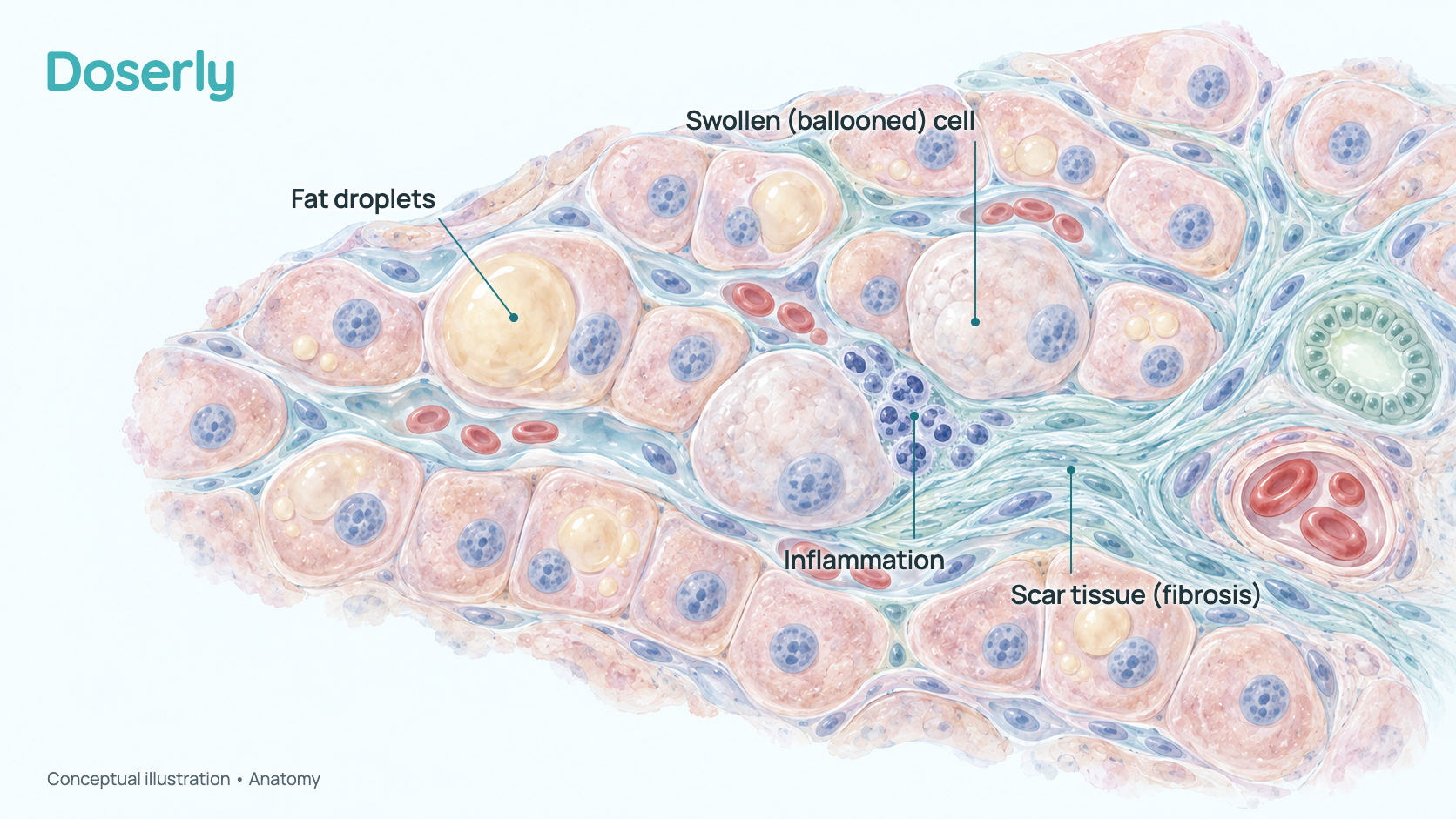
Fatty liver disease is now called MASLD (metabolic dysfunction-associated steatotic liver disease): too much fat in the liver, usually alongside excess weight, high blood sugar or high blood fats. In some people the fat causes inflammation and cell damage, called MASH, and over years this can build scar tissue (fibrosis) that may lead to cirrhosis. Doctors grade scarring from F0 (none) to F4 (cirrhosis); the pemvidutide MASH trials enrolled people with F2 or F3, moderate to advanced scarring without cirrhosis. [11], [35]
In a 12-week trial of 94 adults with fatty liver, liver fat measured by magnetic resonance imaging (MRI) fell by 46.6%, 68.5% and 57.1% on 1.2, 1.8 and 2.4 mg, versus 4.4% on placebo. When 64 of those people continued for another 12 weeks (24 weeks in total), the falls were 56.3%, 75.2% and 76.4%, versus 14.0% on placebo. [19], [5]
IMPACT then tested biopsies. After 24 weeks, MASH cleared without worse scarring in 58% of people on 1.2 mg and 52% on 1.8 mg, versus 20% on placebo. Scarring improved by at least one stage in 33% and 36%, versus 28% on placebo, which was not a significant difference. [11] The human research section explains why the scarring result is the one that matters most, and what the later tests showed.
Weight loss
In MOMENTUM, 391 adults with obesity or overweight and no diabetes took pemvidutide or placebo for 48 weeks alongside diet and exercise. Average weight fell by 10.3% on 1.2 mg, 11.2% on 1.8 mg and 15.6% on 2.4 mg, versus 2.2% on placebo, in Altimmune's reported analysis. These are company-reported results; no journal paper had been published when this guide was checked. [12], [36]
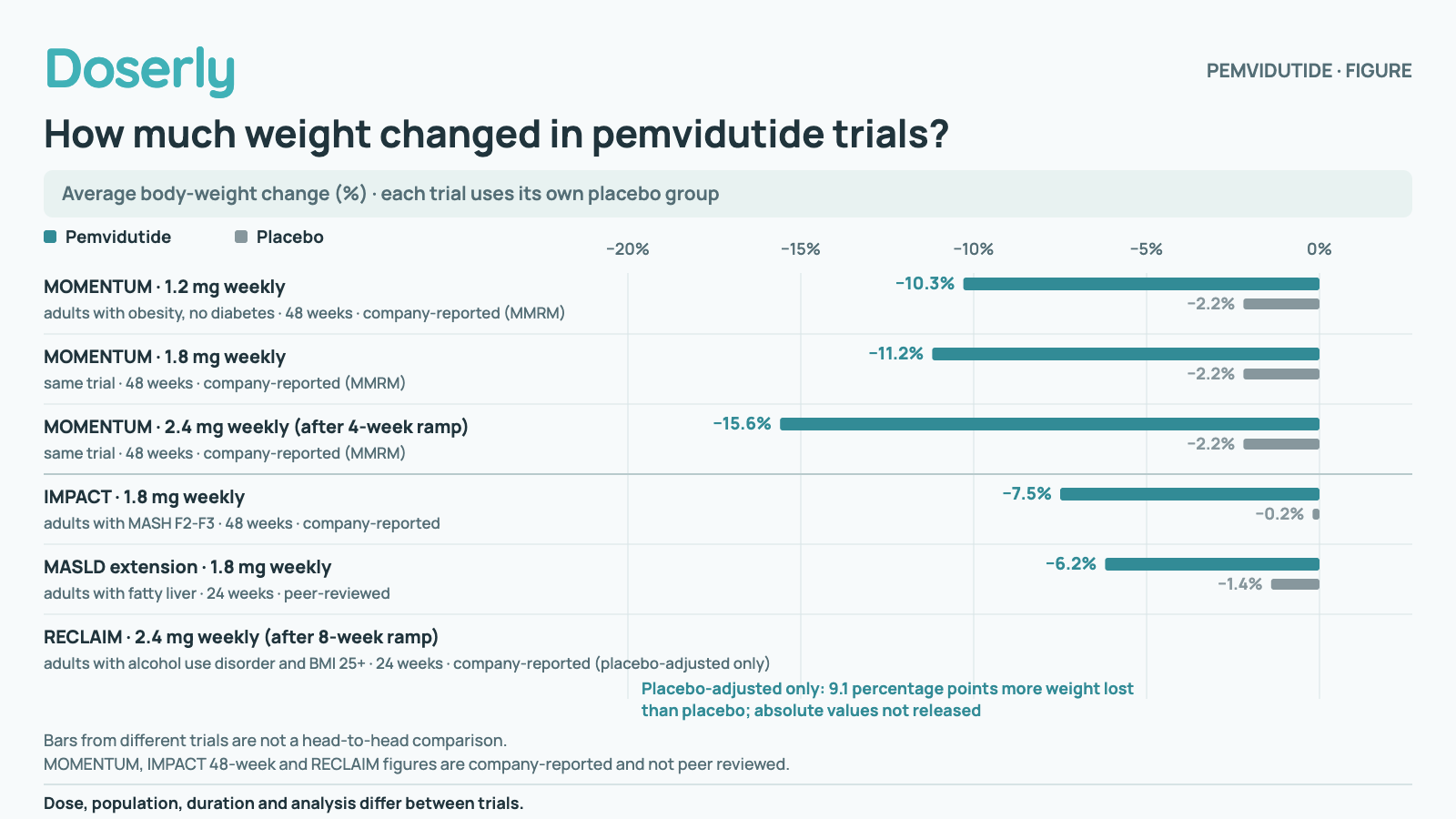
How much weight changed in pemvidutide trials?
Average body-weight change (%); separate trials and placebo groups.
- MOMENTUM · 1.2 mg weekly
- adults with obesity, no diabetes · 48 weeks · company-reported (MMRM). Pemvidutide −10.3%; placebo −2.2%.
- MOMENTUM · 1.8 mg weekly
- same trial · 48 weeks · company-reported (MMRM). Pemvidutide −11.2%; placebo −2.2%.
- MOMENTUM · 2.4 mg weekly (after 4-week ramp)
- same trial · 48 weeks · company-reported (MMRM). Pemvidutide −15.6%; placebo −2.2%.
- IMPACT · 1.8 mg weekly
- adults with MASH F2-F3 · 48 weeks · company-reported. Pemvidutide −7.5%; placebo −0.2%.
- MASLD extension · 1.8 mg weekly
- adults with fatty liver · 24 weeks · peer-reviewed. Pemvidutide −6.2%; placebo −1.4%.
- RECLAIM · 2.4 mg weekly (after 8-week ramp)
- adults with alcohol use disorder and BMI 25+ · 24 weeks · company-reported. Placebo-adjusted only: 9.1 percentage points more weight lost than placebo; absolute values not released.
Bars from different trials are not a head-to-head comparison. MOMENTUM, IMPACT 48-week and RECLAIM figures are company-reported and not peer reviewed.
Average weight change in pemvidutide trials, each against its own placebo group; trials differ in dose, population, length and analysis.
Weight loss was smaller in the liver trials, even at the same dose: in IMPACT, 7.5% at 48 weeks on 1.8 mg versus 0.2% on placebo. The trials enrolled different people in different settings, and neither explains the gap. [37], [12] After meeting the FDA in November 2024, Altimmune announced plans for a four-trial phase 3 obesity program, but no obesity phase 3 trial had started by September 2026; its phase 3 trial is in MASH. [38], [2], [21]
Drinking less (alcohol use disorder)
GLP-1 medicines are being studied for alcohol use disorder, and pemvidutide has one completed trial. In RECLAIM, 100 adults with moderate to severe alcohol use disorder and overweight or obesity (a BMI of 25 or more) took 2.4 mg or placebo for 24 weeks. Heavy drinking days fell by 4.20 a week on pemvidutide versus 2.75 on placebo. In the last four weeks, 42.2% had no heavy drinking days, versus 17.4% on placebo. [14], [15], [39], [40]
A blood test for recent drinking, PEth, fell on pemvidutide and rose slightly on placebo, which supports the self-reported numbers. Weight also fell by 9.1% more than on placebo. These results come from a company announcement and have not been peer reviewed. [14]
Alcohol-related liver disease
A separate trial, RESTORE, is testing 2.4 mg against placebo for 48 weeks in 121 adults with alcohol-associated liver disease, measuring liver stiffness. Results are expected in the second half of 2027. [41], [2]
Type 2 diabetes
Pemvidutide is not being developed as a diabetes medicine, and in its trials so far it has not lowered blood sugar the way approved GLP-1 medicines do. In a 12-week trial of 55 adults with type 2 diabetes, weight fell by 7.7% on 2.4 mg, with no significant change in fasting blood sugar or HbA1c, a blood test that reflects average blood sugar over about three months. HbA1c also stayed about the same in IMPACT, where about 4 in 10 people had type 2 diabetes. [42], [20], [11]
Studies still under way
These registered studies have no results yet. [8], [41], [43]
PERFORMA: MASH with moderate to advanced scarring (phase 3)
About 1,800 adults in two groups: about 990 with biopsy-confirmed MASH and about 800 diagnosed with non-invasive tests. 1.8 mg or 2.4 mg weekly, or placebo, after one or two monthly steps from 1.2 mg. Biopsy results at 52 weeks are expected in 2029; liver-related events are followed for about 5 years.
Recruiting · started July 30, 2026 · no results posted · last update September 2026
[8], [21]RESTORE: alcohol-associated liver disease (phase 2)
121 adults, 2.4 mg weekly or placebo for 48 weeks; the main measure is the change in liver stiffness.
Active, not recruiting · results expected second half of 2027 · last update August 2026
[41], [2]Drug-interaction study (phase 1)
40 healthy volunteers took single doses of metformin, atorvastatin, warfarin, digoxin or a combined birth-control pill with and without pemvidutide (0.6, then 1.2, then 1.8 mg).
Completed in 2022 · no results posted · last update June 2025
[43]Where do pemvidutide protocols differ?
The trial schedules are simple. The confusion comes from whether to ramp up, website ladders that no trial used, the ceiling of 2.4 mg, daily templates, cycling and stopping.
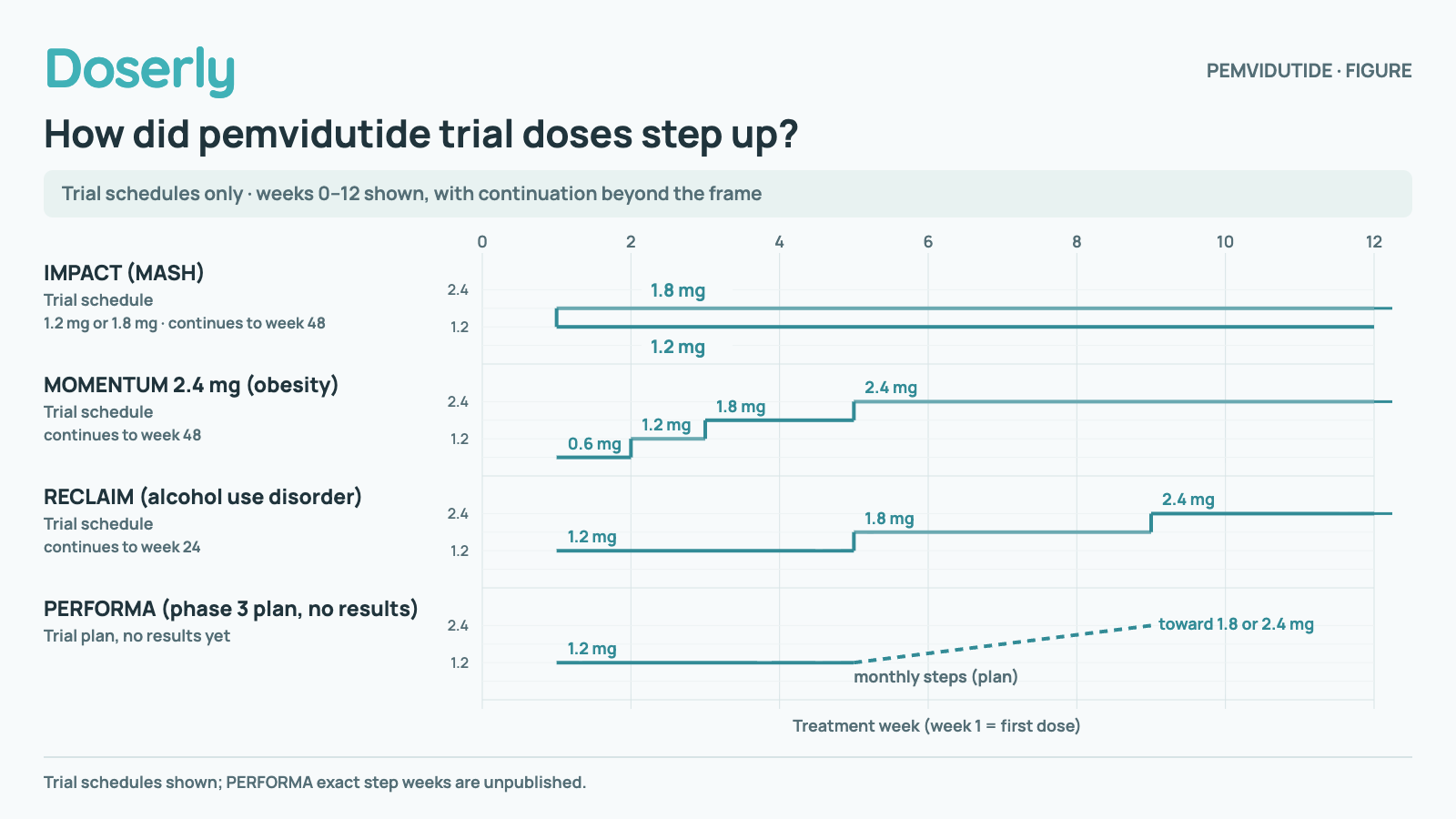
How did pemvidutide trial doses step up?
Weekly subcutaneous dose (mg); treatment week 1 = first dose; weeks 0–12 shown.
- IMPACT (MASH) · Trial schedule
- 1.2 mg or 1.8 mg from week 1, flat, 48 weeks. Continues beyond week 12.
- MOMENTUM 2.4 mg (obesity) · Trial schedule
- 0.6 mg week 1; 1.2 mg week 2; 1.8 mg weeks 3-4; 2.4 mg from week 5 to 48. Continues beyond week 12.
- RECLAIM (alcohol use disorder) · Trial schedule
- 1.2 mg weeks 1-4; 1.8 mg weeks 5-8; 2.4 mg weeks 9-24. Continues beyond week 12.
- PERFORMA (phase 3 plan, no results) · Trial plan, no results yet
- Phase 3 plan: starts at 1.2 mg, then one or two monthly steps toward the assigned 1.8 or 2.4 mg group; exact step weeks not published; no results yet.
PERFORMA exact step weeks have not been published.
Four trial schedules shown as week-by-week step lines; PERFORMA is a plan without results.
Do you need to ramp up the dose?
For 1.2 mg and 1.8 mg, the trials did not; for 2.4 mg, every trial after the first human study did. IMPACT, MOMENTUM and the liver-fat trials started their 1.2 mg and 1.8 mg groups at full strength. [11], [12], [5] The first human study gave 2.4 mg with no ramp, and nausea and vomiting were very common, which is why later trials ramped up to it. [22], [13]
The same unramped 1.8 mg dose was tolerated very differently in two trials. In IMPACT, 1 of 85 people on 1.8 mg stopped because of side effects; in MOMENTUM, 19.2% did, versus 6.2% on placebo. The two trials enrolled different people (biopsy-confirmed MASH versus obesity without diabetes), and neither source explains the gap. [11], [12] Altimmune has since moved to slower starts: RECLAIM's two 4-week steps, which the company says "may improve" stomach side effects, and PERFORMA's monthly steps from 1.2 mg. [14], [21]
Some online discussions claim pemvidutide "needs no titration at any dose". That matches the trials only for the 1.2 mg and 1.8 mg groups. [44], [12]
Why do some websites show a 1.2 → 1.8 → 2.4 mg ladder?
Because they built one. No completed trial used a 1.2 mg start with 4-week steps to 2.4 mg as an open-ended plan, although RECLAIM's 24-week schedule is close. Each row below is one site's schedule as published. [26], [27], [28], [15]
| Website schedule | Starting dose | Steps | Weekly dose at the top | Duration and breaks |
|---|---|---|---|---|
| Website claims | ||||
| Three-step vial ladder | 1.2 mg, weeks 1–4 | 1.8 mg in weeks 5–8, then 2.4 mg | 2.4 mg | Open-ended from week 9 Also gives unit amounts for a 10 mg vial mixed with 2 mL |
| Tiered "beginner to advanced" guide | 1.2 mg, weeks 1–4 (optional) | Then 1.8 mg or 2.4 mg in weeks 5–48 | 1.8 mg, optionally 2.4 mg | 48 weeks on, no break Lists the obesity trial under the wrong registry number |
| "Reported user" ladder | 1.2 mg | Up every 4 weeks to 1.8 mg, then 2.4 mg | 1.8–2.4 mg | Not stated Described as user or vendor reports, with no traceable first source |
| Trial-group copy for a 5 mg vial | 1.2 mg from the first injection (IMPACT's lower-dose group) | None | 1.2 mg | Not stated (the trial ran 48 weeks) Closest to the trials: lists each trial group as its own row and converts each dose to syringe units |
These schedules describe what websites publish, not what was tested. Many pages copy each other, so repetition is not independent support. Recurring errors include naming the wrong developer, giving the obesity trial the wrong registry number, a 5- to 7-day half-life with no source, a pig half-life presented as human data, and a "once daily" template on a drug given weekly. [17], [26], [18], [27], [30]
Is 2.4 mg the maximum dose?
2.4 mg a week is the highest dose in the published multi-week efficacy trials, and it is the top dose in phase 3. All six dosing pages that state a maximum give 2.4 mg. [12], [8], [16], [27] A company analysis of heart-rhythm safety mentions single doses up to 4.8 mg and repeated doses up to 3.0 mg in early studies, but no results at those doses have been published in detail. [45]
Higher is not clearly better. In MOMENTUM, 2.4 mg led to more weight loss than 1.8 mg, but in IMPACT, 1.8 mg did not clear MASH more often than 1.2 mg. [12], [11]
Once a week, or more often?
Every human trial used one injection a week. [11], [12], [14] Reagent sellers repeat a daily dose in nanomoles per kilogram taken from a mouse study; that is an animal dose and cannot be converted into a human schedule. [31], [46], [47] One dosing page shows a generic "once daily" template, which does not fit pemvidutide at all. [30]
No dosing website reviewed gave a microdose, split-dose or stack schedule with pemvidutide amounts. [16], [26], [27]
Do you need to cycle pemvidutide?
No trial has tested cycling. The trials treated people continuously, and phase 3 plans years of treatment. Dosing pages that mention it describe continuous use or say that trials did not cycle. [21], [26], [18], [48]
How do milligrams convert to syringe units?
Units appear only with freeze-dried vials that are mixed with water (reconstitution) and drawn into an insulin syringe. Syringe units measure volume, not drug. On a U-100 syringe, 100 units equal 1 mL, so the amount of pemvidutide in each unit depends on how much water went into the vial. [25], [27]
For example, a 5 mg vial mixed with 2 mL of water holds 2.5 mg per mL. A 1.2 mg dose is then 0.48 mL, or 48 units; 1.8 mg is 72 units; and 2.4 mg is 96 units. A 10 mg vial mixed with 2 mL holds 5 mg per mL, so the same doses are 24, 36 and 48 units. Reading the unit numbers for one vial size while using the other halves or doubles the dose. Doserly's reconstitution calculator works out the arithmetic for any vial and shows each step. Correct arithmetic says nothing about whether the vial contains what its label claims. [25], [26], [27]
What happens when you stop pemvidutide?
Nobody knows yet for people. No trial, paper or company presentation has reported what happened to weight, liver fat, liver tests or drinking after pemvidutide was stopped. [5], [11], [12], [14]
- In rats. Obese rats that lost 24% to 40% of their weight in 28 days of daily injections "rapidly regained weight" during a 2-week recovery period. [6]
- In other drugs (context only). After stopping semaglutide, people in a trial follow-up had regained about two-thirds of their lost weight a year later. That is a different medicine and cannot be used as a pemvidutide estimate. [49]
- How fast it leaves the body. With a half-life of about 110 hours in a company poster, blood levels would be expected to halve roughly every 4 to 5 days after the last dose. [7]
Tapering. No trial has compared tapering with stopping all at once, and no taper schedule has been published. Whether drinking or liver disease returns after the RECLAIM or IMPACT treatment periods is one of the open questions for the next trials.
How is pemvidutide given, and how long does it last in the body?
Pemvidutide has only ever been given by injection. Every human trial used one subcutaneous injection a week. There is no tested pill, nasal spray or under-the-tongue form. In MOMENTUM, according to a company patent application, the study drug came as 1 mL prefilled syringes of ready-mixed solution containing 1.2, 1.8 or 2.4 mg. Altimmune's filings say its patents cover a liquid formulation, and it lists "alternative formulations, doses, and presentations" as a goal. [11], [12], [50], [1]
The only human half-life figure comes from a company conference poster: about 110 hours (4 to 5 days) after a 1.8 mg injection, with blood levels peaking about 70 hours after the dose. That poster has not been peer reviewed. [7] In minipigs the half-life was 52 hours, and some dosing websites wrongly present that animal figure, or an unsourced "5 to 7 days", as the human value. [6], [27], [18], [51]
Altimmune says the EuPort side chain slows how fast pemvidutide enters the bloodstream and lengthens its half-life, which is what allows weekly dosing. [52], [1] No study has published pemvidutide levels in people with kidney or liver impairment, the effect of food, or whether the body makes antibodies against it. [7], [5]
Should the injection go near the liver?
No. A subcutaneous injection enters the bloodstream and reaches the whole body over days, so injecting "near" the liver does not target it. The trials simply used subcutaneous injections once a week. [11], [7]
How should pemvidutide be stored, and how long does it last?
Not established. Pemvidutide has no approved label, and no regulator, trial paper or study document has published the storage temperature, shelf life or in-use time of the trial product. In MOMENTUM, that product was a ready-mixed liquid in prefilled syringes, not a powder to mix; the formulation used in other trials has not been published, and the company's patent application mentions a freeze-dried form only as a possibility, with no storage specification. [50], [1]
Dosing websites fill the gap with numbers that have no pemvidutide testing behind them: 2–8 °C in the fridge after mixing (the most common claim), use within about 4 weeks or within 14–28 days, freezing the powder at −20 °C, and in one case a "pen" kept at room temperature for 28 days, although no pemvidutide pen exists outside trials. [16], [26], [27], [30], [18], [53] These are general peptide habits or borrowed from other drugs. Treat any use-by period for a mixed "research" vial as unverified.
This guide does not cover mixing or injection technique; the Academy note below covers practical handling.
What do we actually know about pemvidutide in people?
A moderate amount, most of it reported by the company. Altimmune has registered ten human trials. Eight have finished (one was an extension of another), with about 1,000 participants in total; one is still running and one is recruiting. Only three results papers have been peer reviewed: a 12-week liver-fat trial, its 12-week extension and the 24-week results of IMPACT. The obesity trial MOMENTUM, the 48-week IMPACT results and the alcohol trial RECLAIM are known only from company announcements, slides and conference presentations. [19], [5], [11], [12], [37], [14]
In a randomized controlled trial, people are assigned by chance to the drug or a comparison such as a placebo, so differences between the groups can be credited to the drug. Every pemvidutide trial below was randomized and placebo-controlled. [11]
| Trial | Who and what | Main result | What it cannot show |
|---|---|---|---|
| Phase 1 (2021) | 34 adults with overweight or obesity, no diabetes; 1.2, 1.8 or 2.4 mg for 12 weeks, no ramp | Weight −4.9%, −10.3% and −9.0% vs −1.6% on placebo | Tiny groups (7 to 11 people); company-reported [22] |
| MASLD (2024) | 94 adults with fatty liver; 1.2, 1.8 or 2.4 mg for 12 weeks | Liver fat −46.6%, −68.5% and −57.1% vs −4.4% | Liver fat is not the same as MASH or scarring [19] |
| MASLD extension (2025) | 64 of those people, 12 more weeks | Liver fat −56.3%, −75.2% and −76.4% vs −14.0%; weight −5.1% to −6.2% vs −1.4% | Selected continuers, not a new random sample [5] |
| Type 2 diabetes (2023) | 55 adults; 1.2, 1.8 or 2.4 mg for 12 weeks | Weight −7.7% on 2.4 mg; no significant HbA1c change | Company-reported; short [42], [20] |
| MOMENTUM (2023) | 391 adults with obesity, no diabetes; 48 weeks | Weight −10.3%, −11.2% and −15.6% vs −2.2% | Not peer reviewed; about 1 in 5 stopped for side effects on the two higher doses [12] |
| IMPACT (2025) | 212 adults with biopsy-proven MASH and F2–F3 scarring; 1.2 or 1.8 mg | MASH cleared in 58% and 52% vs 20% at week 24; scarring endpoint not met | 24-week biopsy only; the 48-week results are company-reported [11], [37] |
| RECLAIM (2026) | 100 adults with alcohol use disorder; 2.4 mg for 24 weeks | Heavy drinking days −4.20 vs −2.75 a week | Company-reported; one trial [14] |
Did pemvidutide reverse liver scarring (fibrosis)?
Not on the standard biopsy test after 24 weeks. Scarring predicts who goes on to cirrhosis and liver failure, so it is the result liver doctors watch most. In IMPACT, scarring improved by at least one stage in 33% on 1.2 mg and 36% on 1.8 mg, versus 28% on placebo; the paper states the trial "did not meet" this endpoint. [11]
Three kinds of evidence are often blended in online summaries and should be kept apart:
- Standard biopsy (pathologists grading slides). Not significantly better than placebo at 24 weeks. There was no biopsy at 48 weeks. [11], [37], [54]
- AI-assisted pathology (qFibrosis). A company-funded analysis of the same 24-week biopsies, available for 183 of the 212 people, with a digital scoring method found at least one stage of scar regression in 68.6% on 1.2 mg and 54.5% on 1.8 mg, versus 29.6% on placebo. This is a secondary analysis presented at a conference, not the trial's main test. [55], [56]
- Non-invasive tests at 48 weeks. A blood score of scarring (ELF) fell by 0.49 and 0.58 points versus a 0.16 rise on placebo, and liver stiffness on an ultrasound-based scan fell by 3.04 and 3.97 kilopascals (kPa, the unit of stiffness) versus 0.03. [37] Both improved enough together in 27.8% and 32.4%, versus 3.2%. These tests are indirect signs, not a biopsy. [37], [54]
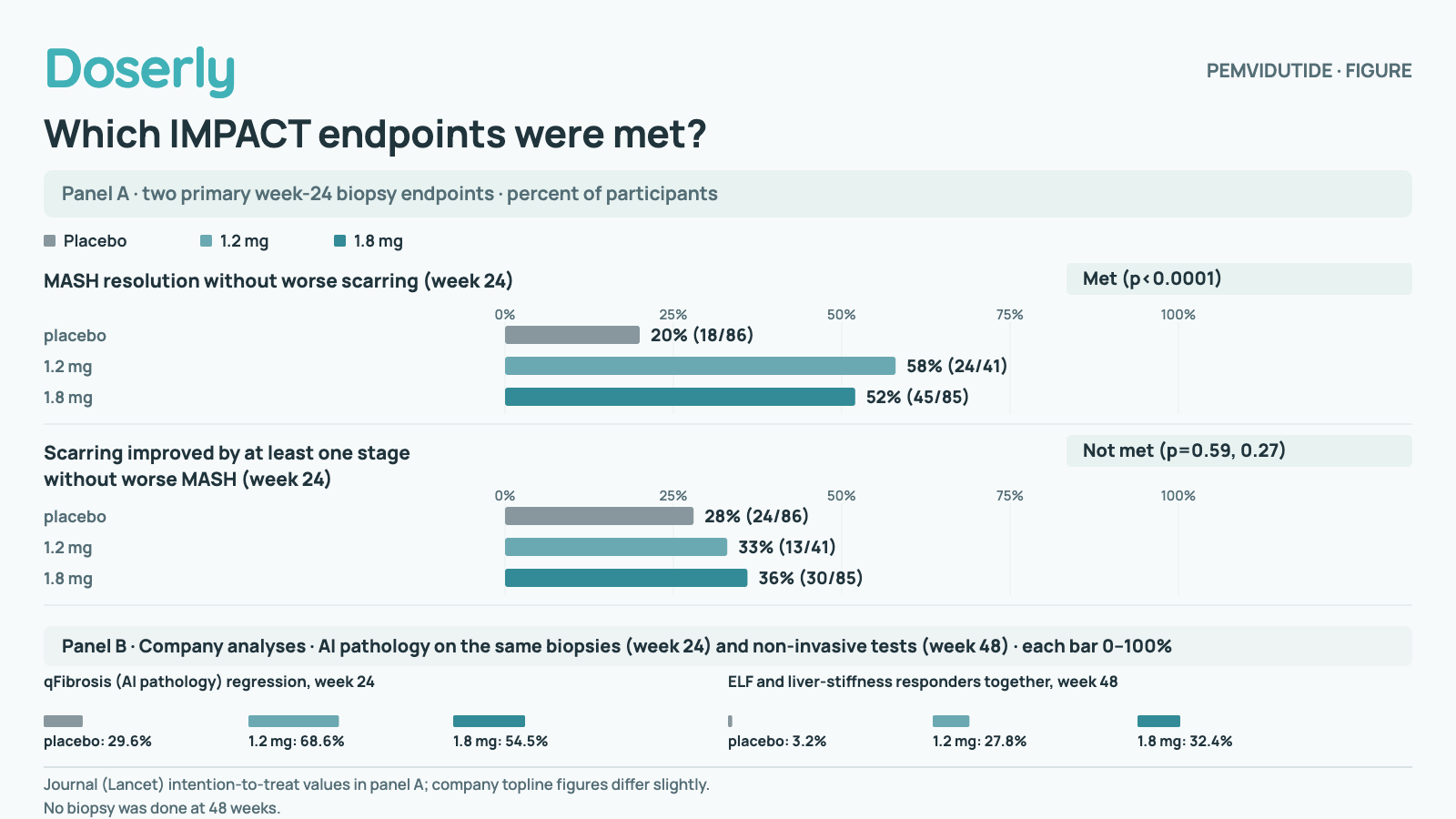
Which IMPACT endpoints were met?
Percent of participants; panel A uses week-24 biopsy endpoints. Panel B · Company analyses · AI pathology on the same biopsies (week 24) and non-invasive tests (week 48) · each bar 0–100%.
- MASH resolution without worse scarring (week 24)
- Placebo 20% (18/86); 1.2 mg 58% (24/41); 1.8 mg 52% (45/85). Met (p<0.0001).
- Scarring improved by at least one stage without worse MASH (week 24)
- Placebo 28% (24/86); 1.2 mg 33% (13/41); 1.8 mg 36% (30/85). Not met (p=0.59, 0.27).
- qFibrosis (AI pathology) regression, week 24
- Company AI pathology reanalysis on the same week-24 biopsies. Placebo 29.6%; 1.2 mg 68.6%; 1.8 mg 54.5%.
- ELF and liver-stiffness responders together, week 48
- Company analysis of non-invasive tests at week 48. Placebo 3.2%; 1.2 mg 27.8%; 1.8 mg 32.4%.
Journal (Lancet) intention-to-treat values in panel A; company topline figures differ slightly. No biopsy was done at 48 weeks.
IMPACT separates two biopsy endpoints: MASH resolution (met) and fibrosis improvement (not met); company AI pathology reanalysis of the week-24 biopsies and week-48 non-invasive tests are shown separately.
The FDA granted Breakthrough Therapy designation in December 2025 on the 24-week IMPACT data, and it agreed that an AI-assisted pathology tool can be used in phase 3. PERFORMA will judge scarring on biopsies at 52 weeks and then follow liver-related events for about five years. [32], [1], [37], [21]
Why do IMPACT numbers differ between sources?
Because the company's first announcement and the journal paper used slightly different analyses. The June 2025 announcement reported MASH clearing in 59.1% and 52.1% versus 19.1%, and scarring improvement in 31.8% and 34.5% versus 25.9%. The Lancet paper, which counts everyone as randomized, reports 58% and 52% versus 20%, and 33% and 36% versus 28%. [57], [11] One person assigned to placebo received 1.2 mg by mistake. [11] Both versions agree on the main points: MASH cleared more often, and scarring did not improve significantly. This guide uses the journal figures.
How much weight do people lose?
In MOMENTUM, the only obesity trial, average weight loss at 48 weeks was 10.3%, 11.2% and 15.6% on 1.2, 1.8 and 2.4 mg, versus 2.2% on placebo. People had an average age of about 50 and an average BMI of about 37, and about 75% were women. [12] Among those who finished the trial, 51.8% on 2.4 mg lost at least 15% of their weight and 32.1% at least 20%, versus 2.0% and 2.0% on placebo; figures for people who finished are more favorable than for everyone who started. [12] Weight was still falling at week 48 on 2.4 mg. [12]
Those figures are smaller than the headline results for tirzepatide or retatrutide in their own trials, which enrolled different people (see the comparison). Pemvidutide's development has since moved toward liver disease rather than obesity. [2]
Is the weight lost fat or muscle?
Mostly fat, in the one scan study. In an MRI body-composition analysis of 50 people on pemvidutide in MOMENTUM, 21.9% of the weight lost was lean mass, the rest fat. An earlier, preliminary company figure of 25.5% gave no method. [58], [59], [60]
Online claims that pemvidutide "preserves muscle better" than other drugs go further than the data. There was no comparison group of people on another drug or on diet alone, and muscle strength was not measured. [58], [61], [44]
Does it change blood sugar, blood fats or blood pressure?
- Blood sugar. HbA1c barely changed in IMPACT (+0.03, −0.14 and +0.03 points on placebo, 1.2 mg and 1.8 mg) or in MOMENTUM, and it did not fall in the diabetes trial. This is unlike GLP-1 medicines, which lower HbA1c. [11], [12], [42]
- Blood fats. At 48 weeks in IMPACT, triglycerides fell by 23.7% (3.3% on placebo) and total cholesterol by 15.4% (5.1% on placebo) on 1.8 mg, but only in people whose own level started high (triglycerides above 150 mg/dL for the triglyceride result, total cholesterol above 200 mg/dL for the cholesterol result). In MOMENTUM, total cholesterol fell by 11.6% to 15.1% versus 2.8% on placebo, and triglycerides by 21.7% to 34.9% versus a 7.3% rise, in the people with available lab data. [62], [63], [12]
- Blood pressure. Systolic pressure fell by 5.5 to 12.0 mmHg in the MASLD extension (2.3 on placebo), by 1.6 to 4.6 mmHg in MOMENTUM (it rose 3.5 on placebo) and by 4.0 mmHg on 1.8 mg at 48 weeks in IMPACT. [5], [12], [62]
- Liver enzymes. ALT, a blood marker of liver injury, fell by about 38 IU/L on both doses in IMPACT at 48 weeks, versus about 10 on placebo. [37], [54]
Does it help people drink less?
In one trial, yes. RECLAIM's main result was 4.20 fewer heavy drinking days a week on 2.4 mg versus 2.75 on placebo, a difference of 1.45 days. On the World Health Organization's drinking-risk scale, 64.4% dropped by two levels versus 34.8%, and the share of alcohol-free days rose by 38.9 points versus 20.5. [14] These are self-reports supported by the PEth blood test, from a single company-reported trial in people who also had a BMI of 25 or more. Whether the effect lasts after stopping, or works in people without excess weight, is unknown. [14], [39]
How might pemvidutide work?
Pemvidutide switches on two receptors: the GLP-1 receptor and the glucagon receptor. In cells engineered to carry each receptor, pemvidutide (called ALT-801 in its design paper) activated both at similar, very low concentrations. [6] What that means inside the human liver is a proposed explanation built on these lab results, animal studies and human liver-fat scans, not a measured pathway in people. [5], [47]
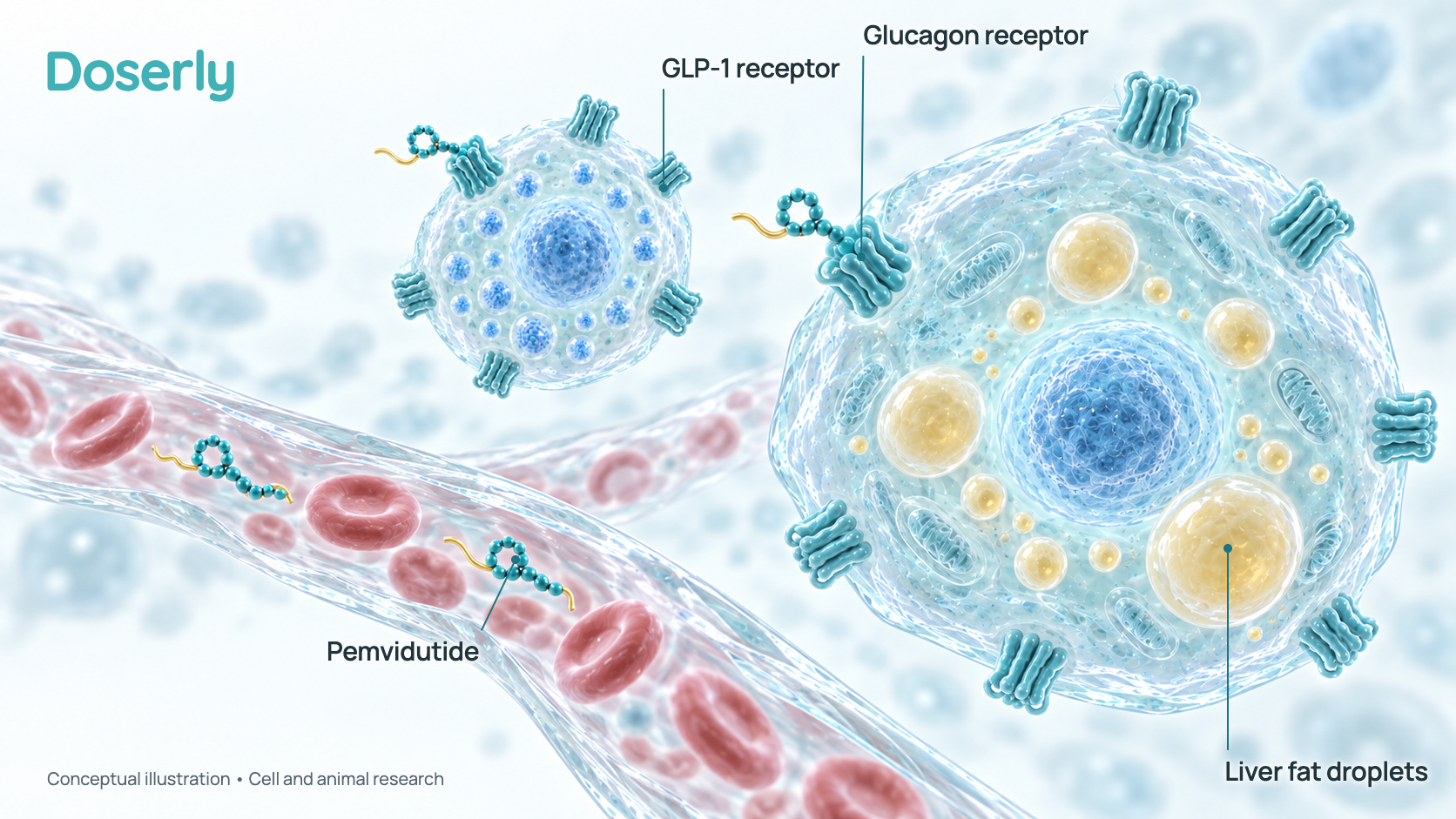
What does the glucagon side do?
Glucagon normally tells the liver to release stored sugar and to burn fat. Unlike GLP-1 drugs, glucagon-receptor drugs act directly on the liver to increase fat burning and reduce the making of new fat, according to the trial authors. That would explain why liver fat fell so quickly, by about half within 12 weeks, alongside modest weight loss. [19], [5] In mice with MASH-like liver disease, pemvidutide lowered liver disease scores; see the research library for how it compared with other drugs. [47]
What does the GLP-1 side do?
It works like other GLP-1 medicines such as semaglutide: appetite falls, the stomach empties more slowly and the pancreas releases insulin when blood sugar is high. This explains much of the weight loss and most of the stomach side effects. [19], [64] Why HbA1c stayed about the same, when glucagon on its own raises blood sugar, has not been studied directly. [11], [12]
What does "balanced 1:1" mean?
It describes a laboratory measurement, not a proven effect in people. In the design paper, the concentration needed to switch on each receptor was almost the same (39 and 42 picomolar) in one test setup, but the numbers were much higher and less even (1,117 and 1,957) when a different blood protein was added to the test. [6] Other dual agonists such as survodutide and mazdutide use different balances, and no trial has compared them directly.
Does it speed up metabolism?
Not shown in people. No human study has measured energy use or resting metabolic rate on pemvidutide. [19], [5], [11] The idea comes from glucagon's known effects and from animal studies, and it circulates as a fact in some online teaching.
Why does one dose last a week?
Pemvidutide carries a fatty side chain linked through a sugar-like group (the EuPort domain) on its 17th amino acid, plus a lactam ring between the 16th and 20th. Altimmune says the side chain slows its entry into the blood and its removal, while the ring helps hold the chain's shape. The result is a half-life of about 110 hours in people, according to a company poster. [4], [1], [7]
What did animal studies show?
Only two original animal papers on pemvidutide exist, plus company patents and conference abstracts. They report less liver disease and scarring in mice, large weight loss in rats that came back after stopping, and lower alcohol intake in hamsters. These early findings are summarized in the research library. [47], [6], [65]
What are the risks and unanswered questions?
Is pemvidutide safe?
In trials of up to 48 weeks, its main problems were stomach and bowel side effects, which were common at higher doses; serious harms were uncommon, but the trials were too small and short to rule out rare or long-term risks. About 1,000 people have joined its completed trials, far fewer than for approved GLP-1 medicines, and important safety questions have no public answer yet. Products sold outside trials add risks of their own. [12], [37], [14], [11]
What are the most common side effects?
Nausea, vomiting, diarrhea and constipation, generally more common on the higher doses (though not at every step) and clustered in the first weeks. In IMPACT, stomach side effects "predominantly occurred within the first 8 weeks", and in MOMENTUM most stops for side effects happened in the first 16 weeks. [66], [12]
| Trial and group | Nausea | Vomiting | Diarrhea | Constipation | Stopped for side effects |
|---|---|---|---|---|---|
| MOMENTUM, placebo (48 weeks) | 11.3% | 3.1% | 5.2% | 8.2% | 6.2% |
| MOMENTUM, 1.2 mg | 25.5% | 6.1% | 8.2% | 17.3% | 5.1% |
| MOMENTUM, 1.8 mg | 59.6% | 27.3% | 10.1% | 13.1% | 19.2% |
| MOMENTUM, 2.4 mg | 51.5% | 27.8% | 18.6% | 22.7% | 19.6% |
| IMPACT, placebo (48 weeks) | 17.4% | 2.3% | 8.1% | 11.6% | 3.5% |
| IMPACT, 1.2 mg | 22.0% | 7.3% | 12.2% | 12.2% | 0% |
| IMPACT, 1.8 mg | 41.2% | 11.8% | 22.4% | 17.6% | 1.2% |
| RECLAIM, placebo (24 weeks) | 24% | 6% | 10% | 6% | 0% (drug-related) |
| RECLAIM, 2.4 mg | 44% | 18% | 20% | 26% | 10% (drug-related) |
Most side effects were mild or moderate. MOMENTUM reported one serious side effect judged related to the drug, vomiting on 2.4 mg. In IMPACT at 48 weeks, serious adverse events affected 8 of 85 people on 1.8 mg, 1 of 41 on 1.2 mg and 5 of 86 on placebo, with none judged related to the drug. In RECLAIM, one serious case of low blood sodium (hyponatremia) on pemvidutide was judged possibly related; the company's slides also list a breast-cancer diagnosis on pemvidutide among serious events, with no stated link to the drug. [12], [66], [14], [15]
Does pemvidutide raise heart rate?
On average, very little. Drugs that act on the glucagon receptor are often assumed to raise heart rate, and some do. Pemvidutide's average changes in trials were small: in MOMENTUM, +0.1, +3.1 and +2.5 beats per minute on 1.2, 1.8 and 2.4 mg versus −1.4 on placebo; in IMPACT, −0.8 and +1.0 versus +0.4. [12], [11] In the MASLD extension, the 1.2 mg group averaged +3.7 beats per minute versus −1.0 on placebo, a difference that was not statistically significant. [5]
Heart-related side effects affected about 3% to 4% of people on every dose and on placebo in MOMENTUM, with no major cardiac events reported. [12] A company analysis of heart-rhythm recordings found no meaningful lengthening of the QT interval. [45] Averages do not rule out a bigger rise in some individuals, and no long-term heart outcome trial has been done.
Can it raise blood sugar?
It can in some people. In IMPACT, high blood sugar was reported as a side effect in 12 of 85 people on 1.8 mg, 2 of 41 on 1.2 mg and 7 of 86 on placebo, even though average HbA1c did not change. [11] Glucagon raises blood sugar, which is the likely reason to watch it. Low blood sugar (hypoglycemia) has not been reported as a finding in the public results, and the 12-week liver-fat trial excluded people who used insulin. [11], [24]
What has not been reported?
The public results give no event-level data on pancreatitis, gallbladder disease, thyroid effects, injection-site reactions, anti-drug antibodies or pregnancy outcomes. That means "not reported", not "zero". [11], [12], [14] Approved GLP-1 medicines carry warnings about pancreatitis, gallbladder disease and, from rat studies, thyroid C-cell tumors; whether any of these apply to pemvidutide is unknown. [64], [67]
Are online "research" vials the same as trial pemvidutide?
No. The trial product is made for Altimmune's trials under the FDA's investigational-drug rules. Vials sold online as "research use only" are not approved anywhere, and their identity, purity, strength and sterility are unknown. No regulator warning names pemvidutide specifically, but the FDA, Health Canada and the UK regulator warn against unapproved GLP-1 drugs and peptides bought online. [3], [9], [10], [68] No case report of harm from self-sourced pemvidutide was found, which reflects a lack of reporting, not proof of safety. Dosing mistakes are a separate risk (see units).
Is pemvidutide legal? Is it FDA approved?
Checked September 24, 2026. Rules differ by country and change often.
United States. Not approved: the FDA's drug databases have no pemvidutide application or listed product. It is studied under an investigational new drug application. [3], [1]
- October 24, 2023. Fast Track designation for MASH (then called NASH). [69], [60]
- August 19, 2025. Fast Track designation for alcohol use disorder. [1], [70]
- December 2025. End-of-phase-2 meeting with the FDA; Breakthrough Therapy designation for MASH, announced January 5, 2026. [37], [32], [71]
- July 30, 2026. The phase 3 PERFORMA trial started (announced August 3). [8], [21]
These designations speed up development and review. They are not approvals, and the company's own filing says they do not guarantee approval. [1] FDA warnings about "research use only" GLP-1 drugs name other compounds, not pemvidutide, but the same rules on unapproved drugs apply. [9], [72]
Canada. No pemvidutide product is in Health Canada's Drug Product Database, and Health Canada warns against injecting peptides bought online. [73], [10]
European Union. Not authorized. Altimmune reports receiving scientific advice from the European Medicines Agency, which is guidance during development, not approval, and the company's July 2026 trial presentation states that pemvidutide has not been approved by the FDA "or any other regulatory authority". [74], [15]
United Kingdom. The medicines regulator's product database returns no results for pemvidutide, and the regulator warns against buying weight-loss injections online. [75], [68]
Australia. The Australian Register of Therapeutic Goods returns no pemvidutide products. [76]
A "research use only" label does not make any of these products legal to sell for human use. [10], [9]
Is pemvidutide banned in sport?
Athletes should treat it as banned. Pemvidutide is not named on the World Anti-Doping Agency's 2026 or 2027 Prohibited Lists, but WADA's S0 category bans at all times any substance "with no current approval by any governmental regulatory health authority for human therapeutic use", including drugs still in clinical development. Pemvidutide fits that description. It is not part of WADA's Monitoring Program, which tracks only semaglutide and tirzepatide among these drugs. [77], [78], [79] Tested athletes should confirm with their anti-doping organization.
Who should be especially cautious?
- Pregnancy and breastfeeding. Not studied. The trials excluded pregnant or breastfeeding women and required birth control for women who could become pregnant. [23], [24]
- Under 18. Not studied; every trial enrolled adults only. [35], [23]
- Diabetes. Blood sugar needs watching (see above). The trials excluded type 1 diabetes, and the liver-fat trial excluded people on insulin. [35], [24]
- Past pancreatitis or gallbladder surgery. Not studied. MOMENTUM excluded pancreatitis in the past year and gallbladder removal; the liver-fat trial excluded any history of pancreatitis. [23], [24]
- Cirrhosis. Not studied; the MASH trials excluded it. [35], [8]
- Depression or suicidal thoughts. Not studied in people with untreated depression or recent suicidal thoughts, who were excluded. [23], [39]
- Heavy drinking with withdrawal symptoms. RECLAIM excluded people with significant withdrawal, alcohol-related seizures or past hospital stays for withdrawal. Pemvidutide is not a treatment for alcohol withdrawal. [39]
- Kidney or liver impairment. No published data on blood levels. [7]
- Tested athletes. See the sport question above.
- People taking other medicines. See the next question.
Can pemvidutide be taken with other medicines?
What has been tested and what has not:
- Common medicines. A completed trial tested pemvidutide with metformin, atorvastatin (a cholesterol medicine), warfarin (a blood thinner), digoxin (a heart medicine) and a combined birth-control pill, but no results have been posted. [43]
- Pills in general. GLP-1 drugs slow stomach emptying, which can change how some pills are absorbed; the drug-interaction trial was designed to check this but has not reported. [64], [43]
- Diabetes medicines. Trials allowed stable diabetes treatment, but no interaction results with insulin or sulfonylureas are published. [35]
- Other GLP-1 drugs. Combining pemvidutide with semaglutide, tirzepatide, retatrutide or another dual agonist has never been tested. In community education groups, educators warn against running two GLP-1-type drugs together, even as some members describe adding a dual agonist on top of tirzepatide.
- Liver-focused "stacks". Some online teaching pairs a GLP-1 and glucagon drug with other peptides such as BPC-157 or KPV, with no amounts. No such combination has been studied with pemvidutide.
Bring a full list of everything you take, including supplements, to a pharmacist or doctor.
What is still unknown?
- Whether the MASH results translate into less scarring on biopsy and fewer liver-related illnesses; PERFORMA's first biopsy results are expected in 2029. [21]
- What happens after stopping: weight, liver fat, liver tests or drinking. [5], [14]
- Safety beyond 48 weeks and in larger groups, including rare problems such as pancreatitis. [37]
- Results from peer-reviewed papers for MOMENTUM, the 48-week IMPACT data and RECLAIM. [12], [37], [14]
- Drug-interaction results, blood levels with kidney or liver impairment, and use in pregnancy. [43], [7]
- Whether it helps alcohol-associated liver disease; RESTORE reports in the second half of 2027. [2]
- How it compares head-to-head with any other drug; no such trial exists.
What should be monitored while using pemvidutide?
Pemvidutide has no label, so no official monitoring schedule exists. The trials show what researchers thought worth measuring. Use this summary to prepare questions for a clinician; it is not a personal testing plan. [5], [11], [14]
What did the trials measure?
| Why it matters | What the trials measured | Tracking category |
|---|---|---|
| Liver fat and injury | MRI liver fat, liver enzymes ALT and AST, liver stiffness and the ELF blood score; biopsies in the MASH trials | Blood work; Other |
| Weight and body shape | Weight, waist size, MRI body composition in a subgroup | Weight Management; Fat Loss |
| Blood sugar | Fasting blood sugar and HbA1c; in the diabetes trial, insulin and C-peptide | Blood work |
| Heart and circulation | Heart rate, blood pressure, electrocardiogram (ECG) heart tracings | Heart Rate & Palpitations; Blood Pressure |
| Blood fats | Total cholesterol, LDL ("bad") and HDL ("good") cholesterol, triglycerides | Blood work |
| Stomach and bowel | Nausea, vomiting, diarrhea, constipation and whether people stopped | Nausea & GI Tolerance; Digestive Comfort |
| Mood | Depression and suicidal-thought questionnaires at screening in MOMENTUM and the alcohol trials | Mood & Wellbeing |
| Drinking | Heavy drinking days, WHO drinking-risk level and the PEth blood test | Cravings & Impulse Control; Blood work |
[5], [11], [20], [12], [23], [14]
What deserves the most attention?
Based on what the trials found, the practical watch points are stomach side effects and fluid loss in the first weeks and after any dose increase, blood sugar in people with diabetes (high readings were reported on 1.8 mg), heart rate in anyone who notices palpitations, and liver tests, since liver disease is the reason most people consider it. [66], [11], [12] RECLAIM's serious case of low blood sodium is a reason to report confusion, headache or unusual weakness promptly. [14]
In community education groups, educators also suggest tracking fasting insulin, the triglyceride-to-HDL ratio and waist size. These are reasonable metabolic markers, but they were not the main measures in pemvidutide trials.
How is the response judged?
In the trials, liver response meant liver fat on MRI, liver enzymes, stiffness scans and, in MASH, biopsy; weight response meant the percentage of starting weight lost. No trial set a rule for stopping when there was little response. [11], [12] People care about different outcomes, such as liver tests, energy, drinking or how they feel, and tracking what matters to you next to dose changes and side effects makes a conversation with a clinician more useful.
What do people in public communities report?
Almost nothing first-hand. Pemvidutide has never been widely sold, and public discussion is mostly investors, people with fatty liver asking whether anyone has tried it, and comparisons with other drugs. Across 45 public forums and subreddits we tried, where some archive searches were incomplete, only one person described taking it, inside a trial. Discussions in community education groups are summarized here without identifying anyone. [80], [81], [61]
What does the one first-hand account say?
A person who said they were in a blinded pemvidutide trial, and guessed they were on the lowest dose, reported "a bit a nausea, acid reflux twice, zero weight loss". In a later comment they said they had left the study after about five months and started tirzepatide (Mounjaro). They never knew whether they received pemvidutide or placebo, so the account cannot show what the drug does. [80], [82]
What claims circulate, and do they hold up?
| Claim seen online | What the trials show |
|---|---|
| "It preserves muscle better than other drugs" | 21.9% of weight lost was lean mass in one MRI analysis, with no comparison group [58], [61] |
| "It reversed liver fibrosis" | The standard biopsy measure of scarring was not met at 24 weeks [11], [44] |
| "No heart-rate increase at all" | Average changes were small (about −1 to +4 beats per minute across trials), not zero [12], [5], [34] |
| "Almost no stomach side effects" | Nausea affected about half of people on 1.8 or 2.4 mg in MOMENTUM, and about 1 in 5 stopped [12], [44] |
| "No titration needed" | True for the 1.2 and 1.8 mg groups; 2.4 mg with no ramp caused very common nausea in the first study, and every later 2.4 mg group used a ramp [12], [13], [22], [33] |
What comes up in community education groups?
In the community education groups reviewed, no member reported using pemvidutide. The one educator who teaches about it presents it as a liver drug and gives only trial doses, with strong reminders that it is investigational. In the one member thread about it, most people who replied had never heard of it; another member wanted to buy it as a substitute for retatrutide for weight loss and was pointed to a different drug.
Two misunderstandings recurred. One was that pemvidutide was fast-tracked for alcohol-related liver damage; in fact its FDA designations are for MASH and for alcohol use disorder, and the alcohol-associated liver disease trial has not reported. [1], [2] The other was that it produced "solid" fibrosis improvement, which overstates the IMPACT biopsy result. [11]
How can you judge a story about pemvidutide?
Ask: Was it a trial injection (possibly placebo) or an online vial? What was the dose in milligrams, not units, and how fast was it raised? Was anything else taken, such as tirzepatide? Was the result a lab test, a scan, a biopsy or a feeling? What happened months later, and after stopping?
These selected discussions show what people ask and believe, not what the drug does. They are not a survey of users, a success rate or a substitute for the trials.
How does pemvidutide compare with survodutide, mazdutide, semaglutide and retatrutide?
These are the drugs most often weighed against pemvidutide, either because they work the same way (survodutide and mazdutide) or because they are already used or tested for fatty liver disease and weight. Status was checked on September 24, 2026.
| Medicine | What it is | Route and schedule | Human evidence | Approval status |
|---|---|---|---|---|
| Pemvidutide (this guide) | Dual GLP-1 and glucagon receptor agonist [4] | Weekly subcutaneous injection in trials [11] | Phase 2b IMPACT: MASH cleared in 52–58% vs 20% on placebo at 24 weeks, scarring endpoint not met; obesity trial −15.6% at 48 weeks on 2.4 mg (company-reported) [11], [12] | Approved nowhere; phase 3 in MASH began 2026 [3], [8] |
| Survodutide | Dual GLP-1 and glucagon receptor agonist, like pemvidutide [83] | Weekly subcutaneous injection in trials [83] | Phase 2 in MASH (F1–F3), 48 weeks: MASH improved without worse scarring in 43–62% vs 14% on placebo, a different measure from IMPACT's; phase 3 obesity trial −12.2% to −13.0% at 76 weeks vs −5.4% [84], [83] | Not approved anywhere; the FDA has warned sellers of "research" survodutide [85], [9] |
| Mazdutide | Dual GLP-1 and glucagon receptor agonist [86] | Weekly subcutaneous injection [86] | Phase 3 GLORY-1 in Chinese adults: −14.0% at 48 weeks on 6 mg vs +0.3% on placebo [87] | Approved in China (2025) for weight management and type 2 diabetes [86]; not approved in the US [9] |
| Semaglutide (Wegovy) | GLP-1 receptor agonist [64] | Weekly subcutaneous injection or daily tablet [64] | Phase 3 ESSENCE in MASH: cleared without worse scarring in 62.9% vs 34.3% on placebo at 72 weeks [88] | Approved in the US for MASH with moderate to advanced scarring (accelerated approval, August 2025), and for weight management [89], [64] |
| Retatrutide | Triple GIP (glucose-dependent insulinotropic polypeptide, another gut hormone), GLP-1 and glucagon receptor agonist [90] | Weekly subcutaneous injection in trials [90] | Phase 2: −24.2% at 48 weeks on 12 mg vs −2.1% on placebo [90] | Not approved anywhere; the FDA has warned sellers of "research" retatrutide [91], [92] |
The results come from separate trials in different people, measured at different times, so the table cannot rank these drugs. No trial has compared pemvidutide head-to-head with any of them. Survodutide is the closest rival for MASH, with its own phase 3 liver trials under way. [85] Semaglutide is the only drug here with an approved liver use; its MASH result was measured after 72 weeks, while IMPACT's biopsy came at 24 weeks. [88], [11] Pemvidutide's weight loss in its obesity trial was smaller than retatrutide's in its phase 2 trial, and its development now centers on liver disease and alcohol rather than obesity. [12], [90], [2]
Common questions about pemvidutide
Is pemvidutide FDA approved? Can you buy it?
No to both, legally. Pemvidutide is investigational: the FDA's drug databases list no approved product, and its Fast Track and Breakthrough Therapy designations are steps toward a possible approval, not approvals. The documented way to receive it is in a clinical trial such as PERFORMA; this guide found no expanded-access program. "Research" vials sold online are unapproved products of unknown content. [3], [1], [8], [9] See legal status by country.
Is pemvidutide a liver drug or a weight-loss drug?
Mainly a liver drug now. It was tested for weight loss in MOMENTUM (up to 15.6% at 48 weeks on 2.4 mg), and Altimmune announced plans for a phase 3 obesity program in 2024, but its only phase 3 trial is in MASH, and its other trials are in alcohol use disorder and alcohol-associated liver disease. No obesity phase 3 trial had started by September 2026. [12], [38], [2], [21] See common uses.
Did pemvidutide reverse liver fibrosis?
Not on the standard biopsy test. In IMPACT, MASH cleared much more often than on placebo after 24 weeks, but scarring improved in 33% and 36% of people versus 28% on placebo, which did not meet the trial's goal. Company analyses using AI pathology and blood and stiffness tests look more favorable, but they are secondary or indirect measures. [11], [55], [56], [37], [54] See the fibrosis results.
What is the pemvidutide dose?
In trials, 1.2 mg or 1.8 mg once a week, given at full strength from the start, or 2.4 mg once a week after a ramp of 4 to 8 weeks. Phase 3 starts at 1.2 mg and steps up monthly to 1.8 mg or 2.4 mg. None of these is an approved dose. [11], [13], [15], [21] See typical protocols.
How long does pemvidutide take to work?
It depends on the outcome. Liver fat fell by about half within 12 weeks in the first liver-fat trial, and MASH biopsies improved by week 24. Weight kept falling through 48 weeks on 2.4 mg in MOMENTUM. Stomach side effects were most common in the first 8 weeks. [19], [11], [12], [66] See human research.
Does pemvidutide raise heart rate?
Only a little, on average: in the obesity trial, heart rate rose by up to about 3 beats per minute on 1.8 mg, against a small fall on placebo, and in IMPACT the changes were about 1 beat per minute. Heart-related side effects were no more common than on placebo. Averages can hide larger rises in some people, so it is worth tracking. [12], [11], [45] See heart rate.
Does pemvidutide help people drink less?
In one trial, yes. In RECLAIM, 2.4 mg cut heavy drinking days by 4.20 a week versus 2.75 on placebo, and 42.2% had no heavy drinking days in the last month versus 17.4%. The released results measure drinking, not cravings. They are company-reported, come from people who also had excess weight, and do not show whether the effect lasts after stopping. [14], [15] See drinking less.
Is pemvidutide the same as retatrutide or survodutide?
No. Retatrutide also acts on a third receptor (GIP), and it produced more weight loss in its own trials. Survodutide and mazdutide act on the same two receptors as pemvidutide but are different molecules with different doses and trial results. Swapping one for another, or adding pemvidutide to tirzepatide or retatrutide, has never been tested. [90], [83], [86] See how it compares.
Glossary
Plain explanations of the medical, dosing and research terms used in this guide. Underlined terms in the text link here.
- Adverse event
- A harmful or unwanted medical event reported after someone used a treatment. A report alone does not prove the treatment caused it.
- ALT (alanine aminotransferase)
- A liver enzyme measured in a routine blood test. High levels suggest liver cells are being damaged; in IMPACT, ALT fell by about 38 IU/L on pemvidutide.
- Animal study
- Research in animals such as mice, rats or hamsters. It shows what a substance does in a living body, but results in people can differ.
- Bioavailability
- How much of a dose reaches the bloodstream in a usable form. It depends heavily on the route. It has not been published for pemvidutide.
- BMI (body mass index)
- Weight in kilograms divided by height in meters squared. A BMI of 30 or more is classed as obesity and 25 to 29.9 as overweight.
- Breakthrough Therapy designation
- An FDA program that gives extra guidance and faster review to a drug whose early results suggest a substantial improvement for a serious condition. It is not an approval.
- Cell study (in vitro)
- Research on cells grown in a dish. It gives early clues about biology, but it is far from proof of benefit in people.
- Cirrhosis
- Advanced scarring (stage F4) that changes the liver's structure and can lead to liver failure. The pemvidutide MASH trials excluded people with cirrhosis.
- Compounding
- When a pharmacy prepares a customized medicine from individual ingredients. In the US, federal rules control which bulk ingredients pharmacies may use.
- Randomized controlled trial
- A study that assigns people by chance to a treatment or a comparison, often a placebo, so the groups can be compared fairly.
- Course and cycle
- A course is a period of repeated use. A cycle is a course plus a planned break. Pemvidutide trials used continuous treatment, not cycles.
- Dose (amount each time)
- The amount given on one occasion. For weekly pemvidutide injections, the dose is also the weekly total.
- Dual agonist
- A single drug that switches on two different receptors. Pemvidutide, survodutide and mazdutide switch on the GLP-1 and glucagon receptors.
- ELF test (Enhanced Liver Fibrosis)
- A blood test that combines three markers of scar-tissue turnover into one score. A falling score suggests less active scarring, but it is not a biopsy.
- Fast Track designation
- An FDA program that allows more frequent meetings and rolling review for drugs aimed at serious conditions with unmet needs. It is not an approval.
- Fibrosis (liver scarring)
- Scar tissue that builds up after long-term liver injury. It is graded from F0 (none) to F4 (cirrhosis) and is the strongest predictor of future liver problems.
- GLP-1 (glucagon-like peptide-1)
- A hormone released by the gut after eating. It raises insulin when blood sugar is high, slows the stomach and signals fullness to the brain.
- Glucagon
- A hormone made by the pancreas that raises blood sugar by telling the liver to release stored glucose. It also increases fat burning in the liver.
- Half-life
- The time it takes for the level of a substance in the blood to fall by half. For pemvidutide, a company poster reports about 110 hours. It is not the same as how long an effect lasts.
- HbA1c
- A blood test that reflects average blood sugar over roughly the past three months. It is the main measure of diabetes control.
- Investigational
- Being tested in clinical trials but not approved by any regulator for sale or medical use. Pemvidutide is investigational everywhere.
- Lactam bridge
- A chemical link between two amino acids in the same chain that forms a small ring. In pemvidutide it joins the 16th and 20th amino acids and helps hold the chain's shape.
- Lean mass
- Everything in the body that is not fat, including muscle, organs and water. A scan measures it; it is not the same as muscle strength.
- Liver stiffness (elastography)
- A painless ultrasound-based scan, often called FibroScan, that measures how stiff the liver is in kilopascals (kPa). Stiffer livers usually have more scarring.
- Loading phase
- Starting with a higher amount for a short period, then lowering it. No pemvidutide trial used one.
- MASLD
- Metabolic dysfunction-associated steatotic liver disease: excess fat in the liver linked to excess weight, high blood sugar or high blood fats. It was formerly called NAFLD.
- MASH
- Metabolic dysfunction-associated steatohepatitis: fatty liver disease with inflammation and liver-cell damage, often with scarring. It was formerly called NASH.
- mcg and mg
- Micrograms and milligrams. 1 mg equals 1,000 mcg. Pemvidutide doses are written in mg.
- MRI liver fat (MRI-PDFF)
- An MRI scan that measures the percentage of the liver made up of fat. The pemvidutide trials report the relative change, so a 50% reduction means half the starting fat is gone.
- Peptide
- A short chain of amino acids. Pemvidutide is a chain of 29 with a fatty side chain attached.
- PEth (phosphatidylethanol)
- A blood marker that forms only when alcohol is present, so it reflects drinking over the past few weeks. It is used to check self-reported drinking.
- Pharmacokinetics
- How the body absorbs, moves, breaks down and removes a substance.
- Placebo
- A dummy treatment with no active ingredient, used as a comparison in studies.
- Preclinical research
- Studies done before or alongside research in people: cell studies and animal studies.
- qFibrosis (AI-assisted pathology)
- A digital method that scores scarring on biopsy slides with imaging and artificial intelligence, instead of a pathologist's standard staging. Its results are not interchangeable with standard stages.
- Reconstitution
- Mixing a freeze-dried powder with a liquid so it can be measured and injected. The amount of liquid sets how much drug each unit holds.
- Research use only
- A label on products sold for laboratory research. It does not mean a product is approved, tested for human use or legal to sell as a medicine.
- Subcutaneous (SC)
- Injected into the fatty layer just under the skin. Every pemvidutide trial used subcutaneous injections once a week.
- Syringe units
- Markings on an insulin syringe that measure volume. On a U-100 syringe, 100 units equal 1 mL. The amount of drug per unit depends on the vial's concentration.
- Titration
- Adjusting a dose in steps, usually starting lower and increasing. Pemvidutide trials used a ramp only for the 2.4 mg dose.
- Topline results
- A company's first summary of a trial's main results, usually in a press release, before full peer-reviewed publication. Numbers can change in the final paper.
- WADA
- The World Anti-Doping Agency, which publishes the list of substances banned in sport, including a category (S0) for drugs not approved anywhere.
- Weekly total
- All the amounts given in one week, added together. For a once-weekly injection it equals the single dose.
Explore more of the research
Go deeper into the animal experiments and laboratory findings behind the mechanism claims.
Across this guide, the citations include 5 peer-reviewed original papers on pemvidutide: 3 human trials and 2 animal studies, plus company trial reports, conference posters and abstracts, and a patent example. The optional library below groups the pemvidutide animal and laboratory research by question. Preclinical results show what happened in animals or cells; they are not proof of the same effect in people, and animal doses are never converted to human doses here.
Liver disease in mice · 1 paper
Did pemvidutide improve MASH-like liver disease in mice?
Model: Male mice fed a fat-, sugar- and cholesterol-rich diet for 32 weeks until they developed biopsy-confirmed fatty liver with scarring.
Finding: After 12 weeks of daily injections, weight fell by about a quarter, and liver disease scores fell by 32% and 61% at the two doses. Scarring improved by at least one stage in 64% and 55% of mice, versus 75% on elafibranor (a non-incretin comparison drug), 42% on semaglutide and none on the inactive injection. [47]
Limit: A company-authored mouse study with daily dosing, unlike the weekly human schedule. The inactive-injection group was accidentally given one dose of pemvidutide on day 63, and the higher dose did not beat elafibranor on scarring. Human biopsy results are in human research.
Study details and access
Effects of ALT-801, a GLP-1 and glucagon receptor dual agonist, in a translational mouse model of non-alcoholic steatohepatitis (2022). Full text reviewed. Subcutaneous injection, daily · 12 weeks. [47]
Animal doses are not converted to human doses.
Receptors, rats and minipigs · 1 paper
How was pemvidutide designed, and what happened in rats?
Model: Cells engineered to carry the human receptors, diabetic mice, obese rats and minipigs.
Finding: The design paper, which calls pemvidutide compound 17 (ALT-801), reports that it switched on the GLP-1 and glucagon receptors at almost the same low concentration in one test setup, but not in another. In obese rats, 28 days of daily injections cut weight by 24% and 40% at two doses, versus 13% on semaglutide, without raising blood sugar; the rats "rapidly regained weight" within 2 weeks of stopping. In minipigs, the half-life after a single injection was 52 hours. [6]
Limit: Company-authored, with small groups (4 rats per group in the recovery phase). The minipig half-life is not the human value, and rat weight loss is not a human prediction.
Study details and access
Design and characterization of a surfactant-conjugated, long-acting, balanced GLP-1/glucagon receptor dual agonist (2021). Full text reviewed by a verification reviewer. Rats: daily injections for 28 days plus 2 weeks off; minipigs: single injection. [6]
Animal doses are not converted to human doses.
Alcohol and cholesterol in hamsters · 1 patent, 1 abstract
What did the alcohol and cholesterol experiments in hamsters show?
Model: Golden Syrian hamsters, which readily drink alcohol when offered, and obese hamsters for cholesterol handling.
Finding: In an experiment described in a company patent application, 12 hamsters given daily pemvidutide for 21 days cut their intake of 15% alcohol from 6.2 to 2.8 mL a day, but they also ate less and lost weight, which makes the alcohol-specific effect harder to judge. A conference abstract reported that 35 days of daily pemvidutide increased how much cholesterol obese hamsters cleared through their gut, with no effect sizes available. [65], [93]
Limit: A patent example and a short abstract, neither peer reviewed. The human alcohol results are in human research.
Study details and access
GLP-1R and GCGR agonist in the treatment of alcohol use disorder in subjects with obesity or overweight (patent application, 2026). Text reviewed by a verification reviewer on a public patent mirror. Hamsters, daily injections · 21 days. [65]
778-P: Pemvidutide enhances reverse cholesterol transport in a golden Syrian hamster model (2025). Conference abstract; text reviewed through a search index. Hamsters, daily · 35 days. [93]
Animal doses are not converted to human doses.
How this guide was researched
This guide is built from a thorough review of the sources cited throughout it: published clinical trials, clinical-trial registry records, company filings and presentations, regulatory documents and published dosing descriptions. We also reviewed public online forums and community education groups where people discuss pemvidutide.
The guide cites 90 sources, including 5 peer-reviewed original papers on pemvidutide itself (3 human trials and 2 animal studies), plus company trial reports and conference posters, an animal patent example and abstract, and published trials of related drugs for comparison. Each type of source answers a different question. Trials show what was measured, company announcements show results not yet peer reviewed, dosing descriptions show how pemvidutide is discussed online, and personal accounts show what individual people experienced. Every numbered citation links to its entry below, labeled by source type. The research library above summarizes the animal studies by question.
How this guide was made
Research and drafting were AI-assisted. Every cited source was checked against the original or, where the source list says so, a saved or indexed copy, and the guide was reviewed and edited by Doserly before publication. It has not had an independent clinical review, and Doserly does not currently have medical reviewers. Doserly makes a medication and health-tracking app and runs Doserly Academy, both of which are promoted in this guide. Read our editorial policy for how guides are researched, updated and corrected.
This guide is for educational purposes. It summarizes what the reviewed sources report so the research is easier to understand; it is not medical advice. For a deeper dive, or to check any point for yourself, go straight to the cited sources.
Explore the sources
These are the documents cited in this guide. Trials, company announcements, website advice and personal accounts answer different questions. A source being listed does not mean every statement on its page is endorsed.
Showing 93 sources
- 01
Annual Report on Form 10-K for the fiscal year ended December 31, 2025 ↗
Company annual report (SEC filing)
Original page or document reviewed.
- 02
Altimmune Announces Second Quarter 2026 Financial Results and Business Update ↗
Company announcement
Company release filed with the SEC; full text reviewed. Not peer reviewed.
- 03
openFDA Drugs@FDA and NDC directory searches: pemvidutide ↗
Regulator database (US)
Searches run on 24 Sep 2026 returned no pemvidutide application or listed product.
- 04
- 05
Safety and efficacy of 24 weeks of pemvidutide in metabolic dysfunction-associated steatotic liver disease: A randomized, controlled clinical trial ↗
Human trial
Full text reviewed.
Result detail: 64 continuers, 24 weeks: liver fat −56.3%, −75.2% and −76.4% versus −14.0%; weight −5.1% to −6.2% versus −1.4%; no titration.
- 06
Design and characterization of a surfactant-conjugated, long-acting, balanced GLP-1/glucagon receptor dual agonist ↗
Animal study
Original document reviewed by a verification reviewer; the company site blocked the editor's access.
Result detail: Receptor activation, rat weight loss (−24% and −40% in 28 days, rapid regain after stopping) and a 52-hour minipig half-life.
- 07
Pemvidutide (ALT-801), a Balanced (1:1) GLP-1/Glucagon Dual Receptor Agonist, Induces Rapid and Marked Weight Loss without the Need for Dose Titration in People with Overweight/Obesity ↗
Conference poster (human, company)
Original document reviewed by a verification reviewer; the company site blocked the editor's access.
Detail: Sponsor poster: half-life about 110 hours and peak levels about 70 hours after a 1.8 mg injection. Not peer reviewed.
- 08
A Phase 3, Multinational, Randomized, Double-blind, Placebo-controlled, Parallel-group Study to Evaluate the Efficacy, Safety, and Clinical Outcomes of Pemvidutide in Subjects With Noncirrhotic Metabolic Dysfunction-Associated Steatohepatitis (MASH) ↗
Registered study (no results posted)
Full registry record reviewed on 24 Sep 2026; no results posted.
- 09
FDA's Concerns with Unapproved GLP-1 Drugs Used for Weight Loss ↗
Regulator statement (US)
Original document reviewed and re-checked for pemvidutide on 24 Sep 2026.
Detail: Names semaglutide, tirzepatide, retatrutide, survodutide and mazdutide sold as "research" products; does not name pemvidutide (cited as context).
- 10
Think twice before injecting peptides bought online: unauthorized products can seriously harm your health ↗
Regulator advisory (Canada)
Original document reviewed and re-checked for pemvidutide on 24 Sep 2026.
Detail: General warning about unauthorized injectable peptides bought online; does not name pemvidutide.
- 11
Safety and efficacy of weekly pemvidutide versus placebo for metabolic dysfunction-associated steatohepatitis (IMPACT): 24-week results from a multicentre, randomised, double-blind, phase 2b study ↗
Human trial
Original abstract reviewed; full text reviewed by a verification reviewer.
Result detail: 212 adults with MASH F2–F3: MASH cleared in 58% (1.2 mg) and 52% (1.8 mg) versus 20%; scarring improved in 33% and 36% versus 28% (endpoint not met); no dose titration.
- 12
Altimmune Announces Positive Topline Results from MOMENTUM 48-Week Phase 2 Obesity Trial of Pemvidutide ↗
Company trial report (not peer reviewed)
Company release filed with the SEC; full text reviewed. Not peer reviewed.
Result detail: 391 adults without diabetes, 48 weeks: −10.3%, −11.2% and −15.6% versus −2.2%; stopped for side effects 5.1%, 19.2% and 19.6% versus 6.2%.
- 13
MOMENTUM: Pemvidutide Phase 2 Obesity Trial Topline Week 48 Results (presentation) ↗
Company trial report (not peer reviewed)
Company release filed with the SEC; full text reviewed. Not peer reviewed.
Detail: Trial design: 2.4 mg reached after 0.6, 1.2, 1.8 and 1.8 mg in weeks 1 to 4; dose reductions not allowed.
- 14
Altimmune Announces Positive Topline Results from RECLAIM Phase 2 Trial of Pemvidutide in Alcohol Use Disorder ↗
Company trial report (not peer reviewed)
Company release filed with the SEC; full text reviewed. Not peer reviewed.
Result detail: RECLAIM, 100 adults, 24 weeks: heavy drinking days −4.20 versus −2.75 a week; drug-related stopping 10% versus 0%.
- 15
RECLAIM Phase 2 Trial in AUD Top-line Results ↗
Company trial report (not peer reviewed)
Original document reviewed by a verification reviewer; the company site blocked the editor's access.
Detail: RECLAIM design slide: 1.2 mg for 4 weeks, 1.8 mg for 4 weeks, then 2.4 mg weekly to week 24.
- 16
Pemvidutide Dosing Protocols and Administration ↗
Protocol source
Page reviewed; dosing text checked against a saved copy.
- 17
Pemvidutide Dosage, Safety & Stacks ↗
Protocol source
Page reviewed; dosing text checked against a saved copy.
- 18
Pemvidutide, Benefits, Dosing, Cycles & Half-Life ↗
Protocol source
Page reviewed; dosing text checked against a saved copy.
- 19
Effect of pemvidutide, a GLP-1/glucagon dual receptor agonist, on MASLD: A randomized, double-blind, placebo-controlled study ↗
Human trial
Original abstract reviewed; full text reviewed by a verification reviewer.
Result detail: 94 adults with fatty liver, 12 weeks: liver fat −46.6%, −68.5% and −57.1% (1.2, 1.8, 2.4 mg) versus −4.4%; no severe or serious adverse events.
- 20
A Phase 1, Randomized, Double-Blind, Placebo-Controlled, Parallel Group Study to Evaluate the Safety and Tolerability, Pharmacodynamics and Pharmacokinetics of ALT-801 in Overweight and Obese Subjects With Type 2 Diabetes Mellitus ↗
Registered study (no results posted)
Full registry record reviewed on 24 Sep 2026; no results posted.
- 21
Altimmune Initiates PERFORMA Phase 3 Trial of Pemvidutide in Patients with MASH ↗
Company announcement
Original page or document reviewed.
Detail: PERFORMA design: about 990 adults with biopsy-confirmed MASH plus about 800 diagnosed by non-invasive tests; 1- or 2-step monthly titration from 1.2 mg to 1.8 or 2.4 mg; 52-week readout expected 2029.
- 22
Altimmune Announces Positive Results From 12-week Phase 1 Clinical Trial of ALT-801 (Pemvidutide) in Overweight and Obese Volunteers ↗
Company trial report (not peer reviewed)
Company release filed with the SEC; full text reviewed. Not peer reviewed.
- 23
A Phase 2, Multicenter, Randomized, Double-blind, Placebo-controlled and Parallel Group 48-Week Study to Evaluate the Efficacy and Safety of ALT-801 in the Treatment of Obesity (MOMENTUM Trial) ↗
Registered study (no results posted)
Full registry record reviewed on 24 Sep 2026; no results posted.
- 24
A Phase 1, 12-Week, Randomized, Double-Blind, Placebo-Controlled Study of ALT-801 in Diabetic and Non-Diabetic Overweight and Obese Subjects With Non-alcoholic Fatty Liver Disease ↗
Registered study (no results posted)
Full registry record reviewed on 24 Sep 2026; no results posted.
- 25
Pemvidutide (5 mg) Dosage Protocol ↗
Protocol source
Page reviewed; dosing text checked against a saved copy.
- 26
- 27
Pemvidutide Dosage Chart, Schedule & Reconstitution Protocol ↗
Protocol source
Page reviewed; dosing text checked against a saved copy.
- 28
- 29
Pemvidutide Phase 3 PERFORMA Starts in MASH ↗
Protocol source
Page reviewed; dosing text checked against a saved copy.
- 30
Pemvidutide Protocol — Complete Dosing & Administration Guide ↗
Protocol source
Page reviewed by a verification reviewer; its "once daily" template text was confirmed on a saved copy.
- 31
Pemvidutide (ALT-801) | GLP-1R/GCGR Agonist ↗
Protocol source
Page reviewed; dosing text checked against a saved copy.
- 32
Altimmune Announces Fourth Quarter and Full-year 2025 Financial Results and Business Updates ↗
Company announcement
Company release filed with the SEC; full text reviewed. Not peer reviewed.
- 33
Pemvidutide GLP-1/GCGR agonist - Holy grail for weight loss! ↗
Community account
Public thread and its comments reviewed through an archive.
- 34
Whats the difference between mazdutide and pemvidutide ↗
Community account
Public thread and its comments reviewed through an archive.
- 35
A Phase 2, Multicenter, Randomized, Double-blind, Placebo-controlled Study Evaluating the Efficacy and Safety of Pemvidutide in Non-Cirrhotic Subjects With Nonalcoholic Steatohepatitis (NASH) ↗
Registered study (no results posted)
Full registry record reviewed on 24 Sep 2026; no results posted.
- 36
262-OR: Pemvidutide, a GLP-1/Glucagon Dual Receptor Agonist, in Subjects with Overweight or Obesity—A 48-Week, Placebo-Controlled, Phase 2 (MOMENTUM) Trial ↗
Conference abstract or poster
Text reviewed through a search index by a verification reviewer; the original page could not be opened.
- 37
Altimmune Announces that Pemvidutide Achieved Key Measures of Success at 48 Weeks in IMPACT Phase 2b MASH Trial ↗
Company trial report (not peer reviewed)
Company release filed with the SEC; full text reviewed. Not peer reviewed.
Result detail: IMPACT at 48 weeks: weight −4.5% and −7.5% versus −0.2%; ELF and liver-stiffness improvements; no week-48 biopsy.
- 38
Altimmune Announces Successful Completion of End-of-Phase 2 Meeting with FDA for Pemvidutide in the Treatment of Obesity ↗
Company announcement
Original document reviewed by a verification reviewer; the company site blocked the editor's access.
Detail: Describes a planned four-trial phase 3 obesity program (VELOCITY). No obesity phase 3 trial had been announced as started by September 2026.
- 39
RECLAIM STUDY: A Phase 2, Multicenter, Randomized, Double-blind, Placebo-controlled Study Evaluating the Efficacy and Safety of Pemvidutide in the Treatment of Alcohol Use Disorder (AUD) in Subjects With Obesity or Overweight ↗
Registered study (no results posted)
Full registry record reviewed on 24 Sep 2026; no results posted.
- 40
Glucagon-like peptide 1 receptor agonists in substance use disorders: A systematic review of ClinicalTrials.Gov ↗
Review
Original abstract reviewed.
- 41
RESTORE TRIAL: A Phase 2, Multicenter, Randomized, Double-blind, Placebo-controlled Study Evaluating the Efficacy and Safety of Pemvidutide in the Treatment of Alcohol-Associated Liver Disease (ALD) ↗
Registered study (no results posted)
Full registry record reviewed on 24 Sep 2026; no results posted.
- 42
Altimmune Announces Positive Results from Week 24 Interim Analysis of Pemvidutide MOMENTUM Phase 2 Obesity Trial and 12-Week Phase 1b Type 2 Diabetes Safety Trial ↗
Company trial report (not peer reviewed)
Company release filed with the SEC; full text reviewed. Not peer reviewed.
- 43
An Open-label Study of the Effect of ALT-801 on the Pharmacokinetics of Metformin, Warfarin, Atorvastatin, Digoxin, and the Combined Oral Contraceptive Ethinylestradiol/Levonorgestrel in Healthy Volunteers ↗
Registered study (no results posted)
Full registry record reviewed on 24 Sep 2026; no results posted.
- 44
Alrimmune (ALT) looks like it has a promising weight loss drug that preserves lean mass ↗
Community account
Public thread reviewed by a verification reviewer; not re-opened by the editor.
- 45
Integrated Analysis Supports Cardiovascular Safety And Risk Reduction With Pemvidutide Treatment ↗
Conference poster (human, company)
Original document reviewed by a verification reviewer; the company site blocked the editor's access.
- 46
Pemvidutide | GLP Receptor | 2538014-94-5 ↗
Protocol source
Page reviewed; dosing text checked against a saved copy.
- 47
Effects of ALT-801, a GLP-1 and glucagon receptor dual agonist, in a translational mouse model of non-alcoholic steatohepatitis ↗
Animal study
Full text reviewed.
Result detail: Mice with diet-induced MASH, 12 weeks: scarring improved by at least one stage in 64% and 55% versus 42% on semaglutide and 75% on elafibranor.
- 48
Pemvidutide: dosage, cost, and uses ↗
Protocol source
Page reviewed; dosing text checked against a saved copy.
- 49
Weight regain and cardiometabolic effects after withdrawal of semaglutide: The STEP 1 trial extension ↗
Human trial (extension)
Original abstract reviewed.
Result detail: 327 people followed for a year after stopping semaglutide regained about two-thirds of their lost weight. Not a pemvidutide result.
- 50
WO2025193765A1: Therapeutic regimens and methods for reducing body weight and/or serum lipids using a GLP-1R and GCGR agonist ↗
Patent application
Original document reviewed by a verification reviewer; the company site blocked the editor's access.
Detail: Describes MOMENTUM study medication as 1 mL prefilled syringes of pemvidutide solution (1.2, 1.8 or 2.4 mg/mL); gives no storage temperature or shelf life.
- 51
Pemvidutide — Mechanism, Benefits, Research & Synergies ↗
Protocol source
Page reviewed; dosing text checked against a saved copy.
- 52
Altimmune Announces Significant Reductions in Liver Fat Content and Body Weight in 12-Week Phase 1b Clinical Trial of Pemvidutide in Subjects with NAFLD ↗
Company trial report (not peer reviewed)
Company release filed with the SEC; full text reviewed. Not peer reviewed.
- 53
- 54
OS-016 Week 48 top-line results from the phase 2b, multicenter, randomized, placebo-controlled IMPACT trial of pemvidutide in metabolic dysfunction-associated steatohepatitis ↗
Conference abstract (human; low-grade evidence)
Original abstract reviewed in the EASL Congress 2026 abstract book (J Hepatol volume 84 supplement, page S19). A conference abstract is low-grade evidence, not a peer-reviewed full paper. Several authors are Altimmune employees.
Result detail: IMPACT at 48 weeks, with no biopsy at week 48: ELF −0.49 and −0.58 versus +0.16; ELF and liver-stiffness response together in 27.8% and 32.4% versus 3.2%; ALT −37.8 and −37.4 versus −10.3 IU/L; stopped for side effects 0% (1.2 mg), 1.2% (1.8 mg) and 3.5% (placebo).
- 55
New IMPACT Phase 2b Data Highlight Concurrent Improvements Across Multiple Non-Invasive Markers and qFibrosis-Measured Fibrosis Regression with Pemvidutide in MASH at EASL 2026 ↗
Company trial report (not peer reviewed)
Company release; text reviewed through its syndicated GlobeNewswire copy. Not peer reviewed.
Detail: qFibrosis regression at 24 weeks: 68.6% (1.2 mg) and 54.5% (1.8 mg) versus 29.6% (placebo); a secondary digital-pathology analysis.
- 56
LBP-036 Pemvidutide treatment led to fibrosis regression after 24 weeks in patients with metabolic dysfunction-associated steatohepatitis: quantitative digital pathology analysis from the IMPACT phase 2b, multicenter, randomized, placebo-controlled trial ↗
Conference abstract (human; low-grade evidence)
Original abstract reviewed in the EASL Congress 2026 abstract book (J Hepatol volume 84 supplement, page S84). A conference abstract is low-grade evidence, not a peer-reviewed full paper. Several authors are Altimmune employees.
Detail: qFibrosis reanalysis of 24-week biopsies from 183 of 212 people (35 on 1.2 mg, 77 on 1.8 mg, 71 on placebo): at least one stage of regression in 68.6% and 54.5% versus 29.6%.
- 57
Altimmune Announces Positive Topline Results from the IMPACT Phase 2b Trial of Pemvidutide in the Treatment of MASH ↗
Company trial report (not peer reviewed)
Company release filed with the SEC; full text reviewed. Not peer reviewed.
- 58
Altimmune Presents Data from Phase 2 MOMENTUM Trial of Pemvidutide in Obesity during Oral Presentation at the American Diabetes Association's 84th Scientific Sessions ↗
Company trial report (not peer reviewed)
Original document reviewed by a verification reviewer; the company site blocked the editor's access.
Detail: MRI analysis of 50 people on pemvidutide in MOMENTUM: 21.9% of weight lost was lean mass; no comparison group.
- 59
CORRECTION: Altimmune Presents Results of a Phase 2 MRI-Based Body Composition Sub-Study at 60th Annual Meeting of the European Association for the Study of Diabetes ↗
Company trial report (not peer reviewed)
Original document reviewed by a verification reviewer; the company site blocked the editor's access.
Detail: MRI substudy of 67 people (50 on pemvidutide); the correction changed fat-compartment figures, not the 21.9% lean share.
- 60
Altimmune Announces Positive Lean Mass Preservation Data for Pemvidutide and Reports Fourth Quarter and Full Year 2023 Financial Results ↗
Company trial report (not peer reviewed)
Company release filed with the SEC; full text reviewed. Not peer reviewed.
- 61
Better Fat vs Lean Weight Loss than Diet and Exercise! ↗
Community account
Public thread reviewed by a verification reviewer; not re-opened by the editor.
- 62
Pemvidutide demonstrates significant metabolic improvements in patients with MASH in new 48-week IMPACT data (EASL 2026, 28 May 2026) ↗
Company trial report (not peer reviewed)
Original document reviewed by a verification reviewer; the company site blocked the editor's access.
- 63
FRI-201 Effect of pemvidutide on cardiovascular risk factors in patients with metabolic dysfunction-associated steatohepatitis: 48-week results from the phase 2b, IMPACT trial ↗
Conference abstract (human; low-grade evidence)
Original abstract reviewed in the EASL Congress 2026 abstract book (J Hepatol volume 84 supplement, page S700). A conference abstract is low-grade evidence, not a peer-reviewed full paper. All authors are Altimmune employees.
Detail: IMPACT at 48 weeks on 1.8 mg: triglycerides −23.7% versus −3.3% on placebo (starting level above 150 mg/dL); total cholesterol −15.4% versus −5.1% (above 200 mg/dL); waist −5.3 versus −1.9 cm; systolic and diastolic blood pressure fell (no figures given).
- 64
WEGOVY (semaglutide) injection, for subcutaneous use; WEGOVY (semaglutide) tablets, for oral use ↗
Product label (US)
Full label reviewed for Doserly's semaglutide guide.
Detail: Semaglutide is a GLP-1 receptor agonist given as a weekly injection or a daily tablet.
- 65
GLP-1R and GCGR Agonist in the Treatment of Alcohol Use Disorder (AUD) in Subjects with Obesity or Overweight Human Beings ↗
Patent application (animal experiment)
Text reviewed through a search index by a verification reviewer; the original page could not be opened.
- 66
48-Week IMPACT Phase 2b Topline Data Presentation ↗
Company trial report (not peer reviewed)
Company presentation filed with the SEC; full text reviewed. Not peer reviewed.
Detail: 48-week safety table: nausea 41.2% (1.8 mg), 22.0% (1.2 mg), 17.4% (placebo); stomach side effects mostly in the first 8 weeks; serious adverse events 8, 1 and 5, none judged related.
- 67
GLP-1 receptor agonists and dual GLP-1/GIP receptor agonists: strengthened warnings on acute pancreatitis, including necrotising and fatal cases ↗
Regulator safety update (UK)
Original document reviewed and re-checked for pemvidutide on 24 Sep 2026.
Detail: Pancreatitis warning for authorized GLP-1 and GLP-1/GIP medicines; pemvidutide is not covered.
- 68
No summer shortcut for safe weight loss ↗
Regulator announcement (UK)
Original document reviewed and re-checked for pemvidutide on 24 Sep 2026.
Detail: Warns against buying weight-loss injections from unregulated sellers; does not name pemvidutide.
- 69
Altimmune announcement: FDA Fast Track designation for pemvidutide in NASH ↗
Company announcement
Original document reviewed by a verification reviewer; the company site blocked the editor's access.
- 70
Altimmune announcement: FDA Fast Track designation for pemvidutide in alcohol use disorder ↗
Company announcement
Original document reviewed by a verification reviewer; the company site blocked the editor's access.
- 71
Altimmune Receives FDA Breakthrough Therapy Designation for Pemvidutide in MASH ↗
Company announcement
Original document reviewed by a verification reviewer; the company site blocked the editor's access.
- 72
Import Alert 66-80: Detention Without Physical Examination of Glucagon-Like Peptide-1 (GLP-1) Receptor Agonist Bulk Drug Substances ↗
FDA import alert
Original document reviewed and re-checked for pemvidutide on 24 Sep 2026.
Detail: Covers GLP-1 receptor agonist bulk drug substances; does not name pemvidutide.
- 73
Drug Product Database active-ingredient search: pemvidutide ↗
Regulator database (Canada)
Search run on 24 Sep 2026 returned no pemvidutide product.
- 74
Quarterly Report on Form 10-Q for the quarter ended June 30, 2026 ↗
Company quarterly report (SEC filing)
Filing text reviewed by a verification reviewer; the editor holds a saved copy.
- 75
MHRA Products search: pemvidutide ↗
Regulator database (UK)
Search run by the editor on 24 Sep 2026: "There are no search results for pemvidutide".
Detail: No UK-licensed pemvidutide product.
- 76
Australian Register of Therapeutic Goods (ARTG) search: pemvidutide ↗
Regulator database (Australia)
Search run by the editor on 24 Sep 2026: "There were no matching results." The same search for tirzepatide returned 18 results.
Detail: No pemvidutide product is registered in Australia.
- 77
World Anti-Doping Code International Standard: Prohibited List 2026 ↗
Anti-doping document
Original document reviewed and re-checked for pemvidutide on 24 Sep 2026.
Detail: Category S0 bans at all times any substance with no current government approval for human therapeutic use, including drugs in clinical development. Pemvidutide is not named.
- 78
World Anti-Doping Code International Standard: Prohibited List 2027 ↗
Anti-doping document
Original document reviewed and re-checked for pemvidutide on 24 Sep 2026.
Detail: Keeps the same S0 category; pemvidutide is not named.
- 79
The 2027 Monitoring Program ↗
Anti-doping document
Original document reviewed and re-checked for pemvidutide on 24 Sep 2026.
Detail: Among GLP-1-type drugs, only semaglutide and tirzepatide are monitored; pemvidutide is not named.
- 80
Starting at 7.5 ↗
Community account
Public thread reviewed through an archive; the quoted comment was matched word for word.
Detail: One commenter describes being in a blinded pemvidutide trial: mild nausea, reflux twice and no weight loss. The rest of the thread is about tirzepatide.
- 81
has anyone heard or tried pemvidutide? looks promising. ↗
Community account
Public thread and its comments reviewed through an archive.
- 82
Bad night of puking OR the moose-burp problem ↗
Community account
Public thread reviewed through an archive; the quoted comment was matched word for word.
Detail: The same person says they left the pemvidutide study after about five months. The thread's vomiting account is about tirzepatide.
- 83
Survodutide Once Weekly for the Treatment of Adults with Obesity ↗
Human trial (comparator)
Original abstract reviewed.
Result detail: SYNCHRONIZE-1, 725 adults without diabetes, 76 weeks: −12.2% (3.6 mg) and −13.0% (6.0 mg) vs −5.4% on placebo (treatment-regimen estimand); survodutide described as investigational.
- 84
A Phase 2 Randomized Trial of Survodutide in MASH and Fibrosis ↗
Human trial (comparator)
Full text reviewed by a verification reviewer.
Result detail: 293 adults with F1–F3 MASH, 48 weeks: MASH improved without worse scarring in 47%, 62% and 43% (2.4, 4.8, 6.0 mg) versus 14%; scarring improved in 34%, 36% and 34% versus 22%.
- 85
Survodutide ↗
Company pipeline page
Original page reviewed by a verification reviewer.
Detail: Describes survodutide as investigational and not approved by any regulator.
- 86
Xinermei (mazdutide injection) prescribing information: chronic weight management ↗
Product label (China)
Full Chinese label reviewed.
Detail: Mazdutide, a GLP-1 and glucagon dual agonist, is approved in China as a once-weekly injection (2 → 4 → 4 or 6 mg) for weight management; a separate label covers type 2 diabetes.
- 87
Once-Weekly Mazdutide in Chinese Adults with Obesity or Overweight ↗
Human trial (comparator)
Full text reviewed.
Result detail: GLORY-1, 610 Chinese adults, 48 weeks: −11.0% (4 mg) and −14.0% (6 mg) versus +0.3% on placebo.
- 88
Phase 3 Trial of Semaglutide in Metabolic Dysfunction-Associated Steatohepatitis ↗
Human trial (comparator)
Original abstract reviewed.
Result detail: ESSENCE interim, week 72: MASH resolved without worse scarring in 62.9% vs 34.3%.
- 89
FDA Approves Treatment for Serious Liver Disease Known as ‘MASH’ ↗
Regulator announcement (US)
Original page reviewed.
Detail: Accelerated approval of Wegovy for MASH with moderate to advanced fibrosis, 15 August 2025.
- 90
Triple-Hormone-Receptor Agonist Retatrutide for Obesity — A Phase 2 Trial ↗
Human trial (comparator)
Original abstract reviewed by a verification reviewer.
Result detail: 338 adults, once-weekly injections for 48 weeks: −24.2% on 12 mg versus −2.1% on placebo.
- 91
Lilly's triple agonist, retatrutide, successful in two additional Phase 3 obesity trials, delivering significant improvements in weight and A1C ↗
Company announcement
Original release reviewed by a verification reviewer.
Limitation: Topline results announced by the manufacturer, not yet published in a journal; FDA submission planned for early 2027.
- 92
Gram Peptides - 721806 - 03/31/2026 ↗
FDA warning letter
Original letter reviewed by a verification reviewer.
Detail: Names retatrutide sold with "Research Use Only" labeling.
- 93
778-P: Pemvidutide, a Balanced GLP-1/Glucagon Dual Receptor Agonist, Enhances Reverse Cholesterol Transport in a Golden Syrian Hamster Model ↗
Conference abstract (animal)
Text reviewed through a search index by a verification reviewer; the original page could not be opened.
No matching sources
Try a different term or show the full list.
Updates and corrections
Updated September 27, 2026. Added three EASL Congress 2026 conference abstracts from the IMPACT trial (low-grade evidence): the 48-week results, the qFibrosis analysis (now with the number of people whose biopsies were analyzed) and the blood-fat results (now with the placebo figures and the starting-level cut-offs). September 24, 2026. This version replaces the earlier pemvidutide guide with a full rewrite. It keeps the earlier page's focus on MASH, its separation of biopsy, AI-pathology and non-invasive fibrosis results, and its trial dose references, and adds the 2.4 mg ramp and RECLAIM's dose steps, the obesity and alcohol trial results, side-effect and heart-rate data, a dated legal-status summary, what the trials monitored, storage and stopping (both not yet established), dosing-website errors and a comparison with related drugs. It corrects the start date of the PERFORMA trial (it began in July 2026 and was announced in August), uses the peer-reviewed Lancet figures for IMPACT instead of the earlier company figures, and notes that the triglyceride and cholesterol falls apply only to people who started with high levels. The date describes this revision, not a fresh check of every source.
Found an error or a relevant study we missed? Report a correction with the guide title, the specific passage and a supporting source if available. Please leave out personal health records. See our editorial policy for how we handle attribution, evidence limits and corrections.