
Methylene Blue (Low-Dose): The Complete Supplement Guide
On this page
Quick Reference Card
Attribute
Common Name
- Detail
- Methylene Blue
Attribute
Other Names / Aliases
- Detail
- Methylthioninium chloride, basic blue 9, solvent blue 8
Attribute
Category
- Detail
- Specialty redox-active dye-drug compound often discussed in nootropic and mitochondrial-support contexts
Attribute
Primary Forms & Variants
- Detail
- Medical injectable methylene blue; compounded oral liquids; oral drops; specialty tablets such as colonoscopy-focused formulations; research and laboratory-grade material are not interchangeable consumer products [1][2][4]
Attribute
Typical Dose Range
- Detail
- No established consumer wellness dose. Published human contexts range from low oral acute dosing in healthy-volunteer studies to 100-500 mg oral PK studies, 195 mg oral use in a bipolar trial, and 1 mg/kg IV medical treatment for methemoglobinemia [2][4][5][6][7]
Attribute
RDA / AI / UL
- Detail
- Not established [1][2]
Attribute
Common Delivery Forms
- Detail
- Injectable solution, oral liquid/drops, tablet, compounded preparation
Attribute
Best Taken With / Without Food
- Detail
- No authoritative universal meal rule was confirmed in this dossier. Route, formulation, and medical context matter more than generic "with food" advice [4][5]
Attribute
Key Cofactors
- Detail
- No essential cofactor is established; most stack logic around mitochondrial-support pairings remains theoretical rather than directly validated for methylene blue combinations [5][8]
Attribute
Storage Notes
- Detail
- Protect from light, store according to product labeling, and treat staining and child-safety concerns seriously; labeled injectable product should not be refrigerated or frozen [2]
Overview
The Basics
Methylene blue is not a vitamin, mineral, herb, or essential nutrient. It is a synthetic dye compound with real medical uses, a long pharmacology history, and a growing online reputation as a mitochondrial or nootropic tool [1][2]. That makes it unusual in a supplement guide context: the strongest official references do not describe it as a general wellness ingredient. They describe it as a regulated drug identity with specific risks and clinical indications [2].
People who use methylene blue outside formal medical settings usually do so for one of three reasons. Some are chasing acute cognitive or energy effects. Some are interested in mitochondrial or longevity theory. Others encounter it through broader biohacker or psychiatric discussions because it has documented redox and monoamine-related actions [3][6][8]. The internet often compresses all of those use cases into a single "brain energy" story. The evidence does not support that level of simplification.
The safest framing is this: methylene blue is biologically active, orally bioavailable, and interesting enough to have both healthy-volunteer and disease-state human literature. It is also interaction-heavy, dose-sensitive, and poorly standardized across consumer products. That is a very different profile from a typical supplement [2][3][4][5][7].
The Science
PubChem identifies methylene blue as methylthioninium chloride, a phenothiazinium dye with molecular formula C16H18ClN3S and PubChem CID 6099 [1]. The FDA-approved injectable form is indicated for acquired methemoglobinemia, where it acts as an oxidation-reduction agent that helps convert methemoglobin back toward functional hemoglobin [2]. Beyond that established clinical use, the compound also has literature around monoamine oxidase inhibition, redox cycling, mitochondrial electron transfer, neuroimaging changes, and mood-related outcomes [1][2][7][8].
Human evidence exists, but it is fragmented. Healthy-volunteer work suggests acute changes in attention and memory-related neuroimaging outcomes [6]. Pharmacokinetic work shows that oral methylene blue can achieve meaningful systemic exposure [4]. Psychiatric literature includes a bipolar adjunctive crossover trial with positive depression and anxiety findings in a disease-treatment context [7]. Those findings are real, but they do not automatically validate routine consumer use in healthy adults.
Chemical & Nutritional Identity
Property
Chemical Name
- Value
- Methylthioninium chloride
Property
Molecular Formula
- Value
- C16H18ClN3S
Property
Molecular Weight
- Value
- 319.9 g/mol
Property
CAS Number
- Value
- 61-73-4
Property
PubChem CID
- Value
- 6099
Property
Category
- Value
- Synthetic phenothiazinium dye / redox-active compound
Property
Common Synonyms
- Value
- Methylene blue, basic blue 9, solvent blue 8, methylthioninium chloride
Property
Nutrient Status
- Value
- Not an essential nutrient
Property
RDA / AI / UL
- Value
- None established
Property
Regulatory Identity
- Value
- FDA-approved medicinal form exists for acquired methemoglobinemia
Methylene blue should be understood as a pharmacologically active compound first and a consumer "supplement" second, if it belongs in that second category at all [1][2]. That matters because nutrient-style assumptions do not travel well here. There is no deficiency syndrome to correct, no normal daily requirement to hit, and no clean public-health intake framework that says most healthy adults ought to take it [1][2].
Mechanism of Action
The Basics
At low concentrations, methylene blue is best understood as a redox shuttle. It can accept electrons and donate them again, which is why it is repeatedly discussed in mitochondrial and cellular-energy conversations [2][8]. In practical terms, that means the compound may help certain biological systems move electrons more efficiently under some conditions. That is the appealing part of the story and the reason it attracts nootropic and longevity interest.
The caution is that this is not a simple "more is better" compound. The mechanistic literature repeatedly describes a hormetic pattern, where lower and higher doses can produce very different outcomes [8]. That is one reason internet drop-count advice is a weak substitute for real dose and formulation understanding.
Methylene blue also intersects with neurotransmitter biology. FDA safety materials and broader pharmacology references treat its MAOI-style behavior seriously enough to warn about serotonin syndrome with serotonergic drugs [2][3]. So even before you ask whether it helps attention or mood, you have to acknowledge that it is capable of causing clinically relevant interactions.
The Science
The FDA label explains methylene blue's core medical mechanism in methemoglobinemia: it is reduced to leucomethylene blue through NADPH reductase, and the reduced form then converts ferric iron in methemoglobin back to ferrous hemoglobin [2]. That official mechanism does not fully explain the broader neurological interest, but it confirms that methylene blue is a bona fide redox-active therapeutic agent rather than a passive dye.
The mechanistic review literature describes low-dose methylene blue as an electron cycler in the mitochondrial electron transport chain with downstream effects on cytochrome oxidase activity, oxidative stress handling, and cellular respiration [8]. The same literature emphasizes hormesis: lower doses can support function under some conditions, while higher doses can become inhibitory or toxic [8]. PubChem also lists roles related to monoamine oxidase inhibition and guanylate cyclase inhibition, which helps explain why methylene blue sits at the intersection of energy, vascular, and neuropsychiatric discussions [1].
Pathway
Methylene blue moves through at least two very different practical pathways depending on context. In medicine, the relevant pathway may be rapid intravenous delivery for methemoglobinemia, where redox conversion and oxygen-carrying function are central [2]. In consumer or research oral use, the pathway is slower and more complex: absorption, tissue distribution, metabolism, and brain penetration all become relevant [4][5].
The route question matters because oral bioavailability does not automatically equal oral equivalence to intravenous use. One PK study found substantial oral bioavailability for an aqueous formulation [4]. Another emphasized that route-dependent organ distribution can matter enough that intravenous methylene blue may be preferable when the desired site of action is the central nervous system [5]. That does not mean oral use is irrelevant. It means the pathway depends on what someone is trying to do, and many consumer discussions ignore that distinction.
Absorption & Bioavailability
The Basics
Oral methylene blue is not inert. Human pharmacokinetic work shows it can be meaningfully absorbed, which is one reason oral drops and oral tablets have persisted as discussion topics rather than staying purely in laboratory or injection settings [4]. That said, "absorbed" is not the same as "ideal for every target tissue" or "proven for healthy-user goals."
One of the most important realities here is that route changes the story. If the goal is systemic exposure, oral use can clearly achieve that [4]. If the goal is reproducing the distribution profile of a medical intravenous application, the evidence is much less reassuring [5]. This is exactly where many consumer narratives become too tidy.
Understanding how your body absorbs a supplement is only useful if you can act on it. Doserly lets you log exactly when you take each form, whether it's a capsule with a meal, a sublingual tablet on an empty stomach, or a liquid taken with a cofactor, so you can see how timing and form choices affect your results over time.
The app also tracks cofactor pairings that influence absorption. If a supplement works better alongside vitamin C, fat, or black pepper extract, Doserly reminds you to take them together and logs both. Over weeks, your personal data reveals whether those pairing strategies are translating into measurable differences in the biomarkers you're tracking.
Turn symptom and safety notes into a clearer timeline.
Doserly helps you log doses, symptoms, and safety observations side by side so patterns are easier to discuss with a qualified clinician.
Pattern view
Logs and observations

Pattern visibility is informational and should be reviewed with a clinician.
The Science
In a phase I study, a 500 mg oral aqueous methylene blue dose showed an absolute bioavailability of 72.3% plus or minus 23.9% relative to a 50 mg intravenous dose, supporting substantial systemic absorption by the oral route [4]. That is the strongest direct human argument against the idea that oral methylene blue "doesn't get in."
However, a separate pharmacokinetic study in volunteers found that whole-blood exposure after oral administration was much lower than after intravenous administration in that protocol and highlighted route-dependent organ distribution differences [5]. The authors specifically noted that if the desired site of action is the central nervous system, intravenous methylene blue may be preferable because it produced much higher brain concentrations in the translational tissue work [5]. The clean takeaway is not that oral methylene blue fails. It is that oral and intravenous use should not be treated as interchangeable.
Research & Clinical Evidence
Healthy-volunteer attention and memory signal
The Basics
The healthiest direct human evidence for nootropic-style use comes from a small randomized trial in healthy adults. In that study, low-dose oral methylene blue changed functional MRI responses during attention and short-term memory tasks and was associated with a modest improvement in memory retrieval accuracy [6]. That is a legitimate signal and one of the main reasons methylene blue keeps resurfacing in cognitive-enhancement circles.
The limitation is scale. This was a short, acute study in 26 participants, not a long-term proof that healthy adults should routinely take methylene blue for cognition [6].
The Science
The randomized double-blind placebo-controlled study enrolled 26 adults and tested methylene blue before and after administration during psychomotor vigilance and delayed match-to-sample tasks [6]. Methylene blue increased functional MRI response in bilateral insular regions during attention testing and in multiple prefrontal, parietal, occipital, and related regions during short-term memory work [6]. The methylene blue group also showed a 7% increase in correct responses during memory retrieval [6].
Bipolar disorder adjunctive evidence
The Basics
If you look for stronger clinical outcomes than healthy-volunteer imaging, the most meaningful human literature in this dossier shifts into psychiatry. A randomized crossover study in bipolar disorder found that an active methylene blue dose improved residual depression and anxiety symptoms when used alongside lamotrigine [7]. That is more clinically substantial than a sharpness anecdote, but it belongs to a treatment setting, not a healthy-user wellness setting.
The Science
The bipolar crossover study compared a 15 mg low-dose condition against an active 195 mg methylene blue condition in 37 participants over 6 months [7]. The active dose significantly improved depression scores and reduced anxiety symptoms, while cognitive outcomes were not significantly changed and tolerability was described as mild and transient in that trial [7]. This is important because it suggests that human benefit signals exist, but they do not line up neatly with the way consumer methylene blue is usually marketed.
Established clinical use and boundary conditions
The Basics
Medical treatment of acquired methemoglobinemia is the established clinical use that anchors methylene blue in official medicine [2]. That matters because it proves the compound can be therapeutically useful. It does not mean all consumer use cases inherit the same evidence quality, dosing clarity, or safety oversight.
The Science
The FDA label describes methylene blue as indicated for acquired methemoglobinemia and reports high response rates in the limited efficacy dataset used for approval [2]. That same official source also carries the strongest warnings in the dossier: serotonin syndrome risk with serotonergic drugs and opioids, G6PD-related hemolysis risk, pregnancy cautions, delayed anemia, and monitoring artifacts such as inaccurate pulse oximetry readings [2][3]. Those warnings should shape how readers interpret any broader benefit story.
Evidence & Effectiveness Matrix
Category
Focus & Mental Clarity
- Evidence Strength
- 5/10
- Reported Effectiveness
- 5/10
- Summary
- Small healthy-volunteer data suggests an acute signal, but community reports split between noticeable benefit and no effect [6].
Category
Energy Levels
- Evidence Strength
- 4/10
- Reported Effectiveness
- 5/10
- Summary
- Real-world users sometimes describe a boost, but the formal human literature in this dossier does not establish a strong everyday-energy benefit in healthy people [4][6].
Category
Memory & Cognition
- Evidence Strength
- 5/10
- Reported Effectiveness
- N/A
- Summary
- The clearest human signal is modest short-term memory retrieval improvement in a small acute study, not broad long-term cognitive enhancement [6].
Category
Mood & Wellbeing
- Evidence Strength
- 5/10
- Reported Effectiveness
- N/A
- Summary
- Bipolar adjunctive data suggests clinically meaningful mood effects in a disease context, but that does not automatically transfer to healthy users [7].
Category
Anxiety
- Evidence Strength
- 5/10
- Reported Effectiveness
- N/A
- Summary
- Anxiety symptoms improved in the bipolar crossover study, but consumer evidence remains thin and heavily confounded [7].
Category
Physical Performance
- Evidence Strength
- 2/10
- Reported Effectiveness
- 4/10
- Summary
- Performance anecdotes exist online, but direct controlled evidence for athletic improvement is weak in this dossier [4][8].
Category
Side Effect Burden
- Evidence Strength
- 7/10
- Reported Effectiveness
- 4/10
- Summary
- Official safety information is strong and specific, while community reports include both harmless blue-discoloration effects and more concerning adverse anecdotes [2][3].
Category
Treatment Adherence
- Evidence Strength
- 3/10
- Reported Effectiveness
- 3/10
- Summary
- Real-world adherence appears limited by product distrust, uncertainty about dosing, and frequent no-effect reports.
Category
Longevity & Neuroprotection
- Evidence Strength
- 4/10
- Reported Effectiveness
- 3/10
- Summary
- Mechanistic and preclinical interest is strong, but healthy-human outcome evidence remains narrow and skepticism is common [8].
Categories scored: 9
Categories with community data: 5
Categories not scored (insufficient data): Fat Loss, Muscle Growth, Weight Management, Appetite & Satiety, Food Noise, Sleep Quality, Stress Tolerance, Motivation & Drive, Emotional Aliveness, Emotional Regulation, Libido, Sexual Function, Joint Health, Inflammation, Pain Management, Recovery & Healing, Gut Health, Digestive Comfort, Nausea & GI Tolerance, Skin Health, Hair Health, Heart Health, Blood Pressure, Heart Rate & Palpitations, Hormonal Symptoms, Temperature Regulation, Fluid Retention, Body Image, Immune Function, Bone Health, Cravings & Impulse Control, Social Connection, Withdrawal Symptoms, Daily Functioning, Other
Benefits & Potential Effects
The Basics
The strongest benefit language for methylene blue is narrower than the hype. A fair summary is that it may acutely influence attention and memory-related performance in some healthy adults, and it has more clinically meaningful mood data in bipolar disorder than most people realize [6][7]. That is already interesting. It just is not the same thing as proving that routine consumer methylene blue use is a general cognitive or longevity upgrade.
The biggest overstatement to avoid is the idea that methylene blue has already "solved" healthy brain aging. Mechanistic and preclinical enthusiasm is high, but the human evidence base is still too thin and too context-specific for that conclusion [7][8].
The Science
The healthy-volunteer randomized imaging study supports a short-term cognitive signal centered on attention and memory retrieval [6]. The bipolar adjunctive study supports a mood and anxiety signal in a psychiatric treatment setting [7]. Mechanistic review literature supports redox cycling, mitochondrial electron-shuttling, and hormetic low-dose framing [8]. Those are real positives, but they belong to different evidence layers and should not be collapsed into a single broad promise.
Side Effects & Safety
The Basics
Safety is not a side note with methylene blue. It is part of the main story. The official materials are explicit about serotonin syndrome risk with serotonergic drugs, G6PD-related hemolysis risk, pregnancy cautions, and monitoring artifacts during clinical use [2][3]. Even community discussions that are otherwise very casual still repeatedly circle back to anemia fears, serotonin syndrome, breathing issues, and the uncertainty created by low-quality products.
Some effects are more nuisance than danger. Blue or green urine, staining, odd taste, and visible discoloration are unsurprising with this compound [2]. Others are much more important: psychiatric medication interactions, delayed hemolysis, or use in the wrong population.
Knowing the possible side effects is the first step. Catching them early in your own experience is what keeps a supplement routine safe. Doserly lets you log any symptoms as they arise, tagging them with severity, timing relative to your dose, and whether they resolve on their own or persist.
The app's interaction checker cross-references everything in your stack, supplements and medications alike, flagging known interactions before they become a problem. It also monitors your total intake against established upper limits, alerting you if your combined sources of a nutrient are approaching thresholds where risk increases. Think of it as a safety net that works quietly in the background while you focus on the benefits.
Capture changes while they are still fresh.
Log symptoms, energy, sleep, mood, and other observations alongside protocol events so patterns do not live only in memory.
Trend view
Symptom timeline
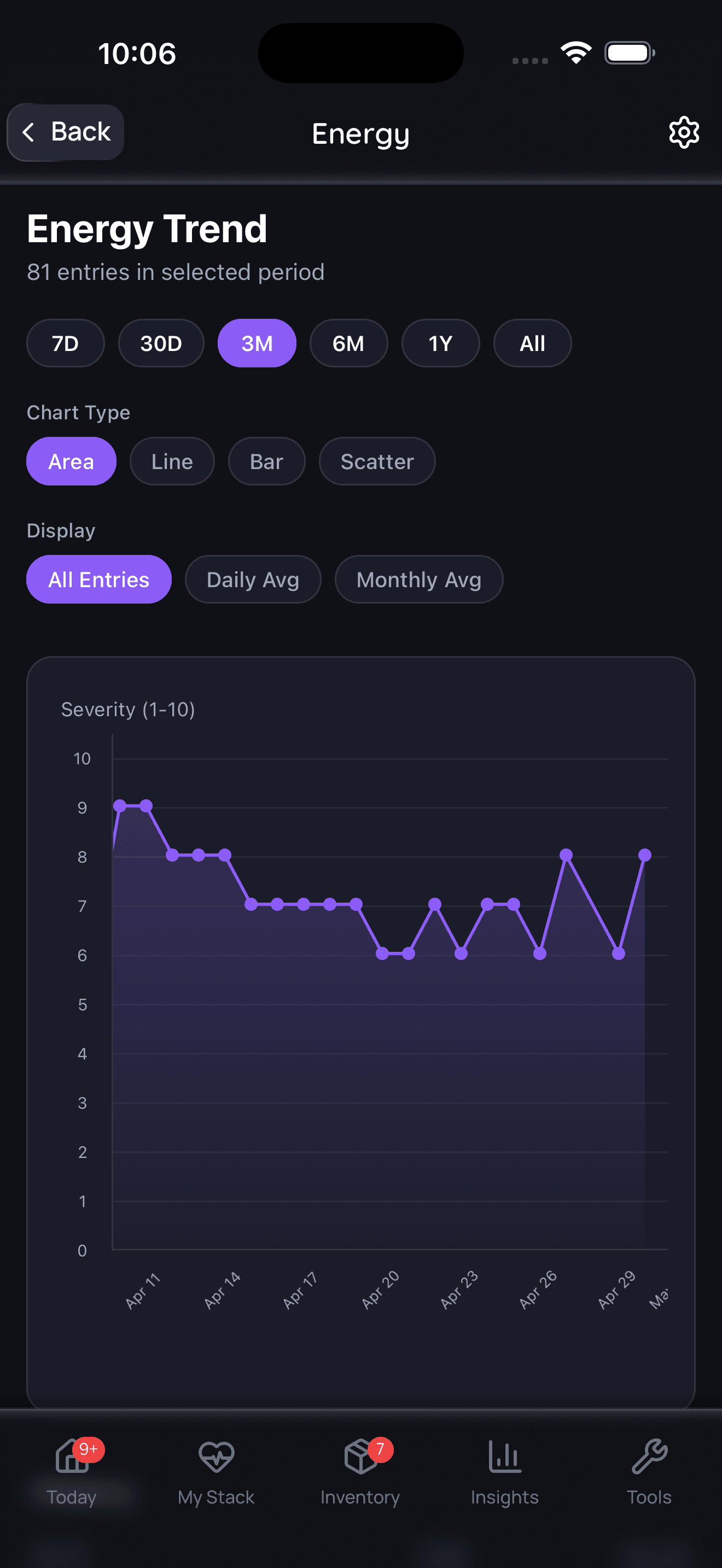
Symptom tracking is informational and should be interpreted with a qualified clinician.
The Science
The FDA label contraindicates methylene blue in patients with G6PD deficiency and in those with severe hypersensitivity to the compound [2]. Official warnings cover serotonin syndrome, lack of effectiveness in certain methemoglobinemia contexts, delayed hemolytic anemia, inaccurate pulse-oximetry readings, neurologic and visual adverse effects, fetal risk, and interruption of breastfeeding for up to 8 days after treatment [2][3]. The label also notes common adverse reactions including headache, nausea, diarrhea, dizziness, dysgeusia, discoloration, and related infusion or systemic complaints in studied settings [2].
Dosing & Usage Protocols
The Basics
There is no authoritative consumer-wellness dose for methylene blue in this dossier. That is the most important dosing fact. The published human literature covers very different scenarios, from acute medical IV treatment to PK studies to psychiatric adjunctive use, and those settings should not be blended into one homemade protocol [2][4][5][7].
If someone is looking for a neat drop-count answer, this guide cannot honestly provide one. The better answer is to separate clinical dosing, research dosing, and consumer marketing claims, then decide whether the gap between those categories is acceptable to you and your clinician.
When your stack includes several supplements, each with its own dose, form, and timing requirements, the logistics alone can derail consistency. Doserly consolidates all of it into one protocol view, so every dose across your entire routine is accounted for without spreadsheets or guesswork.
The app also tracks cumulative intake for nutrients that appear in multiple products. If your multivitamin, standalone supplement, and fortified protein shake all contain the same nutrient, Doserly adds them up and shows you the total alongside recommended and upper limits. Managing a thoughtful supplement protocol shouldn't require a degree in nutrition science. The app handles the complexity so you can focus on staying consistent.
Track injection timing, draw notes, and site rotation.
Doserly helps keep syringe-related notes, injection site history, reminders, and reconstitution context together for easier review.
Injection log
Site rotation
Injection logs support record-keeping; follow clinician instructions for administration.
The Science
Context
Acquired methemoglobinemia
- Dose or Range in Literature
- 1 mg/kg IV over 5-30 minutes, with a possible repeat up to 1 mg/kg after 1 hour
- Notes
- Medical supervision only [2]
Context
Oral PK study
- Dose or Range in Literature
- 500 mg oral aqueous dose versus 50 mg IV
- Notes
- Used to estimate bioavailability, not to define a wellness protocol [4]
Context
Oral versus IV distribution study
- Dose or Range in Literature
- 100 mg oral and IV comparisons
- Notes
- Used to compare route-dependent exposure and distribution [5]
Context
Healthy-volunteer cognition study
- Dose or Range in Literature
- Low-dose oral methylene blue
- Notes
- Acute experimental setting; abstract did not provide consumer-ready dosing guidance [6]
Context
Bipolar adjunctive trial
- Dose or Range in Literature
- 195 mg active dose, 15 mg low-dose comparator
- Notes
- Disease-treatment context with lamotrigine, not a general nootropic recommendation [7]
The safest dosing conclusion is that methylene blue has published human exposure ranges, but not a clean consumer standard. Readers should be especially careful with internet advice based on drops, compounded liquids of uncertain concentration, or the assumption that "pharma-grade" branding alone solves dose accuracy.
What to Expect (Timeline)
The most immediate effects people notice are often not the ones they were looking for. Blue or green urine, staining, odd taste, or no obvious subjective change may appear before any desired benefit does [2]. Some users describe same-day alertness or sharper perception, but those reports are inconsistent and not reliable enough to promise [6].
If a person is going to notice an acute cognitive effect, the healthy-volunteer literature suggests that it would likely show up on the scale of hours, not months [6]. The opposite outcome is also common in community discussion: plenty of users say they feel nothing and stop.
Longer-term expectations should be treated very cautiously. The bipolar literature involved months of structured adjunctive treatment, not casual self-experimentation [7]. Preclinical neuroprotection and longevity stories are even farther from a normal supplement timeline [8]. For most healthy users, "uncertain payoff" is a more honest expectation than "steady compounding benefits."
Interactions & Compatibility
Synergistic
- CoQ10: Often paired in mitochondrial-support stacks, but the rationale is mechanistic and indirect rather than proven in direct methylene blue combination trials.
- Alpha-Lipoic Acid: Another redox-active stack partner sometimes used for oxidative-stress framing, though combination evidence is limited.
- L-Carnitine: Sometimes used alongside methylene blue in energy-metabolism stacks, but the support for synergy is mostly theoretical.
Caution / Avoid
- SAMe: Because methylene blue carries MAOI-style interaction concern, combining it with other mood-active or serotonergic-leaning compounds deserves caution.
- Serotonergic antidepressants: FDA materials specifically warn about serotonin syndrome risk with SSRIs, SNRIs, clomipramine, and related agents [2][3].
- Opioids and dextromethorphan: Official materials also extend serotonin-syndrome caution to opioids and related agents in some contexts [2].
- G6PD deficiency: Methylene blue is contraindicated in this population because of hemolysis risk [2].
- Pregnancy and breastfeeding: The labeled product carries fetal-risk language and recommends interruption of breastfeeding for up to 8 days after treatment [2].
How to Take / Administration Guide
Route and product identity come before timing tricks with methylene blue. A user should first know whether they are dealing with a medically supervised injectable product, a compounded oral product, or a consumer-marketed liquid with far less standardization [2]. Without that clarity, "take it in the morning" advice is low value.
Oral consumer use is often discussed in drops or liquid form, but this is exactly where concentration errors, staining, and product-authenticity problems become practical issues. If a product does not clearly state concentration, raw ingredient identity, and manufacturing details, that uncertainty is part of the risk profile.
Meal timing guidance is weak in this dossier. The more important administration rules are to avoid serotonergic conflicts, keep it away from children and fabrics, protect the product from light if directed, and avoid copying medical-use assumptions into self-experimentation [2][3].
Choosing a Quality Product
The methylene blue category has a bigger quality problem than most supplement categories. Community discussion repeatedly centers on bargain bottles, unclear color, doubtful concentration, and the difficulty of telling whether a product is authentic or simply branded well [2]. That alone should make readers stricter than usual.
Look for transparent concentration labeling, a full ingredient list, batch-level testing where available, and evidence that the material is intended for human use rather than laboratory or aquarium use. Be skeptical of ultra-cheap listings, vague "USP-like" wording, or brand pages that talk endlessly about effects without showing how identity and impurities are verified.
Athletes have an extra layer of quality concern. Even though methylene blue was not specifically surfaced as a named prohibited substance in the WADA list reviewed, contamination and route-of-administration issues still matter [9]. Certified-for-sport style screening is worth prioritizing when available.
Storage & Handling
Protect methylene blue products from light when the product labeling says to do so, because light sensitivity is part of how the official injectable product is handled [2]. Store consumer products according to their label, typically in a cool, dry place away from heat and moisture.
The compound stains aggressively. Handle liquids with care around counters, clothes, fingers, and bathroom fixtures. Child safety also matters more than usual because methylene blue is not an ordinary flavored wellness gummy that can be casually left on a shelf.
For the labeled injectable product, the FDA instructions specify room-temperature storage and avoidance of refrigeration or freezing [2]. Consumer oral products may differ, so label-specific instructions should win.
Lifestyle & Supporting Factors
Methylene blue should not be asked to compensate for a weak foundation. Sleep deprivation, poor hydration, chaotic stacking, and lack of baseline tracking make it almost impossible to judge whether the compound is helping, doing nothing, or causing subtle harm.
This is one of those compounds where logging matters. Because the subjective signal can be strong for some people and absent for others, a simple before-and-after narrative is often misleading. Track timing, dose, co-used compounds, perceived effects, side effects, and any relevant lab or symptom markers if the experiment is medically appropriate.
The biggest supportive factor may be restraint. Methylene blue works better as a tightly defined question than as a vague "add this to the stack and hope" ingredient.
Regulatory Status & Standards
In the United States, methylene blue has an FDA-approved injectable drug form for acquired methemoglobinemia [2]. That is the most important regulatory fact in this guide. It means methylene blue is not just a free-floating supplement ingredient with no medicinal identity.
That said, the existence of an approved drug form does not automatically define the legal or quality status of every oral retail product sold online. Depending on formulation and jurisdiction, consumer methylene blue products may fall into messy territory between compounded product, consumer chemical, or supplement-like marketing language. This guide avoids assuming that any retail listing is equivalent to the approved drug [2].
For athletes, the WADA 2026 prohibited-list page reviewed did not specifically surface methylene blue as a named prohibited substance, but that is only a limited inference from the list page itself [9]. Intravenous infusions above WADA thresholds remain a prohibited-method issue, and contamination or undeclared ingredients still matter.
FAQ (Frequently Asked Questions)
Is methylene blue a normal dietary supplement like magnesium or creatine?
No. It is better understood as a pharmacologically active specialty compound with a regulated drug identity in at least one official medical form [2].
Is there an established daily wellness dose?
Not from the sources in this dossier. Published human doses vary by medical, pharmacokinetic, and psychiatric context, and they do not collapse into a validated general-health dose [2][4][5][7].
Can oral methylene blue actually be absorbed?
Yes. Human pharmacokinetic work supports substantial oral bioavailability for at least some formulations [4].
Does oral methylene blue equal intravenous methylene blue?
No. Route changes exposure and distribution, and one PK study explicitly argues that intravenous administration may be preferable when the central nervous system is the target [5].
Why do people worry about serotonin syndrome with methylene blue?
Because FDA safety communications and the current ProvayBlue label both warn about serious interaction risk with serotonergic drugs and related agents [2][3].
Why do online users focus so much on product quality?
Because the community signal is full of doubts about concentration, authenticity, impurities, and suspiciously cheap products. That uncertainty changes both safety and adherence [2].
Is methylene blue clearly banned for athletes?
The WADA list page reviewed did not specifically name methylene blue, but athlete safety is still not automatic because route rules, contamination, and undeclared ingredients can create problems [9].
Myth vs. Fact
Myth: Methylene blue is basically just a harmless blue antioxidant supplement.
Fact: The official evidence base treats it as a pharmacologically active compound with real contraindications, interaction warnings, and route-specific medical use [2][3].
Myth: If a product is oral, the serotonin interaction warnings do not matter.
Fact: FDA explicitly said the oral-route risk was not clearly known from the evidence available in the safety communication, not that oral use was automatically safe [3].
Myth: Strong oral bioavailability means oral methylene blue is interchangeable with IV use.
Fact: Oral bioavailability can be substantial while route-dependent tissue distribution still differs in meaningful ways [4][5].
Myth: The healthy-volunteer memory study proves methylene blue is a proven nootropic for everyone.
Fact: The study is interesting but small, acute, and not a long-term real-world effectiveness trial [6].
Myth: If online users say they feel nothing, the compound must be useless.
Fact: Community reporting is heavily confounded by product quality, dosing ambiguity, and stack complexity. "No effect" is common, but it is not a clean verdict on the underlying compound [2][4].
Sources & References
Official and Regulatory Sources
[1] PubChem. Methylene Blue (CID 6099). https://pubchem.ncbi.nlm.nih.gov/compound/3%2C7-Bis%28dimethylamino%29phenazathionium%20chloride
[2] FDA. PROVAYBLUE (methylene blue) injection label, revised January 2024. https://www.accessdata.fda.gov/drugsatfda_docs/label/2024/204630s021lbl.pdf
[3] FDA. Updated information about the drug interaction between methylene blue and serotonergic psychiatric medications. https://www.fda.gov/drugs/drug-safety-and-availability/fda-drug-safety-communication-updated-information-about-drug-interaction-between-methylene-blue
[9] World Anti-Doping Agency. The Prohibited List. https://www.wada-ama.org/en/prohibited-list
Human Pharmacokinetic and Clinical Studies
[4] Walter-Sack I, Rengelshausen J, Oberwittler H, et al. High absolute bioavailability of methylene blue given as an aqueous oral formulation. PubMed PMID: 18810398. https://pubmed.ncbi.nlm.nih.gov/18810398/
[5] Peter C, Hongwan D, Kupfer A, Lauterburg BH. Pharmacokinetics and organ distribution of intravenous and oral methylene blue. PubMed PMID: 10952480. https://pubmed.ncbi.nlm.nih.gov/10952480/
[6] Riha PD, Bruchey AK, Echevarria DJ, et al. Multimodal randomized functional MR imaging of the effects of methylene blue in the human brain. PubMed PMID: 27351678. https://pubmed.ncbi.nlm.nih.gov/27351678/
[7] Naylor GJ, Martin B, Hopwood SE, Watson Y. Methylene blue treatment for residual symptoms of bipolar disorder: randomised crossover study. PubMed PMID: 27284082. https://pubmed.ncbi.nlm.nih.gov/27284082/
Review and Mechanism Sources
[8] Rojas JC, Bruchey AK, Gonzalez-Lima F. Neurometabolic mechanisms for memory enhancement and neuroprotection of methylene blue. PubMed PMID: 22067440. https://pubmed.ncbi.nlm.nih.gov/22067440/