
Resveratrol: The Complete Supplement Guide
On this page
Quick Reference Card
Attribute
Common Name
- Detail
- Resveratrol
Attribute
Other Names / Aliases
- Detail
- trans-resveratrol, 3,5,4'-trihydroxystilbene, stilbenoid polyphenol
Attribute
Category
- Detail
- Polyphenol / longevity / cardiometabolic support supplement
Attribute
Primary Forms & Variants
- Detail
- trans-resveratrol, cis-resveratrol, Japanese-knotweed-derived extracts, grape-derived extracts, multi-ingredient longevity blends
Attribute
Typical Dose Range
- Detail
- Human trials commonly range from 75 mg/day to 1000 mg/day, with some protocols using higher short-term doses [1][2][3]
Attribute
RDA / AI / UL
- Detail
- No established RDA, AI, or UL
Attribute
Common Delivery Forms
- Detail
- Capsules, tablets, powders, longevity stacks, liposomal or enhanced-delivery products
Attribute
Best Taken With / Without Food
- Detail
- Often taken with food or fat in practical use, but no single timing rule is proven across all products
Attribute
Key Cofactors
- Detail
- Fat-containing meals, broader diet quality, and careful stack design may matter more than any single cofactor
Attribute
Storage Notes
- Detail
- Store sealed, dry, and away from heat and light because polyphenol stability matters
Overview
The Basics
Resveratrol is one of the best-known longevity supplements because it sits at the intersection of red-wine lore, antioxidant marketing, and real laboratory interest. The simple version is that it is a plant polyphenol found in grapes, Japanese knotweed, and some berries, and it has been studied for possible effects on inflammation, metabolism, vascular function, and aging-related biology [1][2].
The problem is that the public story is much cleaner than the human evidence. Resveratrol has been promoted for everything from healthy aging to blood sugar control to brain support, but human trials have not produced one clear, universally accepted use case. The strongest fair summary is that it is biologically interesting, generally tolerated in common study ranges, and still clinically unsettled [1][4].
The Science
Resveratrol is a stilbenoid that has shown anti-inflammatory, antioxidant, and signaling effects in preclinical work, including pathways involving sirtuins, AMPK, oxidative stress, and inflammatory mediators [1][2]. Clinical reviews now include nearly 200 studies across many conditions, but the trial literature remains heterogeneous in dose, formulation, duration, and endpoints [1].
That mismatch explains why the compound can look powerful in mechanistic discussions yet underwhelming in practical guidance. The question is no longer whether resveratrol does anything biologically. The question is whether oral supplemental use, at realistic doses and formulations, produces reliable human benefit strong enough to justify confident recommendations [1][2][3].
Chemical & Nutritional Identity
Property
Chemical Name
- Value
- 3,5,4'-trihydroxystilbene
Property
Molecular Formula
- Value
- C14H12O3
Property
Molecular Weight
- Value
- 228.24 g/mol
Property
Category
- Value
- Polyphenol / stilbenoid
Property
Common Natural Sources
- Value
- Grape skins, Japanese knotweed, berries, red wine
Property
Most Marketed Form
- Value
- trans-resveratrol
Property
Key Identity Issue
- Value
- Many commercial products vary in purity, source material, and added co-ingredients
Property
Nutritional Status
- Value
- Not an essential nutrient and not used to correct a deficiency
Resveratrol is not a vitamin, mineral, or amino acid with a required intake target. It is a bioactive plant compound sold for theoretical health effects rather than deficiency correction [2]. Most serious supplement discussion centers on trans-resveratrol because it is considered the biologically more relevant commercial form.
Commercial identity still matters. Community reviews repeatedly emphasize purity, trans-resveratrol labeling, and source material, which is consistent with the broader evidence problem: if products vary widely, real-world outcomes will vary too [2][6].
Mechanism of Action
The Basics
Resveratrol is usually discussed as a signaling compound rather than a straightforward nutrient replacement. People take it because they hope it nudges the body toward a lower-inflammatory, more resilient state, especially around aging, blood sugar, vascular function, and brain health [1][2].
That sounds appealing, but it also creates a problem. When one supplement touches many pathways a little bit, it can be hard to know whether it changes anything enough to matter in everyday life. That is one reason the hype around resveratrol has always outpaced the certainty [1][2].
The Science
Mechanistically, resveratrol has been linked with sirtuin-related signaling, AMPK activity, inflammatory modulation, oxidative-stress regulation, endothelial function, and platelet-related pathways [1][2][3]. Some of these mechanisms are plausible enough to support interest in cardiometabolic and neurocognitive endpoints, but none solve the core delivery problem on their own.
The main scientific caveat is that mechanism does not equal outcome. Human metabolism rapidly converts resveratrol into sulfate and glucuronide conjugates, so the impressive cell and animal data do not translate cleanly into equivalent human exposure at the tissue level [2][3].
Pathway
Resveratrol follows a familiar supplement pattern: it is absorbed after oral ingestion, quickly metabolized, and then circulated more as conjugated metabolites than as free parent compound [2][3]. That matters because the pathway from swallowing a capsule to getting a clinical effect is not straightforward.
In practical terms, the supplement story looks like this:
- Oral resveratrol is taken in capsule, powder, or blend form.
- It is absorbed in the gut to a meaningful degree.
- It is rapidly conjugated in the body, limiting free circulating resveratrol.
- Any real-world effect depends on whether the resulting exposure, formulation, timing, and tissue distribution are enough to affect the targeted endpoint.
This is why resveratrol is better framed as a compound with biologic potential than as a dependable, high-confidence intervention.
Absorption & Bioavailability
The Basics
Absorption is one of the most important reasons resveratrol remains controversial. A product can look exciting on paper and still disappoint in practice if very little active compound remains in circulation long enough to matter [2][3].
This is also why users obsess over trans-resveratrol, purity, taking it with fat, or switching to pterostilbene. Those choices are all attempts to solve the same problem: getting a meaningful biological signal from a compound known for low practical bioavailability [2][6].
The Science
Human reviews describe a high-absorption, low-parent-exposure paradox. Resveratrol is absorbed orally, but rapid glucuronidation and sulfation leave low levels of free parent compound in circulation, which limits straightforward dose-response thinking [2][3]. Reviews focused on human metabolism repeatedly identify poor systemic bioavailability as a key reason human outcomes are inconsistent [2][3].
Managing absorption timing across multiple supplements gets complicated fast. Some need to be taken with food, others on an empty stomach. Some compete for the same absorption pathways, others enhance each other. Doserly organizes all of this into a single schedule that accounts for the interactions between everything in your stack.
Instead of juggling mental notes about which supplements to separate and which to pair, the app handles the coordination for you. It flags timing conflicts, suggests optimal windows based on the forms you're using, and builds a daily routine that gives each supplement its best chance of being absorbed effectively. One place for all the details that are easy to forget.
Turn symptom and safety notes into a clearer timeline.
Doserly helps you log doses, symptoms, and safety observations side by side so patterns are easier to discuss with a qualified clinician.
Pattern view
Logs and observations

Pattern visibility is informational and should be reviewed with a clinician.
Research & Clinical Evidence
The Basics
The fairest summary of human evidence is that resveratrol has pockets of promise but no universally clean win. Some trial clusters suggest benefit for selected inflammatory, metabolic, vascular, or cognitive outcomes. Others show weak, inconsistent, or clinically modest effects [1][3][4][5].
That does not make the supplement useless. It means benefit language has to stay narrow and conditional. Resveratrol is not well supported as a general anti-aging shortcut, but it also cannot be dismissed as pure placebo because some endpoints do move in the literature [1][4][5].
The Science
The 2024 systematic review of purified-form trials concludes that there is no conclusive clinical evidence to recommend resveratrol in healthcare settings, even though inflammatory markers and some dysregulated-metabolism endpoints show recurrent positive signals [1]. NCCIH also describes the diabetes and glycemic-control literature as low-certainty rather than definitive, even when some meta-analyses show improvements in fasting glucose or blood pressure at higher doses [5].
The cognitive and mood meta-analysis adds a second important nuance. It found that resveratrol supplementation might improve selected outcomes such as delayed recognition and negative mood, but the overall literature was limited and inconsistent [4]. That is useful evidence, but still not the sort of signal that justifies broad brain-health marketing.
Evidence & Effectiveness Matrix
Category
Energy Levels
- Evidence Strength
- 4/10
- Reported Effectiveness
- 5/10
- Summary
- Human trials do not strongly support an energy supplement framing, but community reports are mixed-positive enough to keep the score moderate.
Category
Inflammation
- Evidence Strength
- 5/10
- Reported Effectiveness
- 5/10
- Summary
- Clinical and anecdotal signals support a plausible anti-inflammatory role, but the effect size and consistency remain uncertain.
Category
Heart Health
- Evidence Strength
- 4/10
- Reported Effectiveness
- 4/10
- Summary
- Cardiometabolic interest is real, but practical community results and human endpoints are too mixed for strong claims.
Category
Focus & Mental Clarity
- Evidence Strength
- 4/10
- Reported Effectiveness
- 4/10
- Summary
- Some users report better focus, but stack confounding and limited human trial evidence keep the score conservative.
Category
Skin Health
- Evidence Strength
- 3/10
- Reported Effectiveness
- 4/10
- Summary
- Skin and vitality claims are common in reviews but weakly evidenced.
Category
Dizziness & Headache Burden
- Evidence Strength
- 4/10
- Reported Effectiveness
- 4/10
- Summary
- Headache and dizziness show up repeatedly enough to matter in tolerability counseling.
Category
GI Tolerance
- Evidence Strength
- 4/10
- Reported Effectiveness
- 4/10
- Summary
- Stomach upset is common enough to justify caution, especially at higher doses.
Category
Treatment Adherence
- Evidence Strength
- 3/10
- Reported Effectiveness
- 4/10
- Summary
- Cost, uncertain benefit, and stack complexity weaken long-term adherence.
Benefits & Potential Effects
The Basics
If resveratrol helps, the most plausible benefits are not usually dramatic. Users tend to describe subtle shifts in energy, inflammation, cardiovascular wellbeing, or overall vitality rather than an obvious “I took this and changed overnight” effect [1][4][6].
That is an important expectation-setting point. A supplement with subtle benefits can still matter, but it should be evaluated over time, preferably against a stable routine and with realistic goals rather than vague anti-aging hopes.
The Science
The strongest support is still endpoint-specific rather than category-wide. Clinical reviews support cautious discussion around inflammatory markers, dysregulated metabolism, and selected cognitive endpoints, but none of those areas are strong enough to stand as a general wellness endorsement [1][4][5].
A practical reader takeaway is that resveratrol may be worth evaluating in narrow contexts, but not as a default longevity supplement for everyone.
Side Effects & Safety
The Basics
Resveratrol is usually described as tolerated in common oral study ranges, but “tolerated” is not the same thing as risk-free. The most practical downside signals from community use are headaches, dizziness, GI upset, jittery or sweaty feelings, and occasional complaints about fatigue or poor overall payoff [2][5][6].
The bigger safety issue for some people is context. If someone is taking blood thinners, has liver disease, or is stacking multiple supplements with overlapping effects, the risk discussion becomes more important than the marketing copy.
The Science
Official and review sources describe oral resveratrol as generally safe in common study settings, but they also repeatedly flag possible interaction risk with anticoagulant and antiplatelet therapies [2][5]. Human toxicity reviews further emphasize that real-world formulation differences and rapid metabolism complicate both efficacy and safety interpretation [2].
Managing side effect risks across a multi-supplement stack can feel overwhelming, especially when interactions between supplements, medications, and foods add layers of complexity. Doserly brings all of that into a single safety view so nothing falls through the cracks.
Rather than researching every possible interaction yourself, the app checks your full stack automatically and flags supplement-drug and supplement-supplement interactions that warrant attention. If you do experience something unexpected, logging it takes seconds, and over time the app helps you spot patterns: whether symptoms correlate with specific doses, timing, or combinations. One place for the safety picture that matters most when your stack grows beyond a few bottles.
Capture changes while they are still fresh.
Log symptoms, energy, sleep, mood, and other observations alongside protocol events so patterns do not live only in memory.
Trend view
Symptom timeline
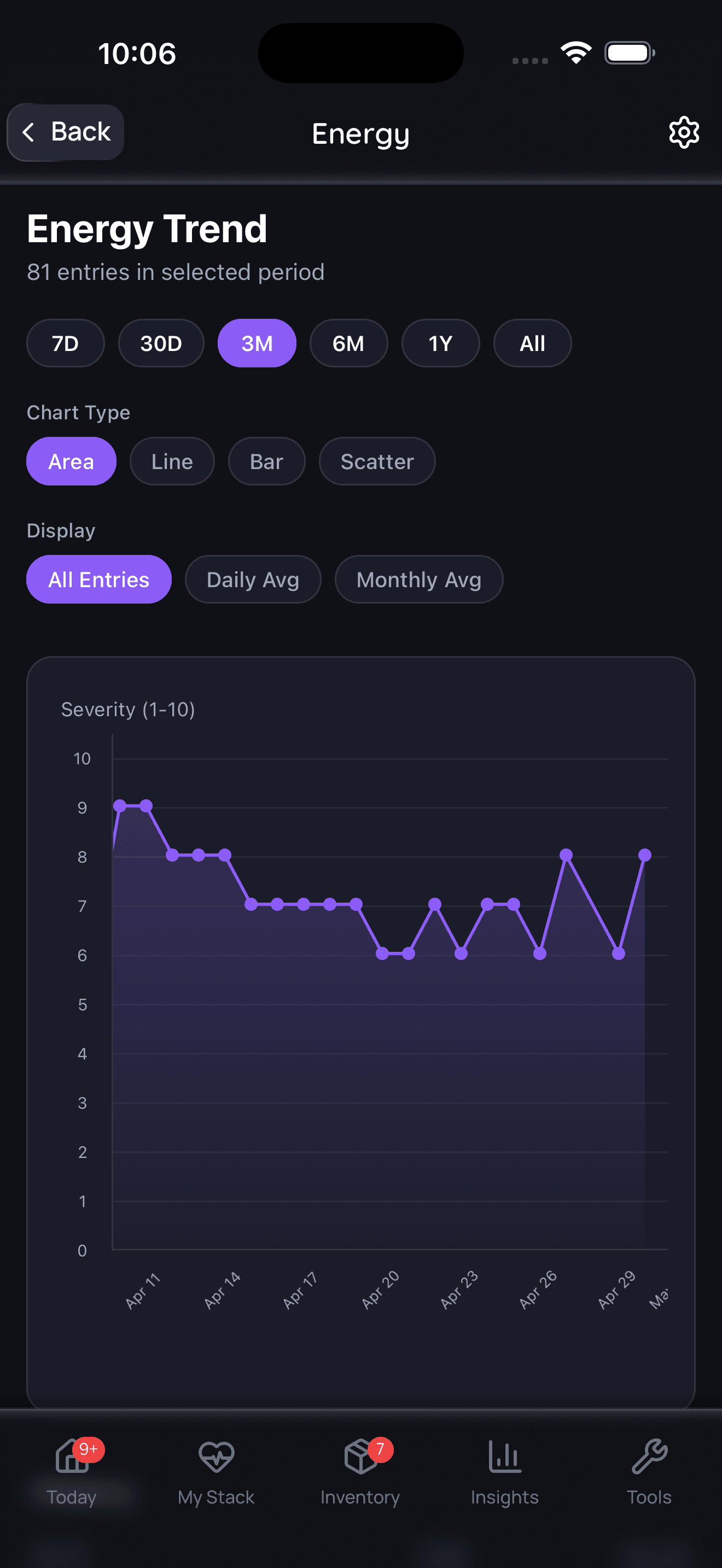
Symptom tracking is informational and should be interpreted with a qualified clinician.
Dosing & Usage
The Basics
There is no one “correct” resveratrol dose. Human trials range widely, and real-world products vary even more. That means the best dosing section is not a single number. It is a framework: start with what the product actually contains, compare it with the study range most relevant to your goal, and pay attention to tolerability [1][3][5].
High-dose enthusiasm is common in longevity circles, but higher dose does not automatically mean better result. It may simply mean more cost and more risk of feeling unwell.
The Science
Clinical and review literature commonly spans roughly 75 mg/day to 1000 mg/day in oral protocols, with some specialized studies going beyond that [1][3]. NCCIH highlights that higher-dose resveratrol may reduce fasting glucose or blood pressure in some diabetes-related analyses, but these outcomes remain low-certainty and not uniformly replicated [5].
The practical reading is that dose should match the actual question being tested. A person using resveratrol for a vague longevity goal is already in uncertain territory, so escalating the dose without a defined endpoint is not especially rational.
When your stack includes several supplements, each with its own dose, form, and timing requirements, the logistics alone can derail consistency. Doserly consolidates all of it into one protocol view, so every dose across your entire routine is accounted for without spreadsheets or guesswork.
The app also tracks cumulative intake for nutrients that appear in multiple products. If your multivitamin, standalone supplement, and fortified protein shake all contain the same nutrient, Doserly adds them up and shows you the total alongside recommended and upper limits. Managing a thoughtful supplement protocol should not require a degree in nutrition science. The app handles the complexity so you can focus on staying consistent.
Track injection timing, draw notes, and site rotation.
Doserly helps keep syringe-related notes, injection site history, reminders, and reconstitution context together for easier review.
Injection log
Site rotation
Injection logs support record-keeping; follow clinician instructions for administration.
What to Expect
Resveratrol is rarely described as a fast-feedback supplement. If a person notices anything, it is more often a subtle change over weeks than a dramatic early effect [1][4][6].
That expectation cuts both ways. Some users may notice improved vitality or reduced inflammation-like symptoms. Others may notice nothing at all. For a supplement with this much hype and this much uncertainty, outcome tracking matters more than enthusiasm.
Interactions & Compatibility
Synergistic
- NMN: Commonly paired in longevity stacks, though attribution becomes weaker when both are used together.
- Pterostilbene: Often discussed as a better-delivery stilbenoid alternative rather than a true synergy, but users compare them constantly.
- Quercetin: Frequently combined in antioxidant and longevity stacks.
- CoQ10: Common companion in cardiometabolic support routines.
Caution / Avoid
- Anticoagulant or antiplatelet drugs: Official sources flag interaction concern and bleeding-risk caution [2][5].
- Heavy stack users: Attribution becomes very poor when resveratrol is added on top of NMN, quercetin, curcumin, or multi-ingredient “longevity” formulas.
- Pre-existing liver disease or high sensitivity to supplements: Community reports suggest extra caution is warranted.
How to Take
Resveratrol is usually taken as capsules or powders, commonly once daily, sometimes with food or fat in practical use. The best real-world rule is to keep the approach consistent long enough to evaluate it, rather than constantly changing timing, dose, and co-supplements at the same time.
If GI discomfort or headaches show up, practical user reports support trying a lower dose, splitting the dose, or stopping the product rather than pushing through. Because the signal is often subtle, it is better to assess cleanly than to force adherence to an uncertain protocol.
Choosing a Quality Product
The strongest quality signals are form transparency, trans-resveratrol labeling, brand clarity, and third-party testing. Community discussion repeatedly stresses purity and source material, and athlete-facing guidance reinforces that contamination risk matters even when the named ingredient is not itself prohibited [5][6][7].
Helpful quality markers include:
- clear trans-resveratrol disclosure
- source transparency, such as Japanese knotweed versus vague “polyphenol blend” labeling
- third-party testing or published quality controls
- athlete-focused certifications when sports compliance matters
- avoidance of proprietary blends that hide the actual resveratrol amount
Storage
Store resveratrol sealed, dry, and away from excess heat and light. That advice is mundane, but it matters more for polyphenols than many users assume. A product with weak stability or unclear handling may underperform before the biology even becomes the limiting factor.
Lifestyle
Resveratrol works best as a narrow supplement experiment inside a broader cardiometabolic or longevity routine, not as a substitute for sleep, diet quality, exercise, or blood-pressure and glucose management. The less stable those fundamentals are, the harder it becomes to decide whether a subtle supplement is doing anything useful.
That is especially true for people drawn to resveratrol because of long-horizon anti-aging messaging. If the endpoint is abstract, the routine needs to be concrete.
Regulatory Status & Standards
Resveratrol is sold in the United States as a dietary supplement, which means products are marketed under DSHEA-style supplement rules rather than drug approval standards. That limits how much efficacy certainty can be assumed from retail availability alone [5].
For athletes, the important distinction is between ingredient status and product risk. Resveratrol is not a known WADA-prohibited ingredient in the current official guidance, but USADA repeatedly warns that dietary supplements remain contamination and mislabeling risks regardless of the named ingredient [6][7]. Sport-certified programs such as NSF Certified for Sport and Informed Sport remain the best practical quality filters when compliance matters.
FAQ
Does resveratrol actually work?
Based on current human evidence, it may help selected endpoints in some contexts, but the evidence is mixed and not strong enough to support broad anti-aging or universal health claims [1][4][5].
Is resveratrol good for longevity?
It is popular for longevity, but human evidence does not justify treating it as a proven life-extension supplement. That use remains theoretical and indirect.
Why do people say resveratrol has poor bioavailability?
Because it is absorbed orally but rapidly metabolized, leaving limited free parent compound in circulation [2][3].
Is trans-resveratrol better than generic resveratrol labeling?
Commercially, trans-resveratrol is usually the more relevant form. Clear form disclosure is a quality advantage.
Should I take resveratrol with food?
There is no single proven rule for everyone. Many users take it with food or fat, but strong universal evidence for one timing strategy is lacking.
Can resveratrol upset the stomach?
Yes. Community reports include GI upset, headache, dizziness, and other dose-related tolerability issues [6].
Can I take resveratrol with blood thinners?
That is a higher-caution situation. Official sources flag possible interaction risk with anticoagulant or antiplatelet drugs [2][5].
Is resveratrol banned for athletes?
The ingredient is not a known WADA-prohibited substance in current guidance, but athletes still face supplement contamination risk and should use strong quality filters [6][7].
Myth vs. Fact
Myth: Resveratrol is a proven anti-aging supplement.
Fact: Human evidence remains mixed and insufficient for broad anti-aging claims [1].
Myth: If a dose is higher, the results must be better.
Fact: Larger doses may increase exposure or tolerability issues without guaranteeing better real-world benefit [1][3].
Myth: Low bioavailability means resveratrol does nothing.
Fact: Low bioavailability is a real limitation, but it does not prove zero biological effect. It means claims need to stay cautious [2][3].
Myth: All resveratrol products are basically interchangeable.
Fact: Purity, form, source material, and product quality vary substantially in real-world use [6].
Myth: If the ingredient is not banned, athlete risk is solved.
Fact: Official anti-doping guidance stresses that contamination and mislabeling remain significant supplement risks even when the named ingredient is not prohibited [6][7].
Sources & References
- Brown K, Theofanous D, Britton RG, et al. Resveratrol for the Management of Human Health: How Far Have We Come? A Systematic Review of Resveratrol Clinical Trials to Highlight Gaps and Opportunities. Int J Mol Sci. 2024. https://pmc.ncbi.nlm.nih.gov/articles/PMC10815776/
- Cottart CH, Nivet-Antoine V, Beaudeux JL. Review of recent data on the metabolism, biological effects, and toxicity of resveratrol in humans. Mol Nutr Food Res. 2014. https://pubmed.ncbi.nlm.nih.gov/23740855/
- Springer M, Moco S. Resveratrol and Its Human Metabolites—Effects on Metabolic Health and Obesity. Nutrients. 2019. https://pmc.ncbi.nlm.nih.gov/articles/PMC6357128/
- Marx W, et al. Effect of resveratrol supplementation on cognitive performance and mood in adults: a systematic literature review and meta-analysis of randomized controlled trials. Nutrition Reviews. 2018. https://pubmed.ncbi.nlm.nih.gov/29596658/
- NCCIH Clinical Digest. Type 2 Diabetes and Dietary Supplements: Science. https://www.nccih.nih.gov/health/providers/digest/type-2-diabetes-and-dietary-supplements-science
- USADA. World Anti-Doping Agency (WADA) Prohibited List. https://www.usada.org/athletes/substances/prohibited-list/
- USADA. Supplement Connect High Risk List. https://www.usada.org/athletes/substances/supplement-connect/high-risk-list/