
Strontium Citrate: The Complete Supplement Guide
On this page
Quick Reference Card
Attribute
Common Name
- Detail
- Strontium Citrate
Attribute
Other Names / Aliases
- Detail
- Strontium, Sr citrate, elemental strontium from citrate salt
Attribute
Category
- Detail
- Bone health / osteoporosis support supplement
Attribute
Primary Forms & Variants
- Detail
- Citrate salt, multi-ingredient bone blends, standalone capsules or tablets. Other strontium salts discussed in the literature include ranelate, lactate, gluconate, carbonate, and chloride [5][6].
Attribute
Typical Dose Range
- Detail
- Community and supplement-label discussion often clusters around 500 to 680 mg elemental strontium per day, but the strongest published efficacy data are not for standalone citrate and there is no universally accepted citrate-specific target [4][6].
Attribute
RDA / AI / UL
- Detail
- No established RDA, AI, or UL identified in the current source set.
Attribute
Common Delivery Forms
- Detail
- Capsule, tablet, combination bone-support formula
Attribute
Best Taken With / Without Food
- Detail
- Goal-dependent. Because calcium intake can reduce strontium absorption, users and clinicians often discuss separating it from calcium-rich meals or calcium supplements [2].
Attribute
Key Cofactors
- Detail
- Calcium balance, vitamin D status, vitamin K status, resistance training, and broader bone-health habits are commonly discussed alongside strontium use [2][4][6].
Attribute
Storage Notes
- Detail
- Keep sealed, cool, and dry. Real-world user reports suggest some products may develop odor or tolerability issues over time, so identity transparency and storage quality matter.
Overview
The Basics
Strontium citrate is a bone-focused supplement that people usually consider when they are worried about osteopenia, osteoporosis, or disappointing bone density scans. The appeal is easy to understand. Strontium behaves a lot like calcium chemically, it can become incorporated into bone, and parts of the research story make it sound like a mineral shortcut to stronger bones.
The problem is that the story is not clean. The strongest historical evidence is for prescription strontium ranelate, not over-the-counter strontium citrate. The best citrate-specific human data are much thinner, and some of the "improvement" people see on a bone scan may reflect how strontium changes the scan itself rather than a one-to-one improvement in fracture resistance [3][4][5][8].
That does not mean strontium citrate is useless. It means the supplement sits in a gray zone: plausible bone biology, real bone incorporation, some combination-trial support, but not the kind of direct citrate-only fracture evidence that would settle the question [3][4][5].
The Science
Strontium is a divalent alkaline earth element with close chemical similarity to calcium, which explains why it can enter bone mineral and participate in calcium-adjacent biological pathways [1][5]. In supplement form, the citrate salt acts as a delivery partner rather than the primary active mineral itself, with regulatory review explicitly describing strontium as the active component and the salt form as an absorption aid [6].
Clinical interpretation is complicated by evidence asymmetry. Prescription strontium ranelate generated much of the historic fracture and bone-density literature, whereas strontium citrate is supported mainly by mechanistic reasoning, observational accumulation data, and small combination studies rather than large citrate-only fracture trials [3][4][5]. This creates a recurring interpretive problem for clinicians and users alike: the biology is real, but the evidence base is form-dependent and the endpoints are not interchangeable.
Chemical & Nutritional Identity
Property
Chemical Name
- Value
- Strontium citrate
Property
Molecular Formula
- Value
- C6H5O7Sr- [1]
Property
Molecular Weight
- Value
- Not consistently provided in the current KB source set
Property
CAS Number
- Value
- Not consistently provided in the current KB source set
Property
PubChem CID
- Value
- 181658 [1]
Property
Classification
- Value
- Strontium salt used in bone-support supplements
Property
Established Daily Values
- Value
- No established RDA, AI, or UL identified in the current source set
Property
Common Supplement Forms
- Value
- Standalone capsules, tablets, and multi-ingredient bone formulas
Property
Bioavailability Notes
- Value
- Oral strontium absorption is variable and falls when calcium intake is very high; different salt forms likely change handling, but direct form-comparison data remain limited [2][6]
Property
Isomer / Stereochemistry Notes
- Value
- Not a meaningful issue for this supplement in the way it is for some vitamins or amino acids
The practical identity issue is not chirality or unusual chemistry. It is form confusion. Many consumers hear "strontium" and assume citrate, ranelate, and other salts can be treated as interchangeable. The current evidence base does not support that simplification [4][5][6].
Mechanism of Action
The Basics
Strontium citrate is usually framed as a bone remodeling supplement. In plain language, the theory is that it may help tilt bone metabolism toward more building and less breakdown. That idea comes from the broader strontium literature, where strontium is discussed as both osteoblast-supportive and antiresorptive.
There is another layer, and it matters a lot. Strontium is not just a signaling factor. It can also become part of the bone mineral itself. That means it may change what a scan sees even when the deeper question, "are the bones actually less likely to break," is still unsettled [3][5][8].
The Science
The broader strontium literature describes dual effects on bone tissue metabolism, including osteoblast-promoting and osteoclast-modulating actions, with receptor-level and mineral-phase mechanisms proposed as contributors [5]. In the MOTS combination trial, a strontium-citrate-containing regimen was associated with higher P1NP, lower turnover ratios, greater osteoblastogenesis, reduced osteoclastogenesis, and changes in OPG/RANKL signaling, although the intervention also contained melatonin, vitamin D3, and vitamin K2 [4].
Bone incorporation is independently supported by human observational data showing that self-supplementation with strontium products leads to measurable and sustained increases in bone strontium content over time [3]. That is biologically important because it creates a second pathway of apparent benefit: genuine remodeling effects may coexist with physical changes in X-ray attenuation, which can raise measured areal bone mineral density without mapping perfectly onto calcium-equivalent bone quality [3][8].
Pathway
Strontium citrate follows a two-part pathway that helps explain both its promise and its uncertainty.
- After oral ingestion, some of the elemental strontium is absorbed across the gut into plasma. Adult absorption is variable, and calcium intake can influence how much is taken up [2].
- Once absorbed, strontium can circulate to bone and become incorporated into mineralized tissue, where it may influence remodeling biology and also change imaging behavior because strontium attenuates X-rays more strongly than calcium [3][5][8].
The practical consequence is straightforward. A better DXA result after strontium exposure may reflect some mix of biology and physics rather than a simple one-to-one improvement in fracture resistance.
Absorption & Bioavailability
The Basics
Strontium is absorbed through the gut, but not in a perfectly consistent way. The biggest practical point is that calcium matters. High calcium intake can reduce strontium absorption, while lower calcium intake can increase it. That is why so much real-world discussion around strontium citrate focuses on timing and spacing from calcium supplements [2].
This is also where salt-form confidence drops. Official review language recognizes that citrate and other salt partners help with absorption, but available data do not clearly tell us how much safer or more effective one non-ranelate form is than another [6].
The Science
A review of published adult absorption data estimated a geometric mean absorbed fraction of 22.3%, with a broad 95% confidence interval of 10.9% to 45.6% [2]. Within healthy adults, absorption did not appear strongly dependent on sex or age, but it was reduced by very high calcium intake and enhanced when calcium intake was very low [2].
Official Canadian safety review language adds an important practical nuance: citrate, lactate, gluconate, and ranelate are treated as salt partners that assist strontium delivery, but the available evidence is insufficient to compare non-ranelate salts cleanly for cardiovascular risk or absorption behavior at supplement doses [6].
Managing absorption timing across multiple supplements gets complicated fast. Some need to be taken with food, others on an empty stomach. Some compete for the same absorption pathways, others enhance each other. Doserly organizes all of this into a single schedule that accounts for the interactions between everything in your stack.
Instead of juggling mental notes about which supplements to separate and which to pair, the app handles the coordination for you. It flags timing conflicts, suggests optimal windows based on the forms you're using, and builds a daily routine that gives each supplement its best chance of being absorbed effectively. One place for all the details that are easy to forget.
Track injection timing, draw notes, and site rotation.
Doserly helps keep syringe-related notes, injection site history, reminders, and reconstitution context together for easier review.
Injection log
Site rotation
Injection logs support record-keeping; follow clinician instructions for administration.
Research & Clinical Evidence
The Basics
The clinical evidence for strontium citrate is not empty, but it is narrow. There is a meaningful difference between "strontium as a concept helps bones" and "standalone strontium citrate has strong human fracture data." The first statement is easier to support than the second.
The best citrate-specific human evidence in this dossier comes from two places: a combination trial in postmenopausal osteopenic women, and observational data showing that people who self-supplement accumulate measurable strontium in bone over time. Those are useful findings, but they are not the same as a large standalone citrate fracture trial [3][4].
The Science
In the MOTS randomized controlled trial, a one-year combination of melatonin, strontium citrate, vitamin D3, and vitamin K2 improved lumbar spine bone mineral density by 4.3% and left femoral neck bone mineral density by 2.2% relative to placebo in postmenopausal osteopenic women [4]. The same intervention increased P1NP and shifted several mechanistic markers toward a more bone-forming profile [4]. The limitation is obvious: the study tested a multi-ingredient regimen, not isolated strontium citrate [4].
Independent human observational evidence shows that self-supplementation with strontium products raises bone strontium content quickly and that accumulation can continue for years, with marked person-to-person variability [3]. That finding supports real tissue exposure, but it does not resolve whether the resulting scan gains fully represent stronger bone [3].
The imaging problem is not hypothetical. A phantom study demonstrated that DXA-derived areal bone mineral density rises linearly as strontium concentration increases, with a theoretical 10.8% overestimation for each 1 mol/mol% calcium substitution by strontium [8]. This means that part of a DXA gain after chronic strontium exposure can be measurement inflation rather than pure structural improvement [8].
The broader review literature remains relevant because it captures the larger strontium biology. However, it also reinforces that the strongest fracture and bone-density evidence base still belongs to prescription ranelate, not citrate [5].
Evidence & Effectiveness Matrix
Category
Bone Health
- Evidence Strength
- 5/10
- Reported Effectiveness
- 5/10
- Summary
- Mechanistic rationale and small human data are real, but citrate-only fracture evidence is thin and DEXA interpretation is confounded [3][4][5][8].
Category
Side Effect Burden
- Evidence Strength
- 4/10
- Reported Effectiveness
- 4/10
- Summary
- Official non-ranelate safety data are limited, and real-world discussion ranges from no problems to GI complaints, product distrust, and cardiovascular concern spillover [6].
Category
Nausea & GI Tolerance
- Evidence Strength
- 3/10
- Reported Effectiveness
- 3/10
- Summary
- GI discussion is limited but mostly negative when it appears, with odor, burping, and stomach-upset complaints clustering around certain products.
Category
Treatment Adherence
- Evidence Strength
- 4/10
- Reported Effectiveness
- 5/10
- Summary
- Long-term use occurs, but routines are often complicated by calcium spacing, uncertainty about benefit, and brand switching [2].
Categories not scored: All other biomarker categories lacked enough combined evidence and meaningful community discussion for a defensible score in this guide.
Benefits & Potential Effects
The Basics
The main hoped-for benefit is better bone density or better bone maintenance over time. Some users are drawn to strontium citrate because they want a non-prescription option, because they cannot tolerate other treatments, or because they want to build a more aggressive bone-support stack around diet, exercise, vitamin D, and vitamin K.
The honest version is less exciting than the marketing version. Strontium citrate may contribute to bone-related changes, but the size and meaning of those changes are harder to interpret than people often expect. Better scans are possible. Clear proof of citrate-only fracture protection is not [3][4][8].
The Science
The most favorable published human result in the current dossier is the combination-trial signal from the MOTS study, where a strontium-citrate-containing formula improved lumbar spine and femoral neck bone mineral density over one year [4]. Bone-incorporation data also show that orally supplemented strontium reaches and remains in bone tissue [3].
The broader strontium literature adds plausible remodeling mechanisms, including a shift toward more bone formation and less resorption [5]. But the guide has to stay precise: those mechanisms do not erase the evidence gap between ranelate and citrate, and they do not solve the DXA-artifact issue [5][8].
For some readers, the most practical benefit may be psychological rather than purely biological. Strontium citrate gives people who are reluctant to start prescription therapy another option to discuss with a clinician. That can matter, but it should not be confused with certainty about outcomes.
Side Effects & Safety
The Basics
Safety is where this supplement stops being simple. Many users say they tolerate strontium citrate well. Some say they had no side effects at all for years. But official safety language remains cautious because the historical cardiovascular concerns around prescription ranelate cannot be cleanly walled off from the broader strontium discussion [6].
On the practical side, user complaints cluster around odor, sulfur burps, stomach upset, and brand distrust rather than dramatic acute toxicity. That does not prove the supplement is safe. It just shows what real-world discussion focuses on most often.
The Science
Health Canada's review did not find direct cardiovascular risk evidence for non-ranelate salts such as strontium citrate at any dose, but it also concluded that such risk could not be ruled out and recommended precautionary label updates for higher-dose products in people with heart or circulatory risk factors [6]. In plain terms, the official position is not "proven dangerous" and not "clearly cleared." It is cautious uncertainty [6].
At the same time, the same review makes clear that strontium is the active component across salt forms, which is part of why regulators were unwilling to treat citrate as categorically separate from the older safety signal [6]. Real-world discussion adds lower-grade but still relevant tolerability concerns such as sulfur burps, stomach upset, exercise heat intolerance, and brand-level trust issues.
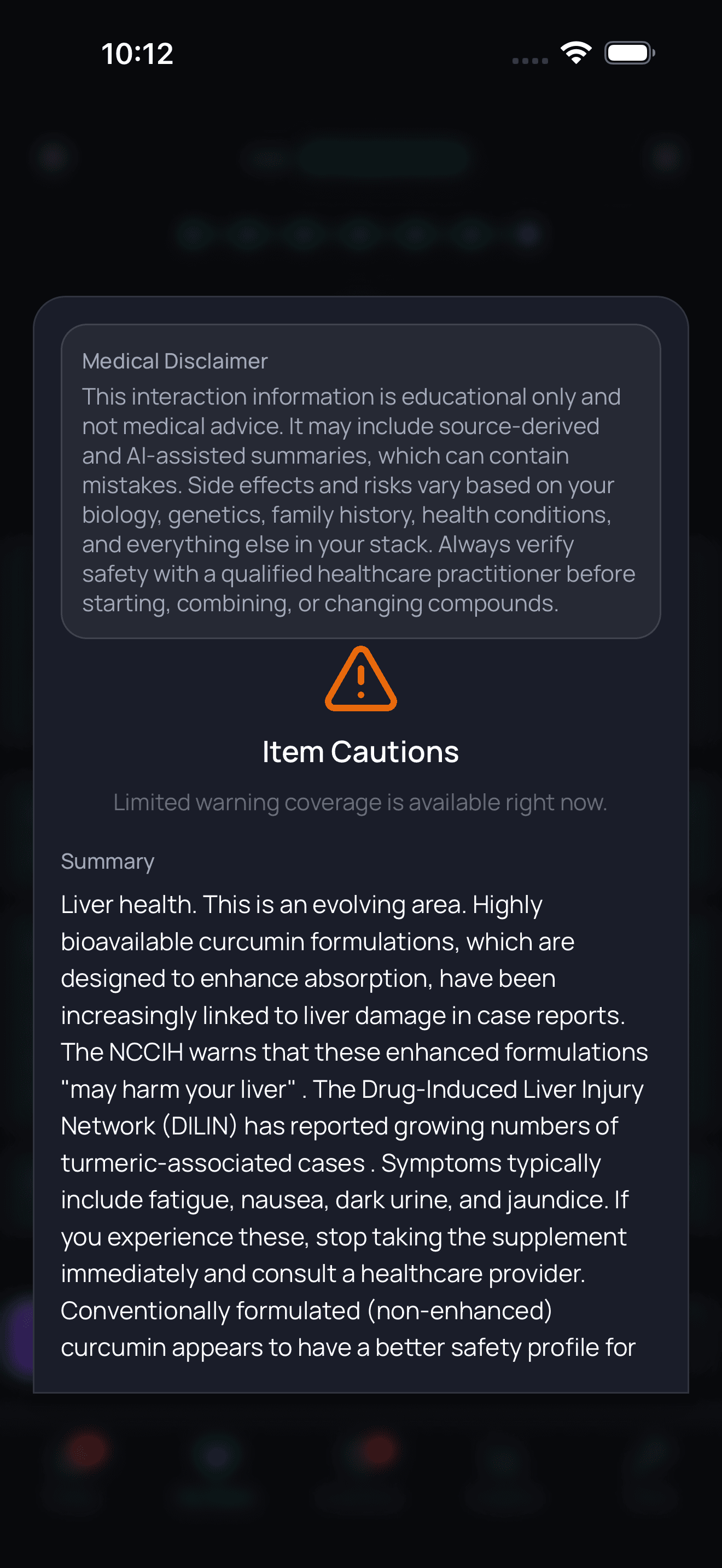
Managing side effect risks across a multi-supplement stack can feel overwhelming, especially when interactions between supplements, medications, and foods add layers of complexity. Doserly brings all of that into a single safety view so nothing falls through the cracks.
Rather than researching every possible interaction yourself, the app checks your full stack automatically and flags supplement-drug and supplement-supplement interactions that warrant attention. If you do experience something unexpected, logging it takes seconds, and over time the app helps you spot patterns: whether symptoms correlate with specific doses, timing, or combinations. One place for the safety picture that matters most when your stack grows beyond a few bottles.
Keep side effects, flags, and follow-up notes visible.
Doserly helps you document safety observations, side effects, medication changes, and follow-up questions so important context is not scattered.
Safety log
Flags and notes
Safety notes are not emergency guidance; seek medical help when appropriate.
Dosing & Usage Protocols
The Basics
This is a high-uncertainty dosing supplement. People often quote daily elemental strontium numbers such as 500 mg or 680 mg, but those figures come from a mix of community practice, licensed-product ranges, and ranelate-era history rather than from a settled citrate-only evidence base [4][6].
That means the safest way to read the dosing conversation is as a collection of commonly discussed ranges, not as a universal protocol. Form matters, elemental dose matters, calcium timing matters, and the reason for use matters.
The Science
In Canada's licensed-product review, oral products delivered between 4 mg and 682 mg elemental strontium daily across citrate, lactate, and gluconate forms [6]. Real-world discussion commonly clusters around the upper part of that range, often with dosing separated from calcium-containing supplements because of the known absorption competition between calcium and strontium [2].
The citrate-specific evidence problem shows up here clearly. The best human clinical signal in the current dossier comes from a multi-ingredient regimen rather than an isolated citrate dose-response trial [4]. For that reason, any frequently repeated "standard" dose should be treated as a commonly cited practice, not as a universally validated citrate target.
What to Expect (Timeline)
The short-term expectation should be modest. Strontium citrate is not the kind of supplement that usually creates a dramatic day-one body signal. Some users report no noticeable subjective effect at all in the first days or weeks.
If change occurs, it is usually discussed on the scale of months rather than days. Real-world users typically talk about repeat scans, fracture-free years, or long-term routine tolerance rather than an immediate felt benefit.
The biggest timeline trap is interpreting scan changes too quickly or too confidently. Bone strontium can rise within 24 hours of supplementation, and bone levels can continue increasing over long periods [3]. Because DXA can overestimate density when strontium is present, an early or moderate scan gain should not automatically be read as a clean measure of stronger bone [8].
One of the hardest parts of any supplement routine is knowing whether it's working when results unfold gradually over weeks or months. Without a record, it's easy to abandon something too early or keep taking something that isn't delivering. Doserly solves that by giving you a visual timeline of your entire supplementation history mapped against the outcomes you care about.
When everything is in one view, you can compare how different supplements in your stack are performing over the same period. You can see whether adding this supplement coincided with the improvement you've noticed, or whether the timing points to something else entirely. That kind of clarity turns patience into a strategy rather than a gamble.
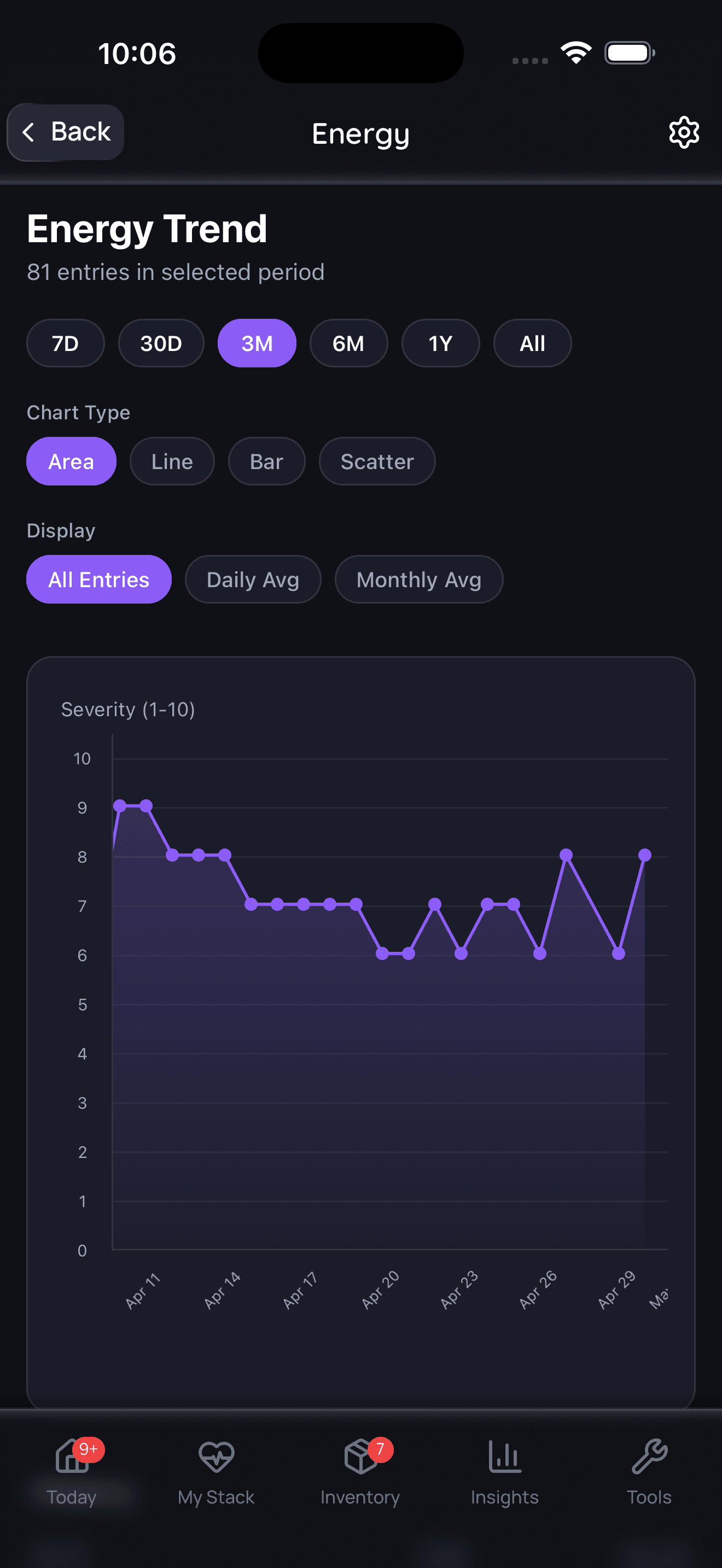
Capture changes while they are still fresh.
Log symptoms, energy, sleep, mood, and other observations alongside protocol events so patterns do not live only in memory.
Trend view
Symptom timeline
Symptom tracking is informational and should be interpreted with a qualified clinician.
Interactions & Compatibility
Synergistic
- Calcium: Bone-health routines often pair the two conceptually, though absorption competition means timing may matter [2].
- Vitamin D3: Vitamin D status is frequently treated as background support for bone-focused protocols and combination trials [4].
- Vitamin K2: Included alongside strontium citrate in the MOTS bone-support combination [4].
- Magnesium: Commonly discussed in broader bone-support stacks and community routines.
- Collagen: Common stack partner in bone and connective-tissue routines.
Caution / Avoid
- Calcium: Take care with simultaneous use because very high calcium intake can reduce strontium absorption [2].
- Cardiovascular-risk medications or high-risk cardiovascular states: Official Canadian labeling takes a precautionary approach in people with heart disease, circulatory problems, stroke history, or clot risk [6].
- DXA-based monitoring without disclosure: Clinicians interpreting scans should know strontium is being used because bone strontium can distort DXA results [8].
How to Take / Administration Guide
Strontium citrate is usually discussed as a once-daily or spaced oral supplement, but the more useful practical issue is timing relative to calcium. Because calcium and strontium share absorption logic, people often prefer to separate strontium from calcium-heavy meals or calcium supplements rather than stack them in the same window [2].
Form transparency matters too. Standalone products are easier to interpret than proprietary bone blends because they make the elemental dose and salt form easier to track. That matters if you ever need to compare tolerance, discuss scan interpretation, or review total strontium exposure with a clinician.
Community routines often include nighttime or between-meal timing, but those practices are anecdotal, not standardized clinical instructions. If the goal is a clean, interpretable trial of the supplement, consistency matters more than folklore.
Choosing a Quality Product
The quality checklist for this supplement is unusually important because form confusion is common. Products that clearly disclose the salt form and the elemental strontium amount are easier to interpret than vague bone blends.
Look for:
- Clear labeling of elemental strontium, not just total capsule weight
- Explicit identification of the citrate salt form
- Third-party testing, lot transparency, or a certificate-of-analysis path when available
- Avoidance of proprietary blends that obscure how much strontium is actually present
Real-world reports also surface brand-level odor and sulfur-burp concerns, which are not proof of contamination but do highlight how quickly user trust falls when identity feels uncertain. When a supplement already has thin citrate-specific efficacy data, poor labeling is an even bigger red flag.
Storage & Handling
Store strontium citrate the same way you would store most mineral supplements: sealed, dry, and away from heat and moisture. User discussion suggests that smell changes are one of the first reasons people abandon certain products, so storage and packaging quality matter in a practical sense even when the chemistry is not fully confirmed.
If a product develops a strong sulfur odor, causes repeated sulfur burps, or otherwise feels different from a prior batch, that is the kind of change worth documenting rather than ignoring.
Lifestyle & Supporting Factors
Strontium citrate is not a replacement for the boring parts of bone health. Weight-bearing exercise, adequate protein intake, calcium adequacy, vitamin D sufficiency, and broader fall-risk reduction are still the foundation around which any supplement decision sits.
That matters especially here because the supplement is often chosen by people who are trying to avoid or delay prescription therapy. In that setting, the supporting factors do even more work. If the rest of the bone-health routine is weak, strontium citrate has very little chance of rescuing the situation by itself.
The community signal also reinforces that strontium citrate is rarely used alone. Most users discussing it are also changing diet, adding vitamins, lifting weights, or using hormones. That makes lifestyle support both essential and a major confounder.
Regulatory Status & Standards
In the current source set, the clearest supplement-facing official regulatory language comes from Canada. Health Canada classifies strontium as a natural health product ingredient and reviewed products containing citrate, lactate, and gluconate salt forms, ultimately recommending precautionary cardiovascular label warnings for higher-dose adult products [6].
The broader clinical history is shaped by Europe, where the legacy of prescription strontium ranelate influenced later safety scrutiny and continues to color how all strontium products are discussed [5][6]. That history matters, but it does not make citrate and ranelate interchangeable.
In athlete-facing regulation, the current WADA Prohibited List page states that the list is updated at least annually and that athletes should verify any unclear substance directly with their anti-doping organization [7]. Strontium citrate is not surfaced as a named concern in the retrieved prohibited-list content, but that should not be treated as blanket clearance for every sport, every product, or every contaminated supplement scenario [7].
Active-trial context is limited in this dossier. The clearest registry-linked example is the MOTS trial already reflected in the published combination paper [4].
FAQ
Does strontium citrate really build stronger bones?
Based on the current source set, it may contribute to bone-related changes, but the evidence is not strong enough to say with confidence that standalone citrate use produces the same fracture-protection profile as prescription ranelate. Some scan improvements may also reflect DXA overestimation [4][5][8].
Why do people say it can make bone scans look better than they really are?
DXA estimates density from X-ray attenuation. Because strontium attenuates X-rays more strongly than calcium, bone strontium can overestimate DXA-derived bone density [8].
Is strontium citrate the same as strontium ranelate?
No. They are different salt forms, and the strongest human fracture and treatment data are for ranelate, not citrate [5][6].
Is there a standard dose?
No citrate-specific universal standard was identified in the current source set. What you will usually see are commonly discussed elemental-strontium ranges rather than a single validated citrate-only protocol [4][6].
Should it be taken with calcium?
The absorption data suggest that very high calcium intake can reduce strontium absorption, which is why people often discuss separating them in time. The best way to handle that question for a real regimen is with a clinician reviewing the full stack [2].
What side effects matter most?
The official concern is cardiovascular uncertainty in higher-risk users, while the most common real-world complaints are GI or product-quality related, such as sulfur burps, odor, or stomach upset [6].
If my DXA improves, does that mean fracture risk definitely improved?
Not necessarily. It may indicate a genuine positive change, a physics-related inflation effect from bone strontium, or some mixture of both [3][8].
Why do some people love it and others say it is bogus?
Because the supplement sits at the intersection of thin citrate-specific evidence, strong user hopes, genuine bone chemistry, and a measurement problem that makes success harder to interpret cleanly. That combination naturally produces polarized discussion.
Myth vs. Fact
Myth: Strontium citrate and strontium ranelate are basically the same thing.Fact: They are different salts, and the strongest clinical fracture data belong to ranelate, not citrate [5][6].
Myth: A better DXA after strontium citrate proves stronger bone.Fact: Better DXA numbers can reflect real change, but strontium in bone can also directly overestimate DXA-derived density [8].
Myth: There is no real bone biology here, only scan artifact.Fact: Bone incorporation and remodeling-related signals are real. The uncertainty is about how much of the measured gain represents meaningful structural benefit in citrate users [3][4][5].
Myth: Because direct citrate cardiovascular harm has not been proven, safety concerns can be ignored.Fact: Official review did not prove non-ranelate harm, but it also did not rule it out and still recommended precautionary warnings for higher-risk users [6].
Myth: Strontium citrate is a stand-alone fix for osteoporosis.Fact: Real-world and clinical use almost always sits inside a larger bone-health strategy that includes exercise, mineral balance, vitamin support, and medical risk assessment [2][4].
Sources & References
Primary Literature and Clinical Data
[1] PubChem. Strontium citrate. https://pubchem.ncbi.nlm.nih.gov/compound/Strontium-citrateChemical identity record for strontium citrate.
[2] Apostoaei AI. Absorption of strontium from the gastrointestinal tract into plasma in healthy human adults. Health Phys. 2002. https://pubmed.ncbi.nlm.nih.gov/12075684/Review of adult oral strontium absorption variability and calcium interaction.
[3] Chettle DR, et al. Monitoring bone strontium intake in osteoporotic females self-supplementing with strontium citrate with a novel in-vivo X-ray fluorescence based diagnostic tool. Bone. 2014. https://pubmed.ncbi.nlm.nih.gov/24434614/Human observational study showing measurable bone strontium accumulation during self-supplementation.
[4] Maria S, et al. Melatonin-micronutrients Osteopenia Treatment Study (MOTS): a translational study assessing melatonin, strontium citrate, vitamin D3 and vitamin K2 on bone density. Aging (Albany NY). 2017. https://pmc.ncbi.nlm.nih.gov/articles/PMC5310667/Combination RCT and mechanistic paper in postmenopausal osteopenic women.
[5] Kołodziejska B, et al. The Influence of Strontium on Bone Tissue Metabolism and Its Application in Osteoporosis Treatment. Int J Mol Sci. 2021. https://pmc.ncbi.nlm.nih.gov/articles/PMC8235140/Review of strontium biology, bone metabolism, and the broader treatment literature.
[8] Gossman W, et al. Assessment of the effect of strontium, lead, and aluminum in bone on dual-energy x-ray absorptiometry and quantitative ultrasound measurements: A phantom study. Med Phys. 2017. https://pubmed.ncbi.nlm.nih.gov/29080282/Direct DXA overestimation evidence for strontium-containing bone phantoms.
Government and Institutional Sources
[6] Health Canada. Summary Safety Review - Strontium - Risk of Heart and Circulatory Side Effects. https://www.canada.ca/en/health-canada/services/drugs-health-products/medeffect-canada/safety-reviews/summary-safety-review-strontium-risk-heart-circulatory.htmlOfficial regulatory and safety review for oral natural health products containing strontium salts.
[7] World Anti-Doping Agency. The Prohibited List. https://wada-ama.org/en/prohibited-listCurrent athlete-facing prohibited-list reference and verification guidance.