
In this guide
What is TRT in the UK, and who provides it?
TRT is prescribed testosterone for men whose bodies do not make enough. In the UK it is a licensed, prescription-only medicine, available through the NHS or from private doctors and clinics. Either way, the diagnosis rests on symptoms plus low testosterone on repeat morning blood tests, and the same prescription and controlled-drug rules apply. [1], [2], [5]
Two UK medical societies write the clinical guidelines most clinicians use: the British Society for Sexual Medicine (BSSM, 2023) and the Society for Endocrinology (2022). The National Institute for Health and Care Excellence (NICE), which writes much NHS guidance, has none on low testosterone in men. Each local NHS area writes its own prescribing rules, so the level that triggers a referral, the first-choice product and who prescribes differ between areas; the authors of a 2025 UK consensus study (55 clinicians responded; some authors work at private men's health clinics) describe "a broad variation in care". [2], [5], [19], [3], [20], [21]
True deficiency is less common than online talk suggests. In the European Male Ageing Study, strictly defined late-onset hypogonadism (at least three sexual symptoms plus low testosterone) affected 2.1% of men aged 40 to 79, from 0.1% in their 40s to 5.1% in their 70s. Yet prescribing is uneven: UK testosterone prescriptions rose by nearly 90% between 2001 and 2010, while in GP records from North West London, 436 men with testosterone below 8 nmol/L and low sex drive were not prescribed it. [2], [22], [23], [24]
How do you get TRT in the UK?
On the NHS, your GP arranges two morning blood tests and refers you to a hospital specialist, who starts treatment; your GP may take over once you are stable. Privately, a clinic or doctor tests and prescribes, and you pay for everything. Many men use both routes at different times. [1], [3], [25]
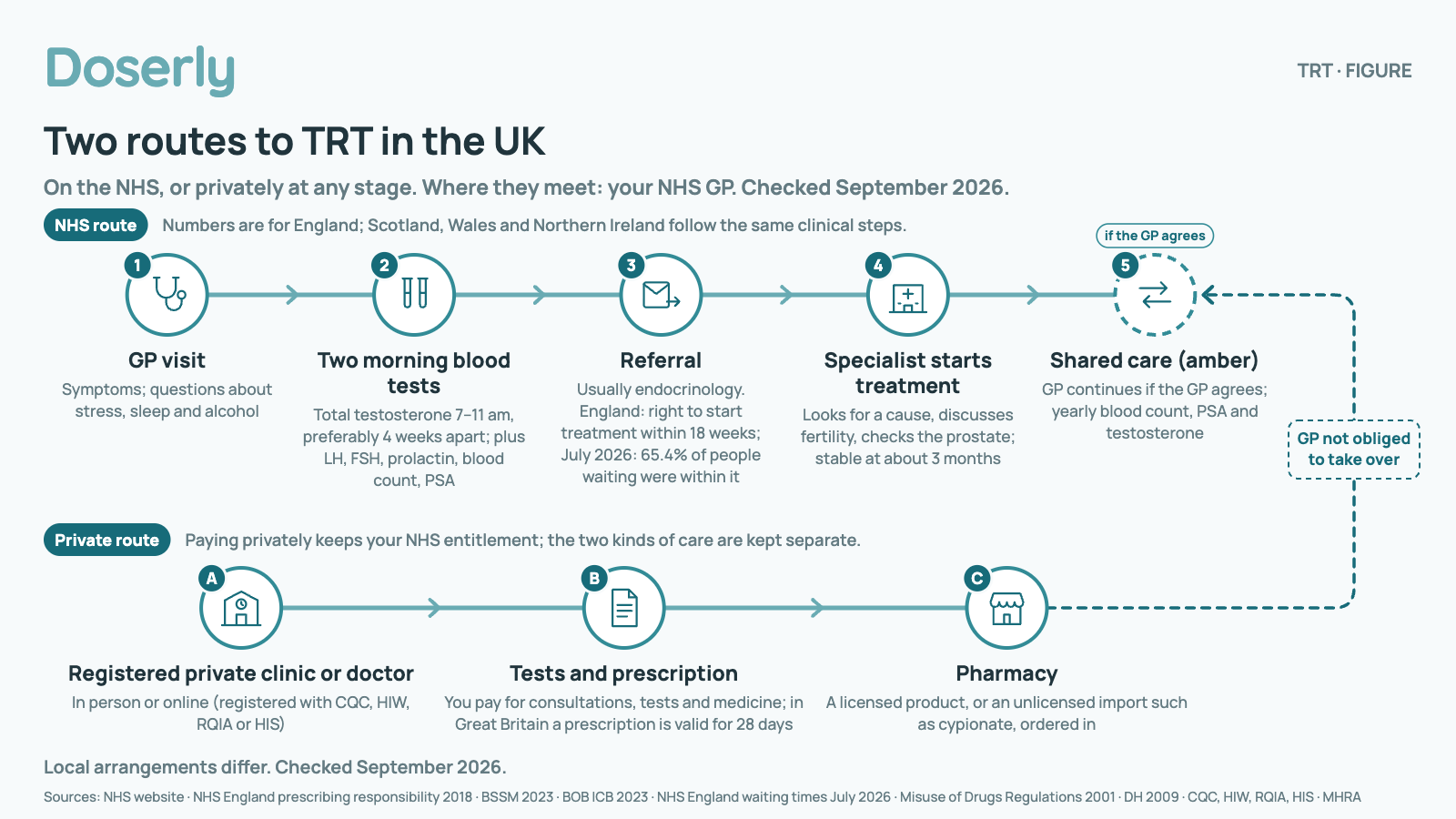
Two routes to TRT in the UK
On the NHS, or privately at any stage. Where they meet: your NHS GP. Checked September 2026.
Numbers are for England; Scotland, Wales and Northern Ireland follow the same clinical steps.
- 1.GP visit
- Symptoms; questions about stress, sleep and alcohol
- 2.Two morning blood tests
- Total testosterone 7–11 am, preferably 4 weeks apart; plus LH, FSH, prolactin, blood count, PSA
- 3.Referral
- Usually endocrinology. England: right to start treatment within 18 weeks; July 2026: 65.4% of people waiting were within it
- 4.Specialist starts treatment
- Looks for a cause, discusses fertility, checks the prostate; stable at about 3 months
- 5.Shared care (amber)if the GP agrees
- GP continues if the GP agrees; yearly blood count, PSA and testosterone
Paying privately keeps your NHS entitlement; the two kinds of care are kept separate.
- A.Registered private clinic or doctor
- In person or online (registered with CQC, HIW, RQIA or HIS)
- B.Tests and prescription
- You pay for consultations, tests and medicine; in Great Britain a prescription is valid for 28 days
- C.Pharmacy
- A licensed product, or an unlicensed import such as cypionate, ordered in
From private to NHS: you can ask your NHS GP to take over at step 5, but the GP is not obliged to.
Local arrangements differ. Checked September 2026.
- See your GP. The NHS advises seeing your GP about symptoms such as low sex drive, erection problems, tiredness or low mood; expect questions about stress, sleep and alcohol too. You cannot normally refer yourself to an NHS specialist. [1], [26]
- Have two morning blood tests. The BSSM advises total testosterone between 7 and 11 am on at least two occasions, preferably 4 weeks apart, ideally fasting for the first, because non-fasting levels can be up to 30% lower. The GP usually adds LH and FSH and prolactin, which show whether the problem is in the testes or the pituitary, plus a blood count (including hematocrit), PSA and liver tests. [2], [3], [27]
- Get a referral. If results are low, the GP refers you to secondary care, usually endocrinology. In England you have a right to start consultant-led treatment within 18 weeks of referral, with exceptions; at the end of July 2026, 65.4% of people on English waiting lists had waited up to 18 weeks (standard 92%), and people still waiting had waited a median of 12.0 weeks so far. There is no separate endocrinology figure. Scotland's standard is a first outpatient appointment within 12 weeks for 95% of patients. Checked September 2026. [28], [29], [30]
- The specialist diagnoses and starts treatment. An endocrinologist (or urologist) looks for a cause, discusses fertility (testosterone switches off sperm production), checks the prostate, agrees a product with you and reviews you until you are stable, usually about 3 months. [3], [27]
- Your GP may take over. Testosterone is an amber medicine in the NHS areas whose documents we read: suitable for shared care, where the GP continues what the specialist started. That needs the GP's agreement; NHS England says a shared-care guideline "does not necessarily mean that the GP has to agree". After transfer, the GP typically checks blood count, PSA and testosterone yearly. [4], [3], [20], [27]
- Or go private, at any stage. You can see a private doctor or clinic, in person or online, and pay for consultations, tests and medicine. The NHS still advises a GP referral letter first, and paying privately does not remove your right to NHS care. [26], [25]
Scotland, Wales and Northern Ireland follow the same clinical steps. Prescriptions are free there, and each nation has its own waiting standards and its own regulator for private clinics. The local NHS documents in this guide are from England, so ask your GP how referral works where you live. [7], [8], [30]
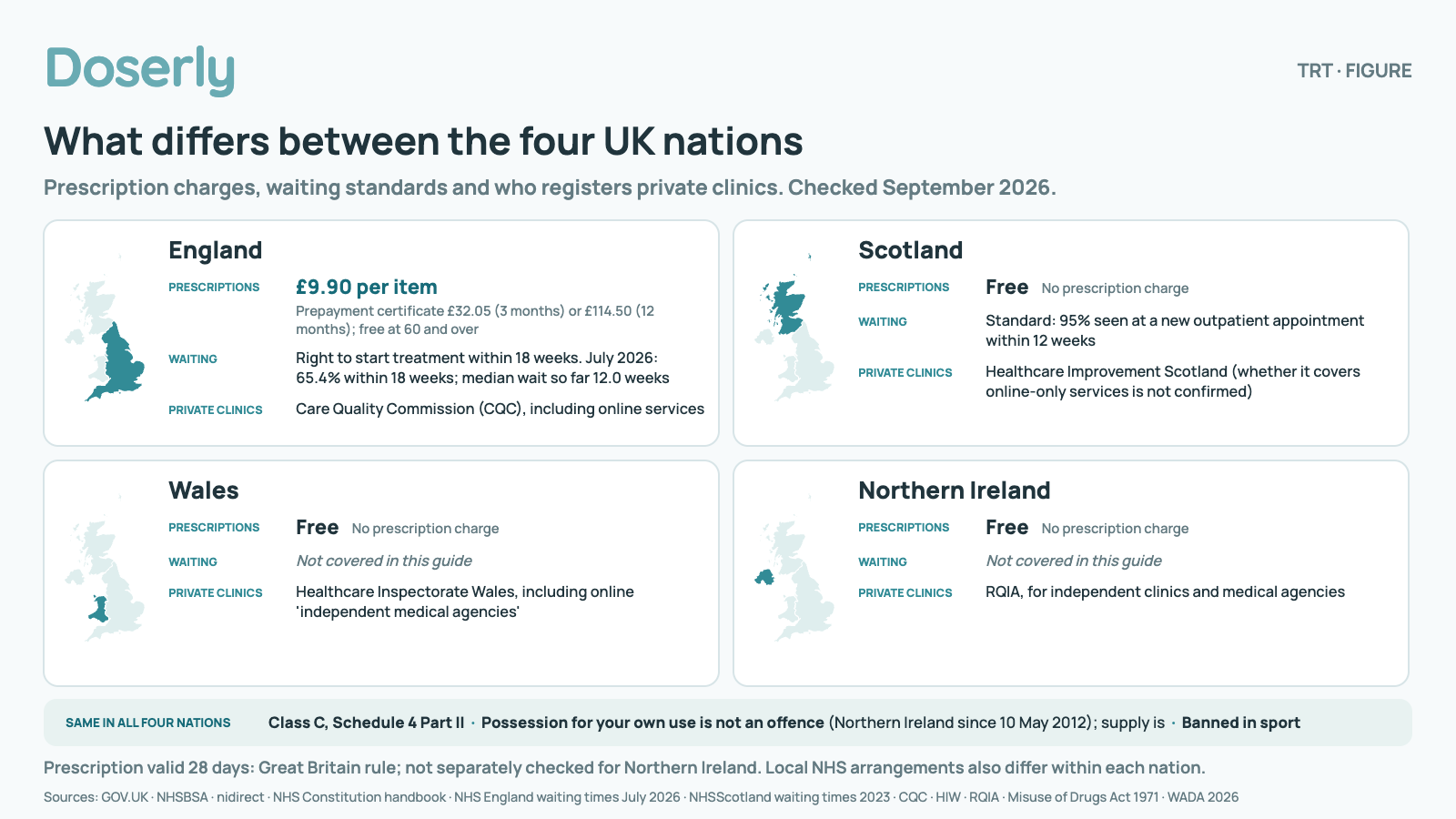
What differs between the four UK nations
Prescription charges, waiting standards and who registers private clinics. Checked September 2026.
- England
- Prescriptions: £9.90 per item. Prepayment certificate £32.05 (3 months) or £114.50 (12 months); free at 60 and over.
- Waiting standard: Right to start treatment within 18 weeks. July 2026: 65.4% within 18 weeks; median wait so far 12.0 weeks.
- Private clinics: Care Quality Commission (CQC), including online services.
- Scotland
- Prescriptions: Free. No prescription charge.
- Waiting standard: Standard: 95% seen at a new outpatient appointment within 12 weeks.
- Private clinics: Healthcare Improvement Scotland (whether it covers online-only services is not confirmed).
- Wales
- Prescriptions: Free. No prescription charge.
- Waiting standard: Not covered in this guide.
- Private clinics: Healthcare Inspectorate Wales, including online 'independent medical agencies'.
- Northern Ireland
- Prescriptions: Free. No prescription charge.
- Waiting standard: Not covered in this guide.
- Private clinics: RQIA, for independent clinics and medical agencies.
Same in all four nations
- Class C, Schedule 4 Part II: The same law in all four nations.
- Possession for your own use: Not an offence (Northern Ireland since 10 May 2012); supply is.
- Banned in sport: WADA prohibits testosterone at all times.
Prescription valid 28 days: Great Britain rule; not separately checked for Northern Ireland. Local NHS arrangements also differ within each nation.
What testosterone level do you need for TRT in the UK?
Symptoms plus a low morning testosterone, confirmed on repeat testing. UK documents usually treat below 12 nmol/L (about 350 ng/dL) as low enough when symptoms fit, and below 8 nmol/L (about 230 ng/dL) as clearly low. In between, it depends on your free testosterone, the cause and which guideline your clinician follows. [2], [5], [3]
| Guideline or NHS area (year) | Threshold | How measured | Action at this level |
|---|---|---|---|
| BSSM (2023) | Below 12 nmol/L, or free testosterone below 225 pmol/L, usually needs treatment; at 8–14 nmol/L, a trial of at least 6 months if symptoms fit | Two morning samples (advice: 7–11 am; the 12 nmol/L threshold statement uses 8–11 am) | Aim for 15–30 nmol/L; stop if no benefit after 6 months |
| Society for Endocrinology (2022) | Symptoms more likely below 8 nmol/L, or below 11 nmol/L with free testosterone below 220 pmol/L; little evidence of benefit above 12 nmol/L | Repeat morning samples | No time-limited trials; treatment is usually lifelong |
| NICE | No guideline on low testosterone in men | Not applicable | Its fertility guideline (2026) suggests hormone tests after two or more abnormal semen analyses |
| NHS Buckinghamshire, Oxfordshire and Berkshire West (2023) | Below 8 nmol/L consistent with low testosterone; 8–12 nmol/L possible, assessed by a specialist; above 12 nmol/L not low | 9 am, at least a week apart | GP refers; specialist starts; GP continues |
| Pan Mersey (2020; review date passed) | Two fasting results below 10 nmol/L plus three sexual symptoms | Fasting, 7–11 am, 4 weeks apart | A specialist decides |
Where they land: 12 nmol/L for "usually treat" and 8 nmol/L for "clearly low". They differ because the BSSM supports a trial of treatment at 8–14 nmol/L while the Society for Endocrinology rejects time-limited trials, and because each NHS area writes its own referral rules. The BSSM advises measuring free testosterone (the part not bound to the carrier protein SHBG) in that 8–14 nmol/L zone. UK labs use nmol/L; multiply by 28.84 for ng/dL, or use the testosterone unit converter. [2], [5], [3], [20]
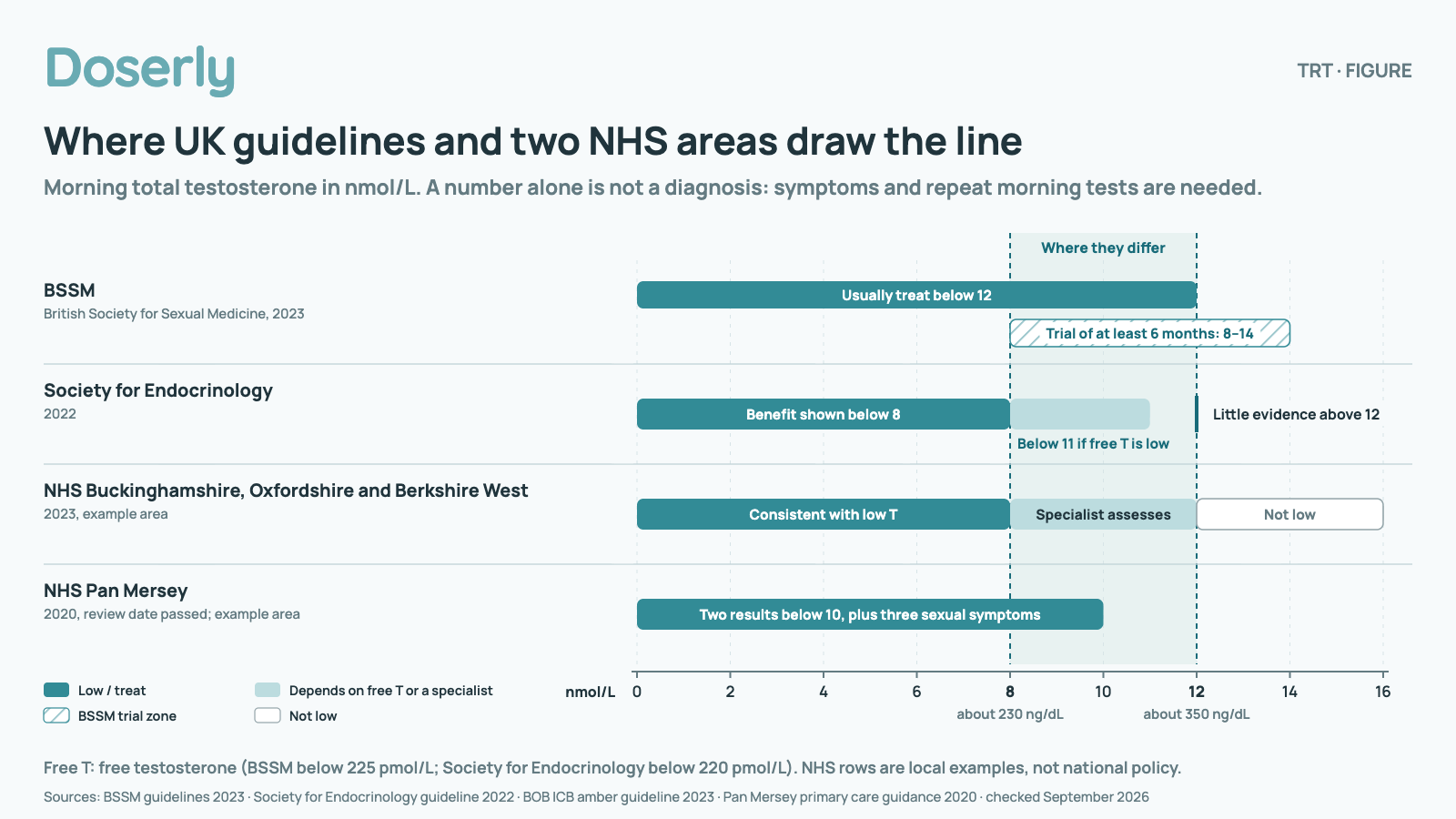
Where UK guidelines and two NHS areas draw the line
Morning total testosterone in nmol/L. A number alone is not a diagnosis: symptoms and repeat morning tests are needed.
Each line runs from 0 (left) to 16 nmol/L (right). The two thin marks are 8 nmol/L (about 230 ng/dL) and 12 nmol/L (about 350 ng/dL), where most UK documents agree; the shaded strip between them is where they differ.
- BSSM (British Society for Sexual Medicine, 2023)
- Usually treat below 12Trial of at least 6 months: 8–14
- Society for Endocrinology (2022)
- Benefit shown below 8Below 11 if free T is lowLittle evidence above 12
- NHS Buckinghamshire, Oxfordshire and Berkshire West (2023, example area)
- Consistent with low T (below 8 nmol/L)Specialist assesses (8–12 nmol/L)Not low (above 12 nmol/L)
- NHS Pan Mersey (2020, review date passed; example area)
- Two results below 10, plus three sexual symptoms
Free T means free testosterone. NHS rows are local examples, not national policy. Checked September 2026.
Why can two men with the same result get different answers?
Besides the guideline and the area, the lab and the cause matter. The BSSM warns of "wide variations in laboratory practice for testosterone testing in the UK", so compare results taken the same way. Specialists also look for causes such as obesity, opioid or steroid medicines and pituitary disease. [2], [27]
Where do UK guidelines disagree?
- A trial, or lifelong treatment. The BSSM supports at least 6 months of treatment at 8–14 nmol/L and stopping if there is no benefit; the Society for Endocrinology rejects time-limited trials. [2], [5]
- Lifestyle first, or together. The BSSM backs lifestyle change together with testosterone rather than lifestyle alone; several international guidelines put weight loss first when obesity is the driver (see obesity-related hypogonadism). [2]
- Diabetes. The BSSM advises treating men with symptoms and prediabetes below 14 nmol/L. In the T4DM trial, where every man was in a lifestyle program, testosterone injections lowered type 2 diabetes at 2 years to 12% (55 of 443) vs 21% (87 of 413) on placebo, but the larger TRAVERSE trial of a daily gel found no significant prevention (7.8% vs 10.7% at 12 months), so testosterone alone should not be used to prevent diabetes. [2], [31], [32]
Where these numbers come from
The guideline rows come from the BSSM guidelines on male adult testosterone deficiency (2023, full text), the Society for Endocrinology guideline (2022) and NICE guideline NG257 on fertility problems (March 2026). The two NHS rows are examples of local rules, not national policy: the Buckinghamshire, Oxfordshire and Berkshire West amber guideline (approved November 2023, review due November 2026) and the Pan Mersey primary care guidance (February 2020; its own review date of June 2023 has passed). The Doncaster and Bassetlaw shared-care guideline (December 2025) repeats the BOB cut-offs and supplies the lists of tests and risk factors. [2], [5], [19], [3], [20], [27]
The 2.1% prevalence comes from the European Male Ageing Study as reported in the BSSM guideline. The T4DM result comes from the trial itself: the BSSM text describes it as a "21% reduction", which does not match the trial's own figures (12% vs 21%). [22], [2], [31]
Not used: the claim that 8–12% of UK men aged 40 to 69 have testosterone deficiency (the population study behind the UK figures found 2.1%), and the claim that a level below 8 nmol/L "almost always" warrants treatment (neither UK guideline says so).
Which testosterone products are available in the UK?
Gels and injections only. There is no licensed oral capsule, nasal gel, patch or pellet. NHS areas usually start with a gel, because it is easy to adjust or stop, and use Nebido as the first-choice injection. Checked September 2026. [11], [3], [2]
| Product | Form and route | UK label dose | Role in the NHS documents we read |
|---|---|---|---|
| Testogel 16.2 mg/g pump and 40.5 mg sachet; Irisel 16.2 mg/g | Transdermal gel (absorbed through the skin), daily | Testogel 16.2 mg/g: 40.5 mg a day, up to 81 mg | Usual starting choice |
| Tostran 2% | Gel, daily | 60 mg (3 g) a day, up to 80 mg | Gel option |
| Testavan 20 mg/g | Gel with a hands-free applicator, daily | 23 mg a day, up to 69 mg | First line in one area |
| Nebido, Roxadin and generic testosterone undecanoate 1000 mg/4 mL | Intramuscular (into a muscle), injected slowly by a healthcare professional | 1,000 mg every 10–14 weeks; the second dose can come after 6 weeks | First-choice injection |
| Sustanon 250 (four esters) | Intramuscular | Usually 250 mg every 3 weeks | Not for new patients in one area, citing peaks and troughs and a higher risk of high hematocrit; hospital-only in another |
| Testosterone Enantate 250 mg/mL | Intramuscular | 250 mg every 2–3 weeks, then every 3–6 weeks | Mainly for men who want to self-inject; one area also allows 50–100 mg weekly subcutaneous (under the skin) doses |
[33], [34], [35], [36], [37], [38], [39], [40], [41], [11], [3], [27]
Doses come from each product's UK summary of product characteristics; specialists adjust them with blood tests, and your own prescription is the one to follow. A listing shows a medicine is authorised, not that it is in stock. (The BSSM calls enanthate unlicensed, but a UK licence for Testosterone Enantate exists.) See the guides to testosterone gel, undecanoate injections, Sustanon 250 and enanthate, and the TRT dose calculator for milligrams to millilitres. [2], [41], [11]
Is testosterone cypionate available in the UK?
Only as an unlicensed import. No cypionate product is licensed in the UK, but records from the MHRA, the UK medicines regulator, show six companies notified plans to import unlicensed testosterone cypionate since January 2021. MHRA guidance allows an unlicensed medicine only for an individual's special clinical need that a licensed product cannot meet, which "does not include reasons of cost, convenience or operational needs". The BSSM adds that findings from the long-term trials of licensed gels and undecanoate "cannot be extrapolated to unlicensed formulations". Having cypionate is legal; see the rules. Checked September 2026. [12], [42], [43], [2]
Which products are not sold in the UK?
No UK product information is listed for nasal testosterone (Natesto), oral undecanoate capsules (Jatenzo, Kyzatrex, Tlando), the Xyosted autoinjector, testosterone implants (pellets), patches (Androderm) or Testim gel. The Testogel 50 mg sachet is marked discontinued, and Restandol oral capsules have been withdrawn. Checked September 2026. [11], [44], [45], [46], [47]
What about hCG, clomiphene and enclomiphene?
These are fertility options. The BSSM lists hCG, off-label SERMs such as clomiphene and aromatase inhibitors as alternatives for men who want to keep fertility. The hCG brands Pregnyl and Choragon are discontinued, so hCG now arrives mostly as an unlicensed import, and it is itself Class C. Enclomiphene is unlicensed, and the BSSM does not recommend it for routine use outside specialist settings. See TRT and fertility and hCG. [2], [48], [12], [13], [49]
Are there shortages?
We found no official shortage notice for UK testosterone products from 2023 to September 2026; the August 2023 MHRA notice about Tostran corrected its leaflet's pump-priming instructions. Private patients reported enanthate supply problems in 2026, including a £350 quote for 10 ampoules that previously cost £55, but no official record confirmed a shortage. [50], [51], [52]
Where these product details come from
Product status comes from the UK electronic medicines compendium (emc), which hosts each licensed medicine's summary of product characteristics. A search for testosterone on 28 September 2026 listed 13 products: Irisel, Nebido, Roxadin, Sustanon 250, Testavan, Testogel 16.2 mg/g, Testogel 40.5 mg, Testogel 50 mg (marked discontinued), Testosterone Enantate, three generic undecanoate injections and Tostran. Searches the same day for Xyosted, testosterone implant, testosterone patch, Testim and Androderm returned no results. [11]
Label doses come from the current UK summaries: Testogel 16.2 mg/g (January 2025), Tostran (May 2026), Testavan (June 2024), Nebido (December 2025), Sustanon 250 (February 2026) and Testosterone Enantate (January 2026). NHS roles come from the BOB (2023) and Doncaster and Bassetlaw (2025) documents. Import notifications come from MHRA freedom-of-information response 23/659 (notifications since 1 January 2021; five companies also notified enanthate and two Pregnyl). [33], [36], [37], [38], [40], [41], [3], [27], [12]
Not used: NHS list prices (what the NHS pays per pack), because the figures in earlier versions could not be traced to the document they cited, and a reported 2023 Tostran shortage, for which no official record was found.
What does TRT cost in the UK?
On the NHS you pay only prescription charges: £9.90 per item in England and nothing in Scotland, Wales or Northern Ireland. Privately you pay for consultations, tests and medicine; UK patients' public posts put monthly plans at about £120 to £180 in 2025–2026. Checked September 2026. [6], [7], [8], [9], [10]
| Item | Amount (checked September 2026) | Where |
|---|---|---|
| NHS prescription charge | £9.90 per item, frozen for 2026/27 | England |
| Prescription prepayment certificate | £32.05 for 3 months; £114.50 for 12 months | England |
| NHS prescriptions | Free for everyone | Scotland, Wales, Northern Ireland |
| Free by age | 60 and over, without applying | England |
| Medical exemption certificate | Covers listed conditions, including "other forms of hypopituitarism"; low testosterone on its own is not listed | England |
| NHS Low Income Scheme | An HC2 certificate gives full help with health costs | England |
The charge is per item. Because testosterone is usually supplied a month at a time (see the rules), a 12-month certificate at £114.50 costs less than twelve single charges (£118.80), and much less if you take other regular medicines. A man whose low testosterone comes from pituitary failure may qualify for a medical exemption; your GP signs the application, and certificates applied for from 16 July 2026 last 10 years. [7], [6], [55], [54]
What does private TRT cost?
There is no official price list, and this guide does not quote clinic price lists. The figures below are what UK patients wrote in public posts between November 2025 and August 2026: individual reports, not a survey.
| What was paid | Reported amount | When |
|---|---|---|
| Monthly plan | £129, £136 and £180 including consultations and some tests; £120 plus £60 to £120 per blood test | Nov 2025 to Aug 2026 |
| Medicine from a pharmacy | £55 for 10 enanthate ampoules, then a £350 quote; £85 for 10 mL of enanthate; about £175 to £200 or more for a cypionate vial | Dec 2025 to Jul 2026 |
| Consultations and tests at one clinic | About £200 for consultations and £180 for blood tests | Apr 2026 |
[9], [56], [57], [10], [52], [51], [58], [59]
Cost shapes access. In an online survey of 973 UK men, run by researchers who included employees of a private men's health company, cost was a barrier to seeking care for 35%, and only 7% were satisfied with their access to help. [60]
Private health insurance: check your own policy before you book. We could not verify any insurer's statement on TRT cover, so ask whether the specialist consultation, blood tests and ongoing prescription are covered and whether an existing condition counts as pre-existing. [57]
Can you use private TRT, and will the NHS take it over?
You can use private care at any time and keep your NHS rights, but your GP does not have to take over a prescription started privately. Checked September 2026. [25], [26], [4]
What rules do private and online clinics follow?
- England: online providers that prescribe must be registered with the Care Quality Commission (CQC); operating unregistered is an offence. [61], [62]
- Wales: Healthcare Inspectorate Wales registers independent clinics and "independent medical agencies", including remote or online services based in Wales. [63]
- Northern Ireland: the Regulation and Quality Improvement Authority registers independent clinics and medical agencies. [64]
- Scotland: independent healthcare services register with Healthcare Improvement Scotland; we could not confirm how this applies to services that work only online. [65]
- Prescribing: pharmacy regulator guidance says medicines liable to misuse are not suitable for prescribing from a questionnaire alone (testosterone is not named). Doctors, and nurse and pharmacist independent prescribers, can prescribe testosterone. [66], [67], [42]
How can you judge a private TRT service?
A 2026 analysis of 253 clinic websites, 48 of them in Europe, found 24.4% said they routinely use other hormone treatments such as gonadotrophins, 20.6% claimed testosterone reduces heart risk, and 9.9% offered it to men with normal levels (above 12 nmol/L). Checks you can make: [68]
- Is the service registered with its nation's regulator, and is the prescriber on a professional register? [62], [63], [64], [65]
- Does it confirm low testosterone on two morning samples and look for a cause before prescribing? [2]
- Does it ask whether you want children before starting? [2], [3]
- Does it check hematocrit and PSA before starting, at 3–6 months, at 12 months and then yearly? [2]
- Does it tell you whether your product is licensed, and why an unlicensed import is needed? [42]
- Does it promise heart protection, anti-ageing or treatment at normal levels? [68]
Will your GP take over a private prescription?
Not necessarily. The NHS says that whether you see a private or an NHS specialist, "your GP is not obliged to accept the specialist's recommendations". You keep your entitlement to NHS care "on exactly the same basis of clinical need", but NHS resources must never subsidise private care, and the two are kept separate. In practice, moving to the NHS usually means going through GP referral and specialist assessment, and because the NHS documents we read include no cypionate, it may mean changing to a licensed product. Keep your results from before treatment: tests taken on testosterone cannot show your untreated level. [26], [25], [4], [3], [27]
What are the UK rules on prescriptions, possession and travel?
Testosterone is a Class C controlled drug in Schedule 4 Part II of the Misuse of Drugs Regulations. That makes prescriptions short-lived in Great Britain but otherwise ordinary, keeps possession for your own use legal and makes supplying it a crime. Checked September 2026. [13], [14], [16]
How long is a testosterone prescription valid?
In England, Scotland and Wales, 28 days from its date (Misuse of Drugs Regulations 2001). NHS England guidance says it can be written for repeat dispensing if the first supply is within 28 days. Northern Ireland has its own regulations and we could not confirm the 28-day limit there, so ask a pharmacist in Northern Ireland. NHS guidance "strongly" recommends no more than 30 days' supply per prescription, which is why many men collect monthly, but that is guidance, not law. A private prescription does not need the special controlled-drug form (FP10PCD), which is only for Schedules 2 and 3. An unlicensed import such as cypionate has to be ordered in: one UK poster could not find a pharmacy willing to dispense his private cypionate prescription directly. Checked September 2026. [69], [70], [55], [71], [43], [58]
Is it legal to have testosterone without a prescription?
Possessing testosterone, including its esters, is not an offence anywhere in the UK: Great Britain changed the law in 2012, and Northern Ireland made the same change from 10 May 2012. But supplying it, including selling or sharing, carries up to 14 years in prison, an unlimited fine or both, and importing is exempt only when you carry it in person for your own use, so controlled medicine posted to you from overseas can be seized. Legal is not the same as checked: without a prescriber, no one monitors hematocrit, PSA or fertility, and UK blood services permanently turn away anyone who has ever injected drugs that were not prescribed, a rule that "includes bodybuilding drugs". Checked September 2026. [14], [72], [15], [13], [16], [67], [17], [73]
Can you travel with testosterone?
Yes, with proof it is yours. Carry it in your hand luggage with a prescription or a doctor's letter. The Home Office lists Schedule 4 Part II medicines such as testosterone separately from the medicines with an explicit 3-month limit, but its recommended letter should still show you are carrying no more than a 3-month supply. Check your destination's rules with its embassy. Checked September 2026. [74], [17] See travelling with testosterone.
Can you give blood on TRT in the UK?
Sometimes. Since 17 February 2026, UK blood-service guidelines say men on testosterone must not donate if it is "not prescribed and monitored by a UK registered practitioner", or if they have polycythaemia (too many red cells) or a raised hematocrit or hemoglobin; otherwise the blood service may accept them. They add: "Blood donation should not be used to prevent medication-associated polycythaemia or raised haematocrit." Each blood service decides when to apply the rule. See hematocrit on TRT. Checked September 2026. [75], [76]
Is testosterone allowed in sport?
No. The World Anti-Doping Agency (WADA) prohibits it at all times, and its 2027 list keeps the ban. A therapeutic use exemption (TUE) is granted only when low testosterone has a physical cause, not for age, obesity or earlier steroid use. Athletes in UK Anti-Doping's National TUE Pool need a TUE before starting; others apply if tested. Checked September 2026. [18], [77], [78], [79]
How does UK law compare with other countries?
Checked September 2026. Rules differ by country and change often.
- England, Scotland, Wales and, since 10 May 2012, Northern Ireland: Class C and Schedule 4 Part II; possession for your own use is not an offence; supply is. [13], [14], [72], [15]
- United States: Schedule III controlled substance. The FDA's June 2026 requests to change testosterone labels apply to US labels, not UK product information. See TRT in the United States. [80], [81]
- Canada: Schedule IV controlled substance (TRT in Canada). [82]
- Australia: Schedule 4 prescription-only medicine; possession without authority is illegal (TRT in Australia). [83]
- Europe: rules are national (TRT in Europe).
A "research use only" label or an overseas website does not make a product licensed in the UK.
Is TRT safe, and who should be especially cautious?
It is a licensed treatment with known risks, which UK guidelines manage with regular checks: it switches off sperm production, raises red blood cells and needs prostate checks. The largest heart-safety trial found no rise in heart attacks, strokes or cardiovascular deaths, but more heart-rhythm, kidney and lung-clot problems. [2], [5], [84], [85]
What did the largest safety trial find?
TRAVERSE randomized 5,204 men aged 45 to 80 with low testosterone and heart disease or high heart risk to a daily testosterone gel or a placebo gel. Among the 5,198 men who took the study gel, heart attack, stroke or cardiovascular death occurred in 7.0% vs 7.3% (182 of 2,596 vs 190 of 2,602 men; hazard ratio 0.96), meeting its safety goal. Atrial fibrillation (3.5% vs 2.4%), acute kidney injury (2.3% vs 1.5%), pulmonary embolism (0.9% vs 0.5%) and fractures (91 of 2,601 vs 64 of 2,603 men, or 3.50% vs 2.46%) were more common on testosterone; high-grade prostate cancer was rare in both groups (5 vs 3 men). Its limits: gel only, an average of 21.7 months of use, about 61% stopped their study gel early, and high-risk men only. See TRT and heart health. [84], [85], [86], [87]
Who should be especially cautious?
- Men who want children now or soon. The BSSM lists an active desire for children as a main reason not to start, and after stopping, fertility returns within 12 months in about 60 to 70% of men, so it can take longer (TRT and fertility). [2]
- Men with prostate or breast cancer. UK labels word the prostate rule two ways: Nebido, Roxadin and Testosterone Enantate rule out "androgen-dependent carcinoma of the prostate"; Testogel, Irisel, Tostran, Testavan and Sustanon 250 rule out known or suspected prostate cancer (TRT and the prostate). [33], [35], [36], [37], [38], [39], [40], [41]
- Men with a high hematocrit (the BSSM does not start above 54%) or severe heart failure; one NHS area also lists untreated severe sleep apnoea, thrombophilia (a tendency to clot) and a heart attack or stroke in the last 6 months. [2], [27]
- Partners and children of gel users. The MHRA warned in 2023 that accidental transfer "can lead to increased blood testosterone levels in the other person"; wash your hands and cover the site once the gel is dry. [88], [27]
- Under-18s (NHS guidance notes testosterone "has not been evaluated clinically in males under 18"), drug-tested athletes (sport) and women (see testosterone therapy for women). [3]
Can TRT interact with other medicines?
UK documents list a few: blood thinners such as warfarin (more INR clotting checks), insulin and diabetes medicines (doses may need adjusting as insulin sensitivity improves) and corticosteroids (more fluid retention). UK labels for Nebido, Sustanon 250, Tostran, Testosterone Enantate, Irisel and Roxadin also warn that SGLT-2 inhibitors such as dapagliflozin have been linked with more erythrocytosis (too many red blood cells) when combined with testosterone. Bring a full list of what you take to your pharmacist or prescriber. Checked September 2026. [3], [27], [35], [36], [38], [39], [40], [41]
What is checked once you start?
| What | When (UK guidelines and labels) | Why |
|---|---|---|
| Testosterone | At follow-up visits, aiming for 15–30 nmol/L (BSSM); injections judged on the trough level just before the next dose, gels 2–4 hours after applying (BSSM) or 2–6 hours (Society for Endocrinology) | To set the dose |
| Hematocrit | Before starting, at 3–6 months, at 12 months, then yearly (BSSM) | Above 54% the BSSM lowers the dose or switches product |
| PSA and prostate | At 3–6 months, at 12 months, then yearly (BSSM); prostate and breast checks at least yearly (UK labels) | Urology referral if PSA rises more than 1.4 ng/mL in a year (BSSM) |
| Symptoms | At 6 months | The BSSM stops treatment if there is no benefit |
In one NHS area the specialist checks at 2 weeks, 6–8 weeks and 3 months before handing over; in another, the GP repeats the blood count within 1–2 weeks if hematocrit passes 0.52 and asks the hospital for advice above 0.54. Report suspected side effects on a Yellow Card. See TRT blood work. [27], [3], [88]
What do UK men report about getting TRT?
Public UK discussions from September 2025 to September 2026 are mostly about access rather than effects. The accounts below come from public Reddit threads read with their replies; they show experiences, not how often anything happens.
What happens with a borderline result?
The answer varies more than the numbers do. A man of about 50 whose GP measured 10 (against a reference range of 8–30) was offered no NHS treatment and, unable to afford private care, was considering testosterone from an unregulated source. A man at 13.2 nmol/L fell outside both NHS and online-clinic criteria, while a 23-year-old at 12.3 nmol/L was prescribed Testogel by an NHS urologist he was seeing about another problem. A 43-year-old's GP repeated an 11 am result of 11.6 nmol/L at 9 am and got 9.5. [89], [90], [91], [92]
Results also disagree. One man's private finger-prick test read 11 nmol/L and an NHS test from a vein two months later read 21.1, after he returned to the gym; another got 350 ng/dL on the NHS and 220 at a private clinic that was keen to start treatment. [93], [94]
How long are the waits people describe?
Much longer than the typical wait in the national figures: about 40 weeks for endocrinology after testicular cancer, nearly 18 months to see endocrinology and urology, and more than 8 months before paying for private care. In a survey of 905 UK men on TRT, recruited partly through private clinics' email lists by researchers who included clinic employees, 86% had delayed treatment for at least a year. [95], [96], [56], [97]
What do men on NHS gels and injections report?
A man on Tostran reported fewer symptoms but found daily application a burden and his skin dry and flaky, and later moved to Nebido. Another measured 52.6 nmol/L about 3 hours after applying Tostran and 10.3 nmol/L before the next dose, with better libido but spells of exhaustion, and planned to ask about injections. On Nebido, a cancer survivor felt better for about a month, then had low libido and energy despite 18.8 nmol/L at 7 weeks; another felt worse before each 3-monthly injection and asked whether a private clinic could take over. [98], [99], [100], [101]
What do people report about private clinics?
Some describe clear gains: a man on cypionate with hCG reported more strength, libido, focus and energy at 3 months, and his doctor cut the dose after a very high level. Another felt "somewhat better" at 3 months but not transformed, while his hematocrit rose from 0.51 to 0.537. Supply comes up often: one man was told enanthate was out of stock and offered cypionate at more than double the price, and another was offered clomiphene because his clinic said hCG was in short supply. [102], [103], [51], [104]
What do men report about fertility and other causes?
A man who had used NHS-prescribed enanthate for over 8 years, after earlier anabolic steroid use, had no sperm in his semen; an NHS endocrinologist stopped testosterone and started clomiphene, and his testosterone rose from 5.1 to 13.3 nmol/L over about 140 days, with a semen test pending. Another saw no improvement in sperm production after 6 months off TRT with hCG. Separately, a 42-year-old about to pay £180 a month found low vitamin D and iron stores, put TRT on hold, changed several things at once and reported his total testosterone rising from 340 to 510 over 14 weeks; replies disputed whether that was ordinary variation. [105], [106], [10]
How can you judge a UK access story?
Ask: were both tests taken in the morning, from a vein? What did the GP or specialist say about the cause? Which NHS area was it? What did the next test show? Some posters facing a refusal or private costs consider unregulated testosterone, with the problems described in the rules. [107], [108] These selected discussions are not a survey of UK men on TRT or a guide to eligibility.
Common questions about TRT in the UK
Can I get TRT on the NHS?
Yes, if a specialist confirms low testosterone with symptoms. The usual route is your GP, two morning blood tests and a referral; the specialist starts treatment and your GP may continue it. Most UK documents treat below 12 nmol/L as low enough when symptoms fit, but local cut-offs differ. [1], [2], [3] See how to get TRT.
How long is the NHS wait for TRT?
There is no TRT-specific figure. England promises consultant-led treatment within 18 weeks of referral, but at the end of July 2026 only 65.4% of people waiting had waited that long or less, and people still waiting had waited a median of 12.0 weeks so far; endocrinology is not reported separately. Scotland aims to see 95% of new outpatients within 12 weeks. Checked September 2026. [28], [29], [30] See the steps.
Will my GP take over a private TRT prescription?
Not necessarily. Your GP "is not obliged to accept the specialist's recommendations", NHS or private, and shared care needs the GP's agreement. You keep your NHS entitlement, but NHS and private care are kept separate, so moving over usually means an NHS assessment. [26], [4], [25] See private care.
How much does private TRT cost in the UK?
There is no official figure. UK patients' public posts from late 2025 to 2026 describe monthly plans of about £120 to £180, with tests, consultations or medicine sometimes charged on top. On the NHS you pay £9.90 per item in England and nothing elsewhere in the UK. Checked September 2026. [9], [10], [6] See costs.
Is testosterone cypionate legal in the UK?
Yes to possess, but it is not licensed. Possessing testosterone for your own use is not an offence, and cypionate reaches patients as an unlicensed import prescribed for an individual's clinical need. Supplying testosterone is illegal, and testosterone posted to you from abroad can be seized. [14], [12], [42], [16], [17] See products and the rules.
Can I give blood on TRT in the UK?
Possibly, if your testosterone is prescribed and monitored by a UK-registered practitioner and your hematocrit and hemoglobin are normal; the blood service decides. You must not donate if it is not prescribed, if your hematocrit is raised, or to bring your hematocrit down. Checked September 2026. [75], [76] See blood donation.
Can I inject testosterone myself in the UK?
It depends on the product. Nebido is injected slowly into a buttock muscle by a healthcare professional, while one NHS area reserves Testosterone Enantate mainly for men who want to self-inject, into a muscle or, once a week, subcutaneously. Ask your GP practice or pharmacy how to dispose of needles, because arrangements are local. [27], [3] See products and how to inject testosterone.
Glossary
Plain explanations of the medical, NHS and legal terms used in this guide. Underlined terms in the text link here.
- Amber (traffic-light) medicine
- A medicine that a local NHS medicines committee has marked as suitable for shared care: a specialist starts it and a GP may continue it. Green medicines can be started by a GP; red ones stay with the hospital.
- BSSM
- The British Society for Sexual Medicine, a UK medical society whose 2023 guideline on testosterone deficiency is widely used by UK clinicians.
- Class C drug
- One of the three drug classes under the UK Misuse of Drugs Act 1971, with the lowest maximum penalty for possession. Testosterone, its esters and hCG are Class C, and possessing them for your own use is not an offence.
- Care Quality Commission (CQC)
- The regulator for health and care services in England. Online services that prescribe must be registered with it.
- Endocrinologist
- A doctor who specializes in hormones and the glands that make them. NHS referrals for low testosterone usually go to endocrinology.
- Erythrocytosis
- Too many red blood cells, shown by a high hematocrit or hemoglobin. UK blood-service rules call it polycythaemia.
- Free testosterone
- The small share of testosterone in the blood that is not bound to proteins. It is usually calculated from total testosterone, SHBG and albumin, and matters most when total testosterone is borderline.
- GP (general practitioner)
- The family doctor you are registered with. In the NHS, the GP is the first step and makes referrals to hospital specialists.
- Clinical guideline
- Recommendations written by a medical society or health system, based on its review of the evidence and expert judgment. Different guidelines can reach different conclusions.
- Hazard ratio
- A measure comparing how often an event happens over time in two groups. A hazard ratio of 1 means no difference; 0.96 means about 4% lower in the first group.
- Hematocrit
- The share of the blood made up of red blood cells, written haematocrit on UK reports. Testosterone therapy can raise it, which is why it is checked.
- Independent prescriber
- A nurse or pharmacist with an extra qualification that lets them prescribe on their own authority. They can prescribe testosterone in the UK.
- Intramuscular (IM)
- Injected into a muscle. Nebido, Sustanon 250 and most testosterone enanthate are given this way.
- Summary of product characteristics (SmPC)
- The official UK document approved by the medicines regulator for each licensed product, describing its uses, doses, warnings and monitoring. It is the UK equivalent of US prescribing information.
- LH and FSH
- Luteinizing hormone and follicle-stimulating hormone, the pituitary signals that tell the testes to make testosterone and sperm. Their levels show whether low testosterone starts in the testes or the pituitary.
- Late-onset hypogonadism
- Low testosterone that develops in adulthood, usually from middle age, confirmed by symptoms and repeat low blood tests. The NHS describes it as uncommon and not a normal part of ageing.
- MHRA
- The Medicines and Healthcare products Regulatory Agency, which licenses medicines in the UK and runs the Yellow Card scheme.
- Prescription prepayment certificate (PPC)
- An English NHS certificate that covers all your prescriptions for 3 or 12 months for one fixed price.
- PSA (prostate-specific antigen)
- A protein made by the prostate, measured with a blood test. A rising PSA on testosterone can prompt a referral to urology.
- Schedule 4 Part II
- The category of the UK Misuse of Drugs Regulations 2001 that holds anabolic steroids and testosterone. In England, Scotland and Wales, prescriptions are valid for 28 days (not confirmed for Northern Ireland), and possession for your own use is not an offence.
- Secondary care
- Hospital and specialist services that you usually reach through a referral from your GP.
- SERM
- Selective estrogen receptor modulator, a medicine such as clomiphene that blocks estrogen's signal in some tissues. In men it can raise the body's own testosterone and is used off-label.
- Society for Endocrinology
- A UK medical society for hormone specialists. Its 2022 guideline on testosterone replacement is one of the two main UK guidelines.
- SGLT-2 inhibitor
- A group of diabetes, heart and kidney medicines, such as dapagliflozin and empagliflozin, that make the kidneys remove sugar in urine. They raise hematocrit on their own.
- SHBG (sex hormone-binding globulin)
- A protein that carries testosterone in the blood. A high or low SHBG changes how much testosterone is free, so it is used to calculate free testosterone.
- Subcutaneous (SC)
- Injected into the fatty layer just under the skin. One NHS area allows weekly subcutaneous testosterone enanthate.
- Thrombophilia
- An inherited or acquired tendency to form blood clots more easily than normal.
- Transdermal
- Absorbed through the skin, as with testosterone gels.
- Trough level
- The lowest blood level of a medicine, just before the next dose. UK guidelines judge testosterone injections by it.
- TRT (testosterone replacement therapy)
- Prescribed testosterone, by injection, gel or other forms, for men with low testosterone.
- Therapeutic use exemption (TUE)
- Permission from an anti-doping body for an athlete to use a banned medicine for a genuine medical need. For testosterone, it is granted only when low testosterone has a physical cause.
- Unlicensed medicine (special)
- A medicine without a UK licence, such as imported testosterone cypionate. It can be prescribed for an individual's special clinical need that no licensed product meets, not for cost or convenience.
- WADA
- The World Anti-Doping Agency, which publishes the list of substances banned in sport. Testosterone is prohibited at all times.
- Yellow Card scheme
- The MHRA's system for reporting suspected side effects of medicines.
How this guide was researched
This guide is built from a thorough review of the sources cited throughout it: UK law and regulations, NHS and government documents, local NHS prescribing guidelines, the UK summaries of product characteristics, UK clinical guidelines, published studies and anti-doping rules. We also reviewed public online forums where UK men describe their own experiences of getting TRT.
The guide cites 108 sources, including 65 legal, NHS, regulator and product documents, 5 UK clinical guidelines, consensus and position statements, 11 published studies and 27 public community discussions. Each type of source answers a different question. Laws and NHS documents show the rules. Guidelines and labels show what clinicians are told to do. Studies show what was measured. Personal accounts show what individual people experienced. Every numbered citation links to its entry below, labeled by source type.
How this guide was made
Research and drafting were AI-assisted. Every cited source was checked against the original, and the guide was reviewed and edited by Doserly before publication. It has not had an independent clinical review, and Doserly does not currently have medical reviewers. Doserly makes a medication and health-tracking app and runs Doserly Academy, both of which are promoted in this guide. Read our editorial policy for how guides are researched, updated and corrected.
This guide is for educational purposes. It summarizes what the reviewed sources report so the rules and the research are easier to understand; it is not medical or legal advice. For a deeper dive, or to check any point for yourself, go straight to the cited sources.
Explore the sources
These are the documents cited in this guide. Laws, NHS documents, product information, guidelines, studies and personal accounts answer different questions. A source being listed does not mean every statement on its page is endorsed.
Showing 108 sources
- 01
The 'male menopause' ↗
NHS patient information (UK)
Full text reviewed.
Detail: See your GP; a blood test may lead to referral to an endocrinologist, who may offer testosterone as an injection or gel. Testosterone falls about 1% a year from around 30 or 40; many symptoms are not hormonal.
- 02
The British Society for Sexual Medicine Guidelines on Male Adult Testosterone Deficiency, with Statements for Practice ↗
Clinical guideline (UK)
Full text reviewed.
Detail: Test 7–11 am on two occasions, preferably 4 weeks apart; treat below 12 nmol/L or free T below 225 pmol/L; trial at 8–14 nmol/L; target 15–30 nmol/L; hematocrit and PSA schedules; contraindications.
- 03
Testosterone for Hypogonadism in Males: Amber Recommendation Guideline for Primary Care (v1.0) ↗
Local NHS prescribing guideline (England)
Full text reviewed.
Detail: Two 9 am samples at least a week apart; <8 nmol/L consistent, 8–12 nmol/L specialist assessment, >12 not low. Gels first, Nebido first-line injection, Sustanon not for new patients, enanthate mainly for self-injectors.
- 04
Responsibility for prescribing between primary & secondary/tertiary care ↗
NHS guidance (England)
Full text reviewed.
Detail: Shared care needs the GP's agreement; medicines are sorted locally into green (GP), amber (shared care) and red (hospital only) by area prescribing committees.
- 05
Society for Endocrinology guidelines for testosterone replacement therapy in male hypogonadism ↗
Clinical guideline (UK)
Full text reviewed.
Detail: Benefit shown below 8 nmol/L; little evidence above 12 nmol/L; no time-limited trials; hematocrit action above 0.50; gel samples 2–6 hours after application.
- 06
Get a prescription prepayment certificate (PPC) ↗
Official NHS information (England)
Full text reviewed.
Detail: £9.90 per item; PPC £32.05 for 3 months or £114.50 for 12 months.
- 07
Help with NHS prescription costs ↗
Official NHS information (England)
Full text reviewed.
Detail: £9.90 for each prescribed item; prescriptions free in Scotland and Wales; the NHS Low Income Scheme (HC2 certificate) gives full help with health costs.
- 08
Help with health costs ↗
Government information (Northern Ireland)
Full text reviewed.
Detail: All prescriptions dispensed in Northern Ireland are free.
- 09
Best place for TRT UK? ↗
Community account
Public thread reviewed: opening post and 19 comments.
Detail: About £120 a month for cypionate through a private clinic, plus £60–£120 for blood tests every few months.
- 10
Almost went on TRT for life when half my problems were a £40 vitamin D supplement ↗
Community account
Public thread reviewed: opening post and 36 comments.
Detail: Quoted £180 a month all in; put TRT on hold after a wider panel found low vitamin D and ferritin; total testosterone later 510 from 340.
- 11
electronic medicines compendium (emc) searches: testosterone; Xyosted; testosterone implant; testosterone patch; Testim; Androderm ↗
Product information listings (UK)
Search results reviewed on 28 Sep 2026.
Detail: 13 testosterone products listed (Irisel, Nebido, Roxadin, Sustanon 250, Testavan, Testogel 16.2 mg/g, 40.5 mg and 50 mg (discontinued), Testosterone Enantate, three generic undecanoate injections and Tostran); no results for the other five searches. A listing shows authorisation, not stock.
- 12
FOI 23/659: notifications of intent to import unlicensed testosterone and hCG products ↗
Regulator record (UK)
Full text reviewed.
Detail: Since 1 Jan 2021: 6 companies notified intent to import testosterone cypionate, 5 enanthate, 8 Gonasi (hCG) and 2 Pregnyl.
- 13
Misuse of Drugs Act 1971, Schedule 2 (Part III: Class C drugs) ↗
Legislation (UK)
Full text reviewed.
Detail: Class C includes testosterone and "any substance which is an ester or ether" of the listed steroids, and chorionic gonadotrophin (hCG).
- 14
The Misuse of Drugs Regulations 2001, regulation 4 and Schedule 4 Part II ↗
Legislation (Great Britain)
Full text reviewed.
Detail: Possession of a Schedule 4 Part II drug is not an offence; import or export is exempt only when carried in person for your own use.
- 15
The Misuse of Drugs (Amendment) Regulations (Northern Ireland) 2012 ↗
Legislation (Northern Ireland)
Full text reviewed.
Detail: Made the same change in Northern Ireland from 10 May 2012 (the revised view of the Northern Ireland regulation on legislation.gov.uk has not yet applied it).
- 16
Drugs penalties ↗
Government information (UK)
Full text reviewed.
Detail: Class C supply or production: up to 14 years in prison, an unlimited fine or both; not an offence to possess anabolic steroids for personal use.
- 17
Travelling with medicine containing controlled drugs ↗
Government guidance (UK)
Full text reviewed.
Detail: Personal import policy lists Schedule 4 Part II medicines separately from the 3-month Schedule 2–4 Part I limit; recommended letter should show no more than 3 months' supply; posted controlled medicines will be seized.
- 18
World Anti-Doping Code International Standard: Prohibited List 2026 ↗
Anti-doping rules (international)
Full text reviewed.
Detail: Testosterone is prohibited at all times (S1.1).
- 19
Fertility problems: assessment and treatment (NICE guideline NG257) ↗
Clinical guideline (UK)
Full text reviewed.
Detail: Consider testosterone and gonadotrophin tests after two or more abnormal semen analyses. NICE has no guideline on male hypogonadism.
- 20
Testosterone for men with secondary androgen deficiency: guidance for primary care prescribing (v1.4) ↗
Local NHS prescribing guideline (England)
Full text reviewed.
Detail: Two fasting 7–11 am results below 10 nmol/L, 4 weeks apart, plus three sexual symptoms; testosterone designated Amber Recommended.
- 21
Improving the recognition, diagnosis, and management of male testosterone deficiency across the NHS: a Delphi consensus ↗
Expert consensus
Original abstract reviewed.
Detail: 55 UK clinicians, including clinicians from private testosterone clinics; describes "a broad variation in care".
- 22
Identification of late-onset hypogonadism in middle-aged and elderly men ↗
Human study (population survey)
Original abstract reviewed.
Detail: 3,369 men aged 40–79 at eight European centres; defines late-onset hypogonadism by three sexual symptoms plus low total and free testosterone.
- 23
A UK epidemic of testosterone prescribing, 2001-2010 ↗
Human study (prescribing records)
Original abstract reviewed.
Detail: Dispensed items rose nearly 90% (157,602 to 298,134 a year).
- 24
Clinical characteristics and comorbidities associated with testosterone prescribing in men ↗
Human study (GP records)
Original abstract reviewed.
Detail: Of 20,299 men tested in North West London, 3.5% started TRT; 436 men with total testosterone below 8 nmol/L and low libido were not prescribed it. The abstract also gives 24.3% for this group without saying what it is a share of, so this guide uses the count.
- 25
Guidance on NHS patients who wish to pay for additional private care ↗
Government guidance (England)
Full text reviewed.
Detail: Patients who pay privately keep NHS entitlement "on exactly the same basis of clinical need"; NHS resources must never subsidise private care, which should be kept separate.
- 26
Referrals for specialist care ↗
NHS patient information (UK)
Full text reviewed.
Detail: Whether you see a private or an NHS specialist, "your GP is not obliged to accept the specialist's recommendations"; a GP referral letter is still advised for private specialists.
- 27
Shared Care Guideline for Topical (Testogel, Testavan) and injectable Testosterone (Nebido) for adult male patients with hypogonadism (v1.1) ↗
Local NHS shared-care guideline (England)
Full text reviewed.
Detail: Testavan first line; transfer to the GP not expected before 3 months; Sustanon kept in secondary care; lists baseline tests, contraindications, interactions and the monitoring schedule.
- 28
The Handbook to the NHS Constitution for England ↗
Government guidance (England)
Full text reviewed.
Detail: Right to start consultant-led treatment within 18 weeks of referral for non-urgent conditions, with exceptions.
- 29
Referral to Treatment (RTT) waiting times statistical press notice, July 2026 ↗
Official statistics (England)
Full text reviewed.
Detail: 65.4% of waiting pathways within 18 weeks (standard 92%); median 12.0 weeks; urology 64.7%; no separate endocrinology row. Figures change monthly.
- 30
NHSScotland waiting times guidance: November 2023 ↗
Government guidance (Scotland)
Full text reviewed.
Detail: Standards: 12 weeks to a new outpatient appointment for 95% of patients; 18 weeks referral to treatment for 90%.
- 31
Testosterone treatment to prevent or revert type 2 diabetes in men enrolled in a lifestyle programme (T4DM): a randomised, double-blind, placebo-controlled, 2-year, phase 3b trial ↗
Human trial (randomized, placebo-controlled)
Original abstract reviewed.
Detail: Type 2 diabetes at 2 years: 12% (55 of 443) on testosterone undecanoate vs 21% (87 of 413) on placebo, all in a lifestyle program.
- 32
Effect of Testosterone on Progression From Prediabetes to Diabetes in Men With Hypogonadism: A Substudy of the TRAVERSE Randomized Clinical Trial ↗
Human trial (TRAVERSE substudy)
Original abstract reviewed.
Detail: No significant reduction in progression from prediabetes to diabetes (for example 7.8% vs 10.7% at 12 months; P=0.49).
- 33
Testogel 16.2 mg/g gel: summary of product characteristics ↗
Product information (UK)
Full text reviewed.
Detail: 40.5 mg daily, up to 81 mg; prostate cancer contraindication; prostate and breast checks at least yearly.
- 34
Testogel 40.5 mg transdermal gel in sachet: summary of product characteristics ↗
Product information (UK)
Headline sections reviewed.
Detail: Current 40.5 mg sachet.
- 35
Irisel 16.2 mg/g transdermal gel: summary of product characteristics ↗
Product information (UK)
Full text reviewed.
Detail: Licensed 16.2 mg/g gel; carries the SGLT-2 erythrocytosis warning.
- 36
Tostran 20 mg/g transdermal gel: summary of product characteristics ↗
Product information (UK)
Full text reviewed.
Detail: Starts at 60 mg (3 g) daily, up to 80 mg.
- 37
Testavan 20 mg/g transdermal gel: summary of product characteristics ↗
Product information (UK)
Full text reviewed.
Detail: Starts at 23 mg daily, up to 69 mg.
- 38
Nebido 1000 mg/4 ml solution for injection: summary of product characteristics ↗
Product information (UK)
Full text reviewed.
Detail: 1,000 mg every 10–14 weeks, first interval as short as 6 weeks, injected very slowly; SGLT-2 erythrocytosis warning; prostate contraindication worded as androgen-dependent carcinoma.
- 39
Roxadin 1000 mg/4 ml solution for injection: summary of product characteristics ↗
Product information (UK)
Full text reviewed.
Detail: Testosterone undecanoate 1000 mg/4 mL.
- 40
Sustanon 250, 250 mg/ml solution for injection: summary of product characteristics ↗
Product information (UK)
Full text reviewed.
Detail: Usually 1 mL every 3 weeks; four esters; SGLT-2 erythrocytosis warning.
- 41
Testosterone Enantate 250 mg/ml solution for injection ampoules: summary of product characteristics ↗
Product information (UK)
Full text reviewed.
Detail: 250 mg every 2–3 weeks initially, then every 3–6 weeks; a current UK licence.
- 42
The supply of unlicensed medicinal products ("specials"): MHRA Guidance Note 14 ↗
Regulator guidance (UK)
Full text reviewed.
Detail: An unlicensed medicine is for an individual's special clinical need that a licensed product cannot meet, which "does not include reasons of cost, convenience or operational needs"; lists doctors and nurse and pharmacist independent prescribers.
- 43
Supply unlicensed medicinal products (specials) ↗
Regulator guidance (UK)
Full text reviewed.
Detail: Importers must notify the MHRA, with evidence of special clinical need, before each import.
- 44
emc search: Natesto; testosterone nasal ↗
Product information listings (UK)
Search results reviewed.
Detail: No UK listing for nasal testosterone.
- 45
emc search: testosterone undecanoate ↗
Product information listings (UK)
Search results reviewed.
Detail: Only injections listed; no oral capsule.
- 46
Testogel 50 mg transdermal gel in sachet (marked discontinued on emc) ↗
Product information (UK)
Headline sections reviewed.
Detail: Marked discontinued.
- 47
West Hertfordshire formulary 6.4.2 male sex hormones (Restandol entry) ↗
Local NHS formulary (England)
Full text reviewed.
Detail: "MSD have discontinued Restandol 40mg capsules from the UK market."
- 48
North Central London Joint Formulary: chorionic gonadotrophin ↗
Local NHS formulary (England)
Full text reviewed.
Detail: "Pregnyl® and Choragon® are discontinued."
- 49
British Society of Sexual Medicine: Position Statement for the Potential Use of Enclomiphene in the Treatment of Male Hypogonadism ↗
Position statement (UK)
Full text reviewed.
Detail: Enclomiphene is unlicensed; not recommended for routine use outside specialist settings.
- 50
Class 4 Medicines Defect Information: Tostran (testosterone 2% gel), EL (23)A/33 ↗
Regulator notice (UK)
Full text reviewed.
Detail: The patient leaflet's pump-priming instructions needed updating; not a shortage notice.
- 51
UK - Test E / National Shortage? ↗
Community account
Public thread reviewed: opening post and 17 comments.
Detail: Told enanthate was out of stock; offered cypionate at more than double the price (about £200) or Sustanon; usually paid £85 for 10 mL.
- 52
UK Pricing - WTF HAS HAPPENED?! ↗
Community account
Public thread reviewed: opening post and 22 comments.
Detail: Pharmacy quoted £350 for 10 enanthate ampoules after previously charging £55, citing imports during a reported shortage.
- 53
Budget 2025 ↗
Government policy (England)
Full text reviewed.
Detail: Prescription charges in England frozen at £9.90 for 2026-27.
- 54
Medical exemption certificates ↗
Official NHS information (England)
Full text reviewed.
Detail: List includes "diabetes insipidus and other forms of hypopituitarism"; age 60 and over is free without applying; certificates applied for from 16 July 2026 last 10 years.
- 55
Controlled drug prescribing (v2) ↗
Official NHS guidance (England)
Full text reviewed.
Detail: Strongly recommends no more than 30 days' supply of Schedule 2, 3 and 4 controlled drugs per prescription (guidance, not law).
- 56
How to know if ugl testosterone is any good and safe? (UK) ↗
Community account
Public thread reviewed: opening post and 52 comments.
Detail: NHS waiting list of more than 8 months; private TRT at £129 a month; mood much better, level up from about 5 to 15 nmol/L.
- 57
How much are you spending (UK People)? ↗
Community account
Public thread reviewed: opening post and 80 comments.
Detail: About £136 a month all in; did not believe workplace health insurance would cover it.
- 58
Where can I fill my existing TRT prescription for Testosterone Cypionate in the UK without being overcharged? ↗
Community account
Public thread reviewed: opening post and 2 comments.
Detail: Could not find a pharmacy to dispense a private cypionate prescription directly; clinic medicine prices above £200.
- 59
Switching TRT clinics for cost (UK) ↗
Community account
Public thread reviewed: opening post only.
Detail: About 3 years on enanthate and feeling good; reported about £200 for consultations and £180 for blood tests at one clinic.
- 60
Awareness and prevalence of the symptoms of testosterone deficiency: a cross-sectional survey of community-dwelling men in the UK ↗
Human study (online survey)
Original abstract reviewed.
Detail: 973 UK men; cost a barrier for 35%; 7% satisfied with access. Two authors are employees of a private men's health company.
- 61
Online primary care services ↗
Regulator guidance (England)
Full text reviewed.
Detail: CQC regulates providers of online primary care in England that carry out a regulated activity online.
- 62
Scope of registration ↗
Regulator guidance (England)
Full text reviewed.
Detail: "It is an offence to carry on a regulated activity without being registered."
- 63
Who needs to register with us? ↗
Regulator guidance (Wales)
Full text reviewed.
Detail: Independent clinics and independent medical agencies, including remote or online private medical services based in Wales, must register.
- 64
Registration guidance ↗
Regulator guidance (Northern Ireland)
Full text reviewed.
Detail: RQIA registers and regulates independent clinics and independent medical agencies.
- 65
Registration of independent healthcare service (Scotland) ↗
Government information (Scotland)
Full text reviewed.
Detail: Independent healthcare services in Scotland must register with Healthcare Improvement Scotland; the page does not say how wholly online services are covered.
- 66
Guidance for registered pharmacies providing pharmacy services at a distance, including on the internet ↗
Regulator guidance (Great Britain)
Full text reviewed.
Detail: Some medicines, including those liable to misuse, are not suitable for prescribing from a questionnaire alone; testosterone is not named in the examples.
- 67
Circular 009/2012: nurse and pharmacist independent prescribing and personal exemption provisions for Schedule 4 Part II drugs ↗
Government circular (UK)
Full text reviewed.
Detail: Explains independent prescribing of Schedule 4 Part II drugs and the restriction of personal import and export to carriage in person.
- 68
Discordance Between Online Information and Male Hypogonadism Clinical Guidelines: A Global Multilingual Content Analysis ↗
Content analysis of clinic websites
Original abstract reviewed.
Detail: 253 websites (48 in Europe): 24.4% routine gonadotrophins or other androgens, 20.6% heart-benefit claims, 9.9% treat normal levels (above 12 nmol/L).
- 69
The Misuse of Drugs Regulations 2001, regulation 16 (provisions as to supply on prescription) ↗
Legislation (Great Britain)
Full text reviewed.
Detail: A Schedule 4 drug cannot be supplied on a prescription more than 28 days after its date.
- 70
FP10 prescription time limits (knowledge article KA-01561) ↗
Official NHS guidance (England)
Full text reviewed.
Detail: Schedule 2, 3 and 4 prescriptions are valid 28 days; Schedule 4 can be on repeat dispensing if first dispensed within 28 days.
- 71
Information for contractors on the sorting and submission of private CD forms and requisitions ↗
Official NHS guidance (England)
Full text reviewed.
Detail: The FP10PCD form is required for private prescriptions of Schedule 2 and 3 drugs only.
- 72
The Misuse of Drugs (Amendment No. 2) (England, Wales and Scotland) Regulations 2012, regulation 4 ↗
Legislation (Great Britain)
Full text reviewed.
Detail: The 2012 change that removed the "medicinal product" limit on lawful possession and limited personal import to carriage in person.
- 73
Addiction and Drug Abuse (Whole Blood and Components Donor Selection Guidelines) ↗
Blood-service guideline (UK)
Full text reviewed.
Detail: Anyone who has ever injected drugs must not donate, which "includes bodybuilding drugs"; prescribed injections are accepted if the condition allows.
- 74
Take medicine in or out of the UK ↗
Government information (UK)
Full text reviewed.
Detail: Carry medicine containing a controlled drug in your hand luggage and be able to prove it was prescribed for you.
- 75
Testosterone Replacement Therapy (Whole Blood and Components Donor Selection Guidelines) ↗
Blood-service guideline (UK)
Full text reviewed.
Detail: Must not donate if testosterone is not prescribed and monitored by a UK registered practitioner, or with polycythaemia or raised haematocrit or haemoglobin; otherwise at the service's discretion; implementation set by each service.
- 76
Polycythaemia and Raised Haemoglobin (Whole Blood and Components Donor Selection Guidelines) ↗
Blood-service guideline (UK)
Full text reviewed.
Detail: "Blood donation should not be used to prevent medication associated polycythaemia/raised haematocrit."
- 77
World Anti-Doping Code International Standard: Prohibited List 2027 ↗
Anti-doping rules (international)
Full text reviewed.
Detail: Keeps testosterone prohibited.
- 78
TUE Physician Guidelines: Male Hypogonadism (Version 9) ↗
Anti-doping guidance (international)
Full text reviewed.
Detail: A TUE for testosterone is granted only for organic hypogonadism, not functional low testosterone such as from age, obesity or earlier steroid use.
- 79
National TUE Pool ↗
Anti-doping rules (UK)
Full text reviewed.
Detail: Athletes in the National TUE Pool must obtain a TUE before starting a prohibited medicine; others follow the retroactive procedure if tested.
- 80
21 CFR 1308.13: Schedule III (anabolic steroids) ↗
Regulation (US)
Full text reviewed.
Detail: Testosterone and its esters are Schedule III controlled substances.
- 81
HHS Announces Requested Updates to Testosterone Therapy Product Labels ↗
Regulator announcement (US)
Full text reviewed.
Detail: FDA is requesting US label changes; requested, not yet in the labels (checked Sep 2026).
- 82
Controlled Drugs and Substances Act (S.C. 1996, c. 19), Schedule IV ↗
Legislation (Canada)
Full text reviewed.
Detail: Testosterone is a Schedule IV controlled substance.
- 83
Therapeutic Goods (Poisons Standard, June 2026) Instrument 2026 ↗
Legislation (Australia)
Full text reviewed.
Detail: Testosterone is Schedule 4 (prescription only) with Appendix D controls on possession.
- 84
Cardiovascular Safety of Testosterone-Replacement Therapy (TRAVERSE) ↗
Human trial (randomized, placebo-controlled)
Original abstract reviewed.
Detail: 5,204 men aged 45–80 at high heart risk; heart attack, stroke or cardiovascular death 7.0% vs 7.3% (hazard ratio 0.96); mean treatment 21.7 months.
- 85
Kyzatrex (testosterone undecanoate) capsules: prescribing information, sections 5 and 6.1 (TRAVERSE class text) ↗
Product label (US)
Full text reviewed.
Detail: TRAVERSE adverse events: atrial fibrillation 3.5% vs 2.4%, acute kidney injury 2.3% vs 1.5%, pulmonary embolism 0.9% vs 0.5%; about 61% stopped study gel.
- 86
Testosterone Treatment and Fractures in Men with Hypogonadism ↗
Human trial (TRAVERSE substudy)
Original abstract reviewed.
Detail: Clinical fractures 3.50% (91 of 2,601) vs 2.46% (64 of 2,603); hazard ratio 1.43.
- 87
Prostate Safety Events During Testosterone Replacement Therapy in Men With Hypogonadism: A Randomized Clinical Trial ↗
Human trial (TRAVERSE substudy)
Full text reviewed.
Detail: High-grade prostate cancer 5 of 2,596 vs 3 of 2,602 (0.19% vs 0.12%), not significant.
- 88
Topical testosterone (Testogel): risk of harm to children following accidental exposure ↗
Regulator safety advice (UK)
Full text reviewed.
Detail: Accidental transfer "can lead to increased blood testosterone levels in the other person"; report suspected reactions on a Yellow Card.
- 89
Testosterone level of 10 at age 50 - NHS won't offer treatment. Looking for experiences ↗
Community account
Public thread reviewed: opening post and 35 comments.
Detail: GP result of 10 against an NHS range of 8–30; no NHS treatment offered.
- 90
Looking starting TRT in the UK ↗
Community account
Public thread reviewed: opening post and 6 comments.
Detail: 13.2 nmol/L: outside both NHS and online clinic criteria.
- 91
Prescribed Testogel through NHS ↗
Community account
Public thread reviewed: opening post and 15 comments.
Detail: 12.3 nmol/L at 23; prescribed Testogel 40.5 mg by an NHS urologist.
- 92
Do i need TRT... UK Based.. ↗
Community account
Public thread reviewed: opening post and 35 comments.
Detail: 11.6 nmol/L at 11 am, then 9.5 nmol/L on a 9 am repeat.
- 93
Just got results from NHS (UK) ↗
Community account
Public thread reviewed: opening post and 10 comments.
Detail: Private test 11 nmol/L, NHS venous test 21.1 nmol/L two months later.
- 94
Endocrinologist that specializes in TRT recommendation in London, UK ↗
Community account
Public thread reviewed: opening post and 1 comment.
Detail: NHS retest 350 ng/dL vs private clinic 220; wanted an independent specialist.
- 95
NHS prescription considering private ↗
Community account
Public thread reviewed: opening post and 6 comments.
Detail: About 40-week wait for endocrinology after testicular cancer; GP managing gel meanwhile.
- 96
Just started Testogel - was I right to? ↗
Community account
Public thread reviewed: opening post and 1 comment.
Detail: Nearly 18 months to see endocrinology and urology; started private Testogel; GP mentioned possible shared care.
- 97
A cross-sectional survey of experiences and outcomes of using testosterone replacement therapy in UK men ↗
Human study (online survey)
Original abstract reviewed.
Detail: 905 UK TRT users recruited partly through private clinics' email lists; 86% delayed treatment at least a year. Several authors are employed by a private clinic company.
- 98
Tostran 2% Discussion ↗
Community account
Public thread reviewed: opening post and 18 comments.
Detail: NHS Tostran: fewer symptoms but daily application a burden and skin dry and flaky; later switched to Nebido.
- 99
large peak/trough swings on Tostran. What should I discuss with my endo ↗
Community account
Public thread reviewed: opening post and 2 comments.
Detail: Tostran: 52.6 nmol/L about 3 hours after applying vs 10.3 nmol/L before the next dose.
- 100
UK/NHS Advice - Considering private ↗
Community account
Public thread reviewed: opening post and 4 comments.
Detail: Nebido after cancer treatment: better for a month, then low libido and energy despite 18.8 nmol/L at 7 weeks.
- 101
Transitioning from NHS Care to Private in the UK ↗
Community account
Public thread reviewed: opening post and 4 comments.
Detail: Felt worse before each 3-monthly Nebido injection; asked about transferring to a private clinic.
- 102
3 months blood results (UK) ↗
Community account
Public thread reviewed: opening post and 6 comments.
Detail: Cypionate with hCG: more strength, libido, focus and energy at 3 months; dose cut after a very high level.
- 103
[UK] 3 Months in, slightly underwhelmed ↗
Community account
Public thread reviewed: opening post and 18 comments.
Detail: "Somewhat better" at 3 months on cypionate; hematocrit 0.51 to 0.537.
- 104
Where to get legit HCG? (uk) ↗
Community account
Public thread reviewed: opening post and 1 comment.
Detail: Clinic proposed clomiphene because of a reported hCG shortage; poster did not plan to take it.
- 105
The start of fertility treatment in the UK - Feb 26 ↗
Community account
Public thread reviewed: opening post and 15 comments.
Detail: No sperm after 8+ years of NHS enanthate (earlier steroid use); NHS endocrinologist started clomiphene; testosterone 5.1 to 13.3 nmol/L.
- 106
Conceiving after long-term TRT with azoospermia – looking for advice (UK) ↗
Community account
Public thread reviewed: opening post and 7 comments.
Detail: No sperm after long-term TRT; 6 months off with hCG 750 IU a week brought no improvement.
- 107
Should I tell my GP I’m self-administering TRT and see if I can get them to do bloodwork? [UK based] ↗
Community account
Public thread reviewed: opening post and 18 comments.
Detail: Asked whether a GP would monitor self-sourced testosterone; replies said GPs vary.
- 108
Donating blood on self prescribed TRT in UK ↗
Community account
Public thread reviewed: opening post and 33 comments.
Detail: Asked about donating blood while using self-sourced testosterone.
No matching sources
Try a different term or show the full list.
Updates and corrections
Published September 28, 2026. This version replaces the earlier guide to TRT access in the UK with a rewrite based on current NHS, government and regulator documents, the UK product information and the two UK clinical guidelines. It adds the step-by-step NHS route with official waiting-time data, a comparison of UK and local NHS thresholds, the current licensed products and their NHS roles, dated costs, private-clinic regulators in all four nations, prescription validity, the 2026 blood-donation rule, travel and sport rules, and a dated legal-status summary.
It corrects the earlier page on several points: low testosterone affects about 2.1% of men aged 40 to 79 in the population study behind the UK figures, not 8–12%; the "30–50+ week" NHS wait had no source and is replaced by official figures; the BSSM trial zone is 8–14 nmol/L, not 8–12; Testim is no longer listed and Irisel, Roxadin and a licensed Testosterone Enantate are added; cypionate is an unlicensed import rather than a product of "some private clinics"; the hCG brands Pregnyl and Choragon are discontinued; prepayment certificates now cost £32.05 and £114.50; nurses and pharmacists can also prescribe; carrying testosterone in person needs no Home Office licence; and TRAVERSE enrolled 5,204 men who used the gel for an average of 21.7 months. Private prices taken from clinic websites and NHS list prices that could not be traced to their cited source were removed. The date describes this version, not a fresh check of every source.
Found an error or a relevant source we missed? Report a correction with the guide title, the specific passage and a supporting source if available. Please leave out personal health records. See our editorial policy for how we handle attribution, evidence limits and corrections.