
In this guide
Does TRT build muscle and burn fat?
Yes, modestly. On average, randomized trials show testosterone therapy trading fat for lean tissue: about 1.6 kg (3.5 lb) more lean mass and about 1.6 kg less fat, so the scale barely moves. Those 29 trials enrolled middle-aged and older men whose average testosterone was about 314 ng/dL (10.9 nmol/L), so not every man had low testosterone. The largest reviews of trials agree on this swap, and so do the major guidelines. [1], [23], [7], [6]
Three details matter as much as the headline. First, the "lean mass" on a body scan counts everything that is not fat or bone, including water and organs, so a lean-mass gain is not all new muscle. In one small study of men with very low testosterone, about two-thirds of the gain was muscle. Second, more lean mass did not reliably mean more strength: several trials found none, and the average gain in older men was small. Third, the changes fade within months of stopping, and testosterone is not approved or recommended to build a physique or to lose weight. [24], [3], [2], [25], [22], [7]
This guide is about men with diagnosed low testosterone (hypogonadism); studies of very high research doses appear only to explain why steroid results do not carry over to TRT.
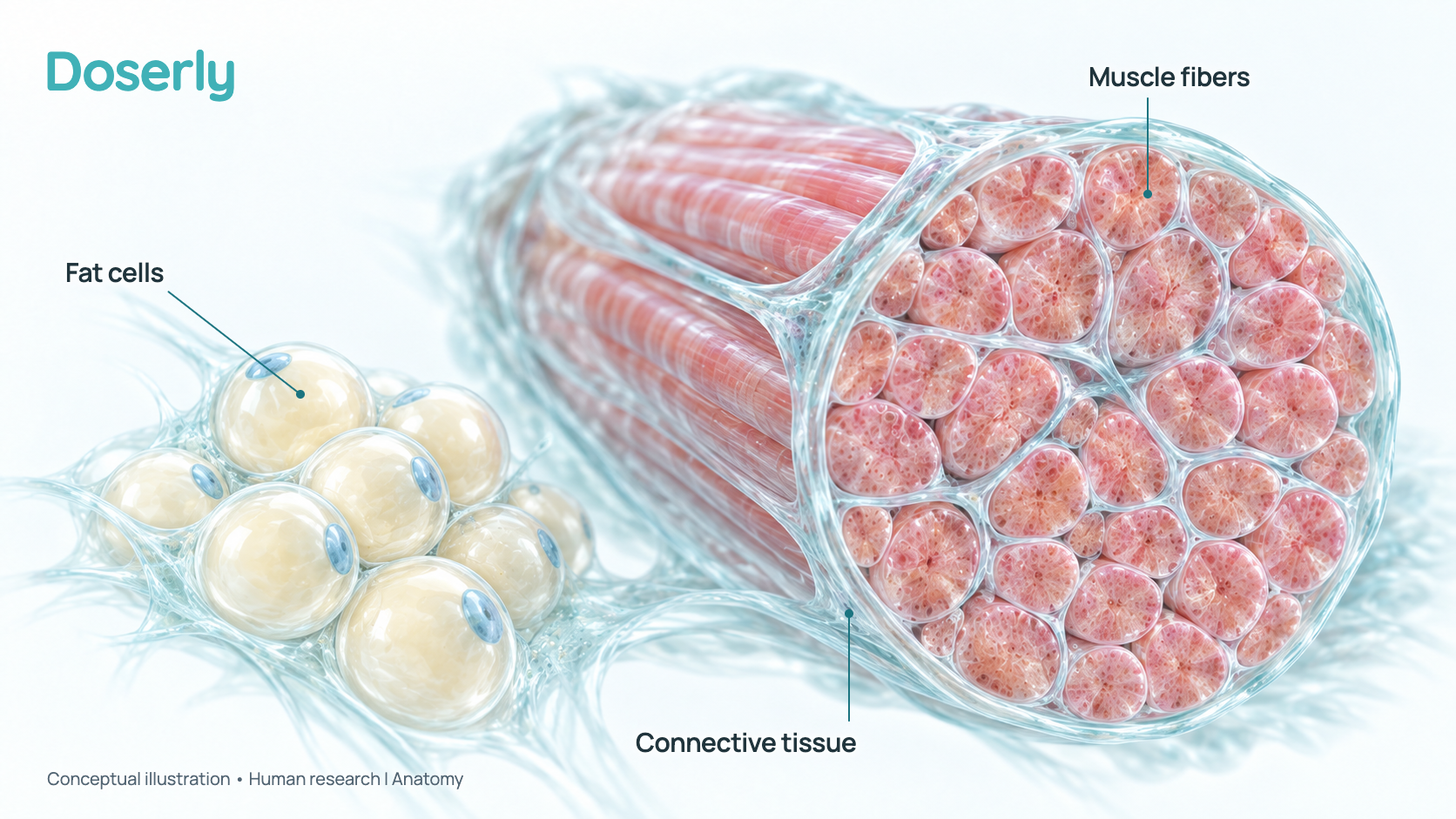
TRT, muscle and fat: the key numbers
Every major clinical guideline that addresses body composition accepts that testosterone shifts fat to lean mass in men with confirmed low testosterone. None of the current ones recommends it as a weight-loss treatment or to build muscle in men with normal levels. This table shows what each body says, checked in September 2026.
| Guideline (version, year) | Muscle and fat | Weight and obesity | Review point |
|---|---|---|---|
| AUA, American Urological Association (2018, reconfirmed 2024) | May improve lean body mass (moderate recommendation) | Counsel overweight men about weight-loss programs alongside testosterone | Discuss stopping at 3–6 months if symptoms have not improved |
| Endocrine Society (2018 guideline) | Raises fat-free mass and strength, lowers whole-body and belly fat; walking and disability gains inconsistent | Against testosterone for blood sugar control in type 2 diabetes | Evaluate at 3–12 months, then yearly |
| Endocrine Society (statement, July 2026) | Not addressed | Weight loss is typically first-line when overweight or obesity (BMI above 27) is the only cause | Not stated |
| EAU, European Association of Urology (2026) | Fat and lean mass change by the same amount, weight does not; registry weight loss carries selection bias | Lifestyle and weight loss before starting (strong); not to reduce weight (weak) or improve strength in ageing men (strong) | First clinical review after 3 months |
| EAA, European Academy of Andrology (2020) | Improves body composition without changing weight or BMI | Against testosterone as a weight-loss treatment (strong recommendation, low-quality evidence) | Assess response at 3 and 12 months; stopping may be considered after weight loss |
| BSSM, British Society for Sexual Medicine (2023) | Lean gain and fat loss, no change in weight, BMI or waist | Treat men with symptoms alongside weight-loss advice | Changes may take 12 months or more; stop if no benefit within 6 months, including muscle and body fat |
| CUA, Canadian Urological Association (2021) | Diet and exercise are recommended together with testosterone | Test men with muscle loss (sarcopenia) or HIV-related weight loss | May take 6 months or more |
| Society for Endocrinology, UK (2022) | May improve lean mass in obesity-related low testosterone, but the red-cell rise makes the balance unclear | Lifestyle change and weight loss are the mainstays | May take 6–12 months; treatment is lifelong once the diagnosis is confirmed |
| VA, US Department of Veterans Affairs (January 2026) | Not stated | Big weight changes may prompt earlier testosterone checks | Stop if symptoms have not improved after 6–12 months |
| ESA, Endocrine Society of Australia (2016) | Moderate effects on fat and lean mass | Whether testosterone adds to lifestyle weight loss is an open question | Not stated |
| ACP, American College of Physicians (2020, now listed inactive) | Not for energy or physical function in age-related low testosterone | Not addressed | Reassess within 12 months |
| US product labels | Not shown safe and effective for athletic performance | May cause salt and water retention | Not stated |
[15], [26], [27], [7], [6], [16], [28], [29], [30], [31], [32], [22], [18]
The bodies that address it accept a modest fat-for-lean shift in men with confirmed low testosterone, and no current guideline endorses testosterone for weight loss or physique; an older 2016 obesity guideline, described below, is more favorable. They differ on whether weight loss should come first when low testosterone is linked to obesity. They also differ on when to judge whether treatment is working: a first review after 3 months (EAU), 3–6 months (AUA), 3–12 months (Endocrine Society), within 6 months (BSSM) or 6–12 months (VA). The Society for Endocrinology instead expects lifelong treatment once the diagnosis is confirmed. [7], [15], [26], [16], [30], [29]
What do the trials show, in numbers?
| What was measured | What randomized trials found | Where it comes from |
|---|---|---|
| Lean (fat-free) mass | About +1.6 kg (29 trials); +2.54 kg in men 40 and older (8 trials); about +2 kg with obesity (16 trials) | Meta-analyses [1], [33], [34] |
| Fat mass | About −1.6 kg (29 trials); −2.38 kg over 40 weeks with type 2 diabetes | Meta-analysis; trial [1], [35] |
| Body weight | No change on average | Meta-analyses [1], [23] |
| Waist | Smaller than with usual care in men with obesity-related low testosterone | Network meta-analysis of 23 trials [36] |
| Strength | Small average gain in men over 60 (effect size 0.21); larger in injection trials | Meta-analysis [2] |
| Physical function | Inconsistent: a slightly longer 6-minute walk in some men, no fewer falls | Trials [37], [5] |
| During a diet | 2.9 kg more fat lost and 3.4 kg less lean mass lost than placebo over 56 weeks | Trial [12] |
| Timing | Changes within 12–16 weeks, stable at 6–12 months | Review [14] |
| After stopping | Gone within 6 months (frail older men) and by about 82 weeks (dieting men with obesity) | Trial follow-ups [25], [13] |
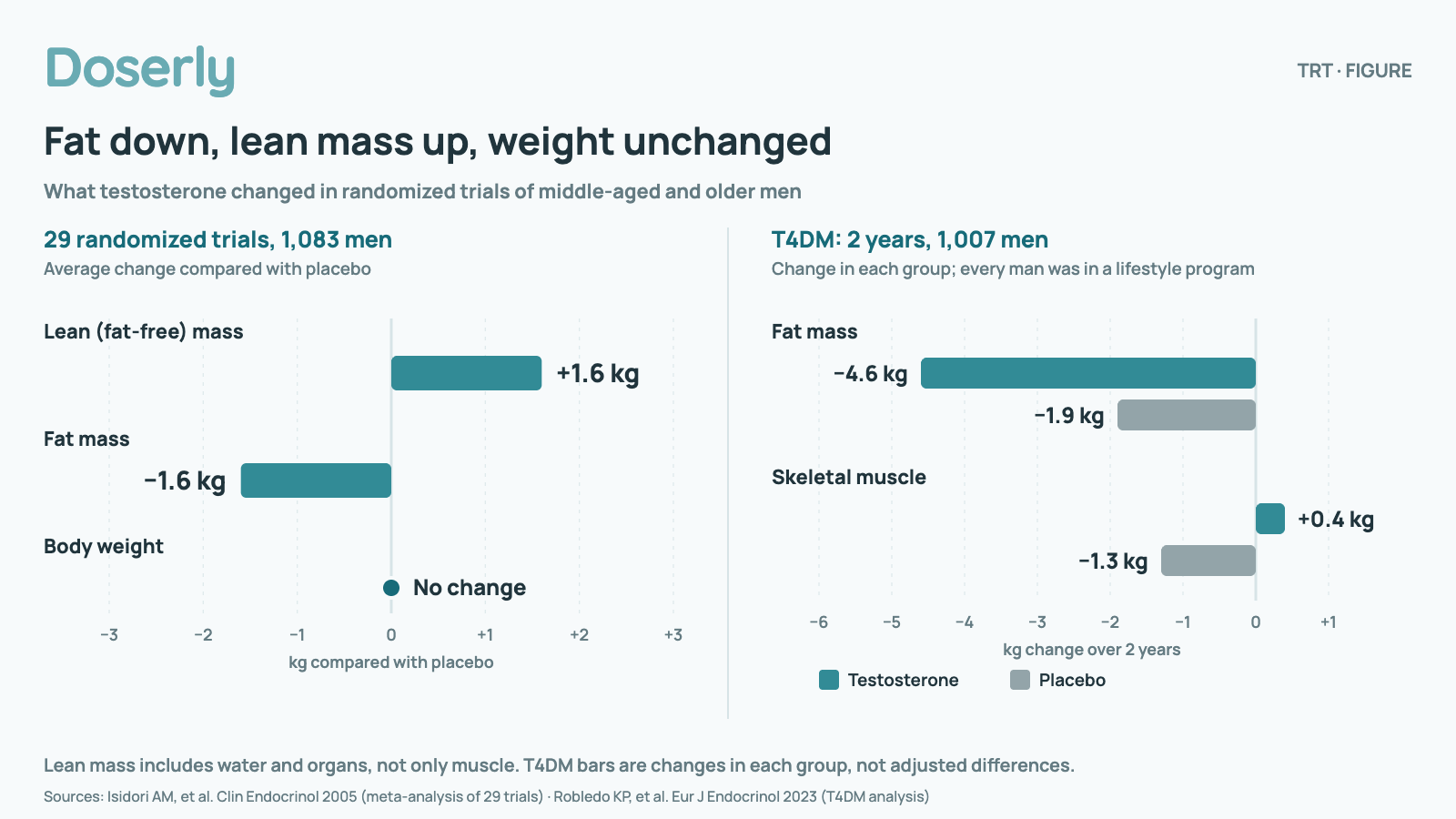
Fat down, lean mass up, weight unchanged
What testosterone changed in randomized trials of middle-aged and older men.
29 randomized trials, 1,083 men
Average change compared with placebo. Bars run from −3 kg (left) to +3 kg (right); the thin line is zero.
- Lean (fat-free) mass
- +1.6 kg
- Fat mass
- −1.6 kg
- Body weight
- No change
T4DM: 2 years, 1,007 men
Change in each group; every man was in a lifestyle program. Bars run from −6 kg to +1.5 kg; testosterone, placebo.
- Fat mass: Testosterone
- −4.6 kg
- Fat mass: Placebo
- −1.9 kg
- Skeletal muscle: Testosterone
- +0.4 kg
- Skeletal muscle: Placebo
- −1.3 kg
Lean mass includes water and organs, not only muscle. T4DM bars are changes in each group, not adjusted differences.
Why do guidelines disagree?
- Weight loss first, or treatment alongside it? The Endocrine Society's 2026 statement, the EAU and the EAA put weight loss first when low testosterone comes from obesity. The BSSM says lifestyle change alone is not first-line. A 2016 obesity guideline from the American Association of Clinical Endocrinologists (AACE) suggests testosterone with lifestyle change in men with true hypogonadism and reports weight loss and metabolic benefits, which conflicts with the EAA. Newer statements from Brazil (2026) and Obesity Canada (2025) do not recommend testosterone for weight loss or obesity. [27], [7], [6], [38], [39], [40], [16]
- When to call it a failure. Body composition changes slowly, so a 3-month review can come before the full effect; earlier review points mostly judge symptoms such as sex drive and energy. [14], [15], [16]
- Who the trials enrolled. Many muscle trials studied healthy older men with low-normal testosterone rather than men with a firm diagnosis. [10], [41], [2]
How are muscle and fat measured?
Most trials use a DXA scan, a low-dose X-ray that splits the body into fat, bone and everything else. That "everything else" is lean mass (fat-free mass): muscle, but also water, organs and skin. Studies that measured muscle directly with MRI or muscle samples show real muscle growth, but a lean-mass number alone cannot tell muscle from water. Bioimpedance, used by many home and gym scales, estimates body fat from a small electrical current. [24], [42], [43]
Results in this guide are in kilograms (1 kg is about 2.2 lb). Testosterone results appear in ng/dL in the US and nmol/L in most other countries: the TRAVERSE trial, for example, enrolled men with levels under 300 ng/dL (10.4 nmol/L). The testosterone unit converter switches between them. [44]
Where these numbers come from
Each guideline row comes from that body's current document: the AUA testosterone deficiency guideline (2018, validity reconfirmed 2024), the Endocrine Society guideline (2018) and its July 2026 statement, the EAU guidelines (2026 edition), the EAA functional hypogonadism guideline (2020), the BSSM guidelines (2023), the CUA guideline (2021), the Society for Endocrinology guideline (2022), the VA recommendations (January 2026), the Endocrine Society of Australia position statement (2016), and the ACP guideline (2020, now listed inactive by the ACP). The label row quotes current US prescribing information for Depo-Testosterone and a generic 1% gel. [15], [26], [27], [7], [6], [16], [28], [29], [30], [31], [32], [22], [18]
The trial numbers come from the meta-analyses and trials named in the second table, read in the original abstract or full text. The 1.6 kg figures are from the 2005 meta-analysis of 29 trials; a larger 2016 meta-analysis of 59 trials found the same direction but gives no kilogram values in its abstract.
Not used: a lean-mass range of "1.6–5.7 kg" that circulates online (5.7 is a percentage from a different analysis, not kilograms); fat-loss claims of up to 3.6 kg without a traceable source; "2–5 kg of water weight" in the first weeks (no study has measured it); and a 20% weight loss with lower death rates taken from a conference abstract rather than a peer-reviewed paper. The peer-reviewed report from the same registry is described below with its funding.
How does testosterone change muscle and fat?
It makes muscle fibers bigger and tilts the balance of muscle protein toward building, while estradiol, which the body makes from testosterone, does much of the work on fat. Both were measured in people. [42], [45], [46]
- Muscle fibers get thicker. In 61 healthy young men whose own testosterone was switched off and replaced with five research doses for 20 weeks, the volume of one thigh muscle changed from −4 mL at the lowest dose to +48 mL at the highest. In muscle samples from 39 of the men, fibers grew clearly larger (hypertrophy) at the two highest research doses. [42]
- Less breakdown, more building. In a trial of 12 older men with testosterone under 480 ng/dL (17 nmol/L), the 7 given testosterone in the normal range for 6 months gained lean mass because muscle protein breakdown fell. In another small study of 5 men with very low testosterone, replacement raised muscle protein building by 56%, and about 65% of their lean-mass gain was muscle. [45], [24]
- DHT is not needed. The body turns some testosterone into DHT. In a trial of 139 men, blocking that step with dutasteride (a stronger relative of the hair-loss medicine finasteride) did not reduce the lean-mass gain. [47]
- Estradiol handles much of the fat. When researchers lowered men's testosterone and estradiol on purpose, the lack of estradiol mainly caused the gain in body fat. In a year-long trial of 88 older men, the aromatase inhibitor anastrozole raised testosterone by cutting estradiol but did not improve body composition or strength, and in the 69 men in its bone study, it lowered spine bone density. [46], [48], [49]
- Low testosterone and body fat feed each other. In a European survey of 3,369 men, a BMI of 30 or more was strongly linked with low testosterone from weak brain signals (secondary hypogonadism; relative risk ratio 8.74, a link rather than proof of cause). Losing weight raises testosterone: by about 2.5 nmol/L (about 72 ng/dL) after diet-based weight loss and 7.2 nmol/L (about 208 ng/dL) after weight-loss surgery across 44 studies. [50], [51]
Does more testosterone mean more muscle?
In research studies, yes, but side effects rose with it. In healthy men aged 60 to 75 whose own testosterone was switched off, 20 weeks of five research doses changed lean mass by −0.3, +1.7, +4.2, +5.6 and +7.3 kg from lowest to highest. A hematocrit above 54%, leg swelling and prostate problems were numerically more frequent than in young men, and the authors noted a high rate of side effects at the high doses. In young men, HDL cholesterol fell as the dose rose. [52], [53]
The top doses were far above replacement, so they describe steroid-level exposure, not TRT. In treatment, prescribers aim for the normal range using blood tests and symptoms, not muscle; see the TRT dosage and blood work guides. US labels say testosterone has not been shown safe and effective for athletic performance and that abuse happens "typically at doses higher than recommended". [22], [54] The TRT vs steroids guide covers what separates the two.
What does the research show?
Most of the evidence comes from randomized trials in middle-aged and older men, including men with diabetes, obesity or frailty. Many enrolled men with low-normal testosterone, and men who start lower tend to gain more. [10], [41], [2], [55]
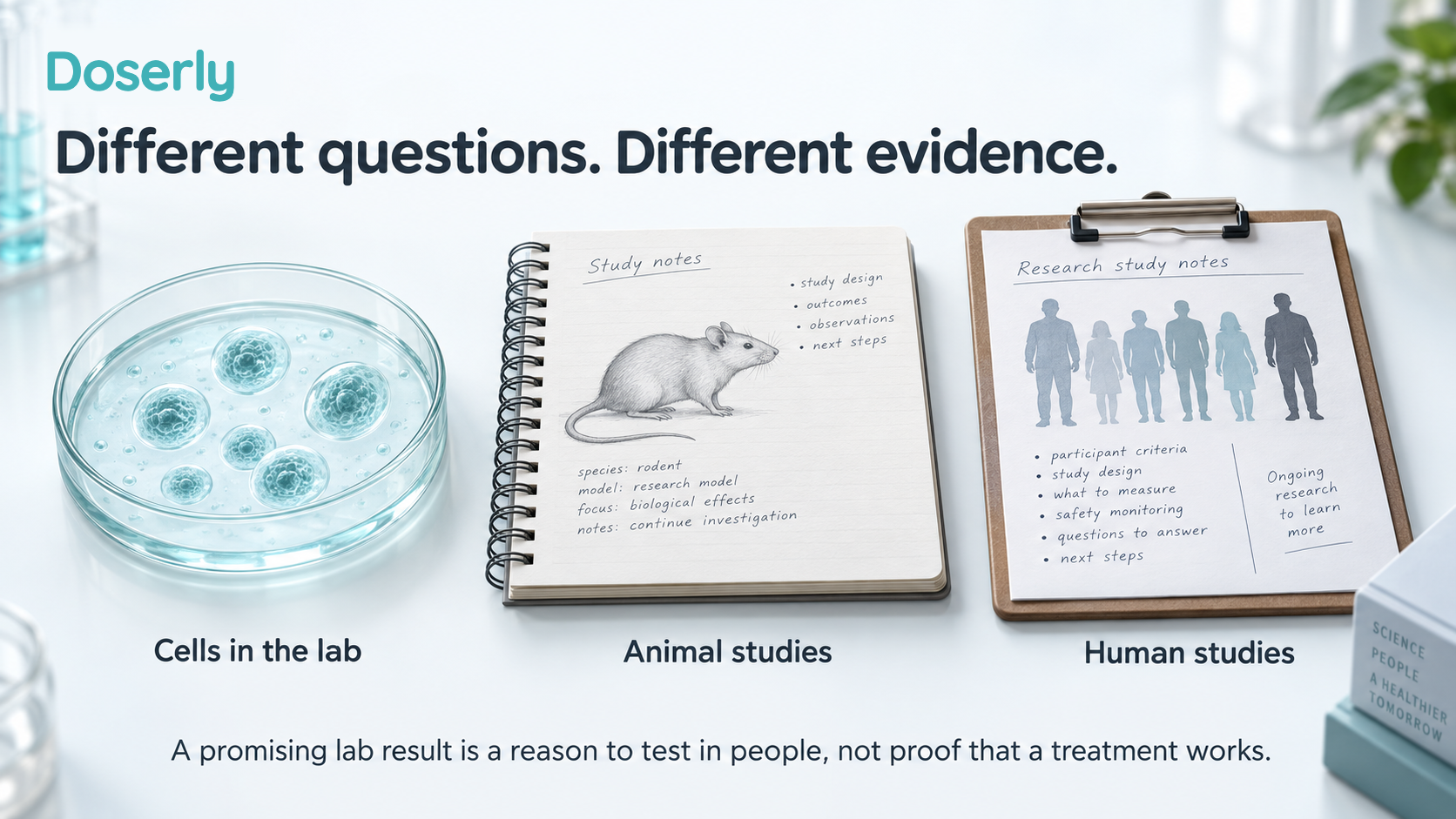
How much muscle and fat does TRT change?
About 1.5–2.5 kg of lean mass gained and a similar amount of fat lost over 6 to 12 months, varying by trial.
| Study | Who and what | Body composition | Strength or function |
|---|---|---|---|
| Snyder 1999 (controlled trial) | 108 men over 65, testosterone patch or placebo patch, 3 years | Fat −3.0 vs −0.7 kg; lean mass +1.9 vs +0.2 kg | Knee strength no different [3] |
| Srinivas-Shankar 2010 (controlled trial) | 274 frail or nearly frail men over 65, gel, 6 months | Lean mass 1.2 kg above placebo | Knee strength up 8.6 Nm [56], [25] |
| TEAAM 2017 (controlled trial) | 256 healthy men over 60 with low or low-normal testosterone, gel, 3 years | Lean mass +0.9 kg | Stair-climbing power +22.4 W and chest-press strength +16.3 N, described as modest [41] |
| Testosterone Trials 2016 (controlled trials) | 790 men over 65 with testosterone under 275 ng/dL (9.5 nmol/L), gel, 1 year | Not a main outcome | No walking benefit in the physical function trial; falls 27% in both groups [57], [37] |
| Kolind 2022 (controlled trial) | 41 men with low testosterone from opioid painkillers, undecanoate injections, 24 weeks | Lean mass +3.6 vs +0.1 kg | No better muscle function or walking [4] |
| Bischoff-Ferrari 2024 (controlled trial) | 91 pre-frail men over 65 with low testosterone, testosterone on the skin, 12 months | Limb lean mass +0.21 kg/m² | Walking speed +0.11 m/s; no fewer falls [5] |
| Meta-analysis of 16 trials (2023) | 1,728 men, average age 77 | Lean mass up at 6 months | No clear effect on muscle or bone at 12 months [58] |
The pattern is consistent: lean mass goes up and fat goes down, while strength, walking and falls change less or not at all.
Does more lean mass mean more strength?
Not reliably. A 2023 meta-analysis of 13 trials in 2,043 men over 60 found a small strength gain (effect size 0.21), larger in injection trials (0.74) and in men who started lower. An older analysis found a moderate effect (0.53), but without one influential study it fell to 0.23. Grip strength rose about 1.6 kg of force across 7 trials in men 40 and older. [2], [59], [33]
Guidelines read this cautiously. The Endocrine Society notes that trials "have not shown consistent improvements in gait speed or measures of disability", and the EAU advises against testosterone to improve strength in ageing men. A September 2026 review of the Testosterone Trials and TRAVERSE found benefits for sexual function and mood but not energy or physical function. The EAU even describes a 2,043-man meta-analysis as showing no significant strength gain, while the 2023 analysis reports a small one: a small effect that may not change daily life much. [26], [7], [60], [2]
That matters because doctors now define age-related muscle loss (sarcopenia) mainly by low strength, not low muscle mass. [61] One trial in frail older men with walking limits did find better leg press, chest press and stair climbing, but it stopped early after heart-related problems in 23 men on testosterone vs 5 on placebo. The much larger TRAVERSE trial later found no increase in heart attacks, strokes or heart deaths (7.0% vs 7.3%; see the heart section). [62], [44]
Do you need to lift weights on TRT?
Not to gain some lean mass, but lifting is what turns it into strength.
- Training plus testosterone. In a 12-month trial of 167 healthy men around 66 with low-normal testosterone, adding gel to supervised weight training gave 1.5 kg more fat-free mass and 1.2 kg less fat than training with placebo, but no better strength or function. Without training, testosterone still improved fat and lean mass. [10]
- Which does what. In 68 men aged 60–78 with low-normal testosterone and large waists, training improved muscle function, testosterone raised lean mass, and only the combination did both. [11]
- Frail men. In 71 frail men (average age 78) in rehabilitation, 12 weeks of weekly intramuscular injections (into a muscle) increased thigh muscle area by 7.9% vs 2.4% on placebo, while strength gains came mainly from high-intensity training. [63]
- Real-world clinic data. In 214 Japanese men with low testosterone followed for a year (not randomized), lean mass rose only in men who both took testosterone and exercised at least twice a week. [64]
Steroid-level doses show much larger gains: healthy young men given a very high research dose while training gained 6.1 kg of fat-free mass in 10 weeks, far outside what TRT does. [65] For training itself, the World Health Organization advises muscle-strengthening activity on 2 or more days a week for all adults, and the CUA recommends diet and exercise together with testosterone; neither tested a plan on TRT. [66], [28]
Will TRT make me lose weight?
Not by itself. In randomized trials, weight stayed the same on average because the fat lost was replaced by about the same amount of lean mass. A 2016 meta-analysis of 59 trials (3,029 men on testosterone, 2,049 controls) agreed; the BSSM reads the trials as showing no change in weight, BMI or waist, and the EAU as no change in weight. [1], [23], [16], [7], [6]
Why do some sources promise big weight loss? Because they quote studies without a fair comparison group:
- Uncontrolled studies. Across 32 observational studies (4,513 men), weight fell 3.50 kg and waist 6.23 cm at 24 months, with no randomized comparison; the authors asked for a proper trial. [8]
- Registries. In one urology practice, 261 men on long-acting injections went from 100.1 to 92.5 kg, with no control group. In an 11-year registry where men chose whether to be treated, obese treated men lost 23.2 kg while untreated men gained 4.2 kg. Both had ties to Bayer, which makes the injection; the second was Bayer-supported, with a Bayer employee as first author. [67], [9]
The EAU says registry weight loss carries "selection bias": men who stay on treatment for years differ from men who stop or never start. [7] Labels even list weight gain: in 2 of 95 men (2.1%) in the 24-day Tlando oral testosterone trial, and UK product information says it can signal too much testosterone. [68], [69]
Does TRT burn belly fat?
Mostly the layer just below the skin; results for the deeper fat around the organs are mixed. Subcutaneous fat sits just under the skin; visceral fat sits around the organs inside the belly. [70], [35]
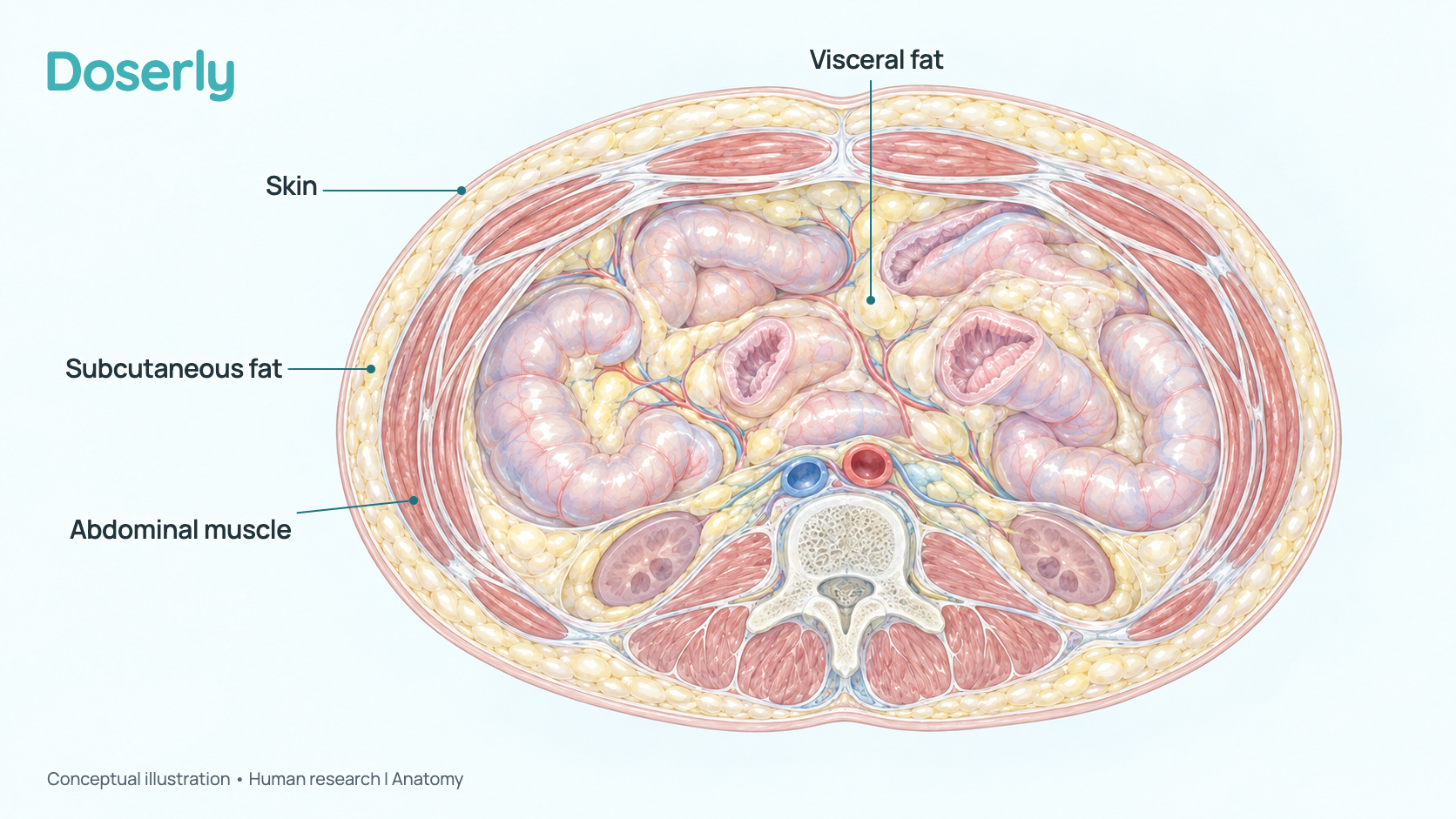
- Less under-skin fat, visceral unchanged. In 38 men aged 60–78 with large waists, 6 months of gel reduced subcutaneous belly fat by 3.0% while visceral fat did not change. Two trials in men with type 2 diabetes found the same pattern: in one, subcutaneous fat fell 3.3 kg compared with placebo, while the drop in visceral fat was not statistically clear. [70], [35], [71]
- Less visceral fat. In 60 lean men over 55, a year of patches stopped the visceral fat gain seen on placebo, and in men with obesity on a very-low-calorie diet, visceral fat fell more with testosterone. [72], [12]
- Waist size. In a 2026 network meta-analysis of 23 trials in men with obesity-related low testosterone, testosterone was the only option that clearly reduced waist size compared with usual care; it also raised hematocrit. [36]
The Endocrine Society guideline does describe testosterone as reducing fat inside the abdomen; the trials mainly show that this effect is smaller and less consistent than the effect on subcutaneous fat. [26]
Can TRT help you keep muscle while dieting?
Partly. In trials, testosterone made more of the weight lost come from fat, but men still lost some lean mass on strict diets, and the advantage faded after stopping.
- Very-low-calorie diet. 100 men with obesity and testosterone of 12 nmol/L (about 346 ng/dL) or lower had a 10-week very-low-calorie diet, then weight maintenance, with long-acting undecanoate injections or placebo. Testosterone gave 2.9 kg more fat loss and 3.4 kg less lean-mass loss with testosterone over 56 weeks. Both groups lost lean mass on the diet (3.9 kg vs 4.8 kg); the testosterone group regained 3.3 kg of it during maintenance. [12]
- Older men losing weight. In 83 frail men over 65 with obesity in an intensive diet and exercise program (about 9% weight loss in 6 months), gel reduced the loss of lean mass (2% vs 3%) and thigh muscle (2% vs 4%). Physical performance improved about equally (17% vs 16%). Hematocrit rose 5% vs 1%, and testosterone blunted the HDL rise the program produced. [73], [74]
- T4DM. The trial enrolled 1,007 men aged 50–74 with a large waist and prediabetes or new type 2 diabetes, all in a lifestyle program. Over 2 years, long-acting undecanoate injections reduced fat by 4.6 kg vs 1.9 kg on placebo, and skeletal muscle rose 0.4 kg while it fell 1.3 kg on placebo. Grip strength rose 1.7 kg vs fell 0.5 kg. The fat loss explained most of the lower diabetes rate (12% vs 21% at 2 years), but hematocrit went above 54% in 106 of 491 men on testosterone vs 6 of 484 on placebo. [75], [17]
- A severe deficit in young men. In 50 healthy young men with normal testosterone on a 28-day severe deficit, a weekly research dose added 2.5 kg of lean mass compared with placebo, but fat loss was the same and leg function did not improve. This was not TRT. [76]
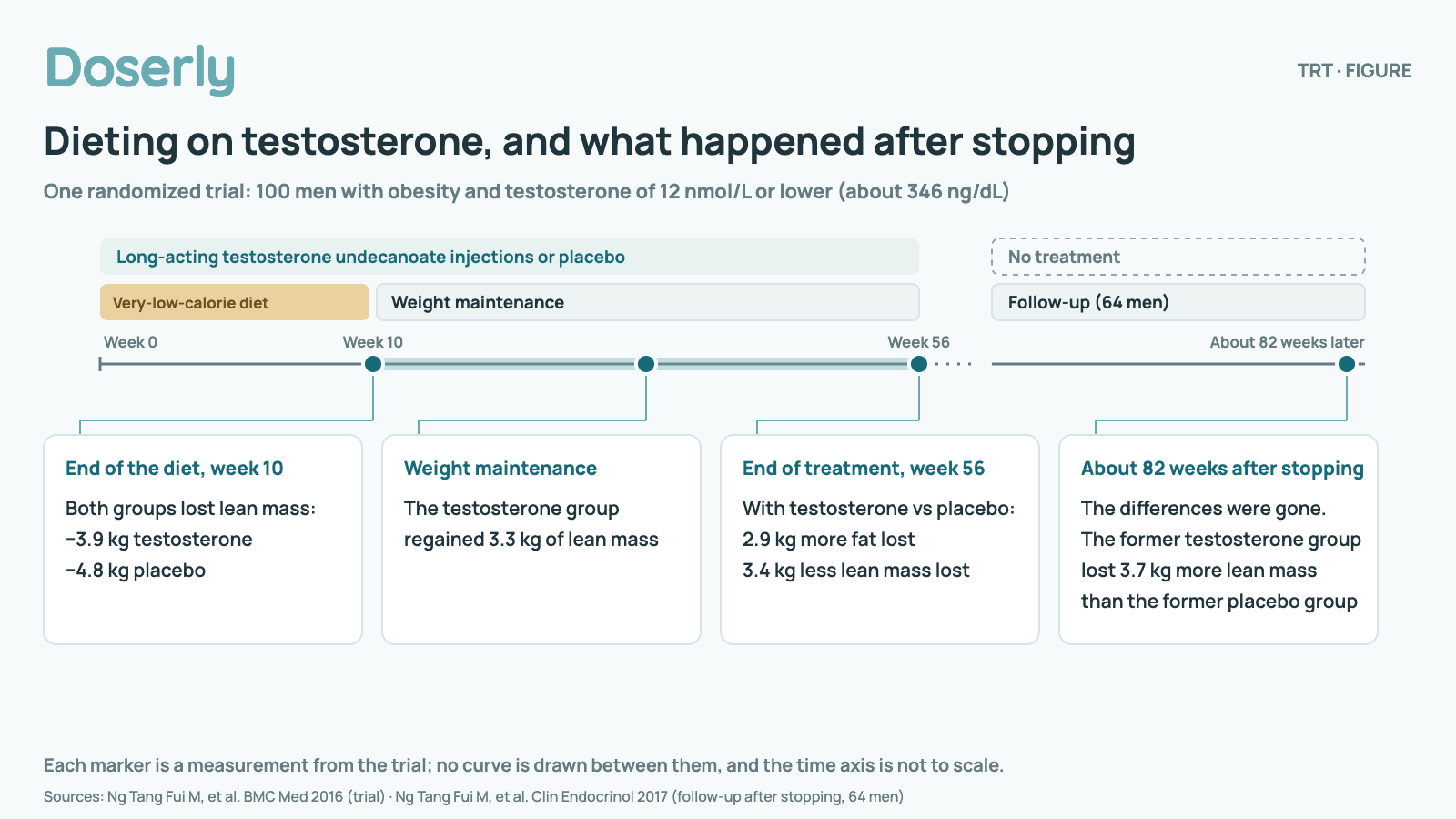
Dieting on testosterone, and what happened after stopping
One randomized trial: 100 men with obesity and testosterone of 12 nmol/L or lower (about 346 ng/dL).
Long-acting testosterone undecanoate injections or placebo from week 0 to week 56, then no treatment.
- Weeks 0–10: very-low-calorie diet
Both groups lost lean mass: −3.9 kg with testosterone, −4.8 kg with placebo.
- Weeks 10–56: weight maintenance
The testosterone group regained 3.3 kg of lean mass.
- Week 56: end of treatment
With testosterone vs placebo: 2.9 kg more fat lost and 3.4 kg less lean mass lost.
- About 82 weeks after stopping (64 men)
The differences were gone. The former testosterone group lost 3.7 kg more lean mass than the former placebo group while off treatment.
Each marker is a measurement from the trial; no curve is drawn between them.
Diabetes trials point the same way. In men with type 2 diabetes, testosterone cut fat and added lean mass without improving blood sugar. A larger gel trial, sponsored by the gel's maker and using bioimpedance, found no change in body fat percentage, BMI or waist. A 2026 review of 8 trials said testosterone should not be regarded as a diabetes treatment. [35], [77], [43], [78] The American Diabetes Association (2026) does not recommend it to prevent diabetes, noting that TRAVERSE, a gel trial without a lifestyle program, found no significant prevention. The BSSM differs, treating men with symptoms and prediabetes when testosterone is below 14 nmol/L (about 404 ng/dL). [79], [80], [16]
Do injections build more muscle than gels?
Injection trials showed bigger average gains, but no trial has compared the forms head to head. Across placebo-controlled trials, intramuscular injections were linked with a 5.7% rise in fat-free mass and gels or patches (transdermal, absorbed through the skin) with 1.7%, and the skin forms did not improve leg strength. The authors stress that "no RCT to date has directly compared" the routes. Strength analyses point the same way. [81], [2], [59]
Every form raises hematocrit. In a network analysis of 29 trials, the average rise was about 4.0 points with cypionate or enanthate injections, 3.0 with gel and 1.4 with patches, and 1.6 with long-acting undecanoate injections. Only the gap between cypionate or enanthate injections and patches was statistically clear, so a bigger lean-mass effect may come with a bigger red-cell effect (see the hematocrit guide, and the cypionate and gel guides). [82]
Who gains the most?
- Men who start lower. In 105 men on injections for 18 months, those starting below 264 ng/dL (9.2 nmol/L) gained 4.2% fat-free mass vs 2.7% above it (no placebo group); lower starting levels also predicted bigger strength gains. [55], [2]
- Men who exercise, as in the Japanese clinic study above. [64]
- Age matters less than side effects: older men gained as much lean mass as young men at the same research dose, with more side effects. [52]
How long does it take to see changes?
Measurable changes appear within about 3–4 months and level off by 6–12 months: a review of treatment time courses found fat mass, lean mass and strength changing within 12–16 weeks and stabilizing at 6–12 months. Guidelines give 6 months or more (CUA), 6–12 months (Society for Endocrinology) or 12 months or more (BSSM). [14], [28], [29], [16]
In a pooled analysis of 16 trials in older men, lean mass was clearly higher at 6 months, but the pooled effect at 12 months was not statistically significant. Single long trials still showed gains: +1.9 vs +0.2 kg over 3 years with patches, and a modest +0.9 kg in the 3-year TEAAM trial. See the TRT results timeline. [58], [3], [41]
What happens to muscle and fat when you stop TRT?
The gains fade. In frail older men, lean mass was 1.2 kg higher than placebo after 6 months of gel, and none of the differences remained 6 months after stopping. In men with obesity who had used testosterone during a diet, the extra fat loss and lean-mass protection were gone about 82 weeks after stopping. The former testosterone group lost 3.7 kg more lean mass while off treatment than the former placebo group. [25], [13]
About five years after T4DM ended, more former testosterone users had restarted it (6% vs 2.8%). The EAA says stopping may be considered after weight loss in obesity-linked low testosterone, while the Society for Endocrinology expects lifelong treatment for a confirmed diagnosis. See stopping TRT. [83], [6], [29]
Is testosterone ever used to treat muscle wasting?
Only in narrow cases. The Endocrine Society suggests considering short-term testosterone for men with HIV who have low testosterone and unexplained weight loss; in trials it added about 1.22 kg of lean mass. The CUA recommends testing testosterone in men with sarcopenia or HIV-related weight loss. For age-related sarcopenia itself, the sarcopenia guideline found the evidence insufficient to recommend hormones, and the 2024 international consensus paper on defining sarcopenia notes that no drug treatment currently exists. [26], [84], [28], [85], [86]
Is TRT safe for building muscle or losing fat?
Is TRT safe when the goal is muscle or fat loss?
For men with confirmed low testosterone and regular monitoring, its risks are well described and checked for, and the most common is a rise in red blood cells. For men with normal testosterone who want a better physique, no guideline or label supports it, so they take on the same risks without a proven medical benefit. [17], [7], [22]
What side effects matter most here?
- More red blood cells. In T4DM, hematocrit went above 54% in 22% of men on testosterone vs 1% on placebo; the Society for Endocrinology says this frequent rise makes the balance of benefit and risk unclear in obesity-related low testosterone. See the hematocrit guide. [17], [29]
- Fluid retention. US labels say androgens "may promote retention of sodium and water", which can cause swelling (edema), serious in people with heart, kidney or liver disease; in gel trials, leg swelling affected fewer than 1% of men. [18], [22]
- Blood pressure. All testosterone products can raise blood pressure, and FDA required warnings on every label in 2025. [87]
- Sleep apnea. In men with obesity and severe sleep apnea, injections worsened nighttime oxygen drops at 7 weeks but not at 18 weeks. In T4DM, new sleep apnea diagnoses during the trial were more common on testosterone (3.0% vs 0.4%), as self-reported in a follow-up survey of 599 men (316 vs 283). [88], [83]
- Cholesterol. HDL cholesterol fell in some trials. [77], [74]
- Fertility. Testosterone lowers sperm production, which may not fully recover in some men; the AUA advises against it for men trying to conceive. See TRT and fertility. [19], [15]
Does TRT affect the heart?
The best evidence comes from TRAVERSE, a randomized trial of about 5,200 men aged 45 to 80 with low testosterone and heart disease or high heart risk, given daily testosterone gel or a placebo gel. Among the 2,596 men who used testosterone gel and the 2,602 who used placebo gel, it found: [44]
- Heart attack, stroke or heart death: 182 men (7.0%) on testosterone vs 190 (7.3%) on placebo; hazard ratio 0.96, which met the trial's safety goal. [44]
- Heart rhythm: atrial fibrillation 3.5% vs 2.4%; nonfatal rhythm problems needing treatment 5.2% vs 3.3%. [89]
- Kidneys: acute kidney injury 2.3% vs 1.5%. [89]
- Clots: venous clots 1.7% vs 1.2%, including pulmonary embolism 0.9% vs 0.5%. [89]
- Fractures: in TRAVERSE, clinical fractures occurred in 3.50% vs 2.46% of men (91 of 2,601 vs 64 of 2,603), so testosterone did not prevent fractures. [90]
- Blood pressure: systolic pressure rose 1.0 mm Hg on testosterone and fell 0.5 mm Hg on placebo by 36 months. [89]
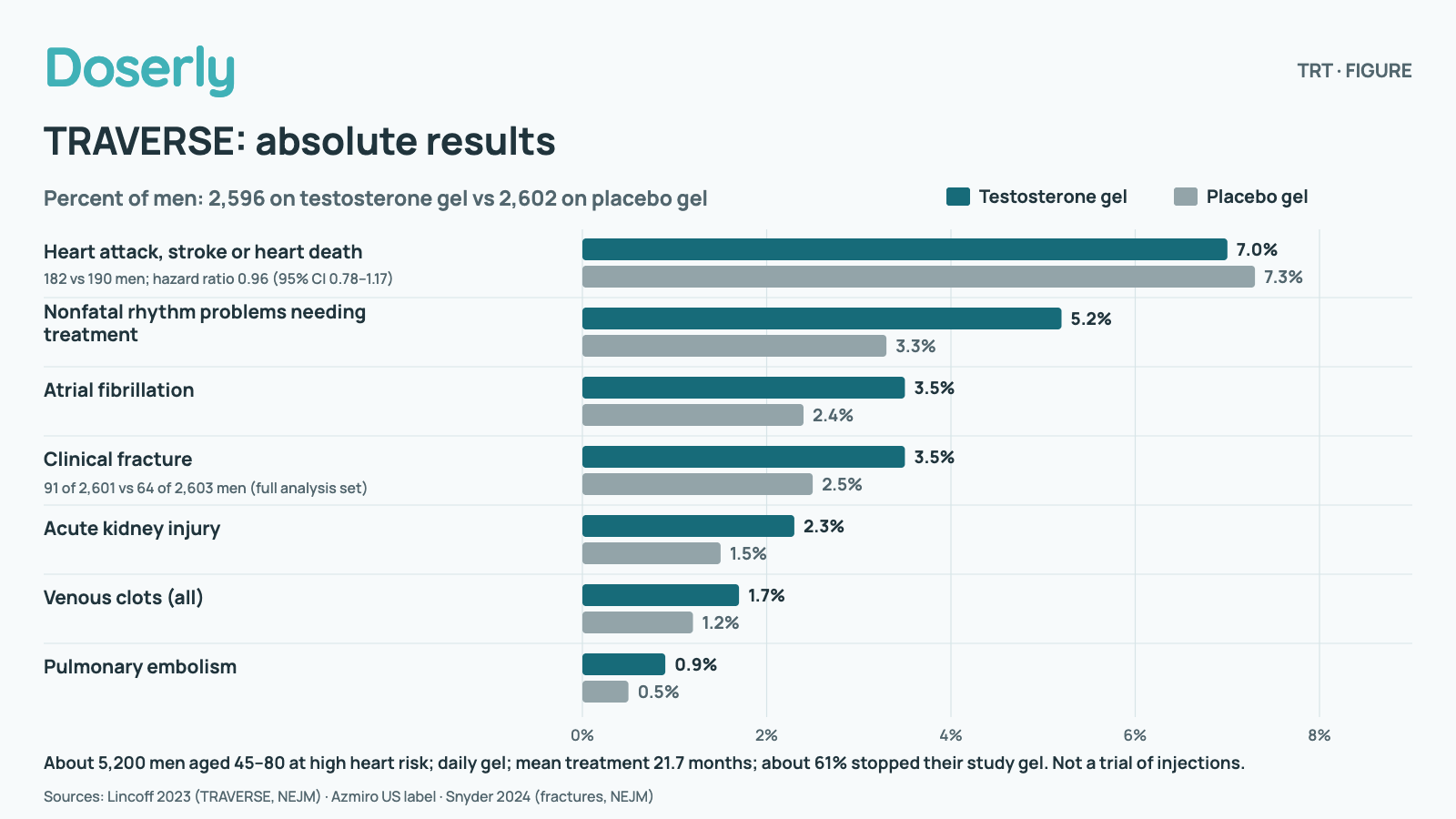
TRAVERSE: absolute results
Testosterone gel (2,596 men)Placebo gel (2,602 men)
- Heart attack, stroke or heart death
- Testosterone 7.0% vs placebo 7.3% (182 vs 190 men; hazard ratio 0.96, 95% CI 0.78–1.17; met the 1.5 safety margin)
- Nonfatal rhythm problems needing treatment
- Testosterone 5.2% vs placebo 3.3%
- Atrial fibrillation
- Testosterone 3.5% vs placebo 2.4%
- Clinical fracture
- Testosterone 3.5% vs placebo 2.5% (91 of 2,601 vs 64 of 2,603 in the full analysis set)
- Acute kidney injury
- Testosterone 2.3% vs placebo 1.5%
- Venous clots (all)
- Testosterone 1.7% vs placebo 1.2%
- Pulmonary embolism
- Testosterone 0.9% vs placebo 0.5%
About 5,200 men aged 45–80 at high heart risk; daily gel; mean treatment 21.7 months; about 61% stopped their study gel. Not a trial of injections.
Its limits matter here. TRAVERSE tested only a daily gel, the average man used it for 21.7 months, about 61% stopped their study gel early, and it enrolled men already at high heart risk. It did not test injections, higher doses or physique use. [44], [91] The earlier TOM trial in 209 frail men over 65 was stopped early after heart-related problems in 23 men on gel vs 5 on placebo; it was small and in sick older men. [62] See TRT and heart health.
What about taking more than prescribed?
Since 2016, US testosterone labels have warned about abuse and dependence. Abuse typically involves doses above those approved, often with other anabolic steroids, and stopping above-treatment doses can bring weeks or months of withdrawal symptoms, including depression, fatigue, low sex drive and suppressed natural testosterone. Dependence has not been documented at approved doses. [54], [22]
Who should be especially cautious?
- Men with normal testosterone who want muscle. The EAU advises against testosterone in men with normal levels, and US labels require low morning levels on at least two days before starting. [7], [19]
- Men who want children now or soon. Testosterone lowers sperm production; guidelines advise against it for men trying to conceive. [15]
- Men with a high hematocrit, untreated sleep apnea, heart, kidney or liver disease, or past blood clots, because of the risks above. [29], [22], [88], [89]
- Men with prostate or breast cancer. Current US labels contraindicate testosterone in known or suspected prostate cancer. In June 2026 FDA requested narrowing this to metastatic prostate cancer; that request is pending and not yet in any label (checked September 2026). [22], [92]
- Drug-tested athletes. Testosterone is banned in sport at all times. [21]
- Under-18s. Testosterone for teenagers belongs only in specialist care.
- Women. This guide is written for men. Testosterone for women uses different doses and products; see testosterone therapy for women.
Which medicines and supplements matter?
- GLP-1 medicines (semaglutide in Ozempic and Wegovy; tirzepatide in Mounjaro and Zepbound). No current US label lists an interaction with testosterone (checked September 2026); see below. [93]
- Corticosteroids may add to fluid retention, and testosterone may lower blood sugar and insulin needs. [68]
- Aromatase inhibitors and finasteride are covered under how it works.
Bring a complete list of what you take, including supplements, to a pharmacist or prescriber.
Is testosterone legal, and is it allowed in sport?
Checked September 2026. Rules differ by country and change often.
- United States. Testosterone and its esters are Schedule III controlled substances, prescription only; no proposal to change that has been published. In June 2026, HHS announced that FDA is requesting label changes, including removing the statement that safety and efficacy in "age-related hypogonadism" have not been established; these are requests, not yet in any label. [20], [92]
- United Kingdom. Testosterone is a Class C controlled drug, in Schedule 4 Part II. [94], [95]
- Canada. Testosterone is a Schedule IV controlled substance. [96]
- Australia. Testosterone is a Schedule 4 prescription-only medicine. [97]
- Sport. The World Anti-Doping Agency (WADA) prohibits testosterone at all times, and its 2027 list keeps the ban. An exemption is granted only for low testosterone with an organic cause, not for age, obesity or overtraining. Semaglutide and tirzepatide are only on WADA's monitoring program. [21], [98], [99], [100]
What do guidelines say to do?
Confirm low testosterone, lose weight first when obesity is the likely cause (in most guidelines), combine treatment with diet and training, and review it after a few months. This describes the choices clinicians weigh; it is not a personal plan.
| Choice | Which guidelines name it | What the evidence shows |
|---|---|---|
| Confirm low testosterone before treating | US labels (two low morning tests); EAU (not in men with normal levels); Endocrine Society 2026 (rule out reversible causes first) | Body-composition goals alone are not a reason to treat [19], [7], [27] |
| Lose weight first when obesity is the cause | Endocrine Society 2026, EAU, EAA, Society for Endocrinology (the AUA and BSSM treat alongside weight loss) | Diet-based weight loss raises testosterone by about 2.5 nmol/L (72 ng/dL) [51] |
| Combine treatment with diet and exercise | AUA, CUA, BSSM | Training drives strength; testosterone adds lean mass [10], [11] |
| Review response after a set time | EAU (after 3 months), AUA (3–6 months), Endocrine Society (3–12 months), BSSM (6 months), VA (6–12 months) | Body composition changes within 12–16 weeks [14] |
| Do not use testosterone for weight loss | EAA, EAU, Brazil 2026, Obesity Canada 2025 | Randomized trials show no average weight change [1] |
| Do not use it for physical function in age-related low testosterone | ACP (2020, inactive), EAU (strength) | No walking benefit in the Testosterone Trials [57] |
[15], [26], [27], [7], [6], [29], [16], [28], [30], [39], [40], [32]
Can you take TRT just for muscle or fat loss?
No guideline supports it. The EAU advises against testosterone in men with normal levels. US labels require low levels on at least two mornings and say it has not been shown safe and effective for athletic performance. The Endocrine Society's 2026 statement says symptoms alone do not make a diagnosis and reversible causes such as obesity, corticosteroids and opioids come first. [7], [19], [22], [27]
Obesity also makes one test harder to read: it lowers SHBG, the protein that carries testosterone, so total testosterone can read low while free testosterone stays normal, a pattern the VA notes. The AUA recommends testing men with a BMI of 30 or more or a waist over 40 inches. [30], [15] See the low testosterone guide.
When should you decide whether it is working?
At the review your prescriber sets, usually 3 to 6 months after starting (EAU after 3 months, AUA 3–6 months, Endocrine Society 3–12 months, BSSM 6 months, VA 6–12 months). Body composition can still be changing then, so the review is also a chance to check hematocrit, blood pressure and whether diet and training changed at the same time. [7], [15], [26], [16], [30], [14]
How do dieting, GLP-1 medicines and training fit with TRT?
Should you lose weight before starting TRT?
Most guidelines say yes when obesity is the likely cause, because losing weight raises testosterone on its own; the BSSM and AUA will treat alongside weight loss when symptoms are clear (see why guidelines disagree). [27], [7], [16], [15] The rise depends on how much weight comes off: about 2.9 nmol/L (84 ng/dL) with a low-calorie diet and 8.7 nmol/L (251 ng/dL) after weight-loss surgery in one meta-analysis. In a European study of 2,395 men followed for 4.4 years, free testosterone changed only with a 15% or larger change in weight. [101], [102] The obesity-related low testosterone guide covers this in depth.
Why did I gain weight in my first weeks on TRT?
Usually a mix of more food, more training and some retained water, but no study has measured how much is water. Labels say androgens may cause salt and water retention. Swelling in the ankles or legs, or sudden weight gain with breathlessness, needs a medical check, especially with heart, kidney or liver disease. [18], [22] Over months, trials show lean mass rising and fat falling by similar amounts, so a waist measurement or the fit of your clothes says more than the scale. [1]
Can you take TRT with Ozempic, Wegovy or Mounjaro?
No label lists an interaction (checked September 2026), but no randomized trial has tested whether testosterone protects muscle during GLP-1 weight loss. [93], [103]
- GLP-1 weight loss includes lean mass. In a body-scan substudy of the tirzepatide trial SURMOUNT-1 (160 adults, 73% women), 74% of the weight lost was fat and 26% lean mass, the same split as on placebo; tirzepatide simply caused more weight loss. In the semaglutide trial STEP 1, lean mass fell 9.7% and fat 19.3% (a conference report of 140 adults, 76% women). [104], [105]
- The only combined data are uncontrolled. In one clinic's records of 93 men with obesity on tirzepatide, testosterone and coaching, lean body mass fell 4.0–6.1 kg over 12 months, while muscle estimated by bioimpedance rose 1.6–3.7 kg and grip strength rose 5.7–7.1 kg. The authors say the design "precludes attribution" to any single part. [103]
- GLP-1 medicines raise testosterone too. In a 16-week trial in men with obesity, liraglutide raised testosterone by 2.6 nmol/L (75 ng/dL) and cut weight by 7.9 kg, while testosterone gel raised testosterone by 5.9 nmol/L (170 ng/dL) with 0.9 kg of weight loss. [106]
Retatrutide, which some men combine with testosterone, is not approved anywhere (checked September 2026); see the retatrutide guide. The TRT with GLP-1 medicines guide covers the combination in full.
How much protein and training do you need?
No trial has set targets for men on TRT. In healthy people doing resistance training, protein supplements added about 0.3 kg of fat-free mass, with no further gain once total protein reached about 1.6 g per kg of body weight a day. The WHO advises strength work on 2 or more days a week, and the sarcopenia guideline strongly recommends resistance training for older adults with muscle loss. [107], [66], [85] See the whey protein and creatine guides.
Does an aromatase inhibitor help you lean out?
No trial shows that it does: estradiol helps control body fat in men, and anastrozole did not improve body composition or strength in older men while lowering spine bone density (how it works). See estrogen on TRT. [46], [48], [49]
Are enclomiphene and TRT the same for body composition?
Nobody knows yet: we found no trial comparing their effects on muscle and fat. They differ for fertility: in two trials in overweight men, enclomiphene raised testosterone while keeping sperm counts normal, whereas testosterone gel markedly reduced sperm production. [108] See the enclomiphene guide and TRT and fertility.
Is TRT the same as taking steroids for bodybuilding?
No. TRT brings low testosterone back into the normal range; bodybuilding cycles use much higher (supraphysiologic) doses, often with other steroids, the source of both the big gains and the label warnings. [65], [22] See TRT vs steroids.
What do men on TRT report about muscle and fat?
Public forums are full of transformation photos, stalled scales and questions about water weight. The threads below are public Reddit discussions from the past year, read with their replies; they show what people experience, not how often, and most combine testosterone with other changes.
What do positive reports look like?
Most describe strength and training quality first, and body changes over months. A man in his 50s on 70 mg a week posted three scans from the same machine over about 11 months: lean mass up 13.0 lb and fat down 25.4 lb. He was also taking two weight-loss drugs (one unapproved), creatine and a new training program. He noticed gains around month three. [109] A longtime lifter in his 30s reported about 20 lb gained on a dose raised to 200 mg a week, which he himself called "hardly trt maintenance", and named faster recovery as the clearest benefit. [110]
A man in his 40s who had lost 73 lb by diet before restarting treatment went from about 193 to 210 lb in six months, with a bench-press record, while eating about 200 more calories a day. [111] A man in his 30s lost 164 lb over two years on tirzepatide, with testosterone for the last six months. He credited the GLP-1 medicine for appetite, TRT for motivation and recovery, and walking and protein for "the real long term work". [112]
Why does the scale go up in the first weeks?
It is one of the most common worries. Reported gains in the first one to three months range from about 6 lb to 15 lb, and most posters had also changed food, training or both. Examples include 8 lb in seven weeks after restarting daily walking and some lifting, and 15 lb in a month after switching from one meal a day to several meals and protein shakes. Another man gained 6–7 lb in about 10 days, four weeks in, after months at a stable weight on tirzepatide. [113], [114], [115] A fourth, 12 weeks in, was up 9 lb after also starting creatine but said clothes fit better every day. [116]
Some stories are less clear-cut. One poster, weighing about 350 lb, reported nearly 20 lb gained in the first three weeks of a third attempt at TRT, as in two earlier attempts, alongside about two sodas with every meal. Another gained 15 lb in the two weeks after starting an aromatase inhibitor. [117], [118]
What about men who gained little or nothing?
Nonresponse comes up often. A man in his 30s on 100 mg a week for two years, with testosterone up from 280 to 410 ng/dL (9.7 to 14.2 nmol/L), reported little muscle or strength gain despite tracking protein and lifts. He asked about raising the dose, a decision for a prescriber. [119] A man on tirzepatide who had lost about 100 lb said his doctor doubled his dose after the clinic's body-composition checks showed little muscle gain, although his testosterone results were already high. He was also getting conflicting calorie advice from his rehabilitation doctor, his trainer and his testosterone doctor. [120] Another man stopped after seven months of feeling no better and gaining almost 20 lb without a strength change; after tapering off with enclomiphene, he reported losing almost 15 lb and improving some lifts a month later. [121]
What do people report when combining GLP-1 medicines?
Big losses on the scale, and worries about looking soft. A man who lost 34 lb on tirzepatide without lifting had a scan showing 28.5% body fat before starting prescribed testosterone and weight training. Another called Zepbound the "game changer" in losing 57 lb, and a man on retatrutide and testosterone reported a stalled scale while forcing himself to eat to hit protein targets. [122], [123], [124]
Several men asked whether to lose weight first. One man in his 20s, whose doctor blamed his low testosterone on weight and insulin resistance, turned down a 6-month course his trainer suggested, partly because he wants children. Another, 63 lb down on Zepbound, chose more weight loss and further hormone tests first. [125], [126] A man who started at about 25% body fat stopped after three weeks because of acne, facial bloating, weaker erections and a flare of old breast-tissue swelling, planning to lose weight first. [127]
What unwanted effects come up?
Beyond the scale, three accounts stand out. One man said an aromatase inhibitor improved his erections but brought headaches and worse gym performance. Another reached a hematocrit above 54% on a higher dose, then lowered the dose, gave blood and switched to subcutaneous injections (into the fatty layer under the skin), with upper-body strength dipping for a while. A third man, with a total testosterone of 1,664 ng/dL (57.7 nmol/L) four months in, stopped after whole-body muscle stiffness and cramping that he tied to each injection. [128], [129], [130]
How can you judge a transformation story?
Ask: Was low testosterone confirmed before treatment? What dose, and did it change? What else changed at the same time: diet, training, weight-loss medicines, other hormones or drugs? Was body fat measured the same way before and after? Is there a later update?
Some "TRT transformations" are not TRT at all: one four-year recomposition post included a later non-prescribed cycle of several steroids, and another man whose testosterone was already in the normal range described his new prescription as a cycle. [131], [132] Meanwhile a man three months into treatment asked whether he was "wasting" TRT by not lifting, after better energy and sleep but no measured change in his body. [133]
These selected discussions show what people experience and the questions research has not answered. They are not a survey of all men on TRT, a success rate or a substitute for the trials above.
What should you track?
Guidelines monitor testosterone, hematocrit, the prostate blood test PSA, blood pressure and symptoms; none reviewed lists repeat DXA scans for tracking physique. For your own goals, simple measures taken the same way each time work best. Use this to prepare questions for your prescriber; it is not a personal testing plan. [26], [15]
| Why it matters | What guidelines say, or what helps | Tracking category |
|---|---|---|
| Testosterone and hematocrit | Endocrine Society: at 3–6 months, at 12 months, then yearly; AUA: every 6–12 months. The hematocrit rise is the main lab trade-off | Blood work |
| Prostate (PSA) | AUA: before starting in men over 40; Endocrine Society: if prostate monitoring is chosen (men 55–69, or 40–69 at higher risk), before and 3–12 months after starting | Blood work |
| Blood pressure | Labels warn that testosterone can raise it; check periodically | Blood Pressure |
| The symptoms you started for | The AUA, BSSM and VA review whether they improved at 3–6, 6 and 6–12 months | Energy Levels; Libido; Mood & Wellbeing |
| Strength or function | Lean mass does not guarantee strength; track the lifts or tasks you care about | Physical Performance |
| Waist and weight | The scale can stay flat while composition changes; measure the waist the same way each time | Fat Loss; Weight Management |
| Swelling and sleep | Fluid retention and sleep apnea are known risks; ankle swelling, snoring or daytime sleepiness are worth reporting | Fluid Retention; Sleep Quality |
[26], [15], [87], [16], [30], [2], [18], [88]
If you want a body scan, use the same machine each time so the results are comparable. The TRT blood work guide covers when to draw each test.
Common questions about TRT, muscle and fat
How much muscle can I expect to gain on TRT?
On average, about 1.5 to 2.5 kg (about 3 to 5.5 lb) of lean mass over 6 to 12 months in randomized trials, and not all of it is muscle. Men who start with lower testosterone and who lift tend to gain more, while strength gains are usually small without training. [1], [33], [55], [10] See the research.
Why isn't the scale moving if TRT is working?
Because fat and lean mass change by similar amounts, so weight stays about the same; that is what randomized trials found on average. A waist measurement, how clothes fit or a repeat body scan on the same machine show the change better, and weight gain in the first weeks often comes from more food, more training and some water. [1], [7], [18] See the weight question.
Can I lose weight on TRT without exercise?
Trials without exercise programs still found less fat and more lean mass, but no average weight loss; the biggest fat losses came with a diet or lifestyle program, as in T4DM (4.6 kg vs 1.9 kg on placebo). [1], [10], [75] See dieting on TRT.
Will I lose my gains if I stop TRT?
Probably, over months. In trials, the extra lean mass and fat loss were gone within 6 months of stopping in frail older men and by about 82 weeks in men with obesity who had dieted. The former testosterone group also lost more lean mass while off treatment. [25], [13] See stopping.
Does finasteride stop TRT from building muscle?
Probably not. In a research trial, blocking the conversion of testosterone to DHT with dutasteride, a stronger relative of finasteride, did not reduce the lean-mass gain; the researchers concluded DHT is not essential for testosterone's effect on muscle. [47] See how it works.
Is a DXA scan necessary on TRT?
No. Guidelines monitor testosterone, hematocrit, PSA, blood pressure and symptoms, and none reviewed lists repeat body scans for tracking physique. A scan can be useful if you want an objective measure, as long as repeat scans use the same machine. [26], [15] See what to track.
Glossary
Plain explanations of the medical, body-composition and research terms used in this guide. Underlined terms in the text link here.
- Aromatase inhibitor
- A medicine, such as anastrozole, that blocks the enzyme that turns testosterone into estradiol. In a trial of older men it did not improve body composition or strength.
- Bioimpedance (BIA)
- A way of estimating body fat by passing a tiny electrical current through the body, used by many home and gym scales. It is an estimate, not a direct measurement.
- Clinical guideline
- Recommendations written by a medical society or health system, based on its review of the evidence and expert judgment. Different guidelines can reach different conclusions.
- Cohort study (records study)
- A study that follows a group of people, or looks back at their records, without assigning treatments. It can show links but not prove that one thing caused another.
- Controlled trial
- A study that compares people who receive a treatment with a similar group who do not, often receiving a placebo instead. Randomly assigning people to each group makes the comparison fairer.
- DHT (dihydrotestosterone)
- A stronger hormone the body makes from testosterone in the skin, hair follicles and prostate. Finasteride and dutasteride block its production. It is not needed for testosterone's effect on muscle.
- DXA scan
- Dual-energy X-ray absorptiometry: a low-dose X-ray scan that splits the body into fat, bone and lean mass. It is the usual way trials measure body composition.
- Edema
- Swelling from fluid held in the body's tissues, often in the ankles, hands or face.
- Effect size
- A standard way of saying how big a difference is, so studies with different measurements can be combined. As a rough guide, 0.2 is small, 0.5 moderate and 0.8 large.
- Estradiol
- The main form of estrogen. In men it is made mostly from testosterone, and it helps control body fat and bone strength.
- Fat mass
- The total weight of fat in the body, as measured by a body-composition scan.
- Hazard ratio
- A measure comparing how often an event happens over time in two groups. A hazard ratio of 1 means no difference; 0.96 means about 4% lower in the first group.
- HDL cholesterol
- Often called 'good' cholesterol because higher levels go with lower heart risk. Testosterone lowered it in some trials.
- Hematocrit
- The share of the blood made up of red blood cells. Testosterone therapy can raise it, which is why it is checked.
- Hypertrophy
- Growth of a tissue because its cells get bigger. Testosterone makes muscle fibers thicker.
- Hypogonadism
- Low testosterone caused by a problem in the testicles or in the brain and pituitary signals that control them, confirmed with symptoms and repeated morning blood tests.
- Intramuscular (IM)
- Injected into a muscle. Most testosterone cypionate and enanthate is given this way.
- Product label (prescribing information)
- The official document approved by a medicines regulator for a product, describing its approved uses, doses, warnings and monitoring. In the UK it is called the summary of product characteristics.
- Lean mass (fat-free mass)
- Everything in the body that is not fat (or, on a DXA scan, not fat or bone): muscle, but also water, organs and skin. A lean-mass gain is not all muscle.
- Meta-analysis and systematic review
- A systematic review gathers all studies on a question in a planned way. A meta-analysis combines their results statistically. A network meta-analysis compares several treatments at once, even ones never tested head to head.
- Placebo
- A dummy treatment with no active ingredient, used as a comparison in studies.
- Registry study
- A long-term record of patients on a treatment, often without a randomized comparison group. It shows what happened over time, not what the treatment caused.
- Sarcopenia
- Age-related loss of muscle strength and mass. Current definitions put low strength first.
- SHBG (sex hormone-binding globulin)
- A blood protein that carries testosterone. Obesity lowers it, so total testosterone can read low while free testosterone is normal.
- Subcutaneous (SC)
- Injected into the fatty layer just under the skin. Xyosted is given this way, and some prescribers use this route for other testosterone injections.
- Subcutaneous fat
- The fat just under the skin, the kind you can pinch. Testosterone therapy reduced it more consistently than visceral fat in trials.
- Supraphysiologic dose
- A dose that pushes testosterone well above the normal range, as in bodybuilding cycles and some research studies. TRT aims for the normal range.
- Transdermal
- Absorbed through the skin, as with testosterone gels and patches.
- TRT (testosterone replacement therapy)
- Prescribed testosterone, by injection, gel or other forms, for men with low testosterone. It switches off the brain's LH and FSH signals.
- Visceral fat
- Fat inside the belly around the organs. It is more closely linked with diabetes and heart disease than subcutaneous fat.
- WADA
- The World Anti-Doping Agency, which publishes the list of substances banned in sport. Testosterone is prohibited at all times.
How this guide was researched
This guide is built from a thorough review of the sources cited throughout it: guidelines and consensus statements from 18 medical and public-health bodies, product labels, published randomized trials and other studies, trial reviews and regulatory documents. We also reviewed public online forums where men on TRT describe their own changes in muscle, fat and weight.
The guide cites 133 sources, including 51 original studies in people, 19 clinical guidelines, consensus statements and position statements, and 25 public community discussions. Each type of source answers a different question. Guidelines and labels show what clinicians are told to do. Trials and studies show what was measured. Personal accounts show what individual people experienced. Every numbered citation links to its entry below, labeled by source type.
How this guide was made
Research and drafting were AI-assisted. Every cited source was checked against the original, and the guide was reviewed and edited by Doserly before publication. It has not had an independent clinical review, and Doserly does not currently have medical reviewers. Doserly makes a medication and health-tracking app and runs Doserly Academy, both of which are promoted in this guide. Read our editorial policy for how guides are researched, updated and corrected.
This guide is for educational purposes. It summarizes what the reviewed sources report so the research is easier to understand; it is not medical advice. For a deeper dive, or to check any point for yourself, go straight to the cited sources.
Explore the sources
These are the documents cited in this guide. Guidelines, labels, trials, reviews and personal accounts answer different questions. A source being listed does not mean every statement on its page is endorsed.
Showing 133 sources
- 01
Effects of testosterone on body composition, bone metabolism and serum lipid profile in middle-aged men: a meta-analysis ↗
Systematic review
Original abstract reviewed.
Detail: 29 randomized trials, 1,083 middle-aged and older men (mean testosterone 10.9 nmol/L, trial range 7.8–19): fat −1.6 kg, fat-free mass +1.6 kg, no change in body weight.
- 02
Effects of Testosterone Replacement Therapy on Muscle Strength in Older Men with Low to Low-Normal Testosterone Levels: A Systematic Review and Meta-Analysis ↗
Systematic review
Original abstract reviewed.
Detail: 13 trials, 2,043 men over 60: small strength gain (effect size 0.21), 0.74 with injections; larger with lower starting testosterone.
- 03
Effect of testosterone treatment on body composition and muscle strength in men over 65 years of age ↗
Human trial
Original abstract reviewed.
Detail: 108 men over 65, patch vs placebo for 3 years: fat −3.0 vs −0.7 kg, lean +1.9 vs +0.2 kg, knee strength no different.
- 04
Muscle function following testosterone replacement in men on opioid therapy for chronic non-cancer pain: A randomized controlled trial ↗
Human trial
Original abstract reviewed.
Detail: 41 men with opioid-related low testosterone: lean mass +3.6 vs +0.1 kg without better muscle function or walking.
- 05
Effects of testosterone and vitamin D on fall risk in pre-frail hypogonadal men: a factorial design RCT ↗
Human trial
Original abstract reviewed.
Detail: 91 pre-frail men over 65: limb lean mass +0.21 kg/m² and walking speed +0.11 m/s; no fewer falls.
- 06
European Academy of Andrology (EAA) guidelines on investigation, treatment and monitoring of functional hypogonadism in males ↗
Clinical guideline (Europe)
Full guideline reviewed.
Detail: Recommendation 11: against testosterone as a weight-loss treatment in obese men; lifestyle and weight loss first.
- 07
EAU Guidelines on Sexual and Reproductive Health, Chapter 3: Male Hypogonadism (2026 edition) ↗
Clinical guideline (Europe)
Full guideline reviewed.
Detail: First clinical review after 3 months; trials show fat and lean mass changing equally without weight change; registry weight loss has selection bias; do not use testosterone to reduce weight or improve strength in ageing men.
- 08
Testosterone supplementation and body composition: results from a meta-analysis of observational studies ↗
Systematic review
Original abstract reviewed.
Detail: 32 observational studies, 4,513 men: weight −3.50 kg and waist −6.23 cm at 24 months, without a randomized comparison.
- 09
Differential effects of 11 years of long-term injectable testosterone undecanoate therapy on anthropometric and metabolic parameters in hypogonadal men with normal weight, overweight and obesity in comparison with untreated controls ↗
Human study (registry)
Full text reviewed.
Detail: 823 men who chose treatment or not, up to 11 years: obese treated men −23.2 kg vs +4.2 kg untreated; Bayer-supported, first author a Bayer employee.
- 10
Effects of testosterone and progressive resistance exercise in healthy, highly functioning older men with low-normal testosterone levels ↗
Human trial
Selected original full-text sections reviewed.
Detail: 167 healthy men around 66 with low-normal testosterone: with supervised training, gel added 1.5 kg fat-free mass and 1.2 kg fat loss but no extra strength or function.
- 11
Mechanical muscle function and lean body mass during supervised strength training and testosterone therapy in aging men with low-normal testosterone levels ↗
Human trial
Original abstract reviewed.
Detail: 68 men aged 60–78: training improved muscle function, testosterone raised lean mass, only both together did both.
- 12
Effects of testosterone treatment on body fat and lean mass in obese men on a hypocaloric diet: a randomised controlled trial ↗
Human trial
Original abstract reviewed.
Detail: 100 men with obesity on a very-low-calorie diet then maintenance, 56 weeks: 2.9 kg more fat loss and 3.4 kg less lean loss with testosterone.
- 13
The effects of testosterone on body composition in obese men are not sustained after cessation of testosterone treatment ↗
Human study (trial follow-up)
Original abstract reviewed.
Detail: 64 of 100 men followed about 82 weeks after stopping: body-composition advantages gone; former testosterone group lost 3.7 kg more lean mass.
- 14
Onset of effects of testosterone treatment and time span until maximum effects are achieved ↗
Review
Original abstract reviewed.
Detail: Fat mass, lean mass and strength change within 12–16 weeks and stabilize at 6–12 months.
- 15
Evaluation and Management of Testosterone Deficiency: AUA Guideline ↗
Clinical guideline (US)
Full guideline reviewed.
Detail: Lean body mass among discussed benefits; weight-loss counseling alongside testosterone; discuss stopping at 3–6 months if no improvement; test men with BMI 30 or more or a waist over 40 inches.
- 16
The British Society for Sexual Medicine Guidelines on Male Adult Testosterone Deficiency, with Statements for Practice ↗
Clinical guideline (UK)
Full guideline reviewed.
Detail: Lifestyle change together with testosterone in men with symptoms; stop if no benefit within 6 months; treats symptomatic prediabetes below 14 nmol/L.
- 17
Testosterone treatment to prevent or revert type 2 diabetes in men enrolled in a lifestyle programme (T4DM): a randomised, double-blind, placebo-controlled, 2-year, phase 3b trial ↗
Human trial
Original abstract reviewed.
Detail: 1,007 men aged 50–74 in a lifestyle program: diabetes at 2 years 12% vs 21%; hematocrit above 54% in 22% vs 1%.
- 18
Testosterone gel 1%, prescribing information (generic) ↗
Product label (US)
Full label reviewed.
Detail: Androgens may promote retention of sodium and water; peripheral edema in fewer than 1% in trials.
- 19
Xyosted (testosterone enanthate) subcutaneous autoinjector 50, 75, 100 mg/0.5 mL prescribing information ↗
Product label (US)
Full label reviewed.
Detail: Confirm low morning testosterone on two separate days before starting; high doses suppress sperm production and reduced fertility may be irreversible.
- 20
21 CFR 1308.13(f) Schedule III: anabolic steroids ↗
Regulation (US)
Official text reviewed.
Detail: Anabolic steroids, including testosterone and its esters, are Schedule III.
- 21
World Anti-Doping Code International Standard: Prohibited List 2026 ↗
Anti-doping list
Official text reviewed.
Detail: Testosterone is prohibited at all times (S1.1).
- 22
DEPO-TESTOSTERONE (testosterone cypionate) injection, prescribing information ↗
Product label (US)
Full label reviewed.
Detail: Not shown safe and effective for athletic performance; abuse typically at doses higher than recommended; edema warning.
- 23
Testosterone supplementation and body composition: results from a meta-analysis study ↗
Systematic review
Original abstract reviewed.
Detail: 59 randomized trials (3,029 men on testosterone, 2,049 controls): less fat and more lean mass; the abstract gives no kilogram values.
- 24
Effects of testosterone replacement on muscle mass and muscle protein synthesis in hypogonadal men--a clinical research center study ↗
Human study (no placebo group)
Original abstract reviewed.
Detail: 5 men with very low testosterone, 6 months: 65% of the fat-free mass gain was muscle; muscle protein synthesis +56%.
- 25
Do the effects of testosterone on muscle strength, physical function, body composition, and quality of life persist six months after treatment in intermediate-frail and frail elderly men? ↗
Human trial
Original abstract reviewed.
Detail: Same trial, 6 months after stopping: the 1.2 kg lean-mass difference and other gains no longer remained.
- 26
Testosterone Therapy in Men With Hypogonadism: An Endocrine Society Clinical Practice Guideline ↗
Clinical guideline
Full guideline reviewed.
Detail: Against testosterone to improve blood sugar in type 2 diabetes; evaluate at 3–12 months, then yearly; testosterone and hematocrit at 3–6 months, 12 months, then yearly; PSA before and 3–12 months after starting if prostate monitoring is chosen.
- 27
Statement on Testosterone Replacement Therapy (Endocrine Society press statement, 16 July 2026) ↗
Position statement
Full statement reviewed.
Detail: Weight loss typically first-line for low testosterone caused by overweight or obesity (BMI above 27); rule out reversible causes; symptoms alone do not diagnose.
- 28
Canadian Urological Association guideline on testosterone deficiency in men: Evidence-based Q&A ↗
Clinical guideline (Canada)
Full guideline reviewed.
Detail: Diet and exercise with testosterone recommended for body composition; changes may take 6 months or more.
- 29
Society for Endocrinology guidelines for testosterone replacement therapy in male hypogonadism ↗
Clinical guideline (UK)
Full guideline reviewed.
Detail: In obesity-related low testosterone, lifestyle and weight loss are the mainstays; frequent erythrocytosis makes the balance unclear.
- 30
Evaluation for and Management of Males with Low Testosterone: Recommendations for Use (January 2026) ↗
Clinical recommendations (US)
Full guideline reviewed.
Detail: Stop if no improvement after 6–12 months despite in-range testosterone; recheck earlier after significant weight change; free testosterone may stay normal in obesity because SHBG is lower.
- 31
Endocrine Society of Australia position statement on male hypogonadism (part 1): assessment and indications for testosterone therapy ↗
Position statement (Australia)
Full statement reviewed.
Detail: Moderate effects on fat and lean mass; whether testosterone adds to lifestyle weight loss is an open question.
- 32
Testosterone Treatment in Adult Men With Age-Related Low Testosterone: A Clinical Guideline From the American College of Physicians ↗
Clinical guideline (US)
Original abstract reviewed.
Detail: Do not start testosterone for energy, vitality, physical function or cognition in age-related low testosterone.
- 33
Effect of testosterone supplementation on sarcopenic components in middle-aged and elderly men: A systematic review and meta-analysis ↗
Systematic review
Original abstract reviewed.
Detail: 11 trials in men 40 and older: lean mass +2.54 kg (8 trials); grip +1.58 kg of force (7 trials).
- 34
Effectiveness of testosterone replacement in men with obesity: a systematic review and meta-analysis ↗
Systematic review
Original abstract reviewed.
Detail: 16 trials in men with obesity: about 2 kg more lean mass; waist and BMI effects inconsistent.
- 35
Effect of testosterone treatment on glucose metabolism in men with type 2 diabetes: a randomized controlled trial ↗
Human trial
Original abstract reviewed.
Detail: 88 men with type 2 diabetes, 40 weeks: fat −2.38 kg, lean +2.08 kg, subcutaneous but not visceral fat reduced; no blood-sugar benefit.
- 36
Treatment strategies for functional hypogonadism in obese men: a systematic review and network meta-analysis ↗
Systematic review
Selected original full-text sections reviewed.
Detail: 23 trials in men with obesity-related low testosterone: testosterone lowered waist and raised lean mass vs usual care, and raised hematocrit.
- 37
Effect of testosterone replacement on measures of mobility in older men with mobility limitation and low testosterone concentrations: secondary analyses of the Testosterone Trials ↗
Human trial
Original abstract reviewed.
Detail: Testosterone Trials secondary analyses: 6-minute walk +8.9 m in men outside the physical function trial; falls 27% in both groups.
- 38
AACE/ACE Comprehensive Clinical Practice Guidelines for Medical Care of Patients with Obesity (2016) ↗
Clinical guideline (US)
Full guideline reviewed.
Detail: Consider testosterone with lifestyle change in true hypogonadism with obesity; more than 5–10% weight loss needed for a meaningful testosterone rise.
- 39
Care of Patients with Male Hypogonadism: A Joint Position Statement from SBEM, SBU and ABEMSS ↗
Position statement (Brazil)
Full statement reviewed.
Detail: Testosterone solely for weight loss, blood sugar or heart risk is not recommended.
- 40
Canadian Adult Obesity Clinical Practice Guideline: Pharmacotherapy for obesity management in adults (2025 update, v3) ↗
Clinical guideline (Canada)
Full guideline reviewed.
Detail: Insufficient evidence for hormonal treatments such as testosterone for managing obesity.
- 41
Effects of Testosterone Supplementation for 3 Years on Muscle Performance and Physical Function in Older Men ↗
Human trial
Selected original full-text sections reviewed.
Detail: 256 men over 60, gel vs placebo for 3 years: stair-climb power +22.4 W, chest press +16.3 N, lean mass +0.9 kg.
- 42
Testosterone-induced increase in muscle size in healthy young men is associated with muscle fiber hypertrophy ↗
Human trial
Original abstract reviewed.
Detail: 61 healthy young men, five research doses for 20 weeks: volume of one thigh muscle −4 to +48 mL; in biopsies from 39 men, fibers grew significantly larger at the two highest doses.
- 43
Testosterone replacement in hypogonadal men with type 2 diabetes and/or metabolic syndrome (the TIMES2 study) ↗
Human trial
Full text reviewed.
Detail: 220 men with type 2 diabetes or metabolic syndrome, gel for 12 months: no change in body fat percentage, BMI or waist in the main analysis; sponsored by the gel's maker.
- 44
Cardiovascular Safety of Testosterone-Replacement Therapy ↗
Human trial
Original abstract reviewed.
Detail: TRAVERSE: heart attack, stroke or cardiovascular death in 7.0% on testosterone gel vs 7.3% on placebo (hazard ratio 0.96); mean treatment 21.7 months.
- 45
Testosterone administration to older men improves muscle function: molecular and physiological mechanisms ↗
Human trial
Original abstract reviewed.
Detail: 12 older men with testosterone under 480 ng/dL (7 on testosterone, 5 on placebo), 6 months: lean mass rose through less muscle protein breakdown.
- 46
Gonadal steroids and body composition, strength, and sexual function in men ↗
Human trial
Original abstract reviewed.
Detail: Men whose hormones were lowered on purpose: estradiol deficiency mainly caused the gain in body fat.
- 47
Effect of testosterone supplementation with and without a dual 5alpha-reductase inhibitor on fat-free mass in men with suppressed testosterone production ↗
Human trial
Original abstract reviewed.
Detail: 139 healthy men, research doses with or without dutasteride: blocking DHT did not reduce the fat-free mass gain.
- 48
Effects of aromatase inhibition in hypogonadal older men: a randomized, double-blind, placebo-controlled trial ↗
Human trial
Original abstract reviewed.
Detail: 88 older men, anastrozole for a year: testosterone up, no change in body composition or strength.
- 49
Effects of aromatase inhibition on bone mineral density and bone turnover in older men with low testosterone levels ↗
Human trial
Original abstract reviewed.
Detail: Same trial: anastrozole lowered spine bone density.
- 50
Characteristics of secondary, primary, and compensated hypogonadism in aging men: evidence from the European Male Ageing Study ↗
Human study (survey)
Original abstract reviewed.
Detail: 3,369 men aged 40–79: BMI of 30 or more linked with secondary hypogonadism (relative risk ratio 8.74).
- 51
Meta-analysis and construction of simple-to-use nomograms for approximating testosterone levels gained from weight loss in obese men ↗
Systematic review
Original abstract reviewed.
Detail: 44 studies, 1,774 men: testosterone rose about 2.5 nmol/L after diet-based weight loss and 7.2 nmol/L after bariatric surgery.
- 52
Older men are as responsive as young men to the anabolic effects of graded doses of testosterone on the skeletal muscle ↗
Human trial
Original abstract reviewed.
Detail: Healthy men aged 60–75, five research doses for 20 weeks: lean mass −0.3 to +7.3 kg by dose, with more side effects in older men.
- 53
Testosterone dose-response relationships in healthy young men ↗
Human trial
Original abstract reviewed.
Detail: Healthy young men, five research doses for 20 weeks: fat-free mass rose with dose; hemoglobin rose and HDL fell.
- 54
ANDRODERM supplement approval letter S-034 (abuse and dependence labeling) ↗
Regulator letter (US)
Official text reviewed.
Detail: Abuse and dependence warnings added to testosterone labels in 2016.
- 55
Baseline Testosterone Predicts Body Composition and Metabolic Response to Testosterone Therapy ↗
Human study (no placebo group)
Original abstract reviewed.
Detail: 105 men on injections for 18 months: fat-free mass +4.2% if starting below 264 ng/dL vs +2.7% above.
- 56
Effects of testosterone on muscle strength, physical function, body composition, and quality of life in intermediate-frail and frail elderly men ↗
Human trial
Original abstract reviewed.
Detail: 274 frail or nearly frail men over 65, gel vs placebo for 6 months: knee extension torque +8.6 Nm.
- 57
Effects of Testosterone Treatment in Older Men ↗
Human trial
Full text reviewed.
Detail: 790 men over 65, gel for a year: no vitality or walking benefit in the physical function trial.
- 58
Safety and Efficacy of Testosterone Therapy on Musculoskeletal Health and Clinical Outcomes in Men: A Systematic Review and Meta-Analysis of Randomized Placebo-Controlled Trials ↗
Systematic review
Original abstract reviewed.
Detail: 16 trials, 1,728 men with an average age of 77: lean mass up at 6 months; no significant musculoskeletal effect at 12 months.
- 59
Androgen treatment and muscle strength in elderly men: A meta-analysis ↗
Systematic review
Original abstract reviewed.
Detail: 11 trials in men over 65: strength effect size 0.53 (0.95 injected vs 0.26 topical), 0.23 without one influential study.
- 60
Key Findings on the Efficacy and Safety of Testosterone Therapy from Two Large Randomized Trials ↗
Review
Original abstract reviewed.
Detail: September 2026 review of the Testosterone Trials and TRAVERSE: better sexual function and mood, not energy or physical function.
- 61
Sarcopenia: revised European consensus on definition and diagnosis (EWGSOP2) ↗
Consensus definition
Original abstract reviewed.
Detail: Defines sarcopenia with low muscle strength as the key feature.
- 62
Adverse events associated with testosterone administration ↗
Human trial
Full text reviewed.
Detail: 209 frail men over 65 with mobility limits, gel vs placebo: strength and loaded stair climbing improved; stopped early after heart-related events in 23 vs 5 men.
- 63
Effects of muscle strength training and testosterone in frail elderly males ↗
Human trial
Original abstract reviewed.
Detail: 71 frail men, average age 78: weekly injections for 12 weeks raised mid-thigh muscle area 7.9% vs 2.4%.
- 64
Efficacy of Testosterone Replacement Therapy Combined With Exercise on Body Composition in Hypogonadal Men ↗
Human study (clinic records)
Original abstract reviewed.
Detail: 214 men with low testosterone over 12 months (not randomized): lean mass rose only with both testosterone and an exercise habit.
- 65
The effects of supraphysiologic doses of testosterone on muscle size and strength in normal men ↗
Human trial
Original abstract reviewed.
Detail: 43 healthy men, very high research dose for 10 weeks: fat-free mass +6.1 kg with training. Not a treatment dose.
- 66
World Health Organization 2020 guidelines on physical activity and sedentary behaviour ↗
Public health guideline
Full guideline reviewed.
Detail: Adults: muscle-strengthening activity on 2 or more days a week plus 150–300 minutes of moderate aerobic activity.
- 67
Testosterone therapy in hypogonadal men results in sustained and clinically meaningful weight loss ↗
Human study (registry)
Full text reviewed.
Detail: 261 men in one urology practice on long-acting injections, no control group: weight 100.1 to 92.5 kg; authors disclosed payments from the maker.
- 68
TLANDO (testosterone undecanoate) capsules, prescribing information ↗
Product label (US)
Full label reviewed.
Detail: Weight increased in 2 of 95 men (2.1%) in a 24-day trial; fluid retention with corticosteroids; may lower blood sugar and insulin needs.
- 69
Nebido 1000 mg/4 ml solution for injection (testosterone undecanoate) SmPC ↗
Product information (UK)
Full label reviewed.
Detail: Weight gain, irritability and frequent erections may signal too much androgen.
- 70
Testosterone therapy decreases subcutaneous fat and adiponectin in aging men ↗
Human trial
Original abstract reviewed.
Detail: 38 men aged 60–78 with large waists, gel for 6 months: subcutaneous belly fat −3.0%, visceral fat unchanged.
- 71
Insulin Resistance and Inflammation in Hypogonadotropic Hypogonadism and Their Reduction After Testosterone Replacement in Men With Type 2 Diabetes ↗
Human trial
Selected original full-text sections reviewed.
Detail: 44 men with type 2 diabetes and low testosterone: subcutaneous fat −3.3 kg and lean mass +3.4 kg vs placebo; visceral fat not significantly changed.
- 72
Testosterone therapy prevents gain in visceral adipose tissue and loss of skeletal muscle in nonobese aging men ↗
Human trial
Original abstract reviewed.
Detail: 60 lean men over 55, patch for 52 weeks: visceral fat gain prevented without change in total fat.
- 73
Testosterone Replacement Therapy Added to Intensive Lifestyle Intervention in Older Men With Obesity and Hypogonadism ↗
Human trial
Original abstract reviewed.
Detail: 83 frail men over 65 with obesity in a lifestyle program: lean mass −2% vs −3%, physical performance +17% vs +16%, hematocrit +5% vs +1%.
- 74
Metabolic Effects of Testosterone Added to Intensive Lifestyle Intervention in Older Men With Obesity and Hypogonadism ↗
Human trial
Original abstract reviewed.
Detail: Same trial: no added blood-sugar benefit; testosterone blunted the lifestyle-related HDL rise.
- 75
Mediation analysis of the testosterone treatment effect to prevent type 2 diabetes in the T4DM trial ↗
Human trial (analysis)
Selected original full-text sections reviewed.
Detail: T4DM, 2 years: fat −4.6 vs −1.9 kg, skeletal muscle +0.4 vs −1.3 kg, grip +1.7 vs −0.5 kg; fat loss explained most of the diabetes effect.
- 76
Effects of testosterone supplementation on body composition and lower-body muscle function during severe exercise- and diet-induced energy deficit ↗
Human trial
Full text reviewed.
Detail: 50 healthy young men with normal testosterone, 28-day severe deficit, research dose: lean +2.5 kg, same fat loss, no function benefit.
- 77
Effect of testosterone on insulin sensitivity, oxidative metabolism and body composition in aging men with type 2 diabetes on metformin monotherapy ↗
Human trial
Original abstract reviewed.
Detail: 39 men with type 2 diabetes on metformin, 24 weeks of gel: lean +1.9 kg, fat −1.3 kg, HDL down.
- 78
Metabolic Effects of Testosterone Replacement Therapy in Men with Functional Secondary Hypogonadism, Obesity and Type 2 Diabetes or Metabolic Syndrome: A Systematic Review ↗
Systematic review
Original abstract reviewed.
Detail: 8 placebo-controlled trials in men with obesity and diabetes or metabolic syndrome: body composition the most consistent signal, low certainty; not a diabetes treatment.
- 79
3. Prevention or Delay of Diabetes and Associated Comorbidities: Standards of Care in Diabetes-2026 ↗
Clinical guideline (US)
Full guideline reviewed.
Detail: Does not recommend testosterone therapy to prevent type 2 diabetes in men with hypogonadism.
- 80
Effect of Testosterone on Progression From Prediabetes to Diabetes in Men With Hypogonadism: A Substudy of the TRAVERSE Randomized Clinical Trial ↗
Human trial
Original abstract reviewed.
Detail: TRAVERSE prediabetes substudy: no significant reduction in progression to diabetes.
- 81
Muscular responses to testosterone replacement vary by administration route: a systematic review and meta-analysis ↗
Systematic review
Full text reviewed.
Detail: 31 trials for fat-free mass: +5.7% with intramuscular injections vs +1.7% with transdermal products; no head-to-head trial.
- 82
The Effect of Route of Testosterone on Changes in Hematocrit: A Systematic Review and Bayesian Network Meta-Analysis of Randomized Trials ↗
Systematic review
Original abstract reviewed.
Detail: 29 trials: every form raised hematocrit (about 4.0 points with enanthate or cypionate injections, 4.3 oral undecanoate, 3.0 gel, 1.6 undecanoate injections, 1.4 patch); only injections vs patch differed clearly.
- 83
Long-term Outcomes of Testosterone Treatment in Men: A T4DM Postrandomization Observational Follow-up Study ↗
Human study (trial follow-up)
Original abstract reviewed.
Detail: About five years after T4DM: 6% of former testosterone users vs 2.8% of former placebo users had restarted testosterone; new sleep apnea diagnoses 3.0% vs 0.4% during the trial.
- 84
Testosterone therapy in HIV wasting syndrome: systematic review and meta-analysis ↗
Systematic review
Original abstract reviewed.
Detail: 8 trials, 417 patients with HIV wasting: lean mass +1.22 kg vs placebo.
- 85
International Clinical Practice Guidelines for Sarcopenia (ICFSR): Screening, Diagnosis and Management ↗
Clinical guideline
Full guideline reviewed.
Detail: Strong recommendation for resistance training; evidence insufficient to recommend anabolic hormones for sarcopenia.
- 86
The Conceptual Definition of Sarcopenia: Delphi Consensus from the Global Leadership Initiative in Sarcopenia (GLIS) ↗
Consensus statement
Full statement reviewed.
Detail: International Delphi consensus on the conceptual definition of sarcopenia; its introduction notes that no drug treatment currently exists.
- 87
FDA issues class-wide labeling changes for testosterone products ↗
Regulator statement (US)
Official text reviewed.
Detail: TRAVERSE results and class-wide blood-pressure warnings added to all testosterone labels.
- 88
Effects of testosterone therapy on sleep and breathing in obese men with severe obstructive sleep apnoea: a randomized placebo-controlled trial ↗
Human trial
Original abstract reviewed.
Detail: Men with obesity and severe sleep apnea: oxygen drops worsened at 7 weeks on testosterone, not at 18 weeks.
- 89
KYZATREX (testosterone undecanoate) capsules, prescribing information, section 5 and 6.1 (TRAVERSE class text) ↗
Product label (US)
Full label reviewed.
Detail: TRAVERSE class text: atrial fibrillation 3.5% vs 2.4%, acute kidney injury 2.3% vs 1.5%, pulmonary embolism 0.9% vs 0.5%; corticosteroid and diabetes-medicine interactions.
- 90
Testosterone Treatment and Fractures in Men with Hypogonadism ↗
Human trial
Original abstract reviewed.
Detail: TRAVERSE fractures: 91 of 2,601 (3.50%) vs 64 of 2,603 (2.46%).
- 91
ANDROGEL (testosterone gel) 1.62%, prescribing information ↗
Product label (US)
Full label reviewed.
Detail: Edema warning; TRAVERSE results in the label, including that about 61% stopped study gel.
- 92
HHS Announces Requested Updates to Testosterone Therapy Product Labels ↗
Government announcement (US)
Official text reviewed.
Detail: FDA is requesting label changes, including removal of the age-related limitation of use; requested, not yet in labels (checked September 2026).
- 93
WEGOVY (semaglutide) injection and tablets, US prescribing information (SPL v19) ↗
Product label (US)
Full label reviewed.
Detail: No interaction with testosterone listed (checked September 2026).
- 94
Misuse of Drugs Act 1971, Schedule 2 Part III (Class C drugs) ↗
Law (UK)
Official text reviewed.
Detail: Lists testosterone as a Class C drug.
- 95
Misuse of Drugs Regulations 2001, regulation 4 and Schedule 4 Part II (consolidated) ↗
Regulation (UK)
Official text reviewed.
Detail: Testosterone is listed in Schedule 4 Part II.
- 96
Controlled Drugs and Substances Act (S.C. 1996, c. 19): ss. 4, 6 and Schedule IV ↗
Law (Canada)
Official text reviewed.
Detail: Lists testosterone among anabolic steroids in Schedule IV.
- 97
Therapeutic Goods (Poisons Standard—June 2026) Instrument 2026 (F2026L00633) ↗
Regulation (Australia)
Official text reviewed.
Detail: Testosterone is a Schedule 4 prescription-only medicine.
- 98
World Anti-Doping Code International Standard: Prohibited List 2027 (and explanatory note) ↗
Anti-doping list
Official text reviewed.
Detail: Keeps testosterone prohibited at all times from 1 January 2027.
- 99
TUE Physician Guidelines – Male Hypogonadism, Version 9 (January 2026) ↗
Anti-doping guidance
Official text reviewed.
Detail: Exemptions for testosterone only for organic hypogonadism, not functional low testosterone such as from obesity or overtraining.
- 100
WADA Monitoring Program 2026 and 2027 ↗
Anti-doping monitoring program
Official text reviewed.
Detail: Semaglutide and tirzepatide are monitored, not prohibited.
- 101
Body weight loss reverts obesity-associated hypogonadotropic hypogonadism: a systematic review and meta-analysis ↗
Systematic review
Original abstract reviewed.
Detail: Weight loss raised testosterone about 2.9 nmol/L with a low-calorie diet and 8.7 nmol/L after bariatric surgery.
- 102
Age-associated changes in hypothalamic-pituitary-testicular function in middle-aged and older men are modified by weight change and lifestyle factors: longitudinal results from the European Male Ageing Study ↗
Human study (cohort)
Original abstract reviewed.
Detail: 2,395 men followed 4.4 years: free testosterone changed only with a 15% or larger change in weight.
- 103
Increasing skeletal muscle mass and strength during incretin-based weight loss ↗
Human study (case series)
Full text reviewed.
Detail: 93 men on tirzepatide, testosterone and coaching in one clinic, no control group: lean body mass fell 4.0–6.1 kg while bioimpedance-estimated muscle rose 1.6–3.7 kg and grip 5.7–7.1 kg; the design cannot separate the parts.
- 104
Body composition changes during weight reduction with tirzepatide in the SURMOUNT-1 study of adults with obesity or overweight ↗
Human trial (substudy)
Full text reviewed.
Detail: 160 adults (73% women) on tirzepatide for 72 weeks: 74% of weight lost was fat and 26% lean, the same split as placebo.
- 105
Impact of Semaglutide on Body Composition in Adults With Overweight or Obesity: Exploratory Analysis of the STEP 1 Study ↗
Conference abstract
Full conference abstract reviewed.
Detail: 140 adults (76% women) on semaglutide for 68 weeks: weight −15.0%, fat −19.3%, lean mass −9.7%.
- 106
Effects of liraglutide on obesity-associated functional hypogonadism in men ↗
Human trial
Original abstract reviewed.
Detail: Men with obesity, 16 weeks: liraglutide raised testosterone 2.6 nmol/L with 7.9 kg weight loss; gel raised it 5.9 nmol/L with 0.9 kg.
- 107
A systematic review, meta-analysis and meta-regression of the effect of protein supplementation on resistance training-induced gains in muscle mass and strength in healthy adults ↗
Systematic review
Original abstract reviewed.
Detail: 49 trials, 1,863 healthy adults doing resistance training: protein supplements added 0.30 kg of fat-free mass, with no further gain above about 1.62 g/kg/day.
- 108
Oral enclomiphene citrate raises testosterone and preserves sperm counts in obese hypogonadal men, unlike topical testosterone: restoration instead of replacement ↗
Human trial
Original abstract reviewed.
Detail: Two phase 3 trials in overweight men: enclomiphene raised testosterone and kept sperm concentration normal over 16 weeks, while AndroGel 1.62% markedly reduced sperm production.
- 109
Age 53, 7 mos on TRT body recomp w serial Dexa results ↗
Community account
Public thread reviewed: opening post and 27 comments.
Detail: Three DEXA scans over about 11 months on 70 mg a week plus two weight-loss drugs and new training: lean +13.0 lb, fat −25.4 lb.
- 110
36M, 7mo on TRT, 10+ yrs lifting ↗
Community account
Public thread reviewed: opening post and 121 comments.
Detail: Longtime lifter on 200 mg a week reports about 20 lb gained; recovery the clearest benefit; changes noticeable after about three months.
- 111
My experience as a gym guy and physician assistant ↗
Community account
Public thread reviewed: opening post and 32 comments.
Detail: Lost 73 lb by diet before restarting; six months later up from about 193 to 210 lb with strength records.
- 112
Total body recomp ↗
Community account
Public thread reviewed: opening post and 31 comments.
Detail: 164 lb lost over two years on tirzepatide, with testosterone added for the last six months, daily walking and high protein.
- 113
Muscle, Weight and Water ↗
Community account
Public thread reviewed: opening post and 26 comments.
Detail: Seven weeks in: 8 lb gained (peak 11) after restarting walking and some lifting; no measurements taken before starting.
- 114
Super weight gain! ↗
Community account
Public thread reviewed: opening post and 45 comments.
Detail: 15 lb gained in a month after changing from one meal a day to several meals and protein shakes; strength up.
- 115
Initial weight gain, does it stick or will it let go? ↗
Community account
Public thread reviewed: opening post and 22 comments.
Detail: Four weeks in after months at a stable weight on tirzepatide: 6–7 lb gained in about 10 days.
- 116
How much water did u gain on test? ↗
Community account
Public thread reviewed: opening post and 50 comments.
Detail: 12 weeks in: 9 lb up after also starting creatine; clothes fitting better.
- 117
On TRT and Noticed WEight Gain..High Estrogen and INuslin Levels. ↗
Community account
Public thread reviewed: opening post and 34 comments.
Detail: Third attempt at TRT: nearly 20 lb gained in three weeks alongside a high-sugar diet.
- 118
Weight Gain - AI Making worse ↗
Community account
Public thread reviewed: opening post and 18 comments.
Detail: 15 lb gained in the two weeks after starting an aromatase inhibitor.
- 119
M 36, on TRT for 2 years, not seeing any gains, should I increase my dosage? ↗
Community account
Public thread reviewed: opening post and 83 comments.
Detail: Two years on 100 mg a week, testosterone 280 to 410 ng/dL, little muscle or strength gain.
- 120
Doctor doubled my dose after failure to put on muscle/lose fat ↗
Community account
Public thread reviewed: opening post and 105 comments.
Detail: Dose doubled after body-composition checks despite high testosterone results; conflicting diet advice.
- 121
Better gain off ↗
Community account
Public thread reviewed: opening post and 10 comments.
Detail: Seven months without benefit and almost 20 lb gained; lost almost 15 lb and improved lifts after stopping.
- 122
Body Recomp Advice - New to TRT ↗
Community account
Public thread reviewed: opening post and 41 comments.
Detail: 34 lb lost on tirzepatide without lifting, DEXA 28.5% body fat, then prescribed testosterone started.
- 123
Weight loss journey. ↗
Community account
Public thread reviewed: opening post and 16 comments.
Detail: 57 lb lost with Zepbound and testosterone; credits the GLP-1 medicine as the game changer.
- 124
Reta + TRT transformations ↗
Community account
Public thread reviewed: opening post and 84 comments.
Detail: Stalled weight on retatrutide and testosterone while force-feeding protein and training less for joint pain.
- 125
Low Testosterone, fat loss and weight lifting. ↗
Community account
Public thread reviewed: opening post and 51 comments.
Detail: Doctor attributed low testosterone to weight and insulin resistance; declined a trainer-suggested course.
- 126
41M | 6'1" | 287 lbs | TT 277 | Free T 4.3 – Continue losing weight or consider TRT? ↗
Community account
Public thread reviewed: opening post and 32 comments.
Detail: 63 lb lost on Zepbound with low testosterone; chose further weight loss and testing before deciding.
- 127
Started to at too high body fat, too many sides in 3 weeks, help PCT advice ↗
Community account
Public thread reviewed: opening post and 46 comments.
Detail: Stopped after three weeks because of acne, bloating, sexual side effects and breast-tissue flare; plans to lose weight first.
- 128
TRT + AI: Better Erections, Worse Gym Performance ↗
Community account
Public thread reviewed: opening post and 19 comments.
Detail: An aromatase inhibitor improved erections but brought headaches and worse gym performance.
- 129
IM to Sub Q and changes in strength and recovery? ↗
Community account
Public thread reviewed: opening post and 23 comments.
Detail: Hematocrit above 54% led to a lower dose, a donation and subcutaneous injections; upper-body strength dipped.
- 130
Aching, stiff muscles across my ENTIRE body—a side effect? Like every muscle is exhausted from working out, but I haven’t ↗
Community account
Public thread reviewed: opening post and 41 comments.
Detail: Four months with whole-body muscle stiffness tied to injections and a total testosterone of 1,664 ng/dL; stopped.
- 131
Body Recomp - 4 yr progress ↗
Community account
Public thread reviewed: opening post and 71 comments.
Detail: Four-year 'recomp' that includes a later non-prescribed multi-steroid cycle.
- 132
TRT at normal levels (588) — worth it for muscle gain or not? ↗
Community account
Public thread reviewed: opening post and 56 comments.
Detail: Total testosterone 588 before a clinic prescription that the poster himself described as a cycle.
- 133
Am I “wasting” TRT if I’m not lifting? ↗
Community account
Public thread reviewed: opening post and 44 comments.
Detail: Three months in with better energy and sleep but no lifting; asks whether he is wasting TRT.
No matching sources
Try a different term or show the full list.