
In this guide
What is TRT access in Australia?
In Australia you can get testosterone therapy (TRT) in two ways: through the Pharmaceutical Benefits Scheme (PBS), where the government pays most of the cost but a specialist must be involved and strict rules apply, or on a private prescription, which any doctor can write and you pay in full. Either way, testosterone is a prescription-only medicine. [2], [1], [13]
Most men start with a GP. The GP orders the blood tests, looks for other causes of low testosterone and, for the PBS route, refers you to an endocrinologist (hormone specialist), a urologist or a sexual health physician. Healthy Male, a men's health organisation funded by the Australian Government, puts it this way: TRT "must be prescribed by a medical practitioner, usually a GP, after evaluation by a specialist in sexual medicine or endocrinology, or by a urologist". That describes the recommended and PBS route; legally, any doctor can write a private prescription for a Schedule 4 medicine without a specialist. [5], [13], [1]
The PBS rules are strict on purpose. They are meant for men with true androgen deficiency, which Healthy Male estimates affects about 5 in 1,000 men, not for every man with a lowish result. After the rules were tightened in 2015, many men moved to private prescriptions. [5], [14], [15]
The Endocrine Society of Australia's 2016 position statement is still the Australian guideline. It sets no single testosterone number for diagnosis and says treatment is "not justified in older men with chronic disease in the absence of pathological hypogonadism", meaning a disease of the testes or pituitary gland. [6]
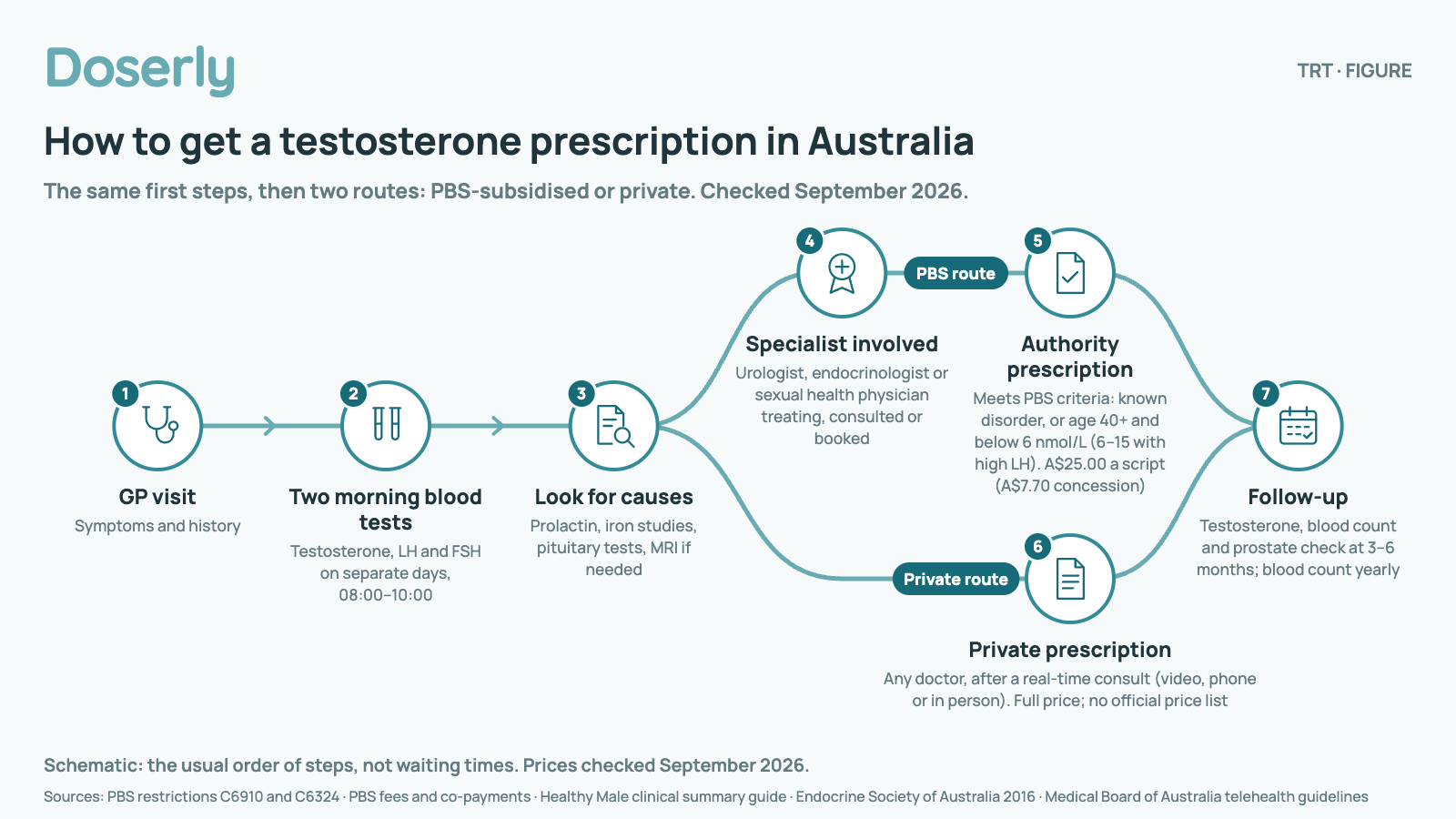
How to get a testosterone prescription in Australia
The same first steps, then two routes: PBS-subsidised or private. Checked September 2026.
- 1.GP visit
- Symptoms and history
- 2.Two morning blood tests
- Testosterone, LH and FSH on separate days, 08:00–10:00
- 3.Look for causes
- Prolactin, iron studies, pituitary tests, MRI if needed
Then one of two routes:
- 4.Specialist involved
- Urologist, endocrinologist or sexual health physician treating, consulted or booked
- 5.Authority prescription
- Meets PBS criteria: known disorder, or age 40+ and below 6 nmol/L (6–15 with high LH). A$25.00 a script (A$7.70 concession)
- 6.Private prescription
- Any doctor, after a real-time consult (video, phone or in person). Full price; no official price list
- 7.Follow-up
- Testosterone, blood count and prostate check at 3–6 months; blood count yearly
Schematic: the usual order of steps, not waiting times. Prices checked September 2026.
How do you get TRT in Australia?
These are the usual steps. The PBS route follows all of them; a private prescription can skip the specialist.
- See a GP and describe your symptoms. Healthy Male lists low sex drive, tiredness, low mood or irritability, poor concentration, hot flushes and sweats, and loss of muscle among the signs of low testosterone in adult men. Each has many other causes, so the GP looks for those too. [5]
- Have at least two morning blood tests. Healthy Male says a diagnosis needs "at least two measurements of serum testosterone, LH and FSH (from fasting, morning samples collected on separate days)". The Endocrine Society of Australia advises drawing blood between 08:00 and 10:00 and measuring at least twice unless one result is clearly diagnostic. The PBS also asks for two morning samples on different mornings. [5], [6], [2]
- Look for causes. Depending on the results, your GP may order a prolactin test, iron studies and a blood count, other pituitary hormone tests, a chromosome test or a pituitary MRI scan. The Endocrine Society of Australia notes that obesity, diabetes, opioids and steroid medicines (glucocorticoids) lower testosterone, and that losing 10% of body weight raises it by 2–3 nmol/L. [5], [6]
- See a specialist (for the PBS). A urologist, an endocrinologist or a sexual health physician (a FAChSHM) must be treating you, be consulted, or have you booked in. A GP referral to a specialist lasts 12 months from the first visit unless the GP writes otherwise. [2], [16]
- Get an authority prescription. Every PBS testosterone item is "Authority Required": the prescriber applies for approval and names the specialist, and for men without a known disorder also gives the dates and results of the qualifying tests. A GP can then write the PBS prescription "in consultation with" that specialist. [17], [2], [5]
- Or get a private prescription. Any doctor can prescribe testosterone privately, without the PBS criteria, but you pay the full price. Online TRT services work this way. The Medical Board of Australia's guidelines expect a real-time consultation (in person, by video or by phone) before prescribing; prescribing from a questionnaire alone is not supported. [1], [8]
- Go back for follow-up. Healthy Male advises a repeat testosterone test, full blood count, prostate examination and prostate-specific antigen (PSA) test 3 to 6 months after starting. See what is checked once you start. [13]
In one review of 294 men referred to two Gold Coast public hospital clinics in 2020–2024, two-thirds of referrals included two early-morning samples, 43% of the men turned out to have functional low testosterone (low levels linked to weight, illness or medicines rather than a gland disease), and 25% were started on TRT. Patients were usually discharged after a median of three visits over six months. [18]
Do you need to see a specialist?
For the PBS, yes: a urologist, endocrinologist or sexual health physician has to be involved and named on the authority application. For a private prescription, no: any registered doctor can prescribe it. [2], [5]
Healthy Male's clinical guide says GPs are "generally the first point of contact" and handle the tests, referral and ongoing care. A specialist visit costs more than a GP visit, and waits can be long; see what it costs. [5]
What blood tests do you need?
Total testosterone, LH and FSH on at least two separate early mornings, often with SHBG (the protein that carries testosterone in the blood). Australian labs report testosterone in nmol/L; US sources use ng/dL, and 1 nmol/L is about 28.8 ng/dL. The testosterone unit converter switches between the two, and the TRT blood work guide explains the timing. [5], [19], [6]
What does Australia require to qualify for the PBS?
The PBS criteria decide who gets the subsidy, not who has low testosterone. This table shows the two PBS routes next to the Australian and international guidelines. Checked September 2026.
| Rule or guideline | Testosterone level | How measured | What it decides |
|---|---|---|---|
| PBS, men with a known pituitary or testicular disorder (restriction C6910) | No level set | Diagnosis of the disorder | PBS subsidy; a urologist, endocrinologist, sexual health physician or, for boys, a paediatrician or paediatric endocrinologist, named on the application |
| PBS, men without a known disorder (restriction C6324) | Below 6 nmol/L (173 ng/dL), or 6–15 nmol/L (173–433 ng/dL) with LH above 1.5 times the young-men upper limit or above 14 IU/L, whichever is higher | At least two morning samples on different mornings; aged 40 or over; not due to age, obesity, heart disease, infertility or drugs | PBS subsidy; a urologist, endocrinologist or sexual health physician named on the application |
| Endocrine Society of Australia (2016) | No single cut-off; reference range 10.4–30.1 nmol/L (300–868 ng/dL) in healthy men aged 21–35 (by mass spectrometry) | Total testosterone with LH and FSH, 08:00–10:00, at least twice | Diagnosis of pathological hypogonadism, which is treated at any age |
| Healthy Male clinical guide | Repeats the PBS numbers; "a low testosterone level alone does not constitute androgen deficiency" | Two fasting morning tests on separate days | Diagnosis and referral |
| For comparison: Endocrine Society (US, 2018) | 264 ng/dL (9.2 nmol/L) lower limit of normal | Morning, fasting, repeated | Diagnosis |
| For comparison: Canadian Urological Association (2021) | Below 10 nmol/L (288 ng/dL) | Morning, 7–11 am | Diagnosis |
| For comparison: American Urological Association (2018) | Below 300 ng/dL (10.4 nmol/L) | Two early-morning tests | Diagnosis |
| For comparison: EAU (2026), ICSM (2024), BSSM (2023) | 12 nmol/L (346 ng/dL) | Morning samples | Diagnosis |
[2], [20], [6], [5], [21], [22], [23], [24], [25], [26]
The main PBS line for men without a known disorder, below 6 nmol/L, is lower than any diagnostic guideline's. Diagnostic guidelines land between about 9.2 and 12 nmol/L, while the PBS pays for these men only below 6 nmol/L, or up to 15 nmol/L when LH is also high (a sign the testes themselves are failing). That gap is deliberate: the 2015 change was designed to stop subsidised prescribing to middle-aged men with low testosterone but no gland disease. [2], [14], [27]
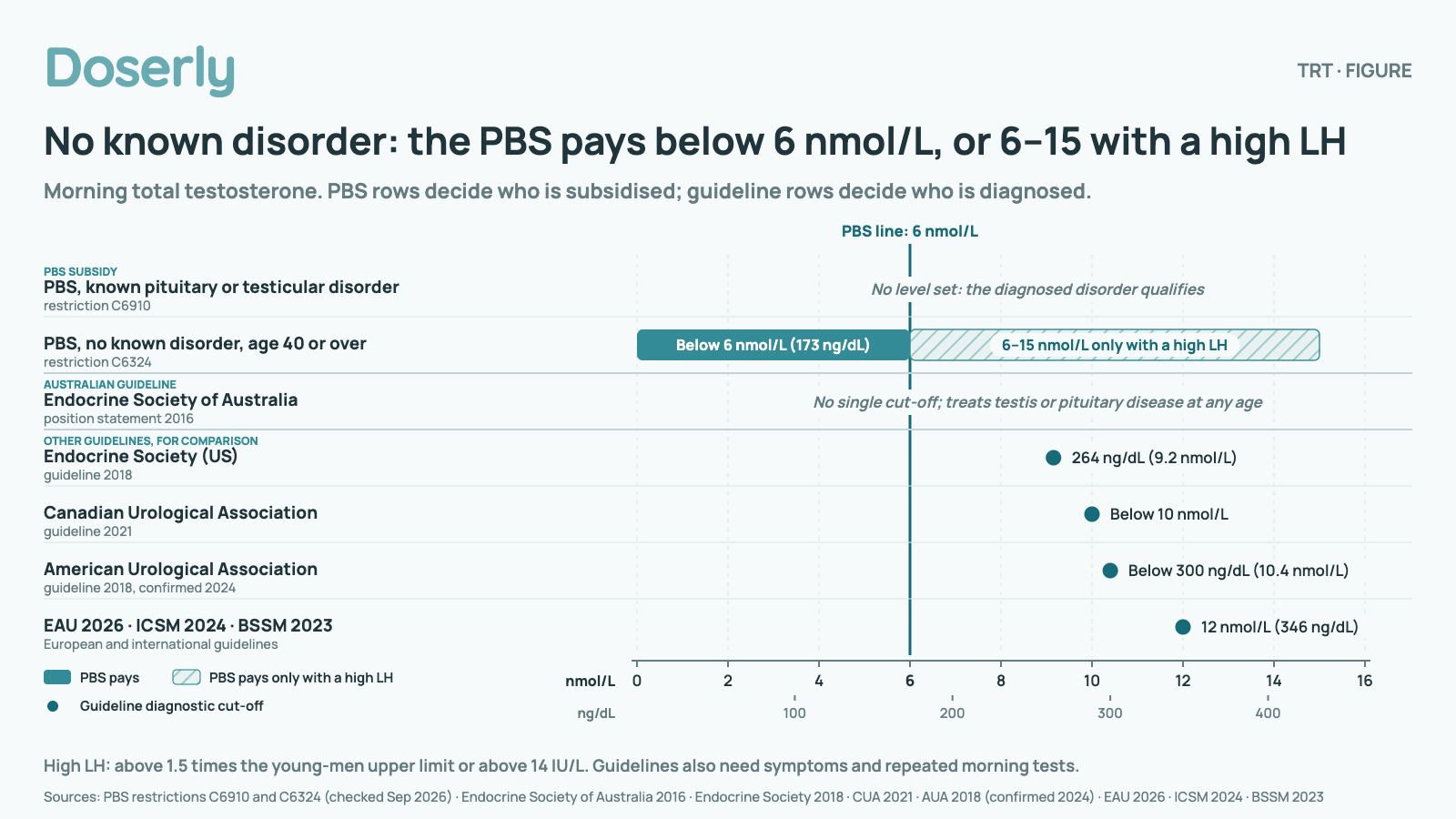
No known disorder: the PBS pays below 6 nmol/L, or 6–15 with a high LH
Morning total testosterone. PBS rows decide who is subsidised; guideline rows decide who is diagnosed.
Each line runs from 0 (left) to 16 nmol/L (right); the thick mark is the PBS line at 6 nmol/L. A solid bar means the PBS pays; a striped bar means it pays only with a high LH.
PBS subsidy
- PBS, known pituitary or testicular disorder (restriction C6910)
- No level set: the diagnosed disorder qualifies
- PBS, no known disorder, age 40 or over (restriction C6324)
- Below 6 nmol/L (173 ng/dL), or 6–15 nmol/L only with LH above 1.5 times the young-men upper limit or above 14 IU/L
Australian guideline
- Endocrine Society of Australia (position statement 2016)
- No single cut-off; treats testis or pituitary disease at any age
Other guidelines, for comparison
- Endocrine Society (US) (guideline 2018)
- 264 ng/dL (9.2 nmol/L)
- Canadian Urological Association (guideline 2021)
- Below 10 nmol/L
- American Urological Association (guideline 2018, confirmed 2024)
- Below 300 ng/dL (10.4 nmol/L)
- EAU 2026 · ICSM 2024 · BSSM 2023 (European and international guidelines)
- 12 nmol/L (346 ng/dL)
Guidelines also need symptoms and repeated morning tests. PBS rules checked September 2026.
Why is the PBS threshold so low?
Because PBS spending on testosterone had grown fast, mostly for men without a gland disease. PBS spending rose ninefold between 1992 and 2010 (4.5-fold after allowing for inflation and population growth), and before 2015 over 80% of new PBS prescriptions were for men over 40 with low testosterone and no reproductive disorder, started by GPs. [28], [27]
From 1 April 2015, the qualifying level dropped from below 8 nmol/L to below 6 nmol/L (and from 8–15 to 6–15 nmol/L with a high LH), a specialist had to be involved for every patient, and age, obesity, heart disease, infertility and drugs were excluded as causes. In the following year, new PBS patients fell 60% (9,781 to 3,940), the total number of PBS patients fell 20% (47,995 to 38,364), and new patients whose first prescription was written by a GP fell 80%. [14]
Total testosterone use changed much less, as men moved to private prescriptions. A 2016 government review of the first year found a net fall in men supplied testosterone, even counting private prescriptions, while a 2020 study covering three years found that total national prescribing had changed little. [14], [15] The PBS share of all testosterone prescribing fell from 97.6% in 2014 to 74% in 2017–18 [15], and in a general-practice sample the private share rose from about 21% to 43%. [14] Male PBS prescriptions fell 30% by 2016 and then climbed back to 98% of the 2014 peak by 2023, mostly from non-specialist prescribing to men aged 40–79; the authors suggest this may reflect "evasion of PBS regulations". [29]
The PBS still funds a lot of testosterone. In 2018, 33,615 people were supplied PBS testosterone, 4,276 of them for the first time, and in PBS data up to 2018, injections made up about half of PBS testosterone use and the 1% gel about 30%. [30], [31]
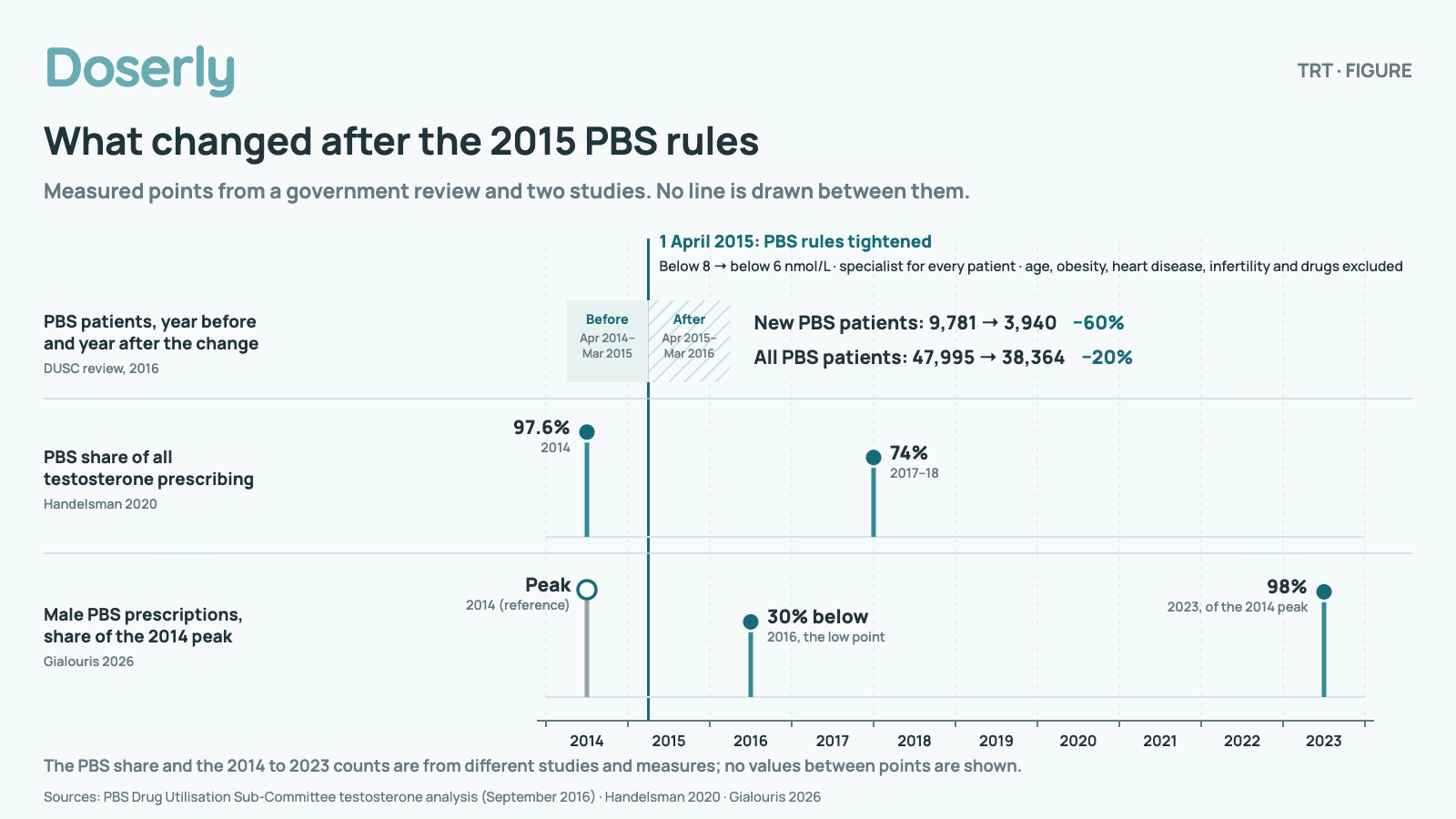
What changed after the 2015 PBS rules
Measured points from a government review and two studies. No line is drawn between them.
- 2014
Male PBS testosterone prescriptions peak. The PBS pays for 97.6% of all testosterone use.Gialouris 2026; Handelsman 2020
- 1 April 2015
PBS rules tightened: below 8 moves to below 6 nmol/L, a specialist is needed for every patient, and age, obesity, heart disease, infertility and drugs are excluded as causes.DUSC review, 2016
- Year after vs year before
New PBS patients fall from 9,781 to 3,940 (−60%); the total number of PBS patients falls from 47,995 to 38,364 (−20%).DUSC review, 2016
- 2016
Male PBS prescriptions reach their low point, 30% below the 2014 peak.Gialouris 2026
- 2017–18
The PBS share of all testosterone use is down to 74%, as more men pay privately.Handelsman 2020
- 2023
Male PBS prescriptions are back to 98% of the 2014 peak.Gialouris 2026
The points come from different studies and measures; no values between them are shown.
What if you don't meet the PBS criteria?
You can still be treated on a private prescription if a doctor judges that you need it; the PBS rules only decide the subsidy. A man of 45 at 8 nmol/L with a high LH can qualify for the PBS, while a man of 35 at 8 nmol/L without a known disorder cannot, because the no-disorder route starts at age 40. [2], [1]
Online services set their own entry rules, which are business policies, not law or guidelines. A 2026 study of 253 testosterone-clinic websites worldwide, 17 of them Australian, found that 9.9% offered treatment to men with normal testosterone (above 12 nmol/L). [32] Before starting privately, ask what a guideline would: has the result been repeated in the morning, has a cause been looked for, and what will be monitored?
Can teenagers get testosterone on the PBS?
Only in specialist care. The PBS has separate restrictions for boys under 18, for example for delayed puberty, and these are managed by a paediatrician or paediatric endocrinologist. This guide is written for adult men. [2], [5]
Where these numbers come from
The PBS rows quote the restriction texts attached to every PBS testosterone item in the September 2026 schedule: C6910 for men with an established pituitary or testicular disorder and C6324 for men without one. The same criteria apply to the injection, gels and cream. [2], [20], [4]
The 2015 change and its effects come from the PBS Drug Utilisation Sub-Committee's 2016 analysis (Table 2 and the private-prescription section) and later studies of PBS data. The private-share figures come from a general-practice sample, not a national count of private scripts. [14], [15], [29]
The labeled doses in the products table come from each product's current Australian product information, one source per row. The guideline rows come from each body's current document: the Endocrine Society of Australia position statement (2016, still current), the Endocrine Society (US, 2018), the Canadian Urological Association (2021), the American Urological Association (2018, validity reconfirmed 2024), the EAU (2026), the ICSM (2024) and the BSSM (2023). [6], [21], [22], [23], [24], [25], [26]
Conversions use 1 nmol/L = 28.84 ng/dL, rounded. Not used: a claim that the PBS share fell from 86% to 66% (the 86% in the 2016 analysis is the fall in new prescriptions under one restriction, a different measure), and online statements that the PBS needs a level below 6 nmol/L for every man (it does not for men with a known disorder, and it allows 6–15 nmol/L with a high LH).
Which testosterone products are available in Australia?
Six kinds of product are registered and in use: undecanoate injections, two gels and a cream on the PBS, and Primoteston Depot and Sustanon 250 on private prescription. Registration on the Australian Register of Therapeutic Goods (ARTG) shows a product is approved, not that a pharmacy has it in stock. Checked September 2026.
| Product | Form and route | Labeled dose | PBS? |
|---|---|---|---|
| Testosterone undecanoate 1000 mg/4 mL (Reandron 1000, Rejunon 1000, Gonadron, Testosterone ADVZ 1000; Testosterone SUN and RBX also registered) | Intramuscular injection (into a muscle), deep in the buttock | 1000 mg every 10–14 weeks; the first gap may be shortened to 6 weeks [33] | Yes, item 10205D, 1 vial plus 1 repeat |
| Testogel 1% (50 mg sachet; pump giving 12.5 mg a press) | Transdermal gel (absorbed through the skin) | 50 mg daily, up to 100 mg [34] | Yes, items 8830R and 10380H; 2-pack items for stable patients |
| Testavan 2% (23 mg a press) | Transdermal gel | 23 mg daily, up to 69 mg [35] | Yes, item 11740X; 2-pack item |
| AndroForte 5 cream (50 mg/mL) | Transdermal cream | 25 mg daily on the scrotum, or 100 mg daily on the upper body [36] | Yes, item 10378F; PBS supply "must be applied to the scrotum, where possible"; 2-pack item |
| Primoteston Depot (testosterone enantate 250 mg in a 1 mL prefilled syringe) | Intramuscular injection | 250 mg every 2–3 weeks at first, then every 3–4 weeks [37] | No, private prescription only |
| Sustanon 250 (four testosterone esters, 250 mg in a 1 mL ampoule) | Intramuscular injection | Usually 1 mL every 3 weeks [38] | No, private prescription only |
| Compounded testosterone (for example cypionate or custom creams) | Varies | No approved dose; made for one named patient [39] | No |
[40], [4], [17], [41], [42], [43], [44], [45], [2]
Each labeled dose comes from that product's current Australian product information, cited in its row: Reandron 1000 (revised December 2025), Testogel (October 2025), Testavan (April 2026), AndroForte 5 (August 2023), Primoteston Depot (January 2026) and Sustanon 250 (February 2026). Prescribers adjust these doses using blood tests and symptoms. Schedules and blood-test timing for each form are in the medication guides: undecanoate injections, testosterone gel, compounded cream, enanthate (Primoteston) and Sustanon 250. Testosterone for women uses different products and doses; see testosterone therapy for women.
Testosterone cypionate, the most common injection in the US, has no registered Australian product that we could find; in Australia it is supplied only as a compounded medicine. [40], [39]
Can you inject testosterone yourself in Australia?
It depends on the product. The undecanoate injection is usually given in a clinic, because its product information says to inject it "very slowly" and to observe the patient "during and immediately after each injection" for a rare reaction to the oil reaching the lungs (pulmonary oil microembolism), which causes coughing or breathlessness. [33]
Primoteston Depot comes as a single 1 mL prefilled syringe, and Sustanon 250 as a single-use 1 mL ampoule. Whether you inject these at home is decided with your prescriber; men in Australian forums describe injecting Primoteston themselves. The injection guide covers technique. [37], [38], [46]
Is compounded testosterone legal in Australia?
Yes, on a prescription for one named person. A compounding pharmacy may make a medicine that is not on the ARTG only when it is "dispensed or extemporaneously compounded, for a particular person". Compounded testosterone is not checked by the regulator the way registered products are, and it is never PBS-subsidised. The American Urological Association advises using commercially made testosterone rather than compounded where possible. [39], [10], [23]
Are there shortages?
Not at the time of writing. The Therapeutic Goods Administration (TGA) shortage database lists a Gonadron shortage from 12 May to 23 July 2026 and a brief Rejunon 1000 shortage on 7 July 2026, both for manufacturing reasons and both resolved. It listed no other testosterone shortages. Checked September 2026. [47]
Are older or overseas products available in Australia?
- Andriol Testocaps (oral testosterone undecanoate), Androderm patches and the 2.5 g (25 mg) Testogel sachet: we found no current Australian product information or PBS listing for them (checked September 2026), so they appear to be no longer sold. The Testogel product information says the 25 mg sachet is "not currently marketed". Older Australian guidance that lists oral capsules or patches is out of date. [4], [34], [5]
- AndroGel 1% 5 g sachets also have an active ARTG entry but are not on the PBS. [40], [4]
- Products approved in the US or Canada, including Xyosted, Jatenzo, Kyzatrex, Tlando, Natesto and Testopel pellets, have no PBS listing and are not among the registered Australian products we reviewed. [4], [40]
What does TRT cost in Australia?
On the PBS, A$25.00 a prescription, or A$7.70 with a concession card. Privately, the price depends on the pharmacy and the prescriber, and no official private price list exists. Doctor visits and blood tests are partly covered by Medicare. Checked September 2026. [3], [48], [19]
| What you pay for | Official figure (September 2026) |
|---|---|
| PBS prescription (any listed testosterone item) | A$25.00 general; A$7.70 concession |
| PBS Safety Net (after this much in a calendar year, PBS medicines cost less or nothing) | A$1,748.20 general; A$277.20 concession |
| Full government price per pack (the "dispensed price", a benchmark, not what you pay) | Undecanoate injection A$92.91 per vial; Testogel A$77.90; Testavan A$83.19; AndroForte 5 A$105.62; 2-pack items A$142.80–A$201.00 |
| GP visit (standard consultation, item 23) | Schedule fee A$45.05; Medicare benefit A$45.05 |
| Specialist first visit (item 104) | Schedule fee A$103.95; Medicare benefit A$88.40 (85%) |
| Consultant physician first visit, such as an endocrinologist (item 110) | Schedule fee A$183.35; Medicare benefit A$155.85 (85%) |
| Hormone blood tests (testosterone, LH, FSH, SHBG; item 66695 and up) | A$30.50 for one test, up to A$70.15 for four |
| Full blood count (includes hematocrit; item 65070) | A$17.80 |
| PSA test (item 66655) | A$20.15, claimable once in 23 months unless it monitors known prostate disease (item 66656) |
[3], [17], [41], [43], [44], [45], [48], [19], [49], [50]
Doctors set their own fees. The Medicare schedule fee is what Medicare bases its rebate on. A doctor can bulk bill (accept the rebate as full payment) or charge more, and you pay the difference. One man described a first endocrinologist visit costing A$354, about A$200 after the Medicare rebate. [48], [51]
Private prescriptions have no official price. Primoteston Depot, Sustanon 250 and compounded testosterone are priced by the pharmacy, and online services add their own fees. What people report gives examples of individual bills, not a price survey; this guide does not quote service websites, whose prices are advertising and change often. [4], [39]
Does Medicare cover TRT?
Partly. Medicare pays a rebate on doctor visits and blood tests, and the PBS subsidises the listed medicines for men who meet the criteria. The medicine on a private prescription is not subsidised. [48], [19], [4]
Telehealth visits have an extra rule: Medicare pays for a GP-type telehealth consultation only if you are registered with that practice through MyMedicare, or the doctor or their practice has seen you face to face in the last 12 months, unless an exemption applies. A first telehealth visit with a new online service will usually not meet that rule, so expect to pay the full fee. [9]
How much are the blood tests?
The Medicare schedule fee for one hormone test such as testosterone is A$30.50, rising to A$70.15 for four tests on the same request, and a full blood count is A$17.80. Whether you pay anything depends on whether the pathology provider bulk bills. A Medicare-rebated PSA test is limited to once in 23 months for men without diagnosed prostate disease. [19], [49], [50]
What are the rules on testosterone in Australia?
Is testosterone legal in Australia?
Yes, with a prescription. Nationally it is a Schedule 4 (prescription-only) medicine, with extra controls in Appendix D of the Poisons Standard, and Healthy Male notes it "is illegal to possess or supply without a prescription or permit". It is not a Schedule 8 controlled drug: none of the state and territory rules we read (New South Wales, Victoria, Queensland, Western Australia, Tasmania and the Australian Capital Territory) lists it as Schedule 8, and we did not verify South Australia or the Northern Territory. Checked September 2026. [1], [13]
The states and territories add their own rules on top. Checked September 2026:
| State or territory | How testosterone is treated |
|---|---|
| New South Wales | An S4B medicine now. Under new laws starting 5 November 2026 it becomes an S4D medicine, and S4D prescriptions (for all S4D medicines, not only testosterone) will be valid for 12 months (currently 6) |
| Victoria | A Schedule 4 "drug of dependence": the prescriber must confirm the medical need and your identity. It is not on SafeScript, the state's real-time prescription monitoring system |
| Queensland | A "diversion-risk medicine"; as with any written Schedule 4 prescription, it cannot be dispensed more than 1 year after it was written |
| Western Australia | A "specified drug": possessing it is an offence unless it was prescribed for you |
| Tasmania | A "specified psychotropic substance": the usual rule letting a pharmacist supply a restricted medicine in an emergency without a prescription does not cover it |
| Australian Capital Territory | Possessing an anabolic steroid is an offence (up to 50 penalty units, 6 months in prison, or both) unless it was lawfully prescribed or supplied |
| South Australia, Northern Territory | Not verified for this guide; check the local health department |
[52], [53], [54], [55], [56], [57], [58], [59]
For comparison, testosterone is Schedule III in the United States, Class C in the United Kingdom and Schedule IV in Canada. [60], [61], [62]
Can you get TRT through telehealth?
Yes. The Medical Board of Australia allows prescribing after a video or phone consultation, but says that "prescribing or providing healthcare for a patient without a real-time direct consultation, whether in-person, via video or telephone, is not good practice and is not supported by the Board". Ahpra, the national regulator of health practitioners, adds that an online chat does not count as a real-time consultation. So a service that prescribes from a questionnaire alone falls short of the Board's guidelines. Checked September 2026. [8], [63]
The Board also expects prescribers to follow real-time prescription monitoring rules in both their own and the patient's state. [8]
Can TRT clinics advertise testosterone?
Not to the public. The Therapeutic Goods Act generally prohibits advertising Schedule 4 medicines, such as testosterone, to consumers. Checked September 2026. [64] A 2026 study of testosterone-clinic websites worldwide found claims outside the guidelines common, such as that testosterone lowers heart risk or slows ageing. [32]
Can you bring testosterone into Australia?
Yes, your own prescribed supply, carried with you. Customs law allows a passenger to bring in anabolic or androgenic medicines prescribed for them, on the plane or ship, in no more than the prescribed amount. Medicine law caps a traveler's import at 3 months' supply at a time and 15 months' in any 12 months, with a prescription or letter from a doctor, which can be an overseas doctor. The TGA also asks travelers to keep medicines in their original packaging. Checked September 2026. [65], [10], [66]
Athletes and athlete support staff cannot use the passenger exception. [65]
Can you order testosterone from overseas?
Not without a permit. The Office of Drug Control requires a permit for each shipment of anabolic or androgenic substances, and the TGA's Personal Importation Scheme, which lets people post in some medicines, excludes anything containing a controlled substance. Imports that break these conditions may be seized, and you lose both the goods and the money spent. People have gone to prison for importing steroids commercially: the Australian Border Force reported a sentence of more than three years in December 2025. [11], [67], [68]
The traveling with testosterone guide covers leaving and returning to Australia, other countries' rules and time zones.
Is testosterone allowed in sport?
No. The World Anti-Doping Agency (WADA) prohibits testosterone at all times, and its 2027 list keeps the ban. Sport Integrity Australia says athletes prescribed testosterone "for a legitimate therapeutic reason" may be eligible for a therapeutic use exemption (TUE), under strict criteria: WADA's guidance to the doctors who decide these exemptions says one should be approved only for hypogonadism with a clear physical cause, not for low testosterone linked to age or weight. Checked September 2026. [12], [69], [70], [71]
Can you donate blood while on TRT in Australia?
Yes, if an Australian-registered doctor prescribed it. Lifeblood, Australia's blood service, checks hemoglobin before each donation, because testosterone can push it above the accepted range, and allows whole blood every 12 weeks. It does not accept men with testosterone-related high red cells (secondary polycythaemia) as therapeutic donors, saying there is "no evidence to support venesection treatment". The hematocrit guide explains the options. Checked September 2026. [72], [73], [74]
Is TRT safe, and what is checked once you start?
Is TRT safe?
For men with confirmed low testosterone who are monitored, the largest safety trial found no increase in heart attacks, strokes or cardiovascular deaths, but some other problems were more common, and long-term effects beyond about two years are less certain. In TRAVERSE, heart attack, stroke or cardiovascular death occurred in 182 of 2,596 men on testosterone gel (7.0%) and 190 of 2,602 on placebo (7.3%), a hazard ratio of 0.96 (95% confidence interval 0.78 to 1.17). That met the trial's test for being no worse than placebo on this measure (noninferiority: the upper limit had to stay below 1.5). Atrial fibrillation (3.5% vs 2.4%), acute kidney injury (2.3% vs 1.5%) and pulmonary embolism (0.9% vs 0.5%) were more common on testosterone, in groups of about 2,600 men each. Clinical fractures were also more common (91 of 2,601 on testosterone vs 64 of 2,603 on placebo, hazard ratio 1.43), while prostate cancer was not clearly different (12 vs 11 men with any prostate cancer; 5 of 2,596 vs 3 of 2,602 with high-grade cancer). [75], [76], [77], [78]
TRAVERSE has limits: it tested only a daily gel, men used it for an average of 21.7 months, about 61% stopped their study gel early, and it enrolled men already at high heart risk. See the TRT and heart health guide and the side effects guide for the full results, including the fracture, prostate, diabetes, sexual-function and depression substudies. [75]
Who should be especially cautious?
- Men with prostate or breast cancer. The Endocrine Society of Australia lists advanced or incurable prostate cancer and breast cancer as reasons not to use testosterone, and Healthy Male lists known or suspected prostate or breast cancer. [6], [5]
- Men with high red blood cells, untreated severe sleep apnea, severe urinary symptoms or unstable heart disease. These are precautions in the Australian guideline. Healthy Male's clinical guide treats a hematocrit above 55% as a reason not to start and above 52% as a reason for caution. [6], [5]
- Men who want children. Testosterone lowers sperm production. Healthy Male says that if you are planning a child, "your doctor won't prescribe testosterone therapy". See the TRT and fertility guide. [13]
- Men on blood thinners or diabetes medicines. See the next question.
- Drug-tested athletes and workers. Testosterone is banned in sport, and the Australian guideline lists occupational drug testing as a precaution. [12], [6]
- Under-18s. Only in specialist care (see the PBS rules).
- Women. This guide is written for men; see testosterone therapy for women.
Does testosterone interact with other medicines?
Some. The Australian undecanoate product information warns that testosterone can strengthen the effect of coumarin blood thinners such as warfarin, can lower the dose of insulin or other diabetes medicines needed, and may add to fluid retention when taken with corticosteroids. It also advises against deep muscle injections in men with bleeding disorders or on blood thinners. Bring a full list of what you take, including supplements, to your pharmacist or prescriber. [33]
What is monitored on TRT?
Testosterone, a full blood count (for hematocrit) and prostate checks. The Australian sources agree on the basics but differ in their details and numbers, as the table shows. Use it to prepare questions for your doctor; it is not a personal testing plan.
| What is checked | Endocrine Society of Australia (2016) | Healthy Male | Product information (undecanoate) |
|---|---|---|---|
| Testosterone | At the trough (just before the next dose) for injections and skin products; for undecanoate, the morning before the 4th injection, aiming for 10–15 nmol/L | Repeat test 3–6 months after starting | At the end of an injection interval |
| Hematocrit and hemoglobin | 3 months after starting, then yearly; a high count is usually managed by lowering the dose or frequency, rarely by removing blood | Clinical guide: 3 months, then yearly. Consumer page: above 54% on treatment means stopping, lowering the dose or changing the form | Periodically, on long-term treatment |
| Prostate | As for men of the same age with normal testosterone; a PSA and examination before starting when prostate disease is possible | Examination and PSA at 3–6 months; a PSA rise above 1.4 ng/mL over 12 months means referral to a urologist | Examination and PSA at least yearly, twice yearly in older or higher-risk men |
Healthy Male's two pages use different hematocrit numbers (55% and 52% before starting; 54% on treatment), and the Endocrine Society of Australia gives none, so ask your doctor which line they use. The hematocrit guide compares every guideline. [5], [13], [7]
What do people in Australia report about getting TRT?
Australian forums are full of men working out which route to take: why a service said no, what a specialist will do, what it costs, and what happens when hematocrit climbs. The threads below are public Reddit discussions, read with their replies; they show what people experience, not how often it happens. Service names are left out.
Why do online services turn some men away?
Because each service sets its own cut-off. A man in his early 40s with low drive was declined by one service because his levels were "actually quite good", and a retest read 15 nmol/L; replies said other services use different cut-offs and that shop-bought "booster" supplements had not helped them. [79] A man in his early 30s at 15.8 nmol/L, offered Primoteston for fatigue and low mood, asked whether the service's commercial interest should worry him; one reply described turning to a service after an endocrinologist had declined. [80]
What happens on the specialist route?
It can be slow and costly, and it can end without TRT. A 29-year-old went from his GP to a urologist, who would not treat on one test, and then waited three months for an endocrinologist at A$354 (about A$200 after the rebate). Meanwhile his morning results rose from 4.8 to 9.4 to 12.4 nmol/L after he lost 15–20 kg. [51] A 42-year-old at 7 nmol/L described his endocrinologist moving him through clomiphene, gel, undecanoate injections and then Primoteston over about a year, without improvement so far. [81]
On the PBS itself, a man in his 30s on Testavan from a urologist still measured 5.5 nmol/L at six months, with the blood drawn three hours after his gel, and his dose was doubled. [82] A 27-year-old with confirmed primary hypogonadism asked how PBS approval and sperm freezing work; nobody in the thread answered. [83] In another thread, a reply summed up the PBS rule as two tests "lower than 6 nmol/L", leaving out the 6–15 nmol/L route with a high LH and the route for men with a known disorder. [84]
What do people pay privately?
Individual bills vary widely. In an April 2026 thread, one man on Primoteston described his online service's monthly access fee rising from A$80 to A$120, with the medicine, blood tests and a mandatory A$50 injection kit charged on top. [85] In a November 2025 thread, another described paying A$270 for three 5 mL vials of compounded cypionate plus a A$100 service fee. [86]
Cost pushes some posters toward non-prescribed testosterone. It is illegal to possess without a prescription, a specific offence in Western Australia and the ACT, and its contents are unchecked. [85], [13], [57], [59] Moving back is not simple either: a man who had used non-prescribed testosterone for six years found that his GP wanted two low off-treatment results before prescribing, and replies disagreed about whether that is needed outside the PBS. [87]
What problems come up once treatment starts?
Two themes recur in these threads: injection reactions and rising hematocrit. A man self-injecting Primoteston from its prefilled syringe and supplied needle had three days of severe pain and a feverish feeling after each injection; replies disagreed on the cause, and one urged him not to inject again until he had an answer. [46]
Eleven and a half weeks into 100 mg of Primoteston a week, another man's hematocrit rose from 0.48 to 0.51, and his new service said it would stop prescribing at 0.54. [88] A man in Canberra on 200 mg of cypionate a week, with sleep apnea only recently treated, had a hematocrit of 0.59; the blood service declined him and two emergency visits ended in a hematology referral with a three-month wait. [89] Lifeblood's rules are explained above.
How can you judge an access story?
Ask: Were the tests repeated in the early morning? Was a cause looked for? Was it the PBS route or a private service? What dose was prescribed, and what did the follow-up blood count show?
These selected discussions are not a survey of all men on TRT in Australia, a price list or a substitute for the sources above.
Common questions about TRT in Australia
Can I get TRT on the PBS?
Yes, if you meet the criteria. Men with a known testicular or pituitary disorder qualify with a specialist involved and no set testosterone level; men aged 40 or over without one need a level below 6 nmol/L, or 6–15 nmol/L with a high LH, on two morning tests, with age, obesity, heart disease, infertility and drugs ruled out as causes. [2] See the PBS rules.
How much does TRT cost in Australia?
On the PBS, A$25.00 a prescription (A$7.70 with a concession card), plus doctor and blood-test fees that Medicare partly covers. Privately, the pharmacy and prescriber set the price, and online services add their own fees; no official private price exists. Checked September 2026. [3], [48] See what it costs.
Can a GP prescribe testosterone in Australia?
Yes. Any doctor can write a private prescription, and a GP can write PBS prescriptions once a urologist, endocrinologist or sexual health physician is involved and named on the authority application. [1], [2], [5] See the steps.
Is one blood test enough?
No. Healthy Male, the Endocrine Society of Australia and the PBS all call for at least two morning tests, because testosterone varies from day to day and through the day; one clearly diagnostic result is the Endocrine Society of Australia's only exception. [5], [6], [2] See what blood tests you need.
Can I get TRT through telehealth in Australia?
Yes, after a real-time video or phone consultation. The Medical Board says prescribing from a questionnaire, chat, text or email alone is not good practice, and Medicare usually pays for GP telehealth only if you are registered with that practice or were seen face to face there in the last 12 months. Checked September 2026. [8], [63], [9] See the telehealth rules.
Is testosterone a Schedule 8 drug in Australia?
No. It is Schedule 4 (prescription-only) nationally, with extra state rules: for example, a "drug of dependence" in Victoria, a "diversion-risk medicine" in Queensland and a "specified drug" in Western Australia. None of the state and territory rules we read (New South Wales, Victoria, Queensland, Western Australia, Tasmania and the Australian Capital Territory) lists it as Schedule 8; we did not verify South Australia or the Northern Territory. Checked September 2026. [1], [54], [56], [57] See the rules.
Can I bring testosterone from overseas?
Only your own prescribed supply, carried with you, up to 3 months at a time with a prescription or doctor's letter. Posting or couriering it in needs an Office of Drug Control permit for each shipment. Checked September 2026. [65], [10], [11] See bringing testosterone in.
Do I have to freeze sperm before starting TRT?
Not by law, but testosterone lowers sperm production, and Healthy Male says doctors will not prescribe it to men planning a child. The TRT and fertility guide covers the options. [13]
Glossary
Plain explanations of the medical, regulatory and Medicare terms used in this guide. Underlined terms in the text link here.
- Androgen deficiency
- Low testosterone together with symptoms or signs, caused by a problem in the testes or the pituitary gland. Healthy Male stresses that a low level on its own is not androgen deficiency.
- ARTG
- The Australian Register of Therapeutic Goods: the list of medicines approved for supply in Australia. Being on it does not guarantee a product is in stock.
- Authority Required (PBS)
- A PBS listing that needs approval before the prescription is written. For testosterone, the prescriber names the specialist and, for men without a known disorder, gives the qualifying test dates and results.
- Compounded medicine
- A medicine made up by a pharmacy for one named patient, rather than a registered factory-made product. It is legal on a prescription but is not checked by the regulator like registered products.
- Dispensed price (DPMQ)
- The government's full price for a PBS pack, used to calculate the subsidy. It is a benchmark, not what the patient pays.
- Endocrinologist
- A doctor who specializes in hormones and the glands that make them, such as the testes and pituitary.
- FAChSHM
- A Fellow of the Australasian Chapter of Sexual Health Medicine: a sexual health physician, one of the specialists who can support a PBS testosterone prescription.
- FSH (follicle-stimulating hormone)
- A pituitary hormone that drives sperm production in the testes. It is measured with LH to tell testicular from pituitary causes of low testosterone.
- Hematocrit
- The share of the blood made up of red blood cells. Testosterone can raise it, which is why it is checked.
- Hypogonadism
- Underactive testes. Primary hypogonadism starts in the testes; secondary starts in the pituitary gland or hypothalamus in the brain.
- Intramuscular (IM)
- Injected into a muscle. All the testosterone injections registered in Australia are given this way.
- LH (luteinizing hormone)
- A pituitary hormone that tells the testes to make testosterone. A high LH with low testosterone points to a problem in the testes themselves.
- Medicare schedule fee
- The fee the government sets for each medical service, on which the Medicare rebate is based. Doctors may charge more, and the patient pays the difference.
- MyMedicare
- A voluntary registration with one general practice. It affects whether Medicare pays for some telehealth consultations.
- Office of Drug Control (ODC)
- The federal office that issues permits to import controlled substances, including anabolic and androgenic steroids.
- PBS (Pharmaceutical Benefits Scheme)
- The Australian Government scheme that subsidises listed prescription medicines, so patients pay a set co-payment instead of the full price.
- PBS Safety Net
- A yearly spending threshold. Once your PBS co-payments reach it in a calendar year, PBS medicines cost less or nothing for the rest of that year.
- Private prescription
- A prescription filled without the PBS subsidy, so you pay the pharmacy's full price. Any doctor can write one for testosterone.
- PSA (prostate-specific antigen)
- A protein made by the prostate, measured in a blood test to help watch for prostate problems.
- Schedule 4 (prescription-only medicine)
- Australia's national category for medicines that need a prescription. Testosterone is Schedule 4, with extra possession controls.
- SHBG (sex hormone-binding globulin)
- A blood protein that carries testosterone. High or low SHBG changes how much testosterone is free to act.
- TGA (Therapeutic Goods Administration)
- Australia's medicines regulator. It keeps the ARTG and runs the medicine shortage database.
- Transdermal
- Absorbed through the skin, as with testosterone gels and creams.
- Trough level
- The lowest blood level of a medicine, just before the next dose.
- TRT (testosterone replacement therapy)
- Prescribed testosterone, by injection, gel, cream or other forms, for men with low testosterone.
- Therapeutic use exemption (TUE)
- Permission from an anti-doping body for an athlete to use a banned medicine for a medical condition. In Australia it is handled through Sport Integrity Australia.
- WADA
- The World Anti-Doping Agency, which publishes the list of substances banned in sport. Testosterone is prohibited at all times.
How this guide was researched
This guide is built from a thorough review of the sources cited throughout it: Australian laws and regulations, PBS and Medicare listings, product information documents, the Endocrine Society of Australia's position statement and other clinical guidelines, government prescribing reviews and published studies. We also reviewed public online forums where men in Australia describe their own experiences of getting TRT.
The guide cites 89 sources, including 56 laws, government listings, regulators' pages and product documents, 10 clinical guidelines and health guidance documents, 10 published studies, and 13 public community discussions. Each type of source answers a different question. Laws, listings and product information show the rules and prices. Guidelines show what clinicians are told to do. Studies show what happened to prescribing and patients. Personal accounts show what individual people experienced. Every numbered citation links to its entry below, labeled by source type.
How this guide was made
Research and drafting were AI-assisted. Every cited source was checked against the original, and the guide was reviewed and edited by Doserly before publication. It has not had an independent clinical review, and Doserly does not currently have medical reviewers. Doserly makes a medication and health-tracking app and runs Doserly Academy, both of which are promoted in this guide. Read our editorial policy for how guides are researched, updated and corrected.
This guide is for educational purposes. It summarizes what the reviewed sources report so the research is easier to understand; it is not medical advice. For a deeper dive, or to check any point for yourself, go straight to the cited sources.
Explore the sources
These are the documents cited in this guide. Laws, government listings, product information, guidelines, studies and personal accounts answer different questions. A source being listed does not mean every statement on its page is endorsed.
Showing 89 sources
- 01
Therapeutic Goods (Poisons Standard—June 2026) Instrument 2026 (F2026L00633) ↗
Regulation (Australia)
Official legal text reviewed.
Detail: Testosterone is a Schedule 4 (prescription-only) medicine, with Appendix D possession controls.
- 02
PBS restriction texts for testosterone (C6910, C6324, paediatric 6919/6933/6934, AndroForte 16165_16166/16176_16211, increased-quantity 14867_14912 etc.) ↗
PBS restrictions (Australia)
Official page reviewed.
Detail: C6910 and C6324 criteria, the same for injection, gel and cream; AndroForte PBS supply 'must be applied to the scrotum, where possible'; separate restrictions for under-18s.
- 03
PBS: Fees, Patient Contributions and Safety Net Thresholds ↗
PBS fees (Australia)
Official page reviewed.
Detail: Co-payment A$25.00 general and A$7.70 concession from 1 January 2026; Safety Net thresholds A$1,748.20 and A$277.20.
- 04
PBS API v3 items, schedule 4333 (effective 1 Sep 2026): all testosterone items ↗
PBS data (Australia)
Official page reviewed.
Detail: Only undecanoate injection, Testogel, Testavan and AndroForte 5 are PBS-listed; Primoteston Depot and Sustanon 250 are not.
- 05
Healthy Male clinical summary guide: Androgen deficiency ↗
Clinical guidance (Australia)
Full page reviewed.
Detail: Two fasting morning tests of testosterone, LH and FSH; about 5 in 1,000 men have androgen deficiency warranting treatment; hematocrit above 55% an absolute and above 52% a relative contraindication; blood count at 3 months then yearly.
- 06
Endocrine Society of Australia position statement on male hypogonadism (part 1): assessment and indications for testosterone therapy ↗
Clinical guideline (Australia)
Full guideline reviewed.
Detail: Part 1: no single diagnostic cut-off; measure total testosterone with LH and FSH between 08:00 and 10:00, at least twice; treatment not justified in older men with chronic disease without pathological hypogonadism; contraindications and precautions (Box 4).
- 07
Endocrine Society of Australia position statement on male hypogonadism (part 2): treatment and therapeutic considerations ↗
Clinical guideline (Australia)
Full guideline reviewed.
Detail: Part 2: trough sampling; undecanoate measured before the 4th injection aiming for 10–15 nmol/L; blood count 3 months after starting then yearly; prostate monitoring as for men of the same age.
- 08
Medical Board of Australia: Guidelines: Telehealth consultations with patients ↗
Professional regulator (Australia)
Official page reviewed.
Detail: Prescribing without a real-time consultation is not good practice; follow real-time prescription monitoring rules in both jurisdictions.
- 09
MBS note AN.1.1: Eligibility criteria for MBS telehealth (video and phone) ↗
Medicare rule (Australia)
Official page reviewed.
Detail: GP-type telehealth is rebatable only with MyMedicare registration at that practice, a face-to-face service from that practitioner or practice in the last 12 months, or an exemption.
- 10
Therapeutic Goods Regulations 1990, Schedule 5 item 1 (personal importation) and item 6 (extemporaneous compounding) ↗
Regulation (Australia)
Official page reviewed.
Detail: Personal import: no more than 3 months' supply per importation and 15 months' in 12 months, with written authority from a doctor; item 6 exempts medicines compounded for a particular person.
- 11
ODC: Importing anabolic and androgenic substances into Australia ↗
Regulator page (Australia)
Official page reviewed.
Detail: A permit is needed for each shipment of anabolic and androgenic substances entering Australia.
- 12
World Anti-Doping Code International Standard: Prohibited List 2026 ↗
Anti-doping rule
Official list reviewed.
Detail: Testosterone is prohibited at all times (S1.1).
- 13
Healthy Male: What is testosterone replacement therapy (TRT)? ↗
Health information (Australia)
Full page reviewed.
Detail: Usually prescribed by a GP after specialist evaluation; illegal to possess without a prescription or permit; review at 3–6 months; above 54% hematocrit on treatment means stopping, lowering the dose or changing form; PSA rise above 1.4 ng/mL in 12 months means urology referral.
- 14
Testosterone: utilisation analysis (DUSC, September 2016) public release document and full report ↗
Government review (Australia)
Official page reviewed.
Detail: The 1 April 2015 change: new PBS patients fell 60% (9,781 to 3,940), all PBS patients 20% (47,995 to 38,364), new patients first prescribed by a GP 80%; private share in a general-practice sample rose from 21% to 43%.
- 15
Pharmacoepidemiology of testosterone: Impact of reimbursement policy on curbing off-label prescribing ↗
Human study (prescribing data)
Original abstract reviewed.
Detail: PBS share of all testosterone use fell from 97.6% in 2014 to 74% in 2017–18.
- 16
MBS note GN.6.16: referrals (period for which a referral is valid) ↗
Medicare rule (Australia)
Official page reviewed.
Detail: A GP referral to a specialist is valid for 12 months unless the referrer states otherwise.
- 17
PBS item 10205D testosterone undecanoate 1 g/4 mL injection ↗
PBS listing (Australia)
Official page reviewed.
Detail: Authority Required; 1 vial plus 1 repeat; full dispensed price A$92.91; brands Gonadron, Rejunon 1000, Reandron 1000, Testosterone ADVZ 1000.
- 18
Functional causes of low testosterone predominate in contemporary Australian endocrine referral practice: a two centre experience across 5 years ↗
Human study (clinic records)
Original abstract reviewed.
Detail: 294 referrals to two Gold Coast public clinics, 2020–2024: 43% functional low testosterone; two-thirds had two early-morning samples; 25% started TRT.
- 19
MBS items 66695, 66698, 66701, 66704 (hormone and binding-protein assays incl. free or total testosterone, LH, FSH, SHBG, oestradiol, prolactin) ↗
Medicare listing (Australia)
Official page reviewed.
Detail: Hormone assays including testosterone, LH, FSH and SHBG: A$30.50 for one test to A$70.15 for four.
- 20
PBS item 10205D testosterone undecanoate 1 g/4 mL injection and restrictions 6910 and 6324 ↗
PBS listing (Australia)
Official page reviewed.
Detail: Undecanoate injection item 10205D and its restrictions C6910 (known disorder, no level) and C6324 (no known disorder, below 6 nmol/L or 6–15 with high LH, age 40+).
- 21
Testosterone Therapy in Men With Hypogonadism: An Endocrine Society Clinical Practice Guideline ↗
Clinical guideline (US)
Full guideline reviewed.
Detail: Harmonized lower limit of normal total testosterone 264 ng/dL (9.2 nmol/L) on morning fasting samples, repeated.
- 22
Canadian Urological Association guideline on testosterone deficiency in men: Evidence-based Q&A ↗
Clinical guideline (Canada)
Full guideline reviewed.
Detail: Total testosterone below 10 nmol/L is a reasonable diagnostic threshold; draw between 7 and 11 am.
- 23
Evaluation and Management of Testosterone Deficiency: AUA Guideline ↗
Clinical guideline (US)
Full guideline reviewed.
Detail: Total testosterone below 300 ng/dL on two early-morning tests; prefer commercially made over compounded testosterone where possible.
- 24
EAU Guidelines on Sexual and Reproductive Health, Chapter 3: Male Hypogonadism (2026 edition) ↗
Clinical guideline (Europe)
Full guideline chapter reviewed.
Detail: Total testosterone 12 nmol/L is a reliable threshold for diagnosing late-onset hypogonadism.
- 25
Male hypogonadism: recommendations from the Fifth International Consultation on Sexual Medicine (ICSM 2024) ↗
Clinical guideline (international)
Full guideline reviewed.
Detail: Total testosterone 12 nmol/L threshold on fasting morning samples, repeated.
- 26
The British Society for Sexual Medicine Guidelines on Male Adult Testosterone Deficiency, with Statements for Practice ↗
Clinical guideline (UK)
Full guideline reviewed.
Detail: Total testosterone below 12 nmol/L (or free testosterone below 225 pmol/L) on two morning samples.
- 27
Pharmacoepidemiology of testosterone: Curbing off-label prescribing ↗
Human study (prescribing data)
Original abstract reviewed.
Detail: Before 2015, over 80% of new PBS prescriptions were GP-started 'Low T' in men over 40.
- 28
Pharmacoepidemiology of testosterone prescribing in Australia, 1992-2010 ↗
Human study (prescribing data)
Original abstract reviewed.
Detail: PBS testosterone spending rose ninefold from 1992 to 2010.
- 29
Pharmacoepidemiology of testosterone prescribing in Australia, 2010-2023 ↗
Human study (prescribing data)
Original abstract reviewed.
Detail: Male PBS prescriptions fell 30% to 2016, then rose to 98% of the 2014 peak in 2023, mostly from non-specialist prescribing to men aged 40–79.
- 30
Testosterone (DUSC, February 2020) public release document ↗
Government review (Australia)
Official page reviewed.
Detail: In 2018, 33,615 people were supplied PBS testosterone, 4,276 for the first time; 156,259 prescriptions.
- 31
A National Analysis of Temporal Changes in Prescribing of Testosterone Replacement Therapy Considering Methods of Delivery and Government Regulation ↗
Human study (prescribing data)
Original abstract reviewed.
Detail: PBS data 1992–2018: after 2015, injections about 50% and 1% gel about 30% of PBS testosterone.
- 32
Discordance Between Online Information and Male Hypogonadism Clinical Guidelines: A Global Multilingual Content Analysis ↗
Human study (website analysis)
Original abstract reviewed.
Detail: 253 testosterone-clinic websites (17 Australian): 9.9% offered treatment above 12 nmol/L; non-guideline claims common.
- 33
Reandron 1000 (testosterone undecanoate 1000 mg/4 mL) Australian PI ↗
Product information (Australia)
Relevant sections of the product information reviewed.
Detail: 1000 mg every 10–14 weeks, first gap may be 6 weeks; inject very slowly and observe the patient during and immediately after each injection; interactions with coumarin anticoagulants, antidiabetic medicines and corticosteroids; PSA and examination at least yearly.
- 34
Testogel 1% gel (50 mg sachet and pump; PI shared) Australian PI ↗
Product information (Australia)
Relevant sections of the product information reviewed.
Detail: 50 mg daily, up to 100 mg; the 25 mg sachet is not currently marketed.
- 35
Testavan 2% testosterone gel Australian PI ↗
Product information (Australia)
Relevant sections of the product information reviewed.
Detail: 23 mg daily, up to 69 mg.
- 36
AndroForte 5 (testosterone 5% w/v cream) Australian PI ↗
Product information (Australia)
Relevant sections of the product information reviewed.
Detail: 25 mg daily to the scrotum or 100 mg daily to the upper body.
- 37
Primoteston Depot (testosterone enanthate 250 mg/mL prefilled syringe) Australian PI ↗
Product information (Australia)
Relevant sections of the product information reviewed.
Detail: 250 mg in a 1 mL prefilled syringe, pack of one; every 2–3 weeks at first, then every 3–4 weeks.
- 38
Sustanon '250' (mixed testosterone esters) Australian PI ↗
Product information (Australia)
Relevant sections of the product information reviewed.
Detail: Usually 1 mL every 3 weeks; single-use ampoule; vials and the 3-ampoule pack are not available commercially.
- 39
TGA: Manufacturing, supplying and advertising compounded medicines lawfully ↗
Regulator guidance (Australia)
Official page reviewed.
Detail: Compounded medicines are exempt from ARTG registration only when made for a particular person.
- 40
ARTG public summaries for testosterone medicines (13 entries) ↗
Regulator register (Australia)
Official page reviewed.
Detail: Active entries for Primoteston Depot, Sustanon 250, Reandron 1000, Rejunon 1000, Gonadron, Testosterone SUN, Testosterone RBX, Testogel, AndroGel 1% sachets, Testavan and AndroForte 5.
- 41
PBS item 10380H testosterone 1% gel pump 2 x 60 actuations (Testogel) ↗
PBS listing (Australia)
Official page reviewed.
Detail: Authority Required; 4 repeats; full dispensed price A$77.90.
- 42
PBS item 8830R testosterone 1% gel 30 x 5 g sachets (Testogel) ↗
PBS listing (Australia)
Official page reviewed.
Detail: Authority Required; 5 repeats; full dispensed price A$77.90.
- 43
PBS item 11740X testosterone 2% gel 56 actuations (Testavan) ↗
PBS listing (Australia)
Official page reviewed.
Detail: Authority Required; 5 repeats; full dispensed price A$83.19; listed since August 2019.
- 44
PBS item 10378F testosterone 5% cream 50 mL (AndroForte 5) ↗
PBS listing (Australia)
Official page reviewed.
Detail: Authority Required; full dispensed price A$105.62.
- 45
PBS increased-quantity testosterone items 13924W, 13983Y, 14025E, 14563L ↗
PBS listing (Australia)
Official page reviewed.
Detail: Two-pack items for patients whose condition is stable, A$142.80 to A$201.00 full dispensed price; the patient still pays one co-payment.
- 46
Severe pain and fever after Primoteston Depot injections – am I doing something wrong? ↗
Community account
Public thread reviewed: opening post and 29 comments.
Detail: A man self-injecting Primoteston Depot from its prefilled syringe and supplied needle, 250 mg every 14 days, had three days of severe pain and a feverish feeling after each injection; replies disagreed on the cause, and one advised no further injection until he had an answer.
- 47
TGA Medicine Shortage Reports Database: testosterone undecanoate ↗
Regulator database (Australia)
Official page reviewed.
Detail: Gonadron shortage 12 May to 23 July 2026 and Rejunon 1000 on 7 July 2026, both resolved.
- 48
MBS consultation items 23 (GP level B), 104/105 (specialist initial/subsequent), 110/116 (consultant physician initial/subsequent) ↗
Medicare listing (Australia)
Official page reviewed.
Detail: Item 23 A$45.05; item 104 A$103.95 (benefit A$88.40 at 85%); item 110 A$183.35 (benefit A$155.85 at 85%).
- 49
MBS item 65070 (full blood count incl. haematocrit) ↗
Medicare listing (Australia)
Official page reviewed.
Detail: Full blood count including hematocrit A$17.80.
- 50
MBS items 66655 and 66656 (PSA quantitation) ↗
Medicare listing (Australia)
Official page reviewed.
Detail: PSA A$20.15, not more than once in 23 months; item 66656 monitors previously diagnosed prostate disease.
- 51
What to expect from an endo appointment? ↗
Community account
Public thread reviewed: opening post and 10 comments.
Detail: A 29-year-old went from GP to urologist (one test was not enough) to an endocrinologist after a 3-month wait, at A$354 (about A$200 after the Medicare rebate); his morning results rose from 4.8 to 9.4 to 12.4 nmol/L after losing 15–20 kg.
- 52
NSW Health: Schedule 4 Appendix B (S4B) medicines ↗
State health department (NSW)
Official page reviewed.
Detail: Testosterone is currently an S4B medicine in New South Wales.
- 53
NSW Health: Schedule 4D medicines (rules from 5 November 2026) ↗
State health department (NSW)
Official page reviewed.
Detail: Testosterone becomes an S4D medicine on 5 November 2026; S4D prescriptions (for all S4D medicines) are valid for 12 months (currently 6).
- 54
Victoria: Drugs of dependence and drug-dependent persons ↗
State health department (Victoria)
Official page reviewed.
Detail: Testosterone is a Schedule 4 drug of dependence; prescribers must confirm therapeutic need and identity.
- 55
Victoria: Medicines monitored in SafeScript ↗
State health department (Victoria)
Official page reviewed.
Detail: Testosterone is not among the medicines monitored in SafeScript.
- 56
Queensland Medicines and Poisons (Medicines) Regulation 2021 (compilation 30 April 2026) ↗
Regulation (Queensland)
Official page reviewed.
Detail: Anabolic and androgenic steroidal agents are diversion-risk medicines; a written S4 prescription cannot be dispensed after 1 year.
- 57
WA Health: Specified drugs ↗
State health department (Western Australia)
Official page reviewed.
Detail: Anabolic steroids are specified drugs; possession is an offence unless prescribed.
- 58
Tasmania Poisons Regulations 2018, reg 52 and Schedule 3 item 81 ↗
Regulation (Tasmania)
Official page reviewed.
Detail: Testosterone (S4) is a specified psychotropic substance (Schedule 3, item 81).
- 59
ACT Crimes Act 1900, s172 Possessing anabolic steroids (republication 155, effective 23 Feb 2026) ↗
Law (ACT)
Official page reviewed.
Detail: Possessing an anabolic steroid is an offence (50 penalty units, 6 months or both) unless lawfully prescribed or supplied.
- 60
21 CFR 1308.13(f) Schedule III: anabolic steroids ↗
Regulation (US)
Official legal text reviewed.
Detail: Testosterone and its esters are Schedule III anabolic steroids.
- 61
Misuse of Drugs Act 1971, Schedule 2 Part III (Class C drugs) ↗
Law (UK)
Official legal text reviewed.
Detail: Testosterone is a Class C drug.
- 62
Controlled Drugs and Substances Act (S.C. 1996, c. 19): ss. 4, 6 and Schedule IV ↗
Law (Canada)
Official legal text reviewed.
Detail: Testosterone is in Schedule IV.
- 63
Ahpra: Information for practitioners who provide virtual care ↗
Professional regulator (Australia)
Official page reviewed.
Detail: An online chat is not a real-time consultation.
- 64
Therapeutic Goods Act 1989, s42DL(10) and s42DLB(7) (advertising references to Schedule 3, 4 or 8 substances) ↗
Law (Australia)
Official page reviewed.
Detail: The advertising offence and civil-penalty provisions apply to advertisements referring to Schedule 3, 4 or 8 substances.
- 65
Customs (Prohibited Imports) Regulations 1956, reg 5G and Schedule 7A (compilation 13 July 2026) ↗
Regulation (Australia)
Official legal text reviewed.
Detail: Importing anabolic or androgenic substances needs permission, except a passenger's own prescribed supply carried on the plane or ship; the exception does not apply to athletes or athlete support staff.
- 66
TGA: Travelling with medicines and medical devices ↗
Regulator page (Australia)
Official page reviewed.
Detail: Entering Australia: own or immediate family use, original packaging, a prescription or doctor's letter, no more than a 3-month supply.
- 67
TGA: Personal Importation Scheme ↗
Regulator page (Australia)
Official page reviewed.
Detail: The Personal Importation Scheme does not cover imports that contain a controlled substance.
- 68
ABF media release: South Australian man sentenced for importing steroids ↗
Border agency release (Australia)
Official page reviewed.
Detail: A South Australian man was sentenced to three years, four months and 16 days in prison for commercially importing performance and image enhancing drugs.
- 69
World Anti-Doping Code International Standard: Prohibited List 2027 (and explanatory note) ↗
Anti-doping rule
Official list reviewed.
Detail: Testosterone remains prohibited from 1 January 2027.
- 70
Sport Integrity Australia: Testosterone information ↗
Anti-doping agency (Australia)
Official page reviewed.
Detail: Prohibited at all times; athletes prescribed testosterone for a legitimate therapeutic reason may be eligible for a TUE under strict criteria.
- 71
TUE Physician Guidelines – Male Hypogonadism, Version 9 (January 2026) ↗
Anti-doping guidance
Official guidance reviewed.
Detail: Exemptions for testosterone are granted only for organic hypogonadism, not for functional low testosterone linked to age or obesity.
- 72
I'm using testosterone patches or receiving testosterone injections. Can I donate? ↗
Blood service (Australia)
Official page reviewed.
Detail: Donors whose testosterone was prescribed by a doctor registered in Australia can donate; hemoglobin is checked before each donation.
- 73
Blood donation essentials ↗
Blood service (Australia)
Official page reviewed.
Detail: Whole blood can be donated every 12 weeks.
- 74
High ferritin: therapeutic venesection (clinical indications) ↗
Blood service (Australia)
Official page reviewed.
Detail: Secondary polycythaemia is not accepted for therapeutic donation; 'no evidence to support venesection treatment'.
- 75
Cardiovascular Safety of Testosterone-Replacement Therapy ↗
Human trial
Original abstract reviewed.
Detail: TRAVERSE: heart attack, stroke or cardiovascular death in 182 of 2,596 men on testosterone gel (7.0%) vs 190 of 2,602 on placebo (7.3%); hazard ratio 0.96 (95% CI 0.78 to 1.17), meeting the noninferiority limit of 1.5; average treatment 21.7 months.
- 76
KYZATREX (testosterone undecanoate) capsules, prescribing information, section 5 and 6.1 (TRAVERSE class text) ↗
Product label (US)
Relevant label sections reviewed.
Detail: Class text on TRAVERSE: atrial fibrillation 3.5% vs 2.4%, acute kidney injury 2.3% vs 1.5%, pulmonary embolism 0.9% vs 0.5%.
- 77
Prostate Safety Events During Testosterone Replacement Therapy in Men With Hypogonadism: A Randomized Clinical Trial ↗
Human trial
Original full text reviewed.
Detail: TRAVERSE prostate safety substudy: high-grade prostate cancer in 5 of 2,596 men on testosterone vs 3 of 2,602 on placebo; any prostate cancer 12 vs 11; none of the differences significant; safety set 5,198 men.
- 78
Testosterone Treatment and Fractures in Men with Hypogonadism ↗
Human trial
Original abstract reviewed.
Detail: TRAVERSE fracture substudy: clinical fractures in 91 of 2,601 men on testosterone (3.50%) vs 64 of 2,603 on placebo (2.46%); hazard ratio 1.43 (95% CI 1.04 to 1.97).
- 79
Rejected from clinic, do T booster supplements do anything? ↗
Community account
Public thread reviewed: opening post and 43 comments.
Detail: A man in his early 40s with low drive was turned down by one online TRT service because his levels were 'actually quite good'; a retest read 15 nmol/L. Replies said other services use different cut-offs, and several said shop-bought boosters had not helped them.
- 80
32M, 15.8 nmol/L, Dr recommending Primoteston. Worth it for fatigue and low mood? ↗
Community account
Public thread reviewed: opening post and 9 comments.
Detail: A man in his early 30s at 15.8 nmol/L, offered Primoteston by an online service for fatigue and low mood, asked whether the service's commercial interest mattered; one reply described using a service after an endocrinologist declined.
- 81
3 Primoteston Depot Injections In, Still No Results — Is This Normal? ↗
Community account
Public thread reviewed: opening post and 13 comments.
Detail: A 42-year-old at 7 nmol/L was moved by his endocrinologist through clomiphene, gel, undecanoate injections and then Primoteston every two weeks over about a year, and had noticed no change after three Primoteston injections.
- 82
TRT options in Australia ↗
Community account
Public thread reviewed: opening post and 14 comments.
Detail: A man in his 30s on PBS-subsidised Testavan from a urologist still measured 5.5 nmol/L at 6 months (drawn 3 hours after the gel), had his dose doubled, and asked about switching to undecanoate injections or a private enanthate script.
- 83
Aus trt pbs approval and sperm freezing ↗
Community account
Public thread reviewed: opening post and 2 comments.
Detail: A 27-year-old with confirmed primary hypogonadism asked how PBS approval works once an endocrinologist is involved, and whether sperm freezing before TRT is required and what it costs; the thread drew no answers on either point.
- 84
Can I get PBS ↗
Community account
Public thread reviewed: opening post and 12 comments.
Detail: A man with a result of 12.8 nmol/L asked whether the PBS would cover him; a reply said it would not and summed up the rule as two tests 'lower than 6 nmol/L', leaving out the 6–15 nmol/L route with high LH and the route for men with a known disorder.
- 85
TRT in Australia is rough ↗
Community account
Public thread reviewed: opening post and 40 comments.
Detail: After about 18 months on Primoteston through an online service, a man's monthly access fee rose from A$80 to A$120, with the medicine, blood tests and a mandatory A$50 injection kit charged on top; replies compared GPs, other services and non-prescribed supply.
- 86
Aussie doc update ↗
Community account
Public thread reviewed: opening post and 50 comments.
Detail: A man described a 30-minute private consultation, then an invoice of A$270 for three 5 mL vials of compounded cypionate plus a A$100 service fee; replies compared prices across services.
- 87
Want to switch to safe, prescribed TRT but doc wants me to crash my test to prove I need it ↗
Community account
Public thread reviewed: opening post and 35 comments.
Detail: A man who had used non-prescribed testosterone for six years asked a men's health GP for a prescription and was told he would first need two low off-treatment results; replies disagreed about whether that is needed outside the PBS.
- 88
Haematocrit rising. Advised to donate Blood, considering Nattokinase. ↗
Community account
Public thread reviewed: opening post and 73 comments.
Detail: Eleven and a half weeks into 100 mg of Primoteston a week, a man's hematocrit rose from 0.48 to 0.51; his new online service said it would stop issuing prescriptions at 0.54 and advised two blood donations before his 4-month review.
- 89
High hematocrit 0.59 and heamoglobin at 192, how to get it drained in aus ↗
Community account
Public thread reviewed: opening post and 19 comments.
Detail: A man in Canberra on 200 mg of cypionate a week, with sleep apnea only recently treated, had a hematocrit of 0.59; the blood service declined him, local pathology collectors did not offer venesection, and two emergency visits ended in a hematology referral with a 3-month wait.
No matching sources
Try a different term or show the full list.
Updates and corrections
Published September 28, 2026. Rewritten to the Doserly Definitive Guide standard. Corrections to the earlier page: testosterone is Schedule 4 nationally and not Schedule 8 in the states and territories we checked; the PBS criteria were inverted (the below-6 nmol/L rule applies to men without a known disorder, and men with one have no level threshold); the PBS share fell from 97.6% to 74%, not from 86% to 66%; Testavan and Sustanon 250 were missing, and we found no current Australian listing for Androderm; the Endocrine Society of Australia draws blood between 08:00 and 10:00 and sets no hematocrit number; the undecanoate product information does not ban self-injection but asks for observation during and after each injection; clinic names, clinic prices and unsupported Medicare rebate ranges were removed. Prices, PBS items and state rules were checked in September 2026 and change often.
Found an error or a source we missed? Report a correction with the guide title, the specific passage and a supporting source if available. Please leave out personal health records. See our editorial policy for how we handle attribution, evidence limits and corrections.